Parent Engagement for Successful PartnershipsBy: Serenity KeltonMembership & Programs DirectorTexas Association of Partners in Education
Texas Association of Partners in EducationTAPE is a state-wide membership association made up of businesses, institutions of higher education, school districts, volunteers and community organizations.We provide:Best practices for partnership engagementModels of effective programs/partnerships that may be replicatedResourcesProfessional development Networking opportunities
How can Educators and Parents STREGTHEN and SUSTAIN HEALTHY SCHOOLS?What do we mean by healthy schools?We mean a safe and nurturing PLACE.A welcoming environment for ALL.A “Partnership School”A “family-like” school and “school-like” familiesAn EXCELLENT school that students, teachers, and parents want to attend and support.A place where students develop to their full potential and produce positive results (Academically, physically, emotionally)Other ideas?
What is important to know about school, family and community partnerships?Not only  	THAT partnerships contribute to 			good schools and successful 			studentsBut also 	WHAT is needed in and excellent 			partnership program?And 		HOW to organize and sustain high-		quality and effective programs of 		family and community involvement
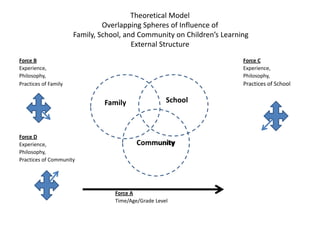
Theoretical ModelOverlapping Spheres of Influence of Family, School, and Community on Children’s LearningExternal StructureForce BForce CExperience,							Experience,Philosophy,							Philosophy, Practices of FamilyPractices of School Force DExperience,Philosophy,Practices of CommunityForce ATime/Age/Grade LevelSchoolFamilyCommunityCommunity
The Keys To Successful School-Family-Community PartnershipsEpstein’s Six Types of InvolvementType 1,Parenting – Assist families with parenting and child-rearing skills, understanding child and adolescent development, and setting home conditions that support children as students at each age and grade level.  Assist schools in understanding families.Type 2,Communicating – Communicate with families about school programs and student progress through effective school-to-home and home-to-school communications. Type 3,Volunteering – Improve recruitment, training, work and schedules to involve families as volunteers and audiences at school or in other locations to support students and school programs.Type 4,Learning at Home – Involve families with their children in learning activities at home, including homework and other curriculum-related activities and decisions.Type 5, Decision Making – Include families as participants in school decisions, governance and advocacy through PTO/PTA, school councils, committees, action teams, and other parent organizationsType 6, Collaborating with Community – Coordinate resources and services for students, families, and the school with businesses, agencies, and other groups, and provide services to the community.National Network of Partnership Schools Johns Hopkins University
Meeting the challengesChallenges – Type 1PARENTINGProvide information to all families who want it or who need it, not just to the few who attend workshops or meetings at the school
Enable families to share information with schools about background, culture, children’s talents, goals and needsRedefinitions“Workshop is not only a meeting on a topic at the “school building” at a particular time but also the content of a topic to be viewed, heard or read at convenient times and varied locations”
Challenges – Type 2COMMUNICATINGMake all memos, notices and other print and non print communications clear and understandable for all familiesObtain ideas from families to improve the design and content of major communications such as newsletters, report cards, and conference schedulesEstablish easy-to-use two-way channels for communications from school to home and home to schoolRedefinitions“Communications about school programs and student progress” are not only from school-to-home but also home-to-school, with varied two way  channels of communication that connect schools, families, students and the community
Challenges-Type 3VOLUNTEERINGRecruit widely for volunteers so that all families know that their time and talents are welcome
Make flexible schedules for volunteers, assemblies and events to enable working parents to participate
Recognize parent and other volunteers for their assistance at school and in other locationsRedefinitions“Volunteer” not only means those who come to school during the day, but also those who support school goals and children’s learning in any way, at any place and at any time.
Challenges-Type 4LEARNING AT HOMEDesign and implement interactive homework for which students take responsibility to discuss important class work and ideas with their families
Involve families and their children in all curriculum-related decisionsRedefinitions“Homework” not only means work that students do alone, but also, interactive activities that students share with others at home, linking school work to real life“Help” at home means how families encourage, listen, praise, guide and discuss schoolwork with their children, not only how they “teach” children school subjects.
Challenges-Type 5DECISION MAKINGInclude parent leaders from all racial, ethnic, socioeconomic and other groups in the school
Offer training to enable parent leaders to develop skills to serve as representatives of other families
Include student representatives along with parents on decision-making committeesRedefinitions“Decision making” means a process of partnership – sharing views, solving problems and taking action on shared goals, not an endless power struggle.Parent “leader” means a representative who shares information with and obtains ideas from other families and community members, not just a parent who attends school meetings.

Parents as Partners

  • 1.
    Parent Engagement forSuccessful PartnershipsBy: Serenity KeltonMembership & Programs DirectorTexas Association of Partners in Education
  • 2.
    Texas Association ofPartners in EducationTAPE is a state-wide membership association made up of businesses, institutions of higher education, school districts, volunteers and community organizations.We provide:Best practices for partnership engagementModels of effective programs/partnerships that may be replicatedResourcesProfessional development Networking opportunities
  • 3.
    How can Educatorsand Parents STREGTHEN and SUSTAIN HEALTHY SCHOOLS?What do we mean by healthy schools?We mean a safe and nurturing PLACE.A welcoming environment for ALL.A “Partnership School”A “family-like” school and “school-like” familiesAn EXCELLENT school that students, teachers, and parents want to attend and support.A place where students develop to their full potential and produce positive results (Academically, physically, emotionally)Other ideas?
  • 4.
    What is importantto know about school, family and community partnerships?Not only THAT partnerships contribute to good schools and successful studentsBut also WHAT is needed in and excellent partnership program?And HOW to organize and sustain high- quality and effective programs of family and community involvement
  • 5.
    Theoretical ModelOverlapping Spheresof Influence of Family, School, and Community on Children’s LearningExternal StructureForce BForce CExperience, Experience,Philosophy, Philosophy, Practices of FamilyPractices of School Force DExperience,Philosophy,Practices of CommunityForce ATime/Age/Grade LevelSchoolFamilyCommunityCommunity
  • 6.
    The Keys ToSuccessful School-Family-Community PartnershipsEpstein’s Six Types of InvolvementType 1,Parenting – Assist families with parenting and child-rearing skills, understanding child and adolescent development, and setting home conditions that support children as students at each age and grade level. Assist schools in understanding families.Type 2,Communicating – Communicate with families about school programs and student progress through effective school-to-home and home-to-school communications. Type 3,Volunteering – Improve recruitment, training, work and schedules to involve families as volunteers and audiences at school or in other locations to support students and school programs.Type 4,Learning at Home – Involve families with their children in learning activities at home, including homework and other curriculum-related activities and decisions.Type 5, Decision Making – Include families as participants in school decisions, governance and advocacy through PTO/PTA, school councils, committees, action teams, and other parent organizationsType 6, Collaborating with Community – Coordinate resources and services for students, families, and the school with businesses, agencies, and other groups, and provide services to the community.National Network of Partnership Schools Johns Hopkins University
  • 7.
    Meeting the challengesChallenges– Type 1PARENTINGProvide information to all families who want it or who need it, not just to the few who attend workshops or meetings at the school
  • 8.
    Enable families toshare information with schools about background, culture, children’s talents, goals and needsRedefinitions“Workshop is not only a meeting on a topic at the “school building” at a particular time but also the content of a topic to be viewed, heard or read at convenient times and varied locations”
  • 9.
    Challenges – Type2COMMUNICATINGMake all memos, notices and other print and non print communications clear and understandable for all familiesObtain ideas from families to improve the design and content of major communications such as newsletters, report cards, and conference schedulesEstablish easy-to-use two-way channels for communications from school to home and home to schoolRedefinitions“Communications about school programs and student progress” are not only from school-to-home but also home-to-school, with varied two way channels of communication that connect schools, families, students and the community
  • 10.
    Challenges-Type 3VOLUNTEERINGRecruit widelyfor volunteers so that all families know that their time and talents are welcome
  • 11.
    Make flexible schedulesfor volunteers, assemblies and events to enable working parents to participate
  • 12.
    Recognize parent andother volunteers for their assistance at school and in other locationsRedefinitions“Volunteer” not only means those who come to school during the day, but also those who support school goals and children’s learning in any way, at any place and at any time.
  • 13.
    Challenges-Type 4LEARNING ATHOMEDesign and implement interactive homework for which students take responsibility to discuss important class work and ideas with their families
  • 14.
    Involve families andtheir children in all curriculum-related decisionsRedefinitions“Homework” not only means work that students do alone, but also, interactive activities that students share with others at home, linking school work to real life“Help” at home means how families encourage, listen, praise, guide and discuss schoolwork with their children, not only how they “teach” children school subjects.
  • 15.
    Challenges-Type 5DECISION MAKINGIncludeparent leaders from all racial, ethnic, socioeconomic and other groups in the school
  • 16.
    Offer training toenable parent leaders to develop skills to serve as representatives of other families
  • 17.
    Include student representativesalong with parents on decision-making committeesRedefinitions“Decision making” means a process of partnership – sharing views, solving problems and taking action on shared goals, not an endless power struggle.Parent “leader” means a representative who shares information with and obtains ideas from other families and community members, not just a parent who attends school meetings.

Editor's Notes

  • #3 TAPE’s mission is to provide leadership and expertise for schools, families, businesses and communities to build partnerships that enhance student success.
  • #4 Concept of A Family Like School and School Like FamilyAcademically: intellectual development; curricular and other achievements; commitment to role of studentPhysically: good nutrition; exercise, prevention of alcohol, tobacco and drug use/abuse, good attendanceEmotionally: positive attitudes about school, self concept, behavior, positive relationships with peers, friends, family, teachers, appreciation of othersEVERYONE WANTS EXCELENT SCHOOLS AND HEALTHY ANS SUCCESSFUL STUDENTS—CAN EDUCATORS DO THIS WORK ALONE?