This presentation draws on ideas from Professor Porter’s books and articles, in particular, Competitive Strategy (The Free Press, 1980); Competitive
Advantage (The Free Press, 1985); “What is Strategy?” (Harvard Business Review, Nov/Dec 1996); On Competition (Harvard Business Review, 2008);
and “Creating Shared Value” (Harvard Business Review, Jan 2011). No part of this publication may be reproduced, stored in a retrieval system, or
transmitted in any form or by any means—electronic, mechanical, photocopying, recording, or otherwise—without the permission of Michael E. Porter. For
further materials, see the website of the Institute for Strategy and Competitiveness, www.isc.hbs.edu, and FSG website, www.fsg.org.
The New Competitive Advantage:
Creating Shared Value
Professor Michael E. Porter
Harvard Business School
Mumbai,
May 24th, 2017
20170524—Creating Shared Value: India Copyright 2017 © Professor Michael E. Porter2
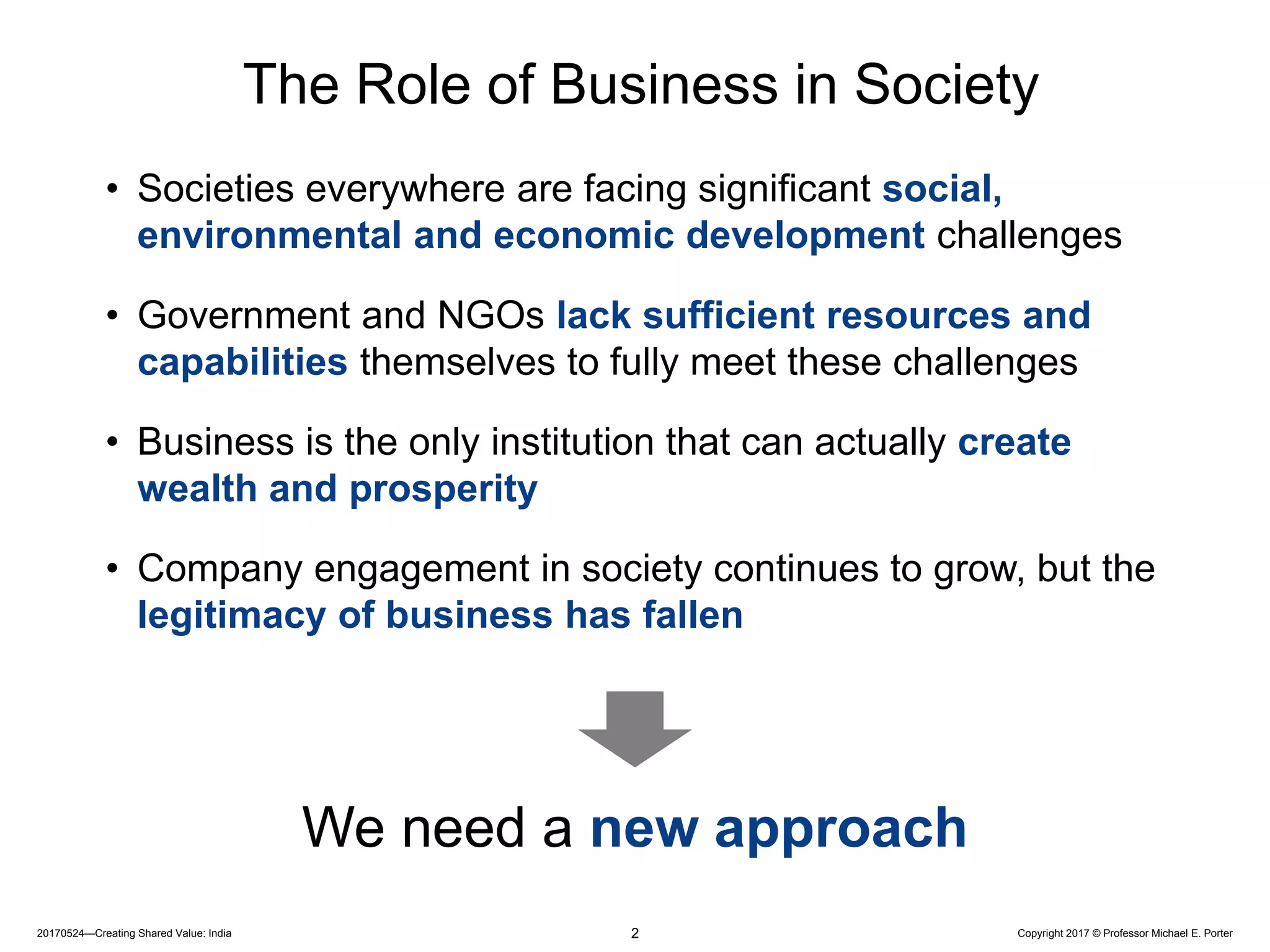
• Societies everywhere are facing significant social,
environmental and economic development challenges
• Government and NGOs lack sufficient resources and
capabilities themselves to fully meet these challenges
• Business is the only institution that can actually create
wealth and prosperity
• Company engagement in society continues to grow, but the
legitimacy of business has fallen
The Role of Business in Society
We need a new approach
20170524—Creating Shared Value: India Copyright 2017 © Professor Michael E. Porter3
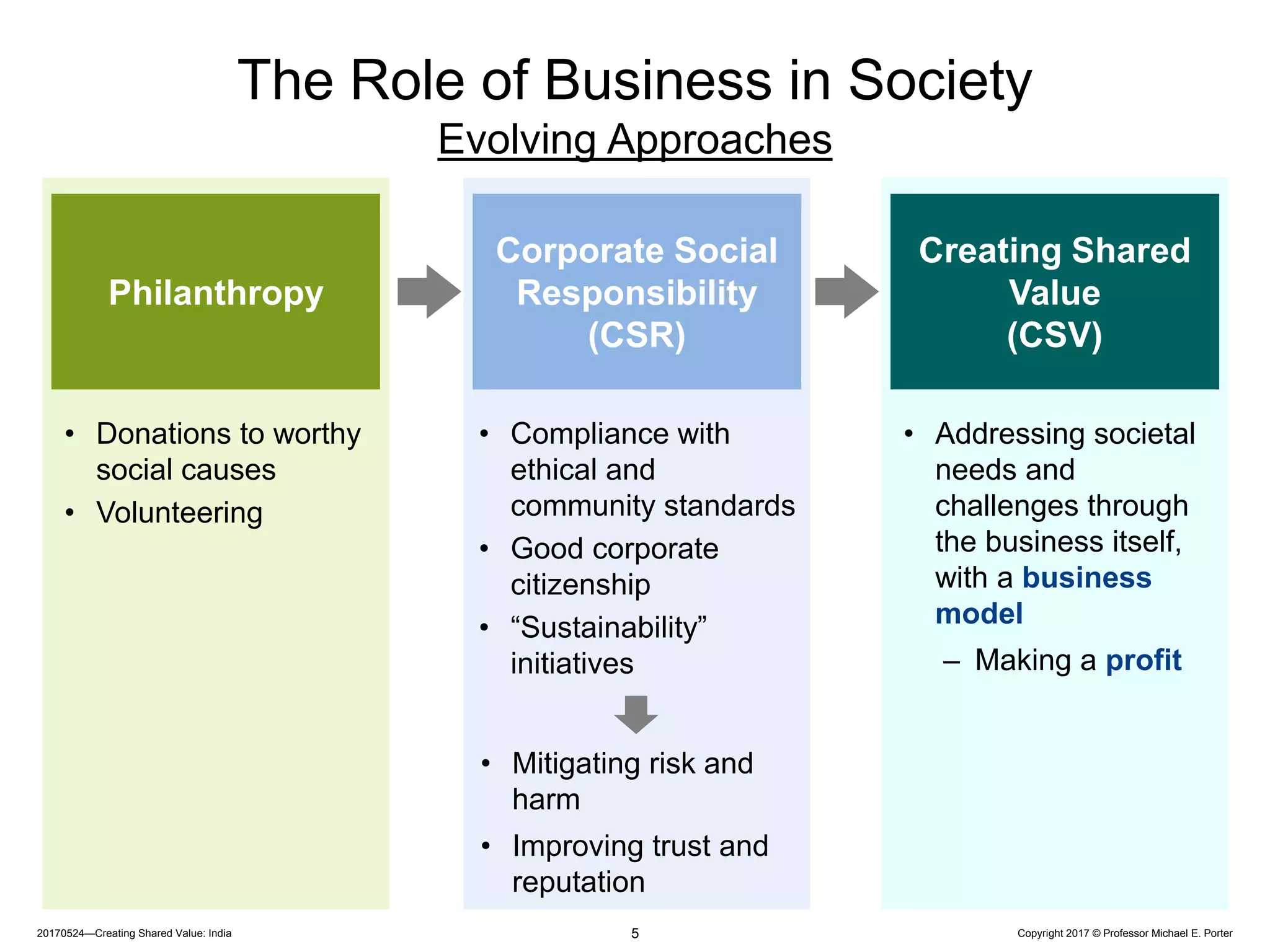
The Role of Business in Society
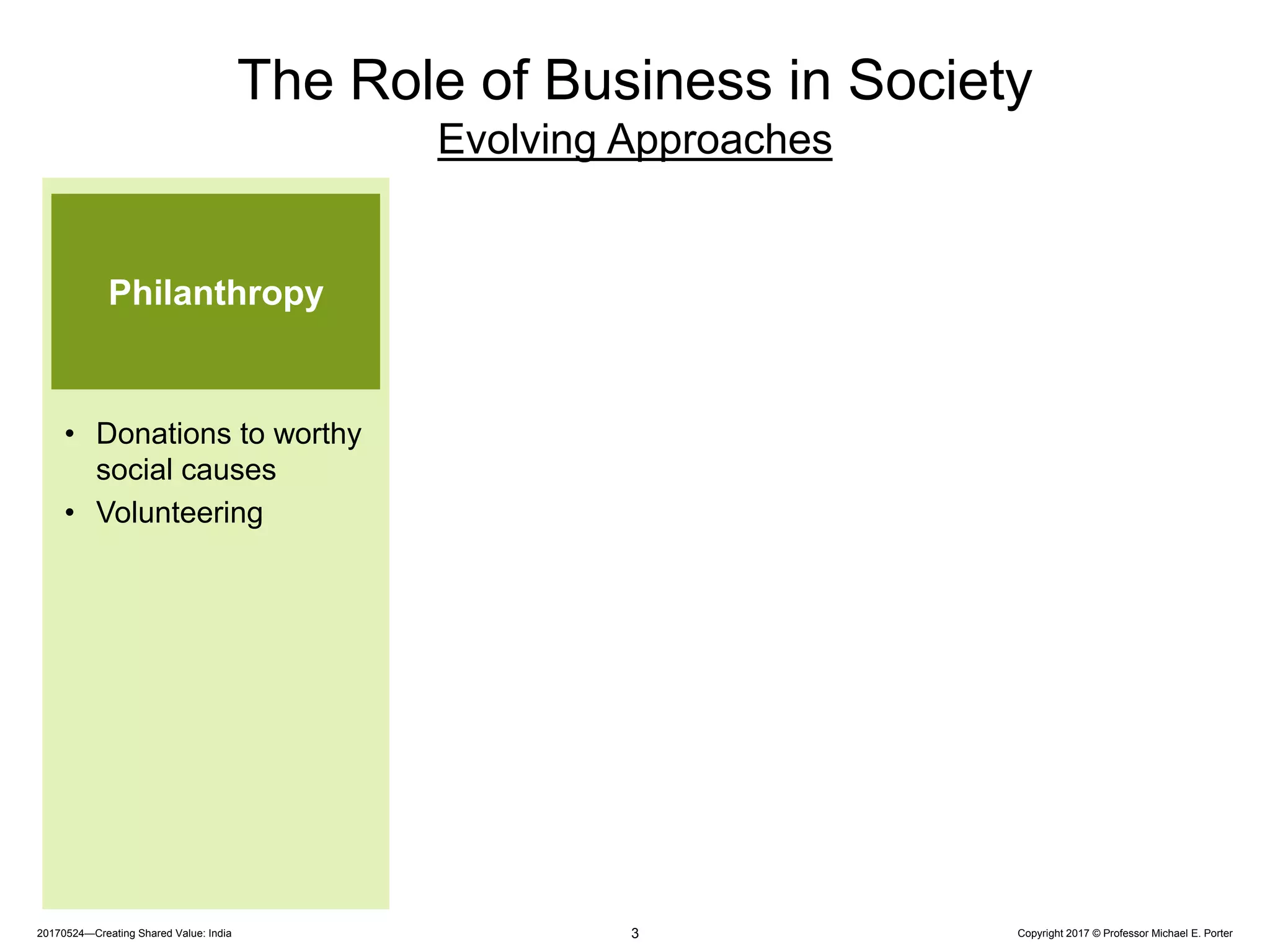
Evolving Approaches
Philanthropy
• Donations to worthy
social causes
• Volunteering
20170524—Creating Shared Value: India Copyright 2017 © Professor Michael E. Porter4
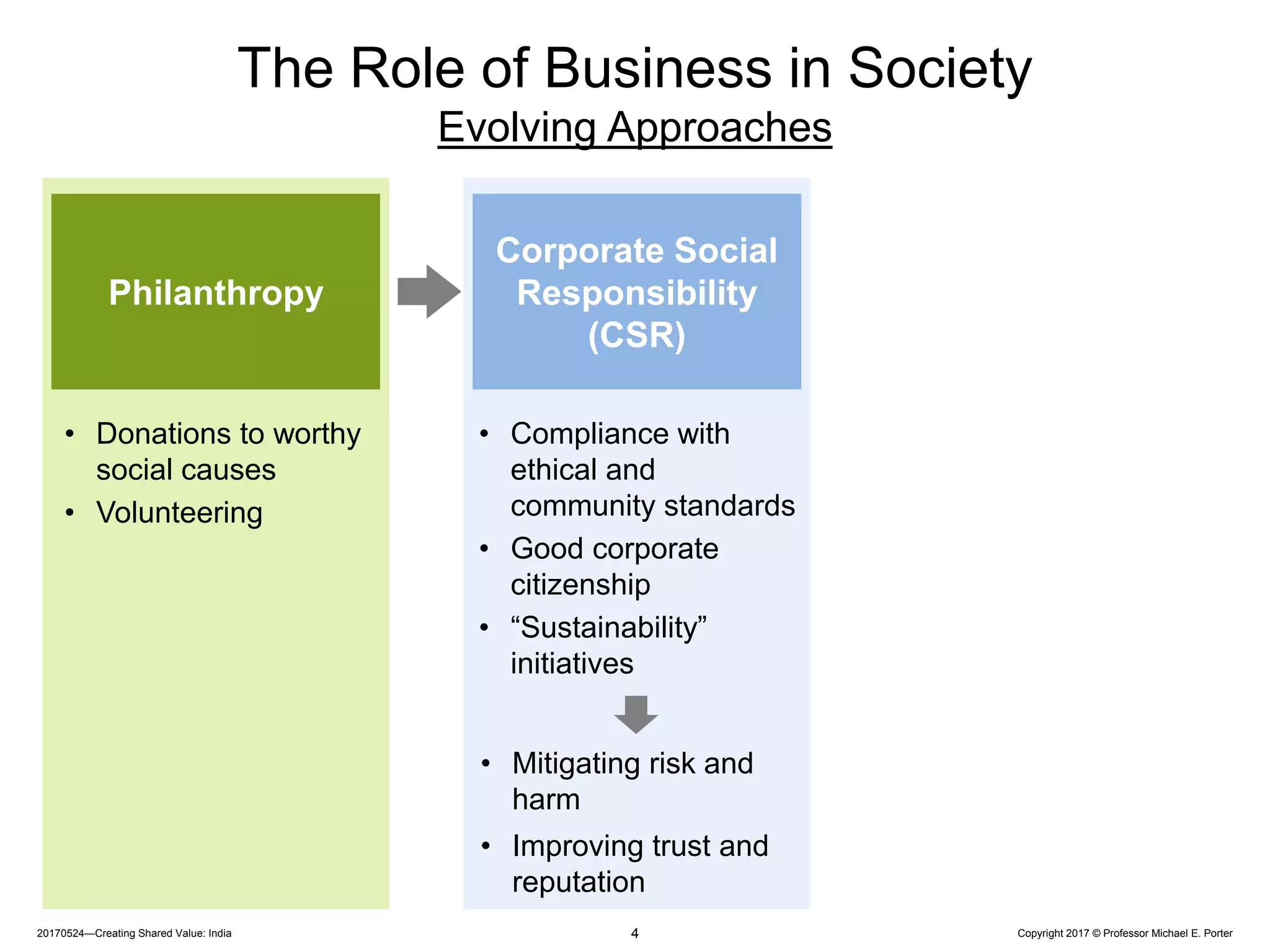
Corporate Social
Responsibility
(CSR)
Philanthropy
• Donations to worthy
social causes
• Volunteering
• Mitigating risk and
harm
• Improving trust and
reputation
• Compliance with
ethical and
community standards
• Good corporate
citizenship
• “Sustainability”
initiatives
The Role of Business in Society
Evolving Approaches
20170524—Creating Shared Value: India Copyright 2017 © Professor Michael E. Porter5
Corporate Social
Responsibility
(CSR)
Creating Shared
Value
(CSV)
Philanthropy
• Donations to worthy
social causes
• Volunteering
• Addressing societal
needs and
challenges through
the business itself,
with a business
model
– Making a profit
• Mitigating risk and
harm
• Improving trust and
reputation
• Compliance with
ethical and
community standards
• Good corporate
citizenship
• “Sustainability”
initiatives
The Role of Business in Society
Evolving Approaches
20170524—Creating Shared Value: India Copyright 2017 © Professor Michael E. Porter6
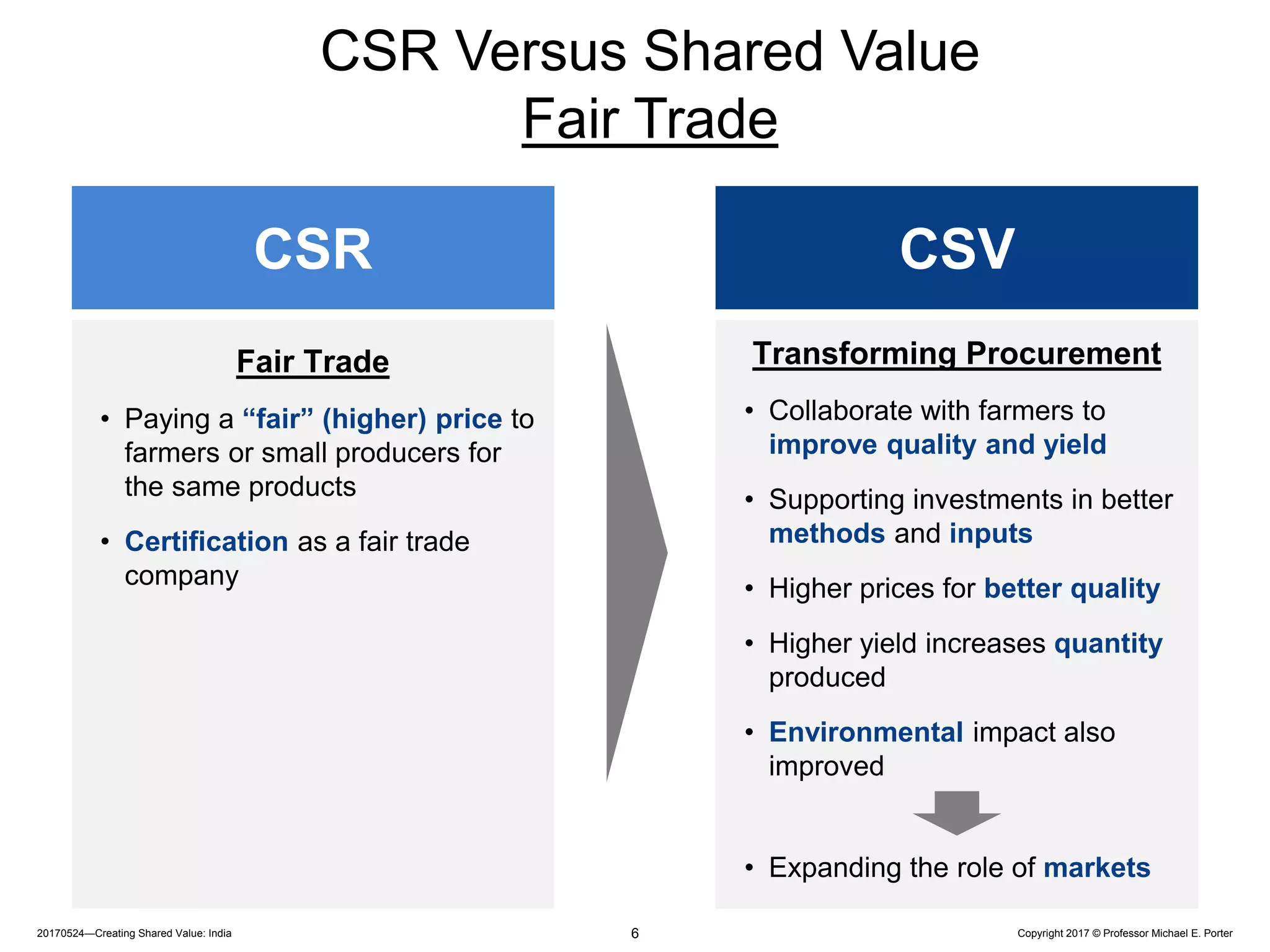
Fair Trade
• Paying a “fair” (higher) price to
farmers or small producers for
the same products
• Certification as a fair trade
company
CSR CSV
Transforming Procurement
• Collaborate with farmers to
improve quality and yield
• Supporting investments in better
methods and inputs
• Higher prices for better quality
• Higher yield increases quantity
produced
• Environmental impact also
improved
• Expanding the role of markets
CSR Versus Shared Value
Fair Trade
20170524—Creating Shared Value: India Copyright 2017 © Professor Michael E. Porter7
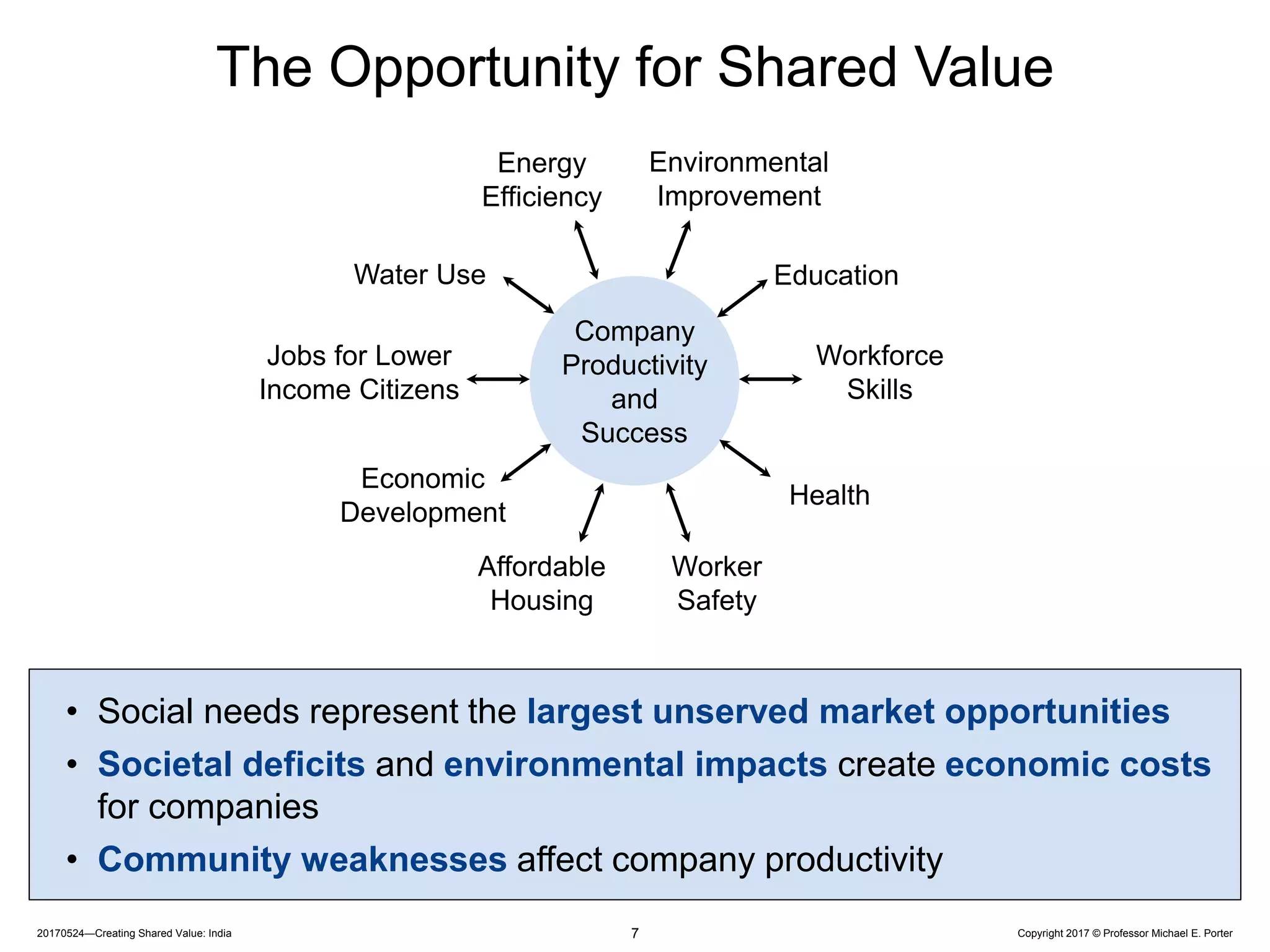
Company
Productivity
and
Success
• Social needs represent the largest unserved market opportunities
• Societal deficits and environmental impacts create economic costs
for companies
• Community weaknesses affect company productivity
The Opportunity for Shared Value
Environmental
Improvement
Energy
Efficiency
Water Use
Economic
Development
Affordable
Housing
Worker
Safety
Health
Workforce
Skills
Education
Jobs for Lower
Income Citizens
20170524—Creating Shared Value: India Copyright 2017 © Professor Michael E. Porter8
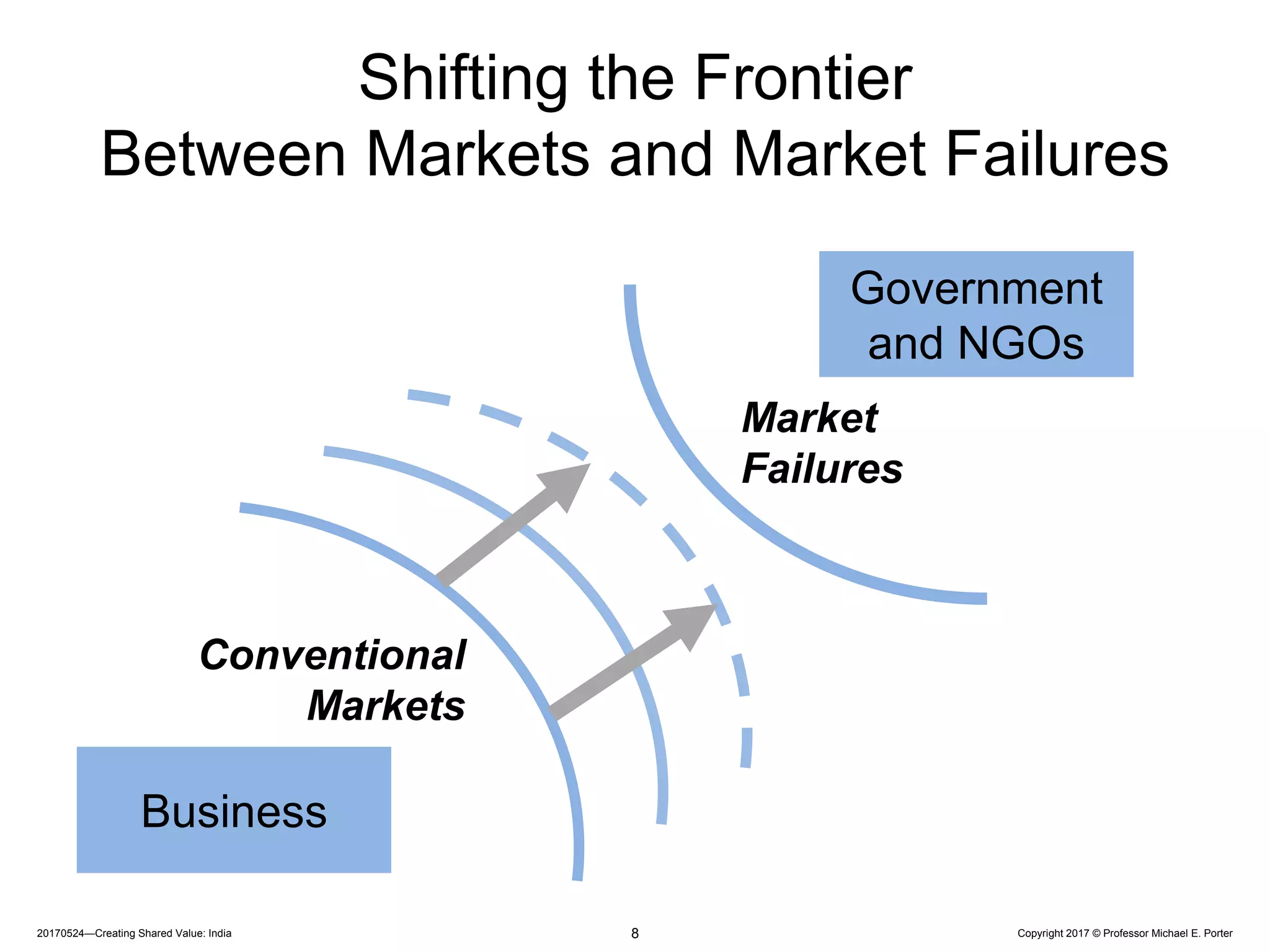
Business
Government
and NGOs
Shifting the Frontier
Between Markets and Market Failures
Conventional
Markets
Market
Failures
20170524—Creating Shared Value: India Copyright 2017 © Professor Michael E. Porter9
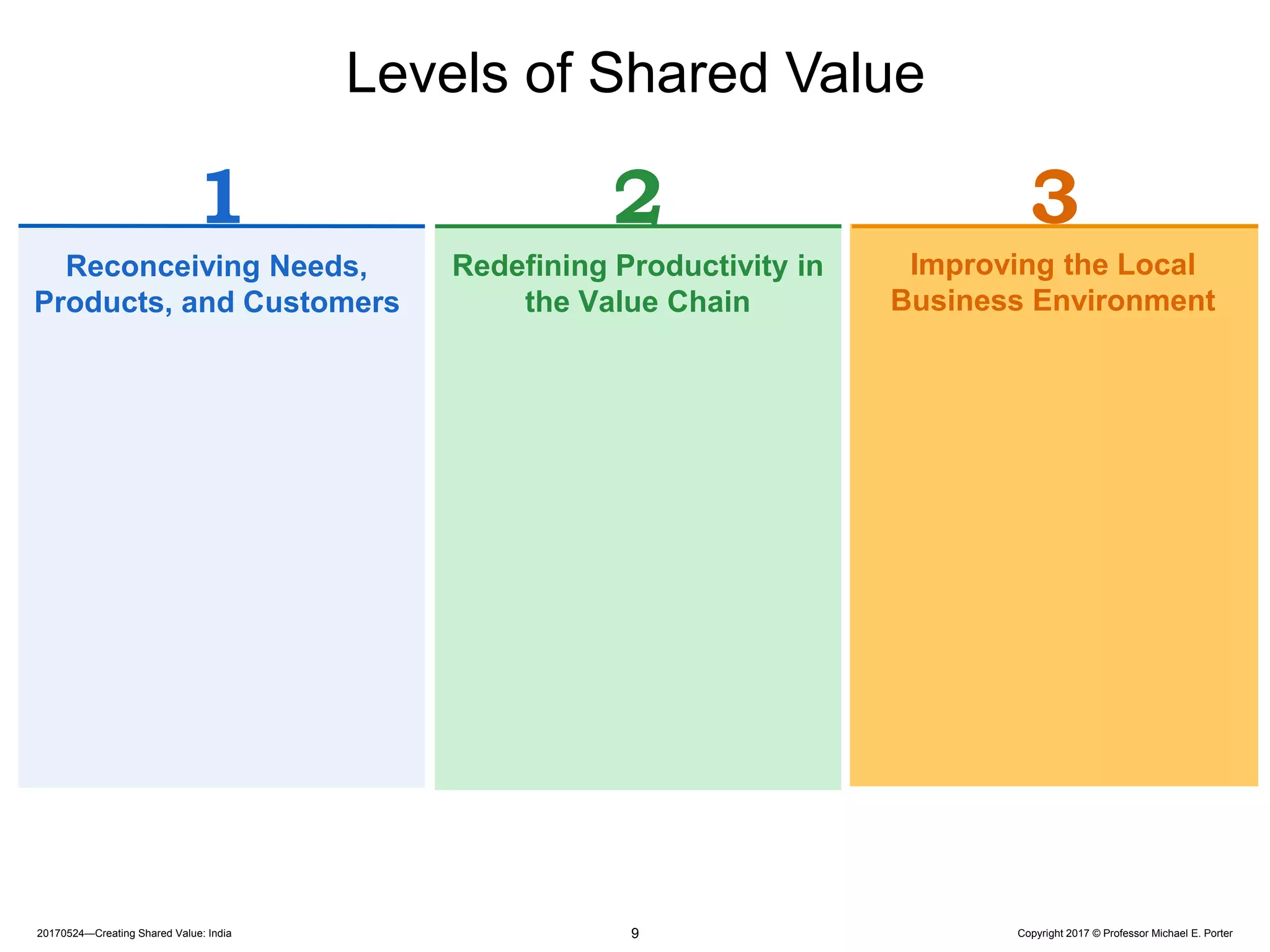
Levels of Shared Value
1
Reconceiving Needs,
Products, and Customers
2
Redefining Productivity in
the Value Chain
3
Improving the Local
Business Environment
20170524—Creating Shared Value: India Copyright 2017 © Professor Michael E. Porter10
Levels of Shared Value
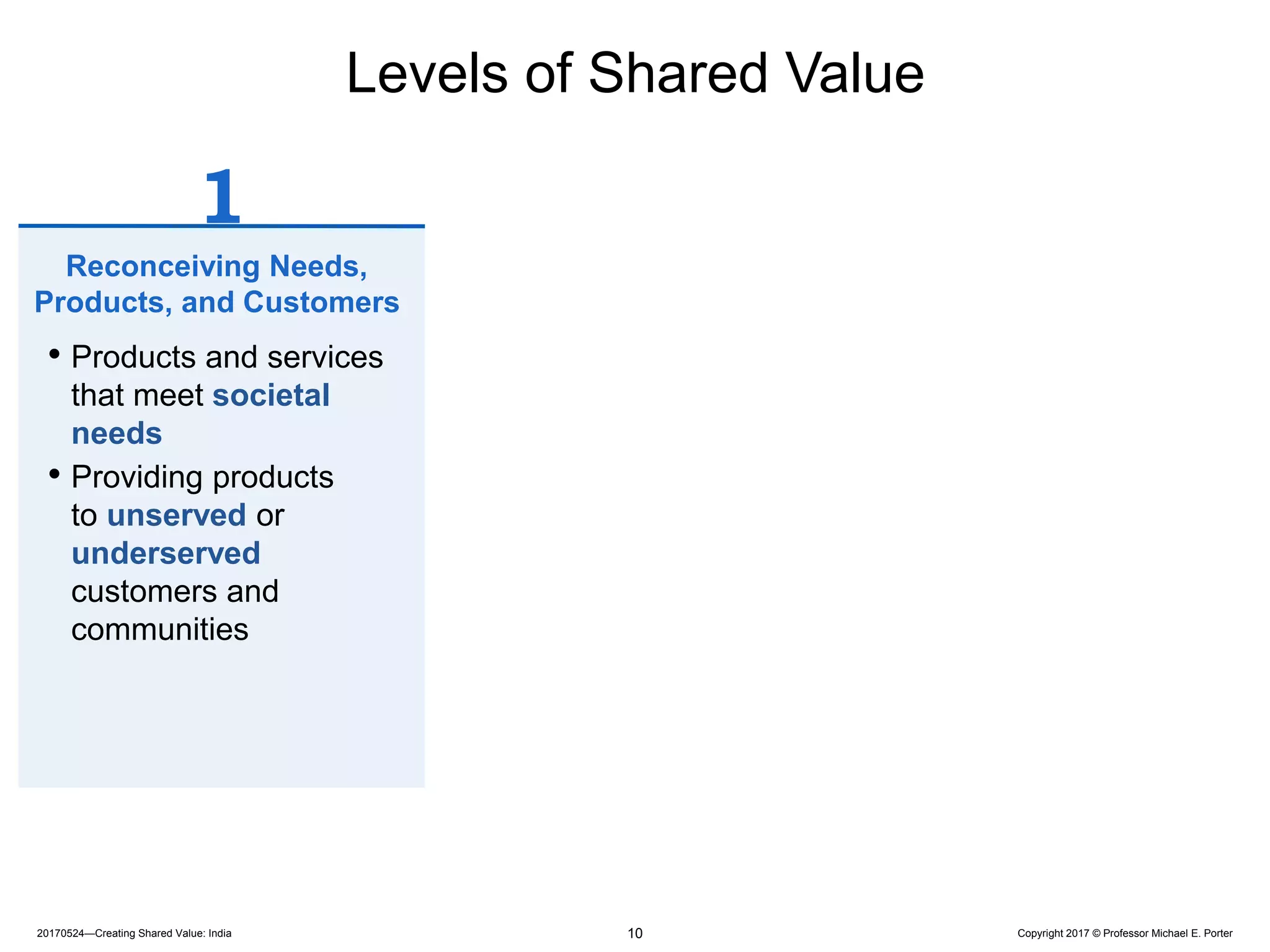
1
• Products and services
that meet societal
needs
• Providing products
to unserved or
underserved
customers and
communities
Reconceiving Needs,
Products, and Customers
20170524—Creating Shared Value: India Copyright 2017 © Professor Michael E. Porter11
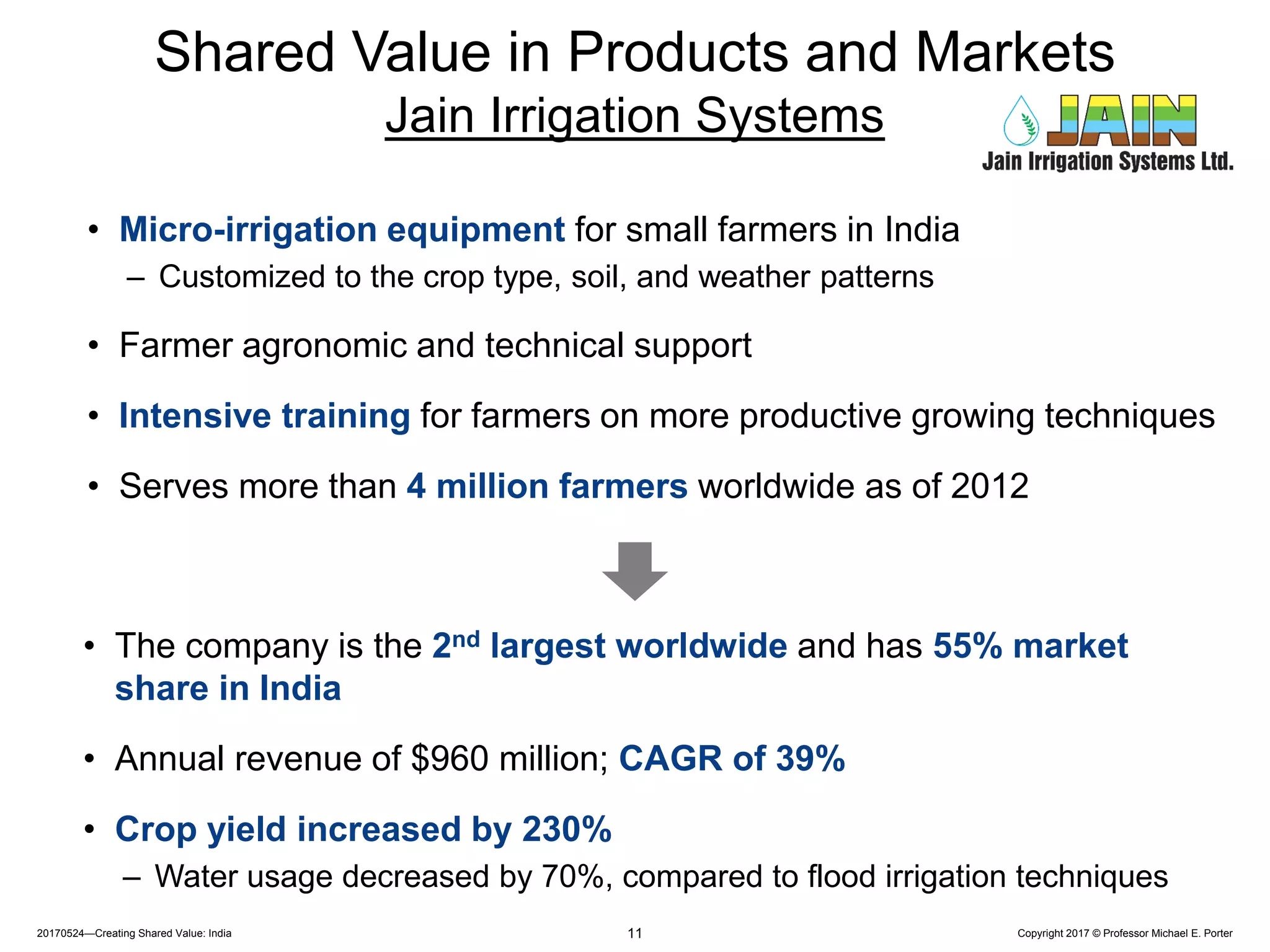
Shared Value in Products and Markets
Jain Irrigation Systems
• Micro-irrigation equipment for small farmers in India
– Customized to the crop type, soil, and weather patterns
• Farmer agronomic and technical support
• Intensive training for farmers on more productive growing techniques
• Serves more than 4 million farmers worldwide as of 2012
• The company is the 2nd largest worldwide and has 55% market
share in India
• Annual revenue of $960 million; CAGR of 39%
• Crop yield increased by 230%
– Water usage decreased by 70%, compared to flood irrigation techniques
20170524—Creating Shared Value: India Copyright 2017 © Professor Michael E. Porter12
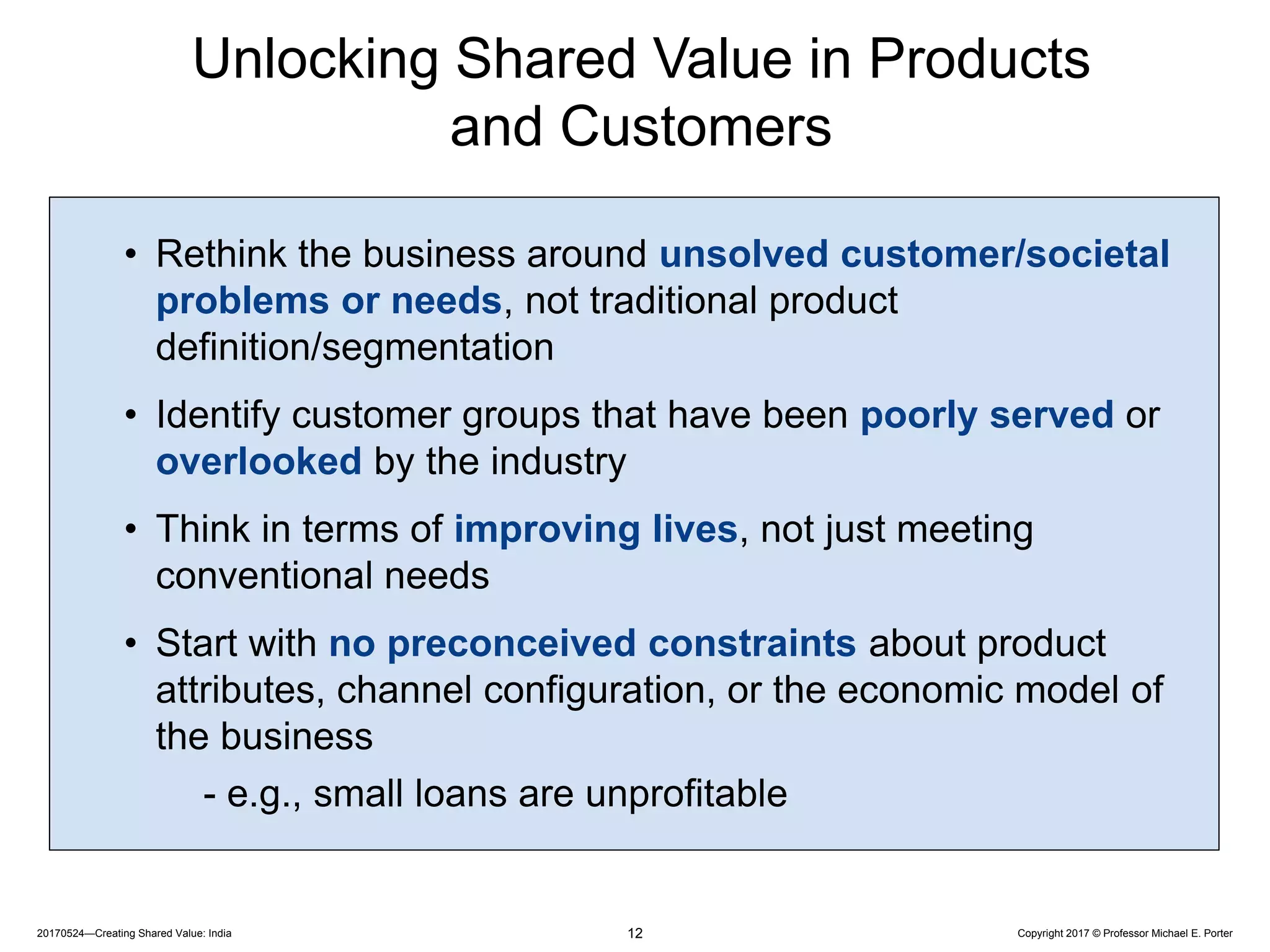
Unlocking Shared Value in Products
and Customers
• Rethink the business around unsolved customer/societal
problems or needs, not traditional product
definition/segmentation
• Identify customer groups that have been poorly served or
overlooked by the industry
• Think in terms of improving lives, not just meeting
conventional needs
• Start with no preconceived constraints about product
attributes, channel configuration, or the economic model of
the business
- e.g., small loans are unprofitable
20170524—Creating Shared Value: India Copyright 2017 © Professor Michael E. Porter13
Levels of Shared Value
1
• Products and services
that meet societal
needs
• Providing products
to unserved or
underserved
customers and
communities
Reconceiving Needs,
Products, and Customers
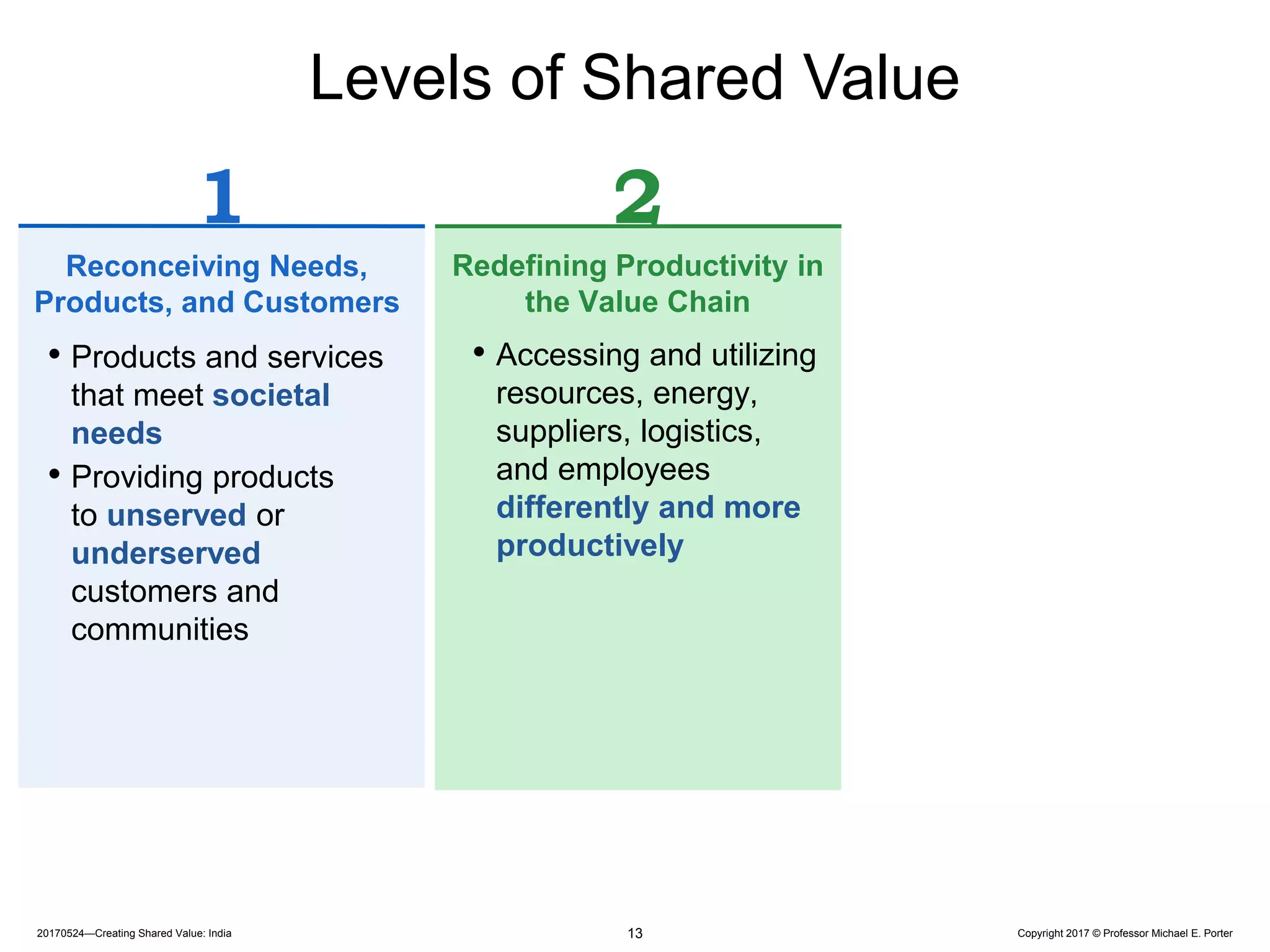
• Accessing and utilizing
resources, energy,
suppliers, logistics,
and employees
differently and more
productively
2
Redefining Productivity in
the Value Chain
20170524—Creating Shared Value: India Copyright 2017 © Professor Michael E. Porter14
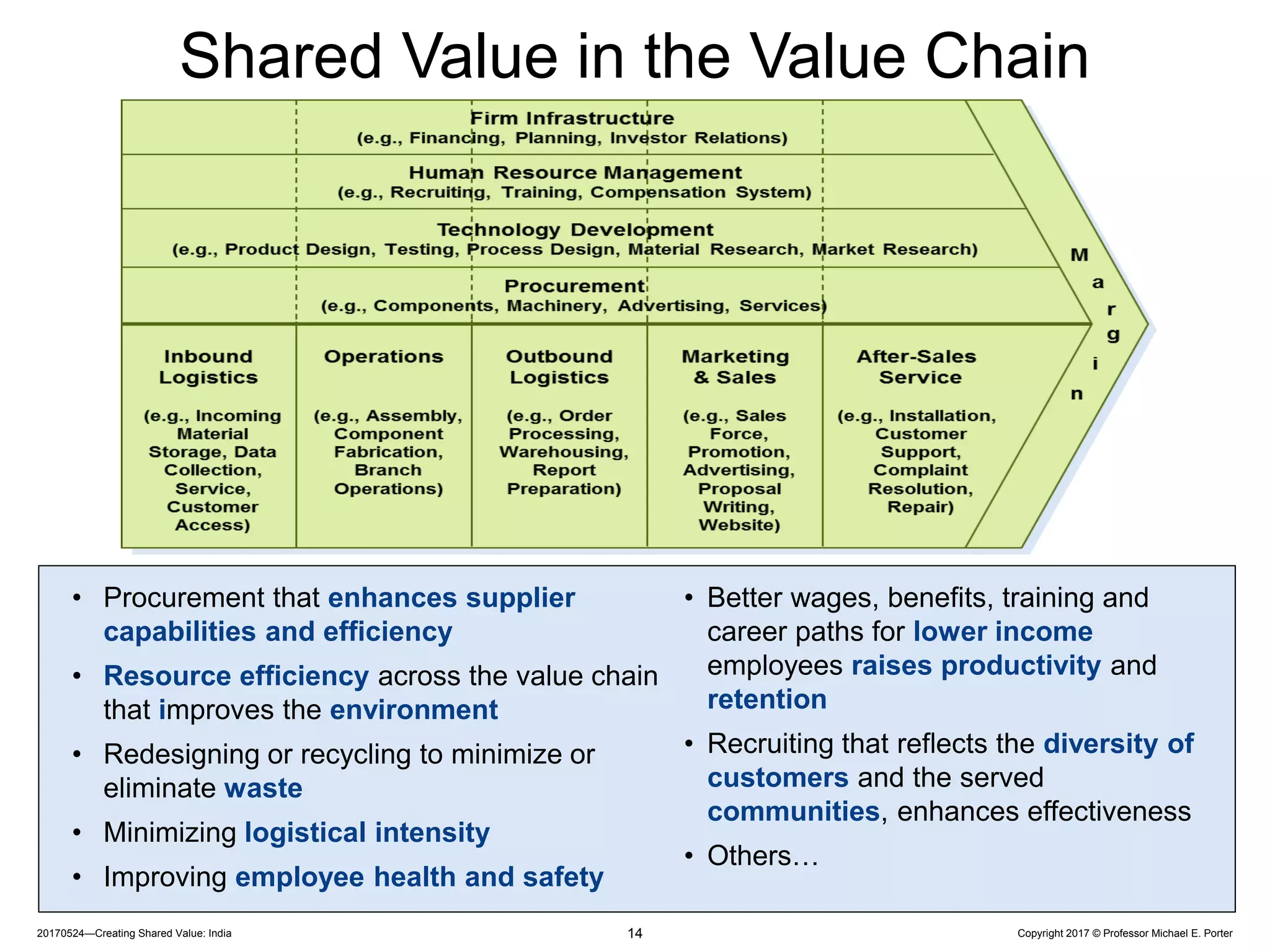
Shared Value in the Value Chain
• Procurement that enhances supplier
capabilities and efficiency
• Resource efficiency across the value chain
that improves the environment
• Redesigning or recycling to minimize or
eliminate waste
• Minimizing logistical intensity
• Improving employee health and safety
• Better wages, benefits, training and
career paths for lower income
employees raises productivity and
retention
• Recruiting that reflects the diversity of
customers and the served
communities, enhances effectiveness
• Others…
20170524—Creating Shared Value: India Copyright 2017 © Professor Michael E. Porter15
Shared Value in the Value Chain
Fibria, Brazil
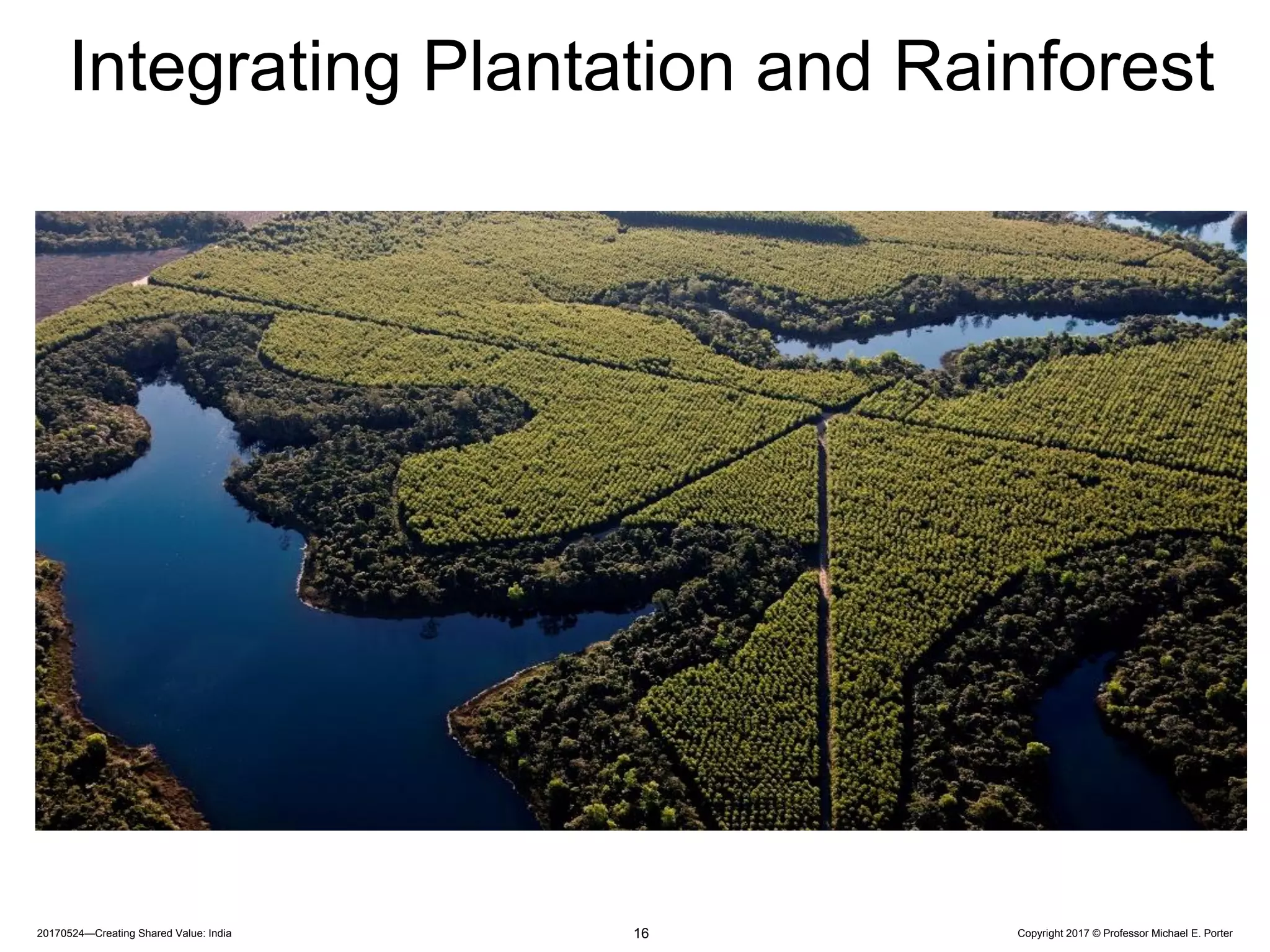
• World’s leading manufacturer of chemical pulp integrates planted
eucalyptus trees with native habitat to dramatically reduce the land
required for wood fiber cultivation and improve sustainability
• Encourages small-scale producers near its mills to plant eucalyptus
in conjunction with other crops, providing technical training and
inputs
• Far greater land and water efficiency compared to traditional
plantation methods. 35% of planted areas preserved as native
forest
• Small scale producers currently contribute 27% of raw material
volume used in Fibria mills
• Over 4,000 households have significantly increased employment
and incomes
20170524—Creating Shared Value: India Copyright 2017 © Professor Michael E. Porter16
Integrating Plantation and Rainforest
20170524—Creating Shared Value: India Copyright 2017 © Professor Michael E. Porter17
Shared Value in the Value Chain
Arvind Eye Care
• Cross subsidy model of healthcare delivery
– Customers choose between a paying hospital and free hospital; facilities and
service vary accordingly
– Doctors are rotated between paying and free hospital to maintain standard
quality of healthcare delivery
• Arvind introduced multiple innovations in the delivery of cataract
surgeries in India
– In house manufacturing of intraocular lenses
– Training for hospital administrators, and employees
• Establish Africa’s largest eye hospital (Nigeria) in 2015
• 32 million patients treated and 4 million cataract surgeries
– The hospital performs 5 times the average number of surgeries that are performed in
India; 16 times more than the U.S.
– Infection rate is 33% lower than international standards
• Single handedly responsible for decreasing cataract-related blindness in India
20170524—Creating Shared Value: India Copyright 2017 © Professor Michael E. Porter18
Levels of Shared Value
1
• Products and services
that meet societal
needs
• Providing products
to unserved or
underserved
customers and
communities
Reconceiving Needs,
Products, and Customers
• Accessing and utilizing
resources, energy,
suppliers, logistics,
and employees
differently and more
productively
2
Redefining Productivity in
the Value Chain
• E.g., improving skills,
local suppliers, and
supporting
institutions in the
areas where the
company operates
• Enhancing cluster
sophistication in the
sector
3
Improving the Local
Business Environment
20170524—Creating Shared Value: India Copyright 2017 © Professor Michael E. Porter19
Improving the Business Environment:
Japanese Tea Cluster
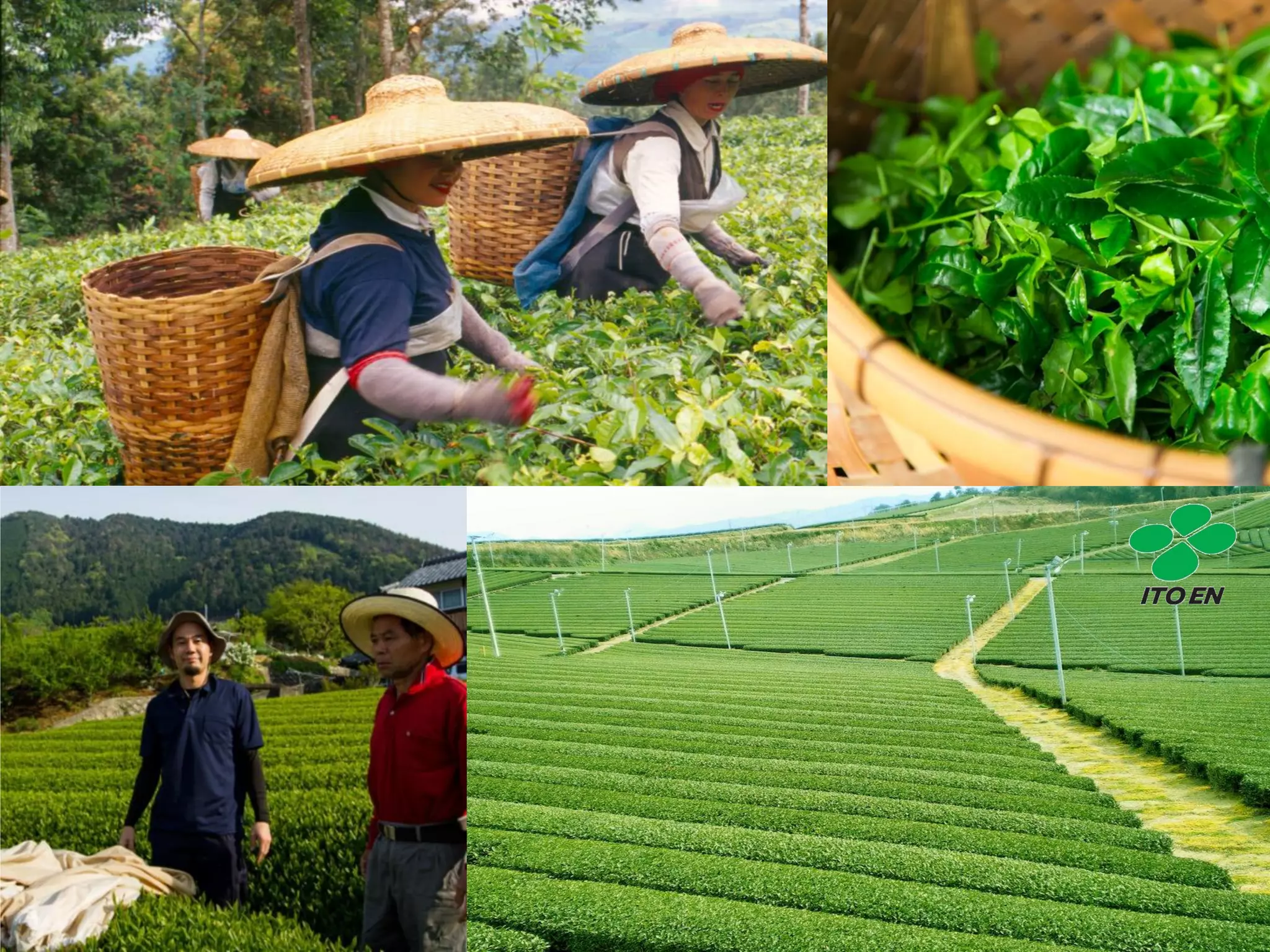
ITO EN
• ITO EN is the world's leading producer and marketer
of loose leaf and bottled green tea
• Partners with Japanese farmers and other stakeholders to
utilize abandoned agricultural land
• Provides assistance in modern farm management practices
to growers to meet ITO EN standards, and purchases farmers’ entire
crop to encourage investment and lower selling costs
• Motivates and trains young people for careers in tea growing
when older farmers retire
• Farmer incomes have risen due to increased quality and efficiency
• Land abandoned by retiring farmers has been restored to production
• Supply has expanded, quality is higher, and costs are lower
20170524—Creating Shared Value: India Copyright 2017 © Professor Michael E. Porter20
20170524—Creating Shared Value: India Copyright 2017 © Professor Michael E. Porter21
Shared Value in the Local Business Environment
JSW Steel
• Established an integrated steel plant on 3,000 acres of
undeveloped land in Karnataka
– Developed in technology to produce high quality steel from low-grade
iron ore
– Built local infrastructure, such as roads and bridges
– Provided extensive training for local residents
– Introduced health benefit program for employee and their families,
including child immunizations and cataract surgeries
• Has become the largest steel plant in India, by capacity, and highly
profitable
• 45% higher productivity compared to industry average
• Reduced project delivery time by 50%
• 65% of the workforce from the local region
20170524—Creating Shared Value: India Copyright 2017 © Professor Michael E. Porter22
Shared Value and Strategy
• Shared value opens up new needs and customer
segments, and new ways of producing and
delivering
• Shared value creates new value propositions, new
opportunities for strategic positioning, and new
competitive advantages
• Shared value strategies are often more sustainable
than conventional cost, feature, and quality advantages
20170524—Creating Shared Value: India Copyright 2017 © Professor Michael E. Porter23
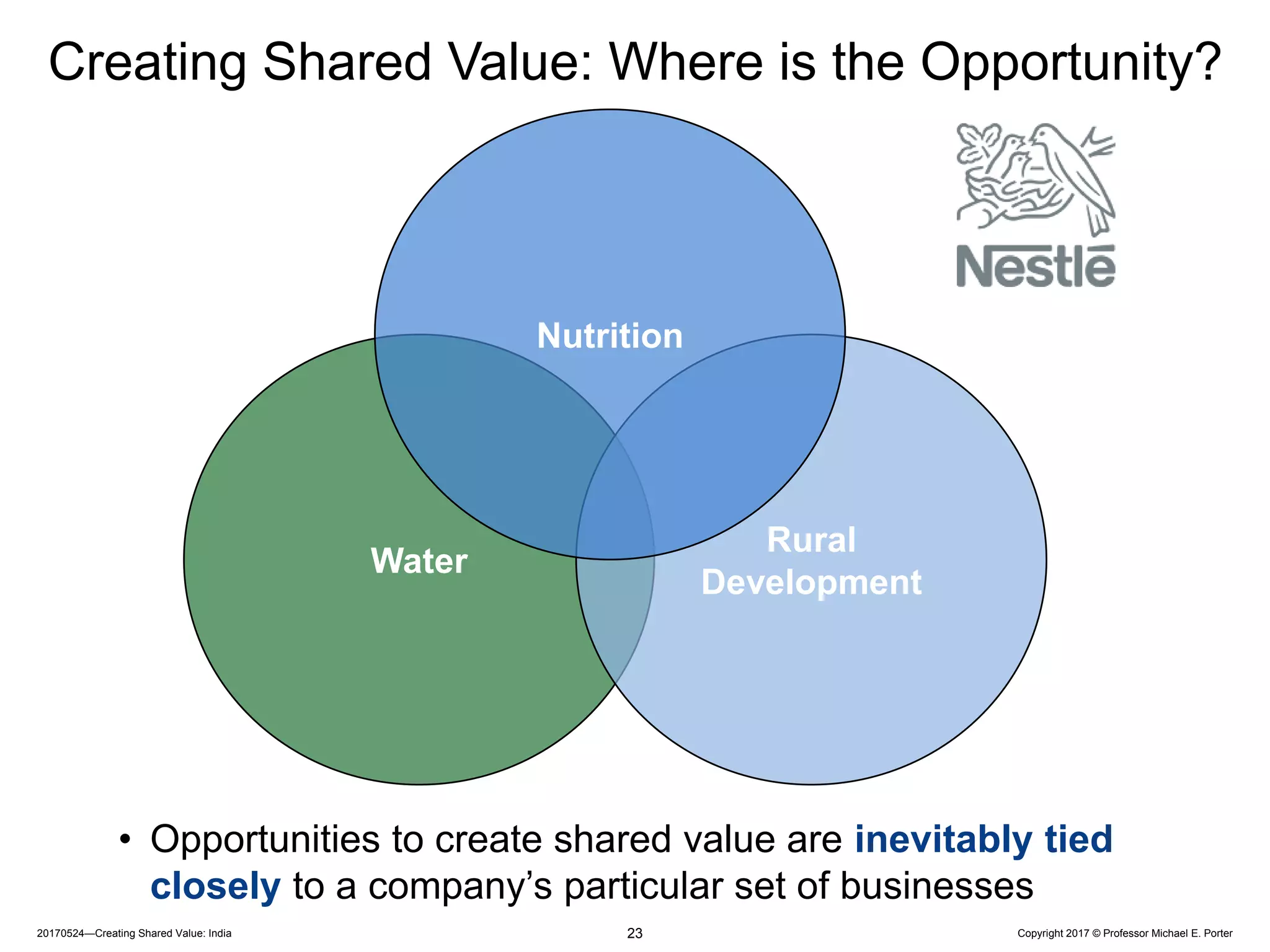
Creating Shared Value: Where is the Opportunity?
Water
Rural
Development
Nutrition
• Opportunities to create shared value are inevitably tied
closely to a company’s particular set of businesses
20170524—Creating Shared Value: India Copyright 2017 © Professor Michael E. Porter24
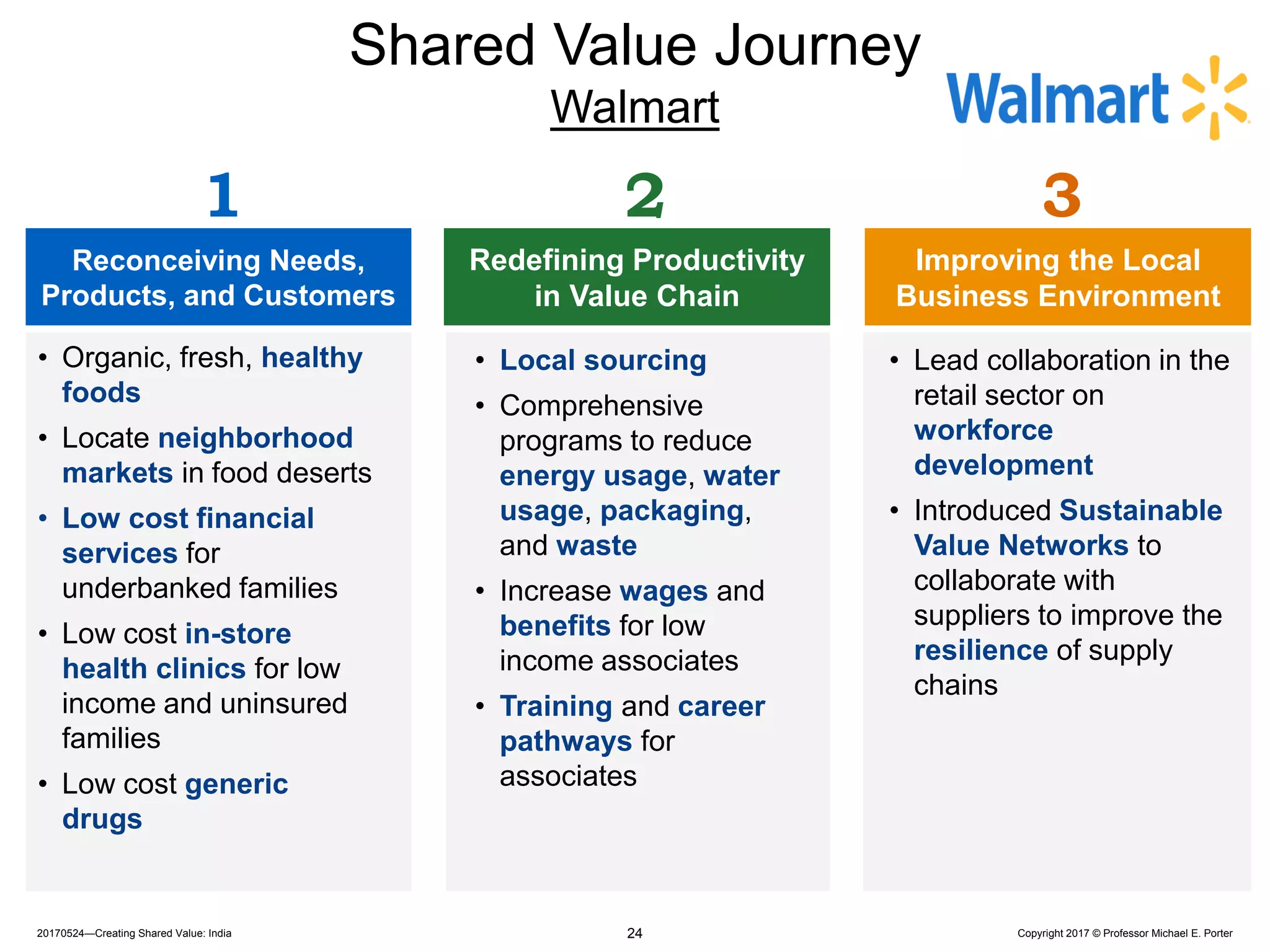
Shared Value Journey
Walmart
• Organic, fresh, healthy
foods
• Locate neighborhood
markets in food deserts
• Low cost financial
services for
underbanked families
• Low cost in-store
health clinics for low
income and uninsured
families
• Low cost generic
drugs
Reconceiving Needs,
Products, and Customers
1
• Local sourcing
• Comprehensive
programs to reduce
energy usage, water
usage, packaging,
and waste
• Increase wages and
benefits for low
income associates
• Training and career
pathways for
associates
Redefining Productivity
in Value Chain
2
• Lead collaboration in the
retail sector on
workforce
development
• Introduced Sustainable
Value Networks to
collaborate with
suppliers to improve the
resilience of supply
chains
Improving the Local
Business Environment
3
20170524—Creating Shared Value: India Copyright 2017 © Professor Michael E. Porter25
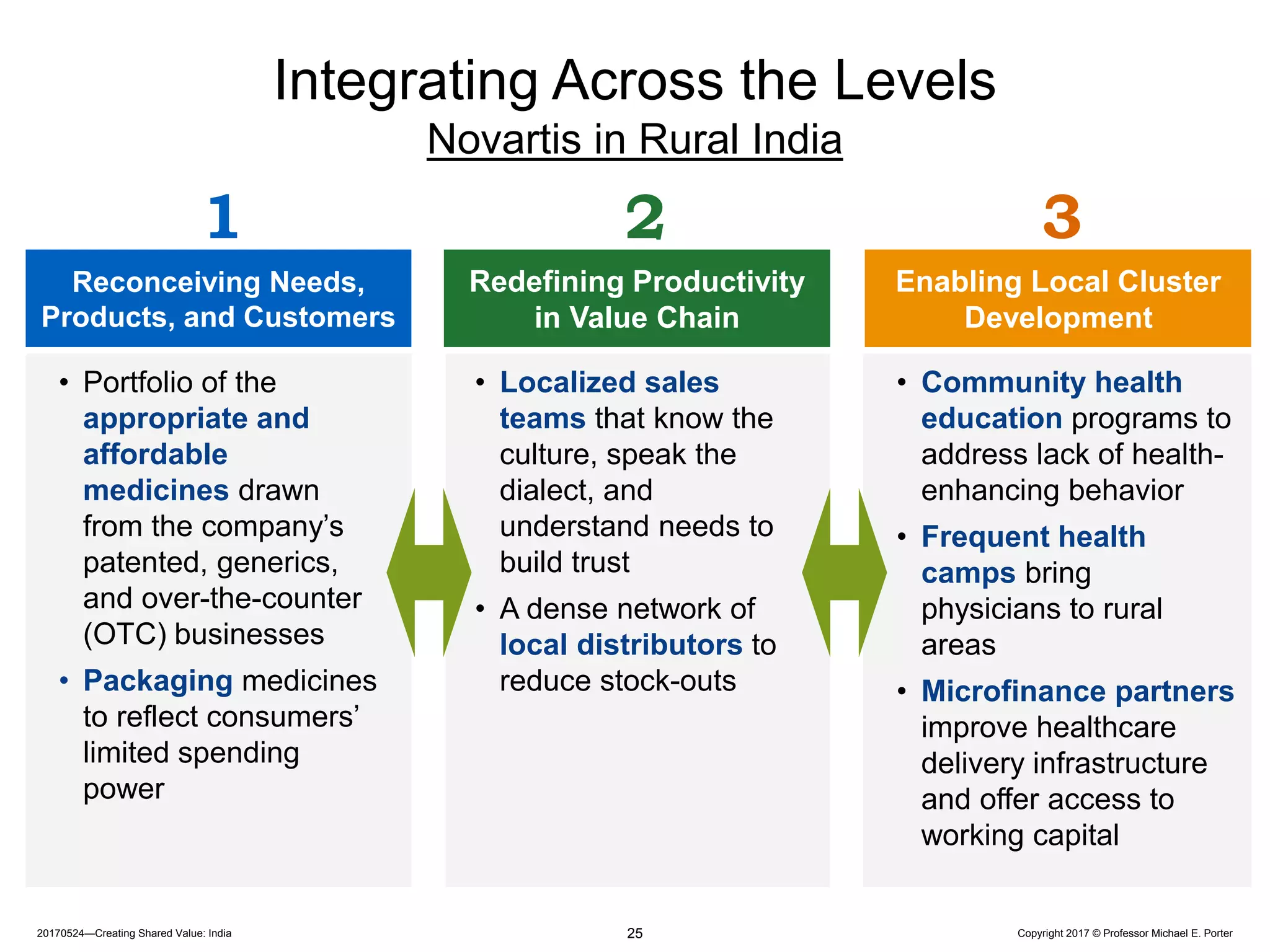
Integrating Across the Levels
Novartis in Rural India
• Portfolio of the
appropriate and
affordable
medicines drawn
from the company’s
patented, generics,
and over-the-counter
(OTC) businesses
• Packaging medicines
to reflect consumers’
limited spending
power
Reconceiving Needs,
Products, and Customers
1
• Localized sales
teams that know the
culture, speak the
dialect, and
understand needs to
build trust
• A dense network of
local distributors to
reduce stock-outs
Redefining Productivity
in Value Chain
2
• Community health
education programs to
address lack of health-
enhancing behavior
• Frequent health
camps bring
physicians to rural
areas
• Microfinance partners
improve healthcare
delivery infrastructure
and offer access to
working capital
Enabling Local Cluster
Development
3
20170524—Creating Shared Value: India Copyright 2017 © Professor Michael E. Porter26
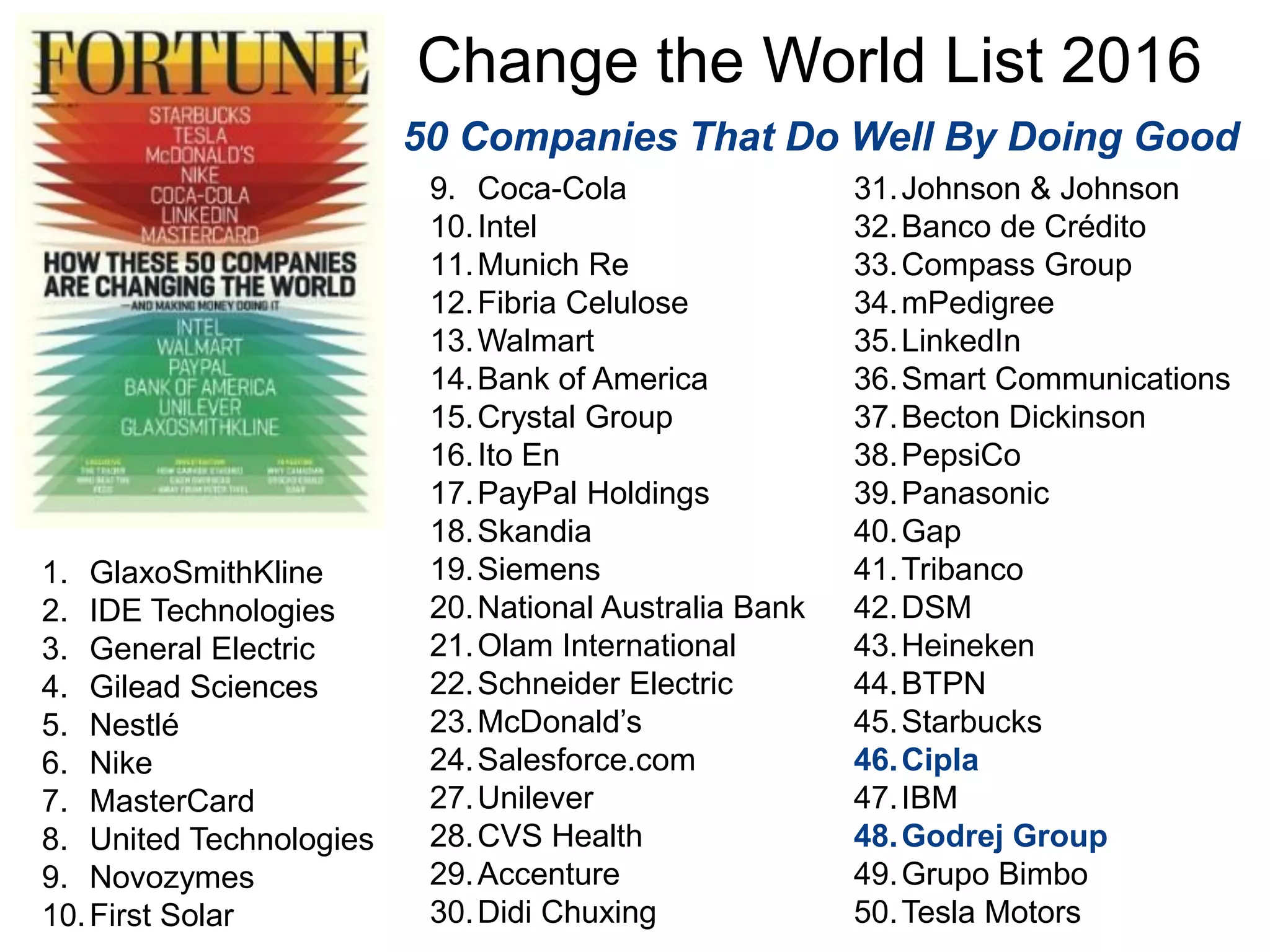
Change the World List 2016
50 Companies That Do Well By Doing Good
9. Coca-Cola
10.Intel
11.Munich Re
12.Fibria Celulose
13.Walmart
14.Bank of America
15.Crystal Group
16.Ito En
17.PayPal Holdings
18.Skandia
19.Siemens
20.National Australia Bank
21.Olam International
22.Schneider Electric
23.McDonald’s
24.Salesforce.com
27.Unilever
28.CVS Health
29.Accenture
30.Didi Chuxing
1. GlaxoSmithKline
2. IDE Technologies
3. General Electric
4. Gilead Sciences
5. Nestlé
6. Nike
7. MasterCard
8. United Technologies
9. Novozymes
10.First Solar
31.Johnson & Johnson
32.Banco de Crédito
33.Compass Group
34.mPedigree
35.LinkedIn
36.Smart Communications
37.Becton Dickinson
38.PepsiCo
39.Panasonic
40.Gap
41.Tribanco
42.DSM
43.Heineken
44.BTPN
45.Starbucks
46.Cipla
47.IBM
48.Godrej Group
49.Grupo Bimbo
50.Tesla Motors
20170524—Creating Shared Value: India Copyright 2017 © Professor Michael E. Porter27
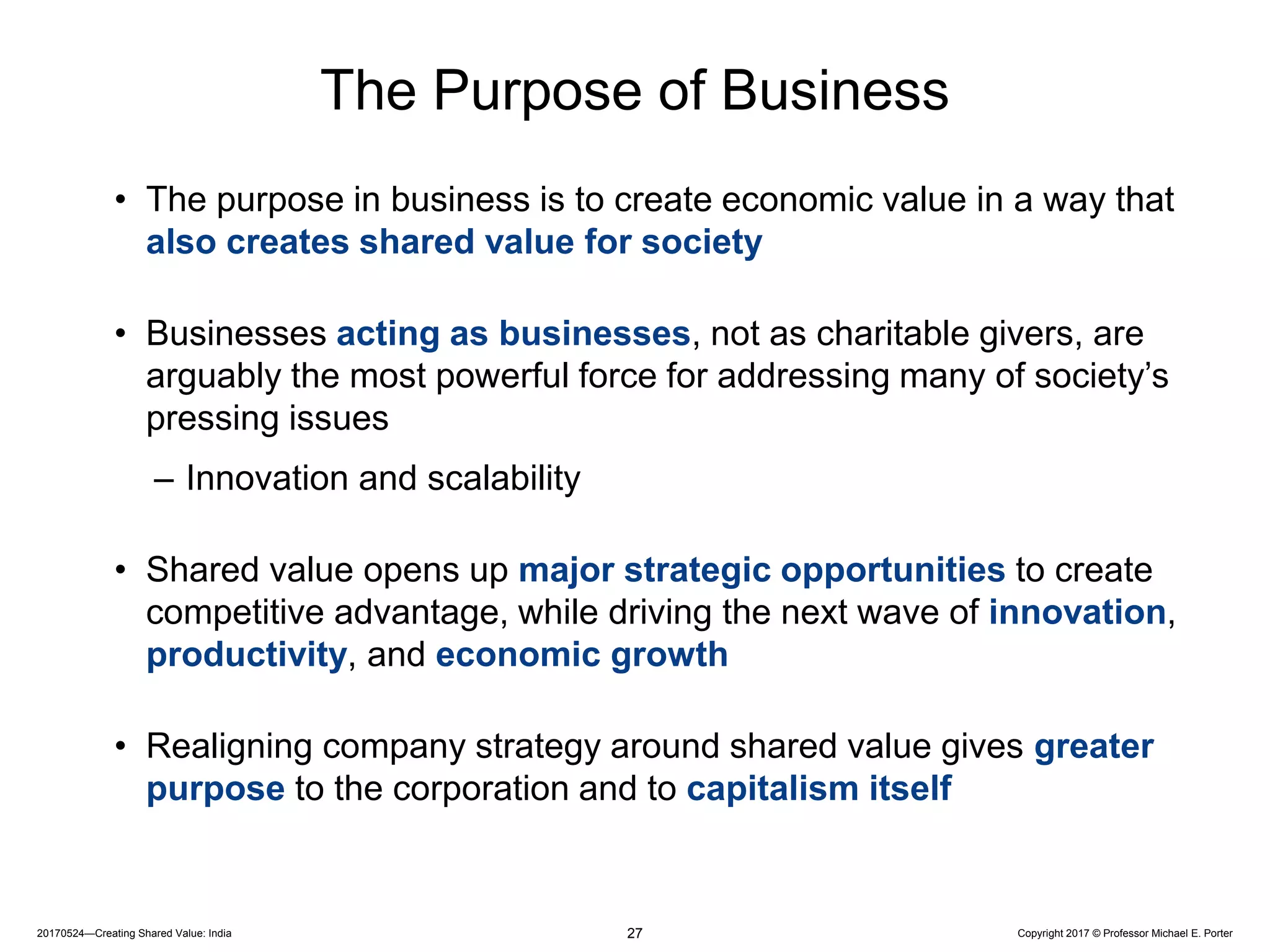
The Purpose of Business
• The purpose in business is to create economic value in a way that
also creates shared value for society
• Businesses acting as businesses, not as charitable givers, are
arguably the most powerful force for addressing many of society’s
pressing issues
– Innovation and scalability
• Shared value opens up major strategic opportunities to create
competitive advantage, while driving the next wave of innovation,
productivity, and economic growth
• Realigning company strategy around shared value gives greater
purpose to the corporation and to capitalism itself

Creating Shared Value

  • 1.
    This presentation drawson ideas from Professor Porter’s books and articles, in particular, Competitive Strategy (The Free Press, 1980); Competitive Advantage (The Free Press, 1985); “What is Strategy?” (Harvard Business Review, Nov/Dec 1996); On Competition (Harvard Business Review, 2008); and “Creating Shared Value” (Harvard Business Review, Jan 2011). No part of this publication may be reproduced, stored in a retrieval system, or transmitted in any form or by any means—electronic, mechanical, photocopying, recording, or otherwise—without the permission of Michael E. Porter. For further materials, see the website of the Institute for Strategy and Competitiveness, www.isc.hbs.edu, and FSG website, www.fsg.org. The New Competitive Advantage: Creating Shared Value Professor Michael E. Porter Harvard Business School Mumbai, May 24th, 2017
  • 2.
    20170524—Creating Shared Value:India Copyright 2017 © Professor Michael E. Porter2 • Societies everywhere are facing significant social, environmental and economic development challenges • Government and NGOs lack sufficient resources and capabilities themselves to fully meet these challenges • Business is the only institution that can actually create wealth and prosperity • Company engagement in society continues to grow, but the legitimacy of business has fallen The Role of Business in Society We need a new approach
  • 3.
    20170524—Creating Shared Value:India Copyright 2017 © Professor Michael E. Porter3 The Role of Business in Society Evolving Approaches Philanthropy • Donations to worthy social causes • Volunteering
  • 4.
    20170524—Creating Shared Value:India Copyright 2017 © Professor Michael E. Porter4 Corporate Social Responsibility (CSR) Philanthropy • Donations to worthy social causes • Volunteering • Mitigating risk and harm • Improving trust and reputation • Compliance with ethical and community standards • Good corporate citizenship • “Sustainability” initiatives The Role of Business in Society Evolving Approaches
  • 5.
    20170524—Creating Shared Value:India Copyright 2017 © Professor Michael E. Porter5 Corporate Social Responsibility (CSR) Creating Shared Value (CSV) Philanthropy • Donations to worthy social causes • Volunteering • Addressing societal needs and challenges through the business itself, with a business model – Making a profit • Mitigating risk and harm • Improving trust and reputation • Compliance with ethical and community standards • Good corporate citizenship • “Sustainability” initiatives The Role of Business in Society Evolving Approaches
  • 6.
    20170524—Creating Shared Value:India Copyright 2017 © Professor Michael E. Porter6 Fair Trade • Paying a “fair” (higher) price to farmers or small producers for the same products • Certification as a fair trade company CSR CSV Transforming Procurement • Collaborate with farmers to improve quality and yield • Supporting investments in better methods and inputs • Higher prices for better quality • Higher yield increases quantity produced • Environmental impact also improved • Expanding the role of markets CSR Versus Shared Value Fair Trade
  • 7.
    20170524—Creating Shared Value:India Copyright 2017 © Professor Michael E. Porter7 Company Productivity and Success • Social needs represent the largest unserved market opportunities • Societal deficits and environmental impacts create economic costs for companies • Community weaknesses affect company productivity The Opportunity for Shared Value Environmental Improvement Energy Efficiency Water Use Economic Development Affordable Housing Worker Safety Health Workforce Skills Education Jobs for Lower Income Citizens
  • 8.
    20170524—Creating Shared Value:India Copyright 2017 © Professor Michael E. Porter8 Business Government and NGOs Shifting the Frontier Between Markets and Market Failures Conventional Markets Market Failures
  • 9.
    20170524—Creating Shared Value:India Copyright 2017 © Professor Michael E. Porter9 Levels of Shared Value 1 Reconceiving Needs, Products, and Customers 2 Redefining Productivity in the Value Chain 3 Improving the Local Business Environment
  • 10.
    20170524—Creating Shared Value:India Copyright 2017 © Professor Michael E. Porter10 Levels of Shared Value 1 • Products and services that meet societal needs • Providing products to unserved or underserved customers and communities Reconceiving Needs, Products, and Customers
  • 11.
    20170524—Creating Shared Value:India Copyright 2017 © Professor Michael E. Porter11 Shared Value in Products and Markets Jain Irrigation Systems • Micro-irrigation equipment for small farmers in India – Customized to the crop type, soil, and weather patterns • Farmer agronomic and technical support • Intensive training for farmers on more productive growing techniques • Serves more than 4 million farmers worldwide as of 2012 • The company is the 2nd largest worldwide and has 55% market share in India • Annual revenue of $960 million; CAGR of 39% • Crop yield increased by 230% – Water usage decreased by 70%, compared to flood irrigation techniques
  • 12.
    20170524—Creating Shared Value:India Copyright 2017 © Professor Michael E. Porter12 Unlocking Shared Value in Products and Customers • Rethink the business around unsolved customer/societal problems or needs, not traditional product definition/segmentation • Identify customer groups that have been poorly served or overlooked by the industry • Think in terms of improving lives, not just meeting conventional needs • Start with no preconceived constraints about product attributes, channel configuration, or the economic model of the business - e.g., small loans are unprofitable
  • 13.
    20170524—Creating Shared Value:India Copyright 2017 © Professor Michael E. Porter13 Levels of Shared Value 1 • Products and services that meet societal needs • Providing products to unserved or underserved customers and communities Reconceiving Needs, Products, and Customers • Accessing and utilizing resources, energy, suppliers, logistics, and employees differently and more productively 2 Redefining Productivity in the Value Chain
  • 14.
    20170524—Creating Shared Value:India Copyright 2017 © Professor Michael E. Porter14 Shared Value in the Value Chain • Procurement that enhances supplier capabilities and efficiency • Resource efficiency across the value chain that improves the environment • Redesigning or recycling to minimize or eliminate waste • Minimizing logistical intensity • Improving employee health and safety • Better wages, benefits, training and career paths for lower income employees raises productivity and retention • Recruiting that reflects the diversity of customers and the served communities, enhances effectiveness • Others…
  • 15.
    20170524—Creating Shared Value:India Copyright 2017 © Professor Michael E. Porter15 Shared Value in the Value Chain Fibria, Brazil • World’s leading manufacturer of chemical pulp integrates planted eucalyptus trees with native habitat to dramatically reduce the land required for wood fiber cultivation and improve sustainability • Encourages small-scale producers near its mills to plant eucalyptus in conjunction with other crops, providing technical training and inputs • Far greater land and water efficiency compared to traditional plantation methods. 35% of planted areas preserved as native forest • Small scale producers currently contribute 27% of raw material volume used in Fibria mills • Over 4,000 households have significantly increased employment and incomes
  • 16.
    20170524—Creating Shared Value:India Copyright 2017 © Professor Michael E. Porter16 Integrating Plantation and Rainforest
  • 17.
    20170524—Creating Shared Value:India Copyright 2017 © Professor Michael E. Porter17 Shared Value in the Value Chain Arvind Eye Care • Cross subsidy model of healthcare delivery – Customers choose between a paying hospital and free hospital; facilities and service vary accordingly – Doctors are rotated between paying and free hospital to maintain standard quality of healthcare delivery • Arvind introduced multiple innovations in the delivery of cataract surgeries in India – In house manufacturing of intraocular lenses – Training for hospital administrators, and employees • Establish Africa’s largest eye hospital (Nigeria) in 2015 • 32 million patients treated and 4 million cataract surgeries – The hospital performs 5 times the average number of surgeries that are performed in India; 16 times more than the U.S. – Infection rate is 33% lower than international standards • Single handedly responsible for decreasing cataract-related blindness in India
  • 18.
    20170524—Creating Shared Value:India Copyright 2017 © Professor Michael E. Porter18 Levels of Shared Value 1 • Products and services that meet societal needs • Providing products to unserved or underserved customers and communities Reconceiving Needs, Products, and Customers • Accessing and utilizing resources, energy, suppliers, logistics, and employees differently and more productively 2 Redefining Productivity in the Value Chain • E.g., improving skills, local suppliers, and supporting institutions in the areas where the company operates • Enhancing cluster sophistication in the sector 3 Improving the Local Business Environment
  • 19.
    20170524—Creating Shared Value:India Copyright 2017 © Professor Michael E. Porter19 Improving the Business Environment: Japanese Tea Cluster ITO EN • ITO EN is the world's leading producer and marketer of loose leaf and bottled green tea • Partners with Japanese farmers and other stakeholders to utilize abandoned agricultural land • Provides assistance in modern farm management practices to growers to meet ITO EN standards, and purchases farmers’ entire crop to encourage investment and lower selling costs • Motivates and trains young people for careers in tea growing when older farmers retire • Farmer incomes have risen due to increased quality and efficiency • Land abandoned by retiring farmers has been restored to production • Supply has expanded, quality is higher, and costs are lower
  • 20.
    20170524—Creating Shared Value:India Copyright 2017 © Professor Michael E. Porter20
  • 21.
    20170524—Creating Shared Value:India Copyright 2017 © Professor Michael E. Porter21 Shared Value in the Local Business Environment JSW Steel • Established an integrated steel plant on 3,000 acres of undeveloped land in Karnataka – Developed in technology to produce high quality steel from low-grade iron ore – Built local infrastructure, such as roads and bridges – Provided extensive training for local residents – Introduced health benefit program for employee and their families, including child immunizations and cataract surgeries • Has become the largest steel plant in India, by capacity, and highly profitable • 45% higher productivity compared to industry average • Reduced project delivery time by 50% • 65% of the workforce from the local region
  • 22.
    20170524—Creating Shared Value:India Copyright 2017 © Professor Michael E. Porter22 Shared Value and Strategy • Shared value opens up new needs and customer segments, and new ways of producing and delivering • Shared value creates new value propositions, new opportunities for strategic positioning, and new competitive advantages • Shared value strategies are often more sustainable than conventional cost, feature, and quality advantages
  • 23.
    20170524—Creating Shared Value:India Copyright 2017 © Professor Michael E. Porter23 Creating Shared Value: Where is the Opportunity? Water Rural Development Nutrition • Opportunities to create shared value are inevitably tied closely to a company’s particular set of businesses
  • 24.
    20170524—Creating Shared Value:India Copyright 2017 © Professor Michael E. Porter24 Shared Value Journey Walmart • Organic, fresh, healthy foods • Locate neighborhood markets in food deserts • Low cost financial services for underbanked families • Low cost in-store health clinics for low income and uninsured families • Low cost generic drugs Reconceiving Needs, Products, and Customers 1 • Local sourcing • Comprehensive programs to reduce energy usage, water usage, packaging, and waste • Increase wages and benefits for low income associates • Training and career pathways for associates Redefining Productivity in Value Chain 2 • Lead collaboration in the retail sector on workforce development • Introduced Sustainable Value Networks to collaborate with suppliers to improve the resilience of supply chains Improving the Local Business Environment 3
  • 25.
    20170524—Creating Shared Value:India Copyright 2017 © Professor Michael E. Porter25 Integrating Across the Levels Novartis in Rural India • Portfolio of the appropriate and affordable medicines drawn from the company’s patented, generics, and over-the-counter (OTC) businesses • Packaging medicines to reflect consumers’ limited spending power Reconceiving Needs, Products, and Customers 1 • Localized sales teams that know the culture, speak the dialect, and understand needs to build trust • A dense network of local distributors to reduce stock-outs Redefining Productivity in Value Chain 2 • Community health education programs to address lack of health- enhancing behavior • Frequent health camps bring physicians to rural areas • Microfinance partners improve healthcare delivery infrastructure and offer access to working capital Enabling Local Cluster Development 3
  • 26.
    20170524—Creating Shared Value:India Copyright 2017 © Professor Michael E. Porter26 Change the World List 2016 50 Companies That Do Well By Doing Good 9. Coca-Cola 10.Intel 11.Munich Re 12.Fibria Celulose 13.Walmart 14.Bank of America 15.Crystal Group 16.Ito En 17.PayPal Holdings 18.Skandia 19.Siemens 20.National Australia Bank 21.Olam International 22.Schneider Electric 23.McDonald’s 24.Salesforce.com 27.Unilever 28.CVS Health 29.Accenture 30.Didi Chuxing 1. GlaxoSmithKline 2. IDE Technologies 3. General Electric 4. Gilead Sciences 5. Nestlé 6. Nike 7. MasterCard 8. United Technologies 9. Novozymes 10.First Solar 31.Johnson & Johnson 32.Banco de Crédito 33.Compass Group 34.mPedigree 35.LinkedIn 36.Smart Communications 37.Becton Dickinson 38.PepsiCo 39.Panasonic 40.Gap 41.Tribanco 42.DSM 43.Heineken 44.BTPN 45.Starbucks 46.Cipla 47.IBM 48.Godrej Group 49.Grupo Bimbo 50.Tesla Motors
  • 27.
    20170524—Creating Shared Value:India Copyright 2017 © Professor Michael E. Porter27 The Purpose of Business • The purpose in business is to create economic value in a way that also creates shared value for society • Businesses acting as businesses, not as charitable givers, are arguably the most powerful force for addressing many of society’s pressing issues – Innovation and scalability • Shared value opens up major strategic opportunities to create competitive advantage, while driving the next wave of innovation, productivity, and economic growth • Realigning company strategy around shared value gives greater purpose to the corporation and to capitalism itself