Shared Security in AWS
March 2017
Peter Gordon
Cloud Security Architect APAC
Agenda
• Shared Security Model recap
• Common threats & consequences
• Ransomware and the cloud
• Mapping controls to the SSM
Sophos and AWS
• Sophos is a Security Competency Partner
• Have had the UTM on the AWS Marketplace since 2011
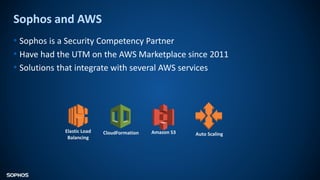
• Solutions that integrate with several AWS services
Auto ScalingAmazon S3CloudFormationElastic Load
Balancing
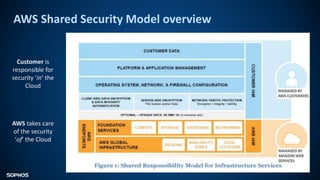
Customer is
responsible for
security ‘in’ the
Cloud
AWS takes care
of the security
‘of’ the Cloud
AWS Shared Security Model overview
Common threats
• Web application attacks, such as
SQLi and XSS
• DoS and DDoS
• Ransomware
• Exploits
• Brute force attacks
Consequences
• Data breach
o User data / passwords
o Financial info
o Now mandatory disclosure in Australia (for some)
• Loss of data
o Encryption by ransomware
• Hijacked servers
o Used as malware delivery servers
o Participation in DDoS attacks
o Stepping stone to bigger target
• Time and cost of restoration of systems and data
Servers are critical assets
7
• Corporate / proprietary data on network shares
• Web site content
• Higher value targets for ransomware
• Performance and availability critical for servers
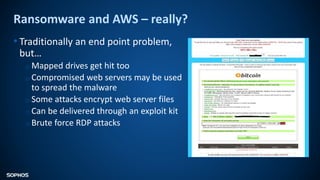
Ransomware and AWS – really?
• Traditionally an end point problem,
but…
o Mapped drives get hit too
o Compromised web servers may be used
to spread the malware
o Some attacks encrypt web server files
o Can be delivered through an exploit kit
o Brute force RDP attacks
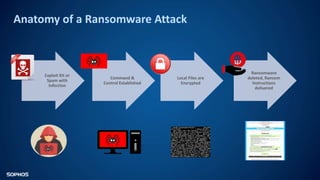
Anatomy of a Ransomware Attack
Exploit Kit or
Spam with
Infection
Command &
Control Established
Local Files are
Encrypted
Ransomware
deleted, Ransom
Instructions
delivered
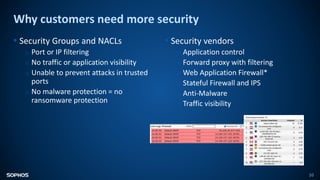
Why customers need more security
10
• Security Groups and NACLs
o Port or IP filtering
o No traffic or application visibility
o Unable to prevent attacks in trusted
ports
o No malware protection = no
ransomware protection
• Security vendors
o Application control
o Forward proxy with filtering
o Web Application Firewall*
o Stateful Firewall and IPS
o Anti-Malware
o Traffic visibility
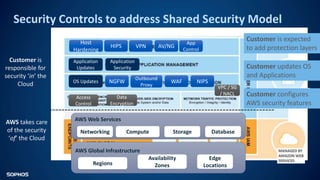
Security Controls to address Shared Security Model
Application
Security
Data
Encryption
Access
Control
VPC / SG
/ NACL
AWS Web Services
DatabaseStorageComputeNetworking
Application
Updates
HIPS
Customer is expected
to add protection layers
WAF
VPN
NGFW
Outbound
Proxy
Host
Hardening
Customer updates OS
and Applications
Availability
ZonesRegions
Edge
Locations
AWS Global Infrastructure
OS Updates NIPS
AV/NG
Customer configures
AWS security features
Customer is
responsible for
security ‘in’ the
Cloud
AWS takes care
of the security
‘of’ the Cloud
App
Control
Further Mitigations
• Backup, backup, backup…
• Block communications to C&C servers
• Monitor and block encryption behaviour on servers
• Reduce attack surface - Server lockdown / application
whitelisting
• Patch your ec2 instances! OS and Applications
• DDoS mitigation services (e.g. AWS Shield)
• Other regular corporate security controls
• User education and user security controls (email etc)
What is Sophos doing?
• Various deployments of UTM (FW/WAF/IPS/VPN/Proxy)
o Standalone
o HA
o Auto-scaling
• Server host protection integrates with AWS
• Phishing education for users
14

Shared Security in AWS

  • 1.
    Shared Security inAWS March 2017 Peter Gordon Cloud Security Architect APAC
  • 2.
    Agenda • Shared SecurityModel recap • Common threats & consequences • Ransomware and the cloud • Mapping controls to the SSM
  • 3.
    Sophos and AWS •Sophos is a Security Competency Partner • Have had the UTM on the AWS Marketplace since 2011 • Solutions that integrate with several AWS services Auto ScalingAmazon S3CloudFormationElastic Load Balancing
  • 4.
    Customer is responsible for security‘in’ the Cloud AWS takes care of the security ‘of’ the Cloud AWS Shared Security Model overview
  • 5.
    Common threats • Webapplication attacks, such as SQLi and XSS • DoS and DDoS • Ransomware • Exploits • Brute force attacks
  • 6.
    Consequences • Data breach oUser data / passwords o Financial info o Now mandatory disclosure in Australia (for some) • Loss of data o Encryption by ransomware • Hijacked servers o Used as malware delivery servers o Participation in DDoS attacks o Stepping stone to bigger target • Time and cost of restoration of systems and data
  • 7.
    Servers are criticalassets 7 • Corporate / proprietary data on network shares • Web site content • Higher value targets for ransomware • Performance and availability critical for servers
  • 8.
    Ransomware and AWS– really? • Traditionally an end point problem, but… o Mapped drives get hit too o Compromised web servers may be used to spread the malware o Some attacks encrypt web server files o Can be delivered through an exploit kit o Brute force RDP attacks
  • 9.
    Anatomy of aRansomware Attack Exploit Kit or Spam with Infection Command & Control Established Local Files are Encrypted Ransomware deleted, Ransom Instructions delivered
  • 10.
    Why customers needmore security 10 • Security Groups and NACLs o Port or IP filtering o No traffic or application visibility o Unable to prevent attacks in trusted ports o No malware protection = no ransomware protection • Security vendors o Application control o Forward proxy with filtering o Web Application Firewall* o Stateful Firewall and IPS o Anti-Malware o Traffic visibility
  • 11.
    Security Controls toaddress Shared Security Model Application Security Data Encryption Access Control VPC / SG / NACL AWS Web Services DatabaseStorageComputeNetworking Application Updates HIPS Customer is expected to add protection layers WAF VPN NGFW Outbound Proxy Host Hardening Customer updates OS and Applications Availability ZonesRegions Edge Locations AWS Global Infrastructure OS Updates NIPS AV/NG Customer configures AWS security features Customer is responsible for security ‘in’ the Cloud AWS takes care of the security ‘of’ the Cloud App Control
  • 12.
    Further Mitigations • Backup,backup, backup… • Block communications to C&C servers • Monitor and block encryption behaviour on servers • Reduce attack surface - Server lockdown / application whitelisting • Patch your ec2 instances! OS and Applications • DDoS mitigation services (e.g. AWS Shield) • Other regular corporate security controls • User education and user security controls (email etc)
  • 13.
    What is Sophosdoing? • Various deployments of UTM (FW/WAF/IPS/VPN/Proxy) o Standalone o HA o Auto-scaling • Server host protection integrates with AWS • Phishing education for users
  • 14.

Editor's Notes

  • #12 The main reason that customers need security solutions in the Public Cloud is that the major platforms use what’s called a shared security model. What this simply means is that the provider such as AWS, will ensure security of the platform itself which leaving security for anything you (the customer) installs up to the customers.