The Corporation in Global Perspective?

*************************************************
         On the Evolution of MNC Regulation
    From the External Regulation of MNCs to Self-
                     Governance
                              Larry Catá Backer
         W. Richard and Mary Eshelman Faculty Scholar and Professor of Law
                         Professor of International Affairs
                           Pennsylvania State University
                             239 Lewis Katz Building
                            University Park, PA 16802
                                  1-814-863-3640
                                  lcb11@psu.edu
Introduction
Roadmap: Overview of the evolution of Multinational
Corporations from objects to sources of law
MNCs as objects of law:
       --traditional governance landscape and regulatory gaps
       --failures of domestic law-state in the wake of
globalization
       --international governance alternatives
MNCs as Subjects
       --the MNC as government
                -self regulating entity
                -regulator through supply chain based
                  governance systems
The relationship between State and Corporation


Framing Assumptions:

        --The feral corporation domesticated—the corporation as a creature
of      the state
        --Economic activity as territorially bounded
        --Collective action approaches consistent with the parameters of the
        law-state ideology
traditional governance landscape and regulatory
                       gaps

• Traditional focus on public and positive law
  • Domestic corporate law
  • Domestic substantive law (environmental, labor, etc.)
  • International process/enforcement activity (arbitration, lex
    mercatoria, etc.)
  • International substantive law
     • Hard law—human rights
     • Soft law –behavior frameworks and principles
Failures of domestic law-state in the wake of
                   globalization

• Globalization: The rug gets pulled out from under the state

• Tensions between ideology of globalization and that of the
  law-state system
  • Law-state grounded in territorial principle and command
    approach to law
  • Globalization grounded in free movement of goods, enterprises
    and capital and managerial approach to governance
• Stubborness
  • States remain reluctant to cede regulatory authority over
    economic actors
Result –Strategic Gaming of Regulatory Environment


• Corporations operate across borders that obliterates
  effectiveness of territorial principle as foundational structure
  of governance units
  • Dispersion of assets and operations (global MNC strategic
    placements)
  • Strategic use of legal personality to divide operations (Bhopal)
  • Operations auctions among states (concessions based approach)
  • Law (and all regulatory systems) becomes a factor in the
    production of value with respect to which national loyalties play
    less of a role (CSR and supply chain governance)
Globalization and the functions of MNCs

• Conflation of private and public spheres
  • from an emphasis on markets and de-emphasis of command
    role for states in economic regulation
  • States engaging in private mafrket activities (SWFs)
• Privatization of governmental activities
• Conflict zone governance
• Political actors
  • Chile in the 1970s
  • Trade relationships with less developed states (agreements for
    favorable treatment between large MNCs and small states)
  • Civil society actors with substantial impacts in political life (even
    in the US—Citizens United)
Result: Governance Angst

• Alternative approaches to the use of law-state systems to
  regulate border crossing enterprises:
  • Extraterritoriality (state based sovereignty based) (Critique of
    “Brussels Effect”)
  • Shrinking Sovereign immunity (state based sovereignty
    debasing)
  • Responsibilities of MNCs (complicity in state obligations)
  • Commodification of law
• Alternative Reforms
  •   Expand veil piercing rules
  •   Universal jurisdiction
  •   Enterprise liability theories
  •   Legal harmonization (Labor, corruption, taxation, etc.)
  •   Civil liability for criminal acts of officers
international governance alternatives

• Developed World:
• New systems of governance developed by functionally
  distinct communities:
  • (i) self-constituted as autonomous governance unit;
  • (ii) rule making authority grounded in power vested in constituting
    documents;
  • (iii) institutionalized through development of a governance apparatus
    (government);
  • (iv) mechanisms for enforcement of rules and disciplining of members.
• Networked but autonomous
• Role of the state: facilitator; participant, partner but not
  owner of systems
international governance alternatives (cont.)

• Developing World:
  • TWAIN (3rd World Attitudes to International Law)
  • Castro critique (ALBA):
     • MNCs are disguised agents fo the states form which the derive their
       operational control.
     • The system itself is disguised imperialism asserted through
       developed state control of international organizations and their
       regulatory (monitoring, technical assistance and aid) machinery in
       the service of hegemony.
       • World Bank = U.S.
       • IMF = E.U.
  • Worh through some tof these approaches moves us closer to
     • Regimes where corporaitons become more actively involved in
       regulaiton
     • Division between public and private governance fade.
OECD System
• three sets of related governance structures that touch on the
  transparency of enterprises in their operations.
  • OECD Principles of Corporate Governance (OECD 2004)
  • OECD Guidelines on Corporate Governance of State-Owned
    Enterprises (OECD 2005)
  • Guidelines on Multinational Enterprises (OECD 2011)

• reflect a consensus, among developed states, of the basis for
  corporate organization in markets-based, welfare maximizing
  economic systems.
• Enforcement facilitated through states
  • National Contact Point System
  • Has produced some important decisions in last several years
     • Vendanta Corporation example
U.N. General Principles of Business and
            Human Rights (2011)
• posits a three-part framework—a state duty to protect
  human rights, a corporate responsibility to respect human
  rights, and an obligation to provide remedies for human
  rights wrongs.
  • State duty grounded on and limited by state legal commitment
    under international law
  • Corporate responsibility is grounded in international normative
    standards (International Bill of Human Rights) (built in
    polycentricity)
  • Remedial right based on shared obligations by states and MNCs
• Centerpiece: Human Rights Due Diligence System
• Now incorporated into OECD MNC Guidelines (Principle IV).
  • Networked governance; autonomy within interlinked
    governance systems
Global Compact
• one of the most recognizable and easy-to-follow initiatives relating
  to gathering and asserting CSR disclosures
• Organized around ten conduct oriented principles, a set of
  aspirational statements covering subjects of human
  rights, labor, environmental and anticorruption values, the UNGC
  seeks to create a framework for corporate accountability, though it
  is one that continues to suffer issues of legitimacy
• provide an annual Communication of Progress (CoP) indicating via
  self-reporting their continued aspiration to greater adherence to
  the Ten Principles.
• Failure to comply can result in listing the company as ‘non-
  communicating’ or “inactive,’ which has been employed against
  600 companies for failing to submit CoPs.
  • Expulsion most extreme sanction
  • Problem of “bluewashing”
ISO and GRI Sysetms
• International Organization for Standardization (ISO)
  • NGO; World’s largest developer of standards for sale
  • Network of national standards institutes of 163 states (some are
    private and some are public)
  • ISO 14000 environmental standards
  • ISO 26000 CSR standards
• Global Reporting Initiative (GRI)
  • promotes economic, environmental and social sustainability.
  • developed comprehensive sustainability reporting framework
    that is widely used around the world.
  • GRI Sustainability Reporting Guidelines consist of a complex
    system of disclosure elements, described as ‘performance
    indicators’, which can be quantitative or qualitative and reflect
    issues and elements of corporate behavior at practically every
    level.
Product and Process Certification
                  Organizations
• Substitute for role of the state in developing and assessing
  conformity with behavior standards
  • Greenwashing?
• Product certification
  • Forest Stewardship Council certification
      • assess forest management using the FSC principles, criteria, and
        standards, each certifier uses their own evaluative process
• Process certification
  • Fair Trade (http://www.fairtradeusa.org/)
      • To earn a license from Fair Trade USA to use the Fair Trade Certified™
        label on their products, companies must buy from certified farms and
        organizations, pay Fair Trade prices and premiums and submit to a
        rigorous supply chain audits.
• Market codes and the legitimacy of arms length evaluation of
  performance
  • Success depends on ability to balance perceived consumer tastes
    with company willingness to change behavior
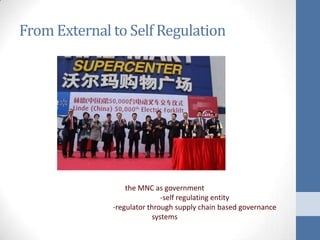
From External to Self Regulation


                  the MNC as government
                             -self regulating entity
              -regulator through supply chain based governance
                          systems
MNCs as Self Regulating Entities

• Corporate control over bundle of national regulatory regimes to
  which it will subject itself
  • Supply chain regulation is itself a testament to this move to
    corporate control
  • Haliburton
• Developer of standards applicable to itself and its supply chain
  • For the largest MNCs this has a powerful regulatory effect (private
    “Brussels Effect”?)
      • Example March 2011 Wal-Mart bans use of P.B.D.E.’s, or
        polybrominated diphenyl ethers, found in products like fabrics, car
        interiors and electronics from consumer goods sold at its stores
• Developer of self-imposed codes of conduct
  • 2011 KPMG International Corporate Responsibility Reporting
    Survey 2011 reported that “[n]inety-five percent of the 250 largest
    companies in the world (G250 companies) now report on their
    corporate responsibility (CR) activities, two-thirds of non-reporters
    are based in the US
From objects to sources of governance—
      Wal-Mart and the construction of autonomous self-
              constituted governance systems
• Governance is not confined to political territory but only to
  the intangible frontiers of the governance community
• Increasingly used by other communities as well:
  • Indigenous communities
  • religious communities
• Basic structure:
  •   Contract replaces law
  •   Networks of relationships replace political community,
  •   Interest replaces territory
  •   the regulated becomes the regulator
• Functionally differentiated community that is self
  constituted and operates within the parameters of its own
  organizing structures
Elements of MNC Supply Chain Regulatory
                   System:
•   MNCs
•   NGOs
•   Media
•   Consumers/Investors
•   States/ IOs
At the Center—The MNC
• Legislative role
   • Imposes norms, including norms with social and political effects as part of
     the working
       • Effectuated through supplier agreement and related policies
• Enforces standards
   • relationship internally and with supply chain partners
   • Through monitoring, retraining, audit, changes in organization and
     operation, assess penalties or terminate contract
• Shaper of behavior norms
   • Targeting consumers and investors as well as regulated group
• Techniques
   • The governance contract
   • Policies with governance effect
   • Networks with third party providers of
       • standards (Product/process certification) or
       • Verification (Apple and FLA)
   • Accountability to consumers and investors
       • Central role of transparency regimes (engagement and information harvesting
NGOs—
Monitors and Partners and Competitors
• Legislative function
• Monitoring function
• Normative function
   • Shaper of norms sometimes with and sometimes in opposition
     to MNC

   • Nature of interest:
      •   Enhances status
      •   Action at the center of their reason for existing
      •   Increase membership
      •   Useful for enhancing contributions and attention
Media—
Legitimators and Transparency Medium
• Legitimacy role
• Communication function to all stakeholders
• Nature of interest
   • In the business of generating news—basic commodity of media
     production
   • Enhanced role increases influence of media
   • Enhanced role good for institutional position of media actor and
     may also work on readership numbers and advertising revenues
Investors and Consumers—
Demos
• Corresponds to the demos in law-state system
• By their actions they determine the efficacy of actions by
  MNCs
  • Effected through market based actions—buying securities or
    products
• Both MNCs and NGOs (as well as the state and international
  organizations) look to these for the construction of norms
  and the management of common values.
• Governmentalization of markets
The State—
A De-Centered Role
• Secondary and indirect role in this system
• Memorialize potentially applicable standards
   • Like MNCs and NGOs target masses for the development and
     normalization of values which can then be expressed politically
     through voting and in market regulatory systems through
     purchases.
• Set outside boundaries for governance
• Provide an alternative space for disputer resolution
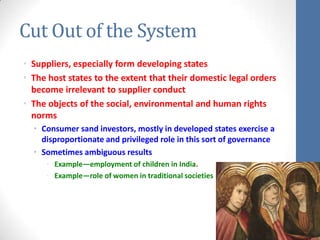
Cut Out of the System
• Suppliers, especially form developing states
• The host states to the extent that their domestic legal orders
  become irrelevant to supplier conduct
• The objects of the social, environmental and human rights
  norms
  • Consumer sand investors, mostly in developed states exercise a
    disproportionate and privileged role in this sort of governance
  • Sometimes ambiguous results
     • Example—employment of children in India.
     • Example—role of women in traditional societies
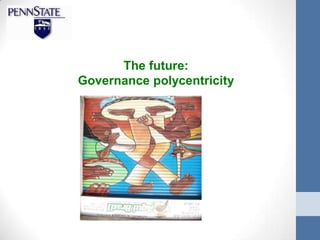
The future:
Governance polycentricity
Polycentricity
• Embrace idea that states and international frameworks work
  simultaneously
• States work through law systems
• Corporations work through norm systems
• International law and governance serves as a nexus point for state
  and non-state interests
• Soft law in this context changes character
  • Soft with respect to application within the law system of states
  • Soft with respect to its binding effect international law through states
  • Hard with respect to governance communities in which such norms
    serve as the rules of internal organization and governance
      • Implemented through contract and custom
      • Enforced internally through processes set up by the governance
        community
Additional Readings
• Transparency and Business in International Law, in TRANSPARENCY IN
  INTERNATIONAL LAW (Anne Peters and Andrea
  Bianchi, eds., Cambridge: Cambridge University Press, forthcoming
  2012);
  http://papers.ssrn.com/sol3/papers.cfm?abstract_id=2025503
• Globalization and the Socialist Multinational: Cuba at the
  Intersection of Business and Human Rights, in HANDBOOK ON
  CONTEMPORARY CUBA: ECONOMY, CIVIL SOCIETY, AND GLOBALIZATION (New
  York: CUNY/Paradigm Press, forthcoming 2012).
  http://papers.ssrn.com/sol3/papers.cfm?abstract_id=1646962
• From Institutional Misalignments to Socially Sustainable
  Governance: The Guiding Principles for the Implementation of the
  United Nation’s “Protect, Respect and Remedy” and the Construction
  of Inter-Systemic Global Governance, 24 PACIFIC MCGEORGE GLOBAL
  BUSINESS & DEVELOPMENT LAW JOURNAL – (forthcoming 2012) ;
  http://papers.ssrn.com/sol3/papers.cfm?abstract_id=1922953
More Stuff
• Private Actors and Public Governance Beyond the State: The
  Multinational Corporation, the Financial Stability Board and the
  Global Governance Order, 18(2) INDIANA JOURNAL OF GLOBAL LEGAL
  STUDIES 751 (2011).
  http://papers.ssrn.com/sol3/papers.cfm?abstract_id=1658730
• From Moral Obligation to International Law: Disclosure
  Systems, Markets and the Regulation of Multinational
  Corporations, 39 GEORGETOWN JOURNAL OF INTERNATIONAL LAW 591
  (2008).
  http://papers.ssrn.com/sol3/papers.cfm?abstract_id=1112882
• Multinational Corporations as Objects and Sources of Transnational
  Regulation, 14 ILSA JOURNAL OF INTERNATIONAL & COMPARATIVE LAW 499
  (2008).
  http://papers.ssrn.com/sol3/papers.cfm?abstract_id=1092167
• GLOBAL PANOPTICISM: SURVEILLANCE LAWMAKING BY
  CORPORATIONS, STATES, AND OTHER ENTITIES, 15(1) INDIANA JOURNAL OF
  GLOBAL LEGAL STUDIES 101 (2008).
  HTTP://PAPERS.SSRN.COM/SOL3/PAPERS.CFM?ABSTRACT_ID=1081242
Even More
• Economic Globalization and the Rise of Efficient Systems of Global
  Private Law Making: Wal-Mart as Global Legislator, 39(4) UNIVERSITY
  OF CONNECTICUT LAW REVIEW 1739 (2007).
  http://papers.ssrn.com/sol3/papers.cfm?abstract_id=953216

• Bric à Brac
• Governance Without Government: An Overview, in BEYOND
  TERRITORIALITY: TRANSNATIONAL LEGAL AUTHORITY IN AN AGE OF
  GLOBALIZATION (Günther Handl and Joachim Zekoll
  Editors, Leiden, Netherlands & Boston, MA: Brill Academic
  Publishers, forthcoming 2012).
  http://papers.ssrn.com/sol3/papers.cfm?abstract_id=1568934
• Sovereign Wealth Funds as Regulatory Chameleons: The Norwegian
  Sovereign Wealth Funds and Public Global Governance Through
  Private Global Investment, 41(2) GEORGETOWN JOURNAL OF
  INTERNATIONAL LAW 425-500 (2010).
  http://papers.ssrn.com/sol3/papers.cfm?abstract_id=1398835
Sovereign Investing in Times of Crisis: Global Regulation of Sovereign
Wealth Funds, State Owned Enterprises and the Chinese Experience, 19(1)
TRANSNATIONAL LAW & CONTEMPORARY PROBLEMS 3-144 (2010).
http://papers.ssrn.com/sol3/papers.cfm?abstract_id=1444190


Case Note: Rights And Accountability In Development (Raid) V Das Air
(21
July 2008) And Global Witness V Afrimex (28 August 2008); Small Steps
Toward an Autonomous Transnational Legal System for the Regulation of
Multinational Corporations, 10(1) MELBOURNE JOURNAL OF INTERNATIONAL LAW
258-307 (2009).
http://papers.ssrn.com/sol3/papers.cfm?abstract_id=1427883
Thank You!!!

Shared corp globalpersp3-2012

  • 1.
    The Corporation inGlobal Perspective? ************************************************* On the Evolution of MNC Regulation From the External Regulation of MNCs to Self- Governance Larry Catá Backer W. Richard and Mary Eshelman Faculty Scholar and Professor of Law Professor of International Affairs Pennsylvania State University 239 Lewis Katz Building University Park, PA 16802 1-814-863-3640 lcb11@psu.edu
  • 2.
    Introduction Roadmap: Overview ofthe evolution of Multinational Corporations from objects to sources of law MNCs as objects of law: --traditional governance landscape and regulatory gaps --failures of domestic law-state in the wake of globalization --international governance alternatives MNCs as Subjects --the MNC as government -self regulating entity -regulator through supply chain based governance systems
  • 3.
    The relationship betweenState and Corporation Framing Assumptions: --The feral corporation domesticated—the corporation as a creature of the state --Economic activity as territorially bounded --Collective action approaches consistent with the parameters of the law-state ideology
  • 4.
    traditional governance landscapeand regulatory gaps • Traditional focus on public and positive law • Domestic corporate law • Domestic substantive law (environmental, labor, etc.) • International process/enforcement activity (arbitration, lex mercatoria, etc.) • International substantive law • Hard law—human rights • Soft law –behavior frameworks and principles
  • 5.
    Failures of domesticlaw-state in the wake of globalization • Globalization: The rug gets pulled out from under the state • Tensions between ideology of globalization and that of the law-state system • Law-state grounded in territorial principle and command approach to law • Globalization grounded in free movement of goods, enterprises and capital and managerial approach to governance • Stubborness • States remain reluctant to cede regulatory authority over economic actors
  • 6.
    Result –Strategic Gamingof Regulatory Environment • Corporations operate across borders that obliterates effectiveness of territorial principle as foundational structure of governance units • Dispersion of assets and operations (global MNC strategic placements) • Strategic use of legal personality to divide operations (Bhopal) • Operations auctions among states (concessions based approach) • Law (and all regulatory systems) becomes a factor in the production of value with respect to which national loyalties play less of a role (CSR and supply chain governance)
  • 7.
    Globalization and thefunctions of MNCs • Conflation of private and public spheres • from an emphasis on markets and de-emphasis of command role for states in economic regulation • States engaging in private mafrket activities (SWFs) • Privatization of governmental activities • Conflict zone governance • Political actors • Chile in the 1970s • Trade relationships with less developed states (agreements for favorable treatment between large MNCs and small states) • Civil society actors with substantial impacts in political life (even in the US—Citizens United)
  • 8.
    Result: Governance Angst •Alternative approaches to the use of law-state systems to regulate border crossing enterprises: • Extraterritoriality (state based sovereignty based) (Critique of “Brussels Effect”) • Shrinking Sovereign immunity (state based sovereignty debasing) • Responsibilities of MNCs (complicity in state obligations) • Commodification of law • Alternative Reforms • Expand veil piercing rules • Universal jurisdiction • Enterprise liability theories • Legal harmonization (Labor, corruption, taxation, etc.) • Civil liability for criminal acts of officers
  • 9.
    international governance alternatives •Developed World: • New systems of governance developed by functionally distinct communities: • (i) self-constituted as autonomous governance unit; • (ii) rule making authority grounded in power vested in constituting documents; • (iii) institutionalized through development of a governance apparatus (government); • (iv) mechanisms for enforcement of rules and disciplining of members. • Networked but autonomous • Role of the state: facilitator; participant, partner but not owner of systems
  • 10.
    international governance alternatives(cont.) • Developing World: • TWAIN (3rd World Attitudes to International Law) • Castro critique (ALBA): • MNCs are disguised agents fo the states form which the derive their operational control. • The system itself is disguised imperialism asserted through developed state control of international organizations and their regulatory (monitoring, technical assistance and aid) machinery in the service of hegemony. • World Bank = U.S. • IMF = E.U. • Worh through some tof these approaches moves us closer to • Regimes where corporaitons become more actively involved in regulaiton • Division between public and private governance fade.
  • 11.
    OECD System • threesets of related governance structures that touch on the transparency of enterprises in their operations. • OECD Principles of Corporate Governance (OECD 2004) • OECD Guidelines on Corporate Governance of State-Owned Enterprises (OECD 2005) • Guidelines on Multinational Enterprises (OECD 2011) • reflect a consensus, among developed states, of the basis for corporate organization in markets-based, welfare maximizing economic systems. • Enforcement facilitated through states • National Contact Point System • Has produced some important decisions in last several years • Vendanta Corporation example
  • 12.
    U.N. General Principlesof Business and Human Rights (2011) • posits a three-part framework—a state duty to protect human rights, a corporate responsibility to respect human rights, and an obligation to provide remedies for human rights wrongs. • State duty grounded on and limited by state legal commitment under international law • Corporate responsibility is grounded in international normative standards (International Bill of Human Rights) (built in polycentricity) • Remedial right based on shared obligations by states and MNCs • Centerpiece: Human Rights Due Diligence System • Now incorporated into OECD MNC Guidelines (Principle IV). • Networked governance; autonomy within interlinked governance systems
  • 13.
    Global Compact • oneof the most recognizable and easy-to-follow initiatives relating to gathering and asserting CSR disclosures • Organized around ten conduct oriented principles, a set of aspirational statements covering subjects of human rights, labor, environmental and anticorruption values, the UNGC seeks to create a framework for corporate accountability, though it is one that continues to suffer issues of legitimacy • provide an annual Communication of Progress (CoP) indicating via self-reporting their continued aspiration to greater adherence to the Ten Principles. • Failure to comply can result in listing the company as ‘non- communicating’ or “inactive,’ which has been employed against 600 companies for failing to submit CoPs. • Expulsion most extreme sanction • Problem of “bluewashing”
  • 14.
    ISO and GRISysetms • International Organization for Standardization (ISO) • NGO; World’s largest developer of standards for sale • Network of national standards institutes of 163 states (some are private and some are public) • ISO 14000 environmental standards • ISO 26000 CSR standards • Global Reporting Initiative (GRI) • promotes economic, environmental and social sustainability. • developed comprehensive sustainability reporting framework that is widely used around the world. • GRI Sustainability Reporting Guidelines consist of a complex system of disclosure elements, described as ‘performance indicators’, which can be quantitative or qualitative and reflect issues and elements of corporate behavior at practically every level.
  • 15.
    Product and ProcessCertification Organizations • Substitute for role of the state in developing and assessing conformity with behavior standards • Greenwashing? • Product certification • Forest Stewardship Council certification • assess forest management using the FSC principles, criteria, and standards, each certifier uses their own evaluative process • Process certification • Fair Trade (http://www.fairtradeusa.org/) • To earn a license from Fair Trade USA to use the Fair Trade Certified™ label on their products, companies must buy from certified farms and organizations, pay Fair Trade prices and premiums and submit to a rigorous supply chain audits. • Market codes and the legitimacy of arms length evaluation of performance • Success depends on ability to balance perceived consumer tastes with company willingness to change behavior
  • 16.
    From External toSelf Regulation the MNC as government -self regulating entity -regulator through supply chain based governance systems
  • 17.
    MNCs as SelfRegulating Entities • Corporate control over bundle of national regulatory regimes to which it will subject itself • Supply chain regulation is itself a testament to this move to corporate control • Haliburton • Developer of standards applicable to itself and its supply chain • For the largest MNCs this has a powerful regulatory effect (private “Brussels Effect”?) • Example March 2011 Wal-Mart bans use of P.B.D.E.’s, or polybrominated diphenyl ethers, found in products like fabrics, car interiors and electronics from consumer goods sold at its stores • Developer of self-imposed codes of conduct • 2011 KPMG International Corporate Responsibility Reporting Survey 2011 reported that “[n]inety-five percent of the 250 largest companies in the world (G250 companies) now report on their corporate responsibility (CR) activities, two-thirds of non-reporters are based in the US
  • 18.
    From objects tosources of governance— Wal-Mart and the construction of autonomous self- constituted governance systems • Governance is not confined to political territory but only to the intangible frontiers of the governance community • Increasingly used by other communities as well: • Indigenous communities • religious communities • Basic structure: • Contract replaces law • Networks of relationships replace political community, • Interest replaces territory • the regulated becomes the regulator • Functionally differentiated community that is self constituted and operates within the parameters of its own organizing structures
  • 19.
    Elements of MNCSupply Chain Regulatory System: • MNCs • NGOs • Media • Consumers/Investors • States/ IOs
  • 20.
    At the Center—TheMNC • Legislative role • Imposes norms, including norms with social and political effects as part of the working • Effectuated through supplier agreement and related policies • Enforces standards • relationship internally and with supply chain partners • Through monitoring, retraining, audit, changes in organization and operation, assess penalties or terminate contract • Shaper of behavior norms • Targeting consumers and investors as well as regulated group • Techniques • The governance contract • Policies with governance effect • Networks with third party providers of • standards (Product/process certification) or • Verification (Apple and FLA) • Accountability to consumers and investors • Central role of transparency regimes (engagement and information harvesting
  • 21.
    NGOs— Monitors and Partnersand Competitors • Legislative function • Monitoring function • Normative function • Shaper of norms sometimes with and sometimes in opposition to MNC • Nature of interest: • Enhances status • Action at the center of their reason for existing • Increase membership • Useful for enhancing contributions and attention
  • 22.
    Media— Legitimators and TransparencyMedium • Legitimacy role • Communication function to all stakeholders • Nature of interest • In the business of generating news—basic commodity of media production • Enhanced role increases influence of media • Enhanced role good for institutional position of media actor and may also work on readership numbers and advertising revenues
  • 23.
    Investors and Consumers— Demos •Corresponds to the demos in law-state system • By their actions they determine the efficacy of actions by MNCs • Effected through market based actions—buying securities or products • Both MNCs and NGOs (as well as the state and international organizations) look to these for the construction of norms and the management of common values. • Governmentalization of markets
  • 24.
    The State— A De-CenteredRole • Secondary and indirect role in this system • Memorialize potentially applicable standards • Like MNCs and NGOs target masses for the development and normalization of values which can then be expressed politically through voting and in market regulatory systems through purchases. • Set outside boundaries for governance • Provide an alternative space for disputer resolution
  • 25.
    Cut Out ofthe System • Suppliers, especially form developing states • The host states to the extent that their domestic legal orders become irrelevant to supplier conduct • The objects of the social, environmental and human rights norms • Consumer sand investors, mostly in developed states exercise a disproportionate and privileged role in this sort of governance • Sometimes ambiguous results • Example—employment of children in India. • Example—role of women in traditional societies
  • 26.
  • 27.
    Polycentricity • Embrace ideathat states and international frameworks work simultaneously • States work through law systems • Corporations work through norm systems • International law and governance serves as a nexus point for state and non-state interests • Soft law in this context changes character • Soft with respect to application within the law system of states • Soft with respect to its binding effect international law through states • Hard with respect to governance communities in which such norms serve as the rules of internal organization and governance • Implemented through contract and custom • Enforced internally through processes set up by the governance community
  • 28.
    Additional Readings • Transparencyand Business in International Law, in TRANSPARENCY IN INTERNATIONAL LAW (Anne Peters and Andrea Bianchi, eds., Cambridge: Cambridge University Press, forthcoming 2012); http://papers.ssrn.com/sol3/papers.cfm?abstract_id=2025503 • Globalization and the Socialist Multinational: Cuba at the Intersection of Business and Human Rights, in HANDBOOK ON CONTEMPORARY CUBA: ECONOMY, CIVIL SOCIETY, AND GLOBALIZATION (New York: CUNY/Paradigm Press, forthcoming 2012). http://papers.ssrn.com/sol3/papers.cfm?abstract_id=1646962 • From Institutional Misalignments to Socially Sustainable Governance: The Guiding Principles for the Implementation of the United Nation’s “Protect, Respect and Remedy” and the Construction of Inter-Systemic Global Governance, 24 PACIFIC MCGEORGE GLOBAL BUSINESS & DEVELOPMENT LAW JOURNAL – (forthcoming 2012) ; http://papers.ssrn.com/sol3/papers.cfm?abstract_id=1922953
  • 29.
    More Stuff • PrivateActors and Public Governance Beyond the State: The Multinational Corporation, the Financial Stability Board and the Global Governance Order, 18(2) INDIANA JOURNAL OF GLOBAL LEGAL STUDIES 751 (2011). http://papers.ssrn.com/sol3/papers.cfm?abstract_id=1658730 • From Moral Obligation to International Law: Disclosure Systems, Markets and the Regulation of Multinational Corporations, 39 GEORGETOWN JOURNAL OF INTERNATIONAL LAW 591 (2008). http://papers.ssrn.com/sol3/papers.cfm?abstract_id=1112882 • Multinational Corporations as Objects and Sources of Transnational Regulation, 14 ILSA JOURNAL OF INTERNATIONAL & COMPARATIVE LAW 499 (2008). http://papers.ssrn.com/sol3/papers.cfm?abstract_id=1092167 • GLOBAL PANOPTICISM: SURVEILLANCE LAWMAKING BY CORPORATIONS, STATES, AND OTHER ENTITIES, 15(1) INDIANA JOURNAL OF GLOBAL LEGAL STUDIES 101 (2008). HTTP://PAPERS.SSRN.COM/SOL3/PAPERS.CFM?ABSTRACT_ID=1081242
  • 30.
    Even More • EconomicGlobalization and the Rise of Efficient Systems of Global Private Law Making: Wal-Mart as Global Legislator, 39(4) UNIVERSITY OF CONNECTICUT LAW REVIEW 1739 (2007). http://papers.ssrn.com/sol3/papers.cfm?abstract_id=953216 • Bric à Brac • Governance Without Government: An Overview, in BEYOND TERRITORIALITY: TRANSNATIONAL LEGAL AUTHORITY IN AN AGE OF GLOBALIZATION (Günther Handl and Joachim Zekoll Editors, Leiden, Netherlands & Boston, MA: Brill Academic Publishers, forthcoming 2012). http://papers.ssrn.com/sol3/papers.cfm?abstract_id=1568934 • Sovereign Wealth Funds as Regulatory Chameleons: The Norwegian Sovereign Wealth Funds and Public Global Governance Through Private Global Investment, 41(2) GEORGETOWN JOURNAL OF INTERNATIONAL LAW 425-500 (2010). http://papers.ssrn.com/sol3/papers.cfm?abstract_id=1398835
  • 31.
    Sovereign Investing inTimes of Crisis: Global Regulation of Sovereign Wealth Funds, State Owned Enterprises and the Chinese Experience, 19(1) TRANSNATIONAL LAW & CONTEMPORARY PROBLEMS 3-144 (2010). http://papers.ssrn.com/sol3/papers.cfm?abstract_id=1444190 Case Note: Rights And Accountability In Development (Raid) V Das Air (21
July 2008) And Global Witness V Afrimex (28 August 2008); Small Steps Toward an Autonomous Transnational Legal System for the Regulation of Multinational Corporations, 10(1) MELBOURNE JOURNAL OF INTERNATIONAL LAW 258-307 (2009). http://papers.ssrn.com/sol3/papers.cfm?abstract_id=1427883
  • 32.