Shape Your Ideas oikos Winter School 2008 Katharina Beck & Martin Herrndorf University Witten/Herdecke 20 November 2008 based on a presentation by Kim Poldner and Martin Herrndorf at the oikos Autumn Meeting 2008, Graz Alpstein Fotos: Katharina Beck; LogFrame Content based on BOND publication
Agenda 2 A project as a journey 1 Introduction and expectations 3 The Logical Framework (LogFrame) Method 4  Group work on your project ideas 5 Discussion and Feedback
Intro: The Butterfly Effect
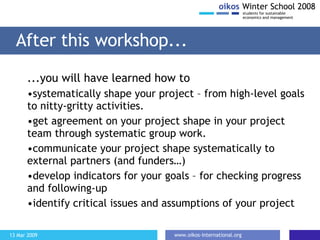
...you w ill have learned how to systematically shape your project  –  from high-level goals to nitty-gritty activities. g et agreement on your project shape in your project team through systematic group work. communicate your project shape systematically to external partners (and funders …) develop indicators for your goals  –  for checking progress and following-up identify critical issues and assumptions of your project After this workshop...
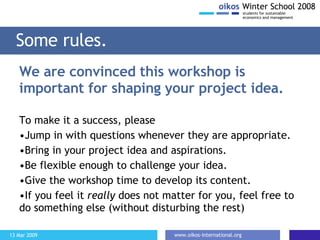
We are convinced this workshop is important for shaping your project idea. To make it a success, please Jump in with questions whenever they are appropriate. Bring in your project idea and aspirations. Be flexible enough to challenge your idea. Give the workshop time to develop its content. If you feel it  really  does not matter for you, feel free to do something else (without disturbing the rest) Some rules.
Agenda 2 A project as a journey 1 Introduction and expectations 3 The Logical Framework (LogFrame) Method 4  Group work on your project ideas 5 Discussion and Feedback
A project is like a journey! so... How do you find your way? Measuring and managing
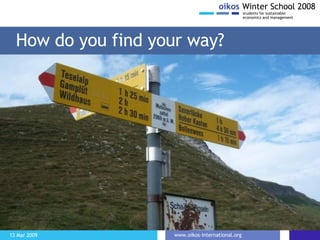
How do you find your way?
Agenda 2 A project as a journey 1 Introduction and expectations 3 The Logical Framework (LogFrame) Method 4  Group work on your project ideas 5 Discussion and Feedback
Why use a logical framework? 1 Goal   2 Purposes 3 Outputs 4 Activities 5 Input
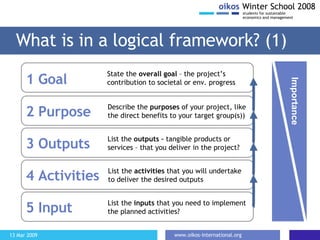
What is in a logical framework? (1) State the  overall goal  – the project’s contribution to societal or env. progress   1 Goal   Describe the  purposes  of your project, like the direct benefits to your target group(s))   2 Purpose List the  outputs –  tangible products or services – that you deliver in the project?   3 Outputs List the  activities  that you will undertake to deliver the desired outputs   4 Activities List the  inputs  that you need to implement the planned activities?   5 Input Control Importance
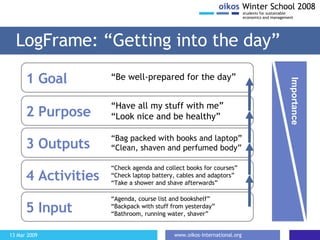
LogFrame: “Getting into the day” “ Be well-prepared for the day” 1 Goal  “ Have all my stuff with me” “Look nice and be healthy” 2 Purpose “ Bag packed with books and laptop” “ Clean, shaven and perfumed body” 3 Outputs “ Check agenda and collect books for courses” “ Check laptop battery, cables and adaptors” “ Take a shower and shave afterwards” 4 Activities “ Agenda, course list and bookshelf” “ Backpack with stuff from yesterday” “ Bathroom, running water, shaver” 5 Input Control Importance
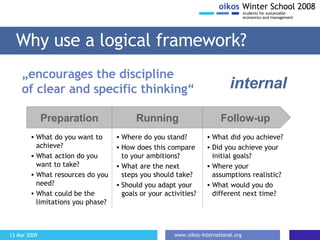
Why use a logical framework? Where do you stand?  How does this compare to your ambitions? What are the next steps you should take? Should you adapt your goals or your activities? „ encourages the discipline  of clear and specific thinking“ Preparation Running Follow-up What do you want to achieve? What action do you want to take? What resources do you need? What could be the limitations you phase? internal What did you achieve? Did you achieve your initial goals? Where your assumptions realistic? What would you do different next time?
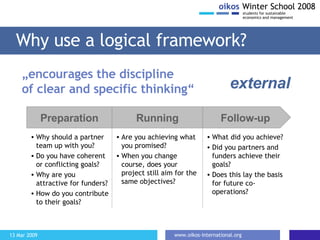
Why use a logical framework? Are you achieving what you promised? When you change course, does your project still aim for the same objectives? „ encourages the discipline  of clear and specific thinking“ Preparation Running Follow-up Why should a partner team up with you? Do you have coherent or conflicting goals? Why are you attractive for funders? How do you contribute to their goals? external What did you achieve? Did you partners and funders achieve their goals? Does this lay the basis for future co-operations?
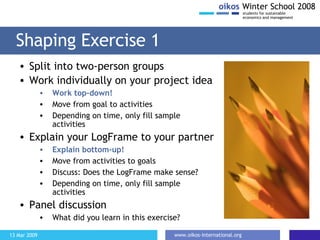
Shaping Exercise 1 Split into two-person groups Work individually on your project idea Work top-down!   Move from goal to activities Depending on time, only fill sample activities Explain your LogFrame to your partner Explain bottom-up!   Move from activities to goals Discuss: Does the LogFrame make sense? Depending on time, only fill sample activities Panel discussion  What did you learn in this exercise?
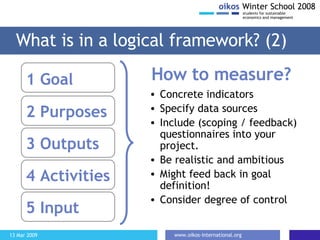
What is in a logical framework? (2) 1 Goal   2 Purposes 3 Outputs 4 Activities 5 Input How to measure? Concrete indicators Specify data sources Include (scoping / feedback) questionnaires into your project.  Be realistic and ambitious Might feed back in goal definition! Consider degree of control
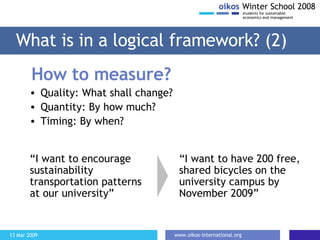
What is in a logical framework? (2) How to measure? Quality: What shall change? Quantity: By how much? Timing: By when? “ I want to encourage sustainability transportation patterns at our university” “ I want to have 200 free, shared bicycles on the university campus by November 2009”
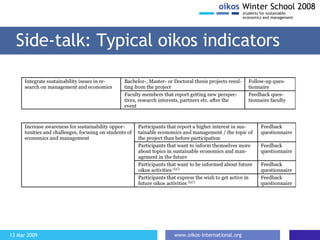
Side-talk: Typical oikos indicators
Shaping Exercise 2 Split into the same two-person groups Work individually on your project idea Fill in indicators in your sheet 1 for goal, 2 for purposes, 3 for activities Explain your LogFrame to your partner Explain your indicators Discuss: How good are these indicators? Precision? Panel discussion  What did you learn in this exercise?
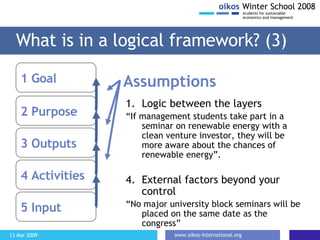
What is in a logical framework? (3) 1 Goal  2 Purpose 3 Outputs 4 Activities 5 Input Assumptions Logic between the layers “ If management students take part in a seminar on renewable energy with a clean venture investor, they will be more aware about the chances of renewable energy”. External factors beyond your control “ No major university block seminars will be placed on the same date as the congress”
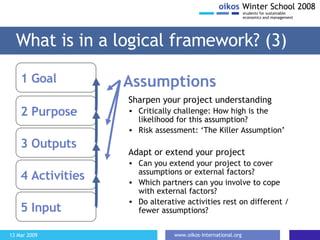
What is in a logical framework? (3) Sharpen your project understanding Critically challenge: How high is the likelihood for this assumption? Risk assessment: ‘The Killer Assumption’ Adapt or extend your project Can you extend your project to cover assumptions or external factors? Which partners can you involve to cope with external factors? Do alterative activities rest on different / fewer assumptions? 1 Goal  2 Purpose 3 Outputs 4 Activities 5 Input Assumptions
Shaping Exercise 3 Split into the same two-person groups Work individually on your project idea Fill in assumptions in your sheet 2 for each linkage (1 logic, 1 external factor) Explain your LogFrame to your partner Explain your assumptions Discuss: How good are these indicators? Precision? Panel discussion  What did you learn in this exercise?
Further reading & surfing………… Bell, Simon; Morse, Stephen (2008); Sustainability Indicators: Measuring the Immeasurable? George, Clive; Kirkpatrick, Colin (2007); Impact  Assessment and Sustainable Development: European Practice and Experience (Evaluating Sustainable Development) BOND:  Logical Framework Analysis. BOND Guidance Notes Series  (nice introduction and overview on LogFrames) European Commission: Project Cycle Management Guidelines. Aid Delivery Methods, Volume 1  (nicely prepared, but very extensive treatment of LogFrames and other tools) Lawlor, E., Neitzert, E., & Nicholls, J. (2008). Measuring real value: A guide to Social Return on Investment. London, UK: new economics foundation (nef).  (variant to LogFrame, wider scope) Butterfly-works: www.butterfly-works.org
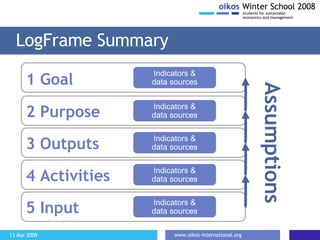
LogFrame Summary 1 Goal   2 Purpose 3 Outputs 4 Activities 5 Input Assumptions Indicators & data sources Indicators & data sources Indicators & data sources Indicators & data sources Indicators & data sources

Agenda 2 A project as a journey 1 Introduction and expectations 3 The Logical Framework (LogFrame) Method 4  Group work on your project ideas 5 Discussion and Feedback
Group work …  If we would have some time left … Spend some time revising the LogFrame you started during the previous exercises. Write questions on the board Martin and Katharina answer your specific questions individually / in small group / in plenum, depending on the interest others have in the question.
Group work …  As we have some time left … Spend some time revising the LogFrame you started during the previous exercises. Write questions on the board Martin and Katharina answer your specific questions individually / in small group / in plenum, depending on the interest others have in the question.
Agenda 2 A project as a journey 1 Introduction and expectations 3 The Logical Framework (LogFrame) Method 4  Group work on your project ideas 5 Discussion and Feedback
Discussion Did LogFrame help you to shape your project idea? Is it a method you will use for shaping your project further (and preparing your  S aturday  presentation)? Is it a method you would like to use in the future on other projects? Oh, and what did you like about the workshop?
What to keep in mind….. Well, you might… Continuously reflect on your project; Balance ‘questioning’ and ‘full steam’; Not drown yourself in paperwork, but keep it simple; Be out there and not locked in an office And also… Act from the heart & with good intentions; Trust that you actually can have a great impact!
Be a butterfly until you're 88!  a nd beyond …
Thanks  for... oikos Winter School 2008 Katharina Beck & Martin Herrndorf beck@oikosinternational.org, herrndorf@oikosinternational.org University Witten/Herdecke 20 November 2008

Shaping Ideas – LogFrame Workshop at the oikos Winter School 2008

  • 1.
    Shape Your Ideasoikos Winter School 2008 Katharina Beck & Martin Herrndorf University Witten/Herdecke 20 November 2008 based on a presentation by Kim Poldner and Martin Herrndorf at the oikos Autumn Meeting 2008, Graz Alpstein Fotos: Katharina Beck; LogFrame Content based on BOND publication
  • 2.
    Agenda 2 Aproject as a journey 1 Introduction and expectations 3 The Logical Framework (LogFrame) Method 4 Group work on your project ideas 5 Discussion and Feedback
  • 3.
    Agenda 2 Aproject as a journey 1 Introduction and expectations 3 The Logical Framework (LogFrame) Method 4 Group work on your project ideas 5 Discussion and Feedback
  • 4.
  • 5.
    ...you w illhave learned how to systematically shape your project – from high-level goals to nitty-gritty activities. g et agreement on your project shape in your project team through systematic group work. communicate your project shape systematically to external partners (and funders …) develop indicators for your goals – for checking progress and following-up identify critical issues and assumptions of your project After this workshop...
  • 6.
    We are convincedthis workshop is important for shaping your project idea. To make it a success, please Jump in with questions whenever they are appropriate. Bring in your project idea and aspirations. Be flexible enough to challenge your idea. Give the workshop time to develop its content. If you feel it really does not matter for you, feel free to do something else (without disturbing the rest) Some rules.
  • 7.
    Agenda 2 Aproject as a journey 1 Introduction and expectations 3 The Logical Framework (LogFrame) Method 4 Group work on your project ideas 5 Discussion and Feedback
  • 8.
    A project islike a journey! so... How do you find your way? Measuring and managing
  • 9.
    How do youfind your way?
  • 10.
    How do youfind your way?
  • 11.
    How do youfind your way?
  • 12.
    How do youfind your way?
  • 13.
    How do youfind your way?
  • 14.
    How do youfind your way?
  • 15.
    How do youfind your way?
  • 16.
    How do youfind your way?
  • 17.
    Agenda 2 Aproject as a journey 1 Introduction and expectations 3 The Logical Framework (LogFrame) Method 4 Group work on your project ideas 5 Discussion and Feedback
  • 18.
    Why use alogical framework? 1 Goal 2 Purposes 3 Outputs 4 Activities 5 Input
  • 19.
    What is ina logical framework? (1) State the overall goal – the project’s contribution to societal or env. progress 1 Goal Describe the purposes of your project, like the direct benefits to your target group(s)) 2 Purpose List the outputs – tangible products or services – that you deliver in the project? 3 Outputs List the activities that you will undertake to deliver the desired outputs 4 Activities List the inputs that you need to implement the planned activities? 5 Input Control Importance
  • 20.
    LogFrame: “Getting intothe day” “ Be well-prepared for the day” 1 Goal “ Have all my stuff with me” “Look nice and be healthy” 2 Purpose “ Bag packed with books and laptop” “ Clean, shaven and perfumed body” 3 Outputs “ Check agenda and collect books for courses” “ Check laptop battery, cables and adaptors” “ Take a shower and shave afterwards” 4 Activities “ Agenda, course list and bookshelf” “ Backpack with stuff from yesterday” “ Bathroom, running water, shaver” 5 Input Control Importance
  • 21.
    Why use alogical framework? Where do you stand? How does this compare to your ambitions? What are the next steps you should take? Should you adapt your goals or your activities? „ encourages the discipline of clear and specific thinking“ Preparation Running Follow-up What do you want to achieve? What action do you want to take? What resources do you need? What could be the limitations you phase? internal What did you achieve? Did you achieve your initial goals? Where your assumptions realistic? What would you do different next time?
  • 22.
    Why use alogical framework? Are you achieving what you promised? When you change course, does your project still aim for the same objectives? „ encourages the discipline of clear and specific thinking“ Preparation Running Follow-up Why should a partner team up with you? Do you have coherent or conflicting goals? Why are you attractive for funders? How do you contribute to their goals? external What did you achieve? Did you partners and funders achieve their goals? Does this lay the basis for future co-operations?
  • 23.
    Shaping Exercise 1Split into two-person groups Work individually on your project idea Work top-down! Move from goal to activities Depending on time, only fill sample activities Explain your LogFrame to your partner Explain bottom-up! Move from activities to goals Discuss: Does the LogFrame make sense? Depending on time, only fill sample activities Panel discussion What did you learn in this exercise?
  • 24.
    What is ina logical framework? (2) 1 Goal 2 Purposes 3 Outputs 4 Activities 5 Input How to measure? Concrete indicators Specify data sources Include (scoping / feedback) questionnaires into your project. Be realistic and ambitious Might feed back in goal definition! Consider degree of control
  • 25.
    What is ina logical framework? (2) How to measure? Quality: What shall change? Quantity: By how much? Timing: By when? “ I want to encourage sustainability transportation patterns at our university” “ I want to have 200 free, shared bicycles on the university campus by November 2009”
  • 26.
  • 27.
    Shaping Exercise 2Split into the same two-person groups Work individually on your project idea Fill in indicators in your sheet 1 for goal, 2 for purposes, 3 for activities Explain your LogFrame to your partner Explain your indicators Discuss: How good are these indicators? Precision? Panel discussion What did you learn in this exercise?
  • 28.
    What is ina logical framework? (3) 1 Goal 2 Purpose 3 Outputs 4 Activities 5 Input Assumptions Logic between the layers “ If management students take part in a seminar on renewable energy with a clean venture investor, they will be more aware about the chances of renewable energy”. External factors beyond your control “ No major university block seminars will be placed on the same date as the congress”
  • 29.
    What is ina logical framework? (3) Sharpen your project understanding Critically challenge: How high is the likelihood for this assumption? Risk assessment: ‘The Killer Assumption’ Adapt or extend your project Can you extend your project to cover assumptions or external factors? Which partners can you involve to cope with external factors? Do alterative activities rest on different / fewer assumptions? 1 Goal 2 Purpose 3 Outputs 4 Activities 5 Input Assumptions
  • 30.
    Shaping Exercise 3Split into the same two-person groups Work individually on your project idea Fill in assumptions in your sheet 2 for each linkage (1 logic, 1 external factor) Explain your LogFrame to your partner Explain your assumptions Discuss: How good are these indicators? Precision? Panel discussion What did you learn in this exercise?
  • 31.
    Further reading &surfing………… Bell, Simon; Morse, Stephen (2008); Sustainability Indicators: Measuring the Immeasurable? George, Clive; Kirkpatrick, Colin (2007); Impact Assessment and Sustainable Development: European Practice and Experience (Evaluating Sustainable Development) BOND: Logical Framework Analysis. BOND Guidance Notes Series (nice introduction and overview on LogFrames) European Commission: Project Cycle Management Guidelines. Aid Delivery Methods, Volume 1 (nicely prepared, but very extensive treatment of LogFrames and other tools) Lawlor, E., Neitzert, E., & Nicholls, J. (2008). Measuring real value: A guide to Social Return on Investment. London, UK: new economics foundation (nef). (variant to LogFrame, wider scope) Butterfly-works: www.butterfly-works.org
  • 32.
    LogFrame Summary 1Goal 2 Purpose 3 Outputs 4 Activities 5 Input Assumptions Indicators & data sources Indicators & data sources Indicators & data sources Indicators & data sources Indicators & data sources
  • 33.
    Agenda 2 Aproject as a journey 1 Introduction and expectations 3 The Logical Framework (LogFrame) Method 4 Group work on your project ideas 5 Discussion and Feedback
  • 34.
    Group work … If we would have some time left … Spend some time revising the LogFrame you started during the previous exercises. Write questions on the board Martin and Katharina answer your specific questions individually / in small group / in plenum, depending on the interest others have in the question.
  • 35.
    Group work … As we have some time left … Spend some time revising the LogFrame you started during the previous exercises. Write questions on the board Martin and Katharina answer your specific questions individually / in small group / in plenum, depending on the interest others have in the question.
  • 36.
    Agenda 2 Aproject as a journey 1 Introduction and expectations 3 The Logical Framework (LogFrame) Method 4 Group work on your project ideas 5 Discussion and Feedback
  • 37.
    Discussion Did LogFramehelp you to shape your project idea? Is it a method you will use for shaping your project further (and preparing your S aturday presentation)? Is it a method you would like to use in the future on other projects? Oh, and what did you like about the workshop?
  • 38.
    What to keepin mind….. Well, you might… Continuously reflect on your project; Balance ‘questioning’ and ‘full steam’; Not drown yourself in paperwork, but keep it simple; Be out there and not locked in an office And also… Act from the heart & with good intentions; Trust that you actually can have a great impact!
  • 39.
    Be a butterflyuntil you're 88! a nd beyond …
  • 40.
    Thanks for...oikos Winter School 2008 Katharina Beck & Martin Herrndorf beck@oikosinternational.org, herrndorf@oikosinternational.org University Witten/Herdecke 20 November 2008

Editor's Notes