Shape Preserving
Interpolation Using
C2 Rational Cubic
Spline
Prepared by Adarsha Dhakal
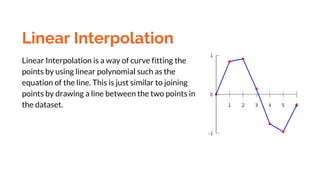
Linear Interpolation
Linear Interpolation is a way of curve fitting the
points by using linear polynomial such as the
equation of the line. This is just similar to joining
points by drawing a line between the two points in
the dataset.
Cubic Spline
A cubic spline is a spline constructed of piecewise
third-order polynomials which pass through a set
of control points.
Cubic Spline
➔ STRENGTH
It has second order
parametric continuity.
Splines are smooth and
continuous.
Cubic Spline
➔ WEAKNESS
Interpolating curves may
give few unwanted
behaviour of the original
data which may destroy the
data.
Cubic Spline
➔ WEAKNESS
If the given data is positive
cubic spline may give some
negative values along the
whole interval.
Cubic Spline
➔ WEAKNESS
For some application
negativity is unacceptable.
Eg: Wind Speed, Solar
energy and rainfall received
are always having positive
values.
Cubic Spline
➔ WEAKNESS
Cannot Produce completely
monotone and convex
interpolating curves.
Methods for preserving
Positivity, Monotonicity and
Convexity of the data by
Researchers.
Fritsch and Carlson
Used cubic spline interpolation by modifying the first
derivative values in which shape violation is found.
Butt and Brodlie
Used cubic spline interpolation to preserve the positivity
and convexity of the finite data by inserting extra knots in
the interval.
Drawbacks
Did not give any extra freedom to the user in controlling the
final shape of the interpolating curves.
Their method require the modification of the first derivative
parameters.
C2 Rational Cubic
Spline Interpolant
It is interpolation with cubic numerator and quadratic denominator which
is used for shape preserving interpolation for positive data.
It has three parameters αi, βi, γi
Sufficient condition for positivity are derived on one parameter γi
αi and βi are free parameters that can be used to change the final shape
of the resulting interpolating curves.
Features
It works for both equally and unequally spaced data.
It doesn’t require any knots insertion.
Provides greater flexibility to the user in controlling the final shape of the
interpolating curves.
C2 Rational Cubic
Spline Interpolant
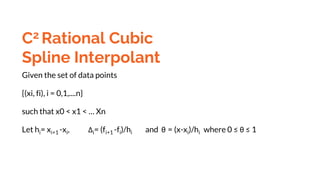
Given the set of data points
{(xi, fi), i = 0,1,....n}
such that x0 < x1 < … Xn
Let hi= xi+1 -xi, Δi= (fi+1 -fi)/hi and θ = (x-xi)/hi where 0 ≤ θ ≤ 1
C2 Rational Cubic Cont.
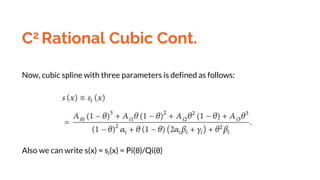
Now, cubic spline with three parameters is defined as follows:
Also we can write s(x) = si(x) = Pi(θ)/Qi(θ)s(x) = si(x) = Pi()/Qi()s(x)
= si(x) = Pi()/Qi()s(x) = si(x) = Pi()/Qi()
C2 Rational Cubic Cont.
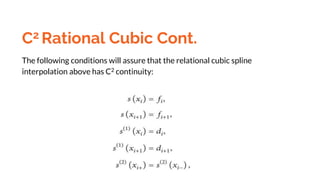
The following conditions will assure that the relational cubic spline
interpolation above has C2 continuity:
C2 Rational Cubic Cont.
The required C2 rational cubic spline interpolation with three parameters
has the unknown Aij where j=0,1,2,3 and is given as follows:
The parameters αi, βi > 0, γi ≥ are used to control the final shape of the
interpolating curves.
Positivity Preserving
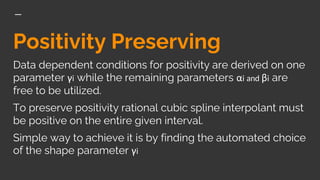
Data dependent conditions for positivity are derived on one
parameter γi while the remaining parameters αi and βi are
free to be utilized.
To preserve positivity rational cubic spline interpolant must
be positive on the entire given interval.
Simple way to achieve it is by finding the automated choice
of the shape parameter γi
Positivity Preserving Cont.
Given the strictly positive set of data (xi, fi) where i = 0,1,...n
And x0 < x1 < . . . < xn, such that fi > 0
We know that s(x) = si(x) = Pi(θ)/Qi(θ)
The rational cubic spline will preserve positivity of data if and only if Pi(θ) and
Qi(θ) > 0.
Since for all αi, βi, > 0 and γi ≥ 0 the denominator Qi(θ) > 0 Thus s(x) > 0 if and
only if Pi(θ) > 0
Positivity Preserving Cont.
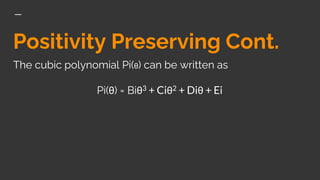
The cubic polynomial Pi(θ) can be written as
Pi(θ) = Biθ3 + Ciθ2 + Diθ + Ei
Thank you!

Shape Preserving Interpolation Using C2 Rational Cubic Spline

  • 1.
    Shape Preserving Interpolation Using C2Rational Cubic Spline Prepared by Adarsha Dhakal
  • 2.
    Linear Interpolation Linear Interpolationis a way of curve fitting the points by using linear polynomial such as the equation of the line. This is just similar to joining points by drawing a line between the two points in the dataset.
  • 3.
    Cubic Spline A cubicspline is a spline constructed of piecewise third-order polynomials which pass through a set of control points.
  • 4.
    Cubic Spline ➔ STRENGTH Ithas second order parametric continuity. Splines are smooth and continuous.
  • 5.
    Cubic Spline ➔ WEAKNESS Interpolatingcurves may give few unwanted behaviour of the original data which may destroy the data.
  • 6.
    Cubic Spline ➔ WEAKNESS Ifthe given data is positive cubic spline may give some negative values along the whole interval.
  • 7.
    Cubic Spline ➔ WEAKNESS Forsome application negativity is unacceptable. Eg: Wind Speed, Solar energy and rainfall received are always having positive values.
  • 8.
    Cubic Spline ➔ WEAKNESS CannotProduce completely monotone and convex interpolating curves.
  • 9.
    Methods for preserving Positivity,Monotonicity and Convexity of the data by Researchers.
  • 10.
    Fritsch and Carlson Usedcubic spline interpolation by modifying the first derivative values in which shape violation is found.
  • 11.
    Butt and Brodlie Usedcubic spline interpolation to preserve the positivity and convexity of the finite data by inserting extra knots in the interval.
  • 12.
    Drawbacks Did not giveany extra freedom to the user in controlling the final shape of the interpolating curves. Their method require the modification of the first derivative parameters.
  • 13.
    C2 Rational Cubic SplineInterpolant It is interpolation with cubic numerator and quadratic denominator which is used for shape preserving interpolation for positive data. It has three parameters αi, βi, γi Sufficient condition for positivity are derived on one parameter γi αi and βi are free parameters that can be used to change the final shape of the resulting interpolating curves.
  • 14.
    Features It works forboth equally and unequally spaced data. It doesn’t require any knots insertion. Provides greater flexibility to the user in controlling the final shape of the interpolating curves.
  • 15.
    C2 Rational Cubic SplineInterpolant Given the set of data points {(xi, fi), i = 0,1,....n} such that x0 < x1 < … Xn Let hi= xi+1 -xi, Δi= (fi+1 -fi)/hi and θ = (x-xi)/hi where 0 ≤ θ ≤ 1
  • 16.
    C2 Rational CubicCont. Now, cubic spline with three parameters is defined as follows: Also we can write s(x) = si(x) = Pi(θ)/Qi(θ)s(x) = si(x) = Pi()/Qi()s(x) = si(x) = Pi()/Qi()s(x) = si(x) = Pi()/Qi()
  • 17.
    C2 Rational CubicCont. The following conditions will assure that the relational cubic spline interpolation above has C2 continuity:
  • 18.
    C2 Rational CubicCont. The required C2 rational cubic spline interpolation with three parameters has the unknown Aij where j=0,1,2,3 and is given as follows: The parameters αi, βi > 0, γi ≥ are used to control the final shape of the interpolating curves.
  • 19.
    Positivity Preserving Data dependentconditions for positivity are derived on one parameter γi while the remaining parameters αi and βi are free to be utilized. To preserve positivity rational cubic spline interpolant must be positive on the entire given interval. Simple way to achieve it is by finding the automated choice of the shape parameter γi
  • 20.
    Positivity Preserving Cont. Giventhe strictly positive set of data (xi, fi) where i = 0,1,...n And x0 < x1 < . . . < xn, such that fi > 0 We know that s(x) = si(x) = Pi(θ)/Qi(θ) The rational cubic spline will preserve positivity of data if and only if Pi(θ) and Qi(θ) > 0. Since for all αi, βi, > 0 and γi ≥ 0 the denominator Qi(θ) > 0 Thus s(x) > 0 if and only if Pi(θ) > 0
  • 21.
    Positivity Preserving Cont. Thecubic polynomial Pi(θ) can be written as Pi(θ) = Biθ3 + Ciθ2 + Diθ + Ei
  • 22.