An IoT based smart irrigation
management system using
ML and open source
technologies
Prepared by Adarsha Dhakal
Irrigation Management System
Act of timing and regulating irrigation water application
in a way that will satisfy water requirement of the crop
without wasting water, energy and plant nutrients or
degrading soil resource.
Scarcity of clean water around the globe has generated a
need for its optimum utilization and IoT can become
savior.
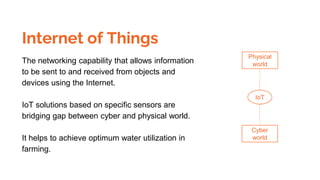
Internet of Things
The networking capability that allows information
to be sent to and received from objects and
devices using the Internet.
IoT solutions based on specific sensors are
bridging gap between cyber and physical world.
It helps to achieve optimum water utilization in
farming.
Physical
world
IoT
Cyber
world
Soil Temperature.
Air relative humidity
Solar Radiation
Extra-Terrestrial
Radiation
Soil moisture
Air Temperature
Smart Irrigation
Management System
Evapotranspiration
Total water loss to the
atmosphere from a land surface.
Different methods for
estimating
Evapotranspiration
Hargreaves and Samani (1985)
Evapotranspiration can be calculated based on
temperature and Extra-terrestrial radiation.
ET0 = 0.0023Ra[(Tmax + Tmin)/2+17.8] sqr(Tmax - Tmin)
where Tmax and Tmin are maxm and minm temperature (oC)
and Ra = extra-terrestrial radiation(MJm-2day-1) which is
power of the sun at the top of Earth’s atmosphere.
Jones and Ritchie (1990)
Evapotranspiration can be calculated based on
temperature and solar radiation.
ET0 = α[3.87*10-3*Rs*(0.6 Tmax +0.4 Tmin +29]
where Tmax and Tmin are maxm and minm temperature (oC)
and Rs = solar radiation(MJm-2day-1) which is sunlight or
electromagnetic radiation emitted by sun.
Jones and Ritchie cont.
For calculating α,
if 5 < Tmax <= 35oC then α = 1.1
if Tmax > 35oC then α = 1.1+0.05(Tmax -35)
if Tmax < 5oC then α = 0.01 exp[0.18(Tmax +20)]
Cobaner (2011)
Evapotranspiration estimation method based on Neuro-
Fuzzy (NF) inference and found that the NF model (based
on solar radiation, air temperature, and relative humidity)
exhibits better accuracy than the combination of solar
radiation, air temperature and wind speed.
Cubic Spline
➔ WEAKNESS
Interpolating curves may
give few unwanted
behaviour of the original
data which may destroy the
data.
Zigbee Network
Zigbee is a standards-based wireless technology
developed to enable low-cost, low-power wireless
machine-to-machine (M2M) and internet of things (IoT)
networks. Zigbee is for low-data rate, low-power
applications and is an open standard.
Cubic Spline
➔ WEAKNESS
For some application
negativity is unacceptable.
Eg: Wind Speed, Solar
energy and rainfall received
are always having positive
values.
Cubic Spline
➔ WEAKNESS
If the given data is positive
cubic spline may give some
negative values along the
whole interval.
Conclusion
The soil moisture is a critical parameter for developing a smart
irrigation system.
The soil moisture is affected by a number of environmental
variables, e.g., air temperature, air humidity, UV, soil temperature,
etc.
The proposed algorithm uses sensors data of recent past and the
weather forecasted data for prediction of soil moisture of upcoming
days. The predicted value of the soil moisture is better in terms of
their accuracy and error rate.
The system prototype is cost effective, as it is based on the open
standard technologies.
Thank you!
References:
Research paper by:
Amarendra Goap (Smart IMS using IoT)
Deepak Sharma
A.K Shukla
C.Rama Krishna

An IoT based smart irrigation management system(SIMS) using machine learning and open source technology

  • 1.
    An IoT basedsmart irrigation management system using ML and open source technologies Prepared by Adarsha Dhakal
  • 2.
    Irrigation Management System Actof timing and regulating irrigation water application in a way that will satisfy water requirement of the crop without wasting water, energy and plant nutrients or degrading soil resource. Scarcity of clean water around the globe has generated a need for its optimum utilization and IoT can become savior.
  • 3.
    Internet of Things Thenetworking capability that allows information to be sent to and received from objects and devices using the Internet. IoT solutions based on specific sensors are bridging gap between cyber and physical world. It helps to achieve optimum water utilization in farming. Physical world IoT Cyber world
  • 4.
    Soil Temperature. Air relativehumidity Solar Radiation Extra-Terrestrial Radiation Soil moisture Air Temperature Smart Irrigation Management System
  • 5.
    Evapotranspiration Total water lossto the atmosphere from a land surface.
  • 6.
  • 7.
    Hargreaves and Samani(1985) Evapotranspiration can be calculated based on temperature and Extra-terrestrial radiation. ET0 = 0.0023Ra[(Tmax + Tmin)/2+17.8] sqr(Tmax - Tmin) where Tmax and Tmin are maxm and minm temperature (oC) and Ra = extra-terrestrial radiation(MJm-2day-1) which is power of the sun at the top of Earth’s atmosphere.
  • 8.
    Jones and Ritchie(1990) Evapotranspiration can be calculated based on temperature and solar radiation. ET0 = α[3.87*10-3*Rs*(0.6 Tmax +0.4 Tmin +29] where Tmax and Tmin are maxm and minm temperature (oC) and Rs = solar radiation(MJm-2day-1) which is sunlight or electromagnetic radiation emitted by sun.
  • 9.
    Jones and Ritchiecont. For calculating α, if 5 < Tmax <= 35oC then α = 1.1 if Tmax > 35oC then α = 1.1+0.05(Tmax -35) if Tmax < 5oC then α = 0.01 exp[0.18(Tmax +20)]
  • 10.
    Cobaner (2011) Evapotranspiration estimationmethod based on Neuro- Fuzzy (NF) inference and found that the NF model (based on solar radiation, air temperature, and relative humidity) exhibits better accuracy than the combination of solar radiation, air temperature and wind speed.
  • 11.
    Cubic Spline ➔ WEAKNESS Interpolatingcurves may give few unwanted behaviour of the original data which may destroy the data.
  • 12.
    Zigbee Network Zigbee isa standards-based wireless technology developed to enable low-cost, low-power wireless machine-to-machine (M2M) and internet of things (IoT) networks. Zigbee is for low-data rate, low-power applications and is an open standard.
  • 13.
    Cubic Spline ➔ WEAKNESS Forsome application negativity is unacceptable. Eg: Wind Speed, Solar energy and rainfall received are always having positive values.
  • 14.
    Cubic Spline ➔ WEAKNESS Ifthe given data is positive cubic spline may give some negative values along the whole interval.
  • 15.
    Conclusion The soil moistureis a critical parameter for developing a smart irrigation system. The soil moisture is affected by a number of environmental variables, e.g., air temperature, air humidity, UV, soil temperature, etc. The proposed algorithm uses sensors data of recent past and the weather forecasted data for prediction of soil moisture of upcoming days. The predicted value of the soil moisture is better in terms of their accuracy and error rate. The system prototype is cost effective, as it is based on the open standard technologies.
  • 16.
    Thank you! References: Research paperby: Amarendra Goap (Smart IMS using IoT) Deepak Sharma A.K Shukla C.Rama Krishna