Ahmed Mahmoud Ahmed
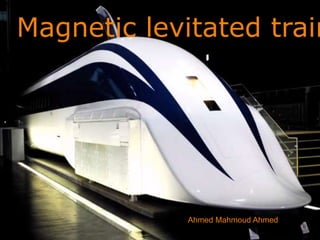
Magnetic levitated train
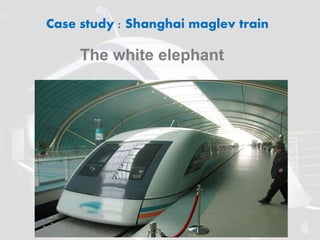
Case study : Shanghai maglev train
The white elephant
 Construction of the line began in March 1, 2001
 It costs 1.2 billion dollars
 The project was joint venture of Siemens and ThyssenKrupp.
 The whole guideway was made by Chinese companies.
 Chinese changed the German design due to the alluvial soil of
Pudong…
Founding state
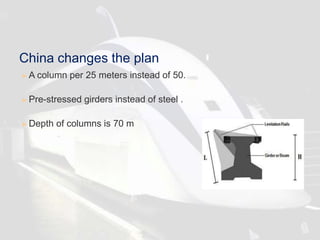
 A column per 25 meters instead of 50.
 Pre-stressed girders instead of steel .
 Depth of columns is 70 m
China changes the plan
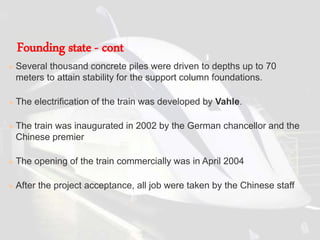
 Several thousand concrete piles were driven to depths up to 70
meters to attain stability for the support column foundations.
 The electrification of the train was developed by Vahle.
 The train was inaugurated in 2002 by the German chancellor and the
Chinese premier
 The opening of the train commercially was in April 2004
 After the project acceptance, all job were taken by the Chinese staff
Founding state - cont
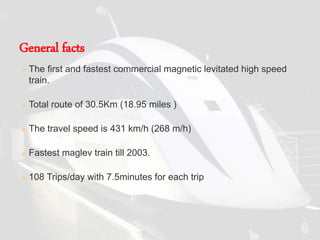
 The first and fastest commercial magnetic levitated high speed
train.
 Total route of 30.5Km (18.95 miles )
 The travel speed is 431 km/h (268 m/h)
 Fastest maglev train till 2003.
 108 Trips/day with 7.5minutes for each trip
General facts
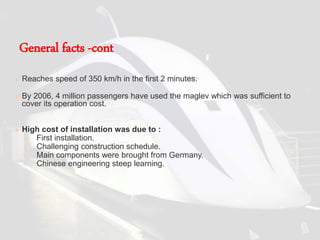
 Reaches speed of 350 km/h in the first 2 minutes.
 By 2006, 4 million passengers have used the maglev which was sufficient to
cover its operation cost.
 High cost of installation was due to :
1. First installation.
2. Challenging construction schedule.
3. Main components were brought from Germany.
4. Chinese engineering steep learning.
General facts -cont
Operation budget
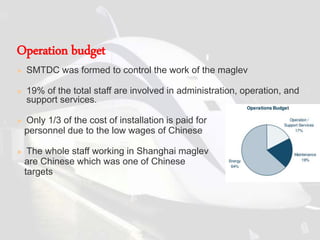
 SMTDC was formed to control the work of the maglev
 19% of the total staff are involved in administration, operation, and
support services.
 Only 1/3 of the cost of installation is paid for
personnel due to the low wages of Chinese
 The whole staff working in Shanghai maglev
are Chinese which was one of Chinese
targets
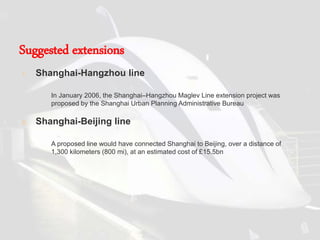
1. Shanghai-Hangzhou line
In January 2006, the Shanghai–Hangzhou Maglev Line extension project was
proposed by the Shanghai Urban Planning Administrative Bureau
2. Shanghai-Beijing line
A proposed line would have connected Shanghai to Beijing, over a distance of
1,300 kilometers (800 mi), at an estimated cost of £15.5bn
Suggested extensions
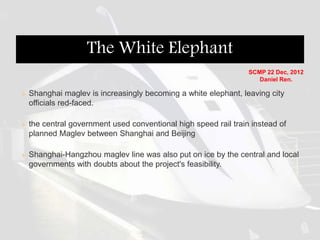
 Shanghai maglev is increasingly becoming a white elephant, leaving city
officials red-faced.
 the central government used conventional high speed rail train instead of
planned Maglev between Shanghai and Beijing
 Shanghai-Hangzhou maglev line was also put on ice by the central and local
governments with doubts about the project's feasibility.
The White Elephant
SCMP 22 Dec, 2012
Daniel Ren.
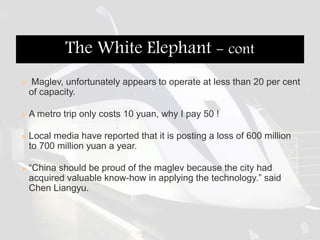
 Maglev, unfortunately appears to operate at less than 20 per cent
of capacity.
 A metro trip only costs 10 yuan, why I pay 50 !
 Local media have reported that it is posting a loss of 600 million
to 700 million yuan a year.
 “China should be proud of the maglev because the city had
acquired valuable know-how in applying the technology.” said
Chen Liangyu.
The White Elephant - cont

Shanghai Maglev

  • 1.
  • 2.
    Case study :Shanghai maglev train The white elephant
  • 3.
     Construction ofthe line began in March 1, 2001  It costs 1.2 billion dollars  The project was joint venture of Siemens and ThyssenKrupp.  The whole guideway was made by Chinese companies.  Chinese changed the German design due to the alluvial soil of Pudong… Founding state
  • 4.
     A columnper 25 meters instead of 50.  Pre-stressed girders instead of steel .  Depth of columns is 70 m China changes the plan
  • 5.
     Several thousandconcrete piles were driven to depths up to 70 meters to attain stability for the support column foundations.  The electrification of the train was developed by Vahle.  The train was inaugurated in 2002 by the German chancellor and the Chinese premier  The opening of the train commercially was in April 2004  After the project acceptance, all job were taken by the Chinese staff Founding state - cont
  • 6.
     The firstand fastest commercial magnetic levitated high speed train.  Total route of 30.5Km (18.95 miles )  The travel speed is 431 km/h (268 m/h)  Fastest maglev train till 2003.  108 Trips/day with 7.5minutes for each trip General facts
  • 7.
     Reaches speedof 350 km/h in the first 2 minutes.  By 2006, 4 million passengers have used the maglev which was sufficient to cover its operation cost.  High cost of installation was due to : 1. First installation. 2. Challenging construction schedule. 3. Main components were brought from Germany. 4. Chinese engineering steep learning. General facts -cont
  • 8.
    Operation budget  SMTDCwas formed to control the work of the maglev  19% of the total staff are involved in administration, operation, and support services.  Only 1/3 of the cost of installation is paid for personnel due to the low wages of Chinese  The whole staff working in Shanghai maglev are Chinese which was one of Chinese targets
  • 9.
    1. Shanghai-Hangzhou line InJanuary 2006, the Shanghai–Hangzhou Maglev Line extension project was proposed by the Shanghai Urban Planning Administrative Bureau 2. Shanghai-Beijing line A proposed line would have connected Shanghai to Beijing, over a distance of 1,300 kilometers (800 mi), at an estimated cost of £15.5bn Suggested extensions
  • 10.
     Shanghai maglevis increasingly becoming a white elephant, leaving city officials red-faced.  the central government used conventional high speed rail train instead of planned Maglev between Shanghai and Beijing  Shanghai-Hangzhou maglev line was also put on ice by the central and local governments with doubts about the project's feasibility. The White Elephant SCMP 22 Dec, 2012 Daniel Ren.
  • 11.
     Maglev, unfortunatelyappears to operate at less than 20 per cent of capacity.  A metro trip only costs 10 yuan, why I pay 50 !  Local media have reported that it is posting a loss of 600 million to 700 million yuan a year.  “China should be proud of the maglev because the city had acquired valuable know-how in applying the technology.” said Chen Liangyu. The White Elephant - cont