Copyright	
  ©	
  2014	
  Oracle	
  and/or	
  its	
  affiliates.	
  All	
  rights	
  reserved.	
  	
  |	
  
Big Data, Fast Data,
Actionable Data
Putting Big Data to Work in Utilities
Martin Dunlea
Global Industries Lead
Utilities Industry Business Unit
June 4, 2014 6th Smart Grids & Cleanpower
Conference
3-4 June 2014, Cambridge, UK
www.hvm-uk.com
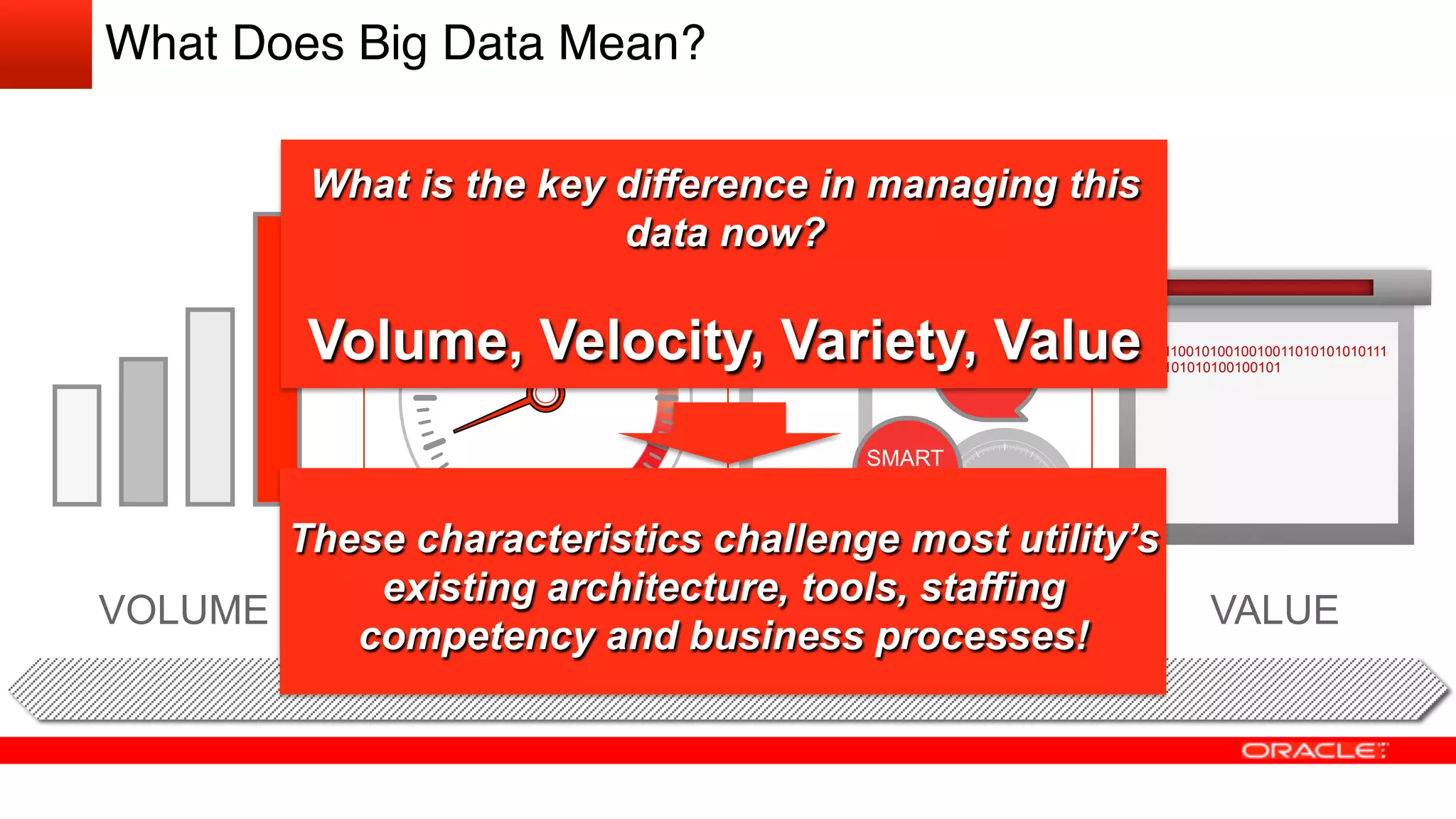
What Does Big Data Mean?!
VOLUME VELOCITY VARIETY VALUE
SOCIAL
BLOG
SMART
METER

1011001010010010011010101010111
00101010100100101
DEVICES
SENSORS
What is the key difference in managing this
data now?
Volume, Velocity, Variety, Value
These characteristics challenge most utility’s
existing architecture, tools, staffing
competency and business processes!
3 Copyright © 2013, Oracle and/or its affiliates. All rights reserved. Proprietary & Confidential
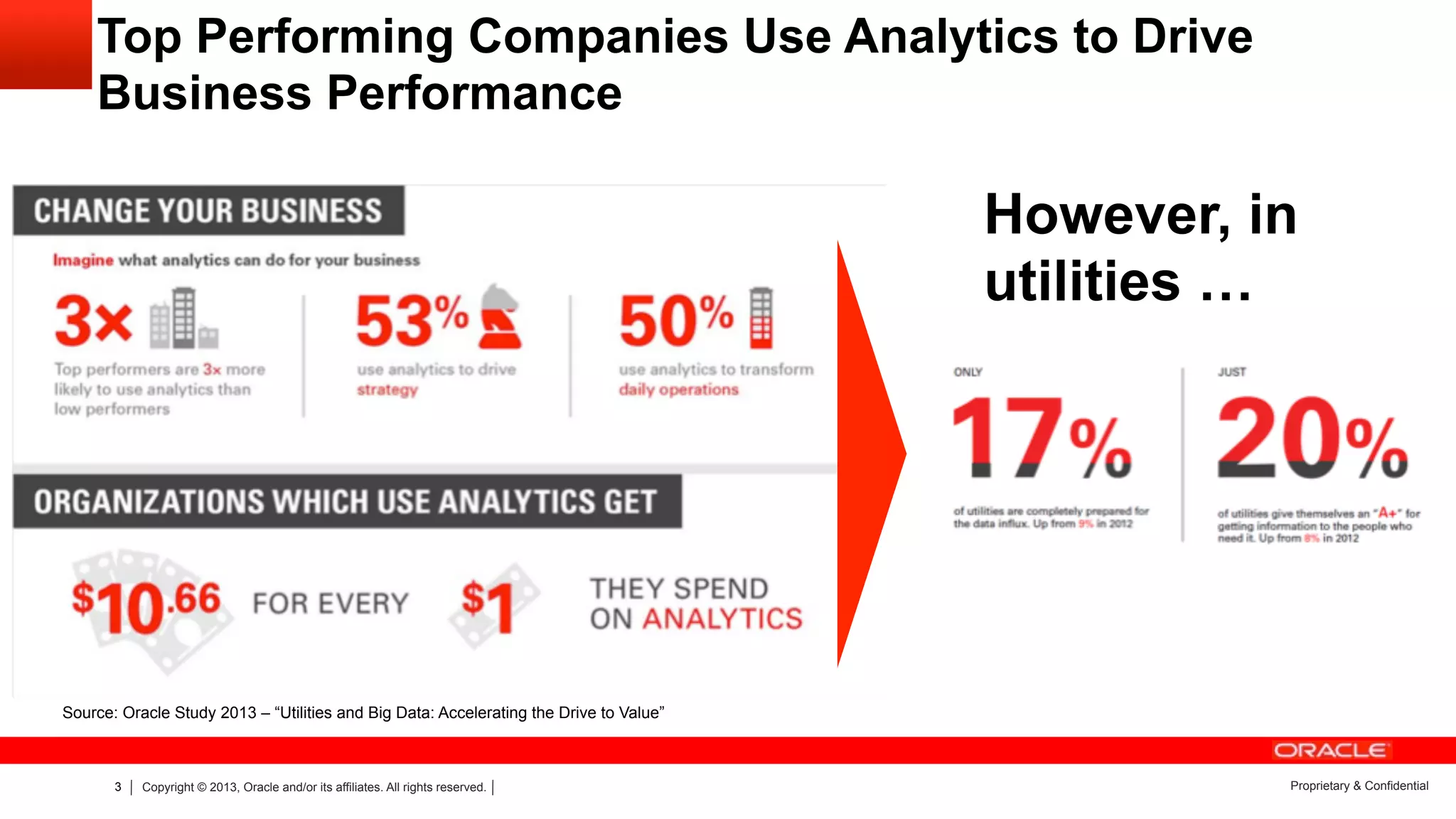
Top Performing Companies Use Analytics to Drive
Business Performance
Source: Oracle Study 2013 – “Utilities and Big Data: Accelerating the Drive to Value”
However, in
utilities …
4 | © 2013 Oracle Corporation – Proprietary and Confidential
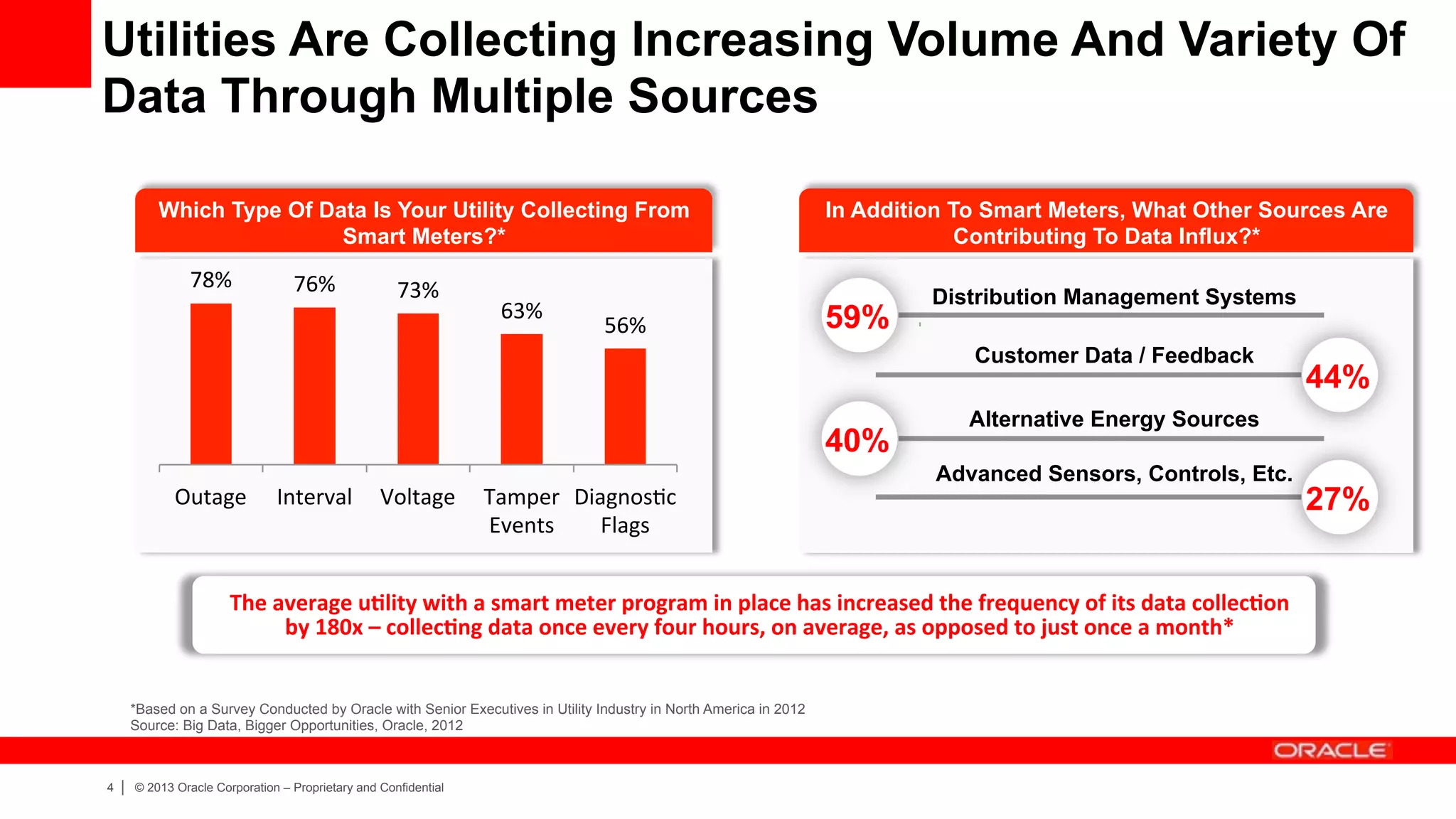
Which Type Of Data Is Your Utility Collecting From
Smart Meters?*
Utilities Are Collecting Increasing Volume And Variety Of
Data Through Multiple Sources
*Based on a Survey Conducted by Oracle with Senior Executives in Utility Industry in North America in 2012
Source: Big Data, Bigger Opportunities, Oracle, 2012
78%	
   76%	
   73%	
  
63%	
  
56%	
  
Outage	
   Interval	
   Voltage	
   Tamper	
  
Events	
  
DiagnosKc	
  
Flags	
  
In Addition To Smart Meters, What Other Sources Are
Contributing To Data Influx?*
59%
Distribution Management Systems
44%
Customer Data / Feedback
40%
27%
Alternative Energy Sources
Advanced Sensors, Controls, Etc.
The	
  average	
  u*lity	
  with	
  a	
  smart	
  meter	
  program	
  in	
  place	
  has	
  increased	
  the	
  frequency	
  of	
  its	
  data	
  collec*on	
  
by	
  180x	
  –	
  collec*ng	
  data	
  once	
  every	
  four	
  hours,	
  on	
  average,	
  as	
  opposed	
  to	
  just	
  once	
  a	
  month*	
  
5 | © 2013 Oracle Corporation – Proprietary and Confidential
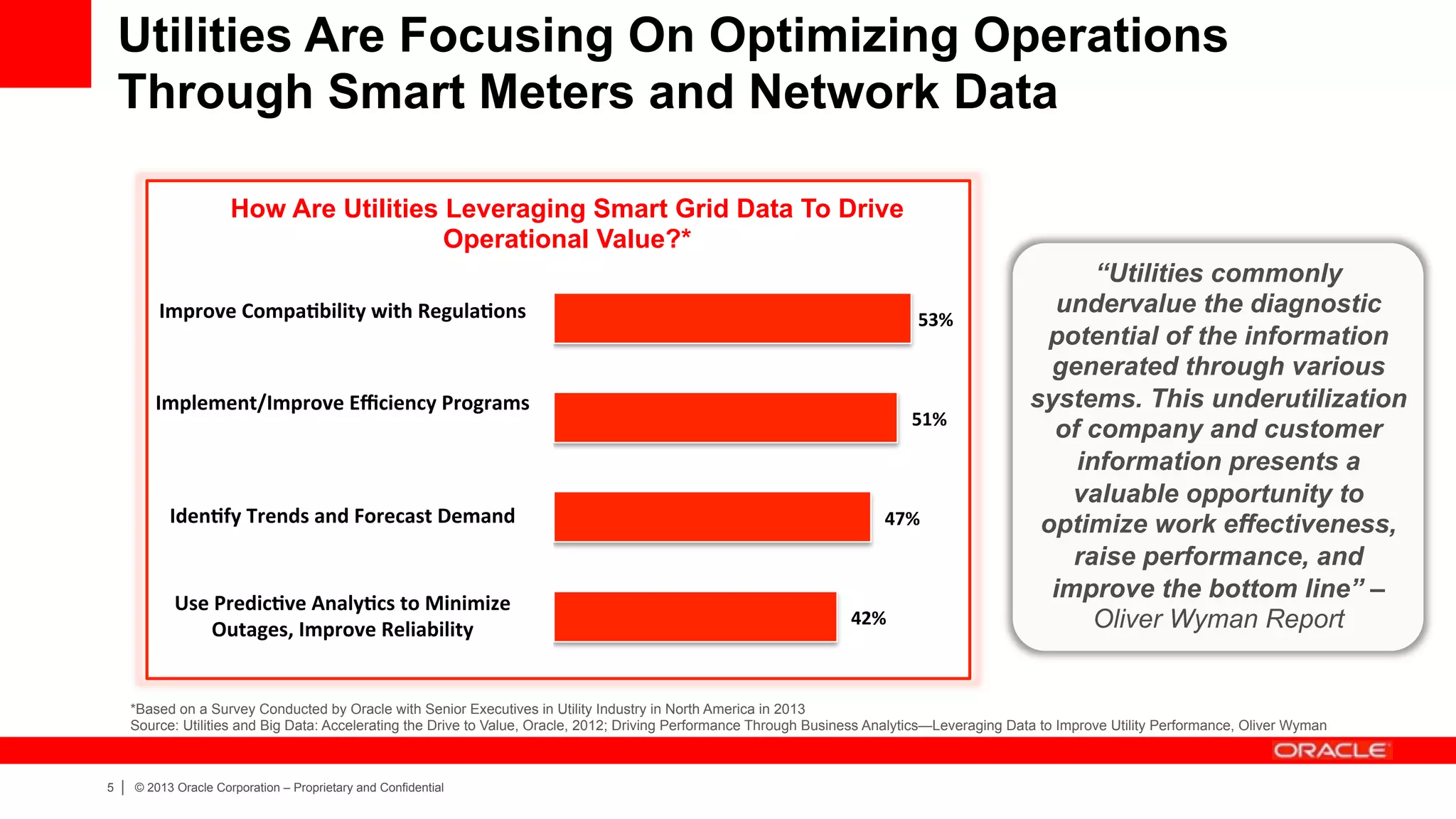
Utilities Are Focusing On Optimizing Operations
Through Smart Meters and Network Data
Improve	
  Compa*bility	
  with	
  Regula*ons	
  
Implement/Improve	
  Efficiency	
  Programs	
  
Iden*fy	
  Trends	
  and	
  Forecast	
  Demand	
  
Use	
  Predic*ve	
  Analy*cs	
  to	
  Minimize	
  
Outages,	
  Improve	
  Reliability	
  
“Utilities commonly
undervalue the diagnostic
potential of the information
generated through various
systems. This underutilization
of company and customer
information presents a
valuable opportunity to
optimize work effectiveness,
raise performance, and
improve the bottom line” –
Oliver Wyman Report
*Based on a Survey Conducted by Oracle with Senior Executives in Utility Industry in North America in 2013
Source: Utilities and Big Data: Accelerating the Drive to Value, Oracle, 2012; Driving Performance Through Business Analytics—Leveraging Data to Improve Utility Performance, Oliver Wyman
How Are Utilities Leveraging Smart Grid Data To Drive
Operational Value?*
42%	
  
47%	
  
51%	
  
53%	
  
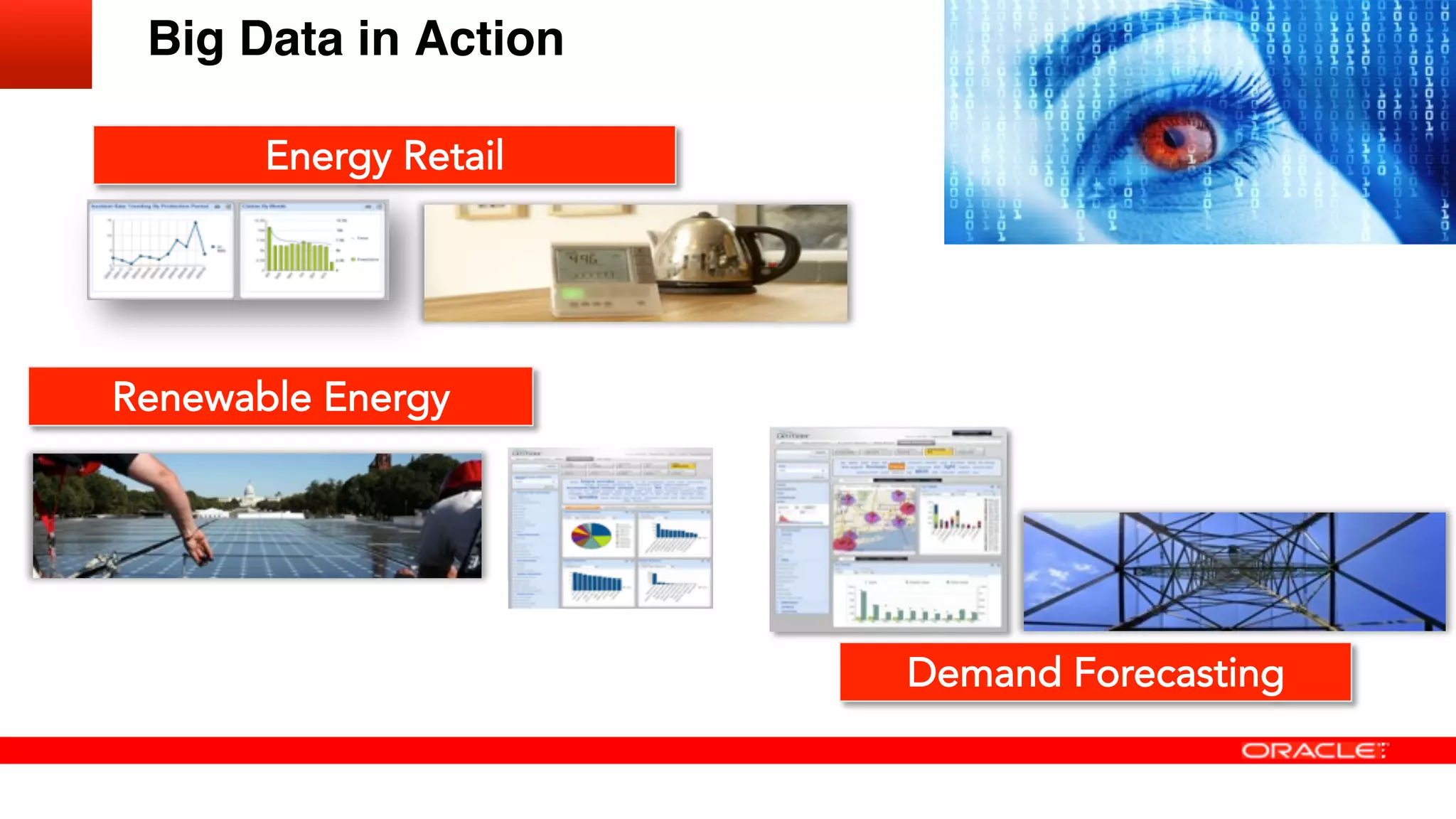
Big Data in Action!
Energy Retail
Renewable Energy 
Demand Forecasting
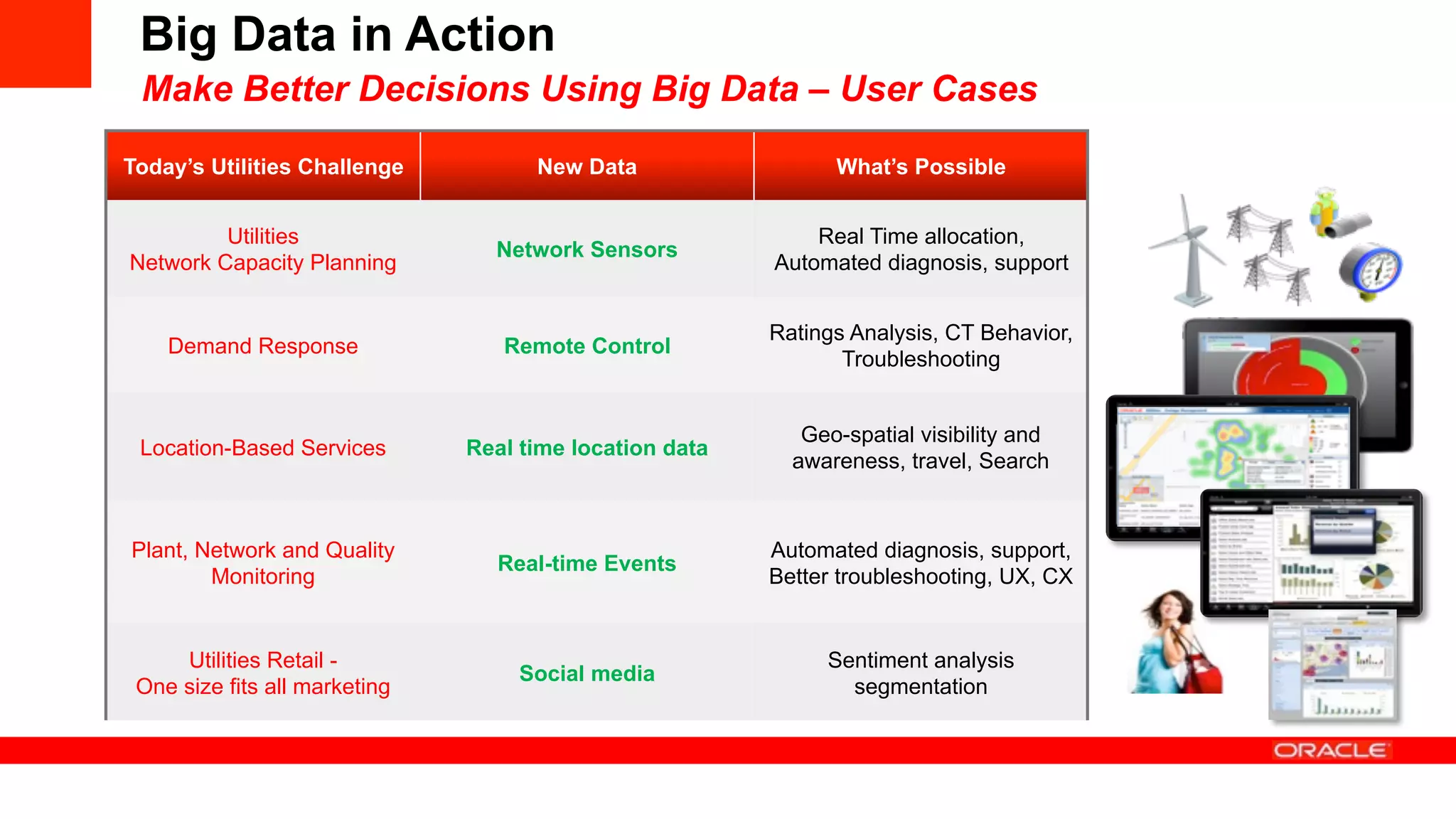
Big Data in Action
Today’s Utilities Challenge New Data What’s Possible
Utilities
Network Capacity Planning
Network Sensors
Real Time allocation,
Automated diagnosis, support
Demand Response Remote Control
Ratings Analysis, CT Behavior,
Troubleshooting
Location-Based Services Real time location data
Geo-spatial visibility and
awareness, travel, Search
Plant, Network and Quality
Monitoring
Real-time Events
Automated diagnosis, support,
Better troubleshooting, UX, CX
Utilities Retail -
One size fits all marketing
Social media
Sentiment analysis
segmentation
Make Better Decisions Using Big Data – User Cases
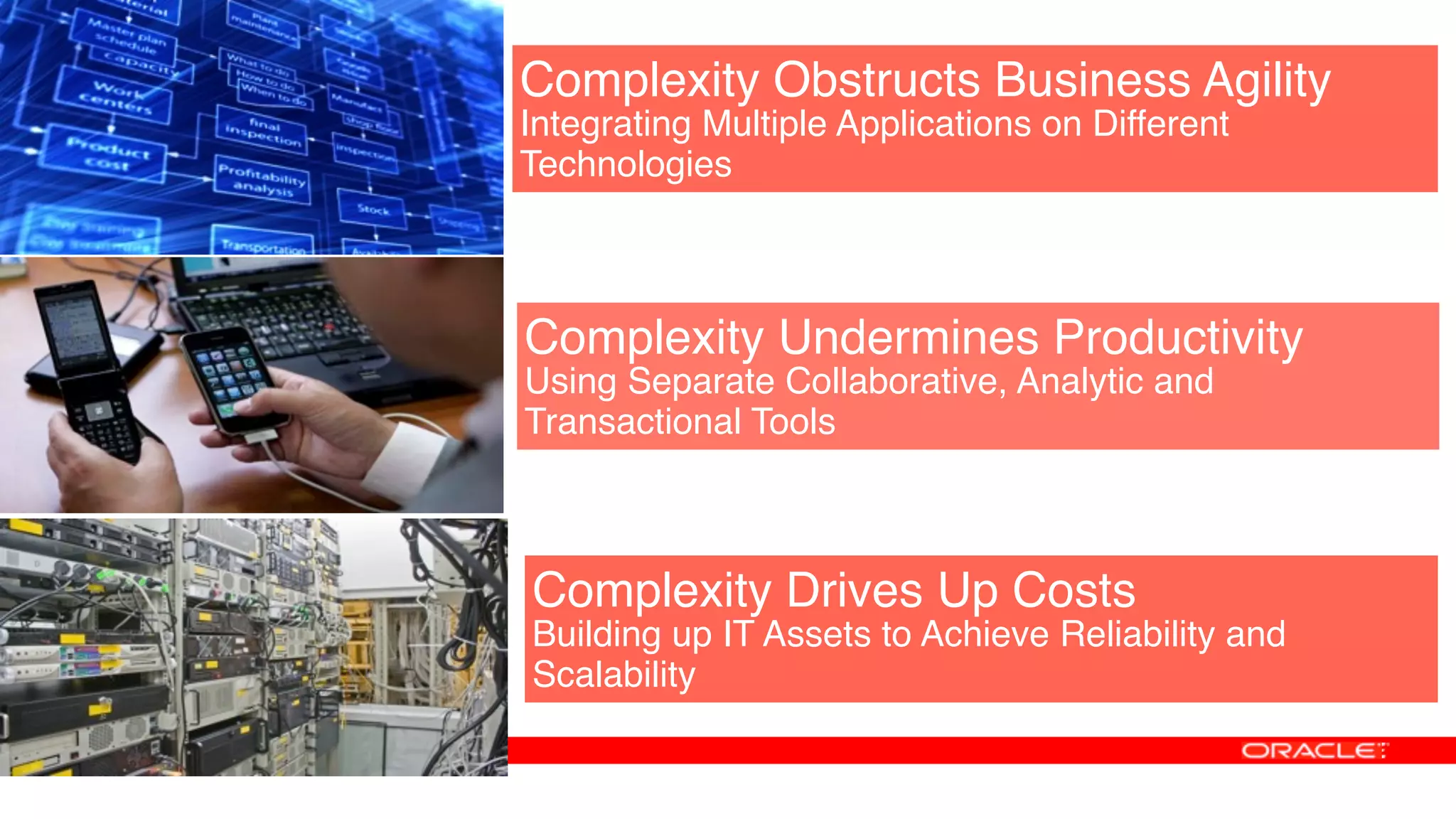
Complexity Obstructs Business Agility

Integrating Multiple Applications on Different
Technologies!
Complexity Undermines Productivity

Using Separate Collaborative, Analytic and
Transactional Tools!
Complexity Drives Up Costs

Building up IT Assets to Achieve Reliability and
Scalability!
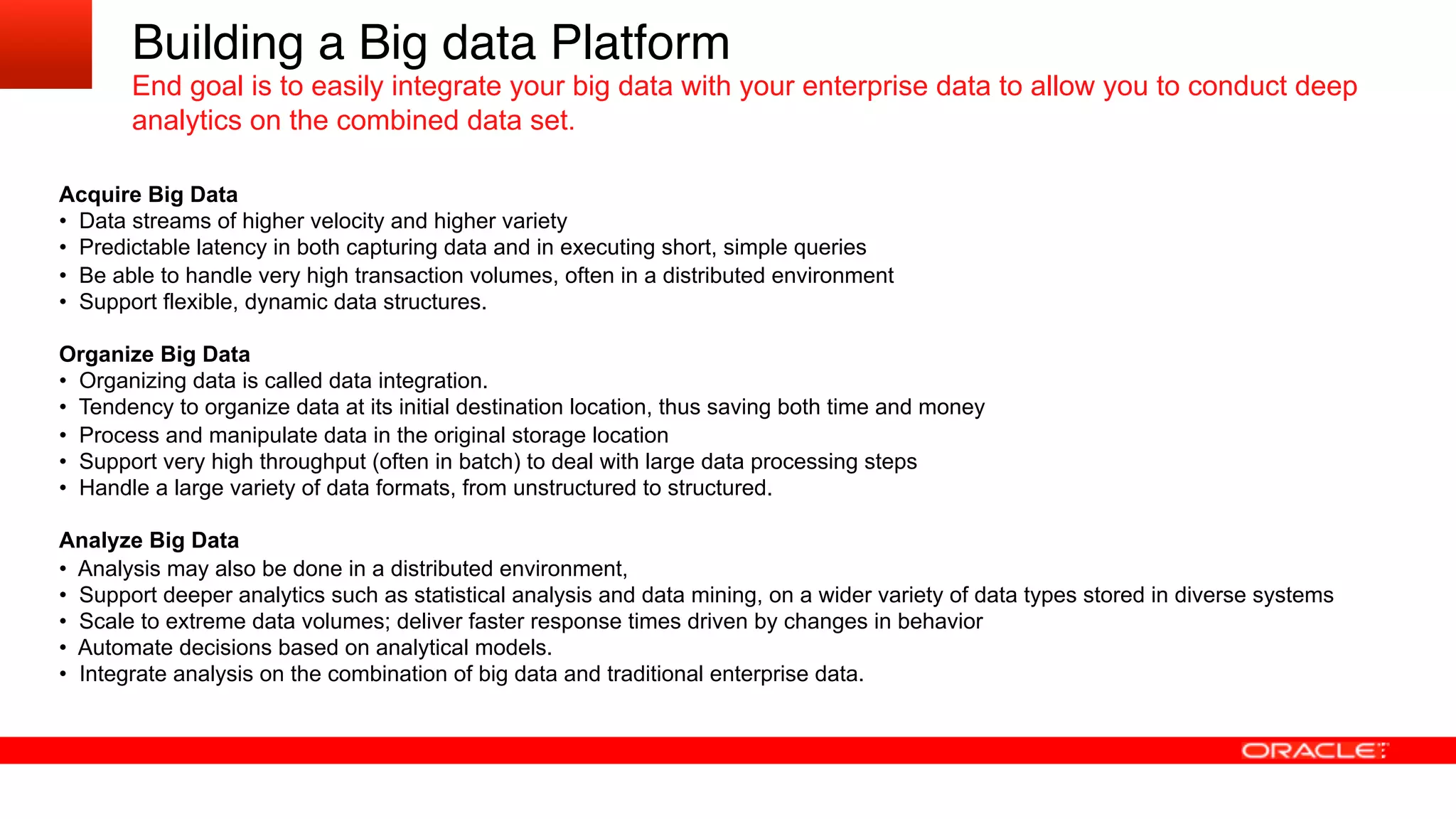
Acquire Big Data
•  Data streams of higher velocity and higher variety
•  Predictable latency in both capturing data and in executing short, simple queries
•  Be able to handle very high transaction volumes, often in a distributed environment
•  Support flexible, dynamic data structures.
Organize Big Data
•  Organizing data is called data integration.
•  Tendency to organize data at its initial destination location, thus saving both time and money
•  Process and manipulate data in the original storage location
•  Support very high throughput (often in batch) to deal with large data processing steps
•  Handle a large variety of data formats, from unstructured to structured.
Analyze Big Data
•  Analysis may also be done in a distributed environment,
•  Support deeper analytics such as statistical analysis and data mining, on a wider variety of data types stored in diverse systems
•  Scale to extreme data volumes; deliver faster response times driven by changes in behavior
•  Automate decisions based on analytical models.
•  Integrate analysis on the combination of big data and traditional enterprise data.
Building a Big data Platform!
End goal is to easily integrate your big data with your enterprise data to allow you to conduct deep
analytics on the combined data set.
!
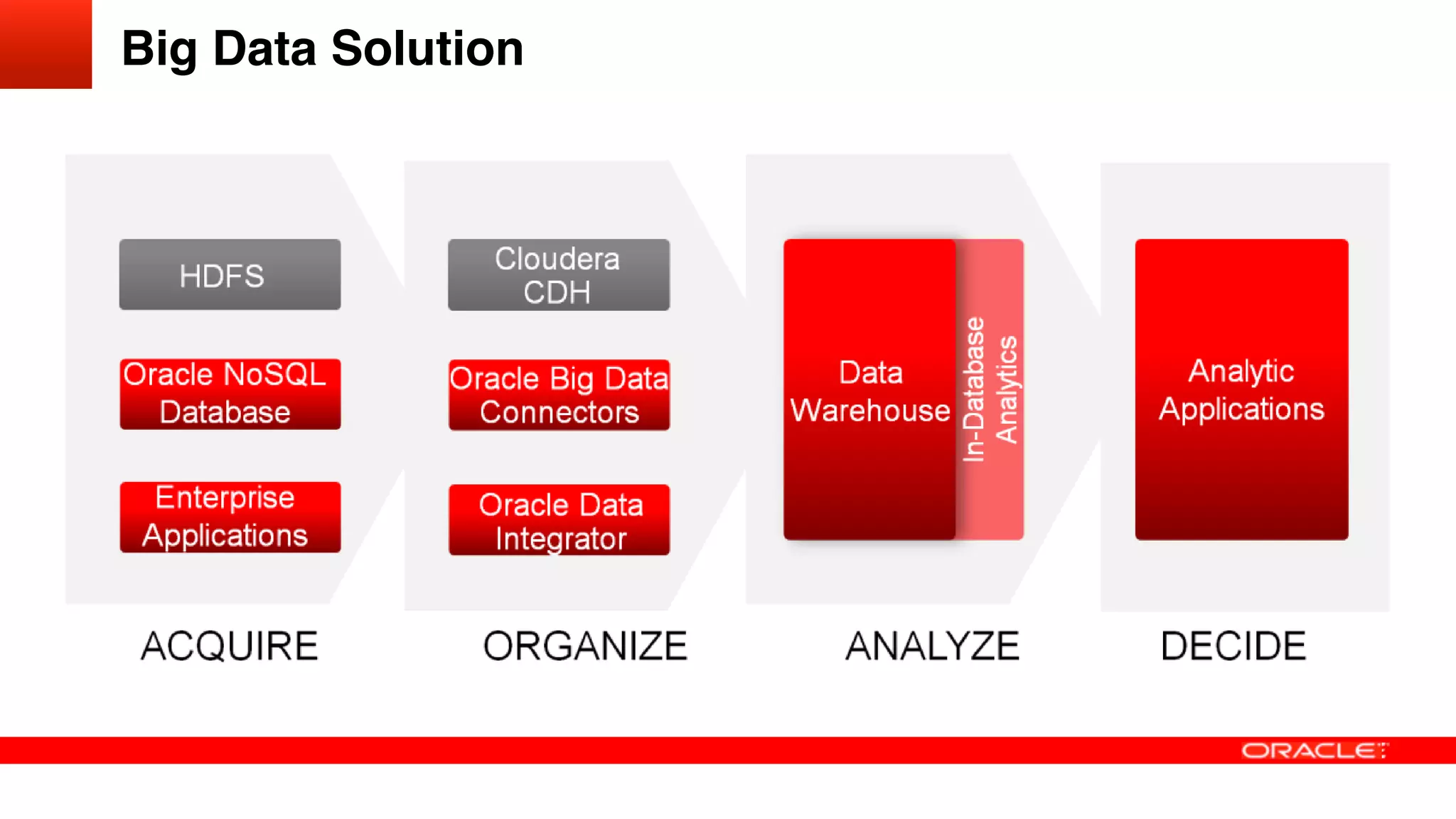
Big Data Solution!
11 Copyright © 2013, Oracle and/or its affiliates. All rights reserved. Proprietary & Confidential
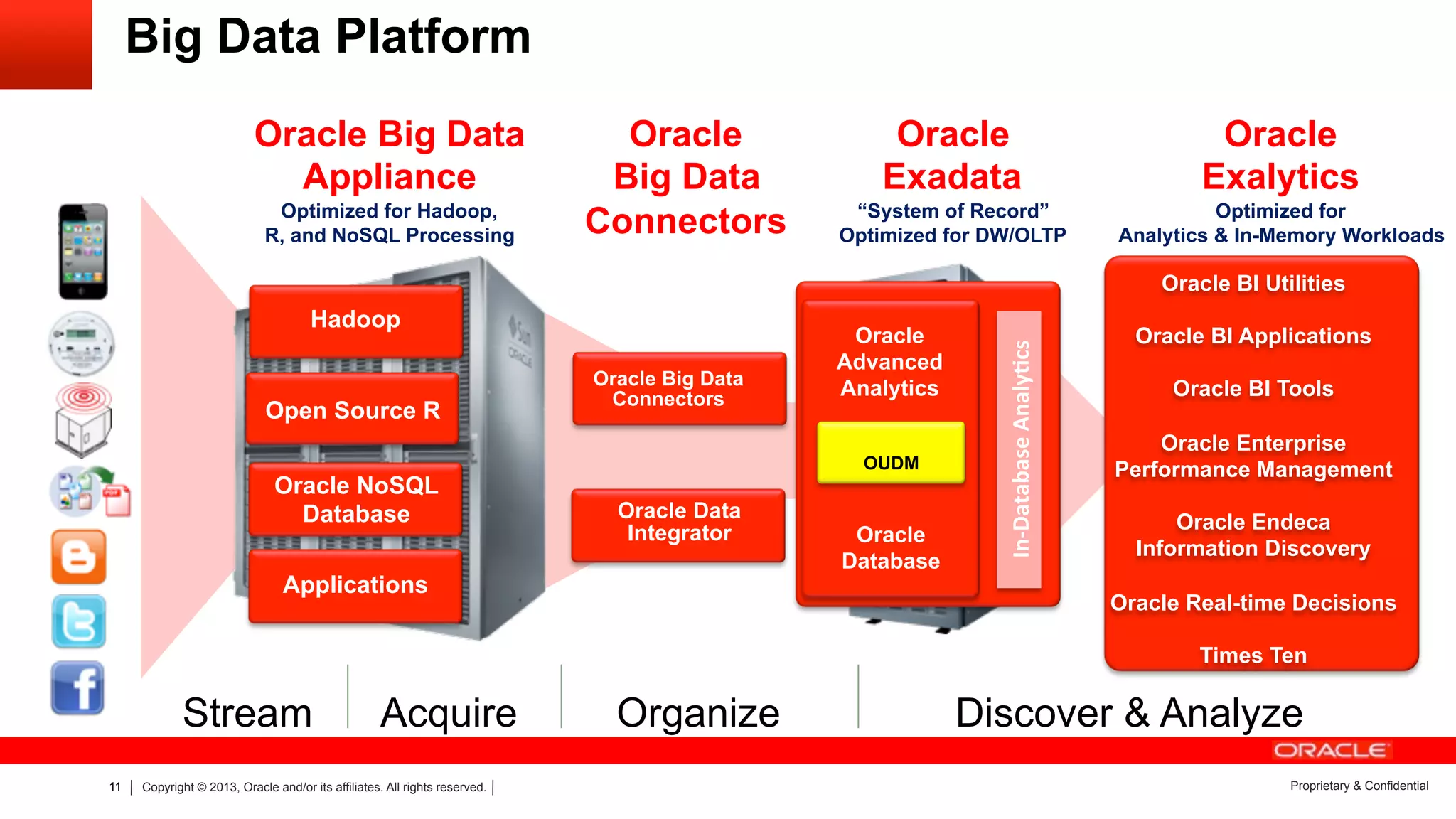
Oracle
Exadata
Oracle
Exalytics
Big Data Platform
Stream Acquire Organize Discover & Analyze
Oracle Big Data
Appliance
Oracle
Big Data
Connectors Optimized for
Analytics & In-Memory Workloads
“System of Record”
Optimized for DW/OLTP
Optimized for Hadoop,
R, and NoSQL Processing
Oracle BI Utilities
Oracle BI Applications
Oracle BI Tools
Oracle Enterprise
Performance Management
Oracle Endeca
Information Discovery
Oracle Real-time Decisions
Times Ten
Hadoop
Open Source R
Applications
Oracle NoSQL
Database
Oracle Big Data
Connectors
Oracle Data
Integrator
In-­‐Database	
  Analy*cs	
  
Oracle
Advanced
Analytics
Oracle
Database
OUDM
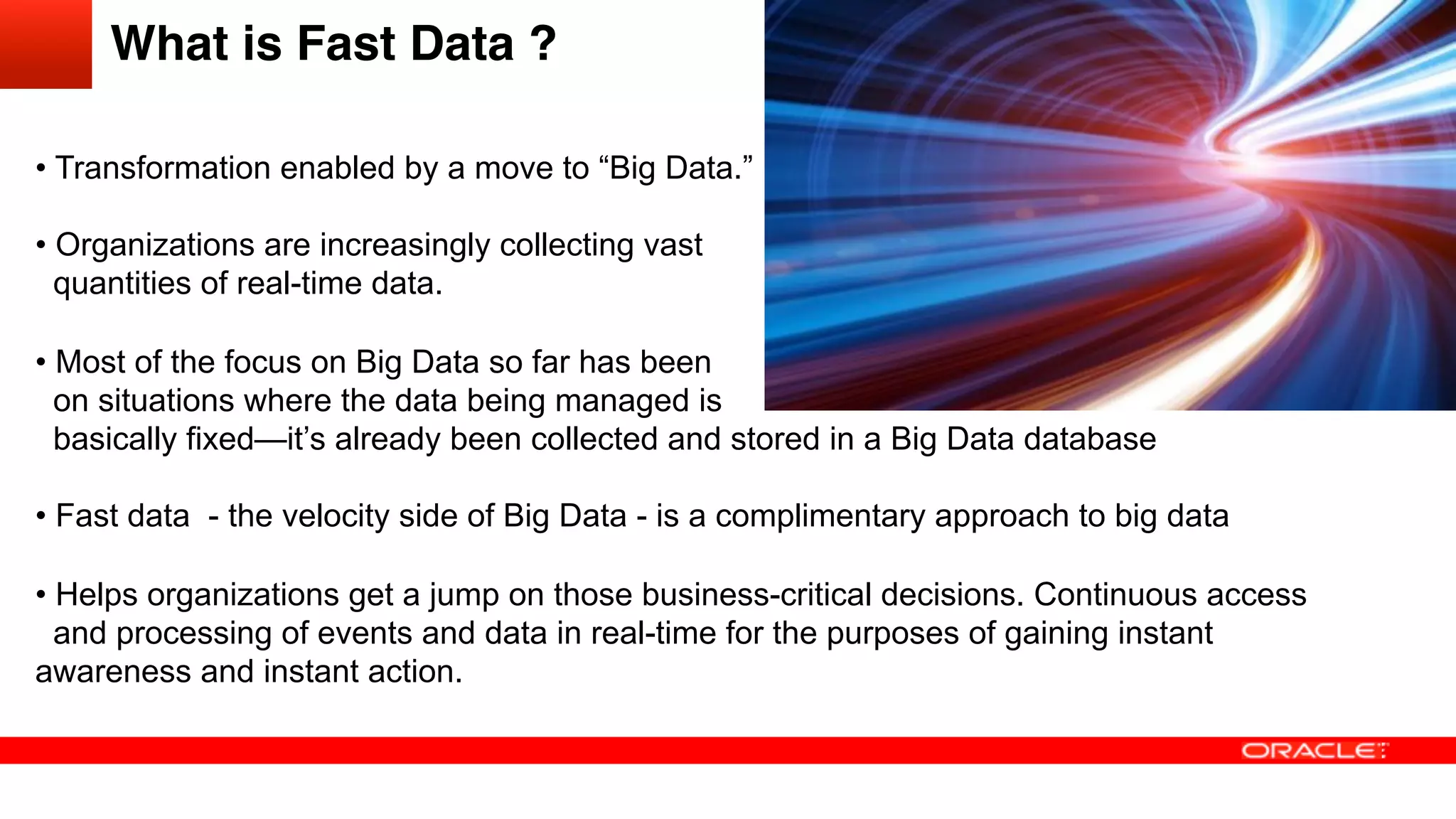
What is Fast Data ?!
• Transformation enabled by a move to “Big Data.”
• Organizations are increasingly collecting vast
quantities of real-time data.
• Most of the focus on Big Data so far has been
on situations where the data being managed is
basically fixed—it’s already been collected and stored in a Big Data database
• Fast data - the velocity side of Big Data - is a complimentary approach to big data
• Helps organizations get a jump on those business-critical decisions. Continuous access
and processing of events and data in real-time for the purposes of gaining instant
awareness and instant action.
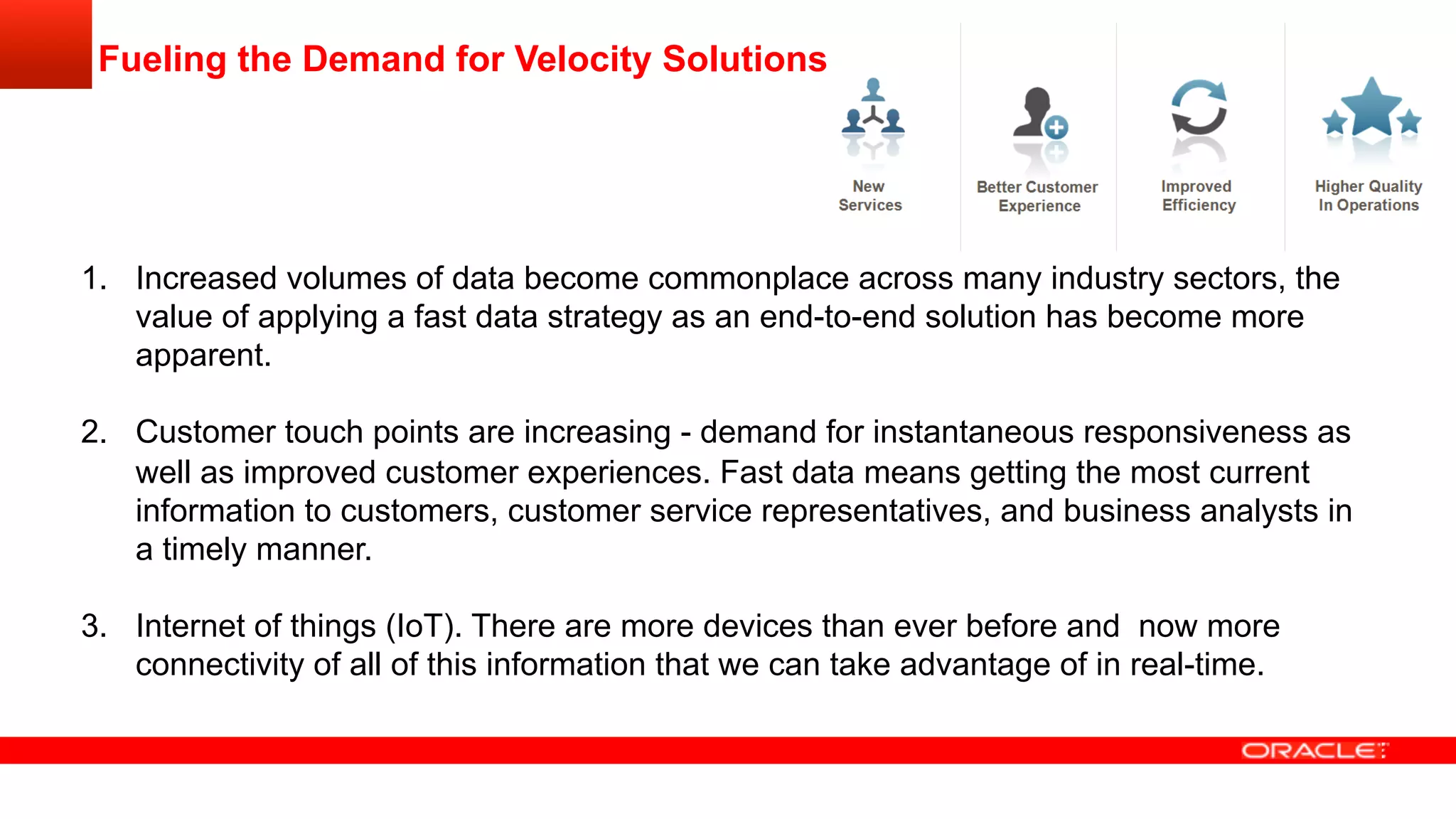
Fueling the Demand for Velocity Solutions
1.  Increased volumes of data become commonplace across many industry sectors, the
value of applying a fast data strategy as an end-to-end solution has become more
apparent.
2.  Customer touch points are increasing - demand for instantaneous responsiveness as
well as improved customer experiences. Fast data means getting the most current
information to customers, customer service representatives, and business analysts in
a timely manner.
3.  Internet of things (IoT). There are more devices than ever before and now more
connectivity of all of this information that we can take advantage of in real-time.
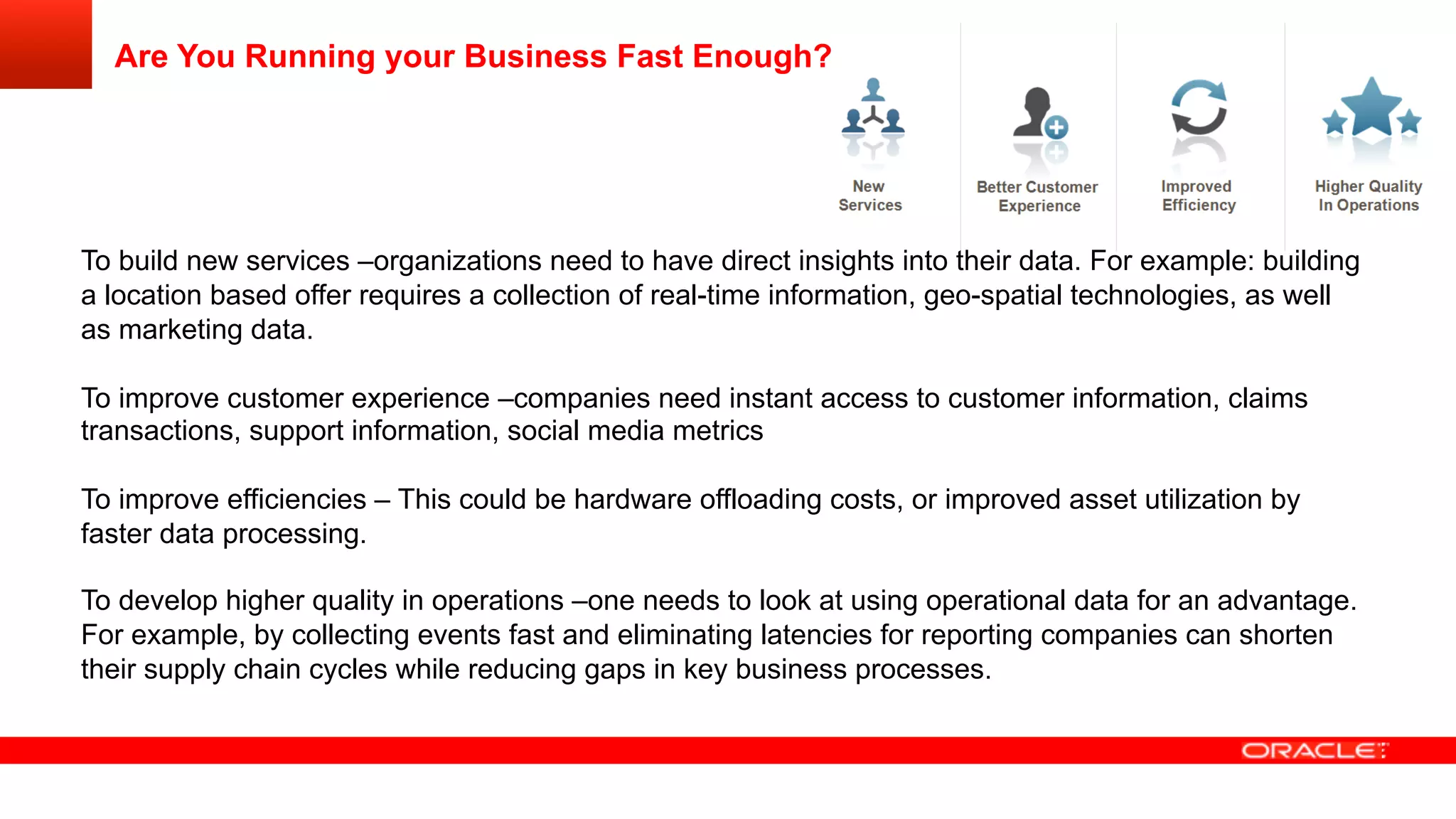
Are You Running your Business Fast Enough?
To build new services –organizations need to have direct insights into their data. For example: building
a location based offer requires a collection of real-time information, geo-spatial technologies, as well
as marketing data.
To improve customer experience –companies need instant access to customer information, claims
transactions, support information, social media metrics
To improve efficiencies – This could be hardware offloading costs, or improved asset utilization by
faster data processing.
To develop higher quality in operations –one needs to look at using operational data for an advantage.
For example, by collecting events fast and eliminating latencies for reporting companies can shorten
their supply chain cycles while reducing gaps in key business processes.
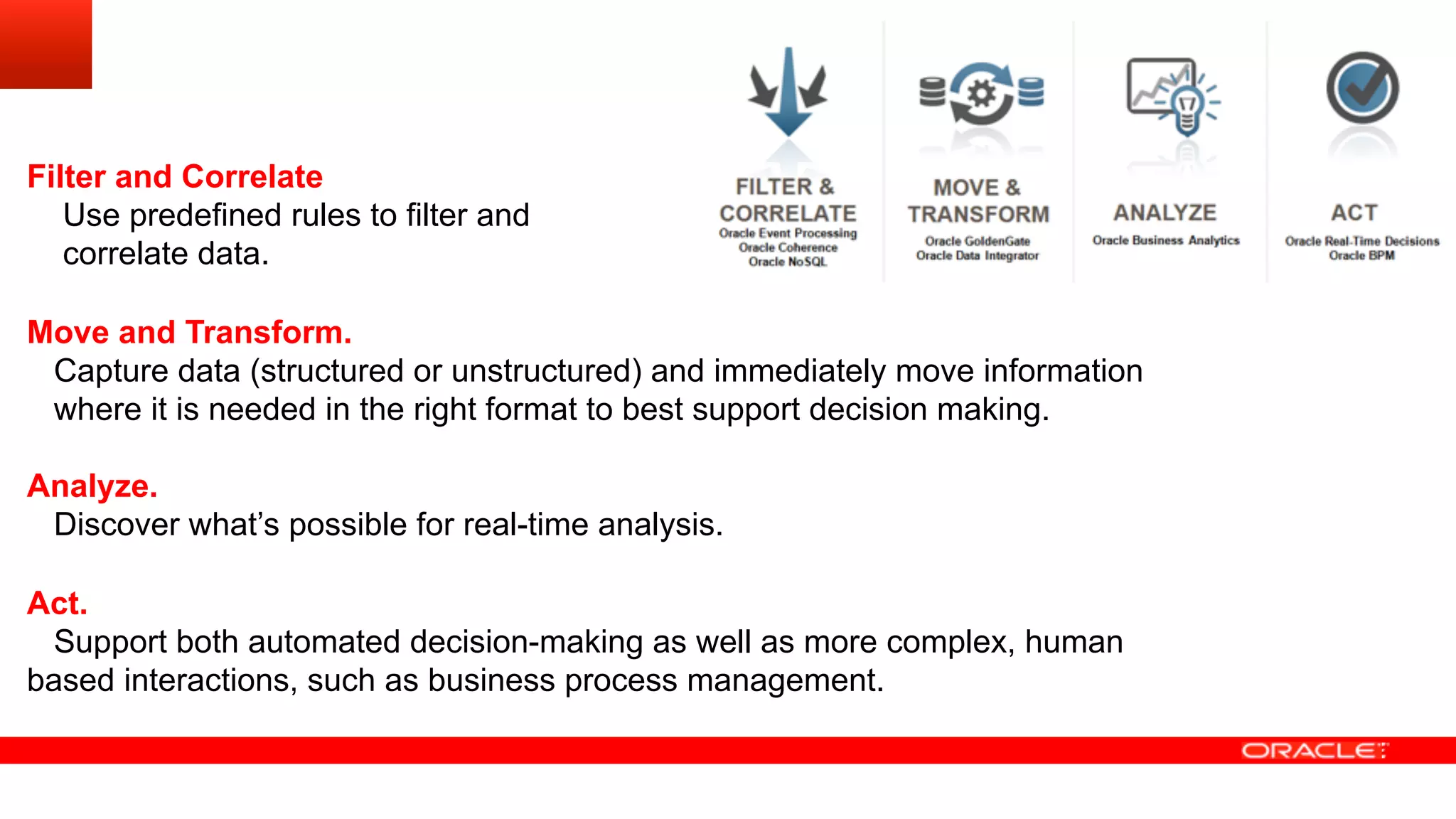
Filter and Correlate
Use predefined rules to filter and
correlate data.
Move and Transform.
Capture data (structured or unstructured) and immediately move information
where it is needed in the right format to best support decision making.
Analyze.
Discover what’s possible for real-time analysis.
Act.
Support both automated decision-making as well as more complex, human
based interactions, such as business process management.
SUMMARY 
Enterprises must learn
to understand how best
to leverage big data
soon, since the amount
of data being
generated shows no
signs of slowing down. 

Companies that have
learned to truly
leverage big data
understand that they
must analyze their new
sources of information

To derive real business
value from big data,
you need the right tools
to capture and organize
a wide variety of data
types from different
sources, and to be able
to easily analyze it
within the context
By using a well designed Data
Management platform,
enterprises can acquire,
organize and analyze all their
enterprise data – including
structured and unstructured –
to make the most informed
decisions.
17 Copyright © 2013, Oracle and/or its affiliates. All rights reserved. Proprietary & Confidential
Questions
18 Copyright © 2013, Oracle and/or its affiliates. All rights reserved. Proprietary & Confidential
The preceding is intended to outline our general product
direction. It is intended for information purposes only, and may
not be incorporated into any contract. It is not a commitment to
deliver any material, code, or functionality, and should not be
relied upon in making purchasing decisions.
The development, release, and timing of any features or
functionality described for Oracle’s products remains at the
sole discretion of Oracle.

Sgcp14dunlea

  • 1.
    Copyright  ©  2014  Oracle  and/or  its  affiliates.  All  rights  reserved.    |   Big Data, Fast Data, Actionable Data Putting Big Data to Work in Utilities Martin Dunlea Global Industries Lead Utilities Industry Business Unit June 4, 2014 6th Smart Grids & Cleanpower Conference 3-4 June 2014, Cambridge, UK www.hvm-uk.com
  • 2.
    What Does BigData Mean?! VOLUME VELOCITY VARIETY VALUE SOCIAL BLOG SMART METER 1011001010010010011010101010111 00101010100100101 DEVICES SENSORS What is the key difference in managing this data now? Volume, Velocity, Variety, Value These characteristics challenge most utility’s existing architecture, tools, staffing competency and business processes!
  • 3.
    3 Copyright ©2013, Oracle and/or its affiliates. All rights reserved. Proprietary & Confidential Top Performing Companies Use Analytics to Drive Business Performance Source: Oracle Study 2013 – “Utilities and Big Data: Accelerating the Drive to Value” However, in utilities …
  • 4.
    4 | ©2013 Oracle Corporation – Proprietary and Confidential Which Type Of Data Is Your Utility Collecting From Smart Meters?* Utilities Are Collecting Increasing Volume And Variety Of Data Through Multiple Sources *Based on a Survey Conducted by Oracle with Senior Executives in Utility Industry in North America in 2012 Source: Big Data, Bigger Opportunities, Oracle, 2012 78%   76%   73%   63%   56%   Outage   Interval   Voltage   Tamper   Events   DiagnosKc   Flags   In Addition To Smart Meters, What Other Sources Are Contributing To Data Influx?* 59% Distribution Management Systems 44% Customer Data / Feedback 40% 27% Alternative Energy Sources Advanced Sensors, Controls, Etc. The  average  u*lity  with  a  smart  meter  program  in  place  has  increased  the  frequency  of  its  data  collec*on   by  180x  –  collec*ng  data  once  every  four  hours,  on  average,  as  opposed  to  just  once  a  month*  
  • 5.
    5 | ©2013 Oracle Corporation – Proprietary and Confidential Utilities Are Focusing On Optimizing Operations Through Smart Meters and Network Data Improve  Compa*bility  with  Regula*ons   Implement/Improve  Efficiency  Programs   Iden*fy  Trends  and  Forecast  Demand   Use  Predic*ve  Analy*cs  to  Minimize   Outages,  Improve  Reliability   “Utilities commonly undervalue the diagnostic potential of the information generated through various systems. This underutilization of company and customer information presents a valuable opportunity to optimize work effectiveness, raise performance, and improve the bottom line” – Oliver Wyman Report *Based on a Survey Conducted by Oracle with Senior Executives in Utility Industry in North America in 2013 Source: Utilities and Big Data: Accelerating the Drive to Value, Oracle, 2012; Driving Performance Through Business Analytics—Leveraging Data to Improve Utility Performance, Oliver Wyman How Are Utilities Leveraging Smart Grid Data To Drive Operational Value?* 42%   47%   51%   53%  
  • 6.
    Big Data inAction! Energy Retail Renewable Energy Demand Forecasting
  • 7.
    Big Data inAction Today’s Utilities Challenge New Data What’s Possible Utilities Network Capacity Planning Network Sensors Real Time allocation, Automated diagnosis, support Demand Response Remote Control Ratings Analysis, CT Behavior, Troubleshooting Location-Based Services Real time location data Geo-spatial visibility and awareness, travel, Search Plant, Network and Quality Monitoring Real-time Events Automated diagnosis, support, Better troubleshooting, UX, CX Utilities Retail - One size fits all marketing Social media Sentiment analysis segmentation Make Better Decisions Using Big Data – User Cases
  • 8.
    Complexity Obstructs BusinessAgility
 Integrating Multiple Applications on Different Technologies! Complexity Undermines Productivity
 Using Separate Collaborative, Analytic and Transactional Tools! Complexity Drives Up Costs
 Building up IT Assets to Achieve Reliability and Scalability!
  • 9.
    Acquire Big Data • Data streams of higher velocity and higher variety •  Predictable latency in both capturing data and in executing short, simple queries •  Be able to handle very high transaction volumes, often in a distributed environment •  Support flexible, dynamic data structures. Organize Big Data •  Organizing data is called data integration. •  Tendency to organize data at its initial destination location, thus saving both time and money •  Process and manipulate data in the original storage location •  Support very high throughput (often in batch) to deal with large data processing steps •  Handle a large variety of data formats, from unstructured to structured. Analyze Big Data •  Analysis may also be done in a distributed environment, •  Support deeper analytics such as statistical analysis and data mining, on a wider variety of data types stored in diverse systems •  Scale to extreme data volumes; deliver faster response times driven by changes in behavior •  Automate decisions based on analytical models. •  Integrate analysis on the combination of big data and traditional enterprise data. Building a Big data Platform! End goal is to easily integrate your big data with your enterprise data to allow you to conduct deep analytics on the combined data set. !
  • 10.
  • 11.
    11 Copyright ©2013, Oracle and/or its affiliates. All rights reserved. Proprietary & Confidential Oracle Exadata Oracle Exalytics Big Data Platform Stream Acquire Organize Discover & Analyze Oracle Big Data Appliance Oracle Big Data Connectors Optimized for Analytics & In-Memory Workloads “System of Record” Optimized for DW/OLTP Optimized for Hadoop, R, and NoSQL Processing Oracle BI Utilities Oracle BI Applications Oracle BI Tools Oracle Enterprise Performance Management Oracle Endeca Information Discovery Oracle Real-time Decisions Times Ten Hadoop Open Source R Applications Oracle NoSQL Database Oracle Big Data Connectors Oracle Data Integrator In-­‐Database  Analy*cs   Oracle Advanced Analytics Oracle Database OUDM
  • 12.
    What is FastData ?! • Transformation enabled by a move to “Big Data.” • Organizations are increasingly collecting vast quantities of real-time data. • Most of the focus on Big Data so far has been on situations where the data being managed is basically fixed—it’s already been collected and stored in a Big Data database • Fast data - the velocity side of Big Data - is a complimentary approach to big data • Helps organizations get a jump on those business-critical decisions. Continuous access and processing of events and data in real-time for the purposes of gaining instant awareness and instant action.
  • 13.
    Fueling the Demandfor Velocity Solutions 1.  Increased volumes of data become commonplace across many industry sectors, the value of applying a fast data strategy as an end-to-end solution has become more apparent. 2.  Customer touch points are increasing - demand for instantaneous responsiveness as well as improved customer experiences. Fast data means getting the most current information to customers, customer service representatives, and business analysts in a timely manner. 3.  Internet of things (IoT). There are more devices than ever before and now more connectivity of all of this information that we can take advantage of in real-time.
  • 14.
    Are You Runningyour Business Fast Enough? To build new services –organizations need to have direct insights into their data. For example: building a location based offer requires a collection of real-time information, geo-spatial technologies, as well as marketing data. To improve customer experience –companies need instant access to customer information, claims transactions, support information, social media metrics To improve efficiencies – This could be hardware offloading costs, or improved asset utilization by faster data processing. To develop higher quality in operations –one needs to look at using operational data for an advantage. For example, by collecting events fast and eliminating latencies for reporting companies can shorten their supply chain cycles while reducing gaps in key business processes.
  • 15.
    Filter and Correlate Usepredefined rules to filter and correlate data. Move and Transform. Capture data (structured or unstructured) and immediately move information where it is needed in the right format to best support decision making. Analyze. Discover what’s possible for real-time analysis. Act. Support both automated decision-making as well as more complex, human based interactions, such as business process management.
  • 16.
    SUMMARY Enterprises mustlearn to understand how best to leverage big data soon, since the amount of data being generated shows no signs of slowing down. Companies that have learned to truly leverage big data understand that they must analyze their new sources of information To derive real business value from big data, you need the right tools to capture and organize a wide variety of data types from different sources, and to be able to easily analyze it within the context By using a well designed Data Management platform, enterprises can acquire, organize and analyze all their enterprise data – including structured and unstructured – to make the most informed decisions.
  • 17.
    17 Copyright ©2013, Oracle and/or its affiliates. All rights reserved. Proprietary & Confidential Questions
  • 18.
    18 Copyright ©2013, Oracle and/or its affiliates. All rights reserved. Proprietary & Confidential The preceding is intended to outline our general product direction. It is intended for information purposes only, and may not be incorporated into any contract. It is not a commitment to deliver any material, code, or functionality, and should not be relied upon in making purchasing decisions. The development, release, and timing of any features or functionality described for Oracle’s products remains at the sole discretion of Oracle.