Khoo Guan Seng, PhD
Head, Group Risk (Models Validation)
Standard Chartered Bank
Khoo.Guan-Seng@standardchartered.com
gskhoo@gmail.com
Developments with Monte Carlo Simulation:
Techniques in Investment & Performance Risk
Management:
Perspectives from Modelling & Validation in Market
Risk Management
Agenda
• Using Monte Carlo (MC) techniques for
investment risk and portfolio performance
management
• Innovations with Monte Carlo methods
• Implementation within your risk systems &
interpreting the results to enhance performance
measurement
• Mitigate dynamic risks through diversification
across time, asset classes, investment styles
and channels with simulations
• Validating the MC techniques
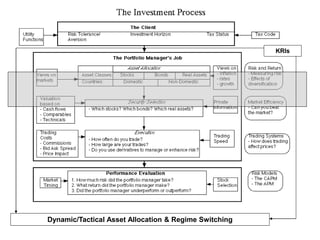
KRIs
Dynamic/Tactical Asset Allocation & Regime Switching
I. Using MC Techniques for Investment
Risk & Portfolio Performance
Management
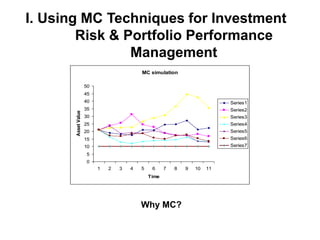
Why MC?
MC simulation
0
5
10
15
20
25
30
35
40
45
50
1 2 3 4 5 6 7 8 9 10 11
Time
AssetValue
Series1
Series2
Series3
Series4
Series5
Series6
Series7
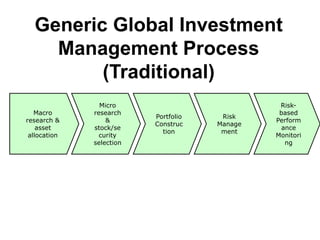
Generic Global Investment
Management Process
(Traditional)
Macro
research &
asset
allocation
Micro
research
&
stock/se
curity
selection
Portfolio
Construc
tion
Risk
Manage
ment
Risk-
based
Perform
ance
Monitori
ng
Recap: Investment Risk
Definition
• Investment Risk: the measurement and
assessment of exposure held by the FI and
its clients’ portfolios to expected and
unexpected volatility in financial
performance and the requirement to ensure
that exposure to unexpected volatility is
managed effectively and comprehensively
Ultimate Objective of Investment
Risk Management
• To minimize the firm’s exposure to:
 Unexpected volatility of investment performance
relative to mandate
 Persistence in investment underperformance
 Loss of client assets/Loss of growth in client assets
 Loss of revenue/Loss of growth in revenues
 Loss of capital
• To maximize the firm’s exposure & returns:
 to consistent high-growth areas
 by capitalizing on risk-based opportunities
 via flexibility and adaptability to challenges
 via risk transfer, hedging or insurance
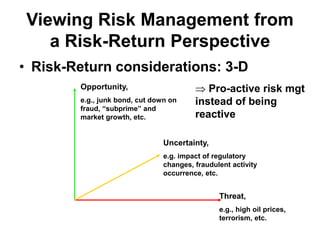
Viewing Risk Management from
a Risk-Return Perspective
• Risk-Return considerations: 3-D
Threat,
e.g., high oil prices,
terrorism, etc.
Uncertainty,
e.g. impact of regulatory
changes, fraudulent activity
occurrence, etc.
Opportunity,
e.g., junk bond, cut down on
fraud, “subprime” and
market growth, etc.
 Pro-active risk mgt
instead of being
reactive
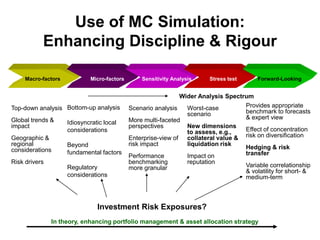
Use of MC Simulation:
Enhancing Discipline & Rigour
Top-down analysis
Global trends &
impact
Geographic &
regional
considerations
Risk drivers
Bottom-up analysis
Idiosyncratic local
considerations
Beyond
fundamental factors
Regulatory
considerations
Scenario analysis
More multi-faceted
perspectives
Enterprise-view of
risk impact
Performance
benchmarking
more granular
Worst-case
scenario
New dimensions
to assess, e.g.,
collateral value &
liquidation risk
Impact on
reputation
Macro-factors Micro-factors Sensitivity Analysis Stress test Forward-Looking
Provides appropriate
benchmark to forecasts
& expert view
Effect of concentration
risk on diversification
Hedging & risk
transfer
Variable correlationship
& volatility for short- &
medium-term
Wider Analysis Spectrum
In theory, enhancing portfolio management & asset allocation strategy
Investment Risk Exposures?
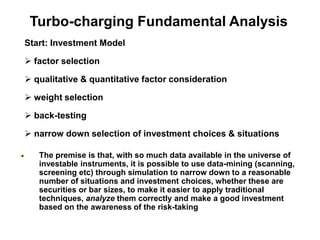
Start: Investment Model
 factor selection
 qualitative & quantitative factor consideration
 weight selection
 back-testing
 narrow down selection of investment choices & situations
The premise is that, with so much data available in the universe of
investable instruments, it is possible to use data-mining (scanning,
screening etc) through simulation to narrow down to a reasonable
number of situations and investment choices, whether these are
securities or bar sizes, to make it easier to apply traditional
techniques, analyze them correctly and make a good investment
based on the awareness of the risk-taking
Turbo-charging Fundamental Analysis
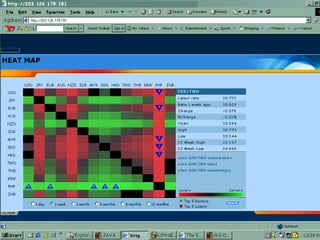
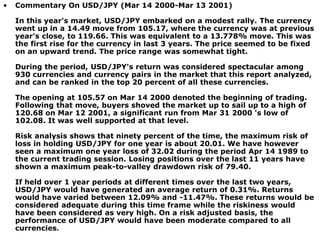
• Commentary On USD/JPY (Mar 14 2000-Mar 13 2001)
In this year's market, USD/JPY embarked on a modest rally. The currency
went up in a 14.49 move from 105.17, where the currency was at previous
year's close, to 119.66. This was equivalent to a 13.778% move. This was
the first rise for the currency in last 3 years. The price seemed to be fixed
on an upward trend. The price range was somewhat tight.
During the period, USD/JPY's return was considered spectacular among
930 currencies and currency pairs in the market that this report analyzed,
and can be ranked in the top 20 percent of all these currencies.
The opening at 105.57 on Mar 14 2000 denoted the beginning of trading.
Following that move, buyers shoved the market up to sail up to a high of
120.68 on Mar 12 2001, a significant run from Mar 31 2000 's low of
102.08. It was well supported at that level.
Risk analysis shows that ninety percent of the time, the maximum risk of
loss in holding USD/JPY for one year is about 20.01. We have however
seen a maximum one year loss of 32.02 during the period Apr 14 1989 to
the current trading session. Losing positions over the last 11 years have
shown a maximum peak-to-valley drawdown risk of 79.40.
If held over 1 year periods at different times over the last two years,
USD/JPY would have generated an average return of 0.31%. Returns
would have varied between 12.09% and -11.47%. These returns would be
considered adequate during this time frame while the riskiness would
have been considered as very high. On a risk adjusted basis, the
performance of USD/JPY would have been moderate compared to all
currencies.
II. Innovations with Monte Carlo
Methods & Platform
• Extending to various frontiers
• Analytical results can be transmitted
• Empowerment of Client Choices
• Multi-scenario analysis
• Customization to be Client-centric
• Audit trail of client selection/choices enhances CRM
• Allowances for Different Dimensions to be Presented with respect to
Portfolio Risk Diversification & Asset Allocation
• Benchmarking MC Performance Results to Clients’ or
Managers’ Risk Appetite/ “Fund Internal Index”
• Time horizon & liquidity diversification – analysis of simulation
results with short-, medium- & long-term investment horizons
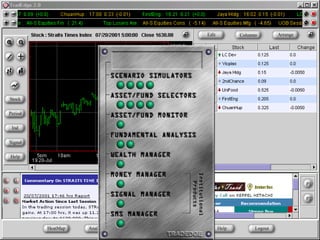
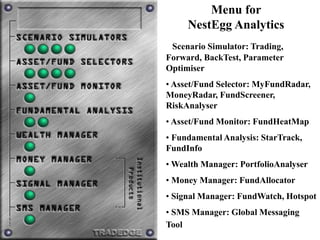
Menu for
NestEgg Analytics
• Scenario Simulator: Trading,
Forward, BackTest, Parameter
Optimiser
• Asset/Fund Selector: MyFundRadar,
MoneyRadar, FundScreener,
RiskAnalyser
• Asset/Fund Monitor: FundHeatMap
• Fundamental Analysis: StarTrack,
FundInfo
• Wealth Manager: PortfolioAnalyser
• Money Manager: FundAllocator
• Signal Manager: FundWatch, Hotspot
• SMS Manager: Global Messaging
Tool
III. Implementation within your Risk
Systems & Interpreting the Results to
Enhance Performance Measurement
Performance Risk Attribution and Consistency
• Case Studies
• MC simulation allows for Market timing & asset allocation perspectives
based on simulation results from a risk-based performance
perspectives, including cases of netting & dynamic optimal asset
allocation, etc.
• In addition, MC simulation enables scenario analysis & stress testing
of redemption & recovery aspects of the investment models, e.g., LGD
modelling, simulated marking-to-market of distressed and/or illiquid
assets, etc.
Case Studies
MC simulation
0
5
10
15
20
25
30
35
40
45
50
1 2 3 4 5 6 7 8 9 10 11
Time
AssetValue
Series1
Series2
Series3
Series4
Series5
Series6
Series7
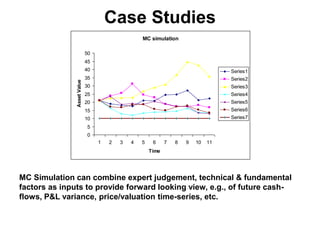
MC Simulation can combine expert judgement, technical & fundamental
factors as inputs to provide forward looking view, e.g., of future cash-
flows, P&L variance, price/valuation time-series, etc.
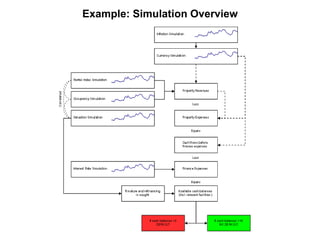
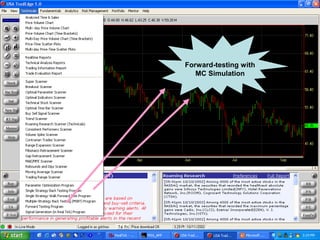
Example: Simulation Overview
Forward-testing with
MC Simulation
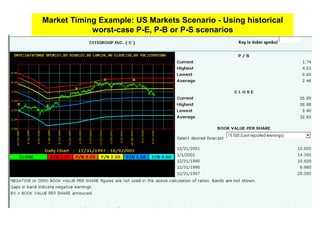
Market Timing Example: US Markets Scenario - Using historical
worst-case P-E, P-B or P-S scenarios
IV. Mitigate dynamic risks
through diversification across
time, asset classes, investment
styles and channels with
simulations
Case studies
Discussions
• Short-term (Technical) trading model +
Medium-term (e.g., Momentum) investing
+ Long-term (e.g., growth/value
investing/sector/etc.) + Managed futures +
Bond fund, etc.
• Position leveraging & deleveraging (not
debt leverage) – mitigating concentration
risk with simulation
V. Validating the MC techniques
On Methodology
Validation Issues:
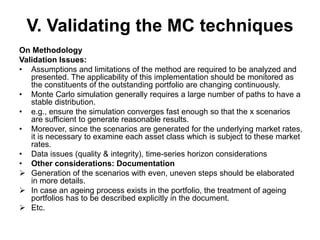
• Assumptions and limitations of the method are required to be analyzed and
presented. The applicability of this implementation should be monitored as
the constituents of the outstanding portfolio are changing continuously.
• Monte Carlo simulation generally requires a large number of paths to have a
stable distribution.
• e.g., ensure the simulation converges fast enough so that the x scenarios
are sufficient to generate reasonable results.
• Moreover, since the scenarios are generated for the underlying market rates,
it is necessary to examine each asset class which is subject to these market
rates.
• Data issues (quality & integrity), time-series horizon considerations
• Other considerations: Documentation
 Generation of the scenarios with even, uneven steps should be elaborated
in more details.
 In case an ageing process exists in the portfolio, the treatment of ageing
portfolios has to be described explicitly in the document.
 Etc.
Validating MC Methodology
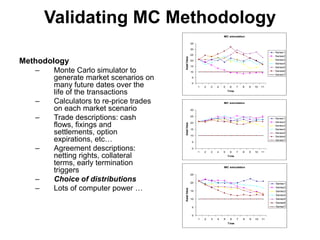
Methodology
– Monte Carlo simulator to
generate market scenarios on
many future dates over the
life of the transactions
– Calculators to re-price trades
on each market scenario
– Trade descriptions: cash
flows, fixings and
settlements, option
expirations, etc…
– Agreement descriptions:
netting rights, collateral
terms, early termination
triggers
– Choice of distributions
– Lots of computer power …
MC simulation
0
5
10
15
20
25
30
35
1 2 3 4 5 6 7 8 9 10 11
Time
AssetValue
Series1
Series2
Series3
Series4
Series5
Series6
Series7
MC simulation
0
5
10
15
20
25
30
1 2 3 4 5 6 7 8 9 10 11
Time
AssetValue
Series1
Series2
Series3
Series4
Series5
Series6
Series7
MC simulation
0
5
10
15
20
25
1 2 3 4 5 6 7 8 9 10 11
Time
AssetValue
Series1
Series2
Series3
Series4
Series5
Series6
Series7
Re-visiting Liquidity Risk in
Investment Risk Management via MC
Simulation
• Asset class exposure: exchange-traded or OTC
& implications on whether liquid, not so liquid,
geographic, free-float, concentration risk, etc.
• Systemic risk: scenario analysis & stress-testing
with capital planning
• Risk appetite/tolerance: impact on reputation
risk, redemptions, business continuity &
sustainability,
• etc.
Consideration of Liquidity Risk Evolution
 Amount of contingent funds vs. severity of crisis.
 Developmental stages in manifestation vs abrupt blowout
 Short-term duration of liquidity crisis vs longer-term
• Clear Identification of Stages of a Crisis
• Categorization of liquid asset & volatile liability
- helps in measurement of remaining liquidity gap after liabilities
renewed or removed
• Asset liquidation & counter-balancing
- Liquidation profile of unencumbered assets, acts as driver of liquidity
gap closure
- asset quality affects speed of liquidation
• Also, evaluate stress tests to identify major contributors to risk
exposures in order to:
 reduce risk exposures if possible
 combine stress testing and limits
 combine stress testing and liquidity contingency planning
MC Stress Test
Concluding Remarks:
Putting It All Together
• MC can be used on its own, but would
reinforce the two other major pieces of
performance risk attribution analyses :
Backtesting and Risk Management
• Comprehensive Approach to Investment
Risk Analytics:
– Step 1: pre-simulation Data-Mining
– Step 2: Strategy Backtesting
– Step 3: post-simulation Risk Management
It’s the whole
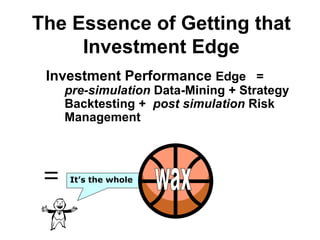
The Essence of Getting that
Investment Edge
Investment Performance Edge =
pre-simulation Data-Mining + Strategy
Backtesting + post simulation Risk
Management
= !
Thank You
CLICK
GS Khoo, PhD
Email:
Khoo.Guan-Seng@standardchartered.com
gskhoo@gmail.com
Cell: +65 98252148

Sg iqpc sg_feb2409_iparmasia_gskhoofinalversion

  • 1.
    Khoo Guan Seng,PhD Head, Group Risk (Models Validation) Standard Chartered Bank Khoo.Guan-Seng@standardchartered.com gskhoo@gmail.com Developments with Monte Carlo Simulation: Techniques in Investment & Performance Risk Management: Perspectives from Modelling & Validation in Market Risk Management
  • 2.
    Agenda • Using MonteCarlo (MC) techniques for investment risk and portfolio performance management • Innovations with Monte Carlo methods • Implementation within your risk systems & interpreting the results to enhance performance measurement • Mitigate dynamic risks through diversification across time, asset classes, investment styles and channels with simulations • Validating the MC techniques
  • 3.
  • 4.
    I. Using MCTechniques for Investment Risk & Portfolio Performance Management Why MC? MC simulation 0 5 10 15 20 25 30 35 40 45 50 1 2 3 4 5 6 7 8 9 10 11 Time AssetValue Series1 Series2 Series3 Series4 Series5 Series6 Series7
  • 5.
    Generic Global Investment ManagementProcess (Traditional) Macro research & asset allocation Micro research & stock/se curity selection Portfolio Construc tion Risk Manage ment Risk- based Perform ance Monitori ng
  • 6.
    Recap: Investment Risk Definition •Investment Risk: the measurement and assessment of exposure held by the FI and its clients’ portfolios to expected and unexpected volatility in financial performance and the requirement to ensure that exposure to unexpected volatility is managed effectively and comprehensively
  • 7.
    Ultimate Objective ofInvestment Risk Management • To minimize the firm’s exposure to:  Unexpected volatility of investment performance relative to mandate  Persistence in investment underperformance  Loss of client assets/Loss of growth in client assets  Loss of revenue/Loss of growth in revenues  Loss of capital • To maximize the firm’s exposure & returns:  to consistent high-growth areas  by capitalizing on risk-based opportunities  via flexibility and adaptability to challenges  via risk transfer, hedging or insurance
  • 8.
    Viewing Risk Managementfrom a Risk-Return Perspective • Risk-Return considerations: 3-D Threat, e.g., high oil prices, terrorism, etc. Uncertainty, e.g. impact of regulatory changes, fraudulent activity occurrence, etc. Opportunity, e.g., junk bond, cut down on fraud, “subprime” and market growth, etc.  Pro-active risk mgt instead of being reactive
  • 9.
    Use of MCSimulation: Enhancing Discipline & Rigour Top-down analysis Global trends & impact Geographic & regional considerations Risk drivers Bottom-up analysis Idiosyncratic local considerations Beyond fundamental factors Regulatory considerations Scenario analysis More multi-faceted perspectives Enterprise-view of risk impact Performance benchmarking more granular Worst-case scenario New dimensions to assess, e.g., collateral value & liquidation risk Impact on reputation Macro-factors Micro-factors Sensitivity Analysis Stress test Forward-Looking Provides appropriate benchmark to forecasts & expert view Effect of concentration risk on diversification Hedging & risk transfer Variable correlationship & volatility for short- & medium-term Wider Analysis Spectrum In theory, enhancing portfolio management & asset allocation strategy Investment Risk Exposures?
  • 10.
    Start: Investment Model factor selection  qualitative & quantitative factor consideration  weight selection  back-testing  narrow down selection of investment choices & situations The premise is that, with so much data available in the universe of investable instruments, it is possible to use data-mining (scanning, screening etc) through simulation to narrow down to a reasonable number of situations and investment choices, whether these are securities or bar sizes, to make it easier to apply traditional techniques, analyze them correctly and make a good investment based on the awareness of the risk-taking Turbo-charging Fundamental Analysis
  • 12.
    • Commentary OnUSD/JPY (Mar 14 2000-Mar 13 2001) In this year's market, USD/JPY embarked on a modest rally. The currency went up in a 14.49 move from 105.17, where the currency was at previous year's close, to 119.66. This was equivalent to a 13.778% move. This was the first rise for the currency in last 3 years. The price seemed to be fixed on an upward trend. The price range was somewhat tight. During the period, USD/JPY's return was considered spectacular among 930 currencies and currency pairs in the market that this report analyzed, and can be ranked in the top 20 percent of all these currencies. The opening at 105.57 on Mar 14 2000 denoted the beginning of trading. Following that move, buyers shoved the market up to sail up to a high of 120.68 on Mar 12 2001, a significant run from Mar 31 2000 's low of 102.08. It was well supported at that level. Risk analysis shows that ninety percent of the time, the maximum risk of loss in holding USD/JPY for one year is about 20.01. We have however seen a maximum one year loss of 32.02 during the period Apr 14 1989 to the current trading session. Losing positions over the last 11 years have shown a maximum peak-to-valley drawdown risk of 79.40. If held over 1 year periods at different times over the last two years, USD/JPY would have generated an average return of 0.31%. Returns would have varied between 12.09% and -11.47%. These returns would be considered adequate during this time frame while the riskiness would have been considered as very high. On a risk adjusted basis, the performance of USD/JPY would have been moderate compared to all currencies.
  • 16.
    II. Innovations withMonte Carlo Methods & Platform • Extending to various frontiers • Analytical results can be transmitted • Empowerment of Client Choices • Multi-scenario analysis • Customization to be Client-centric • Audit trail of client selection/choices enhances CRM • Allowances for Different Dimensions to be Presented with respect to Portfolio Risk Diversification & Asset Allocation • Benchmarking MC Performance Results to Clients’ or Managers’ Risk Appetite/ “Fund Internal Index” • Time horizon & liquidity diversification – analysis of simulation results with short-, medium- & long-term investment horizons
  • 18.
    Menu for NestEgg Analytics •Scenario Simulator: Trading, Forward, BackTest, Parameter Optimiser • Asset/Fund Selector: MyFundRadar, MoneyRadar, FundScreener, RiskAnalyser • Asset/Fund Monitor: FundHeatMap • Fundamental Analysis: StarTrack, FundInfo • Wealth Manager: PortfolioAnalyser • Money Manager: FundAllocator • Signal Manager: FundWatch, Hotspot • SMS Manager: Global Messaging Tool
  • 20.
    III. Implementation withinyour Risk Systems & Interpreting the Results to Enhance Performance Measurement Performance Risk Attribution and Consistency • Case Studies • MC simulation allows for Market timing & asset allocation perspectives based on simulation results from a risk-based performance perspectives, including cases of netting & dynamic optimal asset allocation, etc. • In addition, MC simulation enables scenario analysis & stress testing of redemption & recovery aspects of the investment models, e.g., LGD modelling, simulated marking-to-market of distressed and/or illiquid assets, etc.
  • 21.
    Case Studies MC simulation 0 5 10 15 20 25 30 35 40 45 50 12 3 4 5 6 7 8 9 10 11 Time AssetValue Series1 Series2 Series3 Series4 Series5 Series6 Series7 MC Simulation can combine expert judgement, technical & fundamental factors as inputs to provide forward looking view, e.g., of future cash- flows, P&L variance, price/valuation time-series, etc.
  • 22.
  • 24.
  • 35.
    Market Timing Example:US Markets Scenario - Using historical worst-case P-E, P-B or P-S scenarios
  • 37.
    IV. Mitigate dynamicrisks through diversification across time, asset classes, investment styles and channels with simulations Case studies
  • 38.
    Discussions • Short-term (Technical)trading model + Medium-term (e.g., Momentum) investing + Long-term (e.g., growth/value investing/sector/etc.) + Managed futures + Bond fund, etc. • Position leveraging & deleveraging (not debt leverage) – mitigating concentration risk with simulation
  • 43.
    V. Validating theMC techniques On Methodology Validation Issues: • Assumptions and limitations of the method are required to be analyzed and presented. The applicability of this implementation should be monitored as the constituents of the outstanding portfolio are changing continuously. • Monte Carlo simulation generally requires a large number of paths to have a stable distribution. • e.g., ensure the simulation converges fast enough so that the x scenarios are sufficient to generate reasonable results. • Moreover, since the scenarios are generated for the underlying market rates, it is necessary to examine each asset class which is subject to these market rates. • Data issues (quality & integrity), time-series horizon considerations • Other considerations: Documentation  Generation of the scenarios with even, uneven steps should be elaborated in more details.  In case an ageing process exists in the portfolio, the treatment of ageing portfolios has to be described explicitly in the document.  Etc.
  • 44.
    Validating MC Methodology Methodology –Monte Carlo simulator to generate market scenarios on many future dates over the life of the transactions – Calculators to re-price trades on each market scenario – Trade descriptions: cash flows, fixings and settlements, option expirations, etc… – Agreement descriptions: netting rights, collateral terms, early termination triggers – Choice of distributions – Lots of computer power … MC simulation 0 5 10 15 20 25 30 35 1 2 3 4 5 6 7 8 9 10 11 Time AssetValue Series1 Series2 Series3 Series4 Series5 Series6 Series7 MC simulation 0 5 10 15 20 25 30 1 2 3 4 5 6 7 8 9 10 11 Time AssetValue Series1 Series2 Series3 Series4 Series5 Series6 Series7 MC simulation 0 5 10 15 20 25 1 2 3 4 5 6 7 8 9 10 11 Time AssetValue Series1 Series2 Series3 Series4 Series5 Series6 Series7
  • 45.
    Re-visiting Liquidity Riskin Investment Risk Management via MC Simulation • Asset class exposure: exchange-traded or OTC & implications on whether liquid, not so liquid, geographic, free-float, concentration risk, etc. • Systemic risk: scenario analysis & stress-testing with capital planning • Risk appetite/tolerance: impact on reputation risk, redemptions, business continuity & sustainability, • etc.
  • 46.
    Consideration of LiquidityRisk Evolution  Amount of contingent funds vs. severity of crisis.  Developmental stages in manifestation vs abrupt blowout  Short-term duration of liquidity crisis vs longer-term
  • 47.
    • Clear Identificationof Stages of a Crisis • Categorization of liquid asset & volatile liability - helps in measurement of remaining liquidity gap after liabilities renewed or removed • Asset liquidation & counter-balancing - Liquidation profile of unencumbered assets, acts as driver of liquidity gap closure - asset quality affects speed of liquidation • Also, evaluate stress tests to identify major contributors to risk exposures in order to:  reduce risk exposures if possible  combine stress testing and limits  combine stress testing and liquidity contingency planning MC Stress Test
  • 48.
    Concluding Remarks: Putting ItAll Together • MC can be used on its own, but would reinforce the two other major pieces of performance risk attribution analyses : Backtesting and Risk Management • Comprehensive Approach to Investment Risk Analytics: – Step 1: pre-simulation Data-Mining – Step 2: Strategy Backtesting – Step 3: post-simulation Risk Management
  • 49.
    It’s the whole TheEssence of Getting that Investment Edge Investment Performance Edge = pre-simulation Data-Mining + Strategy Backtesting + post simulation Risk Management = !
  • 50.
    Thank You CLICK GS Khoo,PhD Email: Khoo.Guan-Seng@standardchartered.com gskhoo@gmail.com Cell: +65 98252148