



1
Hidden
SPEED
BUMPSon the Road to “Continuous”
Based on the Sonatype 2015 State of the Software Supply Chain Report
2
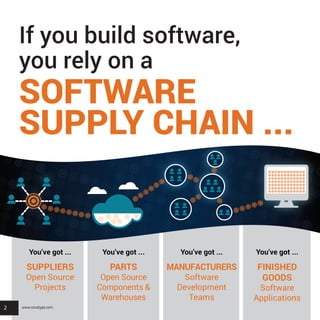
You’ve got ...
SUPPLIERS
Open Source
Projects
You’ve got ...
PARTS
Open Source
Components &
Warehouses
You’ve got ...
MANUFACTURERS
Software
Development
Teams
You’ve got ...
FINISHED
GOODS
Software
Applications
If you build software,
you rely on a
SOFTWARE
SUPPLY CHAIN ...
www.sonatype.com2
3
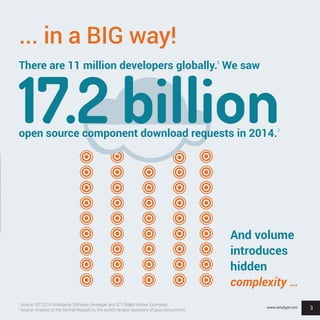
... in a BIG way!
There are 11 million developers globally.1
We saw
17.2 billionopen source component download requests in 2014.2
And volume
introduces
hidden
complexity …
1
Source: IDC 2014 Worldwide Software Developer and ICT-Skilled Worker Estimates
2
Source: Analysis of the Central Repository, the world’s largest repository of java components. 3www.sonatype.com
4
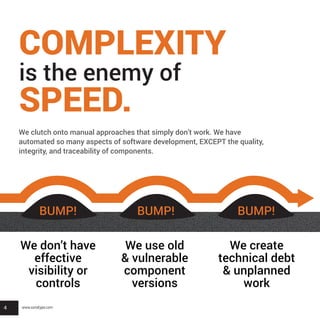
COMPLEXITY
is the enemy of
SPEED.
We don’t have
effective
visibility or
controls
BUMP! BUMP! BUMP!
We use old
& vulnerable
component
versions
We create
technical debt
& unplanned
work
We clutch onto manual approaches that simply don’t work. We have
automated so many aspects of software development, EXCEPT the quality,
integrity, and traceability of components.
www.sonatype.com
5
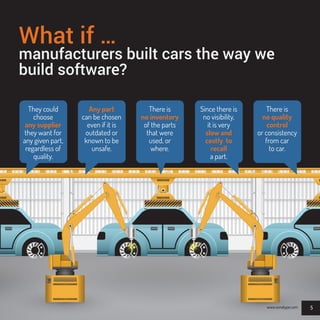
What if …
manufacturers built cars the way we
build software?
They could
choose
any supplier
they want for
any given part,
regardless of
quality.
There is
no inventory
of the parts
that were
used, or
where.
Any part
can be chosen
even if it is
outdated or
known to be
unsafe.
Since there is
no visibility,
it is very
slow and
costly to
recall
a part.
There is
no quality
control
or consistency
from car
to car.
5www.sonatype.com
6
MODERN SOCIETY
wouldn’t accept products
built this way.
We wouldn’t buy cars  built this
way. We wouldn’t accept medical
devices  or food products  or
anything built this way.
www.sonatype.com
7
So, what about our
SOFTWARE?
7www.sonatype.com
8
How did
TRADITIONAL
SUPPLY CHAINS
solve this problem?
8 www.sonatype.com
9
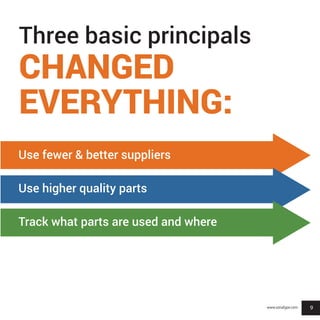
Three basic principals
CHANGED
EVERYTHING:
Use fewer & better suppliers
Use higher quality parts
Track what parts are used and where
www.sonatype.com
10
Every major transformation in human history started
with a new idea that challenged the status quo.
To achieve the next leap in development
efficiency, we MUST challenge our assumptions
and find new approaches. Our current practices
simply are not sustainable.
So, to expose these hidden complexities, we did
a deep dive into the Software Supply Chains of
106,000organizations and we learned ...
www.sonatype.com
11
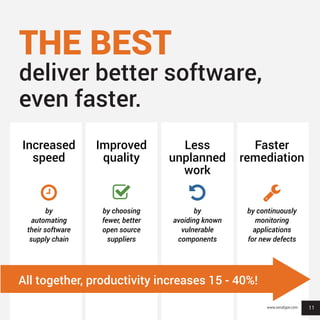
THE BEST
deliver better software,
even faster.
Increased
speed

by
automating
their software
supply chain
Improved
quality

by choosing
fewer, better
open source
suppliers
Less
unplanned
work

by
avoiding known
vulnerable
components
Faster
remediation

by continuously
monitoring
applications
for new defects
11
All together, productivity increases 15 - 40%!
www.sonatype.com
12
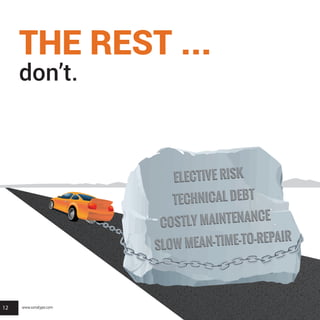
THE REST ...
don’t.
www.sonatype.com
13
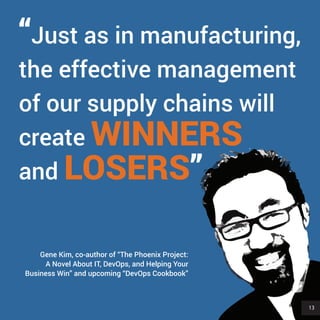
“Just as in manufacturing,
the effective management
of our supply chains will
create WINNERS
and LOSERS”
Gene Kim, co-author of “The Phoenix Project:
A Novel About IT, DevOps, and Helping Your
Business Win” and upcoming “DevOps Cookbook”
13
14
Let’s take a closer look at
the eye-opening STATS of
GOOD and
NOT SO GOOD
software supply chain
practices.
14 www.sonatype.com
15
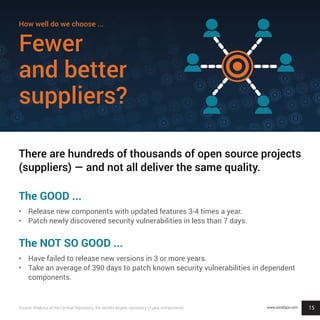
Fewer
and better
suppliers?
The GOOD ...
•	 Release new components with updated features 3-4 times a year.
•	 Patch newly discovered security vulnerabilities in less than 7 days.
The NOT SO GOOD ...
•	 Have failed to release new versions in 3 or more years.
•	 Take an average of 390 days to patch known security vulnerabilities in dependent
components.
There are hundreds of thousands of open source projects
(suppliers) — and not all deliver the same quality.
Source: Analysis of the Central Repository, the world’s largest repository of java components.
How well do we choose ...
www.sonatype.com
16 Source: Analysis of the Central Repository, the world’s largest repository of java components.
Higher
quality
parts?
The GOOD ...
Use automation to deliver up-to-date component intelligence to developers in the
tools they use every day, so only the latest, safest and highest quality components are
chosen.
The NOT SO GOOD ...
1 out of every 16 component download requests is for a component with a known
vulnerability.
Of the 1 million open source components in the Central
Repository, 51,000 have known security vulnerabilities
and 340,000 have restrictive licenses.
How well do we choose ...
17
Track what
is used and
where?
1 Source: Sonatype 2014 Open Source Development and Application Security Survey. Analysis of Sonatype Application Health Checks. 2 Source: Analysis
of the Central Repository, the world’s largest repository of java components. 3 Source: NIST National Vulnerability Database. https://nvd.nist.gov/
How well do we ...
The GOOD ...
•	 Maintain a complete Bill of Materials inventory for their applications.
•	 Instantly know when a component is newly discovered to be vulnerable.
The NOT SO GOOD ...
•	 63% have no clear & complete idea of components used in their applications.1
•	 23% of components in a typical application have known vulnerabilities.2
•	 Average application has 9 restrictive licenses.2
A typical application has 106 open source components2
—and they age more like milk than wine. In fact, 50 new
critical vulnerabilities3
are discovered every day.
18
This is not a
people problem,
this is an automation
problem.
“Software may be eating the world,
but rework is choking software”
John Jeremiah @j_jeremiah
And the lack of automation leads
to rework, context switching and
worse.
www.sonatype.com
1919
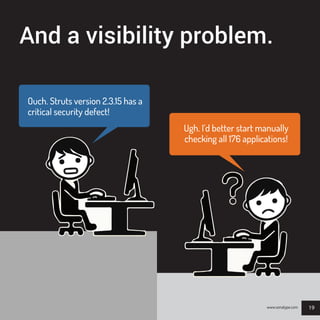
Ugh. I’d better start manually
checking all 176 applications!
Ouch. Struts version 2.3.15 has a
critical security defect!
And a visibility problem.
www.sonatype.com
20
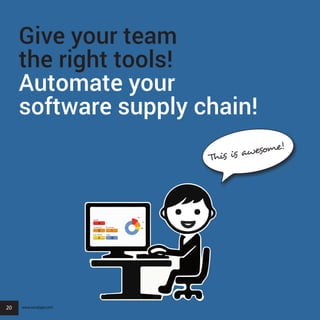
Give your team
the right tools!
Automate your
software supply chain!
20
This is awesome!
www.sonatype.com
21
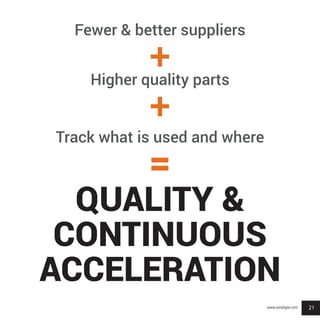
Fewer & better suppliers
+Higher quality parts
+
Track what is used and where
=
QUALITY &
CONTINUOUS
ACCELERATION
www.sonatype.com
22
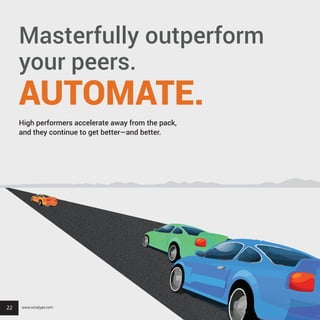
High performers accelerate away from the pack,
and they continue to get better—and better.
Masterfully outperform
your peers.
AUTOMATE.
22 www.sonatype.com
23
Groundbreaking stuff!
Gene Kim
DevOps Authority, Author
“Sonatype uses the metaphor of the
‘software supply chain.’ This metaphor
enables some startling revelations on
how we should select the components
we use and the downstream effects of
the decisions we make.”
John Willis
DevOps Days Core Organizer
“In a world that is vastly moving
to containers and immutable
infrastructure the subject of Software
Supply Chains is going to become of
increased importance.”
Nigel Simpson
Director of Enterprise Architecture
“This report draws parallels with
traditional manufacturing supply
chains, giving us a new way to look
at how we build software.”
Gareth Rushgrove
Senior Software Engineer, Puppet Labs
and Curator of DevOps Weekly
“This report is required reading for
anyone interested in large-scale
systems engineering.”
23www.sonatype.com
24
Got Five Minutes?
Create a free software bill of materials!
www.sonatype.com/BoM
24
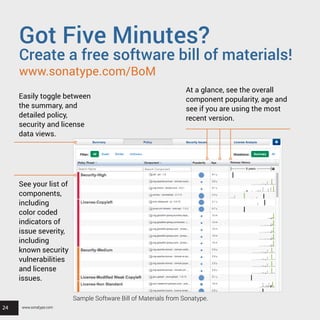
Sample Software Bill of Materials from Sonatype.
Easily toggle between
the summary, and
detailed policy,
security and license
data views.
At a glance, see the overall
component popularity, age and
see if you are using the most
recent version.
See your list of
components,
including
color coded
indicators of
issue severity,
including
known security
vulnerabilities
and license
issues.
www.sonatype.com
25
MORE
AWESOME
INSIGHTS
HERE.
We’ve only covered the tip of the supply chain
story. Get more ideas, more impact, more
vision from the full report at
www.sonatype.com/speedbumps
Share the message!
www.sonatype.com 25
26
Sonatype Inc. • 8161 Maple Lawn Drive, Suite 250 • Fulton, MD 20759 • 1.877.866.2836 • www.sonatype.com
2015. Sonatype Inc. All Rights Reserved.
Sonatype helps organizations build better software, even faster. Like a traditional supply chain, software
applications are built by assembling open source and third party components streaming in from a wide variety
of public and internal sources. While re-use is far faster than custom code, the flow of components into and
through an organization remains complex and inefficient. Sonatype’s Nexus platform applies proven supply
chain principles to increase speed, efficiency and quality by optimizing the component supply chain. Sonatype
has been on the forefront of creating tools to to improve developer efficiency and quality since the inception of
the Central Repository and Apache Maven in 2001, and the company continues to serve as the steward of the
Central Repository serving 17.2 Billion component download requests in 2014 alone. Sonatype is privately held
with investments from New Enterprise Associates (NEA), Accel Partners, Bay Partners, Hummer Winblad Venture
Partners and Morgenthaler Ventures. Visit: www.sonatype.com
www.sonatype.com

Hidden Speed Bumps on the Road to "Continuous"

  • 1.
    1 Hidden SPEED BUMPSon the Roadto “Continuous” Based on the Sonatype 2015 State of the Software Supply Chain Report
  • 2.
    2 You’ve got ... SUPPLIERS OpenSource Projects You’ve got ... PARTS Open Source Components & Warehouses You’ve got ... MANUFACTURERS Software Development Teams You’ve got ... FINISHED GOODS Software Applications If you build software, you rely on a SOFTWARE SUPPLY CHAIN ... www.sonatype.com2
  • 3.
    3 ... in aBIG way! There are 11 million developers globally.1 We saw 17.2 billionopen source component download requests in 2014.2 And volume introduces hidden complexity … 1 Source: IDC 2014 Worldwide Software Developer and ICT-Skilled Worker Estimates 2 Source: Analysis of the Central Repository, the world’s largest repository of java components. 3www.sonatype.com
  • 4.
    4 COMPLEXITY is the enemyof SPEED. We don’t have effective visibility or controls BUMP! BUMP! BUMP! We use old & vulnerable component versions We create technical debt & unplanned work We clutch onto manual approaches that simply don’t work. We have automated so many aspects of software development, EXCEPT the quality, integrity, and traceability of components. www.sonatype.com
  • 5.
    5 What if … manufacturersbuilt cars the way we build software? They could choose any supplier they want for any given part, regardless of quality. There is no inventory of the parts that were used, or where. Any part can be chosen even if it is outdated or known to be unsafe. Since there is no visibility, it is very slow and costly to recall a part. There is no quality control or consistency from car to car. 5www.sonatype.com
  • 6.
    6 MODERN SOCIETY wouldn’t acceptproducts built this way. We wouldn’t buy cars  built this way. We wouldn’t accept medical devices  or food products  or anything built this way. www.sonatype.com
  • 7.
    7 So, what aboutour SOFTWARE? 7www.sonatype.com
  • 8.
    8 How did TRADITIONAL SUPPLY CHAINS solvethis problem? 8 www.sonatype.com
  • 9.
    9 Three basic principals CHANGED EVERYTHING: Usefewer & better suppliers Use higher quality parts Track what parts are used and where www.sonatype.com
  • 10.
    10 Every major transformationin human history started with a new idea that challenged the status quo. To achieve the next leap in development efficiency, we MUST challenge our assumptions and find new approaches. Our current practices simply are not sustainable. So, to expose these hidden complexities, we did a deep dive into the Software Supply Chains of 106,000organizations and we learned ... www.sonatype.com
  • 11.
    11 THE BEST deliver bettersoftware, even faster. Increased speed  by automating their software supply chain Improved quality  by choosing fewer, better open source suppliers Less unplanned work  by avoiding known vulnerable components Faster remediation  by continuously monitoring applications for new defects 11 All together, productivity increases 15 - 40%! www.sonatype.com
  • 12.
  • 13.
    13 “Just as inmanufacturing, the effective management of our supply chains will create WINNERS and LOSERS” Gene Kim, co-author of “The Phoenix Project: A Novel About IT, DevOps, and Helping Your Business Win” and upcoming “DevOps Cookbook” 13
  • 14.
    14 Let’s take acloser look at the eye-opening STATS of GOOD and NOT SO GOOD software supply chain practices. 14 www.sonatype.com
  • 15.
    15 Fewer and better suppliers? The GOOD... • Release new components with updated features 3-4 times a year. • Patch newly discovered security vulnerabilities in less than 7 days. The NOT SO GOOD ... • Have failed to release new versions in 3 or more years. • Take an average of 390 days to patch known security vulnerabilities in dependent components. There are hundreds of thousands of open source projects (suppliers) — and not all deliver the same quality. Source: Analysis of the Central Repository, the world’s largest repository of java components. How well do we choose ... www.sonatype.com
  • 16.
    16 Source: Analysisof the Central Repository, the world’s largest repository of java components. Higher quality parts? The GOOD ... Use automation to deliver up-to-date component intelligence to developers in the tools they use every day, so only the latest, safest and highest quality components are chosen. The NOT SO GOOD ... 1 out of every 16 component download requests is for a component with a known vulnerability. Of the 1 million open source components in the Central Repository, 51,000 have known security vulnerabilities and 340,000 have restrictive licenses. How well do we choose ...
  • 17.
    17 Track what is usedand where? 1 Source: Sonatype 2014 Open Source Development and Application Security Survey. Analysis of Sonatype Application Health Checks. 2 Source: Analysis of the Central Repository, the world’s largest repository of java components. 3 Source: NIST National Vulnerability Database. https://nvd.nist.gov/ How well do we ... The GOOD ... • Maintain a complete Bill of Materials inventory for their applications. • Instantly know when a component is newly discovered to be vulnerable. The NOT SO GOOD ... • 63% have no clear & complete idea of components used in their applications.1 • 23% of components in a typical application have known vulnerabilities.2 • Average application has 9 restrictive licenses.2 A typical application has 106 open source components2 —and they age more like milk than wine. In fact, 50 new critical vulnerabilities3 are discovered every day.
  • 18.
    18 This is nota people problem, this is an automation problem. “Software may be eating the world, but rework is choking software” John Jeremiah @j_jeremiah And the lack of automation leads to rework, context switching and worse. www.sonatype.com
  • 19.
    1919 Ugh. I’d betterstart manually checking all 176 applications! Ouch. Struts version 2.3.15 has a critical security defect! And a visibility problem. www.sonatype.com
  • 20.
    20 Give your team theright tools! Automate your software supply chain! 20 This is awesome! www.sonatype.com
  • 21.
    21 Fewer & bettersuppliers +Higher quality parts + Track what is used and where = QUALITY & CONTINUOUS ACCELERATION www.sonatype.com
  • 22.
    22 High performers accelerateaway from the pack, and they continue to get better—and better. Masterfully outperform your peers. AUTOMATE. 22 www.sonatype.com
  • 23.
    23 Groundbreaking stuff! Gene Kim DevOpsAuthority, Author “Sonatype uses the metaphor of the ‘software supply chain.’ This metaphor enables some startling revelations on how we should select the components we use and the downstream effects of the decisions we make.” John Willis DevOps Days Core Organizer “In a world that is vastly moving to containers and immutable infrastructure the subject of Software Supply Chains is going to become of increased importance.” Nigel Simpson Director of Enterprise Architecture “This report draws parallels with traditional manufacturing supply chains, giving us a new way to look at how we build software.” Gareth Rushgrove Senior Software Engineer, Puppet Labs and Curator of DevOps Weekly “This report is required reading for anyone interested in large-scale systems engineering.” 23www.sonatype.com
  • 24.
    24 Got Five Minutes? Createa free software bill of materials! www.sonatype.com/BoM 24 Sample Software Bill of Materials from Sonatype. Easily toggle between the summary, and detailed policy, security and license data views. At a glance, see the overall component popularity, age and see if you are using the most recent version. See your list of components, including color coded indicators of issue severity, including known security vulnerabilities and license issues. www.sonatype.com
  • 25.
    25 MORE AWESOME INSIGHTS HERE. We’ve only coveredthe tip of the supply chain story. Get more ideas, more impact, more vision from the full report at www.sonatype.com/speedbumps Share the message! www.sonatype.com 25
  • 26.
    26 Sonatype Inc. •8161 Maple Lawn Drive, Suite 250 • Fulton, MD 20759 • 1.877.866.2836 • www.sonatype.com 2015. Sonatype Inc. All Rights Reserved. Sonatype helps organizations build better software, even faster. Like a traditional supply chain, software applications are built by assembling open source and third party components streaming in from a wide variety of public and internal sources. While re-use is far faster than custom code, the flow of components into and through an organization remains complex and inefficient. Sonatype’s Nexus platform applies proven supply chain principles to increase speed, efficiency and quality by optimizing the component supply chain. Sonatype has been on the forefront of creating tools to to improve developer efficiency and quality since the inception of the Central Repository and Apache Maven in 2001, and the company continues to serve as the steward of the Central Repository serving 17.2 Billion component download requests in 2014 alone. Sonatype is privately held with investments from New Enterprise Associates (NEA), Accel Partners, Bay Partners, Hummer Winblad Venture Partners and Morgenthaler Ventures. Visit: www.sonatype.com www.sonatype.com