Micro-Reactor Technology (MRT)
A continuous reactor system for intermediate and API synthesis
Temperature and pressure control
                                                            The small reactor volumes allow tight temperature control
                                                            and – if needed – an almost instantaneous temperature
                                                            jump of hundreds of degrees centigrade. A wide pressure
                                                            range can be easily used for chemical transformations. To
                                                            date the ranges explored extend from -60°C to +300°C
                                                            with pressures up to 100 bar / 1,450 psi. Extension of these
                                                            limits will be possible if deemed necessary.


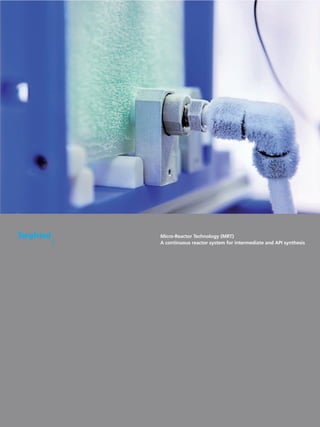
Glass Reactor
Glass reactors tolerate a wide range of chemical
substances such as corrosive and acidic media.
A visual inspection of the reaction mixture and its flow
characteristics allows prompt interaction with the system
during the set-up phase and later on.
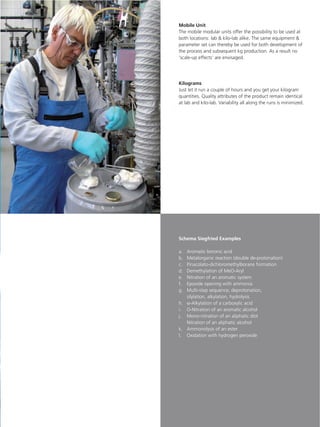
Mobile Unit
The mobile modular units offer the possibility to be used at
both locations: lab & kilo-lab alike. The same equipment &
parameter set can thereby be used for both development of
the process and subsequent kg production. As a result no
‘scale-up effects’ are envisaged.


Kilograms
Just let it run a couple of hours and you get your kilogram
quantities. Quality attributes of the product remain identical
at lab and kilo-lab. Variability all along the runs is minimized.


Schema Siegfried Examples

a. Aromatic boronic acid
b. Metalorganic reaction (double de-protonation)
c. Pinacolato-dichloromethylborane formation
d. Demethylation of MeO-Aryl
e. Nitration of an aromatic system
f. Epoxide opening with ammonia
g. Multi-step sequence; deprotonation,
   silylation, alkylation, hydrolysis
h. α-Alkylation of a carboxylic acid
i. O-Nitration of an aromatic alcohol
j. Mono-nitration of an aliphatic diol
   Nitration of an aliphatic alcohol
k. Ammonolysis of an ester
l. Oxidation with hydrogen peroxide
Process Analysis
                                                                             The process can be monitored by temperature
                                                                             probes and / or Raman probes as needed.


a.                   b.                       c.                     d.                   e.                  f.

                               O                                             R                   R                        O
           MgX                                       DCM
                                                                                 OMe                 H


                          OH       O                                         R
                                              Cl          O                                     R                   NH2
                                                      B
           B(OH)2                             Cl          O                      OH
                               RO         O                                                          NO2                OH


      R'
                OR             CO2H            Ary            OH      HO           OH            CO2R
RHN
                                                                      (Cl)
           O                                                                                                                 OMe


      R'        Cl
                                                                                                                   HO
RHN                                CO2H                              HO          ONO2
                                              Ary             ONO2                               CONH2
            O         Alk                                            (Cl)                                                      O
g.                   h.                       i.                     j.                   k.                  l.
Siegfried Micro-Reactor Technology (MRT)


MRT equipment allows reactions beyond the classical design:
high pressure, low-temperature, tightly defined residence
times and hazardous intermediates are no longer obstacles for
industrial applications.


                                           To address such reaction challenges Siegfried has established a pro-
                                           ject group, implementing MRT into its technology platform.
                                           MRT is now offered at lab and pilot scale, providing Siegfried’s
                                           customers with the opportunity to realize the various demanding
                                           chemical transformations they need.
Contact


If you are interested in how using MRT technology could solve your
chemical reaction challenges and bring value for your particular
projects please contact:


Siegfried Ltd
                                                              GERMANY                                                    A1
Untere Brühlstrasse 4                                                                                                   to Zürich
4800 Zofingen                             FRANCE                                                                         Exit Zofingen

Switzerland                                                   Basel              Zürich
                                                                                          A1    A1
                                                            A2
+41 62 746 12 12                                         Olten                                 to Berne
                                                                      Zofingen


                                                                                                                                       Train
                                                                                                               Tra


                                                              Lucerne
+41 62 746 12 58
                                                                                                                 n i


Process Development                                      Berne

                                            A1     A12                                                    A2
                                                                                                                       Un
                                                                                                                       ter


www.siegfried.ch                                                                 A2
                                                                                                                                               Zofingen
                                                                                                                          eB
                                                                                                                            rü
                                                                                                                              hls
                                                                                                                                 tra
                                                                                                                                 sse


                                         Geneva                         Lugano
                                                                                                                                                 Train
                                                                                                                                                 Station
                                       FRANCE                     ITALY
                                                                                                                       to Lucerne

Sf Micro Reactor Technology 2009

  • 1.
    Micro-Reactor Technology (MRT) Acontinuous reactor system for intermediate and API synthesis
  • 2.
    Temperature and pressurecontrol The small reactor volumes allow tight temperature control and – if needed – an almost instantaneous temperature jump of hundreds of degrees centigrade. A wide pressure range can be easily used for chemical transformations. To date the ranges explored extend from -60°C to +300°C with pressures up to 100 bar / 1,450 psi. Extension of these limits will be possible if deemed necessary. Glass Reactor Glass reactors tolerate a wide range of chemical substances such as corrosive and acidic media. A visual inspection of the reaction mixture and its flow characteristics allows prompt interaction with the system during the set-up phase and later on.
  • 3.
    Mobile Unit The mobilemodular units offer the possibility to be used at both locations: lab & kilo-lab alike. The same equipment & parameter set can thereby be used for both development of the process and subsequent kg production. As a result no ‘scale-up effects’ are envisaged. Kilograms Just let it run a couple of hours and you get your kilogram quantities. Quality attributes of the product remain identical at lab and kilo-lab. Variability all along the runs is minimized. Schema Siegfried Examples a. Aromatic boronic acid b. Metalorganic reaction (double de-protonation) c. Pinacolato-dichloromethylborane formation d. Demethylation of MeO-Aryl e. Nitration of an aromatic system f. Epoxide opening with ammonia g. Multi-step sequence; deprotonation, silylation, alkylation, hydrolysis h. α-Alkylation of a carboxylic acid i. O-Nitration of an aromatic alcohol j. Mono-nitration of an aliphatic diol Nitration of an aliphatic alcohol k. Ammonolysis of an ester l. Oxidation with hydrogen peroxide
  • 4.
    Process Analysis The process can be monitored by temperature probes and / or Raman probes as needed. a. b. c. d. e. f. O R R O MgX DCM OMe H OH O R Cl O R NH2 B B(OH)2 Cl O OH RO O NO2 OH R' OR CO2H Ary OH HO OH CO2R RHN (Cl) O OMe R' Cl HO RHN CO2H HO ONO2 Ary ONO2 CONH2 O Alk (Cl) O g. h. i. j. k. l.
  • 5.
    Siegfried Micro-Reactor Technology(MRT) MRT equipment allows reactions beyond the classical design: high pressure, low-temperature, tightly defined residence times and hazardous intermediates are no longer obstacles for industrial applications. To address such reaction challenges Siegfried has established a pro- ject group, implementing MRT into its technology platform. MRT is now offered at lab and pilot scale, providing Siegfried’s customers with the opportunity to realize the various demanding chemical transformations they need.
  • 6.
    Contact If you areinterested in how using MRT technology could solve your chemical reaction challenges and bring value for your particular projects please contact: Siegfried Ltd GERMANY A1 Untere Brühlstrasse 4 to Zürich 4800 Zofingen FRANCE Exit Zofingen Switzerland Basel Zürich A1 A1 A2 +41 62 746 12 12 Olten to Berne Zofingen Train Tra Lucerne +41 62 746 12 58 n i Process Development Berne A1 A12 A2 Un ter www.siegfried.ch A2 Zofingen eB rü hls tra sse Geneva Lugano Train Station FRANCE ITALY to Lucerne