ReferencesConclusion
Acknowledgment
Unravelling the Mechanism6,7
Au/TiO2 as a Dedicated Hydrolysis Catalyst3
Base-induced Promotional effect4,5
Absorbance,au
CO2
formates
0 500 1000 1500 2000
Time, s
In situ DRIFTS
On-line FTIR
0
10
Feed composition
0.5 wt%Au/TiO2
O2
+H2
OO2
H2
ON2
Reaction orders:
O2: 0.3
H2O: 0.3
HCOOH: -1.0
Water-assisted oxygen activation on Au/TiO2 catalysts
during formic acid decomposition
Manasa Sridhar1,2 , Davide Ferri1, Jeroen Anton van Bokhoven1,2, Oliver Kröcher1,3
1Paul Scherrer Institut, Switzerland
2ETH Zurich, Institute for Chemical and Bioengineering, Switzerland
3École polytechnique fédérale de Lausanne (EPFL), Institute of Chemical
Sciences and Engineering, Switzerland
Motivation1,2
 Selective Catalytic Reduction (SCR) using ammonia is
widely implemented for NOx abatement in stationary and
automobile applications.
 Ammonia storage and handling is hazardous in automobiles
and hence urea is used as the ammonia source.
 But, urea has several limitations: high freezing point, low
temperature stability, durability and propensity to form side
products that block the catalyst pores.
Alternative formate-based ammonia precursors
1. Kröcher, O.; Elsener, M.; Jacob, E. Appl. Catal. B Environ.
2009, 88, 66
2. Gerhart, C.; Krimmer, H.-P.; Hammer, B.; Schulz, B.; Kröcher,
O.; Peitz, D.; Sattelmayer, T.; Toshev, P.; Wachtmeister, G.;
Heubuch, A.; Jacob, E. SAE Int. J. Engines 2012, 5, 938
3. Sridhar, M.; Peitz, D.; van Bokhoven, J.A.; Kröcher, O.
Chem. Commun. 2014, 50, 6998
4. Sridhar, M.; van Bokhoven, J.A.; Kröcher, O. Appl. Catal., A
2014, 486, 219
5. Sridhar, M.; Ferri, D.; Elsener, M.; van Bokhoven, J.A.;
Kröcher, O. ACS Catal. 2015, 5, 4772
6. Sridhar, M.; Ferri, D.; van Bokhoven, J.A.; Kröcher, O. In
preparation
7. Sridhar, M.; Mantzaras, J.; van Bokhoven, J.A.; Kröcher, O.
In preparation
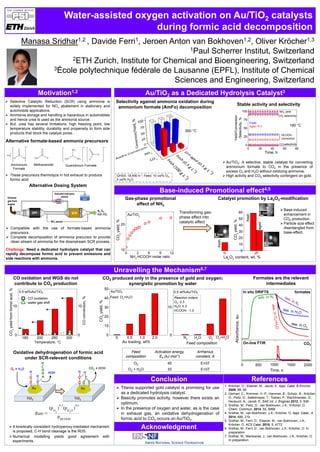
 Titania supported gold catalyst is promising for use
as a dedicated hydrolysis catalyst.
 Basicity promotes activity, however there exists an
optimum.
 In the presence of oxygen and water, as is the case
in exhaust gas, an oxidative dehydrogenation of
formic acid to CO2 occurs on Au/TiO2.
MethanamideAmmonium
Formate
Guanidinium Formate
 Compatible with the use of formate-based ammonia
precursors.
 Complete decomposition of ammonia precursor to provide
clean stream of ammonia for the downstream SCR process.
Challenge: Need a dedicated hydrolysis catalyst that can
rapidly decompose formic acid to prevent emissions and
side reactions with ammonia.
 These precursors thermolyze in hot exhaust to produce
formic acid.
CO2 produced only in the presence of gold and oxygen;
synergistic promotion by water
0
10
20
30
40
50
Au loading, wt%
Feed: O2
+H2O
0.5
CO2
yield,%
Au/TiO2
0 1.0 2.0
Formates are the relevant
intermediates
Oxidative dehydrogenation of formic acid
under SCR-relevant conditions
CO oxidation and WGS do not
contribute to CO2 production
0
10
CO2
yieldfromformicacid,%
Temperature, C
0
10
0.5 wt%Au/TiO2
CO oxidation
water gas shift
300260200
COconversion,%
160
 A kinetically consistent hydroperoxy-mediated mechanism
is proposed, C-H bond cleavage is the RDS.
 Numerical modelling yields good agreement with
experiments.
Alternative Dosing System
Gas-phase promotional
effect of NH3
0 3 6 9 12
10
20
Au/TiO2
NH3
:HCOOH molar ratio
CO2
yield,%
Transforming gas-
phase effect into
catalytic effect
Catalyst promotion by La2O3-modification
0
10
20
30
40
50
60
fresh
fresh
aged
15
CO2
yield,%
La2
O3
content, wt. %
0
5 nm
5 nm
5 nm
 Base-induced
enhancement in
CO2 production.
 Particle size effect
disentangled from
base-effect.
300 °C
Selectivity against ammonia oxidation during
ammonium formate (AmFo) decomposition
GHSV: 19,490 h-1; Feed: 10 vol% O2,
5 vol% H2O
Stable activity and selectivity
 Au/TiO2: A selective, stable catalyst for converting
ammonium formate to CO2 in the presence of
excess O2 and H2O without oxidizing ammonia.
 High activity and CO2 selectivity contingent on gold.
0 20 40 60 80
0
25
50
75
100
Aged 10 h
HCOOH
conversion
CO2
selectivity
}
Fresh
Yield/Conversion
/Selectivity,%
Time, h
CO selectivity
NH3
yield
190 °C
Feed
composition
Activation energy,
Ea (kJ mol-1)
Arrhenius
constant, A
O2 45 E+07
O2 + H2O 33 E+07
Exhaust
gas from
engine
DEF
DPF
NOx sensor
SCR
NH3-slip
N2, O2,
H2O, CO2
DOC
Dedicated hydrolysis
catalyst
Hydr.
HCOOH
0.6
OH
0.3
O
p
)(p)(p
∝ 22
Rate
Au
O2 + H2O
O
O
H
O
O
H
O
H
H
H
O O
C
CO2 + HOH
TiO2
Au
TiO2
H
O
O
C
HOH

ICC16

  • 1.
    ReferencesConclusion Acknowledgment Unravelling the Mechanism6,7 Au/TiO2as a Dedicated Hydrolysis Catalyst3 Base-induced Promotional effect4,5 Absorbance,au CO2 formates 0 500 1000 1500 2000 Time, s In situ DRIFTS On-line FTIR 0 10 Feed composition 0.5 wt%Au/TiO2 O2 +H2 OO2 H2 ON2 Reaction orders: O2: 0.3 H2O: 0.3 HCOOH: -1.0 Water-assisted oxygen activation on Au/TiO2 catalysts during formic acid decomposition Manasa Sridhar1,2 , Davide Ferri1, Jeroen Anton van Bokhoven1,2, Oliver Kröcher1,3 1Paul Scherrer Institut, Switzerland 2ETH Zurich, Institute for Chemical and Bioengineering, Switzerland 3École polytechnique fédérale de Lausanne (EPFL), Institute of Chemical Sciences and Engineering, Switzerland Motivation1,2  Selective Catalytic Reduction (SCR) using ammonia is widely implemented for NOx abatement in stationary and automobile applications.  Ammonia storage and handling is hazardous in automobiles and hence urea is used as the ammonia source.  But, urea has several limitations: high freezing point, low temperature stability, durability and propensity to form side products that block the catalyst pores. Alternative formate-based ammonia precursors 1. Kröcher, O.; Elsener, M.; Jacob, E. Appl. Catal. B Environ. 2009, 88, 66 2. Gerhart, C.; Krimmer, H.-P.; Hammer, B.; Schulz, B.; Kröcher, O.; Peitz, D.; Sattelmayer, T.; Toshev, P.; Wachtmeister, G.; Heubuch, A.; Jacob, E. SAE Int. J. Engines 2012, 5, 938 3. Sridhar, M.; Peitz, D.; van Bokhoven, J.A.; Kröcher, O. Chem. Commun. 2014, 50, 6998 4. Sridhar, M.; van Bokhoven, J.A.; Kröcher, O. Appl. Catal., A 2014, 486, 219 5. Sridhar, M.; Ferri, D.; Elsener, M.; van Bokhoven, J.A.; Kröcher, O. ACS Catal. 2015, 5, 4772 6. Sridhar, M.; Ferri, D.; van Bokhoven, J.A.; Kröcher, O. In preparation 7. Sridhar, M.; Mantzaras, J.; van Bokhoven, J.A.; Kröcher, O. In preparation  Titania supported gold catalyst is promising for use as a dedicated hydrolysis catalyst.  Basicity promotes activity, however there exists an optimum.  In the presence of oxygen and water, as is the case in exhaust gas, an oxidative dehydrogenation of formic acid to CO2 occurs on Au/TiO2. MethanamideAmmonium Formate Guanidinium Formate  Compatible with the use of formate-based ammonia precursors.  Complete decomposition of ammonia precursor to provide clean stream of ammonia for the downstream SCR process. Challenge: Need a dedicated hydrolysis catalyst that can rapidly decompose formic acid to prevent emissions and side reactions with ammonia.  These precursors thermolyze in hot exhaust to produce formic acid. CO2 produced only in the presence of gold and oxygen; synergistic promotion by water 0 10 20 30 40 50 Au loading, wt% Feed: O2 +H2O 0.5 CO2 yield,% Au/TiO2 0 1.0 2.0 Formates are the relevant intermediates Oxidative dehydrogenation of formic acid under SCR-relevant conditions CO oxidation and WGS do not contribute to CO2 production 0 10 CO2 yieldfromformicacid,% Temperature, C 0 10 0.5 wt%Au/TiO2 CO oxidation water gas shift 300260200 COconversion,% 160  A kinetically consistent hydroperoxy-mediated mechanism is proposed, C-H bond cleavage is the RDS.  Numerical modelling yields good agreement with experiments. Alternative Dosing System Gas-phase promotional effect of NH3 0 3 6 9 12 10 20 Au/TiO2 NH3 :HCOOH molar ratio CO2 yield,% Transforming gas- phase effect into catalytic effect Catalyst promotion by La2O3-modification 0 10 20 30 40 50 60 fresh fresh aged 15 CO2 yield,% La2 O3 content, wt. % 0 5 nm 5 nm 5 nm  Base-induced enhancement in CO2 production.  Particle size effect disentangled from base-effect. 300 °C Selectivity against ammonia oxidation during ammonium formate (AmFo) decomposition GHSV: 19,490 h-1; Feed: 10 vol% O2, 5 vol% H2O Stable activity and selectivity  Au/TiO2: A selective, stable catalyst for converting ammonium formate to CO2 in the presence of excess O2 and H2O without oxidizing ammonia.  High activity and CO2 selectivity contingent on gold. 0 20 40 60 80 0 25 50 75 100 Aged 10 h HCOOH conversion CO2 selectivity } Fresh Yield/Conversion /Selectivity,% Time, h CO selectivity NH3 yield 190 °C Feed composition Activation energy, Ea (kJ mol-1) Arrhenius constant, A O2 45 E+07 O2 + H2O 33 E+07 Exhaust gas from engine DEF DPF NOx sensor SCR NH3-slip N2, O2, H2O, CO2 DOC Dedicated hydrolysis catalyst Hydr. HCOOH 0.6 OH 0.3 O p )(p)(p ∝ 22 Rate Au O2 + H2O O O H O O H O H H H O O C CO2 + HOH TiO2 Au TiO2 H O O C HOH