Introduction to the
Seveso Disaster
The Seveso disaster was a chemical accident that occurred on July 10,
1976 in the small Italian town of Seveso, north of Milan. The explosion at
a chemical plant resulted in the release of a toxic cloud containing TCDD,
one of the most potent dioxins known to man, forever altering the lives
of those living in the surrounding area.
ALOKRANJAN.ORG.IN
Overview of the Seveso
Disaster
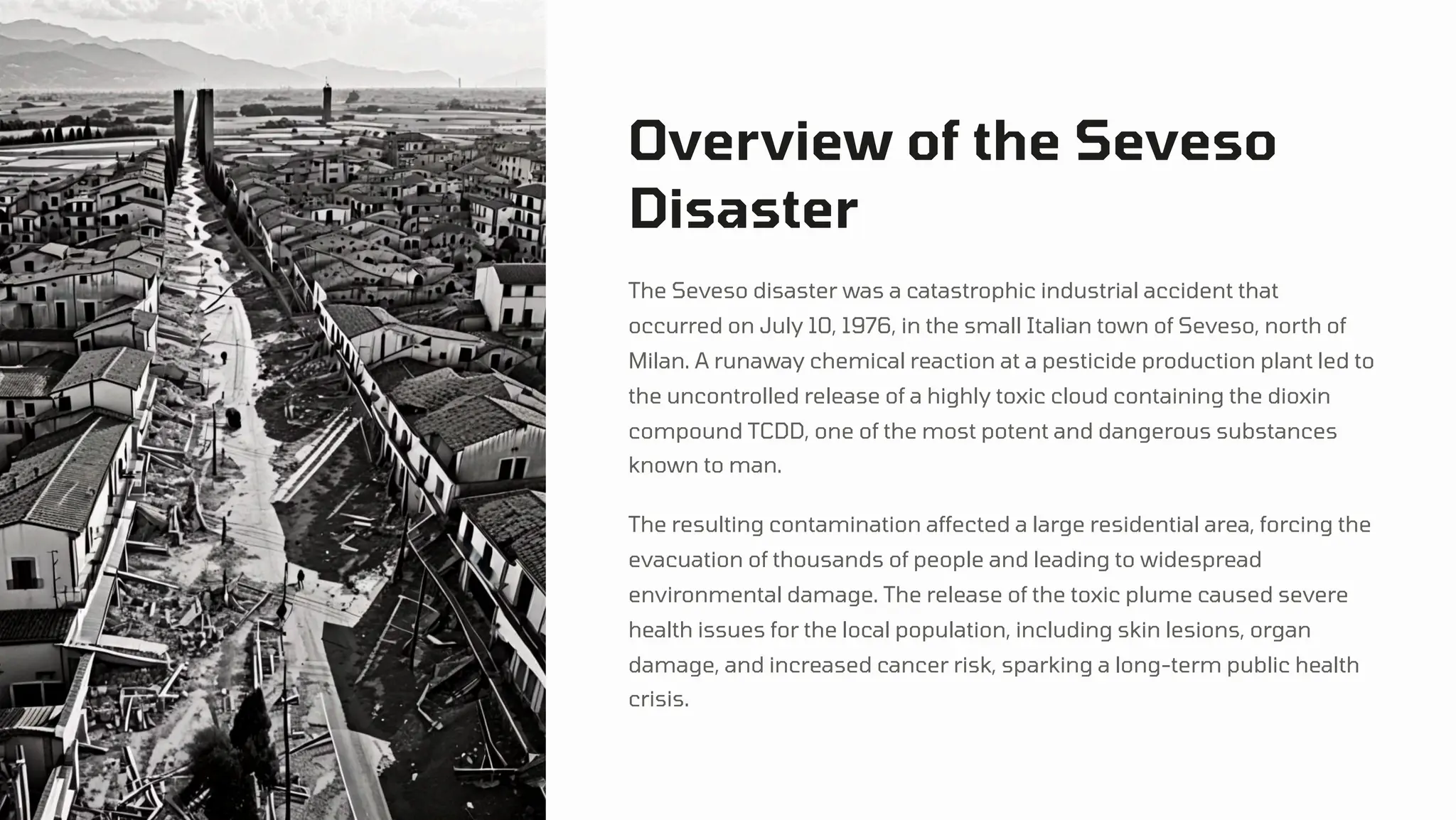
The Seveso disaster was a catastrophic industrial accident that
occurred on July 10, 1976, in the small Italian town of Seveso, north of
Milan. A runaway chemical reaction at a pesticide production plant led to
the uncontrolled release of a highly toxic cloud containing the dioxin
compound TCDD, one of the most potent and dangerous substances
known to man.
The resulting contamination affected a large residential area, forcing the
evacuation of thousands of people and leading to widespread
environmental damage. The release of the toxic plume caused severe
health issues for the local population, including skin lesions, organ
damage, and increased cancer risk, sparking a long-term public health
crisis.
Location and Timeline of the
Incident
1 Seveso, Italy
The Seveso disaster occurred in the small town of Seveso, located about 15
miles north of Milan in the Lombardy region of northern Italy.
2 July 10, 1976
The explosion and release of toxic chemicals happened on a hot summer
day, July 10, 1976, at the ICMESA chemical plant in Seveso.
3 Uncontrolled Reaction
A runaway chemical reaction in one of the plant's production units led to
the uncontrolled release of a highly toxic cloud into the surrounding
residential areas.
Causes of the Seveso Disaster
Faulty Design and Equipment: The ICMESA chemical plant had outdated equipment, poor safety
protocols, and inadequate safeguards against runaway reactions, leading to the catastrophic
event.
1.
Human Error: A series of mistakes by plant operators, including failure to properly monitor and
respond to pressure buildup, contributed directly to the uncontrolled release of toxic chemicals.
2.
Lack of Regulation: Lax oversight and enforcement of safety standards by local and national
authorities allowed the plant to operate with insufficient safety measures in place.
3.
Release of TCDD (Dioxin)
The explosion at the ICMESA chemical plant released a dense, toxic
cloud containing high concentrations of the deadly dioxin compound
TCDD, also known as 2,3,7,8-Tetrachlorodibenzodioxin. This was one of
the most potent forms of dioxin ever encountered, with severe
consequences for the surrounding environment and population.
Environmental Impact of the Disaster
The Seveso disaster had a devastating impact
on the local environment, contaminating a
large area with the highly toxic dioxin
compound TCDD. The toxic cloud settled over
residential neighborhoods, agricultural land,
and natural habitats, causing widespread
ecological damage.
Thousands of animals were killed, including
livestock, pets, and wildlife. Crops and
vegetation were also severely impacted, with
many plants and trees dying or exhibiting
deformities due to the dioxin exposure.
Health Effects on the Population
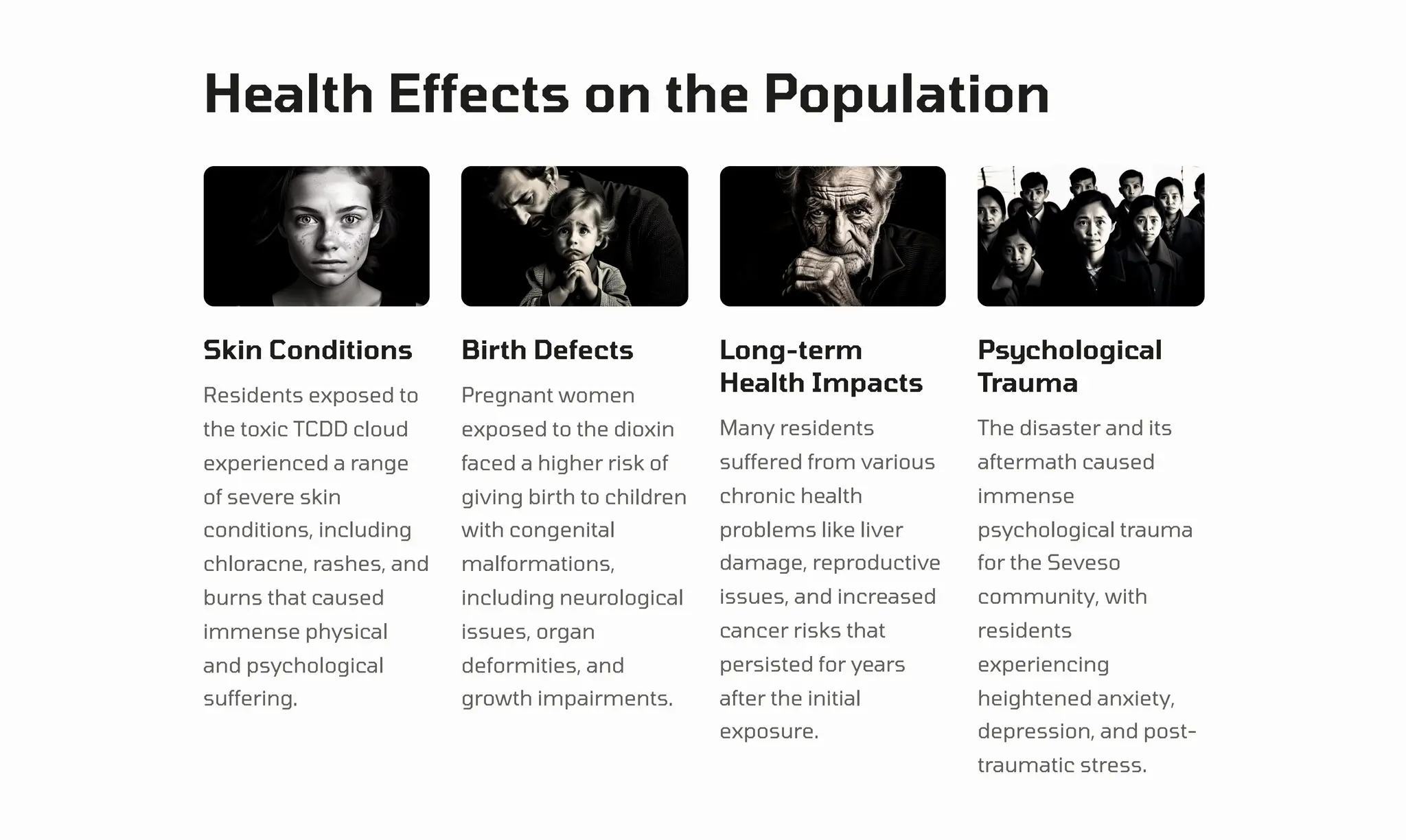
Skin Conditions
Residents exposed to
the toxic TCDD cloud
experienced a range
of severe skin
conditions, including
chloracne, rashes, and
burns that caused
immense physical
and psychological
suffering.
Birth Defects
Pregnant women
exposed to the dioxin
faced a higher risk of
giving birth to children
with congenital
malformations,
including neurological
issues, organ
deformities, and
growth impairments.
Long-term
Health Impacts
Many residents
suffered from various
chronic health
problems like liver
damage, reproductive
issues, and increased
cancer risks that
persisted for years
after the initial
exposure.
Psychological
Trauma
The disaster and its
aftermath caused
immense
psychological trauma
for the Seveso
community, with
residents
experiencing
heightened anxiety,
depression, and post-
traumatic stress.
Evacuation and Decontamination
Efforts
1
Evacuation
Thousands of residents were
swiftly evacuated from the
most heavily contaminated
areas, with authorities
setting up temporary
shelters to house and care
for the displaced population.
2
Decontamination
Extensive decontamination
efforts were launched,
involving the removal of
topsoil, the cleaning of
homes and businesses, and
the strict control of access to
the affected zones.
3
Long-term
Monitoring
Ongoing environmental
monitoring and health
surveillance programs were
established to track the
long-term impacts of the
disaster and guide the
recovery efforts.
Long-term Consequences for the
Community
Lasting
Environmental
Damage
The Seveso disaster
left a lasting scar on
the local
environment, with
extensive soil and
groundwater
contamination that
persisted for
decades. Cleanup
and remediation
efforts were
complex and costly.
Disrupted
Livelihoods
Many residents lost
their homes, farms,
and businesses due
to the evacuation
and permanent
exclusion zones. The
economic impact
devastated the
community, leading
to long-term
unemployment and
financial hardship.
Stigma and
Social Isolation
Residents faced
social stigma and
isolation, as the
Seveso disaster
became
synonymous with
toxic contamination.
This made it difficult
for the community to
recover and rebuild
a sense of normalcy.
Ongoing Health
Monitoring
Extensive health
surveillance
programs were
established to track
the long-term health
impacts on the
population, causing
continued anxiety
and raising
concerns about the
safety of the area.
Regulatory Changes Following the
Disaster
1 Stricter Safety Standards
The Seveso disaster prompted tougher
regulations and oversight for chemical
plants, mandating more rigorous safety
protocols, updated equipment, and
comprehensive risk assessments.
2 Emergency Response Planning
New laws required companies to develop
detailed emergency plans and coordinate
with local authorities to ensure prompt
and effective response to chemical
incidents.
3 Environmental Monitoring
Regulations were introduced to mandate
extensive environmental monitoring
programs to track the long-term impacts
of chemical accidents and guide
remediation efforts.
4 Transparency and Disclosure
Policies were enacted to compel chemical
companies to be more transparent about
their operations and to inform the public
about potential risks and incidents.
Seveso Directive and its Importance
Landmark
Legislation
The Seveso Directive,
enacted in the aftermath of
the disaster, was a
groundbreaking piece of
legislation that
transformed industrial
safety standards across
Europe.
Expanded Oversight
The directive mandated
rigorous risk assessments,
emergency planning, and
stricter regulations for
companies handling
hazardous substances to
prevent future Seveso-like
incidents.
Global Influence
The Seveso Directive
served as a model for
similar regulations
worldwide, raising the bar
for industrial safety and
environmental protection
globally.
Lessons Learned from the Seveso
Disaster
1
Importance of Risk Assessment
Comprehensive evaluation of hazards and implementation of
robust safety measures.
2
Transparency and Communication
Proactive disclosure of information and collaboration
with local authorities.
3
Emergency Preparedness
Detailed contingency planning and effective
response protocols for chemical incidents.
The Seveso disaster highlighted the critical need for stringent risk assessment, transparent
communication, and comprehensive emergency preparedness in the chemical industry. These
lessons have shaped modern regulations and best practices, ensuring greater safety and
environmental protection worldwide.
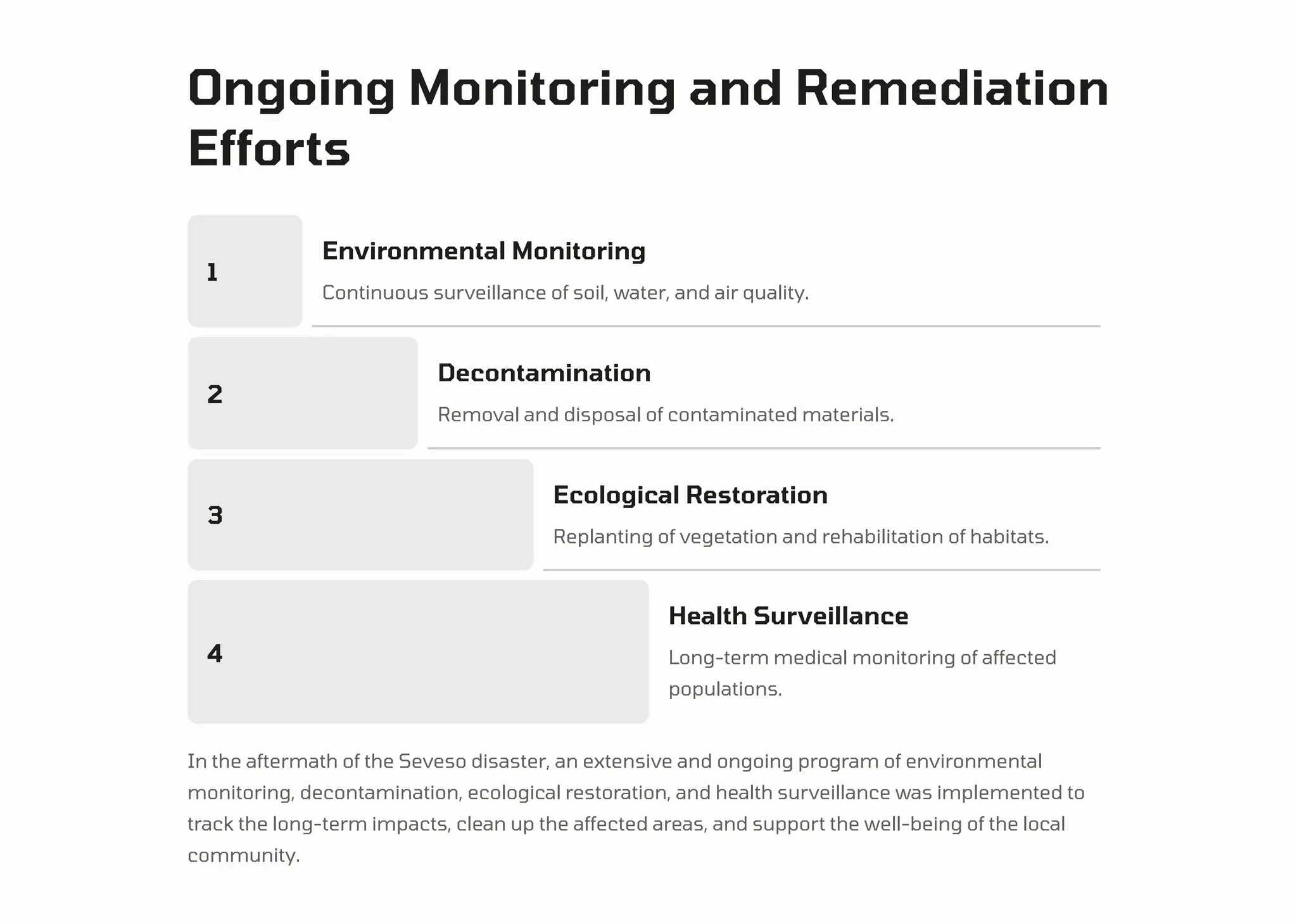
Ongoing Monitoring and Remediation
Efforts
1
Environmental Monitoring
Continuous surveillance of soil, water, and air quality.
2
Decontamination
Removal and disposal of contaminated materials.
3
Ecological Restoration
Replanting of vegetation and rehabilitation of habitats.
4
Health Surveillance
Long-term medical monitoring of affected
populations.
In the aftermath of the Seveso disaster, an extensive and ongoing program of environmental
monitoring, decontamination, ecological restoration, and health surveillance was implemented to
track the long-term impacts, clean up the affected areas, and support the well-being of the local
community.
Remembering the Victims and
Survivors
Remembrance
The Seveso
community holds
annual ceremonies to
honor those who lost
their lives or suffered
from the disaster's
devastating impacts.
Supporting
Survivors
Ongoing social
services and mental
health programs
provide assistance to
the Seveso survivors
and their families,
helping them cope
with the long-term
trauma.
Educational
Initiatives
Schools and local
organizations educate
younger generations
about the Seveso
disaster, ensuring its
lessons are not
forgotten and
inspiring safety
advocacy.
Fostering
Resilience
The Seveso
community has come
together to heal,
rebuild, and
strengthen their
bonds, demonstrating
remarkable resilience
in the face of
unimaginable
adversity.
Conclusion: Preventing Future
Seveso-like Incidents
5
Decades
Since the Seveso disaster,
over 5 decades of progress
have been made to improve
industrial safety and prevent
similar catastrophes.
100M
Investments
Tens of billions have been
invested globally in upgrading
facilities, enhancing
emergency response, and
strengthening environmental
regulations.
$
Costs
The immense financial and
human costs of the Seveso
disaster have motivated
corporations and
governments to prioritize
prevention over reaction.
The Seveso disaster was a tragic wake-up call that catalyzed sweeping reforms worldwide to bolster
industrial safety and environmental protection. Rigorous risk assessments, robust emergency
planning, and comprehensive transparency have become the new standard, significantly reducing
the likelihood of Seveso-like incidents.

Seveso Disaster - by ALOKRANJAN.ORG.IN explained

  • 1.
    Introduction to the SevesoDisaster The Seveso disaster was a chemical accident that occurred on July 10, 1976 in the small Italian town of Seveso, north of Milan. The explosion at a chemical plant resulted in the release of a toxic cloud containing TCDD, one of the most potent dioxins known to man, forever altering the lives of those living in the surrounding area. ALOKRANJAN.ORG.IN
  • 2.
    Overview of theSeveso Disaster The Seveso disaster was a catastrophic industrial accident that occurred on July 10, 1976, in the small Italian town of Seveso, north of Milan. A runaway chemical reaction at a pesticide production plant led to the uncontrolled release of a highly toxic cloud containing the dioxin compound TCDD, one of the most potent and dangerous substances known to man. The resulting contamination affected a large residential area, forcing the evacuation of thousands of people and leading to widespread environmental damage. The release of the toxic plume caused severe health issues for the local population, including skin lesions, organ damage, and increased cancer risk, sparking a long-term public health crisis.
  • 3.
    Location and Timelineof the Incident 1 Seveso, Italy The Seveso disaster occurred in the small town of Seveso, located about 15 miles north of Milan in the Lombardy region of northern Italy. 2 July 10, 1976 The explosion and release of toxic chemicals happened on a hot summer day, July 10, 1976, at the ICMESA chemical plant in Seveso. 3 Uncontrolled Reaction A runaway chemical reaction in one of the plant's production units led to the uncontrolled release of a highly toxic cloud into the surrounding residential areas.
  • 4.
    Causes of theSeveso Disaster Faulty Design and Equipment: The ICMESA chemical plant had outdated equipment, poor safety protocols, and inadequate safeguards against runaway reactions, leading to the catastrophic event. 1. Human Error: A series of mistakes by plant operators, including failure to properly monitor and respond to pressure buildup, contributed directly to the uncontrolled release of toxic chemicals. 2. Lack of Regulation: Lax oversight and enforcement of safety standards by local and national authorities allowed the plant to operate with insufficient safety measures in place. 3.
  • 5.
    Release of TCDD(Dioxin) The explosion at the ICMESA chemical plant released a dense, toxic cloud containing high concentrations of the deadly dioxin compound TCDD, also known as 2,3,7,8-Tetrachlorodibenzodioxin. This was one of the most potent forms of dioxin ever encountered, with severe consequences for the surrounding environment and population.
  • 6.
    Environmental Impact ofthe Disaster The Seveso disaster had a devastating impact on the local environment, contaminating a large area with the highly toxic dioxin compound TCDD. The toxic cloud settled over residential neighborhoods, agricultural land, and natural habitats, causing widespread ecological damage. Thousands of animals were killed, including livestock, pets, and wildlife. Crops and vegetation were also severely impacted, with many plants and trees dying or exhibiting deformities due to the dioxin exposure.
  • 7.
    Health Effects onthe Population Skin Conditions Residents exposed to the toxic TCDD cloud experienced a range of severe skin conditions, including chloracne, rashes, and burns that caused immense physical and psychological suffering. Birth Defects Pregnant women exposed to the dioxin faced a higher risk of giving birth to children with congenital malformations, including neurological issues, organ deformities, and growth impairments. Long-term Health Impacts Many residents suffered from various chronic health problems like liver damage, reproductive issues, and increased cancer risks that persisted for years after the initial exposure. Psychological Trauma The disaster and its aftermath caused immense psychological trauma for the Seveso community, with residents experiencing heightened anxiety, depression, and post- traumatic stress.
  • 8.
    Evacuation and Decontamination Efforts 1 Evacuation Thousandsof residents were swiftly evacuated from the most heavily contaminated areas, with authorities setting up temporary shelters to house and care for the displaced population. 2 Decontamination Extensive decontamination efforts were launched, involving the removal of topsoil, the cleaning of homes and businesses, and the strict control of access to the affected zones. 3 Long-term Monitoring Ongoing environmental monitoring and health surveillance programs were established to track the long-term impacts of the disaster and guide the recovery efforts.
  • 9.
    Long-term Consequences forthe Community Lasting Environmental Damage The Seveso disaster left a lasting scar on the local environment, with extensive soil and groundwater contamination that persisted for decades. Cleanup and remediation efforts were complex and costly. Disrupted Livelihoods Many residents lost their homes, farms, and businesses due to the evacuation and permanent exclusion zones. The economic impact devastated the community, leading to long-term unemployment and financial hardship. Stigma and Social Isolation Residents faced social stigma and isolation, as the Seveso disaster became synonymous with toxic contamination. This made it difficult for the community to recover and rebuild a sense of normalcy. Ongoing Health Monitoring Extensive health surveillance programs were established to track the long-term health impacts on the population, causing continued anxiety and raising concerns about the safety of the area.
  • 10.
    Regulatory Changes Followingthe Disaster 1 Stricter Safety Standards The Seveso disaster prompted tougher regulations and oversight for chemical plants, mandating more rigorous safety protocols, updated equipment, and comprehensive risk assessments. 2 Emergency Response Planning New laws required companies to develop detailed emergency plans and coordinate with local authorities to ensure prompt and effective response to chemical incidents. 3 Environmental Monitoring Regulations were introduced to mandate extensive environmental monitoring programs to track the long-term impacts of chemical accidents and guide remediation efforts. 4 Transparency and Disclosure Policies were enacted to compel chemical companies to be more transparent about their operations and to inform the public about potential risks and incidents.
  • 11.
    Seveso Directive andits Importance Landmark Legislation The Seveso Directive, enacted in the aftermath of the disaster, was a groundbreaking piece of legislation that transformed industrial safety standards across Europe. Expanded Oversight The directive mandated rigorous risk assessments, emergency planning, and stricter regulations for companies handling hazardous substances to prevent future Seveso-like incidents. Global Influence The Seveso Directive served as a model for similar regulations worldwide, raising the bar for industrial safety and environmental protection globally.
  • 12.
    Lessons Learned fromthe Seveso Disaster 1 Importance of Risk Assessment Comprehensive evaluation of hazards and implementation of robust safety measures. 2 Transparency and Communication Proactive disclosure of information and collaboration with local authorities. 3 Emergency Preparedness Detailed contingency planning and effective response protocols for chemical incidents. The Seveso disaster highlighted the critical need for stringent risk assessment, transparent communication, and comprehensive emergency preparedness in the chemical industry. These lessons have shaped modern regulations and best practices, ensuring greater safety and environmental protection worldwide.
  • 13.
    Ongoing Monitoring andRemediation Efforts 1 Environmental Monitoring Continuous surveillance of soil, water, and air quality. 2 Decontamination Removal and disposal of contaminated materials. 3 Ecological Restoration Replanting of vegetation and rehabilitation of habitats. 4 Health Surveillance Long-term medical monitoring of affected populations. In the aftermath of the Seveso disaster, an extensive and ongoing program of environmental monitoring, decontamination, ecological restoration, and health surveillance was implemented to track the long-term impacts, clean up the affected areas, and support the well-being of the local community.
  • 14.
    Remembering the Victimsand Survivors Remembrance The Seveso community holds annual ceremonies to honor those who lost their lives or suffered from the disaster's devastating impacts. Supporting Survivors Ongoing social services and mental health programs provide assistance to the Seveso survivors and their families, helping them cope with the long-term trauma. Educational Initiatives Schools and local organizations educate younger generations about the Seveso disaster, ensuring its lessons are not forgotten and inspiring safety advocacy. Fostering Resilience The Seveso community has come together to heal, rebuild, and strengthen their bonds, demonstrating remarkable resilience in the face of unimaginable adversity.
  • 15.
    Conclusion: Preventing Future Seveso-likeIncidents 5 Decades Since the Seveso disaster, over 5 decades of progress have been made to improve industrial safety and prevent similar catastrophes. 100M Investments Tens of billions have been invested globally in upgrading facilities, enhancing emergency response, and strengthening environmental regulations. $ Costs The immense financial and human costs of the Seveso disaster have motivated corporations and governments to prioritize prevention over reaction. The Seveso disaster was a tragic wake-up call that catalyzed sweeping reforms worldwide to bolster industrial safety and environmental protection. Rigorous risk assessments, robust emergency planning, and comprehensive transparency have become the new standard, significantly reducing the likelihood of Seveso-like incidents.