Welcome to the Presentation
BUS 501- Business, Government and Society
16104024
16104025
16104011
16204003
16204006
Instructed By:
Md. Zahidur Rahman
Faculty, CBA, IUBAT.
2
IUBAT - Friends Café
The Love Canal Tragedy
Table of Contents:
 Overview of the Case Study
 The background of the Case
 The way the stakeholders affected from the tragedy.
 How the responsible company violated the general
principles of CSR?
 The ethical dilemma within this case.
 Recommendation about how the disaster could be ignored
or prevented by our learning from Ethical Decision Making
Process and CSR.
3
Overview of the Case Study
 What disaster are we analyzing, when and where did
it occur?
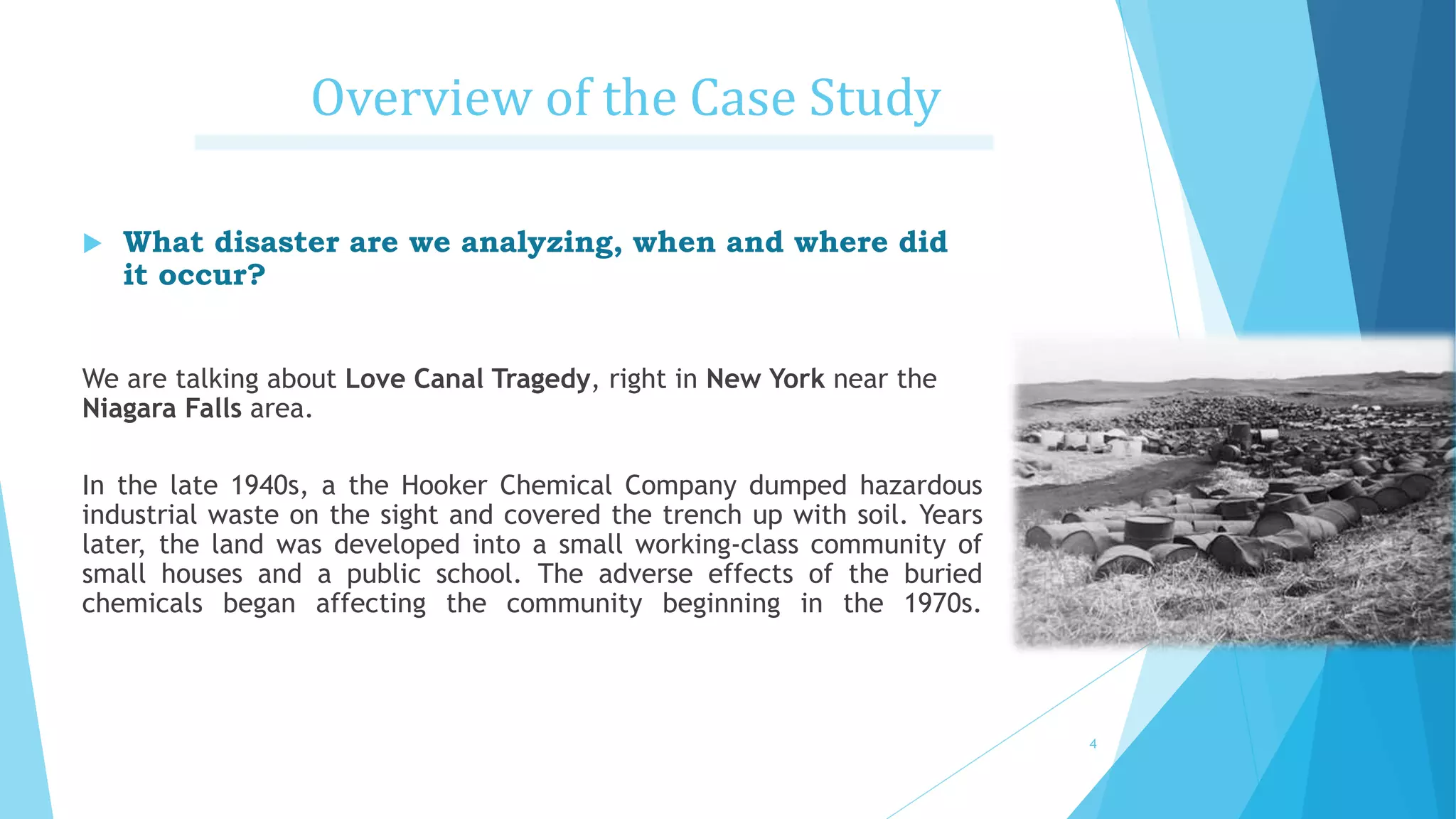
We are talking about Love Canal Tragedy, right in New York near the
Niagara Falls area.
In the late 1940s, a the Hooker Chemical Company dumped hazardous
industrial waste on the sight and covered the trench up with soil. Years
later, the land was developed into a small working-class community of
small houses and a public school. The adverse effects of the buried
chemicals began affecting the community beginning in the 1970s.
4
 What injury and destruction was produced by this disaster?
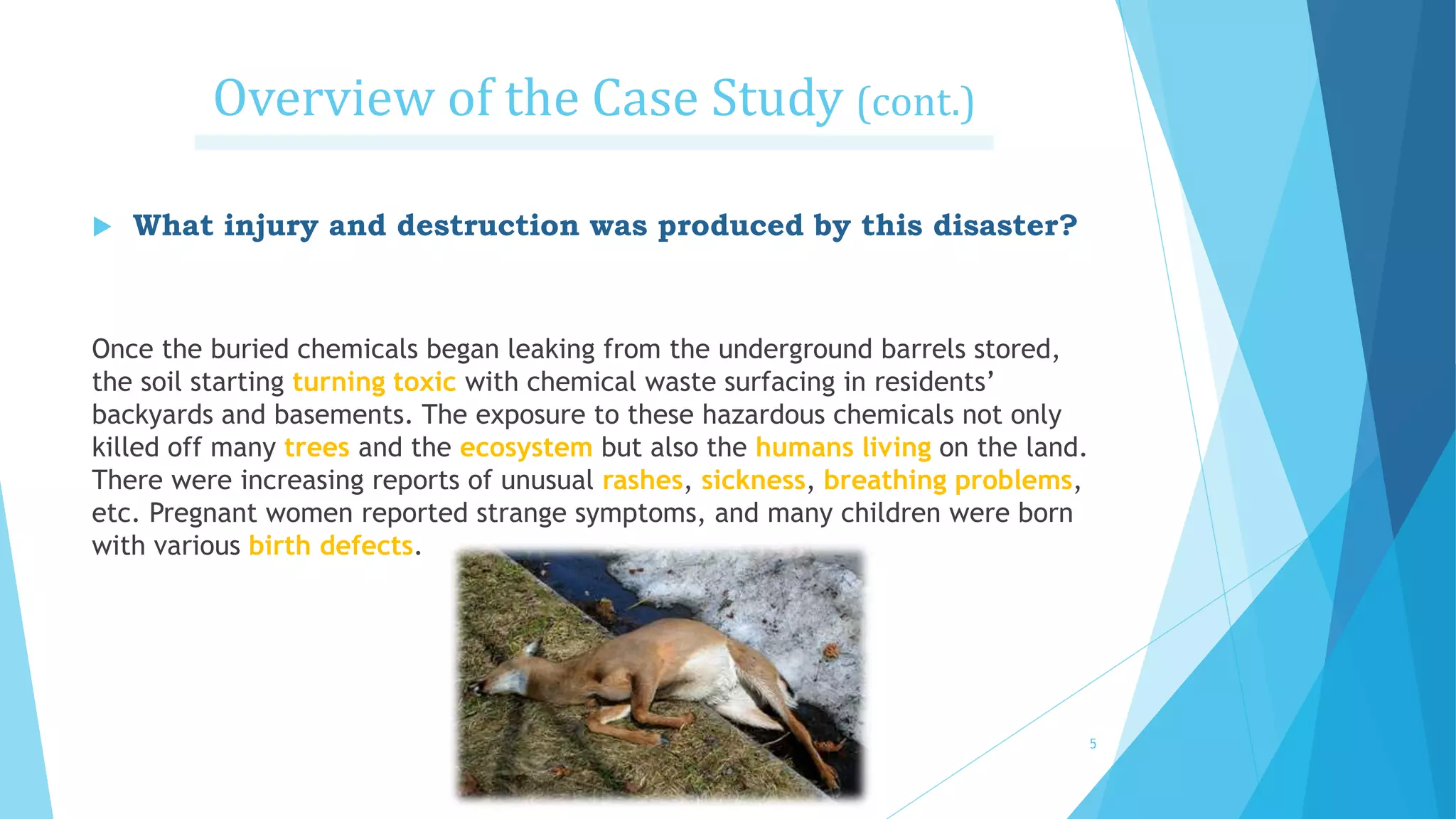
Once the buried chemicals began leaking from the underground barrels stored,
the soil starting turning toxic with chemical waste surfacing in residents’
backyards and basements. The exposure to these hazardous chemicals not only
killed off many trees and the ecosystem but also the humans living on the land.
There were increasing reports of unusual rashes, sickness, breathing problems,
etc. Pregnant women reported strange symptoms, and many children were born
with various birth defects.
5
Overview of the Case Study (cont.)
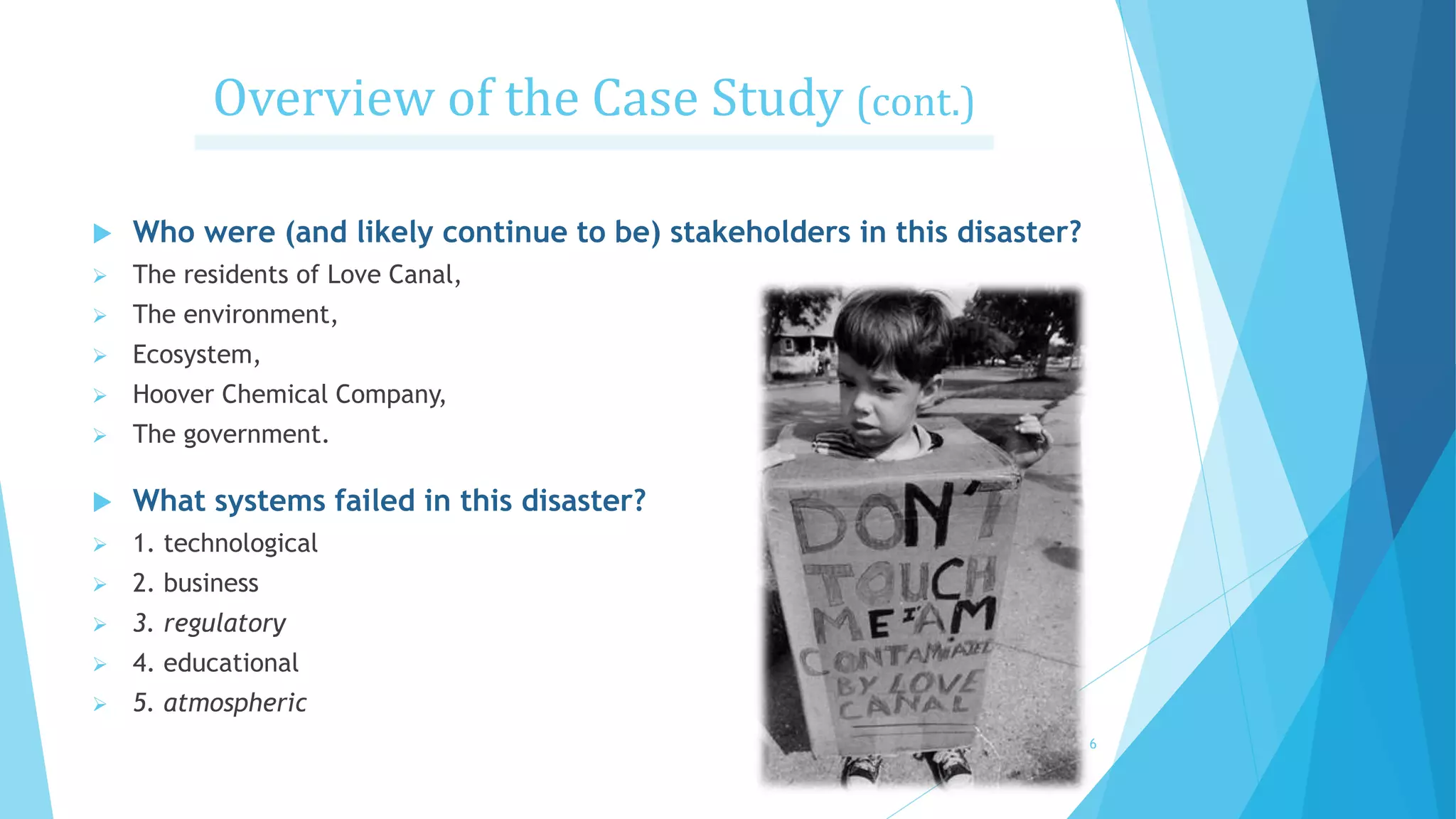
 Who were (and likely continue to be) stakeholders in this disaster?
 The residents of Love Canal,
 The environment,
 Ecosystem,
 Hoover Chemical Company,
 The government.
 What systems failed in this disaster?
 1. technological
 2. business
 3. regulatory
 4. educational
 5. atmospheric
6
Overview of the Case Study (cont.)
 How did disaster recovery unfold?
In the late 1970s, EPA conducted a study on Love Canal residents, finding
from blood tests that there were increased broken chromosome linkages,
suggesting an increased risk of cancer. In 1978, national emergency funds
were allocated and used to evacuate Love Canal residents after public
demand.
The government initiated a cleanup effort. However, the cleanup effort
proved very difficult as the chemicals had mixed into the soil, hence it
was decided that none of the chemicals would be removed from the site.
Drainage and well systems were put in place to prevent the leak of further
toxic waste. The process took nearly two decades. After completion of the
cleanup, homes surrounding the area were refurbished.
7
Overview of the Case Study (cont.)
 How has this disaster been covered by media or other
educational ventures?
After the EPA study was leaked, residents raised concerns and utilized media
to get the message across to the public, sparking a national debate for action.
There was widespread media coverage at the time. Even now, after the
rehabilitation, there are reports from the media indicating that it still might
not be a completely safe place to live.
8
Overview of the Case Study (cont.)
About Love Canal
 The Love Canal neighbourhood is located in the city of Niagara Falls, in
western New York State
 it is an incomplete canal, or just a trench, built in western New York state in
the 1890s. From the 1930s through the 1950s
 it was used as a chemical waste dump
9
Background of the Tragedy
 William T. Love came to 1890s Niagara Falls, New York, with hugely ambitious
plans of an enormous utopian metropolis
 Back in 1892, it seemed inconceivable that Love's plans would fall apart so
dramatically.
 In 1920 the land was sold to nearby Niagara Falls, a growing industrial town
that immediately started using the pit as a dumping ground for chemical
wastes
 By 1953, the company had buried nearly 22,000 tons of waste, and the pit
was virtually full
 In 1976, water from heavy rains and a record-breaking blizzard caused a
significant amount of chemical waste to migrate to the surface
10
Stakeholders suffering from the tragedy
 Trees and gardens were turning black and dying.
 The air had a faint, choking smell
 was stricken with higher than normal rates of stillborn births and miscarriages
 precursor to leukemia
 Citizens evacuated from their homes, pregnant women and infants were the
first to be taken out
 makes up the brew seeping through the ground and into homes
11
Violation of the general principles of
CSR
 They violated the Environmental law which was very crucial for the company
to the community
 buried waste near the community
 Hooker Chemical's experts declared chemical was safe
12
Ethical Dilemma
 Moral right= net high gain happiness
 Killing is never morally acceptable answer
13
Recommendations
 should plan the proper way to dispose the hazardous waste properly without
effecting the environment
 Take adequate and appropriate measures
 alert their hazardous waste is very harmful to the human and environment
event in long term
 limit accessibility to the site by the installation of suitable fencing or other
effective means
 local authorities should take this problem as serious thing
 appropriate and necessary corrective action to abate the public health
14
Conclusion
The Love Canal was a huge environmental disaster and a wakeup call for the
U.S. It is unfortunate that it needed to come to such a tragic event before
any regulations were set forth on chemical wastes.
15
16
17

Love Canal Tragedy

  • 1.
    Welcome to thePresentation
  • 2.
    BUS 501- Business,Government and Society 16104024 16104025 16104011 16204003 16204006 Instructed By: Md. Zahidur Rahman Faculty, CBA, IUBAT. 2 IUBAT - Friends Café
  • 3.
    The Love CanalTragedy Table of Contents:  Overview of the Case Study  The background of the Case  The way the stakeholders affected from the tragedy.  How the responsible company violated the general principles of CSR?  The ethical dilemma within this case.  Recommendation about how the disaster could be ignored or prevented by our learning from Ethical Decision Making Process and CSR. 3
  • 4.
    Overview of theCase Study  What disaster are we analyzing, when and where did it occur? We are talking about Love Canal Tragedy, right in New York near the Niagara Falls area. In the late 1940s, a the Hooker Chemical Company dumped hazardous industrial waste on the sight and covered the trench up with soil. Years later, the land was developed into a small working-class community of small houses and a public school. The adverse effects of the buried chemicals began affecting the community beginning in the 1970s. 4
  • 5.
     What injuryand destruction was produced by this disaster? Once the buried chemicals began leaking from the underground barrels stored, the soil starting turning toxic with chemical waste surfacing in residents’ backyards and basements. The exposure to these hazardous chemicals not only killed off many trees and the ecosystem but also the humans living on the land. There were increasing reports of unusual rashes, sickness, breathing problems, etc. Pregnant women reported strange symptoms, and many children were born with various birth defects. 5 Overview of the Case Study (cont.)
  • 6.
     Who were(and likely continue to be) stakeholders in this disaster?  The residents of Love Canal,  The environment,  Ecosystem,  Hoover Chemical Company,  The government.  What systems failed in this disaster?  1. technological  2. business  3. regulatory  4. educational  5. atmospheric 6 Overview of the Case Study (cont.)
  • 7.
     How diddisaster recovery unfold? In the late 1970s, EPA conducted a study on Love Canal residents, finding from blood tests that there were increased broken chromosome linkages, suggesting an increased risk of cancer. In 1978, national emergency funds were allocated and used to evacuate Love Canal residents after public demand. The government initiated a cleanup effort. However, the cleanup effort proved very difficult as the chemicals had mixed into the soil, hence it was decided that none of the chemicals would be removed from the site. Drainage and well systems were put in place to prevent the leak of further toxic waste. The process took nearly two decades. After completion of the cleanup, homes surrounding the area were refurbished. 7 Overview of the Case Study (cont.)
  • 8.
     How hasthis disaster been covered by media or other educational ventures? After the EPA study was leaked, residents raised concerns and utilized media to get the message across to the public, sparking a national debate for action. There was widespread media coverage at the time. Even now, after the rehabilitation, there are reports from the media indicating that it still might not be a completely safe place to live. 8 Overview of the Case Study (cont.)
  • 9.
    About Love Canal The Love Canal neighbourhood is located in the city of Niagara Falls, in western New York State  it is an incomplete canal, or just a trench, built in western New York state in the 1890s. From the 1930s through the 1950s  it was used as a chemical waste dump 9
  • 10.
    Background of theTragedy  William T. Love came to 1890s Niagara Falls, New York, with hugely ambitious plans of an enormous utopian metropolis  Back in 1892, it seemed inconceivable that Love's plans would fall apart so dramatically.  In 1920 the land was sold to nearby Niagara Falls, a growing industrial town that immediately started using the pit as a dumping ground for chemical wastes  By 1953, the company had buried nearly 22,000 tons of waste, and the pit was virtually full  In 1976, water from heavy rains and a record-breaking blizzard caused a significant amount of chemical waste to migrate to the surface 10
  • 11.
    Stakeholders suffering fromthe tragedy  Trees and gardens were turning black and dying.  The air had a faint, choking smell  was stricken with higher than normal rates of stillborn births and miscarriages  precursor to leukemia  Citizens evacuated from their homes, pregnant women and infants were the first to be taken out  makes up the brew seeping through the ground and into homes 11
  • 12.
    Violation of thegeneral principles of CSR  They violated the Environmental law which was very crucial for the company to the community  buried waste near the community  Hooker Chemical's experts declared chemical was safe 12
  • 13.
    Ethical Dilemma  Moralright= net high gain happiness  Killing is never morally acceptable answer 13
  • 14.
    Recommendations  should planthe proper way to dispose the hazardous waste properly without effecting the environment  Take adequate and appropriate measures  alert their hazardous waste is very harmful to the human and environment event in long term  limit accessibility to the site by the installation of suitable fencing or other effective means  local authorities should take this problem as serious thing  appropriate and necessary corrective action to abate the public health 14
  • 15.
    Conclusion The Love Canalwas a huge environmental disaster and a wakeup call for the U.S. It is unfortunate that it needed to come to such a tragic event before any regulations were set forth on chemical wastes. 15
  • 16.
  • 17.