Quality Management Assistance Tool
( Ishikawa diagram, Pareto Analysis, Poka -Yoke)
 Present by:
 Pravin Prajapati
 ( M.Tech - Production)
 150305208013
Seven Quality Tools
• Cause and Effect Diagram (Ishikawa Diagram)
• Flow Charts
• Check sheets
• Histograms
• Pareto Charts
• Control Charts
• Scatter Diagrams
Ishikawa diagram
 A common use of the Ishikawa diagram is in product design, to
identify desirable factors leading to an overall effect.
 It is known as a fishbone diagram because of its shape.
 Fishbone diagram (also known as Ishikawa diagram) was created
with the goal of identifying and grouping the causes which generate
a quality problem
 Fishbone diagram become a very useful instrument in risk
identification stage.
Ishikawa diagram
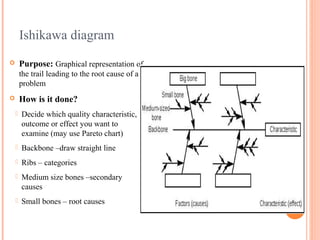
 Purpose: Graphical representation of
the trail leading to the root cause of a
problem
 How is it done?
 Decide which quality characteristic,
outcome or effect you want to
examine (may use Pareto chart)
 Backbone –draw straight line
 Ribs – categories
 Medium size bones –secondary
causes
 Small bones – root causes
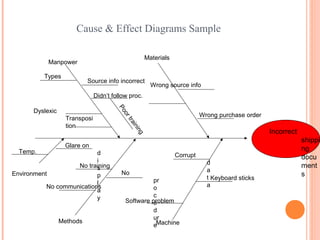
Cause & Effect Diagrams Sample
Incorrect
shippi
ng
docu
ment
s
Manpower
Materials
Methods Machine
Environment
Keyboard sticks
Wrong source info
Wrong purchase order
Types
Source info incorrect
Dyslexic
Transposi
tion
Didn’t follow proc.
Poortraining
Glare on
d
i
s
p
l
a
y
Temp.
No
pr
o
c
e
d
ur
e
No communications
No training
Software problem
Corrupt
d
a
t
a
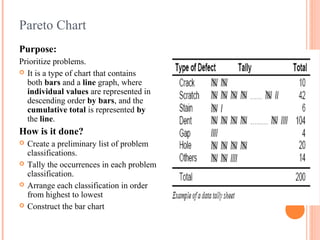
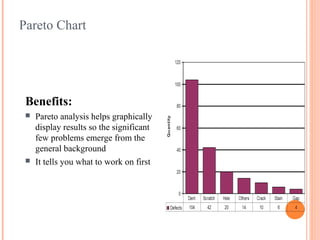
Pareto Chart
Purpose:
Prioritize problems.
 It is a type of chart that contains
both bars and a line graph, where
individual values are represented in
descending order by bars, and the
cumulative total is represented by
the line.
How is it done?
 Create a preliminary list of problem
classifications.
 Tally the occurrences in each problem
classification.
 Arrange each classification in order
from highest to lowest
 Construct the bar chart
Pareto Chart
Benefits:
 Pareto analysis helps graphically
display results so the significant
few problems emerge from the
general background
 It tells you what to work on first
Poka Yoke
 Poka-Yoke was developed by Shigeo Shingo from
Toyota Motors as a tool to achieve Zero Defects.
• The process of Zero Defects is also known as “Mistake
Proofing” or “Fail-Safe”.
• By taking over repetitive tasks or actions that depend on
vigilance or memory, Poka-Yoke can free workers’ time
and mind to pursue more value added activities.
Poka Yoke
 Every inspection method has weaknesses.
• Prevention of defects is better than detection.
• Poka-yoke devices can be applied within any process.
• Focus on the critical functions and actions.
• Sources of defects can be challenged and eliminated.
Poka Yoke
 Mistake-proofing systems
 Does not rely on operators
 catching mistakes
 Inexpensive Point of Origin
 inspection
 Quick feedback 100% of the time
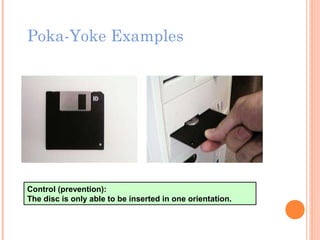
Poka-Yoke Examples
Control (prevention):
The disc is only able to be inserted in one orientation.

seven quality tool

  • 1.
    Quality Management AssistanceTool ( Ishikawa diagram, Pareto Analysis, Poka -Yoke)  Present by:  Pravin Prajapati  ( M.Tech - Production)  150305208013
  • 2.
    Seven Quality Tools •Cause and Effect Diagram (Ishikawa Diagram) • Flow Charts • Check sheets • Histograms • Pareto Charts • Control Charts • Scatter Diagrams
  • 3.
    Ishikawa diagram  Acommon use of the Ishikawa diagram is in product design, to identify desirable factors leading to an overall effect.  It is known as a fishbone diagram because of its shape.  Fishbone diagram (also known as Ishikawa diagram) was created with the goal of identifying and grouping the causes which generate a quality problem  Fishbone diagram become a very useful instrument in risk identification stage.
  • 4.
    Ishikawa diagram  Purpose:Graphical representation of the trail leading to the root cause of a problem  How is it done?  Decide which quality characteristic, outcome or effect you want to examine (may use Pareto chart)  Backbone –draw straight line  Ribs – categories  Medium size bones –secondary causes  Small bones – root causes
  • 5.
    Cause & EffectDiagrams Sample Incorrect shippi ng docu ment s Manpower Materials Methods Machine Environment Keyboard sticks Wrong source info Wrong purchase order Types Source info incorrect Dyslexic Transposi tion Didn’t follow proc. Poortraining Glare on d i s p l a y Temp. No pr o c e d ur e No communications No training Software problem Corrupt d a t a
  • 6.
    Pareto Chart Purpose: Prioritize problems. It is a type of chart that contains both bars and a line graph, where individual values are represented in descending order by bars, and the cumulative total is represented by the line. How is it done?  Create a preliminary list of problem classifications.  Tally the occurrences in each problem classification.  Arrange each classification in order from highest to lowest  Construct the bar chart
  • 7.
    Pareto Chart Benefits:  Paretoanalysis helps graphically display results so the significant few problems emerge from the general background  It tells you what to work on first
  • 8.
    Poka Yoke  Poka-Yokewas developed by Shigeo Shingo from Toyota Motors as a tool to achieve Zero Defects. • The process of Zero Defects is also known as “Mistake Proofing” or “Fail-Safe”. • By taking over repetitive tasks or actions that depend on vigilance or memory, Poka-Yoke can free workers’ time and mind to pursue more value added activities.
  • 9.
    Poka Yoke  Everyinspection method has weaknesses. • Prevention of defects is better than detection. • Poka-yoke devices can be applied within any process. • Focus on the critical functions and actions. • Sources of defects can be challenged and eliminated.
  • 10.
    Poka Yoke  Mistake-proofingsystems  Does not rely on operators  catching mistakes  Inexpensive Point of Origin  inspection  Quick feedback 100% of the time
  • 11.
    Poka-Yoke Examples Control (prevention): Thedisc is only able to be inserted in one orientation.