Bivariate Probability
Distributions
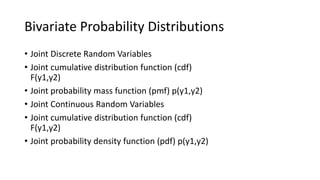
Bivariate Probability Distributions
• Joint Discrete Random Variables
• Joint cumulative distribution function (cdf)
F(y1,y2)
• Joint probability mass function (pmf) p(y1,y2)
• Joint Continuous Random Variables
• Joint cumulative distribution function (cdf)
F(y1,y2)
• Joint probability density function (pdf) p(y1,y2)
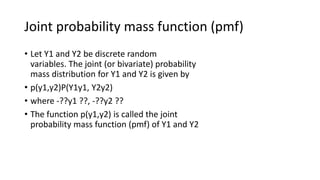
Joint probability mass function (pmf)
• Let Y1 and Y2 be discrete random
variables. The joint (or bivariate) probability
mass distribution for Y1 and Y2 is given by
• p(y1,y2)P(Y1y1, Y2y2)
• where -??y1 ??, -??y2 ??
• The function p(y1,y2) is called the joint
probability mass function (pmf) of Y1 and Y2
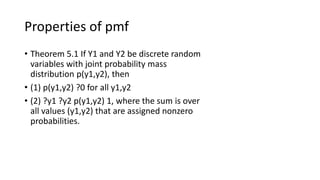
Properties of pmf
• Theorem 5.1 If Y1 and Y2 be discrete random
variables with joint probability mass
distribution p(y1,y2), then
• (1) p(y1,y2) ?0 for all y1,y2
• (2) ?y1 ?y2 p(y1,y2) 1, where the sum is over
all values (y1,y2) that are assigned nonzero
probabilities.
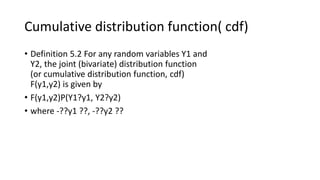
Cumulative distribution function( cdf)
• Definition 5.2 For any random variables Y1 and
Y2, the joint (bivariate) distribution function
(or cumulative distribution function, cdf)
F(y1,y2) is given by
• F(y1,y2)P(Y1?y1, Y2?y2)
• where -??y1 ??, -??y2 ??
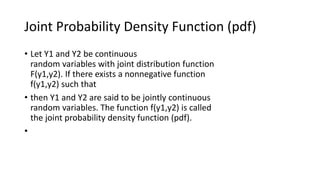
Joint Probability Density Function (pdf)
• Let Y1 and Y2 be continuous
random variables with joint distribution function
F(y1,y2). If there exists a nonnegative function
f(y1,y2) such that
• then Y1 and Y2 are said to be jointly continuous
random variables. The function f(y1,y2) is called
the joint probability density function (pdf).
•
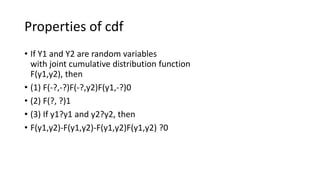
Properties of cdf
• If Y1 and Y2 are random variables
with joint cumulative distribution function
F(y1,y2), then
• (1) F(-?,-?)F(-?,y2)F(y1,-?)0
• (2) F(?, ?)1
• (3) If y1?y1 and y2?y2, then
• F(y1,y2)-F(y1,y2)-F(y1,y2)F(y1,y2) ?0
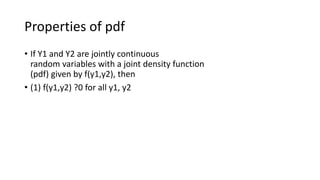
Properties of pdf
• If Y1 and Y2 are jointly continuous
random variables with a joint density function
(pdf) given by f(y1,y2), then
• (1) f(y1,y2) ?0 for all y1, y2

Bivariate Distribution.pptx

  • 1.
  • 2.
    Bivariate Probability Distributions •Joint Discrete Random Variables • Joint cumulative distribution function (cdf) F(y1,y2) • Joint probability mass function (pmf) p(y1,y2) • Joint Continuous Random Variables • Joint cumulative distribution function (cdf) F(y1,y2) • Joint probability density function (pdf) p(y1,y2)
  • 3.
    Joint probability massfunction (pmf) • Let Y1 and Y2 be discrete random variables. The joint (or bivariate) probability mass distribution for Y1 and Y2 is given by • p(y1,y2)P(Y1y1, Y2y2) • where -??y1 ??, -??y2 ?? • The function p(y1,y2) is called the joint probability mass function (pmf) of Y1 and Y2
  • 4.
    Properties of pmf •Theorem 5.1 If Y1 and Y2 be discrete random variables with joint probability mass distribution p(y1,y2), then • (1) p(y1,y2) ?0 for all y1,y2 • (2) ?y1 ?y2 p(y1,y2) 1, where the sum is over all values (y1,y2) that are assigned nonzero probabilities.
  • 5.
    Cumulative distribution function(cdf) • Definition 5.2 For any random variables Y1 and Y2, the joint (bivariate) distribution function (or cumulative distribution function, cdf) F(y1,y2) is given by • F(y1,y2)P(Y1?y1, Y2?y2) • where -??y1 ??, -??y2 ??
  • 6.
    Joint Probability DensityFunction (pdf) • Let Y1 and Y2 be continuous random variables with joint distribution function F(y1,y2). If there exists a nonnegative function f(y1,y2) such that • then Y1 and Y2 are said to be jointly continuous random variables. The function f(y1,y2) is called the joint probability density function (pdf). •
  • 7.
    Properties of cdf •If Y1 and Y2 are random variables with joint cumulative distribution function F(y1,y2), then • (1) F(-?,-?)F(-?,y2)F(y1,-?)0 • (2) F(?, ?)1 • (3) If y1?y1 and y2?y2, then • F(y1,y2)-F(y1,y2)-F(y1,y2)F(y1,y2) ?0
  • 8.
    Properties of pdf •If Y1 and Y2 are jointly continuous random variables with a joint density function (pdf) given by f(y1,y2), then • (1) f(y1,y2) ?0 for all y1, y2