Fred Kossam
Malawi
Department of Climate Change and Meteorological Services
 NAPA to NAPS
 LDCF PROJECTS UNDER IMPLEMENATION
 LESSON LEARNT
 CONCLUSIONs
NAPA to NAPs
 Malawi’s first NAPA was launched in February
2008 and has five (5) priority areas on which
national projects have been developed and
implemented by both Gov. and non-state
actors.
 Government has developed and is implementing
5 specific projects from the NAPA which are
providing lessons to feed into the NAPs
 Medium and long-term adaptation does not
replace the need to address urgent and
immediate needs
 Medium and long term planning and their
implementation will require larger and more
consistent funding and other support
 NAPAs provide a good starting point for medium
and long-term adaptation
 ii) Medium and long-term adaptation requires an
iterative process with stages or phases that may
be designed to suit specific national
circumstances
 iii) Medium and long-term adaptation is more
policy driven, therefore effective integration
becomes more important.
 Medium and long-term adaptation does not replace the
need to address urgent and immediate needs
 “Climate Adaptation for Rural Livelihoods and Agriculture
(CALRA)”. It has a tune of $3m full implementation in
Karonga, Dedza and Chikwawa and is being supported by
African Development Bank. The aim of the project is to
improve resilience to climate variability and future climate
change by developing and implementing adaptation
strategies and measures that will improve agricultural
production and rural livelihood.
 “Climate proofing local development gains in rural and
urban areas of Machinga and Mangochi Districts” – UNDP -
$5.3m (Approved) The aim of the project is to secure
development and food security gains from the baseline
programs by empowering communities to integrate climate
risk considerations in the development policies, plans,
projects and actions.
 “Strengthening Climate Information and Early Warning
Systems in Eastern and Southern Africa For Climate Resilient
Development and Adaptation to Climate Change – Malawi" –
UNDP - $4m .
 “Implementing urgent adaptation priorities through
strengthened decentralized and national development
plans “– UNDP- $4.5m, The goal of the project is
to reduce the vulnerability of rural communities to the
adverse impacts of climate variability and change in
Malawi.
 “Sustainable Land Management,” US$ 3m, UNDP, under
implementation. The objective of the project is to
provide the basis for economic development, food
security and sustainable livelihoods while restoring the
ecological integrity of the River shire Basin.”
 “Shire River Basin Management”, through World Bank,
$5m – under implementation. The overall objective
of the project is to develop a Shire River Basin planning
framework and improve land and water management
for ecosystem and livelihood benefits in target areas.
 Building Climate Resilience in the Fisheries
sector in Malawi, US$6,138,000 million,
Department of Fisheries through the Food
and Agriculture Organization (FAO).
 Sustainable Rural Water Infrastructure for
Improved Health and Livelihoods Project,”
US$ 3m, AfDB, PIF under consideration by
GEF.
 National Adaptation Plan PIFUNDP, PIF under
consideration by GEF.
 Enhanced Awareness and raised profile of
adaptation
 Initiated Integrating adaptation in development
strategies such MGDS and other policy document
 Improved Capacity building components
 Improved demand and delivery of Climate
information services
 Improved identification of gaps, needs and
adaptation priorities in support of vulnerability
Assessments
 Improved Monitoring and Evaluation frameworks
 Link to other support needs such as GCF support
to NAPs formulation
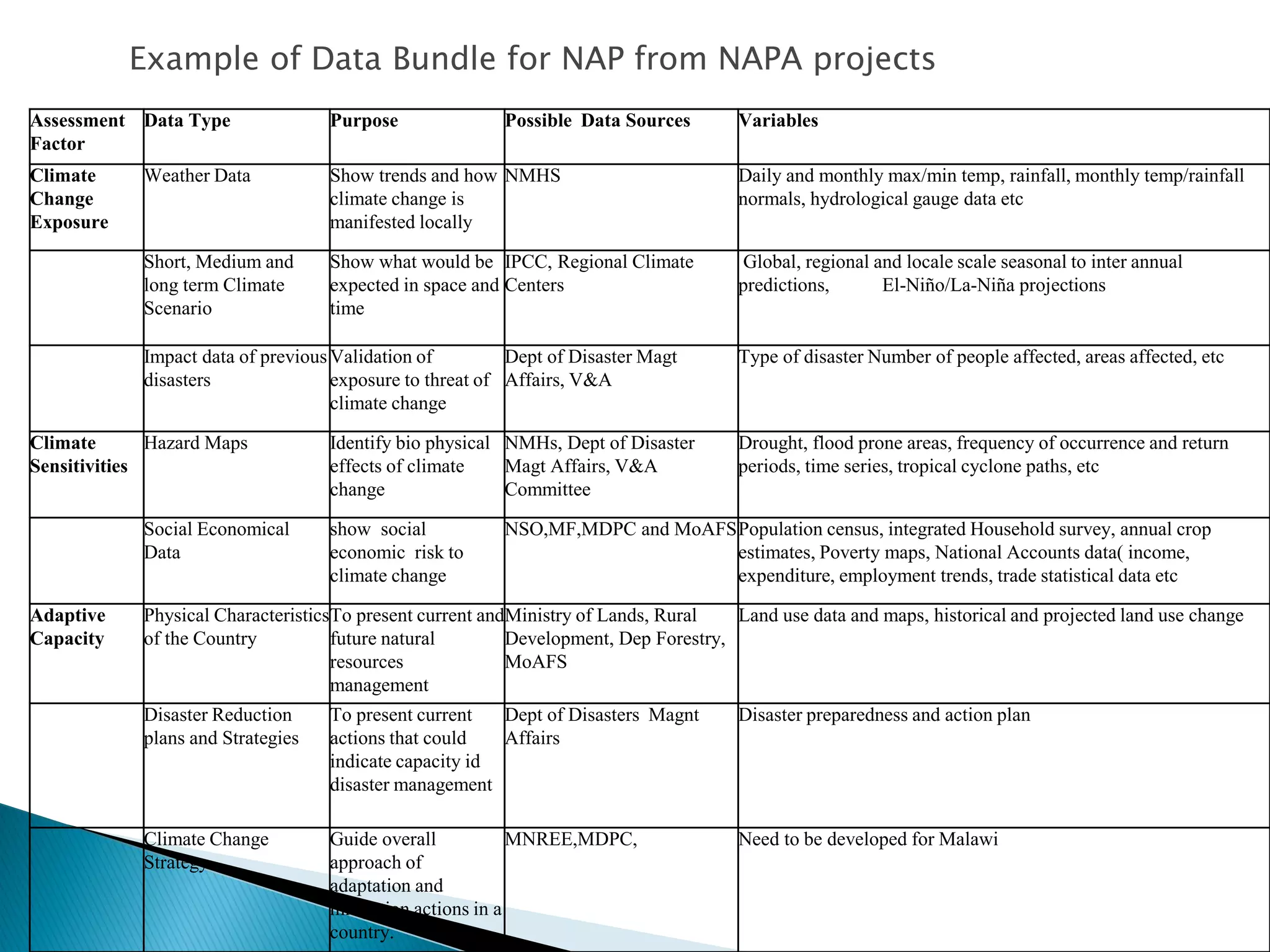
Assessment
Factor
Data Type Purpose Possible Data Sources Variables
Climate
Change
Exposure
Weather Data Show trends and how
climate change is
manifested locally
NMHS Daily and monthly max/min temp, rainfall, monthly temp/rainfall
normals, hydrological gauge data etc
Short, Medium and
long term Climate
Scenario
Show what would be
expected in space and
time
IPCC, Regional Climate
Centers
Global, regional and locale scale seasonal to inter annual
predictions, El-Niño/La-Niña projections
Impact data of previous
disasters
Validation of
exposure to threat of
climate change
Dept of Disaster Magt
Affairs, V&A
Type of disaster Number of people affected, areas affected, etc
Climate
Sensitivities
Hazard Maps Identify bio physical
effects of climate
change
NMHs, Dept of Disaster
Magt Affairs, V&A
Committee
Drought, flood prone areas, frequency of occurrence and return
periods, time series, tropical cyclone paths, etc
Social Economical
Data
show social
economic risk to
climate change
NSO,MF,MDPC and MoAFSPopulation census, integrated Household survey, annual crop
estimates, Poverty maps, National Accounts data( income,
expenditure, employment trends, trade statistical data etc
Adaptive
Capacity
Physical Characteristics
of the Country
To present current and
future natural
resources
management
Ministry of Lands, Rural
Development, Dep Forestry,
MoAFS
Land use data and maps, historical and projected land use change
Disaster Reduction
plans and Strategies
To present current
actions that could
indicate capacity id
disaster management
Dept of Disasters Magnt
Affairs
Disaster preparedness and action plan
Climate Change
Strategy
Guide overall
approach of
adaptation and
mitigation actions in a
country.
MNREE,MDPC, Need to be developed for Malawi
Example of Data Bundle for NAP from NAPA projects
 LDCF is very important to Malawi and LDC in
General equitable access modalities
 Preparatory components which is key for
LDCs including Malawi is very good for NAPs
 More funding is needed for full
implementation of NAPA projects which is
providing valuable lesson to NAP process
 Thanks

Malawi and the LDCF

  • 1.
    Fred Kossam Malawi Department ofClimate Change and Meteorological Services
  • 2.
     NAPA toNAPS  LDCF PROJECTS UNDER IMPLEMENATION  LESSON LEARNT  CONCLUSIONs
  • 3.
    NAPA to NAPs Malawi’s first NAPA was launched in February 2008 and has five (5) priority areas on which national projects have been developed and implemented by both Gov. and non-state actors.  Government has developed and is implementing 5 specific projects from the NAPA which are providing lessons to feed into the NAPs  Medium and long-term adaptation does not replace the need to address urgent and immediate needs  Medium and long term planning and their implementation will require larger and more consistent funding and other support
  • 4.
     NAPAs providea good starting point for medium and long-term adaptation  ii) Medium and long-term adaptation requires an iterative process with stages or phases that may be designed to suit specific national circumstances  iii) Medium and long-term adaptation is more policy driven, therefore effective integration becomes more important.  Medium and long-term adaptation does not replace the need to address urgent and immediate needs
  • 5.
     “Climate Adaptationfor Rural Livelihoods and Agriculture (CALRA)”. It has a tune of $3m full implementation in Karonga, Dedza and Chikwawa and is being supported by African Development Bank. The aim of the project is to improve resilience to climate variability and future climate change by developing and implementing adaptation strategies and measures that will improve agricultural production and rural livelihood.  “Climate proofing local development gains in rural and urban areas of Machinga and Mangochi Districts” – UNDP - $5.3m (Approved) The aim of the project is to secure development and food security gains from the baseline programs by empowering communities to integrate climate risk considerations in the development policies, plans, projects and actions.  “Strengthening Climate Information and Early Warning Systems in Eastern and Southern Africa For Climate Resilient Development and Adaptation to Climate Change – Malawi" – UNDP - $4m .
  • 6.
     “Implementing urgentadaptation priorities through strengthened decentralized and national development plans “– UNDP- $4.5m, The goal of the project is to reduce the vulnerability of rural communities to the adverse impacts of climate variability and change in Malawi.  “Sustainable Land Management,” US$ 3m, UNDP, under implementation. The objective of the project is to provide the basis for economic development, food security and sustainable livelihoods while restoring the ecological integrity of the River shire Basin.”  “Shire River Basin Management”, through World Bank, $5m – under implementation. The overall objective of the project is to develop a Shire River Basin planning framework and improve land and water management for ecosystem and livelihood benefits in target areas.
  • 7.
     Building ClimateResilience in the Fisheries sector in Malawi, US$6,138,000 million, Department of Fisheries through the Food and Agriculture Organization (FAO).  Sustainable Rural Water Infrastructure for Improved Health and Livelihoods Project,” US$ 3m, AfDB, PIF under consideration by GEF.  National Adaptation Plan PIFUNDP, PIF under consideration by GEF.
  • 8.
     Enhanced Awarenessand raised profile of adaptation  Initiated Integrating adaptation in development strategies such MGDS and other policy document  Improved Capacity building components  Improved demand and delivery of Climate information services  Improved identification of gaps, needs and adaptation priorities in support of vulnerability Assessments  Improved Monitoring and Evaluation frameworks  Link to other support needs such as GCF support to NAPs formulation
  • 9.
    Assessment Factor Data Type PurposePossible Data Sources Variables Climate Change Exposure Weather Data Show trends and how climate change is manifested locally NMHS Daily and monthly max/min temp, rainfall, monthly temp/rainfall normals, hydrological gauge data etc Short, Medium and long term Climate Scenario Show what would be expected in space and time IPCC, Regional Climate Centers Global, regional and locale scale seasonal to inter annual predictions, El-Niño/La-Niña projections Impact data of previous disasters Validation of exposure to threat of climate change Dept of Disaster Magt Affairs, V&A Type of disaster Number of people affected, areas affected, etc Climate Sensitivities Hazard Maps Identify bio physical effects of climate change NMHs, Dept of Disaster Magt Affairs, V&A Committee Drought, flood prone areas, frequency of occurrence and return periods, time series, tropical cyclone paths, etc Social Economical Data show social economic risk to climate change NSO,MF,MDPC and MoAFSPopulation census, integrated Household survey, annual crop estimates, Poverty maps, National Accounts data( income, expenditure, employment trends, trade statistical data etc Adaptive Capacity Physical Characteristics of the Country To present current and future natural resources management Ministry of Lands, Rural Development, Dep Forestry, MoAFS Land use data and maps, historical and projected land use change Disaster Reduction plans and Strategies To present current actions that could indicate capacity id disaster management Dept of Disasters Magnt Affairs Disaster preparedness and action plan Climate Change Strategy Guide overall approach of adaptation and mitigation actions in a country. MNREE,MDPC, Need to be developed for Malawi Example of Data Bundle for NAP from NAPA projects
  • 10.
     LDCF isvery important to Malawi and LDC in General equitable access modalities  Preparatory components which is key for LDCs including Malawi is very good for NAPs  More funding is needed for full implementation of NAPA projects which is providing valuable lesson to NAP process
  • 11.