Reticent Media, Inc. Team Development
Change Management Planned process for change divided into four stages: Awareness; a felt need or pain Design; tangible actions taken by the company, intervention, diagnosis and development of a plan Implementation Stabilize & Sustain the change
Senge’s Five Learning Disciplines The core of a learning organization is based upon five learning disciplines, which are lifelong programs of study and practice. Personal Mastery Mental Models Shared Vision Team Learning Systems Thinking
Shared Vision Adopt a strategy for building a shared vision Communicate leader vision so that it’s made clear to all members of a team  Build listening capacity, practice effective communication, and share both values and visions from the top-down & the bottom-up Form bridges between personal and professional agendas
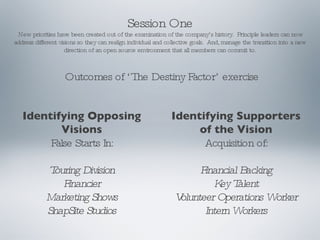
Session One New priorities have been created out of the examination of the company’s history.  Principle leaders can now address different visions so they can realign individual and collective goals.  And, manage the transition into a new direction of an open source environment that all members can commit to. Outcomes of ‘The Destiny Factor’ exercise Identifying Opposing Visions False Starts In: Touring Division Financier Marketing Shows SnapSite Studios Identifying Supporters of the Vision Acquisition of: Financial Backing Key Talent Volunteer Operations Worker Intern Workers
Reticent Community (Shared Vision) The Grand Vision - Collectively Changing Our Futures How Do We Get There? Building Shared Vision in the Reticent Community Marketing Shows  (Personal Vision) Merchandise Store  (Personal Vision) Software Development (Personal Vision) Touring Division  (Personal Vision) You come from a place where you’ve communicated you grand vision, but few have felt reason to commit themselves and act according to it. You want to be at a place where members co-create and voluntarily contribute to the community, rather than focus on what each individual person can get out of it.
Steps To Co-Creating Start with Personal Vision Treat Everyone as Equal Seek Alignment, Not Agreement Among Teams, Encourage Interdependence & Diversity Avoid Sampling Have People Speak Only for Themselves Expect and Nurture Reverence for Each Other Consider Using an Interim Vision to Build Momentum Focus on the Dialogue, Not just the Vision Statement
Systems Thinking Understand the structure and nature of systems, events, and patterns of behavior resulting in the events Identify points within systems that can be leveraged to effect change that lead to improved results Develop a model or universal language to bring disciplines together and integrate functions Change the ordinary ways we think and talk about complex issues
Session Two Problem Statement:   Time availability for development of store application to turn on merchant services, and funds availability to initiate it.  Low cost developers/interface coders are needed with appropriate graphic design skills to get this started. Outcomes of ‘Exploring Your Own Story’ exercise Key Themes & Recurring Patterns Leader Standards are to High Zero Available Time Limited Low Cost Talent with proven capabilities Limited Funding List of Key Factors Risks of capturing Talent without raw skill set and at a low cost Translation of 200 Template Files Capturing Autonomous Workers Identify Resource Pool for Key Talent Set up Vendor Relationships for Merchant Services
Larger Organization Distinct Functions  of the  Organization THE ENCLAVE
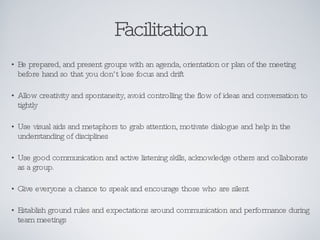
Facilitation Be prepared, and present groups with an agenda, orientation or plan of the meeting before hand so that you don’t lose focus and drift Allow creativity and spontaneity, avoid controlling the flow of ideas and conversation to tightly Use visual aids and metaphors to grab attention, motivate dialogue and help in the understanding of disciplines Use good communication and active listening skills, acknowledge others and collaborate as a group.  Give everyone a chance to speak and encourage those who are silent Establish ground rules and expectations around communication and performance during team meetings
Recommendations Mature our own mental models and re-examine our assessments of situations Hold team learning meetings, and explore areas that have not before been made public, such as personal visions and values Begin to build shared vision by creating environments for co-creating and atmospheres for trust and mutual respect Find a balance between the uses of modern technology and exercising learning disciplines - put the human element (close communication & vision sharing) back into the business Train leaders and managers on employee coaching, team building, and trust building Engage groups in dialogue with well established ground rules to make collective decisions and solve problems
Resources The Society for Organizational Learning is an international not-for-profit organization and provides a space where communities, organization, institutions and individuals can come together, network and benefit from one another,  http://www.solonline.org/ The Free Management Library has many resources links for businesses relating to a vast amount of business processes, issues and topics,  http://www.managementhelp.org/ The American Society for Training & Development is the largest association dedicated to workplace learning and performance professionals,  http://www.astd.org/astd The Fifth Discipline Fieldbook, Strategies and Tools for Building a Learning Organization, written by Peter Senge, Art Kleiner, Charlotte Roberts, Richard Ross, and Bryan Smith.

J Gabelmann U10a2 Pp Presentation Final

  • 1.
    Reticent Media, Inc.Team Development
  • 2.
    Change Management Plannedprocess for change divided into four stages: Awareness; a felt need or pain Design; tangible actions taken by the company, intervention, diagnosis and development of a plan Implementation Stabilize & Sustain the change
  • 3.
    Senge’s Five LearningDisciplines The core of a learning organization is based upon five learning disciplines, which are lifelong programs of study and practice. Personal Mastery Mental Models Shared Vision Team Learning Systems Thinking
  • 4.
    Shared Vision Adopta strategy for building a shared vision Communicate leader vision so that it’s made clear to all members of a team Build listening capacity, practice effective communication, and share both values and visions from the top-down & the bottom-up Form bridges between personal and professional agendas
  • 5.
    Session One Newpriorities have been created out of the examination of the company’s history. Principle leaders can now address different visions so they can realign individual and collective goals. And, manage the transition into a new direction of an open source environment that all members can commit to. Outcomes of ‘The Destiny Factor’ exercise Identifying Opposing Visions False Starts In: Touring Division Financier Marketing Shows SnapSite Studios Identifying Supporters of the Vision Acquisition of: Financial Backing Key Talent Volunteer Operations Worker Intern Workers
  • 6.
    Reticent Community (SharedVision) The Grand Vision - Collectively Changing Our Futures How Do We Get There? Building Shared Vision in the Reticent Community Marketing Shows (Personal Vision) Merchandise Store (Personal Vision) Software Development (Personal Vision) Touring Division (Personal Vision) You come from a place where you’ve communicated you grand vision, but few have felt reason to commit themselves and act according to it. You want to be at a place where members co-create and voluntarily contribute to the community, rather than focus on what each individual person can get out of it.
  • 7.
    Steps To Co-CreatingStart with Personal Vision Treat Everyone as Equal Seek Alignment, Not Agreement Among Teams, Encourage Interdependence & Diversity Avoid Sampling Have People Speak Only for Themselves Expect and Nurture Reverence for Each Other Consider Using an Interim Vision to Build Momentum Focus on the Dialogue, Not just the Vision Statement
  • 8.
    Systems Thinking Understandthe structure and nature of systems, events, and patterns of behavior resulting in the events Identify points within systems that can be leveraged to effect change that lead to improved results Develop a model or universal language to bring disciplines together and integrate functions Change the ordinary ways we think and talk about complex issues
  • 9.
    Session Two ProblemStatement: Time availability for development of store application to turn on merchant services, and funds availability to initiate it. Low cost developers/interface coders are needed with appropriate graphic design skills to get this started. Outcomes of ‘Exploring Your Own Story’ exercise Key Themes & Recurring Patterns Leader Standards are to High Zero Available Time Limited Low Cost Talent with proven capabilities Limited Funding List of Key Factors Risks of capturing Talent without raw skill set and at a low cost Translation of 200 Template Files Capturing Autonomous Workers Identify Resource Pool for Key Talent Set up Vendor Relationships for Merchant Services
  • 10.
    Larger Organization DistinctFunctions of the Organization THE ENCLAVE
  • 11.
    Facilitation Be prepared,and present groups with an agenda, orientation or plan of the meeting before hand so that you don’t lose focus and drift Allow creativity and spontaneity, avoid controlling the flow of ideas and conversation to tightly Use visual aids and metaphors to grab attention, motivate dialogue and help in the understanding of disciplines Use good communication and active listening skills, acknowledge others and collaborate as a group. Give everyone a chance to speak and encourage those who are silent Establish ground rules and expectations around communication and performance during team meetings
  • 12.
    Recommendations Mature ourown mental models and re-examine our assessments of situations Hold team learning meetings, and explore areas that have not before been made public, such as personal visions and values Begin to build shared vision by creating environments for co-creating and atmospheres for trust and mutual respect Find a balance between the uses of modern technology and exercising learning disciplines - put the human element (close communication & vision sharing) back into the business Train leaders and managers on employee coaching, team building, and trust building Engage groups in dialogue with well established ground rules to make collective decisions and solve problems
  • 13.
    Resources The Societyfor Organizational Learning is an international not-for-profit organization and provides a space where communities, organization, institutions and individuals can come together, network and benefit from one another, http://www.solonline.org/ The Free Management Library has many resources links for businesses relating to a vast amount of business processes, issues and topics, http://www.managementhelp.org/ The American Society for Training & Development is the largest association dedicated to workplace learning and performance professionals, http://www.astd.org/astd The Fifth Discipline Fieldbook, Strategies and Tools for Building a Learning Organization, written by Peter Senge, Art Kleiner, Charlotte Roberts, Richard Ross, and Bryan Smith.