CDIPC Overview
For Benefits 3 conference
April 2016
Dan Berty, Executive Director, CDIPC
© Canadian Drug Insurance Pooling Corporation
2
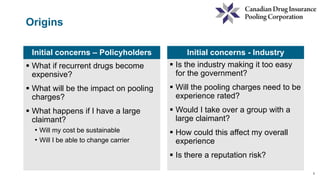
Origins
Initial concerns – Policyholders
 What if recurrent drugs become
expensive?
 What will be the impact on pooling
charges?
 What happens if I have a large
claimant?
• Will my cost be sustainable
• Will I be able to change carrier
Initial concerns - Industry
 Is the industry making it too easy
for the government?
 Will the pooling charges need to be
experience rated?
 Would I take over a group with a
large claimant?
 How could this affect my overall
experience
 Is there a reputation risk?
3
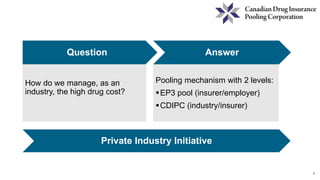
How do we manage, as an
industry, the high drug cost?
Pooling mechanism with 2 levels:
EP3 pool (insurer/employer)
CDIPC (industry/insurer)
Question Answer
Private Industry Initiative
4
EP3 Pool Purpose – Plan Sponsors
 EP3 – proprietary Extended drug Policy Protection Plan
 Protect/Manage risk for the individual employer
 Rules for EP3 are set in the CDIPC framework/arrangement
 Straightforward:
• Pool all claims above threshold set by insurer
• Pooling rates are set for the pool
• Only covers fully insured plans (not ASO or Refund accounting)
5
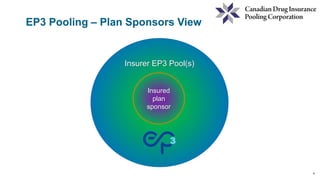
EP3 Pooling – Plan Sponsors View
Insurer EP3 Pool(s)
Insured
plan
sponsor
6
EP3 Pool Characteristics
 Key principles (EP3 and CDIPC)
• Affordability
• Availability
• Transferability of coverage
 Insurers
• Must set up at least one EP3 pool
• They establish multiple EP3 pools
• Pools can not be anti-selective in nature
• Rates must be set for each pool
• Rate for the pool can be based on the experience of the entire pool
• Insurers do not have to disclose EP3 makeup other than confidentially to CDIPC
annually
7
EP3 Pool Characteristics
 Plan Sponsors
• Rates can not based on the experience of a specific employer
o No anti-selection
• Threshold at the insurer’s discretion
• Pool only covers fully insured plans (ASO not covered)
• Fully insured plan can’t opt out
8
EP3 Pool Characteristics
 At renewal
• Renewal rate calculations can only consider non-pooled claims.
• EP3 pooling charges may increase (or decrease) for the entire pool.
 Excluded certificates
• Can be identified when a plans moves from Refund or ASO to Fully Insured.
• If a plan moves from ASO to fully insured, certificates with claims falling into the EP3
pool can be included or excluded from EP3 pooling.
• No certificates with claims exceeding CDIPC threshold can be included in CDIPC
pooling.
 Only non pooled claims can be considered at quote time in “base premium
rates”.
 Drug and non drug can be pooled together (the EP3 rules only apply to
drugs).
9
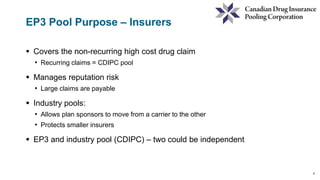
EP3 Pool Purpose – Insurers
 Covers the non-recurring high cost drug claim
• Recurring claims = CDIPC pool
 Manages reputation risk
• Large claims are payable
 Industry pools:
• Allows plan sponsors to move from a carrier to the other
• Protects smaller insurers
 EP3 and industry pool (CDIPC) – two could be independent
10
10
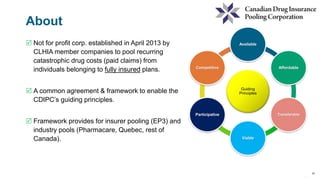
 Not for profit corp. established in April 2013 by
CLHIA member companies to pool recurring
catastrophic drug costs (paid claims) from
individuals belonging to fully insured plans.
 A common agreement & framework to enable the
CDIPC’s guiding principles.
 Framework provides for insurer pooling (EP3) and
industry pools (Pharmacare, Quebec, rest of
Canada).
Guiding
Principles
Available
Affordable
Transferable
Viable
Participative
Competitive
About
11
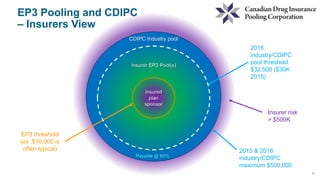
Insurer risk
> $500K
EP3 Pooling and CDIPC
– Insurers View
2016
industry/CDIPC
pool threshold
$32,500 ($30K
2015)
Payable @ 85%
2015 & 2016
industry/CDIPC
maximum $500,000
EP3 threshold
(ex: $10,000 is
often typical)
CDIPC Industry pool
12
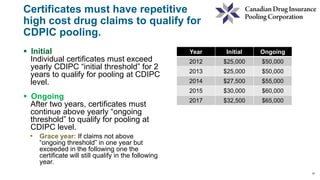
Certificates must have repetitive
high cost drug claims to qualify for
CDPIC pooling.
 Initial
Individual certificates must exceed
yearly CDIPC “initial threshold” for 2
years to qualify for pooling at CDIPC
level.
 Ongoing
After two years, certificates must
continue above yearly “ongoing
threshold” to qualify for pooling at
CDIPC level.
• Grace year: If claims not above
“ongoing threshold” in one year but
exceeded in the following one the
certificate will still qualify in the following
year.
Year Initial Ongoing
2012 $25,000 $50,000
2013 $25,000 $50,000
2014 $27,500 $55,000
2015 $30,000 $60,000
2017 $32,500 $65,000
13
13
 Insurance Company “A” has an EP3 plan which pools claims at the individual
level / certificate level at $10,000 (somewhat typical)
 Example of an eligible certificate hitting EP3 then CDIPC industry pool (in 2nd
year of exceeding CDIPC initial threshold of $65,000):
Family Member Paid Claims
Amount
A) “Direct” plan
sponsor claims
experience
B) Amount flowing to
insurer’s EP3 pool
[ with CDIPC ongoing threshold
@ $32.5K ]
C) Amount flowing to
CDIPC industry pool
Certificate Holder $300 $300 $0 $0
Spouse $102,000 $9,700 $22,500 $69,800
Child $50 $0 $0 $50
Allocations $102,350 $10,000 $22,500 $72,350 @ 85% =
$61,498
Example
14
14
 Greater viability for insured plans in affording the impacts from catastrophic
drug costs.
 A means to improve the degree of predictability of impact risk from
reoccurring catastrophic drug claims.
 Evolving abilities to capture, trend, and share anonymous industry wide
catastrophic drug information.
Value derived from CDIPC’s
presence
15
15
 A vehicle to grow the number of plans that come to market.
 A means to neutralize drug cost growth. Insurers still need to plan
and price for:
• EP3 designs, plans and experience (dollars less than CDIPC pooling level)
• Costs in excess of annual per certificate maximums
• 15% not covered in industry pool (above pool level up to certificate maximum)
• Annual contributions to industry pool if they are a “payer” into the pool.
 A set of standards or guidelines applied to refund and ASO business.
 An instrument for insurers to reduce high cost drug prices through
purchasing power.
What CDIPC is not
16
16
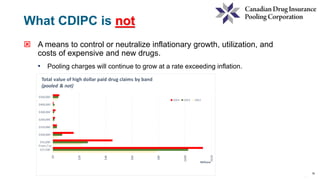
 A means to control or neutralize inflationary growth, utilization, and
costs of expensive and new drugs.
• Pooling charges will continue to grow at a rate exceeding inflation.
What CDIPC is not
From / to
17
17
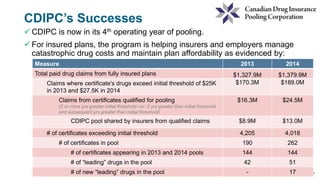
 CDIPC is now in its 4th operating year of pooling.
 For insured plans, the program is helping insurers and employers manage
catastrophic drug costs and maintain plan affordability as evidenced by:
CDIPC’s Successes
Measure 2013 2014
Total paid drug claims from fully insured plans $1,327.9M $1,379.9M
Claims where certificate's drugs exceed initial threshold of $25K
in 2013 and $27.5K in 2014
$170.3M $189.0M
Claims from certificates qualified for pooling
(2 or more yrs greater initial threshold –or- 2 yrs greater than initial threshold
and subsequent yrs greater than initial threshold)
$16.3M $24.5M
CDIPC pool shared by insurers from qualified claims $8.9M $13.0M
# of certificates exceeding initial threshold 4,205 4,018
# of certificates in pool 190 262
# of certificates appearing in 2013 and 2014 pools 144 144
# of “leading” drugs in the pool 42 51
# of new “leading” drugs in the pool - 17
18
18
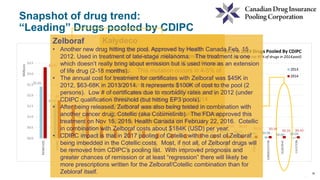
Snapshot of drug trend:
“Leading” Drugs pooled by CDIPC
Kalydeco
• A biologic drug approved by Health
Canada on Nov 12, 2013 for treatment of
a specific gene mutation in Cystic Fibrosis
patients. This mutation occurs in 4-5% of
Cystic Fibrosis cases.
• Cost in Canada for persons with Kalydeco
as their principle drug is $355,000 yearly.
• CDIPC’s pool grew by $4.1M in 2014.
39% of this growth was from Kalydeco.
• Due to Kalydeco, CDIPC expects the pool
will grow by at least $0.75M in 2015.
Zelboraf
• Another new drug hitting the pool. Approved by Health Canada Feb. 15
2012. Used in treatment of late-stage melanoma. The treatment is one
which doesn’t really bring about emission but is used more as an extension
of life drug (2-18 months).
• The annual cost for treatment for certificates with Zelboraf was $45K in
2012, $63-68K in 2013/2014. It represents $100K of cost to the pool (2
persons). Low # of certificates due to morbidity rates and in 2012 (under
CDIPC qualification threshold (but hitting EP3 pools).
• After being released, Zelboraf was also being tested in combination with
another cancer drug; Cotellic (aka Cobimetinib). The FDA approved this
treatment on Nov 15, 2015, Health Canada on February 22, 2016. Cotellic
in combination with Zelboraf costs about $184K (USD) per year.
• CDIPC impact is that in 2017 pooling of Cotellic with the cost of Zelboraf
being imbedded in the Cotellic costs. Most, if not all, of Zelboraf drugs will
be removed from CDIPC’s pooling list. With improved prognosis and
greater chances of remission or at least “regression” there will likely be
more prescriptions written for the Zelboraf/Cotellic combination than for
Zebloraf itself.
19
19
 Continue to improve communications to and from the advisor/broker
communities.
 Data mining: 3 (soon to be 4) years of data to:
• More quantitatively identify inflationary trends and pressures.
• Reinforce delivery on guiding principles.
 Better communication around expectations regarding pooling
experience “asks” during marketings.
 Undertake tracking and reporting on plan marketings on a go forward
basis.
 Better ways to tell story around increases to pooling charges at
renewal.
 ASO & Refund: From strategic review - off table for now
CDIPC’s challenges &
opportunities

Session 7

  • 1.
    CDIPC Overview For Benefits3 conference April 2016 Dan Berty, Executive Director, CDIPC © Canadian Drug Insurance Pooling Corporation
  • 2.
    2 Origins Initial concerns –Policyholders  What if recurrent drugs become expensive?  What will be the impact on pooling charges?  What happens if I have a large claimant? • Will my cost be sustainable • Will I be able to change carrier Initial concerns - Industry  Is the industry making it too easy for the government?  Will the pooling charges need to be experience rated?  Would I take over a group with a large claimant?  How could this affect my overall experience  Is there a reputation risk?
  • 3.
    3 How do wemanage, as an industry, the high drug cost? Pooling mechanism with 2 levels: EP3 pool (insurer/employer) CDIPC (industry/insurer) Question Answer Private Industry Initiative
  • 4.
    4 EP3 Pool Purpose– Plan Sponsors  EP3 – proprietary Extended drug Policy Protection Plan  Protect/Manage risk for the individual employer  Rules for EP3 are set in the CDIPC framework/arrangement  Straightforward: • Pool all claims above threshold set by insurer • Pooling rates are set for the pool • Only covers fully insured plans (not ASO or Refund accounting)
  • 5.
    5 EP3 Pooling –Plan Sponsors View Insurer EP3 Pool(s) Insured plan sponsor
  • 6.
    6 EP3 Pool Characteristics Key principles (EP3 and CDIPC) • Affordability • Availability • Transferability of coverage  Insurers • Must set up at least one EP3 pool • They establish multiple EP3 pools • Pools can not be anti-selective in nature • Rates must be set for each pool • Rate for the pool can be based on the experience of the entire pool • Insurers do not have to disclose EP3 makeup other than confidentially to CDIPC annually
  • 7.
    7 EP3 Pool Characteristics Plan Sponsors • Rates can not based on the experience of a specific employer o No anti-selection • Threshold at the insurer’s discretion • Pool only covers fully insured plans (ASO not covered) • Fully insured plan can’t opt out
  • 8.
    8 EP3 Pool Characteristics At renewal • Renewal rate calculations can only consider non-pooled claims. • EP3 pooling charges may increase (or decrease) for the entire pool.  Excluded certificates • Can be identified when a plans moves from Refund or ASO to Fully Insured. • If a plan moves from ASO to fully insured, certificates with claims falling into the EP3 pool can be included or excluded from EP3 pooling. • No certificates with claims exceeding CDIPC threshold can be included in CDIPC pooling.  Only non pooled claims can be considered at quote time in “base premium rates”.  Drug and non drug can be pooled together (the EP3 rules only apply to drugs).
  • 9.
    9 EP3 Pool Purpose– Insurers  Covers the non-recurring high cost drug claim • Recurring claims = CDIPC pool  Manages reputation risk • Large claims are payable  Industry pools: • Allows plan sponsors to move from a carrier to the other • Protects smaller insurers  EP3 and industry pool (CDIPC) – two could be independent
  • 10.
    10 10  Not forprofit corp. established in April 2013 by CLHIA member companies to pool recurring catastrophic drug costs (paid claims) from individuals belonging to fully insured plans.  A common agreement & framework to enable the CDIPC’s guiding principles.  Framework provides for insurer pooling (EP3) and industry pools (Pharmacare, Quebec, rest of Canada). Guiding Principles Available Affordable Transferable Viable Participative Competitive About
  • 11.
    11 Insurer risk > $500K EP3Pooling and CDIPC – Insurers View 2016 industry/CDIPC pool threshold $32,500 ($30K 2015) Payable @ 85% 2015 & 2016 industry/CDIPC maximum $500,000 EP3 threshold (ex: $10,000 is often typical) CDIPC Industry pool
  • 12.
    12 Certificates must haverepetitive high cost drug claims to qualify for CDPIC pooling.  Initial Individual certificates must exceed yearly CDIPC “initial threshold” for 2 years to qualify for pooling at CDIPC level.  Ongoing After two years, certificates must continue above yearly “ongoing threshold” to qualify for pooling at CDIPC level. • Grace year: If claims not above “ongoing threshold” in one year but exceeded in the following one the certificate will still qualify in the following year. Year Initial Ongoing 2012 $25,000 $50,000 2013 $25,000 $50,000 2014 $27,500 $55,000 2015 $30,000 $60,000 2017 $32,500 $65,000
  • 13.
    13 13  Insurance Company“A” has an EP3 plan which pools claims at the individual level / certificate level at $10,000 (somewhat typical)  Example of an eligible certificate hitting EP3 then CDIPC industry pool (in 2nd year of exceeding CDIPC initial threshold of $65,000): Family Member Paid Claims Amount A) “Direct” plan sponsor claims experience B) Amount flowing to insurer’s EP3 pool [ with CDIPC ongoing threshold @ $32.5K ] C) Amount flowing to CDIPC industry pool Certificate Holder $300 $300 $0 $0 Spouse $102,000 $9,700 $22,500 $69,800 Child $50 $0 $0 $50 Allocations $102,350 $10,000 $22,500 $72,350 @ 85% = $61,498 Example
  • 14.
    14 14  Greater viabilityfor insured plans in affording the impacts from catastrophic drug costs.  A means to improve the degree of predictability of impact risk from reoccurring catastrophic drug claims.  Evolving abilities to capture, trend, and share anonymous industry wide catastrophic drug information. Value derived from CDIPC’s presence
  • 15.
    15 15  A vehicleto grow the number of plans that come to market.  A means to neutralize drug cost growth. Insurers still need to plan and price for: • EP3 designs, plans and experience (dollars less than CDIPC pooling level) • Costs in excess of annual per certificate maximums • 15% not covered in industry pool (above pool level up to certificate maximum) • Annual contributions to industry pool if they are a “payer” into the pool.  A set of standards or guidelines applied to refund and ASO business.  An instrument for insurers to reduce high cost drug prices through purchasing power. What CDIPC is not
  • 16.
    16 16  A meansto control or neutralize inflationary growth, utilization, and costs of expensive and new drugs. • Pooling charges will continue to grow at a rate exceeding inflation. What CDIPC is not From / to
  • 17.
    17 17  CDIPC isnow in its 4th operating year of pooling.  For insured plans, the program is helping insurers and employers manage catastrophic drug costs and maintain plan affordability as evidenced by: CDIPC’s Successes Measure 2013 2014 Total paid drug claims from fully insured plans $1,327.9M $1,379.9M Claims where certificate's drugs exceed initial threshold of $25K in 2013 and $27.5K in 2014 $170.3M $189.0M Claims from certificates qualified for pooling (2 or more yrs greater initial threshold –or- 2 yrs greater than initial threshold and subsequent yrs greater than initial threshold) $16.3M $24.5M CDIPC pool shared by insurers from qualified claims $8.9M $13.0M # of certificates exceeding initial threshold 4,205 4,018 # of certificates in pool 190 262 # of certificates appearing in 2013 and 2014 pools 144 144 # of “leading” drugs in the pool 42 51 # of new “leading” drugs in the pool - 17
  • 18.
    18 18 Snapshot of drugtrend: “Leading” Drugs pooled by CDIPC Kalydeco • A biologic drug approved by Health Canada on Nov 12, 2013 for treatment of a specific gene mutation in Cystic Fibrosis patients. This mutation occurs in 4-5% of Cystic Fibrosis cases. • Cost in Canada for persons with Kalydeco as their principle drug is $355,000 yearly. • CDIPC’s pool grew by $4.1M in 2014. 39% of this growth was from Kalydeco. • Due to Kalydeco, CDIPC expects the pool will grow by at least $0.75M in 2015. Zelboraf • Another new drug hitting the pool. Approved by Health Canada Feb. 15 2012. Used in treatment of late-stage melanoma. The treatment is one which doesn’t really bring about emission but is used more as an extension of life drug (2-18 months). • The annual cost for treatment for certificates with Zelboraf was $45K in 2012, $63-68K in 2013/2014. It represents $100K of cost to the pool (2 persons). Low # of certificates due to morbidity rates and in 2012 (under CDIPC qualification threshold (but hitting EP3 pools). • After being released, Zelboraf was also being tested in combination with another cancer drug; Cotellic (aka Cobimetinib). The FDA approved this treatment on Nov 15, 2015, Health Canada on February 22, 2016. Cotellic in combination with Zelboraf costs about $184K (USD) per year. • CDIPC impact is that in 2017 pooling of Cotellic with the cost of Zelboraf being imbedded in the Cotellic costs. Most, if not all, of Zelboraf drugs will be removed from CDIPC’s pooling list. With improved prognosis and greater chances of remission or at least “regression” there will likely be more prescriptions written for the Zelboraf/Cotellic combination than for Zebloraf itself.
  • 19.
    19 19  Continue toimprove communications to and from the advisor/broker communities.  Data mining: 3 (soon to be 4) years of data to: • More quantitatively identify inflationary trends and pressures. • Reinforce delivery on guiding principles.  Better communication around expectations regarding pooling experience “asks” during marketings.  Undertake tracking and reporting on plan marketings on a go forward basis.  Better ways to tell story around increases to pooling charges at renewal.  ASO & Refund: From strategic review - off table for now CDIPC’s challenges & opportunities