The Affordable Care Act and You
How to Navigate the New Healthcare Landscape
Sponsored by SMARTvt and
Presented by Jean S. Twombly
Member Academy Health
Consulting Partner with PCResourcesVT.com
A
C
A
How do I get better health coverage?
Can I get a subsidy?
When is open enrollment?
Will I pay a penalty if I don’t buy coverage?
My employer’s plan costs
too much. I need a break.
ACA Fast Facts
5
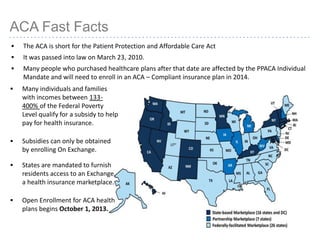
 The ACA is short for the Patient Protection and Affordable Care Act
 It was passed into law on March 23, 2010.
 Many people who purchased healthcare plans after that date are affected by the PPACA Individual
Mandate and will need to enroll in an ACA – Compliant insurance plan in 2014.
ACA Fast Facts
 Many individuals and families
with incomes between 133-
400% of the Federal Poverty
Level qualify for a subsidy to help
pay for health insurance.
 Subsidies can only be obtained
by enrolling On Exchange.
 States are mandated to furnish
residents access to an Exchange,
a health insurance marketplace.
 Open Enrollment for ACA health
plans begins October 1, 2013.
6
All new ACA – compliant plans are mandated to furnish the following ten essential benefits.
 Prescription Drug Coverage
 Hospitalization
 Emergency Care
 Laboratory Services
 Ambulatory Patient Services
 Mental Health and Substance Abuse Benefits
 Pediatric Dental and Vision Services
 Maternity Services
 Wellness and Preventive Care
 Habilitative and Rehabilitative Benefits
Insurance carriers have reworked both plans and rates to comply
with the mandate. The State and Federal healthcare marketplaces
are designed to foster competition among plans and to facilitate
comparison between plans which are similarly priced.
ACA Plans are ranked by actuarial value and are grouped by
metal level: Platinum, Gold, Silver, and Bronze.
ACA Ten Essential Benefits
7
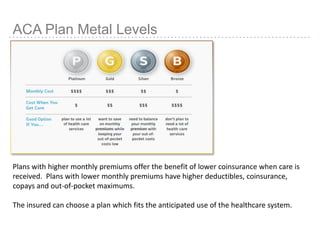
ACA Plan Metal Levels
Plans with higher monthly premiums offer the benefit of lower coinsurance when care is
received. Plans with lower monthly premiums have higher deductibles, coinsurance,
copays and out-of-pocket maximums.
The insured can choose a plan which fits the anticipated use of the healthcare system.
8
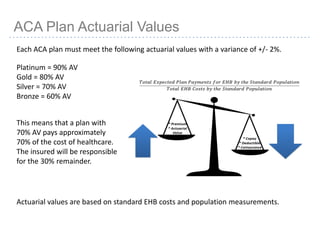
ACA Plan Actuarial Values
Each ACA plan must meet the following actuarial values with a variance of +/- 2%.
Platinum = 90% AV
Gold = 80% AV
Silver = 70% AV
Bronze = 60% AV
Actuarial values are based on standard EHB costs and population measurements.
This means that a plan with
70% AV pays approximately
70% of the cost of healthcare.
The insured will be responsible
for the 30% remainder.
Healthcare Plan Subsidies
10
 The Individual Mandate also requires the Federal government to provide subsidies to make health
insurance affordable for low and middle income individuals and families.
 A new Federal Data Hub will determine subsidy eligibility based on income as % of Federal Poverty
Level (FPL).
 Beginning in 2014, applicants seeking coverage on-exchange may qualify for two types of subsidies:
 Individuals and families with incomes between 100-250% of the FPL qualify for BOTH the
Cost-Sharing Reduction subsidy and the Advance Premium Tax Credit.
Exchange Subsidy Overview
– Advance Premium Tax Credit (APTC)
• Applicants who qualify for the APTC will owe a reduced premium.
• The Federal Government will advance the difference in premium amounts
to the carriers monthly.
– Cost-Sharing Reductions (CSR)
• Applicants who qualify for CSR will be enrolled in a specific plan with
reduced cost-sharing.
• Federal Government will advance an estimated cost-sharing reduction
monthly. e Premium Tax Credit.
11
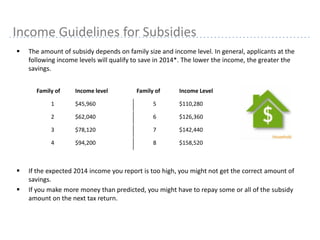
Income Guidelines for Subsidies
 The amount of subsidy depends on family size and income level. In general, applicants at the
following income levels will qualify to save in 2014*. The lower the income, the greater the
savings.
 If the expected 2014 income you report is too high, you might not get the correct amount of
savings.
 If you make more money than predicted, you might have to repay some or all of the subsidy
amount on the next tax return.
Family of Income level Family of Income Level
1 $45,960 5 $110,280
2 $62,040 6 $126,360
3 $78,120 7 $142,440
4 $94,200 8 $158,520
12
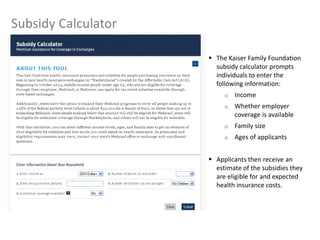
Subsidy Calculator
 The Kaiser Family Foundation
subsidy calculator prompts
individuals to enter the
following information:
o Income
o Whether employer
coverage is available
o Family size
o Ages of applicants
 Applicants then receive an
estimate of the subsidies they
are eligible for and expected
health insurance costs.
13
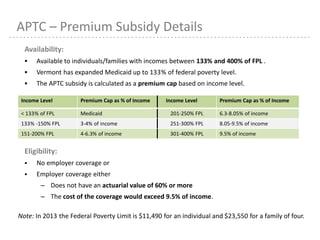
APTC – Premium Subsidy Details
Availability:
 Available to individuals/families with incomes between 133% and 400% of FPL .
 Vermont has expanded Medicaid up to 133% of federal poverty level.
 The APTC subsidy is calculated as a premium cap based on income level.
Eligibility:
 No employer coverage or
 Employer coverage either
– Does not have an actuarial value of 60% or more
– The cost of the coverage would exceed 9.5% of income.
Income Level Premium Cap as % of Income Income Level Premium Cap as % of Income
< 133% of FPL Medicaid 201-250% FPL 6.3-8.05% of income
133% -150% FPL 3-4% of income 251-300% FPL 8.05-9.5% of income
151-200% FPL 4-6.3% of income 301-400% FPL 9.5% of income
Note: In 2013 the Federal Poverty Limit is $11,490 for an individual and $23,550 for a family of four.
14
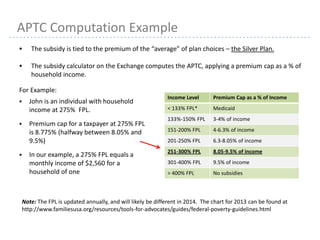
APTC Computation Example
 The subsidy is tied to the premium of the “average” of plan choices – the Silver Plan.
 The subsidy calculator on the Exchange computes the APTC, applying a premium cap as a % of
household income.
For Example:
 John is an individual with household
income at 275% FPL.
 Premium cap for a taxpayer at 275% FPL
is 8.775% (halfway between 8.05% and
9.5%)
 In our example, a 275% FPL equals a
monthly income of $2,560 for a
household of one
Note: The FPL is updated annually, and will likely be different in 2014. The chart for 2013 can be found at
http://www.familiesusa.org/resources/tools-for-advocates/guides/federal-poverty-guidelines.html
Income Level Premium Cap as a % of Income
< 133% FPL* Medicaid
133%-150% FPL 3-4% of income
151-200% FPL 4-6.3% of income
201-250% FPL 6.3-8.05% of income
251-300% FPL 8.05-9.5% of income
301-400% FPL 9.5% of income
> 400% FPL No subsidies
15
APTC Computation Example continued
 If the Silver Plan costs $384/month and John has a monthly income of $2,560 :
– His premium subsidy equals the difference between plan cost and $224.64 [8.775% x $2,560
monthly income]
 Individuals may select any plan and still receive the tax credit.
 The amount of the tax credit may not exceed the plan premium. Since John is eligible for a
$159.36/month tax credit:
– If he selects a less expensive plan with a cost of $150/month, John can only receive a tax credit of
$150/month
– If he selects a more expensive plan with a cost of $500/month, he will owe $340.64 monthly:
Tax credit: $384 minus $224.64 = $159.36/month
His plan cost: $500 minus $159.36 = $340.64/month
16
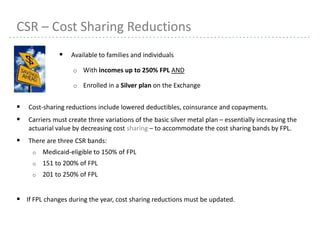
CSR – Cost Sharing Reductions
 Available to families and individuals
o With incomes up to 250% FPL AND
o Enrolled in a Silver plan on the Exchange
 Cost-sharing reductions include lowered deductibles, coinsurance and copayments.
 Carriers must create three variations of the basic silver metal plan – essentially increasing the
actuarial value by decreasing cost sharing – to accommodate the cost sharing bands by FPL.
 There are three CSR bands:
o Medicaid-eligible to 150% of FPL
o 151 to 200% of FPL
o 201 to 250% of FPL
 If FPL changes during the year, cost sharing reductions must be updated.
17
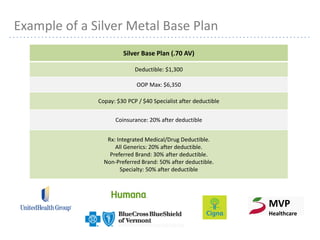
MVP
Healthcare
Silver Base Plan (.70 AV)
Deductible: $1,300
OOP Max: $6,350
Copay: $30 PCP / $40 Specialist after deductible
Coinsurance: 20% after deductible
Rx: Integrated Medical/Drug Deductible.
All Generics: 20% after deductible.
Preferred Brand: 30% after deductible.
Non-Preferred Brand: 50% after deductible.
Specialty: 50% after deductible
Example of a Silver Metal Base Plan
18
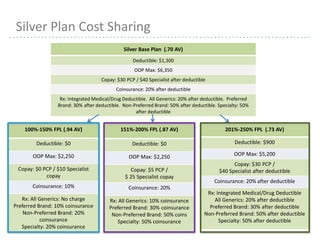
Silver Base Plan (.70 AV)
Deductible: $1,300
OOP Max: $6,350
Copay: $30 PCP / $40 Specialist after deductible
Coinsurance: 20% after deductible
Rx: Integrated Medical/Drug Deductible. All Generics: 20% after deductible. Preferred
Brand: 30% after deductible. Non-Preferred Brand: 50% after deductible. Specialty: 50%
after deductible
201%-250% FPL (.73 AV)
Deductible: $900
OOP Max: $5,200
Copay: $30 PCP /
$40 Specialist after deductible
Coinsurance: 20% after deductible
Rx: Integrated Medical/Drug Deductible
All Generics: 20% after deductible
Preferred Brand: 30% after deductible
Non-Preferred Brand: 50% after deductible
Specialty: 50% after deductible
151%-200% FPL (.87 AV)
Deductible: $0
OOP Max: $2,250
Copay: $5 PCP /
$ 25 Specialist copay
Coinsurance: 20%
Rx: All Generics: 10% coinsurance
Preferred Brand: 30% coinsurance
Non-Preferred Brand: 50% coins
Specialty: 50% coinsurance
100%-150% FPL (.94 AV)
Deductible: $0
OOP Max: $2,250
Copay: $0 PCP / $10 Specialist
copay
Coinsurance: 10%
Rx: All Generics: No charge
Preferred Brand: 10% coinsurance
Non-Preferred Brand: 20%
coinsurance
Specialty: 20% coinsurance
Silver Plan Cost Sharing
The Federal Data Hub and
Penalties for the Uninsured
20
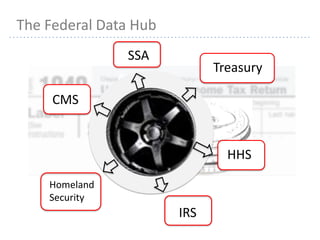
The Federal Data Hub
HHS
Homeland
Security
SSA
IRS
CMS
Treasury
21
 The IRS and Treasury will manage the Advance Premium Tax Credit Subsidy which will be based on
the applicant’s Modified Adjusted Gross Income (MAGI).
 The APTC Subsidy will be sent by the U.S. Treasury Department to insurance carriers to fulfill
premium payments each month.
 Any changes in income will be reconciled with the insured when filing the following year’s taxes.
 Health and Human Services (HHS) will manage the Federal Data Hub and the Federally Facilitated
Exchange (FFE).
Who Manages Subsidies and the Hub?
 HHS will also manage the Cost-Sharing Reducation
Subsidy. Once a member has enrolled in a new
plan and is eligible for a subsidy, the insurance
carrier will be sent a monthly subsidy amount.
 Note that Vermont has expanded Medicaid to
133% of Federal Poverty Level through federal
funding.
22
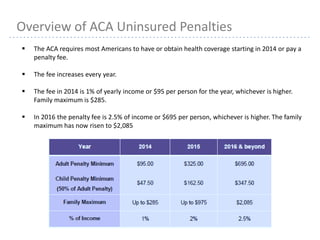
Overview of ACA Uninsured Penalties
 The ACA requires most Americans to have or obtain health coverage starting in 2014 or pay a
penalty fee.
 The fee increases every year.
 The fee in 2014 is 1% of yearly income or $95 per person for the year, whichever is higher.
Family maximum is $285.
 In 2016 the penalty fee is 2.5% of income or $695 per person, whichever is higher. The family
maximum has now risen to $2,085
23
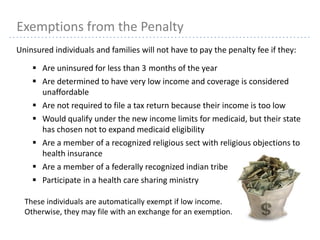
Exemptions from the Penalty
Uninsured individuals and families will not have to pay the penalty fee if they:
 Are uninsured for less than 3 months of the year
 Are determined to have very low income and coverage is considered
unaffordable
 Are not required to file a tax return because their income is too low
 Would qualify under the new income limits for medicaid, but their state
has chosen not to expand medicaid eligibility
 Are a member of a recognized religious sect with religious objections to
health insurance
 Are a member of a federally recognized indian tribe
 Participate in a health care sharing ministry
These individuals are automatically exempt if low income.
Otherwise, they may file with an exchange for an exemption.
24
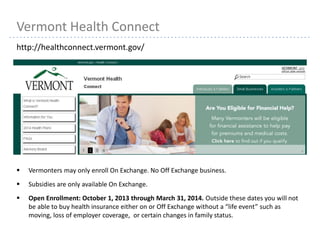
Vermont Health Connect
http://healthconnect.vermont.gov/
 Vermonters may only enroll On Exchange. No Off Exchange business.
 Subsidies are only available On Exchange.
 Open Enrollment: October 1, 2013 through March 31, 2014. Outside these dates you will not
be able to buy health insurance either on or Off Exchange without a “life event” such as
moving, loss of employer coverage, or certain changes in family status.
25
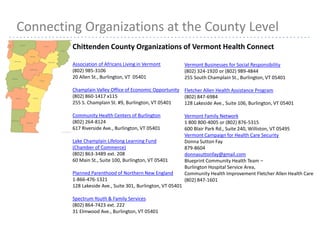
Chittenden County Organizations of Vermont Health Connect
Association of Africans Living in Vermont
(802) 985-3106
20 Allen St., Burlington, VT 05401
Champlain Valley Office of Economic Opportunity
(802) 860-1417 x115
255 S. Champlain St. #9, Burlington, VT 05401
Community Health Centers of Burlington
(802) 264-8124
617 Riverside Ave., Burlington, VT 05401
Lake Champlain Lifelong Learning Fund
(Chamber of Commerce)
(802) 863-3489 ext. 208
60 Main St., Suite 100, Burlington, VT 05401
Planned Parenthood of Northern New England
1-866-476-1321
128 Lakeside Ave., Suite 301, Burlington, VT 05401
Spectrum Youth & Family Services
(802) 864-7423 ext. 222
31 Elmwood Ave., Burlington, VT 05401
Connecting Organizations at the County Level
Vermont Businesses for Social Responsibility
(802) 324-1920 or (802) 989-4844
255 South Champlain St., Burlington, VT 05401
Fletcher Allen Health Assistance Program
(802) 847-6984
128 Lakeside Ave., Suite 106, Burlington, VT 05401
Vermont Family Network
1 800 800-4005 or (802) 876-5315
600 Blair Park Rd., Suite 240, Williston, VT 05495
Vermont Campaign for Health Care Security
Donna Sutton Fay
879-8604
donnasuttonfay@gmail.com
Blueprint Community Health Team –
Burlington Hospital Service Area,
Community Health Improvement Fletcher Allen Health Care
(802) 847-1601
On-Exchange Consumer Assistance
27
Overview of Consumer Assistance
 Consumers will have assistance as they apply for new insurance options through
o Navigators
o In Person Assisters
o Certified Application Counselors.
 The ACA governs who may provide consumer assistance and
o What approval, registration, and/or training is required
o What activities each may perform
o What funds may be used to pay for these activities
o Provides that state law cannot impede Title I of the ACA (such as require Navigators
to be licensed agents or brokers, or carry errors and omissions coverage)
 HHS has final rules and has announced funding opportunities to guide these efforts.
 Activities and funding depend on whether ACA assistors are working with a State-based
Marketplace, State Partnership Marketplace, or Federally Facilitated Exchange (FFE).
28
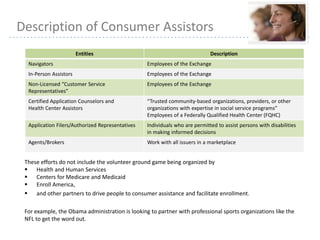
Description of Consumer Assistors
These efforts do not include the volunteer ground game being organized by
 Health and Human Services
 Centers for Medicare and Medicaid
 Enroll America,
 and other partners to drive people to consumer assistance and facilitate enrollment.
For example, the Obama administration is looking to partner with professional sports organizations like the
NFL to get the word out.
Entities Description
Navigators Employees of the Exchange
In-Person Assistors Employees of the Exchange
Non-Licensed “Customer Service
Representatives”
Employees of the Exchange
Certified Application Counselors and
Health Center Assistors
“Trusted community-based organizations, providers, or other
organizations with expertise in social service programs”
Employees of a Federally Qualified Health Center (FQHC)
Application Filers/Authorized Representatives Individuals who are permitted to assist persons with disabilities
in making informed decisions
Agents/Brokers Work with all issuers in a marketplace
29

Aca presentation on exchanges

  • 1.
    The Affordable CareAct and You How to Navigate the New Healthcare Landscape
  • 2.
    Sponsored by SMARTvtand Presented by Jean S. Twombly Member Academy Health Consulting Partner with PCResourcesVT.com
  • 3.
    A C A How do Iget better health coverage? Can I get a subsidy? When is open enrollment? Will I pay a penalty if I don’t buy coverage? My employer’s plan costs too much. I need a break.
  • 4.
  • 5.
    5  The ACAis short for the Patient Protection and Affordable Care Act  It was passed into law on March 23, 2010.  Many people who purchased healthcare plans after that date are affected by the PPACA Individual Mandate and will need to enroll in an ACA – Compliant insurance plan in 2014. ACA Fast Facts  Many individuals and families with incomes between 133- 400% of the Federal Poverty Level qualify for a subsidy to help pay for health insurance.  Subsidies can only be obtained by enrolling On Exchange.  States are mandated to furnish residents access to an Exchange, a health insurance marketplace.  Open Enrollment for ACA health plans begins October 1, 2013.
  • 6.
    6 All new ACA– compliant plans are mandated to furnish the following ten essential benefits.  Prescription Drug Coverage  Hospitalization  Emergency Care  Laboratory Services  Ambulatory Patient Services  Mental Health and Substance Abuse Benefits  Pediatric Dental and Vision Services  Maternity Services  Wellness and Preventive Care  Habilitative and Rehabilitative Benefits Insurance carriers have reworked both plans and rates to comply with the mandate. The State and Federal healthcare marketplaces are designed to foster competition among plans and to facilitate comparison between plans which are similarly priced. ACA Plans are ranked by actuarial value and are grouped by metal level: Platinum, Gold, Silver, and Bronze. ACA Ten Essential Benefits
  • 7.
    7 ACA Plan MetalLevels Plans with higher monthly premiums offer the benefit of lower coinsurance when care is received. Plans with lower monthly premiums have higher deductibles, coinsurance, copays and out-of-pocket maximums. The insured can choose a plan which fits the anticipated use of the healthcare system.
  • 8.
    8 ACA Plan ActuarialValues Each ACA plan must meet the following actuarial values with a variance of +/- 2%. Platinum = 90% AV Gold = 80% AV Silver = 70% AV Bronze = 60% AV Actuarial values are based on standard EHB costs and population measurements. This means that a plan with 70% AV pays approximately 70% of the cost of healthcare. The insured will be responsible for the 30% remainder.
  • 9.
  • 10.
    10  The IndividualMandate also requires the Federal government to provide subsidies to make health insurance affordable for low and middle income individuals and families.  A new Federal Data Hub will determine subsidy eligibility based on income as % of Federal Poverty Level (FPL).  Beginning in 2014, applicants seeking coverage on-exchange may qualify for two types of subsidies:  Individuals and families with incomes between 100-250% of the FPL qualify for BOTH the Cost-Sharing Reduction subsidy and the Advance Premium Tax Credit. Exchange Subsidy Overview – Advance Premium Tax Credit (APTC) • Applicants who qualify for the APTC will owe a reduced premium. • The Federal Government will advance the difference in premium amounts to the carriers monthly. – Cost-Sharing Reductions (CSR) • Applicants who qualify for CSR will be enrolled in a specific plan with reduced cost-sharing. • Federal Government will advance an estimated cost-sharing reduction monthly. e Premium Tax Credit.
  • 11.
    11 Income Guidelines forSubsidies  The amount of subsidy depends on family size and income level. In general, applicants at the following income levels will qualify to save in 2014*. The lower the income, the greater the savings.  If the expected 2014 income you report is too high, you might not get the correct amount of savings.  If you make more money than predicted, you might have to repay some or all of the subsidy amount on the next tax return. Family of Income level Family of Income Level 1 $45,960 5 $110,280 2 $62,040 6 $126,360 3 $78,120 7 $142,440 4 $94,200 8 $158,520
  • 12.
    12 Subsidy Calculator  TheKaiser Family Foundation subsidy calculator prompts individuals to enter the following information: o Income o Whether employer coverage is available o Family size o Ages of applicants  Applicants then receive an estimate of the subsidies they are eligible for and expected health insurance costs.
  • 13.
    13 APTC – PremiumSubsidy Details Availability:  Available to individuals/families with incomes between 133% and 400% of FPL .  Vermont has expanded Medicaid up to 133% of federal poverty level.  The APTC subsidy is calculated as a premium cap based on income level. Eligibility:  No employer coverage or  Employer coverage either – Does not have an actuarial value of 60% or more – The cost of the coverage would exceed 9.5% of income. Income Level Premium Cap as % of Income Income Level Premium Cap as % of Income < 133% of FPL Medicaid 201-250% FPL 6.3-8.05% of income 133% -150% FPL 3-4% of income 251-300% FPL 8.05-9.5% of income 151-200% FPL 4-6.3% of income 301-400% FPL 9.5% of income Note: In 2013 the Federal Poverty Limit is $11,490 for an individual and $23,550 for a family of four.
  • 14.
    14 APTC Computation Example The subsidy is tied to the premium of the “average” of plan choices – the Silver Plan.  The subsidy calculator on the Exchange computes the APTC, applying a premium cap as a % of household income. For Example:  John is an individual with household income at 275% FPL.  Premium cap for a taxpayer at 275% FPL is 8.775% (halfway between 8.05% and 9.5%)  In our example, a 275% FPL equals a monthly income of $2,560 for a household of one Note: The FPL is updated annually, and will likely be different in 2014. The chart for 2013 can be found at http://www.familiesusa.org/resources/tools-for-advocates/guides/federal-poverty-guidelines.html Income Level Premium Cap as a % of Income < 133% FPL* Medicaid 133%-150% FPL 3-4% of income 151-200% FPL 4-6.3% of income 201-250% FPL 6.3-8.05% of income 251-300% FPL 8.05-9.5% of income 301-400% FPL 9.5% of income > 400% FPL No subsidies
  • 15.
    15 APTC Computation Examplecontinued  If the Silver Plan costs $384/month and John has a monthly income of $2,560 : – His premium subsidy equals the difference between plan cost and $224.64 [8.775% x $2,560 monthly income]  Individuals may select any plan and still receive the tax credit.  The amount of the tax credit may not exceed the plan premium. Since John is eligible for a $159.36/month tax credit: – If he selects a less expensive plan with a cost of $150/month, John can only receive a tax credit of $150/month – If he selects a more expensive plan with a cost of $500/month, he will owe $340.64 monthly: Tax credit: $384 minus $224.64 = $159.36/month His plan cost: $500 minus $159.36 = $340.64/month
  • 16.
    16 CSR – CostSharing Reductions  Available to families and individuals o With incomes up to 250% FPL AND o Enrolled in a Silver plan on the Exchange  Cost-sharing reductions include lowered deductibles, coinsurance and copayments.  Carriers must create three variations of the basic silver metal plan – essentially increasing the actuarial value by decreasing cost sharing – to accommodate the cost sharing bands by FPL.  There are three CSR bands: o Medicaid-eligible to 150% of FPL o 151 to 200% of FPL o 201 to 250% of FPL  If FPL changes during the year, cost sharing reductions must be updated.
  • 17.
    17 MVP Healthcare Silver Base Plan(.70 AV) Deductible: $1,300 OOP Max: $6,350 Copay: $30 PCP / $40 Specialist after deductible Coinsurance: 20% after deductible Rx: Integrated Medical/Drug Deductible. All Generics: 20% after deductible. Preferred Brand: 30% after deductible. Non-Preferred Brand: 50% after deductible. Specialty: 50% after deductible Example of a Silver Metal Base Plan
  • 18.
    18 Silver Base Plan(.70 AV) Deductible: $1,300 OOP Max: $6,350 Copay: $30 PCP / $40 Specialist after deductible Coinsurance: 20% after deductible Rx: Integrated Medical/Drug Deductible. All Generics: 20% after deductible. Preferred Brand: 30% after deductible. Non-Preferred Brand: 50% after deductible. Specialty: 50% after deductible 201%-250% FPL (.73 AV) Deductible: $900 OOP Max: $5,200 Copay: $30 PCP / $40 Specialist after deductible Coinsurance: 20% after deductible Rx: Integrated Medical/Drug Deductible All Generics: 20% after deductible Preferred Brand: 30% after deductible Non-Preferred Brand: 50% after deductible Specialty: 50% after deductible 151%-200% FPL (.87 AV) Deductible: $0 OOP Max: $2,250 Copay: $5 PCP / $ 25 Specialist copay Coinsurance: 20% Rx: All Generics: 10% coinsurance Preferred Brand: 30% coinsurance Non-Preferred Brand: 50% coins Specialty: 50% coinsurance 100%-150% FPL (.94 AV) Deductible: $0 OOP Max: $2,250 Copay: $0 PCP / $10 Specialist copay Coinsurance: 10% Rx: All Generics: No charge Preferred Brand: 10% coinsurance Non-Preferred Brand: 20% coinsurance Specialty: 20% coinsurance Silver Plan Cost Sharing
  • 19.
    The Federal DataHub and Penalties for the Uninsured
  • 20.
    20 The Federal DataHub HHS Homeland Security SSA IRS CMS Treasury
  • 21.
    21  The IRSand Treasury will manage the Advance Premium Tax Credit Subsidy which will be based on the applicant’s Modified Adjusted Gross Income (MAGI).  The APTC Subsidy will be sent by the U.S. Treasury Department to insurance carriers to fulfill premium payments each month.  Any changes in income will be reconciled with the insured when filing the following year’s taxes.  Health and Human Services (HHS) will manage the Federal Data Hub and the Federally Facilitated Exchange (FFE). Who Manages Subsidies and the Hub?  HHS will also manage the Cost-Sharing Reducation Subsidy. Once a member has enrolled in a new plan and is eligible for a subsidy, the insurance carrier will be sent a monthly subsidy amount.  Note that Vermont has expanded Medicaid to 133% of Federal Poverty Level through federal funding.
  • 22.
    22 Overview of ACAUninsured Penalties  The ACA requires most Americans to have or obtain health coverage starting in 2014 or pay a penalty fee.  The fee increases every year.  The fee in 2014 is 1% of yearly income or $95 per person for the year, whichever is higher. Family maximum is $285.  In 2016 the penalty fee is 2.5% of income or $695 per person, whichever is higher. The family maximum has now risen to $2,085
  • 23.
    23 Exemptions from thePenalty Uninsured individuals and families will not have to pay the penalty fee if they:  Are uninsured for less than 3 months of the year  Are determined to have very low income and coverage is considered unaffordable  Are not required to file a tax return because their income is too low  Would qualify under the new income limits for medicaid, but their state has chosen not to expand medicaid eligibility  Are a member of a recognized religious sect with religious objections to health insurance  Are a member of a federally recognized indian tribe  Participate in a health care sharing ministry These individuals are automatically exempt if low income. Otherwise, they may file with an exchange for an exemption.
  • 24.
    24 Vermont Health Connect http://healthconnect.vermont.gov/ Vermonters may only enroll On Exchange. No Off Exchange business.  Subsidies are only available On Exchange.  Open Enrollment: October 1, 2013 through March 31, 2014. Outside these dates you will not be able to buy health insurance either on or Off Exchange without a “life event” such as moving, loss of employer coverage, or certain changes in family status.
  • 25.
    25 Chittenden County Organizationsof Vermont Health Connect Association of Africans Living in Vermont (802) 985-3106 20 Allen St., Burlington, VT 05401 Champlain Valley Office of Economic Opportunity (802) 860-1417 x115 255 S. Champlain St. #9, Burlington, VT 05401 Community Health Centers of Burlington (802) 264-8124 617 Riverside Ave., Burlington, VT 05401 Lake Champlain Lifelong Learning Fund (Chamber of Commerce) (802) 863-3489 ext. 208 60 Main St., Suite 100, Burlington, VT 05401 Planned Parenthood of Northern New England 1-866-476-1321 128 Lakeside Ave., Suite 301, Burlington, VT 05401 Spectrum Youth & Family Services (802) 864-7423 ext. 222 31 Elmwood Ave., Burlington, VT 05401 Connecting Organizations at the County Level Vermont Businesses for Social Responsibility (802) 324-1920 or (802) 989-4844 255 South Champlain St., Burlington, VT 05401 Fletcher Allen Health Assistance Program (802) 847-6984 128 Lakeside Ave., Suite 106, Burlington, VT 05401 Vermont Family Network 1 800 800-4005 or (802) 876-5315 600 Blair Park Rd., Suite 240, Williston, VT 05495 Vermont Campaign for Health Care Security Donna Sutton Fay 879-8604 donnasuttonfay@gmail.com Blueprint Community Health Team – Burlington Hospital Service Area, Community Health Improvement Fletcher Allen Health Care (802) 847-1601
  • 26.
  • 27.
    27 Overview of ConsumerAssistance  Consumers will have assistance as they apply for new insurance options through o Navigators o In Person Assisters o Certified Application Counselors.  The ACA governs who may provide consumer assistance and o What approval, registration, and/or training is required o What activities each may perform o What funds may be used to pay for these activities o Provides that state law cannot impede Title I of the ACA (such as require Navigators to be licensed agents or brokers, or carry errors and omissions coverage)  HHS has final rules and has announced funding opportunities to guide these efforts.  Activities and funding depend on whether ACA assistors are working with a State-based Marketplace, State Partnership Marketplace, or Federally Facilitated Exchange (FFE).
  • 28.
    28 Description of ConsumerAssistors These efforts do not include the volunteer ground game being organized by  Health and Human Services  Centers for Medicare and Medicaid  Enroll America,  and other partners to drive people to consumer assistance and facilitate enrollment. For example, the Obama administration is looking to partner with professional sports organizations like the NFL to get the word out. Entities Description Navigators Employees of the Exchange In-Person Assistors Employees of the Exchange Non-Licensed “Customer Service Representatives” Employees of the Exchange Certified Application Counselors and Health Center Assistors “Trusted community-based organizations, providers, or other organizations with expertise in social service programs” Employees of a Federally Qualified Health Center (FQHC) Application Filers/Authorized Representatives Individuals who are permitted to assist persons with disabilities in making informed decisions Agents/Brokers Work with all issuers in a marketplace
  • 29.