Implementing the National Standard for
Psychological Health and Safety in the
Workplace – One Step at a Time
Karla Thorpe, Director, Prevention and Promotion Initiatives, Mental Health
Commission of Canada
April 14, 2015
The Mental Health Strategy for Canada
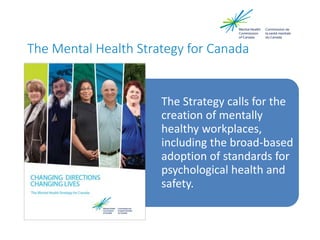
The Strategy calls for the
creation of mentally
healthy workplaces,
including the broad-based
adoption of standards for
psychological health and
safety.
Implementing The National
Standard
The National Standard
The Standard is a set of guidelines, tools and resources
focused on promoting employees’ psychological health and
preventing psychological harm due to workplace factors
• Voluntary – set of tools, not rules
• Aligned with existing standards and tools
• Applicable to any organization
• Intended to enable employers and employees measure progress
• Doesn’t create new legal obligations but may have influence on
the application of 7 branches of law that currently exist
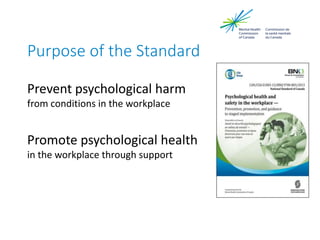
Purpose of the Standard
Prevent psychological harm
from conditions in the workplace
Promote psychological health
in the workplace through support
Who Developed the Standard?
COLLABORATORS
FUNDING PARTNERS
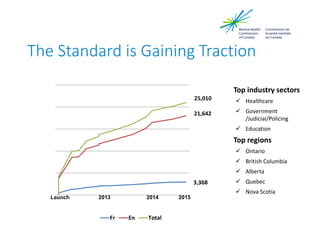
The Standard is Gaining Traction
Top industry sectors
 Healthcare
 Government
/Judicial/Policing
 Education
Top regions
 Ontario
 British Columbia
 Alberta
 Quebec
 Nova Scotia
3,368
21,642
25,010
Fr En Total
Launch 2013 2014 2015
Navigate the Journey
MHCC, GWL and the CSA Group collaborated to develop
“Assembling the Pieces: An Implementation Guide to the
National Standard for Psychological Health and Safety in the
Workplace”
• Intended to be used in conjunction
with the Standard
• Assist organizations through the initial
planning stages through to full
implementation
• Officially launched in November 2014
www.mentalhealthcommission.ca/standardguide
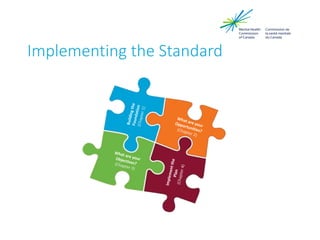
Implementing the Standard
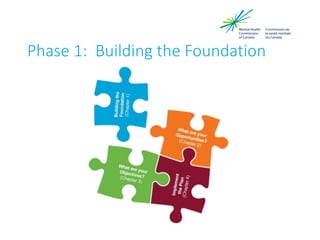
Phase 1: Building the Foundation
• Securing a champion
• Leadership support
• Roles and responsibilities defined
• Policy development
• Worker consultation and participation
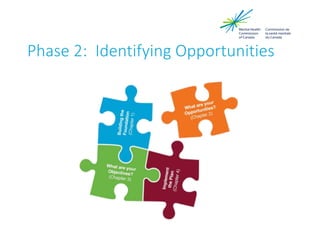
Phase 2: Identifying Opportunities
• Establish baseline
• Data collection
• Organizational audit
• Hazard identification
• Data and trend analysis
• Organizational risk assessment
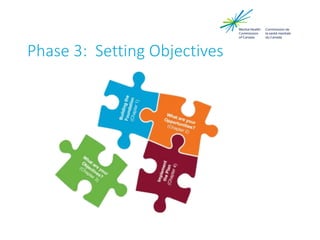
Phase 3: Setting Objectives
• Develop vision
• Set objectives and targets
• Establish implementation team
• Develop implementation strategy
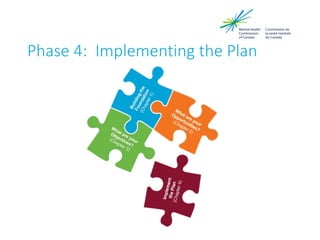
Phase 4: Implementing the Plan
• Implement the strategy
• Establish corrective and preventive action process
• Establish reporting and incident investigation process
• Establish performance monitoring process
• Internal audits
• Management review
• Continuous improvement
Case Study Research Project
Funders
Following more than 40 organizations
Three year national study (Feb 2014 - March 2017)
• Breakdown barriers to implementation and identify gaps and
challenges
• Determine promising practices
• Build a strong business case for implementation
• Inform future revisions to the Standard
• Identify tools/resources to help with implementation
• Create a blueprint for future organizations that wish to implement the
Standard
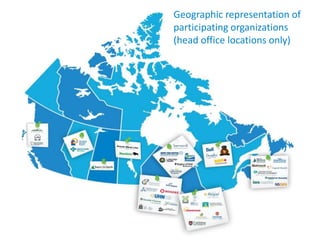
Geographic representation of
participating organizations
(head office locations only)
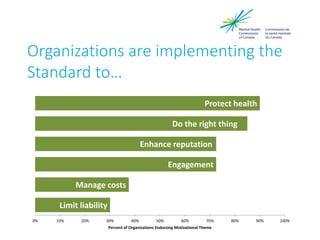
Organizations are implementing the
Standard to…
Limit liability
Manage costs
Engagement
Enhance reputation
Do the right thing
Protect health
0% 10% 20% 30% 40% 50% 60% 70% 80% 90% 100%
Percent of Organizations Endorsing Motivational Theme
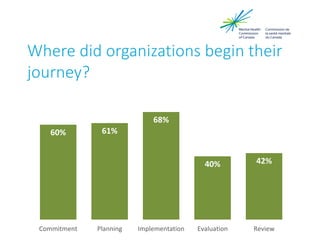
Where did organizations begin their
journey?
60% 61%
68%
40% 42%
Commitment Planning Implementation Evaluation Review
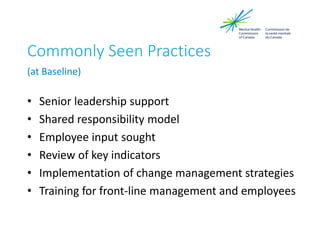
Commonly Seen Practices
(at Baseline)
• Senior leadership support
• Shared responsibility model
• Employee input sought
• Review of key indicators
• Implementation of change management strategies
• Training for front-line management and employees
KeyActivities
• Champion committee
comprised of 9 Deputy
Ministers
• Steering committee – incl.
Dept of Health and Labour
• Community of Action
Group consisting of
representation from all
departments
• Comprehensive list of
existing services and
programs, e.g. EAP, sick
leave benefits, respectful
workplace etc.
• Monitoring key indicators
such as benefits utilization,
staff feedback, employee
complaints and grievances
• Supporting work-home
balance
Training
• The Working Mind Training
• Stress Management
Training
• Enhancing Workplace
conflict resolution through
human resource support,
coaching and training
Lessons
• Communicate and manage
expectations across the
organization
• Measurement/evaluation
of program outcomes and
continuous adjustment
• Training of managers and
employees on mental
health
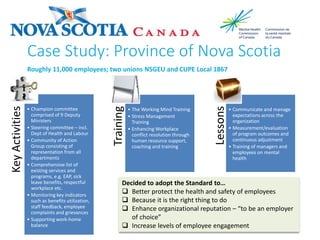
Case Study: Province of Nova Scotia
Roughly 11,000 employees; two unions NSGEU and CUPE Local 1867
Decided to adopt the Standard to…
 Better protect the health and safety of employees
 Because it is the right thing to do
 Enhance organizational reputation – “to be an employer
of choice”
 Increase levels of employee engagement
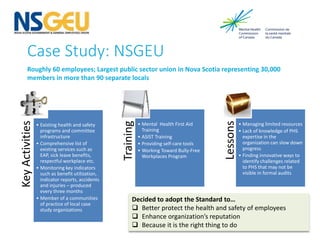
Case Study: NSGEU
Roughly 60 employees; Largest public sector union in Nova Scotia representing 30,000
members in more than 90 separate locals
KeyActivities
• Existing health and safety
programs and committee
infrastructure
• Comprehensive list of
existing services such as
EAP, sick leave benefits,
respectful workplace etc.
• Monitoring key indicators
such as benefit utilization,
indicator reports, accidents
and injuries – produced
every three months
• Member of a communities
of practice of local case
study organizations
Training • Mental Health First Aid
Training
• ASIST Training
• Providing self-care tools
• Working Toward Bully-Free
Workplaces Program
Lessons
• Managing limited resources
• Lack of knowledge of PHS
expertise in the
organization can slow down
progress
• Finding innovative ways to
identify challenges related
to PHS that may not be
visible in formal audits
Decided to adopt the Standard to…
 Better protect the health and safety of employees
 Enhance organization’s reputation
 Because it is the right thing to do
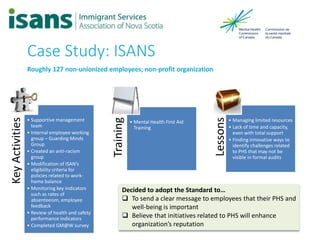
KeyActivities
• Supportive management
team
• Internal employee working
group – Guarding Minds
Group
• Created an anti-racism
group
• Modification of ISAN’s
eligibility criteria for
policies related to work-
home balance
• Monitoring key indicators
such as rates of
absenteeism, employee
feedback
• Review of health and safety
performance indicators
• Completed GM@W survey
Training • Mental Health First Aid
Training
Lessons
• Managing limited resources
• Lack of time and capacity,
even with total support
• Finding innovative ways to
identify challenges related
to PHS that may not be
visible in formal audits
Case Study: ISANS
Roughly 127 non-unionized employees; non-profit organization
Decided to adopt the Standard to…
 To send a clear message to employees that their PHS and
well-being is important
 Believe that initiatives related to PHS will enhance
organization’s reputation
Big changes happen
one small step at a
time.
What’s Your Next Step?
Contact us: kthorpe@mentalhealthcommission.ca
Visit: www.mentalhealthcommission.ca
Follow us:
The views represented herein solely represent the views of the Mental Health Commission of Canada.
Production of this document is made possible through a financial contribution from Health Canada.
Les opinions exprimées aux présentes sont celles de la Commission de la santé mentale du Canada.
La production de ce document a été rendue possible grâce à la contribution financière de Santé Canada.
Thank you

Implementing the National Standard for Psychological Health and Safety in the Workplace – One Step at a Time

  • 1.
    Implementing the NationalStandard for Psychological Health and Safety in the Workplace – One Step at a Time Karla Thorpe, Director, Prevention and Promotion Initiatives, Mental Health Commission of Canada April 14, 2015
  • 2.
    The Mental HealthStrategy for Canada The Strategy calls for the creation of mentally healthy workplaces, including the broad-based adoption of standards for psychological health and safety.
  • 3.
  • 4.
    The National Standard TheStandard is a set of guidelines, tools and resources focused on promoting employees’ psychological health and preventing psychological harm due to workplace factors • Voluntary – set of tools, not rules • Aligned with existing standards and tools • Applicable to any organization • Intended to enable employers and employees measure progress • Doesn’t create new legal obligations but may have influence on the application of 7 branches of law that currently exist
  • 5.
    Purpose of theStandard Prevent psychological harm from conditions in the workplace Promote psychological health in the workplace through support
  • 6.
    Who Developed theStandard? COLLABORATORS FUNDING PARTNERS
  • 7.
    The Standard isGaining Traction Top industry sectors  Healthcare  Government /Judicial/Policing  Education Top regions  Ontario  British Columbia  Alberta  Quebec  Nova Scotia 3,368 21,642 25,010 Fr En Total Launch 2013 2014 2015
  • 8.
    Navigate the Journey MHCC,GWL and the CSA Group collaborated to develop “Assembling the Pieces: An Implementation Guide to the National Standard for Psychological Health and Safety in the Workplace” • Intended to be used in conjunction with the Standard • Assist organizations through the initial planning stages through to full implementation • Officially launched in November 2014 www.mentalhealthcommission.ca/standardguide
  • 9.
  • 10.
    Phase 1: Buildingthe Foundation
  • 11.
    Phase 1: Buildingthe Foundation • Securing a champion • Leadership support • Roles and responsibilities defined • Policy development • Worker consultation and participation
  • 12.
    Phase 2: IdentifyingOpportunities
  • 13.
    Phase 2: IdentifyingOpportunities • Establish baseline • Data collection • Organizational audit • Hazard identification • Data and trend analysis • Organizational risk assessment
  • 14.
    Phase 3: SettingObjectives
  • 15.
    Phase 3: SettingObjectives • Develop vision • Set objectives and targets • Establish implementation team • Develop implementation strategy
  • 16.
  • 17.
    Phase 4: Implementingthe Plan • Implement the strategy • Establish corrective and preventive action process • Establish reporting and incident investigation process • Establish performance monitoring process • Internal audits • Management review • Continuous improvement
  • 18.
  • 19.
  • 20.
    Following more than40 organizations Three year national study (Feb 2014 - March 2017) • Breakdown barriers to implementation and identify gaps and challenges • Determine promising practices • Build a strong business case for implementation • Inform future revisions to the Standard • Identify tools/resources to help with implementation • Create a blueprint for future organizations that wish to implement the Standard
  • 21.
    Geographic representation of participatingorganizations (head office locations only)
  • 22.
    Organizations are implementingthe Standard to… Limit liability Manage costs Engagement Enhance reputation Do the right thing Protect health 0% 10% 20% 30% 40% 50% 60% 70% 80% 90% 100% Percent of Organizations Endorsing Motivational Theme
  • 23.
    Where did organizationsbegin their journey? 60% 61% 68% 40% 42% Commitment Planning Implementation Evaluation Review
  • 24.
    Commonly Seen Practices (atBaseline) • Senior leadership support • Shared responsibility model • Employee input sought • Review of key indicators • Implementation of change management strategies • Training for front-line management and employees
  • 25.
    KeyActivities • Champion committee comprisedof 9 Deputy Ministers • Steering committee – incl. Dept of Health and Labour • Community of Action Group consisting of representation from all departments • Comprehensive list of existing services and programs, e.g. EAP, sick leave benefits, respectful workplace etc. • Monitoring key indicators such as benefits utilization, staff feedback, employee complaints and grievances • Supporting work-home balance Training • The Working Mind Training • Stress Management Training • Enhancing Workplace conflict resolution through human resource support, coaching and training Lessons • Communicate and manage expectations across the organization • Measurement/evaluation of program outcomes and continuous adjustment • Training of managers and employees on mental health Case Study: Province of Nova Scotia Roughly 11,000 employees; two unions NSGEU and CUPE Local 1867 Decided to adopt the Standard to…  Better protect the health and safety of employees  Because it is the right thing to do  Enhance organizational reputation – “to be an employer of choice”  Increase levels of employee engagement
  • 26.
    Case Study: NSGEU Roughly60 employees; Largest public sector union in Nova Scotia representing 30,000 members in more than 90 separate locals KeyActivities • Existing health and safety programs and committee infrastructure • Comprehensive list of existing services such as EAP, sick leave benefits, respectful workplace etc. • Monitoring key indicators such as benefit utilization, indicator reports, accidents and injuries – produced every three months • Member of a communities of practice of local case study organizations Training • Mental Health First Aid Training • ASIST Training • Providing self-care tools • Working Toward Bully-Free Workplaces Program Lessons • Managing limited resources • Lack of knowledge of PHS expertise in the organization can slow down progress • Finding innovative ways to identify challenges related to PHS that may not be visible in formal audits Decided to adopt the Standard to…  Better protect the health and safety of employees  Enhance organization’s reputation  Because it is the right thing to do
  • 27.
    KeyActivities • Supportive management team •Internal employee working group – Guarding Minds Group • Created an anti-racism group • Modification of ISAN’s eligibility criteria for policies related to work- home balance • Monitoring key indicators such as rates of absenteeism, employee feedback • Review of health and safety performance indicators • Completed GM@W survey Training • Mental Health First Aid Training Lessons • Managing limited resources • Lack of time and capacity, even with total support • Finding innovative ways to identify challenges related to PHS that may not be visible in formal audits Case Study: ISANS Roughly 127 non-unionized employees; non-profit organization Decided to adopt the Standard to…  To send a clear message to employees that their PHS and well-being is important  Believe that initiatives related to PHS will enhance organization’s reputation
  • 28.
    Big changes happen onesmall step at a time. What’s Your Next Step?
  • 29.
    Contact us: kthorpe@mentalhealthcommission.ca Visit:www.mentalhealthcommission.ca Follow us: The views represented herein solely represent the views of the Mental Health Commission of Canada. Production of this document is made possible through a financial contribution from Health Canada. Les opinions exprimées aux présentes sont celles de la Commission de la santé mentale du Canada. La production de ce document a été rendue possible grâce à la contribution financière de Santé Canada. Thank you

Editor's Notes

  • #10 Reference to MHCC’s commitment to workplace mental health and implementing the standard – more information on MHCC website
  • #29 Facilitation Question #3: What is your next step? What is one thing you learned today that could be effective in your workplace? Facilitation Question #4: What would be one of your biggest challenges in implementing these suggestions? Facilitation Question #5: To what extent does stigma still exist in your workplace? What can you do about this? Facilitation Question #6: What is your key takeaway from today?