Semiology in Music & Performance AnalysisResearch Skills MusicologyDr Paul Carr
Revision from previous session
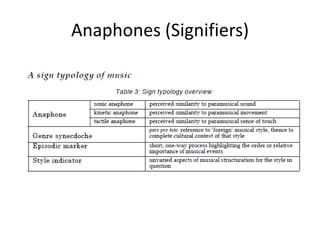
Tagg: Notes from ‘The Semiology Of Music’Charles Pierce – triadic model, adapted for music by Tagg:Icon: Where the sound resembles in some shape or form what it is representing. For example moter bike sounds deriving from a guitar. Tagg calls these ‘sonic anapheles’.Index: Where the sound (or any other gesture) points toward its meaning. Tagg uses Synecdoche as an example of how one small element can represent something larger. Smoke = Fire! Two fingered tapping represents a certain type of rock music! A certain type of fashion equates to a style of music, etc. Symbol: (Tagg describes this as ‘conventional’ or ‘arbitrary’ (both mean the same thing!). Tagg argues that manymusical gestures are not ‘iconic, or indexical, but  ‘arbitrary’ - connected only by convention. This is the case for most words in our language! He does not give any musical examples, but William Echard’sTypical Featuresassist with clarification. For example
Typical FeaturesThe use of electronic drums in certain types of dance music.The use of backing vocals in do-wop.Clichés (Indexical!)The use of distorted guitar in rock music.Certain types of fashion associated with a style of music.More on this next week!
Peirce ContSemiosis: Peirce’s name for how signs can change their meaning over time. Tagg– ‘In short, the same set of musical sounds does not ‘mean’ the same thing in different cultures or at different times in the history of the same culture’ (p.7).
Ferdinand de Saussure:Dyadic model1) Signifier(a ‘sign’: For example a distorted guitar, or a type of fashion) Signified(what it stands for: For example Rock Music)
Important TerminologiesPolysemy: Proposes that music can mean different things to different people or even many things to the same person. It is therefore polysemic in nature.This takes us back to our Week 1 session. The 4 questions I suggested regarding the meaning in music were -
Musical MeaningFour Basic QuestionsCan music communicate anything beyond notes, sounds and textures?Is this ‘meaning’ universal or personal?How do we (or can we) communicate this meaning to others?How do we go about comprehending (and writing about) this meaning?Polysemy can be considered ‘empirical’, as opposed to Plato’s ‘rationalism’ (where we can’t trust our perceptions)
Anaphones (Signifiers)
Terminology ContIntrasubjective analysis: Personal account of ones own reactions to music.Intersubjective analysis: An account that takes numerous accounts of a piece of music into consideration. Interobjective analysis: compares pieces of music to each other.
Performance practices and techniques can give a song its ‘unique’ character.Can impact both live music making and recorded music.Recording changes what may originally have been considered an improvised moment into something that can be analysed repeatedly. How does the musician communicate their musical persona in a recorded or live performance?- In a single take?Via overdubs?Are they being themselves or someone else?How do they combine, time, space and place?How do specific musical and bodily gestures indicate meaning?etcPerformance Analysis
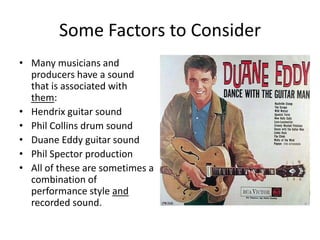
Some Factors to ConsiderMany musicians and producers have a sound that is associated with them: Hendrix guitar soundPhil Collins drum soundDuane Eddy guitar soundPhil Spector productionAll of these are sometimes a combination of performance style and recorded sound.
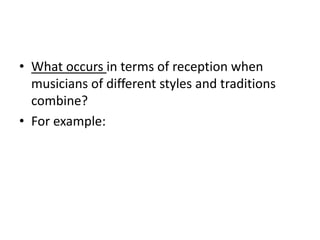
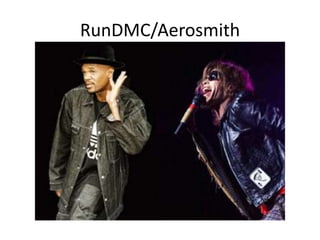
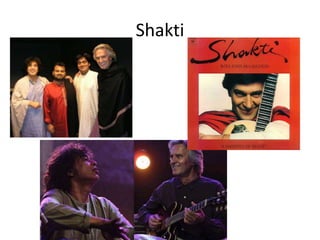
What occurs in terms of reception when musicians of different styles and traditions combine? For example:
RunDMC/Aerosmith
Shakti
Genre Synecdoche“In verbal language, a synecdoche denotes a figure of speech in which a part substitutes the whole, as in the expression 'all hands on deck', implying, at least from the captain's view, that the sailors' brawn is worth more than their brain. A musical synecdoche would therefore be a set of musical structures inside a given musical style that refer to another (different, 'foreign', 'alien') musical style by citing one or two elements supposed to be typical of that 'other' style when heard in the context of the style into which those 'foreign' elements are imported. By citing part of the other style, the citation then alludes not only to that other style in its entirety but also potentially refers to the complete genre of which that other musical style is a subset” (TaggTowards a Sign Typology of Music )
‘Intentional and ‘Extensional aspects of performance.Intentional: Meaning in the performance as the players have more freedomExtensional: Meaning in the notation
Time and Place in performanceInteresting to examine how the time and location of a recording influences the sound.Many artists have used specific ‘places’ to influence a sound. For Example:Phil Spector – Gold Star Studios in Hollywood.Led Zeppelin (4th album) Headley GrangeBuddy Holly: Norman Petty’s studioElvis Presley: Sun StudiosRolling Stones: Muscle Shoals Studio
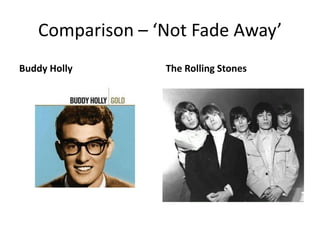
Sometimes the peculiarities of a room may lead to a specific recording technique and therefore sound.Buddy Holly: (“Not Fade Away”) Studio too small for drums – used cardboard boxesNote how The Rolling Stones attempted to emulate this sound in the UK with their version of the song.Stax Studios: Size of room, and the fact that musicians played together without headphones, sometimes led to vocal performances being ahead of the beat (according to legend!).
Comparison – ‘Not Fade Away’Buddy Holly The Rolling Stones
Modern recordings are often compiled in a variety of locations and times.
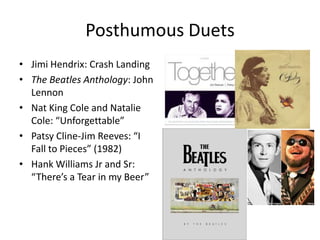
Posthumous DuetsJimi Hendrix: Crash LandingThe Beatles Anthology: John LennonNat King Cole and Natalie Cole: “Unforgettable”Patsy Cline-Jim Reeves: “I Fall to Pieces” (1982)Hank Williams Jr and Sr: “There’s a Tear in my Beer”
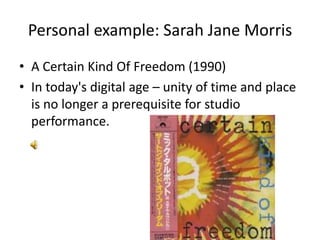
Personal example: Sarah Jane MorrisA Certain Kind Of Freedom (1990)In today's digital age – unity of time and place is no longer a prerequisite for studio performance.
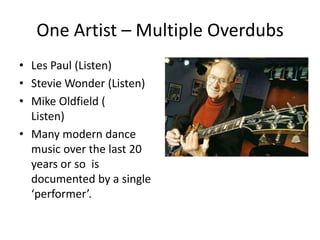
One Artist – Multiple OverdubsLes Paul (Listen)Stevie Wonder (Listen)Mike Oldfield (Listen)Many modern dance music over the last 20 years or so  is documented by a single ‘performer’.
Studio based ‘Virtual Performances’Techniques include:Compiling the best aspects of numerous takes, as opposed to going with a ‘single take’.‘Punching in’ to redo specific aspects of a performanceDigital enhanced tuning and timingUsing a ‘sub mix’ to (for example bass and drums) to bring about a specific type of performance (In this case, it may be a particularly ‘tight’ relationship between the instruments)Other sub mixes could focus on the interaction between instruments.
HomeworkDiscuss any aspect of this lecture on my blog.

Session 5 semiology & performance analysis

  • 1.
    Semiology in Music& Performance AnalysisResearch Skills MusicologyDr Paul Carr
  • 2.
  • 3.
    Tagg: Notes from‘The Semiology Of Music’Charles Pierce – triadic model, adapted for music by Tagg:Icon: Where the sound resembles in some shape or form what it is representing. For example moter bike sounds deriving from a guitar. Tagg calls these ‘sonic anapheles’.Index: Where the sound (or any other gesture) points toward its meaning. Tagg uses Synecdoche as an example of how one small element can represent something larger. Smoke = Fire! Two fingered tapping represents a certain type of rock music! A certain type of fashion equates to a style of music, etc. Symbol: (Tagg describes this as ‘conventional’ or ‘arbitrary’ (both mean the same thing!). Tagg argues that manymusical gestures are not ‘iconic, or indexical, but ‘arbitrary’ - connected only by convention. This is the case for most words in our language! He does not give any musical examples, but William Echard’sTypical Featuresassist with clarification. For example
  • 4.
    Typical FeaturesThe useof electronic drums in certain types of dance music.The use of backing vocals in do-wop.Clichés (Indexical!)The use of distorted guitar in rock music.Certain types of fashion associated with a style of music.More on this next week!
  • 5.
    Peirce ContSemiosis: Peirce’sname for how signs can change their meaning over time. Tagg– ‘In short, the same set of musical sounds does not ‘mean’ the same thing in different cultures or at different times in the history of the same culture’ (p.7).
  • 6.
    Ferdinand de Saussure:Dyadicmodel1) Signifier(a ‘sign’: For example a distorted guitar, or a type of fashion) Signified(what it stands for: For example Rock Music)
  • 7.
    Important TerminologiesPolysemy: Proposesthat music can mean different things to different people or even many things to the same person. It is therefore polysemic in nature.This takes us back to our Week 1 session. The 4 questions I suggested regarding the meaning in music were -
  • 8.
    Musical MeaningFour BasicQuestionsCan music communicate anything beyond notes, sounds and textures?Is this ‘meaning’ universal or personal?How do we (or can we) communicate this meaning to others?How do we go about comprehending (and writing about) this meaning?Polysemy can be considered ‘empirical’, as opposed to Plato’s ‘rationalism’ (where we can’t trust our perceptions)
  • 9.
  • 10.
    Terminology ContIntrasubjective analysis:Personal account of ones own reactions to music.Intersubjective analysis: An account that takes numerous accounts of a piece of music into consideration. Interobjective analysis: compares pieces of music to each other.
  • 11.
    Performance practices andtechniques can give a song its ‘unique’ character.Can impact both live music making and recorded music.Recording changes what may originally have been considered an improvised moment into something that can be analysed repeatedly. How does the musician communicate their musical persona in a recorded or live performance?- In a single take?Via overdubs?Are they being themselves or someone else?How do they combine, time, space and place?How do specific musical and bodily gestures indicate meaning?etcPerformance Analysis
  • 12.
    Some Factors toConsiderMany musicians and producers have a sound that is associated with them: Hendrix guitar soundPhil Collins drum soundDuane Eddy guitar soundPhil Spector productionAll of these are sometimes a combination of performance style and recorded sound.
  • 13.
    What occurs interms of reception when musicians of different styles and traditions combine? For example:
  • 14.
  • 15.
  • 16.
    Genre Synecdoche“In verballanguage, a synecdoche denotes a figure of speech in which a part substitutes the whole, as in the expression 'all hands on deck', implying, at least from the captain's view, that the sailors' brawn is worth more than their brain. A musical synecdoche would therefore be a set of musical structures inside a given musical style that refer to another (different, 'foreign', 'alien') musical style by citing one or two elements supposed to be typical of that 'other' style when heard in the context of the style into which those 'foreign' elements are imported. By citing part of the other style, the citation then alludes not only to that other style in its entirety but also potentially refers to the complete genre of which that other musical style is a subset” (TaggTowards a Sign Typology of Music )
  • 17.
    ‘Intentional and ‘Extensionalaspects of performance.Intentional: Meaning in the performance as the players have more freedomExtensional: Meaning in the notation
  • 18.
    Time and Placein performanceInteresting to examine how the time and location of a recording influences the sound.Many artists have used specific ‘places’ to influence a sound. For Example:Phil Spector – Gold Star Studios in Hollywood.Led Zeppelin (4th album) Headley GrangeBuddy Holly: Norman Petty’s studioElvis Presley: Sun StudiosRolling Stones: Muscle Shoals Studio
  • 19.
    Sometimes the peculiaritiesof a room may lead to a specific recording technique and therefore sound.Buddy Holly: (“Not Fade Away”) Studio too small for drums – used cardboard boxesNote how The Rolling Stones attempted to emulate this sound in the UK with their version of the song.Stax Studios: Size of room, and the fact that musicians played together without headphones, sometimes led to vocal performances being ahead of the beat (according to legend!).
  • 20.
    Comparison – ‘NotFade Away’Buddy Holly The Rolling Stones
  • 21.
    Modern recordings areoften compiled in a variety of locations and times.
  • 22.
    Posthumous DuetsJimi Hendrix:Crash LandingThe Beatles Anthology: John LennonNat King Cole and Natalie Cole: “Unforgettable”Patsy Cline-Jim Reeves: “I Fall to Pieces” (1982)Hank Williams Jr and Sr: “There’s a Tear in my Beer”
  • 23.
    Personal example: SarahJane MorrisA Certain Kind Of Freedom (1990)In today's digital age – unity of time and place is no longer a prerequisite for studio performance.
  • 24.
    One Artist –Multiple OverdubsLes Paul (Listen)Stevie Wonder (Listen)Mike Oldfield (Listen)Many modern dance music over the last 20 years or so is documented by a single ‘performer’.
  • 25.
    Studio based ‘VirtualPerformances’Techniques include:Compiling the best aspects of numerous takes, as opposed to going with a ‘single take’.‘Punching in’ to redo specific aspects of a performanceDigital enhanced tuning and timingUsing a ‘sub mix’ to (for example bass and drums) to bring about a specific type of performance (In this case, it may be a particularly ‘tight’ relationship between the instruments)Other sub mixes could focus on the interaction between instruments.
  • 26.
    HomeworkDiscuss any aspectof this lecture on my blog.