

Dr Paul Carr
   Interesting to compare view to that of Plato and the late
    antiquity scholars. Greek Modes for example were
    deemed to contain emotion.
   Viewed the ‘beauty’ of music as being its formal
    structure – contained no emotional content within its
    notes or referred by them
   Influenced by Kant’s concept of being ‘disinterested’
   Leads to some interesting questions:
   Is there a difference between what a piece of music is –
    and what is known about it?
   What impact does our memory and imagination have
    on our interpretation of music?
   Do our opinions and words reflect reality – or
    construct our own version of it?
   What is the impact of the author (composer) on
    how we interpret music.
   What is the impact of lyrics?
   Can music represent ‘real’ meaning?
   Production Analysis could include factors such
    as
   Impact of Society and Culture
   Impact of the Press
   The impact of the record label/company
   In this session, we will focus more upon -
   Songwriting/Compositional Process
   Intentionality of the composer
   Studio Practices
   For analysis of the text – we will consider ‘The
    Elements of Music’.
   We will generally be considering where the
    ontological presence of a piece of music is.
   Important to remember – that some factors
    (melody and harmony for example) can be part
    of Production and Immanent process.
   Song: Includes basic harmony (chords), melody, lyrics, and some
    degree of formal design.
   Musical Arrangement: A specific setting of the song. Includes
    instrumentation, specific parts, groove, etc.
   Track: The recording itself, includes both song and arrangement.
   Song and Arrangement can be altered at any point. This is not true
    for The Track, as it is a fixed set of relationships that is an
    autographic representation of its makers.
   Compositional process can be simultaneous (all three parameters
    occurring at the same time.
   Or linear – Song – Arrangement – Track
   Interesting to analyse how songwriters and producers develop
    their ideas (or your own work!). How do these three components
    work together?
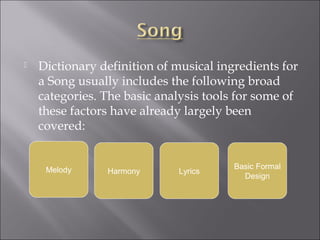
   Dictionary definition of musical ingredients for
    a Song usually includes the following broad
    categories. The basic analysis tools for some of
    these factors have already largely been
    covered:


     Melody                             Basic Formal
                Harmony      Lyrics
                                          Design
   Can be modified and changed (arranged),
    without altering the songs basic character.
   Songs can therefore easily be differentiated
    from particular recorded versions – because
    they do not involve any precise SOUND.
   Songs are the most recognisable of the three
    parameters, and songwriters always get
    principal credit on a record, even if they have
    had nothing to do with its construction.
   Songwriters have historically held a privileged position
    in Popular Music.
   It is only recently that musicians (often important
    factors in forging a musical work) have gained
    royalties through the PPL (in the UK).
   Tin Pan Alley – songwriters were usually separated
    from the artists who performed their songs. The songs
    therefore had an independent life – not related to their
    ‘arrangement’ or ‘track’ versions.
   Leiber & Stoller were an early exception to this:
    Producers and Composers.
   Many Blues artists were forerunners of the modern day
    singer/songwriter as they often linked the composer,
    song and arrangement together.
   Post Rock & Roll – songs became linked to specific
    recordings (Tracks) to a unprecedented degree.
   Listen: ‘Tutti Fruiti’ by Little Richard (1955)
    and then Pat Boone’s version (1956).
   What factors differentiate these recordings
    from each other?
   More detailed than the song.
   Includes aspects such as – instrumentation, style,
    groove, texture, timbre, dynamics, tempo, structural
    form etc.
   In the context of modern record making, electronic
    processing can be part of ‘arranging’ technique, thus
    overlapping with The Track.
   For example instrument effects, outboard signal
    processing such as compression, mixing desk protocols
    such as stereo mix and pan, etc.
   Bands can sometimes aim to obtain a ‘live’ sound, or
    alternatively experiment with arranging techniques
    that are impossible (or very difficult) to recreate live.
   Arranged for voice, guitar, and string quartet.
   Arrangement has a clear identity which was not conceptualised as
    part of the Song, and could be reproduced live or notated (The
    string parts were).
   However the process of recording inadvertently captured both of
    McCartney's attempts at singing the song.
   The fact that the strings were overdubbed at a different ‘time’
    makes this work different from a recording of a live performance.
   This soundscape is specific to recorded sound, even though it
    sounds like it could be played live – the details dictate otherwise.
   Analysis should therefore take this into account – differentiating
    between the Song and Arrangement.
   When song writing and recording originally
    came together they were sequential processes –
    often due to financial implications (Studios
    were expensive)
   With the advent of the home studio, the
    process has become more symbiotic and
    interchangeable.
   For this reason, it is essential to consider the
    whole Record (Song, Arrangement, and Track) as
    the focus of musicological analysis.
   The recording itself.
   It therefore includes the other two parameters.
   When we hear the record, we experience both Song and
    Arrangement through the Track.
   Very important to realise that Song and Arrangement retain
    ontological independence (we can analyse both).
   They potentially have specific modes of representation (lead sheet,
    performance, etc) outside of the Record.
   These modes of representation can change over time – IE one may
    decide to alter the chords of the song, or the instrumentation of
    the arrangement
   This is not the case for the Track – this is a fixed set of
    relationships, a mix of action and intent – AUTOGRAPHIC!
   It is interesting to consider how these three parameters can
    potentially interrelate in the compositional process, and more
    importantly how the Song and Arrangement are influenced by the
    Autographic process.
   Where is the ontological presence of the song?
   In a single recordings?
   Or Multiple Performances – live gigs,
    arrangements, cover versions, etc
   With this philosophy – we consider
    compositions/songs more in the imagination
    than individual instances – they are considered
    the combination of many parts – over time, space
    and place.
   When listening to a specific recording – we are
    only hearing one instance of the song
   For Example
   Timbre
   Texture
   Harmony
   Dynamics
   Melody
   Rhythm
   Mix
   etc
   We can discuss/describe how these elements function
    independently within the music either diachronically
    or synchronically – ‘embodied’/rationalistic meaning.
   We can link them to our own and others’ ‘designative’
    meaning.
   We can discuss how they are prioritised to indoctrinate
    interest and meaning in the music.
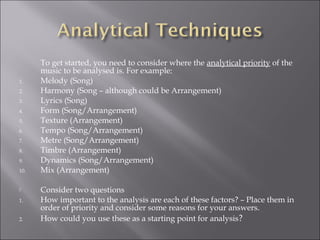
To get started, you need to consider where the analytical priority of the
      music to be analysed is. For example:
1.    Melody (Song)
2.    Harmony (Song – although could be Arrangement)
3.    Lyrics (Song)
4.    Form (Song/Arrangement)
5.    Texture (Arrangement)
6.    Tempo (Song/Arrangement)
7.    Metre (Song/Arrangement)
8.    Timbre (Arrangement)
9.    Dynamics (Song/Arrangement)
10.   Mix (Arrangement)

     Consider two questions
1.    How important to the analysis are each of these factors? – Place them in
      order of priority and consider some reasons for your answers.
2.    How could you use these as a starting point for analysis?
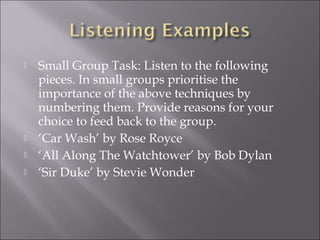
   Small Group Task: Listen to the following
    pieces. In small groups prioritise the
    importance of the above techniques by
    numbering them. Provide reasons for your
    choice to feed back to the group.
   ‘Car Wash’ by Rose Royce
   ‘All Along The Watchtower’ by Bob Dylan
   ‘Sir Duke’ by Stevie Wonder
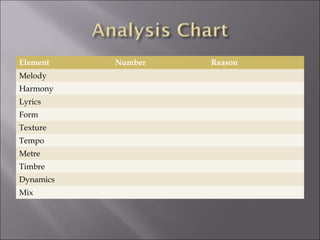
Element    Number   Reason
Melody
Harmony
Lyrics
Form
Texture
Tempo
Metre
Timbre
Dynamics
Mix
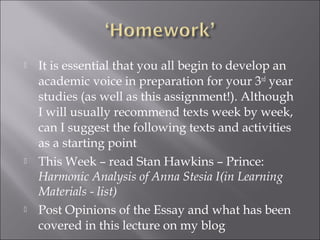
   It is essential that you all begin to develop an
    academic voice in preparation for your 3rd year
    studies (as well as this assignment!). Although
    I will usually recommend texts week by week,
    can I suggest the following texts and activities
    as a starting point
   This Week – read Stan Hawkins – Prince:
    Harmonic Analysis of Anna Stesia I(in Learning
    Materials - list)
   Post Opinions of the Essay and what has been
    covered in this lecture on my blog
   Moore, Allan F., Analyzing popular music
    (Cambridge University Press, 2003).  
   Wald, Elijah, How the Beatles Destroyed Rock N
    Roll (Oxford University Press US, 2009).  
   Frith, Simon, and Andrew Goodwin, On record
    (Routledge, 1990).  
   Shuker, Roy, Popular music (Routledge, 2005).  
   Hesmondhalgh, David, and Keith Negus,
    Popular music studies (Arnold, 2002).  
   Middleton, Richard, Voicing the popular (CRC
    Press, 2006).  
   Stephenson, Ken, What to listen for in rock (Yale
    University Press, 2002).  
   Many important texts are available in preview format
    on Google Books. Read the example below as an
    example of how it can be used.

    Zak, Albin, The poetics of rock (University of California
    Press, 2001).pp 1 – 17. Good overview of of impact of
    technology on popular music

Session 2 song arrangement and track

  • 1.
  • 3.
    Interesting to compare view to that of Plato and the late antiquity scholars. Greek Modes for example were deemed to contain emotion.  Viewed the ‘beauty’ of music as being its formal structure – contained no emotional content within its notes or referred by them  Influenced by Kant’s concept of being ‘disinterested’  Leads to some interesting questions:  Is there a difference between what a piece of music is – and what is known about it?  What impact does our memory and imagination have on our interpretation of music?
  • 4.
    Do our opinions and words reflect reality – or construct our own version of it?  What is the impact of the author (composer) on how we interpret music.  What is the impact of lyrics?  Can music represent ‘real’ meaning?
  • 5.
    Production Analysis could include factors such as  Impact of Society and Culture  Impact of the Press  The impact of the record label/company  In this session, we will focus more upon -  Songwriting/Compositional Process  Intentionality of the composer  Studio Practices
  • 6.
    For analysis of the text – we will consider ‘The Elements of Music’.  We will generally be considering where the ontological presence of a piece of music is.  Important to remember – that some factors (melody and harmony for example) can be part of Production and Immanent process.
  • 7.
    Song: Includes basic harmony (chords), melody, lyrics, and some degree of formal design.  Musical Arrangement: A specific setting of the song. Includes instrumentation, specific parts, groove, etc.  Track: The recording itself, includes both song and arrangement.  Song and Arrangement can be altered at any point. This is not true for The Track, as it is a fixed set of relationships that is an autographic representation of its makers.  Compositional process can be simultaneous (all three parameters occurring at the same time.  Or linear – Song – Arrangement – Track  Interesting to analyse how songwriters and producers develop their ideas (or your own work!). How do these three components work together?
  • 8.
    Dictionary definition of musical ingredients for a Song usually includes the following broad categories. The basic analysis tools for some of these factors have already largely been covered: Melody Basic Formal Harmony Lyrics Design
  • 9.
    Can be modified and changed (arranged), without altering the songs basic character.  Songs can therefore easily be differentiated from particular recorded versions – because they do not involve any precise SOUND.  Songs are the most recognisable of the three parameters, and songwriters always get principal credit on a record, even if they have had nothing to do with its construction.
  • 10.
    Songwriters have historically held a privileged position in Popular Music.  It is only recently that musicians (often important factors in forging a musical work) have gained royalties through the PPL (in the UK).  Tin Pan Alley – songwriters were usually separated from the artists who performed their songs. The songs therefore had an independent life – not related to their ‘arrangement’ or ‘track’ versions.  Leiber & Stoller were an early exception to this: Producers and Composers.  Many Blues artists were forerunners of the modern day singer/songwriter as they often linked the composer, song and arrangement together.  Post Rock & Roll – songs became linked to specific recordings (Tracks) to a unprecedented degree.
  • 11.
    Listen: ‘Tutti Fruiti’ by Little Richard (1955) and then Pat Boone’s version (1956).  What factors differentiate these recordings from each other?
  • 14.
    More detailed than the song.  Includes aspects such as – instrumentation, style, groove, texture, timbre, dynamics, tempo, structural form etc.  In the context of modern record making, electronic processing can be part of ‘arranging’ technique, thus overlapping with The Track.  For example instrument effects, outboard signal processing such as compression, mixing desk protocols such as stereo mix and pan, etc.  Bands can sometimes aim to obtain a ‘live’ sound, or alternatively experiment with arranging techniques that are impossible (or very difficult) to recreate live.
  • 15.
    Arranged for voice, guitar, and string quartet.  Arrangement has a clear identity which was not conceptualised as part of the Song, and could be reproduced live or notated (The string parts were).  However the process of recording inadvertently captured both of McCartney's attempts at singing the song.  The fact that the strings were overdubbed at a different ‘time’ makes this work different from a recording of a live performance.  This soundscape is specific to recorded sound, even though it sounds like it could be played live – the details dictate otherwise.  Analysis should therefore take this into account – differentiating between the Song and Arrangement.
  • 16.
    When song writing and recording originally came together they were sequential processes – often due to financial implications (Studios were expensive)  With the advent of the home studio, the process has become more symbiotic and interchangeable.  For this reason, it is essential to consider the whole Record (Song, Arrangement, and Track) as the focus of musicological analysis.
  • 17.
    The recording itself.  It therefore includes the other two parameters.
  • 18.
    When we hear the record, we experience both Song and Arrangement through the Track.  Very important to realise that Song and Arrangement retain ontological independence (we can analyse both).  They potentially have specific modes of representation (lead sheet, performance, etc) outside of the Record.  These modes of representation can change over time – IE one may decide to alter the chords of the song, or the instrumentation of the arrangement  This is not the case for the Track – this is a fixed set of relationships, a mix of action and intent – AUTOGRAPHIC!  It is interesting to consider how these three parameters can potentially interrelate in the compositional process, and more importantly how the Song and Arrangement are influenced by the Autographic process.
  • 19.
    Where is the ontological presence of the song?  In a single recordings?  Or Multiple Performances – live gigs, arrangements, cover versions, etc  With this philosophy – we consider compositions/songs more in the imagination than individual instances – they are considered the combination of many parts – over time, space and place.  When listening to a specific recording – we are only hearing one instance of the song
  • 20.
    For Example  Timbre  Texture  Harmony  Dynamics  Melody  Rhythm  Mix  etc
  • 21.
    We can discuss/describe how these elements function independently within the music either diachronically or synchronically – ‘embodied’/rationalistic meaning.  We can link them to our own and others’ ‘designative’ meaning.  We can discuss how they are prioritised to indoctrinate interest and meaning in the music.
  • 22.
    To get started,you need to consider where the analytical priority of the music to be analysed is. For example: 1. Melody (Song) 2. Harmony (Song – although could be Arrangement) 3. Lyrics (Song) 4. Form (Song/Arrangement) 5. Texture (Arrangement) 6. Tempo (Song/Arrangement) 7. Metre (Song/Arrangement) 8. Timbre (Arrangement) 9. Dynamics (Song/Arrangement) 10. Mix (Arrangement)  Consider two questions 1. How important to the analysis are each of these factors? – Place them in order of priority and consider some reasons for your answers. 2. How could you use these as a starting point for analysis?
  • 23.
    Small Group Task: Listen to the following pieces. In small groups prioritise the importance of the above techniques by numbering them. Provide reasons for your choice to feed back to the group.  ‘Car Wash’ by Rose Royce  ‘All Along The Watchtower’ by Bob Dylan  ‘Sir Duke’ by Stevie Wonder
  • 24.
    Element Number Reason Melody Harmony Lyrics Form Texture Tempo Metre Timbre Dynamics Mix
  • 25.
    It is essential that you all begin to develop an academic voice in preparation for your 3rd year studies (as well as this assignment!). Although I will usually recommend texts week by week, can I suggest the following texts and activities as a starting point  This Week – read Stan Hawkins – Prince: Harmonic Analysis of Anna Stesia I(in Learning Materials - list)  Post Opinions of the Essay and what has been covered in this lecture on my blog
  • 26.
    Moore, Allan F., Analyzing popular music (Cambridge University Press, 2003).    Wald, Elijah, How the Beatles Destroyed Rock N Roll (Oxford University Press US, 2009).    Frith, Simon, and Andrew Goodwin, On record (Routledge, 1990).    Shuker, Roy, Popular music (Routledge, 2005).    Hesmondhalgh, David, and Keith Negus, Popular music studies (Arnold, 2002).    Middleton, Richard, Voicing the popular (CRC Press, 2006).    Stephenson, Ken, What to listen for in rock (Yale University Press, 2002).  
  • 27.
    Many important texts are available in preview format on Google Books. Read the example below as an example of how it can be used. Zak, Albin, The poetics of rock (University of California Press, 2001).pp 1 – 17. Good overview of of impact of technology on popular music