Research Skills Musicology
Session 3 –
The Elements of Music
Dr Paul Carr
Group Presentations
Overview of last week
Meaning in Korn
• Identifies a ‘gap’ in the market – textual
analysis of Metal.
• Starts with an overview of the band and
Nu Metal – briefly comparing it to other
Metal music.
• Indentifies problems with categorising
music.
• References academic articles and band
interviews.
• Discusses the interrelationship of the lyrics
and the music.
• Dialogic approach – various techniques,
including album covers etc.
• Psycho analytic
• Draw up an interesting table which links
musical sounds to specific meanings (42)
• Embodied approach also – Phrygian
mode
• Relates specific intervals and sounds to
characterises of a person.
• For example Bass = sexually abusive
Father, and vocals/guitar = child
• Style Codes = how specific sounds etc are
culturally specific. For eg a ‘Wah’ sound
can mean various things for Hendrix and
Funkalelic.
• Polysemic Meaning
• Analysis is context specific
• Identity – is it personal or linked to factors
such as gender, sexual orientation, race,
etc?
• What does the music mean to audiences?
• How does this change between genres?
Eg Prog rock emphasis on complexity, Nu
Metal on Textures etc.
• If we enjoy ‘Hey Daddy’ – do we indentify
with the molester?
Discussing ‘The Elements Of
Music’
What are the ‘Elements’?
• For Example
• Timbre
• Texture
• Harmony
• Dynamics
• Melody
• Rhythm
• Mix
• etc
• We can discuss/describe how these elements function
independently within the music either diachronically or
synchronically – ‘embodied’ meaning.
• We can link them to our own and others’ ‘designative’
meaning (as in Korn)
• We can discuss how they are prioritised to indoctrinate
interest and meaning in the music.
• We can discuss how they impact the Form of the music
• For Example:
Musical Form – General Points
• The vast majority of popular music has a specific
structure.
• Common terminologies we use in popular music include
Introduction, Verse, Chorus, and Middle Section/Bridge.
• Most popular music consists of 2 or 4 bar phrases, so
the sections are often divided into 8 or 16 bars. For
Example:
• “Ain’t That A Shame”: Fats Domino: Verse 4: Chorus 8
• “Ticket To Ride”: The Beatles: Verse and Chorus 8 bars
long
• “Clocks”: Coldplay: 4 bar sections
• “Valerie”: Amy Winehouse: All sections 8 bars long
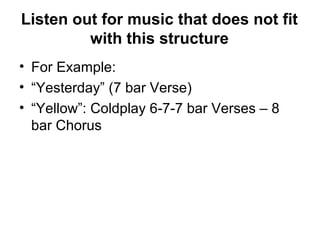
Listen out for music that does not fit
with this structure
• For Example:
• “Yesterday” (7 bar Verse)
• “Yellow”: Coldplay 6-7-7 bar Verses – 8
bar Chorus
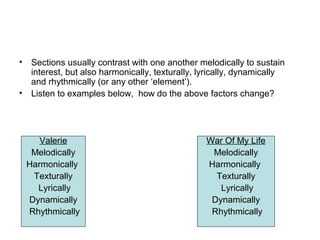
• Sections usually contrast with one another melodically to sustain
interest, but also harmonically, texturally, lyrically, dynamically
and rhythmically (or any other ‘element’).
• Listen to examples below, how do the above factors change?
Valerie
Melodically
Harmonically
Texturally
Lyrically
Dynamically
Rhythmically
War Of My Life
Melodically
Harmonically
Texturally
Lyrically
Dynamically
Rhythmically
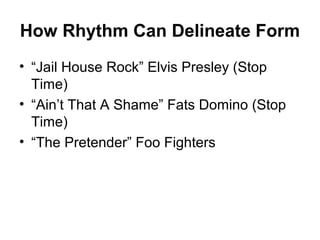
How Rhythm Can Delineate Form
• “Jail House Rock” Elvis Presley (Stop
Time)
• “Ain’t That A Shame” Fats Domino (Stop
Time)
• “The Pretender” Foo Fighters
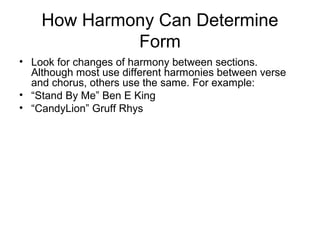
How Harmony Can Determine
Form
• Look for changes of harmony between sections.
Although most use different harmonies between verse
and chorus, others use the same. For example:
• “Stand By Me” Ben E King
• “CandyLion” Gruff Rhys
How Melody Can Determine Form
How Instrumentation/Texture Can
Determine Form
• “Hold The Line”:Toto
• “Sloop John B”:The Beach Boys
• Note how the last example consists of only
one section, so variety of texture is vital)
Discussing Texture/Timbre
Specifically
• Listen closely for the relationships between instruments in terms of:
• Frequency (High – Low)
• Depth/Distance (amount of ambience)
• Stereo Spectrum (Left – Right). Does it change? Do these changes
help evoke the mood of the music?
• General Volume
• Is there any double tracking?
• Use of effects) (compression, delay, chorus, etc)
• Use of EQ?
• Is the texture homophonic or Polyphonic?
• How does the texture relate to the lyrics and the emotion of the
piece (Texture can be ‘physical’ and ‘rhetorical’)?
• How do the individual parts relate to the whole mix?
Example of Texture Relating to
the Lyrics and/or Title
• Annie Lennox: ‘Walking On Broken Glass’
• Feist: ‘The Water’
Artist Specific Sounds
• Specific sounds can immediately inform
the listener of who an artist is, and or what
a style or tradition is.
• For example:
• Pat Metheny
• Phil Spector
• Wes Montgomery
• Try and examine the nature of the
individual sound.
• For example with distortion:
• What type of distortion is it?
• How is it manufactured?
• How does this relate to the style and
authenticity of the artist?
• For example:
• Rainbow: “Since You Been Gone”
• Saxon: “Wheels of Steele”
• Mega death: “Holy Wars”
• ZZ Top: “Tush”
• Slipknot: “Before I Forget”.
• The same type of factors can be discussed for
other instruments
Note how sounds can allude
toward
• A change of style: Compare “In God’s
Country” (The Joshua Tree) to “Zoo
Station” (Achtung Baby) U2
A Time or Place
• “Dippermouth Blues” King Oliver
• “That’s All Right” Elvis Presley
• “I’m Into Something Good” Herman's
Hermits
• Specific Live Albums
• They can can also allude to other styles
(what Tagg calls a ‘Genre Synecdoche’)
• For example: Distortion in Jazz
• Violin in Rock
• Harpsichord in Rock (The Beatles)
• Electric instruments in Jazz or Folk
How Metre Can Determine
Form
• “Lucy In The Sky With Diamonds”: Elton
John
Polyrhythm
• As well a metre being used diachronically,
it can also be used synchronically.
Example:
• “Kashmir” (Led Zeppelin) Drums in 4/4
• “All I Need” (Radiohead) Drums in 4/4 (Not
on Spotify)
General (Somewhat Obvious)
Points About Sections
• Introduction: content usually used somewhere else in the song. Not always
incorporated, but always introduces the song.
• Verse: Recurrent harmonic pattern, but different text and texture etc.
Usually occurs after the introduction, but sometimes chorus can occur
before it (Example “I Shot the Sheriff”, “Rock and Roll Music”)
• Chorus: Usually a recurrent harmonic and lyrical pattern.
• Refrain: Not a distinct section, but part of a verse or chorus.
• Can end or start a section. Consists of a repeated subsection, often with
same lyrics. For Example:
“I Saw Her Standing There”: The Beatles (After Verse)
God Only Knows: The Beach Boys: (note how refrain repeats at end)
I “Want To Hold Your Hand”: The Beatles (After Verse)
• Bridge: Connects two other sections.
• Normally occurs once, if twice, usually has same text.
• Sometimes called the ‘Middle 8’.
• Bridges can be instrumental: “Nights in White Satin”
• Outro: Content usually derives from elsewhere in the song. Always ends
song.
Homework
• Place the following info on the musicology
Wiki (this can be done individually or in
your groups)
• Examples of pieces with unusual bar
numbers in sections
• Examples of how rhythm delineates form
• Examples of verse and chorus with same
chords
• Examples of artist specific sounds
• Examples of texture/instrumentation delineating
form
• Examples of how metre delineates form.
• Examples of how sounds allude toward change
of style
• Examples of how sounds indicate a place or
time.
• Examples of textures that outline the lyrics and
or Title
• With all of these questions you need to also ask
‘how’?
• Briefly discuss how some of the above
relate to embodied and designative
meaning.
• Read Meaning In ‘Zappa’s Galoot Update
paper’

Session 3 ‘The Elements Of Music’

  • 1.
    Research Skills Musicology Session3 – The Elements of Music Dr Paul Carr
  • 2.
  • 3.
  • 4.
    Meaning in Korn •Identifies a ‘gap’ in the market – textual analysis of Metal. • Starts with an overview of the band and Nu Metal – briefly comparing it to other Metal music. • Indentifies problems with categorising music. • References academic articles and band interviews.
  • 5.
    • Discusses theinterrelationship of the lyrics and the music. • Dialogic approach – various techniques, including album covers etc. • Psycho analytic • Draw up an interesting table which links musical sounds to specific meanings (42) • Embodied approach also – Phrygian mode
  • 6.
    • Relates specificintervals and sounds to characterises of a person. • For example Bass = sexually abusive Father, and vocals/guitar = child • Style Codes = how specific sounds etc are culturally specific. For eg a ‘Wah’ sound can mean various things for Hendrix and Funkalelic.
  • 7.
    • Polysemic Meaning •Analysis is context specific • Identity – is it personal or linked to factors such as gender, sexual orientation, race, etc? • What does the music mean to audiences? • How does this change between genres? Eg Prog rock emphasis on complexity, Nu Metal on Textures etc.
  • 8.
    • If weenjoy ‘Hey Daddy’ – do we indentify with the molester?
  • 9.
  • 10.
    What are the‘Elements’? • For Example • Timbre • Texture • Harmony • Dynamics • Melody • Rhythm • Mix • etc
  • 11.
    • We candiscuss/describe how these elements function independently within the music either diachronically or synchronically – ‘embodied’ meaning. • We can link them to our own and others’ ‘designative’ meaning (as in Korn) • We can discuss how they are prioritised to indoctrinate interest and meaning in the music. • We can discuss how they impact the Form of the music • For Example:
  • 12.
    Musical Form –General Points • The vast majority of popular music has a specific structure. • Common terminologies we use in popular music include Introduction, Verse, Chorus, and Middle Section/Bridge. • Most popular music consists of 2 or 4 bar phrases, so the sections are often divided into 8 or 16 bars. For Example: • “Ain’t That A Shame”: Fats Domino: Verse 4: Chorus 8 • “Ticket To Ride”: The Beatles: Verse and Chorus 8 bars long • “Clocks”: Coldplay: 4 bar sections • “Valerie”: Amy Winehouse: All sections 8 bars long
  • 13.
    Listen out formusic that does not fit with this structure • For Example: • “Yesterday” (7 bar Verse) • “Yellow”: Coldplay 6-7-7 bar Verses – 8 bar Chorus
  • 14.
    • Sections usuallycontrast with one another melodically to sustain interest, but also harmonically, texturally, lyrically, dynamically and rhythmically (or any other ‘element’). • Listen to examples below, how do the above factors change? Valerie Melodically Harmonically Texturally Lyrically Dynamically Rhythmically War Of My Life Melodically Harmonically Texturally Lyrically Dynamically Rhythmically
  • 15.
    How Rhythm CanDelineate Form • “Jail House Rock” Elvis Presley (Stop Time) • “Ain’t That A Shame” Fats Domino (Stop Time) • “The Pretender” Foo Fighters
  • 16.
    How Harmony CanDetermine Form • Look for changes of harmony between sections. Although most use different harmonies between verse and chorus, others use the same. For example: • “Stand By Me” Ben E King • “CandyLion” Gruff Rhys
  • 17.
    How Melody CanDetermine Form
  • 18.
    How Instrumentation/Texture Can DetermineForm • “Hold The Line”:Toto • “Sloop John B”:The Beach Boys • Note how the last example consists of only one section, so variety of texture is vital)
  • 19.
    Discussing Texture/Timbre Specifically • Listenclosely for the relationships between instruments in terms of: • Frequency (High – Low) • Depth/Distance (amount of ambience) • Stereo Spectrum (Left – Right). Does it change? Do these changes help evoke the mood of the music? • General Volume • Is there any double tracking? • Use of effects) (compression, delay, chorus, etc) • Use of EQ? • Is the texture homophonic or Polyphonic? • How does the texture relate to the lyrics and the emotion of the piece (Texture can be ‘physical’ and ‘rhetorical’)? • How do the individual parts relate to the whole mix?
  • 20.
    Example of TextureRelating to the Lyrics and/or Title • Annie Lennox: ‘Walking On Broken Glass’ • Feist: ‘The Water’
  • 21.
    Artist Specific Sounds •Specific sounds can immediately inform the listener of who an artist is, and or what a style or tradition is. • For example: • Pat Metheny • Phil Spector • Wes Montgomery
  • 22.
    • Try andexamine the nature of the individual sound. • For example with distortion: • What type of distortion is it? • How is it manufactured? • How does this relate to the style and authenticity of the artist? • For example:
  • 23.
    • Rainbow: “SinceYou Been Gone” • Saxon: “Wheels of Steele” • Mega death: “Holy Wars” • ZZ Top: “Tush” • Slipknot: “Before I Forget”. • The same type of factors can be discussed for other instruments
  • 24.
    Note how soundscan allude toward • A change of style: Compare “In God’s Country” (The Joshua Tree) to “Zoo Station” (Achtung Baby) U2
  • 25.
    A Time orPlace • “Dippermouth Blues” King Oliver • “That’s All Right” Elvis Presley • “I’m Into Something Good” Herman's Hermits • Specific Live Albums
  • 26.
    • They cancan also allude to other styles (what Tagg calls a ‘Genre Synecdoche’) • For example: Distortion in Jazz • Violin in Rock • Harpsichord in Rock (The Beatles) • Electric instruments in Jazz or Folk
  • 27.
    How Metre CanDetermine Form • “Lucy In The Sky With Diamonds”: Elton John
  • 28.
    Polyrhythm • As wella metre being used diachronically, it can also be used synchronically. Example: • “Kashmir” (Led Zeppelin) Drums in 4/4 • “All I Need” (Radiohead) Drums in 4/4 (Not on Spotify)
  • 29.
    General (Somewhat Obvious) PointsAbout Sections • Introduction: content usually used somewhere else in the song. Not always incorporated, but always introduces the song. • Verse: Recurrent harmonic pattern, but different text and texture etc. Usually occurs after the introduction, but sometimes chorus can occur before it (Example “I Shot the Sheriff”, “Rock and Roll Music”) • Chorus: Usually a recurrent harmonic and lyrical pattern. • Refrain: Not a distinct section, but part of a verse or chorus. • Can end or start a section. Consists of a repeated subsection, often with same lyrics. For Example: “I Saw Her Standing There”: The Beatles (After Verse) God Only Knows: The Beach Boys: (note how refrain repeats at end) I “Want To Hold Your Hand”: The Beatles (After Verse) • Bridge: Connects two other sections. • Normally occurs once, if twice, usually has same text. • Sometimes called the ‘Middle 8’. • Bridges can be instrumental: “Nights in White Satin” • Outro: Content usually derives from elsewhere in the song. Always ends song.
  • 30.
    Homework • Place thefollowing info on the musicology Wiki (this can be done individually or in your groups) • Examples of pieces with unusual bar numbers in sections • Examples of how rhythm delineates form • Examples of verse and chorus with same chords • Examples of artist specific sounds
  • 31.
    • Examples oftexture/instrumentation delineating form • Examples of how metre delineates form. • Examples of how sounds allude toward change of style • Examples of how sounds indicate a place or time. • Examples of textures that outline the lyrics and or Title • With all of these questions you need to also ask ‘how’?
  • 32.
    • Briefly discusshow some of the above relate to embodied and designative meaning.
  • 33.
    • Read MeaningIn ‘Zappa’s Galoot Update paper’