Developing
Community
Appropriate
Educational Tools
2015 REGIONAL
CONFERENCES
EWB-USA Model
Mission & Vision
2015 REGIONAL CONFERENCES
MISSION
Engineers Without Borders USA builds a better world
through engineering projects that empower
communities to meet their basic human needs and
equip leaders to solve the world’s most pressing
challenges.
VISION
EWB-USA’s vision is a world in which every
community has the capacity to sustainably meet
their basic human needs.
2002
Year that EWB-USA
was founded
San Pablo, Belize
Location of the first
EWB-USA project
2.5 million
Lives impacted since
2002
Five-year Commitments
2015 REGIONAL CONFERENCES
Long-Term Solutions
“Education is the Most Powerful Weapon Which You Can Use to
Change the World.” – Nelson Mandela
Sustainability and EWB-USA
2015 REGIONAL CONFERENCES
“Education is not the filling of a pail, but the
lighting of a fire.” – William Butler Yeats
Sustainability: Education & Empowerment
2015 REGIONAL CONFERENCES
EDUCATION
1. The process of receiving or giving
systematic instruction
2. Information about or training in a
particular field or subject
EMPOWER
1. To promote the self-actualization or
influence of
2. To enable
Educational Needs
2015 REGIONAL CONFERENCES
Examples:
• Operation and Maintenance
Manual
• Water, Sanitation and Hygiene
(WASH)
• Data Collection
• Construction Techniques
• Water Conservation
• Water Treatment
“Education is a fundamental human right and essential for the
exercise of all other human rights. It promotes individual freedom
and empowerment and yields important development benefits.”
— UNESCO
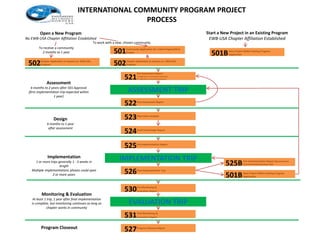
INTERNATIONAL COMMUNITY PROGRAM PROJECT
PROCESS
Open a New Program
No EWB-USA Chapter Affiliation Established
Chapter Application to Acquire an EWB-USA
Program
ASSESSMENT TRIP
Assessment
6 months to 2 years after 501 Approval
(first implementation trip expected within
1 year)
Design
6 months to 1 year
after assessment
IMPLEMENTATION TRIP
EVALUATION TRIP
&
To receive a community
2 months to 1 year
502 Chapter Application to Acquire an EWB-USA
Program502
Community Application for a New Program/First
Project501 New Project Within Existing Program
Application501B
Pre-Assessment Report
1st might focus on Community Assessment
2nd might focus on Technical Assessment521
Post Assessment Report
522
Alternative Analysis
523
Draft Final Design Report
524
Pre-Implementation Report
525
Post Implementation Trip
526
Pre-Monitoring &
Evaluation Report530
Post-Monitoring &
Evaluation Report531
Program Closeout Report
527
Start a New Project in an Existing Program
EWB-USA Chapter Affiliation Established
New Project Within Existing Program
Application501B
Pre-Implementation Report (Short Form for
ContinuedImplementation Trip)525B
Implementation
1 or more trips generally 1 - 3 weeks in
length
Multiple implementations phases could span
2 or more years
Monitoring & Evaluation
At least 1 trip, 1 year after final implementation
is complete, but monitoring continues as long as
chapter works in community
Program Closeout
To work with a new, chosen community
EWB-USA Project Process
Project Process Flow Chart
2015 REGIONAL CONFERENCES
Education Examples
WASH
Water Testing / WASH
O&M Manual /
Construction Techniques
Technical Maintenance
Assessment Trip – Education Objectives
2015 REGIONAL CONFERENCES
• Get to know the community
• Identify existing committees
and leaders
• Identify community educators
to partner with: health
promoters and teachers
• WASH training: schools,
women’s groups
• Technical training: water
sampling
• Assess technical knowledge
of community members
Assessment Trip – Educational Materials
2015 REGIONAL CONFERENCES
Approach
• Written materials, pictorial, oral
trainings?
• Audience: Leadership committee,
designated maintenance staff,
individual families
• What is the capacity of each?
• What level of interaction is best?
Who can you partner with locally?
Who in the community will review?
Source:CAWST-TheCentreforAffordableWater
andSanitationTechnology(www.cawst.org)
Assessment Trip – Educational Materials
2015 REGIONAL CONFERENCES
• Partner with NGO, local
teachers, health promoters,
water authority, etc.
• Train the trainer approach
• Do not develop training in a
vacuum
• Assess audience
Consider:
• Literacy
• Translation
• Who will review?
Design Phase – Educational Materials
2015 REGIONAL CONFERENCES
• Can community collect data while chapter is not in-country?
• Is chapter providing design alternatives for community review?
• Does the community know where to obtain materials for project, and
the cost?
• Are there educational materials that chapter can provide to local
trainers to reinforce ideas and technology of project?
Source:CAWST-TheCentreforAffordableWaterand
SanitationTechnology(www.cawst.org)
Final Design / Pre-Implementation Phase –
Educational Materials
2015 REGIONAL CONFERENCES
O&M Manual
Operation & Maintenance Manual
2015 REGIONAL CONFERENCES
Things to consider:
• Should clearly convey how the implemented system operates
and how it should be maintained so that it is sustainable for
the community.
• Should be aimed at building capacity
• EWB-USA requires that the community accept 100% of all
O&M tasks and costs.
• Consider O&M at all stages of analysis and design; often
O&M will be the driving constraint at the Alternatives Analysis
phase.
• Consider the full life cycle cost of O&M, including repair and
replacement of all parts.
• Systems that rely on financial or technical resources or
equipment not readily available will not be approved
Implementation – Educational Tools
2015 REGIONAL CONFERENCES
Technical training: mixing
concrete, water testing, installing
pipe, etc.
“Example isn't another way to teach, it is the only way to teach.”
- Albert Einstein
Monitoring & Evaluation – Educational Tools
2015 REGIONAL CONFERENCES
• Maintenance education
• Identify lack of technical knowledge
for maintenance
• WASH knowledge reinforcement
• Training local system operators
Source:CAWST-TheCentreforAffordable
WaterandSanitationTechnology
(www.cawst.org)
Operation & Maintenance Manual
2015 REGIONAL CONFERENCES
A comprehensive O&M Manual should include the following items:
• A clear description of the implemented system, including all components
of the system.
• A clearly defined schedule for all maintenance activities related to the
system.
• Anticipated replacement parts, availability locally, and costs.
• Videos of task being done is better than words and pictures, but cannot
replace the O&M Manual
• The manual should be illustrative and include photographs of the
implemented facilities, which will require an update to the draft O&M
Manual submitted before implementation.
• The manual must be a standalone document, which may be an appendix
in the report, but not just a section.
• An O&M Manual should be left with the community, and should therefore
be laminated or included with page protectors. It is important that the
specified maintenance personnel have an opportunity to review and
provide feedback on the O&M manual.
Examples
2015 REGIONAL CONFERENCES
Improving Your Educational Tools
Ideas
• Workshops for construction techniques
• Water Testing while chapter is out of country
• WASH!
• Connect with local educators – health promoters, teachers, local
University, water committee
• Ice-breakers
• Skits / Role-Playing
• Newsletter by chapter for local partners
• Stories for school children
• Photos and Images vs. Words
• Others?
2015 REGIONAL CONFERENCES
Tips and Resources
Tips
• Keep local context in mind
• Who is the audience?
• What are the barriers to participation?
• Find local partners
Resources
• http://www.projectwet.org/
• http://www.cawst.org/services/resources
2015 REGIONAL CONFERENCES
Questions?
2015 REGIONAL CONFERENCES
“If you are planning for a year, sow rice; if you
are planning for a decade, plant trees; if you are
planning for a lifetime, educate people.”
- Chinese proverb

Session 4A - Developing Community Appropriate Educational Training

  • 1.
  • 2.
    EWB-USA Model Mission &Vision 2015 REGIONAL CONFERENCES MISSION Engineers Without Borders USA builds a better world through engineering projects that empower communities to meet their basic human needs and equip leaders to solve the world’s most pressing challenges. VISION EWB-USA’s vision is a world in which every community has the capacity to sustainably meet their basic human needs. 2002 Year that EWB-USA was founded San Pablo, Belize Location of the first EWB-USA project 2.5 million Lives impacted since 2002
  • 3.
    Five-year Commitments 2015 REGIONALCONFERENCES Long-Term Solutions “Education is the Most Powerful Weapon Which You Can Use to Change the World.” – Nelson Mandela
  • 4.
    Sustainability and EWB-USA 2015REGIONAL CONFERENCES “Education is not the filling of a pail, but the lighting of a fire.” – William Butler Yeats
  • 5.
    Sustainability: Education &Empowerment 2015 REGIONAL CONFERENCES EDUCATION 1. The process of receiving or giving systematic instruction 2. Information about or training in a particular field or subject EMPOWER 1. To promote the self-actualization or influence of 2. To enable
  • 6.
    Educational Needs 2015 REGIONALCONFERENCES Examples: • Operation and Maintenance Manual • Water, Sanitation and Hygiene (WASH) • Data Collection • Construction Techniques • Water Conservation • Water Treatment “Education is a fundamental human right and essential for the exercise of all other human rights. It promotes individual freedom and empowerment and yields important development benefits.” — UNESCO
  • 7.
    INTERNATIONAL COMMUNITY PROGRAMPROJECT PROCESS Open a New Program No EWB-USA Chapter Affiliation Established Chapter Application to Acquire an EWB-USA Program ASSESSMENT TRIP Assessment 6 months to 2 years after 501 Approval (first implementation trip expected within 1 year) Design 6 months to 1 year after assessment IMPLEMENTATION TRIP EVALUATION TRIP & To receive a community 2 months to 1 year 502 Chapter Application to Acquire an EWB-USA Program502 Community Application for a New Program/First Project501 New Project Within Existing Program Application501B Pre-Assessment Report 1st might focus on Community Assessment 2nd might focus on Technical Assessment521 Post Assessment Report 522 Alternative Analysis 523 Draft Final Design Report 524 Pre-Implementation Report 525 Post Implementation Trip 526 Pre-Monitoring & Evaluation Report530 Post-Monitoring & Evaluation Report531 Program Closeout Report 527 Start a New Project in an Existing Program EWB-USA Chapter Affiliation Established New Project Within Existing Program Application501B Pre-Implementation Report (Short Form for ContinuedImplementation Trip)525B Implementation 1 or more trips generally 1 - 3 weeks in length Multiple implementations phases could span 2 or more years Monitoring & Evaluation At least 1 trip, 1 year after final implementation is complete, but monitoring continues as long as chapter works in community Program Closeout To work with a new, chosen community
  • 8.
    EWB-USA Project Process ProjectProcess Flow Chart 2015 REGIONAL CONFERENCES Education Examples WASH Water Testing / WASH O&M Manual / Construction Techniques Technical Maintenance
  • 9.
    Assessment Trip –Education Objectives 2015 REGIONAL CONFERENCES • Get to know the community • Identify existing committees and leaders • Identify community educators to partner with: health promoters and teachers • WASH training: schools, women’s groups • Technical training: water sampling • Assess technical knowledge of community members
  • 10.
    Assessment Trip –Educational Materials 2015 REGIONAL CONFERENCES Approach • Written materials, pictorial, oral trainings? • Audience: Leadership committee, designated maintenance staff, individual families • What is the capacity of each? • What level of interaction is best? Who can you partner with locally? Who in the community will review? Source:CAWST-TheCentreforAffordableWater andSanitationTechnology(www.cawst.org)
  • 11.
    Assessment Trip –Educational Materials 2015 REGIONAL CONFERENCES • Partner with NGO, local teachers, health promoters, water authority, etc. • Train the trainer approach • Do not develop training in a vacuum • Assess audience Consider: • Literacy • Translation • Who will review?
  • 12.
    Design Phase –Educational Materials 2015 REGIONAL CONFERENCES • Can community collect data while chapter is not in-country? • Is chapter providing design alternatives for community review? • Does the community know where to obtain materials for project, and the cost? • Are there educational materials that chapter can provide to local trainers to reinforce ideas and technology of project? Source:CAWST-TheCentreforAffordableWaterand SanitationTechnology(www.cawst.org)
  • 13.
    Final Design /Pre-Implementation Phase – Educational Materials 2015 REGIONAL CONFERENCES O&M Manual
  • 14.
    Operation & MaintenanceManual 2015 REGIONAL CONFERENCES Things to consider: • Should clearly convey how the implemented system operates and how it should be maintained so that it is sustainable for the community. • Should be aimed at building capacity • EWB-USA requires that the community accept 100% of all O&M tasks and costs. • Consider O&M at all stages of analysis and design; often O&M will be the driving constraint at the Alternatives Analysis phase. • Consider the full life cycle cost of O&M, including repair and replacement of all parts. • Systems that rely on financial or technical resources or equipment not readily available will not be approved
  • 15.
    Implementation – EducationalTools 2015 REGIONAL CONFERENCES Technical training: mixing concrete, water testing, installing pipe, etc. “Example isn't another way to teach, it is the only way to teach.” - Albert Einstein
  • 16.
    Monitoring & Evaluation– Educational Tools 2015 REGIONAL CONFERENCES • Maintenance education • Identify lack of technical knowledge for maintenance • WASH knowledge reinforcement • Training local system operators Source:CAWST-TheCentreforAffordable WaterandSanitationTechnology (www.cawst.org)
  • 17.
    Operation & MaintenanceManual 2015 REGIONAL CONFERENCES A comprehensive O&M Manual should include the following items: • A clear description of the implemented system, including all components of the system. • A clearly defined schedule for all maintenance activities related to the system. • Anticipated replacement parts, availability locally, and costs. • Videos of task being done is better than words and pictures, but cannot replace the O&M Manual • The manual should be illustrative and include photographs of the implemented facilities, which will require an update to the draft O&M Manual submitted before implementation. • The manual must be a standalone document, which may be an appendix in the report, but not just a section. • An O&M Manual should be left with the community, and should therefore be laminated or included with page protectors. It is important that the specified maintenance personnel have an opportunity to review and provide feedback on the O&M manual.
  • 18.
  • 19.
    Improving Your EducationalTools Ideas • Workshops for construction techniques • Water Testing while chapter is out of country • WASH! • Connect with local educators – health promoters, teachers, local University, water committee • Ice-breakers • Skits / Role-Playing • Newsletter by chapter for local partners • Stories for school children • Photos and Images vs. Words • Others? 2015 REGIONAL CONFERENCES
  • 20.
    Tips and Resources Tips •Keep local context in mind • Who is the audience? • What are the barriers to participation? • Find local partners Resources • http://www.projectwet.org/ • http://www.cawst.org/services/resources 2015 REGIONAL CONFERENCES
  • 21.
    Questions? 2015 REGIONAL CONFERENCES “Ifyou are planning for a year, sow rice; if you are planning for a decade, plant trees; if you are planning for a lifetime, educate people.” - Chinese proverb

Editor's Notes

  • #2 Introductions: Developed By: Melissa Montgomery – Project Engineer at EWB-USA HQ To be presented at these Regional Conferences by EWB-USA Project Engineer: Midwest Region: Melissa Montgomery Mountain Region: Melissa Montgomery Title:  Developing Community Appropriate Educational Tools Audience:  EWB-USA project team members, Intro: One of the most important aspects of a sustainable project and program is providing educational tools to your local community partners to enhance capacity building, knowledge transfer, and behavior change. This presentation is intended to guide chapters and members on various types of community appropriate educational tools, how to develop these, and when chapters should be providing educational tools throughout the overall project process at EWB-USA.   Learning Outcomes:  1.      An understanding of why community appropriate educational tools are critical to a successful project 2.      How to develop appropriate educational tools for your community partners 3.      When chapters should be incorporating educational tools into their programs 4. Examples of good educational materials  
  • #3 Before we begin, let’s review the Mission and Vision of EWB-USA.
  • #4 As we all know, EWB-USA’s mission is based on real relationships by committing to five-year partnerships with communities. Our goal is to create long-term sustainable solutions for the communities we are partnering with. We want to do more than build latrines for communities – we want to equip them to build and maintain latrines themselves, which ensures that the community will have sanitation solutions long after our five-year commitment is fulfilled.
  • #5  Sustainability has become such a catch phrase for different entities that it’s risky to emphasize it heavily without first defining it from the perspective of our organizational mission and vision. In our work: We always want to make sure that harm isn’t done to the environment as a result of our implementation. We want the design to be socially acceptable and appropriate for all members in the community. The projects we implement are to be affordable for the community to operate and maintain into the future. And, in order to maintain the project, we make sure that the technical know-how exists in the community to keep the project operational. If we’ve taken each of these four factors into account when we design the project, we have a better chance of the project meeting the needs of the community and being sustained into the future. Our goal is to make sure we’ve done what we can to design projects that work for our partner communities now and in the long term. Sustainability within EWB-USA is the capacity of a project to endure. This definition emphasizes the need for our partner communities to have the capacity to sustain the project into the future in the context of development work. Consider the likelihood that the project will still be meeting the needs of the community in 10, 20 or 30+ years.
  • #6 As described on the previous slide, sustainability – In a very broad sense, within the context of EWB-USA, is the capacity of a project to endure. As we saw, sustainability includes economic, environmental and social factors, but encompassed within all of these is education. I wanted to share the definitions of both education and empower with you all. (read definitions) Empowerment of the community should be integrated into every step of our partnerships, from the initial identification of needs to a joint discussion of potential solutions, to a side-by-side implementation of the best solution. These ideas, conversations and plans take place over our 5-year commitment. Local sourcing of materials, extensive educations trainings and carefully crafted O&M plans ensure communities are equipped to manage their projects long after EWB-USA’s final monitoring and evaluation trip. Now that we have established the importance of education and empowerment to the overall sustainability of a project, let’s now turn our focus on how to effectively incorporate education into each phase of a project.
  • #7 UNESCO quote So when we talk about educational needs, what are we talking about? Some examples of educational needs are listed here, as you can see: O&M Manual Water, Sanitation and Hygiene Data Collection Construction techniques Water conservation Water Treatment We’ll go into each of these in more detail, but before we do I would like to emphasize two things about education: Don’t make assumption on what the community knows or doesn’t know. Get your partners involved with identifying educational needs. DON’T MAKE ASSUMPTIONS ABOUT THEIR PRIORITY NEEDS (example of group assuming women want to spend less time collecting water, when in reality women highly value time spent at communal water collection point in most communities). DON’T MAKE ASSUMPTIONS ABOUT THEIR RESOURCES (example – assuming group cannot afford anything – they are the “poorest of the poor” when in reality they can afford to buy a bottle of coke every day) 2. Try to establish a train-the-trainer approach so that content can be repeated over the long-term. Train multiple people in the community; try to target different sectors of the community – for instance, women and children, teachers, health promoters.
  • #8 This slide shows a flow chart of our current project process at EWB-USA headquarters. Let’s quickly go through the process and talk about where we think it’s appropriate and important to include education for the our community partners. Most chapters adopt a new program and then begin with their first assessment trip to meet local partners, establish relationships, and confirm the community’s self-identified problem. Poll the audience: By show of hands, how many people think this first assessment trip is an appropriate time to introduce education? What about a second assessment trip? What are some types of educational activities that you can think of that would be appropriate during an assessment trip? How about during an Implementation trip? How many people think this is a good time to provide educational tools for your partners? And how about during a M&E trip? How many people think this is an appropriate time for educational tools?
  • #9  As we can see, providing education to our community partners is important and critical in nearly every phase of the project process. Every time we go into the community, whether it is for an assessment, an implementation, or for monitoring and evaluation, we have the opportunity to develop and nurture our relationships with our local partners. Providing education that not only develops these relationships but also provides a critical component for project sustainability, success, and empowerment.
  • #10 During the first assessment trip, one of the main goals is to get to know your local partners and to confirm the problem identified by the community. During assessment trips, chapters are focused on gathering as much data as possible, conducting household surveys, community meetings, meeting with the local stakeholders, as well as gathering technical data. Often times, especially during a first assessment trip, educational activities are often overlooked. Developing educational tools can be a very effective way at developing and nurturing relationships, building trust and rapport with your partners, as well as a means to gather assessment data from various stakeholders in the community. For example, even a simple WASH activity in the local schools or with the local women’s group can provide your team with the opportunity get to ask questions about what their needs are and what they perceive the problem to be, as well as the opportunity for the group to ask questions or address concerns in a more personal setting. It is also an opportunity to share information about your team and EWB-USA and your long-term plans to partner with the community. Finally, it will open up opportunities for your team take a multi-prong approach to trying to solve the engineering problem which will increase the likelihood of project success. It will take time to understand the local history relating to the project and there will be subtleties in the community dynamics that we cannot see. Take the time to understand the community structure, inter-community relationships, existing committees and leadership, and technical capacity of the community. Consider then what is the best way to get to know them? -Do they respond more openly in group settings vs. household settings? -Is it important to plan for social activities to break the ice? -What to pay attention to about their culture – are they direct or indirect? How do you ask for something? Just straight out or after some small talk? Working with partners, make sure you are patient in your trip planning and dedicate a substantial amount of time to acquaint yourselves with the community members. We don’t have the local history relating to the project, we can’t see subtleties in the community dynamics and we do not have the expertise to engage in true community development. However, we have design and construction expertise and that is our role. In that role, we need to gather all applicable data to bring the right people on board to ensure project success. That includes getting to know the community and assessing their technical capacity to maintain the project and their capacity to organize the appropriate leadership and skilled workers to sustain the projects implemented. With that information, we can then start to think about the educational needs that will go along with the technical solution.
  • #11 EWB-USA is not, alone, a community-development organization, but with our project partners, we need to ensure that the project includes the appropriate educational and training activities.  The training sessions should be aimed at building capacity of groups such as the leadership committee, operation and maintenance staff, and individual households.  Activities should be done by or in partnership with the local NGO, community-based organization, local teachers, water authority, etc. EWB-USA teams should not be doing training in a vacuum. Locals need to review all content to make sure images and translations make sense.
  • #12 Ideally a train the trainer approach should be used so that local trainers can re-enforce concepts. On an assessment trip, you need to be assessing if the intended audience of your training materials is literate. If so, do they read/write a local language that will necessitate translating your materials? If not, would pictures or photos be better? If you are planning to draw images in a manual for O&M, it is imperative that your partners in the community review the materials and can convey to you what you are trying to demonstrate. Example: The chapter who created this poster made significant revisions once their community partner shared that the community would perceive doctors to be rats and that they would have no understanding at all of a flying dollar bill. Example: In El Salvador, they use an X through the photo of someone they WANT to vote for. Our typical approach of drawing an X through the undesirable option would lead to opposite understandings. Example of getting locals to review content: An EWB-USA team had an NGO contact review educational materials and survey. NGO contact did not live in the community but was very familiar with the region. She provided a lot of great feedback but did not catch a very key point. This was for a sanitation project, and she apparently did not know the word this specific community used for toilet. The team was met with blank stares with much of the content. Finally after soliciting the support of an engaged community member to review everything, they learned that surprisingly the community called toilets “water”….something no one but a community member could have guessed. Always have someone from the community review content!
  • #13 It is important to continue emphasizing education throughout every phase of your project. During the design phase, there are still opportunities to engage in educational activities with your partners. Providing design alternatives for review and input from the community is a critical education piece during the design phase. In the photo, we see boys reviewing the construction drawings as they try to recreate the sanitation system using plastic bottles, Styrofoam, and duct tape.
  • #14 The main educational tool during the final design and preparation for implementation is the Operation and Maintenance Manual. EWB-USA aims to ensure that our projects include the appropriate educational and training activities as it relates to the future operations and maintenance of an implemented project.  The community’s capacity to plan for the future operations and maintenance of the project is one of the most important aspects of a project being sustainable. These photos are from Biosand Filter project in Mexico; chapter turned their implementation trip into a workshop to teach the community how to construct their own sand filters. I have seen some chapters document the implementation with photos and then use those photos to create the final O&M Manual.
  • #15  Each project should include an Operations and Maintenance (O&M) Manual that provides information about how to operate the implemented system and maintain it well after a chapter closes a program in their partnering community.  The O&M Manual should be aimed at building capacity of groups such as the leadership committee, operation and maintenance staff, and individual households.  EWB-USA projects require that the community partner (CBO) and community members accept responsibility for 100% of all O&M tasks and costs. It is good practice to involve in the design and implementation of the facility those community members who will be responsible for the operation and maintenance of a facility. It is also good practice to start collecting the operation and maintenance cost allocation that will be assessed to community members prior to the start of implementation.  Consider the full life cycle cost of operation and maintenance, including repair, replacement of all parts and expansion. The chapter needs to consider operation and maintenance of the facilities at all stages of project analysis and design.  Operation and maintenance considerations will often be the driving constraint for the alternatives analysis and design of the project. The community will be 100% responsible for the ongoing operation and maintenance of any system implemented with a EWB-USA chapter.  Any system that relies on financial or technical resources or equipment not readily available to the community will not be approved for implementation by EWB-USA Project Engineers or the Technical Advisory Committee (TAC).
  • #16 The implementation trip is a great opportunity to provide technical training to your community partners. One of the most common ways to incorporate education into your implementation is to include training techniques such as mixing concrete, water testing, or repairing existing pipes. Involving the community in the implementation of their project not only provides an opportunity for education, but it will also encourage community ownership of the system. Photos: Concrete mixing for a school in Zambia; Setting rebar for foundation for a water tank in Fiji Pipe repairs in Tanzania
  • #17  Once implementation is complete, there is still opportunity to provide education to the community members during the monitoring and evaluation phase. In fact, this is a very critical point to reinforce all of the educational activities that your team worked on throughout your program. Reinforce WASH Train local operators Reinforce maintenance education This is where a good and thorough O&M Manual is critical, so we will go a little more into what to include in the O&M Manual.
  • #18 A comprehensive O&M Manual should include the following items: A clear description of the implemented system, including all components of the system. A clearly defined schedule for all maintenance activities related to the system.. Anticipated replacement parts, availability locally, and costs. Videos of task being done is better than words and pictures, but cannot replace the O&M Manual The manual should be illustrative and include photographs of the implemented facilities, which will require an update to the draft O&M Manual submitted before implementation. The manual must be a standalone document, which may be an appendix in the report, but not just a section. An O&M Manual should be left with the community, and should therefore be laminated or included with page protectors.  It is important that the specified maintenance personnel have an opportunity to review and provide feedback on the O&M manual.
  • #19 Discuss / share examples