ENGINEERING AROUND
THE WORLD
Stories of Change from Engineers
Without Borders USA
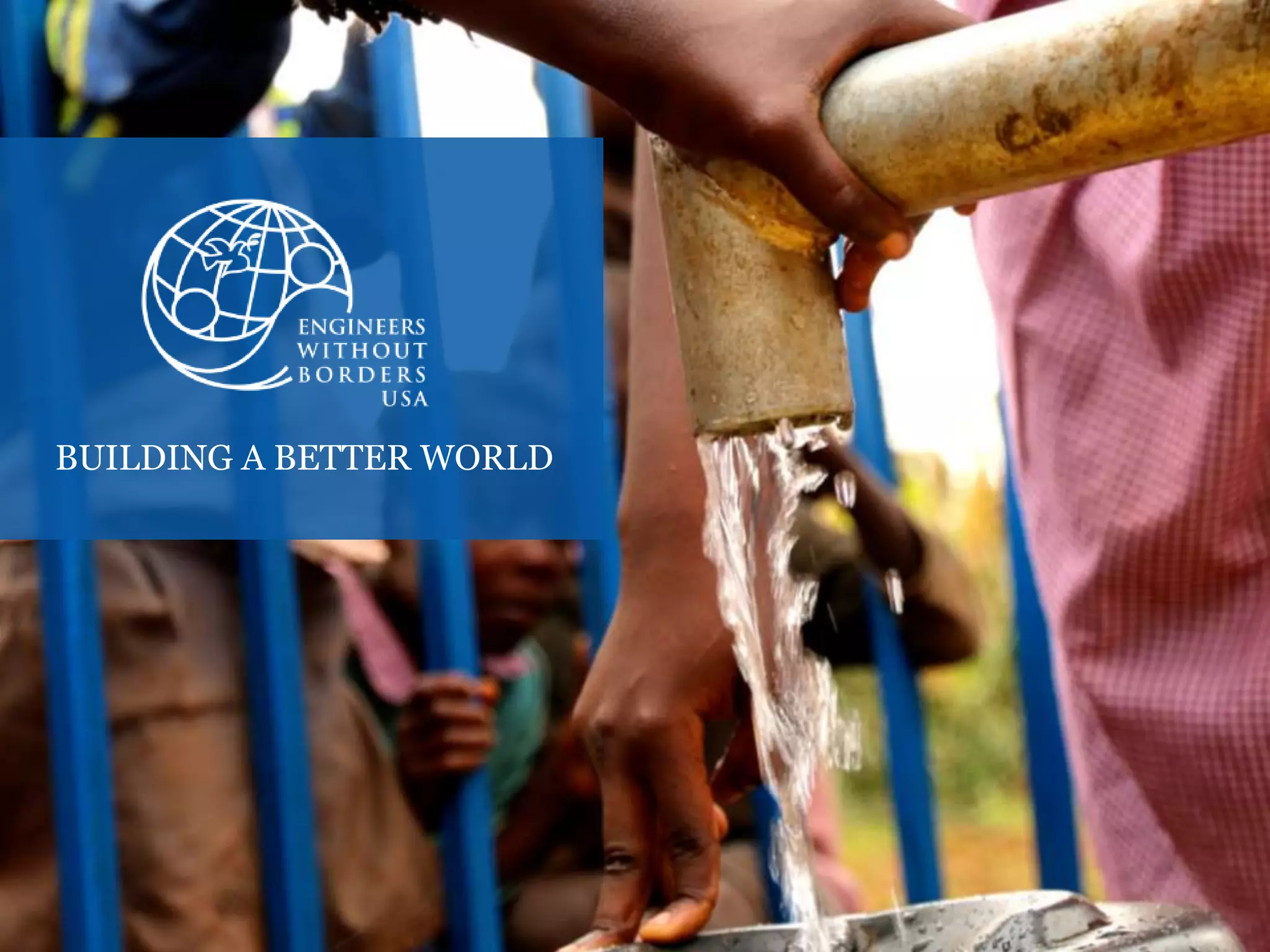
Photo: EWB-USA Montana State University Chapter
BUILDING A BETTER WORLD
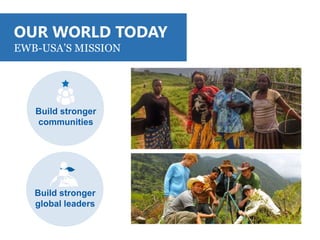
Build stronger
communities
Build stronger
global leaders
OUR WORLD TODAY
EWB-USA’S MISSION
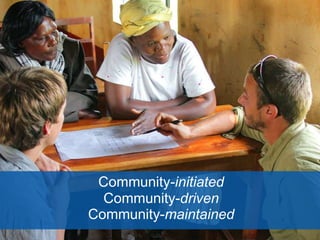
Community-initiated
Community-driven
Community-maintained
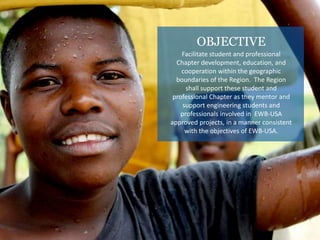
OBJECTIVE
Facilitate student and professional
Chapter development, education, and
cooperation within the geographic
boundaries of the Region. The Region
shall support these student and
professional Chapter as they mentor and
support engineering students and
professionals involved in EWB-USA
approved projects, in a manner consistent
with the objectives of EWB-USA.
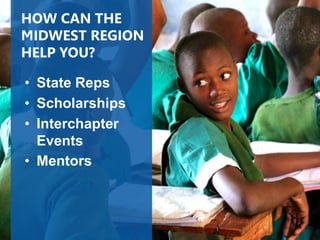
• State Reps
• Scholarships
• Interchapter
Events
• Mentors
HOW CAN THE
MIDWEST REGION
HELP YOU?
SCHOLARSHIPS
International Conference Regional Conference
INTERCHAPTER EVENTS
Ideas? Why so few?
State Rep Lead?
MENTORS
International Conference Regional Conference

Session 2D - Midwest Region Roundtable: How Can We Help?

Editor's Notes

  • #3 Transition from global challenges to how Engineers Without Borders USA is addressing these challenges. As a reference: These statistics reveal a dire reality, but there’s still good news to share. EWB-USA spearheads a movement of more than 14,700 incredibly resourceful and driven members that have the knowledge and willingness to address every single one of these problems. Our mission: EWB-USA is a nonprofit humanitarian organization established to support community-driven development programs worldwide through partnerships that design and implement sustainable engineering projects, while creating transformative experiences that enrich global perspectives and create responsible leaders. Our vision: EWB-USA's vision is a world in which the communities we serve have the capacity to sustainably meet their basic human needs.
  • #4 Walk the audience through a quick overview of the lifecycle of an EWB-USA project. EWB-USA programs originate with a community self-identifying their needs and requesting support. Our 14,700 volunteers work with the community to assess, design, implement and evaluate appropriate solutions. For your reference: Our mission is based on more than blueprints and measurements; it is based on real relationship and five-year partnerships. EWB-USA’s projects are delivered through a community-driven model based on full partnership with the host community. Only technologies that are determined to be the most appropriate solution for a community's identified need are implemented. Both the chapter and community provide equal input in the project process. The chapter must work with the community to implement projects within a program that can be sustained by the community in the long-term. The community must have the financial, administrative, technical, labor and material resources available to operate and maintain the installed facilities without outside assistance. We do more than build latrines for communities – we equip them to build and maintain latrines themselves, which ensures that the community will have sanitation solutions long after our five-year commitment is fulfilled.
  • #6 Winnie in Khwisero, Kenya can spend more time in the classroom and less time fetching water after the EWB-USA Montana State University partnering with the community to build a borehole well. Planning - EWB-USA Headquarters provides resources for our chapters to establish an understanding of the baseline situation in their partner communities and plan for long-term sustainability. Monitoring - The chapter uses consistent organizational tools to assist them in monitoring the program's impact in the community. Evaluation - The chapter evaluates the technical functionality of each project and their role in reaching the community's overall objectives for at least one year after construction is complete. We conduct periodic impact reviews after the chapter closes out their involvement in the program. Learning - EWB-USA uses impact assessment tools to be accountable to our partners and to learn from our experience to improve our community-driven development delivery model.
  • #7 Chapters Quick history :: Started at CU Boulder with a civil engineering professor. In April 2000, a representative of the Belize Ministry of Agriculture invited Dr. Bernard Amadei, Professor of Civil Engineering at the University of Colorado - Boulder, to visit a community in San Pablo, Belize, to assess the community's water supply. When Dr. Amadei visited the community, he learned that they lacked clean water and sanitation infrastructure. As a result, the local children spent a majority of their time carrying water for drinking and irrigation from miles away. Shortly after his first visit, Dr. Amadei returned to San Pablo with eight University of Colorado - Boulder engineering students and another civil engineering expert. In partnership with the community, the team installed a clean water system powered by a local waterfall. This simple, sustainable and low-cost solution was the first EWB-USA project. Dr. Amadei decided to harness the power of professional and student engineers to complete similar low-tech, high-impact projects in other developing countries by officially founding Engineers Without Borders USA in 2002. The students at the University of Colorado - Boulder became the first EWB-USA student chapter following the San Pablo, Belize project. This chapter expanded to 96 students working on three projects by the end of 2002. These students gained soft skills not typically acquired in the engineering curricula. This model of engineering students partnering with developing communities resonated in the engineering and university communities and EWB-USA chapters began expanding across the United States.
  • #8 Chapters Quick history :: Started at CU Boulder with a civil engineering professor. In April 2000, a representative of the Belize Ministry of Agriculture invited Dr. Bernard Amadei, Professor of Civil Engineering at the University of Colorado - Boulder, to visit a community in San Pablo, Belize, to assess the community's water supply. When Dr. Amadei visited the community, he learned that they lacked clean water and sanitation infrastructure. As a result, the local children spent a majority of their time carrying water for drinking and irrigation from miles away. Shortly after his first visit, Dr. Amadei returned to San Pablo with eight University of Colorado - Boulder engineering students and another civil engineering expert. In partnership with the community, the team installed a clean water system powered by a local waterfall. This simple, sustainable and low-cost solution was the first EWB-USA project. Dr. Amadei decided to harness the power of professional and student engineers to complete similar low-tech, high-impact projects in other developing countries by officially founding Engineers Without Borders USA in 2002. The students at the University of Colorado - Boulder became the first EWB-USA student chapter following the San Pablo, Belize project. This chapter expanded to 96 students working on three projects by the end of 2002. These students gained soft skills not typically acquired in the engineering curricula. This model of engineering students partnering with developing communities resonated in the engineering and university communities and EWB-USA chapters began expanding across the United States.
  • #9 Chapters Quick history :: Started at CU Boulder with a civil engineering professor. In April 2000, a representative of the Belize Ministry of Agriculture invited Dr. Bernard Amadei, Professor of Civil Engineering at the University of Colorado - Boulder, to visit a community in San Pablo, Belize, to assess the community's water supply. When Dr. Amadei visited the community, he learned that they lacked clean water and sanitation infrastructure. As a result, the local children spent a majority of their time carrying water for drinking and irrigation from miles away. Shortly after his first visit, Dr. Amadei returned to San Pablo with eight University of Colorado - Boulder engineering students and another civil engineering expert. In partnership with the community, the team installed a clean water system powered by a local waterfall. This simple, sustainable and low-cost solution was the first EWB-USA project. Dr. Amadei decided to harness the power of professional and student engineers to complete similar low-tech, high-impact projects in other developing countries by officially founding Engineers Without Borders USA in 2002. The students at the University of Colorado - Boulder became the first EWB-USA student chapter following the San Pablo, Belize project. This chapter expanded to 96 students working on three projects by the end of 2002. These students gained soft skills not typically acquired in the engineering curricula. This model of engineering students partnering with developing communities resonated in the engineering and university communities and EWB-USA chapters began expanding across the United States.