Curriculum Criteria Past and Present
Blog Response Showcase I enjoyed Glen Hass’s article “Who Should Plan the Curriculum?” He has an interesting plan of involving more than just the education field. I think that we should get more involvement from the community. It would give us a more specialized focus, AND we would be sharing the responsibility of student learning, which should help shift some of the negative stereotypes that teachers have come to hold.
Probably the best way to summarize it would be “All interested citizens, parents, learners, and scholars from many of the disciplines should be encouraged to work with teachers, principals, curriculum leaders, state department of education and federal education agency personnel in the planning.” I think that is the ideal to strive for. I’m just not sure how that would go.
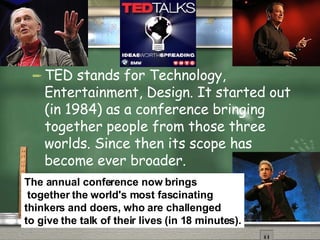
TED stands for Technology, Entertainment, Design. It started out (in 1984) as a conference bringing together people from those three worlds. Since then its scope has become ever broader. The annual conference now brings together the world's most fascinating  thinkers and doers, who are challenged  to give the talk of their lives (in 18 minutes).
The Website http://www.ted.com/index.php/
Sir Ken Robinson is author of  Out of Our Minds: Learning to be Creative , and a leading expert on innovation and human resources. In this talk, he makes an entertaining (and profoundly moving) case for creating an education system that nurtures creativity, rather than undermining it. [Recorded February, 2006 in Monterey, CA. Duration: 20:02]
Group Discussion React to Ken Robinsons assertions about learning and education.  Be prepared to share out as a group.
Mingling Activity Round 1:  Share your ASCD Article. If possible, discuss philosophical implications. Round 2 :  Share your ASCD Article. If possible, discuss historical implications. Round 3:  Share your ASCD article. If possible, discuss implications for your school site and your classroom.
Small Group Discussion Discuss each article separately Take note of elements you would like to use for your textual/visual artifact Create a visual display that includes quotes, phrases, words, symbols, important article facts, and group thoughts and questions about material. Be prepared to present visual as a way of explaining your discussion What aha moments did you have while reading these texts? What is the most important quote in each text? Did any of these articles lead to new understandings about education? How does each article relate to prior readings and discussion? What should today’s curriculum look like? What do the major trends in education look like? Who should plan curriculum?  What doesn’t sit well with you?
Group Presentations
Switch Move into groups that consist of  An Ace, a King, a Queen, and a Jack Some groups may not be equal!
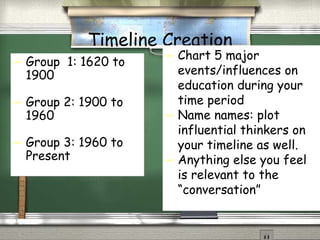
Timeline Creation Group  1: 1620 to 1900 Group 2: 1900 to 1960 Group 3: 1960 to Present Chart 5 major events/influences on education during your time period Name names: plot influential thinkers on your timeline as well. Anything else you feel is relevant to the “conversation”
Reflection Choose a key point on the timeline that you feel has had the greatest impact on your current practice/position/thought related to curriculum and instruction. Describe, analyze, and reflect on the relationship between this timeline entry and your beliefs and instructional practices.
Henry Giroux Video Clip
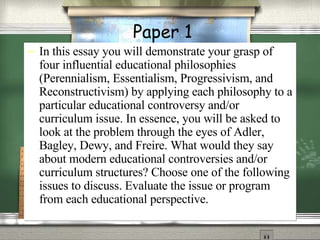
Paper 1 In this essay you will demonstrate your grasp of four influential educational philosophies (Perennialism, Essentialism, Progressivism, and Reconstructivism) by applying each philosophy to a particular educational controversy and/or curriculum issue. In essence, you will be asked to look at the problem through the eyes of Adler, Bagley, Dewy, and Freire. What would they say about modern educational controversies and/or curriculum structures? Choose one of the following issues to discuss. Evaluate the issue or program from each educational perspective.
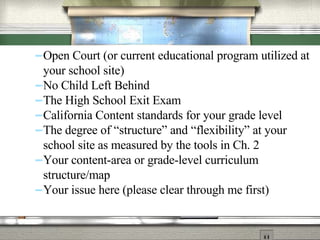
Open Court (or current educational program utilized at your school site) No Child Left Behind The High School Exit Exam California Content standards for your grade level The degree of “structure” and “flexibility” at your school site as measured by the tools in Ch. 2 Your content-area or grade-level curriculum structure/map Your issue here (please clear through me first)
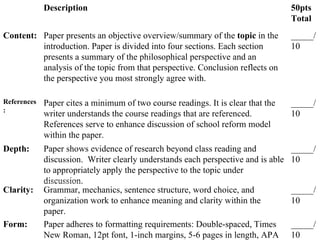
_____/10 Paper adheres to formatting requirements: Double-spaced, Times New Roman, 12pt font, 1-inch margins, 5-6 pages in length, APA guidelines for source material.  Form: _____/10 Grammar, mechanics, sentence structure, word choice, and organization work to enhance meaning and clarity within the paper. Clarity: _____/10 Paper shows evidence of research beyond class reading and discussion.  Writer clearly understands each perspective and is able to appropriately apply the perspective to the topic under discussion. Depth: _____/10 Paper cites a minimum of two course readings. It is clear that the writer understands the course readings that are referenced. References serve to enhance discussion of school reform model within the paper. References: _____/10 Paper presents an objective overview/summary of the  topic  in the introduction. Paper is divided into four sections. Each section presents a summary of the philosophical perspective and an analysis of the topic from that perspective. Conclusion reflects on the perspective you most strongly agree with.  Content:  50pts Total Description
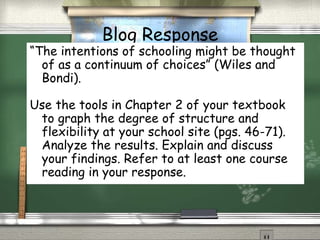
Blog Response “ The intentions of schooling might be thought of as a continuum of choices” (Wiles and Bondi).  Use the tools in Chapter 2 of your textbook to graph the degree of structure and flexibility at your school site (pgs. 46-71). Analyze the results. Explain and discuss your findings. Refer to at least one course reading in your response.

Session 3

  • 1.
  • 2.
    Blog Response ShowcaseI enjoyed Glen Hass’s article “Who Should Plan the Curriculum?” He has an interesting plan of involving more than just the education field. I think that we should get more involvement from the community. It would give us a more specialized focus, AND we would be sharing the responsibility of student learning, which should help shift some of the negative stereotypes that teachers have come to hold.
  • 3.
    Probably the bestway to summarize it would be “All interested citizens, parents, learners, and scholars from many of the disciplines should be encouraged to work with teachers, principals, curriculum leaders, state department of education and federal education agency personnel in the planning.” I think that is the ideal to strive for. I’m just not sure how that would go.
  • 4.
    TED stands forTechnology, Entertainment, Design. It started out (in 1984) as a conference bringing together people from those three worlds. Since then its scope has become ever broader. The annual conference now brings together the world's most fascinating thinkers and doers, who are challenged to give the talk of their lives (in 18 minutes).
  • 5.
  • 6.
    Sir Ken Robinsonis author of Out of Our Minds: Learning to be Creative , and a leading expert on innovation and human resources. In this talk, he makes an entertaining (and profoundly moving) case for creating an education system that nurtures creativity, rather than undermining it. [Recorded February, 2006 in Monterey, CA. Duration: 20:02]
  • 7.
    Group Discussion Reactto Ken Robinsons assertions about learning and education. Be prepared to share out as a group.
  • 8.
    Mingling Activity Round1: Share your ASCD Article. If possible, discuss philosophical implications. Round 2 : Share your ASCD Article. If possible, discuss historical implications. Round 3: Share your ASCD article. If possible, discuss implications for your school site and your classroom.
  • 9.
    Small Group DiscussionDiscuss each article separately Take note of elements you would like to use for your textual/visual artifact Create a visual display that includes quotes, phrases, words, symbols, important article facts, and group thoughts and questions about material. Be prepared to present visual as a way of explaining your discussion What aha moments did you have while reading these texts? What is the most important quote in each text? Did any of these articles lead to new understandings about education? How does each article relate to prior readings and discussion? What should today’s curriculum look like? What do the major trends in education look like? Who should plan curriculum? What doesn’t sit well with you?
  • 10.
  • 11.
    Switch Move intogroups that consist of An Ace, a King, a Queen, and a Jack Some groups may not be equal!
  • 12.
    Timeline Creation Group 1: 1620 to 1900 Group 2: 1900 to 1960 Group 3: 1960 to Present Chart 5 major events/influences on education during your time period Name names: plot influential thinkers on your timeline as well. Anything else you feel is relevant to the “conversation”
  • 13.
    Reflection Choose akey point on the timeline that you feel has had the greatest impact on your current practice/position/thought related to curriculum and instruction. Describe, analyze, and reflect on the relationship between this timeline entry and your beliefs and instructional practices.
  • 14.
  • 15.
    Paper 1 Inthis essay you will demonstrate your grasp of four influential educational philosophies (Perennialism, Essentialism, Progressivism, and Reconstructivism) by applying each philosophy to a particular educational controversy and/or curriculum issue. In essence, you will be asked to look at the problem through the eyes of Adler, Bagley, Dewy, and Freire. What would they say about modern educational controversies and/or curriculum structures? Choose one of the following issues to discuss. Evaluate the issue or program from each educational perspective.
  • 16.
    Open Court (orcurrent educational program utilized at your school site) No Child Left Behind The High School Exit Exam California Content standards for your grade level The degree of “structure” and “flexibility” at your school site as measured by the tools in Ch. 2 Your content-area or grade-level curriculum structure/map Your issue here (please clear through me first)
  • 17.
    _____/10 Paper adheresto formatting requirements: Double-spaced, Times New Roman, 12pt font, 1-inch margins, 5-6 pages in length, APA guidelines for source material. Form: _____/10 Grammar, mechanics, sentence structure, word choice, and organization work to enhance meaning and clarity within the paper. Clarity: _____/10 Paper shows evidence of research beyond class reading and discussion. Writer clearly understands each perspective and is able to appropriately apply the perspective to the topic under discussion. Depth: _____/10 Paper cites a minimum of two course readings. It is clear that the writer understands the course readings that are referenced. References serve to enhance discussion of school reform model within the paper. References: _____/10 Paper presents an objective overview/summary of the topic in the introduction. Paper is divided into four sections. Each section presents a summary of the philosophical perspective and an analysis of the topic from that perspective. Conclusion reflects on the perspective you most strongly agree with. Content: 50pts Total Description
  • 18.
    Blog Response “The intentions of schooling might be thought of as a continuum of choices” (Wiles and Bondi). Use the tools in Chapter 2 of your textbook to graph the degree of structure and flexibility at your school site (pgs. 46-71). Analyze the results. Explain and discuss your findings. Refer to at least one course reading in your response.