What is Content Area Literacy and
Why is it Important?
January 29, 2014

Today’s Objectives:
•Students will be able to explain what is meant by “content area literacy” and how it
applies to their academic domain.
•Students will understand content literacy objectives and expectations as laid out by the
Common Core State Standards and the Wisconsin Department of Public Instruction.
•Students will be able to explain the four approaches to literacy learning (critical,
sociocultural, linguistic, cognitive) and how to apply them to classroom instruction.
•Students will be able to discuss the planning model of Backwards Design and apply the
concepts of “big picture” and “enduring understandings” to literacy learning within their
content area.
Key Vocabulary
Today’s Agenda
• Fang Article: Approaches to developing content area literacies: Writing Prompt, 4Corners Activities, and Connections to mapping our syllabus
• Fisher & Ivey Article: Group Discussion Protocol: One word, one phrase, one
sentence
• BREAK
• Interdisciplinary Groups: Reviewing what the Wisconsin DPI says about
disciplinary literacy
• Content Area Groups: Review Lee & Spratley article and apply to CCSS Literacy in
History, Science, and Technical Subjects
• Wrap-up: Exit Slip Quiz, Questions and Sign-ups
Fang Article
•Opening Writing Prompt
Reflecting on your own literacy learning: Which approach(es) sound most familiar to your literacy
learning experiences? Try to remember specific examples from your past.
Looking forward: Of the four approaches to literacy learning which appeals to you most as a
content area teacher and why? Which approach do you think you would struggle with most
and why?

•Charting our Responses
I will read a series of statements based on the writing prompt. You will move to the section of the
room that correlates with your response. While there, partner up and discuss similarities and
differences in your experiences. Be prepared to share out something you heard your partner say.
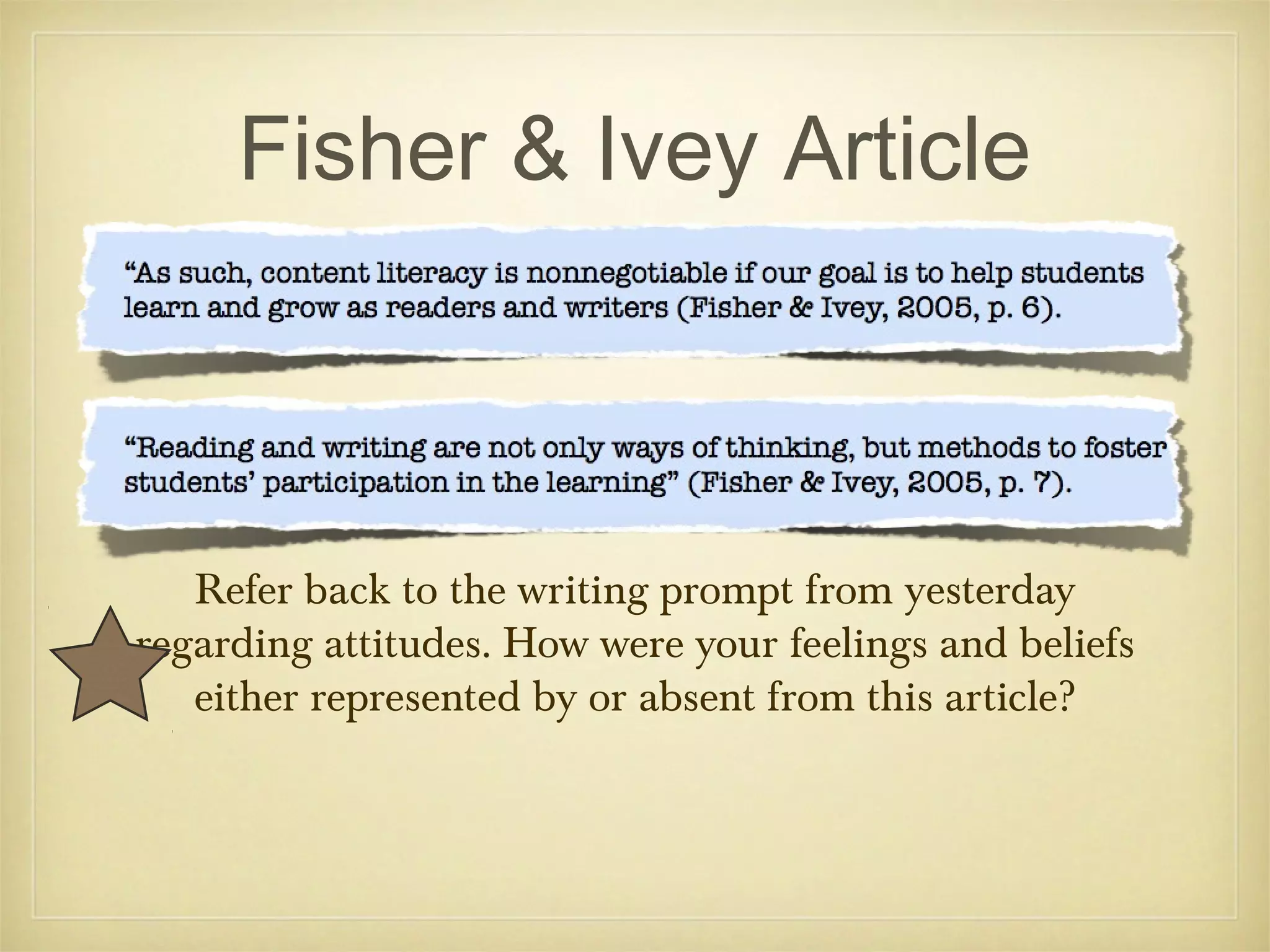
Fisher & Ivey Article

Refer back to the writing prompt from yesterday
regarding attitudes. How were your feelings and beliefs
either represented by or absent from this article?
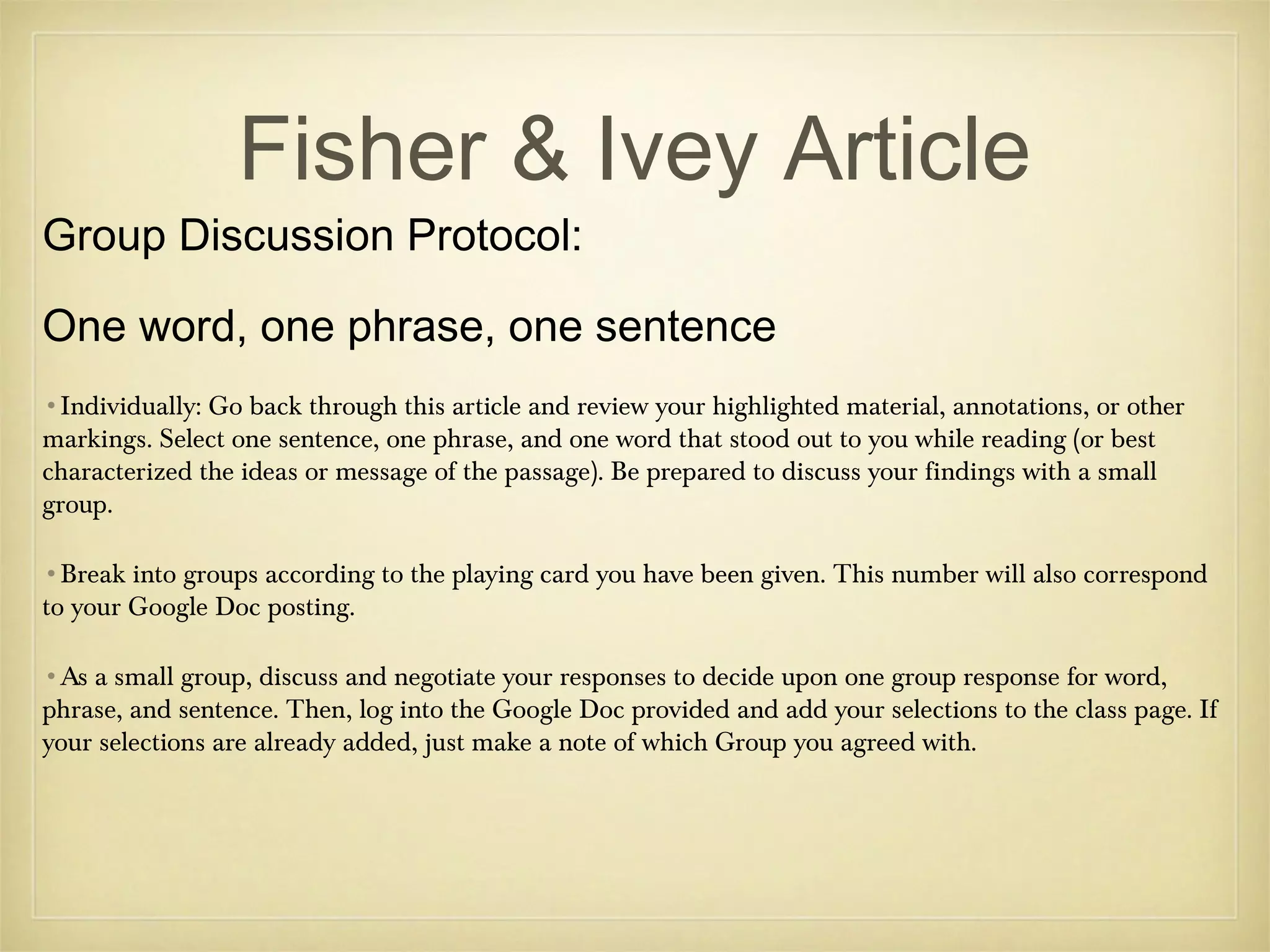
Fisher & Ivey Article

Group Discussion Protocol:

One word, one phrase, one sentence
•Individually: Go back through this article and review your highlighted material, annotations, or other
markings. Select one sentence, one phrase, and one word that stood out to you while reading (or best
characterized the ideas or message of the passage). Be prepared to discuss your findings with a small
group.
•Break into groups according to the playing card you have been given. This number will also correspond
to your Google Doc posting.
•As a small group, discuss and negotiate your responses to decide upon one group response for word,
phrase, and sentence. Then, log into the Google Doc provided and add your selections to the class page. If
your selections are already added, just make a note of which Group you agreed with.
BREAK
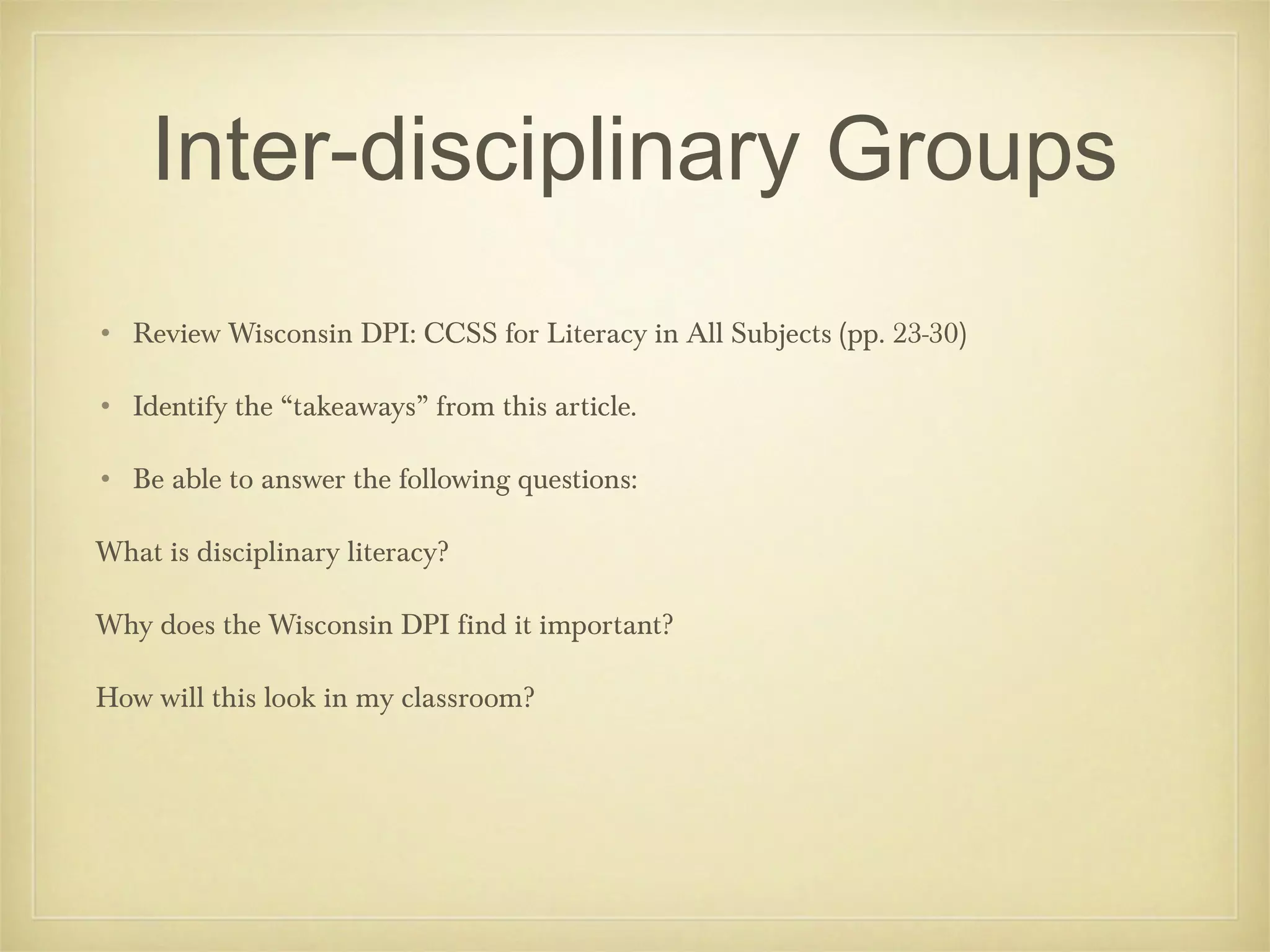
Inter-disciplinary Groups
• Review Wisconsin DPI: CCSS for Literacy in All Subjects (pp. 23-30)
• Identify the “takeaways” from this article.
• Be able to answer the following questions:
What is disciplinary literacy?
Why does the Wisconsin DPI find it important?
How will this look in my classroom?
Content Area Groups
Read excerpt on literacy demands in your content area (Lee & Spratley).
Review the CCSS applicable to literacy in your content area. Compare the development of
strands across grade levels. Then, compare the expectations of the standards to the
expectations for reading in your discipline.
Provide an overall evaluation based on your readings and knowledge of the content area that
includes the following points:
★Do

you think the standards provide a good representation of the skills needed to meet the
literacy demands of your content area. Why or why not?
★Do
★Do

you question any of the choices made by the writers of the CCSS?

you have any questions regarding how to apply these standards? As a group you will
informally present your findings to the class next week--so be sure to carefully record your
findings.
Wrap-Up
•Exit Slip Quiz:
•Discuss how the CCSS for literacy across content
areas might work in conjunction with the
Backwards Planning Model discussed in the Graff
article. How would this look in your content area?
• Questions on Literacy in Action: Part I
• IDU Groups and books due next week--sign up on Learn@UW
• Review discussion leaders: First group starts next week (Meet
with this group after class).
Homework
•Literacy in Action: Part I Due to Discussion
Board

•IDU Groups/Book Selections Due
•Bring Allen book to class
•Readings:
• Vacca, Vacca, & Mraz. Chapter 4, “Planning Instruction for Content Literacy,” pp.
124-165
• Vacca, Vaca, & Mraz. Chapter 7, “Guiding Reading Comprehension,” pp. 194-233
• Fair, G. C., & Combs, D. (2011). Nudging Flaniganedgling Teen Readers from the
Nest: From Round Robin to Real Reading. The Clearing House, 84, 224–230.

Lesson 2: What is Content Area Literacy?

  • 1.
    What is ContentArea Literacy and Why is it Important? Why is it Important? January 29, 2014 Today’s Objectives: •Students will be able to explain what is meant by “content area literacy” and how it applies to their academic domain. •Students will understand content literacy objectives and expectations as laid out by the Common Core State Standards and the Wisconsin Department of Public Instruction. •Students will be able to explain the four approaches to literacy learning (critical, sociocultural, linguistic, cognitive) and how to apply them to classroom instruction. •Students will be able to discuss the planning model of Backwards Design and apply the concepts of “big picture” and “enduring understandings” to literacy learning within their content area.
  • 2.
  • 3.
    Today’s Agenda • FangArticle: Approaches to developing content area literacies: Writing Prompt, 4Corners Activities, and Connections to mapping our syllabus • Fisher & Ivey Article: Group Discussion Protocol: One word, one phrase, one sentence • BREAK • Interdisciplinary Groups: Reviewing what the Wisconsin DPI says about disciplinary literacy • Content Area Groups: Review Lee & Spratley article and apply to CCSS Literacy in History, Science, and Technical Subjects • Wrap-up: Exit Slip Quiz, Questions and Sign-ups
  • 4.
    Fang Article •Opening WritingPrompt Reflecting on your own literacy learning: Which approach(es) sound most familiar to your literacy learning experiences? Try to remember specific examples from your past. Looking forward: Of the four approaches to literacy learning which appeals to you most as a content area teacher and why? Which approach do you think you would struggle with most and why? •Charting our Responses I will read a series of statements based on the writing prompt. You will move to the section of the room that correlates with your response. While there, partner up and discuss similarities and differences in your experiences. Be prepared to share out something you heard your partner say.
  • 5.
    Fisher & IveyArticle Refer back to the writing prompt from yesterday regarding attitudes. How were your feelings and beliefs either represented by or absent from this article?
  • 6.
    Fisher & IveyArticle Group Discussion Protocol: One word, one phrase, one sentence •Individually: Go back through this article and review your highlighted material, annotations, or other markings. Select one sentence, one phrase, and one word that stood out to you while reading (or best characterized the ideas or message of the passage). Be prepared to discuss your findings with a small group. •Break into groups according to the playing card you have been given. This number will also correspond to your Google Doc posting. •As a small group, discuss and negotiate your responses to decide upon one group response for word, phrase, and sentence. Then, log into the Google Doc provided and add your selections to the class page. If your selections are already added, just make a note of which Group you agreed with.
  • 7.
  • 8.
    Inter-disciplinary Groups • ReviewWisconsin DPI: CCSS for Literacy in All Subjects (pp. 23-30) • Identify the “takeaways” from this article. • Be able to answer the following questions: What is disciplinary literacy? Why does the Wisconsin DPI find it important? How will this look in my classroom?
  • 9.
    Content Area Groups Readexcerpt on literacy demands in your content area (Lee & Spratley). Review the CCSS applicable to literacy in your content area. Compare the development of strands across grade levels. Then, compare the expectations of the standards to the expectations for reading in your discipline. Provide an overall evaluation based on your readings and knowledge of the content area that includes the following points: ★Do you think the standards provide a good representation of the skills needed to meet the literacy demands of your content area. Why or why not? ★Do ★Do you question any of the choices made by the writers of the CCSS? you have any questions regarding how to apply these standards? As a group you will informally present your findings to the class next week--so be sure to carefully record your findings.
  • 10.
    Wrap-Up •Exit Slip Quiz: •Discusshow the CCSS for literacy across content areas might work in conjunction with the Backwards Planning Model discussed in the Graff article. How would this look in your content area? • Questions on Literacy in Action: Part I • IDU Groups and books due next week--sign up on Learn@UW • Review discussion leaders: First group starts next week (Meet with this group after class).
  • 11.
    Homework •Literacy in Action:Part I Due to Discussion Board •IDU Groups/Book Selections Due •Bring Allen book to class •Readings: • Vacca, Vacca, & Mraz. Chapter 4, “Planning Instruction for Content Literacy,” pp. 124-165 • Vacca, Vaca, & Mraz. Chapter 7, “Guiding Reading Comprehension,” pp. 194-233 • Fair, G. C., & Combs, D. (2011). Nudging Flaniganedgling Teen Readers from the Nest: From Round Robin to Real Reading. The Clearing House, 84, 224–230.