Reducing green house gas emissions from land
      use changes for oil palm development
                            (Literature Study in Progress)


      Fahmuddin Agus1, Petrus Gunarso2, Bambang H. Saharjo3, Abdul
      Rashid4, K.T. Joseph5, Nancy Harris6, and Meine van Noordwijk7
     1Indonesian  Soil Research Institute, Bogor, Indonesia, 2Tropenbos Indonesia, 3Bogor Agricultural
University/Sawit Watch, Bogor, Indonesia , 4Forest Research Institute Malaysia, Kuala Lumpur, 5University of
  Malaya, Kuala Lumpur, Malaysia, 6Winrock International, Little Rock, USA, 7World Agroforestry Centre
                                           (ICRAF), Nairobi, Kenya


    To be Presentaed at “Sustainable palm oil: challenges, a common vision and the way
                         forward” symposium, 5-6 May 2011, London
Why do we do this?
   Perception that oil palm expansion replaces
    forest and thus the main source of GHG
    emission
   Voluntary GHG emission reduction among
    RSPO members
Objectives
 Analyze land use change in OP
  producing countries
 Estimate of the rate of emissions
 Recommend emission reduction
  scenarios
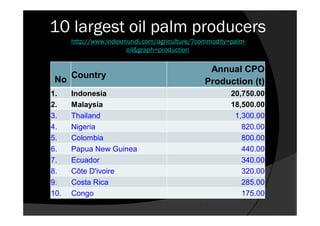
10 largest oil palm producers
      http://www.indexmundi.com/agriculture/?commodity=palm-
                       oil&graph=production

                                                Annual CPO
 No Country                                    Production (t)
1.    Indonesia                                        20,750.00
2.    Malaysia                                         18,500.00
3.    Thailand                                          1,300.00
4.    Nigeria                                             820.00
5.    Colombia                                            800.00
6.    Papua New Guinea                                    440.00
7.    Ecuador                                             340.00
8.    Côte D'ivoire                                       320.00
9.    Costa Rica                                          285.00
10.   Congo                                               175.00
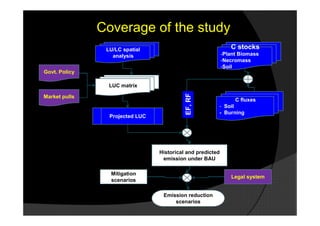
Coverage of the study
                LU/LC spatial                                  C stocks
                  analysis                                  -Plant Biomass
                                                            -Necromass
                                                            -Soil
Govt. Policy

                 LUC matrix


                                           EF, RF
Market pulls
                                                                 C fluxes
                                                        - Soil
                                                        - Burning
                 Projected LUC


                                 Historical and predicted
                                  emission under BAU

                 Mitigation
                                                               Legal system
                 scenarios

                                  Emission reduction
                                      scenarios
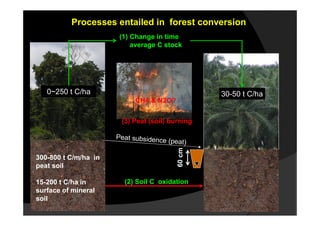
Processes entailed in forest conversion
                       (1) Change in time
                           average C stock


   0~250 t C/ha                                  30-50 t C/ha
                            CH4 & N2O?


                       (3) Peat (soil) burning

                      Peat subsidenc
                                    e (peat)


                                         60 cm
300-800 t C/m/ha in
peat soil

15-200 t C/ha in        (2) Soil C oxidation
surface of mineral
soil
C budget
ΔC= Σij Aij [ΔCijLB + ΔCijDOM + ΔCijSOILS] / Tij

 ΔC       = net C stock change [ton C/yr]
 Aij      = Area under land use i that changes to j [ha]
 ΔCijLB = change in C stock in the living biomass of land
 use i that changes into land use j, [ton C/ha]
 ΔCijDOM = change in C stock in dead plant [ton C/ha]
 ΔCijSOILS = change in soil C stock [ton C/ha]
 Tij      = time scale
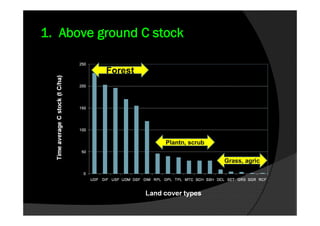
1. Above ground C stock

          Forest


                    Plantn, scrub

                                    Grass, agric
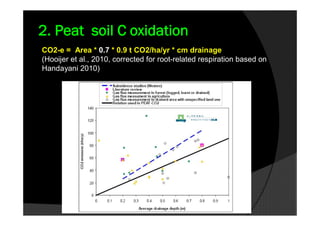
2. Peat soil C oxidation
CO2-e = Area * 0.7 * 0.9 t CO2/ha/yr * cm drainage
(Hooijer et al., 2010, corrected for root-related respiration based on
Handayani 2010)
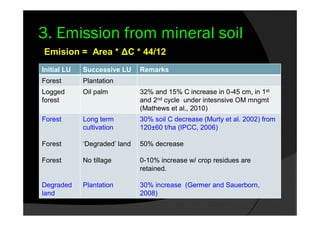
3. Emission from mineral soil
Emision = Area * ΔC * 44/12
Initial LU   Successive LU     Remarks
Forest       Plantation
Logged       Oil palm          32% and 15% C increase in 0-45 cm, in 1st
forest                         and 2nd cycle under intesnsive OM mngmt
                               (Mathews et al., 2010)
Forest       Long term         30% soil C decrease (Murty et al. 2002) from
             cultivation       120±60 t/ha (IPCC, 2006)

Forest       ‘Degraded’ land   50% decrease

Forest       No tillage        0-10% increase w/ crop residues are
                               retained.

Degraded     Plantation        30% increase (Germer and Sauerborn,
land                           2008)
Emission from burning
Above ground:
 Under forest: Partial emission of plant biomass
 Under clear felling: Speed up biomass
  oxidation, but AG biomass also oxidized in
  various ways within 2 years.
Below ground
 Peatland area burning ≠ peat burning
 If peat is burned, then
  ∆C= Vol. of burned peat [m3] * BD [t m-3] * Corg [t t-1] *3.67
  but high uncertainty in prediction.
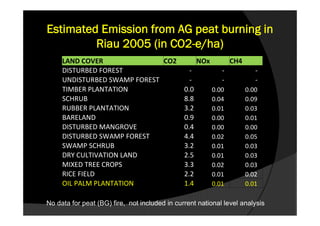
Estimated Emission from AG peat burning in
         Riau 2005 (in CO2-e/ha)
     LAND COVER               CO2                    NOx          CH4
     DISTURBED FOREST                            -            -            -
     UNDISTURBED SWAMP FOREST                    -            -            -
     TIMBER PLANTATION                         0.0         0.00         0.00
     SCHRUB                                    8.8         0.04         0.09
     RUBBER PLANTATION                         3.2         0.01         0.03
     BARELAND                                  0.9         0.00         0.01
     DISTURBED MANGROVE                        0.4         0.00         0.00
     DISTURBED SWAMP FOREST                    4.4         0.02         0.05
     SWAMP SCHRUB                              3.2         0.01         0.03
     DRY CULTIVATION LAND                      2.5         0.01         0.03
     MIXED TREE CROPS                          3.3         0.02         0.03
     RICE FIELD                                2.2         0.01         0.02
     OIL PALM PLANTATION                       1.4         0.01         0.01

No data for peat (BG) fire, not included in current national level analysis
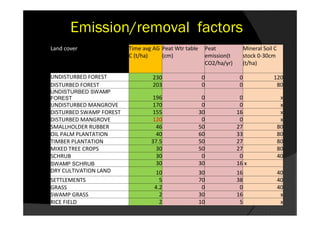
Emission/removal factors
Land cover               Time avg AG Peat Wtr table        Peat              Mineral Soil C
                         C (t/ha)    (cm)                  emission(t        stock 0-30cm
                                                           CO2/ha/yr)        (t/ha)

UNDISTURBED FOREST               230                   0                 0               120
DISTURBED FOREST                 203                   0                 0                80
UNDISTURBED SWAMP
FOREST                            196                  0                 0                     x
UNDISTURBED MANGROVE              170                  0                 0                     x
DISTURBED SWAMP FOREST            155                 30                16                     x
DISTURBED MANGROVE                120                  0                 0                     x
SMALLHOLDER RUBBER                 46                 50                27                    80
OIL PALM PLANTATION                40                 60                33                    80
TIMBER PLANTATION                37.5                 50                27                    80
MIXED TREE CROPS                   30                 50                27                    80
SCHRUB                             30                  0                 0                    40
SWAMP SCHRUB                       30                 30                16 x
DRY CULTIVATION LAND               10                 30                16                    40
SETTLEMENTS                         5                 70                38                    40
GRASS                             4.2                  0                 0                    40
SWAMP GRASS                         2                 30                16                     x
RICE FIELD                          2                 10                 5                     x
Area (Million ha)


                   0.0
                         0.2
                               0.4
                                      0.6
                                                0.8
                                                               1.0
                                                                      1.2
                                                                                   1.4
                                                                                         1.6
                                                                                                    1.8


  OIL PALM 1990
 UNDIST FOREST
    DIST FOREST
 UNDIST SWAMP …
         UNDIST …
   DIST SWAMP …
                                                                     Forest, 32%


DIST MANGROVE
       RUBBER
        TIMBER …
        TIMBER …
        SCHRUB
SWAMP SCHRUB
ANNUAL UPLAND
         GRASS
                                                                                          Non-forest, 68%


  SWAMP GRASS
      RICE FIELD
     BARELAND
                                     Peatland


        OTHERS
                                                Non-peatland
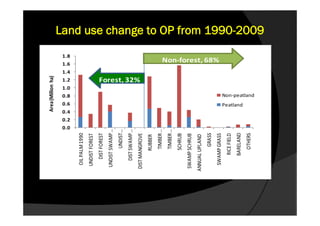
                                                                                                            Land use change to OP from 1990-2009
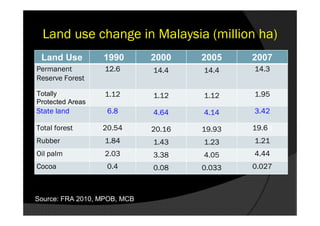
Land use change in Malaysia (million ha)
 Land Use         1990        2000    2005    2007
Permanent          12.6       14.4    14.4    14.3
Reserve Forest

Totally            1.12       1.12    1.12    1.95
Protected Areas
State land         6.8        4.64    4.14    3.42

Total forest      20.54       20.16   19.93   19.66
Rubber             1.84       1.43    1.23    1.21
Oil palm           2.03       3.38    4.05    4.44
Cocoa              0.4        0.08    0.033   0.027


Source: FRA 2010, MPOB, MCB
Oil Palm


                                    Oil Palm


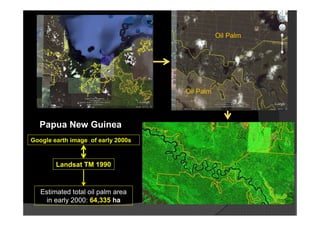
  Papua New Guinea
Google earth image of early 2000s


        Landsat TM 1990


   Estimated total oil palm area
    in early 2000: 64,335 ha
Emission estimate
• Above ground and soil oxidation only (peat fire
  is not included yet)
• This interim calculation assumes same
  emission factors for the three islands
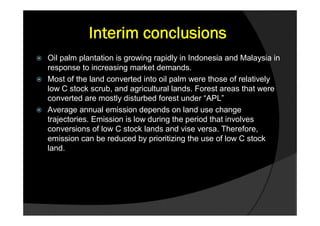
Interim conclusions
 Oil palm plantation is growing rapidly in Indonesia and Malaysia in
  response to increasing market demands.
 Most of the land converted into oil palm were those of relatively
  low C stock scrub, and agricultural lands. Forest areas that were
  converted are mostly disturbed forest under “APL”
 Average annual emission depends on land use change
  trajectories. Emission is low during the period that involves
  conversions of low C stock lands and vise versa. Therefore,
  emission can be reduced by prioritizing the use of low C stock
  land.

Session 2-1-fahmuddin-agus-reducing-ghg-emissions-from-land-use-change-for-oil-palm-development-1465

  • 1.
    Reducing green housegas emissions from land use changes for oil palm development (Literature Study in Progress) Fahmuddin Agus1, Petrus Gunarso2, Bambang H. Saharjo3, Abdul Rashid4, K.T. Joseph5, Nancy Harris6, and Meine van Noordwijk7 1Indonesian Soil Research Institute, Bogor, Indonesia, 2Tropenbos Indonesia, 3Bogor Agricultural University/Sawit Watch, Bogor, Indonesia , 4Forest Research Institute Malaysia, Kuala Lumpur, 5University of Malaya, Kuala Lumpur, Malaysia, 6Winrock International, Little Rock, USA, 7World Agroforestry Centre (ICRAF), Nairobi, Kenya To be Presentaed at “Sustainable palm oil: challenges, a common vision and the way forward” symposium, 5-6 May 2011, London
  • 2.
    Why do wedo this?  Perception that oil palm expansion replaces forest and thus the main source of GHG emission  Voluntary GHG emission reduction among RSPO members
  • 3.
    Objectives  Analyze landuse change in OP producing countries  Estimate of the rate of emissions  Recommend emission reduction scenarios
  • 4.
    10 largest oilpalm producers http://www.indexmundi.com/agriculture/?commodity=palm- oil&graph=production Annual CPO No Country Production (t) 1. Indonesia 20,750.00 2. Malaysia 18,500.00 3. Thailand 1,300.00 4. Nigeria 820.00 5. Colombia 800.00 6. Papua New Guinea 440.00 7. Ecuador 340.00 8. Côte D'ivoire 320.00 9. Costa Rica 285.00 10. Congo 175.00
  • 5.
    Coverage of thestudy LU/LC spatial C stocks analysis -Plant Biomass -Necromass -Soil Govt. Policy LUC matrix EF, RF Market pulls C fluxes - Soil - Burning Projected LUC Historical and predicted emission under BAU Mitigation Legal system scenarios Emission reduction scenarios
  • 6.
    Processes entailed inforest conversion (1) Change in time average C stock 0~250 t C/ha 30-50 t C/ha CH4 & N2O? (3) Peat (soil) burning Peat subsidenc e (peat) 60 cm 300-800 t C/m/ha in peat soil 15-200 t C/ha in (2) Soil C oxidation surface of mineral soil
  • 7.
    C budget ΔC= ΣijAij [ΔCijLB + ΔCijDOM + ΔCijSOILS] / Tij ΔC = net C stock change [ton C/yr] Aij = Area under land use i that changes to j [ha] ΔCijLB = change in C stock in the living biomass of land use i that changes into land use j, [ton C/ha] ΔCijDOM = change in C stock in dead plant [ton C/ha] ΔCijSOILS = change in soil C stock [ton C/ha] Tij = time scale
  • 8.
    1. Above groundC stock Forest Plantn, scrub Grass, agric
  • 9.
    2. Peat soilC oxidation CO2-e = Area * 0.7 * 0.9 t CO2/ha/yr * cm drainage (Hooijer et al., 2010, corrected for root-related respiration based on Handayani 2010)
  • 10.
    3. Emission frommineral soil Emision = Area * ΔC * 44/12 Initial LU Successive LU Remarks Forest Plantation Logged Oil palm 32% and 15% C increase in 0-45 cm, in 1st forest and 2nd cycle under intesnsive OM mngmt (Mathews et al., 2010) Forest Long term 30% soil C decrease (Murty et al. 2002) from cultivation 120±60 t/ha (IPCC, 2006) Forest ‘Degraded’ land 50% decrease Forest No tillage 0-10% increase w/ crop residues are retained. Degraded Plantation 30% increase (Germer and Sauerborn, land 2008)
  • 11.
    Emission from burning Aboveground:  Under forest: Partial emission of plant biomass  Under clear felling: Speed up biomass oxidation, but AG biomass also oxidized in various ways within 2 years. Below ground  Peatland area burning ≠ peat burning  If peat is burned, then ∆C= Vol. of burned peat [m3] * BD [t m-3] * Corg [t t-1] *3.67 but high uncertainty in prediction.
  • 12.
    Estimated Emission fromAG peat burning in Riau 2005 (in CO2-e/ha) LAND COVER CO2 NOx CH4 DISTURBED FOREST - - - UNDISTURBED SWAMP FOREST - - - TIMBER PLANTATION 0.0 0.00 0.00 SCHRUB 8.8 0.04 0.09 RUBBER PLANTATION 3.2 0.01 0.03 BARELAND 0.9 0.00 0.01 DISTURBED MANGROVE 0.4 0.00 0.00 DISTURBED SWAMP FOREST 4.4 0.02 0.05 SWAMP SCHRUB 3.2 0.01 0.03 DRY CULTIVATION LAND 2.5 0.01 0.03 MIXED TREE CROPS 3.3 0.02 0.03 RICE FIELD 2.2 0.01 0.02 OIL PALM PLANTATION 1.4 0.01 0.01 No data for peat (BG) fire, not included in current national level analysis
  • 13.
    Emission/removal factors Land cover Time avg AG Peat Wtr table Peat Mineral Soil C C (t/ha) (cm) emission(t stock 0-30cm CO2/ha/yr) (t/ha) UNDISTURBED FOREST 230 0 0 120 DISTURBED FOREST 203 0 0 80 UNDISTURBED SWAMP FOREST 196 0 0 x UNDISTURBED MANGROVE 170 0 0 x DISTURBED SWAMP FOREST 155 30 16 x DISTURBED MANGROVE 120 0 0 x SMALLHOLDER RUBBER 46 50 27 80 OIL PALM PLANTATION 40 60 33 80 TIMBER PLANTATION 37.5 50 27 80 MIXED TREE CROPS 30 50 27 80 SCHRUB 30 0 0 40 SWAMP SCHRUB 30 30 16 x DRY CULTIVATION LAND 10 30 16 40 SETTLEMENTS 5 70 38 40 GRASS 4.2 0 0 40 SWAMP GRASS 2 30 16 x RICE FIELD 2 10 5 x
  • 14.
    Area (Million ha) 0.0 0.2 0.4 0.6 0.8 1.0 1.2 1.4 1.6 1.8 OIL PALM 1990 UNDIST FOREST DIST FOREST UNDIST SWAMP … UNDIST … DIST SWAMP … Forest, 32% DIST MANGROVE RUBBER TIMBER … TIMBER … SCHRUB SWAMP SCHRUB ANNUAL UPLAND GRASS Non-forest, 68% SWAMP GRASS RICE FIELD BARELAND Peatland OTHERS Non-peatland Land use change to OP from 1990-2009
  • 15.
    Land use changein Malaysia (million ha) Land Use 1990 2000 2005 2007 Permanent 12.6 14.4 14.4 14.3 Reserve Forest Totally 1.12 1.12 1.12 1.95 Protected Areas State land 6.8 4.64 4.14 3.42 Total forest 20.54 20.16 19.93 19.66 Rubber 1.84 1.43 1.23 1.21 Oil palm 2.03 3.38 4.05 4.44 Cocoa 0.4 0.08 0.033 0.027 Source: FRA 2010, MPOB, MCB
  • 16.
    Oil Palm Oil Palm Papua New Guinea Google earth image of early 2000s Landsat TM 1990 Estimated total oil palm area in early 2000: 64,335 ha
  • 17.
    Emission estimate • Aboveground and soil oxidation only (peat fire is not included yet) • This interim calculation assumes same emission factors for the three islands
  • 18.
    Interim conclusions  Oilpalm plantation is growing rapidly in Indonesia and Malaysia in response to increasing market demands.  Most of the land converted into oil palm were those of relatively low C stock scrub, and agricultural lands. Forest areas that were converted are mostly disturbed forest under “APL”  Average annual emission depends on land use change trajectories. Emission is low during the period that involves conversions of low C stock lands and vise versa. Therefore, emission can be reduced by prioritizing the use of low C stock land.