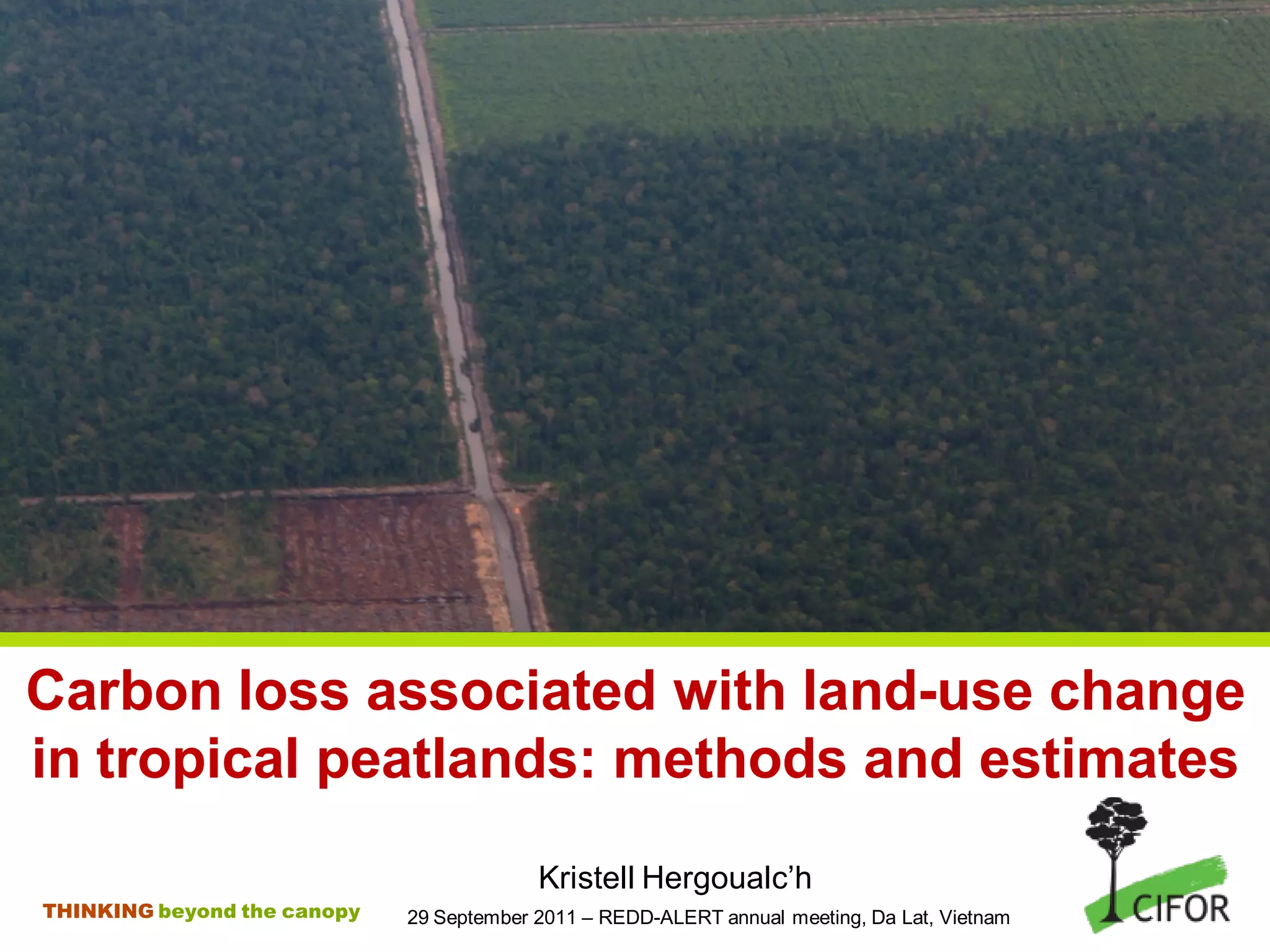
Carbon loss associated with land-use change
in tropical peatlands: methods and estimates
                                          Kristell Hergoualc’h
THINKING beyond the canopy   29 September 2011 – REDD-ALERT annual meeting, Da Lat, Vietnam
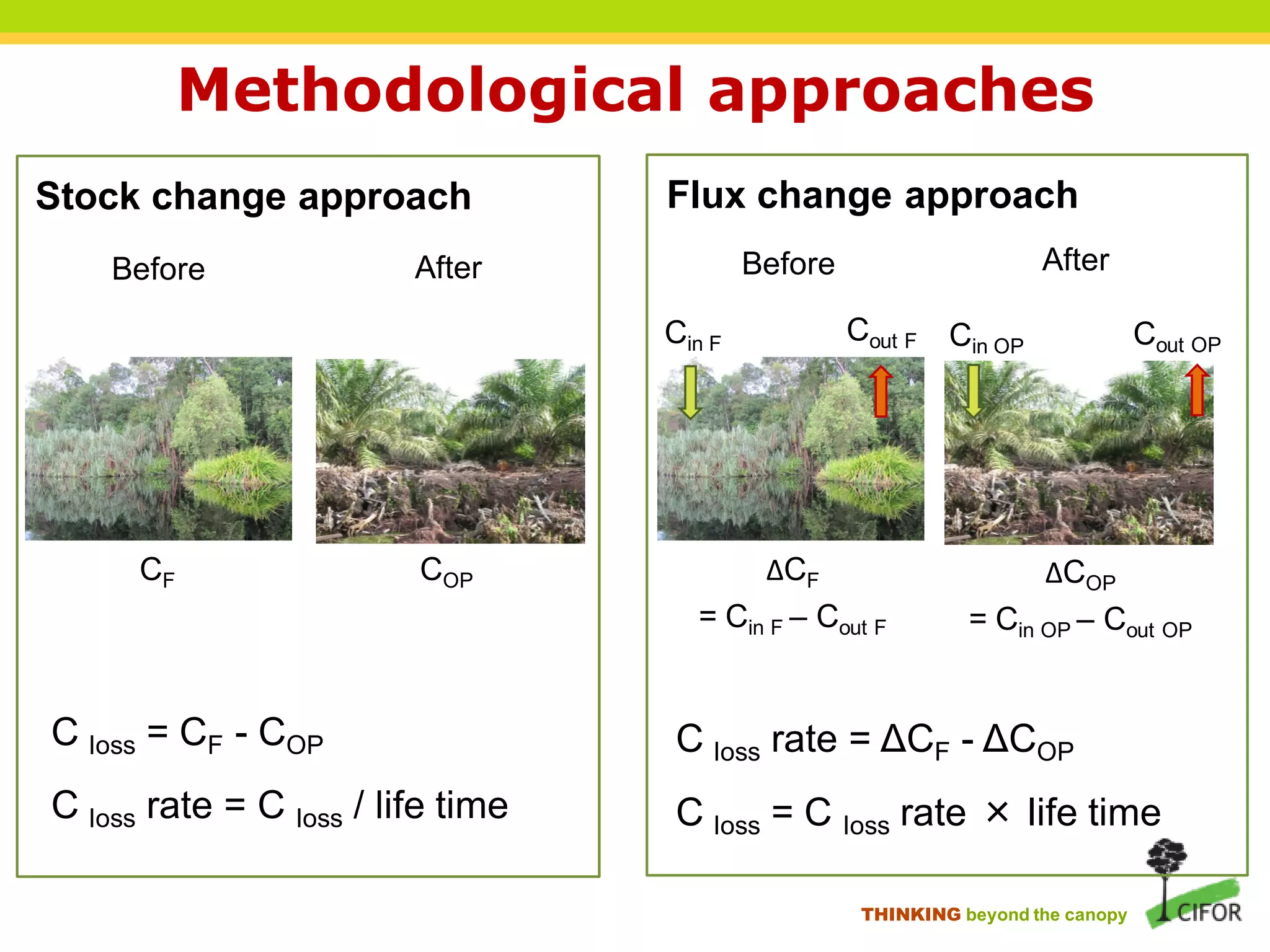
Methodological approaches
Stock change approach              Flux change approach
    Before               After             Before                     After

                                   Cin F            Cout F   Cin OP               Cout OP


      CF                 COP              ΔCF                        ΔCOP
                                     = Cin F – Cout F          = Cin OP – Cout OP


C loss = CF - COP                  C loss rate = ΔCF - ΔCOP
C loss rate = C loss / life time   C loss = C loss rate × life time

                                                     THINKING beyond the canopy
Carbon loss estimates

Literature review
 Southeast Asian peatlands
 C stocks, peat C fluxes
 56 studies

Two publications
   Murdiyarso D, Hergoualc'h K & Verchot LV 2010, ‘Opportunities for
    reducing greenhouse gas emissions in tropical peatlands’, PNAS, vol
    107, no 46, pp. 19655-19660
   Hergoualc’h K & Verchot LV 2011, ‘Stocks and fluxes of carbon
    associated with land-use change in Southeast Asian tropical peatlands: a
    review’, Global Biogeochemical Cycles, vol 25, GB2001.


                                                      THINKING beyond the canopy
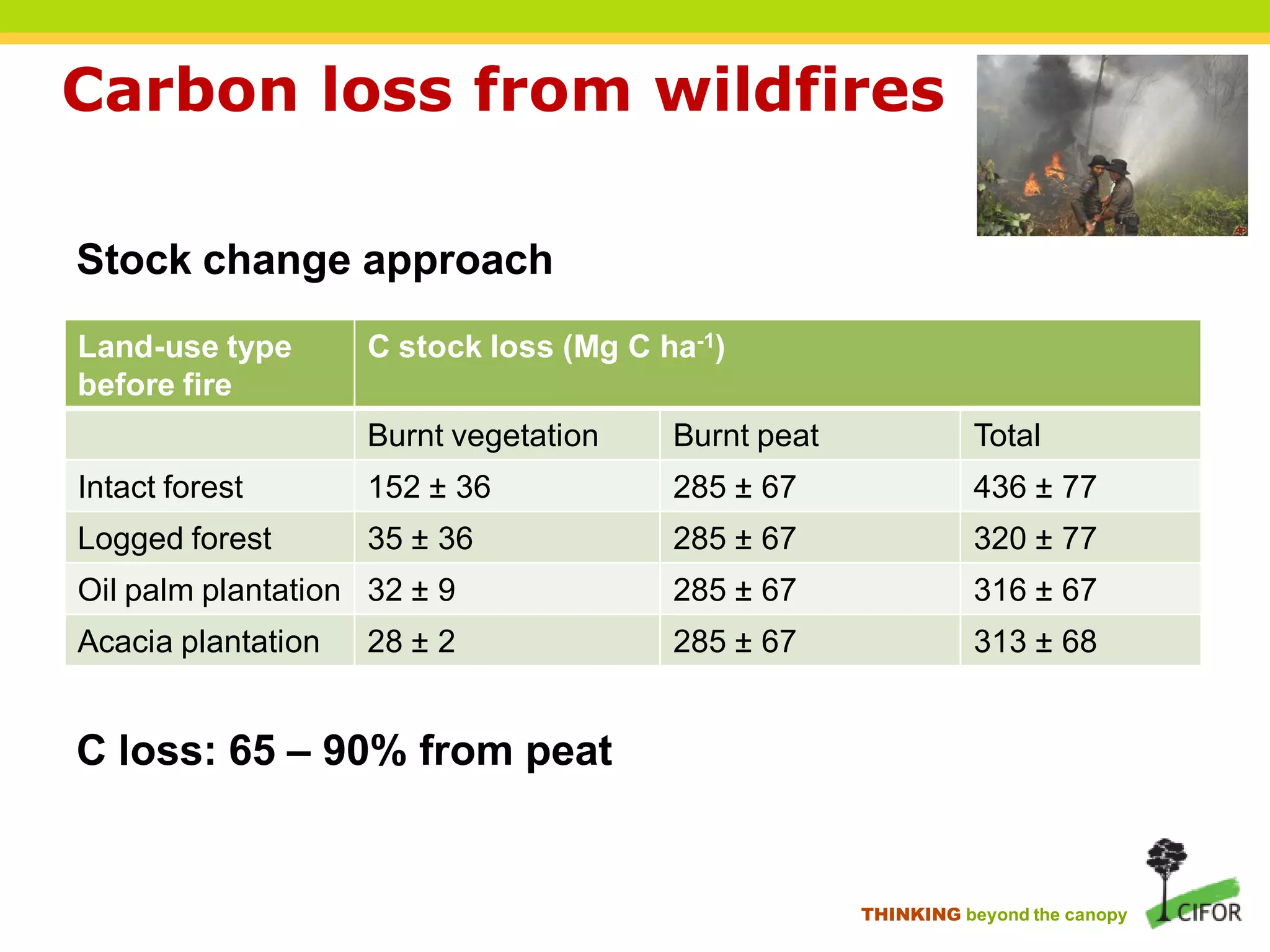
Carbon loss from wildfires

Stock change approach
Land-use type       C stock loss (Mg C ha-1)
before fire
                    Burnt vegetation    Burnt peat             Total
Intact forest       152 ± 36            285 ± 67               436 ± 77
Logged forest       35 ± 36             285 ± 67               320 ± 77
Oil palm plantation 32 ± 9              285 ± 67               316 ± 67
Acacia plantation   28 ± 2              285 ± 67               313 ± 68


C loss: 65 – 90% from peat


                                                     THINKING beyond the canopy
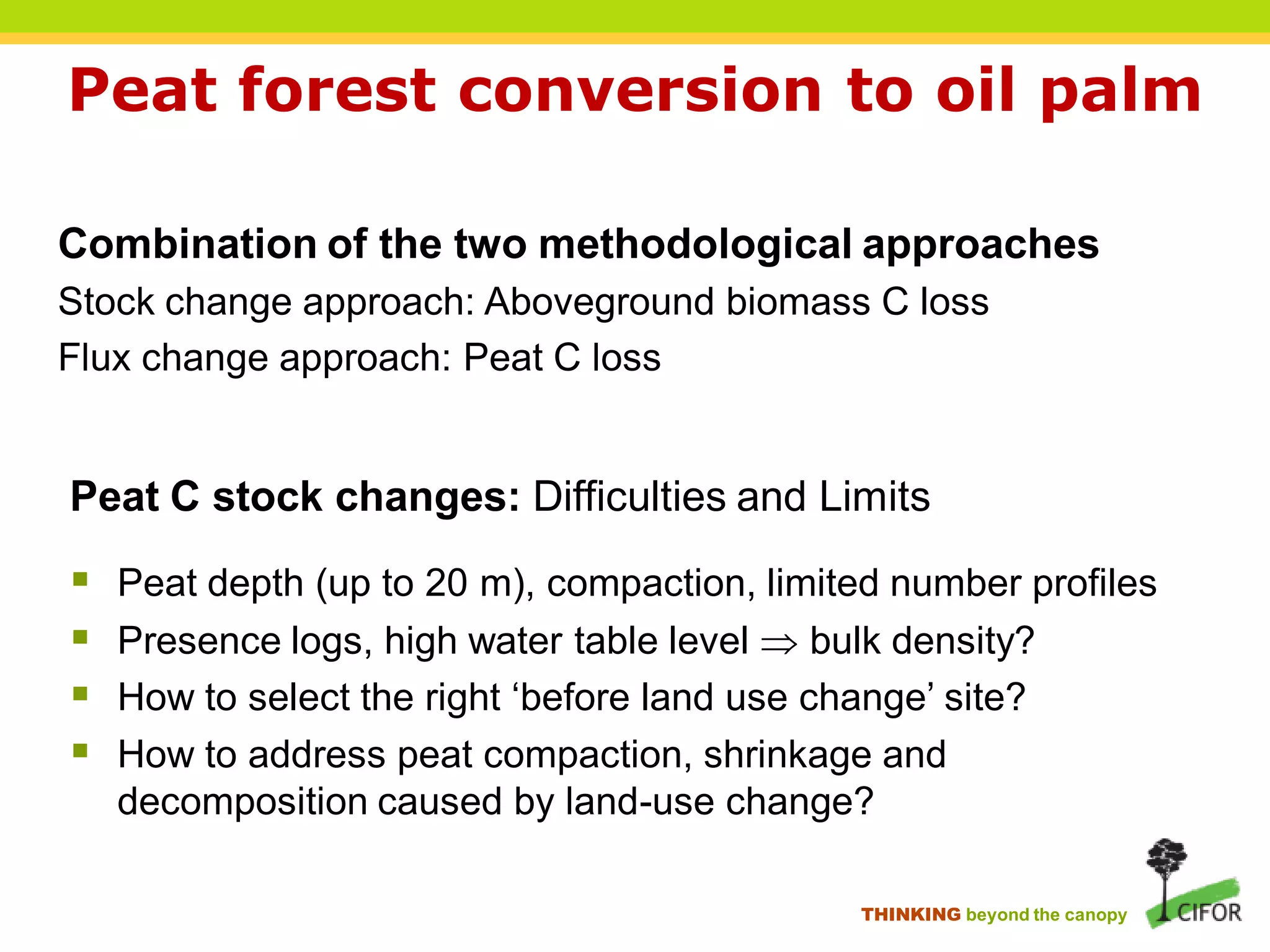
Peat forest conversion to oil palm

Combination of the two methodological approaches
Stock change approach: Aboveground biomass C loss
Flux change approach: Peat C loss


Peat C stock changes: Difficulties and Limits
   Peat depth (up to 20 m), compaction, limited number profiles
   Presence logs, high water table level  bulk density?
   How to select the right ‘before land use change’ site?
   How to address peat compaction, shrinkage and
    decomposition caused by land-use change?

                                              THINKING beyond the canopy
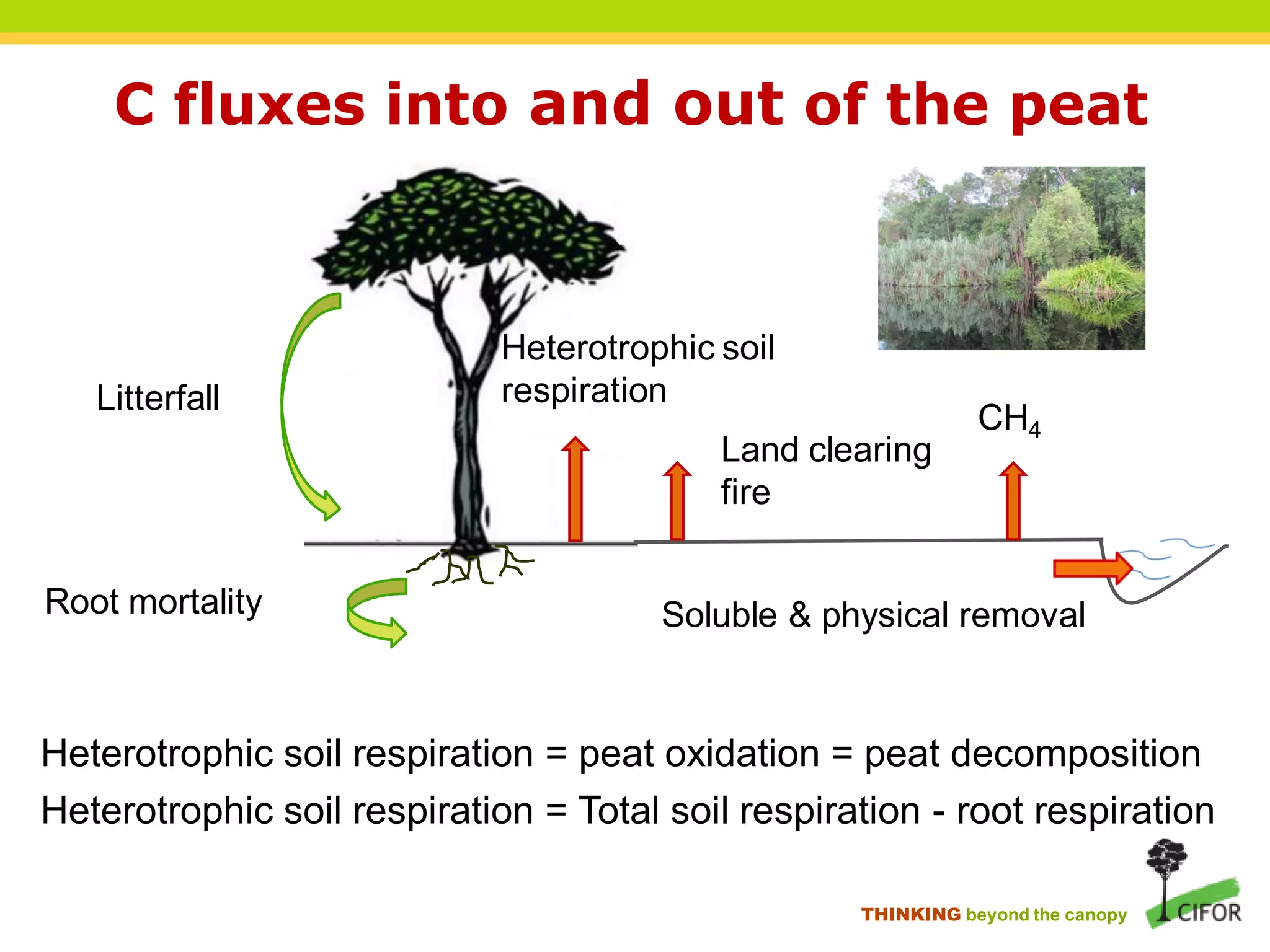
C fluxes into and out of the peat


                             Heterotrophic soil
   Litterfall                respiration
                                                              CH4
                                           Land clearing
                                           fire


Root mortality                         Soluble & physical removal


Heterotrophic soil respiration = peat oxidation = peat decomposition
Heterotrophic soil respiration = Total soil respiration - root respiration

                                                   THINKING beyond the canopy
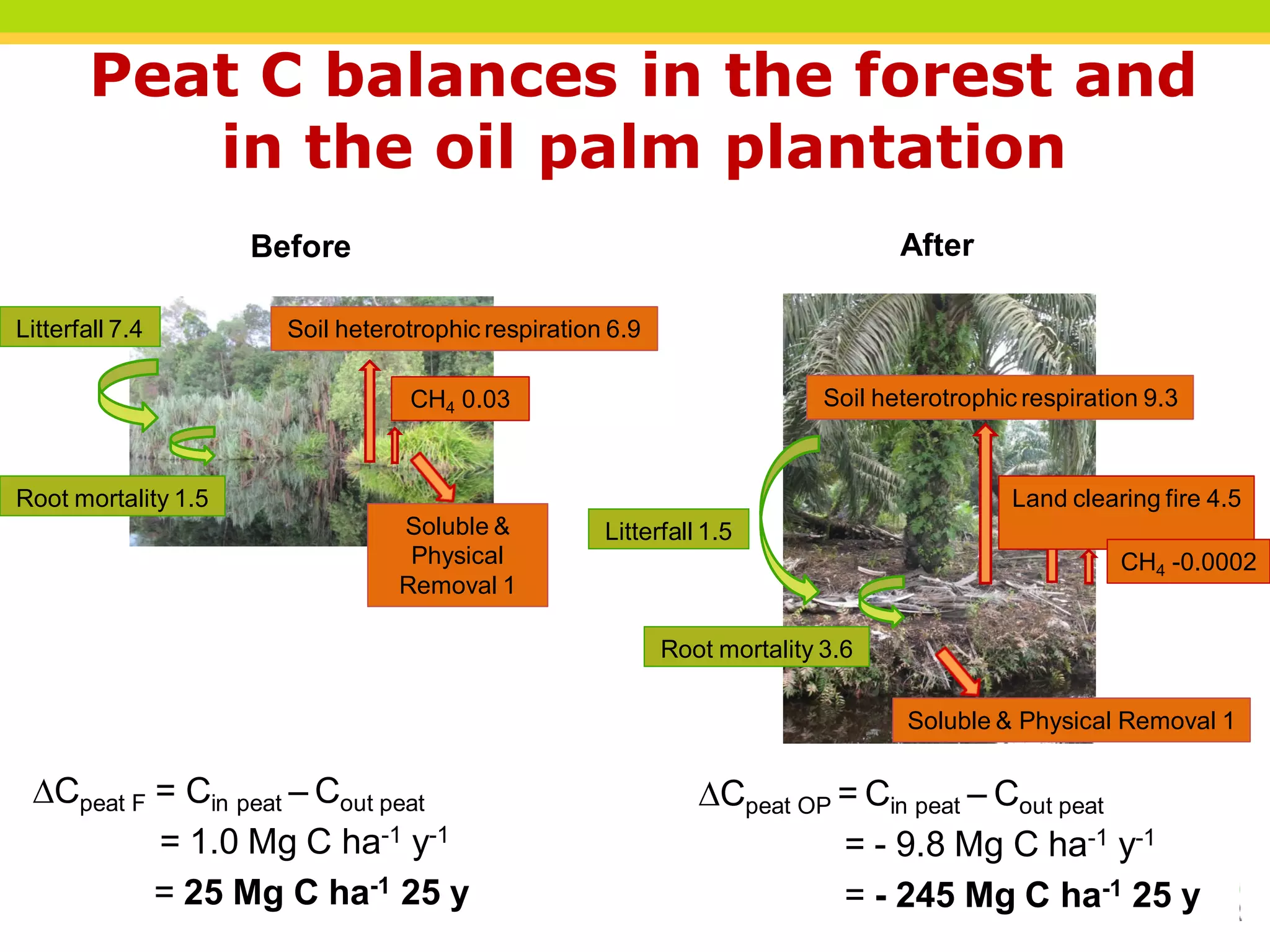
Peat C balances in the forest and
           in the oil palm plantation
                     Before                                                       After

Litterfall 7.4         Soil heterotrophic respiration 6.9

                                  CH4 0.03                                 Soil heterotrophic respiration 9.3


Root mortality 1.5                                                                           Land clearing fire 4.5
                                 Soluble &           Litterfall 1.5
                                  Physical                                                             CH4 -0.0002
                                 Removal 1

                                                            Root mortality 3.6

                                                                                   Soluble & Physical Removal 1

 Cpeat F = Cin peat – Cout peat                               Cpeat OP = Cin peat – Cout peat
          = 1.0 Mg C ha-1 y-1                                            = - 9.8 Mg C ha-1 y-1
          = 25 Mg C ha-1 25 y                                            =THINKING Mg C ha-1 25 y
                                                                           - 245 beyond the canopy
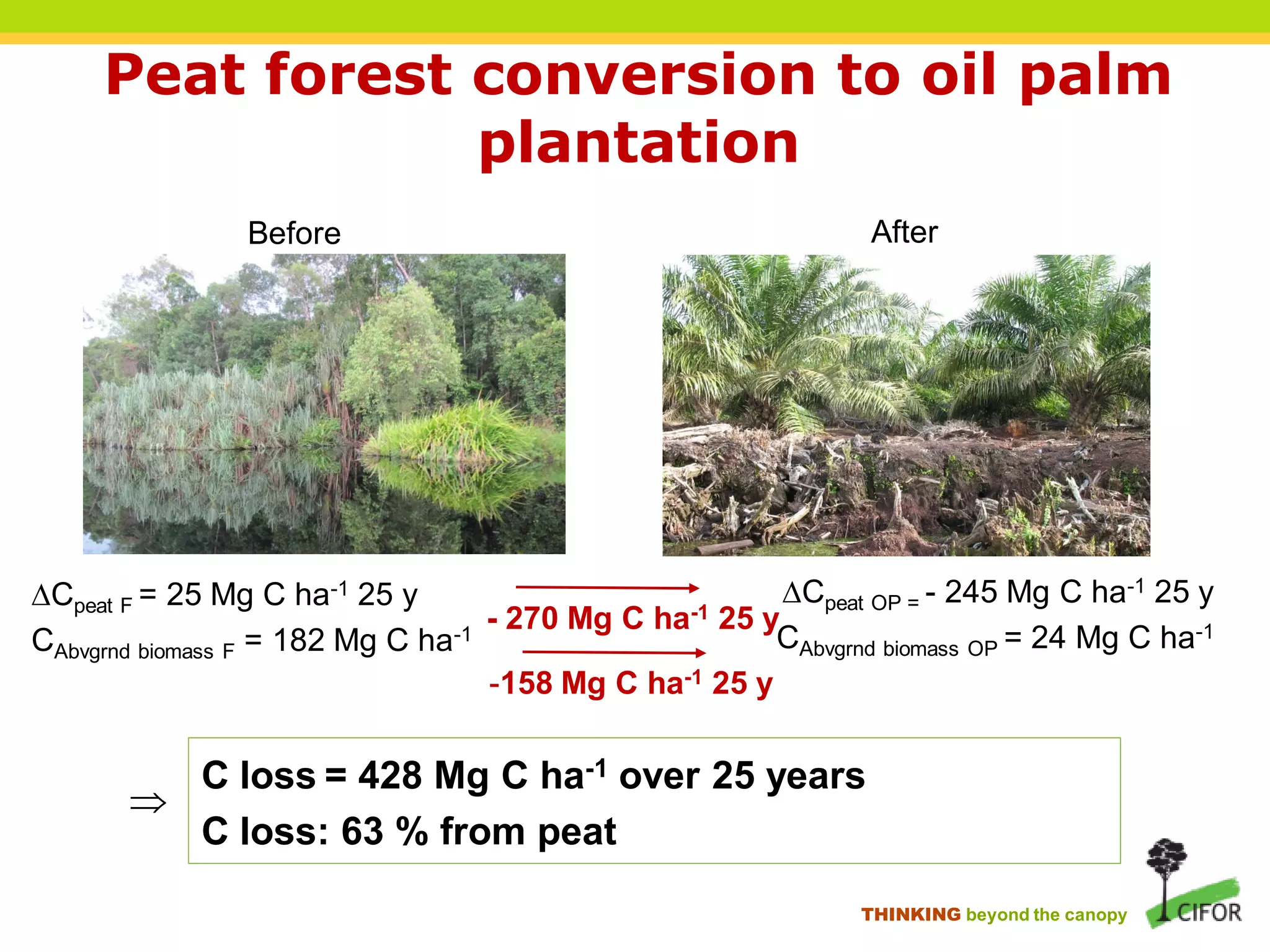
Peat forest conversion to oil palm
                 plantation
                Before                                         After


Cpeat F = 25 Mg C ha-1 25 y                             Cpeat OP = - 245 Mg C ha-1 25 y
                                   - 270 Mg C ha -1 25 y
CAbvgrnd biomass F = 182 Mg C ha-1                      CAbvgrnd biomass OP = 24 Mg C ha-1
                                   -158 Mg C ha-1 25 y

         C loss = 428 Mg C ha-1 over 25 years
       
         C loss: 63 % from peat
                                                               THINKING beyond the canopy
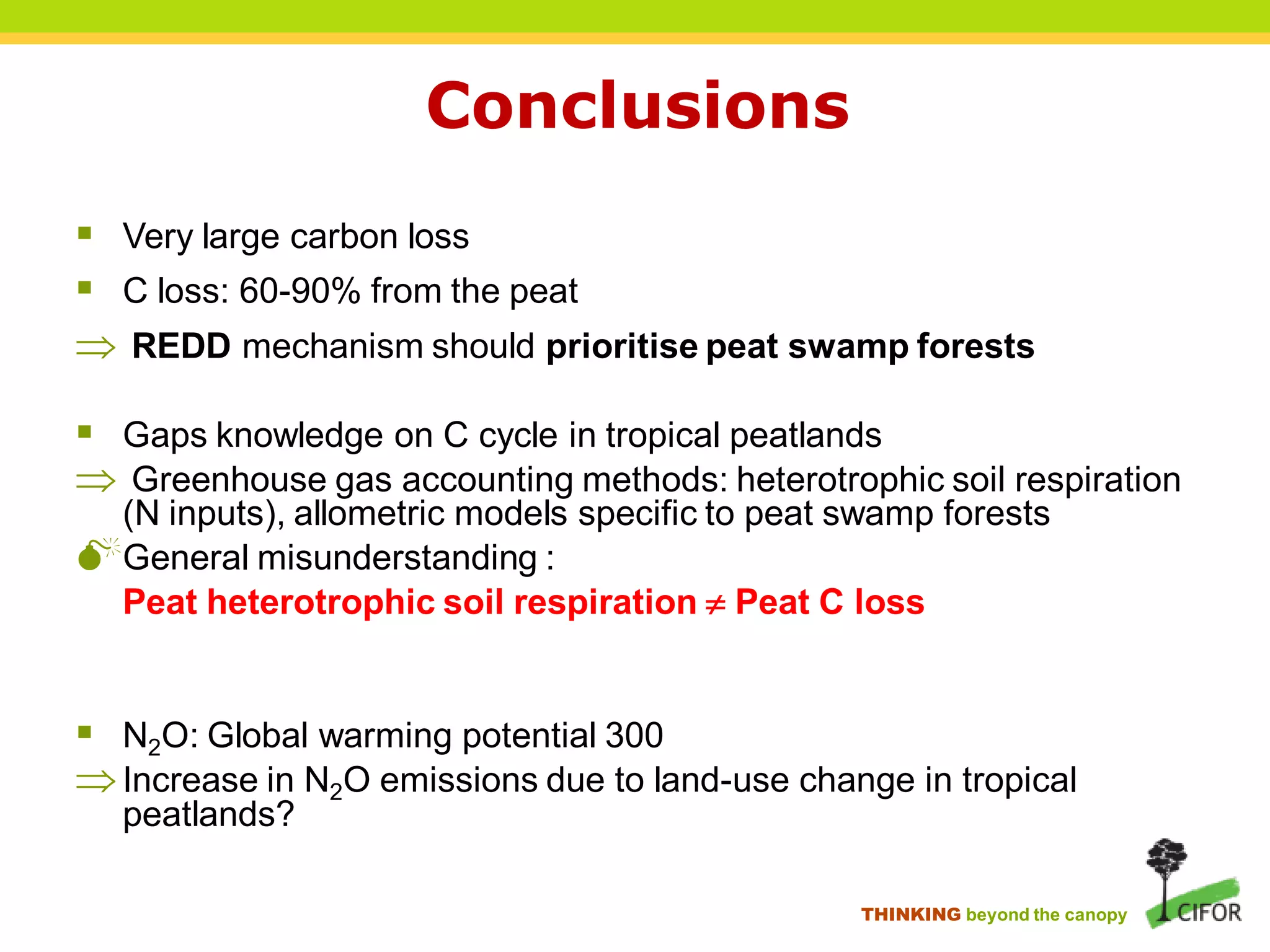
Conclusions
 Very large carbon loss
 C loss: 60-90% from the peat
 REDD mechanism should prioritise peat swamp forests

 Gaps knowledge on C cycle in tropical peatlands
 Greenhouse gas accounting methods: heterotrophic soil respiration
 (N inputs), allometric models specific to peat swamp forests
General misunderstanding :
 Peat heterotrophic soil respiration  Peat C loss


 N2O: Global warming potential 300
 Increase in N2O emissions due to land-use change in tropical
  peatlands?

                                                 THINKING beyond the canopy
Thank you


www.cifor.org

      CIFOR advances human well-being, environmental conservation, and equity by conducting
      research to inform policies and practices that affect forests in developing countries.


                                                                 THINKING beyond the canopy

Carbon loss associated with land-use change in tropical peatlands: methods and estimates

  • 1.
    Carbon loss associatedwith land-use change in tropical peatlands: methods and estimates Kristell Hergoualc’h THINKING beyond the canopy 29 September 2011 – REDD-ALERT annual meeting, Da Lat, Vietnam
  • 2.
    Methodological approaches Stock changeapproach Flux change approach Before After Before After Cin F Cout F Cin OP Cout OP CF COP ΔCF ΔCOP = Cin F – Cout F = Cin OP – Cout OP C loss = CF - COP C loss rate = ΔCF - ΔCOP C loss rate = C loss / life time C loss = C loss rate × life time THINKING beyond the canopy
  • 3.
    Carbon loss estimates Literaturereview  Southeast Asian peatlands  C stocks, peat C fluxes  56 studies Two publications  Murdiyarso D, Hergoualc'h K & Verchot LV 2010, ‘Opportunities for reducing greenhouse gas emissions in tropical peatlands’, PNAS, vol 107, no 46, pp. 19655-19660  Hergoualc’h K & Verchot LV 2011, ‘Stocks and fluxes of carbon associated with land-use change in Southeast Asian tropical peatlands: a review’, Global Biogeochemical Cycles, vol 25, GB2001. THINKING beyond the canopy
  • 4.
    Carbon loss fromwildfires Stock change approach Land-use type C stock loss (Mg C ha-1) before fire Burnt vegetation Burnt peat Total Intact forest 152 ± 36 285 ± 67 436 ± 77 Logged forest 35 ± 36 285 ± 67 320 ± 77 Oil palm plantation 32 ± 9 285 ± 67 316 ± 67 Acacia plantation 28 ± 2 285 ± 67 313 ± 68 C loss: 65 – 90% from peat THINKING beyond the canopy
  • 5.
    Peat forest conversionto oil palm Combination of the two methodological approaches Stock change approach: Aboveground biomass C loss Flux change approach: Peat C loss Peat C stock changes: Difficulties and Limits  Peat depth (up to 20 m), compaction, limited number profiles  Presence logs, high water table level  bulk density?  How to select the right ‘before land use change’ site?  How to address peat compaction, shrinkage and decomposition caused by land-use change? THINKING beyond the canopy
  • 6.
    C fluxes intoand out of the peat Heterotrophic soil Litterfall respiration CH4 Land clearing fire Root mortality Soluble & physical removal Heterotrophic soil respiration = peat oxidation = peat decomposition Heterotrophic soil respiration = Total soil respiration - root respiration THINKING beyond the canopy
  • 7.
    Peat C balancesin the forest and in the oil palm plantation Before After Litterfall 7.4 Soil heterotrophic respiration 6.9 CH4 0.03 Soil heterotrophic respiration 9.3 Root mortality 1.5 Land clearing fire 4.5 Soluble & Litterfall 1.5 Physical CH4 -0.0002 Removal 1 Root mortality 3.6 Soluble & Physical Removal 1 Cpeat F = Cin peat – Cout peat Cpeat OP = Cin peat – Cout peat = 1.0 Mg C ha-1 y-1 = - 9.8 Mg C ha-1 y-1 = 25 Mg C ha-1 25 y =THINKING Mg C ha-1 25 y - 245 beyond the canopy
  • 8.
    Peat forest conversionto oil palm plantation Before After Cpeat F = 25 Mg C ha-1 25 y Cpeat OP = - 245 Mg C ha-1 25 y - 270 Mg C ha -1 25 y CAbvgrnd biomass F = 182 Mg C ha-1 CAbvgrnd biomass OP = 24 Mg C ha-1 -158 Mg C ha-1 25 y C loss = 428 Mg C ha-1 over 25 years  C loss: 63 % from peat THINKING beyond the canopy
  • 9.
    Conclusions  Very largecarbon loss  C loss: 60-90% from the peat  REDD mechanism should prioritise peat swamp forests  Gaps knowledge on C cycle in tropical peatlands  Greenhouse gas accounting methods: heterotrophic soil respiration (N inputs), allometric models specific to peat swamp forests General misunderstanding : Peat heterotrophic soil respiration  Peat C loss  N2O: Global warming potential 300  Increase in N2O emissions due to land-use change in tropical peatlands? THINKING beyond the canopy
  • 10.
    Thank you www.cifor.org CIFOR advances human well-being, environmental conservation, and equity by conducting research to inform policies and practices that affect forests in developing countries. THINKING beyond the canopy