Tassilo Pellegrini (UAS St. Pölten)
Sabrina Kirraine & Simon Steyskal (Vienna Univ. of Economics)
Anna Fensel & Oleksandra Pansiuk (STI2 – Univ. of Innsbruck)
Markus Dörfler (HIP)
Thomas Thurner & Victor Mireles Chavez (SWC)
SEMANTICS 2017, Amsterdam, The Netherlands - 12.09.2017
Contact: tassilo.pellegrini@fhstp.ac.at
Site: http://dalicc.net
This slidedeck is available under CC BY-NC-ND 4.0
Data Governance
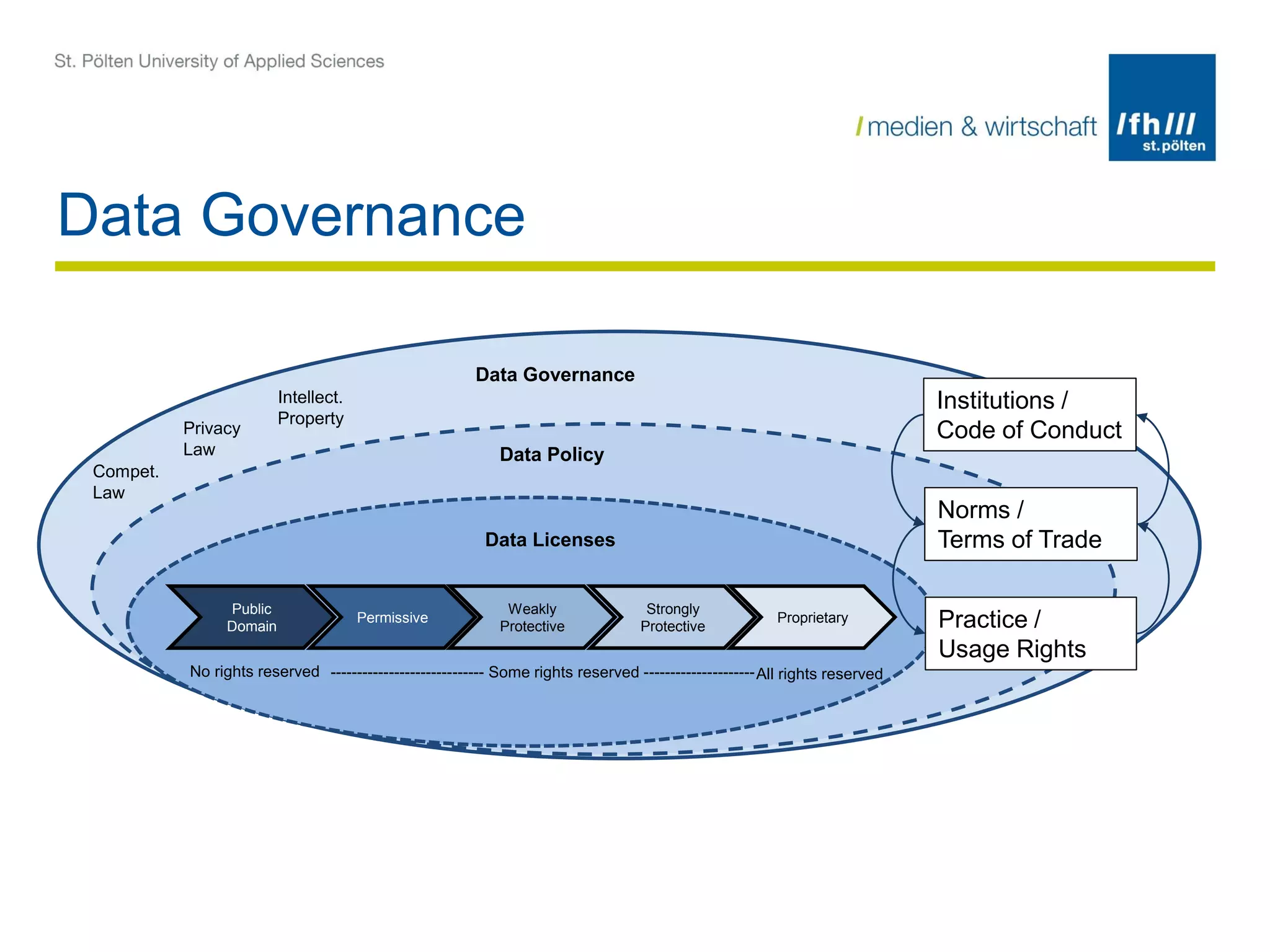
Data Governance
Data Policy
Intellect.
Property
Privacy
Law
Compet.
Law
Data Licenses
Practice /
Usage Rights
Institutions /
Code of Conduct
Norms /
Terms of Trade
----------------------------- Some rights reserved ---------------------
Public
Domain
Permissive
Weakly
Protective
Strongly
Protective
Proprietary
All rights reservedNo rights reserved
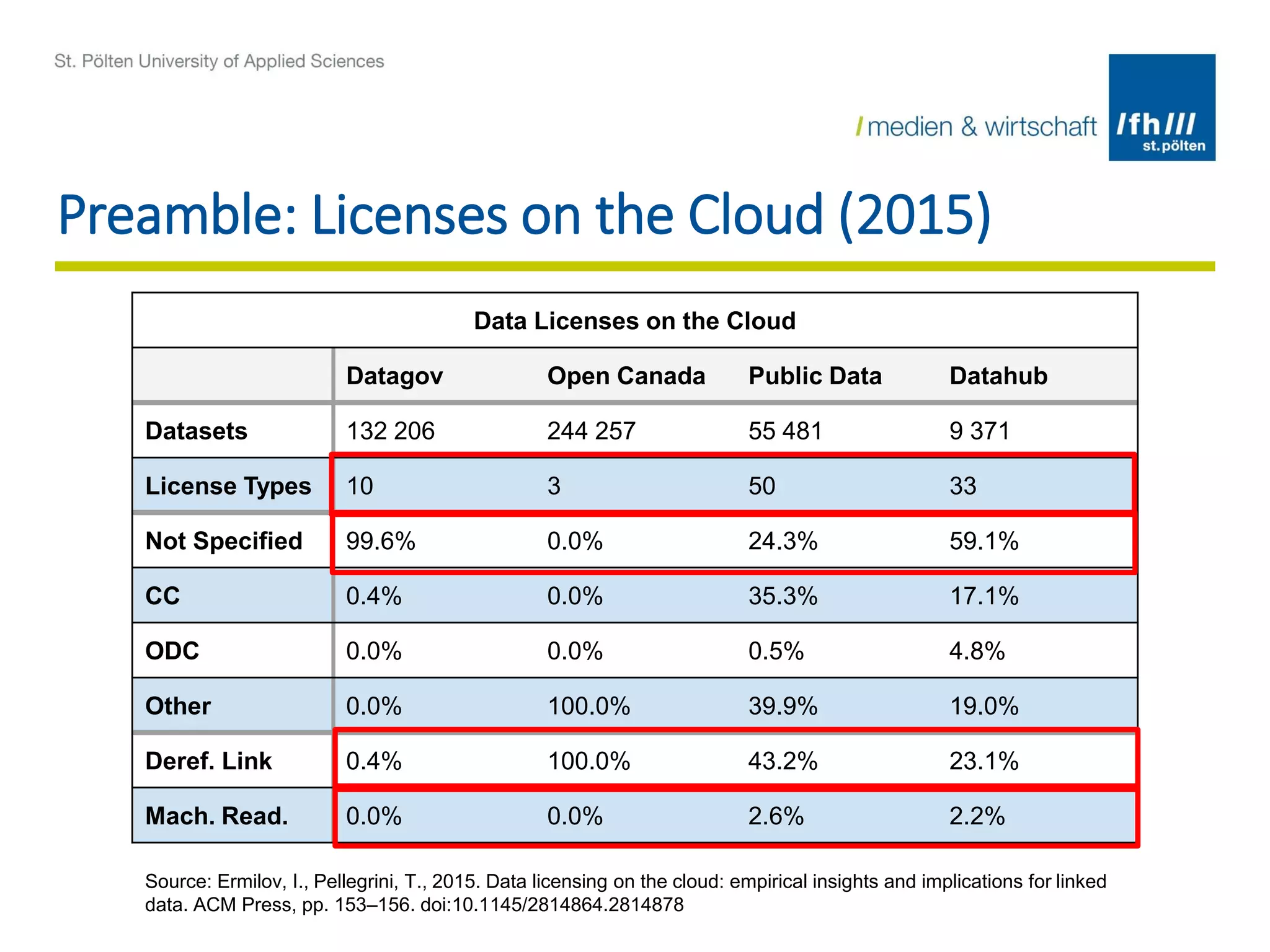
Preamble: Licenses on the Cloud (2015)
Data Licenses on the Cloud
Datagov Open Canada Public Data Datahub
Datasets 132 206 244 257 55 481 9 371
License Types 10 3 50 33
Not Specified 99.6% 0.0% 24.3% 59.1%
CC 0.4% 0.0% 35.3% 17.1%
ODC 0.0% 0.0% 0.5% 4.8%
Other 0.0% 100.0% 39.9% 19.0%
Deref. Link 0.4% 100.0% 43.2% 23.1%
Mach. Read. 0.0% 0.0% 2.6% 2.2%
Source: Ermilov, I., Pellegrini, T., 2015. Data licensing on the cloud: empirical insights and implications for linked
data. ACM Press, pp. 153–156. doi:10.1145/2814864.2814878
Introduction & Problem Statement
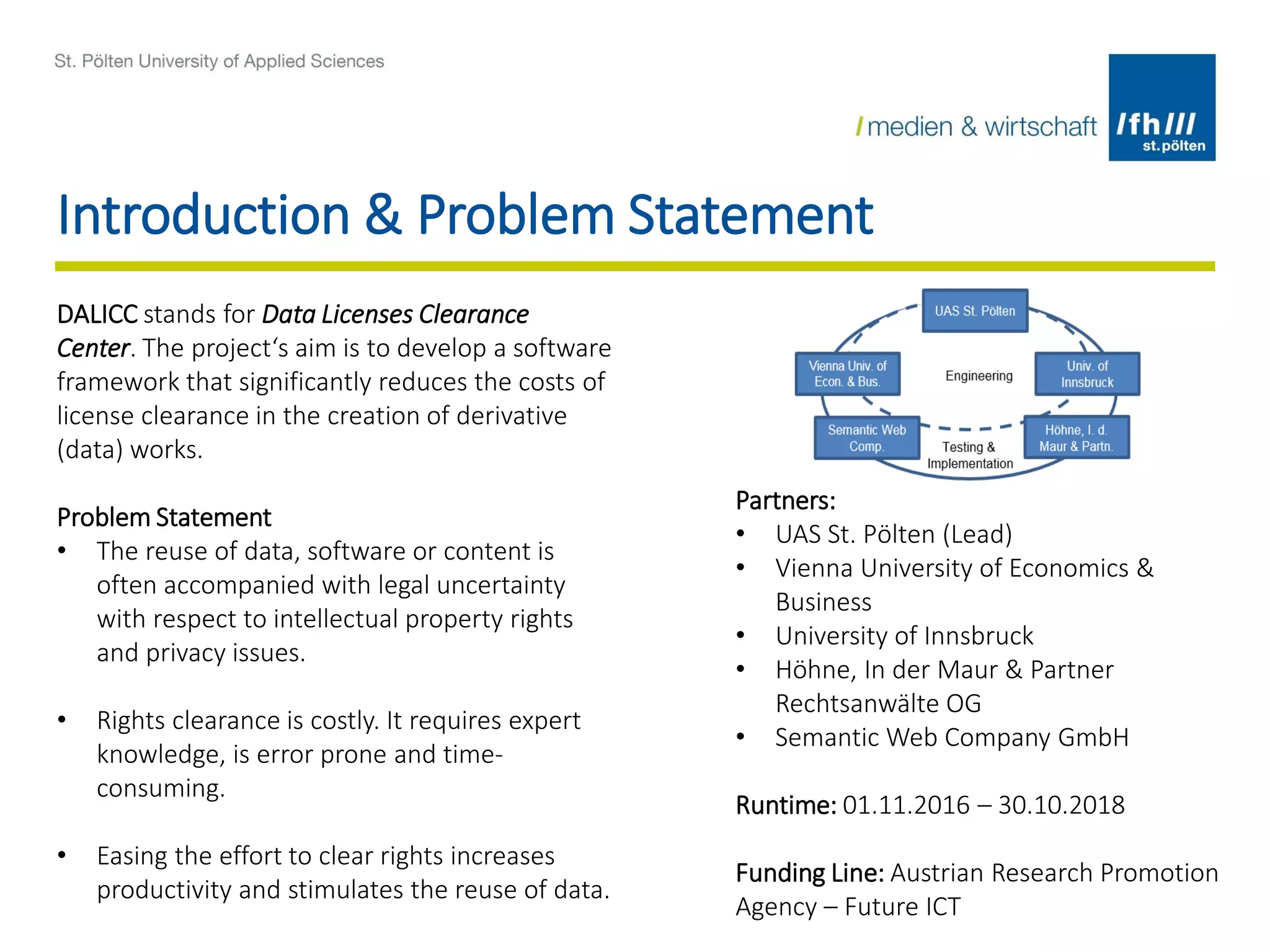
DALICC stands for Data Licenses Clearance
Center. The project‘s aim is to develop a software
framework that significantly reduces the costs of
license clearance in the creation of derivative
(data) works.
Problem Statement
• The reuse of data, software or content is
often accompanied with legal uncertainty
with respect to intellectual property rights
and privacy issues.
• Rights clearance is costly. It requires expert
knowledge, is error prone and time-
consuming.
• Easing the effort to clear rights increases
productivity and stimulates the reuse of data.
Partners:
• UAS St. Pölten (Lead)
• Vienna University of Economics &
Business
• University of Innsbruck
• Höhne, In der Maur & Partner
Rechtsanwälte OG
• Semantic Web Company GmbH
Runtime: 01.11.2016 – 30.10.2018
Funding Line: Austrian Research Promotion
Agency – Future ICT
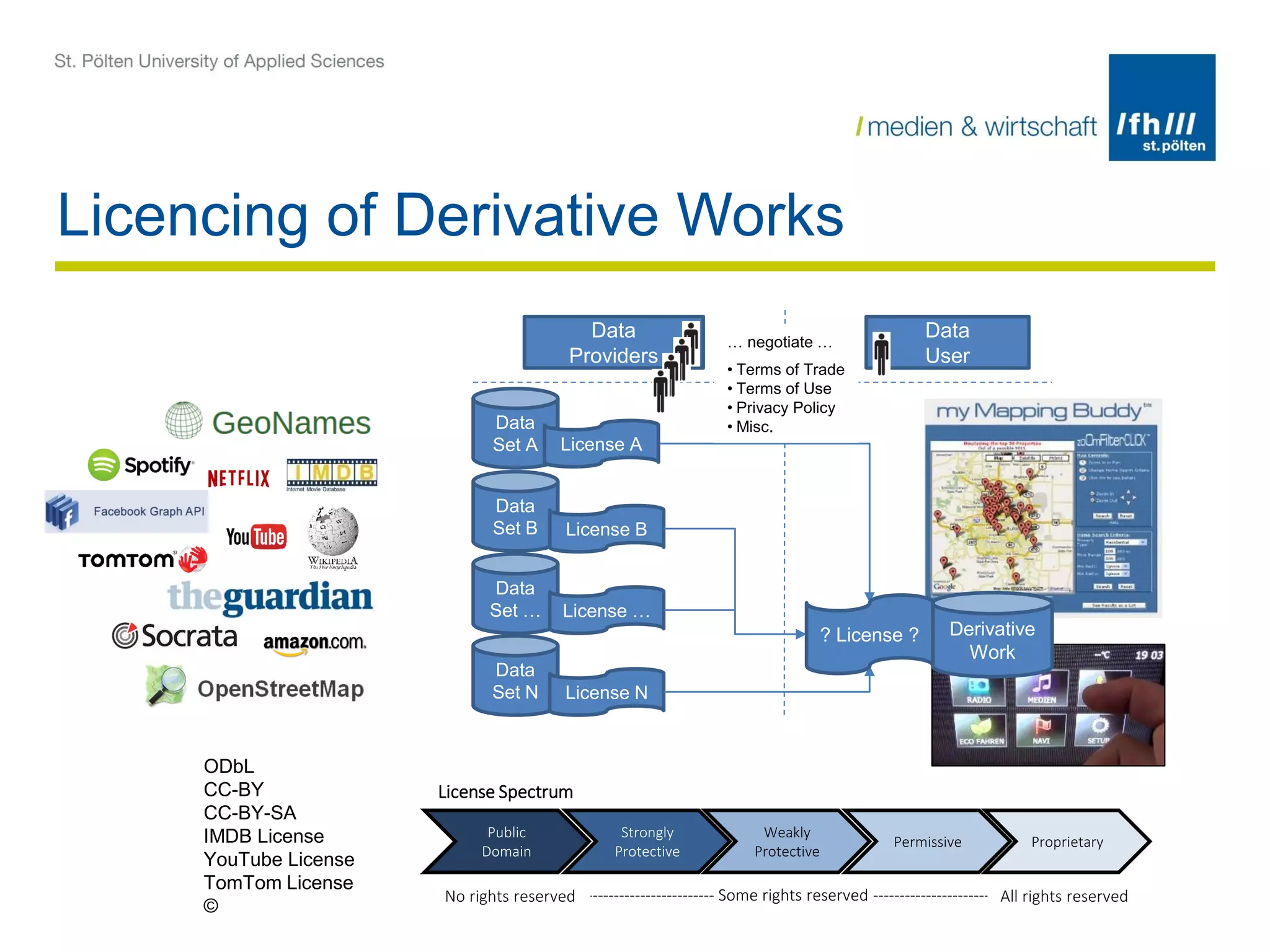
Licencing of Derivative Works
Data
Set N License N
Data
Set … License …
Data
User
Data
Set B License B
Data
Providers
? License ? Derivative
Work
… negotiate …
• Terms of Trade
• Terms of Use
• Privacy Policy
• Misc.Data
Set A License A
ODbL
CC-BY
CC-BY-SA
IMDB License
YouTube License
TomTom License
©
------------------------------- Some rights reserved ------------------------------
Public
Domain
Strongly
Protective
Weakly
Protective
Permissive Proprietary
No rights reserved
License Spectrum
All rights reserved
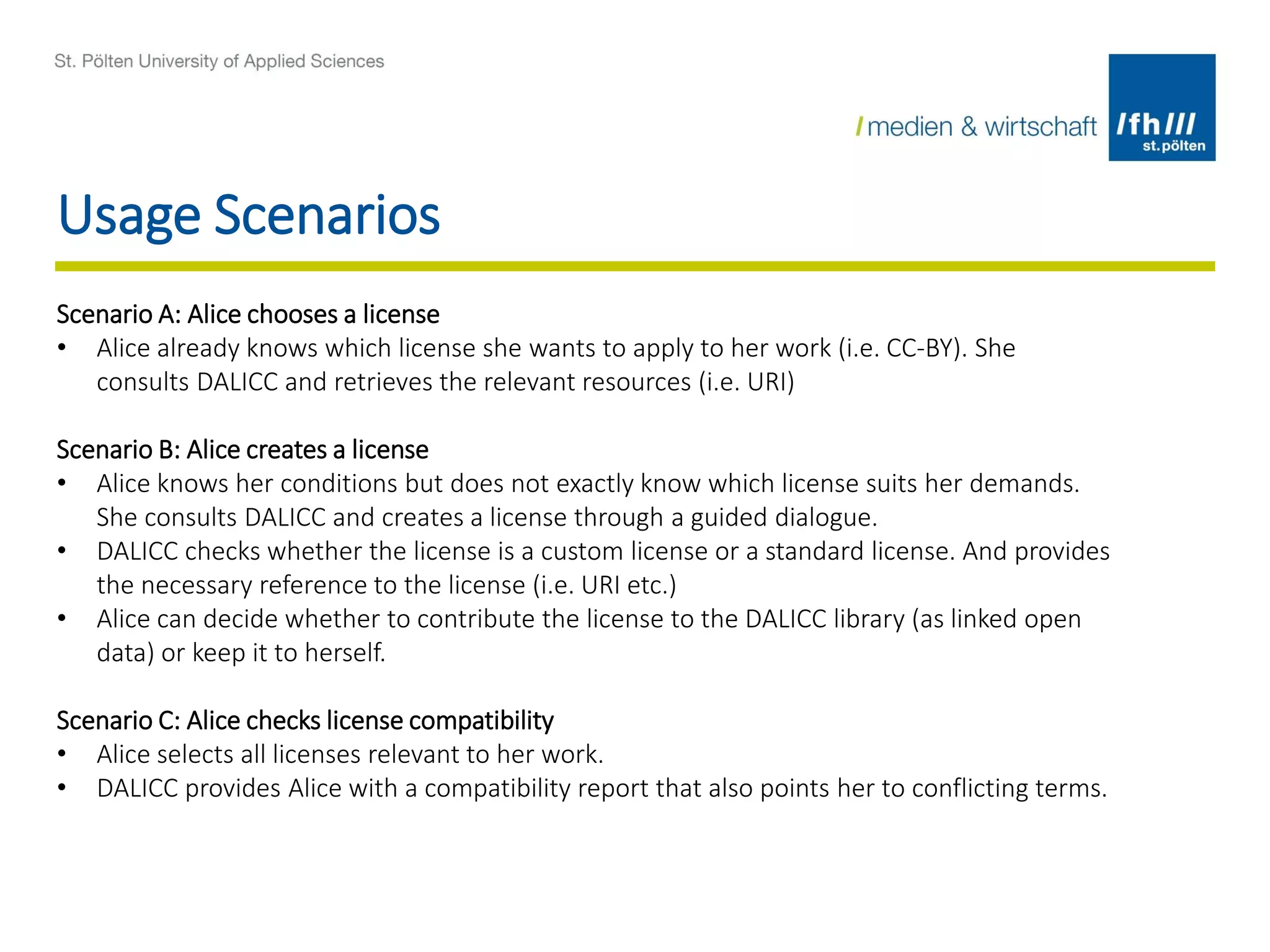
Usage Scenarios
Scenario A: Alice chooses a license
• Alice already knows which license she wants to apply to her work (i.e. CC-BY). She
consults DALICC and retrieves the relevant resources (i.e. URI)
Scenario B: Alice creates a license
• Alice knows her conditions but does not exactly know which license suits her demands.
She consults DALICC and creates a license through a guided dialogue.
• DALICC checks whether the license is a custom license or a standard license. And provides
the necessary reference to the license (i.e. URI etc.)
• Alice can decide whether to contribute the license to the DALICC library (as linked open
data) or keep it to herself.
Scenario C: Alice checks license compatibility
• Alice selects all licenses relevant to her work.
• DALICC provides Alice with a compatibility report that also points her to conflicting terms.
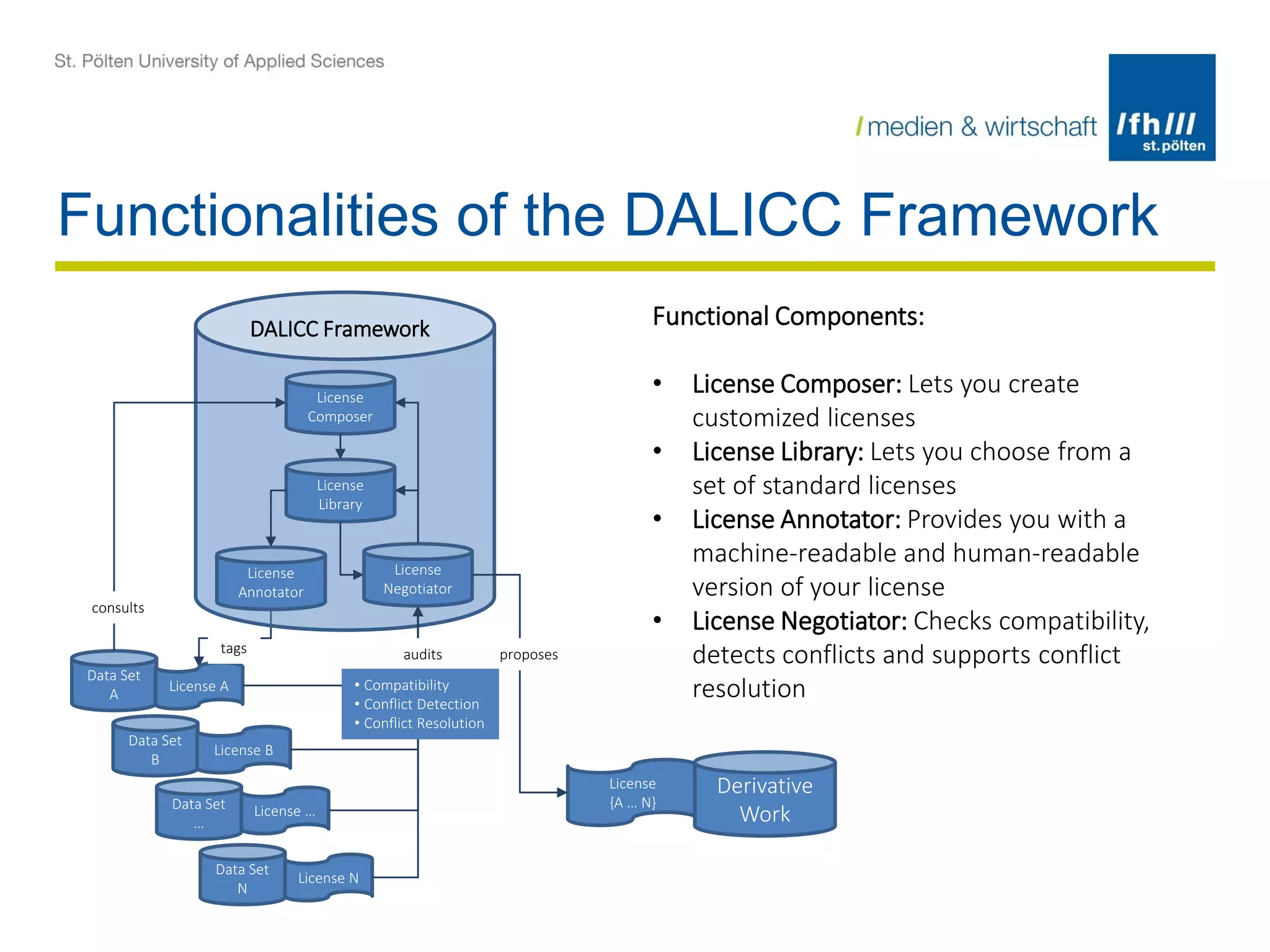
Data Set
N
License N
License
{A … N}
Derivative
Work
Data Set
…
License …
Data Set
B
License B
Data Set
A
License A
License
Composer
License
Annotator
License
Library
DALICC Framework
License
Negotiator
consults
tags audits proposes
• Compatibility
• Conflict Detection
• Conflict Resolution
Functionalities of the DALICC Framework
Functional Components:
• License Composer: Lets you create
customized licenses
• License Library: Lets you choose from a
set of standard licenses
• License Annotator: Provides you with a
machine-readable and human-readable
version of your license
• License Negotiator: Checks compatibility,
detects conflicts and supports conflict
resolution
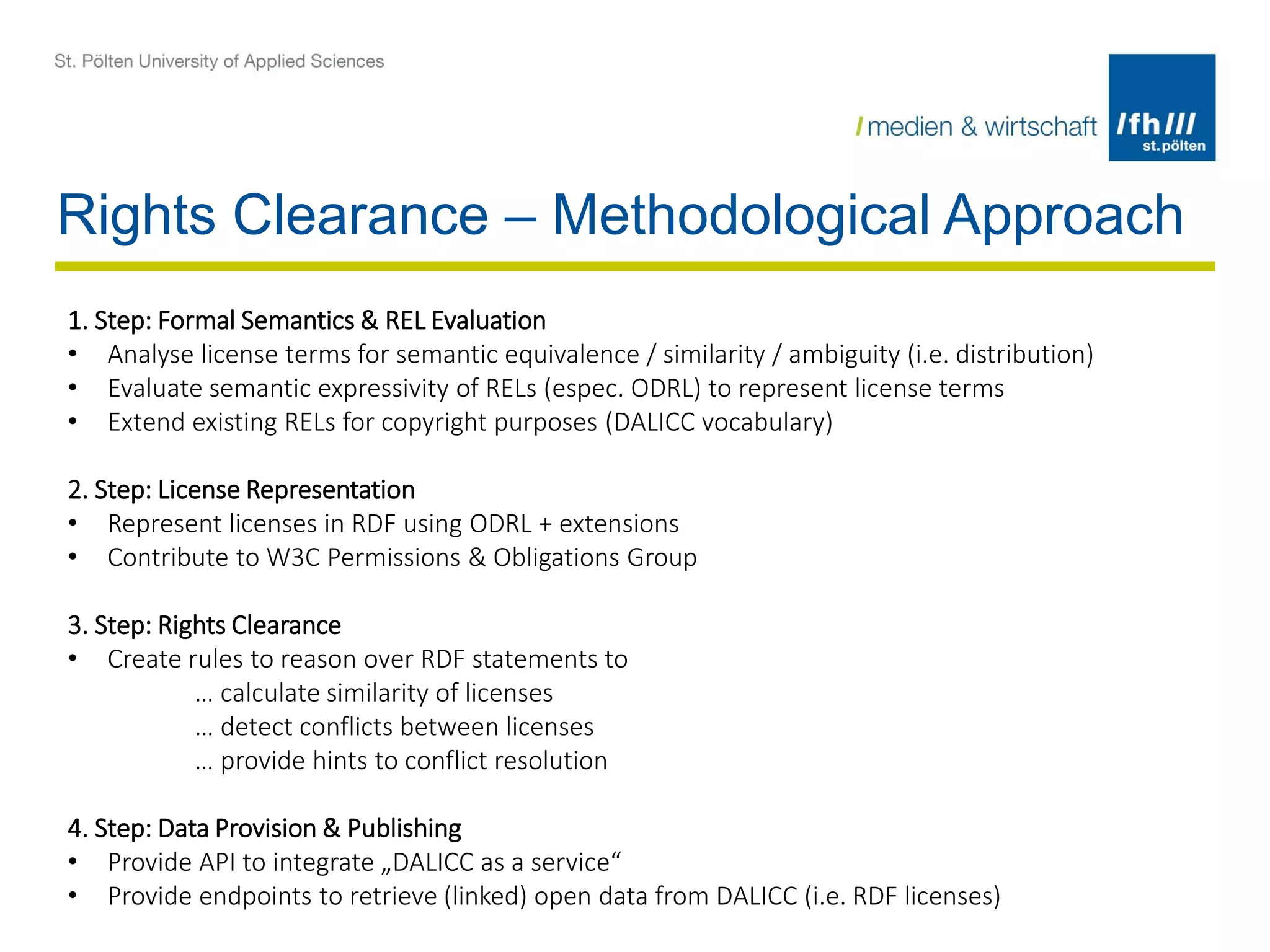
Rights Clearance – Methodological Approach
1. Step: Formal Semantics & REL Evaluation
• Analyse license terms for semantic equivalence / similarity / ambiguity (i.e. distribution)
• Evaluate semantic expressivity of RELs (espec. ODRL) to represent license terms
• Extend existing RELs for copyright purposes (DALICC vocabulary)
2. Step: License Representation
• Represent licenses in RDF using ODRL + extensions
• Contribute to W3C Permissions & Obligations Group
3. Step: Rights Clearance
• Create rules to reason over RDF statements to
… calculate similarity of licenses
… detect conflicts between licenses
… provide hints to conflict resolution
4. Step: Data Provision & Publishing
• Provide API to integrate „DALICC as a service“
• Provide endpoints to retrieve (linked) open data from DALICC (i.e. RDF licenses)
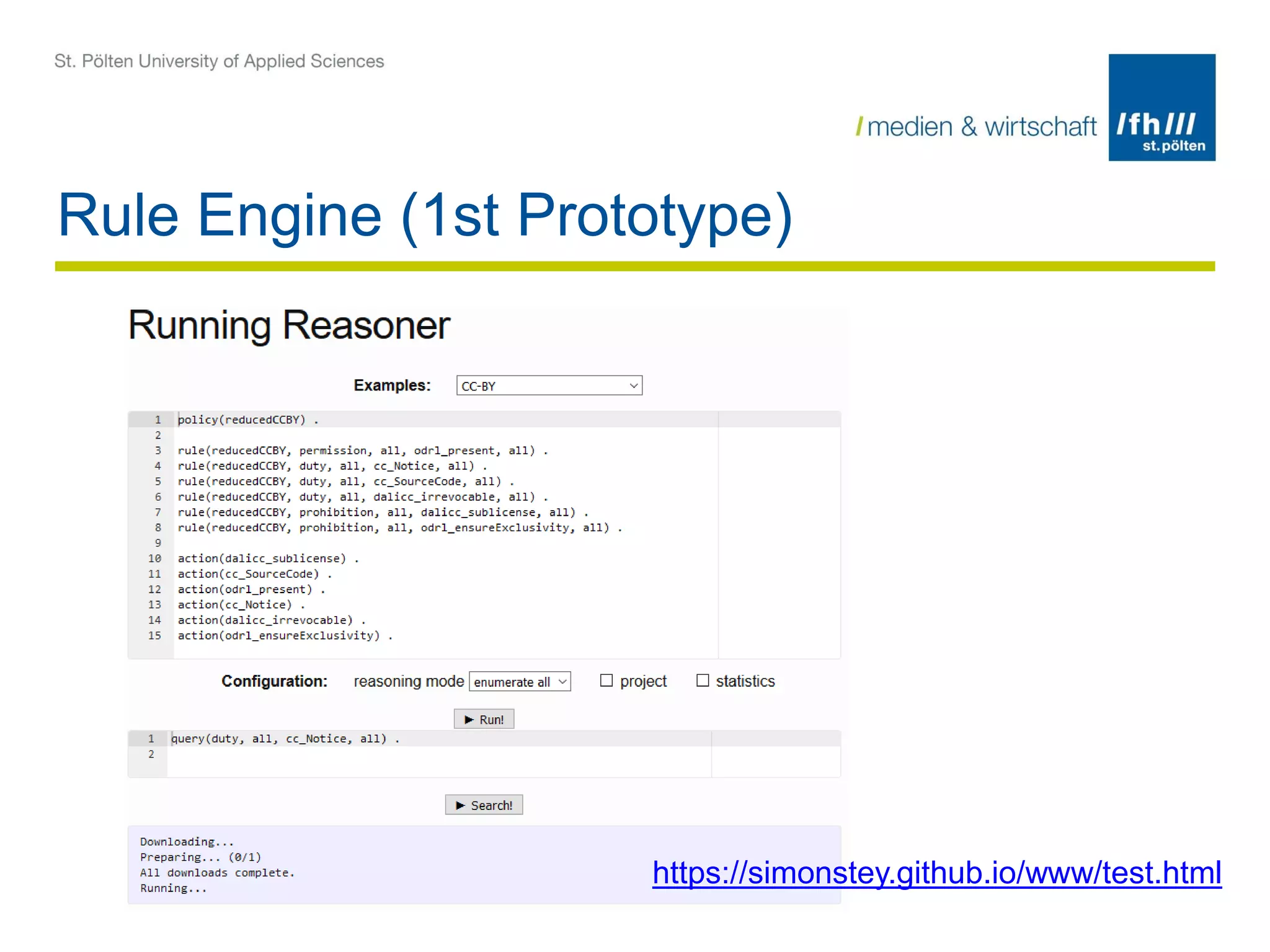
Rule Engine (1st Prototype)
https://simonstey.github.io/www/test.html
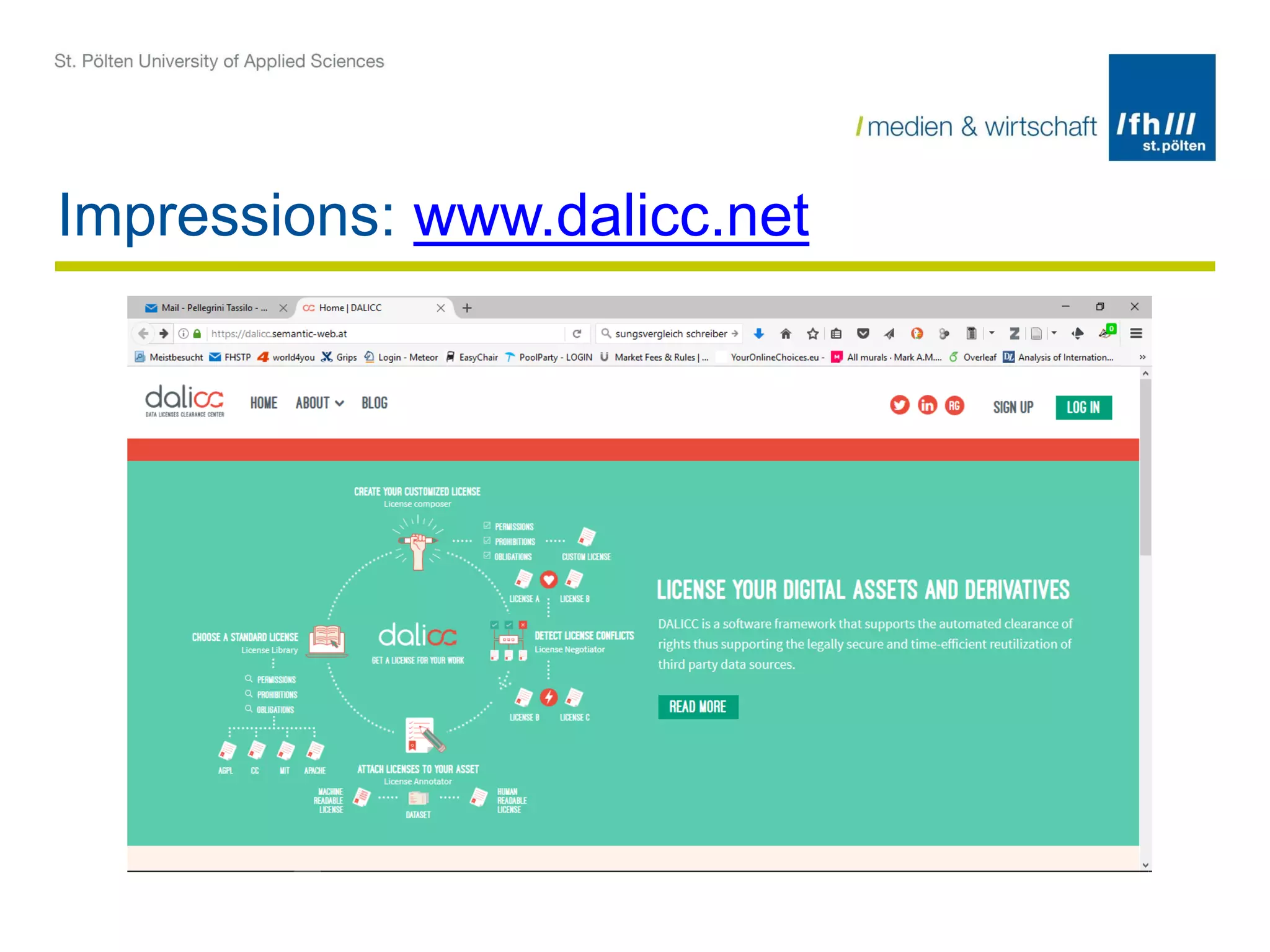
Impressions: www.dalicc.net
Want to become a use case partner?
Please contact us …
Tassilo Pellegrini (UAS St. Pölten)
Sabrina Kirraine & Simon Steyskal (Vienna Univ. of Economics)
Anna Fensel & Oleksandra Pansiuk (STI2 – Univ. of Innsbruck)
Markus Dörfler (HIP)
Thomas Thurner & Victor Mireles Chavez (SWC)
Contact: tassilo.pellegrini@fhstp.ac.at
Site: http://dalicc.net
This slide deck is available under CC BY-NC-ND 4.0

Session 1.1 dalicc - data licenses clearance center

  • 1.
    Tassilo Pellegrini (UASSt. Pölten) Sabrina Kirraine & Simon Steyskal (Vienna Univ. of Economics) Anna Fensel & Oleksandra Pansiuk (STI2 – Univ. of Innsbruck) Markus Dörfler (HIP) Thomas Thurner & Victor Mireles Chavez (SWC) SEMANTICS 2017, Amsterdam, The Netherlands - 12.09.2017 Contact: tassilo.pellegrini@fhstp.ac.at Site: http://dalicc.net This slidedeck is available under CC BY-NC-ND 4.0
  • 2.
    Data Governance Data Governance DataPolicy Intellect. Property Privacy Law Compet. Law Data Licenses Practice / Usage Rights Institutions / Code of Conduct Norms / Terms of Trade ----------------------------- Some rights reserved --------------------- Public Domain Permissive Weakly Protective Strongly Protective Proprietary All rights reservedNo rights reserved
  • 3.
    Preamble: Licenses onthe Cloud (2015) Data Licenses on the Cloud Datagov Open Canada Public Data Datahub Datasets 132 206 244 257 55 481 9 371 License Types 10 3 50 33 Not Specified 99.6% 0.0% 24.3% 59.1% CC 0.4% 0.0% 35.3% 17.1% ODC 0.0% 0.0% 0.5% 4.8% Other 0.0% 100.0% 39.9% 19.0% Deref. Link 0.4% 100.0% 43.2% 23.1% Mach. Read. 0.0% 0.0% 2.6% 2.2% Source: Ermilov, I., Pellegrini, T., 2015. Data licensing on the cloud: empirical insights and implications for linked data. ACM Press, pp. 153–156. doi:10.1145/2814864.2814878
  • 4.
    Introduction & ProblemStatement DALICC stands for Data Licenses Clearance Center. The project‘s aim is to develop a software framework that significantly reduces the costs of license clearance in the creation of derivative (data) works. Problem Statement • The reuse of data, software or content is often accompanied with legal uncertainty with respect to intellectual property rights and privacy issues. • Rights clearance is costly. It requires expert knowledge, is error prone and time- consuming. • Easing the effort to clear rights increases productivity and stimulates the reuse of data. Partners: • UAS St. Pölten (Lead) • Vienna University of Economics & Business • University of Innsbruck • Höhne, In der Maur & Partner Rechtsanwälte OG • Semantic Web Company GmbH Runtime: 01.11.2016 – 30.10.2018 Funding Line: Austrian Research Promotion Agency – Future ICT
  • 5.
    Licencing of DerivativeWorks Data Set N License N Data Set … License … Data User Data Set B License B Data Providers ? License ? Derivative Work … negotiate … • Terms of Trade • Terms of Use • Privacy Policy • Misc.Data Set A License A ODbL CC-BY CC-BY-SA IMDB License YouTube License TomTom License © ------------------------------- Some rights reserved ------------------------------ Public Domain Strongly Protective Weakly Protective Permissive Proprietary No rights reserved License Spectrum All rights reserved
  • 6.
    Usage Scenarios Scenario A:Alice chooses a license • Alice already knows which license she wants to apply to her work (i.e. CC-BY). She consults DALICC and retrieves the relevant resources (i.e. URI) Scenario B: Alice creates a license • Alice knows her conditions but does not exactly know which license suits her demands. She consults DALICC and creates a license through a guided dialogue. • DALICC checks whether the license is a custom license or a standard license. And provides the necessary reference to the license (i.e. URI etc.) • Alice can decide whether to contribute the license to the DALICC library (as linked open data) or keep it to herself. Scenario C: Alice checks license compatibility • Alice selects all licenses relevant to her work. • DALICC provides Alice with a compatibility report that also points her to conflicting terms.
  • 7.
    Data Set N License N License {A… N} Derivative Work Data Set … License … Data Set B License B Data Set A License A License Composer License Annotator License Library DALICC Framework License Negotiator consults tags audits proposes • Compatibility • Conflict Detection • Conflict Resolution Functionalities of the DALICC Framework Functional Components: • License Composer: Lets you create customized licenses • License Library: Lets you choose from a set of standard licenses • License Annotator: Provides you with a machine-readable and human-readable version of your license • License Negotiator: Checks compatibility, detects conflicts and supports conflict resolution
  • 8.
    Rights Clearance –Methodological Approach 1. Step: Formal Semantics & REL Evaluation • Analyse license terms for semantic equivalence / similarity / ambiguity (i.e. distribution) • Evaluate semantic expressivity of RELs (espec. ODRL) to represent license terms • Extend existing RELs for copyright purposes (DALICC vocabulary) 2. Step: License Representation • Represent licenses in RDF using ODRL + extensions • Contribute to W3C Permissions & Obligations Group 3. Step: Rights Clearance • Create rules to reason over RDF statements to … calculate similarity of licenses … detect conflicts between licenses … provide hints to conflict resolution 4. Step: Data Provision & Publishing • Provide API to integrate „DALICC as a service“ • Provide endpoints to retrieve (linked) open data from DALICC (i.e. RDF licenses)
  • 9.
    Rule Engine (1stPrototype) https://simonstey.github.io/www/test.html
  • 10.
  • 11.
    Want to becomea use case partner? Please contact us … Tassilo Pellegrini (UAS St. Pölten) Sabrina Kirraine & Simon Steyskal (Vienna Univ. of Economics) Anna Fensel & Oleksandra Pansiuk (STI2 – Univ. of Innsbruck) Markus Dörfler (HIP) Thomas Thurner & Victor Mireles Chavez (SWC) Contact: tassilo.pellegrini@fhstp.ac.at Site: http://dalicc.net This slide deck is available under CC BY-NC-ND 4.0