Leveraging Technology for Effective EHS
Management Systems Planning and
Establishing Objectives
Susan Mazzarella, LEED AP
Managing Principal
Agenda
2
 ISO 14001 or OHSAS 18001 conformant management system need to
perform some key Planning steps to ensure success. Process for setting
environmental aspects, occupational health and safety hazards, and
Objectives (aka performance goals)
 Common challenges in performing these steps, and keeping them up-to-
date include change management and consistency.
 Technology solutions for this purpose are getting better and better.
 An example Risk Assessment (Job Hazard Analysis) software will be shown
as part of this discussion.
 Q&A
© 2013 Environmental and Occupational Risk Management, Inc.
Terminology Overview
 ISO 14001 (14k): Environmental Management System
standard
 OHSAS 18001 (18k): Occupational Health & Safety
Management System standard
– Similar to ISO 9001 (Quality) standard
– Integrated management system = EHS-MS
 Approximately 80% overlap between 14k and 18k
requirements
3
Management Systems Drivers
Drivers
Corporate
EHS
Perform-
ance
Customer
Supply
Chain
Increased
Market
Share
Semiconductor Industry Benchmarking
5
 Intel: Company-wide certificate for ISO 14001 and OHSAS
18001
 Samsung: Many sites registered to ISO 14001 and OHSAS
18001; some still in progress
 STMicroelectronics: All manufacturing and many non-
manufacturing sites ISO 14001/OHSAS 18001 certified
© 2013 Environmental and Occupational Risk Management, Inc.
Solar Industry Benchmarking
6
 Innotech Solar: ISO 14001/OHSAS 18001
 SolarWorld: ISO 14001/OHSAS 18001
 Canadian Solar: ISO 14001/OHSAS 18001
 First Solar: ISO 14001/OHSAS 18001
 Suntech: ISO 14001/OHSAS 18001
© 2013 Environmental and Occupational Risk Management, Inc.
14k/18k Elements
Policy
Planning
Implementation
& Operation
Checking &
Corrective Action
Management
Review
7
Plan/Do/
Check/Act
Loop
19 Clauses in
each standard
“Performance” not
“Prescriptive” Based
7© 2013 Environmental and Occupational Risk Management, Inc.
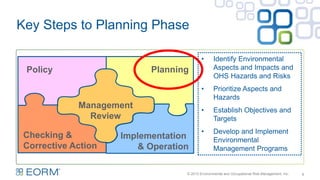
Key Steps to Planning Phase
Planning
Checking &
Corrective Action
Policy
Management
Review
Implementation
& Operation
• Identify Environmental
Aspects and Impacts and
OHS Hazards and Risks
• Prioritize Aspects and
Hazards
• Establish Objectives and
Targets
• Develop and Implement
Environmental
Management Programs
© 2013 Environmental and Occupational Risk Management, Inc. 8
9
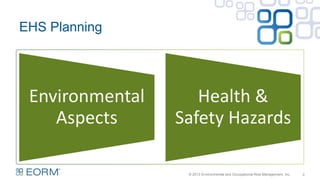
EHS Planning
Environmental
Aspects
Health &
Safety Hazards
© 2013 Environmental and Occupational Risk Management, Inc.
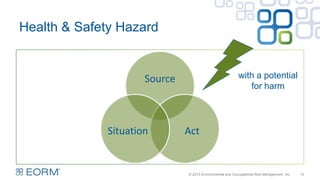
Health & Safety Hazard
10
Source
ActSituation
© 2013 Environmental and Occupational Risk Management, Inc.
with a potential
for harm
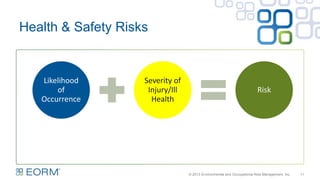
Health & Safety Risks
11© 2013 Environmental and Occupational Risk Management, Inc.
Likelihood
of
Occurrence
Severity of
Injury/Ill
Health
Risk
12
Common Challenges
Lack of
Consistency
Change
Management
Lack of
Training
© 2013 Environmental and Occupational Risk Management, Inc.
How can Technology Improve the Process?
13
 Ensure JHA data is collected and recorded in a consistent,
standardized way in a central repository
 Utilize that data to help organization prioritize controls
 Analyze the effectiveness and impact of those controls
– Required under Performance Measurement and Monitoring in OHSAS 18k
 Increase the accountability for the utilization of safety resources
 Drive the continued improvement of your safety program
© 2013 Environmental and Occupational Risk Management, Inc.
Organize Exposure Groups
 Job/Task Description
 Department
 Location
 Division
 State
 Identify Homogenous
Exposure Groups
– What’s common to
everyone?
– What’s common to
everyone in
» An office?
» In manufacturing?
» In shipping/receiving?
14© 2013 Environmental and Occupational Risk Management, Inc.
Example: Remedy Interactive JHA Software
15
 iPad compatible
 Customize Setup
– Populate with your organization’s terminology
– Limit options for certain fields to ensure consistency
– Use your homogeneous exposure groups to organize the
structure
© 2013 Environmental and Occupational Risk Management, Inc.
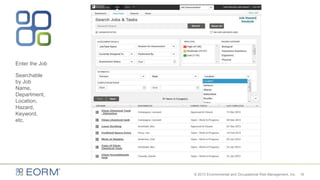
Enter the Job
Searchable
by Job
Name,
Department,
Location,
Hazard,
Keyword,
etc.
16© 2013 Environmental and Occupational Risk Management, Inc.
17
Identifying Hazards for the Job/Task
© 2013 Environmental and Occupational Risk Management, Inc.
Hazard Identification
Modifications to
EHS-MS
External Events
Human Factors
Contractors/Visitors
Workplace Design
Changes or
Proposed Changes
Non-routine
Activities
Routine Activities
Enter each
Hazard
Enter risk
score for
each Hazard
Much more
powerful than
just entering
a risk score
for the entire
job
18© 2013 Environmental and Occupational Risk Management, Inc.
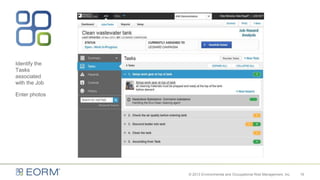
Identify the
Tasks
associated
with the Job
Enter photos
19© 2013 Environmental and Occupational Risk Management, Inc.
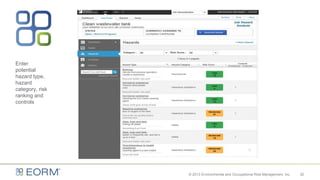
Enter
potential
hazard type,
hazard
category, risk
ranking and
controls
20© 2013 Environmental and Occupational Risk Management, Inc.
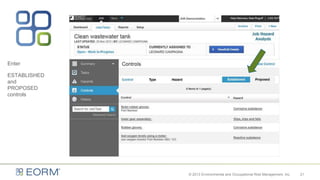
Enter
ESTABLISHED
and
PROPOSED
controls
21© 2013 Environmental and Occupational Risk Management, Inc.
Compare
Established
and
Proposed
Controls
22© 2013 Environmental and Occupational Risk Management, Inc.
23© 2013 Environmental and Occupational Risk Management, Inc.
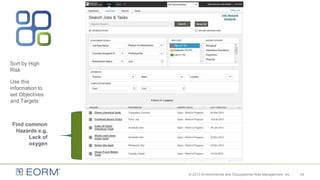
Sort by High
Risk
Use this
information to
set Objectives
and Targets
Find common
Hazards e.g.
Lack of
oxygen
24© 2013 Environmental and Occupational Risk Management, Inc.
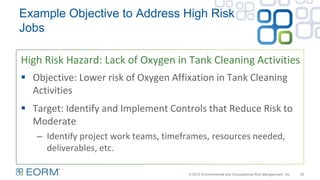
High Risk Hazard: Lack of Oxygen in Tank Cleaning Activities
25
Example Objective to Address High Risk
Jobs
© 2013 Environmental and Occupational Risk Management, Inc.
 Objective: Lower risk of Oxygen Affixation in Tank Cleaning
Activities
 Target: Identify and Implement Controls that Reduce Risk to
Moderate
– Identify project work teams, timeframes, resources needed,
deliverables, etc.
Evaluate High Risks for Objectives
26
 Identify common hazards that if addressed, could lower
multiple job risks
 Apply new proposed controls to quickly quantify risk
mitigation
 Identify problem areas (e.g. jobs, departments, locations) for
special focus
© 2013 Environmental and Occupational Risk Management, Inc.
Embrace Technology
27
 Virtually eliminate JHA program process failures
 Demonstrate compliance with legal and other requirements
 Run reports, charts, graphs quickly and accurately
 Using an iPad, can be completed real-time in the field
 Cut down program administration time, and increase the
time spent on mitigation of risk
 All of these benefits = Reduced risk!
© 2013 Environmental and Occupational Risk Management, Inc.
© 2013 Environmental and Occupational Risk Management, Inc. 28
Thank you!
Susan Mazzarella
mazzarellas@eorm.com
949.420.0660

Sesha 2013 mazzarella (2)

  • 1.
    Leveraging Technology forEffective EHS Management Systems Planning and Establishing Objectives Susan Mazzarella, LEED AP Managing Principal
  • 2.
    Agenda 2  ISO 14001or OHSAS 18001 conformant management system need to perform some key Planning steps to ensure success. Process for setting environmental aspects, occupational health and safety hazards, and Objectives (aka performance goals)  Common challenges in performing these steps, and keeping them up-to- date include change management and consistency.  Technology solutions for this purpose are getting better and better.  An example Risk Assessment (Job Hazard Analysis) software will be shown as part of this discussion.  Q&A © 2013 Environmental and Occupational Risk Management, Inc.
  • 3.
    Terminology Overview  ISO14001 (14k): Environmental Management System standard  OHSAS 18001 (18k): Occupational Health & Safety Management System standard – Similar to ISO 9001 (Quality) standard – Integrated management system = EHS-MS  Approximately 80% overlap between 14k and 18k requirements 3
  • 4.
  • 5.
    Semiconductor Industry Benchmarking 5 Intel: Company-wide certificate for ISO 14001 and OHSAS 18001  Samsung: Many sites registered to ISO 14001 and OHSAS 18001; some still in progress  STMicroelectronics: All manufacturing and many non- manufacturing sites ISO 14001/OHSAS 18001 certified © 2013 Environmental and Occupational Risk Management, Inc.
  • 6.
    Solar Industry Benchmarking 6 Innotech Solar: ISO 14001/OHSAS 18001  SolarWorld: ISO 14001/OHSAS 18001  Canadian Solar: ISO 14001/OHSAS 18001  First Solar: ISO 14001/OHSAS 18001  Suntech: ISO 14001/OHSAS 18001 © 2013 Environmental and Occupational Risk Management, Inc.
  • 7.
    14k/18k Elements Policy Planning Implementation & Operation Checking& Corrective Action Management Review 7 Plan/Do/ Check/Act Loop 19 Clauses in each standard “Performance” not “Prescriptive” Based 7© 2013 Environmental and Occupational Risk Management, Inc.
  • 8.
    Key Steps toPlanning Phase Planning Checking & Corrective Action Policy Management Review Implementation & Operation • Identify Environmental Aspects and Impacts and OHS Hazards and Risks • Prioritize Aspects and Hazards • Establish Objectives and Targets • Develop and Implement Environmental Management Programs © 2013 Environmental and Occupational Risk Management, Inc. 8
  • 9.
    9 EHS Planning Environmental Aspects Health & SafetyHazards © 2013 Environmental and Occupational Risk Management, Inc.
  • 10.
    Health & SafetyHazard 10 Source ActSituation © 2013 Environmental and Occupational Risk Management, Inc. with a potential for harm
  • 11.
    Health & SafetyRisks 11© 2013 Environmental and Occupational Risk Management, Inc. Likelihood of Occurrence Severity of Injury/Ill Health Risk
  • 12.
    12 Common Challenges Lack of Consistency Change Management Lackof Training © 2013 Environmental and Occupational Risk Management, Inc.
  • 13.
    How can TechnologyImprove the Process? 13  Ensure JHA data is collected and recorded in a consistent, standardized way in a central repository  Utilize that data to help organization prioritize controls  Analyze the effectiveness and impact of those controls – Required under Performance Measurement and Monitoring in OHSAS 18k  Increase the accountability for the utilization of safety resources  Drive the continued improvement of your safety program © 2013 Environmental and Occupational Risk Management, Inc.
  • 14.
    Organize Exposure Groups Job/Task Description  Department  Location  Division  State  Identify Homogenous Exposure Groups – What’s common to everyone? – What’s common to everyone in » An office? » In manufacturing? » In shipping/receiving? 14© 2013 Environmental and Occupational Risk Management, Inc.
  • 15.
    Example: Remedy InteractiveJHA Software 15  iPad compatible  Customize Setup – Populate with your organization’s terminology – Limit options for certain fields to ensure consistency – Use your homogeneous exposure groups to organize the structure © 2013 Environmental and Occupational Risk Management, Inc.
  • 16.
    Enter the Job Searchable byJob Name, Department, Location, Hazard, Keyword, etc. 16© 2013 Environmental and Occupational Risk Management, Inc.
  • 17.
    17 Identifying Hazards forthe Job/Task © 2013 Environmental and Occupational Risk Management, Inc. Hazard Identification Modifications to EHS-MS External Events Human Factors Contractors/Visitors Workplace Design Changes or Proposed Changes Non-routine Activities Routine Activities
  • 18.
    Enter each Hazard Enter risk scorefor each Hazard Much more powerful than just entering a risk score for the entire job 18© 2013 Environmental and Occupational Risk Management, Inc.
  • 19.
    Identify the Tasks associated with theJob Enter photos 19© 2013 Environmental and Occupational Risk Management, Inc.
  • 20.
    Enter potential hazard type, hazard category, risk rankingand controls 20© 2013 Environmental and Occupational Risk Management, Inc.
  • 21.
  • 22.
  • 23.
    23© 2013 Environmentaland Occupational Risk Management, Inc.
  • 24.
    Sort by High Risk Usethis information to set Objectives and Targets Find common Hazards e.g. Lack of oxygen 24© 2013 Environmental and Occupational Risk Management, Inc.
  • 25.
    High Risk Hazard:Lack of Oxygen in Tank Cleaning Activities 25 Example Objective to Address High Risk Jobs © 2013 Environmental and Occupational Risk Management, Inc.  Objective: Lower risk of Oxygen Affixation in Tank Cleaning Activities  Target: Identify and Implement Controls that Reduce Risk to Moderate – Identify project work teams, timeframes, resources needed, deliverables, etc.
  • 26.
    Evaluate High Risksfor Objectives 26  Identify common hazards that if addressed, could lower multiple job risks  Apply new proposed controls to quickly quantify risk mitigation  Identify problem areas (e.g. jobs, departments, locations) for special focus © 2013 Environmental and Occupational Risk Management, Inc.
  • 27.
    Embrace Technology 27  Virtuallyeliminate JHA program process failures  Demonstrate compliance with legal and other requirements  Run reports, charts, graphs quickly and accurately  Using an iPad, can be completed real-time in the field  Cut down program administration time, and increase the time spent on mitigation of risk  All of these benefits = Reduced risk! © 2013 Environmental and Occupational Risk Management, Inc.
  • 28.
    © 2013 Environmentaland Occupational Risk Management, Inc. 28 Thank you! Susan Mazzarella mazzarellas@eorm.com 949.420.0660