Leveraging Technology to Effectively
Manage your Ergonomics Program
SESHA - April 20, 2013
Anuja Patil, M.S., AEP
This Session Will Help You…
2
 Discover how technology can help make your organization's
ergonomics program more:
Efficient
Effective
Measurable
© 2013 Environmental and Occupational Risk Management, Inc.
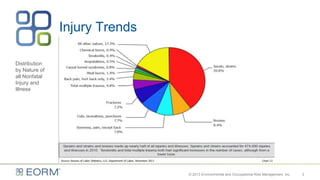
Distribution
by Nature of
all Nonfatal
Injury and
Illness
3
Injury Trends
© 2013 Environmental and Occupational Risk Management, Inc.
Incident rate for nonfatal occupational injuries and illnesses involving days away from work – Nature of Disorders
4
Injury Trends
0
5
10
15
20
25
30
35
40
45
50
Sprains, strains,
tears
Musculoskeletal
disorders
Soreness, pain,
including back
Bruises,
contusions
Cuts, lacerations,
punctures
Fractures Heat burns, scalds Chemical burns
© 2013 Environmental and Occupational Risk Management, Inc.
Costs of Poor Ergonomics
 Repetitive motion injuries (RMIs) average costs range between
$48K-$77K
 RMI’s account for more than $2 Billion in worker’s compensation
costs annually
 Difficult type of injury
– Slow recovering injury
– High level of re-occurrence
– Back pain is second only to the common cold as a cause of work loss
© 2013 Environmental and Occupational Risk Management, Inc. 5
Costs of Injuries
© 2013 Environmental and Occupational Risk Management, Inc. 6
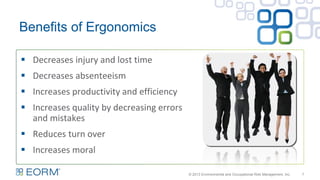
Benefits of Ergonomics
 Decreases injury and lost time
 Decreases absenteeism
 Increases productivity and efficiency
 Increases quality by decreasing errors
and mistakes
 Reduces turn over
 Increases moral
7© 2013 Environmental and Occupational Risk Management, Inc.
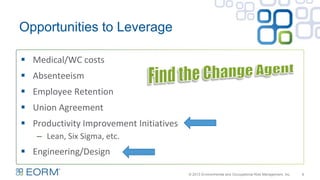
Opportunities to Leverage
8
 Medical/WC costs
 Absenteeism
 Employee Retention
 Union Agreement
 Productivity Improvement Initiatives
– Lean, Six Sigma, etc.
 Engineering/Design
© 2013 Environmental and Occupational Risk Management, Inc.
9
Managing Ergonomic Risks
© 2013 Environmental and Occupational Risk Management, Inc.
EORM’s Ergonomics Philosophy
10
 Our belief is that injuries and pain/discomfort to employee’s can be
eliminated through a proactive risk management approach to
ergonomics.

 Managing risk vs. managing consequences
 Risk management is an accepted strategy for Occupational Health &
Safety professionals:
– Recognition
– Evaluation
– Control
– Anticipation of workplace hazards
© 2013 Environmental and Occupational Risk Management, Inc.
Effective Program “Attributes”
11
 Effective and Efficient in reducing injuries
 Compliant with government regulations
 Systematic, Sustainable & Scalable to other sites
 Business driven (reduce costs)
– Demonstrating value to business leadership
(show results)
© 2013 Environmental and Occupational Risk Management, Inc.
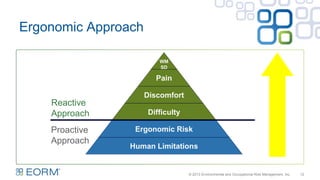
Ergonomic Approach
12
WM
SD
Pain
Discomfort
Difficulty
Ergonomic Risk
Human Limitations
Proactive
Approach
Reactive
Approach
© 2013 Environmental and Occupational Risk Management, Inc.
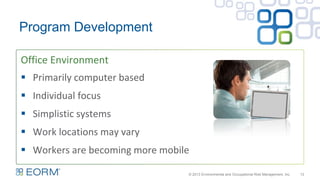
Office Environment
13
Program Development
 Primarily computer based
 Individual focus
 Simplistic systems
 Work locations may vary
 Workers are becoming more mobile
© 2013 Environmental and Occupational Risk Management, Inc.
Ergonomics Support
© 2013 Environmental and Occupational Risk Management, Inc. 14
In-person Support
15
 Personal interaction
 Resource intensive
 Costly
 Rarely done in home and remote offices except in cases
required by law
© 2013 Environmental and Occupational Risk Management, Inc.
Remote Support
16
 Remote Support (phone evaluations or email support)
– Phone evaluations
– Digital pictures
– Web cameras
© 2013 Environmental and Occupational Risk Management, Inc.
Phone Evaluations
17
 Advantages
– Direct interaction with employee
– Can ask questions
– Can direct employee how to set up workstation
 Disadvantages
– Have to rely on employee’s description of workstation
– Need practice in asking questions and experience with
enough in person evaluations to understand challenges
and solutions
– Takes evaluator’s time
© 2013 Environmental and Occupational Risk Management, Inc.
Digital Pictures
18
 Advantages
– Give you a quick look at what equipment employee is using
– If employee is in picture gives idea of possible issues and how
employee interacts with the workstation
– Employee can see their own posture and position
 Disadvantages
– Only a snapshot
– How does the employee sit and work when not on camera?
© 2013 Environmental and Occupational Risk Management, Inc.
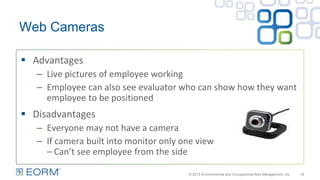
Web Cameras
19
 Advantages
– Live pictures of employee working
– Employee can also see evaluator who can show how they want
employee to be positioned
 Disadvantages
– Everyone may not have a camera
– If camera built into monitor only one view
– Can’t see employee from the side
© 2013 Environmental and Occupational Risk Management, Inc.
20
Diverse Work Locations
Contents © 2009. Reprinted with permission from WorldatWork. Content is licensed for use by purchaser only. No part of this article may be
reproduced, excerpted or redistributed in any form without express written permission from WorldatWork.
© 2013 Environmental and Occupational Risk Management, Inc.
Office Environment
21
Best Solution
 3 Tiered Approach
– Online (along with email screening and support)
– Remote Support (phone evaluations or email support)
» Digital pictures
» Web cameras
– In-person
© 2013 Environmental and Occupational Risk Management, Inc.
22
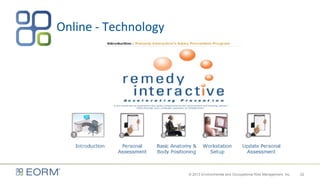
Online - Technology
© 2013 Environmental and Occupational Risk Management, Inc.
23
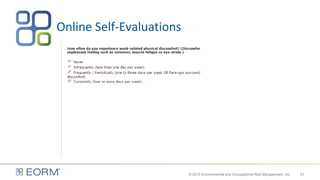
Online Self-Evaluations
© 2013 Environmental and Occupational Risk Management, Inc.
24
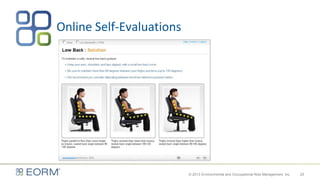
Online Self-Evaluations
© 2013 Environmental and Occupational Risk Management, Inc.
Online Self-Evaluations
© 2013 Environmental and Occupational Risk Management, Inc. 25
26
Track Evaluations
© 2013 Environmental and Occupational Risk Management, Inc.
Online Self-Evaluations
27
 Advantages
– Teaches employees how to adjust their own workstation
– Can integrate online training
» Cal-OSHA regulation, EU Regulations
– Includes checklist with feedback on what changes to make
 Disadvantages
– Limited personal interaction with employee
© 2013 Environmental and Occupational Risk Management, Inc.
Additional In-person Support
28
In person Evaluations Cartevia
 Electronic Reports
 In person Support
 Efficient Completion of reports
 Standardized reports
© 2013 Environmental and Occupational Risk Management, Inc.
29
Measure Outcomes
© 2013 Environmental and Occupational Risk Management, Inc.
Measure Outcomes
30
 Injury and illness records
– Injuries
– Cost per injury
– Days away, restricted or transferred
 Time away from work (absenteeism)
 Employee discomfort
 Are engineering controls being used?
 Turn around time (response to employee requests)
 Number of requests / trainings
 Risk impact
© 2013 Environmental and Occupational Risk Management, Inc.
Measure Outcomes
© 2013 Environmental and Occupational Risk Management, Inc. 31
32
Overcoming Barriers in
Adopting Ergonomic Solutions
© 2013 Environmental and Occupational Risk Management, Inc.
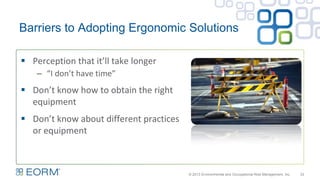
Barriers to Adopting Ergonomic Solutions
 Perception that it’ll take longer
– “I don’t have time”
 Don’t know how to obtain the right
equipment
 Don’t know about different practices
or equipment
33© 2013 Environmental and Occupational Risk Management, Inc.
Barriers to Adopting Ergonomic Solutions
34
 New employees
 Pressure to perform and produce
 It’s not convenient
 It costs too much
© 2013 Environmental and Occupational Risk Management, Inc.
Pre-Established Vendors and Equipment
35
 Advantages
– Employees and evaluators know what equipment is available
– Quick and easy ordering
– Discount prices
 Disadvantages
– Employees do not select own equipment
– Mercy of vendor if only choose one
© 2013 Environmental and Occupational Risk Management, Inc.
Customer Service
36
 JAMA Study – Positive correlation between quality of patient service &
health outcomes
– Patient service includes:
» Reduced wait times
» Communication
 Apply this to employees
– Online assessments provide quick turn around on evaluation requests &
help obtaining equipment
– Automated communication on status, check ins
– Make employees feel like they are important and you care
© 2013 Environmental and Occupational Risk Management, Inc.
How can Technology help?
 Automates process of risk
identification and mitigation
 Engages employee
 Centralizes equipment-related
data and processes
 Assists in resource prioritization
 Effectively measure outcomes
through data analysis
37© 2013 Environmental and Occupational Risk Management, Inc.
Putting it All Together
© 2013 Environmental and Occupational Risk Management, Inc. 38
Emphasis on managing risk vs. consequences
39
Summary
 Consider using a tiered approach to address ergonomics
– Online self-evaluation with checklist & training
– Phone evaluation with pictures and/or web camera when needed
– In person support
– Measure outcomes
– Strategize to make your ergonomics program sustainable & scalable
to other sites
© 2013 Environmental and Occupational Risk Management, Inc.
Thank you !
Anuja Patil, M.S., AEP
Associate Consultant
510.995.5411
patila@eorm.com
© 2013 Environmental and Occupational Risk Management, Inc. 40

Eorm sesha ergo_2013

  • 1.
    Leveraging Technology toEffectively Manage your Ergonomics Program SESHA - April 20, 2013 Anuja Patil, M.S., AEP
  • 2.
    This Session WillHelp You… 2  Discover how technology can help make your organization's ergonomics program more: Efficient Effective Measurable © 2013 Environmental and Occupational Risk Management, Inc.
  • 3.
    Distribution by Nature of allNonfatal Injury and Illness 3 Injury Trends © 2013 Environmental and Occupational Risk Management, Inc.
  • 4.
    Incident rate fornonfatal occupational injuries and illnesses involving days away from work – Nature of Disorders 4 Injury Trends 0 5 10 15 20 25 30 35 40 45 50 Sprains, strains, tears Musculoskeletal disorders Soreness, pain, including back Bruises, contusions Cuts, lacerations, punctures Fractures Heat burns, scalds Chemical burns © 2013 Environmental and Occupational Risk Management, Inc.
  • 5.
    Costs of PoorErgonomics  Repetitive motion injuries (RMIs) average costs range between $48K-$77K  RMI’s account for more than $2 Billion in worker’s compensation costs annually  Difficult type of injury – Slow recovering injury – High level of re-occurrence – Back pain is second only to the common cold as a cause of work loss © 2013 Environmental and Occupational Risk Management, Inc. 5
  • 6.
    Costs of Injuries ©2013 Environmental and Occupational Risk Management, Inc. 6
  • 7.
    Benefits of Ergonomics Decreases injury and lost time  Decreases absenteeism  Increases productivity and efficiency  Increases quality by decreasing errors and mistakes  Reduces turn over  Increases moral 7© 2013 Environmental and Occupational Risk Management, Inc.
  • 8.
    Opportunities to Leverage 8 Medical/WC costs  Absenteeism  Employee Retention  Union Agreement  Productivity Improvement Initiatives – Lean, Six Sigma, etc.  Engineering/Design © 2013 Environmental and Occupational Risk Management, Inc.
  • 9.
    9 Managing Ergonomic Risks ©2013 Environmental and Occupational Risk Management, Inc.
  • 10.
    EORM’s Ergonomics Philosophy 10 Our belief is that injuries and pain/discomfort to employee’s can be eliminated through a proactive risk management approach to ergonomics.  Managing risk vs. managing consequences  Risk management is an accepted strategy for Occupational Health & Safety professionals: – Recognition – Evaluation – Control – Anticipation of workplace hazards © 2013 Environmental and Occupational Risk Management, Inc.
  • 11.
    Effective Program “Attributes” 11 Effective and Efficient in reducing injuries  Compliant with government regulations  Systematic, Sustainable & Scalable to other sites  Business driven (reduce costs) – Demonstrating value to business leadership (show results) © 2013 Environmental and Occupational Risk Management, Inc.
  • 12.
    Ergonomic Approach 12 WM SD Pain Discomfort Difficulty Ergonomic Risk HumanLimitations Proactive Approach Reactive Approach © 2013 Environmental and Occupational Risk Management, Inc.
  • 13.
    Office Environment 13 Program Development Primarily computer based  Individual focus  Simplistic systems  Work locations may vary  Workers are becoming more mobile © 2013 Environmental and Occupational Risk Management, Inc.
  • 14.
    Ergonomics Support © 2013Environmental and Occupational Risk Management, Inc. 14
  • 15.
    In-person Support 15  Personalinteraction  Resource intensive  Costly  Rarely done in home and remote offices except in cases required by law © 2013 Environmental and Occupational Risk Management, Inc.
  • 16.
    Remote Support 16  RemoteSupport (phone evaluations or email support) – Phone evaluations – Digital pictures – Web cameras © 2013 Environmental and Occupational Risk Management, Inc.
  • 17.
    Phone Evaluations 17  Advantages –Direct interaction with employee – Can ask questions – Can direct employee how to set up workstation  Disadvantages – Have to rely on employee’s description of workstation – Need practice in asking questions and experience with enough in person evaluations to understand challenges and solutions – Takes evaluator’s time © 2013 Environmental and Occupational Risk Management, Inc.
  • 18.
    Digital Pictures 18  Advantages –Give you a quick look at what equipment employee is using – If employee is in picture gives idea of possible issues and how employee interacts with the workstation – Employee can see their own posture and position  Disadvantages – Only a snapshot – How does the employee sit and work when not on camera? © 2013 Environmental and Occupational Risk Management, Inc.
  • 19.
    Web Cameras 19  Advantages –Live pictures of employee working – Employee can also see evaluator who can show how they want employee to be positioned  Disadvantages – Everyone may not have a camera – If camera built into monitor only one view – Can’t see employee from the side © 2013 Environmental and Occupational Risk Management, Inc.
  • 20.
    20 Diverse Work Locations Contents© 2009. Reprinted with permission from WorldatWork. Content is licensed for use by purchaser only. No part of this article may be reproduced, excerpted or redistributed in any form without express written permission from WorldatWork. © 2013 Environmental and Occupational Risk Management, Inc.
  • 21.
    Office Environment 21 Best Solution 3 Tiered Approach – Online (along with email screening and support) – Remote Support (phone evaluations or email support) » Digital pictures » Web cameras – In-person © 2013 Environmental and Occupational Risk Management, Inc.
  • 22.
    22 Online - Technology ©2013 Environmental and Occupational Risk Management, Inc.
  • 23.
    23 Online Self-Evaluations © 2013Environmental and Occupational Risk Management, Inc.
  • 24.
    24 Online Self-Evaluations © 2013Environmental and Occupational Risk Management, Inc.
  • 25.
    Online Self-Evaluations © 2013Environmental and Occupational Risk Management, Inc. 25
  • 26.
    26 Track Evaluations © 2013Environmental and Occupational Risk Management, Inc.
  • 27.
    Online Self-Evaluations 27  Advantages –Teaches employees how to adjust their own workstation – Can integrate online training » Cal-OSHA regulation, EU Regulations – Includes checklist with feedback on what changes to make  Disadvantages – Limited personal interaction with employee © 2013 Environmental and Occupational Risk Management, Inc.
  • 28.
    Additional In-person Support 28 Inperson Evaluations Cartevia  Electronic Reports  In person Support  Efficient Completion of reports  Standardized reports © 2013 Environmental and Occupational Risk Management, Inc.
  • 29.
    29 Measure Outcomes © 2013Environmental and Occupational Risk Management, Inc.
  • 30.
    Measure Outcomes 30  Injuryand illness records – Injuries – Cost per injury – Days away, restricted or transferred  Time away from work (absenteeism)  Employee discomfort  Are engineering controls being used?  Turn around time (response to employee requests)  Number of requests / trainings  Risk impact © 2013 Environmental and Occupational Risk Management, Inc.
  • 31.
    Measure Outcomes © 2013Environmental and Occupational Risk Management, Inc. 31
  • 32.
    32 Overcoming Barriers in AdoptingErgonomic Solutions © 2013 Environmental and Occupational Risk Management, Inc.
  • 33.
    Barriers to AdoptingErgonomic Solutions  Perception that it’ll take longer – “I don’t have time”  Don’t know how to obtain the right equipment  Don’t know about different practices or equipment 33© 2013 Environmental and Occupational Risk Management, Inc.
  • 34.
    Barriers to AdoptingErgonomic Solutions 34  New employees  Pressure to perform and produce  It’s not convenient  It costs too much © 2013 Environmental and Occupational Risk Management, Inc.
  • 35.
    Pre-Established Vendors andEquipment 35  Advantages – Employees and evaluators know what equipment is available – Quick and easy ordering – Discount prices  Disadvantages – Employees do not select own equipment – Mercy of vendor if only choose one © 2013 Environmental and Occupational Risk Management, Inc.
  • 36.
    Customer Service 36  JAMAStudy – Positive correlation between quality of patient service & health outcomes – Patient service includes: » Reduced wait times » Communication  Apply this to employees – Online assessments provide quick turn around on evaluation requests & help obtaining equipment – Automated communication on status, check ins – Make employees feel like they are important and you care © 2013 Environmental and Occupational Risk Management, Inc.
  • 37.
    How can Technologyhelp?  Automates process of risk identification and mitigation  Engages employee  Centralizes equipment-related data and processes  Assists in resource prioritization  Effectively measure outcomes through data analysis 37© 2013 Environmental and Occupational Risk Management, Inc.
  • 38.
    Putting it AllTogether © 2013 Environmental and Occupational Risk Management, Inc. 38
  • 39.
    Emphasis on managingrisk vs. consequences 39 Summary  Consider using a tiered approach to address ergonomics – Online self-evaluation with checklist & training – Phone evaluation with pictures and/or web camera when needed – In person support – Measure outcomes – Strategize to make your ergonomics program sustainable & scalable to other sites © 2013 Environmental and Occupational Risk Management, Inc.
  • 40.
    Thank you ! AnujaPatil, M.S., AEP Associate Consultant 510.995.5411 patila@eorm.com © 2013 Environmental and Occupational Risk Management, Inc. 40