INFLUENCE ON SERVICEABILITY
AND DURABILITY
Course Instructor
Dr.S.P.SANGEETHA
VICE PRINCIPAL (ACADEMICS)
AARUPADAI VEEDU INSTITUTE OF TECHNOLOGY
CONTENTS
❑ Effects due to
Climate,temperature , chemicals , wear and erosion , design and construction errors , corrosion mechanism
❑ Effects of cover thickness and cracking
❑ Method of corrosion protection
❑ corrosion inhibitors
❑ corrosion resistant steels ,coatings
❑ cathodic production
Durability
❖Ability to resist weathering action, chemical attack, abrasion or any
other process of deterioration.
❖Factors affecting are environment, cover to embedded steel, type and
quality of constituent materials, cement content and water cement ratio,
workmanship to obtain full compaction, efficient curing and shape and
size of member
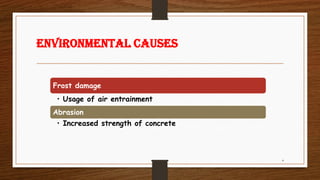
ENVIRONMENTAL CAUSES
Frost damage
• Usage of air entrainment
Abrasion
• Increased strength of concrete
4
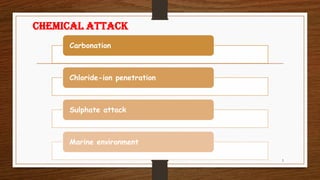
Chemical Attack
Carbonation
Chloride-ion penetration
Sulphate attack
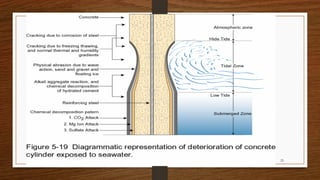
Marine environment
5
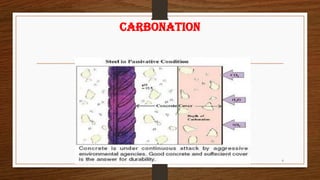
Carbonation
6
CHLORIDE-ION PENETRATION
• Reduces strength
• Destroys passivity
Remedy
• Use blended cements
• Low w/c ratio
7
SULPHATE ATTACK
• From seawater, soil and ground-water
• Maybe of calcium, sodium, magnesium and ammonium
Remedy
• Use low C3A cement.
• E.g. Sulphate resisting cement,Blended cements
8
WHAT IS DURABILITY OF CONCRETE?
The ability of concrete to resist weathering
action, chemical attack, and abrasion while
maintaining its desired engineering properties
FACTORS AFFECTING DURABILITY
• ABRASION
• BIOLOGICAL FACTORS.
• TEMPERATURE EFFECT
• ENVIRONMENTAL RELATED PHYSICAL PROBLEMS
• FREEZING AND THAWING
• CHEMICAL ATTACKS
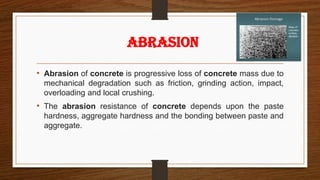
• Abrasion of concrete is progressive loss of concrete mass due to
mechanical degradation such as friction, grinding action, impact,
overloading and local crushing.
• The abrasion resistance of concrete depends upon the paste
hardness, aggregate hardness and the bonding between paste and
aggregate.
ABRASION
FREEZING AND THAWING
• The most potentially destructive weathering factor is freezing and
thawing while the concrete is wet.
• Deterioration is caused by the freezing of water and subsequent
expansion in the paste, the aggregate particles, or both.
• With the addition of an air entrainment admixture, concrete is highly
resistant to freezing and thawing.
• The microscopic air bubbles in the paste provide chambers for the
water to enter and thus relieve the hydraulic pressure generated
CHEMICAL ATTACKS
• Carbonation
• Chloride Attack
• Acid Attack
• Sulphate Attack
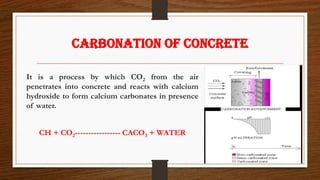
CARBONATION OF CONCRETE
It is a process by which CO2 from the air
penetrates into concrete and reacts with calcium
hydroxide to form calcium carbonates in presence
of water.
CH + CO2----------------- CACO3 + WATER
CHLORIDE ATTACK
• Chloride attack is particularly important because it primarily causes
corrosion of reinforcement.
• Statistics have indicated that over 40 per cent of failure of structures is due
to corrosion of reinforcement.
• Due to high alkalinity of concrete a protective oxide film is present on the
surface of steel reinforcement.
• This protective passivity layer can be lost due to carbonation and chloride
in presence of H2O and O2
CHLORIDE ATTACK-Prevention measures
• Use supplementary cementitious materials to reduce permeability
• Increasing the concrete cover over the steel
• Use of corrosion inhibiting admixtures
• Epoxy-coated reinforcing steel, surface treatments, concrete overlays,
and cathodic protection
SULPHATE ATTACK
• Sulphates can attack concrete by reacting with hydrated compounds in the
hardened cement paste,result in disintegration of the concrete.
• It combines with the C-S-H, or concrete paste, and begins destroying the
paste that holds the concrete together.
• As sulphate dries, new compounds are formed, often called Ettringite.
(calcium sulphoaluminate hydrate)
• These new crystals occupy empty space, and as they continue to form, they
cause the paste to crack, further damaging the concrete
Control of sulphate attack
• Low permeability is the best protection against sulphate attack.
• Adequate concrete thickness
• Sulphate resisting cement
• Low w/c ratio
• Proper compaction and curing
• The addition of a pozzolanic admixture such as flyash
• Use of low C3A content cement
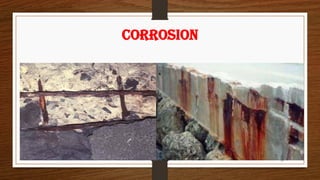
CORROSION
19
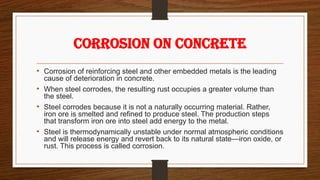
CORROSION ON CONCRETE
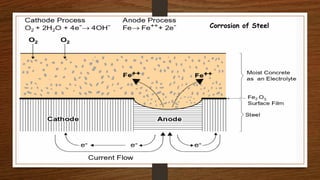
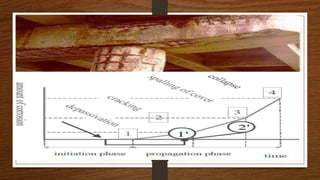
• Corrosion of reinforcing steel and other embedded metals is the leading
cause of deterioration in concrete.
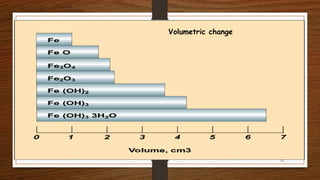
• When steel corrodes, the resulting rust occupies a greater volume than
the steel.
• Steel corrodes because it is not a naturally occurring material. Rather,
iron ore is smelted and refined to produce steel. The production steps
that transform iron ore into steel add energy to the metal.
• Steel is thermodynamically unstable under normal atmospheric conditions
and will release energy and revert back to its natural state—iron oxide, or
rust. This process is called corrosion.
21
Corrosion of Steel
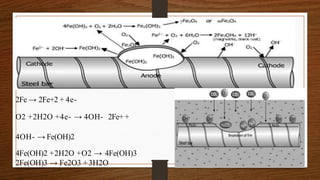
2Fe → 2Fe+2 + 4e-
O2 +2H2O +4e- → 4OH- 2Fe++
4OH- → Fe(OH)2
4Fe(OH)2 +2H2O +O2 → 4Fe(OH)3
2Fe(OH)3 → Fe2O3 +3H2O
23
Volumetric change
25
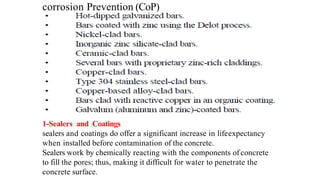
corrosion Prevention (CoP)
1-Sealers and Coatings
sealers and coatings do offer a significant increase in lifeexpectancy
when installed before contamination of the concrete.
Sealers work by chemically reacting with the components of concrete
to fill the pores; thus, making it difficult for water to penetrate the
concrete surface.
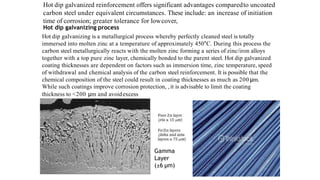
Hot dip galvanized reinforcement offers significant advantages comparedto uncoated
carbon steel under equivalent circumstances. These include: an increase of initiation
time of corrosion; greater tolerance for lowcover,
Hot dip galvanizing process
Hot dip galvanizing is a metallurgical process whereby perfectly cleaned steel is totally
immersed into molten zinc at a temperature of approximately 450°C. During this process the
carbon steel metallurgically reacts with the molten zinc forming a series of zinc/iron alloys
together with a top pure zinc layer, chemically bonded to the parent steel. Hot dip galvanized
coating thicknesses are dependent on factors such as immersion time, zinc temperature, speed
of withdrawal and chemical analysis of the carbon steel reinforcement. It is possible that the
chemical composition of the steel could result in coating thicknesses as much as 200 μm.
While such coatings improve corrosion protection, ,it is advisable to limit the coating
thickness to <200 μm and avoidexcess
Gamma
Layer
(±6 μm)
Corrosion Inhibitors
Corrosion inhibitors, which are added to the concrete at the time of
mixing, are used to prevent the onset of corrosion inR/C.
mechanisms: by increasing the threshold concentration for
aggressive species necessary for corrosion to occur or by
reducing the rate of corrosion once corrosion has begun.
Corrosion inhibitors, whether admixed or surface applied, exist
in three basic forms: anodic inhibitors, cathodic inhibitors, and
mixed inhibitors. Anodic inhibitors minimize the anodic
component of the corrosion process while cathodic inhibitors
minimize the cathodic component. Mixed inhibitors prevent
both the anodic and cathodic reactions. By forming a film on
the steel, coating the surface of the steel, or by reacting with
the chloride ions, the interaction between the chloride ions and
steel will be prevented.
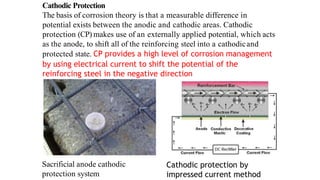
Cathodic Protection
The basis of corrosion theory is that a measurable difference in
potential exists between the anodic and cathodic areas. Cathodic
protection (CP) makes use of an externally applied potential, which acts
as the anode, to shift all of the reinforcing steel into a cathodicand
protected state. CP provides a high level of corrosion management
by using electrical current to shift the potential of the
reinforcing steel in the negative direction
Cathodic protection by
impressed current method
Sacrificial anode cathodic
protection system
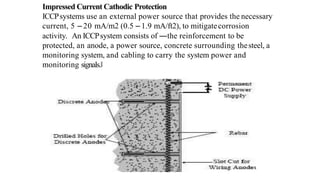
Impressed Current Cathodic Protection
ICCPsystems use an external power source that provides the necessary
current, 5 – 20 mA/m2 (0.5 – 1.9 mA/ft2), to mitigatecorrosion
activity. An ICCPsystem consists of ―the reinforcement to be
protected, an anode, a power source, concrete surrounding thesteel, a
monitoring system, and cabling to carry the system power and
monitoring signals.‖
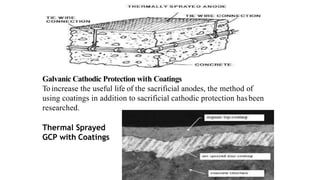
Galvanic Cathodic Protection with Coatings
Toincrease the useful life of the sacrificial anodes, the method of
using coatings in addition to sacrificial cathodic protection hasbeen
researched.
Thermal Sprayed
GCP with Coatings
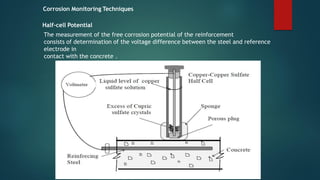
Corrosion Monitoring Techniques
Half-cell Potential
The measurement of the free corrosion potential of the reinforcement
consists of determination of the voltage difference between the steel and reference
electrode in
contact with the concrete .
Fire Resistance
• Fire-rating
• Spalling
Use:
• Light weight concrete
• Aggregates devoid of silica
DURABILITY CONCEPTS 33
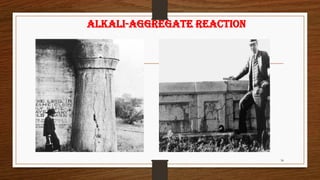
Alkali-aggregate Reaction
34
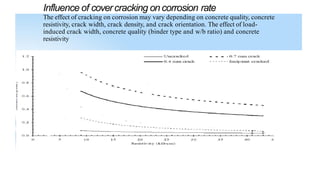
Influence of covercracking on corrosion rate
The effect of cracking on corrosion may vary depending on concrete quality, concrete
resistivity, crack width, crack density, and crack orientation. The effect of load-
induced crack width, concrete quality (binder type and w/b ratio) and concrete
resistivity
Causes
• Reactivity of aggregate – Andesites, Rhyolites, etc.,
• High alkali content in cement – should be less than 0.6%
• Availability of moisture.
• Optimum temperature 10 – 38°
36
RECAP
• CORROSION PHENOMENON
• FACTORS INFLUENCING CORROSION
• CORROSION PROCESS
• CORROSION PREVENTIVE MECHANISM
• CORROSION MONITORING

Serviceability and Durability of concrete structures

  • 1.
    INFLUENCE ON SERVICEABILITY ANDDURABILITY Course Instructor Dr.S.P.SANGEETHA VICE PRINCIPAL (ACADEMICS) AARUPADAI VEEDU INSTITUTE OF TECHNOLOGY
  • 2.
    CONTENTS ❑ Effects dueto Climate,temperature , chemicals , wear and erosion , design and construction errors , corrosion mechanism ❑ Effects of cover thickness and cracking ❑ Method of corrosion protection ❑ corrosion inhibitors ❑ corrosion resistant steels ,coatings ❑ cathodic production
  • 3.
    Durability ❖Ability to resistweathering action, chemical attack, abrasion or any other process of deterioration. ❖Factors affecting are environment, cover to embedded steel, type and quality of constituent materials, cement content and water cement ratio, workmanship to obtain full compaction, efficient curing and shape and size of member
  • 4.
    ENVIRONMENTAL CAUSES Frost damage •Usage of air entrainment Abrasion • Increased strength of concrete 4
  • 5.
  • 6.
  • 7.
    CHLORIDE-ION PENETRATION • Reducesstrength • Destroys passivity Remedy • Use blended cements • Low w/c ratio 7
  • 8.
    SULPHATE ATTACK • Fromseawater, soil and ground-water • Maybe of calcium, sodium, magnesium and ammonium Remedy • Use low C3A cement. • E.g. Sulphate resisting cement,Blended cements 8
  • 9.
    WHAT IS DURABILITYOF CONCRETE? The ability of concrete to resist weathering action, chemical attack, and abrasion while maintaining its desired engineering properties
  • 10.
    FACTORS AFFECTING DURABILITY •ABRASION • BIOLOGICAL FACTORS. • TEMPERATURE EFFECT • ENVIRONMENTAL RELATED PHYSICAL PROBLEMS • FREEZING AND THAWING • CHEMICAL ATTACKS
  • 11.
    • Abrasion ofconcrete is progressive loss of concrete mass due to mechanical degradation such as friction, grinding action, impact, overloading and local crushing. • The abrasion resistance of concrete depends upon the paste hardness, aggregate hardness and the bonding between paste and aggregate. ABRASION
  • 12.
    FREEZING AND THAWING •The most potentially destructive weathering factor is freezing and thawing while the concrete is wet. • Deterioration is caused by the freezing of water and subsequent expansion in the paste, the aggregate particles, or both. • With the addition of an air entrainment admixture, concrete is highly resistant to freezing and thawing. • The microscopic air bubbles in the paste provide chambers for the water to enter and thus relieve the hydraulic pressure generated
  • 13.
    CHEMICAL ATTACKS • Carbonation •Chloride Attack • Acid Attack • Sulphate Attack
  • 14.
    CARBONATION OF CONCRETE Itis a process by which CO2 from the air penetrates into concrete and reacts with calcium hydroxide to form calcium carbonates in presence of water. CH + CO2----------------- CACO3 + WATER
  • 15.
    CHLORIDE ATTACK • Chlorideattack is particularly important because it primarily causes corrosion of reinforcement. • Statistics have indicated that over 40 per cent of failure of structures is due to corrosion of reinforcement. • Due to high alkalinity of concrete a protective oxide film is present on the surface of steel reinforcement. • This protective passivity layer can be lost due to carbonation and chloride in presence of H2O and O2
  • 16.
    CHLORIDE ATTACK-Prevention measures •Use supplementary cementitious materials to reduce permeability • Increasing the concrete cover over the steel • Use of corrosion inhibiting admixtures • Epoxy-coated reinforcing steel, surface treatments, concrete overlays, and cathodic protection
  • 17.
    SULPHATE ATTACK • Sulphatescan attack concrete by reacting with hydrated compounds in the hardened cement paste,result in disintegration of the concrete. • It combines with the C-S-H, or concrete paste, and begins destroying the paste that holds the concrete together. • As sulphate dries, new compounds are formed, often called Ettringite. (calcium sulphoaluminate hydrate) • These new crystals occupy empty space, and as they continue to form, they cause the paste to crack, further damaging the concrete
  • 18.
    Control of sulphateattack • Low permeability is the best protection against sulphate attack. • Adequate concrete thickness • Sulphate resisting cement • Low w/c ratio • Proper compaction and curing • The addition of a pozzolanic admixture such as flyash • Use of low C3A content cement
  • 19.
  • 20.
    CORROSION ON CONCRETE •Corrosion of reinforcing steel and other embedded metals is the leading cause of deterioration in concrete. • When steel corrodes, the resulting rust occupies a greater volume than the steel. • Steel corrodes because it is not a naturally occurring material. Rather, iron ore is smelted and refined to produce steel. The production steps that transform iron ore into steel add energy to the metal. • Steel is thermodynamically unstable under normal atmospheric conditions and will release energy and revert back to its natural state—iron oxide, or rust. This process is called corrosion.
  • 21.
  • 22.
    2Fe → 2Fe+2+ 4e- O2 +2H2O +4e- → 4OH- 2Fe++ 4OH- → Fe(OH)2 4Fe(OH)2 +2H2O +O2 → 4Fe(OH)3 2Fe(OH)3 → Fe2O3 +3H2O
  • 23.
  • 25.
  • 26.
    corrosion Prevention (CoP) 1-Sealersand Coatings sealers and coatings do offer a significant increase in lifeexpectancy when installed before contamination of the concrete. Sealers work by chemically reacting with the components of concrete to fill the pores; thus, making it difficult for water to penetrate the concrete surface.
  • 27.
    Hot dip galvanizedreinforcement offers significant advantages comparedto uncoated carbon steel under equivalent circumstances. These include: an increase of initiation time of corrosion; greater tolerance for lowcover, Hot dip galvanizing process Hot dip galvanizing is a metallurgical process whereby perfectly cleaned steel is totally immersed into molten zinc at a temperature of approximately 450°C. During this process the carbon steel metallurgically reacts with the molten zinc forming a series of zinc/iron alloys together with a top pure zinc layer, chemically bonded to the parent steel. Hot dip galvanized coating thicknesses are dependent on factors such as immersion time, zinc temperature, speed of withdrawal and chemical analysis of the carbon steel reinforcement. It is possible that the chemical composition of the steel could result in coating thicknesses as much as 200 μm. While such coatings improve corrosion protection, ,it is advisable to limit the coating thickness to <200 μm and avoidexcess Gamma Layer (±6 μm)
  • 28.
    Corrosion Inhibitors Corrosion inhibitors,which are added to the concrete at the time of mixing, are used to prevent the onset of corrosion inR/C. mechanisms: by increasing the threshold concentration for aggressive species necessary for corrosion to occur or by reducing the rate of corrosion once corrosion has begun. Corrosion inhibitors, whether admixed or surface applied, exist in three basic forms: anodic inhibitors, cathodic inhibitors, and mixed inhibitors. Anodic inhibitors minimize the anodic component of the corrosion process while cathodic inhibitors minimize the cathodic component. Mixed inhibitors prevent both the anodic and cathodic reactions. By forming a film on the steel, coating the surface of the steel, or by reacting with the chloride ions, the interaction between the chloride ions and steel will be prevented.
  • 29.
    Cathodic Protection The basisof corrosion theory is that a measurable difference in potential exists between the anodic and cathodic areas. Cathodic protection (CP) makes use of an externally applied potential, which acts as the anode, to shift all of the reinforcing steel into a cathodicand protected state. CP provides a high level of corrosion management by using electrical current to shift the potential of the reinforcing steel in the negative direction Cathodic protection by impressed current method Sacrificial anode cathodic protection system
  • 30.
    Impressed Current CathodicProtection ICCPsystems use an external power source that provides the necessary current, 5 – 20 mA/m2 (0.5 – 1.9 mA/ft2), to mitigatecorrosion activity. An ICCPsystem consists of ―the reinforcement to be protected, an anode, a power source, concrete surrounding thesteel, a monitoring system, and cabling to carry the system power and monitoring signals.‖
  • 31.
    Galvanic Cathodic Protectionwith Coatings Toincrease the useful life of the sacrificial anodes, the method of using coatings in addition to sacrificial cathodic protection hasbeen researched. Thermal Sprayed GCP with Coatings
  • 32.
    Corrosion Monitoring Techniques Half-cellPotential The measurement of the free corrosion potential of the reinforcement consists of determination of the voltage difference between the steel and reference electrode in contact with the concrete .
  • 33.
    Fire Resistance • Fire-rating •Spalling Use: • Light weight concrete • Aggregates devoid of silica DURABILITY CONCEPTS 33
  • 34.
  • 35.
    Influence of covercrackingon corrosion rate The effect of cracking on corrosion may vary depending on concrete quality, concrete resistivity, crack width, crack density, and crack orientation. The effect of load- induced crack width, concrete quality (binder type and w/b ratio) and concrete resistivity
  • 36.
    Causes • Reactivity ofaggregate – Andesites, Rhyolites, etc., • High alkali content in cement – should be less than 0.6% • Availability of moisture. • Optimum temperature 10 – 38° 36
  • 37.
    RECAP • CORROSION PHENOMENON •FACTORS INFLUENCING CORROSION • CORROSION PROCESS • CORROSION PREVENTIVE MECHANISM • CORROSION MONITORING