SERVICE SECTOR IN
INDIAServices sector is the lifeline for the socio-economic growth of a country. It
is today the largest and fastest growing sector globally contributing more
to the global output and employing more people than any other sector. In
alignment with global trend, the Indian Services sector has witnessed a
major boom and is one of the major contributors to both employment and
national income in recent time. Services sector in India today accounts for
more than half of India’s GDP. Since independence, there has been a
marked acceleration in Services sector growth in India. This paper provides
an overview of the Indian Services sector. It shows that this sector is the
fastest growing sector in India, contributing significantly to GDP and GDP
growth rate. However, there are some concerns.
Trade, Hotels and
Restaurants
Finance, Insurance,
Real Estate and
Business Service
Community, Personal
ans Social Services
Transport, Storage and
Communication
Swaroop Pandao
swarooppandao@gmail.com
Service Sector in India Date: 23/09/2015
Swaroop Pandao
Service Sector in India
Introduction
The services sector with an around 57 per cent contribution to the gross domestic product
(GDP), has made rapid strides in the last few years and emerged as the largest and fastest-
growing sector of the economy. Besides being the dominant sector in India’s GDP, it has also
contributed substantially to foreign investment flows, exports, and employment. India’s
services sector covers a wide variety of activities that have different features and dimensions.
They include trade, hotel and restaurants, transport, storage and communication, financing,
insurance, real estate, & business services, community, social and personal services and
services associated with construction. Services in India are emerging as a prominent sector in
terms of contribution to national and states’ incomes, trade flows, foreign direct investment
(FDI) inflows, and employment.
The compound annual growth rate (CAGR) of services sector GDP was 8.5 per cent for the
period 2000-01 to 2013-14.
As per the survey, in India, the growth of services-sector gross domestic product (GDP) has
been higher than that of overall GDP between the FY01- FY14. Services constitute a major
portion of India’s GDP with a 57 per cent share in GDP at factor cost (at current prices) in
2013-14, an increase of 6 per cent points over 2000-01.
The shift from primary and secondary activities to tertiary activities by the citizens of a country
indicates that it is on the path of progress. The growth in the services sector can be attributed
mostly to the emergence of the Indian Information Technology (IT) and IT enabled Services
(ITeS) sectors as well as e-commerce.
IT and ITeS: Leading services segment
 India’s technology and BPM sector (including hardware) is estimated to have generated
US$ 146 billion in revenue during FY15 compared to US$ 118 billion in FY14,
implying a growth rate of 23.72 per cent
 The contribution of the IT sector to India’s GDP rose to approximately 9.5 per cent in
FY15 from 1.2 per cent in FY98
 TCS is the market leader, accounting for about 10.1 per cent of India’s total IT & ITeS
sector revenue
 The top six firms contribute around 36 per cent to the total industry revenue, indicating
the market is fairly competitive
Key drivers of growth in the Service sector
 Low cost of operation and tax advantages
 Rapid industrialization and growth of IT parks in the country
 Supportive government policies
 Availability of technically skilled manpower and readily available resources in the
country.
 Rapid introduction of IT technologies in major sectors such as telecom, BFSI.
 Strong growth in export demand
 Use of new technologies like cloud computing
 Government established SEZs
Service Sector in India Date: 23/09/2015
Swaroop Pandao
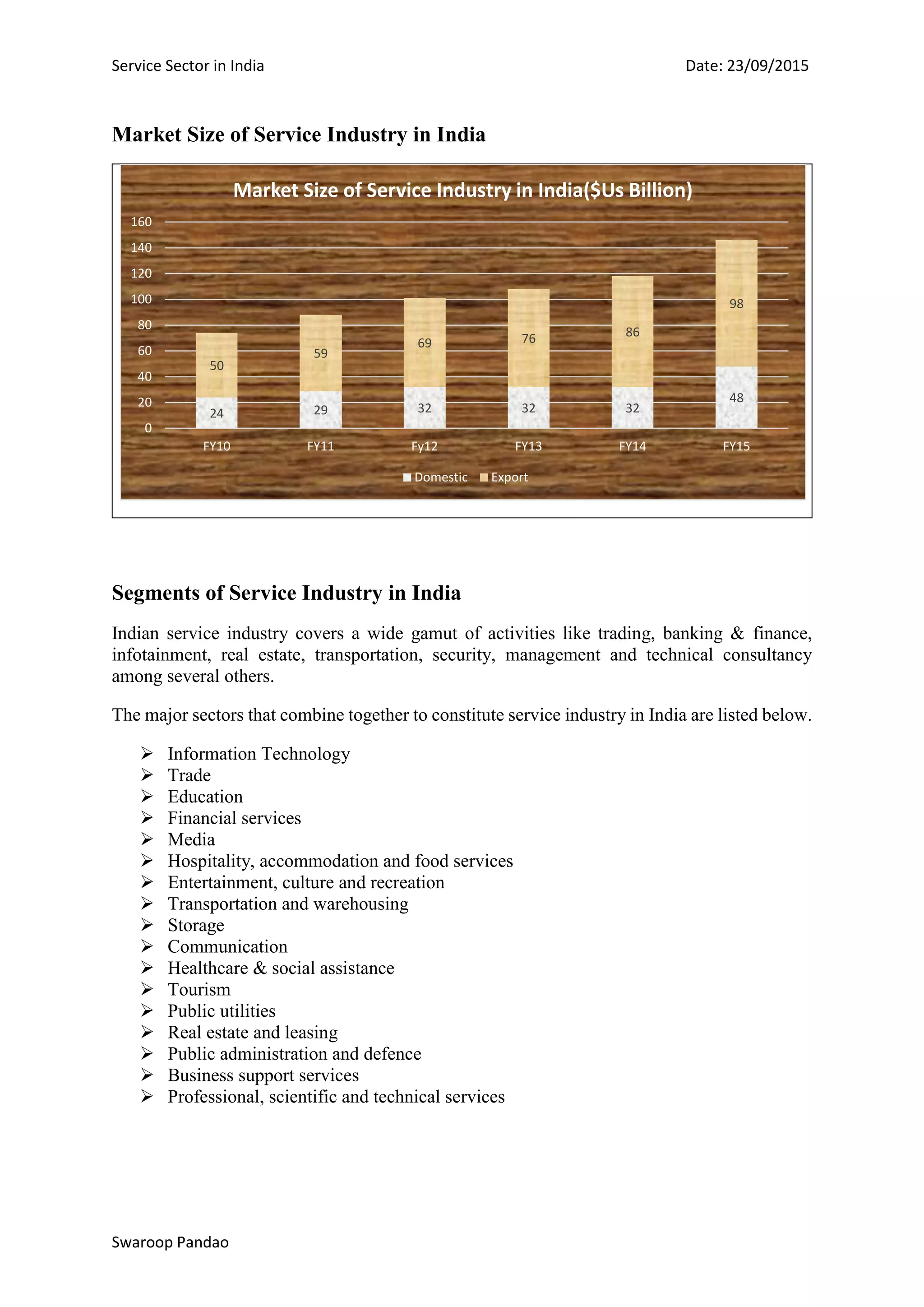
Market Size of Service Industry in India
Segments of Service Industry in India
Indian service industry covers a wide gamut of activities like trading, banking & finance,
infotainment, real estate, transportation, security, management and technical consultancy
among several others.
The major sectors that combine together to constitute service industry in India are listed below.
 Information Technology
 Trade
 Education
 Financial services
 Media
 Hospitality, accommodation and food services
 Entertainment, culture and recreation
 Transportation and warehousing
 Storage
 Communication
 Healthcare & social assistance
 Tourism
 Public utilities
 Real estate and leasing
 Public administration and defence
 Business support services
 Professional, scientific and technical services
24 29 32 32 32
48
50
59
69 76 86
98
0
20
40
60
80
100
120
140
160
FY10 FY11 Fy12 FY13 FY14 FY15
Market Size of Service Industry in India($Us Billion)
Domestic Export
Service Sector in India Date: 23/09/2015
Swaroop Pandao
Service sector can be broadly divided into two parts:
(A) Economic Services:
It includes the following items, such as;
(i) Transport, Storage and Communication (16.50%):
 There are various types of transport, such as rail transport, road transport, water
transport, air transport. Indian railway system is first in Asia and fourth in the world
after USA, Russia and Canada. Storage service is provided by both government and
private. Central Warehousing Corporation (CWC), the Food Corporation of India (FCI)
etc. are the government units which provide storage facilities.
 Again, there are several cold storage facilities mainly provided by private authorities.
Communication is a vital service of an economy. It includes postal and telegraph,
telecommunication, information and broadcasting etc. In India postal department
includes several new schemes like Speed Post, Express Post, E-Post, Media Post,
Satellite Post etc. Indian telecommunication network is one of the largest in Asia. It
provides land phone, mobile phone and e-mail services.
Trade, Hotels and
Retauraunts,
31.90%
Transport, Storage
and Communication
16.50%
Finance, Insurance,
Real Estate and
Business Services,
29.33%
Community,
Personal and Social
Services, 22.72%
% SHARE
Service Sector in India Date: 23/09/2015
Swaroop Pandao
(ii) Trade, Hotels and Tourisms:
 Trade services are the major contributors to the service industry in India, accounting
around 31.9% to the overall Service sector in Indian economy. Trade service comprises
both domestic and foreign trades. Domestic trade means trade between the different
states and cities within the country. On the other hand, foreign trade means trade
between different countries. It includes both exports and imports. There are several
public sector units like State Trading Corporation (STC), Minerals and Metals Trading
Corporation (MMTC), Special Economic Zones (SEZ) etc. giving sufficient support to
increase the foreign trade in India.
 Nowadays, several private sector units are also taking part to enlarge international trade.
Hotel industries are mainly run by private entrepreneurs. However, both government
and private bodies are equally responsible to increase tourism service in India.
(iii) Banking and Insurance Services:
 Development of banking service is the major indicator of economic growth. In India,
banking network is spread all over the country. For the flourishment of other service
sectors, banking sector plays a very vital role. Sector includes: Finance, Banking,
Insurance, Real Estate and Business Services, contributing 29.33% of the sector.
 In India, apart from the Central Bank, i.e., Reserve Bank of India (RBI), all the
commercial banks including both public and private sector banks are performing a true
role for the country’s development. Public sector banks include SBI, PNB, UBI, UCO
Bank etc. and private banks include HDFC, HSBC, AXIS Bank etc. In-spite of these,
there are several non-banking financial institutions like NABARD, ICICI, and IDBI
etc. Moreover, there are several public insurance units like LIC, GIC etc. and private
insurance units like Tata AIG, Birla Sunlife etc.
(B) Social Service:
It includes following items, such as;
(i) Education:
 After Independence, education system has increased tremendously. General education
facilities have increases in good number. There are sharp increase in the number of
primary, middle, high and higher secondary schools. A decent number of students have
enrolled in the schools. Not only that, number of colleges, deemed universities and
universities have also risen to a large extent.
 Moreover, technical and professional education institutions are also increasing rapidly.
Medical colleges, engineering colleges, agriculture colleges and business schools etc.
are also growing rapidly in India. All these have increased the standard of education
system in India.
Service Sector in India Date: 23/09/2015
Swaroop Pandao
(ii) Health:
 It is an important service sector of India. The health service includes number of
hospitals, dispensaries, community health services, primary health centres, number of
doctors, nurses, beds in hospitals along with the number of doctors per 1000 population.
Both private and public sectors are working together to improve the health services in
urban and rural parts of India. After Independences medical facilities have improved in
India.
(iii) Administration:
 In India administrative service has also increased at a rapid pace. After Independence,
the offices of BDO (Block Development Office), DM (District Magistrate), IAS (Indian
Administrative Service), IPS (Indian Police Service), IFS (Indian Forest Service) and
Judicial Courts have increased to operate smooth functioning of civil services in India.
Investments
The Indian services sector has attracted the highest amount of FDI equity inflows in the period
April 2000-December 2014, amounting to about US$ 41,755.46 million which is about 18 per
cent of the total foreign inflows, according to the Department of Industrial Policy and
Promotion (DIPP).
Some of the developments and major investments by companies in the services sector in the
recent past are as follows:
 Zomato has acquired Cibando, one of Italy’s largest restaurant search services. With
this acquisition, the company has a presence in 20 countries. Zomato further aims to
widen its international presence by entering 15 more countries in 2015.
 The private security services industry in India is expected to register a growth of over
20 per cent over the next few years, doubling its market size to Rs 80,000 crore (US$
12.94 billion) by 2020.
 Snapdeal.com has acquired gifting recommendation technology platform
Wishpicker.com. The acquisition will enable Snapdeal to further personalise user
experience and drive conversions through intelligent recommendations.
 The Government of India has awarded a contract worth Rs 1,370 crore (US$ 221.63
million) to Ricoh India Ltd and Telecommunications Consultants India Ltd (TCIL) to
modernise 129,000 post offices through automation.
 Global online food delivery marketplace Foodpanda has acquired TastyKhana in India.
Now, Foodpanda will have a selection from over 2,500 restaurants in 10 cities.
 Taxi service aggregator Ola plans to scale up operations to 100 cities from 19 currently.
The company, which is looking at small towns for growth, also plans to invest in driver
eco-system, such as training centres and technology upgrade.
Service Sector in India Date: 23/09/2015
Swaroop Pandao
SWOT analysis on Indian Service sector
Strengths
 Highly skilled, English-speaking workforce.
 Abundant manpower
 Cheaper workforce than their Western counterparts. According to Nasscom, The wage
difference is as high as 70-80 percent when compared to their Western counterparts.
 Lower attrition rates than in the West.
 Dedicated workforce aiming at making a long-term career in the field.
 Round-the-clock advantage for Western companies due to the huge time difference.
 Lower response time with efficient and effective service.
 Operational excellence
 Conducive business environment
 High technology for database.
Weaknesses
 Recent months have seen a rise in the level of attrition rates among ITES workers who
are quitting their jobs to pursue higher studies. Of late workers have shown a tendency
not to pursue ITES as a full-time career.
 The cost of telecom and network infrastructure is much higher in India than in the US.
 Lack of financial suppliers
 Local infrastructure
 Political opposition from developed countries
Opportunities
 To work closely with associations like Nasscom to portray India as the most favoured
ITES destination in the world.
 Indian ITES companies should work closely with Western governments and assuage
their concerns and issues.
 India can be branded as a quality ITES destination rather than a low-cost destination.
 Development market
 Provide more security and effective database environment
Threats
 The anti-outsourcing legislation in the US state of New Jersey. Three more states in the
United States are planning legislation against outsourcing Connecticut, Missouri and
Wisconsin.
 Workers in British Telecom have protested against outsourcing of work to Indian BPO
companies.
 Competition: Other ITES destinations such as China, Philippines and South Africa
could have an edge on the cost factor.
 Slowdown of demand
 Customer indecisiveness: the requirement change and change often
Service Sector in India Date: 23/09/2015
Swaroop Pandao
Thank You

Service Sector in India

  • 1.
    SERVICE SECTOR IN INDIAServicessector is the lifeline for the socio-economic growth of a country. It is today the largest and fastest growing sector globally contributing more to the global output and employing more people than any other sector. In alignment with global trend, the Indian Services sector has witnessed a major boom and is one of the major contributors to both employment and national income in recent time. Services sector in India today accounts for more than half of India’s GDP. Since independence, there has been a marked acceleration in Services sector growth in India. This paper provides an overview of the Indian Services sector. It shows that this sector is the fastest growing sector in India, contributing significantly to GDP and GDP growth rate. However, there are some concerns. Trade, Hotels and Restaurants Finance, Insurance, Real Estate and Business Service Community, Personal ans Social Services Transport, Storage and Communication Swaroop Pandao swarooppandao@gmail.com
  • 2.
    Service Sector inIndia Date: 23/09/2015 Swaroop Pandao Service Sector in India Introduction The services sector with an around 57 per cent contribution to the gross domestic product (GDP), has made rapid strides in the last few years and emerged as the largest and fastest- growing sector of the economy. Besides being the dominant sector in India’s GDP, it has also contributed substantially to foreign investment flows, exports, and employment. India’s services sector covers a wide variety of activities that have different features and dimensions. They include trade, hotel and restaurants, transport, storage and communication, financing, insurance, real estate, & business services, community, social and personal services and services associated with construction. Services in India are emerging as a prominent sector in terms of contribution to national and states’ incomes, trade flows, foreign direct investment (FDI) inflows, and employment. The compound annual growth rate (CAGR) of services sector GDP was 8.5 per cent for the period 2000-01 to 2013-14. As per the survey, in India, the growth of services-sector gross domestic product (GDP) has been higher than that of overall GDP between the FY01- FY14. Services constitute a major portion of India’s GDP with a 57 per cent share in GDP at factor cost (at current prices) in 2013-14, an increase of 6 per cent points over 2000-01. The shift from primary and secondary activities to tertiary activities by the citizens of a country indicates that it is on the path of progress. The growth in the services sector can be attributed mostly to the emergence of the Indian Information Technology (IT) and IT enabled Services (ITeS) sectors as well as e-commerce. IT and ITeS: Leading services segment  India’s technology and BPM sector (including hardware) is estimated to have generated US$ 146 billion in revenue during FY15 compared to US$ 118 billion in FY14, implying a growth rate of 23.72 per cent  The contribution of the IT sector to India’s GDP rose to approximately 9.5 per cent in FY15 from 1.2 per cent in FY98  TCS is the market leader, accounting for about 10.1 per cent of India’s total IT & ITeS sector revenue  The top six firms contribute around 36 per cent to the total industry revenue, indicating the market is fairly competitive Key drivers of growth in the Service sector  Low cost of operation and tax advantages  Rapid industrialization and growth of IT parks in the country  Supportive government policies  Availability of technically skilled manpower and readily available resources in the country.  Rapid introduction of IT technologies in major sectors such as telecom, BFSI.  Strong growth in export demand  Use of new technologies like cloud computing  Government established SEZs
  • 3.
    Service Sector inIndia Date: 23/09/2015 Swaroop Pandao Market Size of Service Industry in India Segments of Service Industry in India Indian service industry covers a wide gamut of activities like trading, banking & finance, infotainment, real estate, transportation, security, management and technical consultancy among several others. The major sectors that combine together to constitute service industry in India are listed below.  Information Technology  Trade  Education  Financial services  Media  Hospitality, accommodation and food services  Entertainment, culture and recreation  Transportation and warehousing  Storage  Communication  Healthcare & social assistance  Tourism  Public utilities  Real estate and leasing  Public administration and defence  Business support services  Professional, scientific and technical services 24 29 32 32 32 48 50 59 69 76 86 98 0 20 40 60 80 100 120 140 160 FY10 FY11 Fy12 FY13 FY14 FY15 Market Size of Service Industry in India($Us Billion) Domestic Export
  • 4.
    Service Sector inIndia Date: 23/09/2015 Swaroop Pandao Service sector can be broadly divided into two parts: (A) Economic Services: It includes the following items, such as; (i) Transport, Storage and Communication (16.50%):  There are various types of transport, such as rail transport, road transport, water transport, air transport. Indian railway system is first in Asia and fourth in the world after USA, Russia and Canada. Storage service is provided by both government and private. Central Warehousing Corporation (CWC), the Food Corporation of India (FCI) etc. are the government units which provide storage facilities.  Again, there are several cold storage facilities mainly provided by private authorities. Communication is a vital service of an economy. It includes postal and telegraph, telecommunication, information and broadcasting etc. In India postal department includes several new schemes like Speed Post, Express Post, E-Post, Media Post, Satellite Post etc. Indian telecommunication network is one of the largest in Asia. It provides land phone, mobile phone and e-mail services. Trade, Hotels and Retauraunts, 31.90% Transport, Storage and Communication 16.50% Finance, Insurance, Real Estate and Business Services, 29.33% Community, Personal and Social Services, 22.72% % SHARE
  • 5.
    Service Sector inIndia Date: 23/09/2015 Swaroop Pandao (ii) Trade, Hotels and Tourisms:  Trade services are the major contributors to the service industry in India, accounting around 31.9% to the overall Service sector in Indian economy. Trade service comprises both domestic and foreign trades. Domestic trade means trade between the different states and cities within the country. On the other hand, foreign trade means trade between different countries. It includes both exports and imports. There are several public sector units like State Trading Corporation (STC), Minerals and Metals Trading Corporation (MMTC), Special Economic Zones (SEZ) etc. giving sufficient support to increase the foreign trade in India.  Nowadays, several private sector units are also taking part to enlarge international trade. Hotel industries are mainly run by private entrepreneurs. However, both government and private bodies are equally responsible to increase tourism service in India. (iii) Banking and Insurance Services:  Development of banking service is the major indicator of economic growth. In India, banking network is spread all over the country. For the flourishment of other service sectors, banking sector plays a very vital role. Sector includes: Finance, Banking, Insurance, Real Estate and Business Services, contributing 29.33% of the sector.  In India, apart from the Central Bank, i.e., Reserve Bank of India (RBI), all the commercial banks including both public and private sector banks are performing a true role for the country’s development. Public sector banks include SBI, PNB, UBI, UCO Bank etc. and private banks include HDFC, HSBC, AXIS Bank etc. In-spite of these, there are several non-banking financial institutions like NABARD, ICICI, and IDBI etc. Moreover, there are several public insurance units like LIC, GIC etc. and private insurance units like Tata AIG, Birla Sunlife etc. (B) Social Service: It includes following items, such as; (i) Education:  After Independence, education system has increased tremendously. General education facilities have increases in good number. There are sharp increase in the number of primary, middle, high and higher secondary schools. A decent number of students have enrolled in the schools. Not only that, number of colleges, deemed universities and universities have also risen to a large extent.  Moreover, technical and professional education institutions are also increasing rapidly. Medical colleges, engineering colleges, agriculture colleges and business schools etc. are also growing rapidly in India. All these have increased the standard of education system in India.
  • 6.
    Service Sector inIndia Date: 23/09/2015 Swaroop Pandao (ii) Health:  It is an important service sector of India. The health service includes number of hospitals, dispensaries, community health services, primary health centres, number of doctors, nurses, beds in hospitals along with the number of doctors per 1000 population. Both private and public sectors are working together to improve the health services in urban and rural parts of India. After Independences medical facilities have improved in India. (iii) Administration:  In India administrative service has also increased at a rapid pace. After Independence, the offices of BDO (Block Development Office), DM (District Magistrate), IAS (Indian Administrative Service), IPS (Indian Police Service), IFS (Indian Forest Service) and Judicial Courts have increased to operate smooth functioning of civil services in India. Investments The Indian services sector has attracted the highest amount of FDI equity inflows in the period April 2000-December 2014, amounting to about US$ 41,755.46 million which is about 18 per cent of the total foreign inflows, according to the Department of Industrial Policy and Promotion (DIPP). Some of the developments and major investments by companies in the services sector in the recent past are as follows:  Zomato has acquired Cibando, one of Italy’s largest restaurant search services. With this acquisition, the company has a presence in 20 countries. Zomato further aims to widen its international presence by entering 15 more countries in 2015.  The private security services industry in India is expected to register a growth of over 20 per cent over the next few years, doubling its market size to Rs 80,000 crore (US$ 12.94 billion) by 2020.  Snapdeal.com has acquired gifting recommendation technology platform Wishpicker.com. The acquisition will enable Snapdeal to further personalise user experience and drive conversions through intelligent recommendations.  The Government of India has awarded a contract worth Rs 1,370 crore (US$ 221.63 million) to Ricoh India Ltd and Telecommunications Consultants India Ltd (TCIL) to modernise 129,000 post offices through automation.  Global online food delivery marketplace Foodpanda has acquired TastyKhana in India. Now, Foodpanda will have a selection from over 2,500 restaurants in 10 cities.  Taxi service aggregator Ola plans to scale up operations to 100 cities from 19 currently. The company, which is looking at small towns for growth, also plans to invest in driver eco-system, such as training centres and technology upgrade.
  • 7.
    Service Sector inIndia Date: 23/09/2015 Swaroop Pandao SWOT analysis on Indian Service sector Strengths  Highly skilled, English-speaking workforce.  Abundant manpower  Cheaper workforce than their Western counterparts. According to Nasscom, The wage difference is as high as 70-80 percent when compared to their Western counterparts.  Lower attrition rates than in the West.  Dedicated workforce aiming at making a long-term career in the field.  Round-the-clock advantage for Western companies due to the huge time difference.  Lower response time with efficient and effective service.  Operational excellence  Conducive business environment  High technology for database. Weaknesses  Recent months have seen a rise in the level of attrition rates among ITES workers who are quitting their jobs to pursue higher studies. Of late workers have shown a tendency not to pursue ITES as a full-time career.  The cost of telecom and network infrastructure is much higher in India than in the US.  Lack of financial suppliers  Local infrastructure  Political opposition from developed countries Opportunities  To work closely with associations like Nasscom to portray India as the most favoured ITES destination in the world.  Indian ITES companies should work closely with Western governments and assuage their concerns and issues.  India can be branded as a quality ITES destination rather than a low-cost destination.  Development market  Provide more security and effective database environment Threats  The anti-outsourcing legislation in the US state of New Jersey. Three more states in the United States are planning legislation against outsourcing Connecticut, Missouri and Wisconsin.  Workers in British Telecom have protested against outsourcing of work to Indian BPO companies.  Competition: Other ITES destinations such as China, Philippines and South Africa could have an edge on the cost factor.  Slowdown of demand  Customer indecisiveness: the requirement change and change often
  • 8.
    Service Sector inIndia Date: 23/09/2015 Swaroop Pandao Thank You