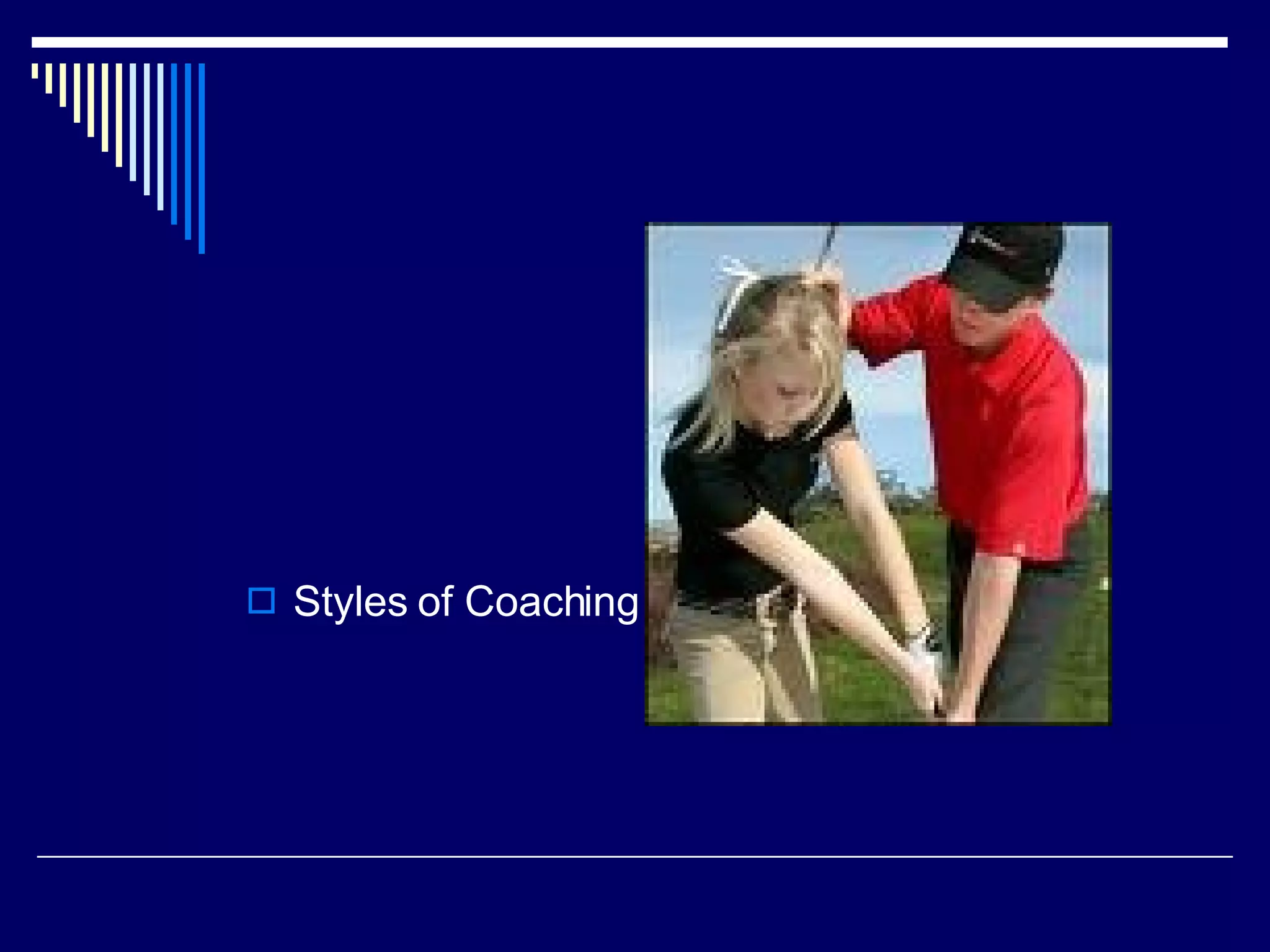
Styles of Coaching
Intro It is the coach who determines whether young athletes early experiences of a sport are rewarding or not.  These experiences are likely to determine whether an individual continues with the sport  As the level of comp increases the player-coach relationship become more crictical.
The Role of the Coach Is a complex one depending on level, sport, age, gender and experience of participants.  Coaching stereotypes ??? Ruthless, yells, aggressive What characteristics should a coach have?
Role of the Coach Educator, leader, teacher, friend, guide, visionary, facilitator, manager, organiser, technician, and mentor.  Coach must meet varied needs and expectations of the individuals.  They must also know the motivating factors of the individuals.
Role of the Coach A coach is defined as “One who instructs players in the fundamentals of a competitive sport and directs team strategies”  Form of leadership where one person guides and influences others.  Question why is the role of the coach so complex???
Styles of Coaching Authoritarian/ Autocratic The coach makes all the decisions with an emphasis on strict discipline and aggression. Winning is the ultimate goal.  He or she decides what the goals of the session are. Highly organised  Players who are sensitive may be turned off by this style.
Friendly/ Personable This coach has an easy and approachable manner, and a close rapport with the players, who are treated as individuals.  Coach is interested in welfare of each player and listens.  A criticism of this is listening to advice from all quarters, which can be construed as weakness
Distant, yet approachable  Coach remains distant yet approachable and still remains prepared to listen to the players concerns.  This style makes it easier to make hard decisions like selection and disciplinary issues.  The danger is players may feel isolated and remote from decision making and team planning process.
Delegatory/ democratic  The head coach delegates tasks to a range of support staff with expertise in different areas.  Often at the elite level.  Good communication between various people is crucial.  Coach must ensure that all people involved are kept up to date.
Casual/ laissez-faire  Tends to coach by instinct with no clear plan or strategy.  Easy going passive approach requiring players to take more responsibility for their own game prep.  Criticism of this style is players feel unsupported and less valued. Often viewed as too casual and disorganised.
Negotiating  Places a high value on gaining input from players and support staff.  Recognises that experienced players can provide valuable input to training and game strategies.
Practice  The practice style involves the coach determining the aims, selecting the method of practice, and providing individual and group feedback.
Reciprocal Each player is then encouraged to provide feedback to a partner  The coach determines the aims, while players are encouraged to be more independent and self-reliant.
Playing  Not strictly a coaching style.  Offers the coach an exclusive perspective on player performance.  Must lead by example Danger of coach being becoming absorbed in playing rather then coaching.  Also worry to much about coaching and forget playing role.
Non-playing/Bench A coach who doesn’t actively play the game but observes from the sidelines to gain an overall perspective of the game.  Free of physical pressures involved with playing  Must be able to make sense of what happens and direct attention to the most important elements.
Characteristics of a respected Coach  Personal Qualities  Strong values of honesty, integrity, consistency, and frankness.  They are trusted by players and support staff.  Organisation is a vital element to gaining respect of players.
Knowledge Has an extensive knowledge of the rules, strategies, and also biomech, skill acquisition, anatomy, exercise physiology, fitness testing, training principles, diet, injuries and sport psychology.  A coach must have the above info up to date to stay ahead of the opposition.  A coach will have more respect if he is seen to be up to speed.
Learner The respected coach is an active and aggressive learner.  Keeps up to date with latest practices  Attends conferences, read journals etc This commitment to learning also spreads to players. Encourages growth
Respect Exhibits respect for the individual athlete, their goals and ambitions  They are ambitious for their players and themselves to reach full potential.
Coaching Quals  Respected coach will have qualifications gained through either  National Coaching Accreditation scheme (NCAS). Or the Australian Coaching counsel
Communication
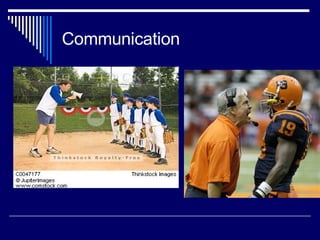
Communication Skills Its all about effective communication ! A coaches success ultimately depends on their ability to communicate effectively with their players.  Skills such as talking, listening, negotiating, encouraging and counseling are vital tools a coach must posses.  Must be able to communicate with other staff.

Sports Coaching Intro

  • 1.
  • 2.
    Intro It isthe coach who determines whether young athletes early experiences of a sport are rewarding or not. These experiences are likely to determine whether an individual continues with the sport As the level of comp increases the player-coach relationship become more crictical.
  • 3.
    The Role ofthe Coach Is a complex one depending on level, sport, age, gender and experience of participants. Coaching stereotypes ??? Ruthless, yells, aggressive What characteristics should a coach have?
  • 4.
    Role of theCoach Educator, leader, teacher, friend, guide, visionary, facilitator, manager, organiser, technician, and mentor. Coach must meet varied needs and expectations of the individuals. They must also know the motivating factors of the individuals.
  • 5.
    Role of theCoach A coach is defined as “One who instructs players in the fundamentals of a competitive sport and directs team strategies” Form of leadership where one person guides and influences others. Question why is the role of the coach so complex???
  • 6.
    Styles of CoachingAuthoritarian/ Autocratic The coach makes all the decisions with an emphasis on strict discipline and aggression. Winning is the ultimate goal. He or she decides what the goals of the session are. Highly organised Players who are sensitive may be turned off by this style.
  • 7.
    Friendly/ Personable Thiscoach has an easy and approachable manner, and a close rapport with the players, who are treated as individuals. Coach is interested in welfare of each player and listens. A criticism of this is listening to advice from all quarters, which can be construed as weakness
  • 8.
    Distant, yet approachable Coach remains distant yet approachable and still remains prepared to listen to the players concerns. This style makes it easier to make hard decisions like selection and disciplinary issues. The danger is players may feel isolated and remote from decision making and team planning process.
  • 9.
    Delegatory/ democratic The head coach delegates tasks to a range of support staff with expertise in different areas. Often at the elite level. Good communication between various people is crucial. Coach must ensure that all people involved are kept up to date.
  • 10.
    Casual/ laissez-faire Tends to coach by instinct with no clear plan or strategy. Easy going passive approach requiring players to take more responsibility for their own game prep. Criticism of this style is players feel unsupported and less valued. Often viewed as too casual and disorganised.
  • 11.
    Negotiating Placesa high value on gaining input from players and support staff. Recognises that experienced players can provide valuable input to training and game strategies.
  • 12.
    Practice Thepractice style involves the coach determining the aims, selecting the method of practice, and providing individual and group feedback.
  • 13.
    Reciprocal Each playeris then encouraged to provide feedback to a partner The coach determines the aims, while players are encouraged to be more independent and self-reliant.
  • 14.
    Playing Notstrictly a coaching style. Offers the coach an exclusive perspective on player performance. Must lead by example Danger of coach being becoming absorbed in playing rather then coaching. Also worry to much about coaching and forget playing role.
  • 15.
    Non-playing/Bench A coachwho doesn’t actively play the game but observes from the sidelines to gain an overall perspective of the game. Free of physical pressures involved with playing Must be able to make sense of what happens and direct attention to the most important elements.
  • 16.
    Characteristics of arespected Coach Personal Qualities Strong values of honesty, integrity, consistency, and frankness. They are trusted by players and support staff. Organisation is a vital element to gaining respect of players.
  • 17.
    Knowledge Has anextensive knowledge of the rules, strategies, and also biomech, skill acquisition, anatomy, exercise physiology, fitness testing, training principles, diet, injuries and sport psychology. A coach must have the above info up to date to stay ahead of the opposition. A coach will have more respect if he is seen to be up to speed.
  • 18.
    Learner The respectedcoach is an active and aggressive learner. Keeps up to date with latest practices Attends conferences, read journals etc This commitment to learning also spreads to players. Encourages growth
  • 19.
    Respect Exhibits respectfor the individual athlete, their goals and ambitions They are ambitious for their players and themselves to reach full potential.
  • 20.
    Coaching Quals Respected coach will have qualifications gained through either National Coaching Accreditation scheme (NCAS). Or the Australian Coaching counsel
  • 21.
  • 22.
    Communication Skills Itsall about effective communication ! A coaches success ultimately depends on their ability to communicate effectively with their players. Skills such as talking, listening, negotiating, encouraging and counseling are vital tools a coach must posses. Must be able to communicate with other staff.