Sericulture
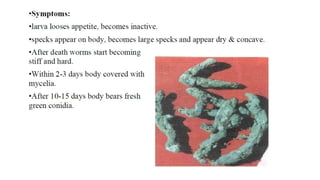
Introduction
• Sericulture – Sericos(G) – silk, Culture (E) – rearing
• Sericulture refers to the conscious mass-scale rearing of silk-producing
organizations in order to obtain silk from them
• Silk – fibrous protein of animal origin – insect and noninsect silk
• Mussels – anchorage, spiders – prey, cocoons – protective sheath
• Head quarters of International Silk Association – Lyon, France
• Central Silk Board, Bangaluru
• Central Silk Technology Research Institute - Bangaluru
• Central Sericulture Research and Training Institute – Mysore
History of sericulture
• Lei- zu(Si Lung Chi) – empress – 2687 BC
• Cocoon dropped in her tea cup – silky threads separated- she taught
this to people
• Source of silk was kept secret for more than 2000 years until the silk
road was opened at 114 BC
• Silk road/ silk route – historic trade route that dated from the second
century BC until the 14th Century A.D
• It stretched from Asia to Mediterranean traversing China, India, Persia,
Arabia, Greece and Italy
• Called as silk route because of the heavy silk trading that took place
during that period, which gave China a monopoly over the trade
Silk
• Valuable natural protein fibre produced by certain inscets
• Lepidoptera – adult stage – silk secretion from salivary glands
• Silk used for construction of cocoons over pupae – protection
• Important silk producers – Bombycidae and Saturnidae
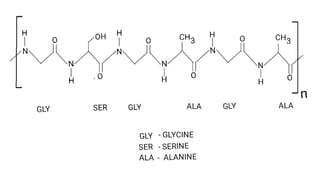
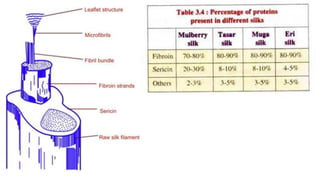
• Silk – sericin (sticky material surrounding) and fibroin (structural centre of
silk)
• Fibroin made of aminoacids – Gly- Ser-Gly-Ala-Gly-Ala – beta pleated
sheets – hydrogen bonds between chains and sidechains from above and
below the plane of the hydrogen bond network
• High proportion of glycine (50 %) allows tight packing and the fibers are
strong and resistant to breaking
• Tensile strength due to many inter-seeded H2 bonds and when stretched the
force is applied to these numerous bonds – do not break
• Silk is resistant to most mineral acids except H2SO4 – precipitate – yellow
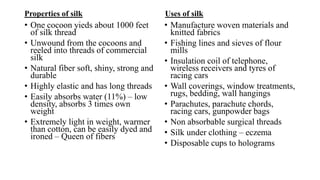
Properties of silk
• One cocoon yieds about 1000 feet
of silk thread
• Unwound from the cocoons and
reeled into threads of commercial
silk
• Natural fiber soft, shiny, strong and
durable
• Highly elastic and has long threads
• Easily absorbs water (11%) – low
density, absorbs 3 times own
weight
• Extremely light in weight, warmer
than cotton, can be easily dyed and
ironed – Queen of fibers
Uses of silk
• Manufacture woven materials and
knitted fabrics
• Fishing lines and sieves of flour
mills
• Insulation coil of telephone,
wireless receivers and tyres of
racing cars
• Wall coverings, window treatments,
rugs, bedding, wall hangings
• Parachutes, parachute chords,
racing cars, gunpowder bags
• Non absorbable surgical threads
• Silk under clothing – eczema
• Disposable cups to holograms
Taxonomic position
• Kingdom – Animalia
• Phylum - Arthropoda
• Class - Insecta
• Order - Lepidoptera
• Family – Bombycidae, Saturnidae
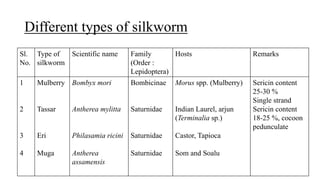
Different types of silkworm
Sl.
No.
Type of
silkworm
Scientific name Family
(Order :
Lepidoptera)
Hosts Remarks
1
2
3
4
Mulberry
Tassar
Eri
Muga
Bombyx mori
Antherea mylitta
Philasamia ricini
Antherea
assamensis
Bombicinae
Saturnidae
Saturnidae
Saturnidae
Morus spp. (Mulberry)
Indian Laurel, arjun
(Terminalia sp.)
Castor, Tapioca
Som and Soalu
Sericin content
25-30 %
Single strand
Sericin content
18-25 %, cocoon
pedunculate
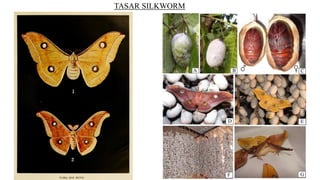
TASAR SILKWORM
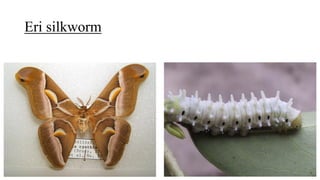
Eri silkworm
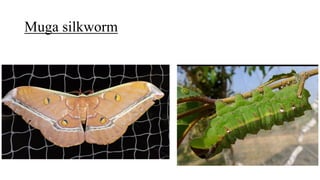
Muga silkworm
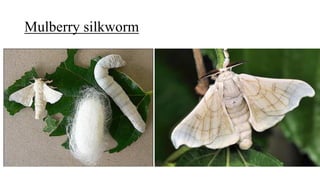
Mulberry silkworm
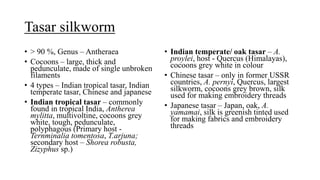
Tasar silkworm
• > 90 %, Genus – Antheraea
• Cocoons – large, thick and
pedunculate, made of single unbroken
filaments
• 4 types – Indian tropical tasar, Indian
temperate tasar, Chinese and japanese
• Indian tropical tasar – commonly
found in tropical India, Antherea
mylitta, multivoltine, cocoons grey
white, tough, pedunculate,
polyphagous (Primary host -
Ternminalia tomentosa, T.arjuna;
secondary host – Shorea robusta,
Zizyphus sp.)
• Indian temperate/ oak tasar – A.
proylei, host - Quercus (Himalayas),
cocoons grey white in colour
• Chinese tasar – only in former USSR
countries, A. pernyi, Quercus, largest
silkworm, cocoons grey brown, silk
used for making embroidery threads
• Japanese tasar – Japan, oak, A.
yamamai, silk is greenish tinted used
for making fabrics and embroidery
threads
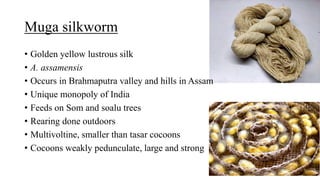
Muga silkworm
• Golden yellow lustrous silk
• A. assamensis
• Occurs in Brahmaputra valley and hills in Assam
• Unique monopoly of India
• Feeds on Som and soalu trees
• Rearing done outdoors
• Multivoltine, smaller than tasar cocoons
• Cocoons weakly pedunculate, large and strong
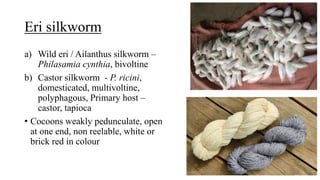
Eri silkworm
a) Wild eri / Ailanthus silkworm –
Philasamia cynthia, bivoltine
b) Castor silkworm - P. ricini,
domesticated, multivoltine,
polyphagous, Primary host –
castor, tapioca
• Cocoons weakly pedunculate, open
at one end, non reelable, white or
brick red in colour
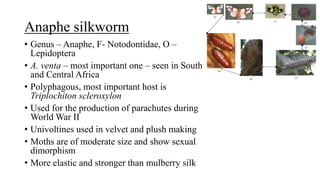
Anaphe silkworm
• Genus – Anaphe, F- Notodontidae, O –
Lepidoptera
• A. venta – most important one – seen in South
and Central Africa
• Polyphagous, most important host is
Triplochiton scleroxylon
• Used for the production of parachutes during
World War II
• Univoltines used in velvet and plush making
• Moths are of moderate size and show sexual
dimorphism
• More elastic and stronger than mulberry silk
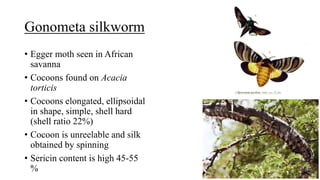
Gonometa silkworm
• Egger moth seen in African
savanna
• Cocoons found on Acacia
torticis
• Cocoons elongated, ellipsoidal
in shape, simple, shell hard
(shell ratio 22%)
• Cocoon is unreelable and silk
obtained by spinning
• Sericin content is high 45-55
%
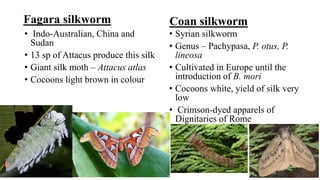
Fagara silkworm
• Indo-Australian, China and
Sudan
• 13 sp of Attacus produce this silk
• Giant silk moth – Attacus atlas
• Cocoons light brown in colour
Coan silkworm
• Syrian silkworm
• Genus – Pachypasa, P. otus, P.
lineosa
• Cultivated in Europe until the
introduction of B. mori
• Cocoons white, yield of silk very
low
• Crimson-dyed apparels of
Dignitaries of Rome
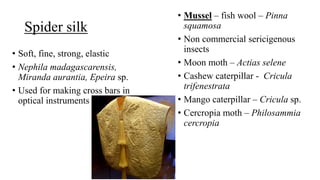
Spider silk
• Soft, fine, strong, elastic
• Nephila madagascarensis,
Miranda aurantia, Epeira sp.
• Used for making cross bars in
optical instruments
• Mussel – fish wool – Pinna
squamosa
• Non commercial sericigenous
insects
• Moon moth – Actias selene
• Cashew caterpillar - Cricula
trifenestrata
• Mango caterpillar – Cricula sp.
• Cercropia moth – Philosammia
cercropia
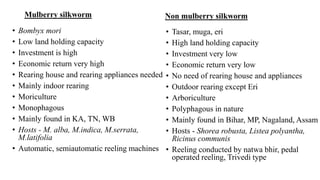
Mulberry silkworm
• Bombyx mori
• Low land holding capacity
• Investment is high
• Economic return very high
• Rearing house and rearing appliances needed
• Mainly indoor rearing
• Moriculture
• Monophagous
• Mainly found in KA, TN, WB
• Hosts - M. alba, M.indica, M.serrata,
M.latifolia
• Automatic, semiautomatic reeling machines
Non mulberry silkworm
• Tasar, muga, eri
• High land holding capacity
• Investment very low
• Economic return very low
• No need of rearing house and appliances
• Outdoor rearing except Eri
• Arboriculture
• Polyphagous in nature
• Mainly found in Bihar, MP, Nagaland, Assam
• Hosts - Shorea robusta, Listea polyantha,
Ricinus communis
• Reeling conducted by natwa bhir, pedal
operated reeling, Trivedi type
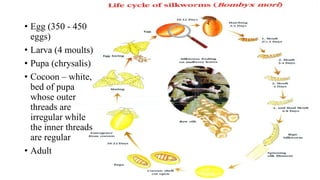
• Egg (350 - 450
eggs)
• Larva (4 moults)
• Pupa (chrysalis)
• Cocoon – white,
bed of pupa
whose outer
threads are
irregular while
the inner threads
are regular
• Adult
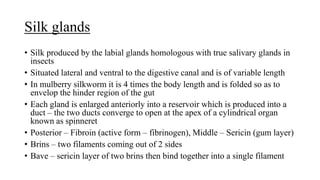
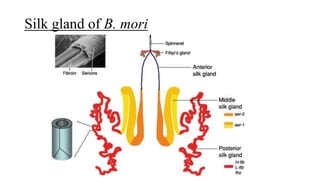
Silk glands
• Silk produced by the labial glands homologous with true salivary glands in
insects
• Situated lateral and ventral to the digestive canal and is of variable length
• In mulberry silkworm it is 4 times the body length and is folded so as to
envelop the hinder region of the gut
• Each gland is enlarged anteriorly into a reservoir which is produced into a
duct – the two ducts converge to open at the apex of a cylindrical organ
known as spinneret
• Posterior – Fibroin (active form – fibrinogen), Middle – Sericin (gum layer)
• Brins – two filaments coming out of 2 sides
• Bave – sericin layer of two brins then bind together into a single filament
Silk gland of B. mori
Terminology
• Breed – a stock of animals or plants within a species having a
distinctive appearance and typically having been developed by
deliberate selection
• Races – a population within a species that is distinct in some way esp.
a subspecies (Indigenous/ native – originating in a particular region/
country, Exotic/ nonnative – introduced into an area where they do
not occur naturally)
• Classification based on geographic distribution – Japanese race,
Chinese race, European race, South East Asian races
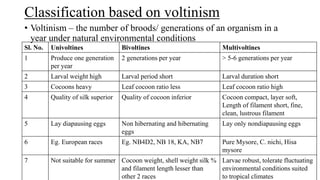
Classification based on voltinism
• Voltinism – the number of broods/ generations of an organism in a
year under natural environmental conditions
Sl. No. Univoltines Bivoltines Multivoltines
1 Produce one generation
per year
2 generations per year > 5-6 generations per year
2 Larval weight high Larval period short Larval duration short
3 Cocoons heavy Leaf cocoon ratio less Leaf cocoon ratio high
4 Quality of silk superior Quality of cocoon inferior Cocoon compact, layer soft,
Length of filament short, fine,
clean, lustrous filament
5 Lay diapausing eggs Non hibernating and hibernating
eggs
Lay only nondiapausing eggs
6 Eg. European races Eg. NB4D2, NB 18, KA, NB7 Pure Mysore, C. nichi, Hisa
mysore
7 Not suitable for summer Cocoon weight, shell weight silk %
and filament length lesser than
other 2 races
Larvae robust, tolerate fluctuating
environmental conditions suited
to tropical climates
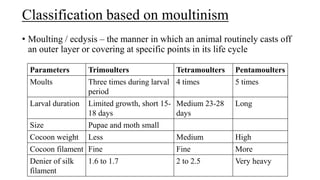
Classification based on moultinism
• Moulting / ecdysis – the manner in which an animal routinely casts off
an outer layer or covering at specific points in its life cycle
Parameters Trimoulters Tetramoulters Pentamoulters
Moults Three times during larval
period
4 times 5 times
Larval duration Limited growth, short 15-
18 days
Medium 23-28
days
Long
Size Pupae and moth small
Cocoon weight Less Medium High
Cocoon filament Fine Fine More
Denier of silk
filament
1.6 to 1.7 2 to 2.5 Very heavy
Production of silk
• Two steps
a. Production of mulberry trees that provide leaves upon which the
worms feed – Moriculture
b. Care of silkworm from egg stage through completion of the cocoon
– Chawki rearing
a. Mulberry cultivation – Moriculture
• Morus spp. (M. alba, M. indica, M. cerata)
• Climate : up to 800 m MSL, rainfall – 600 mm – 2500 mm
• Optimum Temperature – 24-28, RH 65-80 %
• Soil – red loamy soil, saline and alkaline soils not preferred
• Varieties – Irrigated – Kanwa 2, MR 2, S30, S36
• Semi irrigated – Kanwa 2, MR 2
• Rainfed – S13, S34,
Propagation
• Sexual – seedlings – broadcasting in lines
• Asexual - cuttings, grafting, budding, layering.
• Mostly used – cuttings, planted in main field or nursery, rooted
saplings establish better in main field
• Cuttings – semi hardwood cuttings, 10-12 mm diameter, 15-20 cm
long with 3-4 active buds
Nursery
• Select 1800 sq.m area for 1 ha of main field
• Apply 600 Kg FYM @20t/ha and mix well
• Nursery bed of 4m x 1.5 m size
• Provide drainage channel and avoid shady area
• Pre treatment of cutting – 1 Kg Azospirillum in 40l of water
• Keep the bottom end of the cuttings for 30 minutes in it
• Irrigate the nursery once in 3 days
• Termite attack – Malathion 5 D, Quinalphos 1.5 D
• Root rot/ collar rot – Carbendazim 50 WP (2g/l) and T. viridae 0.5g/m2
• After weeding apply 100g of urea/m2 between 55 and 60 DAP
Main field planting
• Transplant 90 -123 days of planting, No. of cutting/ ha – 27,780 (60x 60 cm)
• Plant at a depth of 15 – 20 cm
• Nutrient management – 300: 120: 120 (NPK)
• Biofertilizers – Azospirillum @20Kg/ ha, Phosphobacterium @ 10Kg/ ha
• Mix biofertilizers with 50 Kg of FYM, irrigation after fertilizer
• Apply micro nutrients as per recommendation
• Planting – pit system, row system, strip system and kolar system
• Pit system – rainfed crop, wider spacing 40x 90cm, prune once in June and
Nov. 8-10 cm above ground
• Row system – irrigated crop, 45- 60 cmx 45-60 cm, done at a height of 3-8cm
above ground level , harvest by bottom pruning
• Frequency of irrigation depends on humidity, stage of growth, soil type
• Flood, surface, sub surface, sprinkler, drip, check basin, furrow systems
Pruning
• To increase the leaf yield, production synchronized with silkworm rearing
• Fist form – cutting of mulberry plant each year at one place on main stem.
Stem becomes thick and fist shaped , more resistant to pest and diseases
• Non-fist form – pruning done such that 2-3 branches allowed to grow from
main stem and secondary branches also develop, less resistance to pest and
diseases
• Bottom/ ground – branches cut at the base of the stem at ground level, 5 times
pruning in a year, needs heavy doses of fertilizers and irrigation
• Middle - cutting the branches of bush mulberry at a height of 45 – 60 cm above
the ground level during Dec – Jan, stimulates sprouting of the lower buds
during winter
• Top clipping – done to produce more branches and leaves, clipping off the top
of the branch but not the whole branch, winter season, production & quality
improved
Harvesting
• Leaf picking, branch cutting, whole shoot harvest
• Harvest during early hours
• Largest glossy leaf upto 4th from top – 1st instar larvae
• Next 6-8 leaves – 2nd instar larvae
• 8-10th leaf – late stage larvae
• Size of the chopped leaf – 0.5 to 1.0 sq.cm – upto 2nd stage
• From brushing to the end of the second stage the larvae are fed with
tender leaves
Leaf preservation
• Silkworm grows best when fed with succulent leaves which are rich in
nutrients and moisture
• Leaves if not preserved properly, dry up and become unsuitable for
feeding
• The harvested leaves must be preserved in fresh condition in a wet
gunny cloth
• If the climate is too hot and dry, the leaves are preserved in a leaf
chamber which is lined with gunny cloth
• Cloth is kept wet by spraying water at frequent intervals
b. Silkworm rearing
• 5 phases
• Selection of races of B. mori
• Rearing of silkworm – chawki and late stage rearing
• Mountaging/ cocoon spinning
• Marketing
• Post cocoon processing – stifling, reeling and spinning
Selection of races of B. mori
• DFLs – Disease Free Layings – eggs procured from a quality center called
grainage
• Grainage – establishments where disease free & quality seeds are produced on
scientific lines
• Industrial silkworm seed is a hybrid between two silkworm races exploitation of
multivoltine hybrids
• When silkworm races are continuously breed for more than 6-7 generations,
without any selection for quality cocoon they loose their volatility and vigour
• Systematic seed organization – technique developed by scientists to maintain the
vigour of silkworm
• Pj stations/ basic seed farms – they release silkworm stocks continuously for
multiplication
• Two roles – to maintain the silkworm breeds released by the research
institute
• It releases silkworm stocks at required regular intervals to maintain the
stream of seed production
• Basic seed farms are the temple of seed organization and seed
production
• Should be maintained under highly hygienic conditions and manned
with highly qualified and experienced silkworm breeders
• Silkworm rearing in Pj farm – optimum environmental condition for
worms, produce healthy and strong cocoons for egg production
• Hybrid reraing – rearing for commercial cocoon production where
emphasis for high silk content is made
• Disinfection – basic stocks are less resistant to diseases as compared to
hybrids
• The appliances are washed with 1 % bleaching powder solution followed by
3 % formalin solution
• Rearing house – fumigation of 3% formalin
• Washed equipment's are kept in a closed room, sprayed with 1 % bleaching
powder solution followed by 3 % formalin
• Open the doors and windows 24 hours after disinfection
• Done two days prior to brushing
• Feeding of tender leaves at final stage leads to improper growth of larvae
and incidence of diseases, heavy pupa that dies
DFL preparation
• On the day of moth emergence only healthy moths selected
• Selected male and female moths of the same race are allowed to couple
• Kept in cellules in oviposition room where T 25 degree and 75 % RH
• Darkness is provided for mating, 4-5 hrs after mating male moth is rejected
to ensure all eggs are fertilized
• She is allowed to lay eggs on egg card and covered with cellule in
oviposition room (multivoltine – 450 eggs, bivoltine – 600 eggs)
• Next morning, the mother moths are examined to check whether they are
free from pebrine disease (individual moth crushed, one drop of fluid taken
on a glass slide) moths dried in hot air oven, T 65 dgree for 6-7 hrs layings
with 2% KOH solution grinding)
• A smear prepared by putting a cover glass, microscope 6X even if a single
moth shows pebrine disease that whole lot of cocoon is discarded – action
taken to disinfect reraing room and garinage
• Only layings with large no. of eggs are selected for further breeding
• Washed in 2% formalin for 15 – 20 min – surface sterilization again
washed in water to remove formalin
• About 100 such dfl’s in each of the races are selected
• In bivoltines – these dfl’s are stored in cold storage for hibernation –
6-10 months – preservation of basic stocks
• This will enable rearing of stocks only for one or two generations in a
year. This helps to avoid repeated multiplication and inbreeding
depression
• Multivoltines – no hibernation – dfl’s selected for rearing next
generation
• Supply of dfl’s basic stock – 30 dfl’s are reraed separately in cellular
beds for stock maintenance, 70 dfl’s are reared as Pi stocks for P seed
production
Rearing equipment's
• Chawki rearing box with stand
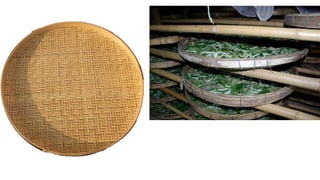
• Bamboo tray (round)
• Rearing stand (wooden)
• Chandrike
• Leaf chamber
• Feeding stand (wooden)
• Chop sticks
• Feather
• Chopping board
• Chopping knife
• Basin stand (Iron)
• Ant well
• Foot cleaning tray
Pre incubation care of silkworm eggs
• Care during transport, well aerated, prevents from desiccation
• 25 degree Celsius, 80 % RH, 16: 8 L:D – ideal
• Transport – carry them in containers or packets with holes on it and loosely
packed
• To avoid desiccation – wrap the packet with green leaves or wet cloths/
blotting paper
• Transport during cooler days
• To eliminate surface contamination – egg’s surface should be soaked in 2%
formalin for 10 min.
• Should not be done if the eggs have already developed head pigmentation
Incubation
• The process of facilitating the growth and development of the embryo
inside the egg till hatching
• It involves providing the required ambiance to the egg which includes
the required T, RH, aeration, light etc.
• The most modern way of incubating eggs is to spread them in trays in
the incubator which has facilities to control the T, RH, light hours
• Usually farmers place the egg sheets or loose eggs spread in the
rearing tray on paraffin paper, cover them with another tray, and then
with a moist cloth. When T increases eggs are incubated in earthen
pots which are kept on wet sand and covered with wet cloths
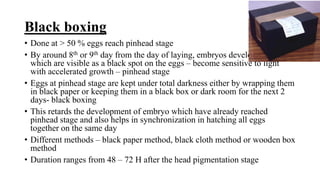
Black boxing
• Done at > 50 % eggs reach pinhead stage
• By around 8th or 9th day from the day of laying, embryos develop eye spots
which are visible as a black spot on the eggs – become sensitive to light
with accelerated growth – pinhead stage
• Eggs at pinhead stage are kept under total darkness either by wrapping them
in black paper or keeping them in a black box or dark room for the next 2
days- black boxing
• This retards the development of embryo which have already reached
pinhead stage and also helps in synchronization in hatching all eggs
together on the same day
• Different methods – black paper method, black cloth method or wooden box
method
• Duration ranges from 48 – 72 H after the head pigmentation stage
Chawki rearing
• Chawki – young silkworms usually up to the end of second instar,
looks like tiny ants
Characterestics
• Tiny and delicate – chances of damage are higher during handling
• Require highly nutritive and easily digestible food
• Require slightly higher T (28 degree) & RH (80%)
• Growth rate is slightly higher, Resistant to high T & high RH
• Weak against pesticides, gases
• Chawki rearing involves providing the young silkworm tender
succulent leaves cut to size, maintaining their freshness by preserving
the leaf moisture content, providing its required environment during
feeding and moulting and sanitation
Leaf quality for chawki rearing
• Feed on the surface of the leaves being too small and tender
• Leaves should be tender , soft and succulent with 80 % moisture and
high nutritive value (27% protein, 11 % carbs, minerals and vit)
• First 4 largest glossy leaf from top – for first instar larvae
• Such tender leaves are fed to silkworms each time they resume feeding
after moult
Chawki rearing practices
• Chawki rearing starts after brushing silkworms into the rearing trays
• Tiny worms which feed on the surface of the leaves should be able to
reach the surface of the leaf more easily and speedier
• Provide chopped leaves of about 1cm2 size
• As the worm grows in size, the size of the chopped leaves can be
increased
• Silkworms are fed 3-4 times a day depending on the climate
• During rainy season/ cooler climate – 2 feedings sufficient, hot/ dry
climate – no. of feedings higher
• 3 feedings per day on an average – 8.00 am, 2.00 pm, 8.00 pm
• 20 Kg tender leaves for rearing 100 dfl’s of the first 2 instars – varies
based on the breed and size of worm
• To prevent loss of moisture from leaves and maintain them fresh – worms are maintained
on a paraffin paper in the rearing tray
• After feeding, the bed is covered with another sheet of paraffin paper and the edges of
both sheets folded together known as wrapping up
• if paraffin paper not available use polythene sheets of 400 gauge thickness
• Before each feeding the paraffin paper cover is removed and bed gently spread and left
over leaf is allowed to dry
• The fresh chopped leaves are then fed and covered with paraffin paper again
• The rearing trays after feeding are usually piled up one above the other on small stand
altogether looking like a box and therefore called box method of chawki rearing
• If the trays are kept in the rearing stand, it is known as stand rearing – most preferred
• As the silkworm grows in size its body becomes too tight and brittle to hold the body. As
a result of which its movements becomes difficult and mouth parts look small compared
to its head. At this stage they stop feeding and moults. Moulting lasts for about 20-24 hrs.
• First moult – 3 days after brushing, second moult 4 days after first moult
• As the larva approaches moulting stage, its body becomes lustrous and shining,
prothoracic segment becomes bulged, head becomes narrow, pointed and black, loose
appetite become weak
• As the worms prepare for moult, leaves are cut into smaller size and thinly
spread to meet the requirement of the fewer feeding worms
• Remove paraffin paper and wet paper, sprinkle slaked lime over the bed to
dry the rearing bed, provide adequate ventilation
• 95 % worms come out of moult, dust bed disinfectant (Vijetha, Ankusk,
Resham Jyothi, TNAU seridust, Sanjeevini)
• Feed in half an hour gap
• Moulted larva looks ash coloured with broader mouth portion and feed
actively
• As the left over leaf accumulates the rearing bed thickness increases
resulting in multiplication of various pathogens
Bed cleaning
• The silkworms have to be transferred to a clean tray and the bed
refuge discarded and this process is called bed cleaning
• Done by spreading a net of meshsize of 1cm2 on the rearing bed
followed by feeding and transferring the worms along with the net
after one more feeding
• Cleaning too many times during young stages result in unconscious
discarding of worms left over in the bed which were unable to move
over the net
• Usually one cleaning is done during the entire chawki stage
Commercial chawki rearing centres (CRC)
• The purpose of chawki rearing is to grow quality silkworms under disease free
environment to reduce the cost and duration with farmers and to improve the cocoon
quality and productivity
• So poor farmers who cannot afford to provide the micro climate can purchase silkworm as
chawki worms
• Cocoon productivity from CRC supplied worms is about 20 – 25 % higher
• CRC provide suitable rearing house for chawki rearing with required rearing appliances
well maintained and irrigated exclusive chawki mulberry garden and well trained man
power
• Advantages - provide proper egg incubation and good hatching, robust and disease free
chawki worms, prevents crop loss and cocoon crop stabilization, increased yield of good
quality cocoons, reduction in production cost of cocoons, higher profits, synchronization
of crops, distribution of labour for other works
Disinfection and hygiene maintenance
• Early instars are (I, II & III) are most susceptible to diseases compared
to late instars, bivoltine more susceptible
• Quantity of disinfectant solution – based on the floor area – effective
disinfection – 1.5 l/ m2 floor area
• Recommended disinfectants
• 2% bleaching powder in 0.3 % slaked lime solution
• 2.5 % Sanitech/ Serichlor in 0.5 % slaked lime solution
• 0.05 % Asthra solution
• Effective disinfection – by drenching spray of disinfectant solution in
all the nook and cornor by the CRC using power sprayer
Disinfection schedule
• Completion of rearing – first disinfection of CRC and appliances with 2%
BP
• 3 days before brushing – cleaning and washing of CRC building, rearing
tray disinfection
• 2 days before brushing – 2nd disinfection of CRC and appliances
• 1 day before brushing – dusting 5% BP in slaked lime powder surrounding
environments of CRC. Open the windows of CRC for ventilation and to free
the gases accumulated
• Worms settling for 1st moult - 50 g slaked lime powder
• Worms in 1st moult – Vijetha/ Ankush 50g
• Worms settling for 2nd moult – 150g slaked lime powder
• Disinfcetants are dusted as thin layer uniformly @ 3g/ sq.ft using a duster/
muslin cloth
Measures to maintain hygiene
• Wash hands and feet with the recommended disinfectant solution before entering
the CRC and also after attending rearing
• Wash hands with disinfectant after every bed cleaning
• Collect diseased/ dead/ weak larvae from the rearing bed with forceps/ chopsticks
into a basin containing disinfectant solution and destroy them by burning
• Collect silkworm bed refuse into litter basket/ vinyl sheet meant for it
• Prevent flooring of bed refuse during bed cleaning
• Disinfect the leaf storage room along with the rearing room
• Store mulberry leaves in a separate room and cover with wet gunny cloth
• Dust slaked lime powder on the rearing bed when the worms settle for moult
• Disinfect silkworm body and rearing set by dusting Ankush/ Vijetha after moulting
and before resumption
• Rear chawki larvae under recommended optimum T, RH, and spacing conditions
for healthy growth
• Feed silkworms with quality mulberry leaves for robust chawki
Transportation of chawki larvae
• After chawki certification the young silkwormsn during the moult are
transported in a vehicle to the farmers during cool hours of the day.
• Care should be taken that young worms are not disturbed during the
transportation
• C: B ratio = 1: 1.51
Late age silkworm rearing
• 3rd , 4th and 5th instar larvae are considered as late-age worms
• Reraed in a bamboo tray
• Newspapers are spread over the trays to absorb excess moisture in leaves
and faecal pellets
• T & H requirement comes down as the stage advances
• Leaves of medium maturity are fed (6th leaf) to 3rd and 4th age and coarse
leaves are fed in the 5th st6age
• Over matures and yellow leaves should be rejected, since they may induce
disease outbreak
• Bed disinfectants after 3rd moult 800g/ 100 dfls, 4th moult – 1000g/ 100 dfls,
final stage - 2000g/ 100 dfls
Moulting
• Remove the paraffin papers
• Evenly spread the larvae in the rearing bed 6-8 H before settling for
moult
• Provide air circulation to avoid excess humidity inside the room
• Provide stove/ heaters to raise the room T during winter
• Apply lime powder 60 min before resumption of feeding daily during
rainy/ winter seasons to reduce dampness in bamboo trays
Mounting and different methods of mounting
• Mountages – the device that helps or supports the silkworms for
comfortable spinning of their cocoons is called cocoonage or
mountage
• It enables the ripe worm to spin cocoon
• Play and important role in quality cocoon production
• Types of material used, finishing of moutages, and space available for
spinning determine both the quality and quantity of cocoons
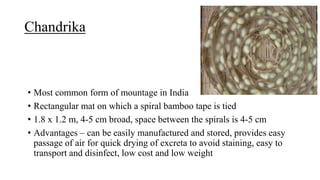
Chandrika
• Most common form of mountage in India
• Rectangular mat on which a spiral bamboo tape is tied
• 1.8 x 1.2 m, 4-5 cm broad, space between the spirals is 4-5 cm
• Advantages – can be easily manufactured and stored, provides easy
passage of air for quick drying of excreta to avoid staining, easy to
transport and disinfect, low cost and low weight
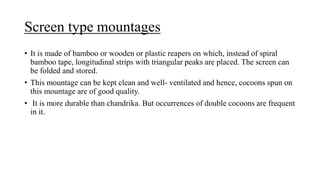
Screen type mountages
• It is made of bamboo or wooden or plastic reapers on which, instead of spiral
bamboo tape, longitudinal strips with triangular peaks are placed. The screen can
be folded and stored.
• This mountage can be kept clean and well- ventilated and hence, cocoons spun on
this mountage are of good quality.
• It is more durable than chandrika. But occurrences of double cocoons are frequent
in it.
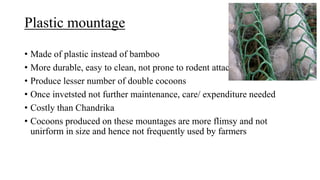
Plastic mountage
• Made of plastic instead of bamboo
• More durable, easy to clean, not prone to rodent attack
• Produce lesser number of double cocoons
• Once invetsted not further maintenance, care/ expenditure needed
• Costly than Chandrika
• Cocoons produced on these mountages are more flimsy and not
unirform in size and hence not frequently used by farmers
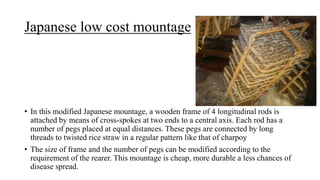
Japanese low cost mountage
• In this modified Japanese mountage, a wooden frame of 4 longitudinal rods is
attached by means of cross-spokes at two ends to a central axis. Each rod has a
number of pegs placed at equal distances. These pegs are connected by long
threads to twisted rice straw in a regular pattern like that of charpoy
• The size of frame and the number of pegs can be modified according to the
requirement of the rearer. This mountage is cheap, more durable a less chances of
disease spread.
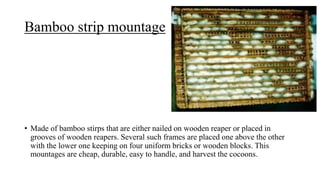
Bamboo strip mountage
• Made of bamboo stirps that are either nailed on wooden reaper or placed in
grooves of wooden reapers. Several such frames are placed one above the other
with the lower one keeping on four uniform bricks or wooden blocks. This
mountages are cheap, durable, easy to handle, and harvest the cocoons.
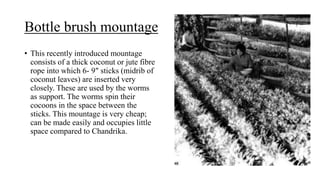
Bottle brush mountage
• This recently introduced mountage
consists of a thick coconut or jute fibre
rope into which 6- 9″ sticks (midrib of
coconut leaves) are inserted very
closely. These are used by the worms
as support. The worms spin their
cocoons in the space between the
sticks. This mountage is very cheap;
can be made easily and occupies little
space compared to Chandrika.
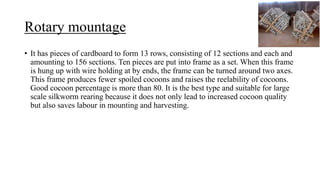
Rotary mountage
• It has pieces of cardboard to form 13 rows, consisting of 12 sections and each and
amounting to 156 sections. Ten pieces are put into frame as a set. When this frame
is hung up with wire holding at by ends, the frame can be turned around two axes.
This frame produces fewer spoiled cocoons and raises the reelability of cocoons.
Good cocoon percentage is more than 80. It is the best type and suitable for large
scale silkworm rearing because it does not only lead to increased cocoon quality
but also saves labour in mounting and harvesting.
Pests and diseases of
silkworm
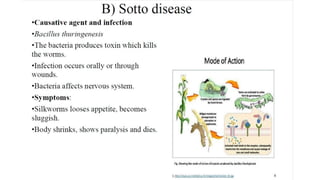
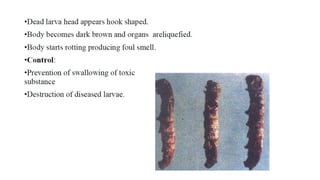
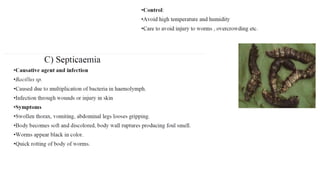
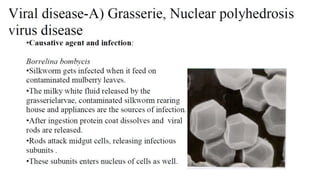
Pebrine Diseases
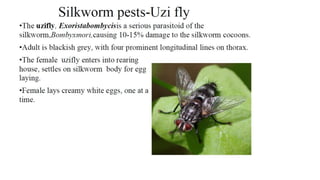
• In Hindi this disease isknown as 'kata’.
• Causative agent and infection: Nosema bombycis
• Infection-Transovarion(through ovary) or orally(consumption of infected leaves)
• Also from diseased and dead larva.
• Microspores are oval and refractile.
• Spores hatch in digestive tract, reaches blood and affects all organs
Control:
•Disinfection of rearing house and equipments with 2% formalin
•Rearing bed should be kept dry
•Destruction of infected worms.
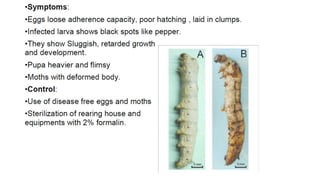
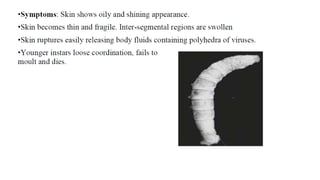
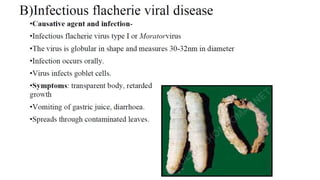
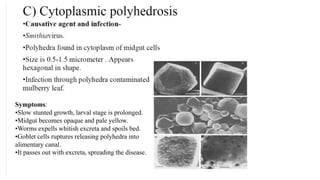
Symptoms:
•Slow stunted growth, larval stage is prolonged.
•Midgut becomes opaque and pale yellow.
•Worms expells whitish excreta and spoils bed.
•Goblet cells ruptures releasing polyhedra into
alimentary canal.
•It passes out with excreta, spreading the disease.
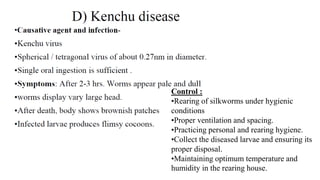
Control :
•Rearing of silkworms under hygienic
conditions
•Proper ventilation and spacing.
•Practicing personal and rearing hygiene.
•Collect the diseased larvae and ensuring its
proper disposal.
•Maintaining optimum temperature and
humidity in the rearing house.
Control Measues
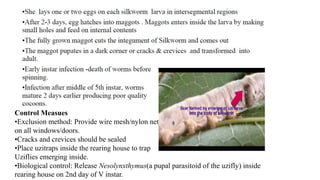
•Exclusion method: Provide wire mesh/nylon net
on all windows/doors.
•Cracks and crevices should be sealed
•Place uzitraps inside the rearing house to trap
Uziflies emerging inside.
•Biological control: Release Nesolynxthymus(a pupal parasitoid of the uzifly) inside
rearing house on 2nd day of V instar.
Assessment of Cocoons
• Cocoons produced are to be marketed. Following points/ characters are generally
considered to assess the cocoons in fixing the price.
A. Cocoon Weight:
• Cocoons are being sold on a weight basis. You will find that the weight of the
cocoons gradually decreases due to moisture loss and consumption of fat till the
pupa transforms into moth and emerges. So, immediately after harvest, defloss,
sort, and weigh the good cocoons. This will be the weight of green cocoons. Make
a label indicating race or combination, date of spinning, green weight, etc. while
taking to the market.
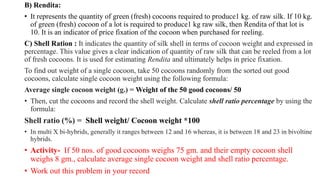
B) Rendita:
• It represents the quantity of green (fresh) cocoons required to produce1 kg. of raw silk. If 10 kg.
of green (fresh) cocoon of a lot is required to produce1 kg raw silk, then Rendita of that lot is
10. It is an indicator of price fixation of the cocoon when purchased for reeling.
C) Shell Ration : It indicates the quantity of silk shell in terms of cocoon weight and expressed in
percentage. This value gives a clear indication of quantity of raw silk that can be reeled from a lot
of fresh cocoons. It is used for estimating Rendita and ultimately helps in price fixation.
To find out weight of a single cocoon, take 50 cocoons randomly from the sorted out good
cocoons, calculate single cocoon weight using the following formula:
Average single cocoon weight (g.) = Weight of the 50 good cocoons/ 50
• Then, cut the cocoons and record the shell weight. Calculate shell ratio percentage by using the
formula:
Shell ratio (%) = Shell weight/ Cocoon weight *100
• In multi X bi-hybrids, generally it ranges between 12 and 16 whereas, it is between 18 and 23 in bivoltine
hybrids.
• Activity- If 50 nos. of good cocoons weighs 75 gm. and their empty cocoon shell
weighs 8 gm., calculate average single cocoon weight and shell ratio percentage.
• Work out this problem in your record
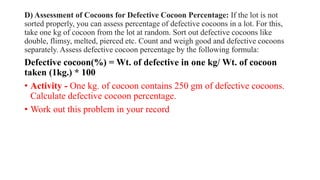
D) Assessment of Cocoons for Defective Cocoon Percentage: If the lot is not
sorted properly, you can assess percentage of defective cocoons in a lot. For this,
take one kg of cocoon from the lot at random. Sort out defective cocoons like
double, flimsy, melted, pierced etc. Count and weigh good and defective cocoons
separately. Assess defective cocoon percentage by the following formula:
Defective cocoon(%) = Wt. of defective in one kg/ Wt. of cocoon
taken (1kg.) * 100
• Activity - One kg. of cocoon contains 250 gm of defective cocoons.
Calculate defective cocoon percentage.
• Work out this problem in your record
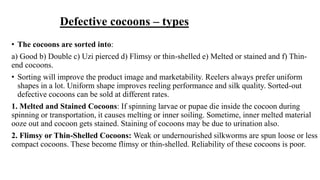
Defective cocoons – types
• The cocoons are sorted into:
a) Good b) Double c) Uzi pierced d) Flimsy or thin-shelled e) Melted or stained and f) Thin-
end cocoons.
• Sorting will improve the product image and marketability. Reelers always prefer uniform
shapes in a lot. Uniform shape improves reeling performance and silk quality. Sorted-out
defective cocoons can be sold at different rates.
1. Melted and Stained Cocoons: If spinning larvae or pupae die inside the cocoon during
spinning or transportation, it causes melting or inner soiling. Sometime, inner melted material
ooze out and cocoon gets stained. Staining of cocoons may be due to urination also.
2. Flimsy or Thin-Shelled Cocoons: Weak or undernourished silkworms are spun loose or less
compact cocoons. These become flimsy or thin-shelled. Reliability of these cocoons is poor.
3. Deformed Cocoons: Weak larvae or improper mountage causes deformed
cocoons. These cocoons affect the reelability and quality of raw silk.
4. Thin-end Cocoons: Thin-end cocoons may be due to genetic character of the
silkworm races or may be due to improper rearing and a spinning environment.
These cocoons affect reeling performance.
5. Pierced Cocoons: Cocoons may be pierced due to the emergence of maggotsof
parasitic Uzi fly or emergence of silkworm moth. These are unsuitable for reeling.
6. Double Cocoons: Double cocoons are abnormally large mostly with oval shape
with two or more pupae inside. This may be due to genetic character overcrowding
in the mountage. Improper mountage also causes double cocoons. Two or
sometimes more filaments are entangled in these cocoons. These cocoons can’t be
reeled normally, can be reeled into a special type of silk, called 'dupion'.
Harvest
• Harvest signifies to the collection and gathering of produced cocoons from
spinning tray or mountage.
• Harvest cocoons at 6th day after completion of full 5 days in mountage, counted
from the last day of mounting.
• Delayed harvest will lead to weight loss of cocoons
• Methods for harvesting of silk cocoons varies, depending upon the mountage
(spinning tray) used.
• Whatever the methods of harvest, first you remove litters and left-over of leaves,
dead or un-spun larva, naked pupa (without cocoon), flimsy and melted cocoons
from the mountage. Flimsy and melted cocoons may spoil the good cocoons by
spilling stain.
• Chandrika is most commonly used in our country - by hand, simply by moving
your fingers in between the ridges.
• In case of plastic collapsible mountages, you may harvest manually by hand
picking.
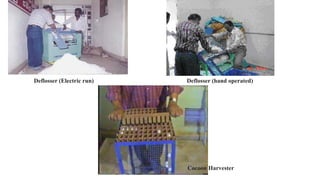
• Rotary card board mountages, harvesting by hand - difficult and time consuming -
wooden harvester for quick harvesting. First part is a wooden frame on which
cardboard mountage can be fixed. Another is pusher, made up of wooden pegs,
that fits with the hole of mountages. After removing dead worms, flimsy and
stained cocoons, fix cardboard mountage on the harvester. Then, place the wooden
pusher on the holes and push gently so that cocoons come out of cardboard hole,
collect the cocoons by hand by folding the mountages
Some machines developed by CSR&TI, Mysore
• Cocoon Harvester: It is made up of iron or wood. It consists of two parts and is
used for harvesting cocoons from rotary mountages. Cardboard mountages are
inserted into the wooden frame and cocoons are pushed out using a pusher made
of the same size as the holes of the mountage
• Cocoon Deflosser: Hand-operated and motorized cocoon deflossing machines of
different capacities are available for fast deflossing of the cocoons. The motorized
machines have capacity to defloss 100 kg cocoons per hour.
• After harvesting, spread the cocoons in trays with maximum of two layers of
cocoon. Heaping of cocoons may lead to accumulation of moisture and heat and
ultimately melting of cocoons.
Deflosser (Electric run) Deflosser (hand operated)
Cocoon Harvester
• Transport the cocoons in a right way and Choose the right market for your cocoons.
Transportation
• Transportation is a very important factor because often it affects the quality of cocoons.
Pack the cocoons loosely, preferably in bamboo baskets or plastic crates or plastic nets.
Transport the cocoon during the early cool hours as live pupa inside may die and melt
leads to staining of cocoons. This will lower the quality of cocoons and get low price.
Marketing
• Choose the right market. There are separate markets for different types of cocoons like
seed cocoons and reeling cocoon. There are many established Govt. controlled markets in
cocoon producing areas, where, market authorities first check the cocoons for complete
pupation then arranges for display and bidding of cocoons and as a producer you will sell
your produce to highest bidder. In that way, youmay get the right price for cocoons. The
reelers do not prefer mixing of different lots of cocoons. So, don't mix different lots.
Post cocoon processing
1. Stifling – process of killing the pupae inside without interfering with the structure of
the silk shell around it.
2. Reeling
a. Brushing or Deflossing is the removal of the floss to find out the actual reeling ends
of the cocoon that can undergo continuous reeling.
b. End picking – Process of collecting ends of all cocoons are separated out and
gathered together for reeling
c. Casting
d. Binding
e. Traversing
3. Chemical processing/ Degumming – removal of sericin and other impurities from raw
silk which imparts lustrous and softness to silk
4. Re reeling – to overcome the defects of silk during reeling, it is first reeled on small
reels and later transferred to standard-sized hanks. This process is known as re reeling
Cocoon stifling
• Stifling treatments are applied to silk cocoons in order to kill the
pupae, preventing the emergence of moths and allowing to preserve
the silk during long periods of time.
Different methods
1. Sun drying
2. Boiling/ steam stifling
3. Hot air drying
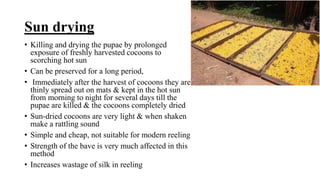
Sun drying
• Killing and drying the pupae by prolonged
exposure of freshly harvested cocoons to
scorching hot sun
• Can be preserved for a long period,
• Immediately after the harvest of cocoons they are
thinly spread out on mats & kept in the hot sun
from morning to night for several days till the
pupae are killed & the cocoons completely dried
• Sun-dried cocoons are very light & when shaken
make a rattling sound
• Simple and cheap, not suitable for modern reeling
• Strength of the bave is very much affected in this
method
• Increases wastage of silk in reeling
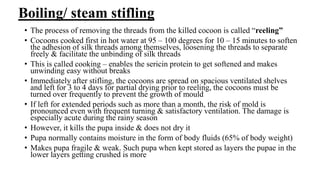
Boiling/ steam stifling
• The process of removing the threads from the killed cocoon is called “reeling”
• Cocoons cooked first in hot water at 95 – 100 degrees for 10 – 15 minutes to soften
the adhesion of silk threads among themselves, loosening the threads to separate
freely & facilitate the unbinding of silk threads
• This is called cooking – enables the sericin protein to get softened and makes
unwinding easy without breaks
• Immediately after stifling, the cocoons are spread on spacious ventilated shelves
and left for 3 to 4 days for partial drying prior to reeling, the cocoons must be
turned over frequently to prevent the growth of mould
• If left for extended periods such as more than a month, the risk of mold is
pronounced even with frequent turning & satisfactory ventilation. The damage is
especially acute during the rainy season
• However, it kills the pupa inside & does not dry it
• Pupa normally contains moisture in the form of body fluids (65% of body weight)
• Makes pupa fragile & weak. Such pupa when kept stored as layers the pupae in the
lower layers getting crushed is more
Disadvantages of steam stifling
• Steam stifling of cocoons has certain drawbacks. Steam stifling only kills the pupa
inside and does not dry it. The pupa normally contains moisture in the form of
body fluids, to the extent of nearly 65 per cent of its own weight. This large
moisture content makes the pupa fragile and weak, and so such cocoons cannot be
kept stored in thick layers, because of the risk of the pupae in the lower layers
getting crushed under the weight of the cocoons above and the body fluids
spoiling the silk of the cocoons.
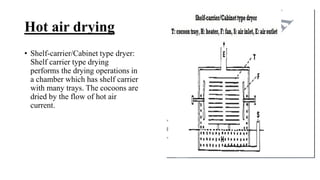
Hot air drying
• Shelf-carrier/Cabinet type dryer:
Shelf carrier type drying
performs the drying operations in
a chamber which has shelf carrier
with many trays. The cocoons are
dried by the flow of hot air
current.
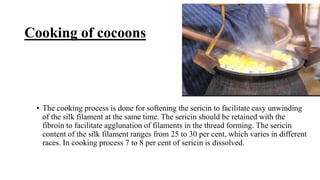
• The cooking process is done for softening the sericin to facilitate easy unwinding
of the silk filament at the same time. The sericin should be retained with the
fibroin to facilitate agglunation of filaments in the thread forming. The sericin
content of the silk filament ranges from 25 to 30 per cent, which varies in different
races. In cooking process 7 to 8 per cent of sericin is dissolved.
Cooking of cocoons
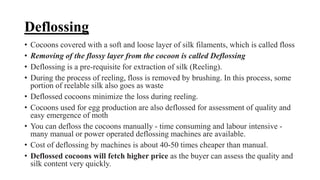
Deflossing
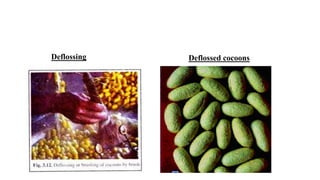
• Cocoons covered with a soft and loose layer of silk filaments, which is called floss
• Removing of the flossy layer from the cocoon is called Deflossing
• Deflossing is a pre-requisite for extraction of silk (Reeling).
• During the process of reeling, floss is removed by brushing. In this process, some
portion of reelable silk also goes as waste
• Deflossed cocoons minimize the loss during reeling.
• Cocoons used for egg production are also deflossed for assessment of quality and
easy emergence of moth
• You can defloss the cocoons manually - time consuming and labour intensive -
many manual or power operated deflossing machines are available.
• Cost of deflossing by machines is about 40-50 times cheaper than manual.
• Deflossed cocoons will fetch higher price as the buyer can assess the quality and
silk content very quickly.
Deflossing Deflossed cocoons
Reeling
• After boiling (cooking) and brushing, reeling started. Reeling is the extraction of
continuous silk thread of desired thickness from the cocoon without any break. Before
reeling, light brushing of the cocoon surface is done to find out the tip of the silk filament.
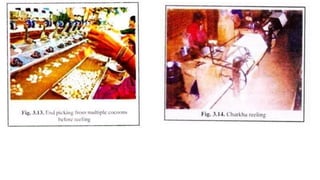
• Then the ends are all separated out and gathered together, this is called end picking.
Generally, filaments from multiple cocoons are combined together and transferred onto
the reeling or spinning machine, which then automatically unravels the cocoons and
simultaneously create a single strand of silk from the cocoons.
• Throughout the reeling process, the cocoons remain in boiling water. When one cocoon gets exhausted, the second
one is immediately substituted to reel a continuous and uniform yarn. So the important steps in reeling are brushing,
end picking, casting, binding and traversing. The individual filament must be inter-wined or twisted and cemented
firmly so that the reeled filament does not break during subsequent processing of fabrics. This twisting and
cementing is done with the help of a special device, called Croissure, which remains attached with the reeling
machine.
• Croissure helps in twisting and agglutinating the have as well as it squeezes out excess water from the reeled thread
to make it dry. Reeling can be done by 3 systems:
1. Charka
• In this manually operated system, inferior quality or defective cocoons are reeled.
Here cooking and reeling are done in one basin. Following cooking at high
temperature, the soften cocoons float in basin.The reeling ends are then taken out
from 4-5 cocoons and twisted around themselves with the help of charkha reel. to
make uniform thread. Charkha reeling machine is traditionally home-made and
used mainly in villages for small scale silk production. It uses chambon type of
simple croissure where threads from two reeling ends are interwindedto form few
spirals. So the silk reeled by charkha is of poor quality.
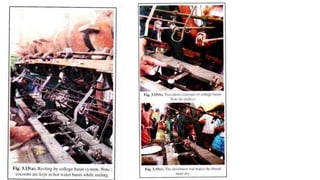
Cottage basin system
• In this system, cooking and reeling are done separately. Boiling water basin is
used for cooking while reeling is done in a hot water basin kept near the cooking
basin. Cottage basin reeling machine uses travellettecroissure. It consists of 3
pulleys to enable the thread to interwine around itself and also better removal of
water and gum spots from the thread.
• Cottage basin is also attached with traverse or distributor which is a modified hot
rod. After being squeezed by the croissure, the thread is further dried as it passes
on the traverse before reaching the reel. So cottage basin yields silk of good
quality with uniform thickness. In India, as much as 806 tonnes silk are produced
by 4000 cottage basin systems.
3. Filature system
• In this power-driven multi- end reeling device, cooking and reeling are done
separately. It is a modern device where continuous reeling is done from cocoons of
superior quality. The silk produced by filature is also of superior quality because
of increased cleanliness and uniformity in thickness of the fibre. However, only
8% of the total silk production in India is contributed by filature.
Chemical Processing of Raw Silk
• The raw silk thread, thus produced is rigid, stiff and not soft in touch and also lacks in lustre due to
presence of sericin and other impurities on the surface.
• Degumming of silk: Degumming is the removal or elimination of sericin and other impurities
from raw silk. It is carried out to impart the lustrous and softness on silk. Degumming is generally
carried out by following treatments:
• (a) Extraction with water: In this process, silk thread is treated in hot water (100-130°C) for 30
minutes to 4 hours, which can cause degumming of sericin. It is a safer process with minimum
degradation to the silk fibre.
• (b) Treatment with alkali/acid: Degumming with alkali or acid depends on pH, temperature, time
of treatment, strength and nature of the reagents used. Alkalis used for degumming include sodium
carbonate and bicarbonate, caustic soda, trisodium phosphate etc. Alkali treatment should be done
for 30 minutes to 2 hours at a pH > 8.5. In a similar; way acid treatment at pH < 3.0 can eliminate
sericin.
• (c) Digestion with enzymes: Enzymatic digestion by proteolytic enzymes like trypsin (pH 8.0),
papain (pH 5.2), chymotrypsin, and pepsin at a temperature of 40-50°C were proved to be useful
for degumming.
• Weighting of silk: Removal of sericin from the silk fibre results in weight loss of 22-
25%. Thus the silk becomes further expensive. Therefore, such weight loss can be
compensated by treating the silk with suitable compounds that adds weight or fix colour
to the silk.
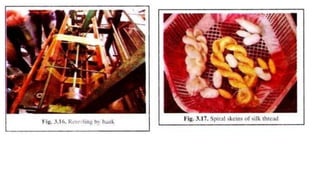
• Re-Reeling: Sometimes silk after being reeled on device like charkha or cottage basin,
may suffer from some defects like short length, broken threads, entanglements, hard gum
spots, etc. These problems may create wastages of thread during subsequent throwing and
twisting. To overcome these defects silk is first reeled on small reels and later is
transferred to standard sized hanks. This process is called re-reeling.
• Lacing and Skeining: Re-reeled silk hunk is then tied with a coloured silk thread by the
two ends. The hunk is then divided into five parts and is laced with a cotton thread. This
lacing prevents entangling of the silk in later operation.The cleaned and laced hunks are
then put on a skeining machine to be skeined. During this process, the hunk is twisted and
folded upon itself to form a number of tight spirals or skeins . The skeining prevents
ruffling and further entanglement of filaments during packing. The skeins are then made
into books. In a book, eight skeins are placed in horizontal row and five in vertical row.
Each book is then tied with separate cotton bands at three different places and wrapped
with tissue paper. Books are kept in bales of twenty kg weight. Thus, silk threads are kept
in store house as bales. Store house should be free from humidity and air.
Practical record
Expt 1. Different types of Silkworm
Expt 2. Life cycle of Bombyx mori
Expt 3. Life cycle of Eri silkworm
Expt 4. Appliances for chawki rearing
Expt 5. Natural enemies of silkworm
Expt 6. Helpful insects
Expt 7. Lac insect life cycle
Expt 8. Forms of lac
Expt 9. Natural enemies of lac

Sericulture notes_240826_090310 silkworm

  • 1.
  • 2.
    Introduction • Sericulture –Sericos(G) – silk, Culture (E) – rearing • Sericulture refers to the conscious mass-scale rearing of silk-producing organizations in order to obtain silk from them • Silk – fibrous protein of animal origin – insect and noninsect silk • Mussels – anchorage, spiders – prey, cocoons – protective sheath • Head quarters of International Silk Association – Lyon, France • Central Silk Board, Bangaluru • Central Silk Technology Research Institute - Bangaluru • Central Sericulture Research and Training Institute – Mysore
  • 3.
    History of sericulture •Lei- zu(Si Lung Chi) – empress – 2687 BC • Cocoon dropped in her tea cup – silky threads separated- she taught this to people • Source of silk was kept secret for more than 2000 years until the silk road was opened at 114 BC • Silk road/ silk route – historic trade route that dated from the second century BC until the 14th Century A.D • It stretched from Asia to Mediterranean traversing China, India, Persia, Arabia, Greece and Italy • Called as silk route because of the heavy silk trading that took place during that period, which gave China a monopoly over the trade
  • 4.
    Silk • Valuable naturalprotein fibre produced by certain inscets • Lepidoptera – adult stage – silk secretion from salivary glands • Silk used for construction of cocoons over pupae – protection • Important silk producers – Bombycidae and Saturnidae • Silk – sericin (sticky material surrounding) and fibroin (structural centre of silk) • Fibroin made of aminoacids – Gly- Ser-Gly-Ala-Gly-Ala – beta pleated sheets – hydrogen bonds between chains and sidechains from above and below the plane of the hydrogen bond network • High proportion of glycine (50 %) allows tight packing and the fibers are strong and resistant to breaking • Tensile strength due to many inter-seeded H2 bonds and when stretched the force is applied to these numerous bonds – do not break • Silk is resistant to most mineral acids except H2SO4 – precipitate – yellow
  • 7.
    Properties of silk •One cocoon yieds about 1000 feet of silk thread • Unwound from the cocoons and reeled into threads of commercial silk • Natural fiber soft, shiny, strong and durable • Highly elastic and has long threads • Easily absorbs water (11%) – low density, absorbs 3 times own weight • Extremely light in weight, warmer than cotton, can be easily dyed and ironed – Queen of fibers Uses of silk • Manufacture woven materials and knitted fabrics • Fishing lines and sieves of flour mills • Insulation coil of telephone, wireless receivers and tyres of racing cars • Wall coverings, window treatments, rugs, bedding, wall hangings • Parachutes, parachute chords, racing cars, gunpowder bags • Non absorbable surgical threads • Silk under clothing – eczema • Disposable cups to holograms
  • 8.
    Taxonomic position • Kingdom– Animalia • Phylum - Arthropoda • Class - Insecta • Order - Lepidoptera • Family – Bombycidae, Saturnidae
  • 9.
    Different types ofsilkworm Sl. No. Type of silkworm Scientific name Family (Order : Lepidoptera) Hosts Remarks 1 2 3 4 Mulberry Tassar Eri Muga Bombyx mori Antherea mylitta Philasamia ricini Antherea assamensis Bombicinae Saturnidae Saturnidae Saturnidae Morus spp. (Mulberry) Indian Laurel, arjun (Terminalia sp.) Castor, Tapioca Som and Soalu Sericin content 25-30 % Single strand Sericin content 18-25 %, cocoon pedunculate
  • 10.
  • 11.
  • 12.
  • 13.
  • 14.
    Tasar silkworm • >90 %, Genus – Antheraea • Cocoons – large, thick and pedunculate, made of single unbroken filaments • 4 types – Indian tropical tasar, Indian temperate tasar, Chinese and japanese • Indian tropical tasar – commonly found in tropical India, Antherea mylitta, multivoltine, cocoons grey white, tough, pedunculate, polyphagous (Primary host - Ternminalia tomentosa, T.arjuna; secondary host – Shorea robusta, Zizyphus sp.) • Indian temperate/ oak tasar – A. proylei, host - Quercus (Himalayas), cocoons grey white in colour • Chinese tasar – only in former USSR countries, A. pernyi, Quercus, largest silkworm, cocoons grey brown, silk used for making embroidery threads • Japanese tasar – Japan, oak, A. yamamai, silk is greenish tinted used for making fabrics and embroidery threads
  • 15.
    Muga silkworm • Goldenyellow lustrous silk • A. assamensis • Occurs in Brahmaputra valley and hills in Assam • Unique monopoly of India • Feeds on Som and soalu trees • Rearing done outdoors • Multivoltine, smaller than tasar cocoons • Cocoons weakly pedunculate, large and strong
  • 16.
    Eri silkworm a) Wilderi / Ailanthus silkworm – Philasamia cynthia, bivoltine b) Castor silkworm - P. ricini, domesticated, multivoltine, polyphagous, Primary host – castor, tapioca • Cocoons weakly pedunculate, open at one end, non reelable, white or brick red in colour
  • 17.
    Anaphe silkworm • Genus– Anaphe, F- Notodontidae, O – Lepidoptera • A. venta – most important one – seen in South and Central Africa • Polyphagous, most important host is Triplochiton scleroxylon • Used for the production of parachutes during World War II • Univoltines used in velvet and plush making • Moths are of moderate size and show sexual dimorphism • More elastic and stronger than mulberry silk
  • 18.
    Gonometa silkworm • Eggermoth seen in African savanna • Cocoons found on Acacia torticis • Cocoons elongated, ellipsoidal in shape, simple, shell hard (shell ratio 22%) • Cocoon is unreelable and silk obtained by spinning • Sericin content is high 45-55 %
  • 19.
    Fagara silkworm • Indo-Australian,China and Sudan • 13 sp of Attacus produce this silk • Giant silk moth – Attacus atlas • Cocoons light brown in colour Coan silkworm • Syrian silkworm • Genus – Pachypasa, P. otus, P. lineosa • Cultivated in Europe until the introduction of B. mori • Cocoons white, yield of silk very low • Crimson-dyed apparels of Dignitaries of Rome
  • 20.
    Spider silk • Soft,fine, strong, elastic • Nephila madagascarensis, Miranda aurantia, Epeira sp. • Used for making cross bars in optical instruments • Mussel – fish wool – Pinna squamosa • Non commercial sericigenous insects • Moon moth – Actias selene • Cashew caterpillar - Cricula trifenestrata • Mango caterpillar – Cricula sp. • Cercropia moth – Philosammia cercropia
  • 21.
    Mulberry silkworm • Bombyxmori • Low land holding capacity • Investment is high • Economic return very high • Rearing house and rearing appliances needed • Mainly indoor rearing • Moriculture • Monophagous • Mainly found in KA, TN, WB • Hosts - M. alba, M.indica, M.serrata, M.latifolia • Automatic, semiautomatic reeling machines Non mulberry silkworm • Tasar, muga, eri • High land holding capacity • Investment very low • Economic return very low • No need of rearing house and appliances • Outdoor rearing except Eri • Arboriculture • Polyphagous in nature • Mainly found in Bihar, MP, Nagaland, Assam • Hosts - Shorea robusta, Listea polyantha, Ricinus communis • Reeling conducted by natwa bhir, pedal operated reeling, Trivedi type
  • 22.
    • Egg (350- 450 eggs) • Larva (4 moults) • Pupa (chrysalis) • Cocoon – white, bed of pupa whose outer threads are irregular while the inner threads are regular • Adult
  • 23.
    Silk glands • Silkproduced by the labial glands homologous with true salivary glands in insects • Situated lateral and ventral to the digestive canal and is of variable length • In mulberry silkworm it is 4 times the body length and is folded so as to envelop the hinder region of the gut • Each gland is enlarged anteriorly into a reservoir which is produced into a duct – the two ducts converge to open at the apex of a cylindrical organ known as spinneret • Posterior – Fibroin (active form – fibrinogen), Middle – Sericin (gum layer) • Brins – two filaments coming out of 2 sides • Bave – sericin layer of two brins then bind together into a single filament
  • 24.
  • 25.
    Terminology • Breed –a stock of animals or plants within a species having a distinctive appearance and typically having been developed by deliberate selection • Races – a population within a species that is distinct in some way esp. a subspecies (Indigenous/ native – originating in a particular region/ country, Exotic/ nonnative – introduced into an area where they do not occur naturally) • Classification based on geographic distribution – Japanese race, Chinese race, European race, South East Asian races
  • 26.
    Classification based onvoltinism • Voltinism – the number of broods/ generations of an organism in a year under natural environmental conditions Sl. No. Univoltines Bivoltines Multivoltines 1 Produce one generation per year 2 generations per year > 5-6 generations per year 2 Larval weight high Larval period short Larval duration short 3 Cocoons heavy Leaf cocoon ratio less Leaf cocoon ratio high 4 Quality of silk superior Quality of cocoon inferior Cocoon compact, layer soft, Length of filament short, fine, clean, lustrous filament 5 Lay diapausing eggs Non hibernating and hibernating eggs Lay only nondiapausing eggs 6 Eg. European races Eg. NB4D2, NB 18, KA, NB7 Pure Mysore, C. nichi, Hisa mysore 7 Not suitable for summer Cocoon weight, shell weight silk % and filament length lesser than other 2 races Larvae robust, tolerate fluctuating environmental conditions suited to tropical climates
  • 27.
    Classification based onmoultinism • Moulting / ecdysis – the manner in which an animal routinely casts off an outer layer or covering at specific points in its life cycle Parameters Trimoulters Tetramoulters Pentamoulters Moults Three times during larval period 4 times 5 times Larval duration Limited growth, short 15- 18 days Medium 23-28 days Long Size Pupae and moth small Cocoon weight Less Medium High Cocoon filament Fine Fine More Denier of silk filament 1.6 to 1.7 2 to 2.5 Very heavy
  • 28.
    Production of silk •Two steps a. Production of mulberry trees that provide leaves upon which the worms feed – Moriculture b. Care of silkworm from egg stage through completion of the cocoon – Chawki rearing
  • 29.
    a. Mulberry cultivation– Moriculture • Morus spp. (M. alba, M. indica, M. cerata) • Climate : up to 800 m MSL, rainfall – 600 mm – 2500 mm • Optimum Temperature – 24-28, RH 65-80 % • Soil – red loamy soil, saline and alkaline soils not preferred • Varieties – Irrigated – Kanwa 2, MR 2, S30, S36 • Semi irrigated – Kanwa 2, MR 2 • Rainfed – S13, S34,
  • 30.
    Propagation • Sexual –seedlings – broadcasting in lines • Asexual - cuttings, grafting, budding, layering. • Mostly used – cuttings, planted in main field or nursery, rooted saplings establish better in main field • Cuttings – semi hardwood cuttings, 10-12 mm diameter, 15-20 cm long with 3-4 active buds
  • 31.
    Nursery • Select 1800sq.m area for 1 ha of main field • Apply 600 Kg FYM @20t/ha and mix well • Nursery bed of 4m x 1.5 m size • Provide drainage channel and avoid shady area • Pre treatment of cutting – 1 Kg Azospirillum in 40l of water • Keep the bottom end of the cuttings for 30 minutes in it • Irrigate the nursery once in 3 days • Termite attack – Malathion 5 D, Quinalphos 1.5 D • Root rot/ collar rot – Carbendazim 50 WP (2g/l) and T. viridae 0.5g/m2 • After weeding apply 100g of urea/m2 between 55 and 60 DAP
  • 32.
    Main field planting •Transplant 90 -123 days of planting, No. of cutting/ ha – 27,780 (60x 60 cm) • Plant at a depth of 15 – 20 cm • Nutrient management – 300: 120: 120 (NPK) • Biofertilizers – Azospirillum @20Kg/ ha, Phosphobacterium @ 10Kg/ ha • Mix biofertilizers with 50 Kg of FYM, irrigation after fertilizer • Apply micro nutrients as per recommendation • Planting – pit system, row system, strip system and kolar system • Pit system – rainfed crop, wider spacing 40x 90cm, prune once in June and Nov. 8-10 cm above ground • Row system – irrigated crop, 45- 60 cmx 45-60 cm, done at a height of 3-8cm above ground level , harvest by bottom pruning • Frequency of irrigation depends on humidity, stage of growth, soil type • Flood, surface, sub surface, sprinkler, drip, check basin, furrow systems
  • 33.
    Pruning • To increasethe leaf yield, production synchronized with silkworm rearing • Fist form – cutting of mulberry plant each year at one place on main stem. Stem becomes thick and fist shaped , more resistant to pest and diseases • Non-fist form – pruning done such that 2-3 branches allowed to grow from main stem and secondary branches also develop, less resistance to pest and diseases • Bottom/ ground – branches cut at the base of the stem at ground level, 5 times pruning in a year, needs heavy doses of fertilizers and irrigation • Middle - cutting the branches of bush mulberry at a height of 45 – 60 cm above the ground level during Dec – Jan, stimulates sprouting of the lower buds during winter • Top clipping – done to produce more branches and leaves, clipping off the top of the branch but not the whole branch, winter season, production & quality improved
  • 34.
    Harvesting • Leaf picking,branch cutting, whole shoot harvest • Harvest during early hours • Largest glossy leaf upto 4th from top – 1st instar larvae • Next 6-8 leaves – 2nd instar larvae • 8-10th leaf – late stage larvae • Size of the chopped leaf – 0.5 to 1.0 sq.cm – upto 2nd stage • From brushing to the end of the second stage the larvae are fed with tender leaves
  • 35.
    Leaf preservation • Silkwormgrows best when fed with succulent leaves which are rich in nutrients and moisture • Leaves if not preserved properly, dry up and become unsuitable for feeding • The harvested leaves must be preserved in fresh condition in a wet gunny cloth • If the climate is too hot and dry, the leaves are preserved in a leaf chamber which is lined with gunny cloth • Cloth is kept wet by spraying water at frequent intervals
  • 36.
    b. Silkworm rearing •5 phases • Selection of races of B. mori • Rearing of silkworm – chawki and late stage rearing • Mountaging/ cocoon spinning • Marketing • Post cocoon processing – stifling, reeling and spinning
  • 37.
    Selection of racesof B. mori • DFLs – Disease Free Layings – eggs procured from a quality center called grainage • Grainage – establishments where disease free & quality seeds are produced on scientific lines • Industrial silkworm seed is a hybrid between two silkworm races exploitation of multivoltine hybrids • When silkworm races are continuously breed for more than 6-7 generations, without any selection for quality cocoon they loose their volatility and vigour • Systematic seed organization – technique developed by scientists to maintain the vigour of silkworm • Pj stations/ basic seed farms – they release silkworm stocks continuously for multiplication
  • 38.
    • Two roles– to maintain the silkworm breeds released by the research institute • It releases silkworm stocks at required regular intervals to maintain the stream of seed production • Basic seed farms are the temple of seed organization and seed production • Should be maintained under highly hygienic conditions and manned with highly qualified and experienced silkworm breeders • Silkworm rearing in Pj farm – optimum environmental condition for worms, produce healthy and strong cocoons for egg production • Hybrid reraing – rearing for commercial cocoon production where emphasis for high silk content is made
  • 39.
    • Disinfection –basic stocks are less resistant to diseases as compared to hybrids • The appliances are washed with 1 % bleaching powder solution followed by 3 % formalin solution • Rearing house – fumigation of 3% formalin • Washed equipment's are kept in a closed room, sprayed with 1 % bleaching powder solution followed by 3 % formalin • Open the doors and windows 24 hours after disinfection • Done two days prior to brushing • Feeding of tender leaves at final stage leads to improper growth of larvae and incidence of diseases, heavy pupa that dies
  • 40.
    DFL preparation • Onthe day of moth emergence only healthy moths selected • Selected male and female moths of the same race are allowed to couple • Kept in cellules in oviposition room where T 25 degree and 75 % RH • Darkness is provided for mating, 4-5 hrs after mating male moth is rejected to ensure all eggs are fertilized • She is allowed to lay eggs on egg card and covered with cellule in oviposition room (multivoltine – 450 eggs, bivoltine – 600 eggs) • Next morning, the mother moths are examined to check whether they are free from pebrine disease (individual moth crushed, one drop of fluid taken on a glass slide) moths dried in hot air oven, T 65 dgree for 6-7 hrs layings with 2% KOH solution grinding) • A smear prepared by putting a cover glass, microscope 6X even if a single moth shows pebrine disease that whole lot of cocoon is discarded – action taken to disinfect reraing room and garinage
  • 41.
    • Only layingswith large no. of eggs are selected for further breeding • Washed in 2% formalin for 15 – 20 min – surface sterilization again washed in water to remove formalin • About 100 such dfl’s in each of the races are selected • In bivoltines – these dfl’s are stored in cold storage for hibernation – 6-10 months – preservation of basic stocks • This will enable rearing of stocks only for one or two generations in a year. This helps to avoid repeated multiplication and inbreeding depression • Multivoltines – no hibernation – dfl’s selected for rearing next generation • Supply of dfl’s basic stock – 30 dfl’s are reraed separately in cellular beds for stock maintenance, 70 dfl’s are reared as Pi stocks for P seed production
  • 42.
    Rearing equipment's • Chawkirearing box with stand • Bamboo tray (round) • Rearing stand (wooden) • Chandrike • Leaf chamber • Feeding stand (wooden) • Chop sticks • Feather • Chopping board • Chopping knife • Basin stand (Iron) • Ant well • Foot cleaning tray
  • 43.
    Pre incubation careof silkworm eggs • Care during transport, well aerated, prevents from desiccation • 25 degree Celsius, 80 % RH, 16: 8 L:D – ideal • Transport – carry them in containers or packets with holes on it and loosely packed • To avoid desiccation – wrap the packet with green leaves or wet cloths/ blotting paper • Transport during cooler days • To eliminate surface contamination – egg’s surface should be soaked in 2% formalin for 10 min. • Should not be done if the eggs have already developed head pigmentation
  • 44.
    Incubation • The processof facilitating the growth and development of the embryo inside the egg till hatching • It involves providing the required ambiance to the egg which includes the required T, RH, aeration, light etc. • The most modern way of incubating eggs is to spread them in trays in the incubator which has facilities to control the T, RH, light hours • Usually farmers place the egg sheets or loose eggs spread in the rearing tray on paraffin paper, cover them with another tray, and then with a moist cloth. When T increases eggs are incubated in earthen pots which are kept on wet sand and covered with wet cloths
  • 45.
    Black boxing • Doneat > 50 % eggs reach pinhead stage • By around 8th or 9th day from the day of laying, embryos develop eye spots which are visible as a black spot on the eggs – become sensitive to light with accelerated growth – pinhead stage • Eggs at pinhead stage are kept under total darkness either by wrapping them in black paper or keeping them in a black box or dark room for the next 2 days- black boxing • This retards the development of embryo which have already reached pinhead stage and also helps in synchronization in hatching all eggs together on the same day • Different methods – black paper method, black cloth method or wooden box method • Duration ranges from 48 – 72 H after the head pigmentation stage
  • 46.
    Chawki rearing • Chawki– young silkworms usually up to the end of second instar, looks like tiny ants Characterestics • Tiny and delicate – chances of damage are higher during handling • Require highly nutritive and easily digestible food • Require slightly higher T (28 degree) & RH (80%) • Growth rate is slightly higher, Resistant to high T & high RH • Weak against pesticides, gases
  • 47.
    • Chawki rearinginvolves providing the young silkworm tender succulent leaves cut to size, maintaining their freshness by preserving the leaf moisture content, providing its required environment during feeding and moulting and sanitation Leaf quality for chawki rearing • Feed on the surface of the leaves being too small and tender • Leaves should be tender , soft and succulent with 80 % moisture and high nutritive value (27% protein, 11 % carbs, minerals and vit) • First 4 largest glossy leaf from top – for first instar larvae • Such tender leaves are fed to silkworms each time they resume feeding after moult
  • 48.
    Chawki rearing practices •Chawki rearing starts after brushing silkworms into the rearing trays • Tiny worms which feed on the surface of the leaves should be able to reach the surface of the leaf more easily and speedier • Provide chopped leaves of about 1cm2 size • As the worm grows in size, the size of the chopped leaves can be increased • Silkworms are fed 3-4 times a day depending on the climate • During rainy season/ cooler climate – 2 feedings sufficient, hot/ dry climate – no. of feedings higher • 3 feedings per day on an average – 8.00 am, 2.00 pm, 8.00 pm • 20 Kg tender leaves for rearing 100 dfl’s of the first 2 instars – varies based on the breed and size of worm
  • 49.
    • To preventloss of moisture from leaves and maintain them fresh – worms are maintained on a paraffin paper in the rearing tray • After feeding, the bed is covered with another sheet of paraffin paper and the edges of both sheets folded together known as wrapping up • if paraffin paper not available use polythene sheets of 400 gauge thickness • Before each feeding the paraffin paper cover is removed and bed gently spread and left over leaf is allowed to dry • The fresh chopped leaves are then fed and covered with paraffin paper again • The fresh chopped leaves are then fed and covered with paraffin paper again • The rearing trays after feeding are usually piled up one above the other on small stand altogether looking like a box and therefore called box method of chawki rearing • If the trays are kept in the rearing stand, it is known as stand rearing – most preferred • As the silkworm grows in size its body becomes too tight and brittle to hold the body. As a result of which its movements becomes difficult and mouth parts look small compared to its head. At this stage they stop feeding and moults. Moulting lasts for about 20-24 hrs. • First moult – 3 days after brushing, second moult 4 days after first moult • As the larva approaches moulting stage, its body becomes lustrous and shining, prothoracic segment becomes bulged, head becomes narrow, pointed and black, loose appetite become weak
  • 50.
    • As theworms prepare for moult, leaves are cut into smaller size and thinly spread to meet the requirement of the fewer feeding worms • Remove paraffin paper and wet paper, sprinkle slaked lime over the bed to dry the rearing bed, provide adequate ventilation • 95 % worms come out of moult, dust bed disinfectant (Vijetha, Ankusk, Resham Jyothi, TNAU seridust, Sanjeevini) • Feed in half an hour gap • Moulted larva looks ash coloured with broader mouth portion and feed actively • As the left over leaf accumulates the rearing bed thickness increases resulting in multiplication of various pathogens
  • 51.
    Bed cleaning • Thesilkworms have to be transferred to a clean tray and the bed refuge discarded and this process is called bed cleaning • Done by spreading a net of meshsize of 1cm2 on the rearing bed followed by feeding and transferring the worms along with the net after one more feeding • Cleaning too many times during young stages result in unconscious discarding of worms left over in the bed which were unable to move over the net • Usually one cleaning is done during the entire chawki stage
  • 53.
    Commercial chawki rearingcentres (CRC) • The purpose of chawki rearing is to grow quality silkworms under disease free environment to reduce the cost and duration with farmers and to improve the cocoon quality and productivity • So poor farmers who cannot afford to provide the micro climate can purchase silkworm as chawki worms • Cocoon productivity from CRC supplied worms is about 20 – 25 % higher • CRC provide suitable rearing house for chawki rearing with required rearing appliances well maintained and irrigated exclusive chawki mulberry garden and well trained man power • Advantages - provide proper egg incubation and good hatching, robust and disease free chawki worms, prevents crop loss and cocoon crop stabilization, increased yield of good quality cocoons, reduction in production cost of cocoons, higher profits, synchronization of crops, distribution of labour for other works
  • 54.
    Disinfection and hygienemaintenance • Early instars are (I, II & III) are most susceptible to diseases compared to late instars, bivoltine more susceptible • Quantity of disinfectant solution – based on the floor area – effective disinfection – 1.5 l/ m2 floor area • Recommended disinfectants • 2% bleaching powder in 0.3 % slaked lime solution • 2.5 % Sanitech/ Serichlor in 0.5 % slaked lime solution • 0.05 % Asthra solution • Effective disinfection – by drenching spray of disinfectant solution in all the nook and cornor by the CRC using power sprayer
  • 55.
    Disinfection schedule • Completionof rearing – first disinfection of CRC and appliances with 2% BP • 3 days before brushing – cleaning and washing of CRC building, rearing tray disinfection • 2 days before brushing – 2nd disinfection of CRC and appliances • 1 day before brushing – dusting 5% BP in slaked lime powder surrounding environments of CRC. Open the windows of CRC for ventilation and to free the gases accumulated • Worms settling for 1st moult - 50 g slaked lime powder • Worms in 1st moult – Vijetha/ Ankush 50g • Worms settling for 2nd moult – 150g slaked lime powder • Disinfcetants are dusted as thin layer uniformly @ 3g/ sq.ft using a duster/ muslin cloth
  • 56.
    Measures to maintainhygiene • Wash hands and feet with the recommended disinfectant solution before entering the CRC and also after attending rearing • Wash hands with disinfectant after every bed cleaning • Collect diseased/ dead/ weak larvae from the rearing bed with forceps/ chopsticks into a basin containing disinfectant solution and destroy them by burning • Collect silkworm bed refuse into litter basket/ vinyl sheet meant for it • Prevent flooring of bed refuse during bed cleaning • Disinfect the leaf storage room along with the rearing room • Store mulberry leaves in a separate room and cover with wet gunny cloth • Dust slaked lime powder on the rearing bed when the worms settle for moult • Disinfect silkworm body and rearing set by dusting Ankush/ Vijetha after moulting and before resumption • Rear chawki larvae under recommended optimum T, RH, and spacing conditions for healthy growth • Feed silkworms with quality mulberry leaves for robust chawki
  • 57.
    Transportation of chawkilarvae • After chawki certification the young silkwormsn during the moult are transported in a vehicle to the farmers during cool hours of the day. • Care should be taken that young worms are not disturbed during the transportation • C: B ratio = 1: 1.51
  • 58.
    Late age silkwormrearing • 3rd , 4th and 5th instar larvae are considered as late-age worms • Reraed in a bamboo tray • Newspapers are spread over the trays to absorb excess moisture in leaves and faecal pellets • T & H requirement comes down as the stage advances • Leaves of medium maturity are fed (6th leaf) to 3rd and 4th age and coarse leaves are fed in the 5th st6age • Over matures and yellow leaves should be rejected, since they may induce disease outbreak • Bed disinfectants after 3rd moult 800g/ 100 dfls, 4th moult – 1000g/ 100 dfls, final stage - 2000g/ 100 dfls
  • 59.
    Moulting • Remove theparaffin papers • Evenly spread the larvae in the rearing bed 6-8 H before settling for moult • Provide air circulation to avoid excess humidity inside the room • Provide stove/ heaters to raise the room T during winter • Apply lime powder 60 min before resumption of feeding daily during rainy/ winter seasons to reduce dampness in bamboo trays
  • 60.
    Mounting and differentmethods of mounting • Mountages – the device that helps or supports the silkworms for comfortable spinning of their cocoons is called cocoonage or mountage • It enables the ripe worm to spin cocoon • Play and important role in quality cocoon production • Types of material used, finishing of moutages, and space available for spinning determine both the quality and quantity of cocoons
  • 61.
    Chandrika • Most commonform of mountage in India • Rectangular mat on which a spiral bamboo tape is tied • 1.8 x 1.2 m, 4-5 cm broad, space between the spirals is 4-5 cm • Advantages – can be easily manufactured and stored, provides easy passage of air for quick drying of excreta to avoid staining, easy to transport and disinfect, low cost and low weight
  • 62.
    Screen type mountages •It is made of bamboo or wooden or plastic reapers on which, instead of spiral bamboo tape, longitudinal strips with triangular peaks are placed. The screen can be folded and stored. • This mountage can be kept clean and well- ventilated and hence, cocoons spun on this mountage are of good quality. • It is more durable than chandrika. But occurrences of double cocoons are frequent in it.
  • 63.
    Plastic mountage • Madeof plastic instead of bamboo • More durable, easy to clean, not prone to rodent attack • Produce lesser number of double cocoons • Once invetsted not further maintenance, care/ expenditure needed • Costly than Chandrika • Cocoons produced on these mountages are more flimsy and not unirform in size and hence not frequently used by farmers
  • 64.
    Japanese low costmountage • In this modified Japanese mountage, a wooden frame of 4 longitudinal rods is attached by means of cross-spokes at two ends to a central axis. Each rod has a number of pegs placed at equal distances. These pegs are connected by long threads to twisted rice straw in a regular pattern like that of charpoy • The size of frame and the number of pegs can be modified according to the requirement of the rearer. This mountage is cheap, more durable a less chances of disease spread.
  • 65.
    Bamboo strip mountage •Made of bamboo stirps that are either nailed on wooden reaper or placed in grooves of wooden reapers. Several such frames are placed one above the other with the lower one keeping on four uniform bricks or wooden blocks. This mountages are cheap, durable, easy to handle, and harvest the cocoons.
  • 66.
    Bottle brush mountage •This recently introduced mountage consists of a thick coconut or jute fibre rope into which 6- 9″ sticks (midrib of coconut leaves) are inserted very closely. These are used by the worms as support. The worms spin their cocoons in the space between the sticks. This mountage is very cheap; can be made easily and occupies little space compared to Chandrika.
  • 67.
    Rotary mountage • Ithas pieces of cardboard to form 13 rows, consisting of 12 sections and each and amounting to 156 sections. Ten pieces are put into frame as a set. When this frame is hung up with wire holding at by ends, the frame can be turned around two axes. This frame produces fewer spoiled cocoons and raises the reelability of cocoons. Good cocoon percentage is more than 80. It is the best type and suitable for large scale silkworm rearing because it does not only lead to increased cocoon quality but also saves labour in mounting and harvesting.
  • 68.
    Pests and diseasesof silkworm
  • 69.
    Pebrine Diseases • InHindi this disease isknown as 'kata’. • Causative agent and infection: Nosema bombycis • Infection-Transovarion(through ovary) or orally(consumption of infected leaves) • Also from diseased and dead larva. • Microspores are oval and refractile. • Spores hatch in digestive tract, reaches blood and affects all organs
  • 76.
    Control: •Disinfection of rearinghouse and equipments with 2% formalin •Rearing bed should be kept dry •Destruction of infected worms.
  • 84.
    Symptoms: •Slow stunted growth,larval stage is prolonged. •Midgut becomes opaque and pale yellow. •Worms expells whitish excreta and spoils bed. •Goblet cells ruptures releasing polyhedra into alimentary canal. •It passes out with excreta, spreading the disease.
  • 85.
    Control : •Rearing ofsilkworms under hygienic conditions •Proper ventilation and spacing. •Practicing personal and rearing hygiene. •Collect the diseased larvae and ensuring its proper disposal. •Maintaining optimum temperature and humidity in the rearing house.
  • 87.
    Control Measues •Exclusion method:Provide wire mesh/nylon net on all windows/doors. •Cracks and crevices should be sealed •Place uzitraps inside the rearing house to trap Uziflies emerging inside. •Biological control: Release Nesolynxthymus(a pupal parasitoid of the uzifly) inside rearing house on 2nd day of V instar.
  • 90.
    Assessment of Cocoons •Cocoons produced are to be marketed. Following points/ characters are generally considered to assess the cocoons in fixing the price. A. Cocoon Weight: • Cocoons are being sold on a weight basis. You will find that the weight of the cocoons gradually decreases due to moisture loss and consumption of fat till the pupa transforms into moth and emerges. So, immediately after harvest, defloss, sort, and weigh the good cocoons. This will be the weight of green cocoons. Make a label indicating race or combination, date of spinning, green weight, etc. while taking to the market.
  • 91.
    B) Rendita: • Itrepresents the quantity of green (fresh) cocoons required to produce1 kg. of raw silk. If 10 kg. of green (fresh) cocoon of a lot is required to produce1 kg raw silk, then Rendita of that lot is 10. It is an indicator of price fixation of the cocoon when purchased for reeling. C) Shell Ration : It indicates the quantity of silk shell in terms of cocoon weight and expressed in percentage. This value gives a clear indication of quantity of raw silk that can be reeled from a lot of fresh cocoons. It is used for estimating Rendita and ultimately helps in price fixation. To find out weight of a single cocoon, take 50 cocoons randomly from the sorted out good cocoons, calculate single cocoon weight using the following formula: Average single cocoon weight (g.) = Weight of the 50 good cocoons/ 50 • Then, cut the cocoons and record the shell weight. Calculate shell ratio percentage by using the formula: Shell ratio (%) = Shell weight/ Cocoon weight *100 • In multi X bi-hybrids, generally it ranges between 12 and 16 whereas, it is between 18 and 23 in bivoltine hybrids. • Activity- If 50 nos. of good cocoons weighs 75 gm. and their empty cocoon shell weighs 8 gm., calculate average single cocoon weight and shell ratio percentage. • Work out this problem in your record
  • 92.
    D) Assessment ofCocoons for Defective Cocoon Percentage: If the lot is not sorted properly, you can assess percentage of defective cocoons in a lot. For this, take one kg of cocoon from the lot at random. Sort out defective cocoons like double, flimsy, melted, pierced etc. Count and weigh good and defective cocoons separately. Assess defective cocoon percentage by the following formula: Defective cocoon(%) = Wt. of defective in one kg/ Wt. of cocoon taken (1kg.) * 100 • Activity - One kg. of cocoon contains 250 gm of defective cocoons. Calculate defective cocoon percentage. • Work out this problem in your record
  • 93.
    Defective cocoons –types • The cocoons are sorted into: a) Good b) Double c) Uzi pierced d) Flimsy or thin-shelled e) Melted or stained and f) Thin- end cocoons. • Sorting will improve the product image and marketability. Reelers always prefer uniform shapes in a lot. Uniform shape improves reeling performance and silk quality. Sorted-out defective cocoons can be sold at different rates. 1. Melted and Stained Cocoons: If spinning larvae or pupae die inside the cocoon during spinning or transportation, it causes melting or inner soiling. Sometime, inner melted material ooze out and cocoon gets stained. Staining of cocoons may be due to urination also. 2. Flimsy or Thin-Shelled Cocoons: Weak or undernourished silkworms are spun loose or less compact cocoons. These become flimsy or thin-shelled. Reliability of these cocoons is poor.
  • 94.
    3. Deformed Cocoons:Weak larvae or improper mountage causes deformed cocoons. These cocoons affect the reelability and quality of raw silk. 4. Thin-end Cocoons: Thin-end cocoons may be due to genetic character of the silkworm races or may be due to improper rearing and a spinning environment. These cocoons affect reeling performance. 5. Pierced Cocoons: Cocoons may be pierced due to the emergence of maggotsof parasitic Uzi fly or emergence of silkworm moth. These are unsuitable for reeling. 6. Double Cocoons: Double cocoons are abnormally large mostly with oval shape with two or more pupae inside. This may be due to genetic character overcrowding in the mountage. Improper mountage also causes double cocoons. Two or sometimes more filaments are entangled in these cocoons. These cocoons can’t be reeled normally, can be reeled into a special type of silk, called 'dupion'.
  • 95.
    Harvest • Harvest signifiesto the collection and gathering of produced cocoons from spinning tray or mountage. • Harvest cocoons at 6th day after completion of full 5 days in mountage, counted from the last day of mounting. • Delayed harvest will lead to weight loss of cocoons
  • 96.
    • Methods forharvesting of silk cocoons varies, depending upon the mountage (spinning tray) used. • Whatever the methods of harvest, first you remove litters and left-over of leaves, dead or un-spun larva, naked pupa (without cocoon), flimsy and melted cocoons from the mountage. Flimsy and melted cocoons may spoil the good cocoons by spilling stain. • Chandrika is most commonly used in our country - by hand, simply by moving your fingers in between the ridges. • In case of plastic collapsible mountages, you may harvest manually by hand picking. • Rotary card board mountages, harvesting by hand - difficult and time consuming - wooden harvester for quick harvesting. First part is a wooden frame on which cardboard mountage can be fixed. Another is pusher, made up of wooden pegs, that fits with the hole of mountages. After removing dead worms, flimsy and stained cocoons, fix cardboard mountage on the harvester. Then, place the wooden pusher on the holes and push gently so that cocoons come out of cardboard hole, collect the cocoons by hand by folding the mountages
  • 98.
    Some machines developedby CSR&TI, Mysore • Cocoon Harvester: It is made up of iron or wood. It consists of two parts and is used for harvesting cocoons from rotary mountages. Cardboard mountages are inserted into the wooden frame and cocoons are pushed out using a pusher made of the same size as the holes of the mountage • Cocoon Deflosser: Hand-operated and motorized cocoon deflossing machines of different capacities are available for fast deflossing of the cocoons. The motorized machines have capacity to defloss 100 kg cocoons per hour. • After harvesting, spread the cocoons in trays with maximum of two layers of cocoon. Heaping of cocoons may lead to accumulation of moisture and heat and ultimately melting of cocoons.
  • 99.
    Deflosser (Electric run)Deflosser (hand operated) Cocoon Harvester
  • 100.
    • Transport thecocoons in a right way and Choose the right market for your cocoons. Transportation • Transportation is a very important factor because often it affects the quality of cocoons. Pack the cocoons loosely, preferably in bamboo baskets or plastic crates or plastic nets. Transport the cocoon during the early cool hours as live pupa inside may die and melt leads to staining of cocoons. This will lower the quality of cocoons and get low price. Marketing • Choose the right market. There are separate markets for different types of cocoons like seed cocoons and reeling cocoon. There are many established Govt. controlled markets in cocoon producing areas, where, market authorities first check the cocoons for complete pupation then arranges for display and bidding of cocoons and as a producer you will sell your produce to highest bidder. In that way, youmay get the right price for cocoons. The reelers do not prefer mixing of different lots of cocoons. So, don't mix different lots.
  • 101.
    Post cocoon processing 1.Stifling – process of killing the pupae inside without interfering with the structure of the silk shell around it. 2. Reeling a. Brushing or Deflossing is the removal of the floss to find out the actual reeling ends of the cocoon that can undergo continuous reeling. b. End picking – Process of collecting ends of all cocoons are separated out and gathered together for reeling c. Casting d. Binding e. Traversing 3. Chemical processing/ Degumming – removal of sericin and other impurities from raw silk which imparts lustrous and softness to silk 4. Re reeling – to overcome the defects of silk during reeling, it is first reeled on small reels and later transferred to standard-sized hanks. This process is known as re reeling
  • 102.
    Cocoon stifling • Stiflingtreatments are applied to silk cocoons in order to kill the pupae, preventing the emergence of moths and allowing to preserve the silk during long periods of time. Different methods 1. Sun drying 2. Boiling/ steam stifling 3. Hot air drying
  • 103.
    Sun drying • Killingand drying the pupae by prolonged exposure of freshly harvested cocoons to scorching hot sun • Can be preserved for a long period, • Immediately after the harvest of cocoons they are thinly spread out on mats & kept in the hot sun from morning to night for several days till the pupae are killed & the cocoons completely dried • Sun-dried cocoons are very light & when shaken make a rattling sound • Simple and cheap, not suitable for modern reeling • Strength of the bave is very much affected in this method • Increases wastage of silk in reeling
  • 104.
    Boiling/ steam stifling •The process of removing the threads from the killed cocoon is called “reeling” • Cocoons cooked first in hot water at 95 – 100 degrees for 10 – 15 minutes to soften the adhesion of silk threads among themselves, loosening the threads to separate freely & facilitate the unbinding of silk threads • This is called cooking – enables the sericin protein to get softened and makes unwinding easy without breaks • Immediately after stifling, the cocoons are spread on spacious ventilated shelves and left for 3 to 4 days for partial drying prior to reeling, the cocoons must be turned over frequently to prevent the growth of mould • If left for extended periods such as more than a month, the risk of mold is pronounced even with frequent turning & satisfactory ventilation. The damage is especially acute during the rainy season • However, it kills the pupa inside & does not dry it • Pupa normally contains moisture in the form of body fluids (65% of body weight) • Makes pupa fragile & weak. Such pupa when kept stored as layers the pupae in the lower layers getting crushed is more
  • 105.
    Disadvantages of steamstifling • Steam stifling of cocoons has certain drawbacks. Steam stifling only kills the pupa inside and does not dry it. The pupa normally contains moisture in the form of body fluids, to the extent of nearly 65 per cent of its own weight. This large moisture content makes the pupa fragile and weak, and so such cocoons cannot be kept stored in thick layers, because of the risk of the pupae in the lower layers getting crushed under the weight of the cocoons above and the body fluids spoiling the silk of the cocoons.
  • 106.
    Hot air drying •Shelf-carrier/Cabinet type dryer: Shelf carrier type drying performs the drying operations in a chamber which has shelf carrier with many trays. The cocoons are dried by the flow of hot air current.
  • 107.
    • The cookingprocess is done for softening the sericin to facilitate easy unwinding of the silk filament at the same time. The sericin should be retained with the fibroin to facilitate agglunation of filaments in the thread forming. The sericin content of the silk filament ranges from 25 to 30 per cent, which varies in different races. In cooking process 7 to 8 per cent of sericin is dissolved. Cooking of cocoons
  • 108.
    Deflossing • Cocoons coveredwith a soft and loose layer of silk filaments, which is called floss • Removing of the flossy layer from the cocoon is called Deflossing • Deflossing is a pre-requisite for extraction of silk (Reeling). • During the process of reeling, floss is removed by brushing. In this process, some portion of reelable silk also goes as waste • Deflossed cocoons minimize the loss during reeling. • Cocoons used for egg production are also deflossed for assessment of quality and easy emergence of moth • You can defloss the cocoons manually - time consuming and labour intensive - many manual or power operated deflossing machines are available. • Cost of deflossing by machines is about 40-50 times cheaper than manual. • Deflossed cocoons will fetch higher price as the buyer can assess the quality and silk content very quickly.
  • 109.
  • 110.
    Reeling • After boiling(cooking) and brushing, reeling started. Reeling is the extraction of continuous silk thread of desired thickness from the cocoon without any break. Before reeling, light brushing of the cocoon surface is done to find out the tip of the silk filament. • Then the ends are all separated out and gathered together, this is called end picking. Generally, filaments from multiple cocoons are combined together and transferred onto the reeling or spinning machine, which then automatically unravels the cocoons and simultaneously create a single strand of silk from the cocoons. • Throughout the reeling process, the cocoons remain in boiling water. When one cocoon gets exhausted, the second one is immediately substituted to reel a continuous and uniform yarn. So the important steps in reeling are brushing, end picking, casting, binding and traversing. The individual filament must be inter-wined or twisted and cemented firmly so that the reeled filament does not break during subsequent processing of fabrics. This twisting and cementing is done with the help of a special device, called Croissure, which remains attached with the reeling machine. • Croissure helps in twisting and agglutinating the have as well as it squeezes out excess water from the reeled thread to make it dry. Reeling can be done by 3 systems:
  • 111.
    1. Charka • Inthis manually operated system, inferior quality or defective cocoons are reeled. Here cooking and reeling are done in one basin. Following cooking at high temperature, the soften cocoons float in basin.The reeling ends are then taken out from 4-5 cocoons and twisted around themselves with the help of charkha reel. to make uniform thread. Charkha reeling machine is traditionally home-made and used mainly in villages for small scale silk production. It uses chambon type of simple croissure where threads from two reeling ends are interwindedto form few spirals. So the silk reeled by charkha is of poor quality.
  • 112.
    Cottage basin system •In this system, cooking and reeling are done separately. Boiling water basin is used for cooking while reeling is done in a hot water basin kept near the cooking basin. Cottage basin reeling machine uses travellettecroissure. It consists of 3 pulleys to enable the thread to interwine around itself and also better removal of water and gum spots from the thread. • Cottage basin is also attached with traverse or distributor which is a modified hot rod. After being squeezed by the croissure, the thread is further dried as it passes on the traverse before reaching the reel. So cottage basin yields silk of good quality with uniform thickness. In India, as much as 806 tonnes silk are produced by 4000 cottage basin systems.
  • 113.
    3. Filature system •In this power-driven multi- end reeling device, cooking and reeling are done separately. It is a modern device where continuous reeling is done from cocoons of superior quality. The silk produced by filature is also of superior quality because of increased cleanliness and uniformity in thickness of the fibre. However, only 8% of the total silk production in India is contributed by filature.
  • 116.
    Chemical Processing ofRaw Silk • The raw silk thread, thus produced is rigid, stiff and not soft in touch and also lacks in lustre due to presence of sericin and other impurities on the surface. • Degumming of silk: Degumming is the removal or elimination of sericin and other impurities from raw silk. It is carried out to impart the lustrous and softness on silk. Degumming is generally carried out by following treatments: • (a) Extraction with water: In this process, silk thread is treated in hot water (100-130°C) for 30 minutes to 4 hours, which can cause degumming of sericin. It is a safer process with minimum degradation to the silk fibre. • (b) Treatment with alkali/acid: Degumming with alkali or acid depends on pH, temperature, time of treatment, strength and nature of the reagents used. Alkalis used for degumming include sodium carbonate and bicarbonate, caustic soda, trisodium phosphate etc. Alkali treatment should be done for 30 minutes to 2 hours at a pH > 8.5. In a similar; way acid treatment at pH < 3.0 can eliminate sericin. • (c) Digestion with enzymes: Enzymatic digestion by proteolytic enzymes like trypsin (pH 8.0), papain (pH 5.2), chymotrypsin, and pepsin at a temperature of 40-50°C were proved to be useful for degumming.
  • 117.
    • Weighting ofsilk: Removal of sericin from the silk fibre results in weight loss of 22- 25%. Thus the silk becomes further expensive. Therefore, such weight loss can be compensated by treating the silk with suitable compounds that adds weight or fix colour to the silk. • Re-Reeling: Sometimes silk after being reeled on device like charkha or cottage basin, may suffer from some defects like short length, broken threads, entanglements, hard gum spots, etc. These problems may create wastages of thread during subsequent throwing and twisting. To overcome these defects silk is first reeled on small reels and later is transferred to standard sized hanks. This process is called re-reeling. • Lacing and Skeining: Re-reeled silk hunk is then tied with a coloured silk thread by the two ends. The hunk is then divided into five parts and is laced with a cotton thread. This lacing prevents entangling of the silk in later operation.The cleaned and laced hunks are then put on a skeining machine to be skeined. During this process, the hunk is twisted and folded upon itself to form a number of tight spirals or skeins . The skeining prevents ruffling and further entanglement of filaments during packing. The skeins are then made into books. In a book, eight skeins are placed in horizontal row and five in vertical row. Each book is then tied with separate cotton bands at three different places and wrapped with tissue paper. Books are kept in bales of twenty kg weight. Thus, silk threads are kept in store house as bales. Store house should be free from humidity and air.
  • 119.
    Practical record Expt 1.Different types of Silkworm Expt 2. Life cycle of Bombyx mori Expt 3. Life cycle of Eri silkworm Expt 4. Appliances for chawki rearing Expt 5. Natural enemies of silkworm Expt 6. Helpful insects Expt 7. Lac insect life cycle Expt 8. Forms of lac Expt 9. Natural enemies of lac