by Edilson R. Rocha
Digital LiteracyDigital Literacy
Literacy and literaciesLiteracy and literacies
The concept of literacy includes visual,
electronic, and digital forms of expression
and communication. Modern literacy has
broadened in scope, as it is tied to
technology and culture, and the ability to
become and remain literate requires a
long term commitment (Cordes, 2009).
There are many literacies that can be identified within
varying social contexts and under varying social
conditions
• Information literacy;
• Computer literacy;
• Library literacy;
• Media literacy;
• Network literacy;
• Digital literacy;
Digital LiteracyDigital Literacy
Digital Literacy is the awareness, attitude
and ability of individuals to appropriately use
digital tools and facilities to identify, access,
manage, integrate, evaluate, analyse and
synthesize digital resources, construct new
knowledge, create media expressions, and
communicate with others, in the context of
specific life situations, in order to enable
constructive social action; and to reflect
upon this process. (Martin, 2006)
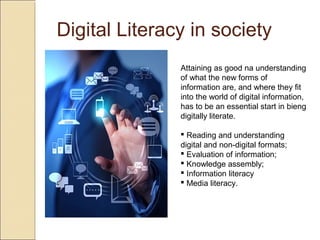
Digital Literacy in society
Attaining as good na understanding
of what the new forms of
information are, and where they fit
into the world of digital information,
has to be an essential start in bieng
digitally literate.
 Reading and understanding
digital and non-digital formats;
 Evaluation of information;
 Knowledge assembly;
 Information literacy
 Media literacy.
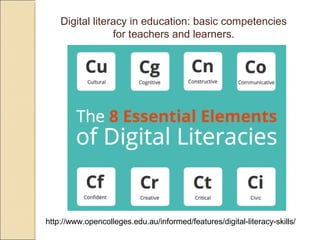
Digital literacy in education: basic competencies
for teachers and learners.
http://www.opencolleges.edu.au/informed/features/digital-literacy-skills/
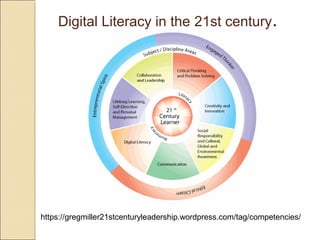
Digital Literacy in the 21st century.
https://gregmiller21stcenturyleadership.wordpress.com/tag/competencies/
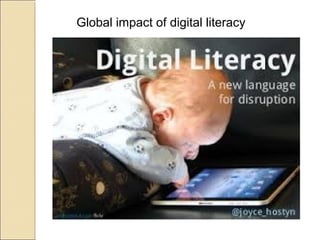
Global impact of digital literacy
Thinking about new technologies as
"opportunities to improve the world" is
necessarily thinking about education.
According to Mark Warschauer (2003),
deterministic discourses related to technology
assume that their development is in ways that
are beyond cultural or political control, and,
therefore, that technology is capable of
exercising, autonomously, Inherent in their
own technical nature, effects on the social
world.
Conclusion
The most adequate notion of the society-
technology relationship, especially in
relation to education, must take as
presupposition that technology, like
language, both shapes and organizes
relationships (such as those between
teachers, authors and students) as the
same time, shaped and organized by
these same forces (when students,
authors and teachers, through their uses
modify the language).
Bibliografy
Cordes S (2009) Broad Horizons: The Role of Multimodal Literacy in 21st Century
Library Instruction. Available (consulted April 03) at:
<http://www.ifla.org/files/hq/papers/ifla75/94-cordes-en.pdf
Educational Leadership in the 21st Century. (Consulted April 03)
https://gregmiller21stcenturyleadership.wordpress.com/tag/competencies
Martin A (2006) Literacies for the digital age. In: Martin A and Madigan D (eds) Digital
Literacies for Learning. London: Facet, 3–25.
Warschauer, M. (2003), Technology and Social Inclusion: Rethinking the Digital
Divide. MIT Press
20 Things Educators Need To Know About Digital Literacy Skills
(consulted april 03)
<http://www.opencolleges.edu.au/informed/features/digital-literacy-skills

CALL -Computer-assisted Language Larning

  • 1.
    by Edilson R.Rocha Digital LiteracyDigital Literacy
  • 2.
    Literacy and literaciesLiteracyand literacies The concept of literacy includes visual, electronic, and digital forms of expression and communication. Modern literacy has broadened in scope, as it is tied to technology and culture, and the ability to become and remain literate requires a long term commitment (Cordes, 2009).
  • 3.
    There are manyliteracies that can be identified within varying social contexts and under varying social conditions • Information literacy; • Computer literacy; • Library literacy; • Media literacy; • Network literacy; • Digital literacy;
  • 4.
    Digital LiteracyDigital Literacy DigitalLiteracy is the awareness, attitude and ability of individuals to appropriately use digital tools and facilities to identify, access, manage, integrate, evaluate, analyse and synthesize digital resources, construct new knowledge, create media expressions, and communicate with others, in the context of specific life situations, in order to enable constructive social action; and to reflect upon this process. (Martin, 2006)
  • 5.
    Digital Literacy insociety Attaining as good na understanding of what the new forms of information are, and where they fit into the world of digital information, has to be an essential start in bieng digitally literate.  Reading and understanding digital and non-digital formats;  Evaluation of information;  Knowledge assembly;  Information literacy  Media literacy.
  • 6.
    Digital literacy ineducation: basic competencies for teachers and learners. http://www.opencolleges.edu.au/informed/features/digital-literacy-skills/
  • 7.
    Digital Literacy inthe 21st century. https://gregmiller21stcenturyleadership.wordpress.com/tag/competencies/
  • 8.
    Global impact ofdigital literacy
  • 9.
    Thinking about newtechnologies as "opportunities to improve the world" is necessarily thinking about education. According to Mark Warschauer (2003), deterministic discourses related to technology assume that their development is in ways that are beyond cultural or political control, and, therefore, that technology is capable of exercising, autonomously, Inherent in their own technical nature, effects on the social world.
  • 10.
    Conclusion The most adequatenotion of the society- technology relationship, especially in relation to education, must take as presupposition that technology, like language, both shapes and organizes relationships (such as those between teachers, authors and students) as the same time, shaped and organized by these same forces (when students, authors and teachers, through their uses modify the language).
  • 11.
    Bibliografy Cordes S (2009)Broad Horizons: The Role of Multimodal Literacy in 21st Century Library Instruction. Available (consulted April 03) at: <http://www.ifla.org/files/hq/papers/ifla75/94-cordes-en.pdf Educational Leadership in the 21st Century. (Consulted April 03) https://gregmiller21stcenturyleadership.wordpress.com/tag/competencies Martin A (2006) Literacies for the digital age. In: Martin A and Madigan D (eds) Digital Literacies for Learning. London: Facet, 3–25. Warschauer, M. (2003), Technology and Social Inclusion: Rethinking the Digital Divide. MIT Press 20 Things Educators Need To Know About Digital Literacy Skills (consulted april 03) <http://www.opencolleges.edu.au/informed/features/digital-literacy-skills