


SEO TIPS & TUTORIAL
100% Result Oriented
vishalsharma00770@gmail.comDigital Marketing Specialist Vishal Sharma
AGENDA
1. What is a Search Engine?
2. Examples of popular Search Engines
3. How Do Search Engines Work?
4. Search Engines statistics
5. Why is Search Engine marketing important?
6. What is SEO
7. Industry Research
8. White hat versus black hat
9. What is a SEO Algorithm?
10. SEO Process
11. Technical aspects of SEO
12. Steps to developing a good SEO strategy
13. Ranking factors
14. Social Media
15. PPC vs. Organic
16. Basic tips for optimization
17. Measuring SEO success
18. SEO Tools
Digital Marketing Specialist vishalsharma00770@gmail.com Vishal Sharma
What is a Search Engine?
• Definition: A program that searches for and identifies items in a
database that correspond to keywords or characters specified by the
user, used especially for finding particular sites on the World Wide
Web.
• Different than a Directory
• Common Characteristics:
• Spider, Indexer, Database, Algorithm
• Find matching documents and display them according to relevance
• Frequent updates to documents searched and ranking algorithm
• Strive to produce “better”, more relevant results than competitors
Digital Marketing Specialist vishalsharma00770@gmail.com Vishal Sharma
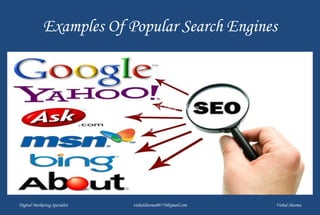
Examples Of Popular Search Engines
Digital Marketing Specialist vishalsharma00770@gmail.com Vishal Sharma
vishalsharma00770@gmail.com
How Do Search Engines Work?
• Spider “crawls” the web to find new documents (web pages, other
documents) typically by following hyperlinks from websites already in their
database.
• Search engines indexes the content (text, code) in these documents by
adding it to their databases and then periodically updates this content.
• Search engines search their own databases when a user enters in a search
to find related documents (not searching web pages in real-time).
• Search engines rank the resulting documents using an algorithm
(mathematical formula) by assigning various weights and ranking factors.
Digital Marketing Specialist vishalsharma00770@gmail.com Vishal Sharma
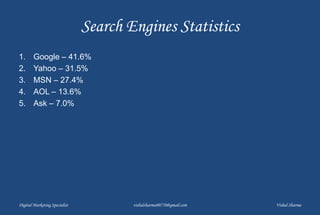
Search Engines Statistics
1. Google – 41.6%
2. Yahoo – 31.5%
3. MSN – 27.4%
4. AOL – 13.6%
5. Ask – 7.0%
Digital Marketing Specialist vishalsharma00770@gmail.com Vishal Sharma
Why Is Search Engine Marketing Important?
• 85% of all traffic on the internet is referred to by
search engines
• 90% of all users don’t look past the first 30 results
(most only view top 10)
• Search engine traffic is low and websites aren’t
indexed because they are generally poorly optimized
• Cost-effective advertising
• Clear and measurable ROI
• Operates under this assumption:
Note:- More (relevant) traffic + Good Conversions Rate = More
Sales/Leads
Digital Marketing Specialist vishalsharma00770@gmail.com Vishal Sharma
What is SEO (Search Engine Optimization)?
Digital Marketing Specialist vishalsharma00770@gmail.com Vishal Sharma
What is SEO (Search Engine Optimization)?
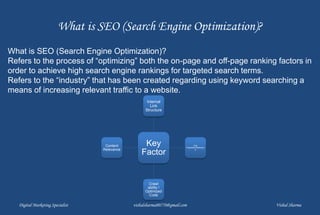
Refers to the process of “optimizing” both the on-page and off-page ranking factors in
order to achieve high search engine rankings for targeted search terms.
Refers to the “industry” that has been created regarding using keyword searching a
means of increasing relevant traffic to a website.
Key
Factor
Internal
Link
Structure
Link
Popularity/Relevanc
e
Crawl
ability /
Optimized
Code
Content
Relevance
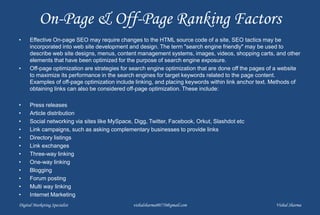
On-Page & Off-Page Ranking Factors
• Effective On-page SEO may require changes to the HTML source code of a site, SEO tactics may be
incorporated into web site development and design. The term "search engine friendly" may be used to
describe web site designs, menus, content management systems, images, videos, shopping carts, and other
elements that have been optimized for the purpose of search engine exposure.
• Off-page optimization are strategies for search engine optimization that are done off the pages of a website
to maximize its performance in the search engines for target keywords related to the page content.
Examples of off-page optimization include linking, and placing keywords within link anchor text. Methods of
obtaining links can also be considered off-page optimization. These include:
• Press releases
• Article distribution
• Social networking via sites like MySpace, Digg, Twitter, Facebook, Orkut, Slashdot etc
• Link campaigns, such as asking complementary businesses to provide links
• Directory listings
• Link exchanges
• Three-way linking
• One-way linking
• Blogging
• Forum posting
• Multi way linking
• Internet Marketing
Digital Marketing Specialist vishalsharma00770@gmail.com Vishal Sharma
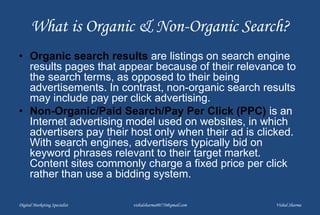
What is Organic & Non-Organic Search?
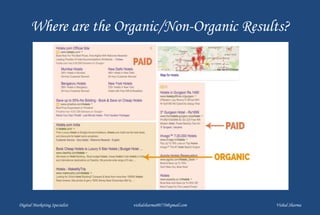
• Organic search results are listings on search engine
results pages that appear because of their relevance to
the search terms, as opposed to their being
advertisements. In contrast, non-organic search results
may include pay per click advertising.
• Non-Organic/Paid Search/Pay Per Click (PPC) is an
Internet advertising model used on websites, in which
advertisers pay their host only when their ad is clicked.
With search engines, advertisers typically bid on
keyword phrases relevant to their target market.
Content sites commonly charge a fixed price per click
rather than use a bidding system.
Digital Marketing Specialist vishalsharma00770@gmail.com Vishal Sharma
Where are the Organic/Non-Organic Results?
Digital Marketing Specialist vishalsharma00770@gmail.com Vishal Sharma
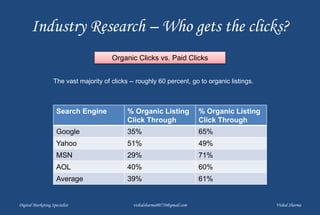
Industry Research – Who gets the clicks?
The vast majority of clicks -- roughly 60 percent, go to organic listings.
Digital Marketing Specialist vishalsharma00770@gmail.com Vishal Sharma
Organic Clicks vs. Paid Clicks
Search Engine % Organic Listing
Click Through
% Organic Listing
Click Through
Google 35% 65%
Yahoo 51% 49%
MSN 29% 71%
AOL 40% 60%
Average 39% 61%
Industry Research: Organic SEO is the most
popular form of SEM
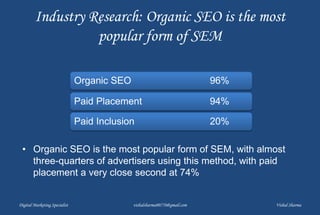
• Organic SEO is the most popular form of SEM, with almost
three-quarters of advertisers using this method, with paid
placement a very close second at 74%
Digital Marketing Specialist vishalsharma00770@gmail.com Vishal Sharma
Organic SEO 96%
Paid Placement 94%
Paid Inclusion 20%
Industry Research & The case for SEO
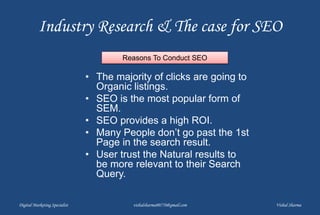
• The majority of clicks are going to
Organic listings.
• SEO is the most popular form of
SEM.
• SEO provides a high ROI.
• Many People don’t go past the 1st
Page in the search result.
• User trust the Natural results to
be more relevant to their Search
Query.
Digital Marketing Specialist vishalsharma00770@gmail.com Vishal Sharma
Reasons To Conduct SEO
White Hat Versus Black Hat
• A SEO tactic, technique or method is considered white had if it conforms to
the search engines’ guidelines and involves no deception. White hat advice
is generally summed up as creating content for users not for search
engines, and then making that content easily accessible to the spiders,
rather than attempting to game the algorithm. White hat SEO is in many
ways similar to web development that promotes accessibility, although the
two are not identical.
• Black Hat SEO attempts to improve rankings in ways that are disapproved
of by the search engines, or involve deception. One Black Hat technique
uses text that is hidden, either as text colored similar to the background on
whether the page is being requested by a human visitor or a search engine,
a technique known as cloaking. Search engines may penalize sites they
discover using black hat methods, either by reducing their rankings or
eliminating their listings from their databases altogether. Such penalties can
be applied either automatically by the search engine’ algorithms, or by a
manual site review.
Digital Marketing Specialist vishalsharma00770@gmail.com Vishal Sharma
What is a SEO Algorithm?
• Top Secret! Only select employees of a search engines
company know for certain
• Reverse engineering, research and experiments gives
SEOs (search engine optimization professionals) a
“pretty good” idea of the major factors and approximate
weight assignments.
• The SEO algorithm is constantly changed, tweaked &
updated.
• Websites and documents being searched are also
constantly changing.
• Varies by Search Engine – some give more weight to
on-page factors, some to link popularity.
Digital Marketing Specialist vishalsharma00770@gmail.com Vishal Sharma
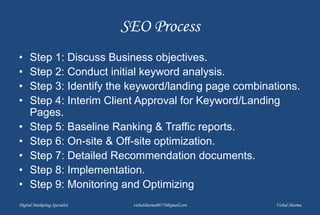
SEO Process
• Step 1: Discuss Business objectives.
• Step 2: Conduct initial keyword analysis.
• Step 3: Identify the keyword/landing page combinations.
• Step 4: Interim Client Approval for Keyword/Landing
Pages.
• Step 5: Baseline Ranking & Traffic reports.
• Step 6: On-site & Off-site optimization.
• Step 7: Detailed Recommendation documents.
• Step 8: Implementation.
• Step 9: Monitoring and Optimizing
Digital Marketing Specialist vishalsharma00770@gmail.com Vishal Sharma
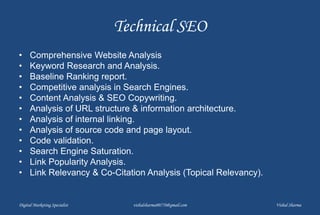
Technical SEO
• Comprehensive Website Analysis
• Keyword Research and Analysis.
• Baseline Ranking report.
• Competitive analysis in Search Engines.
• Content Analysis & SEO Copywriting.
• Analysis of URL structure & information architecture.
• Analysis of internal linking.
• Analysis of source code and page layout.
• Code validation.
• Search Engine Saturation.
• Link Popularity Analysis.
• Link Relevancy & Co-Citation Analysis (Topical Relevancy).
Digital Marketing Specialist vishalsharma00770@gmail.com Vishal Sharma
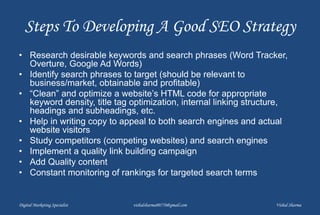
Steps To Developing A Good SEO Strategy
• Research desirable keywords and search phrases (Word Tracker,
Overture, Google Ad Words)
• Identify search phrases to target (should be relevant to
business/market, obtainable and profitable)
• “Clean” and optimize a website’s HTML code for appropriate
keyword density, title tag optimization, internal linking structure,
headings and subheadings, etc.
• Help in writing copy to appeal to both search engines and actual
website visitors
• Study competitors (competing websites) and search engines
• Implement a quality link building campaign
• Add Quality content
• Constant monitoring of rankings for targeted search terms
Digital Marketing Specialist vishalsharma00770@gmail.com Vishal Sharma
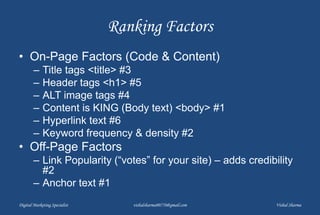
Ranking Factors
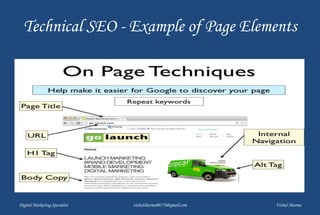
• On-Page Factors (Code & Content)
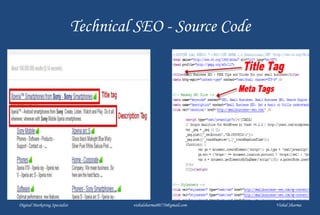
– Title tags <title> #3
– Header tags <h1> #5
– ALT image tags #4
– Content is KING (Body text) <body> #1
– Hyperlink text #6
– Keyword frequency & density #2
• Off-Page Factors
– Link Popularity (“votes” for your site) – adds credibility
#2
– Anchor text #1
Digital Marketing Specialist vishalsharma00770@gmail.com Vishal Sharma
Technical SEO - Example of Page Elements
Digital Marketing Specialist vishalsharma00770@gmail.com Vishal Sharma
Technical SEO - Source Code
Digital Marketing Specialist vishalsharma00770@gmail.com Vishal Sharma
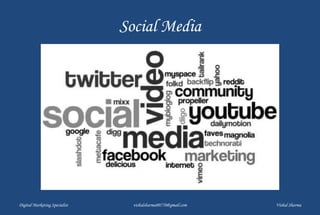
Social Media
Digital Marketing Specialist vishalsharma00770@gmail.com Vishal Sharma
Social Media Marketing and Optimization
• Getting more targeted friends (sort by
demographic criteria).
• Leaving “friends” comments.
• Profile Customization.
• Sending Bulletins.
• Sending mass private messages (with banner ad).
• Writing keyword-rich content with outbound links
containing keyword-rich anchor text.
• Getting inbound links from websites not on the
MySpace domain.
Digital Marketing Specialist vishalsharma00770@gmail.com Vishal Sharma
Pay Per Click
• PPC ads appear as “sponsored listings”.
• Companies bid on price they are willing to pay “per click”.
• Typically have very good tracking tools and statistics.
• Ability to control ad text.
• Can set budgets and spending limits.
• Google Ad Words, Bing and Overture are the Three
leaders.
Digital Marketing Specialist vishalsharma00770@gmail.com Vishal Sharma
Basic Tips & Optimization Techniques
• Research keywords related to your business
• Identify competitors, utilize benchmarking techniques and
identify level of competition
• Utilize descriptive title tags for each page
• Ensure that your text is HTML-text and not image text
• Use text links when ever possible
• Use appropriate keywords in your content and internal
hyperlinks (don’t overdo!)
• Obtain inbound links from related websites
• Monitor your search engine rankings and more importantly
your website traffic statistics and sales/leads produced
• Educate yourself about search engine marketing
Digital Marketing Specialist vishalsharma00770@gmail.com Vishal Sharma
Measuring SEO Success
• Keyword Ranking.
• Website Traffic.
• Increase in "Share of Traffic" per keyword.
• Increased Revenue/keyword.
• Increase in Impressions ( good for Publishers
to show advertisers).
• Lower dependence on Paid Search.
• Lowering the cost per acquisition.
Digital Marketing Specialist vishalsharma00770@gmail.com Vishal Sharma
SEO Tools
• Ubersuggest
• Scoop.it
• Moz Pro
• WooRank
• Optimizely
• PiktoChart
Digital Marketing Specialist vishalsharma00770@gmail.com Vishal Sharma
QUESTIONS
Free to mail me :- vishalsharma00770@gmail.com
Digital Marketing Specialist Vishal Sharma
Please Follow
Please take a moment to share to your delightful comments,
insightful suggestions, and valuable examples via the comment
form below.
Digital Marketing Specialist vishalsharma00770@gmail.com Vishal Sharma
If you really like the slide then please share it. And follow for my
new slide shares.
And
Digital Marketing Specialist vishalsharma00770@gmail.com Vishal Sharma

SeoTutorial For Beginners

  • 1.
    SEO TIPS &TUTORIAL 100% Result Oriented vishalsharma00770@gmail.comDigital Marketing Specialist Vishal Sharma
  • 2.
    AGENDA 1. What isa Search Engine? 2. Examples of popular Search Engines 3. How Do Search Engines Work? 4. Search Engines statistics 5. Why is Search Engine marketing important? 6. What is SEO 7. Industry Research 8. White hat versus black hat 9. What is a SEO Algorithm? 10. SEO Process 11. Technical aspects of SEO 12. Steps to developing a good SEO strategy 13. Ranking factors 14. Social Media 15. PPC vs. Organic 16. Basic tips for optimization 17. Measuring SEO success 18. SEO Tools Digital Marketing Specialist vishalsharma00770@gmail.com Vishal Sharma
  • 3.
    What is aSearch Engine? • Definition: A program that searches for and identifies items in a database that correspond to keywords or characters specified by the user, used especially for finding particular sites on the World Wide Web. • Different than a Directory • Common Characteristics: • Spider, Indexer, Database, Algorithm • Find matching documents and display them according to relevance • Frequent updates to documents searched and ranking algorithm • Strive to produce “better”, more relevant results than competitors Digital Marketing Specialist vishalsharma00770@gmail.com Vishal Sharma
  • 4.
    Examples Of PopularSearch Engines Digital Marketing Specialist vishalsharma00770@gmail.com Vishal Sharma vishalsharma00770@gmail.com
  • 5.
    How Do SearchEngines Work? • Spider “crawls” the web to find new documents (web pages, other documents) typically by following hyperlinks from websites already in their database. • Search engines indexes the content (text, code) in these documents by adding it to their databases and then periodically updates this content. • Search engines search their own databases when a user enters in a search to find related documents (not searching web pages in real-time). • Search engines rank the resulting documents using an algorithm (mathematical formula) by assigning various weights and ranking factors. Digital Marketing Specialist vishalsharma00770@gmail.com Vishal Sharma
  • 6.
    Search Engines Statistics 1.Google – 41.6% 2. Yahoo – 31.5% 3. MSN – 27.4% 4. AOL – 13.6% 5. Ask – 7.0% Digital Marketing Specialist vishalsharma00770@gmail.com Vishal Sharma
  • 7.
    Why Is SearchEngine Marketing Important? • 85% of all traffic on the internet is referred to by search engines • 90% of all users don’t look past the first 30 results (most only view top 10) • Search engine traffic is low and websites aren’t indexed because they are generally poorly optimized • Cost-effective advertising • Clear and measurable ROI • Operates under this assumption: Note:- More (relevant) traffic + Good Conversions Rate = More Sales/Leads Digital Marketing Specialist vishalsharma00770@gmail.com Vishal Sharma
  • 8.
    What is SEO(Search Engine Optimization)? Digital Marketing Specialist vishalsharma00770@gmail.com Vishal Sharma What is SEO (Search Engine Optimization)? Refers to the process of “optimizing” both the on-page and off-page ranking factors in order to achieve high search engine rankings for targeted search terms. Refers to the “industry” that has been created regarding using keyword searching a means of increasing relevant traffic to a website. Key Factor Internal Link Structure Link Popularity/Relevanc e Crawl ability / Optimized Code Content Relevance
  • 9.
    On-Page & Off-PageRanking Factors • Effective On-page SEO may require changes to the HTML source code of a site, SEO tactics may be incorporated into web site development and design. The term "search engine friendly" may be used to describe web site designs, menus, content management systems, images, videos, shopping carts, and other elements that have been optimized for the purpose of search engine exposure. • Off-page optimization are strategies for search engine optimization that are done off the pages of a website to maximize its performance in the search engines for target keywords related to the page content. Examples of off-page optimization include linking, and placing keywords within link anchor text. Methods of obtaining links can also be considered off-page optimization. These include: • Press releases • Article distribution • Social networking via sites like MySpace, Digg, Twitter, Facebook, Orkut, Slashdot etc • Link campaigns, such as asking complementary businesses to provide links • Directory listings • Link exchanges • Three-way linking • One-way linking • Blogging • Forum posting • Multi way linking • Internet Marketing Digital Marketing Specialist vishalsharma00770@gmail.com Vishal Sharma
  • 10.
    What is Organic& Non-Organic Search? • Organic search results are listings on search engine results pages that appear because of their relevance to the search terms, as opposed to their being advertisements. In contrast, non-organic search results may include pay per click advertising. • Non-Organic/Paid Search/Pay Per Click (PPC) is an Internet advertising model used on websites, in which advertisers pay their host only when their ad is clicked. With search engines, advertisers typically bid on keyword phrases relevant to their target market. Content sites commonly charge a fixed price per click rather than use a bidding system. Digital Marketing Specialist vishalsharma00770@gmail.com Vishal Sharma
  • 11.
    Where are theOrganic/Non-Organic Results? Digital Marketing Specialist vishalsharma00770@gmail.com Vishal Sharma
  • 12.
    Industry Research –Who gets the clicks? The vast majority of clicks -- roughly 60 percent, go to organic listings. Digital Marketing Specialist vishalsharma00770@gmail.com Vishal Sharma Organic Clicks vs. Paid Clicks Search Engine % Organic Listing Click Through % Organic Listing Click Through Google 35% 65% Yahoo 51% 49% MSN 29% 71% AOL 40% 60% Average 39% 61%
  • 13.
    Industry Research: OrganicSEO is the most popular form of SEM • Organic SEO is the most popular form of SEM, with almost three-quarters of advertisers using this method, with paid placement a very close second at 74% Digital Marketing Specialist vishalsharma00770@gmail.com Vishal Sharma Organic SEO 96% Paid Placement 94% Paid Inclusion 20%
  • 14.
    Industry Research &The case for SEO • The majority of clicks are going to Organic listings. • SEO is the most popular form of SEM. • SEO provides a high ROI. • Many People don’t go past the 1st Page in the search result. • User trust the Natural results to be more relevant to their Search Query. Digital Marketing Specialist vishalsharma00770@gmail.com Vishal Sharma Reasons To Conduct SEO
  • 15.
    White Hat VersusBlack Hat • A SEO tactic, technique or method is considered white had if it conforms to the search engines’ guidelines and involves no deception. White hat advice is generally summed up as creating content for users not for search engines, and then making that content easily accessible to the spiders, rather than attempting to game the algorithm. White hat SEO is in many ways similar to web development that promotes accessibility, although the two are not identical. • Black Hat SEO attempts to improve rankings in ways that are disapproved of by the search engines, or involve deception. One Black Hat technique uses text that is hidden, either as text colored similar to the background on whether the page is being requested by a human visitor or a search engine, a technique known as cloaking. Search engines may penalize sites they discover using black hat methods, either by reducing their rankings or eliminating their listings from their databases altogether. Such penalties can be applied either automatically by the search engine’ algorithms, or by a manual site review. Digital Marketing Specialist vishalsharma00770@gmail.com Vishal Sharma
  • 16.
    What is aSEO Algorithm? • Top Secret! Only select employees of a search engines company know for certain • Reverse engineering, research and experiments gives SEOs (search engine optimization professionals) a “pretty good” idea of the major factors and approximate weight assignments. • The SEO algorithm is constantly changed, tweaked & updated. • Websites and documents being searched are also constantly changing. • Varies by Search Engine – some give more weight to on-page factors, some to link popularity. Digital Marketing Specialist vishalsharma00770@gmail.com Vishal Sharma
  • 17.
    SEO Process • Step1: Discuss Business objectives. • Step 2: Conduct initial keyword analysis. • Step 3: Identify the keyword/landing page combinations. • Step 4: Interim Client Approval for Keyword/Landing Pages. • Step 5: Baseline Ranking & Traffic reports. • Step 6: On-site & Off-site optimization. • Step 7: Detailed Recommendation documents. • Step 8: Implementation. • Step 9: Monitoring and Optimizing Digital Marketing Specialist vishalsharma00770@gmail.com Vishal Sharma
  • 18.
    Technical SEO • ComprehensiveWebsite Analysis • Keyword Research and Analysis. • Baseline Ranking report. • Competitive analysis in Search Engines. • Content Analysis & SEO Copywriting. • Analysis of URL structure & information architecture. • Analysis of internal linking. • Analysis of source code and page layout. • Code validation. • Search Engine Saturation. • Link Popularity Analysis. • Link Relevancy & Co-Citation Analysis (Topical Relevancy). Digital Marketing Specialist vishalsharma00770@gmail.com Vishal Sharma
  • 19.
    Steps To DevelopingA Good SEO Strategy • Research desirable keywords and search phrases (Word Tracker, Overture, Google Ad Words) • Identify search phrases to target (should be relevant to business/market, obtainable and profitable) • “Clean” and optimize a website’s HTML code for appropriate keyword density, title tag optimization, internal linking structure, headings and subheadings, etc. • Help in writing copy to appeal to both search engines and actual website visitors • Study competitors (competing websites) and search engines • Implement a quality link building campaign • Add Quality content • Constant monitoring of rankings for targeted search terms Digital Marketing Specialist vishalsharma00770@gmail.com Vishal Sharma
  • 20.
    Ranking Factors • On-PageFactors (Code & Content) – Title tags <title> #3 – Header tags <h1> #5 – ALT image tags #4 – Content is KING (Body text) <body> #1 – Hyperlink text #6 – Keyword frequency & density #2 • Off-Page Factors – Link Popularity (“votes” for your site) – adds credibility #2 – Anchor text #1 Digital Marketing Specialist vishalsharma00770@gmail.com Vishal Sharma
  • 21.
    Technical SEO -Example of Page Elements Digital Marketing Specialist vishalsharma00770@gmail.com Vishal Sharma
  • 22.
    Technical SEO -Source Code Digital Marketing Specialist vishalsharma00770@gmail.com Vishal Sharma
  • 23.
    Social Media Digital MarketingSpecialist vishalsharma00770@gmail.com Vishal Sharma
  • 24.
    Social Media Marketingand Optimization • Getting more targeted friends (sort by demographic criteria). • Leaving “friends” comments. • Profile Customization. • Sending Bulletins. • Sending mass private messages (with banner ad). • Writing keyword-rich content with outbound links containing keyword-rich anchor text. • Getting inbound links from websites not on the MySpace domain. Digital Marketing Specialist vishalsharma00770@gmail.com Vishal Sharma
  • 25.
    Pay Per Click •PPC ads appear as “sponsored listings”. • Companies bid on price they are willing to pay “per click”. • Typically have very good tracking tools and statistics. • Ability to control ad text. • Can set budgets and spending limits. • Google Ad Words, Bing and Overture are the Three leaders. Digital Marketing Specialist vishalsharma00770@gmail.com Vishal Sharma
  • 26.
    Basic Tips &Optimization Techniques • Research keywords related to your business • Identify competitors, utilize benchmarking techniques and identify level of competition • Utilize descriptive title tags for each page • Ensure that your text is HTML-text and not image text • Use text links when ever possible • Use appropriate keywords in your content and internal hyperlinks (don’t overdo!) • Obtain inbound links from related websites • Monitor your search engine rankings and more importantly your website traffic statistics and sales/leads produced • Educate yourself about search engine marketing Digital Marketing Specialist vishalsharma00770@gmail.com Vishal Sharma
  • 27.
    Measuring SEO Success •Keyword Ranking. • Website Traffic. • Increase in "Share of Traffic" per keyword. • Increased Revenue/keyword. • Increase in Impressions ( good for Publishers to show advertisers). • Lower dependence on Paid Search. • Lowering the cost per acquisition. Digital Marketing Specialist vishalsharma00770@gmail.com Vishal Sharma
  • 28.
    SEO Tools • Ubersuggest •Scoop.it • Moz Pro • WooRank • Optimizely • PiktoChart Digital Marketing Specialist vishalsharma00770@gmail.com Vishal Sharma
  • 29.
    QUESTIONS Free to mailme :- vishalsharma00770@gmail.com Digital Marketing Specialist Vishal Sharma
  • 30.
    Please Follow Please takea moment to share to your delightful comments, insightful suggestions, and valuable examples via the comment form below. Digital Marketing Specialist vishalsharma00770@gmail.com Vishal Sharma If you really like the slide then please share it. And follow for my new slide shares. And
  • 31.
    Digital Marketing Specialistvishalsharma00770@gmail.com Vishal Sharma