
By
Rajeev Ranjan
Index…..












Search Engine
How search Engine Works
Page Ranking
SEO definition
Why SEO?
Types of SEO
SEO Factors
On-Page optimization
Off-Page optimization
On-page vs Off-page optimization
Tools for SEO
Search engine….
 An internet-based tool that searches an index of documents for a

particular term, phrase or text specified by the user. Commonly
used to refer to large web-based search engines that search
through billions of pages on the internet.
 Common Characteristics:
 Spider, Indexer, Database, Algorithm
 Find matching documents and display them according to
relevance
 Frequent updates to documents searched and ranking
algorithm
 Strive to produce “better”, more relevant results than
competitors
Popular search engines..
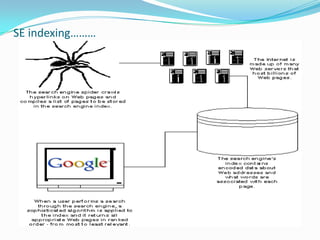
SE indexing………
How Do Search Engines Work?
 Spider “crawls” the web to find new documents (web pages, other

documents) typically by following hyperlinks from websites already in
their database

 Search engines indexes the content (text, code) in these documents by

adding it to their databases and then periodically updates this content

 Search engines search their own databases when a user enters in a

search to find related documents (not searching web pages in realtime)

 Search engines rank the resulting documents using an algorithm

(mathematical formula) by assigning various weights and ranking
factors
Page Ranking……
 It is the way Google measures how popular a given page is based
on the number and quality of sites that link to it.
 Page Rank was developed by Google founders Larry Page and

Sergey Brin at Stanford. Page Rank is patented by Stanford, and
the name Page Rank likely comes from Larry Page.
 Page Rank is measured on a scale of one to ten and assigned to

individual pages within a website, not the entire website.
What is SEO??????
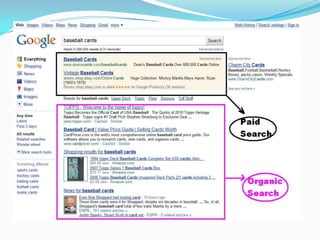
 Search engine optimization (SEO) is the process of

affecting the visibility of a website or a web page in a search
engine's "natural" or un-paid ("organic") search results.
Why SEO…..
 85% of all traffic on the internet is referred to by search

engines

 90% of all users don’t look past the first 30 results (most

only view top 10)

 Search engine traffic is low and websites aren’t indexed

because they are generally poorly optimized

 Cost-effective advertising
Why SEO??
It gives companies the ability to:
 Drive high quality customers to their website
 Increase sales leads from customers looking for their

products and services
 Build their brand online by communicating marketing
messages to their target audience
 Increase their profile against their competitors
 Target a global audience via international search engines
Types of SEO
 White hat technique : Those websites which are optimized in

accordance to rules and policies of search engines are said to be
using White-Hat-Techniques or Ethical SEO.

 Black hat Technique : These are the unofficial methods,
which search engines strictly disapprove of. Once found guilty of
Black Hat, the website may be blocked or severely penalized.

 Gray hat technique : Gray being a shade in between white

and black has properties of both colors. Gray Hat Techniques are
those ways through which websites are optimized using tactics
that don’t exactly follow the policies of search engines but
somehow manage to escape from the eyes of algorithms
SEO Factors….
 Website Structure
 Relevant and Fresh Copy/ Content
 Uniqueness of Content
 Links - internal, inbound, outbound
 Metatags
 Keywords
 Visual Extras
 Domains, URLs, Web Mastery
On-Page Optimization..
 In search engine optimization, on-page optimization

refers to factors that have an effect on Web site or Web
page listing in natural search results. These factors are
controlled by coding on page. Examples of on-page
optimization include actual HTML code, meta tags,
keyword placement and keyword density.
On-page technique…..











Always start with keyword selection, research and testing
Meta Description tag
ALT tags
H1 tags
URL structure
Internal linking strategy
Content
Keyword density
Track target keywords
Expect results in 6-12 months
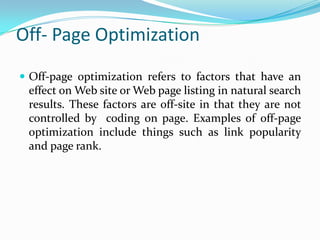
Off- Page Optimization
 Off-page optimization refers to factors that have an

effect on Web site or Web page listing in natural search
results. These factors are off-site in that they are not
controlled by coding on page. Examples of off-page
optimization include things such as link popularity
and page rank.
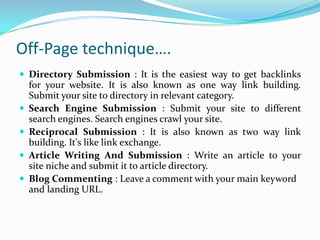
Off-Page technique….
 Directory Submission : It is the easiest way to get backlinks






for your website. It is also known as one way link building.
Submit your site to directory in relevant category.
Search Engine Submission : Submit your site to different
search engines. Search engines crawl your site.
Reciprocal Submission : It is also known as two way link
building. It's like link exchange.
Article Writing And Submission : Write an article to your
site niche and submit it to article directory.
Blog Commenting : Leave a comment with your main keyword
and landing URL.
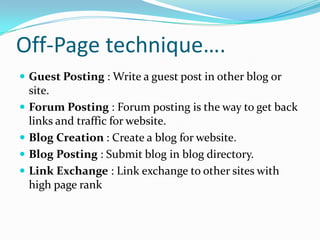
Off-Page technique….
 Guest Posting : Write a guest post in other blog or






site.
Forum Posting : Forum posting is the way to get back
links and traffic for website.
Blog Creation : Create a blog for website.
Blog Posting : Submit blog in blog directory.
Link Exchange : Link exchange to other sites with
high page rank
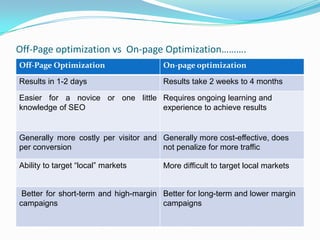
Off-Page optimization vs On-page Optimization……….
Off-Page Optimization

On-page optimization

Results in 1-2 days

Results take 2 weeks to 4 months

Easier for a novice or one little Requires ongoing learning and
knowledge of SEO
experience to achieve results

Generally more costly per visitor and Generally more cost-effective, does
per conversion
not penalize for more traffic
Ability to target “local” markets

More difficult to target local markets

Better for short-term and high-margin Better for long-term and lower margin
campaigns
campaigns
Tools for SEO’s…..
 There are various paid and free tools are available for

Search Engine optimizers.
 Free tools provided by Google to generate analytics
and keywords are Google Adwords,Google Analytics.
 There are various online tools are also available such as
alexa.com,www.compete.com,www.quantcast.com
and many more..
 Paid tools which are used by SEO’s are SEOmoz
Seo Presentation

Seo Presentation

  • 1.
  • 2.
    Index…..            Search Engine How searchEngine Works Page Ranking SEO definition Why SEO? Types of SEO SEO Factors On-Page optimization Off-Page optimization On-page vs Off-page optimization Tools for SEO
  • 3.
    Search engine….  Aninternet-based tool that searches an index of documents for a particular term, phrase or text specified by the user. Commonly used to refer to large web-based search engines that search through billions of pages on the internet.  Common Characteristics:  Spider, Indexer, Database, Algorithm  Find matching documents and display them according to relevance  Frequent updates to documents searched and ranking algorithm  Strive to produce “better”, more relevant results than competitors
  • 4.
  • 5.
  • 6.
    How Do SearchEngines Work?  Spider “crawls” the web to find new documents (web pages, other documents) typically by following hyperlinks from websites already in their database  Search engines indexes the content (text, code) in these documents by adding it to their databases and then periodically updates this content  Search engines search their own databases when a user enters in a search to find related documents (not searching web pages in realtime)  Search engines rank the resulting documents using an algorithm (mathematical formula) by assigning various weights and ranking factors
  • 7.
    Page Ranking……  Itis the way Google measures how popular a given page is based on the number and quality of sites that link to it.  Page Rank was developed by Google founders Larry Page and Sergey Brin at Stanford. Page Rank is patented by Stanford, and the name Page Rank likely comes from Larry Page.  Page Rank is measured on a scale of one to ten and assigned to individual pages within a website, not the entire website.
  • 9.
    What is SEO?????? Search engine optimization (SEO) is the process of affecting the visibility of a website or a web page in a search engine's "natural" or un-paid ("organic") search results.
  • 10.
    Why SEO…..  85%of all traffic on the internet is referred to by search engines  90% of all users don’t look past the first 30 results (most only view top 10)  Search engine traffic is low and websites aren’t indexed because they are generally poorly optimized  Cost-effective advertising
  • 11.
    Why SEO?? It givescompanies the ability to:  Drive high quality customers to their website  Increase sales leads from customers looking for their products and services  Build their brand online by communicating marketing messages to their target audience  Increase their profile against their competitors  Target a global audience via international search engines
  • 12.
    Types of SEO White hat technique : Those websites which are optimized in accordance to rules and policies of search engines are said to be using White-Hat-Techniques or Ethical SEO.  Black hat Technique : These are the unofficial methods, which search engines strictly disapprove of. Once found guilty of Black Hat, the website may be blocked or severely penalized.  Gray hat technique : Gray being a shade in between white and black has properties of both colors. Gray Hat Techniques are those ways through which websites are optimized using tactics that don’t exactly follow the policies of search engines but somehow manage to escape from the eyes of algorithms
  • 13.
    SEO Factors….  WebsiteStructure  Relevant and Fresh Copy/ Content  Uniqueness of Content  Links - internal, inbound, outbound  Metatags  Keywords  Visual Extras  Domains, URLs, Web Mastery
  • 14.
    On-Page Optimization..  Insearch engine optimization, on-page optimization refers to factors that have an effect on Web site or Web page listing in natural search results. These factors are controlled by coding on page. Examples of on-page optimization include actual HTML code, meta tags, keyword placement and keyword density.
  • 15.
    On-page technique…..           Always startwith keyword selection, research and testing Meta Description tag ALT tags H1 tags URL structure Internal linking strategy Content Keyword density Track target keywords Expect results in 6-12 months
  • 16.
    Off- Page Optimization Off-page optimization refers to factors that have an effect on Web site or Web page listing in natural search results. These factors are off-site in that they are not controlled by coding on page. Examples of off-page optimization include things such as link popularity and page rank.
  • 17.
    Off-Page technique….  DirectorySubmission : It is the easiest way to get backlinks     for your website. It is also known as one way link building. Submit your site to directory in relevant category. Search Engine Submission : Submit your site to different search engines. Search engines crawl your site. Reciprocal Submission : It is also known as two way link building. It's like link exchange. Article Writing And Submission : Write an article to your site niche and submit it to article directory. Blog Commenting : Leave a comment with your main keyword and landing URL.
  • 18.
    Off-Page technique….  GuestPosting : Write a guest post in other blog or     site. Forum Posting : Forum posting is the way to get back links and traffic for website. Blog Creation : Create a blog for website. Blog Posting : Submit blog in blog directory. Link Exchange : Link exchange to other sites with high page rank
  • 19.
    Off-Page optimization vsOn-page Optimization………. Off-Page Optimization On-page optimization Results in 1-2 days Results take 2 weeks to 4 months Easier for a novice or one little Requires ongoing learning and knowledge of SEO experience to achieve results Generally more costly per visitor and Generally more cost-effective, does per conversion not penalize for more traffic Ability to target “local” markets More difficult to target local markets Better for short-term and high-margin Better for long-term and lower margin campaigns campaigns
  • 20.
    Tools for SEO’s….. There are various paid and free tools are available for Search Engine optimizers.  Free tools provided by Google to generate analytics and keywords are Google Adwords,Google Analytics.  There are various online tools are also available such as alexa.com,www.compete.com,www.quantcast.com and many more..  Paid tools which are used by SEO’s are SEOmoz