
Search Engine Optimization


            Presented By:
            Syed Absar Karim (EP076268)
            Syed Adeel Mahmood (EP076269)
            Umair Ahmed (EP076283)
Introducing SEO


  Umair Ahmed
   (EP076268)
What is SEO?

   SEO is an abbreviation for search engine
    optimization.

   SEO is the process of improving the volume or
    quality of traffic to a web site from search engines
    via search results.

   SEO aims to improve rankings for relevant keywords
    in search results.
Why are search engines so important?

 Searchengines are the biggest resources of
 your websites traffic.

 Higher   traffic means more visitors.

 Morevisitors means more customers and
 higher profit.
How does a search engine works?

 Search engine employ intelligent program
 robots called crawlers or spider , which visits
 thousands of websites every hour and index
 the pages according to the content .

 These indexes are huge database containing
 reference and links to the actual websites.
 The search engines looks though this
 database and displays the results.
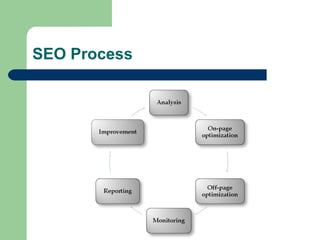
SEO Process
On-Page SEO
   On-page optimization (on-page SEO) is what can be done on
    the pages of a website to maximize its performance in the
    search engines for target keywords related to the on-page
    content.

   On-page optimization stands for all of the techniques and
    methods used on your website that is hosted on a server.

   On-page optimization has an effect on your website listing in
    natural results .

   On-page factors are controlled by coding on website pages
Off-Page SEO
   Off-page optimization (off-page SEO) is what can be
    done off the pages of a website to maximize its
    performance in search engines for target keywords
    related to the on-page content and keywords in
    off-page direct-links.

   Off-page optimization is the most important part in
    search engines optimization because it gives back
    links to your sites and it requires a lot of work on a
    daily bases.

   It helps to maximize website performance in search
    engine for target keywords
White hat versus black hat

 SEO  techniques can be classified into two
  broad categories:

1. Techniques that search engines recommend
  as part of good design,

2. Techniques of which search engines do not
  approve.
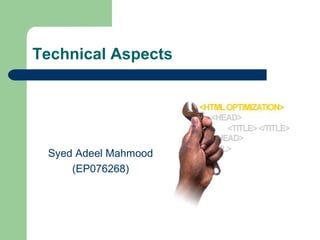
Technical Aspects


 Syed Adeel Mahmood
     (EP076268)
ON PAGE SEO ELEMENTS
 –   Title tags
 –   Meta tags
 –   ALT tags
 –   Header(H1,H2) tags
 –   URL structure
 –   Internal Linking
 –   Relevant keywords near your inbound link
 –   Content
 –   Keyword density
 –   Site maps
 –   Usability
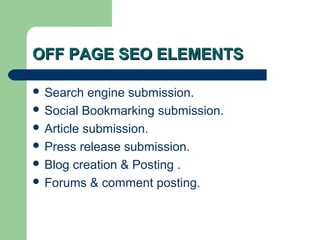
OFF PAGE SEO ELEMENTS

 Search   engine submission.
 Social Bookmarking submission.
 Article submission.
 Press release submission.
 Blog creation & Posting .
 Forums & comment posting.
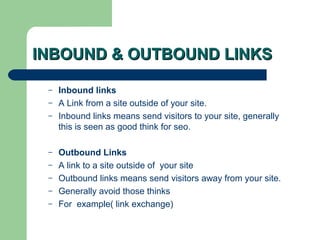
INBOUND & OUTBOUND LINKS

 –   Inbound links
 –   A Link from a site outside of your site.
 –   Inbound links means send visitors to your site, generally
     this is seen as good think for seo.

 –   Outbound Links
 –   A link to a site outside of your site
 –   Outbound links means send visitors away from your site.
 –   Generally avoid those thinks
 –   For example( link exchange)
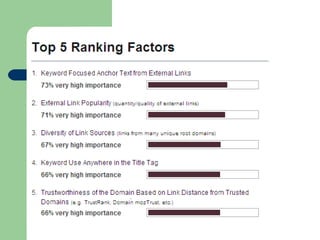
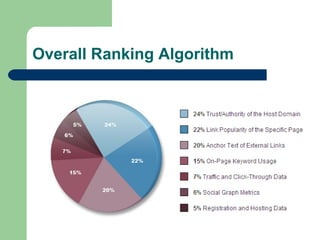
Overall Ranking Algorithm
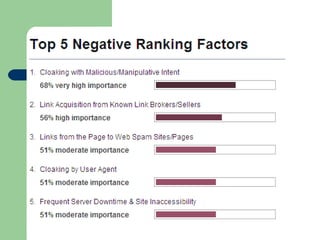
SEO Technique Ethics
   An SEO technique is considered white hat if it conforms to the
    search engines' guidelines and involves no deception. White
    hat advice is generally summed up as creating content for
    users, not for search engines, and then making that content
    easily accessible to the spiders, rather than attempting to trick
    the algorithm from its intended purpose.

   Black hat SEO attempts to improve rankings in ways that are
    disapproved of by the search engines, or involve deception.
    One black hat technique uses text that is hidden, either as text
    colored similar to the background, in an invisible div, or
    positioned off screen. Another method gives a different page
    depending on whether the page is being requested by a human
    visitor or a search engine, a technique known as cloaking.
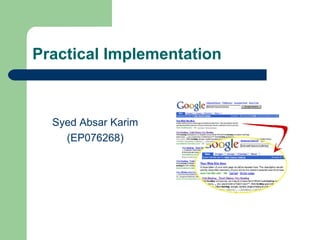
Practical Implementation


  Syed Absar Karim
    (EP076268)
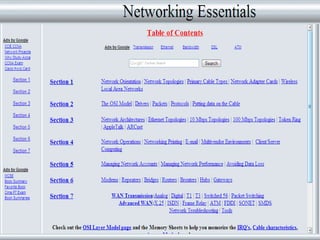
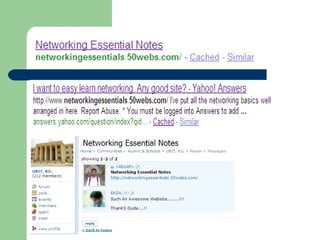
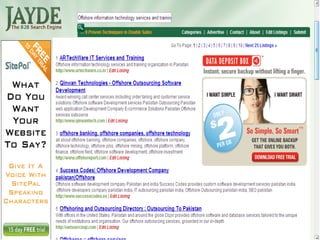
What is important for your online
success?

   Identify your target audience
   Discover your competitors
   Find out keywords, that your target audience use
   Build content, site structure and internal navigation
    with respect to SEO and important keywords
   Public outside your web
   Acquire external links to your website
   Monitor your traffic
   Evaluate results and do improvement
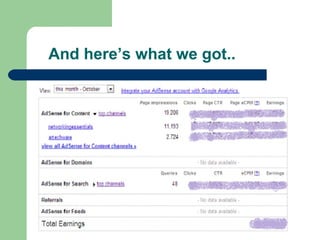
And here’s what we got..
Google Webmaster Tools
   See which parts of a site Googlebot had problems crawling.
   Upload an XML Sitemap file.
   Analyze and generate robots.txt files.
   Remove URLs already crawled by Googlebot.
   Specify the preferred domain.
   Identify issues with title and description meta tags.
   Understand the top searches used to reach a site.
   Get a glimpse at how Googlebot sees pages.
   Remove unwanted sitelinks that Google may use in results.
   Receive notification of quality guideline violations and file for a
    site reconsideration.
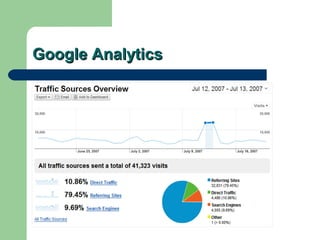
Google Analytics
References

   Search Engine Optimization Made Easy – By Brad
    Callen.

   Google's Search Engine Optimization Starter Guide.

   http://
    en.wikipedia.org/wiki/Search_engine_optimization

   The brains, that actually work. 
Thank You.


Queries/Comments?

Search Engine Optimization

  • 1.
    Search Engine Optimization Presented By: Syed Absar Karim (EP076268) Syed Adeel Mahmood (EP076269) Umair Ahmed (EP076283)
  • 2.
    Introducing SEO Umair Ahmed (EP076268)
  • 3.
    What is SEO?  SEO is an abbreviation for search engine optimization.  SEO is the process of improving the volume or quality of traffic to a web site from search engines via search results.  SEO aims to improve rankings for relevant keywords in search results.
  • 4.
    Why are searchengines so important?  Searchengines are the biggest resources of your websites traffic.  Higher traffic means more visitors.  Morevisitors means more customers and higher profit.
  • 5.
    How does asearch engine works?  Search engine employ intelligent program robots called crawlers or spider , which visits thousands of websites every hour and index the pages according to the content .  These indexes are huge database containing reference and links to the actual websites. The search engines looks though this database and displays the results.
  • 6.
  • 7.
    On-Page SEO  On-page optimization (on-page SEO) is what can be done on the pages of a website to maximize its performance in the search engines for target keywords related to the on-page content.  On-page optimization stands for all of the techniques and methods used on your website that is hosted on a server.  On-page optimization has an effect on your website listing in natural results .  On-page factors are controlled by coding on website pages
  • 8.
    Off-Page SEO  Off-page optimization (off-page SEO) is what can be done off the pages of a website to maximize its performance in search engines for target keywords related to the on-page content and keywords in off-page direct-links.  Off-page optimization is the most important part in search engines optimization because it gives back links to your sites and it requires a lot of work on a daily bases.  It helps to maximize website performance in search engine for target keywords
  • 9.
    White hat versusblack hat  SEO techniques can be classified into two broad categories: 1. Techniques that search engines recommend as part of good design, 2. Techniques of which search engines do not approve.
  • 10.
    Technical Aspects SyedAdeel Mahmood (EP076268)
  • 11.
    ON PAGE SEOELEMENTS – Title tags – Meta tags – ALT tags – Header(H1,H2) tags – URL structure – Internal Linking – Relevant keywords near your inbound link – Content – Keyword density – Site maps – Usability
  • 12.
    OFF PAGE SEOELEMENTS  Search engine submission.  Social Bookmarking submission.  Article submission.  Press release submission.  Blog creation & Posting .  Forums & comment posting.
  • 13.
    INBOUND & OUTBOUNDLINKS – Inbound links – A Link from a site outside of your site. – Inbound links means send visitors to your site, generally this is seen as good think for seo. – Outbound Links – A link to a site outside of your site – Outbound links means send visitors away from your site. – Generally avoid those thinks – For example( link exchange)
  • 16.
  • 17.
    SEO Technique Ethics  An SEO technique is considered white hat if it conforms to the search engines' guidelines and involves no deception. White hat advice is generally summed up as creating content for users, not for search engines, and then making that content easily accessible to the spiders, rather than attempting to trick the algorithm from its intended purpose.  Black hat SEO attempts to improve rankings in ways that are disapproved of by the search engines, or involve deception. One black hat technique uses text that is hidden, either as text colored similar to the background, in an invisible div, or positioned off screen. Another method gives a different page depending on whether the page is being requested by a human visitor or a search engine, a technique known as cloaking.
  • 18.
    Practical Implementation Syed Absar Karim (EP076268)
  • 19.
    What is importantfor your online success?  Identify your target audience  Discover your competitors  Find out keywords, that your target audience use  Build content, site structure and internal navigation with respect to SEO and important keywords  Public outside your web  Acquire external links to your website  Monitor your traffic  Evaluate results and do improvement
  • 24.
  • 25.
    Google Webmaster Tools  See which parts of a site Googlebot had problems crawling.  Upload an XML Sitemap file.  Analyze and generate robots.txt files.  Remove URLs already crawled by Googlebot.  Specify the preferred domain.  Identify issues with title and description meta tags.  Understand the top searches used to reach a site.  Get a glimpse at how Googlebot sees pages.  Remove unwanted sitelinks that Google may use in results.  Receive notification of quality guideline violations and file for a site reconsideration.
  • 26.
  • 27.
    References  Search Engine Optimization Made Easy – By Brad Callen.  Google's Search Engine Optimization Starter Guide.  http:// en.wikipedia.org/wiki/Search_engine_optimization  The brains, that actually work. 
  • 28.