BATRA COMPUTER CENTRE
Website: www.batracomputercentre.com Ph. No.: 9729666670, 0171-4000
Ever wonder how major search engines such as
Google, Bing and Yahoo rank your website within
their searches? Or how content such as videos or
local listings are shown and ranked based on what
the search engine considers most relevant to
users? Welcome to the world of Search Engine
Optimization (SEO). This course is the first within
the SEO Specialization and it is intended to give
you a taste of SEO. You will be introduced to the
foundational elements of how search engines
work, how the SEO landscape has changed and
what you can expect in the future. You discuss
core SEO strategies and tactics used to drive
more organic search results to a specific website
or set of websites, as well as tactics to avoid to
prevent penalization from search engines. You will
also discover how to position yourself for a
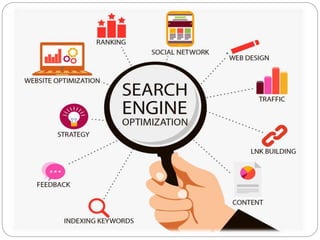
Whenever you enter a query in a search engine and hit 'enter'
you get a list of web results that contain that query term. Users
normally tend to visit websites that are at the top of this list as
they perceive those to be more relevant to the query. If you have
ever wondered why some of these websites rank better than the
others then you must know that it is because of a powerful web
marketing technique called Search Engine Optimization (SEO).
SEO is a technique which helps search engines find and rank
your site higher than the millions of other sites in response to a
search query. SEO thus helps you get traffic from search
engines.
Search engines have one objective – to provide you with the
most relevant
results possible in relation to your search query. If the search
engine is
successful in providing you with information that meets your
needs, then you are
a happy searcher. And happy searchers are more likely to come
back to the
same search engine time and time again because they are
getting the results
they need.
In order for a search engine to be able to display results when a
user types in a
query, they need to have an archive of available information to
choose from.
When indexing pages, the search engine bots
scan each page of your website, looking for
clues about what topics your
website covers and scanning your website's
back-end code for certain
tags, descriptions, and instructions.
As the search engine bots scan webpages for
indexing, they also look for links from other websites.
The more inbound
links a website has, the more influence or authority it
has. Essentially,
every inbound link counts as a vote for that website's
content. Also, each inbound link holds different weight.
For instance, a link from a highly
authoritative website like The New York Times
(nytimes.com) will give a
website a bigger boost than a link from a small blog site.
This boost is
sometimes referred to as link juice.
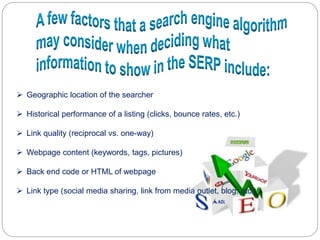
 Geographic location of the searcher
 Historical performance of a listing (clicks, bounce rates, etc.)
 Link quality (reciprocal vs. one-way)
 Webpage content (keywords, tags, pictures)
 Back end code or HTML of webpage
 Link type (social media sharing, link from media outlet, blog, etc.)
It is not difficult to get your website to index and
even rank on the search
engines. However, getting your website to rank for
specific keywords can be
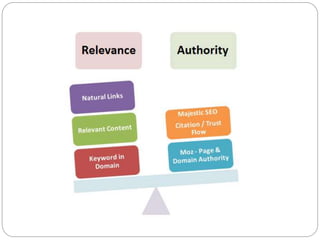
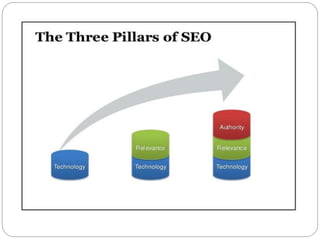
tricky. There are essentially 3 elements that a search
engine considers when
determining where to list a website on the SERP:
rank, authority, and relevance.
Rank is the position that your website physically falls in on
the SERP when a specific search query is entered. If you
are the first website in the
organic section of the SERP (don't be confused by the paid
ads at the very
top), then your rank is 1. If your website is in the second
position, your rank is 2, and so on. As discussed previously
in How Search Engines Work,
your rank is an indicator of how relevant and authoritative
your website is
in the eyes of the search engine, as it relates to the search
query entered.
Tracking how your website ranks for a specific keyword
over time is a good
As previously discussed in the How Search
Engines Work section, search engines
determine how authoritative and credible a
website's content is by
calculating how many inbound links (links
from
other websites) it has. However, the
number of inbound links does not
necessarily correlate with
higher rankings. The search engines also
look at how authoritative the websites that
Relevance is a one of the most critical factors of SEO. The search engines
are not only looking to see that you are using certain keywords, but
they
are also looking for clues to determine how relevant your content is to a
specific search query. Besides actual text on your webpages, the search
engines will review your website's structure, use of keywords in your
URLs, page formatting (such as bolded text), and what keywords are in
the
headline of the webpage versus those in the body text.
While there is no way to track how relevant your website is, there are
some
SEO basics you can practice to cover your bases and make sure you are
giving the search engines every possible opportunity to consider your
website. We‟ll get to that in just a bit.
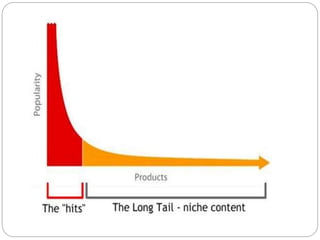
In order to get your website's content to rank on the search engines,
you need to take the path of least resistance. Although trying to
rank for highly trafficked
keywords and terms may seem like a logical approach, it will most
likely lead to a lot of frustration and wasted resources. Also, even if
you end up getting traffic from these types of keywords, chances are
the quality of the traffic will be low due to disinterest in what you
specifically have to offer. Think of every search query as being like a
snow flake - they are all different.
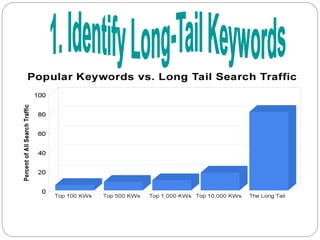
There are billions more unique search queries than there are generic
ones. In
fact, if you were to add up all search engine traffic that comes from
the most
popular keywords, it would not even come close to the amount of
traffic that
comes from searches using those more unique queries. This is
called the theory
of the long-tail.
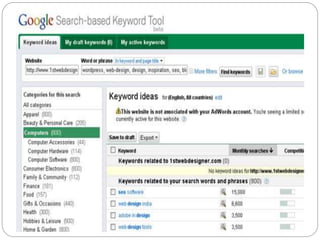
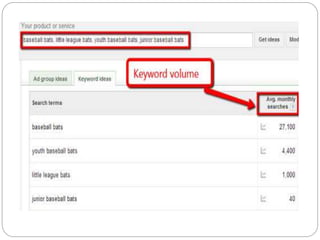
A critical component of SEO is choosing the right
keywords for optimization.
If you sell shoes, you may want your website to rank
for “shoe store,” (a
head term), but chances are you are going to have
some trouble there.
However, if you optimize multiple pages on your
website for each specific
pair of shoes that you sell, you are going to have much
more success and it
will be easier to rank on the SERP. A keyword like “red
tennis shoes with
Velcro” (a long-tail keyword or term) is a good
example. Sure, the number of
We've all heard it - when it comes to SEO,
content is king. Without rich content,
you will find it difficult to rank for specific
keywords and drive traffic to your
website. Additionally, if your content does not
provide value or engage users, you
will be far less likely to drive leads and
customers. As you already know, the search
engines are smart. If you create multiple
webpages about the same exact topic, you are
wasting your time. You need to
create lots of content that covers lots of topics.
There are multiple ways you can
use content to expand your online presence and
increase your chances of
ranking without being repetitive.
Homepage
Product/Service Pages
Resource Center
Blog
Use your homepage to cover your
overall value proposition
and high-level messaging. If there was
ever a place to optimize for more
generic keywords, it is your
homepage.
If you offer products
and/or services, create a
unique webpage for each
one of them.
Provide a webpage that offers
links to other places on
your website that cover
education, advice, and tips.
Blogging is an incredible way to stay current and
fresh while making
it easy to generate tons of content. Blogging on a
regular basis (once per
week is ideal) can have a dramatic impact on
SEO because every blog
post is a new webpage.
As mentioned in the Content is King section, you want to
write content that your
audience will find valuable and engaging. Aside from the
topical nature of the
content, the way you format your webpages can have an
impact on how the
search engine bots digest your content. Every webpage you
create should have
a thought-provoking headline to grab the reader's attention,
and should also
include the keyword or phrase that the webpage covers.
Other body formatting,
such as bolding certain keywords or phrases, can help stress
the importance of
phrases you are optimizing for.
The actual structure of your website URL can have
an impact on the search engines‟ ability to index
and understand your website's content. Opting for
a more organized URL structure will have the
greatest impact. Some website.
creation software will insert arbitrary numbers and
code in the URL. Although this may be optimal for
the software, it serves no other purpose. If you can
edit the
URL to include the title of your webpage, you
should do so. In fact, some website creation
software, like Hub Spot, will automatically create
URLs based off of your
webpage content in order to eliminate this issue.
There is nothing worse than landing on a webpage and being faced with
mountains of text. Not only are pictures a great way to break up sections
of text,
but they also serve as an opportunity to communicate with the search
engines.
Because search engines cannot tell what a picture is by scanning it, they
look for
clues in two places.
Every picture you upload to your website will have a file name. When the
picture
is inserted on your website, the picture‟s file name actually lives in your
website‟s
sources code, or HTML. Since the search engines scan your website‟s
code, you
should use file names that describe the picture.
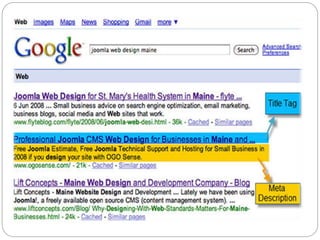
Besides an actual text headline on your page, every
webpage you create
has a title tag. This is the text snippet that appears in
the upper left corner
or on the tabs of your web browser. Also, the title tag is
the blue link that
the search engines show when they list your webpage
on the SERP. Title
tags max out at 75 characters, so choose your words
wisely.
Meta tags are snippets of code you can include within
your webpage‟s HTML.
The meta tags are usually located near the title tag
code in the head of your
HTML. There are two meta tags – meta description and
meta keywords.
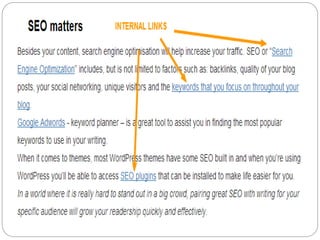
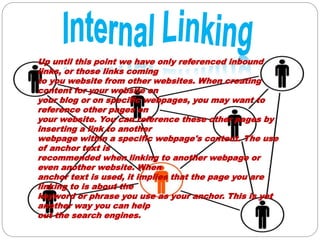
Up until this point we have only referenced inbound
links, or those links coming
to you website from other websites. When creating
content for your website on
your blog or on specific webpages, you may want to
reference other pages on
your website. You can reference these other pages by
inserting a link to another
webpage within a specific webpage's content. The use
of anchor text is
recommended when linking to another webpage or
even another website. When
anchor text is used, it implies that the page you are
linking to is about the
keyword or phrase you use as your anchor. This is yet
another way you can help
out the search engines.
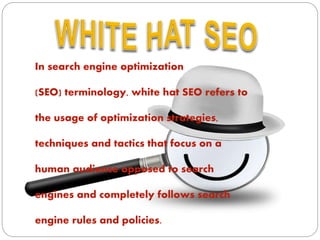
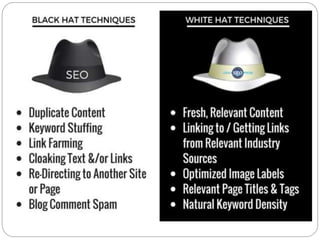
In search engine optimization
(SEO) terminology, white hat SEO refers to
the usage of optimization strategies,
techniques and tactics that focus on a
human audience opposed to search
engines and completely follows search
engine rules and policies.
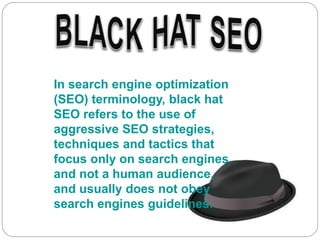
In search engine optimization
(SEO) terminology, black hat
SEO refers to the use of
aggressive SEO strategies,
techniques and tactics that
focus only on search engines
and not a human audience,
and usually does not obey
search engines guidelines.
Address:
15 SCO, Dayal Bagh,
Near Hanuman Mandir,
Ambala Cantt- 133001
Haryana
Ph. No.: 9729666670, 0171-4000670
Email-ID: info.jatinbatra@gmail.com
BASIC COURSES
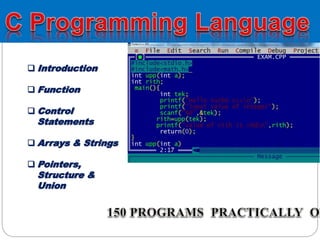
C PROGRAMMING
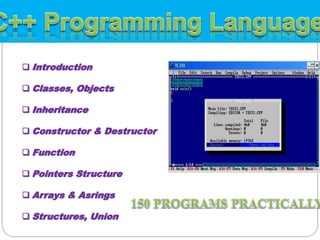
C++ PROGRAMMING
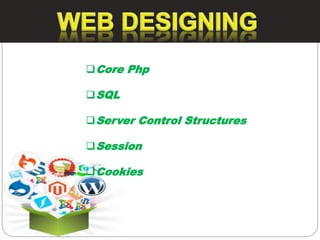
WEB DESIGNING
WEB DEVELOPMENT
S.E.O
 Notepad
WordPad
MS OFFICE 2010, 2013 [ Word, Excel, Power Point Point
Internet [Gmail, Facebook, Twitter]
Online Form Filling
Bill paying, Mobile Recharge, Shopping [Linked, Printer
Window Installation, Software Up-Loadations.
 Introduction
 Function
 Control
Statements
 Arrays & Strings
 Pointers,
Structure &
Union
 Introduction
 Classes, Objects
 Inheritance
 Constructor & Destructor
 Function
 Pointers Structure
 Arrays & Asrings
 Structures, Union
HTML
JavaScript
Dreamweaver / Notepad++
Corel Draw
CSS & CSS3
Core Php
SQL
Server Control Structures
Session
Cookies
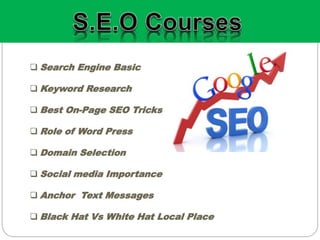
 Search Engine Basic
 Keyword Research
 Best On-Page SEO Tricks
 Role of Word Press
 Domain Selection
 Social media Importance
 Anchor Text Messages
 Black Hat Vs White Hat Local Place
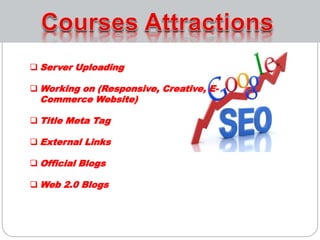
 Server Uploading
 Working on (Responsive, Creative, E-
Commerce Website)
 Title Meta Tag
 External Links
 Official Blogs
 Web 2.0 Blogs
Seo presentation ! BATRA COMPUTER CENTRE

Seo presentation ! BATRA COMPUTER CENTRE

  • 1.
    BATRA COMPUTER CENTRE Website:www.batracomputercentre.com Ph. No.: 9729666670, 0171-4000
  • 3.
    Ever wonder howmajor search engines such as Google, Bing and Yahoo rank your website within their searches? Or how content such as videos or local listings are shown and ranked based on what the search engine considers most relevant to users? Welcome to the world of Search Engine Optimization (SEO). This course is the first within the SEO Specialization and it is intended to give you a taste of SEO. You will be introduced to the foundational elements of how search engines work, how the SEO landscape has changed and what you can expect in the future. You discuss core SEO strategies and tactics used to drive more organic search results to a specific website or set of websites, as well as tactics to avoid to prevent penalization from search engines. You will also discover how to position yourself for a
  • 4.
    Whenever you entera query in a search engine and hit 'enter' you get a list of web results that contain that query term. Users normally tend to visit websites that are at the top of this list as they perceive those to be more relevant to the query. If you have ever wondered why some of these websites rank better than the others then you must know that it is because of a powerful web marketing technique called Search Engine Optimization (SEO). SEO is a technique which helps search engines find and rank your site higher than the millions of other sites in response to a search query. SEO thus helps you get traffic from search engines.
  • 6.
    Search engines haveone objective – to provide you with the most relevant results possible in relation to your search query. If the search engine is successful in providing you with information that meets your needs, then you are a happy searcher. And happy searchers are more likely to come back to the same search engine time and time again because they are getting the results they need. In order for a search engine to be able to display results when a user types in a query, they need to have an archive of available information to choose from.
  • 8.
    When indexing pages,the search engine bots scan each page of your website, looking for clues about what topics your website covers and scanning your website's back-end code for certain tags, descriptions, and instructions.
  • 9.
    As the searchengine bots scan webpages for indexing, they also look for links from other websites. The more inbound links a website has, the more influence or authority it has. Essentially, every inbound link counts as a vote for that website's content. Also, each inbound link holds different weight. For instance, a link from a highly authoritative website like The New York Times (nytimes.com) will give a website a bigger boost than a link from a small blog site. This boost is sometimes referred to as link juice.
  • 10.
     Geographic locationof the searcher  Historical performance of a listing (clicks, bounce rates, etc.)  Link quality (reciprocal vs. one-way)  Webpage content (keywords, tags, pictures)  Back end code or HTML of webpage  Link type (social media sharing, link from media outlet, blog, etc.)
  • 12.
    It is notdifficult to get your website to index and even rank on the search engines. However, getting your website to rank for specific keywords can be tricky. There are essentially 3 elements that a search engine considers when determining where to list a website on the SERP: rank, authority, and relevance.
  • 13.
    Rank is theposition that your website physically falls in on the SERP when a specific search query is entered. If you are the first website in the organic section of the SERP (don't be confused by the paid ads at the very top), then your rank is 1. If your website is in the second position, your rank is 2, and so on. As discussed previously in How Search Engines Work, your rank is an indicator of how relevant and authoritative your website is in the eyes of the search engine, as it relates to the search query entered. Tracking how your website ranks for a specific keyword over time is a good
  • 14.
    As previously discussedin the How Search Engines Work section, search engines determine how authoritative and credible a website's content is by calculating how many inbound links (links from other websites) it has. However, the number of inbound links does not necessarily correlate with higher rankings. The search engines also look at how authoritative the websites that
  • 15.
    Relevance is aone of the most critical factors of SEO. The search engines are not only looking to see that you are using certain keywords, but they are also looking for clues to determine how relevant your content is to a specific search query. Besides actual text on your webpages, the search engines will review your website's structure, use of keywords in your URLs, page formatting (such as bolded text), and what keywords are in the headline of the webpage versus those in the body text. While there is no way to track how relevant your website is, there are some SEO basics you can practice to cover your bases and make sure you are giving the search engines every possible opportunity to consider your website. We‟ll get to that in just a bit.
  • 19.
    In order toget your website's content to rank on the search engines, you need to take the path of least resistance. Although trying to rank for highly trafficked keywords and terms may seem like a logical approach, it will most likely lead to a lot of frustration and wasted resources. Also, even if you end up getting traffic from these types of keywords, chances are the quality of the traffic will be low due to disinterest in what you specifically have to offer. Think of every search query as being like a snow flake - they are all different. There are billions more unique search queries than there are generic ones. In fact, if you were to add up all search engine traffic that comes from the most popular keywords, it would not even come close to the amount of traffic that comes from searches using those more unique queries. This is called the theory of the long-tail.
  • 21.
    A critical componentof SEO is choosing the right keywords for optimization. If you sell shoes, you may want your website to rank for “shoe store,” (a head term), but chances are you are going to have some trouble there. However, if you optimize multiple pages on your website for each specific pair of shoes that you sell, you are going to have much more success and it will be easier to rank on the SERP. A keyword like “red tennis shoes with Velcro” (a long-tail keyword or term) is a good example. Sure, the number of
  • 23.
    We've all heardit - when it comes to SEO, content is king. Without rich content, you will find it difficult to rank for specific keywords and drive traffic to your website. Additionally, if your content does not provide value or engage users, you will be far less likely to drive leads and customers. As you already know, the search engines are smart. If you create multiple webpages about the same exact topic, you are wasting your time. You need to create lots of content that covers lots of topics. There are multiple ways you can use content to expand your online presence and increase your chances of ranking without being repetitive.
  • 25.
  • 26.
    Use your homepageto cover your overall value proposition and high-level messaging. If there was ever a place to optimize for more generic keywords, it is your homepage.
  • 27.
    If you offerproducts and/or services, create a unique webpage for each one of them.
  • 28.
    Provide a webpagethat offers links to other places on your website that cover education, advice, and tips.
  • 29.
    Blogging is anincredible way to stay current and fresh while making it easy to generate tons of content. Blogging on a regular basis (once per week is ideal) can have a dramatic impact on SEO because every blog post is a new webpage.
  • 33.
    As mentioned inthe Content is King section, you want to write content that your audience will find valuable and engaging. Aside from the topical nature of the content, the way you format your webpages can have an impact on how the search engine bots digest your content. Every webpage you create should have a thought-provoking headline to grab the reader's attention, and should also include the keyword or phrase that the webpage covers. Other body formatting, such as bolding certain keywords or phrases, can help stress the importance of phrases you are optimizing for.
  • 34.
    The actual structureof your website URL can have an impact on the search engines‟ ability to index and understand your website's content. Opting for a more organized URL structure will have the greatest impact. Some website. creation software will insert arbitrary numbers and code in the URL. Although this may be optimal for the software, it serves no other purpose. If you can edit the URL to include the title of your webpage, you should do so. In fact, some website creation software, like Hub Spot, will automatically create URLs based off of your webpage content in order to eliminate this issue.
  • 35.
    There is nothingworse than landing on a webpage and being faced with mountains of text. Not only are pictures a great way to break up sections of text, but they also serve as an opportunity to communicate with the search engines. Because search engines cannot tell what a picture is by scanning it, they look for clues in two places. Every picture you upload to your website will have a file name. When the picture is inserted on your website, the picture‟s file name actually lives in your website‟s sources code, or HTML. Since the search engines scan your website‟s code, you should use file names that describe the picture.
  • 36.
    Besides an actualtext headline on your page, every webpage you create has a title tag. This is the text snippet that appears in the upper left corner or on the tabs of your web browser. Also, the title tag is the blue link that the search engines show when they list your webpage on the SERP. Title tags max out at 75 characters, so choose your words wisely. Meta tags are snippets of code you can include within your webpage‟s HTML. The meta tags are usually located near the title tag code in the head of your HTML. There are two meta tags – meta description and meta keywords.
  • 38.
    Up until thispoint we have only referenced inbound links, or those links coming to you website from other websites. When creating content for your website on your blog or on specific webpages, you may want to reference other pages on your website. You can reference these other pages by inserting a link to another webpage within a specific webpage's content. The use of anchor text is recommended when linking to another webpage or even another website. When anchor text is used, it implies that the page you are linking to is about the keyword or phrase you use as your anchor. This is yet another way you can help out the search engines.
  • 57.
    In search engineoptimization (SEO) terminology, white hat SEO refers to the usage of optimization strategies, techniques and tactics that focus on a human audience opposed to search engines and completely follows search engine rules and policies.
  • 58.
    In search engineoptimization (SEO) terminology, black hat SEO refers to the use of aggressive SEO strategies, techniques and tactics that focus only on search engines and not a human audience, and usually does not obey search engines guidelines.
  • 61.
    Address: 15 SCO, DayalBagh, Near Hanuman Mandir, Ambala Cantt- 133001 Haryana Ph. No.: 9729666670, 0171-4000670 Email-ID: info.jatinbatra@gmail.com
  • 65.
    BASIC COURSES C PROGRAMMING C++PROGRAMMING WEB DESIGNING WEB DEVELOPMENT S.E.O
  • 66.
     Notepad WordPad MS OFFICE2010, 2013 [ Word, Excel, Power Point Point Internet [Gmail, Facebook, Twitter] Online Form Filling Bill paying, Mobile Recharge, Shopping [Linked, Printer Window Installation, Software Up-Loadations.
  • 67.
     Introduction  Function Control Statements  Arrays & Strings  Pointers, Structure & Union
  • 68.
     Introduction  Classes,Objects  Inheritance  Constructor & Destructor  Function  Pointers Structure  Arrays & Asrings  Structures, Union
  • 69.
  • 70.
    Core Php SQL Server ControlStructures Session Cookies
  • 71.
     Search EngineBasic  Keyword Research  Best On-Page SEO Tricks  Role of Word Press  Domain Selection  Social media Importance  Anchor Text Messages  Black Hat Vs White Hat Local Place
  • 72.
     Server Uploading Working on (Responsive, Creative, E- Commerce Website)  Title Meta Tag  External Links  Official Blogs  Web 2.0 Blogs