Search Engine Optimization
A A RO N M AT T H E W WA L L
Search Engine Optimization Book
© Aaron Matthew Wall
150 Caldecott Ln #8 • Oakland • Ca 94618
(401) 207-1945 • seobook@gmail.com
3
Table of Contents
SEO Tools 8
Picking a Product 8
Picking a Domain Name 9
Domain Registration & Hosting 9
Analytics 10
Keyword Selection 10
Page Optimization 10
Home Page Optimization 11
Site Optimization 11
Registering With Directories 12
Link Building 13
When Algorithm Changes Occur 14
Common SEO Abuse Techniques 15
Appearing Natural 15
Social Considerations 16
Closing Tips 16
SEO as a Standalone Product 20
The Social Elements of Relevancy 22
Starting from Broke 23
Questions, Comments & Concerns 24
Interactive Elements 25
Finding Prospects 26
Interactive Elements 27
Some Notes 28
The Goal of Search Engines & How They Work 29
Origins of the Web 37
Commercialized Cat & Mouse 38
Choosing a Domain Name 43
Hosting 52
Interactive Elements 54
Some Notes 55
Learning Your Subject 57
Changing Your Site 62
Copywriting 65
Usability 71
Generating Revenue 77
4
Blogging 87
Interactive Elements 91
Some Notes 95
Analytics 97
Keywords 98
Meta Tags 118
Page Title Tag Done Wrong 123
Page Title Tag Done Right 124
Information Scent 127
Internal Linking 127
Navigation 133
Optimizing Your Page Copy 137
Building Content 142
Unexplored Waters 147
Interactive Elements 147
Some Notes 151
Search Engines versus Directories 153
Submitting Your Site 153
Social Interaction and Links 154
General Directories 157
Niche Directories 162
The Active Web 168
Interactive Elements 168
Some Notes 170
The Major Search Engines 171
Google 171
Yahoo! Search 194
Microsoft 200
Ask 201
Comparing Search Results 206
Interactive Elements 207
Some Notes 210
Text in Incoming Links 211
Exchanging Links 220
Requesting Links 222
Evaluating the Quality of a Link 231
Free Links & Buying Links 232
Waiting for Results 246
Customizing Your Browser for SEO 248
Interactive Elements 249
Some Notes 252
Problems with Manufacturing Relevancy 254
Real versus Artificial 255
5
Things Google Can Track 257
My Tinfoil Hat Theories… 259
Is Your Site Future Ready? 260
Don’t Discount the Present Opportunity 261
Blurring Editorial vs Ads & Editors vs Users266
Market Edges 268
Resources 270
Some Notes 271
When Results Don’t Show 272
SEO Worst Practice Manual 273
Other Problems 278
Speeding Things Up: Paid Inclusion 282
Other Search Engines 284
Interactive Elements 288
Before You Start 290
What is Pay-Per-Click? 292
Yahoo! Search Marketing 295
Ad Writing Tips 301
Earning (and Buying) Trust 307
Google AdWords 309
Bonus Info: How to Improve CTR and Slash Google AdWords Costs to Maximize Profits: 315
Microsoft adCenter 328
Other PPC Providers 329
Resources Cited 329
Some Notes 333
The Goal of this e-book 335
What are Your Goals? 335
SEO Business Models 336
More Information on Buying SEO Services339
Resources 340
Online Auctions 341
Forums 342
Writing Articles 342
Ideal Clients 343
Where to find Clients 343
Questions to Ask Clients 344
Being Your Size 345
Contracting & Outsourcing 346
Cold Calling 346
Niche SEO: Real Estate 346
Sales Cycle 347
Contracts 347
Reports 348
6
Dependency on Free Traffic 348
Affiliate Sites & Passive Income Streams349
Resources 349
7
Author’s Note
Chapter 3, General Internet Topics,
covers many non-search related
Internet topics. I include this because
if you do well with many of the “non-
search” related topics it becomes far
easier to build a linking campaign and
achieve top search engine placement.
For competitive phrases, link
popularity and the words in those
links are the single most important
part of Search Engine
Optimization (SEO). But to get the
right types of people to want to vote
for you your site needs to do many
things well.
With most websites, conversion and
profit are more important than the
sheer amount of traffic you get.
Making small changes within your site
can double or triple your conversion
rate. If you do everything else
correctly, you do not need to put as
much effort into SEO.
If you already know the topics covered
in Chapter 3, feel free to skip over
them. More than trying to answer all
questions about the web, Chapter 3 is
there to help point you toward
answers to other Internet business-
related questions you may have.
Before getting too far into SEO, think
about whether the idea you have is
one that will be easy to spread. If it is
not, think of how you can transform
your concept into something that is
easier to disseminate throughout the
Internet.
It is usually far easier and far more
profitable to create an idea worth
spreading than it is to spread an idea
not worth spreading.
Disclaimer: Since search engines are
constantly changing while still keeping
secret their algorithms, there is no way
to know the exact algorithms at any
given time. However, due to data
collected through observations of
search engines over the past several
years, it is my hope that this book will
teach you how to make informed
observations and decisions as search
engines continue to change. With
enough experience, one can discern
patterns in the search engine puzzle,
and as a result, figure out how the
process works. This guide was created
to help you learn to identify those
patterns and solve the puzzle.
While following this guide should help
improve your rankings, I, the author
of this book, shall not be held
responsible for damages because of
the use (or misuse) of this information.
8
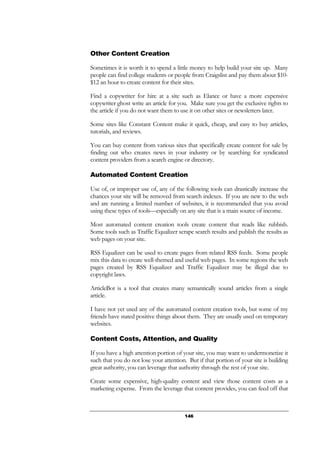
Quick Summary of Do-It-
Yourself SEO Tips
Many people who buy this book will never read it in its entirety. To help whet your
palate and ensure you get some value out of this text (and, therefore, read the
whole thing), here is a quick-start checklist highlighting the most important aspects
of search engine optimization and Internet marketing. When looking to start with
search engine optimization, consider the following issues:
SEO Tools
Oftentimes using the right tools can save you both time and money. I have created
a free PDF checklist of all the SEO tools I use. You may download it here:
http://www.seobook.com/seo-tools.pdf
Picking a Product
You may read this title and think that you have already accomplished this step,
and that your product (or your vision for your product) is already refined,
wrapped, and ready for purchase. However, there are many key questions that
should be considered before bringing your wares or service to customers:
• Are you interested in the product you are trying to sell? If not, why not choose
a different product?
The Internet makes marketing anything a possibility. You are far more
likely to succeed if you are interested in what you are trying to sell. Also, it is
far easier to sell people what they want than to get them to want your product.
Create something the market wants.
• Is the marketplace for your product oversaturated?
Examples: Posters, credit cards, prescription drugs, hosting, generic site
design, and ink refills are all oversaturated markets. Breaking into these
markets can be exceptionally difficult, so think carefully about what would
make your product different and needed.
• Is the product something people would want to order over the web?
• Is there something you can do to make yourself different than everyone else
on the market? (Please note: “cheaper” usually is not a legitimate
branding/business model for most websites in a hyper-competitive market.)
Example: No other e-book covering SEO was supported by a blog that
keeps up with the SEO industry every day (at least, not when I first wrote this
one).
Another example: In 2002, I created a SEO “worst practices” directory.
To this day, nobody else has made a site like it. It earned me thousands in the
first year with a marketing budget well under $100.
9
In the end, ask yourself -- Would people want to link to your site without you
asking them to? If not, what creative or original ideas can you add to your site
to make people want to link to it?
Picking a Domain Name
Finding the right domain name can be a tricky business, and indeed, can mean
the difference between success and failure in the online marketplace. As such,
it is important to consider the following before choosing a domain name:
• FOR NEW SITES: Depending on your branding angle, pick a domain name
that is either highly brandable (meaning that it can be easily and positively
associated with your product or service) or one that has your primary
keywords in it. Use a short and memorable domain name. It is fine if it does
not have your keywords in it if it is memorable. For serious, long-term
websites, a memorable domain name will be one of the key ingredients to
success.
• If your domain name exactly matches your keywords Google places a
relevancy bonus on your site. (ex: SeoBook.com ranks easily for both seobook
and seo book).
• If you are going to be working in competitive fields, or if you will have large
sites, you may want to use a different domain for each different language you
are targeting.
Examples of domain names I own: BlackHatSEO.com,
SEOBook.com, FattyWeightLoss.com, and Threadwatch.org
Domain Registration & Hosting
Once you have selected a domain name, you must make sure that it is
available, and then register it. After your domain name has been registered,
you must find a reliable host for your website.
• Register your domain with an ICANN (Internet Corporation for Assigned
Names and Numbers) accredited registrar. I use GoDaddy.
• Register as a .com if possible, if you have a global market. If you cannot get a
.com, but a great .net or .org is still available, it might be worth it to register
one of those instead of registering a longer (and less memorable) .com domain.
• If you are targeting a specific country or language, register a domain name in
that country’s top-level domain designation (e.g., buy a co.uk website for a
U.K.-targeted site). Also buy the .com version of your domain name and point
it at your country-specific location.
• Oftentimes certain directories and search engines will either be biased toward
local sites will or only let local sites in the index. “Local” may mean ending
with a local domain and/or being hosted on a server in that country.
• Host your site with a reliable host. I recommend DreamHost or Pair.com.
• For dynamic sites, make sure your host supports the technology you will be
using (such as ASP or PHP) before spending money.
10
Analytics
It helps to install a free or cheap analytics program like Google Analytics or
HaveAMint.com before you start marketing so you can see what keywords you
rank for. It is easier to rank for related keywords than to rank for entirely new
keywords.
You can also use pay per click marketing on Google, Yahoo, and Microsoft right
off the start to learn what keywords convert well for you and which keywords do
not.
Keyword Selection
Keywords are what help your site get recognized by Internet search engines,
and as a result, help would-be customers find your Internet presence. There
are many strategies that can be employed to ensure the likelihood of your
website coming up in keyword searches:
• Use a keyword tool to help you find the most targeted keywords for your site.
The tool at http://tools.seobook.com/general/keyword/ is free and cross-references
just about every useful keyword research tool on the market.
• Pick themes or keyword baskets around which you can optimize the various
sections of your site.
• Targeting keyword phrases is a much better idea than trying to target individual
words. Keyword phrases tend to be easier to rank well for AND they typically
convert far better than individual words.
• Target different keyword phrases on each page.
• Target no more than one or two primary and two or three secondary keyword
phrases per page.
• If you generate hundreds (or even thousands) of pages of content, make sure
they read well and have unique content. Over time, if people cite your content,
your page will start to rank for many different terms as long as it is unique and
targeted around a theme.
Page Optimization
Page optimization is the process of making sure that your website functions in
the most effective way possible in relation to search engines. The following
are steps you can take to optimize your page:
• Use your keywords in your page title. Place the most important keyword
phrase close to the beginning of the page title. Do not put your site title on
every page of your site unless you are really trying to brand that name. In that
scenario, it still is usually best to place the site name at the end of the page
titles.
• Shorter site titles are usually better than really long ones.
11
• Sometimes I overlap related keyword phrases in the page title. Overlapping
keyword phrases in the page title can help you pick up multiple search phrases.
For example, professional search engine marketing services helps me obtain good
rankings for (1) search engine marketing, (2) professional search engine marketing, (3)
search engine marketing services, and (4) professional search engine marketing services.
• Meta tags are not extremely important, but they can help some. The meta
description should be a sentence to a paragraph describing the page contents.
The meta description tag can be seen in some search results, so you want to
write it for human eyes and for it be compelling.
• The meta keywords tag is probably not worth the time to make, but if you do
make one, it should contain your primary keyword and its common
misspellings and synonyms. Each keyword phrase in the keywords tag should
be comma separated.
• Use a single, descriptive H1 header on your page containing the keyword
phrases similar to those you targeted in the page title. This helps reinforce the
page title.
• Use descriptive subheaders (H2 or H3) before every paragraph or every few
paragraphs. This improves usability and helps define what the page is about to
search engines without making the page look like it was written for a search
engine.
• Use bulleted lists and bolding to break up content and make it easier to read.
• Write your content for human consumption. If you write exclusively for
search engines, the pages will read poorly and nobody will want to look at
them.
Home Page Optimization
In addition to page optimization for search engines, it is also important to
optimize your site's home page for customers in order to make sure it
functions efficiently.
• Make sure your home page builds credibility and directs consumers to the
most important parts of your site.
• Target your most competitive keyword phrase with the home page or with a
page that is directly linked to from the home page.
• Link to the major theme pages from your home page.
• Link to your home page from every page of your site. Include your site name
and/or the home page’s primary keyword phrase in the text links pointing to
it.
• If you think your site is being filtered out of the search results for being too
focused on a word or phrase, you may want to make the link to your home
page just say something like “home”.
Site Optimization
Your home page is just the starting point for what will probably be a very
multi-layered and multifaceted website. As such, it is important to look at
12
every page your site contains to ensure a cohesive, streamlined design that
works well with search engines as well as customers. Keep the following in
mind:
• Use text-based navigation.
• If you use graphic navigation, use descriptive alt text for your image links, and
link to your primary pages from every page of your site using footer text links.
• Use descriptive/keyword-rich breadcrumb navigation to help search engines
understand the structure of your site.
e.g., home page link(use keywords in it) > level 1 > level 2 >
page I am on
• Use a site map to help search engines spider through your site.
• Whenever possible, use descriptive text when linking between pages of your
site.
• Link to other resources that improve your user’s experience. If you reference
research and trusted sources within your content, readers will think of your
content as information, rather than simply being sales-oriented.
• Deep link to related articles and content from within the active content section
of your page copy.
• If you want your site to convert, assume many site visitors will ignore the
global navigation. Actively guide people toward conversion from within the
active content area of your website. This website, http://www.AndyHagans.com,
does an excellent job of this.
• Use CSS to improve the look and feel of your pages. Put it in an external file.
Registering With Directories
Register your site with the major directories and second-tier general directories.
Try to register with about a half-dozen to a dozen of the better general directories if
you are targeting Google. If you are targeting the other engines first and can wait
on Google, you may want to register with about twenty to fifty general directories.
Register with at least a couple local or niche-specific directories. Niche-specific
directories are findable via search engines and some are listed at
http://www.isedb.com, but you should check to ensure they provide static links before
spending money registering your sites, although directories that rank well may
deliver quality traffic even if they do not provide direct links.
Search for things like “<my keywords> + <add URL>” to find other niche
directories.
Oftentimes I do not mind spending hundreds of dollars getting links from different
sites (or directories) across many different IP ranges. Many of the second-tier
directories charge a one-time fee for listing, and some of them allow you to add
your sites free if you become an editor.
In my directory of directories, I have 50-100 general directories listed in the general
directory categories. Most top ranking sites in mildly competitive fields do not
have text links from fifty different sites pointing to them, so if you can afford it,
13
doing this offers a huge advantage to you for your Yahoo! and MSN rankings, but
you need to choose directories carefully when considering how TrustRank
(explained in the Google section of this e-book) may effect Google.
If you are in more competitive fields and rent some powerful links, these listings in
various directories can help stabilize your rankings when search engine algorithms
shift.
Some directories I highly recommend are Yahoo!, DMOZ, Business.com, JoeAnt,
Best of the Web, and Gimpsy.
Link Building
In the area of link building, there are many important factors to remember.
After all, link building is the single most important part of achieving a high-
ranking website in modern search engines. As such, there are many things that
can significantly impact the growth and spread of links to your site:
• Make sure your site has something that other webmasters in your niche would
be interested in linking to.
• Create content that people will be willing to link to, even if it is not directly
easy to monetize. These linkworthy pages will lift the authority and rankings
of all pages on your site.
• Create something that legitimate webmasters interested in your topic would be
interested in linking to.
• When possible, try to get your keywords in many of the links pointing to your
pages.
• Register with, participate in, or trade links with topical hubs and related sites.
Be in the discussion or at least be near the discussion.
• Look for places from which you can get high-quality free links (like local
libraries or chambers of commerce).
• If you have some good internal content, try to get direct links to your inner
pages.
• Produce articles and get them syndicated to more authoritative sites.
• Start an interesting and unique blog and write about your topics, products,
news, and other sites in your community.
• Comment on other sites with useful relevant and valuable comments.
• Participate in forums to learn about what your potential consumers think is
important. What questions do they frequently have? How do you solve those
problems?
• Issue press releases with links to your site.
• Leave glowing testimonials for people and products you really like.
Oftentimes when the product owner or person posts the testimonials, they will
include a link back to your site.
• Sponsor charities, blogs, or websites related to your site.
• Consider renting links if you are in an extremely competitive industry. Adult,
gaming, credit, and pharmacy categories will likely require link rentals and/or
building topical link networks.
14
• Mix your link text up. Adding words like buy or store to the keywords in your
some of your link text can make it look like more natural linkage data and help
you rank well for many targeted secondary phrases.
• Survey your vertical and related verticals. What ideas/tools/articles have
become industry standard tools or well-cited information? What ideas are
missing from the current market space that could also fill that niche?
• If you have a large site, make sure you create legitimate reasons for people to
want to reference more than just your home page.
• If you are looking to hire an SEO, you may want to look at
http://www.honestseo.com or feel free to ask me to recommend you to someone.
• Brett Tabke (owner of WebmasterWorld) wrote a quick guide worth looking at
before building your site: http://www.webmasterworld.com/forum3/2010.htm
When Algorithm Changes Occur
Your rankings will improve. They will also get worse. Many people rush off to
change things right away when the algorithms change. Sometimes the search
engines roll in new algorithms aggressively, and then later roll them back. They
cannot fight off new forms of spam and determine how aggressive to be with new
algorithms unless they sometimes go too far with them.
If you are unsure of what just happened, then you may not want to start changing
things until you figure it out. Sometimes when algorithms are rolled back or made
less aggressive, many sites still do not rank well because their webmasters changed
things that were helping them. Nobody is owed a good rank, and just because a
ranking temporarily changes does not mean that a site has been penalized. It is far
more likely that the ranking criteria shifted and the site may not match the new
ranking criteria as well as it matched the old ranking criteria.
One of the greatest SEO techniques is knowing when to do nothing at all. I had
one client with whom I shared profit, but for whom I did not do much work after
the first few months. Why? After I built his site up, he had a strong market
position. I could have kept building many links, but it would not help him reach
much more of the market. It would have added nothing but cost and risk. If you
are too aggressive, it adds to the risk profile without adding much on the reward
side.
Tim Mayer, a well-known Yahoo! search engineer, once mentioned that it did not
make sense to bring a knife to a gun fight (when referring to how to compete for
terms like Viagra). The opposite also holds true -- if you are using a shotgun, and
the competing sites are using slingshots, then you stand a greater chance of being
penalized.
All SEO techniques are just a balance of risk versus reward, and while you want to
rank at or near the top of the search results, you probably do not want to use
techniques that are exceptionally aggressive as compared to the other top-ranking
sites if you intend to build a site for long-term profits.
15
Common SEO Abuse Techniques
There is no such thing as a perfectly optimized page. Search engines do not want to
return the most optimized page, but the page that best satisfies the searcher’s
goals.
If you have a page title and H1 header that are exactly the same, and all of your
internal links and all of your inbound links from other sites pointing to that page
use that same text, then that looks suspicious (like attempted ranking
manipulation). As a result, the search engines may de-weight that or filter that out
of the search results.
How do you minimize your risks and make your site more stable? It’s best to mix
things up a bit and create something that markets itself. Or, try looking at things
like a search engine engineer would.
There is a concept called poison words, where if you have things like link exchange, add
URL, or link partners on a page, there stands a good chance a search engines may
place less weight on that page or its outbound links. In the past, some common
poison words were things like forum and guestbook. The more likely the content is to
be of low quality or related to spam, the more likely search engines want to de-
weight it.
Search engines may want to penalize the use of “spammy” sites using an H1
header, so instead people use an H2 header for the highest level header tag on the
spammy sites. Maybe they look to de-weight site-wide links to the home page near
the end of the page code using the exact same link text as the home page’s page
title, so instead you link to the home page from earlier in the page code and/or use
slightly different anchor text than your page title and most of your link profile.
Keep in mind that some of the search relevancy algorithms are genetic algorithms
that train themselves to test the relevancy of new result sets, but humans still
program them. Google wants to have a bias toward informational resources.
Yahoo! will be more biased toward commerce. These biases can affect
optimization, as well.
In addition, some guys like DaveN mention lots of subtle tips like the ones I just
discussed. If you think like a search engineer, those techniques that are common in
SEO and not so common on regular websites are the most likely to be de-weighted
or penalized. Remember that optimizing content is about matching quality signs,
but if you match too many too closely, it could send a negative signal.
Appearing Natural
A recent theme in SEO is finding ways to appear natural. Search engines do not
want the most optimized sites at the top of the search results. They want the best
pages and best sites.
There are only so many things search engines can look at to determine the quality
of a website. You can emulate many of them, but as search algorithms advance, it
16
will continue to get more difficult. Inevitably, influencing people directly (instead
of going after the algorithms) is going to have a higher ROI for many webmasters.
How do you create a natural linkage profile? Create something that lots of people
link to without you needing to ask them. Build a real brand that will get people’s
attention.
How do you write optimized content? Make the page title clear and then write
content remarkable enough that people will want to reference it.
Social Considerations
No matter how smart you are, it is going to be hard to emulate a natural link profile
if you manually build it all. Going forward, the key to doing well in Google is
earning natural citations. If you didn’t own your site, would you still visit it every
week? What can you do to grab bloggers’ attention? What can you do to make
some of your competitors want to link to your site without you needing to ask for
the links?
Closing Tips
The web is nothing but a big social network. SEO was my entry to the web, but I
have bigger hopes, dreams, and goals in mind. No matter what your goals are,
SEO can help you get there from the start. But at some point, it will be necessary
for you to find ways to get other people to want to syndicate your ideas. It's kind
of like what Abe Lincoln was saying when he said, “With public sentiment, nothing
can fail. Without it, nothing can succeed.”
I am somewhat altruistic in that I believe if you study and do what you are
interested in (even if it is on the side to start), then eventually it will drive you
toward success.
I also want to share a quote with you from Weaving the Web by one my favorite web
personalities, and the man who created the Web, Tim Berners-Lee:
People have sometimes asked me whether I am upset that I have not
made a lot of money from the Web. In fact, I made some quite
conscious decisions about which way to take my life. These I would
not change - though I am making no comment on what I might do in
the future. What does distress me, though, is how important a
question it seems to be to some. This happens mostly in America,
not Europe. What is maddening is the terrible notion that a person’s
value depends on how important and financially successful they are,
and that that is measured in terms of money. That suggests
disrespect for the researchers across the globe developing ideas for
the next leaps in science and technology. Core in my upbringing was
a value system that put monetary gain well in its place, behind things
like doing what I really want to do. To use net worth as a criterion by
which to judge people is to set our children’s’ sights on cash rather
than on things that will actually make them happy.
17
Most successful web-based businesses do not need to actively practice SEO.
Optimizing for search engines does help improve the bottom line and help get you
found, but after you are found, it is up to you to convert. It is up to you how hard
and creatively you work to develop your business and reputation.
If this is the last book or e-book you ever read about running your business online,
I would consider that a mistake. I try to read at least one book a month (it was
about three a week when I was just getting started on the web). While not
everyone has that much time, it is always a good call to keep learning new stuff.
Rarely do I ever read a book without learning an important lesson or good idea.
As mentioned before, the web is a big social network, and it gives quick feedback.
Do not be afraid to read from, and learn from, competitors and people in other
fields. Do not be afraid to participate in it…that is how you really learn. If you
never make a mistake and never screw up badly, then you probably won’t do too
many spectacular things either.
Search engines try to emulate users who are largely driven by the social connections
off the web. Create friendships and get media coverage and you win.
I am not a creative genius nor am I a branding expert, but if you need help coming
up with another angle to promote your business from or need SEO help, don’t
hesitate to shoot me an e-mail and I will see if and how I can help in any way.
Also, create a blog to see if you like writing. Too few people ever actually speak
their mind in this world. This blogging website (http://www.blogger.com) is free and
easy to set up. Or, if you are a bit more technically inclined, I would recommend
using http://wordpress.org/.
Best of luck with everything & to your success,
Aaron
18
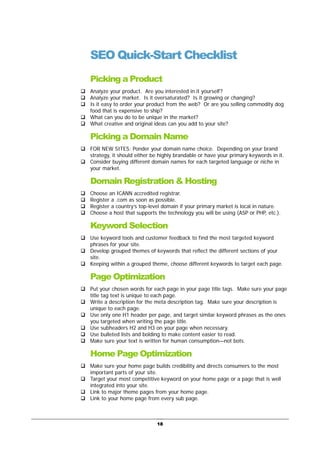
SEO Quick-Start Checklist
Picking a Product
Analyze your product. Are you interested in it yourself?
Analyze your market. Is it oversaturated? Is it growing or changing?
Is it easy to order your product from the web? Or are you selling commodity dog
food that is expensive to ship?
What can you do to be unique in the market?
What creative and original ideas can you add to your site?
Picking a Domain Name
FOR NEW SITES: Ponder your domain name choice. Depending on your brand
strategy, it should either be highly brandable or have your primary keywords in it.
Consider buying different domain names for each targeted language or niche in
your market.
Domain Registration & Hosting
Choose an ICANN accredited registrar.
Register a .com as soon as possible.
Register a country’s top-level domain if your primary market is local in nature.
Choose a host that supports the technology you will be using (ASP or PHP, etc.).
Keyword Selection
Use keyword tools and customer feedback to find the most targeted keyword
phrases for your site.
Develop grouped themes of keywords that reflect the different sections of your
site.
Keeping within a grouped theme, choose different keywords to target each page.
Page Optimization
Put your chosen words for each page in your page title tags. Make sure your page
title tag text is unique to each page.
Write a description for the meta description tag. Make sure your description is
unique to each page.
Use only one H1 header per page, and target similar keyword phrases as the ones
you targeted when writing the page title.
Use subheaders H2 and H3 on your page when necessary.
Use bulleted lists and bolding to make content easier to read.
Make sure your text is written for human consumption—not bots.
Home Page Optimization
Make sure your home page builds credibility and directs consumers to the most
important parts of your site.
Target your most competitive keyword on your home page or a page that is well
integrated into your site.
Link to major theme pages from your home page.
Link to your home page from every sub page.
19
Site Optimization
Use text-based navigation.
If you already have, or insist on using, graphic navigation, use descriptive alt text
on the images, and link to every primary page from your sub pages in the footer of
the sub pages.
Use descriptive keyword breadcrumb navigation.
Make a site map.
Check the text that links pages of your site to make sure it’s descriptive whenever
possible.
Link to resources outside your own site that improve each user's experience.
Deep link to related articles and content from your page copy.
Rely as little as possible on the site navigation. Instead, guide your visitor through
your site with links in the active content portion of the site.
Link to, and use, a cascading style sheet from every page.
Avoid duplicate content issues. Ensure that each page has significantly unique
content that does not exist on other pages on your site or other sites.
Registering With Directories
Register your site with the major directories.
Register your site with a couple better second-tier directories.
Register with a couple local or niche-specific directories.
Link Building
Make sure your site has something that other webmasters in your niche would be
interested in linking to.
Create content that people will be willing to link at even if it is not directly easy to
monetize. These linkworthy pages will lift the authority and rankings of all pages
on your site.
When possible, get your keywords in the link text pointing to your site.
Register with, participate in, or trade links with topical hubs and related sites. Be
in the discussion or at least be near the discussion.
Look for places to get high-quality free links from (like local libraries or chambers
of commerce).
Produce articles and get them syndicated to more authoritative sites.
Participate in forums to learn about what your potential consumers think is
important.
Issue press releases with links to your site.
Leave glowing testimonials for people and products you really like.
Start an interesting and unique blog and write about your topics, products, news,
and other sites in your community.
Comment on other sites with useful relevant and valuable comments.
Sponsor charities, blogs, or websites related to your site.
Consider renting links if you are in an extremely competitive industry.
Mix your link text up, if you can.
Survey your vertical and related verticals. What ideas/tools/articles have become
industry standard tools or well-cited information? What ideas are missing?
Read Brett Tabke’s quick couple-page guide
http://www.webmasterworld.com/forum3/2010.htm
20
How to Read this e-book
There are many sections in this e-book. Most of them relate to search marketing,
although some of them relate to other aspects of the web.
While I actively market this book as being about search engine optimization, it is
actually more about everything I know about marketing on the web. While there
are many guides to how and where to start on the web, most of them are laced with
affiliate links and bogus recommendations. The goal of this guide is what I had
wished I read when I jumped on the web a few years ago. I also reference the most
useful resources I have found in each field so that if you are interested in learning
more about those subjects, you can see what I recommend.
Some areas might read well, whereas others might be a bit choppy. The reason for
this is that I rewrite sections of it frequently. What started off as a 24-page file is, a
couple of years later, a few hundred pages long. I try to reread it as often as I can
without getting burned out from reading it too much. It is a hard balance to strike
between constantly learning and updating everything I have learned. At the same
time, I have to learn about search in depth so that I can also provide better-than-
average information about that topic.
If you already know a topic covered in a certain section of this book, well then, you
may not learn much (or anything) from that section. I don’t expect to be able to
tell a 20-year professional copywriter how to do her job. The point of the other
sections is that SEO works much better as a marketing mechanism if you use it in
conjunction with other ideas, and do not attempt to do SEO on its own.
SEO as a Standalone Product
Search algorithms are still in their infancy. Many people will still be able to run
successful businesses doing nothing but SEO for at least a few years to come.
When I was new to SEO, and only knew a bit about it, I did not have a strong
brand or understand marketing well. I did things like rank people for terms worth
hundreds of thousands of dollars while charging them a one-time $300 fee. Did
my efforts pay off? Sure, but due to my ignorance of the business end of the
process, I still almost wound up bankrupt because I undercharged for services.
As you learn more about the value of SEO and how it integrates into the web, you
should be able to increase your income or social reach significantly. Only by
pairing SEO with other marketing methods or viewing the web through a larger
lens will you be able to fully appreciate the value of SEO.
If you do not know what PPC, CSS, SSI, CMS, or many of the acronyms mean, it
does not make sense to try to learn all of them in one day. It took me a couple of
years to learn what I have written in this e-book. With that said, in many areas it is
sufficient to understand how or why something works, without knowing all the
21
deepest details. If you need help knowing what an acronym means, check out my
SEO glossary at http://www.seobook.com/glossary/.
On top of being a book to read, I also wanted this book to act as a reference guide.
The index makes it quick and easy to flip through to a specific area if you want to
look at something more in-depth later.
While some of this guide talks about technical details, they may not be that
important for the average webmaster to know. For example, latent semantic
indexing finds mathematical patterns in language and determines what concepts a
page represents using mathematics to represent those words. All most people
really need to know about latent semantic indexing is that those types of algorithms
would favor natural writing over unnatural keyword stuffed gibberish.
There are many other algorithms and ideas driving search, but at the end of the
day, the end goal of all the algorithms is to favor useful content that people care
about so the results are relevant, which, in turn, allows the engines to make more
money serving ads.
Content has many meanings though, and there are different ways to make content
useful to different people. This is not a rule-filled, exact guide for what you should
do to promote your site. Think of it more as a guide to a way of thinking of
creative marketing ideas. Some of the ideas in this e-book are here to spark your
creativity and to help you think of ways to gain strong advantages over your
competition.
Any Internet marketing method that is only formula-based misses the social aspects
of the web and, therefore, can fall into any one of the following pitfalls:
• Leaving footprints that are easy to detect and discount (and thus has a high
risk to reward ratio, and/or may be a complete waste of time).
• Leaving footprints that are easy for competitors to duplicate (and thus builds
no competitive advantage).
• Ignoring your strengths and weaknesses, thereby wasting your time with being
focused on a formula, instead of taking advantage of your strengths and
minimizing your weaknesses.
• Being beaten in the search results when an open-minded, creative competitor
leverages the social aspects of the web.
The goal of this book is to help you think up unique ideas that help you build real
value, social/business relationships, and competitive advantages that are hard to
duplicate.
I have worked with Fortune 500 companies worth tens and even hundreds of
billions of dollars, and I have also built five-page websites. Don’t think everything
in this book has to apply to you or your website. Take the pieces that make sense
and use them to build and leverage your reach and brand value.
22
The Social Elements of Relevancy
Since many of you who have bought will not read all of it, I need to make sure I
deliver great value in the first few pages to ensure you get your money’s worth.
Relevancy is never static. Due to commercial market forces, search is
CONSTANTLY broken. Thus, if you think of this e-book as a literal guide, it too
will always be broken. Instead of thinking of the web and search in terms of
algorithms it helps to think of the web as a large social network. Ask yourself
questions like
• What are people talking about?
• What stories are spreading?
• Why are they spreading?
• Who is spreading them?
• How are they spreading them?
The reason search relies so heavily on the social elements is that page content and
site structure are so easy to manipulate. It takes a mind well-tuned into marketing
to be able to influence or manipulate people directly.
There are ways to fake authority, and when you are new it may make sense to push
the envelope on some fronts. But invariably, anything that is widely manipulated is
not a strong signal of authority.
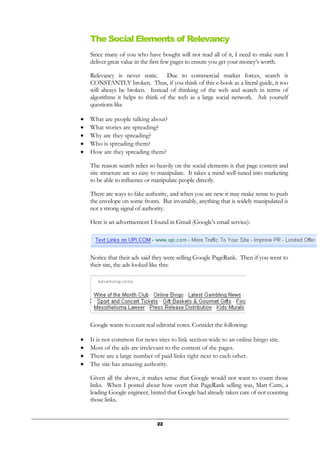
Here is an advertisement I found in Gmail (Google’s email service):
Notice that their ads said they were selling Google PageRank. Then if you went to
their site, the ads looked like this:
Google wants to count real editorial votes. Consider the following:
• It is not common for news sites to link section-wide to an online bingo site.
• Most of the ads are irrelevant to the content of the pages.
• There are a large number of paid links right next to each other.
• The site has amazing authority.
Given all the above, it makes sense that Google would not want to count those
links. When I posted about how overt that PageRank selling was, Matt Cutts, a
leading Google engineer, hinted that Google had already taken care of not counting
those links.
23
And since UPI is a slow moving, 100 year-old company, the fact that they are
selling PageRank should also tell you that Google’s relevancy algorithms have
moved far beyond just considering PageRank. I have PageRank 5 sites that get 100
times the traffic that some of my PageRank 7 sites do, because they have better
content and a more natural link profile.
If you do buy links, think of the page as though you were an editor for a search
engineer. Does the link look like it is a natural part of the page? Or is it an
obviously purchased link?
What if instead of thinking of ways to try to create false authority, you looked at the
web in terms of a social network, where the best ideas and the best marketed ideas
spread? Now that might get you somewhere.
Starting from Broke
What if you are starting with nothing? Can you still compete? Of course you can.
At the end of 2002, I got kicked out of the military for using drugs. At that point, I
was experiencing a number of things:
• Suicidal depression
• Financial bankruptcy, living on credit cards
• Social isolation
• Ignorance to the web, SEO, and marketing (slightly less serious, I know)
Within 4 years, I had pulled myself out of this emotional and psychological slump,
and had achieved success:
• I was fairly knowledgeable about the web, SEO, and marketing.
• I had made lots of friends.
• I was getting mentioned in the Wall Street Journal (and many other
newspapers).
• I was speaking at colleges about SEO (one college even wanted to hire me to
become a professor).
• I had venture capitalists offering to invest in this site.
• I had a mainstream publisher offer to publish this book.
• I got married to the most wonderful woman in the world
What did I have that allowed me to do well? I had a passion for learning. That
passion helped me attract great friends who took me under their wing and helped
me far more than I could have ever expected. It takes time to do well, but if you
keep pushing, keep learning, keep sharing, and are trying to help others, eventually
you will do well on the web.
Many true web authorities started out as topical hubs. People who had no intent of
creating a business would just freely talk about a subject they loved, and linked out
to related websites they found useful. Every web marketer should read this post:
24
http://chartreuse.wordpress.com/2006/09/18/why-paris-hilton-is-famous-or-understanding-value-
in-a-post-madonna-world/
You become a platform worthy of attention by talking about others who are
worthy of attention. Getting people to pay attention is a real cost. You have to get
people to pay attention before you can extract value from your work.
To most people, the single most relevant and important thing in the world is
themselves.
Here is a quote from Radiohead’s Meeting People is Easy:
If you have been rejected many times in your life, then one more
rejection isn't going to make much difference. If you're rejected,
don't automatically assume it's your fault. The other person may
have several reasons for not doing what you are asking her to do:
none of it may have anything to do with you. Perhaps the person
is busy or not feeling well or genuinely not interested in spending
time with you. Rejections are part of everyday life. Don't let them
bother you. Keep reaching out to others. When you begin to
receive positive responses then you are on the right track. It's all a
matter of numbers. Count the positive responses and forget about
the rejections.
You are not always going to be able to predict what will work and what doesn’t, but
the more you keep learning and the more things you try the better the odds are that
something will stick. Internet marketing is just like offline marketing, but cheaper,
faster, and more scalable.
Social scientists have studied why things become popular, and many things are
popular only because they are already popular. In Is Justin Timberlake a Product of
Cumulative Advantage Duncan J. Watts wrote about how groups tended to like the
same things, but random different things in each group. Even if success is random
and unpredictable there is a self reinforcing effect to marketing.
http://www.nytimes.com/2007/04/15/magazine/15wwlnidealab.t.html
If you keep reaching out to people you will be successful. It might take 3 months.
It might take 5 years. But eventually it will happen.
Questions, Comments & Concerns
Some people ask me to do ten hours worth of competitive analysis for free.
Generally, I cannot do hours of consulting for free, but if you have a quick
question or do not understand something, please make sure you e-mail me so I can
try my best to help you.
You bought this book hoping to get useful and easy-to-understand information,
and my goal is to give that to you. I have probably read millions of forum posts and
web pages, so many of the random thoughts scattered throughout this e-book
might not make a bunch of sense to someone who has not done the same. Some
25
of the ideas came from errors I made on my sites, and some of them came from
errors friends made.
Most sites do not end up getting banned or penalized from search engines without
reason, although on rare occasion it does happen. Sometimes engines are quick to
respond, and sometimes they do not care much. As you learn more about why
they do certain things and how the business aspects play into the algorithms, it
becomes easier to evaluate where they might go and how they might try to go
there.
SEO is both reactive and proactive.
If a section of my e-book is not clear to you or does not make sense, then that is
my fault and I should explain it to you. Feel free to send me an e-mail if you have
ANY questions.
This book is primarily my voice and how I understand the web. To help give you a
broader perspective, I also interviewed many search, marketing, and web experts. I
recommend you also read the bonus interviews at http://www.seobook.com/seo-
interviews.pdf.
Best of luck with your sites,
-Aaron
seobook@gmail.com
Interactive Elements
Literature
Chartreuse. “Why Paris Hilton is Famous (Or Understanding Value In a
Post- Madonna World).” 2006. Chartreuse Internet Media
Network Management. 18 September 2006.
<http://chartreuse.wordpress.com/2006/09/18/why-paris-
hilton- is- famous-or-understanding-value-in-a-post-
madonna-world/>.
Wall, Aaron. “SEO Glossary.” SEO Book. 02 December 2006. <http://
www.seobook.com/glossary/>.
---. “SEO Interviews.” SEO Book. 02 December 2006. <http://
www.seobook.com/seo-interviews.pdf/>.
Watts, Duncan J. “Is Justin Timberlake a Product of Cumulative
Advantage” New York Times. 15 April 2007.
<http://www.nytimes.com/2007/04/15/magazine/15wwlnidealab.t.ht
ml>.
26
Why Search?
Search engines take advantage of reverse broadcast networks to help save time and
money. They are instant answer systems that provide ultra-targeted advertising.
Search allows you to sell what your customers want, when they want it.
Finding Prospects
I had just finished reading Permission Marketing by Seth Godin when I became
engaged in one of the most interesting chat sessions of my life. A random kid
from California instant messaged me to say hello. In much the same way as other
marketers do, he scouted the web to find his ideal client. This guy searched
through Yahoo! profiles and found that on my profile I wrote that I collected
baseball cards.
He wanted to know if Barry Bonds was my favorite player. He told me he had over
16,000 Barry Bonds cards. I told him that I had an autographed serial numbered
Barry Bonds rookie, but baseball cards did not mean much to me anymore.
I asked if he did business over the Internet. He, of course, said no. It was clear to
me why. He had no way to display any of his cards, and he was using spam to
contact people. I asked him if he wanted to have a website on which to sell his
cards.
He told me he couldn’t afford it; he said that it was too expensive. But, I thought,
what is a fair price for limitless distribution?
Baseball cards, like many collectible commodities, usually drop in value rather
sharply once a player retires or that collectible goes out of fashion. Not only does
the price drop, but demand plummets. It’s a logarithmic loss of value. I have
picked up Robin Yount and Dave Winfield rookies for $5 and $8 each; both cards
went for $100 or more in their heyday.
This kid wanted to buy my autographed Barry Bonds rookie card to add to his
16,000 Bonds cards. Even though he‘ll never sell them, he thought he was doing
business. I sold baseball cards back in high school, and I knew how to do it well.
But I did not know it well when I started. I was trying to sell expensive cards to
Chapter
1
With search you do not
hunt for your customers.
While they are actively
interested in your products
or services, they hunt for
you.
27
people who did not want to spend much money. What did I learn? Sell what your
customers want, when they want it.
I still displayed some of my $400 and up baseball cards, just to get the “oohs” and
“ahhs.” I learned that once you have a crowd, many people follow just to see what
is going on, and then you can make sales. I knew I would not sell these cards. So
what did I change?
I created a display case with stacks of all the major stars and local popular players.
Each card was $1.00. It did not matter if the card was worth twenty-five cents or
four dollars; I just put $1.00 on each of them. I kept up with whom was doing well
and would buy up cards of players that were about to become popular. Buy-price
ranged from three cents to a quarter a card. Most of the cards I bought were
considered ‘junk’ by the sellers, yet I re-sold most within a month or two.
By taking the time to go through their junk and making ordering simple, I made
money. That $1 display case was a gold mine. Usually, that case sold more cards
than my good cases did. Also, I had very little invested—other than taking the time
to organize the cards.
So, I decided I would do this kid a favor and send him a free book on
marketing from my favorite author. When I asked him if he wanted a free
marketing book, he got angry, even though I was trying to help him. Instead
of considering my offer, he spouted off Eminem lyrics, telling me that “[he'd]
rather put out a mother****ing gospel record.”
All of his frustration, all of his anger, and all of his wasted time were unnecessary.
That is why search is powerful. You do not hunt for your customers, they hunt for
you. You pick the keywords, and the customer picks you. You not only sell what
your customers want, but you also sell it while they are actively looking for it.
The $1 baseball card case is a good analogy for effective search engine
optimization. Imagine the cards in that case as being web pages. It is great to rank
well for a term like SEO, but by ranking well for various small volume searches you
may be able to make far more money in the long run. Longer search phrases have
more implied intent, thus are far more targeted, and convert at a higher rate.
Having a social element to your site or business is like having the $400 baseball
card in the case. The people who reference the interesting parts of your site build
up your authority. Based on that authority, search engines learn to trust other parts
of your site and send visitors to those pages, as well.
You can think of web traffic like my baseball cards. Due to the vastness of the
market and market inefficiencies, there will always be many ways to make money.
If you learn how to spread ideas and build an audience, you can make a windfall of
profits.
Interactive Elements
Literature
28
Godin, Seth. Permission Marketing. New York: Simon & Schuster,
1999. (http://
www.amazon.com/exec/obidos/ASIN/0684856360/.)
Some Notes
• List five problems your product or products solve. Which of these
problems are most important to your target audience?
• Is there a problem your product solves that no other products do?
• Do you have a UNIQUE value proposition that will help you stand out in
the crowd? (This could be being better targeted, more up-to-date, faster,
more reliable, safer, etc.). What do you do better than anyone else?
• List ten terms or phrases your target audience would search for to find
your products.
• Calculate the time you spend prospecting clients and the value of that time.
• Calculate the money you will save if you cut that time in half by ranking
well for a few of the terms you listed.
29
Brief History of the Web
The web has become a direct marketer's dream. In its infancy, the web was based
around the core idea of sharing knowledge. The closer your ideas are in some way
aligned with this idea, the easier it will be to promote your site.
The Goal of Search Engines & How They Work
Search Engine Relevancy
Many people think search engines have a hidden agenda. This simply is not true.
The goal of the search engine is to provide high-quality content to people searching
the Internet.
Search engines with the broadest distribution network sell the most advertising
space. As I write this, Google is considered the search engine with the best
relevancy. Their technologies power the bulk of web searches.
The Problem Listing a New Site
The biggest problem new websites have is that search engines have no idea they
exist. Even when a search engine finds a new document, it has a hard time
determining its quality. Search engines rely on links to help determine the quality
of a document. Some engines, such as Google, also trust websites more as they
age.
The following bits may contain a few advanced search topics. It is fine if you do
not necessarily understand them right away; the average webmaster does not need
to know search technology in depth. Some might be interested in it, so I have
written a bit about it with those people in mind. (If you are new to the web and
uninterested in algorithms, you may want to skip past this to the search result
image on page 35.)
I will cover some of the parts of the search engine in the next few pages while
trying to keep it somewhat basic. It is not important that you fully understand all
of it (in fact, I think it is better for most webmasters if they do not worry about
things like Inverse Document Frequency, as I ranked well for competitive SEO-
related terms without knowing anything about the technical bits of search);
however, I would not feel right leaving the information out.
Chapter
2
30
Gerard Salton
The phrase vector space model, which search algorithms still heavily rely upon today,
goes back to the 1970s. Gerard Salton was a well-known expert in the field of
information retrieval who pioneered many of today’s modern methods. If you are
interested in learning more about early information retrieval systems, you may want
to read A Theory of Indexing, which is a short book by Salton that describes many of
the common terms and concepts in the information retrieval field.
Mike Grehan’s book, Search Engine Marketing: The Essential Best Practices Guide, also
discusses some of the technical bits to information retrieval in more detail than this
book. My book was created to be a current how-to guide, while his is geared more
toward giving information about how information retrieval works.
Parts of a Search Engine
While there are different ways to organize web content, every crawling search
engine has the same basic parts:
• a crawler
• an index (or catalog)
• a search interface
Crawler (or Spider)
The crawler does just what its name implies. It scours the web following links,
updating pages, and adding new pages when it comes across them. Each search
engine has periods of deep crawling and periods of shallow crawling. There is also
a scheduler mechanism to prevent a spider from overloading servers and to tell the
spider what documents to crawl next and how frequently to crawl them.
Rapidly changing or highly important documents are more likely to get crawled
frequently. The frequency of crawl should typically have little effect on search
relevancy; it simply helps the search engines keep fresh content in their index. The
home page of CNN.com might get crawled once every ten minutes. A popular,
rapidly growing forum might get crawled a few dozen times each day. A static site
with little link popularity and rarely changing content might only get crawled once
or twice a month.
The best benefit of having a frequently crawled page is that you can get your new
sites, pages, or projects crawled quickly by linking to them from a powerful or
frequently changing page.
31
The Index
The index is where the spider-collected data are stored. When you perform a
search on a major search engine, you are not searching the web, but the cache of
the web provided by that search engine’s index.
Reverse Index
Search engines organize their content in what is called a reverse index. A reverse
index sorts web documents by words. When you search Google and it displays 1-
10 out of 143,000 websites, it means that there are approximately 143,000 web
pages that either have the words from your search on them or have inbound links
containing them. Also, note that search engines do not store punctuation, just
words.
The following is an example of a reverse index and how a typical search engine
might classify content. While this is an oversimplified version of the real thing, it
does illustrate the point. Imagine each of the following sentences is the content of
a unique page:
The dog ate the cat.
The cat ate the mouse.
Word Document # Position #
The 1,2 1-1, 1-4, 2-1, 2-4
Dog 1 2
Ate 1,2 1-3, 2-3
Cat 1,2 1-5, 2-2
Mouse 2 5
Storing Attributes
Since search engines view pages from their source code in a linear format, it is best
to move JavaScript and other extraneous code to external files to help move the
page copy higher in the source code.
Some people also use Cascading Style Sheets (CSS) or a blank table cell to place the
page content ahead of the navigation. As far as how search engines evaluate what
words are first, they look at how the words appear in the source code. I have not
done significant testing to determine if it is worth the effort to make your unique
32
page code appear ahead of the navigation, but if it does not take much additional
effort, it is probably worth doing. Link analysis (discussed in depth later) is far
more important than page copy to most search algorithms, but every little bit can
help.
Google has also hired some people from Mozilla and is likely working on helping
their spider understand how browsers render pages. Microsoft published visually
segmenting research that may help them understand what page content is most
important.
As well as storing the position of a word, search engines can also store how the
data are marked up. For example, is the term in the page title? Is it a heading?
What type of heading? Is it bold? Is it emphasized? Is it in part of a list? Is it in
link text?
Words that are in a heading or are set apart from normal text in other ways may be
given additional weighting in many search algorithms. However, keep in mind that
it may be an unnatural pattern for your keyword phrases to appear many times in
bold and headings without occurring in any of the regular textual body copy. Also,
if a page looks like it is aligned too perfectly with a topic (i.e., overly-focused so as
to have an abnormally high keyword density), then that page may get a lower
relevancy score than a page with a lower keyword density and more natural page
copy.
Proximity
By storing where the terms occur, search engines can understand how close one
term is to another. Generally, the closer the terms are together, the more likely the
page with matching terms will satisfy your query.
If you only use an important group of words on the page once, try to make sure
they are close together or right next to each other. If words also occur naturally,
sprinkled throughout the copy many times, you do not need to try to rewrite the
content to always have the words next to one another. Natural sounding content is
best.
Stop Words
Words that are common do not help search engines understand documents.
Exceptionally common terms, such as the, are called stop words. While search
engines index stop words, they are not typically used or weighted heavily to
determine relevancy in search algorithms. If I search for the Cat in the Hat, search
engines may insert wildcards for the words the and in, so my search will look like
* cat * * hat.
Index Normalization
Each page is standardized to a size. This prevents longer pages from having an
unfair advantage by using a term many more times throughout long page copy.
This also prevents short pages for scoring arbitrarily high by having a high
33
percentage of their page copy composed of a few keyword phrases. Thus, there is
no magical page copy length that is best for all search engines.
The uniqueness of page content is far more important than the length. Page copy
has three purposes above all others:
• To be unique enough to get indexed and ranked in the search result
• To create content that people find interesting enough to want to link
to
• To convert site visitors into subscribers, buyers, or people who click
on ads
Not every page is going to make sales or be compelling enough to link to, but if, in
aggregate, many of your pages are of high-quality over time, it will help boost the
rankings of nearly every page on your site.
Keyword Density, Term Frequency & Term Weight
Term Frequency (TF) is a weighted measure of how often a term appears in a
document. Terms that occur frequently within a document are thought to be some
of the more important terms of that document.
If a word appears in every (or almost every) document, then it tells you little about
how to discern value between documents. Words that appear frequently will have
little to no discrimination value, which is why many search engines ignore common
stop words (like the, and, and or).
Rare terms, which only appear in a few or limited number of documents, have a
much higher signal-to-noise ratio. They are much more likely to tell you what a
document is about.
Inverse Document Frequency (IDF) can be used to further discriminate the value
of term frequency to account for how common terms are across a corpus of
documents. Terms that are in a limited number of documents will likely tell you
more about those documents than terms that are scattered throughout many
documents.
When people measure keyword density, they are generally missing some other
important factors in information retrieval such as IDF, index normalization, word
proximity, and how search engines account for the various element types. (Is the
term bolded, in a header, or in a link?)
Search engines may also use technologies like latent semantic indexing to
mathematically model the concepts of related pages. Google is scanning millions
of books from university libraries. As much as that process is about helping people
find information, it is also used to help Google understand linguistic patterns.
If you artificially write a page stuffed with one keyword or keyword phrase without
adding many of the phrases that occur in similar natural documents you may not
34
show up for many of the related searches, and some algorithms may see your
document as being less relevant. The key is to write naturally, using various related
terms, and to structure the page well.
Multiple Reverse Indexes
Search engines may use multiple reverse indexes for different content. Most
current search algorithms tend to give more weight to page title and link text than
page copy.
For common broad queries, search engines may be able to find enough quality
matching documents using link text and page title without needing to spend the
additional time searching through the larger index of page content. Anything that
saves computer cycles without sacrificing much relevancy is something you can
count on search engines doing.
After the most relevant documents are collected, they may be re-sorted based on
interconnectivity or other factors.
Around 50% of search queries are unique, and with longer unique queries, there is
greater need for search engines to also use page copy to find enough relevant
matching documents (since there may be inadequate anchor text to display enough
matching documents).
Search Interface
The search algorithm and search interface are used to find the most relevant
document in the index based on the search query. First the search engine tries to
determine user intent by looking at the words the searcher typed in.
These terms can be stripped down to their root level (e.g., dropping ing and other
suffixes) and checked against a lexical database to see what concepts they represent.
Terms that are a near match will help you rank for other similarly related terms.
For example, using the word swims could help you rank well for swim or
swimming.
Search engines can try to match keyword vectors with each of the specific terms in
a query. If the search terms occur near each other frequently, the search engine
may understand the phrase as a single unit and return documents related to that
phrase.
WordNet is the most popular lexical database. At the end of this chapter there is a
link to a Porter Stemmer tool if you need help conceptualizing how stemming
works.
35
Searcher Feedback
Some search engines, such as Google and Yahoo!, have toolbars and systems like
Google Search History and My Yahoo!, which collect information about a user.
Search engines can also look at recent searches, or what the search process was for
similar users, to help determine what concepts a searcher is looking for and what
documents are most relevant for the user’s needs.
As people use such a system it takes time to build up a search query history and a
click-through profile. That profile could eventually be trusted and used to
• aid in search personalization
• collect user feedback to determine how well an algorithm is working
• help search engines determine if a document is of decent quality (e.g.,
if many users visit a document and then immediately hit the back
button, the search engines may not continue to score that document
well for that query).
I have spoken with some MSN search engineers and examined a video about MSN
search. Both experiences strongly indicated a belief in the importance of user
acceptance. If a high-ranked page never gets clicked on, or if people typically
quickly press the back button, that page may get demoted in the search results for
that query (and possibly related search queries). In some cases, that may also flag a
page or website for manual review.
As people give search engines more feedback and as search engines collect a larger
corpus of data, it will become much harder to rank well using only links. The more
satisfied users are with your site, the better your site will do as search algorithms
continue to advance.
Real-Time versus Prior-to-Query Calculations
In most major search engines, a portion of the relevancy calculations are stored
ahead of time. Some of them are calculated in real time.
Some things that are computationally expensive and slow processes, such as
calculating overall inter-connectivity (Google calls this PageRank), are done ahead
of time.
Many search engines have different data centers, and when updates occur, they roll
from one data center to the next. Data centers are placed throughout the world to
minimize network lag time. Assuming it is not overloaded or down for
maintenance, you will usually get search results from the data centers nearest you.
If those data centers are down or if they are experiencing heavy load, your search
query might be routed to a different data center.
36
Search Algorithm Shifts
Search engines such as Google and Yahoo! may update their algorithm dozens of
times per month. When you see rapid changes in your rankings, it is usually due to
an algorithmic shift, a search index update, or something else outside of your
control. SEO is a marathon, not a sprint, and some of the effects take a while to
kick in.
Usually, if you change something on a page, it is not reflected in the search results
that same day. Linkage data also may take a while to have an effect on search
relevancy as search engines need to find the new links before they can evaluate
them, and some search algorithms may trust links more as the links age.
The key to SEO is to remember that rankings are always changing, but the more
you build legitimate signals of trust and quality, the more often you will come out
on top.
Relevancy Wins Distribution!
The more times a search leads to desired content, the more likely a person is to use
that search engine again. If a search engine works well, a person does not just
come back, they also tell their friends about it, and they may even download the
associated toolbar. The goal of all major search engines is to be relevant. If they
are not, they will fade (as many already have).
Search Engine Business Model
Search engines make money when people click on the sponsored advertisements.
In the search result below you will notice that both Viagra and Levitra are bidding
on the term Viagra. The area off to the right displays sponsored advertisements for
the term Viagra. Google gets paid whenever a searcher clicks on any of the
sponsored listings.
The white area off to the left displays the organic (free) search results. Google does
not get paid when people click on these. Google hopes to make it hard for search
engine optimizers (like you and I) to manipulate these results to keep relevancy as
high as possible and to encourage people to buy ads.
Later in this e-book we will discuss both organic optimization and pay-per-click
marketing.
37
Image of Search Results
Origins of the Web
The Web started off behind the idea of the free flow of information as envisioned
by Tim Berners-Lee. He was working at CERN in Europe. CERN had a
somewhat web-like environment in that many people were coming and going and
worked on many different projects.
Tim created a site that described how the Web worked and placed it live on the
first server at info.cern.ch. Europe had very little backing or interest in the Web
back then, so U.S. colleges were the first groups to set up servers. Tim added links
to their server locations from his directory known as the Virtual Library.
Current link popularity measurements usually show college web pages typically
have higher value than most other pages do. This is simply a function of the
following:
• The roots of the WWW started in lab rooms at colleges. It was not until
the mid to late 1990s that the Web became commercialized.
• The web contains self-reinforcing social networks.
• Universities are pushed as sources of authority.
• Universities are heavily funded.
• Universities have quality controls on much of their content.
38
Early Search Engines
The Web did not have sophisticated search engines when it began. The most
advanced information gatherers of the day primitively matched file names. You
had to know the name of the file you were looking for to find anything. The first
file that matched was returned. There was no such thing as search relevancy. It
was this lack of relevancy that lead to the early popularity of directories such as
Yahoo!.
Many search engines such as AltaVista, and later Inktomi, were industry leaders for
a period of time, but the rush to market and lack of sophistication associated with
search or online marketing prevented these primitive machines from having
functional business models.
Overture was launched as a pay-per-click search engine in 1998. While the
Overture system (now known as Yahoo! Search Marketing) was profitable, most
portals were still losing money. The targeted ads they delivered grew in popularity
and finally created a functional profit generating business model for large-scale
general search engines.
Commercialized Cat & Mouse
Web = Cheap Targeted Marketing
As the Internet grew in popularity, people realized it was an incredibly cheap
marketing platform. Compare the price of spam (virtually free) to direct mail (~ $1
each). Spam fills your inbox and wastes your time.
Information retrieval systems (search engines) must also fight off aggressive
marketing techniques to keep their search results relevant. Search engines market
their problems as spam, but the problem is that they need to improve their
algorithms.
It is the job of search engines to filter through the junk to find and return relevant
results.
There will always be someone out there trying to make a quick buck. Who can fault
some marketers for trying to find holes in parasitic search systems that leverage
others’ content without giving any kickback?
Becoming a Resource
Though I hate to quote a source I do not remember, I once read that one in three
people believe the top search result is the most relevant document relating to their
search. Imagine the power associated with people finding your view of the world
first. Whatever you are selling, someone is buying!
39
I have been quoted as a source of information on Islam simply because I wrote
about a conversation I had with a person from Kuwait who called me for help on
the web. I know nothing about Islam, but someone found my post in a search
engine…so I was quoted in their term paper. College professors sourced some
sites I am embarrassed to admit I own.
Sometimes good things happen to you and sometimes the competition gets lucky.
Generally the harder you work, and the more original and useful your site is, the
more often you will get lucky.
Business Links
As easy as it is to get syndicated with useful interesting and unique information, it is
much harder to get syndicated with commercial ideas, especially if the site does not
add significant value to a transaction. Often times links associated with commercial
sites are business partnerships.
Many people do well to give information away and then attach a product to their
business model. You probably would have never read this e-book if I did not have
a blog associated with it. On the same note, it would also be significantly easier for
me to build links to SEOBook.com if I did not sell this e-book on it.
Depending on your skills, faults, and business model, sometimes it is best to make
your official voice one site and then sell stuff on another, or add the commercial
elements to the site after it has gained notoriety and trust. Without knowing
you, it is hard to advise you which road to take, but if you build value before trying
to extract profits, you will do better than if you do it the other way around.
Ease of Reference
If my site was sold as being focused on search and I wrote an e-book or book
about power searching, it would be far easier for me to get links than running a site
about SEO. For many reasons, the concept of SEO is hated in many circles. The
concept of search is much easier to link at.
Sometimes by broadening, narrowing, or shifting your topic it becomes far easier
for people to reference you.
Primitive Search Technology
As the Web grew, content grew faster than technology did. The primitive nature of
search engines promoted the creation of content, but not the creation of quality
content. Search engines had to rely on the documents themselves to state their
purpose. Most early search engines did not even use the full page content either,
relying instead on page title and document name to match results. Then came
along meta tags.
40
Meta Tags
Meta tags were used to help search engines organize the Web. Documents listed
keywords and descriptions that were used to match user queries. Initially these tags
were somewhat effective, but over time, marketers exploited them and they lost
their relevancy.
People began to stuff incredibly large amounts of data (which was frequently off
topic) into these tags to achieve high search engine rankings. Porn and other high-
margin websites published meta tags like “free, free, free, free, Disney, free.”
Getting a better ranking simply meant you repeated your keywords a few more
times in the meta tags.
Banners, Banners, Banners
It did not help anything that during the first Web bubble stocks were based on
eyeballs, not profits. That meant that people were busy trying to buy any type of
exposure they could, which ended up making it exceptionally profitable to spam
search engines to show off topic random banners on websites.
The Bubble Burst
The Internet bubble burst. What caused such a fast economic recovery was the
shift from selling untargeted ad impressions to selling targeted leads. This meant
that webmasters lost much of their incentive for trying to get any kind of traffic
they could. Suddenly it made far greater sense to try to get niche-targeted traffic.
In 1998, Overture pioneered the pay-per-click business model that most all major
search engines rely on. Google AdWords enhanced the model by adding a few
more variables to the equation—the most important one is factoring ad click-
through rate (CTR) into the ad ranking algorithm.
Google extended the targeted advertisement marketing by delivering relevant
contextual advertisements on publisher websites via the Google AdSense program.
More and more ad spending is coming online because it is easy to track the return
on investment. As search algorithms continue to improve, the value of having
well-cited, original, useful content increases daily.
Advancing Search Technology
Instead of relying exclusively on page titles and meta tags, search engine now index
the entire page contents. Since search engines have been able to view entire pages,
the hidden inputs (such as meta tags) have lost much of their importance in
relevancy algorithms.
The best way for search engines to provide relevant results is to emulate a user and
rank the page based on the same things the user see and do (Do users like this
website? Do they quickly hit the back button?), and what other people are saying
41
about the document (For example, does anybody link to this page or site? Who is
linking at it? What is the link text? And so on.).
What is Search Engine Spam?
Search engines make billions of dollars each year selling ads. Most search engine
traffic goes to the free, organically listed sites. The ratio of traffic distribution is
going to be keyword dependent and search engine dependent, but I believe about
85% of Google’s traffic clicks on the organic listings. Most other search engines
display ads a bit more aggressively than Google does. In many of those search
engines, organic listings get around 70% of the traffic. Some sites rank well on
merit, while others are there due exclusively to ranking manipulation.
In many situations, a proper SEO campaign can provide a much greater ROI than
paid ads do. This means that while search engine optimizers—known in the
industry as SEOs—and search engines have business models that may overlap,
they may also compete with one another for ad dollars. Sometimes SEOs and
search engines are friends with each other, and, unfortunately, sometimes they are
enemies.
When search engines return relevant results, they get to deliver more ads. When
their results are not relevant, they lose market share. Beyond relevancy, some
search engines also try to bias the search results to informational sites such that
commercial sites are forced into buying ads.
I have had a single page that I have not actively promoted randomly send me
commission checks for over $1,000. There is a huge sum of money in
manipulating search results. There are ways to improve search engine placement
that go with the goals of the search engines, and there are also ways that go against
them. Quality SEOs aim to be relevant, whether or not they follow search
guidelines.
Many effective SEO techniques may be considered somewhat spammy.
Like anything in life, you should make an informed decision about which SEO
techniques you want to use and which ones you do not (and the odds are, you care
about learning the difference, or you wouldn’t be reading this).
You may choose to use highly aggressive, “crash and burn” techniques, or slower,
more predictable, less risky techniques. Most industries will not require extremely
aggressive promotional techniques. Later on I will try to point out which
techniques are which.
Using Overtly Manipulative Techniques
While there will always be ways to manipulate the search engines, there is no telling
if you will eventually get caught and lose your rankings if you optimize your site
42
using overtly deceptive techniques. In any business such as SEO, there will be
different risk levels.
Search engines try hard not to flag false positives (label good sites as spam), so
there is usually a bunch of slack to play with, but many people also make common
mistakes, like incorrectly using a 302 redirect, or not using specific page titles on
their pages, or allowing spiders to index multiple URLs with the same content. If
you are ever in doubt if you are making technical errors, feel free to search a few
SEO forums or ask me.
The search engines aim to emulate users. If you design good content for users and
build a smart linking campaign, eventually it will pay off.
New aggressive techniques pop up all the time. As long as they are available,
people will exploit them. People will force the issue until search engines close the
loophole, and then people will find a new one. The competitive nature of web
marketing forces search engines to continuously improve their algorithms and
filters.
In my opinion, the ongoing effort of keeping up with the latest SEO tricks is
usually not worth it for most webmasters. Some relational database programmers
and people with creative or analytical minds may always be one step ahead, but the
average business owner probably does not have the time to dedicate to keeping up
with the latest tricks.
Tying ethics to SEO techniques is a marketing scam. Either a technique is
effective, or it is not. There is nothing unethical about being aggressive. You
probably do not want to take big risks with domains you cannot afford to have
blacklisted, but there is nothing wrong with owning a few test sites.
Following Google’s Guidance
Some sites that are not aggressively promoted still fall out of favor on occasion. As
a webmaster following Google’s guidelines, you still can not expect Google to owe
you free traffic. You have to earn it by making others cite your website.
SEO Feedback Loop
The effects of SEO do take time to kick in. At any given time, considering how
dynamically the web changes, there will be some holes in search algorithms that
make certain SEO techniques exceptionally effective.
I have spoken with current search engine engineers working at major search
engines in regards to this e-book. I also have spoken with database programmers
who later became some of the world’s most technically advanced SEOs. Some of
these programmers have told me what some would consider tricks that work really
well, but they only work really well because few people know about them.
43
I do not try to promote the latest search spamming techniques in this e-book for
the following reasons:
• They are the most likely to quickly change. Some things that are
cutting-edge and effective today can become ineffective and actually
hurt you tomorrow.
• Some of them can be damaging to your brand.
• Aggressive techniques are the some of the most likely techniques to get
your site banned.
• Some things are told to me as a secret, and if they are made openly
available to anyone (including search engine engineers—some who
have read this e-book), then they lose their value, and I lose my friends
and resources.
• I do not have a lot of experience with exceptionally aggressive
promotional techniques, as I have not needed them to rank well in
most the markets I worked in.
• People who use aggressive techniques are not evil or bad, but I cannot
possibly put accurate, current, useful, and risky information out to
everyone in an e-book format and expect it to not cause problems for
some people.
• To me, effective web promotion is balancing risk versus reward.
SEOBook.com got on the first page of Google for SEO within nine
months of making the site, with less than $5,000 spent on promotion.
Most sites do not need to use overly aggressive and risky promotional
techniques. SEO works so well because most sites on the web do not
actively practice effective SEO.
Choosing a Domain Name
Optional Business Models
Many web-based businesses fail because they do not have a functional business
model. Before you even choose a name for your site you should know your target
audience, what you intend to sell to them, and what will make your business idea
unique or different than everything else that is already on the market.
You can still make significant profits without being sure what you want to sell if
you can solve large problems and make life easier for a group of targeted people.
At any level, you still have to know your goals and the reasons why you are creating
a site. What makes your site different than the millions of sites already published?
My first few sites failed because they had no functional business models. They
added little value to the web. That is not to say that I didn’t learn from them,
because I did, but they led me to creating this one. If you are uncertain of yourself,
don’t be afraid to create multiple channels just to try them out. If you know you
want to do something for the long run, you may want to spend a bit of time
Before you pick a domain
name, it helps to know
your target audience, what
you intend to sell to them,
and what makes your site
unique or different than
everything else that is
already on the market.
44
watching the marketplace before pouring too much effort into making a huge site
that is hard to update.
SEOBook.com has done exceptionally well, and it has even revived the value and
business models of some of my other sites. The single biggest thing I have going
for me is the social currency my blog has created.
A Horrible Domain Idea
Some people think it is incredibly important to have keywords in a domain. People
purchase domains like look-4-buy-cheap-discount-viagra-online-pharmacy.com.
This is a horrible domain name!
An exact matching domain name in a competitive market can be seen by Google as
a signal of quality since acquiring one would either indicate that you were early to
the market or paid a premium for the URL. Some strong .com names sell for
millions of dollars, while associated .net and .org domains can range from a few
hundred dollars to a hundred thousand dollars.
If your site exhibits a number of strong brand related characteristics, such as high
search volume for brand related keywords, high clickthrough rate for core brand
related searches, many repeat visitors, or relevant matching URL and/or anchor
text, there is a good chance that Google will place a set of Sitelinks in the search
results for brand related search queries.
For example, if someone searches for SEO Book, Google shows the following as
the top result
Keywords in the domain name may help some (as people tend to link to websites
using their official names as the link text), but if I were going to create a long-term
business, I would put brand above keyword-rich, unless you can find a name that
exactly matched your core keywords or something that allows you to leverage both
assets.
If you are creative, you usually can get keywords in the domain while keeping it
short, memorable, fairly brandable, and free of hyphens.
Here is an article about the effect of domain names on anchor text
(http://www.search-marketing.info/newsletter/articles/domain-name.htm). Since
I originally wrote the article, Google has gotten a lot better at detecting natural
45
linkage data, so it is important to ensure you mix your inbound link text. Tips on
mixing anchor text are located in the link building sections of this e-book.
Dashed Domain Names
Direct marketing mail campaigns usually peak in effectiveness around the third
exposure to a marketing message. Many shoppers look around. If you want them
to come back, you want to have a domain name that will stick in their heads. It can
have keywords in it, but the thing you want more than anything else is a name that
sticks.
If the option between having the dash in the domain and not having a dash exists,
you are probably better off going without the dash as it looks more professional
and would most likely be more memorable.
It is branding suicide to only have users find your site via search engines. If you are
hoping to make sales on the first view in search engines, you need strong
copywriting and usability.
If you are just using quick-buck-lead-generation websites then you may want to use
a keyword-rich hyphenated domain for the small benefit it may offer, but in most
cases, I do not recommend a hyphenated domain name for long-term websites.
Long versus Short URLs
People will forget the words in a domain name that is exceptionally long. Another
problem with exceptionally long URLs is that they get cut off in e-mails and some
other data transmission types. If you make the idea hard to spread, then you limit
your site’s potential income.
The Best of Both Worlds!
What if you could get some of the benefits of a long keyword rich domain while
still using a shorter and easy to brand domain name? You can!
If you use a short, branded domain, you can still include your keywords in your
page title and logo to help control how some people link at your site. For example,
a company like PayPal can register the domain Paypal.com, but put the words
payment solutions or online payments in their logo near the word PayPal. Some people
will reference them with those words as part of the company name.
Search engines associate words that occur near one another. For example,
Google showed the following as suggested advertisements.
On the far right notice how Google realized that my name and the name of my
strongest brand are related.
Using your keywords in
your domain name can
increase click-through
rates on search engine
listings and paid ads as
well as make it easier to
get keyword-rich inbound
links. But you want to
consider balancing the
effects on brand and your
long-term goals before
deciding what name to
use.
46
If you can work your name or your company name into the default topical
vocabulary of a search, you will have a strong advantage over your competitors.
Location & Top-Level Domain (TLD) Selection
Some regional-based search engines or indexes will only list sites that are registered
in their country code. If your site exclusively or primarily caters to a specific
country, then you will most likely want to register a domain using the local country
code.
Some search engines will still show your site in regional based search results if your
site is hosted within that country, has links to and from other local sites, and/or has
your address and phone number in the page text, but many directories are
extremely picky and will only list regional domains.
As search progresses, localization of results will become more common. Some of
the major search engines already give sites a regional ranking boost based upon
where the site is hosted and the domain extension.
If you develop a regional domain (.co.uk for example), I also suggest buying the
.com version of your domain, if it is available, and forwarding it to the regional
domain you registered. By buying the .com version and forwarding it your site, you
help retain traffic you may have lost by people forgetting to put your region
specific domain extension in their address bar when they type the website address
directly into the address bar.
I prefer to use a .com version of a URL over other generic TLDs. People may
assume your site is a .com even if it is .net, .biz, .org, or .info when they go to look
for it on the web. If all they remember is your domain name, they may type your
domain name followed by ‘.com’ because ‘.com’ is the default TLD in most
people’s heads. If you don’t own the .com version as well, you are giving some of
your hard-earned traffic to a competitor.
If you are running a charity or organizational website a .org may be seen by some
people as a sign of credibility.
It is a good idea to place your business location on your web pages. If you are in a
country where the search technology is primitive, local searchers will frequently add
the country or city name to their searches, and if you have them on your pages you
stand to be returned as a relevant result for more searches.
Have a Site for Each Language
Many hucksters sell some translational cross-submission products that are
complete bunk. Essentially you pay them money to accept your check and nothing
more. Search engines typically do not translate text on the fly when people
search—it is too computationally expensive.
47
If you use automated software to copy your text into a different language, it is likely
to read clumsily and turn people off. You are better off not having the text on the
web if you do not have a person fluent in the language proof the final page copy.
If you have significant content and target audiences in different languages, then
usually you will want to have a different subdomain or site for each language or
major market. This will make it easier to get links from the different geographic or
ethnic communities you are interested in without the losing focus of your site. It
also makes it easy for engines to understand the clear divisions in your site.
Subdomains & Local Markets
Subdomains are best to use if you have a small amount of content about each
market. If you have significant content for each market, it may make more sense
to create a site for each market.
If your site is in an exceptionally competitive category and you have many links that
would be hard to replicate, then you might want to use folders (or possibly
subdomains) on your main site for each language instead of trying to build up the
link popularity of many different sites.
U.K. English is much different than English in the United States. Even within the
same language you may need multiple versions to cater to different dialects,
customs, and tastes.
Subdomains in General
If your main site is a thin e-commerce site, or if it lacks authority, it might make
sense to keep most of your authoritative content together with the low authority
content. But if your site has great authority, then using a subdomain for some of
your content should allow you to get more listings in the search results.
An advantage of placing some of your content on a subdomain is that if you have a
strong brand and the subdomain is also authoritative, then when people search for
your brand some search engines will feature both your domain and the subdomain
at the top of the search results, and searchers will have to scroll a long way down to
find competing sites or sites that are critical of your brand.
Branding Your Domain Name
Any more than about two or three words in a domain name and it becomes less
memorable. Some of the most memorable websites do a great job of branding by
creating their own word: eBay, Skype, PayPal, Yahoo!, Expedia, Slashdot, Fark,
Travelocity, Google…
However, most successful businesses are soft innovations; they may not be able to
afford the time, money, and effort required to create, brand, and add a new word
to our language. You can create a name that is well-related to something people
already know. It is easier to market corn sugar than it is to market fructose.
48
If you are not going to develop a strong brand, then using keywords in your
domain name may give you a competitive advantage in search results. Having your
keywords in your domain name can increase click-through rates on search engine
listings and paid ads as well as make it easier to get keyword rich descriptive
inbound links.
If your brand is exceptionally strong and your content quality is second to none
you still can rank well in search results after enough related resources reference
your site, even if most references do not mention the keywords you want to rank
for. Google’s search algorithms have moved toward pushing natural authority sites
even if they do not have much relevant anchor text.
Branding Your Site
A keyword-rich domain name will make it easy to get inbound link text with your
primary keywords in them, but don’t forget that your domain name also plays a
role in your branding. Your domain name should have your branding in mind as it
can help reinforce the ideals of your brand.
On the web there are many different business ideas or business models. If low
cost is your business model, then you will find people who are willing to work for
half your wage that will slash throats to get by on razor thin margins. It is not a
way to enjoy life.
Someone can always do your job cheaper. For example, Google turned labeling
images into a game. Now thousands of people are labeling images, for free, to
improve Google’s image search relevancy. You can take a look at this process by
visiting http:// images.google.com/imagelabeler/.
Branding is one of the most important parts of building any website or web-based
business, and it is what allows you to establish healthy profit margins. Every
Monday, Rob Frankel holds free branding clinics on his website. I recommend
going to at least one of them and asking a question or two. He also wrote a great
branding book by the name of The Revenge of Brand X.
Leaving the Keyword Out
The site is not seriously launched yet, but a cool domain name for a site about
sleeping might be something like LikeABaby.com. Using a creative name makes it
easier to build a memorable brand than just focusing on keyword phrases.
Branding to an Audience Segment
A guy I met did not have a large marketing budget, but wanted to market a video
clip idea. I thought that it would be a great idea to use the viral nature of blogs to
market the initial product (i.e., let the bloggers market the product for us by word-
of-mouth, because word-of-mouth spreads like wildfire). I came up with the name
BlogFlix.net. The site later went under after some technical errors, but within a
few months of being finished, it was featured on popular sites such as Smart Mobs.
49
The Right Domain Name
I either make my domain names define themselves exactly or I think of a creative
way to state its purpose. Your best bet is to think of a name that is an extension of
who you are.
A short and easy to remember URL is friendly to word-of-mouth marketing.
Would you feel better referring a friend to seobook.com or seo-search-engine-
optimization-marketing-e-book-book.com? Which would be easier to remember
and say? If you make a message hard to spread, then it will probably spread at a
slower rate.
Buying Multiple Names
Often times it is worth it to buy multiple domain names, even if you do not use
them all. By securing multiple domain names you can decide to use some of your
secondary domains to cover similar thematically-related topics AND prevent
competitors from purchasing the name.
Within six months of my starting the SEOBook.com website, someone was
already spamming me trying to sell me SEOBooks.com. I should have spent the
additional $8 to register that domain from the start. You also may want to buy a
generic name and the domain name that matches your business, and direct them
both to the same location.
Example of Breaking Ideas Down into Niche Sites
I do not recommend buying multiple domain names exclusively for deceptive
practices. Many of my sites are about SEO, but you can break ideas down to their
core and make useful sites in less competitive markets.
For example, one site I own is Search-Marketing.info. This site is similar to the
contents of this e-book, although the site is somewhat dated. That site is not a
well-branded name. I had many concepts on that site that later were extracted and
made into their own sites:
● I had a blog at Search-Marketing.info; the blog was not successful. I
moved the blog from that site to SeoBook.com, and it has likely become
one of the top half dozen most popular blogs in the SEO industry.
● I had a directory list on Search-Marketing.info. I decided to turn that list
into a directory of directories, and created that idea at
DirectoryArchives.com.
● I listed some bad SEO practices on my Search-Marketing.info; I decided to
turn that idea into BlackHatSEO.com.
50
Each of the last three sites occasionally spikes in popularity and helps give me a
multi-brand approach. I would not be nearly as successful if I kept all of those
ideas inside my first site.
When you spin out micro domains, they allow you to try to be humorous or
different without necessarily having as much impact on your root brand as if you
said and did the same things on your main business site.
There are also tactical business reasons for using multiple sites. For example, if
what you are doing might get you sued, it may make sense to put it on a non-
income-generating site to try to make it easier to get free legal help if the lawsuit is
bogus.
Generic Names versus Unique Names
Some businesses will require brand development to become successful. Being a
branded SEO makes it far easier to charge a fair rate for my services than if I was
unbranded. My original website (http://www.search-marketing.info) is really a weak
brand and was a huge mistake.
I like the idea of creating things that I think add long-term value to the web, so I
usually opt for branded names over generic names.
There is more than one way to skin a cat, and the same idea can be said for picking
a domain name. If you aim to extract long-term profits and want to make the site
you are working on become your career, then you want to pick a name that is not
overly generic.
Before you pick a name or start building sites, you should decide what your
goals are for the site. If you are unsure what type of site you want to make or
why you want to make it, you may want to participate in web communities to find
problems that need solutions and create a personal site until you find what you
want to do.
Creating a Topical Web site Network
Note: This is an advanced SEO technique most webmasters do not need to do.
With how many pages there are on the web, quality will usually win over quantity.
With that being said, sometimes it will make sense to have multiple, similar
websites covering slightly different topics. Doing this can help you create topically
authoritative inbound links to different sites in your network and give you a multi-
branded approach to marketing.
However, you want to make sure your sites are all different and unique. If your
sites are extremely similar, then your sites may receive a spam penalty or have the
nepotistic link popularity discounted. Even worse is that if you interlink them all,
then all of your sites could get penalized at the same time.
51
Those using strong brands and good ideas can usually do well without creating a
topical network. If you create a topical network expressly to deceive search
engines, then you are taking a risk and your sites may get removed from the search
indexes. In addition, some search engine relevancy algorithms, such as Google’s
current algorithm, tend to favor one authoritative domain over using many smaller
similar domains.
Many of the more aggressive techniques are used by people who create crash-and
burn-domain names. They use a site until it gets penalized and then use a new one.
They actually start building up multiple other sites and networks before the first
even gets penalized. If your brand and domain name are important to you, then
make sure you use caution to protect them.
How you wrap/package/sell the content is important. Many blog networks seem
to be able to get away with murder right now because they are called a blog
network. Other publishers that have tried similar network approaches have got
banned for it. Over time, how blogs are treated may change though, and any way
you slice it, you still need to get links from outside your network.
Keep the following in mind when developing a website network:
● Make unique sites. Make sure each site is unique enough that it can
stand on its own merit.
● Only cross link the sites where it is logical. Blogs being part of a blog
network might be considered legitimate cross-linking if it does not look
like it was primarily done to spam the engines.
● Use various hosts. This way, if any of your sites go down, not all of your
sites are down. Also, some search algorithms can devalue links that come
from sites hosted on the same C block IP address. Some hosts also
provide random C block IP addresses for each of your sites for a rather
reasonable price on a single account.
• Get inbound links from external sources. Register your sites with
directories and other topical sites to make sure you have plenty of
inbound links into your link network. This will help prevent your sites
from looking like an isolated island or link farm.
• Use various link sources. Each of your sites should have many
unique link sources outside of your network.
• Do not interlink hundreds of domains together unless you are
actively trying to get penalized.
• If you are creating and interlinking sites exclusively for the reason to
manipulate search results, then you stand a good chance to eventually
be penalized.
52
• You probably do not want to use the same WHOIS data on a large
number of sites if the sites are made with deceptive intent.
Additionally, you may want to register sites at a variety of registrars so
that there is no discernible pattern. If you register a ton of your
domains via proxy and cross link them, that too can look somewhat
suspicious.
Registering Domains
I usually register my domains at http://www.GoDaddy.com because they have
reasonable prices. Please note that GoDaddy has a shady policy of holding
domains hostage if they suspect you of using the domain to spam. It has not hit
me yet, but many of the more aggressive search marketers recommend
Moniker.com.
If you know you want to stick with a domain name for an extended period of time,
it makes sense to register the domain for a number of years.
Many low-quality crash-and-burn type sites are not registered for a number of
years, so some search systems may give a small amount of additional trust to
domain names that are registered through many years.
Domain Registration versus Hosting
I like to keep hosting and registration separate.
Whenever you register a domain, make sure you register it at an ICANN
accredited registrar. Whenever you host a domain use a reliable host. It is
usually a bad idea to cross the two.
When people register a site at a host, it may be hard to renew registration if you
want to change hosting providers. Buy hosting from a host and not from a
registrar. Many registrars do not have good technical support and do not place
enough value on their hosted clients either.
Hosting
Problems With Bad Hosting
There are a ton of unreliable hosts on the web. Hosting is one thing I recommend
spending good money on. If your site goes down, you may lose customers, and
search engines may not be able to index your site.
Some extremely low-quality hosts will place hundreds or thousands of domains on
a single IP address on a single server. This may cause system lag and overload the
server.
53
Some hosts will not let you change some of your files or the configurations that
you need to change when running your site. If you run into those sorts of
problems, then it may be best to change hosting providers.
Less Common Hosting Problems
It is not common, but some hosts may be configured incorrectly with the wrong
clock time or may be sending DNS errors that prevent your site from being
indexed. You can use a server header checker to ensure that your clock time is not
way off (like months or years), that your home page provides a 200 code, and that
non-existent pages provide a 404 error code.
You also can use Web Bug or the Firefox Live HTTP Headers extension to check
your HTTP headers. See the references section at the end of this chapter for a list
of online tools.
Some hosts also improperly configure servers or place spammy subdomains on
sites. Be careful if you use a host like iPowerWeb, as some of their clients noticed
spammy subdomains that would appear out of nowhere. Search engines may
penalize your site for this sort of activity. That is yet another reason to go with a
reputable host.
Recommended Hosts
Most of my good sites are hosted by Dreamhost or Pair. Both have provided me
with reliable hosting and responsive customer service. Dreamhost allows you to
host unlimited domains on a single account for $7.95 a month. Pair costs a bit
more for their developer account, but it allows you to host sites on different IP
addresses, and I have NEVER had any issues with Pair.
Dedicated versus Shared Hosting
I have found shared hosting to work well for me, although some people
recommend using dedicated hosting (which is typically far more expensive).
Shared hosting places many domain names on the same IP address and same
server, whereas dedicated servers allow you to place just your stuff on a server.
Search engines such as Google usually place spam penalties on domain names, not
IP addresses. Although it does happen, rarely does a hosting network get
penalized. I believe the SearchKing network is one example where a whole hosting
network got penalized, but this is extremely rare.
If you are going to be making major investments into the web, then it may be
worth it to buy a reliable dedicated server. Off the start, I could not afford one so I
used shared hosting. As my business model progressed, and my traffic increased, I
later bought a dedicated host for SEOBook.com. Most of my other sites are still
hosted on shared hosting accounts.
54
Free Hosting
I do not recommend free hosting. With the plague of garbage on the web many
people may not be willing to link to sites that reside on a free host. Free hosts
usually use your content to build link popularity or put some ugly banners on your
site, which ruin the page flow and make it look exceptionally unprofessional.
A commercially-oriented website needs to show significantly greater quality for me
to want to link to it if it resides on a free host.
I have seen some blogs that were hosted at Blogspot (Blogger’s free host) do all
right, but that exception is based on the fact that blogs are generally more personal
in nature and not so commercially driven. Even those blogs would probably be
better off if they used a more feature-rich blogging engine. Plus, if they ever want
to move their site, it is hard to consolidate the link popularity they built up if all
those links point at a Blogspot location.
If you create a subdomain from a free site and eventually want to move your site, it
may be hard to move some of that link popularity, and aged domain trust you
developed, to the new location.
Cheap Hosting
There are many risks with bad, cheap hosting, but decent, cheap hosting of
secondary type sites can help diversify your business model and lessen the risk if
your main site goes down. One cheap host I have used is 3.75 hosting.
Once I renewed my credit card and forgot to give them my changed credit card
details and my sites immediately went down without warning. That is just one
example of the type of things you can expect from cheap hosting providers.
If you are unsure how reliable your host is, you may want to use a tracking service
such as Internet Seer.
Host in Your Country
Many major search engines give sites a relevancy boost if they are hosted in the
same location as the local search market. In some locations, local hosting may not
be economical, but if you are promoting a site primarily geared toward the U.K.,
you would want to host that site in the U.K.
Interactive Elements
Literature
Frankel, Rob. Free branding clinic.
(http://frankelbiz.com/conf/CNFcalendar.php?m=conf)
55
---. The Revenge of Brand X. (http://www.revengeofbrandx.com/)
Grehan, Mike. Search Engine Marketing, 2/e.
(http://www.search-engine-book.co.uk/)
Salton, Gerard. A Theory of Indexing. New York: Society for
Industrial & Applied Mathematics, 1987.
(http://www.amazon.com/exec/obidos/tg/detail/-/0898710154/)
Wall, Aaron. “The Effect of Domain Name on Anchor Text.” Search-
Marketing Info. 21 May 2004. Accessed 26 December 2004.
(http://www.search-marketing.info/newsletter/articles/domain-
name.htm)
Resources
$3.75 hosting (http://www.3.75-hosting.com)
Dreamhost hosting (http://www.dreamhost.com)
Firefox live http headers extension
(http://livehttpheaders.mozdev.org/)
GoDaddy domain registrar (http://www.godaddy.com)
Google Image Labeler (http://images.google.com/imagelabeler/)
ICANN domain registration information (http://www.icann.org/)
Internet Hosting Report (http://www.internet-hosting-report.com/)
Internet Seer: host tracking (http://www.internetseer.com/)
Moniker domain registrar (http://www.moniker.com)
Pair (http://www.pair.com)
Porter Stemming Algorithm
(http://www.tartarus.org/~martin/PorterStemmer/)
Server Header Checker
(http://www.seoconsultants.com/tools/headers.asp)
Web Bug (http://www.cyberspyder.com/webbug.html)
WordNet: a lexical database (http://wordnet.princeton.edu/)
Some Notes
● Why do you want to build your website? Why should people buy off your
site and not Salesman Steve’s Super Site? What makes you different?
● Who is your target audience?
56
● Is your goal to play cat and mouse with advancing search engines to
extract quick profits, or are you investing for the long term? Neither model
is wrong—it just makes sense to chose one or the other and act
accordingly. Sites stuck somewhere in the middle will likely perform
poorly. Whatever you do, do it well.
● List five websites you think are amazing and/or you visit daily? Why are
they amazing? Why do you visit them often?
● Create five different potential domain names. Make at least one of them
funny. Make at least one of them serious. Tell them to a half dozen people
and see which ones are the most memorable. You will get more honest
feedback if the people do not know you well.
● If available buy the domain name with your name in it. As you change you
can change this site to be whatever you want.
57
General Internet Topics
There is much more work to creating a successful web-based business than just
SEO. Focusing exclusively on SEO is a bad call. Most sites will become more
successful from using SEO techniques, but most sites will not become successful
based exclusively on SEO.
This chapter is dedicated to some other web tips I have learned from my personal
experiences and lists many of the books people recommended which I found
helpful.
Learning Your Subject
Quantity versus Quality
Most Internet Businesses Fail
Many people are in a rush to build thinking they are ready to cash in on the next
gold mine. A ton of money changes hands on the Internet, yet most Internet
businesses fail. Why? People think they can make something rather large that is
pretty good. Logic such as “If I can make a dollar a day off each page and have
200 pages, I would not need to work.”
The low cost of content creation can lead to poor document quality. If you say
one incorrect thing, you may lose the trust of a prospective customer—sometimes
for life.
Making information that just turns out to be clutter rarely makes for a long-term,
successful website. If you don’t have passion for what you do, it is much harder to
be successful in a completely open environment, especially if workers who have a
lower living cost in third world countries can easily duplicate your work.
Long-Term Investment Strategy
Editor and MarketWatch correspondent Bambi Francisco asked Mike Moritz of
Sequoia Capital how he chooses what companies to invest in. He replied, “It’s the
idea that the founders are doing something that they think is useful for themselves,
Chapter
3
Good is bad on the web.
To be successful you
should do something that
has not been done before,
or do it in a way that is
better than what anyone
else is doing.
58
And, then, eventually perhaps, coincidentally, perhaps accidentally, they discover
that the product or service that they have built because they wanted to use
something like this is that of great interest to lots of other people.”
If you create something you enjoy that is exceptionally useful, you stand a good
chance of being successful.
Cutting Through Clutter
Numerous people have asked me to promote their ‘clutter’ sites. The correct
answer has been no, no, and no. The whole reason search has become such a
successful market is because it helps people cut through the clutter.
Each page on a website already has billions of alternatives a click or two away.
Each page is important. The most important thing to do is focus on a specific
niche—something you are truly interested in.
Be Useful
Many successful websites are successful because they are syndicated. There are
many ways you can work to get your site syndicated, but an often overlooked ‘trick’
is to simply be the most useful site in your niche.
Amazon is successful because they built features that make it more useful than
most other shopping sites. They added value to their product or service by
allowing user feedback, related suggestions, used book sales, and the “so you want
to” collection guides to their pages.
Own a Niche
Chartreuse explained his theory on participating in a niche market:
You can’t create a site about what’s going on in the plastic industry unless
you learn how they think. You gotta pick up some trade papers. Talk to
some people inside. So that when you do create you will be authentic and
loved. So that you get it. You can’t be ____ing pedestrian and set up a site
and hope they will come. They may visit but they won’t come back. And if
they don’t come back you have lost.
Bear Sterns posted research titled Why Aggregation & Context and Not (Necessarily)
Content are King in Entertainment, which stated that “Value of aggregation and brands
increases with exponential increase in content choice.” If you lead a market, the
search engines and other aggregators need you. If you are just one of many
participants in a field, shifting relevancy algorithms and increasing competition will
marginalize your earning potential unless you develop a strong market leading
brand.
59
Be Trustworthy
Webmasters, site users, directory editors, and search engines may look for things
like a privacy policy or a physical address as signs of quality. In Beyond Algorithms: A
Librarian's Guide to Finding Web Sites You Can Trust, Karen G. Schneider highlighted
many things she looked for in a trustworthy site, which included:
1. Availability
2. Credibility
3. Authorship
4. External Links
5. Legality
Why did I Make Search Engine Sites?
I am fascinated by search engines. I can build a site about search engines only
because I am extremely interested in them. Reflecting back upon my decisions, I
would probably be more successful today if I would have picked just a specific
engine (most likely Google) or a specific type and expanded from there.
My general rule of thumb is to search for what you want to promote, using your
favorite search engine. Click on the first listing. If it is not good enough, then you
should be there. If they know more than you, learn from them. If you devote
yourself to becoming a guru on a topic that you already love, there is no reason that
you cannot eventually be the first listing. You are only limited by your own
courage, creativity, and efforts.
You cannot learn too much about something that interests you. If someone
wanted to make a network of local sites, I would tell them to research Craigslist.
You need to know what worked and where your topic has been to be able to do
well with it going forward.
Tragedy of the Commons & Being Worthy of a
Subscription
The Tragedy of the Commons is a story based upon farmers sharing a plot of land, with
each owning a few too many cows. As the land exceeds its usable capacity, each
farmer fights back by adding a few more cows. Eventually the land is destroyed.
Nothing of value can be universally accessible and free. Since it
costs virtually nothing to create information (or have a machine generate code for
you), a lot is lost on the web if we trust everything we read.
As more and more information is created, more and more unoriginal information
is duplicated. It gets to the point where sorting through the mess becomes more
60
than most people desire to do. This is part of the reason why people use and trust
search engines so much. It also reinforces the value of the best channels in a
marketplace.
The solution to the information overload problem is to be so remarkable and
interesting that you capture the attention of the audience. RSS and newsreaders
(such as Bloglines, Google Reader, and FeedDemon) make it easy for people to
subscribe to select news channels or websites while blocking out redundant or
useless noise.
If you cover a news topic that is saturated, you may want to use a news reader to
help you organize your news and get the scoop on the latest news as it happens.
The people who are subscribing to RSS feeds are also the most likely to be people
who comment on the contents of those sites, and write other sites that can link at
your site. If you can figure out a way to get those people to desire to give you their
attention, you quickly and cheaply reach the most influential voices.
If you did not own your site, is there any reason you would want to visit it
multiple times each week? If you figure out how to make that answer “yes,”
then you are ahead of over 95% of competing webmasters.
In most industries, many people will fail, or barely get by, while a few successful
voices make themselves heard above the rest. Those people who gain many
subscribers and have other people talking about them will be successful.
Competitive markets are largely a game of mindshare. Ultimately, search engines
follow people.
Controlling Costs and Leveraging Exposure
If you have a high attention portion of your site that is hard to monetize you can
still leverage the value and trust associated with that section of your site without
offending your regular readers.
Some search algorithms heavily weigh domain related authority scores. If you find
yourself in a position of great authority, but fear losing your market position by
placing too many ads or too much lower quality content in your main channel, then
you can create a static part of the site of lower quality that is more aggressively
monetized while still keeping your high authority channel noise free. Some content
management systems also allow you to change page layouts based on content age,
such that you can monetize archive content more aggressively than new content.
Tagging Search Results
Both Yahoo! and Google allow users to sign into accounts and search. Searchers
can also tag, or label, the results. Readers might tag my site using seo, search, or seo
blog.
Here are examples of tags people use to describe my site:
61
I do not believe the tags
are being heavily used
to influence search
relevancy algorithms,
but eventually they may carry some weight. And many of the people who use tags
also publish websites where they may link to some of the items they tagged.
As the user search history builds and search engines can cross-compare search
histories between users, the tag data may be used to help understand what concepts
and other documents a particular document is related to. For example:
• When people tag or link to documents on their own, they are likely to
use a variety of terms to describe a document. This type of somewhat
random and sloppy information organization is known as a folksonomy.
• If searchers tag my site SEO or Internet marketing then search engines
may believe my site is about those topics.
• If the same users frequently tag SearchEngineWatch.com and
SeoBook.com, then a search engine may think that the two websites
are related.
• Yahoo! My Web allows you to share what sites you are tagging with
your friends.
• Google created a program called Google Co-op that allows groups of
people to create a topical search engine by tagging relevant sites.
Google users can then subscribe to allow those results to appear in
their Google search results.
• Yahoo! and Google both have feed readers that they can use to see
how popular your site is and how frequently readers visit it.
• If my site ranks well in search results and many users never click on the
listing, search engines may want to demote my site. If most people
who click on my listing immediately click the back button, search
engines may want to demote my site or flag it for human review.
• Search engines will be able to cross-compare user acceptance data (as
described in the point above), what sites are being tagged, how those
sites are being tagged, and linkage data to determine if the popularity
of a site is natural or if it is being manipulated by human intervention.
• Google bought YouTube for 1.65 billion dollars, and also owns many
other services (AdSense, Google Analytics, Google Toolbar, etc.) that
allow them to collect web usage data. As Google hosts more of the
web’s content they will be able to refine their relevancy algorithms by
incorporating more usage data into their algorithms.
• If you can think of a way to create a site that people interested in your
topic would want to tag, then you will be better off than 95% of your
competition.
• Tagging somewhat relates to link building. Much later on in the book
I cover link building in depth.
62
Changing Your Site
My Trial & Error
I was a “hack-and-go” sort of person off the start. I have re-made thousands of
web pages, most of them by inefficient means. Some of my worst mistakes are:
using frames, trying to become an affiliate of over 1,000 websites, free money
scams, and generally creating garbage without learning about the web.
Business & Change
The Internet is a highly responsive, trackable medium. You should WANT to
change to evaluate consumer response. Successful businesses evolve. Successful
entrepreneurs keep learning. Few sites stay on top forever by being stagnant. It’s
hard to think of change before you even start building your site, but right now I
have thousands of pages that are reminding me of changes I still need to make.
Creating a Site Design
Seth Godin offered me some great advice for site design. He said, “The best way
to make a web page is to steal an outlay idea from another website that is not directly
competing with you.” When you go to make your first web page, do so as a sketch.
After you have a good idea (which is at least slightly different than the site you got
your idea from), recreate your home page as a picture in an editor such as Adobe
Photoshop. From there you can pay a design firm to create your page, or create it
yourself using a program such as Macromedia Dreamweaver.
Software such as Site Grinder and some companies like PSD2HTML and
XHTMLized convert Photoshop images to websites for affordable rates.
If you do not mind using an existing template, OSWD.org is a website that has a
bunch of free web designs you can chose from. Many content management
systems, such as blogs, also have free template galleries. You can start with one of
the designs and modify it to make it look unique.
Crafting Easy Site Wide Changes
Cascading Style Sheets (CSS)
How do you make it easy to change your site? One simple solution is to use
cascading style sheets to control the display of your information. When the Web
was created, the idea was to keep layout and information separate from one
another. Using external style sheets allows you to change virtually every aspect of
your site by making changes to one file. To do this, put the layout in a sheet called
‘yourchosenfilename.css’ and reference it in your other web pages. A code similar
to the following would go in the head section of your pages.
63
<link href="/style.css" rel="stylesheet" type="text/css">
For an example of how powerful CSS is, take a look at the CSS house. A couple of
the more popular resources on the web about cascading style sheets are the CSS
Zen Garden and W3 school’s CSS tutorial page. You may also want to view the
official W3C CSS guidance page.
Effects of Change on Branding
On a daily, weekly, or monthly basis you can choose to change your font type,
layout, colors…just about anything. You can do it in minutes and track the results.
Some branding experts, however, such as Rob Frankel, believe that changing too
frequently could hurt your brand.
Make sure you have a distinct idea of why and how you want to change before you
start altering things. If you realize many things are completely broken, then a
complete makeover might be in order, but typically it is best to change and test
only one thing at a time so you know the exact effects of any change.
How CSS Saves Time
You can link each page of your site to an external style sheet to control the display.
Many of the repetitive changes that would be made on every page can be done
simply by changing one file. This may not seem like a big deal while creating page
five or six, but if your site has 200 pages you will be glad that you used CSS!
CSS are not necessary for smaller sites, but are a great idea if you are building a
large content-based site. They also can help to improve the content-to-code ratio.
Server Side Includes (SSI)
Server Side Includes is an Apache server technology that allows you to include
pages or parts of a page within another page without the negative side effects of
using a framed-based navigation system. To include another file inside of a page,
include the following code where you want the included page to appear.
<!--#include virtual="/includedfile.htm" -->
The use of SSI for common elements, such as navigation or advertisements, work
well to allow you to control your entire site by making simple changes to a single
file. Between CSS and SSI, you can save literally hundreds or thousands of hours
in your site design or re-design.
SSI also lets you include the date last modified or current date in the page. This is
often how many of those generic one page sites have the current date in their sales
letters.
On my Search Marketing Info site (Search-Marketing.info), I use SSI for the page
footer, navigational tabs, local left column navigation, and right-side page ads.
Using CSS and SSI or
dynamic programming
languages is not necessary
if you aim to have a small
Web site. If you are
making a large site, these
technologies can save you
many hours in site
maintenance.
64
You can learn more about SSI by viewing the Apache SSI Tutorial located at
http://httpd.apache.org/docs/1.3/howto/ssi.html.
SSI Without Breaking File Paths
Webmasters often start out with a smaller site and later decide that they should
start using SSI or a dynamic content management system. To use SSI, many
people change their file paths from .html or .htm to .shtml or .shtm. The problem
with doing this is that it can break inbound links. You can get around this by
modifying your .htaccess file.
To learn more about .htaccess files, view the Comprehensive Guide to .htaccess at:
http://www.wsabstract.com/howto/htaccess.shtml.
Content Management Systems (CMS)
Another technique to control the look and design of a site is to use a content
management system. There are many dynamic languages people use such as PHP,
ASP, and ColdFusion. However, most people do not need an expensive content
management system. Before you invest heavily in a content management system
or design, you should know what the goals of the website are. Make sure any
content management system you would consider using produces search-engine-
friendly pages. (More about making a site search engine friendly later.)
Blogs as Content Management Systems
I organize many content sites with weblog programs such as WordPress and
Movable Type. Movable Type costs $199 (as of writing this) for a commercial
license and provides many of the features of expensive content management
systems. Movable Type also offers a free one-month trial of their web-based
software by the name of TypePad. If you like TypePad, you can host your blog
there for a low monthly fee. Blogger, owned by Google, is a 100% free blogging
software platform that is rather limited on the feature front. WordPress is free a
downloadable software program that is easy to install.
If you want to give blogging a try, I suggest going to Blogger.com and signing up
for a free account. If your site is personal in nature or you like the blog content
management system, you may not even need to pay for design beyond a site logo.
If you are serious about using a blog as part of a business, I would recommend
using WordPress or Movable Type.
I wrote a couple articles on why I think using blog software is often an outstanding
idea for both search engine placement and ease of site design. You can find them
at http://www.search-marketing.info/newsletter/articles/articles.htm#blogs..
Professional Looking Design
It is worth it to pay someone to make a professional looking design for your site. It
is very affordable easy to use a default blog template and pay a logo designer $50-
Writing an interesting blog
ensures that you have
fresh content available,
which keeps traffic
coming back to your site.
In addition, blog software
can be used as an
exceptionally cheap
content management
system.
65
$200 to design a logo for you. My original SEO Book site design was not overly
simplistic because I am a minimalist; it was overly simplistic because I am a bad
designer. For the first two years it was a default Movable Type template with a $99
logo at the top. I eventually paid a few thousand dollars to get a new, crisp, clean
design.
It is very easy to find shoddy logo design, but there are some good ones. Recently
I purchased logos from The Logo Company for $150 each. A few times I have
been disappointed, but some of their logos came out better than expected. My
SEO Book logo was created by EZY Logo, a now defunct company that had great
product but terrible customer support. If you need an exceptionally cheap logo
you may want to run a contest at a forum or try to buy a logo from a site like
Elance.
I purchased AAA logo design software for $50. I think it is fun to play with, but if
you are not graphically inclined, you probably will want to pay someone else to
design your logo. Buying a good original logo is an exceptionally cheap one-time
investment.
Professional Looking Design (Part 2)
Making a site accessible, usable, and professional looking might cost you $10,000
or more. If you are low on funds, it might make more sense to spend that money
on brand building and marketing, but if you want designers and the like to link at
your site it is much easier to get links if your site looks professional.
Off the start I did not believe that coding errors or design mattered that much, but
if you want technical sites to link to you, then your site has to pass the sniff test.
That consideration is much more important if you write a tech blog than if you run
a fairly static e-commerce site.
Copywriting
Humans do the Buying
Inevitably, it will be human eyes that see your web page. For example, if my first
six chapters had no good advice, you would not read chapter seven.
I am unaware of any automated buying-bots that surf the web just to buy things.
(There are, however, automated clicking agents that defraud people, and the people
who create them should be shot.)
Copywriting Books
How do you write for human eyes? I recommend investing in a copywriting book.
Some of the books I have read are Net Words by Nick Usborne, The Online
Copywriter’s Handbook by Bob Bly, and Persuasive Online Copywriting by Bryan
Eisenberg. Of the three, I most highly recommend the third; Persuasive Online
When you create your
pages, make sure they read
well to people. You aren't
writing them for robots.
You will need good copy
to have a decent
conversion rate and to
encourage natural linking
to your site.
66
Copywriting contains a ton of information packed into small convenient chapters,
which works out well if you ever need to look at the information again.
Copywriting Bible
The above books are a great introduction to copywriting type books, but if you are
looking for thorough copywriting and advertising advice, I could recommend no
better book than Tested Advertising Methods by John Caples. It is like an encyclopedia
of advertising knowledge from one of the world’s best copywriters. It is a bit dated
and speaks primarily of print ads, but if you are primarily writing sales copy, this is a
great book to read.
The above books will also enlighten you with coverage of subjects such as the sales
process and different personality types.
Horrible Copywriting
We here at XYZ Corporation know what it means to be
successful. In fact, sometimes we forget that at one point a
long, long, long time ago we weren’t the premiere
information distribution technology enhancement resource
agency facilitator. Times have changed though, and we have
transfused our corporate mission to account for the
discrepancies in the post-modern publishing phenomenon.
We are…us…greatest…best…us, us, us…selfish, etc.
Basics of Online Copywriting
• Use varying style. Lose the corporate speak.
• Be yourself.
• Make it a conversation.
• Make your point up front.
• Don’t use jargon.
• Use shorter text, or, as E.B. White would say, “omit needless words.”
• Break up text using headers, sub headers, bulleted lists, and other text
breaking devices.
• Stress benefits before features (unless it is a tech-heavy product).
An Audience of One
It is a great idea to sell information. If your copy can connect with a person and
get them to feel as though they are working with a person instead of a screen, the
sale process is much easier. You do not know who is on the other end of the
computer.
People are generally distrusting toward the unknown. If site visitors sense a person
is writing just for them, they will not want to click away.
67
Include a Call to Action
Many beautiful websites have no call to action. It is a great idea to guide the user.
Some people use flashing text, excessive red coloring or highlighting, or other
over-the-top techniques that distract the user away from what you want them to
do.
Sales pages may want to play off of the emotions certain colors bring out, but with
informational or general product pages, the focus should be on ease of use. I
recommend avoiding using random misplaced bright colors on most web pages;
instead, make it obvious what action you want the user to take.
The one exceptionally large blue button on the page…
The one that is centered inline in the content area…that’s it, that’s what I want you
to do. Users should be able to do the action you want them to without even
thinking! Both The Big Red Fez by Seth Godin and Don’t Make Me Think by Steve Krug
are books largely devoted to this simple concept.
Page Layout Error
Even if you keep the sales copy exactly the same, trying a slightly different page
layout can result in a tremendous increase in profitability.
For example, when I first started the SEO Book site, I only promoted this e-book
off to the side. I switched to promoting this e-book on every page right below the
page content posts and overnight the sales more than tripled.
Another good example of how page layout can really make a difference in a web
campaign is Howard Dean’s presidential campaign. During Howard Dean’s 2004
presidential campaign, they used their blog to cast a vote on whether or not their
campaign should accept matching funds. After people voted, they were sent to a
landing page. The first day saw 100,000 voters and raised $248,000.
They looked at the vote return landing page and noticed that the donate button
was at the bottom of the page. They moved it to the top of the page. On the
second day, another 100,000 people voted, but they raised $4,500,000.
Make it Flow
Small sentences and paragraphs with common words make writing flow easily. In
addition, you can make the text easy on the eyes by setting a line height (the area of
a line of text and the space above or below it) to at least 120% of the text height,
and by using the maximum contrast between your text and background.
Since you have no sales person on your site, the text is the sales person. It needs to
answer questions and arouse appeal toward your products.
68
Sell Upward
McDonald’s asks, “would you like fries with that?” Most major corporations know
it is easier to sell again to a person than it is to find a new prospect. After a person
contacts you or orders something, send them to a thank you page.
Give them small free gifts, strengthen their bond with you, make them feel good
about their decision, or try to sell them something else. It does not need to bring in
money to be a gain. If they subscribe to your mailing list, you have increased your
exposure FREE. Consider giving them options to read other journals that cross
promote you.
Or, you could reference affiliated companies. These links can hold discounts that
appear as gifts, when in actuality, they make you money. I recently purchased ink
cartridges and got 5% off for adding their site to my favorites list. It is much
cheaper to give me 5% off than to try to find me again later. The possibilities are
endless.
Focus on the User
The user focus must be on benefits offered to them. Writing the word you instead
of we is a must. The simpler and easier it is for users to see benefits from an
action, the better off they are and the more conversions you make.
Some techies might like features, but to general audiences it is usually best to rank
your priorities in the following manner:
1. Audience
2. Benefits
3. Features (if you are selling to a techie audience they may want the
features before the benefits).
Make it a Conversation
All the above tips pale in comparison to the following tip:
• Write in a conversational tone, as a person, not a company.
Fake fluffery does not go well on the web. People can smell it a mile away. Since
the Web started as a non-commercial entity, there are certain etiquettes (or
netiquettes) that dictate how we should act. When we go outside these basic ideas,
we not only avoid conversion, but also are likely to offend our readers.
Many of the people who have bought this e-book told me they bought it because I
sounded honest and real. Some of my blog posts are somewhat random, personal,
or humorous, and some people like that.
69
GapingVoid.com is a weblog (some might find offensive for cursing and being
blunt), but it talks about creating smarter conversations, and I find his cartoons and
copy refreshing for their bluntness.
You can get away without being the best copywriter if you are honest.
Rapid Feedback Loops
Blogs and websites such as Epinions and Planet Feedback make it easy for
customers to see what others have to say about you. Google Groups, Yahoo!
Groups, and MSN Groups are additional havens for complaints. A large portion
of the value of the Amazon experience is user reviews and the “X people
recommended blah instead of this” area. People have told me they have bought
my book due to it being mentioned on book lists on Amazon.
Just be honest. If you are not the best, work to improve! Work from your
strengths and focus on something you are the best at. You should also occasionally
look and see what others have to say about your service by checking search results.
If you solve problems and turn complainers into happy customers, you lower your
marketing costs.
Customer interaction should be personal, not corporate-speak driven. Sometimes
you will fall short (as I have many times), but honesty goes a long way. If you find
your way into the conversation and are human about it, you curb the rants and may
even spur on a few people who believe in you. An amazing book on how markets
are conversations is called The ClueTrain Manifesto by Christopher Locke, Rick
Levine, Doc Searls, David Weinberger (ClueTrain is available free online).
Quality Content
Lots of people will tell you to create lots of quality content without ever giving a
legitimate definition of what quality content is. The web is a big social network,
and the trick is to get your messages to spread further and faster than your
competitors. Usually, creating more pages does not do this as well as creating a
better idea.
The Web was designed to save people time or give away useful information. The
closer you can align a portion of your business model or website with those
concepts, the better chance you have at achieving extreme success.
While many SEOs hold back their secrets so they can profit from them, I give this
e-book free to charities and post most of what I learn to my blog. I not only help
people, but my syndicated network grows. I have been found by prospective
customers from word-of-mouth in forums I have never heard of. One day I got a
thank you e-mail from a person from a religious forum and about ten minutes later
got a thank you from a person from a pornography forum.
What is Quality Content?
70
Quality content is conceptually unique content that people would want to read and
link at. If you want people to pay attention to you it is important that your create
content that is conceptually unique. The following article by Sugarrae explores this
topic more in depth:
http://www.sugarrae.com/permalink/when-unique-content-is-not-unique/
Writing Ideas to Spread
Rather than being so focused on search that you try to match keywords, you can
also market certain ideas with the intent to spread. By writing a headline that is
juicy, intriguing, or controversial, you stand a much better idea of seeing that idea
spread. Search engines follow people. If you spread good ideas then search
engines will trust you.
Brian Clark’s CopyBlogger offers great headline tips in his post titled “Magnetic
Headlines” at http://www.copyblogger.com/magnetic-headlines/.
Multiple Customer Types
I need some people to want to buy my e-book. “Buy my stuff” is not an easy
message to spread though. I also need other people to link to my site. Just like I
need to sell my e-book to have a business model, I also need to give others a
reason why they would want to link to my site because that will market my book.
Working From Your Strengths
I am typically a bit goofy in the things I say or do. It is why I have created many
funny or fun-type websites. It is far easier to be myself than to pull off some sort
of act.
I am not the best copywriter, and I do not write the best sales letter pages. If you
read the 33 Days to Online Profits e-book that comes as a bonus, it will include lots of
content about copywriting. Many of the links are not worth buying from for most
people. Much of his information in his report about search engines is inadequate
or incorrect.
However, I still note this document because it shows some copywriting techniques
that may be helpful. You only need to be great at one thing to be extremely
successful on the web. Yanik Silver is good at selling people stuff with compelling
copywriting. I do not suggest that you buy most of the stuff he links to in 33 Days
to Online Profits, but I do recommend you glance at how he writes copy.
Write Content to Target the Ideal Prospect
When you write content, you do not want to create something that makes
everyone happy. You want to write to the ideal target customer because your
writing will have the greatest effect on the people you are trying to target.
71
If you write too broadly, or try to make too many people happy, then your ideal
prospects will not convert as well, as they may become disinterested or offended by
attempts to write to less-targeted prospects. The lower quality prospects are going
to convert poorly no matter what you do.
The reason many hyper-focused sales letters are still a mile long is because the
people who are most interested in the topic are more inclined to want to keep
reading.
I did SEO for a customer where we increased his monthly sales from $3,000 to
around $12,000. I then tuned his page copy for his ideal client. With the same
marketing spend and same rankings, we increased his sales from $12,000 to over
$40,000. Even better yet, he was making greater profit from fewer customers by
targeting the larger spenders.
Sales Letters
Some websites are exceptionally transparent in that you can tell they are all about
making as much money as possible. By reading through the sales letters of various
written-to-sell websites, you can see some of the tricks they use to sell.
A hard sell does not make sense for all people (and may offend some of your
customers), but I could probably increase my income by about 50% if my sales
letter was harder selling. Sometimes it is a bit hard to balance profitability and
being easy to link to.
Clarity is Key
Many organizations aim to manipulate language to make it lose its meaning. If you
are small, one of the biggest advantages you have over competitors is that you can
put yourself into your brand and ensure that your writing is clear and easy to
understand. Since you have fewer stakeholders, it is easier for your writing to more
clearly represent your thoughts.
Usability
Real Life Example
Memorial Day weekend of 2003. I decided to take a risk. I drove my car until the
gas was just about gone. The engine was sputtering when I pulled off at a gas
station near no others and went to fill up. I pulled up to the first pump and it had a
“credit cards do not work” sign on it.
I went in to pay cash and the cashier explained it was full service. There was no
service man out there. I got rather angry seeing the long line of cars waiting to use
the few pumps that worked.
72
I drove off to find another gas station. I then realized there were no other close gas
stations. I went back. I almost got into a wreck on my way back to the gas station.
Now I was enraged.
I arrived at the gas station and waited in line again. The car in front of me would
not back up to let the person who just finished pumping, out. I had to wait until
the van on the other side was done. I then had to wait for the guy who would not
move to finish.
Negative Advertising
I was finally ready to pump my gas. I tried to use my credit card, but after about a
minute of processing, a warning flashed up at me: “Please See Cashier…System
Down.” On the pump it stated “pump then pay.” So I tried to pump. It did not
work.
I went inside and asked the cashier what was up. While snacking on his food he
said, “(crunch) Sorry, I had not got around to turning your pump on yet.” Mind
you it said pump THEN pay. I had been trying for a few minutes at this point.
I went back outside and pumped my gas. I left vowing never again to visit that gas
station. It was a Mobile in Mystic, Connecticut (just off the interstate), and I still
vividly remember the sign in my head as well as the cashier who was snacking while
he should have authorized my pump.
If That Gas Station was a Web site
What was the point of that tangent about a gas station? It took longer to tell the
story than it will take to make my point. I was reading Designing Web Usability by
Jakob Nielsen about the same time I had that bad day, and this nugget of truth
came to me—there is no page that is so important that I cannot go elsewhere. If
that gas station was a website, I would have left.
Many people find your website through search engines. Other sites may link to
your inner pages. There is no way to tell where traffic will come from.
I never see the shopping cart on many sites because they make it a challenge just to
get there. I have abandoned many shopping carts. Most websites have miserable
usability. I must admit some of my sites needs some work in this area too…it is
one of the most neglected aspects of web design.
Web Example
This comes from a usability/design example story found on page 69 of Taking Your
Talent to the Web by Jeffrey Zeldman.
I left my baby daughter in the car while I went to buy dope. Then I drove away. I’d
gone about five blocks when I realized my daughter wasn’t in the car anymore.
73
That story clip was in the main content area of the Narcotics Anonymous
website. At the end of it there was another linear link to more stories.
The site also had a passive navigation menu.
A large part of usability is quickly connecting with people and then
making it easy for them to do whatever you want them to. In this
example it would be to perhaps read more stories, to see there were other
people like them, to find hope, and seek treatment.
A person is more likely to listen if they feel they belong on your site if they feel the
page was written just for them.
Good Usability
Take-with-a-grain-of-salt warning: Bear in mind that my own website does not
currently follow all of these examples, but most of them are worth following if you
can.
• Allow users to control their experience.
• Do not place excessive text inside images.
• Keep a consistent site design.
• Have clear navigation.
• Use alternative text tags with images.
• Use standards where applicable.
• Keep file sizes small.
• Have search or a link to site-level search on every page. On smaller
sites (where site search may typically leave visitors empty-handed), a
link to a sitemap will work better than a link to site-level search.
Some large brands, like Amazon.com, may not follow some important usability
guidelines, but they have the scale, brand and customer loyalty necessary to get
away with making changes that offered poorer usability than some of their
previous designs.
Allow the User to Control Their Experience
While creating text elements, it is important to remember various people and the
means they will use to view your site. Some people are looking at the web through
a phone; some can hardly see; some have text read to them.
When specifying the text size or pallet size, it is best to use relative, not exact,
values. If you set the text at eight pixels and a guy has large text turned on, he will
see your site at eight pixels (which can be hard to see on larger monitors, especially
to a blind guy). He will not see your site.
Setting the page width to 800 pixels might make a PDA user immediately switch to
another site. Setting width using percentages or keeping the page narrow makes
the content accessible on more devices. However, there is an exception to the rule.
If the bulk of your income comes from ads, or controlling the exact layout is
Some of the best
opportunities to improve
your bottom line are done
by improving conversion
rates, which can be done
by making your site easier
to use.
74
crucial to earnings, then you may want to use a fixed width design to better control
the ad integration into the site.
When you design for different types of users, you not only avoid offending these
people, but you also are given extra consideration since you are one of the few who
addressed their needs.
Placing text in an image is typically a bad idea since it may appear illegible (or overly
large) when the user sees the page on a platform different than the one on which it
was designed. Think of search engines as visitors with exceptionally poor vision—
they cannot read the text in images.
Consistent Site Design
People expect to see things in certain places. The upper left corner usually has a
logo and a link to your home page. (Oftentimes the logo is the link.) Search is
either right beneath it or in the upper right-hand corner. Remember, people like to
feel comfortable.
The most successful ideas are usually just re-packaged successful ideas from the
past. Clear navigation also makes it easier for the user to develop comfort and go
where you want him to go. Even if you try something risky, at least be consistent
with it from page to page.
Site-Level Search
There are hoards of people who love to search for information. It is well worth it
to include a small search box on every page if you have a larger content website.
If you do not know anything about dynamic coding, you can get a third party
search engine from Atomz, FreeFind, or Google. Many popular content
management and blog software providers also have free built-in site-level search.
On small sites you should not have a site-level search, as many of the searches will
fail to find the desired information and frustrate the searcher. It is far easier to
actively guide site visitors than to let them enter random text in a search box.
On top of helping visitors navigate your site, a site-level search can also help you
find out what terms and ideas your visitors are interested in that your site may not
yet have content about. You can create content around their needs and use these
terms for refining your pay-per-click keywords.
With large sites, especially large forums, it may be helpful to highlight the search
terms on the page if site visitors arrived from a search engine.
Use Standards Where Applicable
People know “blue underline” means “hyperlink.” Whenever possible, it is a good
idea to follow standards. Sometimes deviations may be necessary for site design,
Many sites fail because
they do not create
substantial value and
appeal prior to trying to
extract profits.
Many non-commercial
sites make greater profits
than commercial sites
because it is far easier and
cheaper to build links into
non-commercial sites.
75
but use them sparingly. It makes it easier for people to do what you want them to
without needing to think.
Some webmasters may be more likely to link to a standards-compliant site. If your
site is focused toward a geek or techy market, you will likely want to make sure it
validates and is standards compliant. Most sites do neither.
If your target audience does not care much about standards, and the time and
money it would cost you to make it accessible are too much, then it may not be
important to address design and accessibility anytime soon.
JavaScript & Active Client Side (browser-based) Scripting
Approximately 3-5% of web browsers are not JavaScript-enabled for one reason or
another. I recommend minimizing the number of pages using JavaScript whenever
possible. In addition, you should place your JavaScript in its own external .js file
and link to it from within your pages. This can decrease page load time and
improve usability. You can link to the external .js file by placing the following code
in your page head.
<script language="JavaScript" src="filename.js"></script>
If your entire page is in JavaScript, some people will not see it; in addition, many
search engines will not index it properly. Make sure to use noscript tags to
define what was in the JavaScript to users with that feature disabled. Noscript tags
look like this and should be placed just after a script’s location:
<noscript>javascript description and related links</noscript>
Hacks
There are ways to use CSS and other technologies to do many of the things
JavaScript does. Additionally, there are some technologies that give more
advanced presentations while still using fairly lean code that search spiders can
follow. For example, you can use unordered lists to make DHTML menus.
Keep File Size Small
The back button is one of the most used buttons on web browsers. If your file
takes a long time to load, you may be kissing your user goodbye before she even
gets to see your full hello.
Specify Image Details
To allow quick loading, it is a good idea to specify image sizes on the page so the
text can load before the image is rendered.
<img src="/images/blah.gif" alt="Blah picture."
title="Picture of Blah." height="300" width="200">
76
If an image is simply part of the design or navigation, you can just use a blank alt
tag as the image does not contribute to the page theme. Also, stuffing 100 words
in the alt tag does not likely add much to your SEO efforts and could make your
pages seem spammy.
If you are unsure whether a page is using text or images, you can view the page
source or hit control A to highlight the text and images.
On linked images, many search algorithms treat the image alt text similarly to how
they treat link anchor text (which is described in more detail in the linking section
of this e-book). Most SEOs recommend using the alt tag, but do not mention the
title tag. Search algorithms try to use whatever they find useful; thus, if most
people are NOT stuffing the image titles full of junk because they don’t know
about this feature, some search engines may eventually want to look there for
good, non-spammy text.
I have yet to use it, but some people use dynamic text replacement to replace images
with their associated text when site visitors have images turned off. Learn how to
do this here: http://www.alistapart.com/articles/dynatext/. As long as it is not overtly
manipulative, search engines should not penalize you for using dynamic text
replacement.
Using CSS to Minimize Page Load Time
Using an external style sheet will keep many of your design elements on a single
common page. This prevents pages from looking jagged due to slightly different
layout specifications between one page and the next. In addition, keeping layout
code separate from content will decrease page load time.
When users navigate from one page to another they will not need to reload the
design elements of the page again since the style sheet will already be in their cache.
Most typical web users expect pages to download within 8-10 seconds at the max.
The longer a person waits for a page to download, the more likely they are to have
their stream of thought interrupted.
Flash is Evil
There are many reasons why huge Flash files are evil:
• Those who view a Flash intro are usually not interested in seeing it
every time they come to your site.
• Flash development is an expense that is rarely justified and is rarely
focused on the needs of the site visitor. Some Flash developers also
protect their Flash files to prevent others from editing them, which
means that you may need to hire them to make changes or design a
new site if the Flash file has errors.
• Search engines struggle to index, navigate, and classify flash. Flash
typically offers little descriptive content, so even if engines could index
it, most won’t care to.
77
• Flash files take a while to load—meanwhile, the user may be hitting the
back button (kiss, kiss, goodbye).
• Even if search engines can determine the content of Flash programs,
most Flash designers place all the Flash in one program, which makes
it hard for search engines to want to refer people to it.
• Some people use meta refreshes and other arbitrary Flash detection
technologies that disable the browser back button. Google AdWords
will not allow you to advertise sites that have the browser back button
disabled.
• A Flash designer once disabled the back button on one of my client’s
websites. He wanted to charge her $4,000 to fix a problem caused by
his own incompetent behavior. It took me ten minutes to fix it, and he
no longer does design work for her.
If you do use Flash, try to keep your files small, embed the Flash files in HTML
pages, and use <noembed>what the Flash represents</noembed> to write
what the content in the Flash represents.
Flash also has an SDK, which can aid in search engine indexing, but it is usually
recommended to avoid Flash.
SWFObject (http://blog.deconcept.com/swfobject/) is probably the best way to do
XHTML valid Flash detection.
I am not a usability expert by any means. If you are interested in the topic, I
recommend Jakob Nielsen’s site or his books, or you can buy Kim Krause’s
inexpensive yet highly useful (and downloadable) usability checklist found at
http://www.usabilityeffect.com/ringbell.html.
Generating Revenue
Create Value and Then Extract Profits
You want to earn money from your site, right? It’s easy if it is your hobby and not
the exclusive goal of your site. However, if your goal is to make larger profits, you
will need to look in areas such as advertising.
Many sites fail because they fill their site with ads on before they even get a loyal
following. By creating value without placing much emphasis on early profits, you
can later make a larger sum of money when the site has a large, valuable user base.
Also, remember that links have value. You need to gain link authority for search
engines to trust you. You will never build a large, profitable audience unless you
get other people to want to link at your site.
Non-Commercial Profits
78
Even if you are only trying to sell your opinion, you can still earn money from it
through hard work, creativity, or simple outspokenness. If you are selling
advertising space, you first need to win great distribution. You do not win that
distribution by throwing too many ads up too early! Offer something worthwhile,
then try to extract value— in that order.
I made a personal blog about losing weight that was accepted into DMOZ and the
Yahoo! Directory, both absolutely free. After the site aged and gained authority, I
placed ads on it.
It is easier to get links for a non-commercial site than for a commercial site. After
the links are in place, you can use that link popularity and authority to do whatever
you want to do with it.
Some people may consider it bait-and-switch, but as long as your site does not
deviate too far from its original purpose, most of the links will likely stay.
Banners versus Contextual Ads
Many web surfers have become banner-blind and ignore the top part of a page.
Banners have horrible click-through rates.
I do not usually use default banner sizes unless I feel it fits well with the site design.
The best revenue options are link rentals, sponsored content, or context-based text
ads. Good advertising does not look like advertising.
One site that I work with sells links for $500 a month per link and only made about
$30 a month off AdSense. Other times, AdSense can make far greater profits.
Depending on the market, it may be best to use one or the other or a combination
of both.
Reviewing Products
If you read a book you like, tell people about it. Give them the opportunity to buy
the book from your website. Review products you like. Successful affiliate
marketers know it is much easier to sell products if they provide what appear to be
personal, unbiased reviews.
Mike’s Marketing Tools is a site that sells Internet marketing books and software.
Some of the stuff he recommends is great, but some of it is also terrible. No
matter what Mike thinks of the product, he gives the appearance of an honest
unbiased positive review of just about everything listed in his directory. It usually
highlights more benefits than downsides. By doing that and ranking well for
numerous product names, he makes a good amount of money.
If you do review products in depth, make sure you give each product its own
review page.
Point-of-Action Marketing
79
If you are trying to sell your service, drive people toward it. A good technique for
improving subscriptions, for example, is to place a “We Value Privacy” statement
near the sign-up form. This is called point-of-action marketing.
Assure people that it is safe for them to do what you want.
Recently, Bryan Eisenberg, author of Persuasive Online Copywriting, made the
statement that placing a secure checkout symbol near the checkout typically
improves conversion rates between 5% and 15%.
Establishing Trust
Unbiased reviews and “We Value Privacy” help to build a strong trust element in
your relationship with your site visitors. In addition, logos from companies such as
the Better Business Bureau, TRUSTe, and Public Eye can help build trust.
If you have a secure part of your site in frames, the lock (secured) symbol may not
show in the browser. When you are performing online transactions, it is a good
idea to avoid frames and display the VeriSign or Thawte secure symbols (as
applicable).
Revenue Generating Programs
Some popular revenue programs are Google AdSense, Amazon Associates, and
other major affiliate program networks such as Commission Junction, LinkShare,
and Performics and perhaps CafePress for smaller, personal websites.
ClickBank is an affiliate program that works well for selling electronic information.
PayPal is also an easy-to-use third party payment processor. Affiliates Alert tracks
new ClickBank products for sale. All of these websites are listed in the resource
section at the end of the chapter.
If you monetize your site using AdSense, it may be worth it to limit the number of
ads that appear on the page, as more ads means you will be showing cheaper ads,
and, in some markets, the cost per click quickly drops off rapidly. I also believe the
first AdSense unit called from your source code will display the most expensive ads
possible.
Some topics may make next to nothing from pay-per-click ads, while other
industries (such as California mortgage) may earn over a dollar a click. If you can
create an idea that generates a decent amount of syndication and attracts a few
good links, you may be able to make money selling text link ads or leveraging that
authority to get pay-per-click contextual ads indexed.
If you know your industry well, then you should have a few friends in it. If your
site directly sells ad space, it is best to place a link or a few links to some of the top
sites in that space. Most people are afraid to take risks and do not see value in
something until some of their competitors do. Why not show a few fake ads so
people assume the ad space is valuable? After you gain a few advertisers, you can
80
take the fake ones down. It is important to understand who the important players
and aggressive ad buyers are in a market before doing this ad display technique.
Affiliate Marketing Tips
Many people create huge affiliate sites using product feeds. The problem with
generic well-used feeds is that many other people will have the exact same content.
Since Google does not desire to show multiple copies of the same content, most of
the affiliate feed sites end up not getting indexed or are quickly removed from the
search results if they are indexed.
Some people end up adding RSS or other content to the pages to make them look
somewhat unique, but Google also employs remote content raters to evaluate sites.
If the site looks like it would not have a functional purpose outside of the affiliate
program, Google does not want it in their index. The instructions Google gave
remote content raters for determining if an affiliate site was useful was “is there a
value-added service that would make users want to visit this site instead of the
original merchant site?”
People do not usually buy from affiliate banners. A better way to create affiliate
sites is to create unique original content with what looks like unbiased reviews.
Whether you are affiliate marketing or creating your own merchant site, each
unique item or idea should have its own unique page with sufficient unique content
on it. If the only difference between items is size or color, then you might run into
duplicate content issues (if pages are too similar, then Google may assume they
offer little value or are of poor content quality).
Lots of people offer sales letters, but if you create what looks like an original,
thoughtful, and honest review, you can send people to the official sites using text
links from within the reviews that convert exceptionally well. The less automated
your site and SEO techniques are, the greater chance it will do well in the long
term.
Many large affiliates also hide the affiliate links to make it harder for people to steal
their affiliate commission. Instead of pointing to ‘www.merchant.com/?aff=123’,
they would use .htaccess or link to a simple redirect script on their own site and
point, for example, www.seobook.com/merchant to the merchant site using an
affiliate link.
Some people think Google hates affiliate marketers. They do not necessarily hate
affiliates, but they hate unoriginal or useless content cluttering their search index.
Most affiliate marketing sites are thin sites featuring duplicate content and other
useless garbage.
If you are new to the web and do not have much money to work with, one good
way to save money is to sell things to yourself using your own affiliate link. Some
merchants may not like this (it may violate some affiliate terms of service), but
81
when I was new I frequently did it, and I occasionally still do today. If you can
save $50 for ten minutes of work, why not do it?
Google AdSense
Since Google automates so much of the ad sales process and has such a large user
base, some people can make good money just by selling AdSense ads. Here are a
few tips for getting the most profit out of your AdSense ads:
• Good advertisements do not look like ads. Blend AdSense ads with
the site design by using similar fonts and colors.
• Usually the banner ad format is not good unless is looks exceptionally
similar to the site design. Different format types will have different
CTRs and earnings. The vertical 160x600 “wide skyscrapers” and ad
blocks work well for me.
• Some people place many ad units on each page. This may work, but
many times this hurts earnings since you are selling more ad inventory
to cheap ads, which may end up getting clicked instead of the more
expensive ads that would display if you ran fewer ad units.
• Default blue with underline is good at getting clicks. Increasing ad
clickthrough rate should be a consideration before doing any major
design or redesign.
• Some people place visual cues next to their AdSense ads, but you
cannot tell people to click on the ads.
• If you are running a somewhat spammy AdSense site that is just there
for AdSense revenue, you want to limit users’ options by not giving
them many other links to click on. Either do not use site navigation
above the fold or visually depreciate the navigation links.
• Google AdSense has channel tracking and URL tracking, which will
show you how various channels and sites perform. Additionally, there
are a variety of third party programs that sell for around $50 to $100
that provide additional details.
• Google offers AdSense optimization tips on their site at
https://www.google.com/support/adsense/bin/static.py?page
=tips.html. Notice how placing ads where navigation typically goes
increases earnings.
• JenSense.com is a good blog about contextual advertising. Jen is also
branded as an AdSense expert. She sells consulting services to help
people optimize their accounts and is also a moderator at Search
Engine Watch forums.
• Your ad click-through rate is going to be highly dependent on your
audience profile. More sophisticated people tend to click fewer ads.
• Yahoo! is beta testing a publisher contextual ad program similar to
Google’s, but Yahoo! does not have as much ad network depth as
Google does. Also, Yahoo! tends to focus on expensive ads, whereas
Google focuses more on ad relevancy, and, thus, gets a higher
clickthrough rate.
82
When using AdSense, the CTR and earnings can be much higher if you make a
couple small changes. The key is to test different things to see what is most
effective for your site design and setup.
Some sites place the ads in such a way that it hurts their ability to gain links. If you
are actively trying to promote a site and build an audience, make sure the ads are
not so prominent that they end up causing people to question the purpose or
usefulness of your site. For example, it may make sense to show no ads on your
home page to make the site seem more legitimate.
Many blog posts are generally short, targeted, and quick to make. Many blog
networks are used as AdSense keyword nets. Reporting topical news can build a
large number of pages quickly. Weblogs, Inc. is one of the more well-known blog
networks that aggressively integrates AdSense ads.
Google also offers AdLinks, which is another ad format that has helped some
publishers. A new contextual ad program by the name of Chitika has been gaining
praise from a number of bloggers although some have been absolutely frustrated
by their ad auditing.
An Example of Aggressive Google AdSense Integration
Please note the the below integration is rather aggressive, moreso than you would
probably do if you were running a longterm business. Google may eventually look
at artificially high AdSense clickthrough rates and flag the associated websites for
review and/ or demotion.
At one point in time you could put images right next to ads to entice clicks, but
after too many people started abusing it Google changed their policy to disallow
that.
83
This screenshot is the upper left corner of an AdSense site. For the screenshot, I
changed the topic of the site to “Illinois Dental” because I didn’t want to point out
the vertical the site targeted.
Notice the following about the screenshot:
• Under the tab titled Illinois Dentists, in an area that looks like sub
navigation, there are Google AdLinks.
• Where left-hand navigation normally goes, there is a 160x 600 wide
skyscraper.
• The AdSense link color is default blue.
• The AdSense URL color is the same color as other page elements to
integrate it into the site design.
• The color flag in the upper left draws attention toward the upper left.
If the eye moves down or to the right from there, people find ads.
Other AdSense Tips
• Inline ad blocks also get a great click-through rate.
• Typically, I place fewer ads on the home page than inner pages in
order to make my AdSense sites seem less ad-cluttered than they are.
Some pages sell the site as being of quality and linkworthy. Other
pages sell ad clicks. It is a balancing act.
• If you make the content look ugly enough, the ads can look relatively
appealing, but that is probably not a good approach for sites you want
to be long-term earners.
• Centering content and using fixed-width designs makes it easy to
control the ad placement and ad-to-content ratio.
• Many high-traffic, low-cost-per-click sites can greatly increase their
income by placing Google search boxes on their site.
Value-Added Packaging
In any arena, there will only be a few people who make lots of money packaging or
repackaging information. Coming up with value-added packaging ideas will help
guarantee the success of your product. I sold more books than I ever thought I
would have based primarily on the fact that the book was attached to my blog.
Most other SEOs selling a book do not have a search engine news blog where they
give away free tips.
If you sell things, like jewelry, the visual appearance of the site is exceptionally
important. Design and copy help develop trust and are part of the packaging.
People do not pay (or want to pay) for what something is allegedly valued at; they
want to pay what they feel it is worth to them.
84
Price and Value
In the past, I sold my e-book for half of its current price. Some people assumed
that it must have low value based upon that price point. Since then, I have done
thousands of hours of research and writing, which likely greatly increased its value.
Few affiliate marketers wanted to make a small share of $40 when they could
recommend other products and make $50-$100 commission per sale.
From what I have seen, affiliate marketing is not usually honest, and most affiliates
recommend what makes them the most money, not what is the best value or the
best product. For example, many affiliates promote software in fields where
better free software exists. Software like OpenOffice allows you to make PDFs for
free. People still market a bunch of junky PDF generator software because it is
easy money and because search engines deliver poor relevancy for many PDF-
related queries.
I doubled the price of my e-book and later switched to hosting my own affiliate
program. Within a couple months, I had over 100 new affiliates and ads for my e-
book appeared on thousands of pages.
If this e-book gives some successful marketers only a couple useful tips, then it has
more than paid for itself. Others who are newer to web marketing would expect
much more, since they still have much to learn.
The more business experience people have, the more reasonable their expectations
are. Raising my price filtered out most of the worst potential clients. Some people
will never be happy no matter what you do. The more you try to use price as
your competitive advantage, the lower the quality of your customer base
and the more hate and fraud you deal with on a daily basis.
I have ranked clients at #1 in Google for terms worth over $10,000 a month while
charging them less than a $1,000 one-time fee for the service, and they were still
angry at me. That is what you get when you accept commodity clients and sell
yourself as a commodity. Those people are rarely appreciative.
You are only a commodity if you think of yourself as one. If you sell your product
at commodity prices, you will attract commodity clients who may never be pleased
with the amount of value you deliver.
Being Published, Gate Keepers & Profit Margins
A major book publishing company read this book and wanted to publish it. I was
all for it if I could keep electronic distribution rights. They wanted me to give that
up and take a huge pay cut, and meanwhile I would have had to hope that they
would have done a good job marketing the book. For most authors, that’s never
the case.
85
I have sold more copies of this e-book than the average physical book sells. If my
business model revolved around a physical book, the slim margins would mean I
could not afford to compete in the pay-per-click market, and affiliate marketers
would market inferior products to my book because they would get paid a higher
commission.
Do not let others fool you into thinking that you need their help or that you need
to be a part of their network to succeed. A few years ago, I knew nothing about
the web or marketing; I was kicked out of the military for using drugs; I had few
social connections; and I had to backdate a credit card to have money to live on.
Now, money is of no concern to me.
To be honest, I could probably make at least five times as much as I do just by
writing smaller and quicker e-books on a wide variety of topics and marketing them
via strong sales copy and pay-per-click ads. If you look through the ClickBank
marketplace, you will see there are thousands of Internet marketers making far
more money than I do by doing just that—creating dozens of similar information
products in various markets.
Business Model & Visitor Value
Some people are good at sales and know how to create more value out of their site
visitors. When you learn how to increase your visitor value by increasing the
amount they are willing to buy or how often they convert, you allow yourself to
receive far greater exposure. For example, at $40 I had maybe 20 affiliates. After I
doubled the price of my e-book, I could afford to pay a high enough commission
to interest more good affiliates.
Once you know the value of an average site visitor, then you know how much you
can afford to spend on leads, which in turn helps you feel comfortable marketing
more aggressively. Don’t try to compete directly against more profitable business
models (for example, link brokers) in hyper-saturated, pay-per-click markets.
Capturing Leads versus Sales
When selling expensive items (over $100), many marketers prefer to get the
prospect’s primary e-mail address before trying to sell the item. Direct response
marketing usually peaks in response rate around the third exposure, so many
marketers want to get prospects on an autoresponder series.
Many marketers also have the shopping cart page open in a new browser so the
prospect has to close two browser windows to leave the site.
How Well Does My Item Fit the Web?
Some items make no sense to sell over the web. Heavy commodities that are
cheaply and easily accessible are bad items.
86
Other items fit the web perfectly. For example, a topic people would be ashamed
or embarrassed about is a likely candidate to write an e-book about. E-books
about genital warts or beating a DUI ticket are likely to fit the web well because
many people would be embarrassed to buy those types of items in person.
If you had a problem and your book, software, product, or idea helps others solve
the same problem, you can use yourself as an example. In a sense, you are selling
yourself and your own experiences. Authentic-sounding voices and stories in first
person sound more authentic. Testimonials are important if you are in saturated
markets like dating or weight loss.
What emotions will people have when searching for your ideas? How can you
connect with their desires or sense of empathy?
Researching Demand for a Product
Alex Mandossian created a concept he calls the “ask database.” For niche ideas
you can market an e-book or product before you complete it. Using AdWords,
you may be able to find targeted leads for a nickel. For example, you can send
people to a page telling them you are just about done writing an e-book on a topic.
Tell them you are looking to add a little more information. Ask them what they
feel is important. Offer them the e-book free in exchange for their e-mail address
and feedback. Over time, you will collect the most important topics the e-book
should cover and you can pay a copywriter to write those topics.
Instead of paying for a complex customer feedback database, you can have
feedback sent to a Gmail account, which you can later search through.
You can also use a similar technique to price a new e-book. Tell people they
qualify as a pre-reader and ask them what they would be willing to pay for the
information. Some small percentage of people will type in 20 cents or $1, but
those would be the same people who are not interested, or who would immediately
want to return your product just to try to get it free. Ignoring those numbers, you
can then look at the remaining prices people offered and determine a good price
from there. If your product does not cost you much for each incremental sale,
then you are not out much finding exactly what people would want and the exact
price they are willing to pay for it.
Price Points
I do not sell a lot of varied products, but I read about and listen to many marketers.
Many people believe that ending a price on the number seven is a good thing
because many consumers are taught that the number seven is good due to religion,
gaming, and other ideas. If your price is going to be somewhat cheap, you can
usually end the price in $9.95 without seeing a huge drop in sales.
If you are going close to $100 or over, then you may also want to try ending the
price with a 7. Usually the only time to end a price on round numbers (like $250 or
87
$500) is if you are trying to appeal to people who are trying to buy something for
its extravagance.
Value & Price Disconnect
If you look on the Amazon.com marketplace, sometimes a brand new hardcover
version of a book will sell for far less than a used copy of the paperback version. I
find it interesting in a marketplace of that size that there would be large price
disconnects with items so close to one another.
In any market there will be price disconnects, many of which will make no logical
sense. If your long-term business model is being the cheapest, then you may want
to refocus on brand-building or other aspects, or your business model may be
doomed from the start.
Blogging
Why is Blogging Such an Effective SEO Strategy?
Over time popular bloggers build up hundreds or thousands of subscribers. These
subscribers are people interested in the field or topics that blogger writes about.
Each time those bloggers write a new post those readers get notified of the new
content in their RSS readers.
Imagine that…
• everytime you had an idea to share, that 5,000 people who trust your
opinions see it.
• most of those 5,000 also write blogs in your field or related fields.
• some of those bloggers frequently mention your site
• some of those bloggers also have thousands of subscribers.
Blogs are all about spreading ideas (via in content links) and accumulating
attention. Where people go search engines follow. If many people link to your blog
posts that also boosts your search engine rankings for the other parts of your site.
If you write a frequently updated blog the media is more likely to believe you are a
topical expert than if you are just a merchant selling goods in your industry.
Attention
IBM gave away a free report called the End of Advertising, which talks about how
infinite user choice is making us less willing to accept selfish and interruption
driven marketing. Which means that going forward if you want to spread an idea
88
one of the easiest ways to do it is to BE THE MEDIA. To summarize the key
message from their report:
The "voice" delivering a message, along with its perceived authenticity, will
become as powerful perhaps as the message or offer.
Due to a rapidly increasing number of competing channels, each publisher is vying
for a smaller piece of the pie. As people like you and me spread stories of blogging
success, it gets harder to jump into the blogging game late.
There are many strategies you can use to accumulate attention against more
established players.
Passion
If you are passionate about a topic it shows. People who share that passion do not
subscribe to your blog, they subscribe to that passion. And they also share it with
others.
Bias
Each of us is brilliant and highly flawed. We are all human. Communities are built
around commonly shared ideas and shared points of personal identity. We are
more likely to listen to and believe those who tell us things confirming our
worldviews than people who challenge them.
Fox News is successful because it turned news into biased entertainment. Many of
the most popular blogs are popular because they are biased and entertaining.
It is easy to build a community around negativity, but it is hard to profit from that
type of community. People looking to spend money are more interested in stories
of hope and success.
Niche
With there already being 1,000’s of SEO blogs, I would not start a new blog
focused on SEO in 2008. The only way I would allow myself to do that is if I was
focused on SEO for a specific vertical like real estate or if I was focusing on a
subset of SEO like link building.
From a publishing standpoint, owning an idea is much more valuable than being a
#57 player in a larger market. The top site in any niche gets more media exposure,
more self reinforcing exposure, and can charge more for ads than a site which is
viewed as an also ran.
Formatting
We thin slice the information we see and make quick judgement calls. We are more
likely to trust and subscribe to sites that:
89
• are aesthetically appealing with a unique site design
• make important content, like top posts and about us pages, easy to find
• rely on simple words and short sentences, and are thus easy to read and
understand
• are well structured – with headings, subheadings, pictures, videos, and
bulleted lists to help break up the content
Filter & Offer High Content Quality
Tools such as Google Reader, iGoogle, Google Alerts, and custom RSS news feeds
make it easy to subscribe to and read a lot of information. If you read 50 different
websites and only cover the best parts you save other people the time it took you
to read 50 different websites.
Some of the better bloggers also write drafts, save them, and finish them a few days
later.
If you are selling content off your blog it may make sense to post less frequently
but only publish your best content. That makes your time appear more valuable,
and makes your content quality better than a person who feels they have to write
about everything. Jakob Nielson’s Write Articles, Not Blog Postings offers additional
background on filtering and content quality.
Social Interaction
Many of the top channels got to be top channels by adding original content and
value to their marketplace. Others may have got there by stroking the egos of key
players in their market.
Your content quality does not matter until you get people to consume it. So here
are a few tips to help you get noticed
• Quote and link to popular bloggers, and add value to the conversion
• Leave valuable useful comments on popular related blogs
• Write articles for other popular blogs
• Create community based ideas and ask for feedback or involvement of
community members before launching it
• Actively solicit comments and reply to them
• Network offline at industry trade shows, conferences, and community
gatherings
90
• Don’t be afraid of controvercy. If you gain mindshare and authority some
envious parties will hate you for it.
• Add enough value to ideas that people talk about you when referencing
them
• Encouraging contribution from others and highlighting their contributions
builds a community effect to your site
Post Regularly
People appreciate regularity. Some bloggers ask for guest bloggers while they go on
vacation, while others pre-write draft posts that they publish periodically when
news is slow.
If you are short on ideas to write about then participate in your community and/or
solicit feedback and questions until you find good topics to write about.
Wait to Monetize
It is hard to win mindshare in competitive markets with a new site, especially if you
run too many ads on your site. If you place AdSense or other ads above your
content on a brand new blog people are going to be less trusting of your blog.
Blogs are often hard to monetize using contextual ads, but tend to have great
revenue potential if you sell branded ads, create your own products, or use your
blog to create opportunities for indirect revenue.
Brian Clark released a great report to launch his Teaching Sells subscription site.
His thesis was that the web is getting too saturated to profit from AdSense, and
that it was more profitable to create your own content to sell. Even if you plan on
giving away your content, if you create content that is good enough to sell that will
help you quickly gain attention and mindshare.
Push Marketing
You have to do a bit of push marketing to get a new website noticed in competitive
markets. When you launch a new blog you should:
• Get involved in your topical community - online and offline if possible.
• Submit your blog to some of the popular general directories and blog
directories.
• Consider buying targeted AdWords or AdSense ads to drive traffic to your
site. Also look at BlogAds if they are popular in your space.
• Guest author for other trusted blogs in your industry.
91
Golden Rules of Blogging
• Follow your passions
• Always cite sources with an HTML link
• Don’t sit on a great story if you believe it is a great idea
• When in doubt, it is better to be opinionated than boring
Popular Blogs
To find blogs in your field you can
• search Google for your topic + blog
• search for recent events in your field on Technorati or Google Blogsearch
• search for feeds on Google reader and see how many subscribers top
channels have
• look at the Technorati 100 most popular blogs list or the Bloglines 1,000
most popular blogs list
Interactive Elements
Literature
Berman, Saul J., Battino, Bill, Shipnuck, Louisa, and Neus, Andreas.
The End of Advertising as We Know It. 2007.
(http://www-03.ibm.com/press/us/en/pressrelease/22570.wss)
Bly, Robert W. The Online Copywriter’s Handbook. New York:
McGraw-Hill, 2003.
(http://www.amazon.com/exec/obidos/ASIN/0658020994/)
Caples, John, and Fred Hahn.. Tested Advertising Methods.
Prentice Hall, 1998.
(http://www.amazon.com/exec/obidos/ASIN/0130957011/)
Clark, Brian. Teaching Sells (http://teachingsells.com/report.html)
Eisenberg, Bryan, Jeffrey Eisenberg, and Lisa T. Davis. Persuasive
Online Copywriting. Wizard Academy Press, 2002.
(http://www.amazon.com/exec/obidos/ASIN/0971476993/)
Godin, Seth. The Big Red Fez. New York: Free Press, 2002.
(http://www.amazon.com/exec/obidos/ASIN/0743227905/)
92
Krause, Kim. Usability Checklist. The Usability Effect. 26 December
2006. (http://www.usabilityeffect.com/ringbell.html)
Krug, Steve. Don’t Make Me Think. New Riders Press, 2002.
(http://www.amazon.com/exec/obidos/ASIN/0789723107/)
Locke, Christopher, et. al. The Cluetrain Manifesto: The End of
Business as Usual.
(http://www.amazon.com/exec/obidos/ASIN/0738204315/)
(Also available online for free at
http://www.cluetrain.com/book/index.html)
Nielsen, Jakob. Designing Web Usability. Peachpit Press, 1999.
(http://www.amazon.com/exec/obidos/ASIN/156205810X/)
---. UseIt Alertbox. Useit.com. 26 December 2006.
(http://www.useit.com/alertbox/)
Usborne, Nick. Net Words. New York: McGraw-Hill, 2001.
(http://www.amazon.com/exec/obidos/ASIN/0071380396/)
Wall, Aaron. What is Quality Content? Blog.v7n.com. 26 December
2006. (http://www.v7n.com/quality-content.php)
Zeldman, Jeffrey. Taking Your Talent to the Web: Making the
Transition from Graphic Design to Web Design. Indianapolis,
IN: Waite Group Press, 2001.
(http://www.amazon.com/exec/obidos/tg/detail/-
/0735710732/104- 7658529-2666358)
Software
AAA Logo: logo design software
(http://www.aaa-logo.com/)
Adobe Photoshop (Image software)
(http://www.adobe.com/products/photoshop/main.html)
Atomz: free site-level search
(http://www.atomz.com)
Blogger: 100% free, easy to use blog software
(http://www.blogger.com)
FreeFind: free site-level search
(http://www.freefind.com)
The Logo Company
(http://thelogocompany.net)
93
Macromedia Dreamweaver: top-of-the-line web page editor
(http://www.macromedia.com/cfusion/tdrc/index.cfm?product=drea
mweaver)
Movable Type: my second favorite blog software. Seobook.com uses
MT.
(http://www.movabletype.org)
Site Grinder – creates websites from Photoshop templates
(http://www.medialab.com/sitegrinder/)
SWFObject: XHTML-friendly Flash detection
(http://blog.deconcept.com/swfobject/)
TypePad: Movable Type’s web-based blog software
(http://www.typepad.com/)
WordPress: my favorite blog software
(http://wordpress.org/)
Websites
AdSense optimization tips
(http://www.google.com/support/adsense/bin/static.py?page=tips.h
tml)
Affiliates Alert: tracks new ClickBank products for sale
(http://www.affiliatesalert.com/)
Amazon Associate Program
(http://www.amazon.com/exec/obidos/subst/
associates/join/associates.html)
Apache SSI Tutorial
(http://httpd.apache.org/docs/howto/ssi.html)
Beyond Algorithms: A Librarian's Guide to Finding Web Sites You
Can Trust
(http://www.google.com/librariancenter/articles/0601_02.html)
CafePress: sells t-shirts, clothing, and other small material, which is
good for sites with a cult following (http://www.cafepress.com/)
Chartreuse: The Correct Way To Build A Niche Website
(http://chartreuse.wordpress.com/2006/02/01/the-correct-way-to-
build-a-niche-website/)
ClickBank: affiliate program and payment processor for electronic
goods and services
(http://www.clickbank.com)
Comprehensive Guide to .htaccess
(http://www.wsabstract.com/howto/htaccess.shtml)
94
CSS @ W3 Schools
(http://www.w3schools.com/css/default.asp)
CSS House: online demonstration showing how powerful CSS is
(http://www.designdetector.com/tips/3DBorderDemo2.html)
CSS Zen Garden
(http://www.csszengarden.com)
Dynamic text replacement article: how to replace images with text
(http://www.alistapart.com/articles/dynatext/)
GapingVoid: free weblog talking about the concept of “smarter
conversations”
(http://www.gapingvoid.com/)
Google AdSense
(http://www.google.com/adsense)
Google Co-op: Google’s vertical social search product
(http://www.google.com/coop/)
GrokDotCom: conversion marketing tips
(http://www.grokdotcom.com/)
JenSense: contextual advertising blog
(http://www.jensense.com)
Macromedia Flash SDK
(http://www.macromedia.com/software/flash/download/search_engi
ne/
search_engine_faq.html)
OSWD: free website designs
(http://www.oswd.org/)
Other affiliate programs: my list of top affiliate directories
(http://www.search-marketing.info/business/affiliate-programs.htm)
PayPal: nearly universal payment processor
(http://www.paypal.com)
Politics and the English Language
(http://www.mtholyoke.edu/acad/intrel/orwell46.htm)
PSD 2 HTML – creates websites from Photoshop templates
(http://www.psd2html.com/)
Quality Content is Conceptually Unique
(http://www.sugarrae.com/permalink/when-unique-content-is-not-
unique/)
Rob Frankel: one of the best branding experts in the world
(http://www.robfrankel.com/)
95
Sample SSI website. Search Marketing Info
(http://www.search-marketing.info/)
Seth Godin: blog by one of the more creative marketers on the web
(http://sethgodin.typepad.com/)
Tragedy of the Commons
(http://dieoff.org/page95.htm)
W3C CSS Guidance
(http://www.w3.org/Style/CSS/)
Weblogs Inc.: large blog network
(http://www.weblogsinc.com)
Why Aggregation & Context and Not (Necessarily) Content are King
in Entertainment
(http://www.bearstearns.com/bscportal/research/analysts/wang/112
706/112706.pdf)
Why I think using blogs is a great idea for many websites
(http://www.search-
marketing.info/newsletter/articles/articles.htm#blogs)
Write Articles, Not Blog Postings
(http://www.useit.com/alertbox/articles-not-blogs.html)
XHTMLized – creates websites from Photoshop templates
(http://www.xhtmlized.com/)
Yahoo! Publisher Network: Yahoo!’s version of AdSense
(http://publisher.yahoo.com/)
Some Notes
● Search for your topic. Find the #1 result on your favorite search engine. If
you know more than them, you will eventually replace them. If not,
consider further focus of your topic or consider buying books and reading
websites to better learn about your topic. Eventually you will be #1.
● Decide what type of editor would be logical to use for your site. I strongly
encourage the use of blog software.
● If you believe you are weak in the skills of copywriting and usability
engineering, buy a book that covers the topic in which you are weak.
● List three ways you can generate revenue from your site without making it
look like the sole purpose of the site.
● If your site is an e-commerce site, list three reasons or features that would
make customers (and competitors) talk about your site.
96
Writing for Search Engines
“Presumably man’s spirit should be elevated if he can better review his shady past and
analyze more completely and objectively his present problems.”
- from As We May Think by Vannevar Bush
Finally…What was all that other junk? What do the spiders want to see? What are
the best words to use? Where do I place them?
Don’t worry, the above chapters are not a complete wash. The more you learn
about the web, the more you will learn how ideas overlap. Good usability is usually
equal to good search engine optimization.
Some people stress search engine optimization so much that they forget about their
visitors’ needs. SEO is just one part of the site-building puzzle. Ultimately, it is
your social impact or cash in the bank that is a measure of success, not where you
rank for some random search query.
In the Tipping Point, Malcolm Gladwell shows how small changes can bear
amazing results. If you can learn to include some of those little extras that make
your site better than your competition’s, site, you will find that others will do your
marketing for you. That is why I think it is more important to understand the
concepts of the web and the goals of search engines versus just learning the flavor-
of-the-moment optimization. If everything else is good, then you do not need to
worry as much about optimization.
Plus, knowing the above in addition to doing search engine optimization will allow
you to draw lots of visitors and have a higher conversion rate. On the web, when
you lose a customer, it is usually forever. The last thing you want to do is draw
prospective customers into a minefield they are sure to regret.
Each and every page is a chance to capture or lose customers.
Focusing a Site & Combining Site Ideas
One time, a person contacted me asking for a bit of help with their site. They
wanted me to submit their site to directories. When I looked at their site I saw it
sold handmade hemp jewelry and SEO services.
Chapter
4
97
In the real world, you would never see people do something like this, but many
people think it is fine on the web.
On the web there are even more alternatives to your business than in the real
world. Because of this, you need to focus on the consumer that much more.
It is fine to have many unique ideas and revenue streams, but each site should
cover its own specific niche. If you cross industries within your site, you weaken
your brand and may offend many people. What are the odds that someone is
looking for SEO services while shopping for hemp?
Even within the specific niche of SEO, I can have a site for linking, one for
keyword research, one for pay-per-click…the list goes on. Most websites fail
because they fail to properly focus, not because they are too focused.
Analytics
Create a Baseline
Many web hosts maintain free server logs which show you what pages were most
frequently requested and what keywords people searched for to find them or what
pages site visitors came from. In addition to web hosts, many analytics products
like Google Analytics, Clicktracks, and HaveAMint.com are available for
reasonable prices.
If you run a commercial site you can also use Google AdWords, Yahoo Search
Marketing, and Microsoft AdCenter to buy traffic for your site. If you track what
keywords convert that will help you know what types of keywords you should be
focusing on with your organic SEO campaign.
Rank Checkers
There are a number of free rank checkers and commercial rank checkers
applicatations available (like Agent Web Ranking and Advanced Web Ranking) that
check your rankings for keywords in major search engines.
It is easy to get lost worrying about shifts in rankings, but what matters more is if
your traffic streams are growing as your site matures and you market it.
Some of the major search engines like Google and Microsoft are sharing data with
webmasters about what keywords their sites rank for and what keywords send
traffic to their sites. You can sign up for Google Webmaster Central for a look at
this type of data.
Building From Your Strengths
Seeing what you already rank for is useful because it helps you understand the
mindset of consumers finding your site. It is easier to rank for keywords related to
98
the words you are already ranking for than it is to rank for entirely different
phrases.
Learning what types of sites reference you and why they chose to reference you
helps you learn how to create marketing ideas that are more likely to spread.
If you track your growth and what has been working well for you then it makes it
easy to keep pushing things that have worked well for you in the past and focus
less on things that provide little to no return.
Keywords
What are Keywords?
Keywords are phrases under which you would want your website to be found in
search engines. Keywords are typically two-to-five-word phrases you expect
people to search for to find your website. Oftentimes, corporate climates force
people to refer to things using special phrases. Keywords are not about what you
call your stuff. Keywords are what Joe average surfer (or your prospective site
visitors) may type in a search box.
How do You Learn Best?
Some people learn better from video than from reading text. If you like video, you
may prefer to look at the Dan Thies keyword research video he mentions near the
end of his post on this page:
http://www.seoresearchlabs.com/blog/2005/10/seo-controlling-entry-pages.html
Emarketingperformance also offers a free quality 22 page PDF about keyword
research.
http://www.emarketingperformance.com/download/Keyword%20Research.pdf
Focusing a Keyword
When people tell you to target the word free, they are out of their minds. That
single word is too general and has too much competition. I just did a search on
Yahoo! for free and it returned 749,000,000 results. That is over 10% of the web
trying to use free as a sales pitch.
I am not saying that free should not be on your page; it is a compelling offer on
many of mine. I am saying that keywords should define the product or idea. Free
alone just does not get this done.
Keyword Phrases
If free isn’t a keyword, then what is? Keywords are typically two-to-five-word
phrases you expect people to search for to find your website. What would you
Single word keywords are
usually not well-targeted
and are hard to rank for.
Longer keywords are
easier to rank well for and
typically have better
conversion rates.
99
expect people to type in the browser to find your site? If you were looking for
your product, what would you type? What types of problems does your product or
service solve? Those answers are likely good keyword phrases.
Keyword Length
A longer search phrase is typically associated with better targeting and increased
consumer desire. Some people say shorter keyword searchers are shoppers and
longer keyword searchers are buyers.
As you add various relevant descriptive copy to pages, you are more likely to
appear in search results similar to your keywords that do not exactly match your
more generic root-term keywords. Most good keyword phrases are generally two
to five words.
Keyword Value Pyramid
One of the most fatal flaws of many SEO campaigns is that people think they need
to rank well for one term or a few generic terms. Generic terms may occasionally
convert, but most strong-converting search terms are specific.
If you read SEO forums you often hear many posts about something like a San
Diego real estate agent no longer ranking for a generic term such as real estate.
Since the term is too generic for most of his target market (and his service would
not be fitting for most people searching for that term), it makes sense that search
engines would not want to show his site in those search results. As search
continues to evolve, it will get better at filtering out untargeted or inappropriate
sites.
Targeting generic terms outside of your area means that you need to use aggressive
techniques to try to rank. There are several problems that can go along with being
too aggressive:
• Targeting exceptionally generic terms may not add much value, since
the leads are not strongly qualified. Paying extra to rank for more
generic terms may not be a cost that is justified unless you can resell
those leads at a profit.
• Being exceptionally aggressive raises your risk profile and makes your
site more likely to fluctuate in rankings when new search algorithms
are rolled out.
• Some of the best value is at the bottom of the keyword pyramid. If
you spend too much time focused too broadly on the top you may
miss some of the exceptional value on the bottom.
100
Here is a search value pyramid:
As you can see from the image, the more we target our specific market, the greater
value we can extract from our sites. I am not suggesting always trying to use free
online Texas holdem software download over and over again, but by scattering those
various words (and related words) throughout your copy, you may be able to rank
for many related phrases.
Where On the Pyramid Do I Start?
Usually, most sites are designed from the top down, starting with a generic concept
and working their way down through specific topics. Another way to look at the
pyramid concept is to look at where the top of your pyramid should start.
Some people will always start at the top with a term like travel, but in doing that they
have to work a long way down to get to the specific categories. If you are not well-
funded, that may be impractical.
If you start your pyramid with more specific terms at the top, your site will have a
stronger theme, and it will be easier for you to dominate your niche market. As
your link popularity spreads from the home page, it does not have to go far to
reach Honolulu beach wedding packages if your site is about Hawaii weddings or Honolulu.
I am not suggesting that most webmasters should make hundreds of 3--5 page
websites, but what I am saying is that it is better to have 100 useful pages about
Jamaica than to have 1,000 lower-quality pages about travel in general.
101
You have to be able to evaluate how competitive your market is, what resources
you have available, and whether you can compete in that market. A large reason
many websites fail is that they are too broad or unfocused. If the top sites in your
industry are Expedia, Orbitz, Travelocity, Hotels.com, and other well-known
properties, you need to have a large budget, create something fundamentally
innovative, or look for a better niche opportunity in which you can dominate.
WebmasterWorld has a useful theming thread here
http://www.webmasterworld.com/forum34/68.htm
Keyword Density (KD)
Keyword density analyzers end up focusing people on something that is not
important. This causes some people to write content that looks like a robot wrote
it. That type of content will not inspire people to link to it and will not convert
well.
In March of 2005, Dr. Garcia, an information retrieval scientist, wrote an article
about keyword density. His conclusion was “this overall ratio [keyword density]
tells us nothing about:
• the relative distance between keywords in documents (proximity);
• where in a document the terms occur (distribution);
• the co-citation frequency between terms (co-occurrence);
• or the main theme, topic, and sub-topics (on-topic issues) of the
documents.
Thus, KD is divorced from content quality, semantics, and relevancy.”
Later on I will discuss how to structure page content, but it is important to know
that exact keyword density is not an important or useful measure of quality.
Why Focusing on Keyword Density is a Waste of Time
About half of all search queries are unique. Many of the searches that bring visitors
to your sites are for keyword phrases you never would have guessed. If a site is not
well-established, most search traffic will be for long, multiword search phrases.
When webmasters start thinking about keyword density, many of them tend to
remove descriptive modifiers and other semantically-related terms. Since some of
those terms will no longer appear on the page, the “optimized” site no longer ranks
well for many queries.
People write, search, and use language in similar ways. Thus, if you write naturally,
you are going to be far better optimized for long-tail searches than some person
who wastes time on keyword density will be.
If the content sounds like it was designed for engines instead of people, then less
people are going to want to read it or link to it.
102
Time spent tweaking keyword density would usually be better spent creating
additional useful original content.
Internal-Speak
A major cell phone company refuses to use the terms cellular phone or cell phone
on their site because, in their words, “We don’t just sell analog phones, we sell
digital phones as well. ‘Cellular’ is old technology.” In engineering-speak, ‛cellular
phone’ is a phone that uses ‘cell towers’ to move voice back and forth via analog
frequencies. They didn’t seem to understand that most customers refer to their
mobile phone as a ‘cell phone’ or ‘cellular phone,’ and they don’t give a rip about
the technology that makes the phone work.
Make sure you research how customers search. Do not rely on what the company
prefers to call things.
Finding Keywords
There are many different ways to find keywords for your website. Some good
keyword ideas are the following:
• Words people would search for to find your product
• Results from data mining your site-level search information if you have
a site-level search.
• Mind map problems your prospective customers may be trying to
solve with your product or service (even if they do not know you exist)
• Keyword tags on competitors’ websites
• Visible page copy on competitors’ websites
• Related search suggestions on large search engines (such as Ask or
Yahoo!)
• Related term suggestions at smaller engines such as Gigablast,
Vivisimo, Become.com, and Snap
• Keyword groupings via tools such as Google Sets or the MSN
clustering technology preview
• Lexical FreeNet: helps find related terms and ideas using a large
database of related terms (this is well beyond the scope of needs for
most people trying to do SEO)
• Tag Cloud: Tag Cloud is a free folksonomy tool showing related terms.
If your product name or brand are related to other common terms in
your market, then you are doing a good job working your brand into
the semantic language. For example, when I search Yahoo! for seo
book, sometimes they show a see also result for seo book aaron.
Sometimes Yahoo! recommends seo book when I search for seo.
• Keyword suggestion tools, which are covered in the next section
I frequently optimize for
overlapping terms so I can
rank well for multiple
terms without losing the
focus of the page or
sounding robotic.
103
Keyword Selection Tips
The goal of keywords is to choose terms that will bring well-targeted traffic to your
website. Each page on your site can be targeted for a few different keyword
phrases. Typically I like to just do about one to two primary phrases and, at most,
two to three secondary phrases.
Overlapping Keyword Phrases
It makes sense to optimize the same page for keyword phrases that share some of
the same words. A page that ranks well for search engine marketing should easily be
able to rank well for professional search engine marketing or search engine marketing services.
Only Use a Few Keyword Phrases per Page
A note of caution--you cannot optimize a page for 20 different keywords. As you
add more keywords to the mix, you lessen the focus of the page. The page can
start to sound robot-created if you optimize for too many terms. Remember that
converting eyeballs is what matters. People are not likely to link to or buy from a
page that reads like rubbish.
Misspelled Keywords
You usually do not want to use misspelled keywords in your body copy or page
title on sites you want to do well long term as they will look somewhat
unprofessional. But a large volume of search queries are misspelled, and that
market is easier to compete in than the core related keywords.
Some sites use “Did you mean…” pages, focusing the page title and heading tag on
the misspelled versions of the keyword and then underneath it say “Oftentimes
Internet searchers searching for xxx misspell the word as blah or blah. If you are
looking for xxx you are in the right place. Learn more about our blah blah blah…”
Search spelling correction will get more sophisticated over time. Search engines
want to correct for misspellings in the search results pages before the users get to
your site. I spoke with a search engine product manager who stated that
misspellings can flag pages for relevancy reviews and usually misspellings for SEO
are not recommended for most websites.
If you are using throw-away domains in competitive environments, then
misspellings might help you get some targeted traffic without requiring as much
effort. Also, if you have a community-driven site, it will naturally include many
misspellings from various bad-spelling authors.
About.com includes “common misspellings” in their page copy in a way that does
not sound or seem spammy. On definition pages they define a word, give its
pronunciation, link to related resources, have a section called “also known as,” and
a section titled “common misspellings.”
104
Many of About.com’s sections are probably more useful to bots than humans, but
they help draw in traffic. Their site is established enough and the format is
legitimate enough that few people question it.
There is no right or wrong way to play misspellings, just risks versus rewards.
Consider your brand strength, your goals, and how legitimate you can make the
misspelling usage look.
As an example of a creative way to play with misspellings, if you want your page to
look professional but want to get misspellings in the page copy, maybe you can
target that keyword on a page with consumer feedback, and leave misspelled
consumer feedback yourself.
Plural Keyword Versions
Some search engines use stemming, but usually the search results for singular and
plural search phrases are at least slightly different. It is recommended that you
optimize for common versions of your popular keywords, while occasionally using
other versions of the words throughout your copy.
Capitalized Keywords
Most major search engines are not case sensitive. Cars is typically treated the same
way as cars.
Hyphenated Keywords
Most search engines treat hyphens as a space. E-mail is different than email. If a
word is split in half by a hyphen then you should check to see which version is
used more frequently and optimize for whatever versions are commonly searched
upon.
If one version of a term is more commonly searched for but is hyper-competitive,
it may make sense to optimize for the less competitive term first.
If a hyphen is sometimes placed between two words, then using either version
(with or without a hyphen) will cause your page to rank better for both versions.
Localized Keyword Research
People use different terminology in different countries. In the U.S., we want taxi
cabs. In London, they look for a car hire. Make sure that if you are not from the
country of your target market, you know what words are commonly used to
describe the products or services you are promoting there. It is typically also
important that your copy sounds local if you are targeting local markets.
Common Keyword Problems
There are a few common problems with keyword selection:
105
• Some people use their internal corporate catch phrases versus focusing
on what people actually search for.
• Sometimes words have a more commonly used different meaning that
elevates the estimated traffic and competition level without actually
bringing in any more sales. This especially holds true for shortened
words (examples: pics, cams).
• Some people use really generic words that are not very relevant and are
extremely competitive. Optimizing my site for search engine would be a
good example of this. Lots of competition to attain traffic
disinterested in my services.
Keyword Selection is a Balancing Act
You want the words to be descriptive enough for you to qualify the person and
describe your product. You also want the search term to be general enough to be
something that is frequently searched for. The definition of “frequently” changes
depending on industry and the value of a lead, but common sense should help
guide you in finding what keywords are the right ones to target. Sales usually are
far more important than just the quantity of traffic you get. The power of
keywords is in their precise targeting.
Sure you can list well for a really long search term that is present only on your site,
but you want it to be something your prospects are searching for. On the flip side,
it is usually hard to list for a single word such as outsourcing. Selecting keywords is a
balancing act. Most good keywords are two to five words long.
Use your home page to target a primary keyword and use the other pages to target
other keyword phrases. The keyword phrases targeted on each page should also be
terms that describe the contents of that page and terms that are likely to yield
conversions.
Frequently Asked Questions
A great way to find targeted prospects is to find what ideas and concepts are
important to them in the buying cycle. Why do they buy? Why did they choose
you? What are common questions they may have during the buying cycle?
You can create a page focused around each of the common buying questions to
show up in the search results when people are about to buy and are focused on
those ideas. Answer the questions as best you can and then place your ads or call
to action near the answer.
Ignoring Keyword Research? When to
For some pages, like customer support pages, it makes sense to optimize them for
the problems people might have with your products, but you want to make sure
that in the attempts to optimize the pages you do not hurt the readability.
106
Not every page needs optimized for keywords. Others may be optimized more for
client usability or linkability.
If you can spread a great idea that other people will link to and reference, then that
is a good thing. Sometimes you can get keywords in great article headlines, but if
making the title keyword rich means that few people will link to it, then I suggest
choosing to go with the story that spreads over the story that ranks. You could
always go back and change the title later after the story spreads.
Keyword Suggestion Tools
There are a variety of tools on the web that do a good job of helping you find
which keywords get searched for and how frequently they are searched for. I will
cover a variety of them, although if you use the free SEO Book Keyword Research
tool and the Google AdWords keyword suggestion tool, you probably do not need
to spend money on any of the other tools.
I typically use keyword suggestion tools just to help find common phrases and
common modifiers. I do not look at the search volume numbers on any of them
as being quantitative, just qualitative. This is especially true when you consider that
much of the relevant search traffic is going to be three-, four-, and five-word
queries, and you might not think of which ones may not show up on any of these
tools.
SEO Book Keyword Research Tool
http://tools.seobook.com/general/keyword/
My tool is a free keyword research tool based on the Overture search term
suggestion tool. My keyword research tool pulls keyword data from Overture and
then provides links to many related tools. When you first look at it the tool may
look a bit overwhelming, but all it does is make it easy to cross reference all the best
keyword tools on the market and the related search results for each term. My tool
has about a dozen columns. Above are the first half dozen or so.
The Overture keyword
tool can show inflated
search volumes for
commercial queries due to
automated bots querying
the network.
WordTracker also will be
off on certain searches as
well.
The free Digital Point tool
shows both of their results
side by side so you can see
a couple different search
volume “opinions.”
Google Suggest results
may also be organized in
order of search volume
and Google offers a
variety of other useful
keyword research tools. I
created my tool to make it
easy to cross reference all
of them.
107
At the bottom of the keyword search results it also links to blog search, news
search, tag search, and some other vertical search types to help you find related
content, resources, and ideas to write about. This can prove exceptionally useful if
you need one or two more resources to reference to prove a point or complete an
article.
I created a free video explaining how my tool works:
http://video.google.com/videoplay?docid=-4731142191695956676.
Please don’t hate me for my need to improve my video skills though.
Google AdWords Keyword Suggestion Tool
https://adwords.google.com/select/KeywordToolExternal
To the right end of my tool, I link to the Google AdWords keyword suggestion
tool. Google’s tool is free to use.
On top of suggesting related keywords to a word you enter, they also can spider
your site or a competing site or page and return a keyword list based on what they
108
think a page is about. It is exceptionally valuable to get feedback from the leading
search engine about what they think your site is about.
Since Google has more search volume than anyone else, the odds of them
recommending frequently searched, high-value terms are pretty good.
This tool approximates competition and gives twelve months of historical data. At
the top of the inserted image you can see that they allow you to sort through
different datasets, which include keyword popularity, advertiser competition level,
and cost-per-click estimates. They also make it easy to add keywords to a
spreadsheet that you can use to organize your SEO or pay-per-click advertising
campaigns.
Yahoo! Search Term Suggestion Tool (Formerly Branded as Overture)
http://inventory.overture.com/d/searchinventory/suggestion/
Yahoo! Search Term Suggestion Tool is a free tool based on the prior month’s
Yahoo! Search Marketing ad distribution. Please note that the Yahoo! tool
combines singular and plural versions of a word (car and cars would both appear as
car). Since Yahoo! makes money by selling ads and many automated bots search
through their distribution network, their search volume results may run high (some
highly broad and highly competitive commercial terms are off by a factor greater
than tenfold).
If you find the term barber shop gets fifteen monthly searches and you find a term
like Seattle barber shop gets 137 monthly searches, then it’s likely some Seattle barber
shop owner is frequently checking his rankings.
Yahoo! has local keyword databases as well. For example, if you search for Overture
suggest UK you should be able to find their U.K. interface.
Google Suggest
http://www.google.com/webhp?complete=1&hl=en
109
Google Suggest auto-completes search queries based on search volume. You can
use this tool to help you find many of your deeper keyword phrases after you find
some of your broad keywords. My site also offers a scraper tool that queries
Google Suggest.
WordTracker
WordTracker is more robust than most keyword research tools. The data pool
WordTracker uses offers better data than what is offered by something like
Overture since it separates plural listings from singular versions and also tracks
meta search click-throughs versus tracking search engine ads. WordTracker also
provides lateral and thesaurus searches, which means that they will return many
keywords like search engine promotion when you search for seo.
Since WordTracker makes money by providing accurate statistics versus selling
keywords, their traffic tends to be a fairer representation of actual web traffic than
Overture’s commercially biased results. Keep in mind that their meta search user
breakdown might be different than the cross section of normal web surfers and
very low search counts will likely produce many anomalies.
WordTracker is a tool well worth trying if you plan to do in-depth keyword
analysis. You can buy a year subscription for a few hundred dollars or use it for a
day for under $10. They also offer a variety of subscription options between those
two time frames. WordTracker also offers a free more limited version of their
keyword research data at http://freekeywords.wordtracker.com/.
Like any other keyword research tool, WordTracker data can be spammed by
competitors. For example, if you find the phrase golden nugget to convert really well,
then you can go to Dogpile and WebCrawler and search for an alternate version
(like gold nugget) to make unimportant terms look like important ones and hide the
good ones. I do not think many people do this, but it can be done and is more
likely to happen in competitive markets.
WordTracker has a free informational guide on their site you may want to read
before using there service so you can get the most out of WordTracker.
WordTracker also has a competition feature (called KEI) that aims to determine
how competitive a phrase is, but the KEI tool is no longer very useful in my
opinion. KEI looks at the number of competing pages to determine how
competitive a market is, but that has long been a poor measurement of
competition. Later in this e-book I will give you my tips on how to determine how
competitive a phrase is.
Keyword Discovery
Keyword Discovery is a product similar to WordTracker with a few more features
and a deeper database. WordTracker is believed to have a cleaner database, but
Keyword Discovery offers historical search data and a deeper database.
110
Keyword Discovery also allows free access to the top terms by category in their
keyword directory, which shows some of the terms that drive traffic from some
smaller engines to sites listed in the various DMOZ categories. Keyword Discovery
also offers a more limited version of their keyword research data at
http://www.keyworddiscovery.com/search.html.
Keyword Intelligence
Keyword Intelligence is HitWise’s keyword research product. It is a bit more
expensive than the other tools with a subscription fee starting at $89 a month.
HitWise partners with Internet service providers and search engines that allow
them to track user behavior of 25 million users. In tracking the behavior and clicks
from various sources, this data is likely to be cleaner than most of the other tools.
Additionally, they track the actual click-through rate of the completed searches to
know what percent of searchers were happy with the results of their search queries.
Having tried Keyword Intelligence, I can say it seems a bit top-heavy (only listing
most of the more generic type terms). The only keyword research tools I usually
use are Google Suggest, Google’s Keyword Tool, my keyword suggestion tool, and
WordTracker. Some of the other tools may be useful, but I get the most value
using all the free tools from the engines and WordTracker. What makes
WordTracker well worth its price is the lateral search and thesaurus features, which
help you think a bit broader about keyword terms.
Another great option for figuring out keywords is to use a broad match Google
campaign and use negative words to filter out obvious bad traffic. As you collect
the various search referrals you can mine that data for deeper keyword sets.
Google Traffic Estimator
https://adwords.google.com/select/TrafficEstimatorSandbox
The Google Traffic Estimator helps estimate how much traffic you might get from
Google AdWords at a given bid price. If you do not enter a bid price, they will
suggest a price that will make an ad rank #1 85% of the time.
These numbers are exceptionally rough, but it should help you determine if there is
much value in a market. If you are creating a site monetized by contextual ads, it is
111
hard to make much money from ads going for a dime a click when you consider
content ads typically are cheaper than search ads and Google gets a large share of
the click cost.
Google Trends
http://www.google.com/trends
This chart compares the volume for search engine optimization and pay-per-click.
Most of the free (and paid) keyword tools only provide keyword data for the last
month or last few months. Google Trends shows years’ worth of data. It also
cross-references this with news mentions and cities, areas, and languages frequently
associated with a search term.
Google Trends only works for popular queries. While the charts do not show
volume numbers, they do allow you to compare keywords, and the trend lines
between multiple terms on the graph at the same time appear to be scaled relative
to their search volume. This tool is great for seasonal queries.
When Google Trends first launched it was rarely updated, but Google now offers a
list of 100 hot keywords daily, and updates the tool hourly.
112
Ebay Pulse & Marketplace Research
http://pages.ebay.com/marketplace_research/ & http://pulse.ebay.com/
Ebay allows you to find items that were recently hot via their free Pulse service. If
you subscribe to their marketplace research service, they will also show you item
sales prices and sales volumes.
Amazon Marketplace
http://www.amazon.com/gp/bestsellers/
http://www.amazon.com/gp/new-releases/
http://www.amazon.com/gp/movers-and-shakers/
Amazon lists category based hot items, movers and shakers, and newly listed items.
SEO Digger, SpyFu & KeyCompete
http://www.seodigger.com http://www.spyfu.com/ & http://www.keycompete.com/
KeyCompete and SpyFu both allow you to research some of the AdWords ads that
competing websites are buying. SpyFu also shows you some of the keywords that
competing sites rank for. SEO Digger shows you some of the words competing
sites rank for in the organic search results.
Competitive Intelligence
Alexa is widely touted as a must-use tool by many marketing gurus.
113
The problems with Alexa are the following:
• My site is not as important as the above graph shows. If it were, I
might be retired by now. ☺
• Alexa does not get much direct traffic and has a limited reach with its
toolbar.
• A small change in site visitor count can represent a huge change in
Alexa ratings.
• Alexa is biased toward webmaster traffic.
• Many times new webmasters are only tracking themselves visiting their
own site.
Why do many marketing hucksters heavily promote Alexa? Usually for one of the
following reasons:
• Ignorance
• If you install the Alexa toolbar and then watch your own Alexa rating
quickly rise as you surf your own site, it is easy for me to tell you that
you are learning quickly and seeing great results, thus it is easy to sell
my customers’ results as being some of the best on the market
• If many people who visit my site about marketing install the Alexa
toolbar, then my Alexa rating would go exceptionally high
• The marketers may associate their own rise in success with their
increasing Alexa ranking, although it happens to be more of an issue of
self-selection than a direct correlation
A lower Alexa number means a greater level of traffic and the traffic drops off
logarithmically. You can fake a good Alexa score using various techniques, but if it
shows your rankings in the millions, then your site likely has next to no traffic.
Alexa by itself does not mean much. It simply provides a rough snapshot of what
is going on. Also, it is hard to compare sites in different industries. For example, if
I created a site about weight loss, there would be many more people searching for
it than a site about SEO. Also, you shouldn’t forget the webmaster bias the tool
114
has, which means that my site will have a higher Alexa rating than it should. Many
days my site has ranked in the top 1,000 sites on Alexa, while other sites I own that
get more traffic are not in the top 10,000. Looking at my traffic stats I can tell you
those stats are bogus.
What is Alexa good for? Just like how Google shows historical data via Google
Trends, Alexa shows historical traffic trends for websites. That should help you
zero in on key marketing mechanisms they used and when they used them. Alexa
breaks down the visitor ratio between the root domain and subdomains so you can
see what parts of competing sites are heavily trafficked. Alexa also shows other
sites owned by a company. This can be useful data for niche discovery.
HitWise is another competitive analysis tool that has partnerships with many search
sites and Internet service providers to track user behavior. I believe Alexa is
installed on about a million computers and HitWise tracks about 25 million users.
The HitWise data is rather expensive to access for the small site webmaster, but has
great competitive analysis data showing historical figures, terms that drive the most
traffic to competing sites, and information regarding from which other sites
competitors’ traffic has come.
As referenced above when mentioning their Keyword Intelligence tool, I think
some of the HitWise data is likely going to be a bit top-heavy.
Compete.com is similar to Alexa, but Better
Compete is a newer competitive analysis tool that shows site ranking, pageviews
per visitor, and time on site. Compete has less of a webmaster related bias than
Alexa does because Compete gets most of their data from Internet service
providers instead of toolbars.
Compete.com also sells a highly recommendable and affordable product called
Search Analytics, which shows you keywords sending traffic to a competing site.
Here is a snapshot of keywords sending traffic to SEO Book. Notice that for 5
credits (~ $10) you can download a couple thousand unique keywords that sent
traffic to my site. The site share stat shows what % of the site’s search traffic the
associated keyword represents.
115
Quantcast offers free demographic profiling tools.
Quantcast offers free demographic statistics for websites. They also show how
sticky a website is, which is important to consider when buying ads on a site or
competing in a new market.
Ontology Finder
http://www.gorank.com/seotools/ontology/
Ontology Finder from goRank finds related words using the Google similarity
search. Logically using related terms in your text may help boost your relevancy in
latent semantic indexing-type algorithms.
Lexical Database
WordNet is a lexical keyword database for the English language. I have not used it
yet, but if you are technical in nature it is probably pretty interesting and useful.
Digital Point’s Keyword Suggestion Tool
http://www.digitalpoint.com/tools/suggestion/
Digital Point created a free tool that combines the Yahoo! tool and the free version
of WordTracker:
116
The three things it lacks, compared to using WordTracker, are lateral search,
thesaurus search, and search depth. The Digital Point tool can also estimate
localized keyword traffic at the national level from Yahoo! Search, although those
numbers are biased by rank checkers and bid management software.
Quintura
http://quintura.com/
Free tool that visually displays keyword relationships.
AdLab
http://adlab.msn.com/
Microsoft offers a number of interesting and innovative keyword tools, including
keyword funnels.
Downloadable Keyword Software
I usually do not recommend many downloadable software tools, but Good
Keywords is free and offers some useful features. I do not use it often, but it saves
your keyword searches and can be well worth the free download for doing
preliminary keyword research.
Is it Worth Buying Keyword Research Information?
Most of the major keyword databases are used by various marketers. Since many
people look at the same data, it is likely that these terms are bid higher in pay-per-
click engines and are also more competitive in the regular search results. By
accessing smaller and lesser used databases, you may find data that other marketers
may not be using; however, most of the tools are a bit top-heavy and do not show
you many of the deeper terms.
Checking Keyword Competition
Many people will look at the number of pages listed for a phrase and think that that
is a fair estimate of competition level. It is not. That is just a measure of how
many pages have those words somewhere in the content or in links that are
pointing to their pages.
A better measure of competition is to search for keyword A keyword B, as that will
at least give you the number of pages that have that phrase on it. You also can
further target your competition estimation by searching Google for “allintitle:
keyword” “allinanchor: keyword”. Pages that have your keyword phrases in their
title may be optimized and pages that have them in their inbound links stand a
good chance of being fairly well optimized.
The best way to look at
the competitive nature of a
keyword is to look at the
link profiles of the top
listed sites.
117
SEO for Firefox
The best way to know what your competition level is to look at the quality of the
top few sites and their link profiles. Are their sites .edu sites, old well branded sites,
or other highly useful sites? Do they have many editorial links pointing at their
site?
Google primarily relies upon site age and link reputation to determine relevancy for
competitive terms. Links from government or educational sites are more likely to
be well-trusted in search results since, typically, it is harder to influence them than
the average .com website.
SEO for Firefox allows you to view many data points from directly within the
search results to see how competitive a marketplace is. It will help you answer
questions such as the following:
• How old are these sites?
• Do they have quality inbound links?
• Are they listed in the major web directories?
• Are bloggers mentioning their site?
• Are people saving their site on social bookmarking sites?
Other Rough Indications of Perceived Value &
Competition: Top Bid Prices & Search Volume
Other signs of a competitive marketplace are when you notice many lead-
generation type websites, many exceptionally smooth user-centric highly converting
websites, educational institutions, government agencies, large corporations, or high
bid prices on those keywords in the top pay-per-click search engines.
You can get an extremely rough approximation of the value of a top listing on
major search engines for a keyword by looking at the top listings using the Google
Traffic Estimator tool.
The Tail of Search
Many people feel the need to rank for a broad generic term and optimize
exclusively for that term. The problem with this is that around half of all search
118
queries are unique each day. On May 16th
, 2007 Udi Manber said that 20 to 25% of
the queries Google sees are queries they had never seen before.
If you were trying to rank well for used books you should cater to a variety of
terms around that idea such as: used book store, buy used books, used book search, etc. By
writing naturally and answering questions, you will also include many common
terms and phrases people search for.
Need Help with Keyword Selection?
If you still need more help understanding keywords, feel free to ask me. In
addition, Dan Thies of SEO Research Labs specializes in doing keyword research
reports for SEOs, web designers, and webmasters.
Meta Tags
When people refer to meta tags, they are talking about the meta description and
meta keyword tags. Some search engines may display the meta description as part
of the search results, but the meta keywords tags generally does not appear in
search results.
Is it Worth it to Create Meta Tags?
I believe creating page specific meta description tags is worthwhile. I generally do
not spend time creating meta keywords tags.
What do Meta Tags Look Like?
<meta name="keywords" content="seo book, seo ebook, seo e-book,
seo tutorial, seo tutorial book, search engine optimisation,
search engine optimisation tutorial">
<META NAME="Description" CONTENT="Search Engine Optimization
Book is a SEO blog that provides daily search engine news. SEO
Book keeps up with the latest trends in search engine algorithm
changes and provides new SEO tips.">
Meta Keywords Tag
If your site does not have meta keyword tags, I would probably not recommend
spending the time to add them. If you add meta keywords while you are creating
pages, I wouldn’t spend more than a minute on each page. I probably wouldn’t list
any more than a few of them per page.
The meta keywords tag is not supported by many major search engines. While it is
important to choose the correct keywords for your page, the meta keywords tag
itself is not used by many top SEO experts.
I usually do not use the meta keywords tag on my pages (as it is not usually very
important), but it can help you out if there are many different ways to say your
The meta keywords tag is
typically used to highlight
a couple of the main
keyword phrases on which
a page is focused.
The meta description tag
should be a few sentences
to a paragraph of text that
uses various versions of
your keywords and
describes the purpose of a
given page.
Meta tags are only one
small element of current
search engine ranking
algorithms.
119
product names and you are not creative enough to cover the permutations in your
page copy. Usually it is better to cover the permutations in your page copy with
sections like alternate part numbers, etc.
If you use the meta keywords tag, it should be unique for each page upon which
you place it. The keywords tag is a good place to put common misspellings,
synonyms, and alternate versions of a word.
Sample Uses of the Meta Keywords Tag
• If you optimized a page for the keyword phrase drop shipping, you may
want to include the word dropshipping in your keywords tag, although if
the term is that competitive, keyword tags are not likely to matter.
• Notice how in my above example meta keyword tag, I spelled the word
optimization with an “s”. I targeted the spelling with a “z” on my page
and am placing “s” versions in my keywords tag. The term is likely
going to be too competitive to compete for using just a meta tag, but
most phrases are not going to be as competitive as search engine
optimisation.
• Some items are model 15-M or 15M or Cannon 15-M or Cannon 15M.
• Prescription is often mistyped as perscription.
If a term is competitive, it is going to need to occur in your page copy and/or
inbound link text for you to rank well for it.
Meta Description Tag
Many search engines will use the meta description as part of the page abstract if the
exact search term that was searched for is found in the meta description tag.
Additionally, it sometimes appears in search results if the search engine cannot
extract meaningful content from the page copy or if the algorithm feels the meta
description will provide a more useful presentation.
This tag should be between a sentance to a paragraph and should not appear
keyword-stuffed. The text should read well to the human eye since this tag is still
used in many search results pages. A good or bad description can be the difference
between a click and being ignored. Google shows ~ 160 characters from the meta
description tag in their search results.
If you write a compelling description, it could boost your click-through
rates and, thus, deliver you more targeted traffic.
120
The meta description tag can often be used to help craft a good search presentation
for your most popular keyword phrases by complementing the page title, targeting
alternet versions, and display your brand messaging, all while inticing clickthroughs.
You can look at the search results of various search engines to see what
competitors uses and how many characters the engine displays. In the above image
Google displayed around 156 characters.
Meta Tags Are Not an Endless Art
Some people try to make meta tags sound like an art form. They are not. There
are multiple tags that tell a search engine when to revisit or what language it is in.
These tags are usually irrelevant and ignored.
Just about the only useful meta tags other than the description and keywords tags
are those tags used to PREVENT search engines from indexing your content.
Since we usually want our content seen, I only wrote about the tags I typically use.
The Truth about Meta Tags
Meta tags are only one small part of search engine algorithms. In major search
engines, each of the following is typically far more important than meta tags:
• Link popularity and link reputation
• Site age
• Page title
• Page copy
Your meta description tags are still important because they help you
differentiate yourself from the competition and boost your clickthrough rates.
Robots Exclusion Standard
When primitive robots were first created, some of them would crash servers by
requesting too many pages too quickly. A robots exclusion standard was crafted to
allow you to tell any robot (or all of them) that you do not want some of your
pages indexed or that you do not want your links followed. You can do this via a
meta tag on the page copy
<meta name="robots" content="noindex,nofollow">
or create a robots.txt file that gets placed in the root of your website. The goal of
either of these methods is to tell the robots where NOT to go. The official robots
exclusion protocol document is located at the following URL.
http://www.robotstxt.org/wc/exclusion.html
121
You do not need to use a robots.txt file. By default, search engines will index your
site. If you do create a robots.txt file, it goes in the root level of your domain using
robots.txt as the file name.
This allows all robots to index everything:
User-agent: *
Disallow:
This disallows all robots to your site:
User-agent: *
Disallow: /
You also can disallow a folder or a single file in the robots txt file. This disallows a
folder:
User-agent: *
Disallow: /projects/
This disallows a file:
User-agent: *
Disallow: /cheese/please.html
If you make a robots.txt user-agent command for a specific search engine (e.g.
User-agent:Googlebot) the associated search engine will ignore the more general
rules located in the section for all search engines (User-agent: *).
One problem many dynamic sites have is sending search engines multiple URLs
with nearly identical content. If you have products in different sizes and colors, or
other small differences, it is likely that you could generate lots of near-duplicate
content, which will prevent search engines from fully indexing your sites.
If you place your variables at the start of your URLs, then you can easily block all
of the sorting options using only a few disallow lines. For example, the following
would block search engines from indexing any URLs that start with ‘cart.php?size’
or ‘cart.php?color’.
User-agent: *
Disallow: /cart.php?size
Disallow: /cart.php?color
Notice how there is no trailing slash at the end of the above disallow lines. That
means the engines will not index anything that starts with that in the URL. If there
were a trailing slash, search engines would only block a specific folder.
If the sort options were at the end of the URL, you would either need to create an
exceptionally long robots.txt file or place the robots noindex meta tags inside the
sort pages. You also can specify any specific user agent, such as Googlebot, instead
of using the asterisk wild card. Many bad bots will ignore your robots txt files
and/or harvest the blocked information, so you do not want to use robots.txt to
block individuals from finding confidential information.
122
Googlebot also supports wildcards in the robots.txt. The following would stop
Googlebot from reading any URL that includes the string ‘sort=’ no matter where
that string occurs in the URL:
User-agent: Googlebot
Disallow: /*sort=
In 2006 Yahoo! also added robots.txt wildcard support. Their example pages is
useful for helping you understand how to structure your robots.txt file
http://www.ysearchblog.com/archives/000372.html
You have to be careful when changing your robots.txt file, because the
following code
Disallow: /*page
also blocks a file like this from being indexed in Google
beauty-pageants.php
Google’s Webmaster Toolset shows you what pages they have tried crawling that
you have already blocked via robots.txt, and they have a robots.txt testing tool
which will show you if a specific URL would end up getting blocked by your
robots.txt file.
In 2007 Google released an unavailable_after meta tag, which tells Google to not
crawl a URL after a specific date. I do not recommend using this. Instead, if one of
your old URLs ranks where you would like a new one to rank I recommend 301
redirecting it to the URL you want to rank.
NOODP & NOYDIR
If your site is listed in the Yahoo Directory then Yahoo may display information
from the directory listing rather than displaying your page title and meta
description.
If your site is listed in the Open Directory Project then Google may display
information from the directory listing rather than displaying your page title and
meta description.
The problem with displaying this third party data is that it is much less likely to be
brand friendly and sales oriented. If your site is listed in these directories you can
still tell the search engines to display your information by using the following tags:
<META NAME="ROBOTS" CONTENT="NOYDIR">
<META NAME="ROBOTS" CONTENT="NOODP">
Free Meta Tag Generator
I offer a free page title meta tag generator here. I wrote general tips on that tools
page to help you create your title and meta tags. Find it here:
http://tools.seobook.com/meta-medic/
123
Page Title Tag Done Wrong
Why the Page Title Tag is Important
When the Web was created, it was created around the idea of pages and links
being the fundamental units of data. The page title tag is one of the most
important attributes on the page. It is the first thing that search engines show site
visitors about your site, and it is the text of the link that site visitors click on when
they visit your site from search engines. Most search engines place much more
weight on the page title tag text than any other on page element.
For some non-competitive terms a good page title alone can land a page a top
search results.
First of all, we will cover bad ways to write page title tag text:
1. “Get ur drugz here!!!!! paxil, prozac, Zoloft buy now, Internet pharmacy,
Viagra, pills on wholesales, antidepressants, weight loss, Phentermine…”
2. Untitled document (comes from not putting in a title tag at all)
3. Site > category > sub-category > item
4. “Welcome to Fred’s store” (from page title tag)
5. “Welcome to Fred’s store” (title of the entire site and from the page title
tag)
The goal of the page title is to give search engines and readers a brief description of
what that page is exactly about.
Problems with the Examples
1. It is true that the page can be about any specific topic (even
prescription drugs or casino stuff or pornography), but the title should
not be a loose array of selected somewhat similar terms. You could
pick any topic and focus on it, but not on a topic range. If you focus
too widely with the page title you dilute the value placed on each word,
and, in the rare event the page does rank, you may be sending visitors
to a page that is not relevant to their needs, and thus does not convert.
A large part of effective SEO is ensuring that visitors land on the most
relevant page possible.
2. Many pages on the web do not even have a title tag. Unless one was
trying to list well for untitled document, not having a title tag makes it
hard to generate any traffic. In the Yahoo! Search index, there are over
twenty million pages sporting the “untitled document” title. They
would get much more traffic if they titled their documents.
124
3. Many content management systems are terrible for SEO purposes. The
words at the front of the page title are the most important. If the first
few words of every page are not very descriptive, it does not give
engines much to determine the difference between pages. Many spam
site generators start page titles with the same words in every page title.
Make sure your page titles are unique to each page, with the most
descriptive words at or near the start of the page title.
4. First of all, people probably have no idea what Fred’s store is. Is
Fred’s store a hardware store? A discount shoe store? A Viagra store?
You just don’t know. Neither do search engines.
Placing salutations or unnecessary document references in the title kills
the keyword weighting of the title. I always say “Welcome to…low
rankings.” Just for fun, I did a search on Yahoo! to show how many
sites had the following in their page title:
1. “welcome to…” (close to 30 million)
2. “home page” (over 15 million)
3. “wecome” & “welcom” (thousands of entries each)
5. Notice there is no difference between example #4 and example #5. A
title should be a page title or document title. The title should not be
the site title. If, for branding purposes, you feel you should place the
site title in the title tag of every page, it is advisable that you place it at
the end of the title—that is, unless you are so big that people are likely
to search for your name already (Nike, Pepsi, Coke…). The page
itself is a fundamental unit of data, not the website!
Page Title Tag Done Right
Since different algorithms look for different things, there is no such thing as a
perfect title, but there are signs of a good one. We saw how to do it wrong, so how
do you do it right? Well, your title should have your keywords in it, it should be
readable to prospects, and should evoke an emotional response.
Your target keyword phrase should be near the beginning of your page title. Let’s
pretend this e-book is a page and we need to title the document. Using the
keyword suggestion tools above I would look up some relevant terms.
All searches were performed on Yahoo! search term suggestion tool and results are
for September 2003:
• seo 101,543
• search engine optimization 56,947
• search engine marketing 14,448
• search engine marketing news 267
The page title is a page by
page thing, not a site by
site thing.
Usually you want to lead
your page title with your
primary keywords for that
given page.
125
• seo book 0 (update: within a few months of creating this domain,
Yahoo! started serving hundreds of ads a month for this name due in
part to me heavily branding the site name)
• seo tutorial 70
• search engine optimization tutorial 59
Remember that search volume alone does not tell you whether or not the term
would bring in targeted traffic. Seo, for example, is a generic term also inflated by
rank checkers and is a common Japanese name, so the number of targeted and
potentially profitable seo searchers is not as high as the number indicates.
Some SEO experts frequently compare the page title to the title of a book. All
major search algorithms place more weight on the page title than on other page
content. Adding unique page titles to a trusted site that did not have them
can easily double search traffic.
Page Title Length
Google shows the first 65 to 70 characters from your page title in their search
results. You should be able to get your entire page title or almost your entire page
title in 70 characters. If you run slightly past that you are fine, but the words near
the start of your page title get more weighting placed on them than keywords at the
end of the page title.
Chose Multiple Keywords
I was not in much of a rush with SEOBook.com to achieve top rankings, as I
already had other well ranking sites. I was going to think big with the title.
Eventually I wanted to rank well for search engine optimization and SEO. I knew that
would take a while though (a year or a few years). I should have been able to
almost immediately rank well for SEO book. (By the time I was done writing this
book, I already did.)
A Good Title for This Page
A good page title for this book would then be “Search Engine Optimization
Tutorial e-book: SEOBook.com.”
This e-book page itself will never rank well in search results, since I do not want
search engines to spider it. If Google gave you a free link to my e-book, then you
probably would not want to pay for it. I used a robots exclusion tag on it, and
move it anytime anyone links to it.
SEOBook.com covers news topics daily, too. The page title of my home page
initially was “SEOBook.com - SEO e-book, Search Engine Optimization Tips, &
Search Engine Marketing News Blog.” In this title I am actually trying to do a
good bit of branding. Since the domain name matched exactly what I wanted to
126
rank for and I spent thousands of hours and dollars branding that name, I push it
hard.
The domain name also matches exactly my keywords without being repulsively
long and dash- or comma-ridden. It is easy and simple enough to remember, plus,
if this book does well enough, more and more people will search for SEO Book.
Branding Title Update
After about a year with the above title, I started getting more search queries for my
name and my site name. I eventually changed the home page title to “Aaron Wall’s
SEOBook.com” to make the site seem more official and for personal branding
purposes.
The original title may have also been a bit longer than necessary. Usually it is best
to keep them at or under about ten words.
Keep in mind that the home page of a strong site can be more brand oriented, but
as you get deeper into a site it makes sense to place more emphasis on matching
keywords than on branding in the page titles.
Chose Terms of Different Difficulty Levels
My general rule for the page title is to include at least one competitive and one non-
competitive term. In less than a month, the home page of SEOBook.com was
listed #1 on Yahoo! (Inktomi back then) and #1 on Google for seo book. Ranking
for Search Engine Optimization or SEO is a much harder task, but I was ranking for
SEO within nine months and it took about 3 years to get in the top 20 in Google
for search engine optimization.
Another good trick for the title might be to use two similar overlaying ideas. If it’s
hard to list well for either of the components of the whole, you typically can still get
top rankings for the searches that mix the terms together. Eventually, as you build
your linking campaign, you can hope to pick up one or both of the original terms.
A good example of this might be a site that is selling Dragon Naturally Speaking
software. Dragon Naturally Speaking is medical transcription software. If you use
a title such as “Dragon Naturally Speaking Medical Transcription Software,” it can
help you rank well for the oddball mixed-up searches such as Dragon Medical
Software.
Sometimes you can also place a strong call to action in the title, which will help
boost click-through rate.
Think Along the Buying Cycle
While it might be good for me to rank at # 1 for search marketing, it is doubtful that
people searching for that term are immediately interested in buying. When a
127
person searches for search engine marketing service company in San Diego, there is much
more express intent implied in that search.
Longer search terms typically have less competition and convert better.
This is the real secret to effective on-the-page SEO. Use different pages to
optimize for different terms.
If you are using pay-per-click advertising, the long specific keyword phrases will
usually be far cheaper than some of the generic untargeted terms. That is why it is
important to focus different pages on different terms versus focusing your site on
one generic term. Not only is there less competition, and more stable income, but
there is better consumer appeal on each page, which leads to higher conversion
rates.
Page Title and Click-Through Rate
A good page title and URL can increase your rankings and double or triple your
click-through rate. You want to make sure your page title is especially made for
human consumption and not just some random ugly keyword-stuffed string.
Certainly get your primary keywords in there, but make sure the title is readable
too.
Writing Titles to Spread Ideas
If you write an editorial website with many readers you may want to forgo placing
too much emphasis on keywords in the title and instead write a catchy or
controversial title that makes the story more appealing to read and easier to link.
Search engines follow people. If enough people link to your documents and give
signs that the document is important, then search engines will still rank it even if
the page title does not match the target keywords.
Information Scent
When people search they are in a rush to complete a task and process a significant
amount of information quickly. Most search queries tend to be research related, but
most commercial sites tend to focus on buying.
Creating comparision content and a reviews sections can help capture a large
portion of that keyword traffic while presenting a search result that better matches
user intent. Gord Hotchkiss published 2 eye tracking studies which show how
people interact with search results. They are on sale for $149 each at the Enquiro
website.
Internal Linking
Categories
128
Most sites do not usually have more than about a half dozen major categories. Just
how I gave the example of a theme pyramid earlier, your site should be broken
down from the broadest topic on the home page to covering more niche topics as
you work your way through the site.
You can break the site structure down into categories:
• Product or service type
• Problems you solve
• Types of people who have the problems you help solve
Search algorithms rely heavily on internal linking structures to determine the
importance of documents on your site. The pages that you link to most frequently
are the pages you are telling search engines are your most important pages.
On your home page, you may want to strongly feature your categories in a manner
that helps prospects self-select their path through your site. Each category and sub
category should have local navigation that helps to support its structure.
If you have areas where one category or choice could offend others in that same
basket (for instance, gay dating and an option for a group of people who
traditionally hate gay people), then you should not show the options that might
offend one group to the other.
If you are trying to get your brand known, you may also want to consider creating
multiple brands if the friction between consumer sets is too great. It is impossible
for one site to appeal to everyone.
Although it is beyond the scope of knowledge necessary for most SEOs or
webmasters, if you are interested in algorithmic research, BlockRank is a well-cited
research paper discussing internal linkage patterns for more efficient PageRank
computation.
Anchor Text
When linking between your documents, you should use the words for which you
want to rank well in the anchor text.
<a href="page.htm">Anchor text</a>
If you cannot use descriptive anchor text, some search engines may still place some
weighting on link titles (although not as much as anchor text).
<a href="blah.htm" title="descriptive text">Click here</a>
You also can make up for slightly under-descriptive site navigation links by
providing descriptive footer text link navigation.
A large criteria in search engine rankings is the text used to link to a document.
Sometimes it is hard to control how others link to you, but you can always do a
good job of providing great links to yourself using internal site linking.
Descriptive internal text
links can help search
engines understand what
your site is about.
129
Use Descriptive Anchor Text
When possible, you want to refer to your documents using words similar to those
expressed in the title. Let’s say I have a page about 5 HTP that is linking to a page
about the history of 5 HTP. I would not use the word history to create the link. I
would use the phrase 5 HTP history or history of 5 HTP in the link as it would help
the relevancy of both pages.
Click Here
Sometimes it is necessary to use a “click here” link, but most times you can get
around it. You cannot always write a link that helps the relevancy of the page that
it’s on, but almost always you can write a good descriptive link that contains a
keyword or keyword phrase that will help the page the link is pointing at.
Having a few click here links scattered throughout your site may make your linkage
profile look more natural, but most of your links should describe what is on the
other end of the link.
Images as Links
I believe it is usually better to use text as links than images, but if you use an image
ensure you place a descriptive image alt tag on it.
<img src="http://www.site.com/blah.jpg" alt="5 HTP History.">
If you use image navigation links, it is advisable to place descriptive text links at the
bottom of the page to help search engines figure out the relevancy of your pages.
Spamming Alt Tags
Image links are likely not weighted as heavily as text links because they are more
susceptible to spam. Examine the following:
<alt="5HTP 5-HTP 5 Hydroxytryptophan 5hydroxytryptophan 5
HYDROXYTRYPTOPHAN">
Using an alt tag incorrectly as done above can hurt more than help. The search
engines are generally rather liberal, but it also does not look appealing to the eye to
see that long string on when someone rolls over the image. What’s even worse is
that some browsers will read that random string to the computer user and your site
will confuse the hell out of ’em!
Yahoo! actively edits their search results. Google employs remote quality raters. If
either of them see signs of artificial ranking manipulation, they may remove your
site from their index. Some competitors can turn you in and get you de-listed as
well.
130
Linking to Page Anchors
On longer pages you can use text to link within the same document. Frequently,
FAQ pages have links at the top of the page that link to the answers of the
associated questions. These links look like this:
<a href="#anchor1">FAQ Anchor Text</a>
You then place the anchor you are linking to somewhere else on that same page.
<a name="anchor1"></a>
Broken Links in Your Site
Many directory editors and site visitors will quickly grow disinterested with your
site if it is full of broken links. Some directory editors will run a link checker on
your site in the background while they review the content. The Internet is dynamic
and ever-changing, and some of your links may break from month to month. I
recommend checking your site for broken links before submitting it to any of the
major directories. Xenu Link Sleuth is a free downloadable link-checking program
that alerts you to broken links and can even help you quickly build a site map.
I try to look through my site for broken links at least once every few months.
When Broken Links are OK
A good thing about the blog format of this site is that I do not need to go back and
fix broken links as they fall into the archives. If your site is a clearly dated news site
then you do not need to go back to edit all of your links as sites around the web
change.
Broken Links as a Signal of Low Quality
If most of the links on your site are broken or link to spammy sites, then search
engines may place less authority on your documents full of broken links. If most
of the links are broken, then how well can they trust the current page content? A
document that links to bad neighborhoods or non existing pages probably offers
outdated advice.
Dangling Nodes
Most, if not all, of your pages should be linked to from other pages and link to
other pages on your site. If a page does not link to other pages, then it prevents
search engine spiders from being able to use that page’s link authority to help get
other pages indexed.
Relative versus Absolute Links
Some people link internally using relative links like this:
131
<a href="../">Anchor Text</a>
Others link using absolute links like this:
<a href="http://www.site/page.htm">Anchor Text</a>
Search engines convert relative links to their absolute locations prior to assigning
the page a document ID number. It is preferable to use absolute URLs, but search
engines should not mess up assigning a proper URL to documents linked to via
relative links.
The big downsides to using relative links are the following:
• Content Theft. If people steal your content and repost it to their
sites, it may be worth using absolute links so you get some link
credit/value out of them stealing your content.
• Hijacking. If someone tries to hijack your site (make a search engine
think your site exists at their URL), they can get many pages on your
site if all your URLs are relative. If you use absolute links, they cannot
get many pages from your site.
• Canonical URL issues. If a search engine indexes your site from
both the www version and non-www version, then duplicate content
issues may result.
Canonical URLs
Search engines may index your website or web pages under multiple URLs if your
site or internal linkage data is not structured properly. Here are some tips to keep
this from happening:
• WWW versus Non-WWW. Make sure you use absolute links and
point them at a consistent version of the site. If your site is being
indexed under the www version and the non-www version, 301
redirect the less important version of the site at the other location.
• Page versus Other Sites. Try not to use too much content that
appears on other indexed sites. If your site is new, by default you will
have less authority than most other sites with the same content, thus
you will not rank for it due to duplicate content filters.
• Site versus Page. When you link back to your home page make sure
you are linking to www.site.com and not something like
site.com/index.html. This will ensure your internal and external link
authority focus on one URL. If you split up your link popularity, you
are splitting your votes.
• Dynamic CMS Errors. Some content management systems get the
same content or near duplicate content indexed at multiple URLs.
There are many ways to look out for this, and I could write thirty pages
on the topic, but make sure that as you surf through your site you do
not have printer friendly versions or other similar versions of your
content getting indexed. Also, make sure that you are not adding
132
arbitrary unnecessary variables to your URLs and that you cannot
access the same page at multiple URL addresses.
• Error Codes. Make sure that when you go to a URL that does not
exist on your site that it sends a 404 error code. If you use any internal
redirects, use 301s instead of 302s if you want the pages to get indexed.
Links Within Your Content
Don’t rely exclusively on your site navigation to drive your internal linkage data.
People will be far more inclined to follow links in the content area of your site, thus
using one article to drive the linkage data for other articles allows you to help
control the visitor path through your site. It also allows you to mix up the anchor
text you are using to describe the pages on your site.
There are three big reasons as to why links in content are important:
• Self Selection. Users get to select which path they are interested in,
which allows you to split your content up and quickly guide them to
where they want to go.
• Active Engagement. When people click links, they are going from
readers of your site to people actively engaged in the content.
• Sense of Control. When we click a link we feel we are in control of
where we are going, that we made the choice to go to the next
location. Navigation and ads can feel like ads.
You may also want to create a new section that is used to point links at pages that
are new on your website. For example, many blogs or news sites feature their
newest content on their homepage.
Linking Out to Quality Sites
Many people are afraid to link out to related resources throughout their copy.
Many search engines grade pages not only based upon their copy and inbound
links, but also upon the pages that they link to. All of your outbound links should
not be link trades in one corner of your site. Try to naturally mix to quality sites in
your site architecture wherever it makes sense.
A few years ago, in a forum thread, Google’s Matt Cutts said:
Of course, folks never know when we're going to adjust our scoring. It's
pretty easy to spot domains that are hoarding PageRank; that can be just
another factor in scoring. If you work really hard to boost your authority-
like score while trying to minimize your hub-like score, that sets your site
apart from most domains. Just something to bear in mind.
And Chartreuse made a post about why Paris Hilton became so popular
133
Though she hired a publicist to get her on Page 6, she never really
talked about herself. She talked about other people. She would
mention the designers of her clothes, the club she was going to, who
made the sweater for her dog, all without any guarantee of any return.
She just threw out links.
It didn’t take long for designers and club owners to realize that Paris
Hilton was a walking billboard. So they embraced her. She paid
attention to them, so they paid attention to her.
Linking out to good sites helps you in multiple ways:
• Linking out to other related sites throughout your copy makes your site
look like a more natural part of the web. It will give you a ranking
boost in clustering search engines (such as Ask.com). Other major
search engines are also believed to factor outbound links into their
ranking algorithms.
• Linking out to related quality sites or pages offers your users additional
useful information. If you refer them to good information, they will be
more inclined to associate you with that good information and many of
them will remember where they came from.
• I am the most relevant thing in my own life. Your site visitors and
people you link to will be more inclined to link to your site if you
provide a wealth of good information and also link out to additional
relevant information.
• By linking out to other relevant sites, it does not force you to have to
recreate the entire Web to have a useful website.
• The people who you link to may end up returning the favor down the
road. This is especially true with social sites like weblogs.
Some example sites that are easy to link to are the following:
• Wikipedia article about your topic
• Useful .edu or .gov pages about your topic
• DMOZ or Yahoo! category about your topic
• Some of the better informational or non-competitive sites ranking in
the search results for your keywords or related phrases
• Sites that are authorities on your topic or a topic slightly broader; for
example, SEOBook.com links many times at SearchEngineWatch.com
• Controversial content in your field or related fields.
Navigation
Effective navigation should let a user know:
• What site they are on
134
• Where they are in that site
• Where they have been
Navigation and Search Engines
Good navigation helps search engines better understand the site structure and
helps site users. Typically, your most important documents will have the greatest
number of inbound links.
Often, people will use tabs or images for their links that have a minimal amount of
descriptive text in them. You can offset this by using descriptive text links in the
page footer. You can see an example of this technique at
http://www.search-marketing.info. It is common to have one set of navigation
that is used by site visitors and another that is used by search engine spiders.
Proper navigation also gives you descriptive internal links. A popular technique for
doing this is using bread crumb navigation.
If I broke this book into online pages, the navigation for what you are reading now
would look as follows: SEO Book Home > Writing for Search Engines > Web
Site Navigation.
• The first link would be a link to the home page.
• The second link would be to the chapter on search engine
optimization. These links would be optimized text links that help
define the purpose of my pages.
• The third piece of text would not be a link, but would just be text
saying the page where the user is.
Setting up navigation looks professional, helps the user, and helps search engines
understand the relationships between pages on your site. It also gives you better
usability and higher rankings. You can’t beat that with a stick!
Visual Segmentation
Navigation that is easy to use aids conversion. Break navigation into main sections
and subsections, using eye breakpoints and visual cues that enhance scanability (like
bold text or a graphic) to highlight when a reader is looking at a new section of
navigation.
Weighting Your Internal Navigation
Some webmasters try to promote everything across their entire site. This means
that some of the less important pages are given as much link equity as more
important pages.
You can’t promote everything to the optimimal level though unless you promote
some sections more than others. Seasonal products, for example, might deserve
135
more exposure just before that shopping season, and less exposure when the offer
is less relevant.
If you know one section of your site is far more profitable than others then it
makes sense to link to that section of your site across your entire site. If you know
one section does not perform well it might make sense to demote that section’s roll
in your navigation, and re-evaluate it later.
Using Nofollow to Sculpt Internal Link Equity
Some links need to be seen by users to aid your site’s credibility. Users expect to
see a link to an about page, privacy policy page, customer support page, etc.
Sending a lot of link equity to these pages means that link equity is being wasted.
Instead of wating it, you can block the ability of these sitewide links to pass link
equity by using rel=nofollow in those links.
<a href=”http://www.seobook.com/privacy/” rel=”nofollow”>Privacy</a>
Nofollow can also be used on secondary navigation schemes that make no sense to
emphasise to search engines. Some content management systems have category
based archives AND date based archives. If you structure your categories well the
names of those categories should be well aligned with some of your target
keywords. The date based archives are not going to be optimized for search
though, so you could use rel=”nofollow” on links to date based archives.
If you block link equity from flowing into low value pages on your site, you are
causing a greater amount of link equity to flow into other important pages on your
site.
If you have a thin affiliate site and you are pushing some boundaries you probably
do not want to be too aggressive with using nofollow, because use of this tag
basically lets search engineers know that you understand SEO. If what you were
doing was borderline spammy and they see you are using nofollow then they might
be more likely to edit your site.
Dynamic Navigation
Some sites use JavaScript and other client-side navigation. Search engines struggle
to follow things that happen on the client side (or in the browser). You can tell if a
site’s navigation is client-side by viewing the source or by turning off JavaScript and
active scripting and then reloading the document.
I generally recommend staying away from JavaScript and client-side navigation. If
you feel you must use it, make sure you add static text links to the bottom of your
pages.
136
Site Maps
It is also a good idea to have a site map linked to from the home page that links to
all major internal pages. The idea is to give search engine spiders another route
through your site and to give users a basic way to flow through your site if your
navigation is broken or confusing. You can also use the sitemap to channel link
authority and promote seasonal specials. The site map should be:
• Quick loading
• Light on graphics
• Overly simplistic
I usually title my site map “site map.” Sometimes, when people optimize their site
map, it lists above the other pages in their site since it has so many descriptive
words on it. The site map is not the ideal entry place into a website.
Once again, Xenu Link Sleuth checks for broken links and can also help you
quickly build a site map.
Site Maps (Part 2)
The original definition of sitemaps was a way for both users and search engines to
be able to find content on your site. Near the end of 2006, search engines also
created an xml based sitemap protocol that could be used to help alert search
engines to new content on your site and the relative importance of each page.
However, it is important to note that actively linking within your main site structure
and building inbound linkage data will carry far more weight in helping engines find
and rank your content. If a file is listed in an XML sitemap, but is not integrated
into the site’s link structure it is hard for search engines to determine how
important the page is.
Pagination
This is not something most webmasters need to worry about, but some large
catalog sites organize items by genre and then list choices alphabetically. If you
have a vast number of related choices and are creating a navigation route that is
more likely to be useful to bots than humans, you may want to link to all of the
choices on one page or provide links to each of the additional pages near the
bottom of the first page.
If you only have one “next link” on each page, then each time a spider indexes a
page, you are sending them to a page with less and less link popularity. This may
not be a big deal if you have other paths for spiders to search through your site, but
if this is a primary indexing mechanism, you cannot expect them to spider through
25 consecutive pages of items starting with the letter “S” if they only get one of
those links at a time until they index the next page.
137
Entry Pages that Convert
Poor pagination and other similar problems sometimes cause large dynamic sites to
waste much of their link authority on pages that provide search spiders with little
unique content or value. If these pages rank in the search results over more
focused pages on your site, then you may have a much lower conversion rate than
would otherwise be attainable if that link equity was focused on a higher quality
page.
Optimizing Your Page Copy
Optimize Each Page
One of the most important things to understand is that each page is its own unit
and has its own ranking potential and its own relevant keywords. Usually a home
page has more value than the other pages, since it is typically the easiest place to
build links to. Home pages should generally be optimized for the most relevant
competitive keyword phrases in your market that you feel you would be able to
rank for. Interior pages should be optimized for other relevant phrases that relate
to the content of each page.
There are many things to optimize on each page. We already went through how to
choose your keywords, page titles, and meta tags. Within each page, there is also
content that can be optimized.
On-the-Page Optimization Only Goes So Far
When optimizing a page for competitive terms, the bulk of the ranking algorithm
will be based upon link analysis. Effective link building has no limit to how
much it can help your rankings.
Some people think that more is better, and more is better, and more is better. This
is not true with on-the-page keyword density, and additionally, some search
algorithms may discount artificial links that are created in quick bursts.
The algorithms for grading page copy are based on a bell curve. Some pages will
have near-perfect term weights. But after some point, added placement of certain
words does not make a page any more relevant; in fact, it can make a page become
less relevant.
Imagine a page that starts its page title, meta description, first header, first
paragraph, and second paragraph all with the same word. Does that sound like
natural quality information? Or perhaps more like someone trying to game the
relevancy algorithms?
So the point is, you have to mix it up. Sure, make the page title ultra-relevant, but
don’t forget to use a few subheaders that might not be keyword rich, and don’t
I do not worry about
keyword density.
I simply use descriptive
page titles, semantically-
related headers and sub
headers, and descriptive
internal linking to help
search engines understand
what my pages are about.
138
forget to use modifiers and related terms in some of your subheaders and
throughout the page copy.
The more your writing sounds like it was crafted for humans instead of bots,
generally the better it will rank. Search engines want to rank high-quality
information. Think news articles more than optimized pages. If your content
looks more like a newspaper article than a piece of obviously SEOed text, you are
on the right track.
Each search engine has its own algorithms, and they do not all align with one
another. Thus, the most effective way to improve your rankings on all search
engines will be via link building, but proper page structure and on-the-page
optimization play important roles in gaining targeted inbound traffic, especially for
non-competitive keyword phrases or in search engines that rely heavily on page
content.
Text is Important
Almost every page is going to have navigation and design elements. It’s impossible
to have just usability or copywriting or SEO; you need them all. Building a page
and a site is a balancing act. For search engines, the portions of the page that
matter most, and that you have the most control over, are the text parts. Some
places try SEO so hard that the copy reads like rubbish. Obviously, that is no
good. Traffic means nothing if people do not convert.
Use Keywords in Headings
Use keywords in headings and subheadings throughout the page—this heading
should capture the person’s attention and tell them they are in the right place.
Think of these headings like you would a heading in a newspaper; a classic, straight
SEO approach might be
<H1>Optimize Web Pages - Learn SEO Copywriting</H1>
You may wish to use something with a call to action as well. That would appear
more like
<H1>Learn SEO Copywriting Techniques that Drive Killer
Converting Search Engine Traffic </H1>.
Heading tags go from H1 to H6, with the biggest tags being the smallest number
(i.e., H1 renders the biggest font). You can change how the text appears with CSS.
I usually try to get some of my primary and secondary keyword phrases and similar
phrases in my page heading as well as in many subheadings. The rest of the page
copy is usually written with sales conversion in mind, and I do not pay too much
attention to optimizing it for search engines. Natural writing should cause you to
use your keywords throughout the text.
139
I recommend using a single H1 tag on each page. I also try to use many H2 or H3
tags to break up the page copy and help structure the data.
Break the page into subgroups
h1 (consisting of primary keywords and a modifier or call to action) Only use one
h1 tag per page and do not bold or emphasize it. It probably works best if it
is slightly different than your page title.
Examples of subheadings can be as follows:
h2 (similar subtopic idea with some related keyword phrases in it)
paragraph blah blah blah
h2 (another subtopic with some semantically related words)
paragraph blah blah
paragraph blah blah blah
h2 (Many subtopics do not have the same keywords as the page title and
main heading. If you are writing for conversion, not all of them will,
which is also good for SEO. If your page title and your headings
contain the exact same keyword phrase it may look like an attempt to
manipulate search relevancy. Mix it up. Keep it natural looking.)
h2 (Don’t forget to change word order and use plural and singular
versions)
unordered list
paragraph blah blah
h2 (another subtopic focused on another niche)
paragraph blah blah blah
Usually the subheadings will focus on a keyword phrase that is slightly more
specific than the main heading.
The next example set is going to contain a bit of self-promotion, but that is not
really the intent. It is hard for me to think of structuring content without thinking
about a topic, and it doesn’t make a whole lot of sense to tell people to copy any of
my pages or client sites.
If I wrote a page about applying for a job, the page title and headers might look
something like this:
<title>Search Engine Optimization Guru Looks to Help 1 Lucky
Client</title>
<h1>Online Search Engine Optimization Expert for Hire</h1>
<h2>Aaron Wall: Your SEO Expert</h2>
140
<h2>History in the Search Community</h2>
<h3>Author of SEO Book: A Well-Known Search
Blog</h3> content
<h3>Top Selling Marketing Book Author</h3>
<h3>Speaker at Search Engine Strategies &
WebmasterWorld</h3> content
<h3>Directory Editor</h3> content
<h3>Moderator at Many Professional Discussion
Forums</h3> content
<h2>Search Engine Ranking Achievements</h2>
<h3>Search Marketing ROI Results</h3> content
<h3>Client Testimonials</h3> content
Descriptive, reader-focused subheadings improve the usability of your website,
both for search engines and human visitors. Remember that the headings help
structure the information, but you shouldn’t overdo it. If you start doing things
like placing all your content in an H1 tag, bolding the H1 tags, or bolding all
occurrences of your keywords, then you are doing things that would give search
engines a reason to discount your page. Thus, the combined effect will be more
likely to hurt your rankings on multiple fronts, since your content may look less
appealing to search engines and site visitors will be less likely to buy from it or link
to it.
Place Your Keywords Where it Makes Sense
• Place keywords in paragraphs.
• Place keywords in heading tags.
• Place keywords in img alt tags.
• When the word is part of a small statement making a specific point,
you may bold it or italicize it.
• You may also want to include your keywords a few times in bulleted
lists.
• When possible, place the keywords in links, and don’t forget
navigation.
• Don’t focus on just one core keyword over and over again. Mix in
many variations.
• The key focus of the page should be on readability. If the page does
not make sense to human eyes, then it is no good for a search engine
and it will not make sales. You want to use keywords often, but not
to the point where it sounds like you are writing for the search engine
and not the user.
• When in doubt, ignore the keywords, write your article for people, and
then come back to it and make sure you covered all the important
topics you wanted to cover.
141
Use Variation
Since latent semantic indexing-type algorithms may be able to detect unnatural
copy that lacks related terms and will score hyper-focused repetitive unnatural text
as being less relevant, it is important to use some mixture of terms and phrases (i.e.,
in some spots you want to use terms related to your keywords and not just your
keywords).
If you took your core keyword out of the page copy and replaced it with blanks,
would humans to be able to understand what the document was about? If they
could, you are in great shape.
Be Creative
There are so many creative ways to mix in your keywords. Again, assuming we
wanted to target eat cheddar, we could write the following:
“Cheddar is one of my favorite foods to eat. Cheddar is…”
Notice how the keywords overlap and are in different sentences. There are many
different ways to get your keywords in the content.
Spread Your Keywords Throughout the Page
Some of the more recent algorithms may have the ability to look for natural
language patterns. In natural language, the different words in a keyword phrase will
appear spread apart from one another.
To boost your rankings in these algorithms, you will want to use the word eat in
some spots and cheddar in other spots. Often your keywords will appear next to
each other naturally. Some words like peanut and butter often occur together, but in
general, all of your occurrences of the keywords should not be together unless that
is how they would appear in a newspaper article about your topic.
Keywords at the Top of the Page
Keywords near the top of the page, and before your navigation, may be weighted
more heavily and enhance your search engine rankings.
Search engines care about the order the content appears in the page code more
than on the screen. Reorganizing the text can easily be accomplished by writing a
sentence above your branding images or through using a floating DIV or another
CSS technique. When using tables, some people use a blank cell technique to make
the search engines see the body content before navigation. If search engines
weight where the keywords are on the page, then they most likely use the order of
the words in the actual page source code and not the visual display of the pages.
Microsoft did research into visual page segmentation, and Google hired some lead
Firefox programmers away from Mozilla. As computer clock cycles get more
142
efficient, if they can improve relevancy by looking closer at how words appear on
displayed pages, they will factor that into their algorithms.
Naming File Paths
Usually, you want to use short file names and folder names so that the data is easy
to transmit using various means (such as e-mail). Long file paths may look a bit
spammy to search engine editors or searchers looking through search results.
Generally, you want to use one to a few keywords in each filename or folder. Use
lowercased file paths because some directories & content management systems do
not handle upper-case filenames. Separate words with a hyphen (-) between each
word. If you leave blank spaces, it will look strange in the address bar and if you
use underscores (_), some search engines may not parse the individual words in
each file name. In July of 2007 Google began using underscores as separators.
Some people will be more likely to click relevant looking URLs. Some will cite
your website using the URL as the link text. If you use descriptive URLs, that
should help improve your traffic and rankings. If your site is already built and well-
indexed, there is probably little reason to change filenames, but if you are making a
new site, it is worth the time it takes to use descriptive filenames.
Page Copy Length
Clarity and formatting are more important than shear length of copy. Rather than
aiming for an arbitrary word limit or cut off, you should write pages of varying
length based on the goals of the page. For example, if you want to make a page
look comprehensive and use that idea as part of your marketing strategy it may
make sense to make that page longer than it needs to be. If you are trying to
quickly communicate an important idea it does not hurt to publish that page with
less text on it.
Building Content
Same Old Stuff
Creating an extremely useful web-based tool, or paying a programmer to create one
for you, is one of the most effective ways to build content, which will, in turn, help
you build natural linkage data. Writing articles will also help you build up your link
popularity.
Many websites blindly add large sums of free content to their site because they
think it will help them for low cost. The problems with adding exact copies of
low-quality articles are the following:
• Since the articles exist elsewhere, yours probably will not rank as well
as one of the other copies on the web.
143
• low-quality content reflects poorly on you and wastes your link equity
that could be going toward getting unique content pages ranked.
• Many people add unfocused garbage to their site, which loses the
interest of their visitors.
• Some unscrupulous parties copy the contents of other websites
without asking. Tools such as CopyScape make this easy to detect,
although legal enforcement is cost prohibitive and too time consuming
for most publishers.
• Many tools scrape various RSS feeds and mix them to create many
content pages. Content generation tools such as these will require
search engines to place even greater trust on linkage data.
Some people also clutter up the Internet with search result screen scrapers and
other auto content generation crap. I am generally against generating low-quality
automated content, as I feel it lowers the quality and functionality of the web as a
whole, though I suppose some people may find it effective for generating traffic (at
least until their sites get banned).
Comparison Content
Many times, people are interested in the difference between two similar or
competing products. I created pages comparing Overture (now known as Yahoo!
Search Marketing) to Google AdWords, and many people search to find the pages
comparing and contrasting those two systems.
Content Format
Sometimes the format of information is as important as its quality. By distributing
information in different formats, it might become easier to pick up inbound links.
For example, good blog posts are often viral marketing link magnets.
Radio is not very competitive in many markets. SEO Rockstars and SEO Radio
are a few SEO-related radio programs that pick up many inbound links. There is
one quarterly print magazine about search marketing; as such, it is easy for them to
gain links because they are the only people distributing content in that format.
Ideal Content
If you can create something that becomes a well-cited authoritative work in your
field, it is worth far more than creating dozens of low-quality pages. The authority
granted by one well-referenced document will help boost the rankings of every
page on your site.
It is a good idea to create day-to-day content, but it is smart from a business
perspective to also try to create a few industry-standard pieces of work. Some
examples of well cited things I have done:
• Free comprehensive glossary
144
• Many free SEO tools
• 101 ways to build links in 2006
• SEO for Firefox
• Industry event calendar
• This book
Deep Linkable Content
If you build a large website and large brand, it is a good idea to try to create niche-
specific, high-quality content that many people will directly reference/link to. This
will help search engines spider your sites better and help them understand that your
site is an authority on much more than just whatever is on the home page.
Free Decent Content
There is a ton of good, free content out there, but you need to do a bit of research
to find it. If you are building a long-term business, quality is usually more
important than quantity. Creative reintegration of other content with some fresh
new content or other features can make your site much more useful to your site
visitors, but you do not want to push it too far, as duplicate content filters improve
daily.
• If you sell products, make sure you grab the official specifications from
the manufacturers.
• Incorporate user feedback into the pages. These can add value to your
shopping experience and give you unique content.
• When you write articles, remember to quote and link to websites of
topical authorities.
• Incorporate product recommendations and related/compatible items
into pages.
• If you have a web-related idea or are researching the history of
something that may have appeared on the web, you can view what a
site looked like in the past from the Internet Archive. You may not be
able to use the old web copy, but screenshots might be acceptable and
how things change certainly makes for good article information.
• Integrate topic-specific RSS feeds into your website.
• Ask a friend to write an article for you or interview an industry expert.
• Search for articles on your topic in search engines. In addition, you
may want to look at article/e-zine directories and glance at industry
hub sites to see if the authors allow you to repost their articles. Many
people who know a decent amount about marketing will let you post
their articles in exchange for a link back to their site.
• Sometimes, it is worth the cost to hire a professional writer. Some of
my friends hire people to write press releases and articles to promote
each new site they create.
145
• Common Content and Copyleft are two projects that aim to help the
free flow of information by allowing people to reuse various registered
content. Yahoo! created a free Creative Commons search.
• Content from prior to 1923 should usually be usable. Material from
1923 to 1963 may be usable depending on whether or not it was
copyrighted, published with a copyright notice, and whether or not the
copyright was renewed.
• The U.S. Government has a bunch of free copy on a variety of topics.
When in doubt, check with Copyright.gov or your local laws. A variety
of government resources are referenced at the end of the chapter.
Integrating Consumer Generated Media
It can seem a bit hard to optimize pages that consist of content created by others,
but there can be some blessings in letting others add content to your site.
• Spelling errors become more acceptable. If some of your users
misspell a word here or there, I doubt that will hurt your credibility as
much as if your own internal content was full of spelling errors.
• Consumers will tend to generate the most feedback on your most
popular offerings.
When you collect feedback on your site, if you let feedback givers rate the quality
of an item, it might be a good idea to create a feedback page for each rating type.
This will help improve conversion rates if spiders index pages that are consistent in
theme and message.
You also want to make sure you are not running into pagination errors where you
require spiders to jump through many hoops to index all your feedback. Any
sorting option you give site visitors should be given to search bots as well, but as
static text links.
It also makes sense to include more content per feedback page instead of less. If
you have fewer feedback pages, then you do not need to index as many pages.
Many long-tail searches will match different words left by different writers. For
example, one of my sites with feedback about medication and depression
frequently matches searches for things like <drugname> side effects libido and orgasms.
One person who left feedback mentioned how it affected their libido, while
another mentioned how it left them with orgasm-related issues. Instead of listing
five or ten feedback messages per page, by offering 20 to 50 feedback messages per
page, it creates a much larger overlap of relevant text, and as a result, search engines
will find the page relevant.
146
Other Content Creation
Sometimes it is worth it to spend a little money to help build your site up. Many
people can find college students or people from Craigslist and pay them about $10-
$12 an hour to create content for their sites.
Find a copywriter for hire at a site such as Elance or have a more expensive
copywriter ghost write an article for you. Make sure you get the exclusive rights to
the article if you do not want them to use it on other sites or newsletters later.
Some sites like Constant Content make it quick, cheap, and easy to buy articles,
tutorials, and reviews.
You can buy content from various sites that specifically create content for sale by
finding out who creates news in your industry or by searching for syndicated
content providers from a search engine or directory.
Automated Content Creation
Use of, or improper use of, any of the following tools can drastically increase the
chances your site will be removed from search indexes. If you are new to the web
and are running a limited number of websites, it is recommended that you avoid
using these types of tools—especially on any site that is a main source of income.
Most automated content creation tools create content that reads like rubbish.
Some tools such as Traffic Equalizer scrape search results and publish the results as
web pages on your site.
RSS Equalizer can be used to create pages from related RSS feeds. Some people
mix this data to create well-themed and useful web pages. In some regions the web
pages created by RSS Equalizer and Traffic Equalizer may be illegal due to
copyright laws.
ArticleBot is a tool that creates many semantically sound articles from a single
article.
I have not yet used any of the automated content creation tools, but some of my
friends have stated positive things about them. They are usually used on temporary
websites.
Content Costs, Attention, and Quality
If you have a high attention portion of your site, you may want to undermonetize it
such that you do not lose your attention. But if that portion of your site is building
great authority, you can leverage that authority through the rest of your site.
Create some expensive, high-quality content and view those content costs as a
marketing expense. From the leverage that content provides, you can feed off that
147
authority using dozens or hundreds of decent quality articles that are more
aggressively monetized.
Unexplored Waters
Hype Hype Hype
Some fields are hyper-saturated and full of hype. Unless you can become one of
the few people at the top of that social group, you probably are not going to make
much money jumping into a hyper-saturated field, unless you know how to create
controversy and/or can attack the field from another angle. Remember, just
because there is hype and conversation in a market does not mean there is money
to be made there.
Where the Money Is
If you find holes in conventional SEO wisdom, you can make a boatload of cash.
I like having at least a couple spare sites to do algorithmic testing on.
If you find markets that are not yet on the radar of other marketers, it is going to
be far easier to profit from your sites.
I have a number of niche sites that make hundreds of dollars a month while
requiring virtually no effort to run them. This site has done well for me, but I have
some sites that make over $1,000 a month while requiring well under an hour of
work, largely because they are markets underserved by other SEOs. One small
niche retailer I do SEO for makes about $40,000 a month on marketing entirely
driven by search engines. I might spend about an hour a month marketing his site.
The point of that last paragraph is not to paint me as arrogant or rich, but more to
emphasize that there is a true disconnect between value created and how much
profit you make. It makes more sense to target underserved markets and
techniques than to jump into an already developed hyper-saturated marketplace.
If you have authority but are not profiting from it, think of how you can extend
your brand out to serve underserved markets. If you have found some
underserved markets but lack authority, think of authoritative ideas you can add to
the site to boost your overall authority score.
Interactive Elements
Literature
Bush, Vannevar. “As We May Think.” The Atlantic Online. July, 1945.
148
12 December 2006.
<http://www.theatlantic.com/unbound/flashbks/computer/bushf.ht
m>.
deGeyeter, Stony. Keyword Research and Selection.
<http://www.emarketingperformance.com/download/Keyword%20
Research.pdf>
Gladwell, Malcolm. The Tipping Point. Back Bay Books, 2002.
(http://www.amazon.com/exec/obidos/ASIN/0316346624/)
Kamvar, Sepandar, et. al. “Exploiting the Block Structure of the Web
for Computing Pagerank.” March 2003. 26 December 2006.
<http://www.stanford.edu/~sdkamvar/papers/blockrank.pdf>
Hotchkiss, Gord. “Enquiro Eye Tracking Whitepapers.”
<http://www.enquiro.com/research/eyetrackingreport.asp>
Software & Research Tools
AdLab – offers keyword funnels and other related keyword tools
(http://adlab.msn.com/)
Alexa: competitive analysis tool (http://www.alexa.com)
Amazon.com Sales Data (http://www.amazon.com/gp/bestsellers/)
(http://www.amazon.com/gp/new-releases/)
(http://www.amazon.com/gp/movers-and-shakers/)
Automated content generation: higher risk tools
(http://www.articlebot.com)
Compete (http://snapshot.compete.com/seobook.com/)
Compete Search Analytics (http://searchanalytics.compete.com/)
CopyScape: find people who are copying your website
(http://www.copyscape.com)
Digital Point keyword suggestion tool
(http://www.digitalpoint.com/tools/suggestion/)
Ebay Pulse & Ebay Marketplace Research (http://pulse.ebay.com/)
(http://pages.ebay.com/marketplace_research/)
Free Meta Tag Generator
(http://tools.seobook.com/meta-medic/)
Good Keywords: downloadable keyword software
(http://www.goodkeywords.com/)
Google AdWords keyword suggestion tool
(https://adwords.google.com/select/KeywordToolExternal)
149
Google Sets (http://labs.google.com/sets)
Google Suggest
(http://www.google.com/webhp?complete=1&hl=en)
Google Suggest Scraper Tool
(http://tools.seobook.com/general/keyword-information/)
Google Traffic Estimator
(https://adwords.google.com/select/TrafficEstimatorSandbox)
Google Trends (http://www.google.com/trends)
GoRank Ontology Tool
(http://www.gorank.com/seotools/ontology/)
HitWise: competitive analysis tool (http://www.hitwise.com)
KeyCompete – lists keywords that competitors are buying on
AdWords (http://www.keycompete.com/)
Keyword Discovery (http://www.keyworddiscovery.com)
keyword directory (http://keyworddiscovery.com/keyword-directory.html)
free keyword research tool (http://www.keyworddiscovery.com/search.html)
Keyword Intelligence (http://www.keywordintelligence.com/)
Lexical FreeNet (http://www.lexfn.com/)
MSN clustering preview
(http://rwsm.directtaps.net/p5/clustermain.aspx)
Quantcast (http://quantcast.com/seobook.com)
Quintura – keyword research tool (http://www.quintura.com/)
SEO Book keyword suggestion tool
(http://tools.seobook.com/general/keyword/)
SEO Digger (http://www.seodigger.com)
SEO for Firefox (http://tools.seobook.com/firefox/seo-for-
firefox.html)
SpyFu – lists keywords that competitors rank for or are buying
(http://www.spyfu.com/)
Tag Cloud: free folksonomy tool (http://www.tagcloud.com/)
WordNet: a lexical keyword database for the English language
(http://www.cogsci.princeton.edu/~wn/)
WordTracker (http://www.wordtracker.com) free version
(http://freekeywords.wordtracker.com/)
Xenu Link Sleuth: finds broken links on your site
(http://home.snafu.de/tilman/xenulink.html)
150
Yahoo! Search Term Suggestion Tool
(http://inventory.overture.com/d/searchinventory/suggestion/)
Web Sites
Article about keyword density not meaning much
(http://www.e-marketing-news.co.uk/Mar05/garcia.html)
Webmasterworld thread on themes
(http://www.webmasterworld.com/forum34/68.htm)
BBC RSS feeds (http://backstage.bbc.co.uk/)
Common Content (http://www.commoncontent.org/)
Constant Content (http://www.constant-content.com/)
Copyleft (http://www.gnu.org/copyleft/copyleft.html)
Copyright.gov (http://www.copyright.gov)
Dan Thies Keyword Research Video: links near the end of this post
(http://www.seoresearchlabs.com/blog/2005/10/seo-controlling-
entry-pages.html)
Elance (http://www.elance.com)
FedWorld (http://www.fedworld.com/)
Google Search: SEO Book
http://www.google.com/search?sourceid=navclient&ie=UTF-
8&oe=UTF-8&q=seo+book
Internet Archives (http://www.archive.org/)
Long vs. Short Articles as Content Strategy
(http://www.useit.com/alertbox/content-strategy.html)
Mike Grehan’s interview of Jon Glick
(http://www.seobook.com/archives/000292.shtml)
My keyword research video
(http://video.google.com/videoplay?docid=-4731142191695956676)
Post about Paris Hilton’s popularity
(http://chartreuse.wordpress.com/2006/09/18/why-paris-hilton-is-
famous-or-understanding-value-in-a-post-madonna-world/)
Robots Exclusion Protocol
(http://www.robotstxt.org/wc/exclusion.html)
SEO Radio (http://www.seoradio.com/)
SEO Research Labs keyword reports
(http://www.seoresearchlabs.com/)
Sitemaps protocol (http://www.sitemaps.org/)
151
Smaller search engines for keyword research Snap, Ask.com,
Gigablast & Vivisimo
(http://www.snap.com)
(http://www.ask.com)
(http://www.gigablast.com)
(http://vivisimo.com/)
(http://www.become.com)
U.S. Government RSS feeds
(http://www.firstgov.gov/Topics/Reference_Shelf/Libraries/RSS_Libr
ary.shtml)
Webmaster Radio: hosts SEO Rockstars
(http://www.webmasterradio.fm/)
Yahoo! Search: SEO Book
http://search.yahoo.com/search?fr=slv1-&ei=UTF-8&p=seo+book
Yahoo! Search: Untitled Document—shows many people are failing
to name their documents correctly
(http://search.yahoo.com/search?p=allintitle%3Auntitled+document)
Yahoo! information on robots.txt
(http://www.ysearchblog.com/archives/000372.html)
Government Printing Offices
Catalog of US Government Publications
(http://www.gpoaccess.gov/cgp)
CIA (http://foia.cia.gov/)
FBI (http://foia.fbi.gov/)
Library of Congress (http://lcweb.loc.gov/rr/news/extgovd.html)
New Electronic Titles (contains content that is not yet properly
indexed and sorted) (http://www.acces.gpo.gov/su_docs/locators/)
U.S. Department of State (http://foia.state.gov/)
U.S. Historical Documents (http://www.ushda.org/)
Some Notes
● Try out a few of the keyword suggestion tools to find your favorite. You’ll
probably use these tools often.
● Look at your top-ranking competitors’ websites to see what terms and
types of customers they are optimized for.
152
● Do home page keyword research. Optimize your home page.
● Find at least three keyword phrases to build internal categories around.
What division points are logical for your internal site structure?
● List five important questions or quality criteria customers may ask or look
at before hiring you. Does your website cover these issues?
● Ask five customers why they chose you? Would it make sense to
emphasize these aspects more?
● Ask for review of your page at the SearchGuild SEO forum.
(http://www.searchguild.com)
● Optimize another page of your website and ask to have it reviewed if you
are still uncomfortable.
153
Directories and
Communities
Most pages that get submitted to search engines are of low-quality. There is no
guarantee that your site will get included for free just by submitting it. The best
way to get listed in search engines is to get other people to link to your site.
Yahoo! is currently the only major search engine to offer a paid inclusion program.
Yahoo! Search Submit Basic lists sites in all of the Yahoo search properties. You
don’t need to use paid inclusion to get listed in search engines. Most useful and
original websites will get included in the search indexes for free if they build
a few links.
Search Engines versus Directories
Search engines are operated by scripts and machine code. Some of them have
human editors, but, by and large, search engines are run by automated relevancy
algorithms.
Directories are human-compiled lists of sites organized by categories. Since
directories are entirely human-edited, they take time and effort to maintain.
Whenever I create a new site and I am happy with it, I submit it to a about a half
dozen or a dozen directories. A few of the larger directories are listed in the next
section. In addition, you can find a relationship chart that clearly shows how the
largest search engines and directories interact here:
http://www.bruceclay.com/searchenginerelationshipchart.htm
When submitting to directories, it is worth it to spend the extra time to ensure you
are in the correct category and are following the directory guidelines. For example,
the DMOZ guidelines can be found here: http://dmoz.org/add.html.
Submitting Your Site
Submitting to Search Engines
Chapter
5
154
The best way to get your site indexed is through having a search engine follow
a link from another site. This section will focus on how to maximize the speed
and efficiency of this process. I will address paid inclusion (mentioned above) in
more depth toward the end of this book.
Social Interaction and Links
Where to Get Links
• Create content or ideas that important people can identify with and
would likely link to.
• Directories may link to sites you submit.
• You can exchange links with similar websites. If you can afford to, it is
better to create legitimate business partnerships and friendships rather
than just to trade links with whoever is willing.
• Writing articles about your topic and placing them on other websites
can give you inbound links via the article signature. If you submit
articles to other sites, you may want to create unique content just for
the article submission sites, or have a longer or different version of the
article on your site so that you are not fighting against duplicate
content issues when others syndicate your articles.
• Writing press releases can give you inbound links.
• You can participate in forums that provide signature links. If you
participate in communities and leave relevant, useful comments, then
eventually people may want to link to you if they start to like you.
• Buy links or rent advertising space.
• Donate to charities for links.
• People interested in your site may eventually link to you without you
asking. Generally, this is where SEO battles are either won or lost in
competitive markets.
Generally, the easier and cheaper the link is to get, the less a search engine will want
to trust it. Getting other people to want to talk about you or your business (and
link to you) is the golden egg of SEO.
Search engines want to count legitimate editorial citations. They would prefer not
to count other types of links as votes. Some engines, such as Google, have
advanced algorithms to find and discount many artificial links.
How often do Search Engines Crawl?
Search engines constantly crawl the web. Pages that frequently update with strong
link popularity may get crawled many times each day. Pages that do not change
that often, are associated with spammy sections of the web, and/or have little link
popularity may get crawled only once or twice a month.
155
Sites like CNN are crawled hundreds or thousands of times each day. Since search
engines are constantly adding content to their index, they are in a constant state of
flux.
How Search Engines Evaluate Links
Through the “eyes” of a search engine, you usually cannot control who links to
you, but you can control to whom you link.. In most cases, if bad sites link to you,
it does not hurt you. If you link back, it does. So in essence, it usually does not
hurt you to get inbound links. You should be rather selective with whom you
are willing to link out.
Start With Trust
Some search algorithms may look at the good link to bad link ratio as well. If your
site has few well-trusted links and many low-quality ones, they may filter out your
site if they suspect it of overt ranking manipulation.
When you get quality links, you are not only getting the boost those links may give
you, but you are also lowering your risk profile and naturalizing your link profile.
Some links are a sure sign of quality. For example, if you are listed in the Yahoo!
Directory, search engines know that at some point in time an editor working at a
search company reviewed your website.
If you are trying to replicate the success of a competing site, it is important to start
by trying to get a number of higher quality links before getting too many low-
quality links.
If you are unsure if something is a quality link or not, ask yourself if you were a
search engineer would you want to trust that link. If the answer is “yes,” then it is a
quality link. It is still okay to get some low-quality links, as automated scraper sites
and other junk sites give practically all well-ranked sites a bunch of low-quality
links, but the key to doing well in the long term is to try to create a reason why
people would want to give you quality links.
Blogs and Weblog Comment Spam
I recommend viewing the web as a social medium. Find blogs with posts about
topics you are interested in and participate in the community. The whole point of
weblogs is community discussion, so it is not spam to add something useful and
link to your website from it.
Don’t expect the link to help you rank better in the search engines, but if you
participate in your community and leave useful comments, it will make some
people more likely to link to your site or pay attention to you.
An even better way to get noticed with blogs is to comment about what other
blogs say on your own blog.
156
On some occasions I have seen mainstream media outlets quote blogs or contact
people who left comments on blogs. If you are actively engaged in the
conversation, you will gain authority much quicker than if you are not.
Rel="NoFollow"
Many major search engines and blog software vendors came together to make a
link “nofollow” attribute. The “nofollow” tag allows people to leave static links in
the comments of blogs that search engines may not count for relevancy.
Essentially, the tag is designed to be used when allowing others to post unverified
links into your site. It is a way of saying, “I did not provide an editorial vote for the
other page.”
You also can use it if you are linking out to shady stuff, but do not want to parse
any link credit to the destination URL.
Many webmasters are likely to be a bit sneaky and create fake blogs and then spam
their own blog with links off to high-margin website affiliate programs.
The “nofollow” feature looks as follows:
<a href="http://www.fgfgsgqf.com" rel="nofollow">Link Text</a>
The rel="nofollow" tag may also make it easier for many webmasters to cheat
out reciprocal link partners. However, I am a big believer in karma, and doing
things like that will likely come back to hurt you.
Also think of the “nofollow” tag as if you were a search engineer. If a site was full
of nothing but unverified links, would you trust that site as much as a site that had
some trusted editorial links to other sites? I wouldn’t.
Search engineers, such as Google’s Matt Cutts, are trying to push webmasters to
use “nofollow” on ads sold on their sites. If you run a clean business there is little
risk to using nofollow, but if your site is a thin affiliate site I would not recommend
using “nofollow.” Using it essentially tells search engines that you understand
SEO, and might make them more likely to take editorial action against you if they
think your site is spammy.
Chat, Google Groups & Forums
In forums, people asking and answering questions creates free content for the
person who owns the site. This automated content creation allows the forum
owner to sell advertising space against the work of others.
In exchange for the posts, many SEO forums allow signature links that point to
your website. Since forums change rapidly, they often get indexed frequently. Your
site will get indexed quickly if you ask a few questions at a few of the various SEO
forums.
157
Of course, the goal of forums is to have meaningful conversations, but if you are
reading this e-book, odds are that you may still have some SEO questions.
Forum links are easy to get and forums have many links on the pages though, so
the links probably do not have a large effect on SEO. Forum sig links from
relevant. useful posts have far more direct value in driving sales and building
friendships than in effecting search results directly.
I have found that some search engines such as Yahoo! look at word patterns on
web pages to find what words relate to others. I have the username “seobook” on
many forums. On many forums, there is a button to private message users next to
their username.
By helping others by participating in web communities, you become more
linkworthy and work your name and your brand into the language representative of
your topic. Plus, if you know what people in your community are talking about, it
is much easier to create things they would be interested in and market them to their
needs and wants.
General Directories
Directories Worth Getting Links In
The two most popular directories are DMOZ and the Yahoo! Directory. Just
about any quality search algorithm should trust and place weight on links from
those two sources.
The Open Directory Project
The Open Directory Project (DMOZ) is free, but sometimes it can take a while to
get listed. DMOZ editors work free of charge and are under no obligation to list
your website.
Ensure that you take the time to submit your site to the right category and follow
their directory guidelines. If your site is not in English, make sure you submit it to
the world category. Regional sites should be submitted to their respective regional
category.
158
With DMOZ, you do not need to keep resubmitting over and over. In the past,
they allowed webmasters to ask for status checks on submissions, but they
discontinued that in May 2005. If you do not get accepted, it is not worth losing
sleep over. Submit and forget it.
If you have general questions about DMOZ, you may want to ask at Resource
Zone.
Become a DMOZ Editor
You may want to apply to become an editor if you really enjoy your category. You
should take your time when applying to become an editor. It is easier to become
an editor for a small, non-commercial category than a large, highly commercial one.
After you become an editor and do a good job, you can gain editing privileges over
other categories as well. Also, it is best if you do not disclose that you are
interested in SEO. They would prefer to hear you say you want to help organize
the web and make it a better place. Saying you are a hobbyist, enthusiast, academic,
or retired person is far better off than telling them you are the CEO of a company
in your field.
The Value of a DMOZ Listing
The Open Directory Project is syndicated by many other sites and inclusion into it
often provides your site with dozens of inbound links. Many people are quick to
state that the Open Directory is worthless or that it is super important.
The fact is, it is fairly important for some sites and fairly unimportant for others. It
really depends on how many other good places there are that may be willing to link
to your site and how creative you are in making things they would want to link at.
There are many variables that go into the value of a listing. I usually just submit
and forget about it. I do not find that it helps to be preoccupied with a DMOZ
listing. Many high ranking sites are listed in DMOZ and many high ranking sites
are not. Most of my original useful sites were accepted into DMOZ. Most of my
spam sites were not.
No ODP Meta Tag
It is easy to create a compelling meta description tag that emphasizes your brand
strengths, but if a website is listed in the Open Directory Project, search engines
may prefer to use your ODP listing information over your meta description or
page content when displaying your site in the search results. If you do not like the
ODP listing information, you can prevent search engines from displaying it when
your site appears in search results by using the following meta tag:
<meta name=“robots” content=“noodp”>
The Yahoo! Directory
159
Your site will still list in Yahoo! powered search results even if you do not submit
your site to their directory, but their directory is well worth its cost for most
commercial sites. Yahoo! charges a $299 recurring annual fee for commercial sites
(double that for adult sites), which is a bit expensive for small-time webmasters, but
not a large fee if you are serious about making and marketing a quality website with
a legitimate business model.
A number of people I know have changed their credit card details and found that
their Yahoo! Directory listings still stayed even though they did not re-pay their
recurring annual review fee.
Unlike most directories, Yahoo! shifted their directory to list sites in order of
popularity, instead of alphabetically. They also paginate the results, so if your site is
new and there are 300 sites listed in your category, your site will not be appearing
on the first page of the category unless you also pay a monthly directory category
sponsorship fee, build significant link popularity from a variety of sources, or find a
more niche category to which you can submit.
Non-commercial sites can list in the Yahoo! Directory for free, and I can attest to
the fact that they have listed multiple sites I own for free. I have also submitted
dozens of paid listings and they have yet to reject any of them.
When a site gets submitted to the Yahoo! Directory, an editor checks the quality of
the site. Since Yahoo! controls their own directory, it would be logical for them to
place extra weighting on a Yahoo! Directory-listed site. Many top SEOs have told
me that they have seen significant increases in their Yahoo! Search rankings after
submitting a site to the Yahoo! Directory, and a Yahoo! Directory link seems to be
trusted fairly well in Google as well.
If you submit your site for free, make sure you submit to the most relevant
category. If you pay the Yahoo! Directory review fee, it might be worth it to try to
submit to a somewhat authoritative category. They may place your site in a
different category than that to which you have submitted, but it is worth a shot.
To give you an example, in the Yahoo! Search guidelines, they link to a SEO
resources category. Thus, I decided to submit my site to the authoritative SEO
resources category instead of submitting to the SEO services category. Why?
Because they link to the SEO resources category in their search guidelines, there
are fewer sites in that category, and the co-citation is associated with higher quality
sites.
Regional Yahoo! Directories
Yahoo! has depreciated the value of many of their own regional directories. They
still accept free submissions, but do not guarantee a review time.
Second Tier Directories
Although more expensive than many other second tier directories, BOTW is one
of the better general directories. Directories such as Gimpsy, GoGuides,
160
RubberStamped, Uncover the Net, JoeAnt, and Skaffe all cost less than $50 each
for submission.
JoeAnt is free if you become an editor, and it only takes a couple minutes to sign
up. Gimpsy is free if you are willing to wait many months. Skaffe is free for
editors. GoGuides has a bulk submission discount program.
If you are going to list your sites in many directories, you may be able to save time
by using RoboForm to save some of your submission details, but make sure you
modify it to make your listings unique at each location.
Mix Things Up!
When links and citations occur naturally, there is no easily definable pattern. If
something is easy for a search engine to do and it will improve search quality, they
probably will do it. As a result, make sure you mix up your anchor text and your
site descriptions so that there is no easily identifiable unnatural pattern.
If you start directories yourself and you use common default directory software,
you may want to remove the common footprints the script leaves. If other sites
using this script are abusing it, you do not want to cause your site to be filtered as
well if a search engine decides to penalize sites that are using a commonly abused
script.
Junk General Directories
On the web, links are a currency. The problem is, many webmasters want any link
they can get to improve their link popularity. Some webmasters take advantage of
this situation by creating low-quality, general web directories that will link to
anyone willing to give them some money.
This leads to a couple problems, both of which essentially boil down to an
unnatural linkage profile. If a directory is not useful to humans, then the inbound
links are likely going to lack linkage data from many trusted sites. To build up a
high PageRank, the directory will often build lots of links from many low-quality
sites.
Additionally, many of these directory owners are lazy and have no desire to create
any legitimate value. In not employing editors to add any useful sites, most of the
listed sites in the directories are of low quality.
TrustRank as an Equalizer
TrustRank is an algorithm that assigns trust scores to a seed set of around a few
hundred or so human-reviewed websites. From those sites, trust propagates
throughout the web. If most of a site’s inbound and outbound links are related to
sites with low trust scores, then that site might have a bad trust score. Good sites
will likely have a higher percentage of trusted links.
161
TrustRank can re-rank the results to account for any improved rankings that would
have occurred due to link spamming. They may even impose a penalty greater
than the effective gain from the link spamming, which is why it is important to
make sure you build some quality links and do not just buy from any page selling
PageRank.
TrustRank also flags high PageRank sites with low trust scores for human reviews.
This allows them to assign bad trust scores to sites that are artificially manipulating
the search results.
The following is a graphic of the link profile of a typical money-hungry, low-quality
directory. The red X's represent things that should be there, but are not.
Many other low-quality sites exist on the web outside of the directory space, but
the business model of selling links to desperate webmasters has created a glut of
junk directories. This glut of directories and their link profiles makes the concept
of TrustRank easy to understand.
How do I Tell Which Directories are Good and Which are Bad?
162
I do not necessarily have the best answer for that question. If you are building a
site for temporary profits, then even most of the low-quality ones can help you
build links that will be effective for ranking in MSN or Yahoo!. The problem
comes about when some of those links that help you in less sophisticated
algorithms end up hurting your Google ranking.
From the above picture, you can see that search algorithms are reliant upon linkage
data. If you look at a site’s inbound links (I will explain how to do this later on)
and find few links from quality sites, few or no related sites, and many low-quality
links, that is not a good sign for the long-term potential of the link.
When you look through the listings in your category and throughout the directory,
there should be, in general, many high-quality sites that were added for free by an
editor for each site that paid for a listing. You do not need to view the whole
directory to figure out if it is good or bad, just a few categories that you know well.
Are quality sites listed there? If mostly junk sites are listed there, then you probably
do not want to pay for a submission.
If the categories are almost all blank, then wait to see if an editor will be making it
useful. If the directory consists only of paid listings or blank pages it is probably
not worth paying to be listed. Directories with many empty categories often get
flagged by duplicate content filters for having too much similar content, since there
is little content on most of their pages beyond the directory structure.
Another thing to look out for is site-wide or home page ads to high margin sites in
areas like casino, prescription, or debt consolidation. Avoid those types of
directories as well, since they are more likely to be above radar and search engineers
would be more likely to want to discount links from those sites.
I believe TrustRank is not implemented to the point where you get large negative
scores for just a few bad links, as scraper sites virtually guarantee all top-ranked
sites gain a few bad links, but perhaps it could be used to help figure out the good
link to bad link ratio and flag high PageRank sites with low trust scores for human
review.
Niche Directories
Industry-Specific Directories
Business.com is a business directory that costs a couple hundred dollars annually to
list your site. In general, Business.com is a strong link that most businesses should
buy in on. Business.com and some other directories allow you to list multiple links
in your listing.
163
There are also many industry-specific directories you can find by searching for
terms such as “<my keywords> + add URL,” “<my keywords> + submit,” or
“<my keywords> + directory.” I usually try to find directories that have one-time
submission fees or directories that look as though they are going to be long-
standing, quality directories.
Tips to Pick Directory Categories
Oftentimes a site will fit many different categories. When choosing a category to
submit to in a directory, I look at a few different ideas.
• Is my site likely to be accepted if I submit to this category? I tend to
be more conservative when submitting to a free directory than if I am
submitting to a paid directory.
• Are there reasons that this organization, or other sites outside of this
organization, are going to place extra emphasis on (or otherwise link
into) this category?
• How many links are listed in this category?
• Where does this category fit in the directory structure?
• How related is my site to the sites listed in this category?
Reasons Why I Like Second Tier Directories (Great Value)
Since second tier directories are smaller, your link is usually closer to the root page,
and most pages have fewer outbound links than large directories. If the categories
in a large directory are full of hundreds of sites, or are many levels deep into the
directory structure, you may gain greater link popularity in a smaller directory than
in a larger one.
Keep in mind that the quality of the other sites listed in the directory matters too.
If they list many junk sites, then few quality resources are going to link to their site.
It is probably not a good idea to list your site in hundreds of directories if you have
not built up significant trust. Also remember that some links may count as a
negative, so try to be somewhat conservative with what you consider to be of good
quality if you are hoping to rank well in Google.
Directory Traffic
Directories rarely provide much direct traffic. The bulk of the value of a directory
listing is in how search engines evaluate the links. Occasionally, you will find a
general directory that does provide good traffic—that is the exception more than
the rule.
Niche directories tend to drive decent traffic. Any site that ranks well in related
search results may be a good place to get a link, because ranking for relevant search
queries means they stand a good chance of being a well-trusted link source and
sending you direct visitors.
164
Reciprocal Link Required
Some directories require reciprocal links to be listed in them. I do not recommend
swapping links with most of these types of directories. Directories are intended to
list sites. Sites are not intended to list directories. If you like something, then feel
free to link to it, if not, then don’t. Some vertical niche directories are of high
enough quality to deserve links, but most are not.
Link popularity is a currency, and if you are lacking money (as I was when I started
on the web), you may need to reciprocate a few links off the start, but if you get
too aggressive with link trades, you will be digging yourself a hole by making your
link profile unnatural, and you can waste many hours of time.
The exceptions to this rule are that I am usually willing to reciprocate links with the
following directories:
• Extremely powerful sites that I do not believe are going to get
penalized. Generally this type of site still should be on the same topic
as your site.
• Directories that are well-focused and are defined as an industry hub in
my topic. The SEO Consultants Directory, for example, would not be
a bad directory for SEO sites to link to.
Directory Warnings
Some sites that pose as directories do not provide static text links and/or their
pages do not get indexed. Many of these databases will never provide any direct
traffic or link popularity. Additionally, many directories require reciprocal linking
and use their sites to promote aggressive high-margin products. If you link into
sites that primarily promote off-topic high-margin items, then you are sharing the
business risk that site owner is taking.
If you choose to spend money on directory submission, you should ensure that the
directory provides direct traffic or link popularity. You can do this by checking to
make sure their directory pages have some PageRank on them and are in Google’s
cache. Search Google for “cache:www.directory.com/page.php,” and check the
links of listed sites. When you scroll over a link in the directory, the status bar at
the bottom should indicate the domain that the link is pointing to and not some
sort of redirect. You also can right click on the link to copy link location and then
paste that to the address bar.
• You can check PageRank by downloading the free Google Toolbar.
• To ensure that a page is not showing phantom PageRank, check that
the page is in Google’s cache. Search Google for
“cache:www.whateversite.com/whateverpage.com.”
• Also make sure that the cache date is within the last month. If a page
has not been cached for many months, then search engines do not
trust that page much.
165
• To check that links are indexed by search engines, scroll over a listing
in the directory. The status bar at the bottom of the browser should
show “www.whateverlisting.com.” A few good directories happen to
show some funky characters for redirects. Yahoo! is the only major
directory I know of that shows funky characters and still provides text
links that search engines index.
Most directories that show some funky tracking characters are not
providing static, spiderable links. If in doubt, ask questions at SEO
forums before spending any money.
• Some redirect links do get indexed, but there is no simple litmus test to
make sure that they do. You can right-click and copy links from within
the directory and do a server header check on them. If they show a
301 redirect, they will probably add to your link popularity. If they
show a 302 redirect, they probably will not add to your link popularity.
If they show a JavaScript redirect, then they do not count. When in
doubt about whether a link counts or not, ask in a couple SEO forums.
• If you use the Safari browser, you can use a tool from Digital Point to
view PageRank.
Crap Directories
Some people buy a directory script, create a ton of categories, and then only add
links if people buy them. The problem with this is that many categories will not
have unique content. Many of these same directories will list any business that
wants to pay for a link.
If there is no unique content, or if the content is all sponsored links, the site does
not add value, and search engines may not want to index it. When looking at a
directory, ask yourself, if you were a search engineer, would you want to count links
from that site? Would you want to allow that site to influence your search
relevancy algorithms?
You can view how many pages Google knows about from a directory by searching
Google for “site:www.directory.com.”
Some directories (such as SevenSeek) do not have many listings as compared to the
number of pages in their site. This will cause some search engines to either avoid
indexing the site or only index a small portion of it. The index saturation of a site
in Google can be found by searching for “site:www.directoryURL.com <signature
text>.”
Signature text for a site is any common text that appears on every page, such as the
copyright. Sites that consist of many pages with the same or similar content may
trip duplicate content filters. If you run a directory make sure you do not let search
engines index the “add URL” pages.
The value of a single
directory link is usually not
very high.
Directories add value after
you list in many of them,
especially if you are listing
in high-quality ones next
to other sites that are in
your same vertical.
166
If you are using a content management system for your site, make sure you are not
accidentally offering search engines the same (or near same) content at multiple
URL variations.
Places to Find Directories
I created the Directory Archives, which should only list directories that parse link
popularity to sites listed in them or directories that look like they might drive traffic
to listed sites. In addition, Search Engine Guide and ISEDB each have a large
directory of directories (though many of the directories listed in those may not
parse link value).
Ensure that the page is in Google’s cache and that the address bar shows the
location of the site the link is going to before paying for placement in any directory.
I also created a Microsoft Excel Directory Checklist sheet so you can track your
submissions to many general directories. Some of them are a bit sketchy, but some
of them are decent, and most of them provide links for free or for a one-time fee.
The directories with a blue background are the ones I believe provide the most
authority in Google or are priced cheaply enough to provide value even if Google
does not count them.
The Value of Directory Listings
The value of a single directory link is usually not very great. Directories add value
after you list in many of them, especially if you are listing in high-quality ones next
to other sites that are in your same vertical.
If you have a keyword-rich domain name, it will help you get descriptive inbound
links from directories. Most sites on the web only have links from a few dozen
sites. By listing your site in a half dozen to a dozen quality directories and also
getting links from other relevant quality sites, you can quickly build up a great
linking campaign at minimal cost.
Known SEO Circles
Most directories are not of amazingly high quality, listing many lousy websites.
Martinibuster, a link building guru, often emphasizes avoiding being heavily located
in known SEO circles.
For example, common SEO strategies for a new site might be to list a site in a
bunch of directories, write a press release or two, trade links with many low-quality
167
sites, get a few links from signature files from SEO forums, and submit a few
articles to various article banks.
If your link profile matches that of most SEO websites, then it may be harder to
rank than if you can come up with creative ways to get links from places that few
other SEOs are listed.
Large portions of the web are well trusted and virgin territory to most SEOs. If
you can think of creative ways to relate your site to people with great trusted and
rarely abused link equity results will show far quicker than if you follow the same
path taken by many people who are obviously SEOing their sites.
Google Ignoring Some Directories
Some directories have recently been removed from Google’s cache, while others
are not crawled very deeply. Additionally, some of them have not had their cache
dates updated in a great deal of time. Google might be trying to slow the growth
of directories by not counting the links from many of them. Make sure you check
the cache before paying for a listing.
Some of the directories will have a greater effect on relevancy in MSN or Yahoo!
than they do on Google, so even if a directory is not counted by Google, the link
price might still be cheap for its effects on other search relevancy algorithms.
Many directory owners are building multiple related directories. Some search
algorithms such as Google Hilltop are likely to automatically filter out some of the
relevancy score from a second directory if it is easily identifiable as being related to
the first directory.
The one-time listing fees make directories exceptionally appealing, but expect that
many directories will eventually be ignored by some of the search engines. In my
perspective, that cost is factored into the listing prices. I average out the link costs
for links from a number of sites. If I can spend $1,000 and get a dozen or two
dozen well-trusted links, then that is going to be a good buy for launching a site.
The reason there are so many different pieces of information associated with
directories is that for a good period of time, they were pure gold. They provided
cheap and easy marketing and a virtually unlimited ROI, but because they were
getting so abused Google had to buck the trend by coming up with ways to lower
that ROI.
Instead of just discounting some of the links, I believe Google may even place
negative weighting on links from sites they define as low quality. Since Google is
so much more complex and harder to manipulate than Yahoo! and MSN (and
Yahoo! and MSN still place great weight on directories, even on many of the bad
ones), it is hard to explain what directories count as quality links – it really depends
on your brand strategy, short term goals, and long term goals.
168
I think it is safe to say that when you look at directories such as Yahoo!, DMOZ,
Best of the Web, JoeAnt, and Gimpsy that they probably count as good links in all
the major search engines. Google still ranks many niche sites well, primarily based
on general directory links with few other citations.
The Active Web
Search beat out directories as a primary means of navigation due to scalability and
efficiency of the search business model. Directories are nowhere near as efficient
at monetizing traffic and generally are not as relevant as search engines.
In addition to search, there are also other forces killing the margins of directories:
• Social news sites. Bottoms-up news sites have virtually no cost and
can quickly build authority because the user becomes the editor, which
means the content is relevant to them and they have a vested interest
in marketing their own work.
• Social bookmarking sites. Similar to social news sites, but users tag
pages they find interesting. There might be some spam marketing
going on in both of these channels, but because we can connect to our
closest friends AND can leverage the user base of the community, we
get a fairly high signal to noise ratio.
• Bloggers. As more and more people maintain websites in active
channels that people are actively paying attention to (i.e., are regularly
reading), it will be easier for engines to determine what parts of the
web are important, and discount those that are not. Quality blogs also
help identify communities and place more context around most links
than most directories do.
A Yahoo! Directory link, listings in a few of the top general directories, and listings
in niche specific directories are still worthwhile because they help identify what
communities you belong to and are signs of editorial quality. But registering in
1,000 directories is not a long-term effective link-building solution. The role of
outlying directories on the web is being reduced as a whole due to so many more
people maintaining active websites.
If competing channels are actively participating in or are actively mentioned in the
active portions of the web then you are going to need to come up with creative
ways for your business to get exposure in those parts of the web as well if you want
to compete.
Interactive Elements
Software
Google Toolbar (http://toolbar.google.com/)
169
Google Toolbar 4 beta (http://www.google.com/tools/toolbar/T4/)
PageRank for Safari (http://www.digitalpoint.com/tools/pagerank-
mac)
Prog: free Google PageRank display search tool
(http://seochat.com/seo-tools/pagerank-search)
RoboForm: form filler (http://www.roboform.com)
Top25Web PageRank lookup
(http://www.top25web.com/pagerank.php)
The Major Search Engines
Search Engine Relationship chart by Bruce Clay
(http://www.bruceclay.com/searchenginerelationshipchart.htm)
TrustRank: an algorithm for determining the difference between a
good link and a bad link (http://www.seobook.com/archives/000661.shtml)
Directories
BOTW (http://botw.org/)
Business.com (http://www.business.com)
DMOZ (http://www.dmoz.org)
DMOZ Resource Zone (http://resource-zone.com/)
DMOZ submission guidelines (http://dmoz.org/add.html)
Gimpsy (http://www.gimpsy.com)
JoeAnt (http://www.joeant.com)
RubberStamped (http://www.rubberstamped.org)
Skaffe (http://www.skaffe.com)
Uncover the Net (http://www.uncoverthenet.com)
Web Beacon (http://www.web-beacon.com)
WoW Directory (http://www.wowdirectory.com)
Yahoo! Directory (http://www.dir.yahoo.com/)
Directories of Directories
Directory Archives (http://www.directoryarchives.com)
ISEDB (http://www.isedb.com/html/Web_Directories/)
Search Engine Guide
(http://www.searchengineguide.com/searchengines.html)
Other Sites
170
How to check Google’s cache (Google’s cache of my home page)
(http://216.239.41.104/search?sourceid=navclient&ie=UTF-8&oe=UTF-
8&q=cache%3Awww.seobook.com)
My Directory Checklist (http://www.seobook.com/directorylist.xls)
Some Notes
● Apply to become an editor at JoeAnt, Skaffe, Web Beacon, and DMOZ in
categories that interest you. DMOZ will probably reject you. When you
do apply to DMOZ, try to apply for a small, ugly, and non-commercial
category (maybe a local one) and take your time filling out the application.
● If your site is together and you can afford it, submit your site to the above-
listed directories. If you cannot afford it, apply to become an editor and
submit your site to whatever directories you can for free.
● If your site is new, and you are working on limited time and a limited
budget, submit your site to at least 3 quality directories.
171
Search Engines
Search has been consolidated to being in the hands of a couple important players.
In some regional markets, there might be important local players, but for most of
the world, Google, Yahoo!, and MSN control the bulk of search.
The Major Search Engines
The following search engines are reviewed in order of search distribution from the
best of my knowledge. Some of the first-listed search engines may appear to have
more content and more information than the later-listed search engines. There are
several reasons that the top couple search engines have much more data listed in
their sections:
• Much of the data from one section would carry over to the next
section.
• Companies that have been focused on search the longest are more
likely to have plugged algorithmic holes.
• Google is MUCH harder for new webmasters to manipulate than the
other engines.
The order of these listings has nothing to do with the relevancy or quality of the
search results. They all provide quality results using similar algorithms.
Google
Google Search Distribution
Currently Google is powering around 70% of U.S. search (Google, AOL,
Earthlink, Go, Netscape, and many others). More worldwide search statistics are
available at http://searchenginewatch.com/reports/index.php.
Chapter
6
172
Google shows up to ten pay-per-click AdWords ads on their search results, but
they keep them separate from the regular (or organic) listings. There is no direct
way to pay Google money to list in their organic search results.
PageRank (PR), Briefly
Google is primarily driven by linkage data.
The Google Toolbar provides a 0-10 logarithmic scale to mimic the link popularity
of pages. PageRank helps provide a quick glance how important Google thinks a
page is.
Google would like you to believe that their PageRank algorithm is the core of their
search technology, but they also use many other technologies to improve their
search relevancy.
Many webmasters exchange links with as many people as they can, but there is an
opportunity cost to everything you do. There are algorithms for sorting good links
from bad links. Many link schemes increase your risk profile much quicker than
they increase your potential rewards. When you link into the wrong circles, you
run the risk of being associated with them.
It is important to note that this PageRank value is only one component of the
Google search engine algorithm. Many times, a PR 4 site will rank above a PR 6
site because it was optimized better and has a well-defined descriptive inbound link
profile, which means better, more natural links from more sites (and more related
sites).
Many Myths about Google
There are many myths about Google that are represented as fact by marketers
trying to make money. Misinformation spreads like wildfire because everyone
wants to sound like the smart person with all the answers. One example of the
many myths about Google is that you are limited to 100 links per page.
173
Google threw out that guidance based upon usability ideas. On pages with no link
popularity, they will not want to follow many links. On pages with a large amount
of link popularity, Google will scour thousands of links.
I have one page with over 950K of page copy. Most pages should be smaller than
that from a usability standpoint, but Google has fully indexed that page.
If you ever have questions on any rumors regarding Google and SEO,
SearchGuild.com is one of the most straightforward SEO forums on the web.
What Pages of My Site are Indexed by Google?
You can check to see what pages of your site are indexed by searching Google for
“site:www.mysite.com mysite.”
How do I Submit My Site to Google?
While Google also offers a free site submit option, the best way to submit your site
is by having Google’s spider follow links from other web pages.
Google offers a Google Sitemaps program that you can use to help Google set
crawl priorities. In addition to helping Google index your site, the Sitemaps
program also shows you if they have any crawling problems with your site.
Where do I Rank in Google for My Keywords?
I use the free Digital Point keyword ranking tool to determine where I rank in
Google. The Digital Point keyword ranking tool also supports Yahoo! and MSN.
Tracking various sites helps me determine some of the ways Google may be
changing their algorithm.
If you sign up for the Google API service and are doing lots of sketchy stuff, then
it makes it easy for Google to cross connect your websites. Google generally is the
slowest of the major search engines to trust and rank new websites.
Google Backlink Check
Backlinks is another way of saying “links into a page.”
When you check backlinks in Google (link:www.whateversite.com,) it only shows a
small sampling of your total backlinks. Many links that do not show up when
you use the “link:” function in Google still count for your relevancy scoring. In
addition, there is a time delay between when links are created and when they will
show up in search results.
To get a more accurate picture of links, you will also want to check backlinks using
Yahoo! or MSN. Yahoo! typically shows many more backlinks than Google. The
code to check Yahoo! backlinks to a site is “linkdomain:www.site.com.”
174
Google Webmaster Central
Google provides obtuse data to the general facing web public. They are more
willing to show site owners more granular data once you have verified that you
own your site.
Inside of Google Webmaster Central they show you
• A much larger list of your inbound links, and the associated anchor text
• Keywords you are ranking for, and keywords that drive the most traffic to
your site
• Any crawling errors, 404 errors, or pages that are blocked in your
robots.txt file
• If your site is penalized in Google, and allows you to submit reinclusion
requests.
• Control of your sitelinks if your site shows sitelinks for search queries
related to your brand.
You can use the information from Webmaster Central to help you fix broken links,
reclaim link popularity, and ensure the important parts of your site are being
indexed.
If you have a site you do not like being associated with it is recommended that you
do not register it with Google Webmaster Central.
How do I Know What Sites are Good?
First off, common sense usually goes pretty far. If a page or site links to a bunch of
off-topic or low-quality garbage, you can feel safe, assuming the page does not pass
link authority. If you have doubts, you probably do not want to link.
Secondly, Google has a toolbar that shows how it currently views a web page or
website. The Google toolbar is one of the top search engine optimization tools for
a person new to search engine marketing. It works on Windows and is
downloadable at http://toolbar.google.com/.
PageRank is a measure of link popularity, which can come and go. It’s not hard for
a successful business to rent a few high PageRank links into their site and then
leverage that link popularity for link exchanges. A site with decent PageRank can
get penalized just the same as a site with low PageRank. Usually, you will want to
error on the side of caution off the start.
Instead of making PageRank your primary criteria when evaluating a page or site,
just think of it as a baseline.
175
Does Google trust this page? There are several ways in which this question can be
answered:
• It ranks for relevant search queries, so that is a good sign.
• It is a useful page, so that is a good sign.
• It is relevant to my site, so that is a good sign.
• It only links to relevant resources, so that is a good sign.
If you are using techniques that fall far outside of Google’s recommended
guidelines, I would not recommend using their toolbar, since the feedback the
toolbar provides may make it easy for them to link you to all of your websites.
In October of 2007 Google edited the toolbar PageRank scores of many sites that
were selling links. Most of the sites that had their toolbar PageRank scores edited
did not see any change in traffic. The only thing that changed was their perceived
PageRank scores.
Google Toolbar Broken?
• Sometimes the Google Toolbar gets stuck at 0 when searching the
web. If you are unsure of the PageRank of a page, go to a high
PageRank site (like http://www.w3c.org) and then type the address of
where you were just at in the address bar of Internet explorer. Usually
this technique will unstick the PageRank.
• Keep in mind that Google has only been updating toolbar display
PageRank about once every 3 months, so if a site is only a few months
old, it will not be uncommon for it to show a PageRank 0 in the
toolbar. Also remember that PageRank is only a rough approximation
of authority.
• To find out who is linking to your competitors, you can type
“link:www.evilcompetitor.com” in the Google search box. Keep in
mind that Google only shows a small sample of inbound links and
other search engines show more/better linkage data.
• The toolbar is just an aid and should be combined with common
sense. If you see sites linking into awful websites or if a site looks
sketchy, then it may not be a good place to get a link from.
• If you use the Safari browser, you can use the PageRank Toolbar
Widget for the Mac from Digital Point.
New Google Toolbar Features
In February 2006, Google introduced the beta version of their 4th
Google Toolbar.
Some notable features are the following:
• Search suggest. The toolbar tries to help you complete your search
queries based on other popular searches.
176
• Toolbar buttons. You can create custom XML buttons to link to
some of your favorite sites. This also has a simple RSS reader
integrated into it. I created buttons on my site to link to many useful
free SEO tools and SEO blogs.
• Saves bookmarks. If you are logged in, it saves your search history
and bookmarks in your Google Account, which is accessible from any
computer.
Google Update Florida
In November of 2003, Google performed a major algorithm change. The goal of
the change was to make it harder to manipulate their search results. It is believed
that Google may have significantly incorporated Hilltop, topic-specific PageRank,
and/or a latent semantic indexing like technology into their algorithms.
It is important to get links from the right community. Do not rely on cheesy off-
topic link exchanges. They can hurt you more than they help you. For example, to
a search engine marketer, a link from Search Engine Watch (a search engine
information resource hub) is worth much more than many random off-topic links.
I still have seen significant evidence that off-topic inbound links can improve your
Google rankings significantly, but it is likely that this will eventually change, and
there is an opportunity cost and risk level associated with every activity.
In early 2004, Google also began to block the ability of certain sites to pass
PageRank, even if those same pages showed PageRank when you visited them.
In addition, Google seems to have set up a portion of their algorithm to delay the
effects of some links or to only allow them to parse partial link credit until the links
age. These moves are aimed at curbing manipulation of the Google index through
link buying by making it a much more expensive and much less predictable
process.
It may take up to three or so months for the full effect of new links to kick in.
Google Update Jagger
In November of 2005, Google rolled out another major update that caused a roar
on the SEO forums. I believe that the update was most likely related to scrubbing
link quality. Google also appeared to have placed more weight on TrustRank or
another similar technology.
The value of low-quality automated links is going down daily. SEO is becoming
more and more about public relations and viral marketing.
Google Update Big Daddy
In early 2006, Google upgraded their crawl and indexing systems to a new
architecture that leveraged different crawl priorities.
177
This update has caused many sites to be not indexed, partially indexed, or stuck in
the supplemental results. Matt Cutts mentioned on his blog that many sites that
were well-indexed are no longer indexed or reduced to only having a few pages
indexed due to having primarily low-trust, spammy, inbound links, shady outbound
links, or participating in cheesy link exchange networks.
The message worth emphasizing again and again is that Google is looking for
quality editorial links.
Google Sandbox
Many new sites, or sites that have not been significantly developed, have a hard
time ranking right away on Google. Many well-known SEOs have stated that a
good way to get around this problem is to just buy old sites. Another option is to
place a site on a subdomain of a developed site, and after the site is developed and
well-indexed, 301 redirect the site to the new location.
The whole goal of the Sandbox concept is to put sites through a probationary
period until they prove they can be trusted.
There are only a few ways webmasters can get around the Sandbox concept:
• Buying an old site and ranking it
• Placing pages on a long-established, well-trusted domain (through
buying sites, renting full-page ads, paying for reviews, renting a folder,
or similar activity)
• Gaining a variety of natural high-quality links. When a real news story
spreads, some of the links come from news sites or other sites that are
highly trusted. Also note that when real news spreads, some of the
links will come from new web pages on established, trusted sites (new
news story and new blog posts). It is an unnatural pattern for all your
link popularity to come from pages that have existed for a long time,
especially if they are links that do not send direct traffic and are mostly
from low-trust sites.
• Participating in hyper-niche markets where it is easy to rank without
needing a large amount of well-trusted link popularity
Google & Authoritative Domains
Content on a new domain with limited authority will not rank as well as content on
a trusted domain name. Through 2006 Google placed significant weighting on
trusted authoritative domains. According to Hitwise and the NYT in November
of 2006, search provides roughly 22% of the web traffic to many newspaper
websites, with roughly 2/3 of that traffic coming from Google.
Google is not sending these newspapers so much more traffic because the
newspapers are doing SEO. They are sending more traffic for a variety of concrete
reasons:
178
• Google wants to rank informational pages.
• Many of these newspapers are well trusted offline within their
communities.
• Newspapers have an informational bias and their articles consist of real
unique human written text.
• Google feels they can rely on long established businesses and sources
of power more than the average website.
The more your sites (or sections of them) look like a trusted newspaper, the easier
it is going to be to rank well in Google.
Various Data Centers
Google uses groups of data centers to process their search queries. When Google
updates algorithms or their refreshes their index, the changes roll from one data
center to the next. When results rapidly change back and forth, sometimes they are
tweaking algorithms, but more frequently you are getting search results from
different data centers. You can use the free Firefox ShowIP extension to find the
IP address of the data center of your search query.
About PageRank
PageRank is a measure of connectivity. It is a rough approximation of the odds
that a random web surfer will cross your page. PageRank is calculated by following
links throughout the web, and placing more weight on links from pages that many
quality pages link at.
The problem with PageRank is that most industries and most ideas are not
exceptionally important and well integrated into the web. This means that if
Google did place a heavy emphasis on PageRank, webmasters could simply buy or
rent a few high PageRank links from sites in a more important vertical and
dominate the search results for their niche topic. However, that is not how it
works.
PageRank (mentioned in The Anatomy of a Search Engine) as it relates to SEO is
overrated. By Google making the concept easy to see and understand, it allows
more people to talk about them and makes it easier for more people to explain
how search engines work using Google and PageRank as the vocabulary.
Google’s technology is not necessarily better/more effective than the technologies
owned by Yahoo!, MSN, or Ask, but they reinforce their market position by being
the default vocabulary. And, as they move on to more elegant and more
sophisticated technologies, many people are still using irrelevant outdated
marketing techniques.
179
Speculation
I mention a number of algorithms and concepts in the following section, including:
Hilltop, TrustRank, Topic-Sensitive PageRank, temporal analysis, and latent
semantic indexing (LSI).
Some of these algorithms may not be part of the current search environment, but
the ideas contained within them are still worth understanding to see where search
may be headed and what search topics search engineers think are important to
improve their overall relevancy scores.
Local Re-ranking Results Based on Inter-Connectivity
Hilltop
Hilltop was an algorithm that reorganizes search results based on an expert rating
system.
In the Hilltop white paper, they talk about how expert documents can be used to
help compute relevancy. An expert document is a non-affiliated page that links to
many related resources. If page A is related to page B and page B is related to page
C, then a connection between A and C is assumed.
Additionally, Hilltop states that it strongly considers page title and page headings in
relevancy scores; in fact, these elements can be considered as important as, or more
important than, link text. It is likely that Hilltop also considers the links pointing
into the page and site that your links come from.
The benefit of Hilltop over raw PageRank (Google) is that it is topic sensitive, and
is thus generally harder to manipulate than buying some random high-power off-
topic link. The benefits of Hilltop over topic distillation (the algorithm that powers
Ask.com, which will be discussed later) are that Hilltop is quicker and cheaper to
calculate and that it tends to have more broad coverage.
When Hilltop does not have enough expert sites, the feature can be turned off, and
results can be organized using a global popularity score, such as PageRank.
Google might be using Hilltop to help sort the relevancy for some of their search
results, but I also see some fairly competitive search queries where three of my sites
rank in the top eight results. On those three sites, it would be fairly obvious for
search engines to know that they were all owned by me.
They may use something like Hilltop to scrub the value of some nepotistic links,
but it will not wipe out all related sites just because they are related. When you
search for things like Microsoft, it makes sense that many of the most relevant
websites are owned by the same company.
180
Ranking Search Results by Reranking the Results Based on Local Inter-
Connectivity
That subheading probably sounds like a handful, but it is the name of a patent
Google filed. The patent is based on finding a good initial set of results (say the top
1,000 or so most relevant results) then reranking those results based on how well
sites are linked to from within that community.
If you have many links and have been mixing your anchor text but still can not
break into the top results, then you likely need to build links from some of the top
ranked results to boost your LocalRank. Just a few in community links can make a
big difference to where you rank. A site that has some authority but lacks the in
community links may get re-ranked to the bottom of the search results. A site that
has abundant authority, like Wikipedia, probably does not need many in
community links.
Topic-Sensitive PageRank (TSPR)
Topic-Sensitive PageRank biases both the query and the relevancy of returned
documents based upon the perceived topical context of the query. The query
context can be determined based on search history, user-defined input (such as
search personalization—try Google Labs Search Personalization if you are
interested) or related information in the document from which the query came (if
people searched Google from a site search box, for example).
Topic-Sensitive PageRank for each page can be calculated offline. Using an
exceptionally coarse topic set (for example, the top level Open Directory Project
categories) still allows Topic-Sensitive PageRank to significantly enhance relevancy
over using PageRank alone; however, TSPR can be applied more specifically as
well.
Since much of it is calculated offline, Topic-Specific PageRank can also be rolled
into other relevancy algorithms that are calculated in near real time.
I do not think it is exceptionally important for most webmasters to deeply
understand TSPR, other than to understand the intent of this algorithm. Instead of
grading the web on the whole, they would prefer to evaluate it based upon local
topical communities.
Latent Semantic Indexing (LSI)
Latent semantic indexing allows machines to understand language by looking at it
from a purely mathematical viewpoint. Here is a brief description of how it works:
Latent semantic indexing adds an important step to the
document indexing process. In addition to recording which
keywords a document contains, the method examines the
document collection as a whole, to see which other documents
contain some of those same words. LSI considers documents
that have many words in common to be semantically close, and
181
ones with few words in common to be semantically distant. This
simple method correlates surprisingly well with how a human
being, looking at content, might classify a document collection.
Although the LSI algorithm doesn’t understand anything about
what the words mean, the patterns it notices can make it seem
astonishingly intelligent.
http://www.seobook.com/lsi/cover_page.htm
Google bought a company called Applied Semantics, which had a technology
called CIRCA, which is a natural language processing technology used to
conceptually understand content for targeting AdSense ads. They may use it better
understand page content and refine their search relevancy as well.
Latent semantic indexing is a rather expensive process, and many SEO experts
debate to what extent major search engines may be using the technology. It is
likely Google is not using LSI, but they are using some other technologies to
understand word relationships.
If you are knowledgeable about a topic and write naturally about a topic you are far
more likely to write semantically sound copy than if you are writing for keyword
density or some outdated SEO technique.
Most webmasters do not need to know much about LSI or other word relationship
technologies other than to know that mixing their inbound link anchor text is
important and that any LSI-like algorithms aim to rank natural writing better
than clumsy, machine-written content focused on things like keyword
density.
Here is an image from Quintura.com that shows some keywords related to SEO.
As you scroll over any of the related words it also allows you to dig deeper into
words semantically related to those words.
182
Even if Google is not using LSI, they launched 5 patents on phrase based research,
which are covered in this WMW thread
http://www.webmasterworld.com/google/3247207.htm.
Temporal Analysis
Search engines can track how long things (sites, pages, links) have been in existence
and how quickly they change. They can track a huge amount of data such as
● How long a domain has been in existence
● How often page copy changes
● How much page copy changes
● How large a site is
● How quickly the site size changes
● How quickly link popularity builds
● How long any particular link exists
● How similar the link text is
● How a site changes in rank over time
● How related linking sites are
● How natural linkage data looks
In some cases, it makes sense for real websites to acquire a bunch of linkage data in
a burst. When news stories about a topic and search volumes on a particular term
are high, it would also make sense that some sites may acquire a large amount of
linkage data. If that link growth is natural, many of those links will be from high-
quality, active, frequently-updated sites. Unless you are doing viral marketing most
of the time, if links build naturally, they build more slowly and evenly.
If links build in huge spikes from low-quality sites, then search engines may
discount—or even apply a penalty—to the domain receiving that linkage data.
Stale pages may also be lowered in relevancy if other pages in the same topic are
referenced or updated more regularly. A page may be considered fresh if it
changes somewhat frequently or if it continues to acquire linkage data as time
passes. Certain types of queries (like news related ones, for instance) may improve
scoring for fresh documents.
183
Google may also look at how often your site is bookmarked, how frequently
people search for your brand, how frequently people click on your listing, who
your advertisers are, and other various feedback they can get from their toolbar.
Google was awarded a patent on March 31, 2005 covering these types of topics,
but put forth in much greater detail than I have done here. While I do not think
they are already necessarily doing all the things they mention in the patent, I think
they may eventually use many of them. The patent is interesting and worth reading
if you are deeply interested in SEO and information retrieval. If you do not want
to read it, you may want to look at the Threadwatch post (URL:
http://www.threadwatch.org/node/2115) that mentioned it and the follow- up thread
(URL: http://www.threadwatch.org/node/2132).
TrustRank
TrustRank is an algorithm that can be used to bias PageRank by placing additional
authority on human-reviewed, trusted sites. Trust propagates out from the trusted
pages and sites to pages and sites they link to. TrustRank also can be used to
neutralize the effects of some types of low-quality link building from untrusted
sources as well as to flag high-PageRank, low-trust websites for human review.
In the TrustRank research paper, the seed sites fit the following criteria:
• Seed sites linked to many other websites. DMOZ and the Yahoo!
Directory, for example, were most likely seed sites.
• Seed sites were controlled by major corporations, educational bodies,
or governmental bodies.
I believe TrustRank (or a similar algorithm) is a huge part of Google’s
current search algorithm. If you look at a link through the eyes of a search
engineer or search editor, rather than just looking at PageRank, you would do far
better in terms of evaluating the value of a link.
Look at a site and ask yourself questions like, “Is this the type of site I would use as
a seed site?” If the answer to that is “no,” then ask, “Is this site directly or
indirectly associated with seed sites?” and “Why would quality seed sites want to
link to this site or sites linking to this site?”
Topic Sensitive TrustRank
Since TrustRank is topic-independent, it could place too much relevancy on topics
that are overrepresented in the seed set of trusted sites. Thus you could use
DMOZ or the Yahoo! Directory to help extend out the seeded sites to a broader
array of sites and topically bias their TrustRank score based on the categories in
which they are listed. You could then filter out the bottom half of trusted sites in
each category to prevent too many spam sites from being selected as trust sources.
184
There is significant effort being placed on looking for ways to move the PageRank
model to a model based upon trust and local communities.
Link Spam Detection Based on Mass Estimation
TrustRank mainly works to give a net boost to good, trusted links. Link Spam
Detection Based on Mass Estimation was a research paper aimed at killing the
effectiveness of low-quality links. Essentially the thesis of this paper was that you
could determine what percent of a site’s direct and indirect link popularity come
from spammy locations and automate spam detection based on that.
The research paper is a bit complex, but many people have digested it. I posted on
it at http://www.seobook.com/archives/001342.shtml.
Due to the high cost of producing quality information versus the profitability and
scalability of spam, most pages on the web are spam. No matter what you do, if
you run a quality website, you are going to have some spammy websites link to you
and/or steal your content. Because my name is Aaron Wall, some idiots kept
posting links to my sites on their “wall clock” spam site.
The best way to fight this off is not to spend lots of time worrying about spammy
links, but to spend the extra time to build some links that could be trusted to offset
the effects of spammy links.
Algorithms like the spam mass estimation research are going to be based on
relative size. Since quality links typically have more PageRank (or authority by
whatever measure they chose to use) than most spam links, you can probably get
away with having 40 or 50 spammy links for every real, quality link.
Another interesting bit mentioned in the research paper was that generally the web
follows power laws. This quote might be as clear as mud, so I will clarify it shortly.
A number of recent publications propose link spam detection
methods. For instance, Fetterly et al. [Fetterly et al., 2004]
analyze the indegree and outdegree distributions of web pages.
Most web pages have in- and outdegrees that follow a power-
law distribution. Occasionally, however, search engines
encounter substantially more pages with the exact same in- or
outdegrees than what is predicted by the distribution formula.
The authors find that the vast majority of such outliers are spam
pages.
Indegrees and outdegrees above refer to link profiles, specifically to inbound links and
outbound links. Most spam generator software and bad spam techniques leave
obvious mathematical footprints.
If you are using widely hyped and marketed spam site generator software, most of
it is likely going to be quickly discounted by link analysis algorithms since many
185
other people will be creating thousands of similar sites with similar link profiles and
similar footprints.
Human Review
Google claims everything is done algorithmically, but they need to refine the
algorithms and test the relevancy of their results with humans. In June of 2005.
Henk van Ess of SearchBistro posted a remote, search-relevancy-quality rater
document and a spam document on his site.
These documents showed how Google asks remote “raters” to review search
results. Even if the review input is not directly used to alter the search results, the
guidance in the documents shows what Google wants. One of the documents was
dated December 2003, so Google has been using human quality raters for a great
length of time.
I would link to the documents, but I believe that GoogleGuy asked that they not
be posted, and they may be taken down. I did an overview of the documents at
http://www.seobook.com/archives/000917.shtml. The highlights are the following:
• Most search spam sites are heavily automated and provide little useful,
unique, or compelling content to the end user.
• If people would have no reason to want to view an affiliate site instead
of going directly to the merchant, then the site is to be rated as
offensive.
• For long-term success of affiliate sites, or bare-bone merchant sites, it
helps to add some value-added service that would make people want to
visit your site instead of your competitors’.
In 2007 a leading Google engineer hand edited one of my websites after it was
mentioned on an SEO blog, in spite of the fact that my site was better
(designed, formatted, higher content quality) than the current #1 ranked
website. If you have a successful thin affiliate type website and trust Google
enough to reveal your websites to them on SEO blogs don’t be surprised
when they hand edit your website out of the search results.
A June 2007 NTY article
(http://www.nytimes.com/2007/06/03/business/yourmoney/03google.html?ex=1185854400&en=d6a2a77466cc47
da&ei=5070) about Google’s shifting relevancy algorithms further discussed how
humans play a role in Google’s relevancy measurements. Around the same
time Matt Cutts confirmed that Google hires over 10,000 quality raters.
Query Deserves Freshness
In the above linked NYT article a concept called query deserves freshness was
described. For some search queries that seem time dependant or see rapid
186
spikes in search volumes or news agencies writing a bunch of content about a
topic Google might be more likely to mix in fresher results.
Supplemental Results Index
When the supplemental index was first launched Google labeled the supplemental
results. SEOs came up with hacks for figuring out how many supplemental results
different websites had, and after they got popular Google disabled them and
removed the supplemental results label.
Google has an auxiliary index where it stores some documents it may not trust
enough to include in its regular index. Supplemental search results are used to
provide search results when not enough regular search results are available. Why
do sites get put in the supplemental results?
• Too much content for the amount of PageRank the site has. If a PR2
site has 100,000 pages Google isn’ going to index most of them.
• Newness. If a site is new and does not have many inbound links, some
of its pages may end up in the supplemental results until the site builds
up its popularity and ages a bit. This is typical for some new URLs
that have not been crawled yet.
• Duplicate content. For example, giving a search engine multiple URLs
with the same content or a directory full of empty categories with near
similar content on every page
• Too many variables in the URL
• Host was down when Google tried to crawl
• Too many low-quality outbound links
• Too many low-quality inbound links
• Any combination of the above
Since pages in the supplemental results are not trusted as much as pages in the
regular index, it is likely that Google rarely crawls and places low or no weight on
links from many of the pages in the supplemental results.
Date Based Filters, Cache Date & Site Indexing Growth
Many analytics programs show what pages are crawled frequently by search
engines. If they crawl some parts of your site frequently it is safe to say they trust
that part of your site significantly because they keep spending bandwidth to visit it
frequently.
Google’s advanced search page allows you to search for pages that are recently
indexed. These search filters can be used to
• Find how well your site is getting indexed
187
• Look for issues in new pages from your site that are getting indexed by
Google
• Find how how rapidly a story is spreading
From this line of thinking has couple a couple SEO tools, namely a free IndexRank
tool and a Website Health Check Tool. The IndexRank tool tracks how regularly
new content on your site is getting indexed in Google. The Website Health Check
Tool allows you to look for duplicate content issues or other technical issues.
Personalized Search
The word Jaguar has drastically different meanings to a person searching for a car
or an animal. Personalization mixes some of the sites you have viewed in the past
near the top of the search results. So if many searchers frequently visit and trust
your site those searchers will get your site mixed in near the top of the search
results more often.
Universal Search
Google mixes relevant fresh news stories and videos in their search results. If you
are finding it hard to get ranked for some of the more competitive terms in your
industry try posting a relevant useful video on YouTube and mention it to friends
in your industry. I have also seen PRNewswire press releases that were picked up
by CNN ranking for competitive searches like forex.
Perfect Links
Google using multiple algorithms in conjunction can allow them to place
exceptional positive bias on links that fit most or all their bolt on relevancy
boosting algorithms. This means the best links are those from the following places:
• Well-trusted sites (think of sites that were chosen as seed sites or
linked to from seed sites in the TrustRank algorithm)
• Sites that are on your theme
• Pages on that site that are about your topic, which is linked to from
many sites on your topic, and also link to other resources similar to
your site
o The anchor text of these pages would include some versions of
your primary keywords
o The link would drive direct, targeted traffic that may convert to
sales or secondary citations from other trusted sites
• Pages that rank well in the search results for your topic
• Sites that are easy to link to and hard to get a link from
• Sites that are well-read
How to Succeed in Google
The easiest way to get
natural-looking quality
linkage data is to create
something people would
want to link to without
you needing to ask them.
Google is much better
than its competitors at
counting only quality
links as votes.
188
Google is harder to manipulate than the other search engines, and Google tends to
trust new sites much less than their competitors do. If you run a new website, do
not expect to rank well in Google for competitive queries until AFTER you rank
well in Yahoo! and MSN.
If you have an old, well-trusted domain but have not focused on SEO yet, then
doing simple things like fixing up your page titles and gaining a few authoritative or
descriptive inbound links might be all you need to do.
Matt Cutts describes his overview of the SEO process in this audio interview:
http://www.mikegrehan.com/audio/mattcutts/seoclip.mp3
Note how he states that it is a process and you need a certain amount of authority
before you will be able to compete in Google.
Google is quick to index new sites, usually within a few days to a month
(depending on the quality and quantity of your inbound links). During the first
month or two, it is common for your site to go into and out of their database many
times until you have built up sufficient link popularity. Link building can help get
your site indexed and keep you in the index.
Google primarily focuses its algorithm on linkage data. On-page criteria is
weighted exceptionally low for shorter and highly competitive search phrases. To
do well in Google, you will need to target low-competition phrases using many
different pages, or think of ways to get others within your community to want to
link to your site. Some of the more common ideas for improving your link
reputation are to do the following things:
• Join trade organizations.
• List your site in quality directories.
• Submit press releases via sites such as http://www.prweb.com. Using PR
Web and paying $80 can get you distribution in Google news and
Yahoo! News. Press releases should usually be newsworthy, although
most of them tend to be pure crap. I believe Google news has a 65-
character limit on its titles, and Yahoo! has a 150-character limit. Both
tend to favor longer copy around the 400- to 600-word range, although
a short useful press release is better than a long useless one. You can
look at a few current press releases on PR Web, Google news, or
Yahoo! news for formatting examples. Don Crowther has good PDF
reports offering templates and press release tips at
http://www.101publicrelations.com/. SEO-PR.com also creates press
releases for an affordable rate.
• Create a quality, topical directory one level above your category
(slightly broader). By giving links to others in your field, some of them
might take notice of your presence.
• Write an interesting blog about your topic. Link out to recognized
topical authorities.
• Write compelling articles and get them syndicated.
189
• Sponsor 501(c) tax-exempt organizations (or buy/rent other links) or
sponsor other sites.
• Reciprocate links with other quality sites. It is hard to get quality sites
to want to reciprocate until you are somewhat integrated into the web,
have built a brand, or are trusted for other reasons, so it may not be
worth chasing reciprocal links too hard off the start.
• Place advertisements on relevant, related sites.
• To keep your link profile looking natural to Google, make sure you
mix your anchor text heavily and get at least a few links from high-
quality sites.
• When your site is brand new, if you take a less is more approach to link
building, and only focus on gaining authoritative high-quality links, that
will help you more than an aggressive campaign where you actively
build many low-quality links.
You will still want to structure your pages properly using heading tags, page titles,
and the other page elements to help you rank well in all search engines, but current,
quality links are what matter most with Google.
Off-topic links still count toward your link popularity. If you already have many
links from within your community, then you may receive a great ranking boost by
sponsoring a few non-profits or by renting a few, strong, inbound links from other
websites. If you are in a competitive field, you need to build many on-topic links.
Be careful with how above the radar you are with link buys though. Established,
trusted, and well-branded sites can get away with using far more aggressive SEO
techniques than a new site could.
Anchor text is important, but all throughout 2006 Google depreciated the effect of
anchor text and started placing more weighting on link authority and domain age
related trust.
It can take up to three months for your inbound links to help improve your
Google rankings for competitive search terms. If Google believes your site is a
trusted authority, the delay time will not really exist. With Google, you want to
build linkage data over time to minimize the chances of it appearing unnatural.
Link Searching Tips
The most time-consuming part of SEO is building a linking campaign. Tools or
ideas that help us save time doing this are extremely valuable.
• You can classify domain extension or specific site ideas when
searching for potential links:
o “Inurl:+".edu” and
o “intitle:links” or “intitle:partners” or “intitle:resources” or
“intitle:engines” and
o “searchenginewatch” or “search engine watch”
190
• In Google you are not able to use the “link:” function with other
advanced search operators at the same time; in Yahoo! or MSN
you can.
• Filtering out a site can be exceptionally helpful. If there is a
specific site that is clouding up your link search, you can filter them out
by placing “-site:www.whateverevilsite.com” in your search string.
Who is in Your Community?
Google TouchGraph graphs out sites related sites (by looking at the Google
related:site.com function). If your related sites do not consist of sites topically
related to your site, then you need to work on getting more people inside your
community to link to your site. The following is a picture of my topical
community. You can see many of the sites are exceptionally related to my site.
Google and Spam
Google is primarily a mathematical company, and they usually state that they try to
handle spam via algorithms.
While the term algorithm can be used loosely, there is human intervention.
However, they do not specifically respond to most spam reports. You can report
spam to them, but do not expect it to have much immediate effect on search
results. Generally, time spent reporting spam to Google would be better spent
making a better site. Also, some competitors can get a bit feisty if they are snitched
on. I know a guy that got so mad at being turned in, that a month later he ranked
1, 2, 3, 4, 6, 9, and 10. He then e-mailed the snitch thanking him for the
motivation to create all those other pages.
191
If your site is kicked out of the index for an automated spam penalty, it will usually
come back after 60 days after the thing that triggered the spam penalty has been
removed. If your site was manually reviewed and removed, the penalty period
might be much longer.
You can send Google a re-inclusion request via a form inside of Webmaster
Central after you have cleaned up your site explaining a sob story of how some
SEO company ripped you off. They prefer to receive this feedback from within
their webmaster console because it shows that you are related to the site you are
requesting a re-inclusion for. The key is to let them know that whatever was wrong
will not happen again.
If you are still having problems after e-mailing them a few times, you can call them
at 650-330-0100. Google usually will not reply to most bans. If your site is
manually banned for industrial strength spam, you stand a slim chance of getting
back in the index unless you are a large advertiser, have a well-known brand, or you
getting banned was a large public issue.
While they do not openly and publicly advertise it, I have been told by a few big
spenders on Google AdWords that they have received low-level, one-on-one
ranking consultations.
In addition to banning sites from the index, Google also has numerous filters they
apply. For example, sites with excessive duplicate content may end up in the
supplemental results. In addition, sites with excessive low-quality inbound or
outbound links may be placed on a reduced crawl priority or have a -30 ranking
penalty applied.
Google’s webmaster guidelines are located at:
http://www.google.com/webmasters/guidelines.html
Problems with Google’s Technology
Jeff Dean, a Google engineer, also talks about Google’s technology a bit in this
video at: http://www.uwtv.org/programs/displayevent.asp?rid=2459.
Since Google has the broadest distribution, people also work the hardest to game
their system.
Google tends to take the view that any relevancy manipulation is inherently wrong
and the SEOs are the enemy. In doing this, Google often prevents many quality
resources from ranking and ends up having substandard relevancy. It seems they
would rather make their own results slightly substandard than allow others to
manipulate their index.
Currently, Google’s algorithms place way too much emphasis on domain age and
trust. This will lead to a stale index, and worse yet, many spammers have been
buying old sites (or finding content management issues trusted sites) and adding
tons of spammy content to them. A relevant thread worth reading about how easy
192
it is to game Google with old domains can be found at
http://www.threadwatch.org/node/6484.
You can also use SEO for Firefox or Archive.org to see how old the average, top-
ranked site is for your primary keywords. Typically the top-ranked Google results
will be older than the top-ranked results on other search engines.
Google & Duplicate Content
Since December 2004, webmasters have been noticing Google has been tweaking
their duplicate content filters. If you have many pages with near similar content,
then they may struggle to rank in Google.
If you rewrite your URLs, make sure they are not getting indexed under the old
and new URLs. Also, ensure print only and other versions of similar content are
not getting indexed. WebmasterWorld had a good thread about the topic
mentioned here: http://www.seobook.com/archives/001230.shtml.
As automated spam spreads and rich consumer feedback is posted to the web,
hollow merchant sites will be forced out of the Google search results, which is a
trend that has been going on for a couple years now.
The best solution to that problem is to be able to collect rich user feedback on your
site or find other value add ideas to differentiate your site from websites that are
hollow product databases.
Wildcard Replace
When search engines compare one page to the next for uniqueness of content,
they can use sliding text readers across the text. This is one of the things that hurts
many information-light product catalog databases. If one page is like Cheap green
baby seat blah blah blah and the next page is like Cheap red baby seat blah blah blah then
when the search engine compares Cheap * baby seat blah blah blah, both of the pages
will appear identical.
Search engines do not want to index multiple copies of identical content.
If the only difference between template-driven pages on your site is part number
you may eventually run into problems where you notice search engines do not
want to index much of your site.
WWW versus Non-WWW
Some search engines may view site.com and www.site.com as being two different
URLs. If you split your link popularity amongst both versions, you will have less
authority on each version than if the two were combined.
To prevent both versions from getting indexed, you may want to 301 redirect one
version at the other version.
193
Informational Bias
Yahoo! has a tool called Yahoo! Mindset that allows you to place greater emphasis
on commercial or informational results.
By default, Google tends to bias the search results heavily toward informational
resources. This makes business sense for them for many reasons:
• They want to promote creating additional search inventory to
show search ads against. As inventory is created, they can demand
more out of new content by biasing their algorithms to work harder at
promoting the creation of higher quality content.
• As more information clogs up the search results, more searchers
will click on AdWords for commercial searches. Merchants are
then stuck using AdWords for commercial transactions.
• Many informational sites are monetized using contextual ads
such as Google AdSense.
Google Hijacking
Sometimes people can hijack the search results of other webmasters. This is rather
uncommon in most fields, but if you get into high-margin areas, such as
prescription drugs, it is much more common.
In May of 2005, Google actually had one of their sites hijacked. Notice below how
the Google AdSense site is showing up as being part of the all-in-one-business.com
domain.
After that happened Google changed their facts & fiction page to include the
following:
There’s almost nothing a competitor can do to harm your
ranking or have your site removed from our index. Your
194
rank and your inclusion are dependent on factors under your
control as a webmaster, including content choices and site
design.
While the hijackings are uncommon, if you are going to play in hyper-competitive
fields, make sure you make friends with some people who can help you out of
sticky situations. People usually do hijacks via 302 redirects, meta redirects, or a
combination of the two. An unwritten law amongst many of the most aggressive
SEOs is that you should never hijack a listing, and you should never file a spam
report. If you do, most likely you will not like some of the retaliation actions that
other webmasters may do.
Google Product Search & Google Base
Google Product Search is Google’s shopping search engine. Via Google Base, it
accepts free merchant product feeds. It also searches the web to find products and
match them up with their associated images as a backfill.
To optimize your site for great Google Product Search listings, you need to submit
a data feed to Google Base. It is a good idea to use descriptive image names and
titles as well as use your keywords in the data you submit to get top Google
Product Search placement.
Yahoo! Search
What is Yahoo! Search?
The Yahoo! Directory and Yahoo! Search are two entirely separate things. The
directory is a manually reviewed collection of websites. Yahoo! Search is powered
through various search technologies purchased by Yahoo!
Yahoo! Search probably serves over 100 million searches each day. The directory
would likely be lucky to serve more than a million searches a day.
Yahoo! Search is powered through a rewrite and combination of different pieces of
what was once AltaVista, AllTheWeb, and Inktomi.
Yahoo! Search Distribution
Yahoo! technology now powers around 20% of U.S. search including Yahoo!,
AllTheWeb, AltaVista, and many other sites that syndicate or use portions of these
search indexes.
Yahoo! places pay-per-click ads at the top and bottom of Yahoo! search results in a
blue box and also places ads on the right side of search results. On some of their
195
partner sites, these ads are blended so that they look very similar to regular search
results.
Yahoo! also has a paid-inclusion program by the name of Yahoo! Search Submit
that allows them to generate revenue from the regular (organic) listings.
The Yahoo! Search Index is Shared
The Yahoo! Search index is also used by AltaVista and AllTheWeb. Each of these
search engine websites may still use their own algorithm to organize search results
from the common search index and Yahoo! may use AltaVista and AllTheWeb as
test beds for some new algorithms.
Editorial Approach to Search
Yahoo! believes that a hybrid of human review and mathematics works better than
just math alone. Sites included in the Yahoo! Directory or in the Yahoo! Search
Submit program are given an editorial review. Yahoo! also has their editors review
portions of the web. It is believed that sites that receive a review may be given a
ranking boost. Yahoo! grants 501(c) tax-exempt organizations and many
educational websites free inclusion into the free side of their Content Acquisition
Program.
What Pages of My Site are Indexed by Yahoo!?
You can check to see what pages of your site are indexed by searching Yahoo! for
“www.mysite.com.” While Yahoo! also offers a free site submit option (you must
be logged in to use it), the best way to submit your site is by having Yahoo!’s spider
follow links from other web pages.
Where do I Rank for My Keyword in Yahoo!?
196
Shawn Hogan’s Digital Point keyword ranking tracker allows webmasters to track
their Google, Yahoo!, and MSN rankings for free, although it will require you to
place a php page on your server.
You can also look for other Yahoo! SEO Tools at the Yahoo! Developer Network.
Yahoo! Backlink Check
Backlinks is another way of saying “links into a page.”
When you check backlinks in Yahoo!, (‘linkdomain:www.whateversite.com’), it
shows most of the known links into a site. Yahoo! has also had some trouble with
301 redirects and may show the wrong URL locations for some of the backlinks.
You can check the backlinks into your home page specifically by specifying the full
URL of the home page (“link:http://www.whateversite.com/”).
You can check the links pointing into any specific page on a site using their
individual page link check command
(link:http://www.site.com/folder/page.html). Make sure to include the “http:”
part when checking links pointing into individual pages.
Yahoo! will also let you look through most of a competitors’ backlinks. Their
advanced search page allows you to specify a domain type as well. This makes it
easy to see if they have any .gov, .edu, or other high-power backlinks that may be
well trusted based upon the domain extension. You can also subtract out their
internal links or links from other specific domains by adding ‘–site:othersite.com’ in
your link search query.
Yahoo! and Meta Tags
Mike Grehan interviewed Jon Glick of Yahoo! Search, and he stated that the meta
description tag is treated similar to page content. He also stated that the meta
keywords tag is used for inclusion into a subset of search results, but has no effect
on relevancy. I also covered the issue of meta tags above in the meta tag section
earlier in this e-book.
Yahoo! Answers
Yahoo! created a free question-answering service and includes many of these
questions and answers in their search results.
The idea of integrating Yahoo! user questions and answers directly into the search
results shows how much Yahoo! wants to keep their users on the Yahoo.com
domain and how much Yahoo! wants to be the most important content site on the
web. Compare that strategy to Google who wants to send away visitors as quickly
as possible and hope they come back.
Yahoo! puts heavy
weighting on page copy.
Using descriptive page
titles, headers, and
subheaders can go a long
way to improve your
rankings in Yahoo!.
197
How to do Well in Yahoo!
Yahoo! usually lists a site within about a month. The best way to get your site
submitted is by building a strong linking campaign. If you need to get your site
indexed quickly, Yahoo! does have two paid inclusion programs. Search Submit
Pro is recommended for large databases that are hard to crawl, sites with rapidly
rotating inventory, event sites on a tight deadline, or sites that need the tracking
provided by the program.
While also factoring in linkage data, Yahoo! Search places a bit more weight on on-
the-page factors than Google does. Yahoo! Search results are far easier to
manipulate than Google’s search results.
To do well in Yahoo! Search, your pages should have a decent keyword
prominence and be properly structured using descriptive heading tags,
subheadings, descriptive linking, and navigation (as mentioned above in the “How
to Optimize Your Pages” part of this e-book).
High rankings for more competitive terms will require you to build a linking
campaign. Yahoo! Search is not as discriminatory as Google is with scrubbing out
bad links. Off-topic inbound links are still somewhat powerful to help improve
your Yahoo! rankings, though it is usually best to get links from similar sites when
possible.
At the 2004 Las Vegas WebmasterWorld World of Search Conference, Yahoo!
stated that they prefer if you have somewhat shallow directory paths of three or so
levels deep or less.
example: www.mysite.com/cheese/cheddar/sharp/yummie.html = good
example: www.mysite.com/chs/chd/shrp/eat/now/today/yummie.html
= bad
At the 2004 Chicago Search Engine Strategies conference, Jon Glick stated that
Yahoo! looks at both the links to a page and the links to the site to help determine
the relevancy scores of a particular page. While Google does not clearly state what
they do, it is quite clear that a page on a trusted authoritative domain will outrank
the same content on a newer domain with less trust.
Why Yahoo! is Somewhat Focused on On-The-Page
Criteria
Yahoo! has a paid inclusion program that allows them to generate revenue from
people who join their paid inclusion program. By relying on page content, Yahoo!
makes it easier for its paid inclusion members (or other editorially reviewed content
participants) to improve their rankings. I cover paid inclusion in depth near the
end of this e-book in a section called “paid inclusion.”
While Google’s search results seem to be tuned to informational websites, Yahoo!’s
algorithms are tuned more toward commercial websites. Google has little
198
information of their own, so they need to make their results as informational as
possible to leverage the value created by small, independent publishers to get bigger
publishing companies to want to give up more of their content.
Yahoo! is perhaps the single largest content site on the web. They do not mind if
their search results are a bit biased toward commercial results because they ideally
want people to read, use, and share Yahoo! content.
Yahoo! and Spam
Yahoo! actively edits spam out of their search results. If someone with whom you
are competing is not complying with Yahoo!’s guidelines, you may want to point
that out to Yahoo!. There is a chance that Yahoo! will remove your competitor’s
site if they deem it as spam. Again, most of the time it is recommended that you
do not use spam reports unless you are prepared for webmasters to play hardball.
Since it is easy to get de-listed via a manual review, it is suggested that you not use
overly aggressive, spammy techniques to achieve top Yahoo! placement unless you
can afford to burn the URL. Also, do not submit your site to their paid inclusion
program if it does not have original and unique content or if your site may be
rejected and removed from their search index.
If your site gets de-indexed from Yahoo! and you think it was due to not following
their editorial guidelines, then clean up the spammy stuff and submit your site to
the Yahoo! Search Submit Express program. Submitting your site will get it
reviewed and re-crawled by Yahoo! Slurp if the editors see your site has been fixed.
If your page was removed and you cannot afford Yahoo! Search Submit Express,
read the Yahoo! spam guidelines (http://help.yahoo.com/help/us/ysear...letions-05.html)
and request a site review at http://add.yahoo.com/fast/help/us/ysearch/cgi_rereview. If
that does not work you can email them at ystfeedback@yahoo.com.
Additionally, Yahoo! has a search help page that may help answer some of your
questions about their search technology:
http://help.yahoo.com/help/us/ysearch/index.html.
Yahoo! and Affiliate Web Sites
Yahoo! tries to edit out many of the “site in a box”-type affiliate sites as well as any
content that does not add value to your search experience. Yahoo! does not hate
affiliate websites, they hate unoriginal, replicated content, as it degrades the quality
of their search results if a searcher sees the same things over and over again.
It does not hurt you to have affiliate links on your website as long as you also have
some original content. It is also worth noting that some search engines may also
have custom algorithms designed to detect and demote thin affiliate sites.
The Problems With Yahoo!’s Technology
199
Since Yahoo! actively edits their search results, they will be forced to edit them over
and over.
After they remove a site for spam, it is very easy for someone to duplicate that site
(and maybe even use a slightly altered version) at another location.
Yahoo! could also use a bit of coaching on determining the difference between
editorial votes and spammy links. Some of my clients outrank their own
manufacturers for their manufacturer’s brand name in Yahoo!. That is just flat out
bad relevancy to make it that easy to manipulate.
Yahoo! Mindset
Some searches are commercial in nature, and some are informational in nature.
Major search engines have the ability to distinguish which search queries are more
likely to be commercial and which search queries are more likely to be
informational.
Search engines can also classify whether they think a particular result is commercial
or informational in nature. In the search results, search engines like to show a mix
of result types so that they have a greater chance of solving the searchers needs.
Yahoo! Mindset is a beta test tool that allows Yahoo! searchers to bias the results
toward commercial or informational type resources.
Yahoo! Robots-Nocontent
Yahoo! supports a robots-nocontent attribute, which you can wrap around the
unimportant parts of a page to tell Yahoo! to ignore it. The code could be applied
likeso:
<p class="robots-nocontent"> This is a boilerplate legal disclaimer required
on each page of the site</p>
I wouldn’t recommend using the robots-nocontent attribute on site navigation as
well structured local navigation tends to be rather rich in keywords that help
support the current document. Rather than using robots-nocontent I would be
more inclined to add more original userful content to the page and limit boilerplate
code as best you can.
Yahoo! offers tips on using the robots-nocontent attribute here
http://www.ysearchblog.com/archives/000444.html
New Yahoo! Patent
Yahoo! filed a patent application on May 12, 2005 for using My Yahoo! data to
help improve search relevancy. Bill Slawski links to the patent and reviews it at
http://www.cre8asiteforums.com/forums/index.php?showtopic=24500.
200
The major search engines are working hard to get a large enough collection of user
data to be able to use it to augment link analysis in determining search relevancy.
Microsoft
MSN is one of the top three search properties. MSN Search switched from
Yahoo! Search to MSN’s technology on February 1st
, 2005. MSN has about 5%
market share. MSN is trying to win search volume by offering prizes to searchers
and has picked up Amazon as a search distribution partner.
Their pay-per-click ads are delivered via the Microsoft adCenter platform.
Currently they place a few ads at the top and bottom and some in the right rail,
similar to how Yahoo! displays ads.
MSN has a “search near me” feature. Sites can gain a relevancy boost in local
search results if they use their address on their site using the following format:
1 Microsoft Way Redmond, WA, 98052
Many of their search results show pages based primarily on page content. The
MSN Search technology is also somewhat easy to manipulate with bulk, non-
themed, low-quality links and other old, basic level, SEO strategies such as spammy
domain names, descriptive page titles and internal linking, and keyword-rich
content. One friend told me that it reminded him of Yahoo! Search from three
years ago (as in sooooo easy to spam).
In February 2005, I started a new site and through about $2,000 worth of link
building, I had the site ranked top 10 in MSN for a frequently searched $5-per-click
word within two weeks. One of the major problems with building all that low-
201
quality linkage so quickly was that it made top Google rankings take a much longer
time to achieve.
MSN search uses clustering algorithms. Some pages and sites may rank for related
phrases that do not even occur on them. At one point in time their clustering
results for my name showed the company that sued me ranking #5, in spite of
having no relevant page copy or link anchor text.
Their search will likely evolve rapidly throughout the next couple years. You can
learn more about the MSN Search product through the following websites:
● Their blog at http://blogs.msdn.com/msnsearch
● Their site owner suggestion guidelines at
http://search.msn.com/docs/siteowner.aspx.
● Andy Edmonds and Erik Selberg discussion of MSN’s search technology
in this hour-long video:
http://blogs.msdn.com/msnsearch/archive/2005/10/22/483846.aspx.
In addition, you can get the latest news about MSN’s ad product by visiting their
adCenter blog http://blogs.msdn.com/adcenter/. Toward the end of 2006, MSN also
hopes to beta launch a contextual ad network.
Microsoft and Spam
In November of 2006, Microsoft sent some webmasters emails stating that their
websites were removed from Microsoft for off-topic link exchanges and other
forms of link spamming. Many blogspot subdomains and just about every other
form of spam is still effective in Microsoft’s results.
How to do Well in Microsoft
Spammy stuff still works great with MSN. Even a web novice can probably rank
for many semi-competitive terms in MSN within a week or two just by submitting
their site to a bunch of directories and writing articles for a bunch of article
syndication sites.
However, keep in mind that if you push too hard for MSN you may be doing so at
the expense of future Google rankings. Microsoft a long way to go to become
relevant, as indicated by their diminishing search market share.
Ask
202
Ask Search Distribution
Ask has a distribution of around 3% of the U.S. search through Lycos, Ask.com,
Excite, My Way, and iWon. For a number of years, My Way was the default home
page on Dell computers, but more recently Google partnered with Dell.
InterActiveCorp bought out Ask and cross promotes Ask on their other properties
such as Expedia.com, Ticketmaster.com, and Match.com.
On the Ask site, they blend Google AdWords ads at the beginning of search results
on highly commercial terms. You can also buy Ask pay-per-click ads directly. Ask
will display internal ads for a particular search query only if they feel they will make
more money from them than from running AdWords ads. Ask also sells banner-
based advertising and Kelkoo product ads for some of their more expensive words.
Pay-per-click advertising is covered further in the “pay-per-click” section of this e-
book. I probably would not recommend buying Ask ads directly unless you have
some compelling reason to believe they would have a significant volume of high-
quality traffic for your keywords.
Below is a screenshot of the results part of an Ask results page:
What is Teoma and How Does it Work?
Teoma is the search engine that powers Ask. In early 2006, Ask killed the Teoma
brand and the Teoma.com website, but Teoma is still the search technology used
to power Ask.
203
The core of the Teoma search technology is based upon the idea that society and
the Internet consist of tiny communities that self-organize themselves into hubs
and authorities.
Hubs and Authorities
An authority is a site that is linked to by many sites and pages covering that topic.
A hub links to many relevant topical sites. It is said that a good authority has links
from many good hubs, and good hubs link to many good authorities.
If you read search engine papers and information mining topics such as latent
semantic indexing and multi-dimensional scaling, you can learn how some of those
technologies are similar to what Teoma does. LSI works at understanding word
relationships, but Teoma looks at understanding link relationships between pages
within communities.
Search engines create a reverse index of all the terms in their index. For example,
maybe 10,000,000 pages have the word cheese in them. After a user searches,
Teoma will look at the local term space to find similar terms to cheese and the local
communities that surround those topics. Teoma takes a snapshot of the area and
bases most of its rankings off of local interconnectivity of that subset of search
results.
Below is an oversimplified image. Notice how pages that link to the same pages
may be assumed to be related. Also, pages that are linked to from a common page
may also be deemed as related.
In the image, “E” may or may not be an authority page, depending on what type of
link it is. If a page has a link from only one hub, then it may not be topically
related. For example, many hosts or web designers add “designed by” or “hosted
by” links on some client websites.
204
When Teoma is Most Effective
Teoma works more effectively at organizing data in larger developed categories
where there are many links pointing back and forth to reinforce the structure of a
community.
Are Hubs Confusing?
If you are still a bit confused about the terms hub and authority, you can use a free
tool I created called Hub Finder to help you understand and visualize what hub
and authority pages are. Notice how the hub sites link at multiple authorities.
Teoma is focused on
local/topical communities.
The best way to rank well
in Teoma is to link out to
useful related sites and get
many related sites to link
to your site.
205
You can think of online communities in the same way as you think of cities and
towns offline. The biggest exception to that analogy is that the online communities
can be based around common ideas, hobbies, or points of interest, in addition to
geographically.
Effect of Links on Teoma
Teoma does most of its link evaluation after the user searches and primarily
focuses on local communities. Several things result from this system:
• It is hard to measure link popularity in Teoma.
• Off-topic links have extremely little effect on Teoma’s search results.
• On-topic links are exceptionally important.
How to do Well in Ask
Ask is usually one of the slower engines at picking up new websites. The average
time for picking up new sites is about a month and a half.
Since the primary focus of Ask is on local communities, it can take a long time to
rank well in it. You will need to find ways to embed yourself in the correct local
communities to list well for competitive terms. Social interaction is key.
Ask has two sections to its search engine results pages. The results section is filled
with the sites that are considered the authority websites. They also provide a
“refine” section. This section lists other terms in the local, associated, term space.
For example, cheese may have phrases like cheddar in the refine section.
Due to their small market share, their slow crawl speed, and their reliance on links
from topical experts, I would not worry about ranking in Ask. I would probably
spend most of my time focusing on the engines with a greater reach.
206
Ask and Spam
I do not know a lot about Ask's spam policies, as they rarely come up in discussion
due to their small market share.
The Problems with Teoma’s Technology
Since Teoma is so focused on local communities, it is easy for people to spoof false
topical authority onto a site by creating many sites within a specific theme that
commonly link to the spoof site and other randomized authoritative sites on that
topic.
Since Teoma does not provide a ton of traffic, there is less of a strain on their
algorithm by people manipulating search results than there is on Google, Yahoo!,
or MSN.
Comparing Search Results
Since different search engines weigh different parts of their algorithms differently,
they can all have similar relevancy while having significantly different search results.
Some people are quick to ask how their sites are being penalized in one search
engine because they rank well in others. While many sites do get penalized for
aggressive spamming techniques, most sites that do not rank well usually just fail to
satisfy the specific ranking algorithm for that specific engine in question.
• Google is primarily focused on site age and link based authority. They
are much better than their competitors at determining which links are
legitimate editorial citations.
• Yahoo! focuses a bit more on on-the-page content while still relying a
decent amount on link popularity.
• MSN is like Yahoo!, but even easier to manipulate with low-quality
links, aggressive anchor text, and keyword prominence.
• Teoma is focused on local communities.
It is far easier to spend a good bit of time learning how to get links versus
constantly tweaking pages over and over again. I do not worry much about things
like keyword density. I know that Yahoo! usually likes content to be a bit more
keyword rich and Google (which is spending millions of dollars to scan books)
usually prefers more natural reading content.
While the on-page criteria can vary from engine to engine, the ability of off-page
factors to raise your rankings is limitless. Different search engines will evaluate
different links in different ways. In general, they all like links pointing to your
website, especially links from authoritative sites related to your field.
Thumbshots has a cool ranking tool that shows you how sites rank in different
search engines, so you can compare how well different algorithms overlap one
207
another. Due to heavy load, this tool is not available all the time.
MyriadSearch.com is another site that makes it easy to see the overlap between the
major search engines.
Interactive Elements
Software
Archive.org: shows the age of a website (http://www.archive.org/)
Digital Point Google Ranking Checker
(http://www.digitalpoint.com/tools/keywords)
Google Toolbar 4 beta (http://www.google.com/tools/toolbar/T4/)
IndexRank
(http://www.soloseo.com/tools/indexRank.html)
PageRank for Safari (http://www.digitalpoint.com/tools/pagerank-
mac)
Prog (Free Google PageRank display search tool)
(http://seochat.com/seo-tools/pagerank-search)
The Google Toolbar (http://toolbar.google.com/)
Website Health Check Tool
(http://tools.seobook.com/website-health-check/)
Yahoo! Developer Network: various tools
(http://developer.yahoo.net/wiki/index.cgi?ApplicationList)
Web Sites
Major search engine search volume breakdown
(http://searchenginewatch.com/reports/index.php)
My review of Link Spam Detection Based on Mass Estimation
(http://www.seobook.com/archives/001342.shtml)
My review of the Google internal spam guidelines and search review
document (http://www.seobook.com/archives/000917.shtml)
SearchBistro:(http://www.searchbistro.com/guide.pdf)
(http://www.searchbistro.com/spamguide.doc)
The Major Search Engines
AllTheWeb: powers Lycos and AllTheWeb
(http://www.AllTheWeb.com)
AltaVista (http://www.AltaVista.com)
Ask pay-per-click listings (http://sponsoredlistings.ask.com/)
208
Discussion of Yahoo!’s new patent
(http://www.cre8asiteforums.com/forums/index.php?showtopic=
24500)
Google (http://www.google.com)
Free Submission (http://www.google.com/addurl.html)
Webmaster Central & Sitemaps
(http://www.google.com/webmasters/sitemaps/)
Webmaster guidelines
(http://www.google.com/webmasters/guidelines.html)
MSN Paid Search (http://advertising.msn.com/searchadv/)
MSN Search (http://search.msn.com/)
MSN Search blog (http://blogs.msdn.com/msnsearch)
MSN Site owner suggestions
(http://search.msn.com/docs/siteowner.aspx)
MSN spam fighting via mathematics: this post
http://www.seobythesea.com/?p=160 links to this great video
http://www.cerias.org/news_and_events/events/security_seminar/d
etails.php?event=212370&date=1102531134;&scope=day
Video about MSN Search
(http://blogs.msdn.com/msnsearch/archive/2005/10/22/483846.
aspx)
Yahoo! Mindset (http://mindset.research.yahoo.com/)
Yahoo! Search (http://www.search.yahoo.com)
Free Submission (http://submit.search.yahoo.com/free/request)
Paid Submission
(http://searchmarketing.yahoo.com/srchsb/sse.php)
Reinclusion requests
(http://add.yahoo.com/fast/help/us/ysearch/cgi_rereview)
Google Research Papers
Anatomy of a Search Engine
(http://www-db.stanford.edu/~backrub/google.html)
Applied Semantics CIRCA
(http://lsdis.cs.uga.edu/SemWebCourse_files/WP/Applied-
semantics- ontology_usage.pdf)
Example of Google getting one of their own sites hijacked
(http://blog.searchenginewatch.com/blog/050526-084634)
Google’s Matt Cutts talks about the SEO process
(http://www.mikegrehan.com/audio/mattcutts/seoclip.mp3)
209
Google Keeps Tweaking Its Search Engine (NYT)
(http://www.nytimes.com/2007/06/03/business/yourmoney/03google.html?ex=11
85854400&en=d6a2a77466cc47da&ei=5070)
Google Phrase Based Research – 5 patents discussed here
(http://www.webmasterworld.com/google/3247207.htm)
Hilltop (http://www.cs.toronto.edu/~georgem/hilltop/)
InfoSpace: meta search engine that owns Dogpile, Excite,
WebCrawler, MetaCrawler, and a few others
(http://www.infospace.com)
Jeff Dean video about some of Google’s technology
(http://www.uwtv.org/programs/displayevent.asp?rid=2459)
Myriad Search (http://www.myriadsearch.com)
PageRank (http://dbpubs.stanford.edu:8090/pub/1999-66)
Post about Google trusting old sites too much
(http://www.threadwatch.org/node/6484)
Ranking Search Results by Reranking the Results Based on Local
Inter-connectivity
(http://www.google.com/patents?id=XhsPAAAAEBAJ)
Search Engine relationship chart by Bruce Clay
(http://www.bruceclay.com/searchenginerelationshipchart.htm)
Topic Sensitive TrustRank
(http://www.cse.lehigh.edu/~brian/pubs/2006/WWW/topical-
trustrank.pdf)
Topic-Sensitive PageRank
(http://www.stanford.edu/~taherh/papers/topic-sensitive-
pagerank- tkde.pdf)
Other Sites
101 Public Relations: press release templates and report
(http://www.101publicrelations.com/)
Coverage of Google’s new patent
(http://www.threadwatch.org/node/2115)
(http://www.threadwatch.org/node/2132)
Google’s cache of my home page
(http://216.239.41.104/search?sourceid=navclient&ie=UTF-
8&oe=UTF- 8&q=cache%3Awww.seobook.com)
Latent Semantic Indexing information
(http://www.seobook.com/lsi/cover_page.htm)
210
My Directory Checklist (http://www.seobook.com/directorylist.xls)
PR Web press releases (http://www.prweb.com)
Report spam to Yahoo!
(http://add.yahoo.com/fast/help/us/ysearch/cgi_reportsearchspa
m)
Search Engine Watch (http://www.searchenginewatch.com)
Thumbshots search engine and ranking comparison tool
(http://ranking.thumbshots.com)
Usually time spent reporting spam is time wasted, but you can
report spam to Google
(http://www.google.com/contact/spamreport.html)
Yahoo!’s advice on robots-nocontent
(http://www.ysearchblog.com/archives/000444.html)
Some Notes
● Search for your target keyword on each of the major engines. Do the
results heavily overlap? Which results are the same across many engines?
Which ones are different?
● Practice searching the link profiles of a couple top-ranked websites. Try
the Google ‘link:www.site.com’ search for a page. Next try Yahoo!’s
‘link:http://www.site.com’ search for a page. Notice how much lower the
Google link count is than Yahoo!’s.
● Try Yahoo!’s ‘linkdomain:www.site.com’ to see how many links point to a
site on the whole. Perform the same query again, but then place
’–site:www.domain.com’ at the end of your search query. This will show
you how many external links point at a page.
● Look at Archive.org to see how old the top five sites in Google ranking for
your primary keyword are. If they are more than a year old, it is going to
take a while to catch them in Google unless you have a much better
holistic marketing strategy.
211
Link Building
Search engines currently base relevancy primarily on linkage patterns. Who links to
you and how they link to you are what determines where your site will rank for
competitive search queries.
Text in Incoming Links
What Link Text is Good to Use?
If you link to SEOBook.com, a link with the words Search Engine Optimization or
SEO Book are more valuable than a link that says other site. Evaluating the text in
the links, along with who links where, is how the major ways search engines get
feedback from external sources.
Search engines can look for noun-verb patterns in text, but machines can be taught
to crank out text. There is limited cost to content creation, so search engines must
look offsite to understand what a document is about.
Currently link analysis is the most effective way to determine document quality.
How Powerful is Link Anchor Text?
Many bloggers are politically outspoken and view George Bush in a less-than-
favorable light. Hundreds of people have linked to his biography page using the
phrase miserable failure as the link text. Searching on the phrase miserable failure in
Google, at one point in time, ranked the biography page of George W. Bush at the
Whitehouse.gov website as the #1 result in Google. It is a good example of just
how powerful link text can be.
The above mentioned marketing technique is called Googlebombing. In early 2007
Google defused the practice of Googlebombing by deploying algorithms that
check if link anchor text is related to the content of the page, but link anchor text is
still an important aspect of SEO.
Chapter
7
212
How Not to Move a Web Site
If I did this with a client site, I’d deserve to be shot. I changed my DNS and
moved one of my sites at about the same time. The DNS change quickly
propagated through, but my site took a while to load to the new server.
Google happened to spider my URL when there was no site on the new web
server:
In spite of the site not being there, my then-blank site (Search-Marketing.info) still
ranked at number six for search engine marketing out of 15 million results.
So don’t repeat my error—the proper way to move hosts is to set up the new site,
point the DNS at the new location, and then take the old site down after a few days
to a week.
213
Authority VS Link Anchor Text
In the past this section talked up how important anchor text is. While anchor text
is still somewhat important, it has been heavily gamed over the past couple years,
and thus Google’s relevancy algorithms have de-weighted anchor text while placing
more weight on domain age and link authority.
A quality link from an authoritative site that does not have your desired anchor text
is worth more than a link from an average or low-quality site that has your
keywords in the anchor text.
Even if you get a quality link that points to a different part of your site it will still
raise your overall relevancy and authority for every page on your site.
Site & Article Titles as Guides for Anchor Text
Many people reference things by their official names. Thus, if you write an article
that has a keyword somewhere in the title many of the people who link at your
article will link with the keyword in the link.
If you are writing information with the intent to spread make sure you place being
linkworthy above being keyword focused though. You can always change your
title after people link to your article.
Why are Links so Powerful?
When we write stuff about ourselves, we have a tendency to lie. It is human nature
to boost your own worth. This is why meta tags and page copy are nowhere near
as powerful as they once were. They have been used and abused.
Links from other webmasters are viewed by search engines as unbiased, third party
votes. While Yahoo! tends to put more weight on page copy than Google does,
links are the #1 ranking criteria for competitive phrases in all major search engines.
Many people who look for links just think “link,” but often, this is not the most
effective way to do link building. If you think of the web as a huge social network
and think of links as relationships, you have a huge advantage over your
competition.
You can do many manipulative things to make your ideas appear better than they
are, but if you can find more natural ways to embed yourself in the social
structure of the web, you will likely become extremely successful.
Links from Directories
Some directories will only list your real site name. When submitting to the major
directories, you want to get the best listing you can, but many of those who edit
directories are volunteers. To make their job easy, make sure you do the following
things:
This is probably the single
most important concept in
this whole e-book:
Many people who look
for links just think “link,”
but often this is not the
most effective way to
do link building. If you
think of the web as a
huge social network
and think of links as
relationships, you have
a huge advantage over
your competitors.
214
• Submit your site to the right category.
• Read the directory submission tips.
• Check to see how other sites in that category are listed. If they
primarily are listed by site title, make sure you submit your actual site
title. If they seem to be a bit liberal (allowing keyword-stuffed listings),
you may want to submit with a more liberal and descriptive title (i.e.,
try to get your keywords in some of the links).
• Use a suitable description. Make sure you mix your link anchor text
and descriptions each time you get a link.
• View the other entries in the category so you can see the style of the
other listings.
• Emulate the style of other listings, but provide your own original
factual details in the description. Try your best to state what sets you
apart or what is your unique selling proposition.
• Keyword-rich domain names lead to keyword-rich links from
directories. If your site does not have a keyword-rich URL, then it is
easy to change the site graphic design to make it look like the site’s
official name at launch is my keyword store or similar. In addition, you
can place your keywords inside the page title and site logo such that it
looks like your site name is Paypal Payment Solutions instead of just
Paypal. That move might be viewed as shady by some, and it is not
something you would do with an already well-branded business, but if
you are starting from scratch, try to use what advantages you can.
Links from Other Resources
Some people are rather link--liberal and will list your site as you please. Again, view
how they have their other links and emulate them.
If you are trading links, and a site is requesting a super keyword-rich link, they
should have no problem with giving you a keyword-rich link.
Sometimes writing articles or creating viral tools is a quick way to build links in a
cheap and time effective manner.
How do You Learn Best?
Some people learn better by watching video than by reading. Dan Thies recently
offered two free videos on link building. I recommend watching both of them,
even if you also read the rest of this chapter. The first video is web-based
(http://www.seoresearchlabs.com/week2-sample.html), and the second one is an exe file
(http://www.seoresearchlabs.com/linkvideo/).
Vary Link Text
All the links pointing to your site should not have the same exact link text as that
could be a sure sign of link spamming. You want to mix it up and use different
215
text links from different sites. This will make it appear as natural linking to search
engines.
You probably shouldn’t let any more than 20-30% of your links have any specific
anchor text if you can control it. There are no set rules, but mixing it up will
prevent you from flagging spam filters that currently exist or may soon be added to
search engines.
When I get links into my SEO Book site, I frequently use the following anchor
text::
• SEO Book
• Aaron Wall
• Aaron Wall’s SEO Book
• Search Engine Optimization Book
• SEO Book: Search Engine Optimization
• sometimes I may use a few other variations such as: SEO Ebook, SEO
Blog, Search Engine Marketing Tips, or SEO News
• I also occasionally use what some would consider to be bad link text.
Sometimes using words like here, click here, <www.domain.com>, and
<http://www.domain.com> may help make your link popularity look
more natural.
• Requesting links without specifying the desired anchor text also helps
guarantee your link profile will have a bit of variety in it, since people
who are not told how to link will use various different anchor text
combinations.
You want to use a few semantically similar phrases and many anchor text variations
to make your anchor text look as natural as it can. Some people try to make
anchor text like this (with the following being one big link):
SEO, search engine optimization, placement positioning services
strategy, top ranked #1 Google, Yahoo!, MSN
But that is not how people normally link. It is usually better to use many short link
text groups than trying to get all of your keyword variations in every link.
My Link Profile is Less than Ideal
My site has hundreds of thousands of links pointing to it. Given that many links, I
should be able to own the market, but because I was so focused on brand building,
my anchor text profile is not as well mixed as it should be.
I never expected my site or my reputation to grow as quickly as they did. This
leads me to the point that if you think there is a chance your brand and reputation
may grow quickly, you may want to try to get good anchor text variation early on in
your link building. Later on, when lots of people link to you with your brand as the
anchor text, your site will have relevant anchor text for many other queries.
216
Using Links to Capture the Tail End of Search
Many people optimize their sites for stuff like purple widgets and forget to optimize
for more specific or related terms. You cannot always optimize your page for all
the terms you like, but you can add some modifier or descriptive words in some of
the inbound link text to try to rank well in a slightly broader keyword basket. Some
example link text might be the following:
• Buy Purple Widgets
• Purple Widget Store
• Purple Widget Sale
Doing this may mean that it may take longer to rank well for purple widgets, but it
also means you will likely rank for many more specific queries around that keyword
term space in a quicker time period. It also makes your link profile look more
natural and makes your site less likely to get filtered out of the search results.
Giving away Tools or Knowledge for Linkage Data
Many sites build free linkage data by creating industry standard tools. I paid a
friend only $400 to create the Hub Finder tool and in its first month of existence, it
probably got at least $1,000 worth of free links. Digital Point has many free links
from the tools they give away.
If you have great free tools on your site, you may garner many natural, editorial,
quality links from them. If you place tools on other sites, make sure you also put a
few links on them to drive traffic and link authority at your most important sites.
Articles can act just like tools as link magnets. Paul Graham is a great example of a
writer who gains a ton of free linkage data by giving away knowledge. His How to
Start a Startup article is a classic example of an article that built him significant
linkage data.
In a large social network, as long as you think about the scalability of your business
model, it is hard to give away too much software or information. The more you
give away, the more you get back.
Framing, Controversy & Story Telling
Framing is a concept well known in politics. The thesis behind the idea of framing
is that if you control the language of a debate, you win. Frank Luntz is brilliant at
framing issues for the Republican Party.
U.S. politicians have used Support Our Troops as a phrase to gain blind support for
the war in Iraq. At the same time, the same government cut hazardous duty pay,
cut veteran’s benefits, and called back reservists using a back door draft.
There is a yellow Support Our Troops ribbon from China on many SUVs. Anyone
who dare criticize the ribbons would be called unpatriotic.
217
Back door draft would be an example of an anti-war frame. Extension of honorable
service would be considered a pro-war frame.
If you create an idea or campaign that is hard to dislike, or one where a mention
causes controversy, you will likely gain many links. Don’t Think of an Elephant is a
short book about framing from a liberal political perspective.
Framing, Search & SEO
For the past few years Google has had the largest search index. They boasted
about how important index size was. Yahoo! announced an index twice the size as
Google’s. Sergey Brin was quick to discredit Yahoo! stating their index had many
duplicate documents in it. Google then stopped showing their number of indexed
pages on their home page and stated that they thought relevancy was more
important.
Many SEOs say they are ethical, which by default frames their competitors as
unethical.
Before I wrote this e-book, many people stated, “you don’t want an SEO book—
they are all outdated garbage.” I used that frame to sell my e-book as “the only
current SEO book.” I also give away free updates to help readers keep up with the
market and also reinforce that marketing message.
If you read conversations in your marketplace, the market will likely grant you
many useful frames to position your business.
Getting Sued
If you ever get sued, reflect upon how you can spin the story and market it. The
marketing value of a well-played lawsuit can be immeasurable.
I was sued by Traffic Power, and it got my site links from many newspapers,
Wired, Slashdot, and the Wall Street Journal. I never really wanted to follow
through with fighting the lawsuit, but my friends talked me into it. After all those
links started to pour in, I knew why.
The nice things about getting links from high-profile, well-trusted sites are that they
are hard to duplicate, they drive significant direct traffic, and they often lead to
many secondary links.
Story Telling
Seth Godin’s All Marketers are Liars is a book about how consumers lie to
themselves to justify their actions. Good marketers tell stories to match the bias
and world views of their customers.
The search phrase SEO Book was not competitive until AFTER I created this site.
I do reference ranking #1 for SEO Book as part of the sales process because it
218
helps tell a story, reinforces my brand, and seems like it would be a competitive
term. It also helps target my sales letter toward newer webmasters.
When people are new, they tend to be hungry and are willing to work hard to earn
a living. One time I formatted this e-book for about four hours so that a person
with poor vision could read it. I was hungry and wanted to help them.
Sometimes people who download this e-book have the page freeze up during
download, or something goes wrong in the payment processing cycle. When
problems occur, I provide customer service as quickly as possible. I never blame
the customer because technology messes up. Blaming them would leave a bad
impression.
If I provide a quick, courteous response within a couple of minutes, that is
remarkable, and means they will be more inclined to think my product is good and
say nice things about me.
One time I ordered something from a person who has been an Internet marketing
guru for about a decade. The download did not work. His support team told me
that I was all screwed up and that I needed to white list their e-mail address. Seems
to me they knew what the problem was (them getting blacklisted for being e-mail
spammers), so why blame me?
A large part of the bad reputation the Internet marketing field gets is due to
marketers working harder at marketing than at creating a relevant useful product in
the changing marketplace and following through with quality customer support.
Customer support is a large part of the story customers will tell other prospective
customers.
Being Remarkable
Another one of Seth’s books is called Purple Cow. The thesis of the book is that
things that are remarkable are worthy of being remarked upon. A link is nothing
but a citation or a remark, so if you figure out how to create ideas or products that
are remarkable, people will talk about you and the links will follow.
Semi-Official Article Names
Many people link to things using their official names. When you write an article,
you can create an article name that is somewhat keyword rich to help pick up links
with those words in the link text. After time passes and you have a few links, you
can change the title to pick up slightly different terms in the link text, or to create
an article title that is more descriptive and compelling.
Sometimes I create bizarre names to force people to mix the anchor text. For
example, when I created my keyword research tool I called it something like
“Google and Yahoo!’s Overture Suggestion Keyword Research Tool.” People
linked to it using all sorts of combinations of those keywords, and I rank in the top
219
10 of Google’s results for just about any keyword tool name I can imagine. After I
got a few dozen links with different anchor text combinations, I changed the name
to the “SEO Book keyword research tool.”
Keep in mind that if you are too overt with how you mix things up, someone
might call you out on the technique.
Creating Tools & Content Based on Linking Opportunities
Sometimes when doing link analysis, you come across pages that would be
appealing to get links from, but the owner may not be readily willing to link to your
current site. So create something that they would link to.
Of all the pages on the web, most of them are not overtly amazingly thoughtful or
original. With that being said, it costs next to nothing to write an article or hire an
article writer to write about a topic that could likely gain links from various trusted
or authoritative resources.
For most people, it is easier to create something worth promoting than to promote
something not worth promoting. Along those lines, it is easier to create something
people care about if you use their interests as the source of the content or idea.
If the thought or reasoning behind the article does not totally agree with you, then
it might be a good occasion to hire a guest writer.
A good example of this idea is Myriad Search, an ad-free meta search engine I
created. Within a month of launch, the site had over 1,000 links without me
buying a single link. People linked to it because it is easy to link to. In the minds of
some people, it also changed my brand from being a person who did SEO to a
person who did search. Suddenly I was able to build link reputation that would
normally be unreachable to most SEOs.
Self Reinforcing Market Positions
Once a site already ranks at the top of the search results it is more likely to be
found and read and linked at. If you are trying to catch up and beat a site that is
enjoying many self-reinforcing links, you need to try to create self-reinforcing
positions in smaller markets, go after different keywords or market segments, or
add something remarkable to your site that will make powerful webmasters want to
link at your site.
Mike Grehan explains the self reinforcing market position link conundrum in his
Filthy Linking Rich.
Tag, You’re It
Currently, most search algorithms are driven by link reputation. Eventually, search
engines will have enough user feedback data to where they will be able to augment
the links with how users tag web pages and their usage data.
220
If a site with exceptionally high link popularity scores rarely gets tagged, search
engines may discount the relevancy for that site or flag that site for human review.
If you are big into web marketing, I recommend creating a user account with each
of the major engines unless you are using shady search marketing techniques.
I also would recommend looking at some of the other social software tagging
websites like del.icio.us. Pages that are heavily tagged today stand a good chance of
being pages that are frequently cited on websites tomorrow.
If you track what types of information people are tagging, then that may help you
sculpt a few good ideas you could launch, which may provide you with free, viral
link popularity.
Also note that things people tag or mention on their sites
• Are typically hard links for competitors to obtain or compete with
• May lead to secondary links and media coverage
• Are links that will likely provide much more pull than links from fairly
static directory type sites
Tracking how ideas spread can also help you see market opportunities and find the
people most likely to help you spread your idea.
Exchanging Links
Opportunity Cost
Over the last year, Google has gotten much better at detecting link exchanges and
giving them no weight or negative weight. Typically for most savvy webmasters,
the time wasted on a lavish link exchange program would be better spent creating
useful, original, link-worthy content.
Trading links with a couple exceptionally relevant related resources might be a
good idea, but don’t waste your time trading dozens or hundreds of links.
Does it Work?
Not as well as it once did. Many people who created SEO software, or
information products that sold themselves as experts, found that their Google
rankings tanked hard core because link exchanges are not all they were once
cracked up to be.
If you go too far off topic with your link exchanges, at best it is an opportunity cost
waste that will have limited upside on your Google rankings. At worst, it can waste
your time and put you in spammy web communities that actually cause your site to
rank far worse than it would if you stayed away from the spammy link networks.
221
The Limits of Reciprocal Linking
As your time becomes more valuable and you learn more, sometimes it is cheaper
to create tools or ideas that will build authoritative links instead of manually going
after low-quality link exchanges.
There are a variety of link exchange networks. A few of the more popular ones are
Link Market, Links4Trade, LinksManager, and Link Metro. Some of these
networks may help you save time, but do not look for them to be the be-all and
end-all solution to your marketing needs. Most of the sites listed in link exchange
hubs are garbage. I would not join one of the automated link exchange networks
with any site I was serious about running long term.
Link networks still suffer from the problem mentioned on June 26, 2000 when
Brett Tabke closed the Buddy Links program:
You must ask yourself why sites would join BL in the first place?
Because they couldn’t get listed in the search engines. That left
us at times ‘bottom’ feeding.
Do not limit yourself to being stuck in networks.
I tend to view the web as a whole as my link pool because if you are willing to work
hard enough and create the right content, you can get almost anyone to link to you.
We Build Pages made a query combination tool that can also be used to find link
sources by tracking various searches on different search engines.
The problem with relying on reciprocal links is that is has been abused. Some
unscrupulous people have e-mailed competitors’ link partners asking them to
remove links. In order to do this, they spoofed the “e-mail from” address to make
it look like their competitor sent the e-mail. If you trade links, you should do so
with trusted sources and ensure they trust you as well.
Keep in mind that since reciprocal links tend to be in virtually hidden sections of
sites chuck full of links that most of them do not carry much weight. Also, if you
link to off-topic resources, quality sites might be less likely to link to your site.
Greg Boser recently pointed out how ineffective most reciprocal link exchange
networks are on his blog: http://www.webguerrilla.com/linking/the-truth-about-reciprocal-
link-networks/.
Jim Boykin mentioned that the fact that link exchange sections are typically tucked
away in a corner that is not heavily referenced from external sources. This also
means that smart search algorithms are not going to place much trust on them,
especially if the pages follow the footprints of a typical link exchange page.
222
Requesting Links
Not every link you request requires giving a link back. Sometimes it is cheaper and
more efficient to just to go target higher quality links. Sometimes you can just
request a link and get it by being personal and empathetic. Other times links may
require payment.
Be Personal
The best way to go about acquiring links is to be as personal about it as you can.
Look around their website and try to find personal information. The more you
find, the better you are.
When e-mailing them, try to submit it to the person who runs the site, not a
general info submission. If you can state where your link should go on their site
and how it would improve their user experience, you stand a good chance of
getting a link.
Off-topic, somewhat personal statements showing you share similar interests may
make you seem more human and more connected with them and will make it
easier to get links. For instance, if you found out that I like peanut butter,
somehow mentioning that or joking about it in the e-mail will make me far more
likely to link to your site.
Proper Link Request Buy Line
Another good idea is to make the buy line of the e-mail appear as a suggestion. If I
see the subject line of the e-mail as “SEO Book website suggestion,” odds are that
I am going to open it. Feedback is a fundamental part of any successful
business so I have to open it.
I like using the word suggestion versus feedback. If you use feedback, they may feel like
you are tricking them. If you use the word suggestion, they are highly inclined to
open the e-mail. Remember, getting someone to open the e-mail is half of the
battle.
E-mail to Use
When building links, you are more likely to have a higher close rate if you use an e-
mail address with the same domain name with the site for which you are building
links. Hotmail and Yahoo! mail type accounts probably do not close as well.
Some people also send their link requests as though they are cute females.
Scouting Out Potential Link Sources
A good way to find candidates for links is to use the Yahoo! link search. Do a
search on Google to find your top few competitors. Go down the list and perform
When asking people to
link to your site, the most
important factors are to be
personal about the link
request and appeal to their
motivators.
223
a backward link check on Yahoo! for each of them. See the sites that link to them
and see if you can get links from those same sites.
Also, look at the categories those sites are in and use the Google directory to get
the best sites from those categories to link to you. (Once again, to do a backwards
link check of a competitor’s website, go to Yahoo!’s search box and type
“link:http://www.evilcompetitor.com.”)
The Cost of Links
Some people are afraid of certain links because they think those links cost too
much money. An expensive link can also be a good deal though.
If a link is expensive, or if the cost of obtaining it is a significant amount of effort,
money, a long wait, or the approval from a webmaster who is a stickler for quality,
it means those links are not going to be easy to get. People who create $5 sites
hoping to double their money will not usually be acquiring links that take hundreds
of dollars or many hours to get.
As people continue to abuse lower quality links the high-quality links will only
count more.
Finding Niche Link Sources
You can do a search for “<your keyword> + directory,” “<your keyword> + add
URL,” “<your keyword> + submit site”…any of them. Start thinking of ideas like
that and finding sources of inbound links should be no problem. You can search
across multiple search engines and even search for various file extensions.
• If you have a resource about the ASP language, it may be a good idea
to search for ASP file types.
• If you have a golf site with a Flash game on it, try to get golf links, but
also see if there are some game sites or Flash sites that might be willing
to link to your site.
• If you have a beautiful site design or an XHTML and CSS compliant
design, try to list your site on sites about beautiful web design.
• If you are a site designer, consider creating free open source site
designs and promoting them on OSWD.org.
Let the Link Sources Come to You
If you know how to create and format truly remarkable information then you
might be able to gain a top ranking by
• Creating great content
• Buying AdWords ads for related keywords
• Letting bloggers and the media find your content via the AdWords ad
• Watch them write about you, and see your rankings improve as you
build links.
224
If you buy AdSense ads, you can run Google’s position placement report to
find where Google was syndicating your ad to. Webmasters who own these
related pages might be willing to sell you links if you contact them.
Affiliate Program Links
Most affiliate programs redirect your links through third-party websites that
prevent the link from parsing link popularity.
In addition, many other websites use query strings on the links. These typically will
not parse PageRank to the destination page. A query string is something like
“?affil=34565” at the end of the link. This identifies the affiliate for tracking
purposes.
Even if affiliate programs do not provide static text links, they still help raise your
brand awareness and build trust in the eyes of your prospective customers. A well-
run affiliate program can also mean that some of your affiliates are crowding some
of your competitors out of the search results.
Problems With SEO-Friendly Affiliate Programs (How They
Can Hurt Affiliates, But Help Merchants)
If you build enough link popularity pointing to an affiliate page, it can outrank the
regular version of the document. But if many good affiliates are promoting a
product and those pages link back to the home page of the site they are promoting,
then you can end up pushing a ton of PageRank to the home page of the merchant
site. That PageRank can filter down to the regular (or non-affiliate) version of the
page, which may eventually outrank all the affiliates. More information is available
on the Over The Mark blog.
You Do Not Need To Reciprocate Every Link
If you have a great resource, you do not need to give a link back every time you ask
for a link. If you write compelling content, people may want to link to it free, and
that is the best way to get links.
I often group my sites with a couple other similar resources when I ask for free
links. This gives me a better chance of getting my site listed, because it seems like I
am trying to help them improve their site versus just helping myself. In addition,
this helps clustering search engines such as Teoma know what sites are similar to
mine.
You cannot be afraid to ask or get rejected. Most link requests are rejected or
ignored, but if you show that you put a good amount of time and effort in and that
you are actually a human who visited their site, then you stand a much better
chance of getting a link.
225
Cheesy Link Exchange Trick
Some people also 301 redirect their new site to an established site to have it show
the PageRank of the other site. Since the PageRank only updates every three
months, they can make many link trades based on fooling webmasters with the
toolbar PageRank from the other site.
Automated Link Exchange Emails
Automation is an extremely bad thing during the human interaction portion of
link exchange. There is a program by the name of Arelis that will automate nearly
100% of the link exchange process, and it may be useful to use for most portions
EXCEPT the human interaction.
You stand a far better chance to get links if you are extremely personal in your
link requests. There are a few linking tools I occasionally use, but keep in mind
that anything that sends automated queries to search engines is usually going to be
against their terms of service.
Evolving Link Analysis
As Google has moved away from PageRank and anchor text and relevancy
algorithms have moved toward things like TrustRank, site age, and link authority,
most of the link analysis tools on the market provide little ROI for the effort and
price required to use them. They can’t measure what the relevancy algorithms are
looking at – how do you measure TrustRank when the numbers are not public?
You may want to use SEO for Firefox to get an overview of the competitive
landscape, Hub Finder to find topical hub pages, and Yahoo! Site Explorer to dig
up some of your competitor’s top backlinks, but I wouldn’t recommend buying
any link analysis tools at this point. The time and effort spent analyzing outdated
stats would be better spent building links.
SEO for Firefox
The best way to know what your competition level is to look at the quality of the
top few sites and their link profiles. Are their sites .edu sites, old well branded sites,
or other highly useful sites? Do they have many editorial links pointing at their
site?
Google primarily relies upon site age and link reputation to determine relevancy for
competitive terms. Links from government or educational sites are more likely to
be well-trusted in search results since, typically, it is harder to influence them than
the average .com website.
226
SEO for Firefox allows you to view many data points from directly within the
search results to see how competitive a marketplace is. It will help you answer
questions like
• How old are these sites?
• Do they have quality inbound links?
• Are they listed in the major web directories?
• Are bloggers mentioning their site?
• Are people saving their site on social bookmarking sites?
Hub Finder
Hub Finder is a free, web-based link analysis tool I created. The sole goal of Hub
Finder is to help webmasters find co-occurring links. Hub pages that link to
multiple competing sites are also likely to link to your site.
This means you can enter in the URL of two to ten competing websites and
wherever their inbound links overlap, it will return in the search results. On-topic
links may carry more weight than off-topic links in some search algorithms. Here
is a quick visual run through of how it works.
You can enter in a relevant topic to grab the top results from the search engine.
You can choose to grab the results from Yahoo!, Google, or both.
The tool then queries Yahoo! to look for what pages are linking to each site. By
default, the tool searches through the top 50 inbound links for each domain. You
can adjust this value from 50 to 250.
227
The sites that rank at the top of the search results for competitive phrases in your
field are called authority sites. For the term SEO, the following eleven sites are
authority sites.
After the tool grabs the links pointing at each of the domains, it compares where
they overlap and returns pages that link to two or more related websites. The
pages that link to two or more authority pages are called hub pages.
The numbers at the top of the results coincide with the numbers next to each site
listed above. I clicked on #4 (SeoBook.com). You can see that TopRank and
Search Engine Watch both linked to my website.
Sometimes this tool will return a few useless or spammy results if you are not
searching for a well-established topic, but most of the time it will show some of the
best sites you should try to get links from.
After the results show, you can click the Download CSV button if you want to
save the results to view them later in a spreadsheet.
Yahoo! Site Explorer
If using the “linkdomain:” and “link:” features confuses you, then you may want to
try Yahoo!’s free link analysis tool. Yahoo! will not give you the in-depth
information that Backlink Analyzer will, but it makes it easy to surf through a site
and see what pages have inbound links and what links point at each page.
228
Backlink Analyzer
I created Backlink Analyzer to give people a free option to do link analysis. Some
of my friends have already compared it to the two paid tools listed below and
described it as being on par or better.
Read more about my newly launched backlink analyzer at:
http://www.seobook.com/archives/001108.shtml. Backlink Analyzer is currently a
Windows-only application. My programmers are making an extensible cross-
platform version.
OptiLink
OptiLink ($224) is link analysis software that can scour up to 1000 different
backlinks of a website and return the results in the order of PageRank. You then
have the ability to go through and request links from the most important sites.
OptiLink also lets you know what words are in the different links so you can get an
accurate picture of total link reputation and not just link popularity. Link
reputation is the combination of link popularity and link text. OptiLink will let you
check the backlinks through multiple search engines.
SEO Elite
SEO Elite ($167) is newer software that is extremely similar to OptiLink. It
surveys backlinks to find what anchor text is used and linking page PageRank. In
addition, SEO Elite will spider the links on your site or page and check that
reciprocal link partners are linking back to your site.
Tattler
Greg Boser created a free, lighting-quick link analysis application similar to the
three listed above. Tattler is available free. It only works with Yahoo!, but is
exceptionally fast.
Web-Based Link Analysis
If you do not want to download any link analysis software but still want to analyze
anchor text profiles there are a couple free web based link analysis tools.
Similar to SEO for Firefox, the WeBuildPages Top 10 Analysis Tool compares a
URL to the stats of the top 10 ranked pages in Google.
BacklinkWatch.com provides link anchor text and PageRank values.
Link Harvester
Link Harvester is a free, web-based link analysis tool I created. Link Harvester will
tell you if a site has any governmental or educational inbound links as well as telling
you the number of unique linking domains and unique linking IP addresses.
229
Link Harvester also auto-checks boxes next to each site that links in more than
four times so that you can re-query the tool to filter out the sites that link in many
times to search deeper through the backlink database quickly and easily. That is
something that none of the paid link analysis tools do.
In addition to displaying a link from each of the sites linking in, you can easily
export the data to a spreadsheet. It is free, open source, and uses the Yahoo! API,
so you do not have to worry about the tool getting blocked.
GoLexa
Some people have described GoLexa as a Swiss Army knife tool for SEO. It does
not give the detailed link analysis data that some of the above tools do, but it does
have many useful and interesting features.
Microsoft Forward Links
Many search engines allow you to search for what pages link to your site, but
Microsoft was the first engine to show you what pages a specific domain links at.
linkfromdomain:site.com is the syntax for Microsoft’s forward link command.
You can use the forward links function in a number of ways:
• To quickly check the quality and types of sites that a site links to
• To get a rough indication of what percent of a site’s links are reciprocal
or nepotistic in nature (linkfomdomain:site.com linkdomain:site.com).
• To create an index of seed sites for creating a topic-specific search
engine using the Google Custom Search Engine technology.
Bonus Linking Tip
One of the best ways to use these linking tools is to use them to track the links
pointing to a website that has moved. Alert webmasters to broken links on their
sites and let them know that you have a similar site. Many webmasters will likely
link to your site, especially if you list multiple, similar, useful sites and they do not
think your motives are 100% selfish.
Being Smooth
Sometimes it helps to be a bit smooth. Sometimes I suggest a few resources other
than my own. Sometimes I just put my URL under my name as if its part of my
signature. Other times I just ask for feedback on an idea. All techniques have
worked to get me many quality inbound links in a short period of time.
A non-link-request link request may actually have a higher conversion rate than an
active link request with some webmasters. You have to read the motives of the
webmaster.
230
The use of the above listed tools allows me to automate most of the link research
process while still allowing me to remaining personal in the link request e-mails I
send out.
Example E-mail (sent to a personal e-mail if they have one available)
Hello <actual person>,
I have been browsing around photography sites
for a couple hours now and just ran across
yours…it’s awesome. [stroke their ego]
Wow! Your picture of that dove—blah blah
blah…bird photography is one of my blah blah
blah. [be specific and show you visited their site]
I took this pic of a flying mongoose here:
[look we are the same]
<optional>I have already added a link to your
site on my cool sites page.</optional> [Pay
them if you feel you need to—link or cash or whatever
other offer. If you feel a phone call is necessary, then
you may want to give them your number or call them
up versus sending an e-mail.]
[you or] Your site visitors may well be
interested in blah blah blah at my site blah
blah. [show them how linking to you benefits them]
If you like my site, please consider linking
to it however you like… [Let them know they have
choices—don’t come across as ordering them to do
something. Also, sometimes just asking for feedback
on an idea gives you all the potential upside of a link
request without any of the potential downside. If they
review your stuff and like it, they will probably link to
it. And by asking for their feedback instead of a link,
you show you value their opinion not just their link
popularity.]
or with this code. [make it easy for them]
I think my site matches well with the theme on
this page:
Either way, thanks for reading this and keep
posting the awesome photos. [reminder ego
stroke]
Thanks,
me
me at myemail.com
http://www.mywhateversite.com
my number
231
Evaluating the Quality of a Link
Do They Have Quality Inbound Links?
You can tell a lot about a website by the other sites that link to it. Typically, good
sites are registered in some of the top directories like DMOZ or the Yahoo!
Directory and have links from other good sites in their same industry.
You can do a “linkdomain:” search on Yahoo! to view some of their best
backlinks.
If they have been exchanging links with Viagra, casino, or other high-margin, off-
topic, cheesy websites, then they are probably not a legitimate resource and are not
a link source worth pursuing.
Does Their Site Offer Quality Content?
If search engines did not exist would you still want the link? Would it potentially
send traffic? Do you enjoy their site? If the answer to these sort of questions is
“yes,” then pursue. If the answer is “no” after “no” after “no,” then it is not a
logical link opportunity.
Avoid the Sure Downfalls
Off the start, you may be a little more desperate for links as you are learning SEO.
A good tip is to stay away from drug, gambling, and porn sites, as they obviously
destroy your credibility. Other sites that link to those types of networks may also
hurt your site as well (since they may eventually be penalized).
Always use your own judgment as you will be the one footing the bill if the idea is
wrong.
Using Common Sense
That hemp/SEO store I mentioned earlier (one guy tried selling both from the
same website) is a good example of not using common sense. If the site you are
linking to has nothing to do with the topic of your site and no relation to what may
interest your viewers, you probably do not want to link to them.
Carpet bomb linking strategies may be successful in the short term, but over time
they will grow less and less useful to the point of ineffectiveness.
There is also an indirect linking effect to linking. If you link to really weird sites,
then it lowers the odds that other industry resources will take you credibly or want
to link to your site.
232
Example of a Junk Link Request
If you send junk link exchange requests, they will usually be deleted as spam. On
the same token, if you receive a message like the following one, you should delete it
as spam. Most link exchange requests should go right into the junk bin.
Hello Sir/Ma’am,
I was at your site today. Great site! I was
wondering if you would want to exchange links. I
already have a link to you located at
http://www.spamsite.com/links/reciprical-links-
exchange2/other-sites37.htm.
As you well know, search engines look at links and
give sites credit for their incoming links. By
linking together we
make both of our sites stronger.
Please link to me with the following information:
<a href="http://www.spamsite.com">Buy Viagra Cheap
Phentermine No Prescription Paxil Prozac Online</a>
Some of them even take it one step further and give you emails with subject lines
like “your link – final warning,” as though they offered any real value.
Eventually, Aggressive Promotion Techniques Get
Discounted or Penalized
Even if a shady site has decent link popularity, you can usually bet that they will be
losing it soon if they are associated with and exchange links with all kinds of
random sites. Link exchange may work up until a point, and then eventually it
becomes link farm. A link farm is a site with a bunch of completely unrelated links
scattered about in no logical order.
Eventually, overly aggressive sites get penalized, but webmasters using those
techniques will usually have already started another site, and you may end up
suffering for their greed if you exchange links with incredibly aggressive sites.
Another trick they may use is to have you link into their good site and link to you
from a different domain of essentially no value. Since their good site is not going
to get penalized (because it does not link out to any shady sites), it does not matter
much to them if their bad site and your site receive a spam penalty for being part of
a link farm.
Free Links & Buying Links
The Best Things in Life Are Free
Mike Grehan interviewed Google’s Matt Cutts
(http://www.mikegrehan.com/audio/mattcutts/prclip.mp3) about PageRank and
233
link quality. Matt stressed that Google wants to count editorial citations, and that
the best links are usually free.
Garbage Links
While many low-quality links may still help, over time their value goes down.
Guestbooks and the like are essentially worthless. Many of the holes in blog
software that permitted heavy spamming are also being taken care of.
Some people have stated that Google is even filtering out links from pages with the
the words link or links in the filename or file path.
In a sketchy field, you may have to use many sketchy techniques to be able to
profitably compete. You don’t want to be the only site in your industry using really
sketchy techniques unless you can afford for the site to get banned or have a bad
effect on your brand. If the top site in your field has 300 links, it probably is a bad
idea to build or buy 87,000 links. Consider the risk to reward ratio and stay below
the radar. You want to blend in.
Some large, well-branded corporate sites like Expedia that spend millions on
Google AdWords will likely be able to get away with doing more shady stuff than a
new webmaster would. Companies that already have a brand built up have much
more leeway than new webmasters. When BMW was removed from Google for
spamming, Google re-indexed the BMW site about one day later.
Have a Good Idea
There are many legitimate, long-term, free link opportunities available, though they
may take a good bit of work to find.
The web is a big social network where good ideas will want to spread naturally. It
is far easier to spread an idea worth spreading than it is to push a bad idea. A link
is a vote for a site. It is a citation. It is a remark, saying “Oh hey, I found this over
here.” By being remarkable or different, it far easier to build a linking campaign
without a large sum of money or effort.
If you act like yourself, are willing to be human, and feed into your character flaws,
sometimes those are more citation-worthy than what you think you are good at.
Plus, if you are being yourself, you are less likely to get burned out and it will be
harder for competitors to replicate what you do.
Give Something Away
One of the best ways to build link popularity is to make something useful and
valuable and give it away. PHP Bulletin Board is a free bulletin board that has a
PageRank of 9 or 10. OpenOffice is another great open source software project.
Some popular things to give away are software, games, designs, and valuable
information.
234
Submitting Articles
There are tons of places on the web where you can submit articles. In addition to
submitting them, if you provide an extremely compelling article with reprint rights,
you will find that it may just end up all over the web. I started writing articles when
Google changed its algorithm in Nov 2003. Within a month or two I had articles
appear on:
• SearchGuild (http://www.searchguild.com/);
• SEO News Journal (http://www.seojournal.com);
• Sticky Sauce (http://www.stickysauce.com/);
• LilEngine (http://www.lilengine.com/);
• Internet Search Engine Database (http://www.isedb.com/);
• and many, many other search-specific websites.
When you write articles to submit to other sites, you may want to give them a
different version than the one you post to your site, so that you do not deal with
duplicate content issues.
Additionally, you can drive more targeted traffic to your site by reminding readers
that they can get the extended version of the article on your site.
Instead of submitting articles to a wide array of article databases it might prove
more effective to write an exclusive article for a highly respected and trusted blog
in your industry. If many people subscribe to your blog your name can spread
through your industry quickly.
Becoming an Authority
In addition to the above links, I have received links from sites I have never even
heard of, and I got linked to by the #1 search resource (SearchEngineWatch.com).
A link from Search Engine Watch is not something I could have bought with piles
of cash, and it validates me as a search engine resource in the eyes of many SEOs
(as well as in the eyes of some search engines). Danny Sullivan (the editor of
Search Engine Watch) is a well-trusted search engine information source.
Becoming the Resource
Danny Sullivan is known as the world’s greatest search engine resource. I could try
to become the same thing, but I would likely fail time and time again. That spot in
the web is already occupied.
I can however become one of the better blog authors about SEO. I also can have
one of the better e-books on the subject. It is worth focusing on an idea until you
can find one that has not already been taken, or something you will enjoy
competing at.
235
It usually is much cheaper to position yourself in a new field or a niche field than a
broad field that already has a dominant player in it.
What Information Sells?
The best selling information is original content, such as tips and articles (“How to”
and creative articles work really well), news stories, resource directories, and top 10
lists.
Where do I Submit My Articles?
You may find that people link to you just because they like your site. Being a
success on the Internet is much easier if people want to syndicate you for free. Off
the start, it will require some active effort to spread your name. A couple good
places to submit articles are the following:
• Ezine Articles (http://ezinearticles.com/)
• SearchWarp (http://searchwarp.com/)
• Buzzle (http://www.buzzle.com)
• IdeaMarketers (http://www.ideamarketers.com/)
• eBooks N’ Bytes (http://www.ebooksnbytes.com/)
• Article Central (http://thewhir.com/find/articlecentral/)
If you can find industry-related hub sites with a wide following, those are going to
be far better link communities than the general article submission sites I just listed.
Additional Bonus Article Submission Ideas
Understanding where and how to find information will help you become
successful on the web. After you find a few authors from the above sites, you
should search for their names to see where else they are published. You may also
want to look through search engines and major directories and search for sites
covering your topic that accept articles.
You should know who the experts in your field of study are. I also wrote a good,
brief article with other article submission locations on my blog
(http://www.seobook.com/archives/000099.shtml).
Another trick is to search for the names of sites that are using automated spam
software to submit articles. If people accept their automated request, then it is
likely that they will want to list your quality article if you use a personalized inquiry.
Two sites that sent me automated spam articles to me are Marketing Blaster and
Search Engine Geek. Please note that if a site accepts automated spam
submissions it may be part of a bad community, so you have to use a bit of
diligence when researching those types of sites.
Additional Submission Packages
236
Some sites, like WeSubmitArticles.com, will write articles for you and submit them
to general articles banks for next to nothing. By the time a packaged value system
reaches a price near zero, there usually isn’t a whole lot of value left, but if you
have a site with an exceptionally natural link profile it might not hurt to submit an
article to the top 10 or 20 article directories.
If you can find a way to get published at serious topical authority sites, those
articles are likely going to be worth about a thousand times as much as submitting
articles to general article banks.
Writing Testimonials for Links
I cannot tell you how effective this technique is! A good testimonial almost
requires they post a link to your site. There are two main things to consider
regarding writing testimonials: choosing who to write a testimonial for, and
deciding how to write that testimonial.
Who to Write a Testimonial For
The web has a bunch of garbage on it. The web also has a bunch of good people
on it. It is just as easy to say good things about people who do a really good job as
it is about people who do a shoddy job.
If you tell people how a bad thing is good, then those people will think you suck
(this is extremely common in hype-driven affiliate marketing). Only promote stuff
that you would be glad to throw your name and reputation on.
Often testimonials are reciprocal promotion techniques. On the web, many links
are business relations. The easiest place to get help is from the people you are
helping; after all, it only makes sense to promote and say good things about the
people with whom you do business.
Not every testimonial is a strong business relationship, but you should write
testimonials only for people you would like to promote. Directly or indirectly, that
is what you are doing.
How to Write a Testimonial
Words like good are actually rather bad. Whenever possible, you want to use
concrete phrases and terms that make the service sound exceptional. A testimonial
I once wrote was, “There are few places on the web where you can place an ad and
have it pay for itself in the first day. Search Engine Guide is one of those places.”
The first two days of me running an ad on that site, I sold over $600 worth of e-
books from his ad.
Many of the people on the web who are considered “marketing experts” are selling
get-rich-quick scams. Most Internet marketers selling Internet marketing products
only make money off selling the idea to someone else who will probably lose
money on the deal.
237
These people usually have crafted the art of writing testimonials because their
livelihood is completely dependent upon selling the products to members of their
newsletters. If you glance through that 33 Days to Online Profits, I would not
recommend buying most of the stuff they are selling, but you can learn a bunch
from reading how Yanik Silver recommends other products.
Building Links to Pages that Link to You
If I tried to add my site to the SEO page at Wikipedia, it would just get removed
and labeled as an attempt to spam. Yet, I still can benefit from the existence of the
Wikipedia by adding links to pages that link to me, as long as those links are useful
to the Wikipedia.
You also can add links fairly easily to the Wikipedia talk pages or your personal
profile page.
I think the Wikipedia is amazing and do not encourage spamming it, but if you
have something that should be linked to from there, then make sure it is. If
someone else linked to you and that page is relevant to Wikipedia, make sure the
Wikipedia links to that page. For example, Alexa linked to my site when I posted
about Accoona spamming SEO forums. I referenced that Alexa page in the
Wikipedia because that page was relevant to coverage of Accoona.
Again, I want to stress that I think the Wikipedia is an amazing site and that I do
not encourage spamming it, but the same indirect link building idea can work with
other sites in similar ways as well.
Building Links to the Most Relevant Page
When you ask for links, it makes sense to point links at the most relevant page.
Pointing links at the most relevant page means the following things:
• People will be more likely to link to the targeted related page.
• People will be more likely to click relevant links.
• People who click the links will be more likely to convert.
• Search engines will rank the right page for relevant queries.
• Algorithms that are good at determining relevancy will boost relevant
links more.
In the same vein, if you have a large site and want to build a natural looking link
profile, you need to create useful and well-marketed content in deep verticals.
Don’t just point all the links at your home page.
“But My Site is a Boring Retail Site Nobody Will Link To...”
If you view yourself as a commodity, so will other people. No matter what field
you are in, there are some causes and people who care deeply about what you do or
a field that relates to you.
238
Become a subject matter expert on an important issue and leverage that authority
to make your site more powerful than competing sites. If many legitimate sites link
to one authoritative document on your site, much of that trust flows through to the
rest of your site.
Other Free Linking Resources
• LinkingMatters.com
• Linking101.com
• EricWard.com
Outsourcing Linking Programs
Frequently, many people find link building frustrating. You may want to outsource
some of your link building to a link building firm.
If you do outsource portions of the work, make sure you still do some link building
yourself. Link building is so important that it is not something I would feel entirely
comfortable entirely outsourcing. Link building is associated with brand building.
If you care about your brand and understanding how you should integrate your site
into the web you need to be involved in the link building process.
Renting/Buying Links
Note: This is an advanced SEO technique most webmasters do not need to do. I would learn and
practice SEO for at least a few months before I jumped right into any type of link rental
advertisements.
Make Sure Your Site Works Well First
Many people aggressively advertise on other sites without fixing internal
conversion problems. If you can double your conversion rate without much
additional expense, it does not make sense to concentrate on more exposure first.
With that said, you can boost your link popularity by renting a few strong inbound
links. I usually prefer to rent links from related sites as they may also send direct
traffic as well as provide a direct boost to link popularity.
Register with Directories First
Many sites rush off to rent links before they have built other links and before it
would be profitable to do so.
By getting a few links from related resources and registering your sites at quality
directories, it makes your link popularity look like a natural part of the web. If you
only have one or two sources of links, the linkage pattern may seem unnatural to
search engine algorithms.
239
Renting links is extremely expensive if you do it incorrectly. Registering your sites
with the Yahoo! Directory, Business.com, and a half dozen or so second tier
directories costs under $1,000. And many of those links will last years without
recurring costs!
When links develop naturally, it is likely that a site has many low-power links
pointing into it as compared to number of high-power links. You usually want to
build a broad base of trusted low-power inbound links in conjunction with building
any exceptionally powerful inbound links.
If you are reliant on just a few powerful links, if something happens to those links,
you could be in the hurt locker. If you have a many low-power inbound links, then
your rankings will be more stable if you lose a few links or when large algorithm
shifts occur.
Look Natural
When renting links, ensure that the rental looks natural. Mix your anchor text and
do not rent links based exclusively on PageRank.
Renting Banners
I prefer to rent static text links versus renting image links. Sometimes certain sites
sell banner space cheap. If you do use an image banner, use descriptive ALT text
on it so search engines will have an idea what the link is about.
Ideal Links
If it is a useful, on-topic site, I first look to see if I can get any free themed links
from that site. Look around and see if there is an area where they link to sites
similar to yours, and think about what you can do to get them to reference your
site. Many sites accept articles or have tools and resources sections.
Jim Boykin offers the following image and advice on looking for linking locations:
You’re the bottom circle (the target). The circles in the
middle represent the site you’re seeking advertising on. The
circles on the top are the sites that link to the site you’re
seeking advertising from.
The page on the far right has no outside link linking to it. It’s
only “votes” are what the internal sites passes. (lower
reputation and trust).
The first subpage you’ll see has lots of votes to it (links). The
Glossary page I found had 740 backlinks including 44
.edu’s….Having an ad on a page like that (in the middle of
the glossary, for relevant products services, yada yada,) would
mean that the 44 colleges are directly linking to a sub page -
they are directly voting for that page…the trust and
240
reputation are through the roof….getting an ad on a page like
that gives the trust and reputation a straight line to your
target.
If you want a link to pass authority to boost your search engine rankings, get links
from within the content area of pages that are voted for by many legitimate
resources. It is also best if these pages are virgin in nature, meaning
• No other SEOs are renting links from the page yet.
• Many of the inbound links are from legitimate governmental,
educational, or news organizations who do not typically consider SEO
when linking.
• The webmaster has not yet heard of what SEO is and thinks they are
just selling you ad space.
How do you find the most authoritative pages on a site? If you do a site: search on
Yahoo!, typically the results are returned in order of importance. Look at the top
few pages from the site to see if they look like they would be important pages and
why they would be important. Then check their link authority either using the
Yahoo! Site Explorer, the Yahoo! ‘link:’ function, or another backlink analysis tool
like SEO for Firefox.
Single Links versus Run-of-Site Links
If you discovered a virgin area of the web and want to keep your link buy under the
radar, it is probably best to find the single most important page from which to get a
link, instead of placing a site-wide link.
If you buy links, you need to consider the direct advertising effect and the indirect
search relevancy effect. Some sites will rent you a single link for $75 or let you
have a link on every page of their site for $100. Frequently, the prices for single
links and site-wide links are exceptionally close to one another. Most of the link
renting I have done has been done more for direct traffic, and thus I usually did
site-wide sponsorship from relevant sites.
241
If rented links make up a large portion of your link authority then you might be
better off trying to stay below radar, renting a few links here or there, rather than
renting sitewide links.
If you are renting links from off-topic sites, it would be advisable to not get run-of-
site links as that could stick out as abnormal link pattern. Google and other search
engines may penalize the sites renting links.
In some cases where sites are obviously selling links, search engines may strip the
ability of that site to pass link authority to other sites. If a site is selling links too
aggressively, some search engines place limited or no trust on their outbound links
while still ranking that site normally.
Many of the major search engines do not give a site much additional relevancy for
site-wide links over a single link.
Caution: In February of 2005, Google did an update where many sites that had a
large percentage of their links come from site-wide links with similar anchor text no
longer ranked well due to having unnatural link profiles. Make sure to obtain many
individual editorial links to offset any paid links.
Pre-Sell Pages (or Content Hosting)
When buying site-wide ads, I usually recommend buying pre-sell pages instead of
placing site-wide links. A pre-sell page is a term I coined for a powerfully rented
page. Essentially, instead of renting a link, you rent a full page ad. If you are
paying for ad space, you should try to get the best value you can. We Build Pages
was the first SEO firm to market pre-sell pages.
Within a site, link popularity flows naturally. If you link cross-site, it may not flow
as naturally. If a site links to another site from every page, many search engines
may only take the most powerful link into account within their relevancy algorithm.
You can ask the advertising site to point site-wide links to a hosted advertising page
on their website. On that page, send multiple deep links into various points of
your site using descriptive link text. You may also want to place links in the middle
of paragraphs and use semantically similar page titles, headers, and subheaders on
your pre-sell pages.
Some people also link off to a few related resource pages on their pre-sell pages to
better help clustering search engines understand what their site is about.
If a site has a strong authority score, their pre-sell page may also rank in the search
results. This helps give you the potential of getting two highly ranked sites from
one link purchase.
If your pre-sell pages are done well they may look more like natural content than an
advertisement.
242
Importance of Number of Links on the Page
Any page only has a certain amount of link popularity (Google calls this PageRank
and Yahoo! calls this Web Rank) that it can redistribute to other pages. Each
additional link on a page takes away from how much voting power the other links
on that same page get.
A page does not lose link popularity for linking out to other sites, it just splits what
link popularity it can give amongst all pages it is linking to. The link popularity of a
page is split up amongst the page’s internal and external links.
When evaluating a potential link buy, it is important to consider how many links
are on the page. If you see north of 80 links on a page, then you need to consider
that you will only be getting a small amount of link popularity from that page. Also
consider how well the links are integrated into the page content and how well they
relate to the content of the page.
Ease into Link Renting
Renting links should be a controlled process. By doing it in a somewhat controlled
manner, you have a better idea what links are working and how many you need.
Location of Links on the Page
A friend of mine is a database programmer/SEO who has friends who work for
Google. He stated that Google is trying to change their link algorithm to where
they can provide both positive and negative linkage credit for link location on the
page and site link patterns (most likely discounting footer banners full of links and
other common link rental locations).
Ideas like these are what make building lots of natural link popularity important.
Many Internet marketing experts are shifting portions of their business models to
creating content they control so that people can get contextually relevant ads within
the main content area of the pages.
The link renting business will evolve as the algorithms do, but quality link renting
will increase in price as the cost of selling links gets more expensive.
Link Brokers
There are many link brokers on the market that jack up the prices considerably as
middle men. You may want to look around to find one of the main link brokers or
websites selling links directly.
Many sites pose as link brokers by marking up the prices of other link brokers’
inventory. When you buy links from a link broker, you want to go to the source
and not pay middle men. If you want to use a link broker directly, I usually
recommend Text-Link-Ads.com.
243
I also believe that it is best to build links from places that others are not looking.
Many people competing with you probably are already buying links from link
brokers and some of the high profile link buying will get discounted.
If Something Seems Like too Good of a Deal...
Google has blocked some websites from being able to pass their PageRank (or link
popularity) to other websites.
The PageRank parsing penalties prevent a page from transferring PageRank, even
though the site itself may show PageRank. These penalties have typically been
applied to sites with a high PageRank, and especially to those that are linking to
high-margin sites that are extremely off topic.
If a site has a high PageRank and pharmacy or casino ads, then there stands a good
chance that it will not parse link popularity.
Shop Around
You may want to look at a few links to view prices for various linking
opportunities. Prices fluctuate in the link market from person to person and site to
site. I believe link prices are more volatile than the commodities or futures market.
It is worth taking the time to shop around.
If you dig up link opportunities that others have yet to explore, they have a much
greater chance of improving your search engine rankings while also being more
affordable.
Getting Links from Various Sites
Any given site can only pass a finite amount of link popularity. To improve the
effectiveness of renting links, it is recommended that you get links from multiple
different websites. This is part of the reason I recommend registering your site
with many different directories and gathering whatever other easy links you can get.
Some search algorithms may also provide additional weighting on links that have
aged.
Cheap Linking Opportunities
You would be surprised how cheap some related sites are renting links for. I have
rented links from a few of the search engine marketing industry hubs at
exceptionally reasonable prices.
In addition, blogs and 501(c) tax-exempt organization sites are havens for low-cost
links. Some powerful 501(c) sites will give you a lifetime or year-long links for as
low as a few hundred dollars.
Network For Good can help you find a worthy cause located in your area that may
be worth you sponsoring, which can also help you build link authority. I view
sponsoring charities as a true win/win situation.
244
Some blogs are out to lunch on their price. Some blogs are exceptionally link-
heavy and provide almost no value on a per-link basis, yet still want to charge
hundreds of dollars per month. Some other blog-type sites don’t know their own
value and will give you a link for a small one-time donation or review fee. Many
bloggers are just having fun and are not out to make a ton of money. An
additional bonus with blog advertising is that blogs are viral in nature, meaning that
if you have a viral-type product, then you may get many ongoing secondary links
for free.
Just to give you an idea of how cool Blogads are (especially for cause-driven or fun-
type sites), I got many additional bonuses for my first ad set I ran. Over half of the
sites I ran my first ad on extended my ad longer than I ran it for, completely free.
In addition, one site provided me a permanent static text link and another site
placed my ad on multiple sites free.
If you have a message worth spreading, bloggers may help spread it. A couple of
the more popular blog ad networks are Blogads and AdBrite. Some of the links
provided by these blog networks may go through redirecting ad servers (and thus
not count toward your link popularity), but the viral nature of blogs make them an
ideal marketing channel for many messages.
Rent Static Links
When renting links to improve search engine placement, ensure they are static
descriptive links versus links with a tracking code or links that get redirected
through some sort of ad server. Search engines usually do not evaluate most links
that are redirected or sent through an ad server.
Also, think of creative ways you can induce free inbound links before heavily
renting links. The best ideas tend to find ways to spread themselves. Money spent
improving the idea behind your site is better spent than money spent on renting
links since improving your idea or site builds recurring value without as much
recurring cost.
Links with Tracking Codes
When buying regular ads from websites, if you use tracking URLs, you may not
want to point them at your home page or other pages that already rank well in the
search results. Some webmasters have bought links from authoritative pages using
tracking URLs only to find that some search engines would spider that link and use
THAT page as the canonical URL.
Search engines only want to include each document in their search database once.
If a document is available at multiple different locations, like site.com,
site.com/index.htm, and www.site.com, the search engine will choose the page that
has the highest authority score, which is usually based on link authority.
That may not be a problem in some cases, but one of my friends had over 100,000
links pointing to his home page, and his rankings disappeared because the high-
245
authority link rental from a site like CNN.com had a tracking code. Google and
Yahoo! thought www.site.com/?source=cnn was his home page.
Some search engines will usually use the highest PageRank URL as the canonical
URL for a given page. If that URL version does not have good anchor text from a
variety of websites, then you risk tanking your rankings if you link to a high-
ranking page using a tracking code.
Canonical URLs
As stated in the above section about links with tracking codes, search engines only
want to index one URL for each set of unique content. The “www.-” version of a
domain is a subdomain of the root URL. Sometimes the contents are the same,
but they are not always on all sites.
It is in your best interest to 301 redirect the URL you are not using to point at the
in-use version of the URL. This way, you do not run into canonical URL and
duplicate content issues. It also will help unify your link popularity if Google is
unaware that both URLs are the same site and some people are linking to different
versions of the URL.
Make sure you know what your old .htaccess file is, read about modifying it, and
know what you are doing prior to modifying your .htaccess file. Always back up
your old .htaccess file before modifying it.
Renting PPC & Contextual Ads for SEO
While PPC ads run through ad servers, and thus do not aid your link popularity,
buying targeted ads can still help boost your exposure. If people find your site they
may be willing to link to it.
I buy over $1,000 worth of AdWords and AdSense ads each month for this site
because I know it will lead to sales that roughly pay for the ad cost, and I get
further mindshare and free links from the new readers out of the deal.
Linking Networks
Currently, I do not use any linking network to boost the rankings of my sites, but
there are a few innovative new linking networks that are worth mentioning.
Digital Point created a free cooperative advertising network where text links are
randomly rotated across thousands of sites in the network. The advertising
network does not focus on relevancy much yet, so currently it amounts to a big link
farm, but since it is so well-integrated into the web and spans so many sites, it is
rather powerful. Some search engines, such as Google, look at temporal effects of
linkage data and are not likely to place much trust on new rotating links. In a
Threadwatch post, Matt Cutts may have also hinted that they could use rotating
inbound and outbound links as a sign of a lack of quality and lower a site’s crawl
priority based on that.
246
Link Vault in another link exchange network that acts similarly to Digital Point’s
network except that it provides static non-rotating links.
Before joining any linking network, I would read the pros and the cons listed in this
high-quality Threadwatch thread at http://www.threadwatch.org/node/808.
Ideas that Lend Authority to Themselves
Some ideas are great link sources. They are easy to build links to and perhaps
provide underpriced ad inventory if you buy ads on them.
• Stats, numbers, and surveys that sound official
• History of _________
• Association of _________
• Demographic xyz is _____________________
If you cannot see any low-hanging fruit ask yourself the following questions:
• How can I make an idea appealing to the local or national
government?
• How can I make an idea appealing to colleges?
• How can I make an idea that appeals to bloggers?
• How can I make an idea appealing to a specific demographic?
Want a good example? Salary.com conducted a survey that reported that the
average stay-at-home mother would be paid $134,121 if she was paid for all the
work she did raising kids. Mom bloggers probably gave them about $1,000,000
worth of links for that research.
Want another good example? There are numerous tools that aim to help bloggers
determine how valuable their blogs are based on how many people link to them.
Not surprisingly, most of these tools estimate exceptionally inflated values, which
in turn cause the bloggers to go “Wow, look what I am worth.”
What is the bottom line? People like to feel important. If you make others feel
important, they will do your marketing for you.
Waiting for Results
Patience is a Virtue
SEO is a marathon not a sprint. Impatience causes many webmasters to grow
frustrated and give up early or use techniques that have a high risk to reward ratio.
Many people want to change and change and change until they get to the top.
Keep testing new ideas and hope that a few of them catch on. That is just smart
marketing. But as far as SEO goes, you will want to wait a few months after your
247
initial optimization before you really start changing anything. Create new content
and new good ideas, but do not worry about going back to your content to re-
tweak it over and over again. Rather than tweaking your site, you are probably far
better off learning more about your topic, making friends, or creating new content.
After you feel the page copy is decently structured for usability and SEO, then you
do not need to change it over and over again unless you are trying to test it for
conversions. Often times, one of the better ways to test conversion rates is
through a split A/B test using pay-per-click search engines (will be explained in the
pay-per –click chapter).
Be Consistent
You have to give search engines a chance to react to what is there. It would be
much harder to list well for a competitive term if you used 100 different anchor
text combinations. It might be useful to use a half dozen to a few dozen variations.
As such, you have to pick and choose. Using a few variations may be a good idea
to make your linking appear as natural linking, but you should focus your anchor
text around related niches. After you master a few related term sets, you may want
to diversify, but you want to choose wisely and stick with it for a few months.
Search engines change their algorithms many times each month. Ranking changes
you see are often due to algorithmic changes and not changes in relevancy based
on small changes in page copy.
Why Frequently Changing can be Bad
If you write a blog or a site with rapidly rotating content, it makes sense that your
copy will constantly be changing. That is not a problem. People run into a
problem when they waste time obsessive-compulsively tweaking the same page
copy over and over again. The time spent doing that might be better doing other
promotional activities or creating new content.
If you keep changing your page copy before you establish your online presence
with good links, you will never know what the best page format or layout is. You
will not be sure how you would rank or convert if you stayed with your copy.
If your site is completely hosed, it might make sense to do a major improvement,
but otherwise it is a good idea to change only one thing at a time since you cannot
isolate the effects if you change everything at once. If your site is a complete
disaster, a makeover may be necessary, otherwise just give it time and keep working
on building relevant inbound links.
Buy an Old Website
If you feel you are waiting too long for results, it might be worth looking into
buying an established site that is not leveraged to its full potential. Most of the sites
at sale at public auctions are not worth buying, but that doesn’t stop you from
248
searching Google or other major search engines for sites that might be worth
buying. If people are not using their sites they may not appreciate what they are
worth.
301 Redirecting a Website
If you own multiple websites it might make sense to consolidate their trust and link
equity. The easiest way to do this is by placing 301 redirect codes in your .htaccess
file of the site you are moving. General tips:
• Make a backup of your .htaccess file before changing it.
• If you are afraid of moving the whole site, you can move one portion of it
first, and see how search engines respond.
• I like to do a bit of link building after I move a site to help speed along its
indexing. I also ask a few friends linking at my old URL to link to change
their citation to reference the new URL.
• When I 301 redirected a website in March of 2007 Microsoft did not
follow the 301 redirects. Both Google and Yahoo quickly indexed the site
at its new location.
Customizing Your Browser for SEO
Internet Explorer
I created free Google Toolbar buttons that make it easy to use some of my favorite
free SEO tools. This will make it easy for you to quickly look up a site’s age or
inbound link counts.
http://tools.seobook.com/buttons/
Firefox
I list my favorite Firefox extensions and bookmarks to help you customize Firefox
to make it SEO friendly on this page.
http://tools.seobook.com/firefox/bookmarklets.html
SEO for Firefox allows you to import competitive research data into the search
results.
http://tools.seobook.com/firefox/seo-for-firefox.html
249
Interactive Elements
Literature
Godin, Seth. All Marketers Are Liars: The Power of Telling Authentic
Stories in a Low-Trust World. New York: Penguin, 2005.
(http://www.amazon.com/exec/obidos/tg/detail/-/1591841003/)
---. Purple Cow. (http://www.sethgodin.com/purple/)
Lakoff, George. Don’t Think of an Elephant: Know Your Values and
Frame the Debate--The Essential Guide for Progressives.
Chelsea Green Publishing Company, 2004.
(http://www.amazon.com/exec/obidos/tg/detail/-/1931498717/)
Software
Backlink Analyzer: like OptiLink and SEO Elite, but free
(http://www.seobook.com/archives/001108.shtml)
Backlink Watch (http://www.backlinkwatch.com/)
Digital Point Google Ranking Checker
(http://www.digitalpoint.com/tools/keywords)
Espion: tool that allows you to search through sites as if you were a
search bot
(http://tools.webguerrilla.com/new-browser-app/)
Free buttons to add SEO tools to your Google toolbar
http://tools.seobook.com/buttons/
Free extension list and bookmarks for making Firefox more SEO-
friendly
http://tools.seobook.com/firefox/bookmarklets.html
GoLexa (http://www.golexa.com/)
Google Toolbar 4 beta (http://www.google.com/tools/toolbar/T4/)
Hub Finder (http://www.linkhounds.com/hub-finder/)
Link Harvester (http://www.linkhounds.com/link-harvester/)
OptiLink ($224) (http://www.optitext.com/)
PageRank for Safari (http://www.digitalpoint.com/tools/pagerank-
mac)
RoboForm: form filler (http://www.roboform.com)
SEO Elite ($167) (http://www.seoelite.com)
250
SEO for Firefox (http://tools.seobook.com/firefox/seo-for-
firefox.html)
Server Header Check
(http://www.searchengineworld.com/cgi-bin/servercheck.cgi)
Show IP: Firefox extension shows what IP Google results are coming
from
(http://l4x.org/site/node/1078)
Tattler: similar to OptiLink and SEO Elite but free
(http://tools.webguerrilla.com/i-deleted-the-download-page/)
The Google Toolbar (http://toolbar.google.com/)
Top 10 Analysis Tool (http://www.webuildpages.com/cool-seo-tool/)
Yahoo! Developer Network: various tools
(http://developer.yahoo.net/wiki/index.cgi?ApplicationList)
Yahoo! Site Explorer (http://siteexplorer.search.yahoo.com/)
Web Sites
Coverage of Google’s new patent
(http://www.threadwatch.org/node/2115)
(http://www.threadwatch.org/node/2132)
Dan Thies’ link building videos
http://www.seoresearchlabs.com/week2-sample.html and
http://www.seoresearchlabs.com/linkvideo/
Digital Point’s Cooperative Advertising Network
(http://www.digitalpoint.com/tools/ad-network/)
Eric Ward’s NetPOST linking strategies website
(http://www.netpost.com/)
Google Custom Search Engine (http://google.com/coop/cse/)
Google internal spam guidelines and search review document
(http://www.seobook.com/archives/000917.shtml)
Google Search: Miserable Failure that shows the power of link text
(http://www.google.com/search?sourceid=navclient&ie=UTF-
8&oe=UTF-8&q=miserable+failure)
Google’s Matt Cutts interview on PageRank and link quality
http://www.mikegrehan.com/audio/mattcutts/prclip.mp3
Greg Boser on reciprocal link networks
(http://www.webguerrilla.com/linking/the-truth-about-reciprocal-
link-networks/)
251
Jim Boykin’s post about finding the most authoritative and most
relevant link locations on a topic
(http://www.jimboykin.com/tips-for-finding-the-best-pages-to-get-
links-from/)
(http://www.jimboykin.com/part-two-tips-for-finding-the-best-
pages-to-get-links-from/)
Latent Semantic Indexing information
(http://javelina.cet.middlebury.edu/lsa/out/cover_page.htm)
Link Spam Detection Based on Mass Estimation
(http://www.seobook.com/archives/001342.shtml)
Link Vault link exchange network (http://www.link-vault.com)
Linking 101 (http://www.linking101.com)
Linking Matters (http://www.linkingmatters.com)
Major search engine search volume breakdown
(http://searchenginewatch.com/reports/index.php)
Mike Grehan’s Filthy Linking Rich
(http://www.search-engine-book.co.uk/filthy_linking_rich.pdf)
Paul Graham’s How to Start a Startup article: free example of an
article that helps build links
(http://www.paulgraham.com/start.html)
Problems with SEO-friendly affiliate programs
(http://www.overthemark.com/seoblog/item/51)
Search Engine Watch: Danny Sullivan’s search engine information
website.
(http://www.searchenginewatch.com)
SearchBistro: site that posted the Google search reviewer
documents. (http://www.searchbistro.com/guide.pdf)
(http://www.searchbistro.com/spamguide.doc)
SearchDay: the free Search Engine Watch newsletter
(http://searchenginewatch.com/about/article.php/2155721)
Text Link Ads (http://www.text-link-ads.com/)
Threadwatch thread about link exchange networks
(http://www.threadwatch.org/node/808)
We Build Pages page about pre-sell pages
(http://www.webuildpages.com/presell-pages.htm)
We Build Pages query combination tool
(http://www.webuildpages.com/search/)
252
WeSubmitArticles.com – cheap article submission site
(http://www.wesubmitarticles.com/)
World Wide Web Consortium (http://www.w3c.org)
SEO Article Sites
Internet Search Engine Database (http://www.isedb.com/)
LilEngine (http://www.lilengine.com/)
SearchGuild (http://www.searchguild.com/)
SEO News Journal (http://www.seojournal.com)
Sticky Sauce (http://www.stickysauce.com/)
General Article Sites
Article Central (http://thewhir.com/find/articlecentral/)
Buzzle (http://www.buzzle.com)
eBooks N’ Bytes (http://www.ebooksnbytes.com/)
Ezine Articles (http://ezinearticles.com/)
IdeaMarketers (http://www.ideamarketers.com/)
SearchWarp (http://searchwarp.com/)
More Article Ideas
My list of article submission locations
(http://www.seobook.com/archives/000099.shtml)
Other Resources
AdBrite (http://www.adbrite.com/)
Blogads (http://www.blogads.com)
Network For Good (http://www.networkforgood.org/)
Some Notes
• Download the Google Toolbar if you are using Internet explorer. Try
it out on a few sites to see what PageRank the top-ranked competitors
in your vertical have.
• Write an article about something that interests you that relates to your
business. Submit that article to Ezine Articles and SearchWarp.
Practice writing at least one article a week.
253
• Glance through my list of article submission locations.
(http://www.seobook.com/archives/000099.shtml)
• If you are a great writer and can write exceptionally authoritative
articles, get one published on a selective site on which it is hard to get
published.
254
Viral Marketing & the
Social Web
Search engines aim to emulate searchers and web users. If you acquire links that
real people click on, buy from, and share with friends, then your site will rank well.
The days of working your way to the top of Google by buying or automating
thousands of junky links to a new domain have come and gone. The opening post
in this thread http://www.webmasterworld.com/forum12/3047.htm describes how
SEO and link building have become a more holistic game.
Viral marketing is the fastest, cheapest, and most effective form of link
building.
Problems with Manufacturing Relevancy
Artificial Reputation
No matter how smart you are, if you artificially manufacture 100% of your website
reputation, Google can probably detect it one way or another.
Google collects an immense amount of data, and user data may heavily augment
link reputation as being an important piece of the algorithm.
There will always be good ideas you can do, and under-priced marketing
opportunities, but if something is not working, odds are that it may help to look at
what you are doing from a more holistic approach.
From what I have seen, most people selling SEO services are not highly focused
on relationships. Real marketing, based on social relationships, is going to be much
harder for your competitors to compete against. You cannot just ask for a quality
editorial link from the Wall Street Journal, but if you figure out how to get one then
your competitor is at a disadvantage.
Chapter
8
255
Real versus Artificial
On Being Real
Sites that are real and useful tend to get far more quality editorial links than bogus
sites. Even mildly interesting sites pick up links. Sure you have to give yourself a
push around launch time, but after that, most sites will float or sink based on how
interesting people think they are.
I have a personal rant blog that has about four subscribers, and yet a writer for Ziff
Davis added my site to his blogroll. It also has some other editorial links that I am
uncertain how it acquired, but exposure leads to more exposure. Being real means
your site will snowball quicker than cheesy passionless sites.
While I did not work hard to optimize my personal blog, that site still gets about
10% to 20% of the traffic that my main blog does while only requiring about 3%
of the effort, simply because it is real and many of the topics I post about on it do
not have many competing sites.
Why New Sites Cannot Compete With Old Ones in Google
You can look at search results and see a lead generation site at the top of the results
and do almost everything they are doing and still get nowhere. Why?
The answer is fivefold:
• Domain history. Google trusts sites that have aged.
• Link quality. Links used to flow much more easily than they do now.
If you try to replicate a competitor’s links, odds are you will not be able
to get a few of their most important ones. The editorial quality links
are the hardest to gain and pull the most weight in search results.
Since the web has more content on it now, and search is so much
more relevant, the quality needed to be linkworthy is much greater
than it once was. For example, if a site like SeoToday.com launched
today it would not be able to compete with all of the social SEO sites,
but because it is aged and well-integrated into the community, it sticks
near the top of Google’s search results.
• Link age. In a similar fashion to how Google may trust older
domains more than new ones, they may also put greater weight on
aged links.
• Usage data. If a site has been serving visitors for many years, it will
take you awhile to build up that much usage data. Plus, a site that has
aged and has had many visitors has many more visitors who may be
willing to link to it.
• Flipping the switch. Many high-profit, authoritative sites only had
the profit element added long after they became authoritative. Many
people, like me, only accidentally stumbled onto business models.
256
Some of the sites that later became highly commercialized may not
have been worthy of a link in their current form, but were easier to link
to when they were less commercial and there were fewer resources on
the web. You can visit Archive.org to see how most sites looked in the
past.
Shortcuts
There are four main ways around the problem of trying to rank new sites in
Google:
• Waiting. Perhaps it is worth creating a few new sites, building them a
few, decent, quality links, and then letting them age. This is the boring
option, but eventually one of your channels may start to do well and
then you can pour more resources into it.
If you are starting from scratch with limited resources, it may also be
worth it to make your site lean towards being an informational/non-
commercial site so it is easier to link at. If a new site is not getting
many visitors, then the odds are pretty good it would not make much
money anyway. So make the site easy to link to and then after you get
link equity (and thus authority), introduce relevant commercial
elements to it.
If few people in your industry have useful, meaningful journals about
your topic, who do you think the media will find when they use search
engines to try to find information about it? You!
• Buy an Old Site. One of the best ways to build a natural link profile is
to go buy an old, non-commercial site that is well integrated into the
web. Search for things related to your field and add words like history,
organization, or other non-commercial terms.
Some sites will go far cheaper than you would expect because an
owner may not be profiting from it and may not know what their
market position is worth.
• Viral marketing. If you can bake viral marketing into your product or
website, that can help you gain many natural editorial links and a bunch
of usage data quickly. Sometimes the viral marketing bubbles up to
reach the mainstream news.
Within five days of accidentally launching a viral marketing campaign
(by announcing I was being sued), I ended up getting links from the
Wall Street Journal and many other mainstream sources. I also made
the Digg homepage many times due to things like creating an SEO
glossary, launching SEO for Firefox, and writing a page about the
257
history of search engines.
• Niche: If an area is hyper-saturated, create your brand around a sub-
sector that is not yet hyper-saturated.
Rather than being yet another SEO, become an expert on link
building, viral marketing, or conversion.
Things Google Can Track
Domain History
• Has it changed ownership?
• Has it expired?
• How long has the site been live?
• Is it about the same topic as older versions of it?
• Where is this site hosted? Local hosts are good for local sites. Free
hosting sites or sites associated with spam might be a bad call.
Link History & Quality
• Have links grown naturally over time?
• If the link growth is spiky, were there also associated news spikes or
many pages generated on other blogs and news sites about this topic
around the same time? Was there a traffic spike to the site around the
time of the link spike?
• Is the anchor text mixed up? Does the anchor text look natural? Is
the site’s current anchor text similar to past anchor text?
• Are there a large number of deep links and many inbound citations
from quality sites?
• Do any of the new citations come from new pages on old trusted sites?
That is how viral stories typically spread—most new links come from
new content, not people editing links into their old content.
• Are any of the links from high-quality pages? Who links to the pages
linking to you?
• Are any of the links from related pages that link to related resources or
have links from related resources? These links help identify what
communities a page or site belong to.
• Do people actually follow any of the links pointing to the site?
• Do people who visit your site stay for a while?
• Has this site been losing many old citations from old trusted sites like
DMOZ and the Yahoo! Directory? If so, why?
• What is the ratio of high-quality links to low-quality links?
• Does it link out to quality sites or does it hoard link popularity? It is
typically hard to get natural citations to your site if you are not willing
to cite any other sites.
258
• Does this site have sections of cheesy off topic reciprocal links or
other signs of link manipulation?
Content History and Content Generation Spikes
• Is the content growth natural? For example, why would a real, quality,
twenty-page site gain 100,000 new pages overnight?
• Do most pages have unique content?
• Are pages so similar that the site is just an empty product database full
of duplicate content?
• Is it an automated content generation or thin affiliate site? What is the
value add of the site? Why would someone want to bookmark it or
visit it instead of other sites in the same vertical?
• Is the site well-themed or random in nature?
• Is the site content biased toward information or commerce?
• Is your writing natural? How does it compare to known spam sites?
How does it compare to known authority sites? How does it compare
to text in books Google has scanned?
Usage data
• Is the site brand new or does it have years of trusted usage data?
• Data from Google Toolbars and Google Accounts
• User acceptance via data gained from Google Analytics
• User acceptance via user action after Google searches (or perhaps even
searches on other engines if you have the toolbar installed). If most
people click the back button right away, that is probably a bad sign.
• Are people bookmarking your site?
• If you have a feed, are people adding your RSS feed to their Google
Toolbar or Google Reader?
• How frequently do visitors revisit your site?
• How frequently is new content added relative to repeat visits?
• Are people e-mailing each other or chatting about your site? Google
has Gmail and Google Talk. They could look at that information to
determine brand reach.
Brand/Site Awareness
• Are people searching for your site name or brand names frequently?
• Is that search frequency increasing or going down?
• Do people refine their query or use a different engine if your site is not
in the results? Do they eventually find their way to your site? Are the
search results incomplete without your site showing up?
• Offline awareness can translate into online awareness.
• Are people blogging about your site on Blogger or other blogging
platforms?
259
• Google also bought Measure Map, so they will further be able to track
temporal blogging activity and linkage data.
• Google News can track news and citations about your site.
• Are people e-mailing each other or chatting about your site?
Keyword Value
• Are you buying any keywords? What do visitors do after clicking on
ads linked to your site?
• Are the keywords that this site targets expensive? Are they commercial
or informational in nature?
• How many people are bidding on your keywords? What other types of
sites are buying similar keywords?
• Commercial keyword markets may have additional algorithmic
relevancy elements than non-commercial or low-value terms.
• What is the average lead value or conversion rate for sites in this
market? Google has Google Checkout, historical AdWords bid
amounts, search volume, Google Analytics, and AdWords conversion
data to help understand the size of a market.
• Are people advertising for your brand? What are those sites related to?
What Sites You Visit Often
• Do they have the same WhoIs data?
• Are they known to spam search engines? Are they trusted sites?
• Do they have trusted linkage data?
• Are they topically related?
• Do people visiting your site visit related sites often?
My Tinfoil Hat Theories…
Does Google Track All of the Above?
I do not want to sound like a conspiracy theorist, and I doubt Google actively
tracks and uses all the above for all domains. The point is, if they find it
computationally valuable, they can mix in any of those variables. The ones that do
not add enough value can get pulled right back out while other variables are tested.
As Google buys access to more and more data and control a larger portion of the
search market, they essentially become the default web host, tracking most things
that happens on the web (via their ads, toolbar, analytics, search products, and
other feedback sources like Google Reader and Feedburner). If Google can make
sense of all that data, they are going to be pretty hard to manipulate unless people
trust your site.
They are buying up dark fiber and creating better algorithms, while the cost of their
hardware is negligible when compared to their revenue. More and more people
260
are creating both fake content and exceptionally high-quality content every day.
Many businesses are getting marginalized from both edges.
Domain Trust
Most new sites using the Digital Point Co-Op link exchange network get negligible
results from using it. Some older, trusted sites may pack more punch in using it,
but keep in mind that it may be risky to use.
It all comes down to earning trust, weighing risk vs reward, and computational
power. If your site has proved itself to be trustworthy, you can get away with
having more potentially negative signals, but you also have more to lose if you get
caught abusing your trust.
Building Quick Trust
The best ways to build lots of quality trust signs quickly are to do the following:
• Give away useful information and services that people want.
• Participate in the community.
• Create a holistic marketing plan that creates brand evangelists.
If you build all of those things, you will get loads of search traffic, but search traffic
will not matter as much since you will also have other traffic streams. Plus, if
people like you and the search engines remove your site from their results, it may
hurt the search engine’s brand credibility far more than it hurts yours. Remember
the BMW story?
Is Your Site Future Ready?
Some companies, like Olive Software, are working at formatting offline content to
make it accessible online. Imagine if a search engine buys them and works out
deals with many publishers to bring offline content online.
Think about billions of quality offline articles, magazines, newspapers, and other
documents becoming searchable online. When people have the ability to search
through that information and link to it, those documents are going to be hard to
compete with on the relevancy front unless your site or business has a strong
brand, multiple reasons to link or deep link to it, or some social aspect to it.
Millions of spammy AdSense sites will die away as no longer being viable business
entities when higher quality content is readily available for free.
261
Don’t Discount the Present Opportunity
Google may continue to grow more complex and harder to manipulate, but if you
have an old, trusted site, Google is not hard to game. And, as it stands, Yahoo! and
MSN are rather easy to spam.
While Yahoo! and MSN have less market share than Google does, I would be
willing to wager that, on average, MSN searchers are not as smart as the average
Google searcher., and thus are easier to monetize via contextual ad clicks or other
ad based monetization models
People searching at MSN and Yahoo! may be less web savvy, more gullible, and
click on more ads on your site if they are unable to distinguish ads from content.
They may also believe what you say in your sales letter more, and thus be easier to
sell to.
The Importance of Linking Out
One of the easiest ways to build authority and mindshare is to become a platform.
Regularly link out to high-quality interesting news. If people see you talking well
about them they are more likely to pay attention to you, especially because many
bloggers do link searches to see what others are saying about them. (Refer back to
the article by Chartreuse about Paris Hilton that I mentioned earlier, if you haven't
read it already.)
Most authority sites were hub sites that talked about their community and linked to
people in their community long before they gained authority status. If people like
your website enough they may link at it, and some may also subscribe to your RSS
feed.
If your community supports you, eventually search engines will too.
The Social Web
As more and more people publish websites using blogs or other simple content
management systems, the value of creating a quality viral marketing idea increases
daily.
Ideas featured on popular blogs or social news sites can offer exposure that leads to
hundreds or thousands of high-quality editorial links. Viral marketing on the social
web is the equivalent of using nuclear weapons for link building, but because viral
marketing is considered legitimate (and creates natural link profiles), it offers huge
potential upside with limited downside.
Social News Sites & Social Bookmarking
There are many sites that allow users to vote on popular news or bookmark and
share interesting web pages. Because these users store their own data, it is easy for
262
the service to be highly relevant to those individuals, and many users actually
become marketers for the service when they try to promote their own stories.
Some of the most popular social news sites are Digg, Netscape, Reddit, and
Newsvine. Some of the most popular social bookmarking sites are Del.icio.us, My
Yahoo!, Furl, Shadows, StumbleUpon, Simpy, and Ma.gnolia.com.
Some markets also have vertically oriented news sites. Pligg is a free open source
software program that allows you to create a vertically focused Digg clone.
If you are unsure of how these sites work, you may want to set up test accounts
and use them for a few hours. By seeing how they work and what gets promoted,
it should make you better at creating ideas that spread.
Meme Trackers
There are also numerous meme trackers like Techmeme that automatically track
what stories are spreading through the blogosphere. Some of the best stories
featured on many blogs or social news sites can pick up free additional exposure
from meme trackers, and thus wind up talked about on more blogs.
Link Baiting
The idea of link baiting is to create a piece of content that is centered on a set
demand from a specific audience. To whom do you want to relate? Why would
they care? What would make them likely to spread your idea?
For example, Salary.com sponsored research stating that work at home moms did
$134,121 worth of work each year. Because it was packaged as research and a story
people would want to spread it spread far and wide.
Some Common Link-Baiting Techniques
• Talk about a specific community.
• Give people a way to feel important about themselves, someone they
care about, or something they feel should be important.
• Take recent events and scale them out to others in your community.
• Be provocative or controversial.
• Be a contrarian.
• Be thorough.
Controlling Your Message
• Launch your story on a main channel such that you can change your
messaging or update your offering based on feedback. If the wrong
group runs with your story you may not want to stop them! ☺
263
• If you do not have a main channel on which you can launch your idea,
try to launch your idea by giving a popular channel such as
TechCrunch the exclusive on your story.
• If possible, build trust and attention in the marketplace well ahead of
when you need to leverage it.
• Consider potential blowback ahead of time. Depending on the
importance of your message and brand strategy, you may want to make
your message easy to misinterpret, or you may want to make your
message clearer.
• Create common link points. Do not throw away your link equity. For
example, here are a couple ways people throw away link equity they
earned:
o Some book authors do not create an official page about their
book on their site, and thus just give away the link equity and
top ranking to an online bookstore.
o Many people use Surveymonkey or some other 3rd
party voting
service when they create contests and polls. If you can include
the voting script on your site you keep that link authority
associated with your site even after the poll closes and people
no longer talk about it.
Magnetic Headlines
• Be specific with your headlines. Salary.com stating that work at home
moms are worth $134,121 a year is probably going to spread further
than if they said $200,000.
• Write your headlines with the intent of spreading them. Focus more
on writing something that evokes emotional responses and spread
rather than writing for keywords and SEO.
• Given that many social news sites have a voting mechanism that does
not even require people to read the article to vote, the title may be far
more important than the actual content of your link bait.
• Copy Blogger offers great free headline writing tips.
Me Me Me…the Selfish Web
• People like to view themselves as being important.
o Many bloggers search for links to their blogs on Technorati or
Google Blog Search multiple times each day (I typically do).
o Calling out specific people, especially with humor, is an easy
way to build linkage data.
o Digg frequently has homepage stories about Digg or Digg
users.
o People are more likely to believe and spread messages that
reinforce their world view.
• Community involvement is important to help others identify with and
feel ownership in your link bait.
264
• When Rand Fishken launched his Search Engine Ranking Factors, he
collected feedback from about a dozen prominent members in the
SEO community. Many of those people are active community
members who helped spread the news at launch time.
o Asking people for feedback can help others feel ownership in
your idea, and is a way to pitch them on your idea without
looking sleazy.
Seeding Your Idea
• Ask for feedback from people who may be interested in helping you
improve your idea or helping you market it.
• Leverage friends and contacts via instant message and email.
• Pitch relevant bloggers and media sources. It is preferable to build
rapport prior to pitching.
• Build accounts on social news sites.
• Some social news sites allow you to place voting buttons on your site.
Do so on your most important ideas.
• Consider the best times and locations to launch your idea.
• Have a friend or yourself submit your best ideas to the most
authoritative and relevant social news sites.
o Ensures your story has a title that is easy to vote for.
o Ensures your story is submitted at an appropriate time.
o If you do not do it soon after mentioning a story on your own
site someone else may submit for you, using a dumb title or
dumb post content.
Launching a Static Site
Even if your site is fairly static in nature you can still create a buzz when you launch
it.
• Call in favors from people you helped in the past.
• Incorporate community ideas into your idea.
• Spread out your ideas. For example, if you are forming a new
partnership you can triple dip on publicity:
o Interview partners on another channel.
o Announce the launch.
o Add linkbait to the site at a later point in time.
Formatting Link Bait
• Make it easy to identify and connect with. Think about human
emotions and tap the sense of empathy.
265
• You may want to make your idea look polarized such that it especially
appeals to one group and/or especially offends another. If other
people are fighting over guessing your intentions, you will get quality
links.
• Make your link bait look comprehensive.
o Perception is more important than reality.
o Most writing is quite wasteful in nature, because you have to
trim off much of what you create.
o By creating ordered lists of factoids, an incomplete story can
look well researched, even if it is not. For example, if you
make a list of 101 ways to do x, people may give a few ideas
and some feedback, but nobody is going to sit and list 383
ways to do x.
• Cite research, further reading, and link out to related resources from
within your content. It makes your story look well-researched and
associates your work with other trusted names or brands in your field.
You may even want to cite a few people that you want links from.
• Dress up your link bait using quality design and/or relevant images
from sites like Istockphoto.
Monetizing Link Bait
• Make your link bait easy to link at.
• Don’t over-monetize it right out of the gate. Make it look like research
that is easy to cite rather than a piece of commercial information.
• In Fame vs Fortune: Micropayments and Free Content, Clay Shirky stressed
the importance of gaining authority to gain scale and distribution if you
want to make money online.
• Link bait rarely makes much money or directly pays for itself from the
direct traffic. However, it has amazing indirect value.
o People who pay attention to the active portions of the web are
far more likely to be web publishers than those who do not.
o Even if people do not link to your link bait idea right away, you
still gain mindshare and brand recognition amongst a group of
people who have significant authority.
o Many search engines, such as Google, use authority centric
relevancy algorithms. Editorial links are seen as votes or signs
of trust.
o In Google, getting a link to any part of your site will help make
all pages on your site more authoritative.
• Two weeks after launching a linkbait, my Google traffic and site
earnings more than doubled on a site that was getting thousands of
visitors and making over $100 a day from AdSense before the viral
marketing campaign.
266
Bubbling Up
• Social news sites and social bookmarking sites have recently popular
lists that many people read.
• Meme trackers track what stories are quickly spreading through the
blogosphere.
• Exposure on either of these can cause additional exposure and more
linkage data. Many bloggers and some mainstream media outlets (like
the MSNBC Clicked Blog) use these social news sites to find stories or
sources.
Don’t Compete With Yourself
Be careful what you name your link bait ideas. If your link bait is well-executed and
targets keywords important to other pages on your site, the link bait will likely
outrank your other pages in the search results. My SEO for Firefox page nearly
outranks my homepage in Google for SEO.
Blurring Editorial vs Ads & Editors vs Users
Algorithms, Crowdsurfing, & Marginalizing Media
Many old media companies ran region-based monopolies that the web largely
undermines. Due to increased content online, more linkage data, improved search
relevancy, improved ad targeting, and increased competition, the mainstream media
websites are losing market share as their margins are getting compressed.
Many media companies are looking for way to turn their readers into participants
in their news process, but just about any way they can find a signal amongst the
noise search engines will be able to beat them because search engines will be able
to process more raw data from more sources more intelligently and faster.
Communities Killing Themselves
Any time there is uproar in an authority-based system it presents an opportunity
for manipulation via public relations, institutional analysis, or manipulating new
algorithmic holes.
Given enough time, most any community will push its own limits toward self
destruction. Clay Shirky’s A Group Is Its Own Worst Enemy highlights this pattern.
Ads & Content Blur
Many mainstream media companies pretend that there is a strict line between
editorial and advertising, but consider the following:
• The U.S. government uses war video games at pizza parties to recruit
13 year old children to die.
267
• Many road toll booths have ads on them.
• Product placement is a large part of the movie industry.
• Television news stations openly take public relations-packaged video
news releases and roll them into their broadcasts as though they are
homegrown reports.
There are a number of online paid review services that have been given flak as
though they should be held to a higher standard than mainstream media
organizations that never disclosed payola even when they operated as market
monopolies.
Reviews
Amazon and many other sites are leveraging their user experience to create
extensible central review databases.
Recently a few blog advertisement networks launched that aim to allow advertisers
to tap decentralized review networks. I was a part owner in one of them, called
ReviewMe and a friend of mine owns Blogsvertise. These networks are looking
for ways to sell influence more efficiently than AdSense or other similar ads do.
If advertisers are responsive to the reviews, they may be able to find new markets,
better target ads, improve their perceived value, and improve conversion rates. If
their products are of exceptional quality, their initial ad may lead to a viral link
campaign discussing their product.
Q & A
Amazon, Yahoo!, Microsoft, and numerous smaller companies are trying to
leverage users to answer questions. If these large companies leverage their
exposure to distribute these questions and answers, it may be a cheap form of
marketing to answer a few relevant questions.
Widgets
If you are struggling to build link equity and mindshare, you might be able to do
well packaging your service and allowing others to include it in their websites.
Google Gadgets and many other systems are allowing people to easily plug
dynamic features and third party data into static sites.
Lenses
Work.com and Squidoo allow you to create topic focused guide pages that can be
reviewed by others. These sites can act as easy link sources, and also reinforce your
market position as a market leader in your marketplace.
268
These sites can also provide an SEO testing platform. If you are starting a site
from scratch, you may want to try to rank a page on an older, established site like
one of these first.
As mainstream media and other content websites focused on scalability are
launched, there will be an increasingly large number of places where you can build
free exposure and free link equity from trusted sources.
Spamming Social Sites
There are many tricks to spamming social news sites. For example, User Submitter
allows advertisers to spam Digg for about $50.
I have seen some stories promoted by spamming that were nuked when they
reached the home page, only to see the same story linking to the same site stick two
days later because it was marketed in a less aggressive and more distributed
manner.
If you use a hybrid technique (have a fairly legitimate account, create quality link
bait, and promote decent quality content), you are going to be far more likely to
have your marketing stick than if you are just trying to hard spam junk stories.
Leveraging Authority
If a search relevancy algorithm heavily weighs domain authority, like Google’s in
2006, it is going to be easier to rank a page on an authoritative domain than to rank
a page on a new domain. By creating pages on a lense site or submitting news
stories to trusted social news sites you can leverage their domain authority.
Some video hosting and audio syndication sites also have nearly unlimited domain-
specific trust, which will make it easy to rank pages on their sites. Some merchants
sell on Amazon or eBay. Classified sites like Craigslist are highly trusted. Some
Q&A sites are listed off subdomains of trusted domains. There are also many
consumer generated media sites, mashups, and event sites that are authoritative and
can rank quickly.
Market Edges
In the Directories section, I noted that many lower quality general directories
consist of low-quality inbound links and low-quality outbound links. That same
image can be used for types of links and levels of link quality on the web as a
whole.
If you (and thousands of other marketers) are picking away at market edges
(trading cheesy reciprocal links, joining automated link networks, using the same
content sources, promoting the same spammy affiliate offers, trying to find cheap
directory links, getting links from FFA pages, etc.), those market edges will be easily
identifiable as being associated with the color red (i.e., bad). And because the active
269
portions of the web are growing in scope daily, the authority/value/reach/trust of
the static web is decreasing daily, which is a bad sign for those relying on picking at
the edges of it for scraps of authority.
If, on the other hand, you come up with creative ways to be mentioned in the
active portions of the web, your site will keep gaining authority. As the algorithms
evolve they will prop you up more and more because your link equity and other
signs of quality will clearly be in the green.
Competitors will get slaughtered by changes in the dynamics of the web that
promote those featured in the active portions of the web, many low-quality sites
replicating the moves of the low-quality sites that actually managed to rank (and
thus associating their profiles with junk parts of the web), and improved search
relevancy algorithms.
270
Resources
Literature
Clay Shirky’s A Group Is Its Own Worst Enemy
(http://www.shirky.com/writings/group_enemy.html)
Clay Shirky’s Fame vs Fortune: Micropayments vs Free Content
(http://shirky.com/writings/fame_vs_fortune.html)
Fake TV News (http://www.prwatch.org/fakenews/execsummary)
Good thread about building value, traffic, and linkage data (requires
registration) (http://www.webmasterworld.com/forum12/3047.htm)
Paris Hilton as a Platform
(http://chartreuse.wordpress.com/2006/09/18/why-paris- hilton-
is-famous-or-understanding-value-in-a-post-madonna-world/)
General Sites of Relevance
Blogsvertise (http://www.blogsvertise.com/)
Copy Blogger’s Magnetic Headlines
(http://www.copyblogger.com/magnetic-headlines/)
Internet Archive: view how a site looked in the past
(http://www.archive.org)
Istockphoto (http://www.istockphoto.com/)
Olive Software: company that formats offline content in a machine-
readable XML format (http://www.olivesoftware.com/)
ReviewMe (http://www.reviewme.com/)
Squidoo (http://www.squidoo.com/)
User Submitter – Digg spamming site (http://www.usersubmitter.com/)
Work.com (http://www.work.com/)
Social News Sites
Digg (http://www.digg.com/)
Netscape (http://www.netscape.com/)
Newsvine (http://www.newsvine.com/)
Pligg – software to create a Digg clone (http://www.pligg.com/)
Reddit (http://www.reddit.com/)
Social Bookmarking Sites
271
Del.icio.us (http://www.del.icio.us/)
Furl (http://www.furl.net/)
Ma.gnolia.com (http://ma.gnolia.com/)
My Yahoo! (http://my.yahoo.com/)
Shadows (http://www.shadows.com/)
Simpy (http://www.simpy.com/)
StumbleUpon (http://www.stumbleupon.com/)
Meme Trackers
Techmeme (http://www.techmeme.com/)
Some Notes
• Sign up for an account at Del.icio.us, Digg, and at least one other
social bookmarking or social news site.
• Spend at least an hour on each one figuring out how they work.
• What could you create that would relate the topic of your sites to one
of these communities?
272
Monitoring Results
Search engine marketing is an ongoing process that never really ends. Markets and
business models constantly evolve. You should reserve some time each month for
reading customer feedback, reading the market, viewing the competition, and
creating new ideas to help spread your brand exposure.
The web grows with or without you, so if you are stagnant, then you are falling
behind.
When Results Don’t Show
Think Big
With pay-per-click marketing (covered in chapter 10) or regular search engine
optimization, you should always be looking to improve your bottom line. Hosting
has gotten so cheap that more traffic does not usually cost much more money.
Most people rarely come near their hosting limits.
Pay-per-click advertising is the same thing that Don LaPree preached with his
newspaper ads, except that it is more trackable and has faster feedback loops. You
find something that is marginally profitable and repeat it many times over. Keep
refining the ads and increase profit margins.
The Value of Large, Reputable Services
Sometimes, results never show up. That is why it is important to stick with the
larger pay-per-click search engines when you use them. If you start using small
ones, you not only have to spend more time managing many accounts, but you
may also buy junky, machine-generated traffic. The things you need to focus on
are your site, your brand, your web integration, your ads, and your conversions. It
is easy to lose focus of the big picture if you are trying to maintain 25 accounts.
Why Isn’t It Working?
With regular search listings, it can take months of optimization and gathering
quality links to rank well. If your site does not list at all after a month or two
(especially for focused terms such as your own domain name or domain string),
Chapter
9
273
that indicates a problem. You have not created enough inbound links for the
search engine to find you, your domain also is a generic and competitive phrase,
you are being penalized for spamming, you do not know how to find your site, or
you have technical problems with your site.
SEO Worst Practice Manual
This chapter is dedicated to some of the tricks people try to play on search engines.
The following are some of the most common current techniques:
• Reciprocal link trading, free-for-all link exchanges, and other bottom
feeder links — not effective
• Page onload redirects — risky, but some do well with it short term
• Link renting — effective if you are creative
• Interlinking many small sites to gain popularity — easy to leave
footprints unless it is done well
• Keyword stuffing and hiding text either on or off the page — not
effective unless intent looks legitimate
• Cloaking — effective until they catch it
• Automated content generation — depends on intent
• Cross site scripting errors — effective short term, but usually solved
quickly
Why They Usually Do Not Work
Free-For-All
Free-for-all link exchanges are very easy for search engines to spot. Once they are
spotted, they get issued a spam penalty, and many get deleted from the search
engine index.
As long as there is some small amount of value, adult or drug website webmasters
will find it. After one finds it, many follow, and then the site becomes worthless.
If you excessively trade links or pick up many other low-quality links it may make
your good link vs. bad link ratio look abnormal, or create other reasons to discount
your authority and relevancy.
Some people use automated bots to scour the web for links. They still work for
some spammers, but they really annoy some people and can ruin your brand, and
should not be used for long-term businesses.
Page Onload Redirects
Meta redirects with short time duration may be offered a small penalty to lower
their relevancy. Google has been doing a better job of spidering JavaScript
redirects recently and has penalized many sites that were using mouseover
274
redirects. Yahoo! editors may remove your site from their search index if they
notice deceptive redirects.
If you do move a site or page, you can use a 301 redirect to allow the link
popularity to pass through to the new location. That is not considered deceptive
as long as the pages are about the same topic.
If you do move site locations, you will want to leave the old site up for about a
week to ensure search engines and Internet service providers have updated the old
DNS details for your site before taking it down. Make sure you keep the old
domain registered after you move your site so that the links from your redirect
domain stay active. Some people let them lapse and lose much of their link equity
when the well linked domains expire.
Link Renting
When renting links make sure you rent relevant links. The more under the radar
your link buy is the more likely it is to be affordable and carry weight long-term.
Why? If few marketers are looking at the same sources as you do, then your
sources may be cheaper than expected and stay out of the range of most marketers
because they may not think of them as being accessible. Also, if your bought links
look like organic citations AND few people are getting links from the same
sources, the odds are quite low that search engines are going to want to devalue
them.
When renting links, it is usually best to focus on quality and relevancy over
quantity. Rent links that will drive direct traffic from related sites. That provides
the maximum return potential while providing the minimum risk exposure.
Google’s Adam Lasnik left this comment on my blog
There is, admittedly, a bit of fuzziness in this, but cases we see quite often
tend to be rather cut and dry. Buying a link on a high-PR site that happens
to be in tiny font on the very bottom of a footer? Probably not being
purchased as "advertising"... not for the purposes of drawing traffic or
garnering brand recognition. As you might guess, those aren't the sort of
links we see as trusted votes for a site.
It is important to consider risk exposure when renting links as well. If you are too
aggressive with renting links it may not only waste your money, but it may get your
site banned for relevancy manipulation.
The best way to buy or rent links is typically indirectly, by creating some sort of
packaged value system, contest, or controversy that many people are willing to link
at. By creating packaged value systems it makes it harder for competitors to
reverse engineer and replicate what you have done, while providing a link profile
that looks more natural to search engineers.
275
Creating a Link Network
In 2006, Google really started pushing up the rewards for having an authority
domain, so creating many smaller sites in link networks is generally not as
profitable as it once was.
One of the biggest benefits of creating mini sites is that it allows you to segregate
risks, business models, and audience profiles.
• If a company you affiliate with would not like to associate their brand
with an aggressive and cheesy viral link campaign, then you might be
able to use that link campaign to build up a feeder site not directly
associated with the monetization model.
• If you are using an aggressive or underhanded marketing technique,
making it look as though some independent affiliate was responsible is
another way to shield your brand from damage due to questionable
tactics. Just look at how many content spammers Google pays to
clutter up Yahoo! and MSN search results with spammy AdSense sites.
• If you wanted to tap a market and a group that hates that market it
would be hard to do both using a single brand and domain.
Creating link networks can be an effective SEO technique if done correctly, though
if your link renting or site networks are done exclusively to manipulate search
results, and they are easily detectable, you may get penalized by algorithms or
human editors employed by search engines.
Linking a bunch of small sites together also shows up easily if you do not have a
bunch of different external links pointing into your link network. Many search
engines also have the ability to devalue links from the same C block IP range or
from the same owner. Make sure if you do this that your sites look legitimate and
unique, or that you use mixed WhoIs data, various hosts for different sites, and
many links pointing into your sites from outside your network.
If you create link networks and do not have original, useful content on each site
(and reasons for creating the many sites), then you are taking a risk that your site
may be removed from search results.
Hidden Text
While it is sometimes hard for a search engine to find, fellow webmasters may rat
you out to the search engines for hiding text. Hidden text usually exists on sites
that have other problems as well. If the search engines find it, they may drop the
site.
Keyword stuffing and using invisible text adds little on the reward side; there are
far more effective SEO techniques to use.
276
Sometimes the legitimacy of a technique is determined by who did it. For example,
if your site accepts user feedback and some of your users are bad at spelling, it does
not look bad, but if you were to manually stuff a bunch of misspelled keywords on
the bottom of a page that would look much more questionable.
Cloaking
If cloaking is done correctly, it is hard to detect. The problem with deceptive
cloaking is that it builds no intrinsic value. A s the web grows, your site stays
stagnant. I would not be interested in chancing my long-term financial stability on
the ability of one software program to stay ahead of the major search engines
indefinitely.
If you use cloaking, I would recommend going with one of the best:,
Fantomaster.com.
Link Building/Spam Tangent
Black hat is the term given to some aggressive SEO practices. As a business, labels
do not matter. The only criteria that matters is if something is effective or not. Are
the risks you are taking logical risks? Are you doing aggressive techniques with
sites that cannot afford the risk? Or have you factored the risks into your actions?
I created BlackHatSEO.com as an example directory of promotional ideas that will
typically waste your time and money. Creating BlackHatSEO.com caused some
people to view me in a negative light.
Even if people hate something, they may talk about it. So, as the idea spreads, I
will become more well-known. To be extremely successful on the web, you
either have to be really good or really bad. That site is really bad, but it has a
clear purpose. Now the entire industry has to either come up with a different catch
phrase or my site sticks as the official answer, as it is the exact matching domain
and ranks #1 in Google for that term. Either way, I get marketing power I can
leverage in the future!
Within six months of making that site, Danny Sullivan of Search Engine Watch
mentioned it in a new article about spam. Since that site has been up, it has cost
less than $5 a month and has generated thousands of dollars worth of business,
link popularity, and notoriety.
• It is hard for me to get people to link to “Aaron Wall: SEO
Consultant.”
• It is somewhat easier for me to get links to “SEO Book Tips on How
to Spam Google.”
• It is even easier for me to get links to “101 Ways to Build Link
Popularity in 2006”
• It is extremely easy for me to get links to “Black Hat SEO: Funny Link
Directory of Deceptive Practices.”
277
End of Tangent
Automated Content Generation
If you create a new collaborative filter or a value system that makes people want to
add quality content to your site, it will generally be viewed as a positive thing.
If you scrape content from other sources and add little to no value and are
aggressive with your ad placement, the site is much less likely to stick.
Duplicate content detection has improved greatly. Some search engines may also
have filters that compare a site’s growth rate to its historical growth rate, or its
content growth rate vs. link growth rate.
Cross Site Scripting Errors
Some content management systems have errors that allow webmasters to add links
to other websites or create pages on other websites. Some search spammers create
finance and pharmacy pages on trusted domains. These pages generally rank well
for a short period of time until the search engines find the footprint and remove
the associated pages from their indexes.
Why Frames are Evil
Though it is not typically a spam technique, I recommend that you not use frames.
The problem with frames is that everything on the Internet has an easily accessible
defined location, except framed pages.
When the home page of a framed site has a defined location, the search engine will
not group the other pages as part of their frame sets. All the internal documents
will show as stand-alone pages that will require you to use redirects to display the
frameset. You can use a noframes tag to allow search engines to read the
content, but you will still have other major problems.
The most evil thing about frames is that if I do not know what the URL of one of
your great articles is, then how can I link to it? If I can’t link people directly to
the most targeted and relevant piece of information on your site, then the odds are
good that I will not link or will just link elsewhere.
Aggressive SEO Practices That Still Help
When a person is paying for placement in the Yahoo! Directory, they are renting
links the same way that “unethical” SEO firms are. Ethics is generally a bogus term
to use in relation to SEO. Effective versus ineffective and risk versus reward are better
ways of describing different SEO practices.
When exchanging links, you do not want to exchange links with a site that does not
add value to your user experience or offer you great strategic advantages. When
search was less sophisticated (and I was poor and more naïve), I reciprocated links
278
with a few off-topic sites, but usually I would only consider doing this if my site
was new and theirs was extremely powerful. Junky link exchanges are probably
unnecessary for most websites, and can put your website in a bad community.
Most effective and successful websites do not need to do things like exchange
links.
When buying links, you should look at local 501(c) tax-exempt organization sites,
blogs, and other sites that sell high-value, authoritative links rather cheaply.
Sometimes sites inside your industry will rent or sell links at reasonable prices as
well. The more relevant a link is, and the more editorial it seems, the less risk there
is in the purchase.
Aggressive SEO Firms
Many people will play the ethics angle to promote themselves. Search engine ethics
is a rather bogus concept when you consider some ethical SEO firms are getting
paid to promote corporations that use sweatshop labor.
It is important that you can trust your SEO, and you should know if they are doing
anything that could get you punished. It is a fact, though, that the search engines
and SEO firms owe each other absolutely nothing when it comes to the organic
search results.
I recently became more aggressive, though I am still rather conservative in
comparison to many SEO firms. It is a balancing act. On one project I might
create pure spam, and then on the next project I might be whiter than white. Use
the right tool for the right job.
Link purchasing is an effective form of advertisement, just like buying a billboard.
Quality, underpriced links are not going to be easy to find unless you think of the
web as a social network composed of people and ideas.
If something seems like a thing you have never heard of before, or it cannot be
easily explained, then it should probably be questioned or explored further before
participating in.
If the idea shows search engines one thing and then shows the user something else,
it is generally not a good practice unless it is via paid inclusion, done on a site you
don’t mind burning, or done by an extremely talented SEO with the risk profile
explained to you in depth beforehand.
Other Problems
Flash
Often people like to use Flash to show off their web design talents. Many people
are overwhelmed by Flash content. Some dial-up visitors will not wait for your
279
Flash to load. Search has become such an effective advertising medium in large
part because of its simplicity.
I strongly urge not using Flash on most websites because it gives search engines
inadequate content to read. If you do not give search engines much text, then you
will need a larger linking campaign to get that page to rank well. If you do embed a
Flash object, make sure you include HTML content in the page, and either use
Flash Object for Flash detection or provide content inside noembed tags to help
search engines understand what is inside the flash.
<NOEMBED>My happy textual content…with links to the other
relevant pages</NOEMBED>
Session IDs & Do Not Feed Search Engines Cookies
Assuming you have many quality incoming links and your site is still not indexed
after an extended period of time, you should evaluate the crawlability of your site.
If you have not received a spam penalty and your site was not previously banned,
you may have technical issues.
There are many dynamic websites that only get a fraction of their web pages
indexed. Search engines are getting better at finding and crawling dynamic pages,
but they still do not like cookies or session ids. Search engines will not accept a
cookie, and if a search engine thinks you are giving it a session ID number, it will
not want to cache your pages (and if they do you will run into duplicate content
issues).
If search engines indexed sites that gave them session ID numbers, they could
draw too much from the site in a quick amount of time and crash the server, they
could get the idea that the site is much larger than it actually is, or they could fill
their index up with pages that no longer exist. If you have a shopping cart, do not
issue a session ID until an item is placed in the cart.
Dynamic Site Fiction
Some ill-informed people say that search engines penalize sites for having a .asp or
.php extension. This is complete garbage.
Search engines read any page as hypertext no matter what the file extension is. If a
site is not getting indexed, it usually is lacking in sufficient inbound link popularity,
is using JavaScript or other client-side navigation that spiders may not follow, has
complex URLs with too many variables, has many dead URLs, has duplicate
content issues, or is issuing the search engine spiders a session ID or cookies.
Is My Site Cached?
To check whether or not your page is in the Google cache, you can do a search in
Google for “cache:www.mysite.com/mypage.whatever.” If the page is in their
cache, then Google is reading it just fine.
280
All search spiders are not the same though, and some other things can keep your
site from getting indexed. Yahoo!, for example, has been known not to index
some sites well if each page does not have a unique title.
Make sure each page of your site starts with unique, page-relevant content, and is
linked to from other pages on your site.
One URL for Each Unique Content Unit
At the end of the day, search engines want as much useful valuable content as they
can index. Each additional useful document improves their relevancy, market-
share, and allows them to sell more ad space.
Some people use rotating URLs or create many pages using printer-friendly
versions and different versions based on size and color. If many of your pages are
almost exactly the same, or if the URLs that search engines index are usually dead
when they go back to re-index them, there stands a good chance that search
engines will not want to index your site very well.
Limit the options you offer search engines to the pages you actually want indexed.
Disable Cookies
Search engines do not accept cookies. If your site gives cookies, try turning
cookies off and see your site how some search engines see it. If, when cookies are
disabled, a session ID is placed in the URL to search spiders, it could cause
indexing problems.
Dynamic Site Tips
To get dynamic content spidered, I recommend doing the following:
• Use two or less variables if possible. If you use many variables, you
may also want to try rewriting your URLs.
• Keep each product or category ID variable at or below ten digits.
• The variable id= is often associated with session IDs. Search
engines do not want to index multiple copies of the exact same content
and may avoid portions of your site if they think that a parameter is a
session ID. Avoid using ID in your URL. Instead of using ID=345 or
catID=345, use prod=345 or cat-345 in the URL.
• If you are having indexing issues, your site is new and is not yet
indexed, or you are doing a major infrastructure update, you may want
to rewrite your URLs using descriptive clean static looking URLs over
ugly variable filled URLs.
• Building a site map and linking to related pages can also help spiders
find your inner pages.
281
• If you do not have hundreds or thousands of inbound links into a
large, database-driven site, then only a small portion of your site is
likely to get indexed.
• If you have pages of limited content value, you may want to prevent
search engines from indexing them to save that link equity for indexing
more important content.
If you have a database-driven site with sensitive data, you may also want to change
the database error pages so it is harder for hackers to find their ways into your
database.
Content Management Systems
When debating what content management system to use, you may want to look to
see what various people say about how search engines index it. The following are a
few common problems with many content management systems:
• Many use the same content for the page title and heading tags. By
making these tags slightly different, you can rank for a broader set of
search terms while looking more like natural content rather than
optimized focused content.
• Many content management systems have problems with URLs, session
IDs, and cookies.
• Many content management systems do not allow you to add custom
fields for things like the meta description tag, and some place a single
meta description tag on all pages. Just about anything that is added to
a page that is not unique to that page lessens the likelihood people will
find it.
• Many content management systems are configured poorly so that the
site title and category paths are included in the page titles ahead of the
page-specific relevant content. You want the most relevant words
describing each page at or near the beginning of your page title.
URL Rewriting
If you are using an Apache server, you can use mod rewrite to write your
filenames and file paths as descriptive URLs. Microsoft servers also have custom
rewriting software solutions like ISAPI_Rewrite.
Wrong Server Status or Server Misconfigured
If you use a custom error script, make sure that the error page returns a 404 header
code. Also make sure your regular pages return a proper 200 series status code.
Another rare error is a misconfigured server clock. If search engines do not think a
document has changed since they last visited it, then some of them will not spider
the document again.
282
Free Help
If you are believe something is wrong with your site, there is a lot of free feedback
available at the SEO forums listed in the SEO Forums section of my site.
Oftentimes you will get great free advice because the person giving it either likes to
help people or realizes that it is great marketing to help people out.
Speeding Things Up: Paid Inclusion
Disclaimers
• I do not usually use paid inclusion. It may be worth considering if you
are on a tight deadline, or are having trouble getting a particular site
crawled.
• Yahoo! has been cracking down on low-quality content. If your
site is less than 100% legit or does not have substantial original
content, I would not recommend using Yahoo!’s paid inclusion
program. If you submit to their paid inclusion program and they reject
you, they may remove your site from their search index.
Paid Inclusion Benefits
• The first benefit of paid inclusion is that you are guaranteed that your
page will be in the index, even if your site would otherwise have issues
stopping it. You may not immediately list exceptionally well, but it will
be in the index.
• Paid inclusion programs also offer a rapid refresh rate, which is perfect
if you have rotating stock.
• Paid inclusion gives you the chance to tweak your page to match the
algorithm and see the changes in the rankings within a couple days.
This is invaluable if you are teaching yourself how to do SEO. It gives
you a rapid feedback loop that helps you learn and change quickly.
• Yahoo! Search weighs page content heavily in their algorithm. Yahoo!
factors in links, but nowhere near as much as Google or Teoma do.
Add a decent number of quality inbound links to a page ranking well in
Yahoo! Search, and it should list well in Google and other major
engines.
• Large sites and large partners may submit trusted feeds that are usually
a bit easier to tweak and optimize than changing page copy.
• Yahoo allows Search Submit Pro listings to promote additional
locations in their sites using quicklinks under their listings.
• Some people have also claimed that their banned sites were allowed
into the Yahoo Search Submit program.
283
Why I Typically Don’t Use Paid Inclusion
I do not recommend buying many paid inclusion programs unless you have
rotating stock that you need updated frequently, and struggle to get it indexed due
to corporate or site structure related issues.
Yahoo! is the only major paid inclusion program with a decent amount of traffic.
Via their bulk program they charge recurring fees for each click, which does not
work for some business models. Their Search Submit Basic only charges a flat $49
per URL yearly rate.
Yahoo! Site Submit Basic vs Pro
• Search Submit Basic costs $49/year per URL. It ensures your page gets
crawled weekly.
• Search Submit Pro costs a flat, category-based, cost per click. It allows you
to submit an XML-like feed of your contents.
Yahoo! Search’s Info
Yahoo! Search has a rather large index. Typically, if you list well in Yahoo! and
then add a quality linking program, you should rank well in the other major search
engines that place more focus on quality links.
One of the good things about Search Submit Basic program is that if an editor
reviews your site and thinks your content is valuable, then they may shift it over so
that they use that page as a seed page to get the rest of your site indexed.
Most people spending money on paid inclusion programs would fair better to
spend their money on building a more robust linking campaign, though spending
the $49 to seed one key URL is probably a good spend if your site is having trouble
getting indexed.
Other Paid Inclusion Programs
InfoSpace has a paid inclusion program, but they do not get enough traffic to
justify the fee for most websites. If you build up sufficient link popularity, your site
may get spidered by the major search engines frequently enough that there would
be no purpose to pay for InfoSpace paid inclusion.
InfoSpace powers maybe a few percent of the overall search market. Google and
Yahoo! Search control the lion share of the market.
Many other small search engines, such as Entireweb, offer paid inclusion, but in
general, I do not think they are money well-spent. I usually do not recommend
paying for inclusion in sites or search indexes that do not provide a spiderable,
static, text link to your site (i.e., directory submission might have value, but
paying for general search engine submission probably does not).
284
General and topical directories are important to list in, but you need to investigate
the area thoroughly before spending. Make sure they provide you with a chance to
receive direct targeted traffic or spiderable text links from pages listed in Google
and Yahoo! by checking “cache:www.whateverdirectory.com/mycategory.html”
from Google and Yahoo!.
If the page is not cached by the major search engines, or has not been cached in
many months, then the odds are good that the engines do not trust that page.
Free Inclusion Programs
The best way to get indexed is through link building. In June of 2005, Google
created a free program called Google Sitemaps that is used to help their crawler
know what pages are on your site. Google Sitemaps will tell you what Google
searches send the most visitors to your site and if Googlebot is having any crawling
issue with your site.
Numerous webmasters have also created free Google Sitemap generator programs
that make it easy to create your Google Sitemap.
Keep in mind that even if you use programs like Google Sitemaps, you should use
your internal link structure and external link profile to help search engines index
your content and understand what pages are most important.
Yahoo Search Builder
In a December 2006 interview Yahoo’s Tim Mayer stated that Yahoo may do a
more comprehensive crawl of sites which use its Search Builder site search
product.
Other Search Engines
There are thousands of search engines on the web, but only a few control most of
the traffic. Generally speaking, if I did not mention a search engine in this e-book,
I do not think of it as a primary concern for most search engine marketers.
Smaller Foreign Search Engines
Some Asian search engines operate using different relevancy algorithms than their
current worldwide counterparts since many of the characters are run together.
Recently, Yahoo! and Google have both invested in this space, and I would expect
rapid shifts in relevancy in the next year.
Most of the other large search engines (domestic or international) can easily be
found by checking the latest Nielsen/NetRatings figures from
SearchEngineWatch.com.
285
Search is generally dominated by Google, Yahoo!, Microsoft, and Ask. In some
smaller markets, some local players are important. Scandinavia has some strong
local players (although I do not know their names); Russia has Rambler Media and
Yandex; and China has Baidu.
If you are unsure of what local engines are important just take a look at your server
logs to see who is sending you traffic.
Shopping Search Engines
I did not cover shopping search engines extensively, but they usually operate
similarly to how pay-per-click search engines work. They accept product feeds and
charge you a set amount per click. Many of them collect consumer feedback on
items and merchants as well.
Shopping search engines have a limited distribution compared to the larger search
engines, but many of them rank well in global search engines due to their site
authority and heavy ad buying in programs like AdWords.
The major shopping search engines are BizRate, DealTime (owns shopping.com
and Epinions), Kelkoo (a European shopping search engine purchased by Yahoo!),
Froogle (free inclusion, powerd by data from Google Base), Yahoo! Shopping,
MSN Shopping, Price Grabber, and mySimon.
Expect to see many new peer-to-peer, personal/social web recommendation sites
like ThisNext to emerge. Expect significant consolidation in this market. Google
has actively been promoting their Google Base product and Yahoo! bought
Kelkoo toward the end of 2003.
SearchEngineWatch.com has more information about shopping search engines at
http://searchenginewatch.com/links/article.php/2156331.
Local Search
Local search has the potential to be a rather large market; North America Yellow
Pages bring in 16 billion dollars per year, which is larger than the search ad market.
Various businesses will tell you that is not a big deal, and other businesses will tell
you that it is the best thing since sliced bread. Typically, whoever is funding the
report determines the outcome.
Local search is still somewhat underdeveloped. Google Local allows businesses to
list their local information for free and add coupons to Google Maps. Yahoo!
Local allows sites to be listed for free and charges a sliding scale for premium
placement based on category and location.
If you have a local business, you may also want to look at some of the other local
search properties such as CitySearch, SuperPages, and Switchboard.
286
Ensure local engines have your correct street address and place the same address
on multiple pages of your site if you want to do well in local engines.
A few SEM firms focus on helping local, small businesses market their sites in local
search. I believe LocalLaunch and ReachLocal are the two most well-known
companies operating in this space.
One thing worth noting before listing in local databases is that you need to ensure
you build up the authority of your core business domain if you want to rank for
your own brand. If your business is listed in many authoritative local search players
they may outrank you for your own brand name, and you may be stuck paying
some of them for searches for your own brand.
Invisible Tabs
A general search database can only provide a useful search service for a limited
number of search queries. That is why so many vertical search engines exist. They
can afford to buy leads from Google or Yahoo! and then funnel them through the
sales cycle and sell them at a higher price to merchants.
All of the major search engines are also looking to build out their vertical search
offerings. Sometimes at Google you will notice that above the search results they
have links to news, press releases, local search, shopping search, stock quotes,
phone numbers, weather, maps, books, Google Base, and other types of
information. Other times they may provide links to vertical databases, such as blog
search, at the bottom of search results.
Google calls these areas OneBox. Danny Sullivan wrote a great article about this
concept called Searching with Invisible Tabs that helps explain what this technology
does. Essentially, if search engines know enough about you or your query to
assume that a smaller, more specific database will provide better results than the
general database, they will make that selection for you and feature it in the search
results. Search engines are also experimenting with technologies that try to answer
some questions from within the search results page.
Inline Suggest and Query Refinement
Some search engines, such as Google, recommend related and more focused
relevant searches in the search results for broad queries.
When trying to compete in the SERPs, if the broadest queries seem out of reach,
don’t forget to look at related searches that search engines may push people
toward.
New Verticals
When a vertical is new, search engines will desire content so much that they will
underprice or give away leads. Google or YouTube will store your videos free of
charge. Yahoo!’s Terry Semel predicted that within a couple years, video will
become as commonplace on the web as text is.
287
Google Base
Google Base is a huge database of products, services, and information located at
http://base.google.com/
Google Base is a free storage platform for information that is structured so that it is
easy for Google to understand. Google allows you to advertise Google Base
listings on Google AdWords. Eventually, the Google AdSense program will move
from just displaying advertisements to displaying recommended content from
Google Base, Google Video, or products sold via Google Checkout, which Google
may be able to get a cut on selling.
Their goal is simply to create the most efficient recommending engine and
marketplace possible.
Google Coop & Google Custom Search
Google allows individuals to create custom topic specific search engines. Using
this, hosing video content, offering Google Base, having the most efficient ad
network, and having the largest search market-share allows Google to tap vertical
search from many different angles.
Google Coop may also be useful in helping Google learn what types of queries
certain sites are good at answering, and which types of queries those sites are bad at
answering. It also provides Google an additional layer of feedback on how relevant
their core search results are for specific queries and verticals.
More Eggs in More Baskets!
For the time being, general search is exceptionally important, but as time passes,
these niche databases will be used more frequently.
What is to prevent Flickr from adding a commerce capability and becoming the #1
photo shopping destination?
If you have a local business, it is probably worth the time to submit your business
details to local search engines. If you sell a wide variety of products, it is probably
worth your time to submit a free feed to Google Base.
Creating and positioning a site that is able to be listed in some of the vertical
databases (like Google News for example) gives your business an unfair advantage
over other businesses that are not.
Search engines vying for buzz and market share will tap the vertical databases using
increasingly aggressive and creative techniques. The line between vertical search
and global search will only blend more as time passes.
288
Interactive Elements
Websites
Add your site to Google Local (http://www.google.com/local/add/)
Add your site to Yahoo! Local (http://listings.local.yahoo.com/)
Black Hat SEO (http://www.blackhatseo.com)
CitySearch (http://www.citysearch.com/)
Excite (paid inclusion)
(https://secure.ah-
ha.com/guaranteed_inclusion/teaser.aspx?network=ah- ha)
Flickr (http://www.flickr.com/)
Google Base (http://base.google.com/)
Google Coop (http://www.google.com/coop/)
Google Local (http://local.google.com/)
Google Sitemaps (https://www.google.com/webmasters/sitemaps)
Google Video (http://video.google.com/)
Local Launch (http://www.locallaunch.com/)
Lycos InSite: paid inclusion—not recommended to most webmasters
(http://insite.lycos.com/inclusion/searchenginesubmit.asp)
SEO Forums article
(http://www.search-marketing.info/newsletter/articles/seo-
forums.htm)
Reach Local (http://www.reachlocal.com/)
Search Engine Watch search engine ratings and reviews
(http://searchenginewatch.com/reports/index.php)
Searching with Invisible Tabs
(http://searchenginewatch.com/searchday/article.php/3115131)
Shopping Search Engines
(http://searchenginewatch.com/links/article.php/2156331)
StoneTemple Interview of Tim Mayer
(http://www.stonetemple.com/articles/interview-tim-mayer-011207.shtml)
SuperPages (http://www.superpages.com/)
Switchboard (http://www.switchboard.com/)
Yahoo! Local (http://local.yahoo.com/)
289
Yahoo! Search Submit Express (paid inclusion program)
(http://searchmarketing.yahoo.com/srchsb/choose.php)
YouTube (http://www.youtube.com/)
Software
Fantomaster: industrial strength cloaking
(http://www.fantomaster.com)
ISAPI rewrite software: URL rewrite software from Microsoft servers
(http://www.isapirewrite.com/)
Mod Rewrite: URL rewrite instructions for Apache servers
(http://httpd.apache.org/docs/mod/mod_rewrite.html)
290
Pay-Per-Click
Pay-per-click (PPC) search engines can give you instant traffic and allow you to test
new business models in real time. However, the pay-per-click market is
competitive. It is worth spending an extensive period of time learning how to write
and target ads, tracking your competitors, and doing deep keyword research before
jumping in.
Before You Start
Metrics-Based Marketing
PPC search engines provide a highly trackable marketing medium. Frequently,
people begin marketing without any idea as to the approximate value of a click. If
you do not set up a value range and track the results, you have no way to
distinguish good marketing from bad marketing.
To know the value of a click, you need to decide what the goal of your marketing
is. If you are just branding, then you should expect to lose money to gain
mindshare or reinforce your brand, and tracking direct results may not be as
important a goal. If you are using pay-per-click search engines for direct product
marketing, you need to know how much each click is worth.
Typical Conversion Rates
Lead generation sites typically have a conversion rate around 10% to 12%, but can
go as high as 30%+ if they are properly targeted and exceptionally appealing to
visitors.
Since little investment is needed to arrive at your website, and many other sites are
just a click away, selling stuff on the web has a conversion rate similar to direct mail
advertising. High ticket items have a lower conversion rate and unique, cheap
items tend to have higher conversion rates. Many stores find typical conversion
rates might be anywhere from .3 to 5%.
Chapter
10
291
Doing the Math
There are many factors that go into click price. It is somewhat hard to measure
branding, but ad distribution can help build brand awareness. Most other things
are tangible.
If you know your average order size, profit per order, and estimated conversion
rate, you can get a good idea what clicks are worth. Some people also factor in
lifetime value of a customer, but that is harder to measure, and there is still enough
opportunity in many markets to do your math primarily based on direct return.
Before You Start
It is a good idea to look at the various ads that are displayed and in which order
over time. The top guy might be an idiot losing tons of money or a person who is
paying a premium for branding.
If ads from affiliate marketers or smaller sites are ranking around the same ad
position over the course of a few weeks to a month, then they are probably doing
something right (generating profits). It is worth it to take a couple weeks to do
deep keyword research and market analysis before jumping into pay-per-click
search engine marketing.
You Will Lose Money
Most clicks end up being failures. Even if you have a 30% conversion rate, it
means that seven out of ten clicks did nothing for you. When you dip your toes
into the pay-per-click market, there stands a good chance you will lose money
before you start making money. There are several reasons for this:
1) You need to learn how the systems work.
• Learn what terms are important and what ones are not
• Learn how to target the ads
• Learn how to write the ad copy
• Learn how to bid, where to rank, and what terms are overpriced
2) You are competing against the best accounts.
• Some competing advertisers may have other intangible assets that give
them an unfair advantage.
• If you are brand new, your competitors have more experience than you
do.
• Some ad campaigns have been fine tuned for months.
• Search engines are building trust factors into ad accounts. Some
advertisers may get quality boosts and cheaper ads just for being long-
term advertisers, or for advertising trusted websites.
292
Search engines try to sell the concept of pay-per-click marketing saying that it is so
targeted that everyone makes money, but in the real world, that is not how things
work. Some markets are competitive and will require learning, practice, sound
strategy, and tracking to generate profits.
Why Pay-Per-Click is Important
I was working to raise the rankings of one client for a few competitive phrases. It
was taking a decent investment in time and money. I then started a pay-per-click
campaign to test numerous terms. As it turns out, the conversion rate for the
words we thought we needed were not great. There were a couple other terms
with lower search frequency and less competition that converted exceptionally well.
Had we not done pay-per-click marketing, we may have never properly focused
our SEO efforts. In less than a month, on about $300, we increased the
productivity of the site tenfold.
The only way to be certain of anything in marketing is to test it. Pay-per-click
marketing allows you to test in real time with the fastest feedback loop of any
marketing medium in the world.
What is Pay-Per-Click?
In 1998, Overture pioneered the idea of selling search ads. You could buy search
results for as low as a penny or two per click. This system has quickly evolved into
one of the world's most competitive marketplaces.
Why Use Pay-Per-Click?
Sometime you cannot afford to—or simply do not want to—wait. Pay-per-click
search engines allow you to be listed at the top of search results quickly. This will
allow you to do the following:
• Prototype ideas to track demand before you invest into a new business
model or are stuck footing the bill for a new site.
• Quickly gather feedback on market conditions.
• Split test a live audience and gather ad test results in real time.
You can use Google AdWords to offer a free white paper about a topic from a
one-page website. If nobody is interested in downloading your white paper, or you
cannot seem to get enough click-throughs, then that could indicate one or several
things:
• The market is not yet ready for your product.
• You are marketing it from the wrong angle.
• You are marketing it to the wrong people.
293
Whom Should I Trust in Pay-Per-Click?
There are a few major players in the pay-per-click arena. Yahoo! Search Marketing
currently has network partnerships that span Yahoo, InfoSpace, AltaVista,
AllTheWeb, and many other partners. Google AdWords has a larger distribution
network across Google, AOL, Ask, About, Earthlink, and many others' sites (even
a few of my own). Microsoft is a new player in the market, but their limited
syndication network means their traffic quality is high.
Amazon.com allows you to advertise contextual ads on their site via ClickRiver.
There are also a few other pay-per-click search engines (Ask, Business.com, Miva,
Kanoodle, Enhance Interactive, 7Search, Findology, Search123, ePilot) that may be
well worth a look after trying Google, Yahoo!, and MSN. When beginning pay-
per-click advertising, I would recommend only using Google AdWords, Yahoo!
Search Marketing, and Microsoft adCenter.
For the sake of this book, I am only going to cover Google AdWords, Yahoo!
Search Marketing, and Microsoft adCenter.
Why Use Large Pay-Per-Click Search Engines?
• The results will be scaleable.
• The feedback will be quicker.
• They offer many great tracking and targeting features for free.
• Larger pay-per-click search engines generally present higher quality
traffic and are less susceptible to fraud.
• It is less complex managing two or three accounts versus 100 accounts.
• It’s easier to track the ROI on two accounts than on 100 accounts.
• Many of the extremely small search engines never have any real
traffic. You are wasting your time registering with them.
• Even some of the better second tier search engines may waste a big
hunk of change. In early November 2004, I tried using LookSmart. It
sent me twice the traffic as Yahoo! Search Marketing , but traffic from
LookSmart had a 95% bounce rate. That means that 19 of 20 site
visitors from LookSmart immediately left, and I paid for garbage
traffic. To appreciate the absurdity of Looksmart charging me for
twice as much traffic as Yahoo, ask a few dozen friends if they have
ever heard of Yahoo, and then ask them if they have ever heard of
Looksmart.
The quality of traffic from smaller engines will vary from term to term, but its best
to go with the biggest guys off the start, and then, if you have spare time and your
campaigns are well optimized, try some of the smaller engines.
Case Study: The Ignorant Bidder
If a term does not convert well for you, then it may not be worth it to rank near the
top for that term.
When you use large pay-
per-click search engines,
you guarantee that you are
getting at least some good
traffic and that your
business model is scalable.
Smaller engines provide
slower feedback loops and
some may not even
provide quality traffic.
294
Not too long ago, a person was bidding on Yahoo with an eBay ad for the
keyword SEO Book at over $1 a click. Assuming I can get a 1.5% conversion rate,
I can afford to pay that much, but this person was just throwing away their money.
Just to test the waters, I placed my e-book on eBay, and it did not go for anywhere
near what I usually sell them for.
I find it hard to believe the person who was bidding a dollar a click was making any
money. They later lowered that bid to 21 cents. In some markets, there will be
dumb companies that rotate in, lose money, and then go bankrupt. By the time
they go bankrupt, others may soon take their money-wasting market position.
Some terms are not worth buying at the price the keywords go for. And if they are
valuable, they may have more value at a lower position.
Landing Page Tips
Conversion is a way to measure how successful a pay-per-click campaign is.
The following are a few tips to improve landing pages:
• Remove excessive navigational options. Unless it is necessary,
remove other options. Let people do what you want them to do, and
don’t give them many other choices.
• Structure your content so it is easy to consume. Use bulleted lists,
headings, subheadings, testimonials, pictures, and other formatting
techiques to make your offer easy to scan.
• Make link text appealing. People tend to glance over copy instead
of deeply reading every word. Since links are action points, people
tend to pay more attention to link text. Make sure link text is
appealing since it is far more likely to get read than most of the page
copy.
• Use pictures of people. People like to look at other people.
Testimonials appear more legitimate if they have pictures next to them.
• Give visitors a clue they have found the correct page. Place the
words they searched for in large text at the top of the page to show
them they are in the right location. If you are a large merchant with
many products, maybe use something like “search results for: <their
search term>.
• Send them to the most targeted page. Typically, it is best to point
people at a landing page instead of the home page.
• Other ideas. Some of the other concepts listed throughout this e-
book (such as using short paragraphs and concise subheaders) also
apply to landing pages. Corey Rudl constantly retested his landing
pages. You can learn a good amount by seeing how he changed his
landing pages over time, by looking in Archive.org. MarketingSherpa
also has a landing page handbook for sale.
295
Yahoo! Search Marketing
How Does Yahoo! Search Marketing Work?
Yahoo! Search Marketing, formerly named Overture., is a large pay-per-click search
provider. You write ads for your website, and they appear in the search results and
content sites with ads delivered by YSM. Yahoo! controls about 20% of the US
search market.
Before the end of 2006, most keywords were editorially reviewed prior to
appearing in search results, but with the launch of YSM's long-awaited Panama
platform, most keywords are automatically approved and running within a couple
minutes.
Ad Format
Yahoo ads allow you to place 40 characters in the ad title, 70 characters in the ad
description. Yahoo also allows you to create an optional 190 character long
descriptions that may be shown in some instances.
YSM Stemming
YSM also truncates search terms for ad targeting, so book and books are treated as
though they are the same keyword phrase.
YSM Advanced vs. Standard Match
By default your Yahoo ads are advanced match, which is similar to broad matching
on Google AdWords. If you bid on seo you would show up in searches for things
like best seos.
If you wish to have a finer control of your ads you can opt for standard match,
which should only show your ad for your core keyword, plural versions of it, and
misspellings of it.
Yahoo also has an excluded words negative keyword tool which allows you to
block your ads from showing on poor performing keywords like free.
296
YSM Bid Prices vs. Click Costs
With YSM, you pick a maximum bid price and your bid will never exceed that
amount. Their software has a bid discounter built in, so oftentimes your average
bid cost may be less than your bid prices.
Prior to the end of 2006, YSM bid prices were transparent, which means that you
could usually see exactly what your competitors were bidding at any given time.
With the launch of the Panama platform, Yahoo! no longer shows exact bid prices
but bid ranges, estimated clicks, and estimated share of clicks.
Please note that their estimates are just estimates, and that by adjusting your ad
copy relevancy and appeal you can drastically alter your ad clickthrough rate, click
costs, and traffic volumes.
• If you use appealing ad copy, an ad at position number 2 or 3 may get
more clicks than an ad at position number 1.
• Relevant ads that get clicked often are given a higher quality score.
Ads with a higher quality score are given a discount for their relevancy,
since search engines make more when searchers click on more ads.
Bid Jamming
With the new Panama system, bid jamming is no longer possible, but this explains
how the process worked in the past.
In some niche markets, there will only be a couple people who place exceptional
value on ultra-qualified leads. For example, a Chicago DUI attorney may bid much
higher for the term Chicago DUI attorney than a general nationwide firm would. If
there are only a couple competitors in a market, it is not uncommon for the top
few bids to be $5 or $10 while the rest of them are around 25 cents or less.
For example, if they bid $10, you can bid a max bid of $9.99. If the third placed
person is only bidding 25 cents, your clicks will cost you 26 cents each while
ensuring your competitor pays a full $10 per click.
297
Of course you want to monitor your accounts closely if you are using aggressive
bidding techniques or are bid jamming people. Some competitors will be stupid
and let you take their lunch money. Others may be smart and readjust their bids to
bid jam you. Some will go so far as to engage in click fraud, so you need to watch
your account closely if you are bidding aggressively in competitive markets.
By default, ads are widely matched and syndicated to the content network, so if you
bid high on the search network, make sure you check the content network ads and
bid lower on those. It doesn’t take too many $10 content clicks to make for a bad
day.
YSM Programs
YSM has a $5 startup fee that is converted to click credit, and it has no monthly
minimum to spend. They also have a FastTrack program where their account
representatives will set up your account for a one time $199 fee. I recommend
taking the time to set up your own account. You know your products better and
are more interested in your own success than some random YSM editor is; they are
more interesting in ensuring that you spend as much as possible.
Local Match
YSM offers a local product called Local Match that allows you to target your ads
from a .5 to 100 mile radius of your business location. The Local Match product
requires that you have a business with a physical address, but it does not require a
website. These ads give driving directions to your place of business. Local Match
ads show up in the same location where other YSM ads appear.
Paid Inclusion
YSM also offers a paid inclusion program by the name of Search Submit. Search
Submit Basic charges a $49 per URL annual fee. Search Submit Pro is sold based
on a category based cost-per-click.
Search Submit Pro is good for sites that meet certain conditions:
• They change rapidly
• They are having dynamic indexing problems
• They need indexing quickly;
• They need the associated tracking offered by Search Submit Pro
Yahoo Smart Ads
In addition to Yahoo!’s contextual ad program they also offer behaviorally
targeted ads via Smart Ads.
Free Yahoo! Search Marketing Tools
Yahoo! offers a suite of tools to help their advertisers set up their accounts.
298
• SEO Book Keyword Research Tool. This tool cross references the
Yahoo! Search Term Suggestion Tool, all the Google keyword research
tools, and many other keyword tools
(http://tools.seobook.com/general/keyword/).
• Yahoo! Search Term Suggestion Tool. This shows the frequency of
searches across the YSM network for the prior month
(http://inventory.overture.com/d/searchinventory/suggestion/).
• Yahoo! Advertiser Workbook. This is a free downloadable e-book
released by Yahoo! to help you get the most out of your YSM
campaign (http://searchmarketing.yahoo.com/rc/srch/eworkbook.pdf).
• Yahoo! Panama Preview. This video previews the new Panama
platform (http://searchmarketing.yahoo.com/rc/srch/tu_htnya.php).
YSM Search Term Suggestion Tool Errors
YSM truncates their search terms. While the plural and singular versions of search
terms will greatly differ in search volume, YSM just lumps them together.
Please note that the Yahoo! search term suggestion tool tends to run high on highly
commercial search terms since many automated bots and bid managers scour
through their partner network.
Here is an example keyword research search for SEO:
WordTracker tracks click data from the meta search engines, Dogpile and
WebCrawler. Since WordTracker makes their money by selling data versus clicks,
you can usually expect more legitimate traffic measurements using WordTracker.
Digital Point created a free keyword suggestion tool that compares both traffic
estimates.
299
KeywordDiscovery.com and GoodKeywords.com are two useful keyword
research resources, as well.
When doing pay-per-click advertising, deep keyword research is a fundamental part
of most successful campaigns. Many of the keyword research tools are top-heavy
(only showing the most common terms), but Yahoo! and Google both have
enough traffic to give some deep keyword research results. WordTracker has a few
cool features called lateral search and thesaurus that help you find similar keywords. I
have tested many of the keyword research tools, and WordTracker is the only
traditional keyword research tool I feel is worth an ongoing subscription.
Other options for finding deep keyword data are
• Look at your organic search traffic logs
• Use Yahoo Advanced match and URL tracking to see what related
keywords they show your ads for
• Run broad-matched Google AdWords ads (AdWords and matching
options are discussed later in this chapter), and mine keyword data from
the referral strings or AdWords search query reports. Make sure you
watch your budget closely and use negative terms to filter unwanted traffic
if you use this technique.
Yahoo! also offers a keyword tool inside of their Search Marketing program. In
addition to offering search volume estimates and keyword suggestions based on a
keyword you enter, the tool also suggests keywords based on a combination of at
least one keyword and a URL.
Ad Optimization:
If you chose to use the internal Yahoo! ad optimization tool, it may optimize your
ads for clickthrough rate (and thus Yahoo! ad relevancy and earnings). When you
optimize for search engine earnings, that optimization may be at your own
expense. Make sure you are tracking results in a way that makes sense for your
business.
Yahoo Keyword Insertion:
You can increase your ad relevancy by including your keywords in your ads. Yahoo
allows you to make your ads more relevant for a wide array of keywords by
clicking the Insert Keyword Automatically link near the ad title or listing description
when making a new ad.
The keyword insertion feature looks like this {KEYWORD:default_keyword},
where you can change the default_keyword to a relevant keyword for when
searches do not exactly match a keyword from your keyword list. When the search
keyword matches a keyword from your keyword list the keyword is inserted in your
300
ad copy at the position where you placed the {KEYWORD:default_keyword}
code.
This feature is similar to Google’s dynamic keyword insertion, discussed in the
Google section of this chapter.
Ad Syndication & the Trusted Feed:
Many pay per click search engines syndicate their ads out to other search engines
and contextual ad networks. Yahoo! has two syndication types, search and content
match. Content match ads place your ads on content websites. Search ads place
your ads on search sites, and sites that obtained a trusted feed from Yahoo!.
If you are in an expensive niche, it is important to track your click sources and click
quality, because many search arbitrage players will target your keywords and your
industry. You can’t opt out of trusted partner keyword feeds without opting out of
Yahoo! Search, but in some cases that means you have to opt out of Yahoo!
altogether if you are concerned about your ROI.
Conversion Tracking
Yahoo offers a free built in conversion tracking tool. In addition to tracking
conversions they track assists. Assists are early stage shopping words that may not
lead directly do a conversion, but were ads people clicked prior to converting from
a future site visit.
The Keys to Doing Well on Yahoo! Search Marketing
Ensure you target your keywords properly and do not get in bidding wars. Do not
bid high prices for exceptionally broad or generic phrases.
Your standard match listings will still compete against advanced match listings, but
if you make a list of targeted phrases and bid for them then you should have higher
ad quality scores. That means your ad cost should be lower and you will not likely
pay for as many untargeted clicks as a person bidding for more generic phrases. If
you use somewhat generic phrases you will want to make sure you use negative
words to block terms you are not interested in.
A few good examples of common negative terms to block are “cracks” and “free.”
People looking for free stuff are typically poor leads for most businesses.
Keyword Tip: Spammed Out Guestbooks. Some guestbooks that have been
spammed by aggressive competitors may help you find many keyword variations.
Keyword tools may help you find about 500 keywords, but the guestbooks
sometimes may yield over 5,000.
There are a variety of free tools that will help you create keywords based on
different keyword groupings. Using permutation generation tools will allow you to
quickly create hundreds or thousands of relevant exact-match terms. I have a free,
301
web-based, keyword list generator to use to make up my extended keyword lists
after I have already done primary keyword research. Microsoft Excel also has a
similar feature.
Some of YSM'spartners cut the ad text short, so you will want to include your most
important words near the beginning of the ad title and ad description.
YSM now factors click-through rate and keyword relevancy into click cost. A high
click-through rate may lower click costs substantially, but make sure your ad copy
and keyword selection still pre-qualify searchers. Write ads for conversions instead
of just clicks. If you are trying to sell bulk stuff at wholesale, do not be afraid to use
the word wholesale in the title and place prices in the ad text.
PPC versus SEO in Small Paid Niches
The more expensive the associated PPC ads are, the more value there is in
performing SEO on a site in a paid niche. If the average cost-per-click is $5, then a
$1,000 SEO campaign pays for itself after only a few hundred targeted visitors.
YSM tends to be a bit sloppier than Google at monetizing niche advertisements.
Google has a larger advertiser base and props up the ad costs using something they
call quality based minimum bids.
If you are unsure whether an SEO campaign would justify its fees, you can run a
test PPC account to see what type of demand there is in your target market.
Want More Information on Yahoo Search Marketing?
Read the Yahoo Advertiser Workbook. If you want more, Mona Elesseily
published an 87 page guide to the Yahoo Panama platform titled Mastering Panama.
Ad Writing Tips
There are many subtle hints to doing pay-per-click advertising correctly. A small
change in conversion rate can make a huge difference once scaled out across the
web. A marginal loss that turns into a marginal profit can become an automated
revenue stream if you write and target your ads to convert better.
English-to-English Conversion
I went to the U.K. and realized just how different the versions of English are
around the world. If you are targeting a specific region or country, make sure your
ads and landing page are compelling to locals using words and phrases that make
sense in their dialect.
302
Use Specific Words!
Choosing a keyword for pay-per-click ads is similar to choosing a keyword for
search engine optimization. You do not want generic terms. Frequently, single-
word terms bring so many competitor clicks, compulsive clicks, untargeted
prospects, and fraudulent clicks that it is hard to justify buying them unless they are
part of a branding campaign. Single words are usually poorly targeted AND more
expensive. If you get into bidding wars over general terms, you are playing the
game all wrong. Actually, the game is playing you.
Use Small Ad Groups
One of the easiest ways to garner a high ad clickthrough rate is to ensure your ad
groups are tightly focused on a core group of related keywords. Using many niche
groups means that each searcher is going to find a more relevant ad and more
relevant shopping experience.
Do Not Follow the Crowd
Bid prices may not be justified where they are. Many times people feel they need
to have certain terms. Without tracking them, these people lose money and do not
know why they are losing.
Sometimes people chase a few core terms that give them an inflated artificial value.
If you try to do exactly what the other ads are doing, you may fail. In some
markets, the top-listed ad is losing money on each and every click.
When Following the Crowd
There are numerous tools that will show you some of the terms on which
competing sites are bidding. KeyCompete.com allows you to access a list of many
of a competitor’s ads for as little as $10 and SpyFu currently offers an affordable
monthly subscription program.
Just because a competitor bids on a term does not mean that there is traffic or that
the term is commercially viable. However, competitors can help give you many
keyword and content ideas.
Use Creativity to Lower Cost and Increase Conversion
Rates
Keyword Selection
Think creatively. Try to imagine what your customers may type into the search
engine to find what you are selling. You may even want to bid on terms that exist
in a question format. Think of your target audience. Maybe these terms are
problems that people have. Perhaps these people do not even know your product
exists.
303
Writing Headlines
Some of the most competitive ads in the world are magazine covers in a checkout
aisle. You may want to glance through a few magazines covers and tables of
contents to find ways to write headlines and ads that pull sales.
Place Keywords in Your Ads
Many search engines highlight the words in ads that match the user's query.
Placing the search term in the ad will help your ad stick out more and improve your
click-through rate.
Bid on Current Events & Buzz Words
My cheapest and highest converting ads are frequently ads for industry buzz words
that nobody else bids on. The phrase Nigritude Ultramarine (a made-up phrase from
an SEO competition) has sold about 10 copies of this e-book , yielding a 2000%
ROI. In addition, it has introduced hundreds of visitors to my site at eight cents
per click.
If you are the first person to bid on a popular topic, you can get many under-priced
leads.
Start with a Verb
You may be able to significantly increase your click-through rate if you start your
ad copy with a powerful active verb.
Additional Conversion Tips
Trying to rank #1 may cause bidding wars with ego bidders. Listing a bit lower
may improve the return on investment since you have fewer compulsive clickers
and a lower bid price. In addition, as people scroll down the ad list, they do a
better job of showing intent. They pre-qualify themselves for the purchase.
If you make the ads sound compelling to the reader, you can improve your click-
through rate to where you get more conversions than the #1 ad. Show benefits or
offer a unique solution to their problems.
Link to a Landing Page
Link to the exact page you want visitors to see, not to your home page. You may
even consider adding a special page to your site that is made exclusively for that
pay-per-click program.
By channeling all your traffic through the home page, you may be telling a person
that you do not care about them, and you make it harder for them to buy. In an
efficient market the merchants who remove the most friction will be the ones with
profit margins and sustainable business models.
304
Exact vs. Broad Matching
Many search engines use different matching levels to filter ad targeting.
“Exact match” will only show for search results where the user searched
specifically for your keyword phrase and only your keyword phrase.
“Phrase match” will show when your exact phrase appears anywhere within the
search query with the words in the same order.
Google and Yahoo! may show broad match ads when people search for synonyms
of your keywords or if your broad match keywords appear in the search in any
order your ads will display.
If you are new to pay-per-click, you may want to use exact match and phrase match
until you get a feel for it, unless you are using broad match to discover additional
keyword phrases.
Misspelled Words
Spelling errors are sometimes corrected for by the search matching software, but
sometimes they are not. Bidding on keywords run together, words with missed
keys, and other spelling errors can help generate many cheap keyword variations.
This free tool at http://tools.seobook.com/spelling/keywords-typos.cgi makes
generating a list of misspelled terms quick and easy.
Make sure you do not place the misspellings in your ad copy, as search engines do
not want misspelled ads. It is usually best to put misspelled words in their own ad
campaign separate from your other ad campaigns.
Search & the Buying Cycle
Many people perform multiple searches prior to purchase. Typically early searches
tend to search for generic phrases, and as people get closer to determining what
they want to buy, they search for brand names (or brand name + product) more
frequently.
It may be harder to determine the ROI on the more generic terms than on well-
branded terms as the branded clicks typically fall closer to the purchase date.
Editing Ads
Many search engines will display ads before they have had editorial approval. If
you consistently break their rules, they may no longer want to do business with
you, but sometimes it makes sense to test where the limits are.
Knowing that Google shows some ads before they are reviewed by humans means
that Friday evening would be a good time to run aggressive ads since they might be
305
displayed all weekend before they are reviewed. But if you do such a thing often
they may be less willing to trust your account.
Once Yahoo! has accepted a keyword, you can try to rewrite new ad copy that is a
bit more aggressive. If they do not accept your new ad copy, your old listing with
your old ad copy should typically still remain.
Customer Tracking and Bid Management
How Tracking Works
If you are paying by the click, you need to know what those clicks are doing. From
the second they click until they leave or purchase.
If your server is already equipped with great tracking software, it is easy to add a
tracking tag on the back of your ads. Instead of your Yahoo! listing going to
http://www.domain.com/salespage.html, have it go to
http://www.domain.com/salespage.html?source=y+ad=6+keyword=fred.
Tracking Software
My favorite log file analyzer is ClickTracks. It displays the web page in a viewable
browser highlighting the click ratio for each of the links. ClickTracks also allows
you to set up custom tracking tags to view traffic through different visitor paths.
While the software is expensive to some at $500, it is a steal for some larger
commercial websites. ClickTracks also offers a hosted tracking solution.
Some other popular conversion tracking software options are Keyword Max,
IndexTools, and WebSideStory. If you are working with an exceptionally large
account, you may also want to try Efficient Frontier or Omniture.
ConversionRuler is inexpensive, suitable software if you are primarily concerned
with tracking pay-per-click results. ConversionRuler starts out around $20 a
month. Yahoo!, Google, and Microsoft also provide built-in free conversion
tracking software.
There are also free tracking services such as eXTReMe Tracking and SiteMeter if
you want to access referrer stats easily, but I would not recommend using them for
tracking any of your pay-per-click statistics.
If you are a heavy spender on pay-per-click and run large complex accounts, you
will most likely want to use bid management software or manage your advertising
accounts through API programs.
Google Analytics
Google created a free, cross-platform conversion tracking tool that comes with
their AdWords product. It works for tracking e-mail ads, banner ads, and various
PPC search engine ads.
306
On top of the free, built-in tracking feature, Google also bought Urchin and re-
branded it as Google Analytics. Google Analytics is free, and perhaps as full-
featured as the most premium conversion tracking tool, but if you use it, you are
sending your valuable market data back to your source of traffic. That may work
against you if they use your best converting terms and most frequent referrals to
recommend keywords to your competitors. If you were Google and you sold
traffic to multiple competitors, would you recommend my best words to my
competitors to drive up profits?
For smaller players who do not have much time and money to invest into analytics
Google might be fine. But if you run a large and complex campaign you might not
want to share your conversion stats with Google. Google does offer some
compelling features that make it appealing to try, such as traffic funnel reports and
keyword earnings based on AdWords ad position.
Bid Management Software
There are automated software programs that will track your bids and change them
multiple times a day so that you achieve optimal efficiency with your ads. These
programs can do various things, such as list your site relative to another website,
bid to a maximum lead cost, or other similar functions. However, some of the
major search providers are rendering some of these features useless, either through
replicating them or by obfuscating data. For example, if a search engine does not
disclose bid prices, you can’t bid jam competitors, and Google AdWords allows
advertisers to schedule ad delivery time and bid to position.
The best part of bid management software is that good bid management software
can allow you to dynamically change the bid price from price-per-click to other
metrics such cost-per-action or ROI.
If you get big into pay-per-click search engines and are managing multiple
accounts, it is worth using a bid management program to help save time and
money. Currently, three market leaders in this field are BidRank (downloadable
software), Keyword Max (hosted software application), and Atlas OnePoint
(hosted software application).
Fraud Prevention Software
Most major pay-per-click search engines have fraud protection built into their
system to protect the value of click prices. Google, for example, will allow you to
see how many invalid clicks you had within the AdWords platform.
You should use your server logs to validate clicks if you are running a large
campaign. Generally due to time overlaps and differences in reporting, it is
considered acceptable to have an error up to 10%. If your error is much larger
than that, be sure to notify the search engine.
307
If you have a good log file analyzer and understand how to use it, then you have no
need for an external fraud prevention tool, but these tools make it quick and easy
to spot potential fraud.
If you believe your competitors are clicking your ads or you are investing heavily in
a competitive market, you will want to take a look at additional fraud protection.
Two of the current leaders in the PPC fraud prevention software market are
Who’sClickingWho and Keyword Max Click Auditor. VeriClix is a similar, but
free, product. Other analytics companies, such as ClickTracks, have also been
getting into the click fraud monitoring market.
Even if a competitor only clicks on your ads every few days, it still adds up over
time. This software allows you to accumulate the evidence you need to reverse
charges and potentially file a lawsuit, but you need to have a large enough spend to
justify its cost, unless you are just suing for publicity.
Google AdWords allows IP exclusion, which can be used to prevent advertisers
from seeing your ads.
Earning (and Buying) Trust
Hidden Bids
Google has never offered an entirely open ad service. Yahoo! used to be more
open, but as time passed they have obfuscated data. If the advertisers do not know
exactly how much they need to pay or who they are bidding against, and publishers
do not know exactly what they are getting paid for, it is easier for search engines to
adjust how much they are charging advertisers or paying publishers for matching
them and removing market friction.
Noise is Relative
When Google AdWords was new, they heavily relied upon affiliates to match
merchants with market opportunities. As more merchants have become
accustomed to using AdWords, Google has got better at filtering duplicate offers
and other affiliate noise out of their ads.
In an ideal market, Google would prefer to deliver leads directly to the merchants.
Affiliates who largely built Google into its current market position may be
considered little more than noise by Google in many markets today.
Google even went on record stating that some business models, like people selling
ebooks, might be likely to garner a low quality score and higher minimum bid
prices. Google would rather sell ads to trusted brands like Amazon than sell to a
person running a one page ebook site.
308
New Filters
As markets evolve, the types of noise (affiliate, arbitrage, double dipping ads,
dictionary attacks, deceptive ads, etc.) change and search engines must come up
with new ways to protect the relevancy of their ads.
Google has blocked some forms of ads using a mixture of sophisticated algorithms
and editorial guidelines, but they have also began to look at ways of pricing noise
out of the market by discounting ads for trusted sources and charging new
advertisers, unproven advertisers, or abusive advertisers premiums to be displayed.
Buying Trust Over Time
In much the same way that old domains may be trusted more in organic search
results as they age and gain links, Google may trust proven advertisers and proven
websites more, and give them a discount for the trust they have built up.
Just by having an AdWords account, spending money, and not being abusive, your
ad account gains some level of trust.
Free Market Feedback
Google keeps collecting more and more market data using a wide array of data
points along the supply chain. They can see relative changes in a host of areas:
• Brand awareness and search volumes and trends
• News trends and content production trends
• Number of advertisers, types of advertisers, bid prices and trends
• User acceptance via conversion data and their toolbar
• General trust based on the link graph and surfing trends via their
toolbar
• Keyword relationships (based on AdWords accounts and text analysis
of web content)
• Conversion data (via Google Analytics, Google AdWords Conversion
Tracker, and Google Website Optimizer)
• Conversion data via Google Checkout
Each of these tools layered on top of one another add to how much value Google
can extract by making their ad platform more relevant and more efficient. The
tools that Google offer cost them next to nothing in regards to the value they help
Google create by offering Google a clearer picture of the market.
Deception as a Filter
Google keeps collecting more and more market data using a wide array of data
points.
309
Google calls their price gouging a quality score, but may even be offering a bit of
misdirection in what they consider of high quality. They largely state that quality is
based on relevancy and mention things like conversion rate and clickthrough rate,
but how hard would it be for them to mix in usage data, link reputation, or other
signs of trust into their quality algorithm?
If marketers are chasing the wrong data points it is going to be hard for us to
manipulate Google’s market. But, if you give users many ways to find you and
many reasons to trust you then eventually some of that data is going to come back
to Google.
In a world where site trust matters, developing at least a base level SEO program
for your site might improve your ability to compete in the AdWords marketplace.
Hidden Message
Google’s hidden message is that they want to police the web, and they invariably
are pushing to marginalize the profits of anyone who is making a good living
without creating much real tangible value.
If the other PPC players are going to be able to compete with Google they are
going to have to do it on margins, ad price, and relevancy. Filtering out noise and
keeping their ads as relevant as possible is going to be crucial for people to keep
paying attention to their ads.
Google AdWords
Google AdWords gets its own extremely long section because Google owns ~
70% of the U.S. search market, and AdWords it is exceptionally more complicated
and feature-rich than other PPC systems, largely because Google has been more
innovative than competitors, and largely because Google wants to be the
worldwide advertising platform. Consider the following:
• To get a lead in video distribution, Google bought YouTube for $1.65
billion in stock.
• Google offers audio ads, and sells ads in newspapers and magazines.
• Google offers video ads, and even has an online ad creation marketplace
built inside AdWords.
Google vs. Yahoo!
310
Google AdWords and Yahoo! are in a battle for search distribution. One of the
two PPC services is distributed on nearly every major search engine or portal.
Google Ad Specs
Ad titles can have a maximum of 25 characters, while each of the 2 ad description
lines can have a maximum of 35 characters. Display URL is limited to 35
characters.
Google Bid Prices vs. Click Costs:
With Google you pick a maximum bid price and your click cost will never exceed
that. Like all other major PPC providers, their software has a bid discounter built
in, so your average bid cost will be less than your bid prices.
Google bid prices are not transparent so your competitors have no way to be sure
exactly what your ads are costing (due to factoring in click-through rates into
effective bid price – which I will explain later).
A Few Things You Can Do With AdWords:
Google AdWords is an advertising medium like no other:
• There is only a $5 signup fee (which is converted into bid credits).
• You can have ads across Google’s network of sites, with some ads
appearing in less than 10 minutes.
• Google’s vast distribution network makes it possible to test a business
model without fully investing into the creation of that business.
• Google AdWords syndication allows you to reach 70% of the search
market, and Google’s vast content network.
• Google offers Geotargeting, so you can target your ad to a country, state,
metro area, zip code, or geographic radius of your choice. Google allows
you to preview local ad delivery using their local ad preview tool.
• You can run multiple ads for the same words and test them against each
other or send them to different pages to A/B split test your site or ad copy.
• Google allows you to use a free multivariant testing software program
called Google Website Optimizer to test landing page conversion potential.
The Importance of a High Click-Through Rate
Google lets searchers determine the relevancy of the ads. Price for Google
AdWords is a function of click cost * click-through rate (and, in some cases, a
The best way to lower
click cost is to create ads
with a high click-through
rate.
You should use the search
words in the copy and
make sure the ads are well-
targeted.
If your product is only
relevant to a small
percentage of searchers,
then focus your ad copy
on conversions instead of
just click-through rate.
311
couple other mystery meat variables). I believe Google uses the average click-
through rate from the 1,000 most recent ads in this calculation, though for some
markets with low search volumes they may use other quality indicators, like CTR
for an ad group. This means that if you know how to get a high click-through rate,
you can dominate Google AdWords by serving up ads at a far cheaper rate than
what your competitors are paying.
The following table gives examples of how the Google system calculates bid prices
and ad positions. Observe how some low priced ads appear above high priced ads
because they are more relevant. Also observe that actual click cost sometimes
varies widely when compared to max bid price. Some clicks are at times expensive
and at other times they are cheap. It is the average click cost that matters, since
that is what you are paying. Max bid does not matter since sometimes it can widely
depart from actual click price. For example, I have seen a $6.00 max bid that had
clicks go for 77 cents.
Ad Number Max Bid CTR
(relevancy)
Effective Bid Ad Position Actual Click
Cost
1 0.40 5% $2.00 4 $0.40
2 0.26 10% $2.60 2 $0.26
3 1.00 2.53% $2.53 3 $0.81
4 1.50 2% $3.00 1 $1.31
Distribution buys further distribution. Off the start, you will want to overbid
slightly as you will be competing against the best ads that have developed over time
in your niche.
The bid prices Google suggests are often somewhat high. I usually cut the
suggested bid price by 20-50% when I first start an account, then monitor it closely
and change it to try to maintain decent ad position and ROI.
Quality-Based Minimum Bids
In the past, Google had a five cent minimum bid price and only allowed ads to
display if their Google click-through rate was above 0.5%, but in August of 2005,
they shifted to quality-based minimum pricing.
This means that if your ad is deemed exceptionally relevant, you can get clicks for
as low as one cent, depending on how competitors are bidding. If your ads are
irrelevant, you will have to pay a higher minimum bid to make up for the lack of ad
relevancy.
Google has been making their ad system more blackbox-like. They include things
like landing page quality in their ad relevancy scores. In other words, we can’t
know exactly how it works, but they will create a system that optimizes for
maximum internal revenue, while delivering value to trusted advertisers, and
overcharging irrelevant or noisy low value advertisers. If they are vague about their
exact ranking criteria, it will be harder for people to game the flaws in their ad
system.
312
Ads that are disabled from search syndication due to low relevancy and bid price
still appear in the Google contextual ad program, unless their quality score is too
low to appear there as well.
The whole point of quality-based minimum bids is to squeeze the margins out of
noisy low value ad campaigns.
Broad Match, Phrase Match, and Exact Match
Google AdWords and Yahoo! both have different levels of word matching. An ad
targeted to [search term] (with the brackets) will only show up on the search results
page for the query search term. This is called “exact match.” Yahoo!’s exact match is
a bit fuzzy, matching plurals and some common misspellings. Google’s exact
match is more precise, only matching the exact search query.
An ad targeted to “search term” (with the quotation marks) will show up on the
search results page for a query that has search term anywhere in it, in the same order.
This is called “phrase match.”
An ad targeted to search term (no quotations or brackets), will show up on the search
results page for any search query that has the words search and term in it. With
broad matching, synonyms to search term may also display your ad. If you decide to
start off with broad matching, you should view the synonyms to ensure none of
them are wasteful. This is especially true with acronyms or other terms with
multiple, well-known meanings.
Google offers all three levels of ad control. Yahoo! offers exact match and Yahoo!
groups phrase match and broad match in a category called advanced match.
Examples Match Type Will Show Results For Will Not Show Results For
[eat cheese] Exact eat cheese any other search
“eat cheese” Google
Phrase
Match
eat cheese;
I love to eat cheese;
you eat cheese
Cheese eat, or anything
else that does not have
both words together in
the same order as the
search term
eat cheese G Broad
(Y!
Advanced
match is
similar)
All above options and
searches such as
cheese eating;
ate cheddar.
Expanded broad match
may also show ads for the
following unrelated search
query after the original
search. If I search for
chedder then search for
knitting I might see a
cheddar ad near the
knitting search results.
313
Google Ad Status
If you do not understand something, or are frustrated with something in particular,
feel free to ask at an SEO forum or ask your ad representative. Google AdWords
has a blog (which does not want direct AdWords feedback), an online support
center, and you can contact Google advertising via phone at 1-(866)-2-Google.
Due to trademark issues, some ad copy will be rejected by the automated review.
When that happens, you can request an exception and the ad will get a human
review.
Google usually runs most ads before they have an editorial review, but they review
them before placing them on partner sites. I have seen long review times in excess
of a few days for Google site-targeted AdSense ads.
Ads on Google.com have two states: active or inactive. If an ad is inactive, you can
make it active by using exact match, bidding higher, and increasing ad relevancy by
using smaller ad groups. Google also has an ad diagnostic tool that hints at quality
scores and states what needs to be done to make each word active.
Google Keyword Suggestion Tool
The Google Keyword Tool estimates search volume, trends, and advertising
competition. You can enter keywords to analyze or it can extract relevant
keywords from a given web page.
The Google Traffic Estimator Tool roughly estimates the price required to rank #1
on AdWords 85% of the time, and it estimates the traffic you could expect to get
from Google AdWords for a given bid.
Google offers a search term suggestion tool by the name of Google Suggest that
auto-completes partial search queries. It does not show search volumes, but search
volume plays a heavy role in its output order. The tool is currently only available in
some languages; many Google Toolbars have this feature enabled.
Negative Keywords
There is a negative keyword option in both Yahoo! and Google AdWords. Any
word that you do not want your ad to appear for can simply be blocked by placing
“-badword” beneath your keywords.
There are many words that would indicate a lack of desire to purchase anything.
Words like crack, free, wallpapers, pic, and mp3 are often money losers if you do not
remember to include these in your negative keyword list.
The following is an example keyword list showing a negative keyword; it should be
much longer and more detailed, this is just an example:
314
eat cheese
buy cheese
-free
Thus, your ad would show up for many cheese queries, but for none that included
the word free. Google also allows you to filter negative keywords at a campaign
level.
Getting Feedback from Your Account
When opening up a Google AdWords account, many people are hesitant to spend
a lot of money. In spending a small amount, the business is essentially ignoring the
feedback loop Google has set up.
Is it better to lose $100 today, or to lose it over three months and finally come to
the conclusion that you need to change? I would rather want to know that I need
to change now. Not all industries or business models will make money from
AdWords.
If you spend on targeted keywords, your site should have a chance for success.
Any marketed, Internet-based business should leverage fast feedback loops to help
it improve. Off the start, you want to overspend on your ads so you can see which
ones are effective. After awhile, you can regroup your ads by price, and then slash
your bid price. The ineffective ad groups or keywords will be disabled due to
quality-based minimum bids and the winners will keep displaying.
Google Advertising Professional
The Google Advertising Professional program is a program that allows marketers
to be certified as a Google AdWords expert. The requirements are that you spend
at least $1,000 in a 90-day period after signing up, comply with their rules, and pass
an online test. After the 90-day period is up, you can place a logo on your site,
which will perhaps make many people assume that Google endorses all of your
SEO/SEM services.
This program also allows you to link together up to 500 AdWords accounts so that
you can access and manage them from a single login. Google also offers many free
online tutorials that can help prepare you for the test and help you learn more
about AdWords even if you do not want to take the test.
Google AdWords is Responsible Advertising
Add all the above features to the fact that Google also offers a free, web-based
conversion tracking tool, and you can see how the AdWords system is a direct
marketers dream. Everything is targetable, tangible, and measurable right down to
the cent.
315
Google also offers a program by the name of Google JumpStart where they will
help set up your account for you for $299, but you are more likely to have a better
account if you set it up yourself.
Keep in mind that their goal is to have you spend money, which may not
necessarily have targeting the best ROI or best keyword buys in mind. Search
engines would prefer that merchants get in bidding wars over a select small set of
terms and miss out on some of the cheaper terms.
Bonus Info: How to Improve CTR and Slash
Google AdWords Costs to Maximize Profits:
Determine Price By Position
The top ad position sometimes loses money. To find out what the top position
costs on Google AdWords, you use their Traffic Estimator tool without entering a
bid price. This price will roughly equate to the bid necessary to rank #1 for 85% of
search queries. Keep in mind that since they factor in CTR ads that get a low CTR,
they would cost more, while ads with a high CTR will not cost as much per click.
In mid 2006, Google created a bid-to-position feature, but typically it is best to use
prices to control your position. If you find that the top two or three positions are
cost prohibitive, but positions 4-7 work great, then you can bid high enough to
where you would normally rank in one of the top few positions, then use the bid to
position feature to limit your exposure.
Determine how Competitive a Market is
Markets may shift quickly. If you notice certain ads appearing again and again over
time, they are probably ads that are generating profits. For a quick glance at how
competitive a market is, you can look at the estimates in the Google Keyword
Tool.
You may also want to record the top ten results every few days for a few weeks to
up to a month. If an ad is in around the same position (and is not from a huge
corporation), after a month has passed, they are probably earning profits.
Listing Your Ads on Top of Google Search Results
While lower ad positions may have a better ROI, in some markets they also may
not provide adequate distribution to create significant profits. Google AdWords
may list the top one to three ads above the regular search results (versus off to the
right side like most other AdWords ads). The top ads usually have a high click-
through rate that helps lower click costs. Eye tracking research shows how
attention is focused on the top left portion of the search results.
316
The ad position on the Google SERP right column is determined primarily by the
equation max bid * ad click-through rate. Before an ad can appear on top, it has to
be reviewed by a human and the ad has to be deemed extremely relevant.
Relevancy is closely approximated by click-through rate, so the ads that display
above the Google search results factor in click-through rate more heavily than max
bid.
If you get an ad that is placed above the organic search results and edit it, your ad
may take a f ew days to appear back in the top ad area.
Find the Best Products
If you see a lot of affiliate ads, typically there is a dominant player or system in that
keyword term space. You may want to try purchasing your competitor's product
to see the whole sales path all the way through to the back end.
If there are more non-affiliate ads than affiliate ads, odds are that there is no
dominant player/system in the marketplace yet.
Checking Broad Match, Phrase Match & Exact Match
Using exact match may drastically improve click-through rates. To determine if a
person is using exact match, do a search for <keyword A> adfkafdjsadf <keyword B>.
If their ad still shows up, they are using broad match.
If their ad does not show up for broad match, check <keyword A> <keyword B>
dfadfkadfa. If it shows up for this check they are using phrase match.
If their ad does not show up for the phrase match, then they are advertising via
exact match. Any time you are checking competitors’ ads, you will want to refresh
the screen multiple times as sometimes certain ads rotate in and out of the system.
Keep in mind you can use different bid prices to bid on all matching variations at
the same time.
317
Extreme Local Targeting
Google will allow you to target your ads to specific locales:
• Any zip code or metropolitan area
• A radius near your business
• The defined coordinates of any polygon you enter
Using Syndication
Google has various levels of ad syndication explained in the chart below.
Google.com is part of all search ad delivery options. You may chose to deliver
content ads in conjunction with search ads by setting up separate content bids, or
you may wish to deliver some ads just to the content network.
Syndication Type Where Ad is Shown
Google Google.com
Search Google.com + AOL, Earthlink, and other
search sites
Content many contextual AdSense partner sites
Site-targeted branded content CPM or
CPC
whatever sites you pick; charged per
impression or per click, based on your
choice
If you set up ad syndication, you can bid separately on content ads. Bid whatever
you determine to be fair market value for the Google AdWords distribution and
then bid a separate lower value for content ads.
Some people like to use different campaigns or ad groups for content and search
ads so it is easier to track the ROI. Some terms convert far better on search than
on content, and if these stats are blended, it may be harder to notice trends at a
quick glance.
On some occasions it may make sense to make content-only ads if you are trying
to increase branding without spending a significant amount of money. Content ads
are generally clicked on at a much lower rate than search ads.
In some rare cases, content ads are worth more than search ads, but in most cases
there is not as much implied buying demand when a person reads an article about a
subject as when they are actively searching about that topic.
Here is an example of what content ads look like. In the past the entire ad area was
clickable, but in November of 2007 Google made it that only the URL and ad title
are clickable.
318
With your content ads, you may also want to try using image ads to lock out
competition from being able to advertise against you. Some image ads disabled
from search distribution due to low click price and low relevancy still may appear in
the content network, but if you run images and text you can get more brand
exposure than if you just used one or the other.
In November of 2006, Google started allowing advertisers to bid not only on
specific sites, but also on specific AdSense channels, so if publishers are using
different channels for different parts of a page, you may want to bid on the ad unit
that most closely fits your goals. In November of 2007 Google re-named site
targeting as position preference targeting, and also enabled CPC based bidding (in
the past you could only get exposure by bidding for CPM ads).
Syndicated ads do not appear on partner sites until they are approved by an editor.
Many ads appear on Google.com prior to editorial review.
How Google Determines AdSense Relevancy
Google reads the content of AdSense publisher web pages to determine what their
pages are about. When attempting to match ads with those pages, Google
considers not just a single keyword, but the entire keyword list associated with an
ad group. Textual ad group creatives are also used to help understand what ads to
display. Finally, Max PPC and click-through rate play into the order of the ads
displayed.
You want to use well-themed keyword ad groups to help ensure your ads are
delivered properly. Including generic words like computer can make it harder for
Google to understand what your ad group is trying to sell. Using appropriate
campaign negative keywords can also help further target your ads.
Google offers effective contextual advertising tips in their free 9-minute video:
http://www.google.com/adwords/context/webinar/1971/index.html
Google AdSense CPM
Most AdSense publishers do not make an exceptional amount of money for
publishing on AdSense, since the ads do not usually have a high click-through rate.
To help compensate for that, and to make AdSense more appealing to large
traditional media buyers, Google also sells AdSense ads via a CPM rate.
Advertisers can buy ads on off-topic sites for branding, but they have a 25-cent
CPM minimum and will have to compete with the revenue earned by other
advertisements that could drive the price much higher. This will eventually cause
people to significantly bid up the ads on larger and more important AdSense
partners.
Large publishers who do not want to compete with Google selling direct ads can
optionally turn off the CPM feature.
319
CPM ads can also be targeted to a specific page or section if an advertiser does not
want to buy ads across an entire site.
A good way to get your ads syndicated to content sites you want to be on, without
being forced to pay CPM rates, is to bid on common page text or names of sites
you want to be on and to enable only that ad to be displayed on the content
network. That should let you roughly target some of your favorite sites and still
only pay when people click on your ads. In November of 2007 Google also started
allowing position placement site targeted ads that are sold on a cost per click basis.
Google also allows you to target AdSense site-targeted ads via demographics data.
Losing Small Money on Contextual Ads
Sometimes it makes sense to lose a bit of money on contextual ads. In some cases,
you can get around five or ten million ad impressions for around $1,000 or so.
Those ad impressions give you a brand lift and may cause increased search volume
for your brand, which you may later convert into customers. Just make sure you
do not bid so much on contextual ads that click fraud becomes appealing and that
your ads start getting syndicated to loosely-related sites just because your bid price
is so high.
Filtering Junk AdSense Clicks
Click fraud is a huge issue. Google now allows you to filter out sites that you do
not want to advertise on. If a site sends you significant traffic that does not
convert, you can block your ads from appearing on their site.
Apogee has a tool (reference link at the end of the chapter) that I have not yet
tried, but it tracks where your AdSense ads are appearing. Sometimes, low-quality
scraper sites actually convert well since people only find them via search, and
immediately click an ad while still in search mode. You cannot determine how well
a site will convert without tracking it, although if you are getting a lot of clicks and
suspect fraud, then it is best to block the URL.
If you enable content syndication (displaying your ads on AdSense), make sure you
filter out regions that have notoriously high click fraud (India and most of Asia)
unless you are trying to target those regions.
In addition to allowing you to filter out individual sites Google allows you to filter
out categories of sites, like domain park pages, or edgy content.
Why Lower Ads Often have Better ROI
The lower ads have a lower bid price that can help save money if the top-placed
ads are overpriced. Another great benefit of having a lower ad is that a user who
scrolls down the page to click is more pre-qualified to make a purchase. By
320
scrolling through a bunch of ads, they have displayed a greater intent to make a
purchase.
These two – lower bid prices and users predisposed towards conversion – combine
such that listing lower may provide a better ROI than listing at the top. If the top
ads seem too expensive, you may need to test the profit elasticity for your market
to see what ad locations will return the highest overall profits.
Lowering Click Price after Bidding
After you get about 30 to 50 clicks and have a decent click-through rate, you may
want to slash your bids in half. Often it is best to start off with your ad near the
top to collect feedback, and then let it fall back slightly after you drop ad price.
Instead of lowering your bid all at once, lower it slowly over time and monitor your
ad rank position as indicated in the AdWords interface. If your ads have a high
relevancy score they can still appear near the top even if you lower your max bids.
Expanding Breadth
If you are running your ads correctly, the availability of well-targeted ads should
be what is limiting your spend.
If your ad spend is limited by a budget, and you are ranking high for many of the
search terms, you may want to lower your max bid to lower the position down to
three to seven. In doing so you will be able to show up on more search results, and
people who are looking at the lower ad positions are more pre-qualified to buy.
Dynamic Keyword Insertion
If you have a group of similar keywords that could still use the same body text, you
can enable dynamic keyword insertion by writing out your normal body text and
placing {KeyWord: default keyword} in the title or description of the ad.
When the keyword matching the search is greater than 25 characters, the default ad
title will show. Otherwise, the ad will show the search term as the ad title. Also
note how I capitalized the “K” and “W” in the word keyword. This makes the
words in your included part capitalized.
Having keywords in your title can help your title jump out at people and improve
click-through rates.
Google now also allows you to pass the referring keyword trigger as a variable in
the actual destination URL. To pass the trigger keyword as a variable, use
&kw={keyword}. You can also track whether the clicks came from Google
content ads or Google search ads by adding the following to your URL
referrer={ifsearch:GoogleAdWordsSearch}{ifcontent:GoogleAdWords
Content}.
321
Use Keyword-Rich URLs to Your Advantage
The URL is one of the most important parts of an ad. The ad title sticks out the
most, but many people factor in the URL more than the copy. By changing your
URL to a descriptive URL, you can sometimes raise your click-through rate by 50-
200%. A new throw-away domain name only costs $8 at GoDaddy.
Bid on Competitors’ Names
I believe this is illegal in France (and maybe some other areas), but trademark laws
still have not been firmly set in this field in the U.S. Unlike Yahoo!, Google allows
U.S. and Canadian advertisers to bid on trademark names of their competitors.
The competitors’ trademark names may not appear in the ad (unless the landing
page is relevant to it), but they can be used as the ad trigger word.
If you use competitors’ names as the triggering word, then you need to group that
in an ad that is not using dynamic keyword insertion, or your ad title will put you in
trademark violation.
Keep in mind that since the laws are gray in this area, you may run into some
problems if you push the envelope and do not respond to complaints. I believe
that in the U.S., trademark owners are required to inform you of the problem and
give you a chance to fix it before they have a chance to sue you for damages.
(Whether or not they can sue you is still somewhat up in the air.).
I did this particular technique and ticked off about a dozen SEOs who made a few
hate threads in various forums. I primarily was looking for AdSense ad space in
articles, but some SEOs offered nasty comments about the technique, even though
it is a rather common technique.
You may want to ask people before using their names if you think they may take it
the wrong way. Another good way to appear on many content sites is to run your
ads on phrase match for some of the more popular article titles in your industry.
A way to avoid the controversy associated with bidding on competitors' names is
to only bid on their names on content-matched ads (i.e., disable search ads in the
ad groups focused on competing products).
Viewing Geographically Targeted Ads
You can target ads to a specific country. If you are not in the country you will be
advertising in, you can view the country-specific ads by adding &gl=country
code to the search string (“ca” for Canada, “us” for the United States, “uk” for
United Kingdom, etc.).
If Google is mixing in state regional ads, it will list the state name at the bottom of
the ad.
322
Geotargeting can allow you to afford words that may be broader than your globally
effective keywords, since geotargeting only delivers ads to locations where you are
interested in advertising. If I live in Chicago and search for dentist, that ad click is
probably just as good as a click as one from a person searching for Chicago dentist.
You may want to break your ads down by different price levels by country codes.
One of my friends nearly doubled his ROI by placing ads from low-converting
countries in their own cheaper ad groups.
Google also offers a free AdWords Local Ad Preview tool to show what ads will
appear on search results in different areas.
Use Capital Letters
Google will allow you to use capital letters at the beginning of words in the title and
in the description. Using capital letters at the beginning of each word in your ad
title and ad description may help boost your click-through rate. Most people do
not capitalize short words like an, or, and a.
Split Testing
Google will allow you to test multiple ads at any given time. Every week or month
you might want to try to make a new ad and place it up against the best prior ad. If
you have an ad that is getting an exceptionally low click-through rate and another
pulling decent rates, you can usually get rid of the bad ad after a few clicks on it, but
it doesn’t hurt to let these ad tests run long.
Perry Marshall created a free, online split testing tool that will help guide you using
mathematics to determine whether or not you have collected enough data do stop
testing. He said he usually recommends waiting until it is at least 90%-95% sure of
the results (as determined by the software).
You can also make two copies of the same ad and send it to different URLs to test
different landing pages. Google also offers a free multivariant landing page testing
software program called Google Website Optimizer.
When split testing, you will want to turn off the auto-optimization tool, and you
may want to limit the test only to Google so you can get the most accurate data.
More Advanced Ad Testing
I do not work with large enough accounts to have put extreme effort into some of
my tracking, but here are a few other ad testing options:
• Split Testing. Split testing is explained above, but you can keep doing
split testing over and over again, creating smarter and smarter ads.
• A/B/C Testing. Make two identical copies of one of the ads and
compare it to another. Run until the CTR of the same ads are nearly
identical, and then compare that rate to the other ad.
323
• Quadrants. Use two title sets and two description sets, which makes
four ads. Leave them un-optimized and run the AdWords account
until a clear leading ad is found.
• Taguchi Method. This method is a bit complex for this guide, as I
have not deeply researched it and most people probably will not use it,
but the Taguchi Method allows you to set up a large matrix of variables
and determine what the best combinations are using advanced
mathematics and minimal testing.
If You Are Having Problems with a Word
For your highest traffic and most expensive keywords, you will usually want to
make custom ads groups or ad campaigns specific to each one. If you have a word
that is giving you problems in an ad group, remove it from the ad group and set it
out on its own.
Off the start, you can try to exact match it as well. If you try multiple exact-match,
specifically-targeted ads for that keyword and still can not get it to run profitably,
then that might not be a word worth running an ad for, or maybe you can save it as
a word worth trying again later down the road.
Cheap Traffic Tricks
Some AOL users have type <search term> here in their search queries. Some of
them accidentally run searches with the word here attached to a term, like hereViagra
or hereYourTerm. Some people search for stuff like NBA Basketball.com. There is a
lot of cheap targeted traffic if you are creative. Misspelled keywords often sell at a
discount to the properly spelled version of the same keyword.
Affiliate Ads
Google only allows one affiliate or merchant ad per keyword per URL. This
means that whoever has the ad with the highest effective price (CTR * max bid)
between the merchant and all of their affiliates gets their ad displayed.
Affiliates can still have their ads show up if they create white-label affiliate sites with
information about the products.
Creative & Aggressive PPC Techniques
Mikkel deMib Svendsen shared a few good PPC tips. The following are a few
pointers he offered:
• Think creatively.
• Do not point PPC ads directly at landing pages. Instead, use
intermediate pages. This way, you can redirect the ads to a page with
new sales copy without needing to change the ad URL.
• You may be able to cloak pages that the ad editors see.
324
• Do not use the budget function. Your budget should be determined
by the amount of relevant profitable traffic you can buy.
If you have the top, premium AdSense position and also rank well in the organic
listings, you can help bump the #2 premium ad position down to the right rail if
you edit your copy. It may take up to three days for an editor to read your new ad
and raise both ads to the top of the results again.
Getting Quicker Business Feedback
When starting a B2B account, it is a bad idea to start an account on a weekend
since there will be few buyers over the weekend. Monday is usually the biggest
spending day for most B2B purchases and is the best day to start your ads.
Lead generation may be a smarter way to dive into Google AdWords than trying to
sell affiliate products. Since it is common to have a lead generation rate of 10-20%,
the feedback loop is about ten times as fast as selling a product that may convert at
a much lower 1-2%.
Google AdWords Competitive Analysis Software
Google does not give its users very much information about competing sites.
Recently, a couple software products hit the market, products that ping Google
and determine the ad display rate and average ad position for your ads and
competing ads. You can use this information to see which competitors are most
sophisticated and what positions have the most competition and perhaps profits.
AdArchiver is a cheaper, lower-end product. AdGooroo is a higher-end, more
sophisticated system. Google also released an API that allows people to build
similar interfacing software. SpyFu and KeyCompete both allow you to glimpse a
list of keywords some competitors bid on.
Bidding on Your Brand (Important!)
If you rank at the top for your brand name, should you also buy the associated ad?
My answer is usually “yes,” for the following reasons:
• You can control the branding statement on your ads. You may not be
able to do that with your regular listings.
• You can point people to your landing pages or make special offers
with the ads. Usually your home page ranks in the regular search
results for brand related queries.
• If you are not advertising there, then your competitors may be.
• If the top ranking ad is from the same site as the top ranking regular
result, then more people may click on your regular result.
• If you have affiliates, make sure you are not getting in bidding wars
with them. Create a consistent affiliate marketing plan that makes
sense.
325
Use Small Tight Ad Groups
When creating ad groups, it is important to keep numerous factors in mind:
• Your most competitive or most important terms should usually be in
their own ad groups (or perhaps ad campaign) so that they are easy to
monitor and so you can write ad copy that is precisely targeted to those
terms.
• You may want to create a group for misspelled terms.
• You may want to create a group for mistyped domain names.
• You may want to create ad groups based on personality types.
• You may want to create ad groups for your most important products.
• You may want to create ad groups for seasonal or special promotions.
• Some people also use different groups for contextual ads, due to
different ad value and the desire to use different ad copy.
There are many ways you can split up your account. By creating and tracking
various ad groups, it makes it easier to monitor your return on investment and
adjust your ad spend accordingly.
Using smaller ad groups makes it easy to have a relevant user experience from
search, to ads, to landing page, to conversion.
Google offers a free downloadable AdWords Editor tool that helps you organize
your keywords into tight ad groups.
Deep Keyword Research
Using deep keyword research is hugely important.
There is something to be said for simplicity and ease of management, but using
targeted permutations of your most important terms should drastically increase
your ROI.
Google AdWords allows dynamic keyword insertion (mentioned above) that
allows the search query to drive the ad copy. That increases your chances of
having a higher click-through rate and lowers your cost-per-click if you bid on
many variations of your most important Google AdWords keywords.
Below is a chart of some example term ideas (with the words slightly modified) and
the associated conversion data from an actual AdWords account. Notice how the
cost per conversion drops off when modifiers are added to the root term. By
bidding on these additional keyword phrases, I am paying less for higher targeted
leads.
Keyword
Phrase
Cost Per
Click
CTR Conversion
Rate
Cost Per
Conversion
abc tires $0.77 7.8% 1.86% $41.37
abc car tires $0.64 10.9% 1.92% $32.96
326
[abc tires] $0.75 10.1% 2.32% $32.01
abc sports tire $0.74 12.4% 2.91% $25.29
abc tire co $0.59 15.1% 2.70% $21.73
[a b c tire
company]
$0.56 38.2% 11.11% $5.03
abc tire
products
$0.74 17.3% 22.22% $3.30
Misspellings $0.21 3.6% 1.82% $11.37
Adding modifiers will split up the traffic volumes to make some terms seem more
profitable than they are and make other similar permutations seem less profitable
than they are. The math from the above campaign was compiled over a year with
hundreds of thousands of ad impressions to help smooth out some of the
discrepancies.
You have to consider the cost of building and managing the account when building
out your keyword list, but I tend to like using various matching levels and modifiers
on my most important keywords.
Tools to Create Large Keyword Lists
Tools.SeoBook.com offers
• a free keyword list generator that allows you to create a list of keyword
permutations based on a list of core keywords and keyword modifiers
• a misspelling and typo generator tool
• a keyword list cleaner to filter out bad keywords
Pay-Per-Call
Google has started testing pay-per-call. For some businesses, pay-per-call will not
have much of an effect, but high-end local businesses (legal, loans, real estate, etc.)
will find their competitive landscape drastically different in the next year.
Google has also launched an offline Google AdWords ad manager software to
help advertisers manage their campaigns.
Pay-Per-Action Ads
Google offers ads that are distributed on a pay per action basis. Some of these ads
are regular text links that can be integrated directly into the page copy of the
publisher.
Google also allows you to set your regular bidding based on a maximum desired
cost per action, but this tool likely increases your cost per conversion and most
advertisers should be able to do a better job manually managing their bids.
327
Google Checkout:
Google is trying to become a leading payment processor to help make their ad
market more efficient, gain more market research data, and create another revenue
source.
AdWords advertisers who accept payment via Google Checkout have their
AdWords ads highlighted, which may cause them to have a higher clickthrough
rate, and thus offer more targeted traffic and a better ROI.
Using Google AdWords Reports
Google offers a wide array of reports to help you analyze how well your AdWords
account is doing.
• Position Placement Report: Can be used to see where your AdSense ads
are syndicated to.
• AdWords Search Query Report: Shows longtail keywords that triggered
phrase match or broad match ads.
• Impression Share Report: Shows what percent of possible impressions
your ads were displayed on.
• Reach and Frequency Performance Report: See how often your ads
show up on a specific site if you use site targeted ads.
Using AdWords as an SEO Tool:
Bidding on some newsworthy or controversial ideas or keywords may make a
particular piece of content or idea more linkworthy. After you get a half-dozen
powerful links, your article may become the default industry-leading article enjoying
a self-reinforcing market position.
I am a blogger who reads many emails about blogging, and Pew Internet has an
AdWords ad that appears in my Gmail account for “Portrait of a Blogger.” If they
can get a few dozen strong links to that story, or just get a couple that end up
creating a viral story, then they might make thousands of dollars from that ad.
Some people even target AdSense ads to specific blogs or sites and mention the
owner’s name in the ads. Talk about making your ad look relevant!
Additional AdWords Resources
• Google offers a free e-book to help you get the most out of
your Google AdWords account.
(http://www.google.com/ads/library/maximimum_effect_dec0
3.pdf)
328
• Andrew Goodman’s Google AdWords report
(http://www.page-zero.com)
• Perry Marshall’s Definitive Guide to Google AdWords
(http://www.perrymarshall.com/adwords/)
• Greg Heslin’s Google AdWords 123: talks about affiliate
marketing using AdWords mentioning specific testing numbers
and marketing based on human emotion
(http://www.google-adwords-123.com/)
• Google Advertising Professional Program
https://adwords.google.com/select/ProfessionalWelcome
• Google’s learning center
http://www.google.com/adwords/learningcenter/
• Many of the Google AdWords tips I learned came from
Andrew Goodman’s and Perry Marshall’s reports.
Microsoft adCenter
Microsoft publicly launched adCenter on May 4th of 2006. Their system, like the
other major PPC providers, factors in both cost per click and click-through rate
into their ad positions.
Microsoft adCenter operates much like Google AdWords but contains several
additional features:
• Search bidding based on demographics details
• Limited search distribution of about 5% of the U.S. market (which
means their campaigns will be relatively small)
• Limited search ad syndication (traffic quality will be relatively high)
• Few advertisers in the system (which should make some markets
artificially cheap)
Given Microsoft’s newness to the field and small search market share, some of
their traffic is underpriced. Microsoft is still in the early stages of development on
adCenter.
Microsoft allows 35 characters in your ad title and 70 characters in your ad text.
Like Google, Microsoft offers dynamic keyword insertion, but Microsoft also
allows you to use one dynamic insertion to drive other ad copy offers.
329
Keyword
sedans
SUVs
Dynamic text parameters
5% off
7% off
When you are ready to build your ad, you can enter “All {keyword} {param2}” as
the ad title. When a user queries sedans, the ad that appears will be “All sedans 5%
off.” You can also use {param1} to drive ad URLs.
Microsoft also announced the purchase of the analytics company, DeepMetrix.
They are beta testing a analytics product called Gatineau. Microsoft also offers a
free built in coversion tracker.
While MSN Search has roughly 5% of the U.S. search market, you can expect that
number to increase in the coming year largely for the following reasons:
• IE7 was packaged as a forced Windows software upgrade.. In the next
version of Microsoft’s Internet Explorer browser, search will be
integrated into the browser.
• They may also integrate web search into the operating system.
Visit https://adcenter.msn.com/ to sign up for adCenter, or
http://advertising.msn.com/microsoft-adcenter/faqs to find answers to common
questions, or http://adlab.msn.com/ to try some of Microsoft’s ad tools.
Other PPC Providers
While Google also syndicates to AOL and Ask, both now allow you to buy search
ads directly from them, and Ask syndicates some of Microsoft’s ads as well. If you
find one of the syndication partners exceptionally valuable it may make sense to
buy those ads direct.
Amazon.com also sells contextual ads across Amazon.com via its ClickRiver Ads
product.
You may also want to try some of the other smaller ppc ad networks, but design
and refine your strategy based on the larger networks first.
Resources Cited
Literature
Black Hat PPC (http://www.e-marketing-news.co.uk/Mar05/black-
hat-ppc.html)
Elesseily, Mona. Mastering Panama.
(http://www.page-zero.com/yahoo-search-marketing/)
330
Google Advertising Professional Program
(https://adwords.google.com/select/ProfessionalWelcome)
Google AdWords Blog (https://adwords.google.com/support/)
Google AdWords expanded broad match example
(http://wiep.net/talk/ads/personalized-google-ads/)
Google AdWords Support Center (http://adwords.blogspot.com/)
Google click-to-call
(http://www.google.com/help/faq_clicktocall.html)
Google’s learning center
(http://www.google.com/adwords/learningcenter/)
Google’s Maximum Effect Guide
(http://www.google.com/ads/library/maximimum_effect_dec03.pdf)
Greg Heslin’s Google AdWords 123
(http://www.google-adwords-123.com/)
MarketingSherpa’s Landing Page Handbook
(http://www.sherpastore.com/store/page.cfm/2182)
Marshall, Perry. The Definitive Guide to Google AdWords.
(http://www.perrymarshall.com/adwords/)
Yahoo! Advertiser Workbook
(http://searchmarketing.yahoo.com/rc/srch/eworkbook.pdf)
Software
Customer Tracking & Bid Management
Atlas one point: web-based software
(http://www.atlasonepoint.com/)
BidRank: downloadable bid management software
(http://www.bidrank.com)
ClickTracks: log file analyzer…awesome
(http://www.clicktracks.com/)
ConversionRuler: web-based PPC click tracking
(http://www.conversionruler.com)
eXTReMe Tracking: free tracking software (http://extreme-
dm.com/tracking/)
Google AdWords offline ad editor: for invited beta participants only
(http://services.google.com/adwordseditor/)
331
Google also offers a free, cross-platform tracking product with
AdWords that can track e-mail ads, banner ads, and various PPC
search engine ads.
Google Analytics: free analytics software, but if you send it you are
sending your traffic and conversion information to Google
(http://www.google.com/analytics/)
Index Tools: web-based tracking software
(http://www.indextools.com)
KeywordMax: web-based software (http://www.keywordmax.com)
SiteMeter: free tracking software
(http://www.sitemeter.com/default.asp?action=newaccount)
WebSideStory: (http://www.websidestory.com)
Fraud Prevention Software
Click Auditor (http://www.keywordmax.com/click_auditor.html)
Track which pages your AdSense ads appear on
(http://www.apogee-web-
consulting.com/tools/track_google_content_ads.html)
VeriClix: free (http://www.vericlix.com/)
Who’s Clicking Who (http://www.whosclickingwho.com/)
Keyword Suggestion Tools
Digital Point Keyword Suggestion Tool
(http://www.digitalpoint.com/tools/suggestion/)
Good Keywords (http://www.goodkeywords.com/)
Google Keyword Suggestion Tool
(https://adwords.google.com/select/KeywordToolExternal)
Google Search Suggestion (organized by search volume)
(http://www.google.com/webhp?complete=1&hl=en)
Google Traffic Estimator
(https://adwords.google.com/select/TrafficEstimatorSandbox)
KeyCompete – lists keywords that competitors are buying on
AdWords (http://www.keycompete.com/)
Keyword Discovery (http://www.keyworddiscovery.com/)
Keyword Typo Generator
(http://tools.seobook.com/spelling/keywords-typos.cgi)
SEO Book Keyword Research Tool: cross references the Yahoo!
Search Term Suggestion Tool, and all the Google keyword research
332
tools
(http://tools.seobook.com/general/keyword/)
SpyFu – lists keywords that competitors rank for or are buying
(http://www.spyfu.com/)
Yahoo! Keyword Suggestion Tool
(http://inventory.overture.com/d/searchinventory/suggestion/)
Keyword List Creators
SEOBook Free Keyword Generator
(http://tools.seobook.com/keyword-list/)
SEOBook Keyword List Cleaner
(http://tools.seobook.com/keyword-list-cleaner/stripper.php)
GoogEdit (http://www.googedit.com/)
The Permutator (http://www.thepermutator.com)
AdWords Competitive Analysis Software
AdArchiver: cheaper competitive analysis software
(http://www.adarchiver.com)
AdGooroo: more expensive and more sophisticated software
(http://www.adgooroo.com/)
Google AdWords API (http://www.google.com/apis/adwords/)
Google Local Ads Preview Tool
(https://adwords.google.com/select/AdTargetingPreviewTool)
Google Website Optimizer
(http://services.google.com/websiteoptimizer/)
Google AdWords Editor
(http://www.google.com/intl/en/adwordseditor/)
Websites
Google Contextual AdWords Tips
(http://www.google.com/adwords/context/webinar/1971/index.h
tml)
Split Tester (http://www.splittester.com/)
Zone Edit (http://www.zoneedit.com)
Large Pay-Per-Click Search Engines
Google AdWords (https://adwords.google.com/select/main)
Microsoft adCenter (https://adcenter.msn.com/Default.aspx)
333
Microsoft’s tools (http://adlab.msn.com/)
Yahoo! Search Marketing (http://searchmarketing.yahoo.com/)
Video previewing the new Panama platform
(http://searchmarketing.yahoo.com/rc/srch/tu_htnya.php)
Yahoo! Smart Ads (http://advertising.yahoo.com/marketing/smartads/)
Smaller Pay-Per-Click Search Engines
7Search (http://www.7search.com)
Amazon Clickriver Ads (http://www.clickriver.com/)
Ask (http://sponsoredlistings.ask.com/)
Business.com (http://www.business.com)
Click River (http://clickriver.com/)
Enhance Interactive (http://www.enhance.com)
ePilot (http://www.epilot.com)
Findology (http://www.findology.com)
Kanoodle (http://www.kanoodle.com)
Miva (http://www.miva.com)
Search123 (http://www.search123.com)
Some Notes
● Sign up for a Google AdWords account (one-time $5 fee that is converted
into bid credits) (https://adwords.google.com/select/main)
● Write down five generic terms for your website. If your business is local,
remember to search for local words. Check the traffic for these terms
using the Yahoo! Keyword Suggestion Tool.
(http://inventory.overture.com/d/searchinventory/suggestion/)
● Search for these terms and view how much people are bidding using the
Yahoo! bid price tool.
(http://uv.bidtool.overture.com/d/search/tools/bidtool/?Keywords
=yourkeyword&mkt=us&lang=en_US)
● Do the words seem like they are worth their price? Do these prices or
search volumes surprise you?
334
● Check the price of these same words with your Google account. Are these
prices close to one another?
● What type of searchers would you like to avoid? Write down five negative
keywords for your site. Why are these words bad?
● Write down ten specific phrases that describe your business (think of
problems you solve, not just your core keywords). Check the prices and
search volumes.
● Are these generic terms? If they are generic, write down ten more terms
and compare their prices.
● Before spending large sums of money on pay-per-click, you should spend
hours writing ad copy and many hours performing keyword research.
● If you intend to spend heavily on Google AdWords, you may want to read
the additional reports I linked to. You only need to find one or two good
tips from a different perspective for these reports to pay for themselves.
335
Hiring a Search Engine
Optimizer
The Goal of this e-book
The goal of this e-book is to be a do-it-yourself guide to SEO. Some people read
through this and say that it’s too much and they do not want to do it.
The core of SEO is a simple concept: you want other people to talk about you and
link to your websites. You want people talking about your site and brand. That is
what good SEO is.
If you do not remember parts of the e-book, you can look at it later or ask
questions at SEO forums. Additionally, I’ve provided a quick start checklist near
the beginning of the e-book. I decided to add this section to the e-book because I
know some people who read this e-book end up wanting to buy SEO services and
hopefully, I can help them find a good partner.
The only time I have ever bought SEO services, I paid too little and thus bought
from a shady vendor. That is part of what caused me to learn SEO and write this
e-book. I might not have all the answers, but I have read probably millions of
forum posts and have seen many complaints and common questions. If you need
help finding someone to do SEO, please let me know and I will recommend
someone to you. Below are some resource links and important questions
associated with buying SEO services as well as brief descriptions of some of the
SEO business models.
What are Your Goals?
Sales
That is what most businesses, webmasters, and charities want. Some people think
they need a #1 ranking, but ranking #1 in and of itself may not mean a bunch.
Chapter
11
336
Each day, probably half of all web searches are unique. If you do SEO well, then
your site not only shows up for some of the generic terms related to your products,
but it also shows up for lots of specific terms.
Hopefully when people search at Google, your information and site structure
caused them to land on relevant information that helps you make sales.
Buying Rankings
When you buy SEO, it is best to pay for targeted traffic, instead of just trying to
buy a number-one ranking. You should communicate clearly with your SEO so
they understand what your specific goals are. You also should feel comfortable
with them and trust them before you give them any money. If you do not feel
comfortable, then you are likely better off to keep shopping around.
Pay for quality, targeted traffic; do not pay for rankings!
Risk versus Reward
Some SEO techniques are more risky than others. Make sure you understand what
risks are associated with your promotion techniques. A good SEO provider should
clearly communicate what they are doing and any associated risks.
There are exceptionally cheap and effective automated techniques that eventually
may cause your site to get penalized. If you are setting up throw-away domains,
that may be fine, but if you are not using a throw-away domain, you will want to
avoid those types of techniques.
Timetable
Most SEOs are not able to gain top rankings or tons of traffic overnight. Make
sure you know what to expect and when. If you need traffic in a hurry, then you
will probably want to use pay-per-click search engines.
SEO Business Models
Profit Share
Some SEOs may be interested in working using a profit share business model.
This type of relationship requires a great amount of trust from both parties.
Usually people who do not know you well will not want to work for a potential
share of future profits.
I cannot even tell you how many people set up a generic, pharmacy-template-
driven, affiliate website and want me to work for future profits for them. I tell
them “no,” but someone asks me about every month.
337
Most SEOs are not going to want to work via profit share off the start unless you
have a REAL tangible brand. If you have an original great idea, some may, but
generally it is going to be hard for most webmasters to find a profit share SEO
partner.
Pay-Per-Click
Some marketers specifically sell services for setting up and managing pay-per-click
search engine accounts. Some people charge anywhere from $300 to $10,000 to
set up the campaign, then 10% to 20% of ad spend for management. Some people
charge for account setup and let you run things from there, and some people
charge recurring fees.
Different business models will be better for you depending on how competitive
your market is and how complex your campaign needs to be. If you have an
exceptionally cheap campaign, then it will be hard to get people to do a quality job
for 20% of a few hundred dollars.
Sell All Clicks as Pay-Per-Click
Some SEOs sell both organic traffic and pay-per-click ads on a cost-per-click basis.
This has recurring fees, but also may limit your down payment risk since you are
only paying for traffic you get.
Some networks that do this have you pay to create content where they also place
ads for others, and they may take years to deplete your initial deposit. Make sure
you define how the ads will appear (i.e., I would recommend buying exclusivity),
and get an approximate time range to deliver traffic. Also ask around to ensure
their traffic is legitimate traffic and not automated traffic bots.
Cloaking and Doorway Pages
Some software allows people to automatically generate thousands of keyword-rich
pages a day. Obviously, search engines do not like this technique. Some people
are exceptionally good at cloaking, but you still may get caught if you use it.
If you find yourself paying only a few hundred dollars, you will want to set up
different sites for those types of services and you will not want to connect those
other sites to your main business site in any way. Multiple sites can get penalized
because one of them was doing something shady. The wrath of Google can be an
unpleasant experience.
Create a Content Network for You
Some SEOs create a content network for you and charge you for the traffic. In a
sense, this is leasing traffic in a way similar to using pay-per-click search engines. If
they know what they are doing, they should be able to provide you targeted traffic
cheaper than pay-per-click search engines do, but there are a couple major
downsides to this business model.
338
• Some of these networks also sell traffic to your competitors, meaning
that you could be paying to set up networks that drive traffic at
competing websites.
• Some of these networks may require a down payment that takes many
years to pay itself off. After they already have your money, there is no
guarantee that they will care about you.
• When your clicks run out, you have to pay again.
• If you decide not to renew, then, in the end, you paid to create another
competing website that will continue to drive traffic at competing
websites.
One-Time Fee for SEO on Your Site
Some niche fields have little competition. If you do not have many competing
websites in your field, you may be able to rank well by doing on-page SEO,
performing a bit of directory registration, syndicating a couple of articles, and
getting a few other quality links. In niche fields, you may be able to get by with
only paying a one-time fee.
Most quality SEO services (even for a niche site) will cost over a thousand dollars,
since there is great value in it. Some people who do not realize what their services
are worth may charge less, but if you pay only a few hundred dollars, you stand a
good chance of wasting time and money. If a marketer does not know how to
effectively sell themselves for anywhere near their market value, why trust them
with control of key marketing aspects of your business?
Ongoing Fees for SEO
If you are in a competitive field, doing a good job of SEO may require ongoing
fees. Many Internet marketers also require a down payment before they begin
work. The competitive nature of the market will determine what rates work.
Some SEOs will be cheaper than others while some charge a hefty premium for
their knowledge and experience. If you are in a field such as gambling or
pharmacy, then the associated SEO fees are going to be much greater than they are
for a person selling pillows, dog toys, or knitting supplies.
Size of Firm
As an individual consultant and partner in a small firm, I am somewhat biased in
saying that I think small SEO firms generally do a better job than larger ones.
Having said that, I would hope I have earned your trust enough to see why I have
that belief.
There are a lot of problems with scaling out to a large SEO firm:
• Most people inherently are not going to be as creative or
knowledgeable as the best search engine optimizers.
339
• As the size of the firms increase, cost increases exponentially.
• It is hard to keep good SEOs working at larger firms because they
might feel like they are lost in the shuffle. When an SEO sees the
value they are creating, it can be easy to get a big ego about it.
• Doing SEO does not necessarily require a ton of expenses or an office.
If a person could make $50,000-$200,000 or more per year working
out of their house, why would they want to work for a firm for much
less?
More Information on Buying SEO Services
SEO Trade Unions & SEO Directories
Any trade union or SEO directory will have some people (likely marketers) at the
center of it. This may of course cause conflict. Search Engine Marketing
Professional Organization (SEMPO), for example, has been ridiculed to death by
many prominent members of the Internet marketing community for talking up the
value of PPC marketing while vilifying SEOs. I do not recommend SEMPO, since
it seemed like it was primarily organized to be a promotional organization for
selfish power grabs.
There are a few more reputable locations you can find search engine optimizers.
Search Marketing Association (SMA) comprises many regional SEO/SEM trade
associations. They intend to be a bit more reputable than SEMPO. Here are a
couple of other spots where you can hunt for SEO/SEM professionals:
• SEOPros.org. A reviewed, best practices guide of SEO firms.
• SEOConsultants.com. A reviewed directory of SEO firms
• MarketingSherpa. This site has as a Buyer’s Guide to SEO for sale; I
have not yet read it
• Forums. Much of the information in SEO forums will be outdated or
over-hyped information with an agenda, but they are additional
locations where you can seek feedback about SEO firms.
People made a bunch of fake forums to promote one
company’s less-than-stellar services, but on most SEO forums, you will
find a few friendly people who provide good answers to SEO
questions.
Some of the people who seem like they would be compatible
with you may be worth contacting to see if they are available to
perform SEO services. In various SEO forums, you will find many
biases, so it is a good idea to ask questions at a bunch of different
forums to get a feel for them. You may want to space out your
questions and ask slightly different questions at the different forums so
that people who frequent various forums do not think that you are
using some sort of automated forum-spamming software.
• Go to conferences and meet people. If you get along well with them
in person the odds are pretty good that you will work well together.
340
You can also find further information about hiring an SEO at HonestSEO.com,
although that guide could use some updating if the author could get some time to
do another update.
A Warning Against Bargain Hunting (or, Don’t Be Cheap)
SEO is a market without much regulation and good SEOs have the opportunity to
make a lot of money. Because of that, if you invest too little in hiring an SEO you
will likely preclude the honest service providers from even wanting to take you on
as a client.
In John Andrew’s post titled A Market For Lemons, a Nobel Prize, and Snake Oil SEO
he relates an award winning game theory paper to the field of SEO, and how
competitive forces hurt the field as a whole.
Resources
Sites
A “Market for Lemons”, a Nobel Price, and Snake Oil SEO
(http://www.johnon.com/293/seo-consulting-2.html)
Honest SEO: (http://www.honestseo.com)
MarketingSherpa’s Buyer’s Guide to SEO
(http://sherpastore.com/store/page.cfm/1759)
SEO Consultants Directory (http://www.seoconsultants.com)
SEO Forums: list of some SEO forums
(http://www.seobook.com/archives/000161.shtml)
SEOPros (http://www.seopros.org)
341
Selling SEO Services
When I originally created this guide, it had no information about selling services.
The two main reasons for that are (1) I was bad at selling services (I tended to
underprice them until I brought on a partner), and (2) as time passes, most of the
most successful SEOs end up moving closer to the profit stream by setting up their
own e-commerce or affiliate sites, or partnering with local merchants they know.
If you want to sell services, I highly recommend talking to Dan Thies. Taking his
16-week course or a one- or two-hour consultation with him would likely help you
develop a brand strategy and help you scout out leads. Below are tips I can offer
from my experience selling SEO services.
Online Auctions
Some sites, like Elance.com, run auctions that allow people to buy various services.
Most of these auctions will be from the following types of people:
• Competitors looking at how to price their services
• People who are not interested in or do not know the value of quality
SEO
• People looking for a steal. These are customers who will waste your
time and never be happy, even if their $100 spend makes them $10,000
or more.
I personally only ever placed a few bids at online auctions, but the things you want
to look out for when trying to sell services are to make sure that the leads have the
following characteristics:
• Lead you would want to take (i.e., Would I feel comfortable marketing
this?)
• Leads you have the technical know-how and time to work on
• Leads from people that appear willing to listen to feedback and have
reasonable expectations
• Leads that are interested in bid quality instead of bid price
Chapter
12
342
Forums
You cannot expect to learn everything, especially when you are new. One of the
fundamental flaws when I started learning was that I thought it was my job to learn
marketing, HTML, graphics, SEO, PHP, ASP, MySQL, etc. In trying to learn
everything, you can spread yourself too thin. The time I have spent editing ASP
code would have been spent much better doing other things. ☺
The nice things about forums are that you get to learn and teach at the same time,
while building friendships and your reputation. Some of your posts can act as mini
sales letters that will drive targeted leads your way. Reading other threads will help
you learn nuggets. On top of selling and learning, you also get to make friends and
learn who knows what. This can help immensely when issues come up that you
are unsure of how to handle, and I have referred many leads to friends I met from
SEO forums.
I usually try to stick with smaller to mid-sized forums off the start as they are easier
to get noticed in than in large forums. Forums like Cre8asite and SearchGuild
might be good places to get started.
Writing Articles
Not everyone is a good writer, but I believe most people can be trained or practice
to become at least decent ones. I do not write articles as much as I did in the past,
but for a while, I was featured in WebProNews almost weekly.
The key to writing articles is to write something so compelling that people will
want to link to it or write something decent and work to get it syndicated on
networks with many eyeballs.
When I started SEO, I was exceptionally poor. It took a while for me to get
around to writing articles, but when I did write one, I noticed a flurry of leads the
next couple days. Three hundred dollars was a lot of money to me back then, and
it was not uncommon to make that in consulting to leads generated from each of
the articles I wrote.
Well-executed research articles tend to get significant media coverage:
• Kalena Jordan did a study on the lack of search engine visibility of the top
100 New Zealand companies and got many leads from it.
• Fathom Online created a Keyword Price Index rating that tracks PPC ad
prices by category each month. Many search-related sites give Fathom
Online free exposure every month by mentioning these statistics.
• SEO-PR was the first SEO company focused purely on public relations. It
is easier for them to get links from other SEO sites than it is for most
other SEO businesses because they are not viewed as direct competitors.
343
• Brad Fallon created an SEO radio show that makes it easy for him to get
on-topic links.
In an industry with a rather tarnished reputation, the value of having a voice that is
seen or heard by many is a strong competitive advantage. For example, there is
probably about a 99% chance you would have never bought this e-book if I did
not write the associated blog.
Ideal Clients
There are many ways to find customers for SEO. One of the common problems
is that many people do not know they need SEO services or what those services
are. If you think of prospects in terms of the ideal prospect, what would be their
common characteristics?
• They have a profitable business.
• They are in a market position that is not hyper-saturated.
• They sell non-commodity products or things that are not easy to get
elsewhere.
• They already have websites.
• They already rank (in the top 100 or so) for some of their keywords.
• Their business model makes sense for the web—item is cheap to ship
or requires customization, which makes it more convenient to buy
online than to hunt at various offline stores.
• They are well established on the web.
• They are willing to spend enough money to see results.
• They already know a bit about SEO.
• They have reasonable expectations.
• They are a similar-sized business or one that you would feel
comfortable working with.
Odds are that most leads are not going to line up with all your most desirable
characteristics. Some people will align with many of them though. You probably
do not want to spend the same amount of effort on all leads. Instead, it is wiser to
place more effort on leads that seem close to conversion and leads that seem like
they are a great match for your business.
It is also important not to rely too heavily on any one potential client. Some people
may just be feeling out the market or trying to learn as much from you as they can
for free before doing their own services or trying to replicate your business model.
Where to find Clients
Here are some common places to look and things you can do to find clients:
344
• Search the Business & Shopping categories of What’s New at the
Yahoo! Directory. These people have spent $300 on a single link and
are actively promoting their websites.
• Utilize services (used mostly for e-mail spamming) that track sites that
are newly accepted to DMOZ.
• Engage pay-per-click ads for somewhat expensive keywords (make
sure you do not click their ads to visit their sites)
• Attend local business meetings
• Create lists, answer questions, or review products on Amazon.com
• Leave testimonials in proper places
• Go to product demo meetings from companies like WebTrends,
Verizon SuperPages, or Google AdWords; watching them demonstrate
and sell their products will help you learn how to sell, and you will be
surrounded by qualified leads
• Register for conferences on issues and areas related to SEO
Questions to Ask Clients
Questions: The Basics
Many times clients will not tell you of past experiences. Research the clients before
accepting the job. Following are some things to find out about a potential client:
• How old is their website and company?
• Have they had their site banned?
• Do they have any past SEO experiences?
• Do they have shadow domains and/or duplicate content or other
problems?
• Do they think they know everything already? Will they give you room
to breathe and to do your job correctly?
• Who makes the decisions? (There are limits to how blunt you can be,
but you need to find out.)
• What is their baseline? You’ll need it to compare the outcome of the
SEO campaign to their current market position.
• What are their goals and payment structure? Agree on these before
commencing work.
Make sure you understand the short- and long-term goals of the client, and make
sure that they are willing to listen to you and provide you with the resources
necessary to make their goals possible.
It works best if they understand the process and have their expectations in line with
what you plan on delivering before you accept the project. It also works out best
when you work with people you feel you would like to work with.
345
Questions: Off the Web & Major Changes
• Why does their company deserve to be ranked as the top resource?
What is their unique sales proposition?
• Is their business healthy? Are other disruptive technologies entering or
replacing their market? Are they continually losing market share?
• Do they plan on launching new site technologies?
• If they contacted you, what prompted them to think they needed a
SEO consultant now?
• Do they intend to use search engine marketing as one of many
marketing channels, or are they expecting their whole business to
succeed or fail based on SEO? Is their site good other than search
engine marketing? Are they willing to accept your feedback on
usability and other issues related to conversion?
Some of the stuff you cannot know fully, but your gut can get a good sense of how
flexible the company is.
Being Your Size
Many SEOs desire huge corporate clients who may have so much red tape that the
SEOs get bogged down and are prevented from doing well. Some small SEO
firms try to act big and, conversely, some large SEO firms try to act small. Usually
it works best if you act your size and attract clients you can handle.
Partner with other firms so that if you feel that a company would be too much of a
research hog or not profitable enough, you can get a referral commission by
sending them to someone else.
Don’t be afraid to mention some of the cons of SEO services. If you are the only
one who they talk to who sounds honest and mentions risks (such as large
algorithm changes or no guaranteed results), then you may get hired. It is usually
best to err on the conservative side when estimating returns so that you can meet
your goals.
Some of my friends with small firms have beat out larger firms by having better
proposals and being more honest about some of the cons of SEO. Some small
firms also have the advantage of being able to move fast since they do not have the
associated legal and IT related wait times.
346
Contracting & Outsourcing
Can’t do everything yourself? It is not uncommon to work out partnerships to
make a percent commission off of sales or to mark up the price others charge you
for work.
Don’t know all the answers? Nobody really does. It is best to have a network of
friends you trust who you can work with and who can answer questions.
Some people are also willing to work as representatives of your company, so you
may be able to scale out to handle a decent number of clients without needing to
hire a ton of employees. When you outsource work to another person, it is not
uncommon to double or triple their fees to make sure you account for your own
time and still have adequate profit margin. Don’t forget to include credit card fees
and pay yourself for your time.
With how fast things change in the SEO space, having a large number of
employees can be more of a negative than a positive.
Cold Calling
If you actively harvest leads and pursue them, you will either need to e-mail them,
call them, or find another way to contact them. Cold calling is not something I am
well-versed in, but if you actively seek out clients in this manner, realize that most
of them will not be interested.
The more personalized your pitch and the better you can show benefit to them and
feed off their empathy, the greater the chance of them saying “yes.” When you
find out what their problems are and restate their problems to them in your
recommended solutions, it appeals to their sense of logic and feeds off their
empathy.
Many large SEO firms get most of their clients from cold calls. In addition, some
firms have tainted the image of many SEOs with their cold calling and lack of
follow-through on services.
If you have to build trust from scratch, it may make sense to deliver some pay-per-
click traffic right off the start to show its value before trying to sell large organic
search packages.
Niche SEO: Real Estate
A friend of mine was doing fairly well selling general SEO services, but eventually
shifted over to primarily catering toward the real estate market.
347
He created a forum geared toward the the real estate market. He picks up many
leads from current client sites and that forum. Based on that, his firm is now
known as leading experts in the real estate field.
Other SEOs have also done well by branding themselves as the link building
expert, the keyword research expert, the SEO copywriting expert, the site
announcement expert, the Australian SEO expert, and other ideas in and around
the SEO scene.
Sales Cycle
It is important not to get stuck on one specific idea or technique so that you lose
focus of the bigger picture. Work clients along the sales cycle without getting too
focused on, or becoming to dependent on, any one client.
Some people may want as much as they can get for free. Showing prices on your
site may filter out some of the worst leads before they even contact you. When
you become successful at SEO, more people will want to hire you than you could
possibly work for. It is best to take on a few quality clients instead of trying to
work cheap for many clients.
Make sure you do not put 10-12 hours into giving away free competitive research
and an actionable plan. You may be able to sell in-depth analysis services prior to
selling full services. It requires a smaller commitment of the client while protecting
you from working free.
If you want to give away something, it does not hurt to give away a PDF that
describes your process.
Contracts
Dealing with large corporate lawyers can be a pain in the ***. If you have common
tasks, try to develop contracts and plans that automate and simplify them. Using
your own standardized documents will save you significant legal costs as compared
to paying a lawyer to review someone else’s contract every time you have a
potential project.
Some of my friends have recommended ProposalKit.com for writing proposals.
You might want to ask some SEO friends for a proposal and contract examples to
work from. It is probably wise to have a legal person look over a proposal prior to
signing as well.
Proposal titles usually look something like “Increasing the Profitability of Company
X by Maximizing Search Engine Visibility.” Then, the proposal itself usually fits
on less than a page.
When you first quote a price, make sure there is some padding in it—this allows
you room to work while still having adequate profit margin, and a higher price
348
usually helps a person assume there is greater value. If you are selling SEO services
correctly, you should stress value instead of price, and the clients should view it as a
long-term investment.
If a client has too many questions about the price, then that might signal there are
other issues, such as business partners, lack of confidence, or other decision
makers. If the person you are talking to is the decision maker, but is doubtful of
the value, perhaps you can try to sell pay-per-click marketing or start their account
with a small, test, PPC budget to let them see what type of traffic and conversions
they could be getting.
Before you get too involved with a potential client, it is good to know everyone
who needs to sign off on a deal. On one occasion, I was talking directly with a
CEO of a company who paid me thousands of dollars to do preliminary work.
After I did that work, he wanted ongoing SEO services. He was ready to sign off
on it, but the venture capital firm that backed his company did not believe in SEO.
Given that lack of sharpness, that venture capital company may have killed his
company the day they invested in it.
Reports
I do not provide any sort of reports to any of my SEO clients, but some people
like to use software such as Web Position Gold, Web CEO, Internet Business
Promoter, or Advanced Web Rankings to provide client ranking reports. To me, it
is important to track the end results (mostly for detecting algorithmic changes), but
I usually track those on tools like Digital Point’s free keyword tracker.
If your clients might be impressed by ranking reports, those software products cost
somewhere between fifty and a few hundred dollars. I have always tried to focus
my clients on results in terms of money in their bank account, so I never gave
reports, just rankings and cash.
Dependency on Free Traffic
One of the largest problems many people face when they are doing SEO well is
that they become dependent on free traffic. This ends up hurting them in other
areas since they can take that free traffic for granted.
Make sure you are working on sites that have specific goals:
• They are trying to build competitive advantages outside of SEO.
• They are maximizing conversion and profit potential.
• They are competitive in the paid ad market.
Also, make sure the owner realizes the free traffic can go away, and that they
should be establishing other marketing channels as a safeguard.
349
Being able to handle large increases and decreases in traffic volume is exceptionally
hard for some businesses. It is another great reason why many businesses should
use PPC to augment their SEO to have a more reliable traffic stream that can be
adjusted as needed.
Affiliate Sites & Passive Income Streams
For the individual, SEO work comes in spurts. To help smooth out the demand
curve and allow you to profit and learn during down time, you may want to create
multiple affiliate sites around topics you know well and in which you are interested.
You can profit from AdSense, link rentals, lead generation, or affiliate programs.
Some of these sites could even target ideal SEO clients working for you on
multiple fronts (like Morgan Carey’s Real Estate Webmaster).
Affiliate programs allow you to increase revenues without the burdens that clients
place on you. If you are busy on other projects or want to work for just a few
clients, augmenting your income is exceptionally important.
Most SEO compensation programs do not compensate the individual directly for
the returns of their work. However, there are nice things about affiliate programs:
• You are compensated for each sale you make. Most SEO business
models do not do that.
• You do not need to spend time cold calling or looking for clients.
• You can chose to only work in high paying verticals or fields you are
deeply interested in.
• Affiliate programs and contextual advertising can provide low-effort,
passive income streams.
• Affiliate marketing is much more flexible than client work.
Resources
Literature
Jordan, Kalena. “Top 100 New Zealand Company Web Sites are
Invisible to Search Engines.” 23 July 2003.
(http://www.high-search-engine-
ranking.com/Top100NZPressRelease.htm)
Websites
What’s New at the Yahoo! Directory (http://dir.yahoo.com/new/)
Proposal Kit: software for making proposals and contracts
(http://www.proposalkit.com/)
350

Seo Book

  • 1.
  • 2.
    A A RON M AT T H E W WA L L Search Engine Optimization Book © Aaron Matthew Wall 150 Caldecott Ln #8 • Oakland • Ca 94618 (401) 207-1945 • seobook@gmail.com
  • 3.
    3 Table of Contents SEOTools 8 Picking a Product 8 Picking a Domain Name 9 Domain Registration & Hosting 9 Analytics 10 Keyword Selection 10 Page Optimization 10 Home Page Optimization 11 Site Optimization 11 Registering With Directories 12 Link Building 13 When Algorithm Changes Occur 14 Common SEO Abuse Techniques 15 Appearing Natural 15 Social Considerations 16 Closing Tips 16 SEO as a Standalone Product 20 The Social Elements of Relevancy 22 Starting from Broke 23 Questions, Comments & Concerns 24 Interactive Elements 25 Finding Prospects 26 Interactive Elements 27 Some Notes 28 The Goal of Search Engines & How They Work 29 Origins of the Web 37 Commercialized Cat & Mouse 38 Choosing a Domain Name 43 Hosting 52 Interactive Elements 54 Some Notes 55 Learning Your Subject 57 Changing Your Site 62 Copywriting 65 Usability 71 Generating Revenue 77
  • 4.
    4 Blogging 87 Interactive Elements91 Some Notes 95 Analytics 97 Keywords 98 Meta Tags 118 Page Title Tag Done Wrong 123 Page Title Tag Done Right 124 Information Scent 127 Internal Linking 127 Navigation 133 Optimizing Your Page Copy 137 Building Content 142 Unexplored Waters 147 Interactive Elements 147 Some Notes 151 Search Engines versus Directories 153 Submitting Your Site 153 Social Interaction and Links 154 General Directories 157 Niche Directories 162 The Active Web 168 Interactive Elements 168 Some Notes 170 The Major Search Engines 171 Google 171 Yahoo! Search 194 Microsoft 200 Ask 201 Comparing Search Results 206 Interactive Elements 207 Some Notes 210 Text in Incoming Links 211 Exchanging Links 220 Requesting Links 222 Evaluating the Quality of a Link 231 Free Links & Buying Links 232 Waiting for Results 246 Customizing Your Browser for SEO 248 Interactive Elements 249 Some Notes 252 Problems with Manufacturing Relevancy 254 Real versus Artificial 255
  • 5.
    5 Things Google CanTrack 257 My Tinfoil Hat Theories… 259 Is Your Site Future Ready? 260 Don’t Discount the Present Opportunity 261 Blurring Editorial vs Ads & Editors vs Users266 Market Edges 268 Resources 270 Some Notes 271 When Results Don’t Show 272 SEO Worst Practice Manual 273 Other Problems 278 Speeding Things Up: Paid Inclusion 282 Other Search Engines 284 Interactive Elements 288 Before You Start 290 What is Pay-Per-Click? 292 Yahoo! Search Marketing 295 Ad Writing Tips 301 Earning (and Buying) Trust 307 Google AdWords 309 Bonus Info: How to Improve CTR and Slash Google AdWords Costs to Maximize Profits: 315 Microsoft adCenter 328 Other PPC Providers 329 Resources Cited 329 Some Notes 333 The Goal of this e-book 335 What are Your Goals? 335 SEO Business Models 336 More Information on Buying SEO Services339 Resources 340 Online Auctions 341 Forums 342 Writing Articles 342 Ideal Clients 343 Where to find Clients 343 Questions to Ask Clients 344 Being Your Size 345 Contracting & Outsourcing 346 Cold Calling 346 Niche SEO: Real Estate 346 Sales Cycle 347 Contracts 347 Reports 348
  • 6.
    6 Dependency on FreeTraffic 348 Affiliate Sites & Passive Income Streams349 Resources 349
  • 7.
    7 Author’s Note Chapter 3,General Internet Topics, covers many non-search related Internet topics. I include this because if you do well with many of the “non- search” related topics it becomes far easier to build a linking campaign and achieve top search engine placement. For competitive phrases, link popularity and the words in those links are the single most important part of Search Engine Optimization (SEO). But to get the right types of people to want to vote for you your site needs to do many things well. With most websites, conversion and profit are more important than the sheer amount of traffic you get. Making small changes within your site can double or triple your conversion rate. If you do everything else correctly, you do not need to put as much effort into SEO. If you already know the topics covered in Chapter 3, feel free to skip over them. More than trying to answer all questions about the web, Chapter 3 is there to help point you toward answers to other Internet business- related questions you may have. Before getting too far into SEO, think about whether the idea you have is one that will be easy to spread. If it is not, think of how you can transform your concept into something that is easier to disseminate throughout the Internet. It is usually far easier and far more profitable to create an idea worth spreading than it is to spread an idea not worth spreading. Disclaimer: Since search engines are constantly changing while still keeping secret their algorithms, there is no way to know the exact algorithms at any given time. However, due to data collected through observations of search engines over the past several years, it is my hope that this book will teach you how to make informed observations and decisions as search engines continue to change. With enough experience, one can discern patterns in the search engine puzzle, and as a result, figure out how the process works. This guide was created to help you learn to identify those patterns and solve the puzzle. While following this guide should help improve your rankings, I, the author of this book, shall not be held responsible for damages because of the use (or misuse) of this information.
  • 8.
    8 Quick Summary ofDo-It- Yourself SEO Tips Many people who buy this book will never read it in its entirety. To help whet your palate and ensure you get some value out of this text (and, therefore, read the whole thing), here is a quick-start checklist highlighting the most important aspects of search engine optimization and Internet marketing. When looking to start with search engine optimization, consider the following issues: SEO Tools Oftentimes using the right tools can save you both time and money. I have created a free PDF checklist of all the SEO tools I use. You may download it here: http://www.seobook.com/seo-tools.pdf Picking a Product You may read this title and think that you have already accomplished this step, and that your product (or your vision for your product) is already refined, wrapped, and ready for purchase. However, there are many key questions that should be considered before bringing your wares or service to customers: • Are you interested in the product you are trying to sell? If not, why not choose a different product? The Internet makes marketing anything a possibility. You are far more likely to succeed if you are interested in what you are trying to sell. Also, it is far easier to sell people what they want than to get them to want your product. Create something the market wants. • Is the marketplace for your product oversaturated? Examples: Posters, credit cards, prescription drugs, hosting, generic site design, and ink refills are all oversaturated markets. Breaking into these markets can be exceptionally difficult, so think carefully about what would make your product different and needed. • Is the product something people would want to order over the web? • Is there something you can do to make yourself different than everyone else on the market? (Please note: “cheaper” usually is not a legitimate branding/business model for most websites in a hyper-competitive market.) Example: No other e-book covering SEO was supported by a blog that keeps up with the SEO industry every day (at least, not when I first wrote this one). Another example: In 2002, I created a SEO “worst practices” directory. To this day, nobody else has made a site like it. It earned me thousands in the first year with a marketing budget well under $100.
  • 9.
    9 In the end,ask yourself -- Would people want to link to your site without you asking them to? If not, what creative or original ideas can you add to your site to make people want to link to it? Picking a Domain Name Finding the right domain name can be a tricky business, and indeed, can mean the difference between success and failure in the online marketplace. As such, it is important to consider the following before choosing a domain name: • FOR NEW SITES: Depending on your branding angle, pick a domain name that is either highly brandable (meaning that it can be easily and positively associated with your product or service) or one that has your primary keywords in it. Use a short and memorable domain name. It is fine if it does not have your keywords in it if it is memorable. For serious, long-term websites, a memorable domain name will be one of the key ingredients to success. • If your domain name exactly matches your keywords Google places a relevancy bonus on your site. (ex: SeoBook.com ranks easily for both seobook and seo book). • If you are going to be working in competitive fields, or if you will have large sites, you may want to use a different domain for each different language you are targeting. Examples of domain names I own: BlackHatSEO.com, SEOBook.com, FattyWeightLoss.com, and Threadwatch.org Domain Registration & Hosting Once you have selected a domain name, you must make sure that it is available, and then register it. After your domain name has been registered, you must find a reliable host for your website. • Register your domain with an ICANN (Internet Corporation for Assigned Names and Numbers) accredited registrar. I use GoDaddy. • Register as a .com if possible, if you have a global market. If you cannot get a .com, but a great .net or .org is still available, it might be worth it to register one of those instead of registering a longer (and less memorable) .com domain. • If you are targeting a specific country or language, register a domain name in that country’s top-level domain designation (e.g., buy a co.uk website for a U.K.-targeted site). Also buy the .com version of your domain name and point it at your country-specific location. • Oftentimes certain directories and search engines will either be biased toward local sites will or only let local sites in the index. “Local” may mean ending with a local domain and/or being hosted on a server in that country. • Host your site with a reliable host. I recommend DreamHost or Pair.com. • For dynamic sites, make sure your host supports the technology you will be using (such as ASP or PHP) before spending money.
  • 10.
    10 Analytics It helps toinstall a free or cheap analytics program like Google Analytics or HaveAMint.com before you start marketing so you can see what keywords you rank for. It is easier to rank for related keywords than to rank for entirely new keywords. You can also use pay per click marketing on Google, Yahoo, and Microsoft right off the start to learn what keywords convert well for you and which keywords do not. Keyword Selection Keywords are what help your site get recognized by Internet search engines, and as a result, help would-be customers find your Internet presence. There are many strategies that can be employed to ensure the likelihood of your website coming up in keyword searches: • Use a keyword tool to help you find the most targeted keywords for your site. The tool at http://tools.seobook.com/general/keyword/ is free and cross-references just about every useful keyword research tool on the market. • Pick themes or keyword baskets around which you can optimize the various sections of your site. • Targeting keyword phrases is a much better idea than trying to target individual words. Keyword phrases tend to be easier to rank well for AND they typically convert far better than individual words. • Target different keyword phrases on each page. • Target no more than one or two primary and two or three secondary keyword phrases per page. • If you generate hundreds (or even thousands) of pages of content, make sure they read well and have unique content. Over time, if people cite your content, your page will start to rank for many different terms as long as it is unique and targeted around a theme. Page Optimization Page optimization is the process of making sure that your website functions in the most effective way possible in relation to search engines. The following are steps you can take to optimize your page: • Use your keywords in your page title. Place the most important keyword phrase close to the beginning of the page title. Do not put your site title on every page of your site unless you are really trying to brand that name. In that scenario, it still is usually best to place the site name at the end of the page titles. • Shorter site titles are usually better than really long ones.
  • 11.
    11 • Sometimes Ioverlap related keyword phrases in the page title. Overlapping keyword phrases in the page title can help you pick up multiple search phrases. For example, professional search engine marketing services helps me obtain good rankings for (1) search engine marketing, (2) professional search engine marketing, (3) search engine marketing services, and (4) professional search engine marketing services. • Meta tags are not extremely important, but they can help some. The meta description should be a sentence to a paragraph describing the page contents. The meta description tag can be seen in some search results, so you want to write it for human eyes and for it be compelling. • The meta keywords tag is probably not worth the time to make, but if you do make one, it should contain your primary keyword and its common misspellings and synonyms. Each keyword phrase in the keywords tag should be comma separated. • Use a single, descriptive H1 header on your page containing the keyword phrases similar to those you targeted in the page title. This helps reinforce the page title. • Use descriptive subheaders (H2 or H3) before every paragraph or every few paragraphs. This improves usability and helps define what the page is about to search engines without making the page look like it was written for a search engine. • Use bulleted lists and bolding to break up content and make it easier to read. • Write your content for human consumption. If you write exclusively for search engines, the pages will read poorly and nobody will want to look at them. Home Page Optimization In addition to page optimization for search engines, it is also important to optimize your site's home page for customers in order to make sure it functions efficiently. • Make sure your home page builds credibility and directs consumers to the most important parts of your site. • Target your most competitive keyword phrase with the home page or with a page that is directly linked to from the home page. • Link to the major theme pages from your home page. • Link to your home page from every page of your site. Include your site name and/or the home page’s primary keyword phrase in the text links pointing to it. • If you think your site is being filtered out of the search results for being too focused on a word or phrase, you may want to make the link to your home page just say something like “home”. Site Optimization Your home page is just the starting point for what will probably be a very multi-layered and multifaceted website. As such, it is important to look at
  • 12.
    12 every page yoursite contains to ensure a cohesive, streamlined design that works well with search engines as well as customers. Keep the following in mind: • Use text-based navigation. • If you use graphic navigation, use descriptive alt text for your image links, and link to your primary pages from every page of your site using footer text links. • Use descriptive/keyword-rich breadcrumb navigation to help search engines understand the structure of your site. e.g., home page link(use keywords in it) > level 1 > level 2 > page I am on • Use a site map to help search engines spider through your site. • Whenever possible, use descriptive text when linking between pages of your site. • Link to other resources that improve your user’s experience. If you reference research and trusted sources within your content, readers will think of your content as information, rather than simply being sales-oriented. • Deep link to related articles and content from within the active content section of your page copy. • If you want your site to convert, assume many site visitors will ignore the global navigation. Actively guide people toward conversion from within the active content area of your website. This website, http://www.AndyHagans.com, does an excellent job of this. • Use CSS to improve the look and feel of your pages. Put it in an external file. Registering With Directories Register your site with the major directories and second-tier general directories. Try to register with about a half-dozen to a dozen of the better general directories if you are targeting Google. If you are targeting the other engines first and can wait on Google, you may want to register with about twenty to fifty general directories. Register with at least a couple local or niche-specific directories. Niche-specific directories are findable via search engines and some are listed at http://www.isedb.com, but you should check to ensure they provide static links before spending money registering your sites, although directories that rank well may deliver quality traffic even if they do not provide direct links. Search for things like “<my keywords> + <add URL>” to find other niche directories. Oftentimes I do not mind spending hundreds of dollars getting links from different sites (or directories) across many different IP ranges. Many of the second-tier directories charge a one-time fee for listing, and some of them allow you to add your sites free if you become an editor. In my directory of directories, I have 50-100 general directories listed in the general directory categories. Most top ranking sites in mildly competitive fields do not have text links from fifty different sites pointing to them, so if you can afford it,
  • 13.
    13 doing this offersa huge advantage to you for your Yahoo! and MSN rankings, but you need to choose directories carefully when considering how TrustRank (explained in the Google section of this e-book) may effect Google. If you are in more competitive fields and rent some powerful links, these listings in various directories can help stabilize your rankings when search engine algorithms shift. Some directories I highly recommend are Yahoo!, DMOZ, Business.com, JoeAnt, Best of the Web, and Gimpsy. Link Building In the area of link building, there are many important factors to remember. After all, link building is the single most important part of achieving a high- ranking website in modern search engines. As such, there are many things that can significantly impact the growth and spread of links to your site: • Make sure your site has something that other webmasters in your niche would be interested in linking to. • Create content that people will be willing to link to, even if it is not directly easy to monetize. These linkworthy pages will lift the authority and rankings of all pages on your site. • Create something that legitimate webmasters interested in your topic would be interested in linking to. • When possible, try to get your keywords in many of the links pointing to your pages. • Register with, participate in, or trade links with topical hubs and related sites. Be in the discussion or at least be near the discussion. • Look for places from which you can get high-quality free links (like local libraries or chambers of commerce). • If you have some good internal content, try to get direct links to your inner pages. • Produce articles and get them syndicated to more authoritative sites. • Start an interesting and unique blog and write about your topics, products, news, and other sites in your community. • Comment on other sites with useful relevant and valuable comments. • Participate in forums to learn about what your potential consumers think is important. What questions do they frequently have? How do you solve those problems? • Issue press releases with links to your site. • Leave glowing testimonials for people and products you really like. Oftentimes when the product owner or person posts the testimonials, they will include a link back to your site. • Sponsor charities, blogs, or websites related to your site. • Consider renting links if you are in an extremely competitive industry. Adult, gaming, credit, and pharmacy categories will likely require link rentals and/or building topical link networks.
  • 14.
    14 • Mix yourlink text up. Adding words like buy or store to the keywords in your some of your link text can make it look like more natural linkage data and help you rank well for many targeted secondary phrases. • Survey your vertical and related verticals. What ideas/tools/articles have become industry standard tools or well-cited information? What ideas are missing from the current market space that could also fill that niche? • If you have a large site, make sure you create legitimate reasons for people to want to reference more than just your home page. • If you are looking to hire an SEO, you may want to look at http://www.honestseo.com or feel free to ask me to recommend you to someone. • Brett Tabke (owner of WebmasterWorld) wrote a quick guide worth looking at before building your site: http://www.webmasterworld.com/forum3/2010.htm When Algorithm Changes Occur Your rankings will improve. They will also get worse. Many people rush off to change things right away when the algorithms change. Sometimes the search engines roll in new algorithms aggressively, and then later roll them back. They cannot fight off new forms of spam and determine how aggressive to be with new algorithms unless they sometimes go too far with them. If you are unsure of what just happened, then you may not want to start changing things until you figure it out. Sometimes when algorithms are rolled back or made less aggressive, many sites still do not rank well because their webmasters changed things that were helping them. Nobody is owed a good rank, and just because a ranking temporarily changes does not mean that a site has been penalized. It is far more likely that the ranking criteria shifted and the site may not match the new ranking criteria as well as it matched the old ranking criteria. One of the greatest SEO techniques is knowing when to do nothing at all. I had one client with whom I shared profit, but for whom I did not do much work after the first few months. Why? After I built his site up, he had a strong market position. I could have kept building many links, but it would not help him reach much more of the market. It would have added nothing but cost and risk. If you are too aggressive, it adds to the risk profile without adding much on the reward side. Tim Mayer, a well-known Yahoo! search engineer, once mentioned that it did not make sense to bring a knife to a gun fight (when referring to how to compete for terms like Viagra). The opposite also holds true -- if you are using a shotgun, and the competing sites are using slingshots, then you stand a greater chance of being penalized. All SEO techniques are just a balance of risk versus reward, and while you want to rank at or near the top of the search results, you probably do not want to use techniques that are exceptionally aggressive as compared to the other top-ranking sites if you intend to build a site for long-term profits.
  • 15.
    15 Common SEO AbuseTechniques There is no such thing as a perfectly optimized page. Search engines do not want to return the most optimized page, but the page that best satisfies the searcher’s goals. If you have a page title and H1 header that are exactly the same, and all of your internal links and all of your inbound links from other sites pointing to that page use that same text, then that looks suspicious (like attempted ranking manipulation). As a result, the search engines may de-weight that or filter that out of the search results. How do you minimize your risks and make your site more stable? It’s best to mix things up a bit and create something that markets itself. Or, try looking at things like a search engine engineer would. There is a concept called poison words, where if you have things like link exchange, add URL, or link partners on a page, there stands a good chance a search engines may place less weight on that page or its outbound links. In the past, some common poison words were things like forum and guestbook. The more likely the content is to be of low quality or related to spam, the more likely search engines want to de- weight it. Search engines may want to penalize the use of “spammy” sites using an H1 header, so instead people use an H2 header for the highest level header tag on the spammy sites. Maybe they look to de-weight site-wide links to the home page near the end of the page code using the exact same link text as the home page’s page title, so instead you link to the home page from earlier in the page code and/or use slightly different anchor text than your page title and most of your link profile. Keep in mind that some of the search relevancy algorithms are genetic algorithms that train themselves to test the relevancy of new result sets, but humans still program them. Google wants to have a bias toward informational resources. Yahoo! will be more biased toward commerce. These biases can affect optimization, as well. In addition, some guys like DaveN mention lots of subtle tips like the ones I just discussed. If you think like a search engineer, those techniques that are common in SEO and not so common on regular websites are the most likely to be de-weighted or penalized. Remember that optimizing content is about matching quality signs, but if you match too many too closely, it could send a negative signal. Appearing Natural A recent theme in SEO is finding ways to appear natural. Search engines do not want the most optimized sites at the top of the search results. They want the best pages and best sites. There are only so many things search engines can look at to determine the quality of a website. You can emulate many of them, but as search algorithms advance, it
  • 16.
    16 will continue toget more difficult. Inevitably, influencing people directly (instead of going after the algorithms) is going to have a higher ROI for many webmasters. How do you create a natural linkage profile? Create something that lots of people link to without you needing to ask them. Build a real brand that will get people’s attention. How do you write optimized content? Make the page title clear and then write content remarkable enough that people will want to reference it. Social Considerations No matter how smart you are, it is going to be hard to emulate a natural link profile if you manually build it all. Going forward, the key to doing well in Google is earning natural citations. If you didn’t own your site, would you still visit it every week? What can you do to grab bloggers’ attention? What can you do to make some of your competitors want to link to your site without you needing to ask for the links? Closing Tips The web is nothing but a big social network. SEO was my entry to the web, but I have bigger hopes, dreams, and goals in mind. No matter what your goals are, SEO can help you get there from the start. But at some point, it will be necessary for you to find ways to get other people to want to syndicate your ideas. It's kind of like what Abe Lincoln was saying when he said, “With public sentiment, nothing can fail. Without it, nothing can succeed.” I am somewhat altruistic in that I believe if you study and do what you are interested in (even if it is on the side to start), then eventually it will drive you toward success. I also want to share a quote with you from Weaving the Web by one my favorite web personalities, and the man who created the Web, Tim Berners-Lee: People have sometimes asked me whether I am upset that I have not made a lot of money from the Web. In fact, I made some quite conscious decisions about which way to take my life. These I would not change - though I am making no comment on what I might do in the future. What does distress me, though, is how important a question it seems to be to some. This happens mostly in America, not Europe. What is maddening is the terrible notion that a person’s value depends on how important and financially successful they are, and that that is measured in terms of money. That suggests disrespect for the researchers across the globe developing ideas for the next leaps in science and technology. Core in my upbringing was a value system that put monetary gain well in its place, behind things like doing what I really want to do. To use net worth as a criterion by which to judge people is to set our children’s’ sights on cash rather than on things that will actually make them happy.
  • 17.
    17 Most successful web-basedbusinesses do not need to actively practice SEO. Optimizing for search engines does help improve the bottom line and help get you found, but after you are found, it is up to you to convert. It is up to you how hard and creatively you work to develop your business and reputation. If this is the last book or e-book you ever read about running your business online, I would consider that a mistake. I try to read at least one book a month (it was about three a week when I was just getting started on the web). While not everyone has that much time, it is always a good call to keep learning new stuff. Rarely do I ever read a book without learning an important lesson or good idea. As mentioned before, the web is a big social network, and it gives quick feedback. Do not be afraid to read from, and learn from, competitors and people in other fields. Do not be afraid to participate in it…that is how you really learn. If you never make a mistake and never screw up badly, then you probably won’t do too many spectacular things either. Search engines try to emulate users who are largely driven by the social connections off the web. Create friendships and get media coverage and you win. I am not a creative genius nor am I a branding expert, but if you need help coming up with another angle to promote your business from or need SEO help, don’t hesitate to shoot me an e-mail and I will see if and how I can help in any way. Also, create a blog to see if you like writing. Too few people ever actually speak their mind in this world. This blogging website (http://www.blogger.com) is free and easy to set up. Or, if you are a bit more technically inclined, I would recommend using http://wordpress.org/. Best of luck with everything & to your success, Aaron
  • 18.
    18 SEO Quick-Start Checklist Pickinga Product Analyze your product. Are you interested in it yourself? Analyze your market. Is it oversaturated? Is it growing or changing? Is it easy to order your product from the web? Or are you selling commodity dog food that is expensive to ship? What can you do to be unique in the market? What creative and original ideas can you add to your site? Picking a Domain Name FOR NEW SITES: Ponder your domain name choice. Depending on your brand strategy, it should either be highly brandable or have your primary keywords in it. Consider buying different domain names for each targeted language or niche in your market. Domain Registration & Hosting Choose an ICANN accredited registrar. Register a .com as soon as possible. Register a country’s top-level domain if your primary market is local in nature. Choose a host that supports the technology you will be using (ASP or PHP, etc.). Keyword Selection Use keyword tools and customer feedback to find the most targeted keyword phrases for your site. Develop grouped themes of keywords that reflect the different sections of your site. Keeping within a grouped theme, choose different keywords to target each page. Page Optimization Put your chosen words for each page in your page title tags. Make sure your page title tag text is unique to each page. Write a description for the meta description tag. Make sure your description is unique to each page. Use only one H1 header per page, and target similar keyword phrases as the ones you targeted when writing the page title. Use subheaders H2 and H3 on your page when necessary. Use bulleted lists and bolding to make content easier to read. Make sure your text is written for human consumption—not bots. Home Page Optimization Make sure your home page builds credibility and directs consumers to the most important parts of your site. Target your most competitive keyword on your home page or a page that is well integrated into your site. Link to major theme pages from your home page. Link to your home page from every sub page.
  • 19.
    19 Site Optimization Use text-basednavigation. If you already have, or insist on using, graphic navigation, use descriptive alt text on the images, and link to every primary page from your sub pages in the footer of the sub pages. Use descriptive keyword breadcrumb navigation. Make a site map. Check the text that links pages of your site to make sure it’s descriptive whenever possible. Link to resources outside your own site that improve each user's experience. Deep link to related articles and content from your page copy. Rely as little as possible on the site navigation. Instead, guide your visitor through your site with links in the active content portion of the site. Link to, and use, a cascading style sheet from every page. Avoid duplicate content issues. Ensure that each page has significantly unique content that does not exist on other pages on your site or other sites. Registering With Directories Register your site with the major directories. Register your site with a couple better second-tier directories. Register with a couple local or niche-specific directories. Link Building Make sure your site has something that other webmasters in your niche would be interested in linking to. Create content that people will be willing to link at even if it is not directly easy to monetize. These linkworthy pages will lift the authority and rankings of all pages on your site. When possible, get your keywords in the link text pointing to your site. Register with, participate in, or trade links with topical hubs and related sites. Be in the discussion or at least be near the discussion. Look for places to get high-quality free links from (like local libraries or chambers of commerce). Produce articles and get them syndicated to more authoritative sites. Participate in forums to learn about what your potential consumers think is important. Issue press releases with links to your site. Leave glowing testimonials for people and products you really like. Start an interesting and unique blog and write about your topics, products, news, and other sites in your community. Comment on other sites with useful relevant and valuable comments. Sponsor charities, blogs, or websites related to your site. Consider renting links if you are in an extremely competitive industry. Mix your link text up, if you can. Survey your vertical and related verticals. What ideas/tools/articles have become industry standard tools or well-cited information? What ideas are missing? Read Brett Tabke’s quick couple-page guide http://www.webmasterworld.com/forum3/2010.htm
  • 20.
    20 How to Readthis e-book There are many sections in this e-book. Most of them relate to search marketing, although some of them relate to other aspects of the web. While I actively market this book as being about search engine optimization, it is actually more about everything I know about marketing on the web. While there are many guides to how and where to start on the web, most of them are laced with affiliate links and bogus recommendations. The goal of this guide is what I had wished I read when I jumped on the web a few years ago. I also reference the most useful resources I have found in each field so that if you are interested in learning more about those subjects, you can see what I recommend. Some areas might read well, whereas others might be a bit choppy. The reason for this is that I rewrite sections of it frequently. What started off as a 24-page file is, a couple of years later, a few hundred pages long. I try to reread it as often as I can without getting burned out from reading it too much. It is a hard balance to strike between constantly learning and updating everything I have learned. At the same time, I have to learn about search in depth so that I can also provide better-than- average information about that topic. If you already know a topic covered in a certain section of this book, well then, you may not learn much (or anything) from that section. I don’t expect to be able to tell a 20-year professional copywriter how to do her job. The point of the other sections is that SEO works much better as a marketing mechanism if you use it in conjunction with other ideas, and do not attempt to do SEO on its own. SEO as a Standalone Product Search algorithms are still in their infancy. Many people will still be able to run successful businesses doing nothing but SEO for at least a few years to come. When I was new to SEO, and only knew a bit about it, I did not have a strong brand or understand marketing well. I did things like rank people for terms worth hundreds of thousands of dollars while charging them a one-time $300 fee. Did my efforts pay off? Sure, but due to my ignorance of the business end of the process, I still almost wound up bankrupt because I undercharged for services. As you learn more about the value of SEO and how it integrates into the web, you should be able to increase your income or social reach significantly. Only by pairing SEO with other marketing methods or viewing the web through a larger lens will you be able to fully appreciate the value of SEO. If you do not know what PPC, CSS, SSI, CMS, or many of the acronyms mean, it does not make sense to try to learn all of them in one day. It took me a couple of years to learn what I have written in this e-book. With that said, in many areas it is sufficient to understand how or why something works, without knowing all the
  • 21.
    21 deepest details. Ifyou need help knowing what an acronym means, check out my SEO glossary at http://www.seobook.com/glossary/. On top of being a book to read, I also wanted this book to act as a reference guide. The index makes it quick and easy to flip through to a specific area if you want to look at something more in-depth later. While some of this guide talks about technical details, they may not be that important for the average webmaster to know. For example, latent semantic indexing finds mathematical patterns in language and determines what concepts a page represents using mathematics to represent those words. All most people really need to know about latent semantic indexing is that those types of algorithms would favor natural writing over unnatural keyword stuffed gibberish. There are many other algorithms and ideas driving search, but at the end of the day, the end goal of all the algorithms is to favor useful content that people care about so the results are relevant, which, in turn, allows the engines to make more money serving ads. Content has many meanings though, and there are different ways to make content useful to different people. This is not a rule-filled, exact guide for what you should do to promote your site. Think of it more as a guide to a way of thinking of creative marketing ideas. Some of the ideas in this e-book are here to spark your creativity and to help you think of ways to gain strong advantages over your competition. Any Internet marketing method that is only formula-based misses the social aspects of the web and, therefore, can fall into any one of the following pitfalls: • Leaving footprints that are easy to detect and discount (and thus has a high risk to reward ratio, and/or may be a complete waste of time). • Leaving footprints that are easy for competitors to duplicate (and thus builds no competitive advantage). • Ignoring your strengths and weaknesses, thereby wasting your time with being focused on a formula, instead of taking advantage of your strengths and minimizing your weaknesses. • Being beaten in the search results when an open-minded, creative competitor leverages the social aspects of the web. The goal of this book is to help you think up unique ideas that help you build real value, social/business relationships, and competitive advantages that are hard to duplicate. I have worked with Fortune 500 companies worth tens and even hundreds of billions of dollars, and I have also built five-page websites. Don’t think everything in this book has to apply to you or your website. Take the pieces that make sense and use them to build and leverage your reach and brand value.
  • 22.
    22 The Social Elementsof Relevancy Since many of you who have bought will not read all of it, I need to make sure I deliver great value in the first few pages to ensure you get your money’s worth. Relevancy is never static. Due to commercial market forces, search is CONSTANTLY broken. Thus, if you think of this e-book as a literal guide, it too will always be broken. Instead of thinking of the web and search in terms of algorithms it helps to think of the web as a large social network. Ask yourself questions like • What are people talking about? • What stories are spreading? • Why are they spreading? • Who is spreading them? • How are they spreading them? The reason search relies so heavily on the social elements is that page content and site structure are so easy to manipulate. It takes a mind well-tuned into marketing to be able to influence or manipulate people directly. There are ways to fake authority, and when you are new it may make sense to push the envelope on some fronts. But invariably, anything that is widely manipulated is not a strong signal of authority. Here is an advertisement I found in Gmail (Google’s email service): Notice that their ads said they were selling Google PageRank. Then if you went to their site, the ads looked like this: Google wants to count real editorial votes. Consider the following: • It is not common for news sites to link section-wide to an online bingo site. • Most of the ads are irrelevant to the content of the pages. • There are a large number of paid links right next to each other. • The site has amazing authority. Given all the above, it makes sense that Google would not want to count those links. When I posted about how overt that PageRank selling was, Matt Cutts, a leading Google engineer, hinted that Google had already taken care of not counting those links.
  • 23.
    23 And since UPIis a slow moving, 100 year-old company, the fact that they are selling PageRank should also tell you that Google’s relevancy algorithms have moved far beyond just considering PageRank. I have PageRank 5 sites that get 100 times the traffic that some of my PageRank 7 sites do, because they have better content and a more natural link profile. If you do buy links, think of the page as though you were an editor for a search engineer. Does the link look like it is a natural part of the page? Or is it an obviously purchased link? What if instead of thinking of ways to try to create false authority, you looked at the web in terms of a social network, where the best ideas and the best marketed ideas spread? Now that might get you somewhere. Starting from Broke What if you are starting with nothing? Can you still compete? Of course you can. At the end of 2002, I got kicked out of the military for using drugs. At that point, I was experiencing a number of things: • Suicidal depression • Financial bankruptcy, living on credit cards • Social isolation • Ignorance to the web, SEO, and marketing (slightly less serious, I know) Within 4 years, I had pulled myself out of this emotional and psychological slump, and had achieved success: • I was fairly knowledgeable about the web, SEO, and marketing. • I had made lots of friends. • I was getting mentioned in the Wall Street Journal (and many other newspapers). • I was speaking at colleges about SEO (one college even wanted to hire me to become a professor). • I had venture capitalists offering to invest in this site. • I had a mainstream publisher offer to publish this book. • I got married to the most wonderful woman in the world What did I have that allowed me to do well? I had a passion for learning. That passion helped me attract great friends who took me under their wing and helped me far more than I could have ever expected. It takes time to do well, but if you keep pushing, keep learning, keep sharing, and are trying to help others, eventually you will do well on the web. Many true web authorities started out as topical hubs. People who had no intent of creating a business would just freely talk about a subject they loved, and linked out to related websites they found useful. Every web marketer should read this post:
  • 24.
    24 http://chartreuse.wordpress.com/2006/09/18/why-paris-hilton-is-famous-or-understanding-value- in-a-post-madonna-world/ You become aplatform worthy of attention by talking about others who are worthy of attention. Getting people to pay attention is a real cost. You have to get people to pay attention before you can extract value from your work. To most people, the single most relevant and important thing in the world is themselves. Here is a quote from Radiohead’s Meeting People is Easy: If you have been rejected many times in your life, then one more rejection isn't going to make much difference. If you're rejected, don't automatically assume it's your fault. The other person may have several reasons for not doing what you are asking her to do: none of it may have anything to do with you. Perhaps the person is busy or not feeling well or genuinely not interested in spending time with you. Rejections are part of everyday life. Don't let them bother you. Keep reaching out to others. When you begin to receive positive responses then you are on the right track. It's all a matter of numbers. Count the positive responses and forget about the rejections. You are not always going to be able to predict what will work and what doesn’t, but the more you keep learning and the more things you try the better the odds are that something will stick. Internet marketing is just like offline marketing, but cheaper, faster, and more scalable. Social scientists have studied why things become popular, and many things are popular only because they are already popular. In Is Justin Timberlake a Product of Cumulative Advantage Duncan J. Watts wrote about how groups tended to like the same things, but random different things in each group. Even if success is random and unpredictable there is a self reinforcing effect to marketing. http://www.nytimes.com/2007/04/15/magazine/15wwlnidealab.t.html If you keep reaching out to people you will be successful. It might take 3 months. It might take 5 years. But eventually it will happen. Questions, Comments & Concerns Some people ask me to do ten hours worth of competitive analysis for free. Generally, I cannot do hours of consulting for free, but if you have a quick question or do not understand something, please make sure you e-mail me so I can try my best to help you. You bought this book hoping to get useful and easy-to-understand information, and my goal is to give that to you. I have probably read millions of forum posts and web pages, so many of the random thoughts scattered throughout this e-book might not make a bunch of sense to someone who has not done the same. Some
  • 25.
    25 of the ideascame from errors I made on my sites, and some of them came from errors friends made. Most sites do not end up getting banned or penalized from search engines without reason, although on rare occasion it does happen. Sometimes engines are quick to respond, and sometimes they do not care much. As you learn more about why they do certain things and how the business aspects play into the algorithms, it becomes easier to evaluate where they might go and how they might try to go there. SEO is both reactive and proactive. If a section of my e-book is not clear to you or does not make sense, then that is my fault and I should explain it to you. Feel free to send me an e-mail if you have ANY questions. This book is primarily my voice and how I understand the web. To help give you a broader perspective, I also interviewed many search, marketing, and web experts. I recommend you also read the bonus interviews at http://www.seobook.com/seo- interviews.pdf. Best of luck with your sites, -Aaron seobook@gmail.com Interactive Elements Literature Chartreuse. “Why Paris Hilton is Famous (Or Understanding Value In a Post- Madonna World).” 2006. Chartreuse Internet Media Network Management. 18 September 2006. <http://chartreuse.wordpress.com/2006/09/18/why-paris- hilton- is- famous-or-understanding-value-in-a-post- madonna-world/>. Wall, Aaron. “SEO Glossary.” SEO Book. 02 December 2006. <http:// www.seobook.com/glossary/>. ---. “SEO Interviews.” SEO Book. 02 December 2006. <http:// www.seobook.com/seo-interviews.pdf/>. Watts, Duncan J. “Is Justin Timberlake a Product of Cumulative Advantage” New York Times. 15 April 2007. <http://www.nytimes.com/2007/04/15/magazine/15wwlnidealab.t.ht ml>.
  • 26.
    26 Why Search? Search enginestake advantage of reverse broadcast networks to help save time and money. They are instant answer systems that provide ultra-targeted advertising. Search allows you to sell what your customers want, when they want it. Finding Prospects I had just finished reading Permission Marketing by Seth Godin when I became engaged in one of the most interesting chat sessions of my life. A random kid from California instant messaged me to say hello. In much the same way as other marketers do, he scouted the web to find his ideal client. This guy searched through Yahoo! profiles and found that on my profile I wrote that I collected baseball cards. He wanted to know if Barry Bonds was my favorite player. He told me he had over 16,000 Barry Bonds cards. I told him that I had an autographed serial numbered Barry Bonds rookie, but baseball cards did not mean much to me anymore. I asked if he did business over the Internet. He, of course, said no. It was clear to me why. He had no way to display any of his cards, and he was using spam to contact people. I asked him if he wanted to have a website on which to sell his cards. He told me he couldn’t afford it; he said that it was too expensive. But, I thought, what is a fair price for limitless distribution? Baseball cards, like many collectible commodities, usually drop in value rather sharply once a player retires or that collectible goes out of fashion. Not only does the price drop, but demand plummets. It’s a logarithmic loss of value. I have picked up Robin Yount and Dave Winfield rookies for $5 and $8 each; both cards went for $100 or more in their heyday. This kid wanted to buy my autographed Barry Bonds rookie card to add to his 16,000 Bonds cards. Even though he‘ll never sell them, he thought he was doing business. I sold baseball cards back in high school, and I knew how to do it well. But I did not know it well when I started. I was trying to sell expensive cards to Chapter 1 With search you do not hunt for your customers. While they are actively interested in your products or services, they hunt for you.
  • 27.
    27 people who didnot want to spend much money. What did I learn? Sell what your customers want, when they want it. I still displayed some of my $400 and up baseball cards, just to get the “oohs” and “ahhs.” I learned that once you have a crowd, many people follow just to see what is going on, and then you can make sales. I knew I would not sell these cards. So what did I change? I created a display case with stacks of all the major stars and local popular players. Each card was $1.00. It did not matter if the card was worth twenty-five cents or four dollars; I just put $1.00 on each of them. I kept up with whom was doing well and would buy up cards of players that were about to become popular. Buy-price ranged from three cents to a quarter a card. Most of the cards I bought were considered ‘junk’ by the sellers, yet I re-sold most within a month or two. By taking the time to go through their junk and making ordering simple, I made money. That $1 display case was a gold mine. Usually, that case sold more cards than my good cases did. Also, I had very little invested—other than taking the time to organize the cards. So, I decided I would do this kid a favor and send him a free book on marketing from my favorite author. When I asked him if he wanted a free marketing book, he got angry, even though I was trying to help him. Instead of considering my offer, he spouted off Eminem lyrics, telling me that “[he'd] rather put out a mother****ing gospel record.” All of his frustration, all of his anger, and all of his wasted time were unnecessary. That is why search is powerful. You do not hunt for your customers, they hunt for you. You pick the keywords, and the customer picks you. You not only sell what your customers want, but you also sell it while they are actively looking for it. The $1 baseball card case is a good analogy for effective search engine optimization. Imagine the cards in that case as being web pages. It is great to rank well for a term like SEO, but by ranking well for various small volume searches you may be able to make far more money in the long run. Longer search phrases have more implied intent, thus are far more targeted, and convert at a higher rate. Having a social element to your site or business is like having the $400 baseball card in the case. The people who reference the interesting parts of your site build up your authority. Based on that authority, search engines learn to trust other parts of your site and send visitors to those pages, as well. You can think of web traffic like my baseball cards. Due to the vastness of the market and market inefficiencies, there will always be many ways to make money. If you learn how to spread ideas and build an audience, you can make a windfall of profits. Interactive Elements Literature
  • 28.
    28 Godin, Seth. PermissionMarketing. New York: Simon & Schuster, 1999. (http:// www.amazon.com/exec/obidos/ASIN/0684856360/.) Some Notes • List five problems your product or products solve. Which of these problems are most important to your target audience? • Is there a problem your product solves that no other products do? • Do you have a UNIQUE value proposition that will help you stand out in the crowd? (This could be being better targeted, more up-to-date, faster, more reliable, safer, etc.). What do you do better than anyone else? • List ten terms or phrases your target audience would search for to find your products. • Calculate the time you spend prospecting clients and the value of that time. • Calculate the money you will save if you cut that time in half by ranking well for a few of the terms you listed.
  • 29.
    29 Brief History ofthe Web The web has become a direct marketer's dream. In its infancy, the web was based around the core idea of sharing knowledge. The closer your ideas are in some way aligned with this idea, the easier it will be to promote your site. The Goal of Search Engines & How They Work Search Engine Relevancy Many people think search engines have a hidden agenda. This simply is not true. The goal of the search engine is to provide high-quality content to people searching the Internet. Search engines with the broadest distribution network sell the most advertising space. As I write this, Google is considered the search engine with the best relevancy. Their technologies power the bulk of web searches. The Problem Listing a New Site The biggest problem new websites have is that search engines have no idea they exist. Even when a search engine finds a new document, it has a hard time determining its quality. Search engines rely on links to help determine the quality of a document. Some engines, such as Google, also trust websites more as they age. The following bits may contain a few advanced search topics. It is fine if you do not necessarily understand them right away; the average webmaster does not need to know search technology in depth. Some might be interested in it, so I have written a bit about it with those people in mind. (If you are new to the web and uninterested in algorithms, you may want to skip past this to the search result image on page 35.) I will cover some of the parts of the search engine in the next few pages while trying to keep it somewhat basic. It is not important that you fully understand all of it (in fact, I think it is better for most webmasters if they do not worry about things like Inverse Document Frequency, as I ranked well for competitive SEO- related terms without knowing anything about the technical bits of search); however, I would not feel right leaving the information out. Chapter 2
  • 30.
    30 Gerard Salton The phrasevector space model, which search algorithms still heavily rely upon today, goes back to the 1970s. Gerard Salton was a well-known expert in the field of information retrieval who pioneered many of today’s modern methods. If you are interested in learning more about early information retrieval systems, you may want to read A Theory of Indexing, which is a short book by Salton that describes many of the common terms and concepts in the information retrieval field. Mike Grehan’s book, Search Engine Marketing: The Essential Best Practices Guide, also discusses some of the technical bits to information retrieval in more detail than this book. My book was created to be a current how-to guide, while his is geared more toward giving information about how information retrieval works. Parts of a Search Engine While there are different ways to organize web content, every crawling search engine has the same basic parts: • a crawler • an index (or catalog) • a search interface Crawler (or Spider) The crawler does just what its name implies. It scours the web following links, updating pages, and adding new pages when it comes across them. Each search engine has periods of deep crawling and periods of shallow crawling. There is also a scheduler mechanism to prevent a spider from overloading servers and to tell the spider what documents to crawl next and how frequently to crawl them. Rapidly changing or highly important documents are more likely to get crawled frequently. The frequency of crawl should typically have little effect on search relevancy; it simply helps the search engines keep fresh content in their index. The home page of CNN.com might get crawled once every ten minutes. A popular, rapidly growing forum might get crawled a few dozen times each day. A static site with little link popularity and rarely changing content might only get crawled once or twice a month. The best benefit of having a frequently crawled page is that you can get your new sites, pages, or projects crawled quickly by linking to them from a powerful or frequently changing page.
  • 31.
    31 The Index The indexis where the spider-collected data are stored. When you perform a search on a major search engine, you are not searching the web, but the cache of the web provided by that search engine’s index. Reverse Index Search engines organize their content in what is called a reverse index. A reverse index sorts web documents by words. When you search Google and it displays 1- 10 out of 143,000 websites, it means that there are approximately 143,000 web pages that either have the words from your search on them or have inbound links containing them. Also, note that search engines do not store punctuation, just words. The following is an example of a reverse index and how a typical search engine might classify content. While this is an oversimplified version of the real thing, it does illustrate the point. Imagine each of the following sentences is the content of a unique page: The dog ate the cat. The cat ate the mouse. Word Document # Position # The 1,2 1-1, 1-4, 2-1, 2-4 Dog 1 2 Ate 1,2 1-3, 2-3 Cat 1,2 1-5, 2-2 Mouse 2 5 Storing Attributes Since search engines view pages from their source code in a linear format, it is best to move JavaScript and other extraneous code to external files to help move the page copy higher in the source code. Some people also use Cascading Style Sheets (CSS) or a blank table cell to place the page content ahead of the navigation. As far as how search engines evaluate what words are first, they look at how the words appear in the source code. I have not done significant testing to determine if it is worth the effort to make your unique
  • 32.
    32 page code appearahead of the navigation, but if it does not take much additional effort, it is probably worth doing. Link analysis (discussed in depth later) is far more important than page copy to most search algorithms, but every little bit can help. Google has also hired some people from Mozilla and is likely working on helping their spider understand how browsers render pages. Microsoft published visually segmenting research that may help them understand what page content is most important. As well as storing the position of a word, search engines can also store how the data are marked up. For example, is the term in the page title? Is it a heading? What type of heading? Is it bold? Is it emphasized? Is it in part of a list? Is it in link text? Words that are in a heading or are set apart from normal text in other ways may be given additional weighting in many search algorithms. However, keep in mind that it may be an unnatural pattern for your keyword phrases to appear many times in bold and headings without occurring in any of the regular textual body copy. Also, if a page looks like it is aligned too perfectly with a topic (i.e., overly-focused so as to have an abnormally high keyword density), then that page may get a lower relevancy score than a page with a lower keyword density and more natural page copy. Proximity By storing where the terms occur, search engines can understand how close one term is to another. Generally, the closer the terms are together, the more likely the page with matching terms will satisfy your query. If you only use an important group of words on the page once, try to make sure they are close together or right next to each other. If words also occur naturally, sprinkled throughout the copy many times, you do not need to try to rewrite the content to always have the words next to one another. Natural sounding content is best. Stop Words Words that are common do not help search engines understand documents. Exceptionally common terms, such as the, are called stop words. While search engines index stop words, they are not typically used or weighted heavily to determine relevancy in search algorithms. If I search for the Cat in the Hat, search engines may insert wildcards for the words the and in, so my search will look like * cat * * hat. Index Normalization Each page is standardized to a size. This prevents longer pages from having an unfair advantage by using a term many more times throughout long page copy. This also prevents short pages for scoring arbitrarily high by having a high
  • 33.
    33 percentage of theirpage copy composed of a few keyword phrases. Thus, there is no magical page copy length that is best for all search engines. The uniqueness of page content is far more important than the length. Page copy has three purposes above all others: • To be unique enough to get indexed and ranked in the search result • To create content that people find interesting enough to want to link to • To convert site visitors into subscribers, buyers, or people who click on ads Not every page is going to make sales or be compelling enough to link to, but if, in aggregate, many of your pages are of high-quality over time, it will help boost the rankings of nearly every page on your site. Keyword Density, Term Frequency & Term Weight Term Frequency (TF) is a weighted measure of how often a term appears in a document. Terms that occur frequently within a document are thought to be some of the more important terms of that document. If a word appears in every (or almost every) document, then it tells you little about how to discern value between documents. Words that appear frequently will have little to no discrimination value, which is why many search engines ignore common stop words (like the, and, and or). Rare terms, which only appear in a few or limited number of documents, have a much higher signal-to-noise ratio. They are much more likely to tell you what a document is about. Inverse Document Frequency (IDF) can be used to further discriminate the value of term frequency to account for how common terms are across a corpus of documents. Terms that are in a limited number of documents will likely tell you more about those documents than terms that are scattered throughout many documents. When people measure keyword density, they are generally missing some other important factors in information retrieval such as IDF, index normalization, word proximity, and how search engines account for the various element types. (Is the term bolded, in a header, or in a link?) Search engines may also use technologies like latent semantic indexing to mathematically model the concepts of related pages. Google is scanning millions of books from university libraries. As much as that process is about helping people find information, it is also used to help Google understand linguistic patterns. If you artificially write a page stuffed with one keyword or keyword phrase without adding many of the phrases that occur in similar natural documents you may not
  • 34.
    34 show up formany of the related searches, and some algorithms may see your document as being less relevant. The key is to write naturally, using various related terms, and to structure the page well. Multiple Reverse Indexes Search engines may use multiple reverse indexes for different content. Most current search algorithms tend to give more weight to page title and link text than page copy. For common broad queries, search engines may be able to find enough quality matching documents using link text and page title without needing to spend the additional time searching through the larger index of page content. Anything that saves computer cycles without sacrificing much relevancy is something you can count on search engines doing. After the most relevant documents are collected, they may be re-sorted based on interconnectivity or other factors. Around 50% of search queries are unique, and with longer unique queries, there is greater need for search engines to also use page copy to find enough relevant matching documents (since there may be inadequate anchor text to display enough matching documents). Search Interface The search algorithm and search interface are used to find the most relevant document in the index based on the search query. First the search engine tries to determine user intent by looking at the words the searcher typed in. These terms can be stripped down to their root level (e.g., dropping ing and other suffixes) and checked against a lexical database to see what concepts they represent. Terms that are a near match will help you rank for other similarly related terms. For example, using the word swims could help you rank well for swim or swimming. Search engines can try to match keyword vectors with each of the specific terms in a query. If the search terms occur near each other frequently, the search engine may understand the phrase as a single unit and return documents related to that phrase. WordNet is the most popular lexical database. At the end of this chapter there is a link to a Porter Stemmer tool if you need help conceptualizing how stemming works.
  • 35.
    35 Searcher Feedback Some searchengines, such as Google and Yahoo!, have toolbars and systems like Google Search History and My Yahoo!, which collect information about a user. Search engines can also look at recent searches, or what the search process was for similar users, to help determine what concepts a searcher is looking for and what documents are most relevant for the user’s needs. As people use such a system it takes time to build up a search query history and a click-through profile. That profile could eventually be trusted and used to • aid in search personalization • collect user feedback to determine how well an algorithm is working • help search engines determine if a document is of decent quality (e.g., if many users visit a document and then immediately hit the back button, the search engines may not continue to score that document well for that query). I have spoken with some MSN search engineers and examined a video about MSN search. Both experiences strongly indicated a belief in the importance of user acceptance. If a high-ranked page never gets clicked on, or if people typically quickly press the back button, that page may get demoted in the search results for that query (and possibly related search queries). In some cases, that may also flag a page or website for manual review. As people give search engines more feedback and as search engines collect a larger corpus of data, it will become much harder to rank well using only links. The more satisfied users are with your site, the better your site will do as search algorithms continue to advance. Real-Time versus Prior-to-Query Calculations In most major search engines, a portion of the relevancy calculations are stored ahead of time. Some of them are calculated in real time. Some things that are computationally expensive and slow processes, such as calculating overall inter-connectivity (Google calls this PageRank), are done ahead of time. Many search engines have different data centers, and when updates occur, they roll from one data center to the next. Data centers are placed throughout the world to minimize network lag time. Assuming it is not overloaded or down for maintenance, you will usually get search results from the data centers nearest you. If those data centers are down or if they are experiencing heavy load, your search query might be routed to a different data center.
  • 36.
    36 Search Algorithm Shifts Searchengines such as Google and Yahoo! may update their algorithm dozens of times per month. When you see rapid changes in your rankings, it is usually due to an algorithmic shift, a search index update, or something else outside of your control. SEO is a marathon, not a sprint, and some of the effects take a while to kick in. Usually, if you change something on a page, it is not reflected in the search results that same day. Linkage data also may take a while to have an effect on search relevancy as search engines need to find the new links before they can evaluate them, and some search algorithms may trust links more as the links age. The key to SEO is to remember that rankings are always changing, but the more you build legitimate signals of trust and quality, the more often you will come out on top. Relevancy Wins Distribution! The more times a search leads to desired content, the more likely a person is to use that search engine again. If a search engine works well, a person does not just come back, they also tell their friends about it, and they may even download the associated toolbar. The goal of all major search engines is to be relevant. If they are not, they will fade (as many already have). Search Engine Business Model Search engines make money when people click on the sponsored advertisements. In the search result below you will notice that both Viagra and Levitra are bidding on the term Viagra. The area off to the right displays sponsored advertisements for the term Viagra. Google gets paid whenever a searcher clicks on any of the sponsored listings. The white area off to the left displays the organic (free) search results. Google does not get paid when people click on these. Google hopes to make it hard for search engine optimizers (like you and I) to manipulate these results to keep relevancy as high as possible and to encourage people to buy ads. Later in this e-book we will discuss both organic optimization and pay-per-click marketing.
  • 37.
    37 Image of SearchResults Origins of the Web The Web started off behind the idea of the free flow of information as envisioned by Tim Berners-Lee. He was working at CERN in Europe. CERN had a somewhat web-like environment in that many people were coming and going and worked on many different projects. Tim created a site that described how the Web worked and placed it live on the first server at info.cern.ch. Europe had very little backing or interest in the Web back then, so U.S. colleges were the first groups to set up servers. Tim added links to their server locations from his directory known as the Virtual Library. Current link popularity measurements usually show college web pages typically have higher value than most other pages do. This is simply a function of the following: • The roots of the WWW started in lab rooms at colleges. It was not until the mid to late 1990s that the Web became commercialized. • The web contains self-reinforcing social networks. • Universities are pushed as sources of authority. • Universities are heavily funded. • Universities have quality controls on much of their content.
  • 38.
    38 Early Search Engines TheWeb did not have sophisticated search engines when it began. The most advanced information gatherers of the day primitively matched file names. You had to know the name of the file you were looking for to find anything. The first file that matched was returned. There was no such thing as search relevancy. It was this lack of relevancy that lead to the early popularity of directories such as Yahoo!. Many search engines such as AltaVista, and later Inktomi, were industry leaders for a period of time, but the rush to market and lack of sophistication associated with search or online marketing prevented these primitive machines from having functional business models. Overture was launched as a pay-per-click search engine in 1998. While the Overture system (now known as Yahoo! Search Marketing) was profitable, most portals were still losing money. The targeted ads they delivered grew in popularity and finally created a functional profit generating business model for large-scale general search engines. Commercialized Cat & Mouse Web = Cheap Targeted Marketing As the Internet grew in popularity, people realized it was an incredibly cheap marketing platform. Compare the price of spam (virtually free) to direct mail (~ $1 each). Spam fills your inbox and wastes your time. Information retrieval systems (search engines) must also fight off aggressive marketing techniques to keep their search results relevant. Search engines market their problems as spam, but the problem is that they need to improve their algorithms. It is the job of search engines to filter through the junk to find and return relevant results. There will always be someone out there trying to make a quick buck. Who can fault some marketers for trying to find holes in parasitic search systems that leverage others’ content without giving any kickback? Becoming a Resource Though I hate to quote a source I do not remember, I once read that one in three people believe the top search result is the most relevant document relating to their search. Imagine the power associated with people finding your view of the world first. Whatever you are selling, someone is buying!
  • 39.
    39 I have beenquoted as a source of information on Islam simply because I wrote about a conversation I had with a person from Kuwait who called me for help on the web. I know nothing about Islam, but someone found my post in a search engine…so I was quoted in their term paper. College professors sourced some sites I am embarrassed to admit I own. Sometimes good things happen to you and sometimes the competition gets lucky. Generally the harder you work, and the more original and useful your site is, the more often you will get lucky. Business Links As easy as it is to get syndicated with useful interesting and unique information, it is much harder to get syndicated with commercial ideas, especially if the site does not add significant value to a transaction. Often times links associated with commercial sites are business partnerships. Many people do well to give information away and then attach a product to their business model. You probably would have never read this e-book if I did not have a blog associated with it. On the same note, it would also be significantly easier for me to build links to SEOBook.com if I did not sell this e-book on it. Depending on your skills, faults, and business model, sometimes it is best to make your official voice one site and then sell stuff on another, or add the commercial elements to the site after it has gained notoriety and trust. Without knowing you, it is hard to advise you which road to take, but if you build value before trying to extract profits, you will do better than if you do it the other way around. Ease of Reference If my site was sold as being focused on search and I wrote an e-book or book about power searching, it would be far easier for me to get links than running a site about SEO. For many reasons, the concept of SEO is hated in many circles. The concept of search is much easier to link at. Sometimes by broadening, narrowing, or shifting your topic it becomes far easier for people to reference you. Primitive Search Technology As the Web grew, content grew faster than technology did. The primitive nature of search engines promoted the creation of content, but not the creation of quality content. Search engines had to rely on the documents themselves to state their purpose. Most early search engines did not even use the full page content either, relying instead on page title and document name to match results. Then came along meta tags.
  • 40.
    40 Meta Tags Meta tagswere used to help search engines organize the Web. Documents listed keywords and descriptions that were used to match user queries. Initially these tags were somewhat effective, but over time, marketers exploited them and they lost their relevancy. People began to stuff incredibly large amounts of data (which was frequently off topic) into these tags to achieve high search engine rankings. Porn and other high- margin websites published meta tags like “free, free, free, free, Disney, free.” Getting a better ranking simply meant you repeated your keywords a few more times in the meta tags. Banners, Banners, Banners It did not help anything that during the first Web bubble stocks were based on eyeballs, not profits. That meant that people were busy trying to buy any type of exposure they could, which ended up making it exceptionally profitable to spam search engines to show off topic random banners on websites. The Bubble Burst The Internet bubble burst. What caused such a fast economic recovery was the shift from selling untargeted ad impressions to selling targeted leads. This meant that webmasters lost much of their incentive for trying to get any kind of traffic they could. Suddenly it made far greater sense to try to get niche-targeted traffic. In 1998, Overture pioneered the pay-per-click business model that most all major search engines rely on. Google AdWords enhanced the model by adding a few more variables to the equation—the most important one is factoring ad click- through rate (CTR) into the ad ranking algorithm. Google extended the targeted advertisement marketing by delivering relevant contextual advertisements on publisher websites via the Google AdSense program. More and more ad spending is coming online because it is easy to track the return on investment. As search algorithms continue to improve, the value of having well-cited, original, useful content increases daily. Advancing Search Technology Instead of relying exclusively on page titles and meta tags, search engine now index the entire page contents. Since search engines have been able to view entire pages, the hidden inputs (such as meta tags) have lost much of their importance in relevancy algorithms. The best way for search engines to provide relevant results is to emulate a user and rank the page based on the same things the user see and do (Do users like this website? Do they quickly hit the back button?), and what other people are saying
  • 41.
    41 about the document(For example, does anybody link to this page or site? Who is linking at it? What is the link text? And so on.). What is Search Engine Spam? Search engines make billions of dollars each year selling ads. Most search engine traffic goes to the free, organically listed sites. The ratio of traffic distribution is going to be keyword dependent and search engine dependent, but I believe about 85% of Google’s traffic clicks on the organic listings. Most other search engines display ads a bit more aggressively than Google does. In many of those search engines, organic listings get around 70% of the traffic. Some sites rank well on merit, while others are there due exclusively to ranking manipulation. In many situations, a proper SEO campaign can provide a much greater ROI than paid ads do. This means that while search engine optimizers—known in the industry as SEOs—and search engines have business models that may overlap, they may also compete with one another for ad dollars. Sometimes SEOs and search engines are friends with each other, and, unfortunately, sometimes they are enemies. When search engines return relevant results, they get to deliver more ads. When their results are not relevant, they lose market share. Beyond relevancy, some search engines also try to bias the search results to informational sites such that commercial sites are forced into buying ads. I have had a single page that I have not actively promoted randomly send me commission checks for over $1,000. There is a huge sum of money in manipulating search results. There are ways to improve search engine placement that go with the goals of the search engines, and there are also ways that go against them. Quality SEOs aim to be relevant, whether or not they follow search guidelines. Many effective SEO techniques may be considered somewhat spammy. Like anything in life, you should make an informed decision about which SEO techniques you want to use and which ones you do not (and the odds are, you care about learning the difference, or you wouldn’t be reading this). You may choose to use highly aggressive, “crash and burn” techniques, or slower, more predictable, less risky techniques. Most industries will not require extremely aggressive promotional techniques. Later on I will try to point out which techniques are which. Using Overtly Manipulative Techniques While there will always be ways to manipulate the search engines, there is no telling if you will eventually get caught and lose your rankings if you optimize your site
  • 42.
    42 using overtly deceptivetechniques. In any business such as SEO, there will be different risk levels. Search engines try hard not to flag false positives (label good sites as spam), so there is usually a bunch of slack to play with, but many people also make common mistakes, like incorrectly using a 302 redirect, or not using specific page titles on their pages, or allowing spiders to index multiple URLs with the same content. If you are ever in doubt if you are making technical errors, feel free to search a few SEO forums or ask me. The search engines aim to emulate users. If you design good content for users and build a smart linking campaign, eventually it will pay off. New aggressive techniques pop up all the time. As long as they are available, people will exploit them. People will force the issue until search engines close the loophole, and then people will find a new one. The competitive nature of web marketing forces search engines to continuously improve their algorithms and filters. In my opinion, the ongoing effort of keeping up with the latest SEO tricks is usually not worth it for most webmasters. Some relational database programmers and people with creative or analytical minds may always be one step ahead, but the average business owner probably does not have the time to dedicate to keeping up with the latest tricks. Tying ethics to SEO techniques is a marketing scam. Either a technique is effective, or it is not. There is nothing unethical about being aggressive. You probably do not want to take big risks with domains you cannot afford to have blacklisted, but there is nothing wrong with owning a few test sites. Following Google’s Guidance Some sites that are not aggressively promoted still fall out of favor on occasion. As a webmaster following Google’s guidelines, you still can not expect Google to owe you free traffic. You have to earn it by making others cite your website. SEO Feedback Loop The effects of SEO do take time to kick in. At any given time, considering how dynamically the web changes, there will be some holes in search algorithms that make certain SEO techniques exceptionally effective. I have spoken with current search engine engineers working at major search engines in regards to this e-book. I also have spoken with database programmers who later became some of the world’s most technically advanced SEOs. Some of these programmers have told me what some would consider tricks that work really well, but they only work really well because few people know about them.
  • 43.
    43 I do nottry to promote the latest search spamming techniques in this e-book for the following reasons: • They are the most likely to quickly change. Some things that are cutting-edge and effective today can become ineffective and actually hurt you tomorrow. • Some of them can be damaging to your brand. • Aggressive techniques are the some of the most likely techniques to get your site banned. • Some things are told to me as a secret, and if they are made openly available to anyone (including search engine engineers—some who have read this e-book), then they lose their value, and I lose my friends and resources. • I do not have a lot of experience with exceptionally aggressive promotional techniques, as I have not needed them to rank well in most the markets I worked in. • People who use aggressive techniques are not evil or bad, but I cannot possibly put accurate, current, useful, and risky information out to everyone in an e-book format and expect it to not cause problems for some people. • To me, effective web promotion is balancing risk versus reward. SEOBook.com got on the first page of Google for SEO within nine months of making the site, with less than $5,000 spent on promotion. Most sites do not need to use overly aggressive and risky promotional techniques. SEO works so well because most sites on the web do not actively practice effective SEO. Choosing a Domain Name Optional Business Models Many web-based businesses fail because they do not have a functional business model. Before you even choose a name for your site you should know your target audience, what you intend to sell to them, and what will make your business idea unique or different than everything else that is already on the market. You can still make significant profits without being sure what you want to sell if you can solve large problems and make life easier for a group of targeted people. At any level, you still have to know your goals and the reasons why you are creating a site. What makes your site different than the millions of sites already published? My first few sites failed because they had no functional business models. They added little value to the web. That is not to say that I didn’t learn from them, because I did, but they led me to creating this one. If you are uncertain of yourself, don’t be afraid to create multiple channels just to try them out. If you know you want to do something for the long run, you may want to spend a bit of time Before you pick a domain name, it helps to know your target audience, what you intend to sell to them, and what makes your site unique or different than everything else that is already on the market.
  • 44.
    44 watching the marketplacebefore pouring too much effort into making a huge site that is hard to update. SEOBook.com has done exceptionally well, and it has even revived the value and business models of some of my other sites. The single biggest thing I have going for me is the social currency my blog has created. A Horrible Domain Idea Some people think it is incredibly important to have keywords in a domain. People purchase domains like look-4-buy-cheap-discount-viagra-online-pharmacy.com. This is a horrible domain name! An exact matching domain name in a competitive market can be seen by Google as a signal of quality since acquiring one would either indicate that you were early to the market or paid a premium for the URL. Some strong .com names sell for millions of dollars, while associated .net and .org domains can range from a few hundred dollars to a hundred thousand dollars. If your site exhibits a number of strong brand related characteristics, such as high search volume for brand related keywords, high clickthrough rate for core brand related searches, many repeat visitors, or relevant matching URL and/or anchor text, there is a good chance that Google will place a set of Sitelinks in the search results for brand related search queries. For example, if someone searches for SEO Book, Google shows the following as the top result Keywords in the domain name may help some (as people tend to link to websites using their official names as the link text), but if I were going to create a long-term business, I would put brand above keyword-rich, unless you can find a name that exactly matched your core keywords or something that allows you to leverage both assets. If you are creative, you usually can get keywords in the domain while keeping it short, memorable, fairly brandable, and free of hyphens. Here is an article about the effect of domain names on anchor text (http://www.search-marketing.info/newsletter/articles/domain-name.htm). Since I originally wrote the article, Google has gotten a lot better at detecting natural
  • 45.
    45 linkage data, soit is important to ensure you mix your inbound link text. Tips on mixing anchor text are located in the link building sections of this e-book. Dashed Domain Names Direct marketing mail campaigns usually peak in effectiveness around the third exposure to a marketing message. Many shoppers look around. If you want them to come back, you want to have a domain name that will stick in their heads. It can have keywords in it, but the thing you want more than anything else is a name that sticks. If the option between having the dash in the domain and not having a dash exists, you are probably better off going without the dash as it looks more professional and would most likely be more memorable. It is branding suicide to only have users find your site via search engines. If you are hoping to make sales on the first view in search engines, you need strong copywriting and usability. If you are just using quick-buck-lead-generation websites then you may want to use a keyword-rich hyphenated domain for the small benefit it may offer, but in most cases, I do not recommend a hyphenated domain name for long-term websites. Long versus Short URLs People will forget the words in a domain name that is exceptionally long. Another problem with exceptionally long URLs is that they get cut off in e-mails and some other data transmission types. If you make the idea hard to spread, then you limit your site’s potential income. The Best of Both Worlds! What if you could get some of the benefits of a long keyword rich domain while still using a shorter and easy to brand domain name? You can! If you use a short, branded domain, you can still include your keywords in your page title and logo to help control how some people link at your site. For example, a company like PayPal can register the domain Paypal.com, but put the words payment solutions or online payments in their logo near the word PayPal. Some people will reference them with those words as part of the company name. Search engines associate words that occur near one another. For example, Google showed the following as suggested advertisements. On the far right notice how Google realized that my name and the name of my strongest brand are related. Using your keywords in your domain name can increase click-through rates on search engine listings and paid ads as well as make it easier to get keyword-rich inbound links. But you want to consider balancing the effects on brand and your long-term goals before deciding what name to use.
  • 46.
    46 If you canwork your name or your company name into the default topical vocabulary of a search, you will have a strong advantage over your competitors. Location & Top-Level Domain (TLD) Selection Some regional-based search engines or indexes will only list sites that are registered in their country code. If your site exclusively or primarily caters to a specific country, then you will most likely want to register a domain using the local country code. Some search engines will still show your site in regional based search results if your site is hosted within that country, has links to and from other local sites, and/or has your address and phone number in the page text, but many directories are extremely picky and will only list regional domains. As search progresses, localization of results will become more common. Some of the major search engines already give sites a regional ranking boost based upon where the site is hosted and the domain extension. If you develop a regional domain (.co.uk for example), I also suggest buying the .com version of your domain, if it is available, and forwarding it to the regional domain you registered. By buying the .com version and forwarding it your site, you help retain traffic you may have lost by people forgetting to put your region specific domain extension in their address bar when they type the website address directly into the address bar. I prefer to use a .com version of a URL over other generic TLDs. People may assume your site is a .com even if it is .net, .biz, .org, or .info when they go to look for it on the web. If all they remember is your domain name, they may type your domain name followed by ‘.com’ because ‘.com’ is the default TLD in most people’s heads. If you don’t own the .com version as well, you are giving some of your hard-earned traffic to a competitor. If you are running a charity or organizational website a .org may be seen by some people as a sign of credibility. It is a good idea to place your business location on your web pages. If you are in a country where the search technology is primitive, local searchers will frequently add the country or city name to their searches, and if you have them on your pages you stand to be returned as a relevant result for more searches. Have a Site for Each Language Many hucksters sell some translational cross-submission products that are complete bunk. Essentially you pay them money to accept your check and nothing more. Search engines typically do not translate text on the fly when people search—it is too computationally expensive.
  • 47.
    47 If you useautomated software to copy your text into a different language, it is likely to read clumsily and turn people off. You are better off not having the text on the web if you do not have a person fluent in the language proof the final page copy. If you have significant content and target audiences in different languages, then usually you will want to have a different subdomain or site for each language or major market. This will make it easier to get links from the different geographic or ethnic communities you are interested in without the losing focus of your site. It also makes it easy for engines to understand the clear divisions in your site. Subdomains & Local Markets Subdomains are best to use if you have a small amount of content about each market. If you have significant content for each market, it may make more sense to create a site for each market. If your site is in an exceptionally competitive category and you have many links that would be hard to replicate, then you might want to use folders (or possibly subdomains) on your main site for each language instead of trying to build up the link popularity of many different sites. U.K. English is much different than English in the United States. Even within the same language you may need multiple versions to cater to different dialects, customs, and tastes. Subdomains in General If your main site is a thin e-commerce site, or if it lacks authority, it might make sense to keep most of your authoritative content together with the low authority content. But if your site has great authority, then using a subdomain for some of your content should allow you to get more listings in the search results. An advantage of placing some of your content on a subdomain is that if you have a strong brand and the subdomain is also authoritative, then when people search for your brand some search engines will feature both your domain and the subdomain at the top of the search results, and searchers will have to scroll a long way down to find competing sites or sites that are critical of your brand. Branding Your Domain Name Any more than about two or three words in a domain name and it becomes less memorable. Some of the most memorable websites do a great job of branding by creating their own word: eBay, Skype, PayPal, Yahoo!, Expedia, Slashdot, Fark, Travelocity, Google… However, most successful businesses are soft innovations; they may not be able to afford the time, money, and effort required to create, brand, and add a new word to our language. You can create a name that is well-related to something people already know. It is easier to market corn sugar than it is to market fructose.
  • 48.
    48 If you arenot going to develop a strong brand, then using keywords in your domain name may give you a competitive advantage in search results. Having your keywords in your domain name can increase click-through rates on search engine listings and paid ads as well as make it easier to get keyword rich descriptive inbound links. If your brand is exceptionally strong and your content quality is second to none you still can rank well in search results after enough related resources reference your site, even if most references do not mention the keywords you want to rank for. Google’s search algorithms have moved toward pushing natural authority sites even if they do not have much relevant anchor text. Branding Your Site A keyword-rich domain name will make it easy to get inbound link text with your primary keywords in them, but don’t forget that your domain name also plays a role in your branding. Your domain name should have your branding in mind as it can help reinforce the ideals of your brand. On the web there are many different business ideas or business models. If low cost is your business model, then you will find people who are willing to work for half your wage that will slash throats to get by on razor thin margins. It is not a way to enjoy life. Someone can always do your job cheaper. For example, Google turned labeling images into a game. Now thousands of people are labeling images, for free, to improve Google’s image search relevancy. You can take a look at this process by visiting http:// images.google.com/imagelabeler/. Branding is one of the most important parts of building any website or web-based business, and it is what allows you to establish healthy profit margins. Every Monday, Rob Frankel holds free branding clinics on his website. I recommend going to at least one of them and asking a question or two. He also wrote a great branding book by the name of The Revenge of Brand X. Leaving the Keyword Out The site is not seriously launched yet, but a cool domain name for a site about sleeping might be something like LikeABaby.com. Using a creative name makes it easier to build a memorable brand than just focusing on keyword phrases. Branding to an Audience Segment A guy I met did not have a large marketing budget, but wanted to market a video clip idea. I thought that it would be a great idea to use the viral nature of blogs to market the initial product (i.e., let the bloggers market the product for us by word- of-mouth, because word-of-mouth spreads like wildfire). I came up with the name BlogFlix.net. The site later went under after some technical errors, but within a few months of being finished, it was featured on popular sites such as Smart Mobs.
  • 49.
    49 The Right DomainName I either make my domain names define themselves exactly or I think of a creative way to state its purpose. Your best bet is to think of a name that is an extension of who you are. A short and easy to remember URL is friendly to word-of-mouth marketing. Would you feel better referring a friend to seobook.com or seo-search-engine- optimization-marketing-e-book-book.com? Which would be easier to remember and say? If you make a message hard to spread, then it will probably spread at a slower rate. Buying Multiple Names Often times it is worth it to buy multiple domain names, even if you do not use them all. By securing multiple domain names you can decide to use some of your secondary domains to cover similar thematically-related topics AND prevent competitors from purchasing the name. Within six months of my starting the SEOBook.com website, someone was already spamming me trying to sell me SEOBooks.com. I should have spent the additional $8 to register that domain from the start. You also may want to buy a generic name and the domain name that matches your business, and direct them both to the same location. Example of Breaking Ideas Down into Niche Sites I do not recommend buying multiple domain names exclusively for deceptive practices. Many of my sites are about SEO, but you can break ideas down to their core and make useful sites in less competitive markets. For example, one site I own is Search-Marketing.info. This site is similar to the contents of this e-book, although the site is somewhat dated. That site is not a well-branded name. I had many concepts on that site that later were extracted and made into their own sites: ● I had a blog at Search-Marketing.info; the blog was not successful. I moved the blog from that site to SeoBook.com, and it has likely become one of the top half dozen most popular blogs in the SEO industry. ● I had a directory list on Search-Marketing.info. I decided to turn that list into a directory of directories, and created that idea at DirectoryArchives.com. ● I listed some bad SEO practices on my Search-Marketing.info; I decided to turn that idea into BlackHatSEO.com.
  • 50.
    50 Each of thelast three sites occasionally spikes in popularity and helps give me a multi-brand approach. I would not be nearly as successful if I kept all of those ideas inside my first site. When you spin out micro domains, they allow you to try to be humorous or different without necessarily having as much impact on your root brand as if you said and did the same things on your main business site. There are also tactical business reasons for using multiple sites. For example, if what you are doing might get you sued, it may make sense to put it on a non- income-generating site to try to make it easier to get free legal help if the lawsuit is bogus. Generic Names versus Unique Names Some businesses will require brand development to become successful. Being a branded SEO makes it far easier to charge a fair rate for my services than if I was unbranded. My original website (http://www.search-marketing.info) is really a weak brand and was a huge mistake. I like the idea of creating things that I think add long-term value to the web, so I usually opt for branded names over generic names. There is more than one way to skin a cat, and the same idea can be said for picking a domain name. If you aim to extract long-term profits and want to make the site you are working on become your career, then you want to pick a name that is not overly generic. Before you pick a name or start building sites, you should decide what your goals are for the site. If you are unsure what type of site you want to make or why you want to make it, you may want to participate in web communities to find problems that need solutions and create a personal site until you find what you want to do. Creating a Topical Web site Network Note: This is an advanced SEO technique most webmasters do not need to do. With how many pages there are on the web, quality will usually win over quantity. With that being said, sometimes it will make sense to have multiple, similar websites covering slightly different topics. Doing this can help you create topically authoritative inbound links to different sites in your network and give you a multi- branded approach to marketing. However, you want to make sure your sites are all different and unique. If your sites are extremely similar, then your sites may receive a spam penalty or have the nepotistic link popularity discounted. Even worse is that if you interlink them all, then all of your sites could get penalized at the same time.
  • 51.
    51 Those using strongbrands and good ideas can usually do well without creating a topical network. If you create a topical network expressly to deceive search engines, then you are taking a risk and your sites may get removed from the search indexes. In addition, some search engine relevancy algorithms, such as Google’s current algorithm, tend to favor one authoritative domain over using many smaller similar domains. Many of the more aggressive techniques are used by people who create crash-and burn-domain names. They use a site until it gets penalized and then use a new one. They actually start building up multiple other sites and networks before the first even gets penalized. If your brand and domain name are important to you, then make sure you use caution to protect them. How you wrap/package/sell the content is important. Many blog networks seem to be able to get away with murder right now because they are called a blog network. Other publishers that have tried similar network approaches have got banned for it. Over time, how blogs are treated may change though, and any way you slice it, you still need to get links from outside your network. Keep the following in mind when developing a website network: ● Make unique sites. Make sure each site is unique enough that it can stand on its own merit. ● Only cross link the sites where it is logical. Blogs being part of a blog network might be considered legitimate cross-linking if it does not look like it was primarily done to spam the engines. ● Use various hosts. This way, if any of your sites go down, not all of your sites are down. Also, some search algorithms can devalue links that come from sites hosted on the same C block IP address. Some hosts also provide random C block IP addresses for each of your sites for a rather reasonable price on a single account. • Get inbound links from external sources. Register your sites with directories and other topical sites to make sure you have plenty of inbound links into your link network. This will help prevent your sites from looking like an isolated island or link farm. • Use various link sources. Each of your sites should have many unique link sources outside of your network. • Do not interlink hundreds of domains together unless you are actively trying to get penalized. • If you are creating and interlinking sites exclusively for the reason to manipulate search results, then you stand a good chance to eventually be penalized.
  • 52.
    52 • You probablydo not want to use the same WHOIS data on a large number of sites if the sites are made with deceptive intent. Additionally, you may want to register sites at a variety of registrars so that there is no discernible pattern. If you register a ton of your domains via proxy and cross link them, that too can look somewhat suspicious. Registering Domains I usually register my domains at http://www.GoDaddy.com because they have reasonable prices. Please note that GoDaddy has a shady policy of holding domains hostage if they suspect you of using the domain to spam. It has not hit me yet, but many of the more aggressive search marketers recommend Moniker.com. If you know you want to stick with a domain name for an extended period of time, it makes sense to register the domain for a number of years. Many low-quality crash-and-burn type sites are not registered for a number of years, so some search systems may give a small amount of additional trust to domain names that are registered through many years. Domain Registration versus Hosting I like to keep hosting and registration separate. Whenever you register a domain, make sure you register it at an ICANN accredited registrar. Whenever you host a domain use a reliable host. It is usually a bad idea to cross the two. When people register a site at a host, it may be hard to renew registration if you want to change hosting providers. Buy hosting from a host and not from a registrar. Many registrars do not have good technical support and do not place enough value on their hosted clients either. Hosting Problems With Bad Hosting There are a ton of unreliable hosts on the web. Hosting is one thing I recommend spending good money on. If your site goes down, you may lose customers, and search engines may not be able to index your site. Some extremely low-quality hosts will place hundreds or thousands of domains on a single IP address on a single server. This may cause system lag and overload the server.
  • 53.
    53 Some hosts willnot let you change some of your files or the configurations that you need to change when running your site. If you run into those sorts of problems, then it may be best to change hosting providers. Less Common Hosting Problems It is not common, but some hosts may be configured incorrectly with the wrong clock time or may be sending DNS errors that prevent your site from being indexed. You can use a server header checker to ensure that your clock time is not way off (like months or years), that your home page provides a 200 code, and that non-existent pages provide a 404 error code. You also can use Web Bug or the Firefox Live HTTP Headers extension to check your HTTP headers. See the references section at the end of this chapter for a list of online tools. Some hosts also improperly configure servers or place spammy subdomains on sites. Be careful if you use a host like iPowerWeb, as some of their clients noticed spammy subdomains that would appear out of nowhere. Search engines may penalize your site for this sort of activity. That is yet another reason to go with a reputable host. Recommended Hosts Most of my good sites are hosted by Dreamhost or Pair. Both have provided me with reliable hosting and responsive customer service. Dreamhost allows you to host unlimited domains on a single account for $7.95 a month. Pair costs a bit more for their developer account, but it allows you to host sites on different IP addresses, and I have NEVER had any issues with Pair. Dedicated versus Shared Hosting I have found shared hosting to work well for me, although some people recommend using dedicated hosting (which is typically far more expensive). Shared hosting places many domain names on the same IP address and same server, whereas dedicated servers allow you to place just your stuff on a server. Search engines such as Google usually place spam penalties on domain names, not IP addresses. Although it does happen, rarely does a hosting network get penalized. I believe the SearchKing network is one example where a whole hosting network got penalized, but this is extremely rare. If you are going to be making major investments into the web, then it may be worth it to buy a reliable dedicated server. Off the start, I could not afford one so I used shared hosting. As my business model progressed, and my traffic increased, I later bought a dedicated host for SEOBook.com. Most of my other sites are still hosted on shared hosting accounts.
  • 54.
    54 Free Hosting I donot recommend free hosting. With the plague of garbage on the web many people may not be willing to link to sites that reside on a free host. Free hosts usually use your content to build link popularity or put some ugly banners on your site, which ruin the page flow and make it look exceptionally unprofessional. A commercially-oriented website needs to show significantly greater quality for me to want to link to it if it resides on a free host. I have seen some blogs that were hosted at Blogspot (Blogger’s free host) do all right, but that exception is based on the fact that blogs are generally more personal in nature and not so commercially driven. Even those blogs would probably be better off if they used a more feature-rich blogging engine. Plus, if they ever want to move their site, it is hard to consolidate the link popularity they built up if all those links point at a Blogspot location. If you create a subdomain from a free site and eventually want to move your site, it may be hard to move some of that link popularity, and aged domain trust you developed, to the new location. Cheap Hosting There are many risks with bad, cheap hosting, but decent, cheap hosting of secondary type sites can help diversify your business model and lessen the risk if your main site goes down. One cheap host I have used is 3.75 hosting. Once I renewed my credit card and forgot to give them my changed credit card details and my sites immediately went down without warning. That is just one example of the type of things you can expect from cheap hosting providers. If you are unsure how reliable your host is, you may want to use a tracking service such as Internet Seer. Host in Your Country Many major search engines give sites a relevancy boost if they are hosted in the same location as the local search market. In some locations, local hosting may not be economical, but if you are promoting a site primarily geared toward the U.K., you would want to host that site in the U.K. Interactive Elements Literature Frankel, Rob. Free branding clinic. (http://frankelbiz.com/conf/CNFcalendar.php?m=conf)
  • 55.
    55 ---. The Revengeof Brand X. (http://www.revengeofbrandx.com/) Grehan, Mike. Search Engine Marketing, 2/e. (http://www.search-engine-book.co.uk/) Salton, Gerard. A Theory of Indexing. New York: Society for Industrial & Applied Mathematics, 1987. (http://www.amazon.com/exec/obidos/tg/detail/-/0898710154/) Wall, Aaron. “The Effect of Domain Name on Anchor Text.” Search- Marketing Info. 21 May 2004. Accessed 26 December 2004. (http://www.search-marketing.info/newsletter/articles/domain- name.htm) Resources $3.75 hosting (http://www.3.75-hosting.com) Dreamhost hosting (http://www.dreamhost.com) Firefox live http headers extension (http://livehttpheaders.mozdev.org/) GoDaddy domain registrar (http://www.godaddy.com) Google Image Labeler (http://images.google.com/imagelabeler/) ICANN domain registration information (http://www.icann.org/) Internet Hosting Report (http://www.internet-hosting-report.com/) Internet Seer: host tracking (http://www.internetseer.com/) Moniker domain registrar (http://www.moniker.com) Pair (http://www.pair.com) Porter Stemming Algorithm (http://www.tartarus.org/~martin/PorterStemmer/) Server Header Checker (http://www.seoconsultants.com/tools/headers.asp) Web Bug (http://www.cyberspyder.com/webbug.html) WordNet: a lexical database (http://wordnet.princeton.edu/) Some Notes ● Why do you want to build your website? Why should people buy off your site and not Salesman Steve’s Super Site? What makes you different? ● Who is your target audience?
  • 56.
    56 ● Is yourgoal to play cat and mouse with advancing search engines to extract quick profits, or are you investing for the long term? Neither model is wrong—it just makes sense to chose one or the other and act accordingly. Sites stuck somewhere in the middle will likely perform poorly. Whatever you do, do it well. ● List five websites you think are amazing and/or you visit daily? Why are they amazing? Why do you visit them often? ● Create five different potential domain names. Make at least one of them funny. Make at least one of them serious. Tell them to a half dozen people and see which ones are the most memorable. You will get more honest feedback if the people do not know you well. ● If available buy the domain name with your name in it. As you change you can change this site to be whatever you want.
  • 57.
    57 General Internet Topics Thereis much more work to creating a successful web-based business than just SEO. Focusing exclusively on SEO is a bad call. Most sites will become more successful from using SEO techniques, but most sites will not become successful based exclusively on SEO. This chapter is dedicated to some other web tips I have learned from my personal experiences and lists many of the books people recommended which I found helpful. Learning Your Subject Quantity versus Quality Most Internet Businesses Fail Many people are in a rush to build thinking they are ready to cash in on the next gold mine. A ton of money changes hands on the Internet, yet most Internet businesses fail. Why? People think they can make something rather large that is pretty good. Logic such as “If I can make a dollar a day off each page and have 200 pages, I would not need to work.” The low cost of content creation can lead to poor document quality. If you say one incorrect thing, you may lose the trust of a prospective customer—sometimes for life. Making information that just turns out to be clutter rarely makes for a long-term, successful website. If you don’t have passion for what you do, it is much harder to be successful in a completely open environment, especially if workers who have a lower living cost in third world countries can easily duplicate your work. Long-Term Investment Strategy Editor and MarketWatch correspondent Bambi Francisco asked Mike Moritz of Sequoia Capital how he chooses what companies to invest in. He replied, “It’s the idea that the founders are doing something that they think is useful for themselves, Chapter 3 Good is bad on the web. To be successful you should do something that has not been done before, or do it in a way that is better than what anyone else is doing.
  • 58.
    58 And, then, eventuallyperhaps, coincidentally, perhaps accidentally, they discover that the product or service that they have built because they wanted to use something like this is that of great interest to lots of other people.” If you create something you enjoy that is exceptionally useful, you stand a good chance of being successful. Cutting Through Clutter Numerous people have asked me to promote their ‘clutter’ sites. The correct answer has been no, no, and no. The whole reason search has become such a successful market is because it helps people cut through the clutter. Each page on a website already has billions of alternatives a click or two away. Each page is important. The most important thing to do is focus on a specific niche—something you are truly interested in. Be Useful Many successful websites are successful because they are syndicated. There are many ways you can work to get your site syndicated, but an often overlooked ‘trick’ is to simply be the most useful site in your niche. Amazon is successful because they built features that make it more useful than most other shopping sites. They added value to their product or service by allowing user feedback, related suggestions, used book sales, and the “so you want to” collection guides to their pages. Own a Niche Chartreuse explained his theory on participating in a niche market: You can’t create a site about what’s going on in the plastic industry unless you learn how they think. You gotta pick up some trade papers. Talk to some people inside. So that when you do create you will be authentic and loved. So that you get it. You can’t be ____ing pedestrian and set up a site and hope they will come. They may visit but they won’t come back. And if they don’t come back you have lost. Bear Sterns posted research titled Why Aggregation & Context and Not (Necessarily) Content are King in Entertainment, which stated that “Value of aggregation and brands increases with exponential increase in content choice.” If you lead a market, the search engines and other aggregators need you. If you are just one of many participants in a field, shifting relevancy algorithms and increasing competition will marginalize your earning potential unless you develop a strong market leading brand.
  • 59.
    59 Be Trustworthy Webmasters, siteusers, directory editors, and search engines may look for things like a privacy policy or a physical address as signs of quality. In Beyond Algorithms: A Librarian's Guide to Finding Web Sites You Can Trust, Karen G. Schneider highlighted many things she looked for in a trustworthy site, which included: 1. Availability 2. Credibility 3. Authorship 4. External Links 5. Legality Why did I Make Search Engine Sites? I am fascinated by search engines. I can build a site about search engines only because I am extremely interested in them. Reflecting back upon my decisions, I would probably be more successful today if I would have picked just a specific engine (most likely Google) or a specific type and expanded from there. My general rule of thumb is to search for what you want to promote, using your favorite search engine. Click on the first listing. If it is not good enough, then you should be there. If they know more than you, learn from them. If you devote yourself to becoming a guru on a topic that you already love, there is no reason that you cannot eventually be the first listing. You are only limited by your own courage, creativity, and efforts. You cannot learn too much about something that interests you. If someone wanted to make a network of local sites, I would tell them to research Craigslist. You need to know what worked and where your topic has been to be able to do well with it going forward. Tragedy of the Commons & Being Worthy of a Subscription The Tragedy of the Commons is a story based upon farmers sharing a plot of land, with each owning a few too many cows. As the land exceeds its usable capacity, each farmer fights back by adding a few more cows. Eventually the land is destroyed. Nothing of value can be universally accessible and free. Since it costs virtually nothing to create information (or have a machine generate code for you), a lot is lost on the web if we trust everything we read. As more and more information is created, more and more unoriginal information is duplicated. It gets to the point where sorting through the mess becomes more
  • 60.
    60 than most peopledesire to do. This is part of the reason why people use and trust search engines so much. It also reinforces the value of the best channels in a marketplace. The solution to the information overload problem is to be so remarkable and interesting that you capture the attention of the audience. RSS and newsreaders (such as Bloglines, Google Reader, and FeedDemon) make it easy for people to subscribe to select news channels or websites while blocking out redundant or useless noise. If you cover a news topic that is saturated, you may want to use a news reader to help you organize your news and get the scoop on the latest news as it happens. The people who are subscribing to RSS feeds are also the most likely to be people who comment on the contents of those sites, and write other sites that can link at your site. If you can figure out a way to get those people to desire to give you their attention, you quickly and cheaply reach the most influential voices. If you did not own your site, is there any reason you would want to visit it multiple times each week? If you figure out how to make that answer “yes,” then you are ahead of over 95% of competing webmasters. In most industries, many people will fail, or barely get by, while a few successful voices make themselves heard above the rest. Those people who gain many subscribers and have other people talking about them will be successful. Competitive markets are largely a game of mindshare. Ultimately, search engines follow people. Controlling Costs and Leveraging Exposure If you have a high attention portion of your site that is hard to monetize you can still leverage the value and trust associated with that section of your site without offending your regular readers. Some search algorithms heavily weigh domain related authority scores. If you find yourself in a position of great authority, but fear losing your market position by placing too many ads or too much lower quality content in your main channel, then you can create a static part of the site of lower quality that is more aggressively monetized while still keeping your high authority channel noise free. Some content management systems also allow you to change page layouts based on content age, such that you can monetize archive content more aggressively than new content. Tagging Search Results Both Yahoo! and Google allow users to sign into accounts and search. Searchers can also tag, or label, the results. Readers might tag my site using seo, search, or seo blog. Here are examples of tags people use to describe my site:
  • 61.
    61 I do notbelieve the tags are being heavily used to influence search relevancy algorithms, but eventually they may carry some weight. And many of the people who use tags also publish websites where they may link to some of the items they tagged. As the user search history builds and search engines can cross-compare search histories between users, the tag data may be used to help understand what concepts and other documents a particular document is related to. For example: • When people tag or link to documents on their own, they are likely to use a variety of terms to describe a document. This type of somewhat random and sloppy information organization is known as a folksonomy. • If searchers tag my site SEO or Internet marketing then search engines may believe my site is about those topics. • If the same users frequently tag SearchEngineWatch.com and SeoBook.com, then a search engine may think that the two websites are related. • Yahoo! My Web allows you to share what sites you are tagging with your friends. • Google created a program called Google Co-op that allows groups of people to create a topical search engine by tagging relevant sites. Google users can then subscribe to allow those results to appear in their Google search results. • Yahoo! and Google both have feed readers that they can use to see how popular your site is and how frequently readers visit it. • If my site ranks well in search results and many users never click on the listing, search engines may want to demote my site. If most people who click on my listing immediately click the back button, search engines may want to demote my site or flag it for human review. • Search engines will be able to cross-compare user acceptance data (as described in the point above), what sites are being tagged, how those sites are being tagged, and linkage data to determine if the popularity of a site is natural or if it is being manipulated by human intervention. • Google bought YouTube for 1.65 billion dollars, and also owns many other services (AdSense, Google Analytics, Google Toolbar, etc.) that allow them to collect web usage data. As Google hosts more of the web’s content they will be able to refine their relevancy algorithms by incorporating more usage data into their algorithms. • If you can think of a way to create a site that people interested in your topic would want to tag, then you will be better off than 95% of your competition. • Tagging somewhat relates to link building. Much later on in the book I cover link building in depth.
  • 62.
    62 Changing Your Site MyTrial & Error I was a “hack-and-go” sort of person off the start. I have re-made thousands of web pages, most of them by inefficient means. Some of my worst mistakes are: using frames, trying to become an affiliate of over 1,000 websites, free money scams, and generally creating garbage without learning about the web. Business & Change The Internet is a highly responsive, trackable medium. You should WANT to change to evaluate consumer response. Successful businesses evolve. Successful entrepreneurs keep learning. Few sites stay on top forever by being stagnant. It’s hard to think of change before you even start building your site, but right now I have thousands of pages that are reminding me of changes I still need to make. Creating a Site Design Seth Godin offered me some great advice for site design. He said, “The best way to make a web page is to steal an outlay idea from another website that is not directly competing with you.” When you go to make your first web page, do so as a sketch. After you have a good idea (which is at least slightly different than the site you got your idea from), recreate your home page as a picture in an editor such as Adobe Photoshop. From there you can pay a design firm to create your page, or create it yourself using a program such as Macromedia Dreamweaver. Software such as Site Grinder and some companies like PSD2HTML and XHTMLized convert Photoshop images to websites for affordable rates. If you do not mind using an existing template, OSWD.org is a website that has a bunch of free web designs you can chose from. Many content management systems, such as blogs, also have free template galleries. You can start with one of the designs and modify it to make it look unique. Crafting Easy Site Wide Changes Cascading Style Sheets (CSS) How do you make it easy to change your site? One simple solution is to use cascading style sheets to control the display of your information. When the Web was created, the idea was to keep layout and information separate from one another. Using external style sheets allows you to change virtually every aspect of your site by making changes to one file. To do this, put the layout in a sheet called ‘yourchosenfilename.css’ and reference it in your other web pages. A code similar to the following would go in the head section of your pages.
  • 63.
    63 <link href="/style.css" rel="stylesheet"type="text/css"> For an example of how powerful CSS is, take a look at the CSS house. A couple of the more popular resources on the web about cascading style sheets are the CSS Zen Garden and W3 school’s CSS tutorial page. You may also want to view the official W3C CSS guidance page. Effects of Change on Branding On a daily, weekly, or monthly basis you can choose to change your font type, layout, colors…just about anything. You can do it in minutes and track the results. Some branding experts, however, such as Rob Frankel, believe that changing too frequently could hurt your brand. Make sure you have a distinct idea of why and how you want to change before you start altering things. If you realize many things are completely broken, then a complete makeover might be in order, but typically it is best to change and test only one thing at a time so you know the exact effects of any change. How CSS Saves Time You can link each page of your site to an external style sheet to control the display. Many of the repetitive changes that would be made on every page can be done simply by changing one file. This may not seem like a big deal while creating page five or six, but if your site has 200 pages you will be glad that you used CSS! CSS are not necessary for smaller sites, but are a great idea if you are building a large content-based site. They also can help to improve the content-to-code ratio. Server Side Includes (SSI) Server Side Includes is an Apache server technology that allows you to include pages or parts of a page within another page without the negative side effects of using a framed-based navigation system. To include another file inside of a page, include the following code where you want the included page to appear. <!--#include virtual="/includedfile.htm" --> The use of SSI for common elements, such as navigation or advertisements, work well to allow you to control your entire site by making simple changes to a single file. Between CSS and SSI, you can save literally hundreds or thousands of hours in your site design or re-design. SSI also lets you include the date last modified or current date in the page. This is often how many of those generic one page sites have the current date in their sales letters. On my Search Marketing Info site (Search-Marketing.info), I use SSI for the page footer, navigational tabs, local left column navigation, and right-side page ads. Using CSS and SSI or dynamic programming languages is not necessary if you aim to have a small Web site. If you are making a large site, these technologies can save you many hours in site maintenance.
  • 64.
    64 You can learnmore about SSI by viewing the Apache SSI Tutorial located at http://httpd.apache.org/docs/1.3/howto/ssi.html. SSI Without Breaking File Paths Webmasters often start out with a smaller site and later decide that they should start using SSI or a dynamic content management system. To use SSI, many people change their file paths from .html or .htm to .shtml or .shtm. The problem with doing this is that it can break inbound links. You can get around this by modifying your .htaccess file. To learn more about .htaccess files, view the Comprehensive Guide to .htaccess at: http://www.wsabstract.com/howto/htaccess.shtml. Content Management Systems (CMS) Another technique to control the look and design of a site is to use a content management system. There are many dynamic languages people use such as PHP, ASP, and ColdFusion. However, most people do not need an expensive content management system. Before you invest heavily in a content management system or design, you should know what the goals of the website are. Make sure any content management system you would consider using produces search-engine- friendly pages. (More about making a site search engine friendly later.) Blogs as Content Management Systems I organize many content sites with weblog programs such as WordPress and Movable Type. Movable Type costs $199 (as of writing this) for a commercial license and provides many of the features of expensive content management systems. Movable Type also offers a free one-month trial of their web-based software by the name of TypePad. If you like TypePad, you can host your blog there for a low monthly fee. Blogger, owned by Google, is a 100% free blogging software platform that is rather limited on the feature front. WordPress is free a downloadable software program that is easy to install. If you want to give blogging a try, I suggest going to Blogger.com and signing up for a free account. If your site is personal in nature or you like the blog content management system, you may not even need to pay for design beyond a site logo. If you are serious about using a blog as part of a business, I would recommend using WordPress or Movable Type. I wrote a couple articles on why I think using blog software is often an outstanding idea for both search engine placement and ease of site design. You can find them at http://www.search-marketing.info/newsletter/articles/articles.htm#blogs.. Professional Looking Design It is worth it to pay someone to make a professional looking design for your site. It is very affordable easy to use a default blog template and pay a logo designer $50- Writing an interesting blog ensures that you have fresh content available, which keeps traffic coming back to your site. In addition, blog software can be used as an exceptionally cheap content management system.
  • 65.
    65 $200 to designa logo for you. My original SEO Book site design was not overly simplistic because I am a minimalist; it was overly simplistic because I am a bad designer. For the first two years it was a default Movable Type template with a $99 logo at the top. I eventually paid a few thousand dollars to get a new, crisp, clean design. It is very easy to find shoddy logo design, but there are some good ones. Recently I purchased logos from The Logo Company for $150 each. A few times I have been disappointed, but some of their logos came out better than expected. My SEO Book logo was created by EZY Logo, a now defunct company that had great product but terrible customer support. If you need an exceptionally cheap logo you may want to run a contest at a forum or try to buy a logo from a site like Elance. I purchased AAA logo design software for $50. I think it is fun to play with, but if you are not graphically inclined, you probably will want to pay someone else to design your logo. Buying a good original logo is an exceptionally cheap one-time investment. Professional Looking Design (Part 2) Making a site accessible, usable, and professional looking might cost you $10,000 or more. If you are low on funds, it might make more sense to spend that money on brand building and marketing, but if you want designers and the like to link at your site it is much easier to get links if your site looks professional. Off the start I did not believe that coding errors or design mattered that much, but if you want technical sites to link to you, then your site has to pass the sniff test. That consideration is much more important if you write a tech blog than if you run a fairly static e-commerce site. Copywriting Humans do the Buying Inevitably, it will be human eyes that see your web page. For example, if my first six chapters had no good advice, you would not read chapter seven. I am unaware of any automated buying-bots that surf the web just to buy things. (There are, however, automated clicking agents that defraud people, and the people who create them should be shot.) Copywriting Books How do you write for human eyes? I recommend investing in a copywriting book. Some of the books I have read are Net Words by Nick Usborne, The Online Copywriter’s Handbook by Bob Bly, and Persuasive Online Copywriting by Bryan Eisenberg. Of the three, I most highly recommend the third; Persuasive Online When you create your pages, make sure they read well to people. You aren't writing them for robots. You will need good copy to have a decent conversion rate and to encourage natural linking to your site.
  • 66.
    66 Copywriting contains aton of information packed into small convenient chapters, which works out well if you ever need to look at the information again. Copywriting Bible The above books are a great introduction to copywriting type books, but if you are looking for thorough copywriting and advertising advice, I could recommend no better book than Tested Advertising Methods by John Caples. It is like an encyclopedia of advertising knowledge from one of the world’s best copywriters. It is a bit dated and speaks primarily of print ads, but if you are primarily writing sales copy, this is a great book to read. The above books will also enlighten you with coverage of subjects such as the sales process and different personality types. Horrible Copywriting We here at XYZ Corporation know what it means to be successful. In fact, sometimes we forget that at one point a long, long, long time ago we weren’t the premiere information distribution technology enhancement resource agency facilitator. Times have changed though, and we have transfused our corporate mission to account for the discrepancies in the post-modern publishing phenomenon. We are…us…greatest…best…us, us, us…selfish, etc. Basics of Online Copywriting • Use varying style. Lose the corporate speak. • Be yourself. • Make it a conversation. • Make your point up front. • Don’t use jargon. • Use shorter text, or, as E.B. White would say, “omit needless words.” • Break up text using headers, sub headers, bulleted lists, and other text breaking devices. • Stress benefits before features (unless it is a tech-heavy product). An Audience of One It is a great idea to sell information. If your copy can connect with a person and get them to feel as though they are working with a person instead of a screen, the sale process is much easier. You do not know who is on the other end of the computer. People are generally distrusting toward the unknown. If site visitors sense a person is writing just for them, they will not want to click away.
  • 67.
    67 Include a Callto Action Many beautiful websites have no call to action. It is a great idea to guide the user. Some people use flashing text, excessive red coloring or highlighting, or other over-the-top techniques that distract the user away from what you want them to do. Sales pages may want to play off of the emotions certain colors bring out, but with informational or general product pages, the focus should be on ease of use. I recommend avoiding using random misplaced bright colors on most web pages; instead, make it obvious what action you want the user to take. The one exceptionally large blue button on the page… The one that is centered inline in the content area…that’s it, that’s what I want you to do. Users should be able to do the action you want them to without even thinking! Both The Big Red Fez by Seth Godin and Don’t Make Me Think by Steve Krug are books largely devoted to this simple concept. Page Layout Error Even if you keep the sales copy exactly the same, trying a slightly different page layout can result in a tremendous increase in profitability. For example, when I first started the SEO Book site, I only promoted this e-book off to the side. I switched to promoting this e-book on every page right below the page content posts and overnight the sales more than tripled. Another good example of how page layout can really make a difference in a web campaign is Howard Dean’s presidential campaign. During Howard Dean’s 2004 presidential campaign, they used their blog to cast a vote on whether or not their campaign should accept matching funds. After people voted, they were sent to a landing page. The first day saw 100,000 voters and raised $248,000. They looked at the vote return landing page and noticed that the donate button was at the bottom of the page. They moved it to the top of the page. On the second day, another 100,000 people voted, but they raised $4,500,000. Make it Flow Small sentences and paragraphs with common words make writing flow easily. In addition, you can make the text easy on the eyes by setting a line height (the area of a line of text and the space above or below it) to at least 120% of the text height, and by using the maximum contrast between your text and background. Since you have no sales person on your site, the text is the sales person. It needs to answer questions and arouse appeal toward your products.
  • 68.
    68 Sell Upward McDonald’s asks,“would you like fries with that?” Most major corporations know it is easier to sell again to a person than it is to find a new prospect. After a person contacts you or orders something, send them to a thank you page. Give them small free gifts, strengthen their bond with you, make them feel good about their decision, or try to sell them something else. It does not need to bring in money to be a gain. If they subscribe to your mailing list, you have increased your exposure FREE. Consider giving them options to read other journals that cross promote you. Or, you could reference affiliated companies. These links can hold discounts that appear as gifts, when in actuality, they make you money. I recently purchased ink cartridges and got 5% off for adding their site to my favorites list. It is much cheaper to give me 5% off than to try to find me again later. The possibilities are endless. Focus on the User The user focus must be on benefits offered to them. Writing the word you instead of we is a must. The simpler and easier it is for users to see benefits from an action, the better off they are and the more conversions you make. Some techies might like features, but to general audiences it is usually best to rank your priorities in the following manner: 1. Audience 2. Benefits 3. Features (if you are selling to a techie audience they may want the features before the benefits). Make it a Conversation All the above tips pale in comparison to the following tip: • Write in a conversational tone, as a person, not a company. Fake fluffery does not go well on the web. People can smell it a mile away. Since the Web started as a non-commercial entity, there are certain etiquettes (or netiquettes) that dictate how we should act. When we go outside these basic ideas, we not only avoid conversion, but also are likely to offend our readers. Many of the people who have bought this e-book told me they bought it because I sounded honest and real. Some of my blog posts are somewhat random, personal, or humorous, and some people like that.
  • 69.
    69 GapingVoid.com is aweblog (some might find offensive for cursing and being blunt), but it talks about creating smarter conversations, and I find his cartoons and copy refreshing for their bluntness. You can get away without being the best copywriter if you are honest. Rapid Feedback Loops Blogs and websites such as Epinions and Planet Feedback make it easy for customers to see what others have to say about you. Google Groups, Yahoo! Groups, and MSN Groups are additional havens for complaints. A large portion of the value of the Amazon experience is user reviews and the “X people recommended blah instead of this” area. People have told me they have bought my book due to it being mentioned on book lists on Amazon. Just be honest. If you are not the best, work to improve! Work from your strengths and focus on something you are the best at. You should also occasionally look and see what others have to say about your service by checking search results. If you solve problems and turn complainers into happy customers, you lower your marketing costs. Customer interaction should be personal, not corporate-speak driven. Sometimes you will fall short (as I have many times), but honesty goes a long way. If you find your way into the conversation and are human about it, you curb the rants and may even spur on a few people who believe in you. An amazing book on how markets are conversations is called The ClueTrain Manifesto by Christopher Locke, Rick Levine, Doc Searls, David Weinberger (ClueTrain is available free online). Quality Content Lots of people will tell you to create lots of quality content without ever giving a legitimate definition of what quality content is. The web is a big social network, and the trick is to get your messages to spread further and faster than your competitors. Usually, creating more pages does not do this as well as creating a better idea. The Web was designed to save people time or give away useful information. The closer you can align a portion of your business model or website with those concepts, the better chance you have at achieving extreme success. While many SEOs hold back their secrets so they can profit from them, I give this e-book free to charities and post most of what I learn to my blog. I not only help people, but my syndicated network grows. I have been found by prospective customers from word-of-mouth in forums I have never heard of. One day I got a thank you e-mail from a person from a religious forum and about ten minutes later got a thank you from a person from a pornography forum. What is Quality Content?
  • 70.
    70 Quality content isconceptually unique content that people would want to read and link at. If you want people to pay attention to you it is important that your create content that is conceptually unique. The following article by Sugarrae explores this topic more in depth: http://www.sugarrae.com/permalink/when-unique-content-is-not-unique/ Writing Ideas to Spread Rather than being so focused on search that you try to match keywords, you can also market certain ideas with the intent to spread. By writing a headline that is juicy, intriguing, or controversial, you stand a much better idea of seeing that idea spread. Search engines follow people. If you spread good ideas then search engines will trust you. Brian Clark’s CopyBlogger offers great headline tips in his post titled “Magnetic Headlines” at http://www.copyblogger.com/magnetic-headlines/. Multiple Customer Types I need some people to want to buy my e-book. “Buy my stuff” is not an easy message to spread though. I also need other people to link to my site. Just like I need to sell my e-book to have a business model, I also need to give others a reason why they would want to link to my site because that will market my book. Working From Your Strengths I am typically a bit goofy in the things I say or do. It is why I have created many funny or fun-type websites. It is far easier to be myself than to pull off some sort of act. I am not the best copywriter, and I do not write the best sales letter pages. If you read the 33 Days to Online Profits e-book that comes as a bonus, it will include lots of content about copywriting. Many of the links are not worth buying from for most people. Much of his information in his report about search engines is inadequate or incorrect. However, I still note this document because it shows some copywriting techniques that may be helpful. You only need to be great at one thing to be extremely successful on the web. Yanik Silver is good at selling people stuff with compelling copywriting. I do not suggest that you buy most of the stuff he links to in 33 Days to Online Profits, but I do recommend you glance at how he writes copy. Write Content to Target the Ideal Prospect When you write content, you do not want to create something that makes everyone happy. You want to write to the ideal target customer because your writing will have the greatest effect on the people you are trying to target.
  • 71.
    71 If you writetoo broadly, or try to make too many people happy, then your ideal prospects will not convert as well, as they may become disinterested or offended by attempts to write to less-targeted prospects. The lower quality prospects are going to convert poorly no matter what you do. The reason many hyper-focused sales letters are still a mile long is because the people who are most interested in the topic are more inclined to want to keep reading. I did SEO for a customer where we increased his monthly sales from $3,000 to around $12,000. I then tuned his page copy for his ideal client. With the same marketing spend and same rankings, we increased his sales from $12,000 to over $40,000. Even better yet, he was making greater profit from fewer customers by targeting the larger spenders. Sales Letters Some websites are exceptionally transparent in that you can tell they are all about making as much money as possible. By reading through the sales letters of various written-to-sell websites, you can see some of the tricks they use to sell. A hard sell does not make sense for all people (and may offend some of your customers), but I could probably increase my income by about 50% if my sales letter was harder selling. Sometimes it is a bit hard to balance profitability and being easy to link to. Clarity is Key Many organizations aim to manipulate language to make it lose its meaning. If you are small, one of the biggest advantages you have over competitors is that you can put yourself into your brand and ensure that your writing is clear and easy to understand. Since you have fewer stakeholders, it is easier for your writing to more clearly represent your thoughts. Usability Real Life Example Memorial Day weekend of 2003. I decided to take a risk. I drove my car until the gas was just about gone. The engine was sputtering when I pulled off at a gas station near no others and went to fill up. I pulled up to the first pump and it had a “credit cards do not work” sign on it. I went in to pay cash and the cashier explained it was full service. There was no service man out there. I got rather angry seeing the long line of cars waiting to use the few pumps that worked.
  • 72.
    72 I drove offto find another gas station. I then realized there were no other close gas stations. I went back. I almost got into a wreck on my way back to the gas station. Now I was enraged. I arrived at the gas station and waited in line again. The car in front of me would not back up to let the person who just finished pumping, out. I had to wait until the van on the other side was done. I then had to wait for the guy who would not move to finish. Negative Advertising I was finally ready to pump my gas. I tried to use my credit card, but after about a minute of processing, a warning flashed up at me: “Please See Cashier…System Down.” On the pump it stated “pump then pay.” So I tried to pump. It did not work. I went inside and asked the cashier what was up. While snacking on his food he said, “(crunch) Sorry, I had not got around to turning your pump on yet.” Mind you it said pump THEN pay. I had been trying for a few minutes at this point. I went back outside and pumped my gas. I left vowing never again to visit that gas station. It was a Mobile in Mystic, Connecticut (just off the interstate), and I still vividly remember the sign in my head as well as the cashier who was snacking while he should have authorized my pump. If That Gas Station was a Web site What was the point of that tangent about a gas station? It took longer to tell the story than it will take to make my point. I was reading Designing Web Usability by Jakob Nielsen about the same time I had that bad day, and this nugget of truth came to me—there is no page that is so important that I cannot go elsewhere. If that gas station was a website, I would have left. Many people find your website through search engines. Other sites may link to your inner pages. There is no way to tell where traffic will come from. I never see the shopping cart on many sites because they make it a challenge just to get there. I have abandoned many shopping carts. Most websites have miserable usability. I must admit some of my sites needs some work in this area too…it is one of the most neglected aspects of web design. Web Example This comes from a usability/design example story found on page 69 of Taking Your Talent to the Web by Jeffrey Zeldman. I left my baby daughter in the car while I went to buy dope. Then I drove away. I’d gone about five blocks when I realized my daughter wasn’t in the car anymore.
  • 73.
    73 That story clipwas in the main content area of the Narcotics Anonymous website. At the end of it there was another linear link to more stories. The site also had a passive navigation menu. A large part of usability is quickly connecting with people and then making it easy for them to do whatever you want them to. In this example it would be to perhaps read more stories, to see there were other people like them, to find hope, and seek treatment. A person is more likely to listen if they feel they belong on your site if they feel the page was written just for them. Good Usability Take-with-a-grain-of-salt warning: Bear in mind that my own website does not currently follow all of these examples, but most of them are worth following if you can. • Allow users to control their experience. • Do not place excessive text inside images. • Keep a consistent site design. • Have clear navigation. • Use alternative text tags with images. • Use standards where applicable. • Keep file sizes small. • Have search or a link to site-level search on every page. On smaller sites (where site search may typically leave visitors empty-handed), a link to a sitemap will work better than a link to site-level search. Some large brands, like Amazon.com, may not follow some important usability guidelines, but they have the scale, brand and customer loyalty necessary to get away with making changes that offered poorer usability than some of their previous designs. Allow the User to Control Their Experience While creating text elements, it is important to remember various people and the means they will use to view your site. Some people are looking at the web through a phone; some can hardly see; some have text read to them. When specifying the text size or pallet size, it is best to use relative, not exact, values. If you set the text at eight pixels and a guy has large text turned on, he will see your site at eight pixels (which can be hard to see on larger monitors, especially to a blind guy). He will not see your site. Setting the page width to 800 pixels might make a PDA user immediately switch to another site. Setting width using percentages or keeping the page narrow makes the content accessible on more devices. However, there is an exception to the rule. If the bulk of your income comes from ads, or controlling the exact layout is Some of the best opportunities to improve your bottom line are done by improving conversion rates, which can be done by making your site easier to use.
  • 74.
    74 crucial to earnings,then you may want to use a fixed width design to better control the ad integration into the site. When you design for different types of users, you not only avoid offending these people, but you also are given extra consideration since you are one of the few who addressed their needs. Placing text in an image is typically a bad idea since it may appear illegible (or overly large) when the user sees the page on a platform different than the one on which it was designed. Think of search engines as visitors with exceptionally poor vision— they cannot read the text in images. Consistent Site Design People expect to see things in certain places. The upper left corner usually has a logo and a link to your home page. (Oftentimes the logo is the link.) Search is either right beneath it or in the upper right-hand corner. Remember, people like to feel comfortable. The most successful ideas are usually just re-packaged successful ideas from the past. Clear navigation also makes it easier for the user to develop comfort and go where you want him to go. Even if you try something risky, at least be consistent with it from page to page. Site-Level Search There are hoards of people who love to search for information. It is well worth it to include a small search box on every page if you have a larger content website. If you do not know anything about dynamic coding, you can get a third party search engine from Atomz, FreeFind, or Google. Many popular content management and blog software providers also have free built-in site-level search. On small sites you should not have a site-level search, as many of the searches will fail to find the desired information and frustrate the searcher. It is far easier to actively guide site visitors than to let them enter random text in a search box. On top of helping visitors navigate your site, a site-level search can also help you find out what terms and ideas your visitors are interested in that your site may not yet have content about. You can create content around their needs and use these terms for refining your pay-per-click keywords. With large sites, especially large forums, it may be helpful to highlight the search terms on the page if site visitors arrived from a search engine. Use Standards Where Applicable People know “blue underline” means “hyperlink.” Whenever possible, it is a good idea to follow standards. Sometimes deviations may be necessary for site design, Many sites fail because they do not create substantial value and appeal prior to trying to extract profits. Many non-commercial sites make greater profits than commercial sites because it is far easier and cheaper to build links into non-commercial sites.
  • 75.
    75 but use themsparingly. It makes it easier for people to do what you want them to without needing to think. Some webmasters may be more likely to link to a standards-compliant site. If your site is focused toward a geek or techy market, you will likely want to make sure it validates and is standards compliant. Most sites do neither. If your target audience does not care much about standards, and the time and money it would cost you to make it accessible are too much, then it may not be important to address design and accessibility anytime soon. JavaScript & Active Client Side (browser-based) Scripting Approximately 3-5% of web browsers are not JavaScript-enabled for one reason or another. I recommend minimizing the number of pages using JavaScript whenever possible. In addition, you should place your JavaScript in its own external .js file and link to it from within your pages. This can decrease page load time and improve usability. You can link to the external .js file by placing the following code in your page head. <script language="JavaScript" src="filename.js"></script> If your entire page is in JavaScript, some people will not see it; in addition, many search engines will not index it properly. Make sure to use noscript tags to define what was in the JavaScript to users with that feature disabled. Noscript tags look like this and should be placed just after a script’s location: <noscript>javascript description and related links</noscript> Hacks There are ways to use CSS and other technologies to do many of the things JavaScript does. Additionally, there are some technologies that give more advanced presentations while still using fairly lean code that search spiders can follow. For example, you can use unordered lists to make DHTML menus. Keep File Size Small The back button is one of the most used buttons on web browsers. If your file takes a long time to load, you may be kissing your user goodbye before she even gets to see your full hello. Specify Image Details To allow quick loading, it is a good idea to specify image sizes on the page so the text can load before the image is rendered. <img src="/images/blah.gif" alt="Blah picture." title="Picture of Blah." height="300" width="200">
  • 76.
    76 If an imageis simply part of the design or navigation, you can just use a blank alt tag as the image does not contribute to the page theme. Also, stuffing 100 words in the alt tag does not likely add much to your SEO efforts and could make your pages seem spammy. If you are unsure whether a page is using text or images, you can view the page source or hit control A to highlight the text and images. On linked images, many search algorithms treat the image alt text similarly to how they treat link anchor text (which is described in more detail in the linking section of this e-book). Most SEOs recommend using the alt tag, but do not mention the title tag. Search algorithms try to use whatever they find useful; thus, if most people are NOT stuffing the image titles full of junk because they don’t know about this feature, some search engines may eventually want to look there for good, non-spammy text. I have yet to use it, but some people use dynamic text replacement to replace images with their associated text when site visitors have images turned off. Learn how to do this here: http://www.alistapart.com/articles/dynatext/. As long as it is not overtly manipulative, search engines should not penalize you for using dynamic text replacement. Using CSS to Minimize Page Load Time Using an external style sheet will keep many of your design elements on a single common page. This prevents pages from looking jagged due to slightly different layout specifications between one page and the next. In addition, keeping layout code separate from content will decrease page load time. When users navigate from one page to another they will not need to reload the design elements of the page again since the style sheet will already be in their cache. Most typical web users expect pages to download within 8-10 seconds at the max. The longer a person waits for a page to download, the more likely they are to have their stream of thought interrupted. Flash is Evil There are many reasons why huge Flash files are evil: • Those who view a Flash intro are usually not interested in seeing it every time they come to your site. • Flash development is an expense that is rarely justified and is rarely focused on the needs of the site visitor. Some Flash developers also protect their Flash files to prevent others from editing them, which means that you may need to hire them to make changes or design a new site if the Flash file has errors. • Search engines struggle to index, navigate, and classify flash. Flash typically offers little descriptive content, so even if engines could index it, most won’t care to.
  • 77.
    77 • Flash filestake a while to load—meanwhile, the user may be hitting the back button (kiss, kiss, goodbye). • Even if search engines can determine the content of Flash programs, most Flash designers place all the Flash in one program, which makes it hard for search engines to want to refer people to it. • Some people use meta refreshes and other arbitrary Flash detection technologies that disable the browser back button. Google AdWords will not allow you to advertise sites that have the browser back button disabled. • A Flash designer once disabled the back button on one of my client’s websites. He wanted to charge her $4,000 to fix a problem caused by his own incompetent behavior. It took me ten minutes to fix it, and he no longer does design work for her. If you do use Flash, try to keep your files small, embed the Flash files in HTML pages, and use <noembed>what the Flash represents</noembed> to write what the content in the Flash represents. Flash also has an SDK, which can aid in search engine indexing, but it is usually recommended to avoid Flash. SWFObject (http://blog.deconcept.com/swfobject/) is probably the best way to do XHTML valid Flash detection. I am not a usability expert by any means. If you are interested in the topic, I recommend Jakob Nielsen’s site or his books, or you can buy Kim Krause’s inexpensive yet highly useful (and downloadable) usability checklist found at http://www.usabilityeffect.com/ringbell.html. Generating Revenue Create Value and Then Extract Profits You want to earn money from your site, right? It’s easy if it is your hobby and not the exclusive goal of your site. However, if your goal is to make larger profits, you will need to look in areas such as advertising. Many sites fail because they fill their site with ads on before they even get a loyal following. By creating value without placing much emphasis on early profits, you can later make a larger sum of money when the site has a large, valuable user base. Also, remember that links have value. You need to gain link authority for search engines to trust you. You will never build a large, profitable audience unless you get other people to want to link at your site. Non-Commercial Profits
  • 78.
    78 Even if youare only trying to sell your opinion, you can still earn money from it through hard work, creativity, or simple outspokenness. If you are selling advertising space, you first need to win great distribution. You do not win that distribution by throwing too many ads up too early! Offer something worthwhile, then try to extract value— in that order. I made a personal blog about losing weight that was accepted into DMOZ and the Yahoo! Directory, both absolutely free. After the site aged and gained authority, I placed ads on it. It is easier to get links for a non-commercial site than for a commercial site. After the links are in place, you can use that link popularity and authority to do whatever you want to do with it. Some people may consider it bait-and-switch, but as long as your site does not deviate too far from its original purpose, most of the links will likely stay. Banners versus Contextual Ads Many web surfers have become banner-blind and ignore the top part of a page. Banners have horrible click-through rates. I do not usually use default banner sizes unless I feel it fits well with the site design. The best revenue options are link rentals, sponsored content, or context-based text ads. Good advertising does not look like advertising. One site that I work with sells links for $500 a month per link and only made about $30 a month off AdSense. Other times, AdSense can make far greater profits. Depending on the market, it may be best to use one or the other or a combination of both. Reviewing Products If you read a book you like, tell people about it. Give them the opportunity to buy the book from your website. Review products you like. Successful affiliate marketers know it is much easier to sell products if they provide what appear to be personal, unbiased reviews. Mike’s Marketing Tools is a site that sells Internet marketing books and software. Some of the stuff he recommends is great, but some of it is also terrible. No matter what Mike thinks of the product, he gives the appearance of an honest unbiased positive review of just about everything listed in his directory. It usually highlights more benefits than downsides. By doing that and ranking well for numerous product names, he makes a good amount of money. If you do review products in depth, make sure you give each product its own review page. Point-of-Action Marketing
  • 79.
    79 If you aretrying to sell your service, drive people toward it. A good technique for improving subscriptions, for example, is to place a “We Value Privacy” statement near the sign-up form. This is called point-of-action marketing. Assure people that it is safe for them to do what you want. Recently, Bryan Eisenberg, author of Persuasive Online Copywriting, made the statement that placing a secure checkout symbol near the checkout typically improves conversion rates between 5% and 15%. Establishing Trust Unbiased reviews and “We Value Privacy” help to build a strong trust element in your relationship with your site visitors. In addition, logos from companies such as the Better Business Bureau, TRUSTe, and Public Eye can help build trust. If you have a secure part of your site in frames, the lock (secured) symbol may not show in the browser. When you are performing online transactions, it is a good idea to avoid frames and display the VeriSign or Thawte secure symbols (as applicable). Revenue Generating Programs Some popular revenue programs are Google AdSense, Amazon Associates, and other major affiliate program networks such as Commission Junction, LinkShare, and Performics and perhaps CafePress for smaller, personal websites. ClickBank is an affiliate program that works well for selling electronic information. PayPal is also an easy-to-use third party payment processor. Affiliates Alert tracks new ClickBank products for sale. All of these websites are listed in the resource section at the end of the chapter. If you monetize your site using AdSense, it may be worth it to limit the number of ads that appear on the page, as more ads means you will be showing cheaper ads, and, in some markets, the cost per click quickly drops off rapidly. I also believe the first AdSense unit called from your source code will display the most expensive ads possible. Some topics may make next to nothing from pay-per-click ads, while other industries (such as California mortgage) may earn over a dollar a click. If you can create an idea that generates a decent amount of syndication and attracts a few good links, you may be able to make money selling text link ads or leveraging that authority to get pay-per-click contextual ads indexed. If you know your industry well, then you should have a few friends in it. If your site directly sells ad space, it is best to place a link or a few links to some of the top sites in that space. Most people are afraid to take risks and do not see value in something until some of their competitors do. Why not show a few fake ads so people assume the ad space is valuable? After you gain a few advertisers, you can
  • 80.
    80 take the fakeones down. It is important to understand who the important players and aggressive ad buyers are in a market before doing this ad display technique. Affiliate Marketing Tips Many people create huge affiliate sites using product feeds. The problem with generic well-used feeds is that many other people will have the exact same content. Since Google does not desire to show multiple copies of the same content, most of the affiliate feed sites end up not getting indexed or are quickly removed from the search results if they are indexed. Some people end up adding RSS or other content to the pages to make them look somewhat unique, but Google also employs remote content raters to evaluate sites. If the site looks like it would not have a functional purpose outside of the affiliate program, Google does not want it in their index. The instructions Google gave remote content raters for determining if an affiliate site was useful was “is there a value-added service that would make users want to visit this site instead of the original merchant site?” People do not usually buy from affiliate banners. A better way to create affiliate sites is to create unique original content with what looks like unbiased reviews. Whether you are affiliate marketing or creating your own merchant site, each unique item or idea should have its own unique page with sufficient unique content on it. If the only difference between items is size or color, then you might run into duplicate content issues (if pages are too similar, then Google may assume they offer little value or are of poor content quality). Lots of people offer sales letters, but if you create what looks like an original, thoughtful, and honest review, you can send people to the official sites using text links from within the reviews that convert exceptionally well. The less automated your site and SEO techniques are, the greater chance it will do well in the long term. Many large affiliates also hide the affiliate links to make it harder for people to steal their affiliate commission. Instead of pointing to ‘www.merchant.com/?aff=123’, they would use .htaccess or link to a simple redirect script on their own site and point, for example, www.seobook.com/merchant to the merchant site using an affiliate link. Some people think Google hates affiliate marketers. They do not necessarily hate affiliates, but they hate unoriginal or useless content cluttering their search index. Most affiliate marketing sites are thin sites featuring duplicate content and other useless garbage. If you are new to the web and do not have much money to work with, one good way to save money is to sell things to yourself using your own affiliate link. Some merchants may not like this (it may violate some affiliate terms of service), but
  • 81.
    81 when I wasnew I frequently did it, and I occasionally still do today. If you can save $50 for ten minutes of work, why not do it? Google AdSense Since Google automates so much of the ad sales process and has such a large user base, some people can make good money just by selling AdSense ads. Here are a few tips for getting the most profit out of your AdSense ads: • Good advertisements do not look like ads. Blend AdSense ads with the site design by using similar fonts and colors. • Usually the banner ad format is not good unless is looks exceptionally similar to the site design. Different format types will have different CTRs and earnings. The vertical 160x600 “wide skyscrapers” and ad blocks work well for me. • Some people place many ad units on each page. This may work, but many times this hurts earnings since you are selling more ad inventory to cheap ads, which may end up getting clicked instead of the more expensive ads that would display if you ran fewer ad units. • Default blue with underline is good at getting clicks. Increasing ad clickthrough rate should be a consideration before doing any major design or redesign. • Some people place visual cues next to their AdSense ads, but you cannot tell people to click on the ads. • If you are running a somewhat spammy AdSense site that is just there for AdSense revenue, you want to limit users’ options by not giving them many other links to click on. Either do not use site navigation above the fold or visually depreciate the navigation links. • Google AdSense has channel tracking and URL tracking, which will show you how various channels and sites perform. Additionally, there are a variety of third party programs that sell for around $50 to $100 that provide additional details. • Google offers AdSense optimization tips on their site at https://www.google.com/support/adsense/bin/static.py?page =tips.html. Notice how placing ads where navigation typically goes increases earnings. • JenSense.com is a good blog about contextual advertising. Jen is also branded as an AdSense expert. She sells consulting services to help people optimize their accounts and is also a moderator at Search Engine Watch forums. • Your ad click-through rate is going to be highly dependent on your audience profile. More sophisticated people tend to click fewer ads. • Yahoo! is beta testing a publisher contextual ad program similar to Google’s, but Yahoo! does not have as much ad network depth as Google does. Also, Yahoo! tends to focus on expensive ads, whereas Google focuses more on ad relevancy, and, thus, gets a higher clickthrough rate.
  • 82.
    82 When using AdSense,the CTR and earnings can be much higher if you make a couple small changes. The key is to test different things to see what is most effective for your site design and setup. Some sites place the ads in such a way that it hurts their ability to gain links. If you are actively trying to promote a site and build an audience, make sure the ads are not so prominent that they end up causing people to question the purpose or usefulness of your site. For example, it may make sense to show no ads on your home page to make the site seem more legitimate. Many blog posts are generally short, targeted, and quick to make. Many blog networks are used as AdSense keyword nets. Reporting topical news can build a large number of pages quickly. Weblogs, Inc. is one of the more well-known blog networks that aggressively integrates AdSense ads. Google also offers AdLinks, which is another ad format that has helped some publishers. A new contextual ad program by the name of Chitika has been gaining praise from a number of bloggers although some have been absolutely frustrated by their ad auditing. An Example of Aggressive Google AdSense Integration Please note the the below integration is rather aggressive, moreso than you would probably do if you were running a longterm business. Google may eventually look at artificially high AdSense clickthrough rates and flag the associated websites for review and/ or demotion. At one point in time you could put images right next to ads to entice clicks, but after too many people started abusing it Google changed their policy to disallow that.
  • 83.
    83 This screenshot isthe upper left corner of an AdSense site. For the screenshot, I changed the topic of the site to “Illinois Dental” because I didn’t want to point out the vertical the site targeted. Notice the following about the screenshot: • Under the tab titled Illinois Dentists, in an area that looks like sub navigation, there are Google AdLinks. • Where left-hand navigation normally goes, there is a 160x 600 wide skyscraper. • The AdSense link color is default blue. • The AdSense URL color is the same color as other page elements to integrate it into the site design. • The color flag in the upper left draws attention toward the upper left. If the eye moves down or to the right from there, people find ads. Other AdSense Tips • Inline ad blocks also get a great click-through rate. • Typically, I place fewer ads on the home page than inner pages in order to make my AdSense sites seem less ad-cluttered than they are. Some pages sell the site as being of quality and linkworthy. Other pages sell ad clicks. It is a balancing act. • If you make the content look ugly enough, the ads can look relatively appealing, but that is probably not a good approach for sites you want to be long-term earners. • Centering content and using fixed-width designs makes it easy to control the ad placement and ad-to-content ratio. • Many high-traffic, low-cost-per-click sites can greatly increase their income by placing Google search boxes on their site. Value-Added Packaging In any arena, there will only be a few people who make lots of money packaging or repackaging information. Coming up with value-added packaging ideas will help guarantee the success of your product. I sold more books than I ever thought I would have based primarily on the fact that the book was attached to my blog. Most other SEOs selling a book do not have a search engine news blog where they give away free tips. If you sell things, like jewelry, the visual appearance of the site is exceptionally important. Design and copy help develop trust and are part of the packaging. People do not pay (or want to pay) for what something is allegedly valued at; they want to pay what they feel it is worth to them.
  • 84.
    84 Price and Value Inthe past, I sold my e-book for half of its current price. Some people assumed that it must have low value based upon that price point. Since then, I have done thousands of hours of research and writing, which likely greatly increased its value. Few affiliate marketers wanted to make a small share of $40 when they could recommend other products and make $50-$100 commission per sale. From what I have seen, affiliate marketing is not usually honest, and most affiliates recommend what makes them the most money, not what is the best value or the best product. For example, many affiliates promote software in fields where better free software exists. Software like OpenOffice allows you to make PDFs for free. People still market a bunch of junky PDF generator software because it is easy money and because search engines deliver poor relevancy for many PDF- related queries. I doubled the price of my e-book and later switched to hosting my own affiliate program. Within a couple months, I had over 100 new affiliates and ads for my e- book appeared on thousands of pages. If this e-book gives some successful marketers only a couple useful tips, then it has more than paid for itself. Others who are newer to web marketing would expect much more, since they still have much to learn. The more business experience people have, the more reasonable their expectations are. Raising my price filtered out most of the worst potential clients. Some people will never be happy no matter what you do. The more you try to use price as your competitive advantage, the lower the quality of your customer base and the more hate and fraud you deal with on a daily basis. I have ranked clients at #1 in Google for terms worth over $10,000 a month while charging them less than a $1,000 one-time fee for the service, and they were still angry at me. That is what you get when you accept commodity clients and sell yourself as a commodity. Those people are rarely appreciative. You are only a commodity if you think of yourself as one. If you sell your product at commodity prices, you will attract commodity clients who may never be pleased with the amount of value you deliver. Being Published, Gate Keepers & Profit Margins A major book publishing company read this book and wanted to publish it. I was all for it if I could keep electronic distribution rights. They wanted me to give that up and take a huge pay cut, and meanwhile I would have had to hope that they would have done a good job marketing the book. For most authors, that’s never the case.
  • 85.
    85 I have soldmore copies of this e-book than the average physical book sells. If my business model revolved around a physical book, the slim margins would mean I could not afford to compete in the pay-per-click market, and affiliate marketers would market inferior products to my book because they would get paid a higher commission. Do not let others fool you into thinking that you need their help or that you need to be a part of their network to succeed. A few years ago, I knew nothing about the web or marketing; I was kicked out of the military for using drugs; I had few social connections; and I had to backdate a credit card to have money to live on. Now, money is of no concern to me. To be honest, I could probably make at least five times as much as I do just by writing smaller and quicker e-books on a wide variety of topics and marketing them via strong sales copy and pay-per-click ads. If you look through the ClickBank marketplace, you will see there are thousands of Internet marketers making far more money than I do by doing just that—creating dozens of similar information products in various markets. Business Model & Visitor Value Some people are good at sales and know how to create more value out of their site visitors. When you learn how to increase your visitor value by increasing the amount they are willing to buy or how often they convert, you allow yourself to receive far greater exposure. For example, at $40 I had maybe 20 affiliates. After I doubled the price of my e-book, I could afford to pay a high enough commission to interest more good affiliates. Once you know the value of an average site visitor, then you know how much you can afford to spend on leads, which in turn helps you feel comfortable marketing more aggressively. Don’t try to compete directly against more profitable business models (for example, link brokers) in hyper-saturated, pay-per-click markets. Capturing Leads versus Sales When selling expensive items (over $100), many marketers prefer to get the prospect’s primary e-mail address before trying to sell the item. Direct response marketing usually peaks in response rate around the third exposure, so many marketers want to get prospects on an autoresponder series. Many marketers also have the shopping cart page open in a new browser so the prospect has to close two browser windows to leave the site. How Well Does My Item Fit the Web? Some items make no sense to sell over the web. Heavy commodities that are cheaply and easily accessible are bad items.
  • 86.
    86 Other items fitthe web perfectly. For example, a topic people would be ashamed or embarrassed about is a likely candidate to write an e-book about. E-books about genital warts or beating a DUI ticket are likely to fit the web well because many people would be embarrassed to buy those types of items in person. If you had a problem and your book, software, product, or idea helps others solve the same problem, you can use yourself as an example. In a sense, you are selling yourself and your own experiences. Authentic-sounding voices and stories in first person sound more authentic. Testimonials are important if you are in saturated markets like dating or weight loss. What emotions will people have when searching for your ideas? How can you connect with their desires or sense of empathy? Researching Demand for a Product Alex Mandossian created a concept he calls the “ask database.” For niche ideas you can market an e-book or product before you complete it. Using AdWords, you may be able to find targeted leads for a nickel. For example, you can send people to a page telling them you are just about done writing an e-book on a topic. Tell them you are looking to add a little more information. Ask them what they feel is important. Offer them the e-book free in exchange for their e-mail address and feedback. Over time, you will collect the most important topics the e-book should cover and you can pay a copywriter to write those topics. Instead of paying for a complex customer feedback database, you can have feedback sent to a Gmail account, which you can later search through. You can also use a similar technique to price a new e-book. Tell people they qualify as a pre-reader and ask them what they would be willing to pay for the information. Some small percentage of people will type in 20 cents or $1, but those would be the same people who are not interested, or who would immediately want to return your product just to try to get it free. Ignoring those numbers, you can then look at the remaining prices people offered and determine a good price from there. If your product does not cost you much for each incremental sale, then you are not out much finding exactly what people would want and the exact price they are willing to pay for it. Price Points I do not sell a lot of varied products, but I read about and listen to many marketers. Many people believe that ending a price on the number seven is a good thing because many consumers are taught that the number seven is good due to religion, gaming, and other ideas. If your price is going to be somewhat cheap, you can usually end the price in $9.95 without seeing a huge drop in sales. If you are going close to $100 or over, then you may also want to try ending the price with a 7. Usually the only time to end a price on round numbers (like $250 or
  • 87.
    87 $500) is ifyou are trying to appeal to people who are trying to buy something for its extravagance. Value & Price Disconnect If you look on the Amazon.com marketplace, sometimes a brand new hardcover version of a book will sell for far less than a used copy of the paperback version. I find it interesting in a marketplace of that size that there would be large price disconnects with items so close to one another. In any market there will be price disconnects, many of which will make no logical sense. If your long-term business model is being the cheapest, then you may want to refocus on brand-building or other aspects, or your business model may be doomed from the start. Blogging Why is Blogging Such an Effective SEO Strategy? Over time popular bloggers build up hundreds or thousands of subscribers. These subscribers are people interested in the field or topics that blogger writes about. Each time those bloggers write a new post those readers get notified of the new content in their RSS readers. Imagine that… • everytime you had an idea to share, that 5,000 people who trust your opinions see it. • most of those 5,000 also write blogs in your field or related fields. • some of those bloggers frequently mention your site • some of those bloggers also have thousands of subscribers. Blogs are all about spreading ideas (via in content links) and accumulating attention. Where people go search engines follow. If many people link to your blog posts that also boosts your search engine rankings for the other parts of your site. If you write a frequently updated blog the media is more likely to believe you are a topical expert than if you are just a merchant selling goods in your industry. Attention IBM gave away a free report called the End of Advertising, which talks about how infinite user choice is making us less willing to accept selfish and interruption driven marketing. Which means that going forward if you want to spread an idea
  • 88.
    88 one of theeasiest ways to do it is to BE THE MEDIA. To summarize the key message from their report: The "voice" delivering a message, along with its perceived authenticity, will become as powerful perhaps as the message or offer. Due to a rapidly increasing number of competing channels, each publisher is vying for a smaller piece of the pie. As people like you and me spread stories of blogging success, it gets harder to jump into the blogging game late. There are many strategies you can use to accumulate attention against more established players. Passion If you are passionate about a topic it shows. People who share that passion do not subscribe to your blog, they subscribe to that passion. And they also share it with others. Bias Each of us is brilliant and highly flawed. We are all human. Communities are built around commonly shared ideas and shared points of personal identity. We are more likely to listen to and believe those who tell us things confirming our worldviews than people who challenge them. Fox News is successful because it turned news into biased entertainment. Many of the most popular blogs are popular because they are biased and entertaining. It is easy to build a community around negativity, but it is hard to profit from that type of community. People looking to spend money are more interested in stories of hope and success. Niche With there already being 1,000’s of SEO blogs, I would not start a new blog focused on SEO in 2008. The only way I would allow myself to do that is if I was focused on SEO for a specific vertical like real estate or if I was focusing on a subset of SEO like link building. From a publishing standpoint, owning an idea is much more valuable than being a #57 player in a larger market. The top site in any niche gets more media exposure, more self reinforcing exposure, and can charge more for ads than a site which is viewed as an also ran. Formatting We thin slice the information we see and make quick judgement calls. We are more likely to trust and subscribe to sites that:
  • 89.
    89 • are aestheticallyappealing with a unique site design • make important content, like top posts and about us pages, easy to find • rely on simple words and short sentences, and are thus easy to read and understand • are well structured – with headings, subheadings, pictures, videos, and bulleted lists to help break up the content Filter & Offer High Content Quality Tools such as Google Reader, iGoogle, Google Alerts, and custom RSS news feeds make it easy to subscribe to and read a lot of information. If you read 50 different websites and only cover the best parts you save other people the time it took you to read 50 different websites. Some of the better bloggers also write drafts, save them, and finish them a few days later. If you are selling content off your blog it may make sense to post less frequently but only publish your best content. That makes your time appear more valuable, and makes your content quality better than a person who feels they have to write about everything. Jakob Nielson’s Write Articles, Not Blog Postings offers additional background on filtering and content quality. Social Interaction Many of the top channels got to be top channels by adding original content and value to their marketplace. Others may have got there by stroking the egos of key players in their market. Your content quality does not matter until you get people to consume it. So here are a few tips to help you get noticed • Quote and link to popular bloggers, and add value to the conversion • Leave valuable useful comments on popular related blogs • Write articles for other popular blogs • Create community based ideas and ask for feedback or involvement of community members before launching it • Actively solicit comments and reply to them • Network offline at industry trade shows, conferences, and community gatherings
  • 90.
    90 • Don’t beafraid of controvercy. If you gain mindshare and authority some envious parties will hate you for it. • Add enough value to ideas that people talk about you when referencing them • Encouraging contribution from others and highlighting their contributions builds a community effect to your site Post Regularly People appreciate regularity. Some bloggers ask for guest bloggers while they go on vacation, while others pre-write draft posts that they publish periodically when news is slow. If you are short on ideas to write about then participate in your community and/or solicit feedback and questions until you find good topics to write about. Wait to Monetize It is hard to win mindshare in competitive markets with a new site, especially if you run too many ads on your site. If you place AdSense or other ads above your content on a brand new blog people are going to be less trusting of your blog. Blogs are often hard to monetize using contextual ads, but tend to have great revenue potential if you sell branded ads, create your own products, or use your blog to create opportunities for indirect revenue. Brian Clark released a great report to launch his Teaching Sells subscription site. His thesis was that the web is getting too saturated to profit from AdSense, and that it was more profitable to create your own content to sell. Even if you plan on giving away your content, if you create content that is good enough to sell that will help you quickly gain attention and mindshare. Push Marketing You have to do a bit of push marketing to get a new website noticed in competitive markets. When you launch a new blog you should: • Get involved in your topical community - online and offline if possible. • Submit your blog to some of the popular general directories and blog directories. • Consider buying targeted AdWords or AdSense ads to drive traffic to your site. Also look at BlogAds if they are popular in your space. • Guest author for other trusted blogs in your industry.
  • 91.
    91 Golden Rules ofBlogging • Follow your passions • Always cite sources with an HTML link • Don’t sit on a great story if you believe it is a great idea • When in doubt, it is better to be opinionated than boring Popular Blogs To find blogs in your field you can • search Google for your topic + blog • search for recent events in your field on Technorati or Google Blogsearch • search for feeds on Google reader and see how many subscribers top channels have • look at the Technorati 100 most popular blogs list or the Bloglines 1,000 most popular blogs list Interactive Elements Literature Berman, Saul J., Battino, Bill, Shipnuck, Louisa, and Neus, Andreas. The End of Advertising as We Know It. 2007. (http://www-03.ibm.com/press/us/en/pressrelease/22570.wss) Bly, Robert W. The Online Copywriter’s Handbook. New York: McGraw-Hill, 2003. (http://www.amazon.com/exec/obidos/ASIN/0658020994/) Caples, John, and Fred Hahn.. Tested Advertising Methods. Prentice Hall, 1998. (http://www.amazon.com/exec/obidos/ASIN/0130957011/) Clark, Brian. Teaching Sells (http://teachingsells.com/report.html) Eisenberg, Bryan, Jeffrey Eisenberg, and Lisa T. Davis. Persuasive Online Copywriting. Wizard Academy Press, 2002. (http://www.amazon.com/exec/obidos/ASIN/0971476993/) Godin, Seth. The Big Red Fez. New York: Free Press, 2002. (http://www.amazon.com/exec/obidos/ASIN/0743227905/)
  • 92.
    92 Krause, Kim. UsabilityChecklist. The Usability Effect. 26 December 2006. (http://www.usabilityeffect.com/ringbell.html) Krug, Steve. Don’t Make Me Think. New Riders Press, 2002. (http://www.amazon.com/exec/obidos/ASIN/0789723107/) Locke, Christopher, et. al. The Cluetrain Manifesto: The End of Business as Usual. (http://www.amazon.com/exec/obidos/ASIN/0738204315/) (Also available online for free at http://www.cluetrain.com/book/index.html) Nielsen, Jakob. Designing Web Usability. Peachpit Press, 1999. (http://www.amazon.com/exec/obidos/ASIN/156205810X/) ---. UseIt Alertbox. Useit.com. 26 December 2006. (http://www.useit.com/alertbox/) Usborne, Nick. Net Words. New York: McGraw-Hill, 2001. (http://www.amazon.com/exec/obidos/ASIN/0071380396/) Wall, Aaron. What is Quality Content? Blog.v7n.com. 26 December 2006. (http://www.v7n.com/quality-content.php) Zeldman, Jeffrey. Taking Your Talent to the Web: Making the Transition from Graphic Design to Web Design. Indianapolis, IN: Waite Group Press, 2001. (http://www.amazon.com/exec/obidos/tg/detail/- /0735710732/104- 7658529-2666358) Software AAA Logo: logo design software (http://www.aaa-logo.com/) Adobe Photoshop (Image software) (http://www.adobe.com/products/photoshop/main.html) Atomz: free site-level search (http://www.atomz.com) Blogger: 100% free, easy to use blog software (http://www.blogger.com) FreeFind: free site-level search (http://www.freefind.com) The Logo Company (http://thelogocompany.net)
  • 93.
    93 Macromedia Dreamweaver: top-of-the-lineweb page editor (http://www.macromedia.com/cfusion/tdrc/index.cfm?product=drea mweaver) Movable Type: my second favorite blog software. Seobook.com uses MT. (http://www.movabletype.org) Site Grinder – creates websites from Photoshop templates (http://www.medialab.com/sitegrinder/) SWFObject: XHTML-friendly Flash detection (http://blog.deconcept.com/swfobject/) TypePad: Movable Type’s web-based blog software (http://www.typepad.com/) WordPress: my favorite blog software (http://wordpress.org/) Websites AdSense optimization tips (http://www.google.com/support/adsense/bin/static.py?page=tips.h tml) Affiliates Alert: tracks new ClickBank products for sale (http://www.affiliatesalert.com/) Amazon Associate Program (http://www.amazon.com/exec/obidos/subst/ associates/join/associates.html) Apache SSI Tutorial (http://httpd.apache.org/docs/howto/ssi.html) Beyond Algorithms: A Librarian's Guide to Finding Web Sites You Can Trust (http://www.google.com/librariancenter/articles/0601_02.html) CafePress: sells t-shirts, clothing, and other small material, which is good for sites with a cult following (http://www.cafepress.com/) Chartreuse: The Correct Way To Build A Niche Website (http://chartreuse.wordpress.com/2006/02/01/the-correct-way-to- build-a-niche-website/) ClickBank: affiliate program and payment processor for electronic goods and services (http://www.clickbank.com) Comprehensive Guide to .htaccess (http://www.wsabstract.com/howto/htaccess.shtml)
  • 94.
    94 CSS @ W3Schools (http://www.w3schools.com/css/default.asp) CSS House: online demonstration showing how powerful CSS is (http://www.designdetector.com/tips/3DBorderDemo2.html) CSS Zen Garden (http://www.csszengarden.com) Dynamic text replacement article: how to replace images with text (http://www.alistapart.com/articles/dynatext/) GapingVoid: free weblog talking about the concept of “smarter conversations” (http://www.gapingvoid.com/) Google AdSense (http://www.google.com/adsense) Google Co-op: Google’s vertical social search product (http://www.google.com/coop/) GrokDotCom: conversion marketing tips (http://www.grokdotcom.com/) JenSense: contextual advertising blog (http://www.jensense.com) Macromedia Flash SDK (http://www.macromedia.com/software/flash/download/search_engi ne/ search_engine_faq.html) OSWD: free website designs (http://www.oswd.org/) Other affiliate programs: my list of top affiliate directories (http://www.search-marketing.info/business/affiliate-programs.htm) PayPal: nearly universal payment processor (http://www.paypal.com) Politics and the English Language (http://www.mtholyoke.edu/acad/intrel/orwell46.htm) PSD 2 HTML – creates websites from Photoshop templates (http://www.psd2html.com/) Quality Content is Conceptually Unique (http://www.sugarrae.com/permalink/when-unique-content-is-not- unique/) Rob Frankel: one of the best branding experts in the world (http://www.robfrankel.com/)
  • 95.
    95 Sample SSI website.Search Marketing Info (http://www.search-marketing.info/) Seth Godin: blog by one of the more creative marketers on the web (http://sethgodin.typepad.com/) Tragedy of the Commons (http://dieoff.org/page95.htm) W3C CSS Guidance (http://www.w3.org/Style/CSS/) Weblogs Inc.: large blog network (http://www.weblogsinc.com) Why Aggregation & Context and Not (Necessarily) Content are King in Entertainment (http://www.bearstearns.com/bscportal/research/analysts/wang/112 706/112706.pdf) Why I think using blogs is a great idea for many websites (http://www.search- marketing.info/newsletter/articles/articles.htm#blogs) Write Articles, Not Blog Postings (http://www.useit.com/alertbox/articles-not-blogs.html) XHTMLized – creates websites from Photoshop templates (http://www.xhtmlized.com/) Yahoo! Publisher Network: Yahoo!’s version of AdSense (http://publisher.yahoo.com/) Some Notes ● Search for your topic. Find the #1 result on your favorite search engine. If you know more than them, you will eventually replace them. If not, consider further focus of your topic or consider buying books and reading websites to better learn about your topic. Eventually you will be #1. ● Decide what type of editor would be logical to use for your site. I strongly encourage the use of blog software. ● If you believe you are weak in the skills of copywriting and usability engineering, buy a book that covers the topic in which you are weak. ● List three ways you can generate revenue from your site without making it look like the sole purpose of the site. ● If your site is an e-commerce site, list three reasons or features that would make customers (and competitors) talk about your site.
  • 96.
    96 Writing for SearchEngines “Presumably man’s spirit should be elevated if he can better review his shady past and analyze more completely and objectively his present problems.” - from As We May Think by Vannevar Bush Finally…What was all that other junk? What do the spiders want to see? What are the best words to use? Where do I place them? Don’t worry, the above chapters are not a complete wash. The more you learn about the web, the more you will learn how ideas overlap. Good usability is usually equal to good search engine optimization. Some people stress search engine optimization so much that they forget about their visitors’ needs. SEO is just one part of the site-building puzzle. Ultimately, it is your social impact or cash in the bank that is a measure of success, not where you rank for some random search query. In the Tipping Point, Malcolm Gladwell shows how small changes can bear amazing results. If you can learn to include some of those little extras that make your site better than your competition’s, site, you will find that others will do your marketing for you. That is why I think it is more important to understand the concepts of the web and the goals of search engines versus just learning the flavor- of-the-moment optimization. If everything else is good, then you do not need to worry as much about optimization. Plus, knowing the above in addition to doing search engine optimization will allow you to draw lots of visitors and have a higher conversion rate. On the web, when you lose a customer, it is usually forever. The last thing you want to do is draw prospective customers into a minefield they are sure to regret. Each and every page is a chance to capture or lose customers. Focusing a Site & Combining Site Ideas One time, a person contacted me asking for a bit of help with their site. They wanted me to submit their site to directories. When I looked at their site I saw it sold handmade hemp jewelry and SEO services. Chapter 4
  • 97.
    97 In the realworld, you would never see people do something like this, but many people think it is fine on the web. On the web there are even more alternatives to your business than in the real world. Because of this, you need to focus on the consumer that much more. It is fine to have many unique ideas and revenue streams, but each site should cover its own specific niche. If you cross industries within your site, you weaken your brand and may offend many people. What are the odds that someone is looking for SEO services while shopping for hemp? Even within the specific niche of SEO, I can have a site for linking, one for keyword research, one for pay-per-click…the list goes on. Most websites fail because they fail to properly focus, not because they are too focused. Analytics Create a Baseline Many web hosts maintain free server logs which show you what pages were most frequently requested and what keywords people searched for to find them or what pages site visitors came from. In addition to web hosts, many analytics products like Google Analytics, Clicktracks, and HaveAMint.com are available for reasonable prices. If you run a commercial site you can also use Google AdWords, Yahoo Search Marketing, and Microsoft AdCenter to buy traffic for your site. If you track what keywords convert that will help you know what types of keywords you should be focusing on with your organic SEO campaign. Rank Checkers There are a number of free rank checkers and commercial rank checkers applicatations available (like Agent Web Ranking and Advanced Web Ranking) that check your rankings for keywords in major search engines. It is easy to get lost worrying about shifts in rankings, but what matters more is if your traffic streams are growing as your site matures and you market it. Some of the major search engines like Google and Microsoft are sharing data with webmasters about what keywords their sites rank for and what keywords send traffic to their sites. You can sign up for Google Webmaster Central for a look at this type of data. Building From Your Strengths Seeing what you already rank for is useful because it helps you understand the mindset of consumers finding your site. It is easier to rank for keywords related to
  • 98.
    98 the words youare already ranking for than it is to rank for entirely different phrases. Learning what types of sites reference you and why they chose to reference you helps you learn how to create marketing ideas that are more likely to spread. If you track your growth and what has been working well for you then it makes it easy to keep pushing things that have worked well for you in the past and focus less on things that provide little to no return. Keywords What are Keywords? Keywords are phrases under which you would want your website to be found in search engines. Keywords are typically two-to-five-word phrases you expect people to search for to find your website. Oftentimes, corporate climates force people to refer to things using special phrases. Keywords are not about what you call your stuff. Keywords are what Joe average surfer (or your prospective site visitors) may type in a search box. How do You Learn Best? Some people learn better from video than from reading text. If you like video, you may prefer to look at the Dan Thies keyword research video he mentions near the end of his post on this page: http://www.seoresearchlabs.com/blog/2005/10/seo-controlling-entry-pages.html Emarketingperformance also offers a free quality 22 page PDF about keyword research. http://www.emarketingperformance.com/download/Keyword%20Research.pdf Focusing a Keyword When people tell you to target the word free, they are out of their minds. That single word is too general and has too much competition. I just did a search on Yahoo! for free and it returned 749,000,000 results. That is over 10% of the web trying to use free as a sales pitch. I am not saying that free should not be on your page; it is a compelling offer on many of mine. I am saying that keywords should define the product or idea. Free alone just does not get this done. Keyword Phrases If free isn’t a keyword, then what is? Keywords are typically two-to-five-word phrases you expect people to search for to find your website. What would you Single word keywords are usually not well-targeted and are hard to rank for. Longer keywords are easier to rank well for and typically have better conversion rates.
  • 99.
    99 expect people totype in the browser to find your site? If you were looking for your product, what would you type? What types of problems does your product or service solve? Those answers are likely good keyword phrases. Keyword Length A longer search phrase is typically associated with better targeting and increased consumer desire. Some people say shorter keyword searchers are shoppers and longer keyword searchers are buyers. As you add various relevant descriptive copy to pages, you are more likely to appear in search results similar to your keywords that do not exactly match your more generic root-term keywords. Most good keyword phrases are generally two to five words. Keyword Value Pyramid One of the most fatal flaws of many SEO campaigns is that people think they need to rank well for one term or a few generic terms. Generic terms may occasionally convert, but most strong-converting search terms are specific. If you read SEO forums you often hear many posts about something like a San Diego real estate agent no longer ranking for a generic term such as real estate. Since the term is too generic for most of his target market (and his service would not be fitting for most people searching for that term), it makes sense that search engines would not want to show his site in those search results. As search continues to evolve, it will get better at filtering out untargeted or inappropriate sites. Targeting generic terms outside of your area means that you need to use aggressive techniques to try to rank. There are several problems that can go along with being too aggressive: • Targeting exceptionally generic terms may not add much value, since the leads are not strongly qualified. Paying extra to rank for more generic terms may not be a cost that is justified unless you can resell those leads at a profit. • Being exceptionally aggressive raises your risk profile and makes your site more likely to fluctuate in rankings when new search algorithms are rolled out. • Some of the best value is at the bottom of the keyword pyramid. If you spend too much time focused too broadly on the top you may miss some of the exceptional value on the bottom.
  • 100.
    100 Here is asearch value pyramid: As you can see from the image, the more we target our specific market, the greater value we can extract from our sites. I am not suggesting always trying to use free online Texas holdem software download over and over again, but by scattering those various words (and related words) throughout your copy, you may be able to rank for many related phrases. Where On the Pyramid Do I Start? Usually, most sites are designed from the top down, starting with a generic concept and working their way down through specific topics. Another way to look at the pyramid concept is to look at where the top of your pyramid should start. Some people will always start at the top with a term like travel, but in doing that they have to work a long way down to get to the specific categories. If you are not well- funded, that may be impractical. If you start your pyramid with more specific terms at the top, your site will have a stronger theme, and it will be easier for you to dominate your niche market. As your link popularity spreads from the home page, it does not have to go far to reach Honolulu beach wedding packages if your site is about Hawaii weddings or Honolulu. I am not suggesting that most webmasters should make hundreds of 3--5 page websites, but what I am saying is that it is better to have 100 useful pages about Jamaica than to have 1,000 lower-quality pages about travel in general.
  • 101.
    101 You have tobe able to evaluate how competitive your market is, what resources you have available, and whether you can compete in that market. A large reason many websites fail is that they are too broad or unfocused. If the top sites in your industry are Expedia, Orbitz, Travelocity, Hotels.com, and other well-known properties, you need to have a large budget, create something fundamentally innovative, or look for a better niche opportunity in which you can dominate. WebmasterWorld has a useful theming thread here http://www.webmasterworld.com/forum34/68.htm Keyword Density (KD) Keyword density analyzers end up focusing people on something that is not important. This causes some people to write content that looks like a robot wrote it. That type of content will not inspire people to link to it and will not convert well. In March of 2005, Dr. Garcia, an information retrieval scientist, wrote an article about keyword density. His conclusion was “this overall ratio [keyword density] tells us nothing about: • the relative distance between keywords in documents (proximity); • where in a document the terms occur (distribution); • the co-citation frequency between terms (co-occurrence); • or the main theme, topic, and sub-topics (on-topic issues) of the documents. Thus, KD is divorced from content quality, semantics, and relevancy.” Later on I will discuss how to structure page content, but it is important to know that exact keyword density is not an important or useful measure of quality. Why Focusing on Keyword Density is a Waste of Time About half of all search queries are unique. Many of the searches that bring visitors to your sites are for keyword phrases you never would have guessed. If a site is not well-established, most search traffic will be for long, multiword search phrases. When webmasters start thinking about keyword density, many of them tend to remove descriptive modifiers and other semantically-related terms. Since some of those terms will no longer appear on the page, the “optimized” site no longer ranks well for many queries. People write, search, and use language in similar ways. Thus, if you write naturally, you are going to be far better optimized for long-tail searches than some person who wastes time on keyword density will be. If the content sounds like it was designed for engines instead of people, then less people are going to want to read it or link to it.
  • 102.
    102 Time spent tweakingkeyword density would usually be better spent creating additional useful original content. Internal-Speak A major cell phone company refuses to use the terms cellular phone or cell phone on their site because, in their words, “We don’t just sell analog phones, we sell digital phones as well. ‘Cellular’ is old technology.” In engineering-speak, ‛cellular phone’ is a phone that uses ‘cell towers’ to move voice back and forth via analog frequencies. They didn’t seem to understand that most customers refer to their mobile phone as a ‘cell phone’ or ‘cellular phone,’ and they don’t give a rip about the technology that makes the phone work. Make sure you research how customers search. Do not rely on what the company prefers to call things. Finding Keywords There are many different ways to find keywords for your website. Some good keyword ideas are the following: • Words people would search for to find your product • Results from data mining your site-level search information if you have a site-level search. • Mind map problems your prospective customers may be trying to solve with your product or service (even if they do not know you exist) • Keyword tags on competitors’ websites • Visible page copy on competitors’ websites • Related search suggestions on large search engines (such as Ask or Yahoo!) • Related term suggestions at smaller engines such as Gigablast, Vivisimo, Become.com, and Snap • Keyword groupings via tools such as Google Sets or the MSN clustering technology preview • Lexical FreeNet: helps find related terms and ideas using a large database of related terms (this is well beyond the scope of needs for most people trying to do SEO) • Tag Cloud: Tag Cloud is a free folksonomy tool showing related terms. If your product name or brand are related to other common terms in your market, then you are doing a good job working your brand into the semantic language. For example, when I search Yahoo! for seo book, sometimes they show a see also result for seo book aaron. Sometimes Yahoo! recommends seo book when I search for seo. • Keyword suggestion tools, which are covered in the next section I frequently optimize for overlapping terms so I can rank well for multiple terms without losing the focus of the page or sounding robotic.
  • 103.
    103 Keyword Selection Tips Thegoal of keywords is to choose terms that will bring well-targeted traffic to your website. Each page on your site can be targeted for a few different keyword phrases. Typically I like to just do about one to two primary phrases and, at most, two to three secondary phrases. Overlapping Keyword Phrases It makes sense to optimize the same page for keyword phrases that share some of the same words. A page that ranks well for search engine marketing should easily be able to rank well for professional search engine marketing or search engine marketing services. Only Use a Few Keyword Phrases per Page A note of caution--you cannot optimize a page for 20 different keywords. As you add more keywords to the mix, you lessen the focus of the page. The page can start to sound robot-created if you optimize for too many terms. Remember that converting eyeballs is what matters. People are not likely to link to or buy from a page that reads like rubbish. Misspelled Keywords You usually do not want to use misspelled keywords in your body copy or page title on sites you want to do well long term as they will look somewhat unprofessional. But a large volume of search queries are misspelled, and that market is easier to compete in than the core related keywords. Some sites use “Did you mean…” pages, focusing the page title and heading tag on the misspelled versions of the keyword and then underneath it say “Oftentimes Internet searchers searching for xxx misspell the word as blah or blah. If you are looking for xxx you are in the right place. Learn more about our blah blah blah…” Search spelling correction will get more sophisticated over time. Search engines want to correct for misspellings in the search results pages before the users get to your site. I spoke with a search engine product manager who stated that misspellings can flag pages for relevancy reviews and usually misspellings for SEO are not recommended for most websites. If you are using throw-away domains in competitive environments, then misspellings might help you get some targeted traffic without requiring as much effort. Also, if you have a community-driven site, it will naturally include many misspellings from various bad-spelling authors. About.com includes “common misspellings” in their page copy in a way that does not sound or seem spammy. On definition pages they define a word, give its pronunciation, link to related resources, have a section called “also known as,” and a section titled “common misspellings.”
  • 104.
    104 Many of About.com’ssections are probably more useful to bots than humans, but they help draw in traffic. Their site is established enough and the format is legitimate enough that few people question it. There is no right or wrong way to play misspellings, just risks versus rewards. Consider your brand strength, your goals, and how legitimate you can make the misspelling usage look. As an example of a creative way to play with misspellings, if you want your page to look professional but want to get misspellings in the page copy, maybe you can target that keyword on a page with consumer feedback, and leave misspelled consumer feedback yourself. Plural Keyword Versions Some search engines use stemming, but usually the search results for singular and plural search phrases are at least slightly different. It is recommended that you optimize for common versions of your popular keywords, while occasionally using other versions of the words throughout your copy. Capitalized Keywords Most major search engines are not case sensitive. Cars is typically treated the same way as cars. Hyphenated Keywords Most search engines treat hyphens as a space. E-mail is different than email. If a word is split in half by a hyphen then you should check to see which version is used more frequently and optimize for whatever versions are commonly searched upon. If one version of a term is more commonly searched for but is hyper-competitive, it may make sense to optimize for the less competitive term first. If a hyphen is sometimes placed between two words, then using either version (with or without a hyphen) will cause your page to rank better for both versions. Localized Keyword Research People use different terminology in different countries. In the U.S., we want taxi cabs. In London, they look for a car hire. Make sure that if you are not from the country of your target market, you know what words are commonly used to describe the products or services you are promoting there. It is typically also important that your copy sounds local if you are targeting local markets. Common Keyword Problems There are a few common problems with keyword selection:
  • 105.
    105 • Some peopleuse their internal corporate catch phrases versus focusing on what people actually search for. • Sometimes words have a more commonly used different meaning that elevates the estimated traffic and competition level without actually bringing in any more sales. This especially holds true for shortened words (examples: pics, cams). • Some people use really generic words that are not very relevant and are extremely competitive. Optimizing my site for search engine would be a good example of this. Lots of competition to attain traffic disinterested in my services. Keyword Selection is a Balancing Act You want the words to be descriptive enough for you to qualify the person and describe your product. You also want the search term to be general enough to be something that is frequently searched for. The definition of “frequently” changes depending on industry and the value of a lead, but common sense should help guide you in finding what keywords are the right ones to target. Sales usually are far more important than just the quantity of traffic you get. The power of keywords is in their precise targeting. Sure you can list well for a really long search term that is present only on your site, but you want it to be something your prospects are searching for. On the flip side, it is usually hard to list for a single word such as outsourcing. Selecting keywords is a balancing act. Most good keywords are two to five words long. Use your home page to target a primary keyword and use the other pages to target other keyword phrases. The keyword phrases targeted on each page should also be terms that describe the contents of that page and terms that are likely to yield conversions. Frequently Asked Questions A great way to find targeted prospects is to find what ideas and concepts are important to them in the buying cycle. Why do they buy? Why did they choose you? What are common questions they may have during the buying cycle? You can create a page focused around each of the common buying questions to show up in the search results when people are about to buy and are focused on those ideas. Answer the questions as best you can and then place your ads or call to action near the answer. Ignoring Keyword Research? When to For some pages, like customer support pages, it makes sense to optimize them for the problems people might have with your products, but you want to make sure that in the attempts to optimize the pages you do not hurt the readability.
  • 106.
    106 Not every pageneeds optimized for keywords. Others may be optimized more for client usability or linkability. If you can spread a great idea that other people will link to and reference, then that is a good thing. Sometimes you can get keywords in great article headlines, but if making the title keyword rich means that few people will link to it, then I suggest choosing to go with the story that spreads over the story that ranks. You could always go back and change the title later after the story spreads. Keyword Suggestion Tools There are a variety of tools on the web that do a good job of helping you find which keywords get searched for and how frequently they are searched for. I will cover a variety of them, although if you use the free SEO Book Keyword Research tool and the Google AdWords keyword suggestion tool, you probably do not need to spend money on any of the other tools. I typically use keyword suggestion tools just to help find common phrases and common modifiers. I do not look at the search volume numbers on any of them as being quantitative, just qualitative. This is especially true when you consider that much of the relevant search traffic is going to be three-, four-, and five-word queries, and you might not think of which ones may not show up on any of these tools. SEO Book Keyword Research Tool http://tools.seobook.com/general/keyword/ My tool is a free keyword research tool based on the Overture search term suggestion tool. My keyword research tool pulls keyword data from Overture and then provides links to many related tools. When you first look at it the tool may look a bit overwhelming, but all it does is make it easy to cross reference all the best keyword tools on the market and the related search results for each term. My tool has about a dozen columns. Above are the first half dozen or so. The Overture keyword tool can show inflated search volumes for commercial queries due to automated bots querying the network. WordTracker also will be off on certain searches as well. The free Digital Point tool shows both of their results side by side so you can see a couple different search volume “opinions.” Google Suggest results may also be organized in order of search volume and Google offers a variety of other useful keyword research tools. I created my tool to make it easy to cross reference all of them.
  • 107.
    107 At the bottomof the keyword search results it also links to blog search, news search, tag search, and some other vertical search types to help you find related content, resources, and ideas to write about. This can prove exceptionally useful if you need one or two more resources to reference to prove a point or complete an article. I created a free video explaining how my tool works: http://video.google.com/videoplay?docid=-4731142191695956676. Please don’t hate me for my need to improve my video skills though. Google AdWords Keyword Suggestion Tool https://adwords.google.com/select/KeywordToolExternal To the right end of my tool, I link to the Google AdWords keyword suggestion tool. Google’s tool is free to use. On top of suggesting related keywords to a word you enter, they also can spider your site or a competing site or page and return a keyword list based on what they
  • 108.
    108 think a pageis about. It is exceptionally valuable to get feedback from the leading search engine about what they think your site is about. Since Google has more search volume than anyone else, the odds of them recommending frequently searched, high-value terms are pretty good. This tool approximates competition and gives twelve months of historical data. At the top of the inserted image you can see that they allow you to sort through different datasets, which include keyword popularity, advertiser competition level, and cost-per-click estimates. They also make it easy to add keywords to a spreadsheet that you can use to organize your SEO or pay-per-click advertising campaigns. Yahoo! Search Term Suggestion Tool (Formerly Branded as Overture) http://inventory.overture.com/d/searchinventory/suggestion/ Yahoo! Search Term Suggestion Tool is a free tool based on the prior month’s Yahoo! Search Marketing ad distribution. Please note that the Yahoo! tool combines singular and plural versions of a word (car and cars would both appear as car). Since Yahoo! makes money by selling ads and many automated bots search through their distribution network, their search volume results may run high (some highly broad and highly competitive commercial terms are off by a factor greater than tenfold). If you find the term barber shop gets fifteen monthly searches and you find a term like Seattle barber shop gets 137 monthly searches, then it’s likely some Seattle barber shop owner is frequently checking his rankings. Yahoo! has local keyword databases as well. For example, if you search for Overture suggest UK you should be able to find their U.K. interface. Google Suggest http://www.google.com/webhp?complete=1&hl=en
  • 109.
    109 Google Suggest auto-completessearch queries based on search volume. You can use this tool to help you find many of your deeper keyword phrases after you find some of your broad keywords. My site also offers a scraper tool that queries Google Suggest. WordTracker WordTracker is more robust than most keyword research tools. The data pool WordTracker uses offers better data than what is offered by something like Overture since it separates plural listings from singular versions and also tracks meta search click-throughs versus tracking search engine ads. WordTracker also provides lateral and thesaurus searches, which means that they will return many keywords like search engine promotion when you search for seo. Since WordTracker makes money by providing accurate statistics versus selling keywords, their traffic tends to be a fairer representation of actual web traffic than Overture’s commercially biased results. Keep in mind that their meta search user breakdown might be different than the cross section of normal web surfers and very low search counts will likely produce many anomalies. WordTracker is a tool well worth trying if you plan to do in-depth keyword analysis. You can buy a year subscription for a few hundred dollars or use it for a day for under $10. They also offer a variety of subscription options between those two time frames. WordTracker also offers a free more limited version of their keyword research data at http://freekeywords.wordtracker.com/. Like any other keyword research tool, WordTracker data can be spammed by competitors. For example, if you find the phrase golden nugget to convert really well, then you can go to Dogpile and WebCrawler and search for an alternate version (like gold nugget) to make unimportant terms look like important ones and hide the good ones. I do not think many people do this, but it can be done and is more likely to happen in competitive markets. WordTracker has a free informational guide on their site you may want to read before using there service so you can get the most out of WordTracker. WordTracker also has a competition feature (called KEI) that aims to determine how competitive a phrase is, but the KEI tool is no longer very useful in my opinion. KEI looks at the number of competing pages to determine how competitive a market is, but that has long been a poor measurement of competition. Later in this e-book I will give you my tips on how to determine how competitive a phrase is. Keyword Discovery Keyword Discovery is a product similar to WordTracker with a few more features and a deeper database. WordTracker is believed to have a cleaner database, but Keyword Discovery offers historical search data and a deeper database.
  • 110.
    110 Keyword Discovery alsoallows free access to the top terms by category in their keyword directory, which shows some of the terms that drive traffic from some smaller engines to sites listed in the various DMOZ categories. Keyword Discovery also offers a more limited version of their keyword research data at http://www.keyworddiscovery.com/search.html. Keyword Intelligence Keyword Intelligence is HitWise’s keyword research product. It is a bit more expensive than the other tools with a subscription fee starting at $89 a month. HitWise partners with Internet service providers and search engines that allow them to track user behavior of 25 million users. In tracking the behavior and clicks from various sources, this data is likely to be cleaner than most of the other tools. Additionally, they track the actual click-through rate of the completed searches to know what percent of searchers were happy with the results of their search queries. Having tried Keyword Intelligence, I can say it seems a bit top-heavy (only listing most of the more generic type terms). The only keyword research tools I usually use are Google Suggest, Google’s Keyword Tool, my keyword suggestion tool, and WordTracker. Some of the other tools may be useful, but I get the most value using all the free tools from the engines and WordTracker. What makes WordTracker well worth its price is the lateral search and thesaurus features, which help you think a bit broader about keyword terms. Another great option for figuring out keywords is to use a broad match Google campaign and use negative words to filter out obvious bad traffic. As you collect the various search referrals you can mine that data for deeper keyword sets. Google Traffic Estimator https://adwords.google.com/select/TrafficEstimatorSandbox The Google Traffic Estimator helps estimate how much traffic you might get from Google AdWords at a given bid price. If you do not enter a bid price, they will suggest a price that will make an ad rank #1 85% of the time. These numbers are exceptionally rough, but it should help you determine if there is much value in a market. If you are creating a site monetized by contextual ads, it is
  • 111.
    111 hard to makemuch money from ads going for a dime a click when you consider content ads typically are cheaper than search ads and Google gets a large share of the click cost. Google Trends http://www.google.com/trends This chart compares the volume for search engine optimization and pay-per-click. Most of the free (and paid) keyword tools only provide keyword data for the last month or last few months. Google Trends shows years’ worth of data. It also cross-references this with news mentions and cities, areas, and languages frequently associated with a search term. Google Trends only works for popular queries. While the charts do not show volume numbers, they do allow you to compare keywords, and the trend lines between multiple terms on the graph at the same time appear to be scaled relative to their search volume. This tool is great for seasonal queries. When Google Trends first launched it was rarely updated, but Google now offers a list of 100 hot keywords daily, and updates the tool hourly.
  • 112.
    112 Ebay Pulse &Marketplace Research http://pages.ebay.com/marketplace_research/ & http://pulse.ebay.com/ Ebay allows you to find items that were recently hot via their free Pulse service. If you subscribe to their marketplace research service, they will also show you item sales prices and sales volumes. Amazon Marketplace http://www.amazon.com/gp/bestsellers/ http://www.amazon.com/gp/new-releases/ http://www.amazon.com/gp/movers-and-shakers/ Amazon lists category based hot items, movers and shakers, and newly listed items. SEO Digger, SpyFu & KeyCompete http://www.seodigger.com http://www.spyfu.com/ & http://www.keycompete.com/ KeyCompete and SpyFu both allow you to research some of the AdWords ads that competing websites are buying. SpyFu also shows you some of the keywords that competing sites rank for. SEO Digger shows you some of the words competing sites rank for in the organic search results. Competitive Intelligence Alexa is widely touted as a must-use tool by many marketing gurus.
  • 113.
    113 The problems withAlexa are the following: • My site is not as important as the above graph shows. If it were, I might be retired by now. ☺ • Alexa does not get much direct traffic and has a limited reach with its toolbar. • A small change in site visitor count can represent a huge change in Alexa ratings. • Alexa is biased toward webmaster traffic. • Many times new webmasters are only tracking themselves visiting their own site. Why do many marketing hucksters heavily promote Alexa? Usually for one of the following reasons: • Ignorance • If you install the Alexa toolbar and then watch your own Alexa rating quickly rise as you surf your own site, it is easy for me to tell you that you are learning quickly and seeing great results, thus it is easy to sell my customers’ results as being some of the best on the market • If many people who visit my site about marketing install the Alexa toolbar, then my Alexa rating would go exceptionally high • The marketers may associate their own rise in success with their increasing Alexa ranking, although it happens to be more of an issue of self-selection than a direct correlation A lower Alexa number means a greater level of traffic and the traffic drops off logarithmically. You can fake a good Alexa score using various techniques, but if it shows your rankings in the millions, then your site likely has next to no traffic. Alexa by itself does not mean much. It simply provides a rough snapshot of what is going on. Also, it is hard to compare sites in different industries. For example, if I created a site about weight loss, there would be many more people searching for it than a site about SEO. Also, you shouldn’t forget the webmaster bias the tool
  • 114.
    114 has, which meansthat my site will have a higher Alexa rating than it should. Many days my site has ranked in the top 1,000 sites on Alexa, while other sites I own that get more traffic are not in the top 10,000. Looking at my traffic stats I can tell you those stats are bogus. What is Alexa good for? Just like how Google shows historical data via Google Trends, Alexa shows historical traffic trends for websites. That should help you zero in on key marketing mechanisms they used and when they used them. Alexa breaks down the visitor ratio between the root domain and subdomains so you can see what parts of competing sites are heavily trafficked. Alexa also shows other sites owned by a company. This can be useful data for niche discovery. HitWise is another competitive analysis tool that has partnerships with many search sites and Internet service providers to track user behavior. I believe Alexa is installed on about a million computers and HitWise tracks about 25 million users. The HitWise data is rather expensive to access for the small site webmaster, but has great competitive analysis data showing historical figures, terms that drive the most traffic to competing sites, and information regarding from which other sites competitors’ traffic has come. As referenced above when mentioning their Keyword Intelligence tool, I think some of the HitWise data is likely going to be a bit top-heavy. Compete.com is similar to Alexa, but Better Compete is a newer competitive analysis tool that shows site ranking, pageviews per visitor, and time on site. Compete has less of a webmaster related bias than Alexa does because Compete gets most of their data from Internet service providers instead of toolbars. Compete.com also sells a highly recommendable and affordable product called Search Analytics, which shows you keywords sending traffic to a competing site. Here is a snapshot of keywords sending traffic to SEO Book. Notice that for 5 credits (~ $10) you can download a couple thousand unique keywords that sent traffic to my site. The site share stat shows what % of the site’s search traffic the associated keyword represents.
  • 115.
    115 Quantcast offers freedemographic profiling tools. Quantcast offers free demographic statistics for websites. They also show how sticky a website is, which is important to consider when buying ads on a site or competing in a new market. Ontology Finder http://www.gorank.com/seotools/ontology/ Ontology Finder from goRank finds related words using the Google similarity search. Logically using related terms in your text may help boost your relevancy in latent semantic indexing-type algorithms. Lexical Database WordNet is a lexical keyword database for the English language. I have not used it yet, but if you are technical in nature it is probably pretty interesting and useful. Digital Point’s Keyword Suggestion Tool http://www.digitalpoint.com/tools/suggestion/ Digital Point created a free tool that combines the Yahoo! tool and the free version of WordTracker:
  • 116.
    116 The three thingsit lacks, compared to using WordTracker, are lateral search, thesaurus search, and search depth. The Digital Point tool can also estimate localized keyword traffic at the national level from Yahoo! Search, although those numbers are biased by rank checkers and bid management software. Quintura http://quintura.com/ Free tool that visually displays keyword relationships. AdLab http://adlab.msn.com/ Microsoft offers a number of interesting and innovative keyword tools, including keyword funnels. Downloadable Keyword Software I usually do not recommend many downloadable software tools, but Good Keywords is free and offers some useful features. I do not use it often, but it saves your keyword searches and can be well worth the free download for doing preliminary keyword research. Is it Worth Buying Keyword Research Information? Most of the major keyword databases are used by various marketers. Since many people look at the same data, it is likely that these terms are bid higher in pay-per- click engines and are also more competitive in the regular search results. By accessing smaller and lesser used databases, you may find data that other marketers may not be using; however, most of the tools are a bit top-heavy and do not show you many of the deeper terms. Checking Keyword Competition Many people will look at the number of pages listed for a phrase and think that that is a fair estimate of competition level. It is not. That is just a measure of how many pages have those words somewhere in the content or in links that are pointing to their pages. A better measure of competition is to search for keyword A keyword B, as that will at least give you the number of pages that have that phrase on it. You also can further target your competition estimation by searching Google for “allintitle: keyword” “allinanchor: keyword”. Pages that have your keyword phrases in their title may be optimized and pages that have them in their inbound links stand a good chance of being fairly well optimized. The best way to look at the competitive nature of a keyword is to look at the link profiles of the top listed sites.
  • 117.
    117 SEO for Firefox Thebest way to know what your competition level is to look at the quality of the top few sites and their link profiles. Are their sites .edu sites, old well branded sites, or other highly useful sites? Do they have many editorial links pointing at their site? Google primarily relies upon site age and link reputation to determine relevancy for competitive terms. Links from government or educational sites are more likely to be well-trusted in search results since, typically, it is harder to influence them than the average .com website. SEO for Firefox allows you to view many data points from directly within the search results to see how competitive a marketplace is. It will help you answer questions such as the following: • How old are these sites? • Do they have quality inbound links? • Are they listed in the major web directories? • Are bloggers mentioning their site? • Are people saving their site on social bookmarking sites? Other Rough Indications of Perceived Value & Competition: Top Bid Prices & Search Volume Other signs of a competitive marketplace are when you notice many lead- generation type websites, many exceptionally smooth user-centric highly converting websites, educational institutions, government agencies, large corporations, or high bid prices on those keywords in the top pay-per-click search engines. You can get an extremely rough approximation of the value of a top listing on major search engines for a keyword by looking at the top listings using the Google Traffic Estimator tool. The Tail of Search Many people feel the need to rank for a broad generic term and optimize exclusively for that term. The problem with this is that around half of all search
  • 118.
    118 queries are uniqueeach day. On May 16th , 2007 Udi Manber said that 20 to 25% of the queries Google sees are queries they had never seen before. If you were trying to rank well for used books you should cater to a variety of terms around that idea such as: used book store, buy used books, used book search, etc. By writing naturally and answering questions, you will also include many common terms and phrases people search for. Need Help with Keyword Selection? If you still need more help understanding keywords, feel free to ask me. In addition, Dan Thies of SEO Research Labs specializes in doing keyword research reports for SEOs, web designers, and webmasters. Meta Tags When people refer to meta tags, they are talking about the meta description and meta keyword tags. Some search engines may display the meta description as part of the search results, but the meta keywords tags generally does not appear in search results. Is it Worth it to Create Meta Tags? I believe creating page specific meta description tags is worthwhile. I generally do not spend time creating meta keywords tags. What do Meta Tags Look Like? <meta name="keywords" content="seo book, seo ebook, seo e-book, seo tutorial, seo tutorial book, search engine optimisation, search engine optimisation tutorial"> <META NAME="Description" CONTENT="Search Engine Optimization Book is a SEO blog that provides daily search engine news. SEO Book keeps up with the latest trends in search engine algorithm changes and provides new SEO tips."> Meta Keywords Tag If your site does not have meta keyword tags, I would probably not recommend spending the time to add them. If you add meta keywords while you are creating pages, I wouldn’t spend more than a minute on each page. I probably wouldn’t list any more than a few of them per page. The meta keywords tag is not supported by many major search engines. While it is important to choose the correct keywords for your page, the meta keywords tag itself is not used by many top SEO experts. I usually do not use the meta keywords tag on my pages (as it is not usually very important), but it can help you out if there are many different ways to say your The meta keywords tag is typically used to highlight a couple of the main keyword phrases on which a page is focused. The meta description tag should be a few sentences to a paragraph of text that uses various versions of your keywords and describes the purpose of a given page. Meta tags are only one small element of current search engine ranking algorithms.
  • 119.
    119 product names andyou are not creative enough to cover the permutations in your page copy. Usually it is better to cover the permutations in your page copy with sections like alternate part numbers, etc. If you use the meta keywords tag, it should be unique for each page upon which you place it. The keywords tag is a good place to put common misspellings, synonyms, and alternate versions of a word. Sample Uses of the Meta Keywords Tag • If you optimized a page for the keyword phrase drop shipping, you may want to include the word dropshipping in your keywords tag, although if the term is that competitive, keyword tags are not likely to matter. • Notice how in my above example meta keyword tag, I spelled the word optimization with an “s”. I targeted the spelling with a “z” on my page and am placing “s” versions in my keywords tag. The term is likely going to be too competitive to compete for using just a meta tag, but most phrases are not going to be as competitive as search engine optimisation. • Some items are model 15-M or 15M or Cannon 15-M or Cannon 15M. • Prescription is often mistyped as perscription. If a term is competitive, it is going to need to occur in your page copy and/or inbound link text for you to rank well for it. Meta Description Tag Many search engines will use the meta description as part of the page abstract if the exact search term that was searched for is found in the meta description tag. Additionally, it sometimes appears in search results if the search engine cannot extract meaningful content from the page copy or if the algorithm feels the meta description will provide a more useful presentation. This tag should be between a sentance to a paragraph and should not appear keyword-stuffed. The text should read well to the human eye since this tag is still used in many search results pages. A good or bad description can be the difference between a click and being ignored. Google shows ~ 160 characters from the meta description tag in their search results. If you write a compelling description, it could boost your click-through rates and, thus, deliver you more targeted traffic.
  • 120.
    120 The meta descriptiontag can often be used to help craft a good search presentation for your most popular keyword phrases by complementing the page title, targeting alternet versions, and display your brand messaging, all while inticing clickthroughs. You can look at the search results of various search engines to see what competitors uses and how many characters the engine displays. In the above image Google displayed around 156 characters. Meta Tags Are Not an Endless Art Some people try to make meta tags sound like an art form. They are not. There are multiple tags that tell a search engine when to revisit or what language it is in. These tags are usually irrelevant and ignored. Just about the only useful meta tags other than the description and keywords tags are those tags used to PREVENT search engines from indexing your content. Since we usually want our content seen, I only wrote about the tags I typically use. The Truth about Meta Tags Meta tags are only one small part of search engine algorithms. In major search engines, each of the following is typically far more important than meta tags: • Link popularity and link reputation • Site age • Page title • Page copy Your meta description tags are still important because they help you differentiate yourself from the competition and boost your clickthrough rates. Robots Exclusion Standard When primitive robots were first created, some of them would crash servers by requesting too many pages too quickly. A robots exclusion standard was crafted to allow you to tell any robot (or all of them) that you do not want some of your pages indexed or that you do not want your links followed. You can do this via a meta tag on the page copy <meta name="robots" content="noindex,nofollow"> or create a robots.txt file that gets placed in the root of your website. The goal of either of these methods is to tell the robots where NOT to go. The official robots exclusion protocol document is located at the following URL. http://www.robotstxt.org/wc/exclusion.html
  • 121.
    121 You do notneed to use a robots.txt file. By default, search engines will index your site. If you do create a robots.txt file, it goes in the root level of your domain using robots.txt as the file name. This allows all robots to index everything: User-agent: * Disallow: This disallows all robots to your site: User-agent: * Disallow: / You also can disallow a folder or a single file in the robots txt file. This disallows a folder: User-agent: * Disallow: /projects/ This disallows a file: User-agent: * Disallow: /cheese/please.html If you make a robots.txt user-agent command for a specific search engine (e.g. User-agent:Googlebot) the associated search engine will ignore the more general rules located in the section for all search engines (User-agent: *). One problem many dynamic sites have is sending search engines multiple URLs with nearly identical content. If you have products in different sizes and colors, or other small differences, it is likely that you could generate lots of near-duplicate content, which will prevent search engines from fully indexing your sites. If you place your variables at the start of your URLs, then you can easily block all of the sorting options using only a few disallow lines. For example, the following would block search engines from indexing any URLs that start with ‘cart.php?size’ or ‘cart.php?color’. User-agent: * Disallow: /cart.php?size Disallow: /cart.php?color Notice how there is no trailing slash at the end of the above disallow lines. That means the engines will not index anything that starts with that in the URL. If there were a trailing slash, search engines would only block a specific folder. If the sort options were at the end of the URL, you would either need to create an exceptionally long robots.txt file or place the robots noindex meta tags inside the sort pages. You also can specify any specific user agent, such as Googlebot, instead of using the asterisk wild card. Many bad bots will ignore your robots txt files and/or harvest the blocked information, so you do not want to use robots.txt to block individuals from finding confidential information.
  • 122.
    122 Googlebot also supportswildcards in the robots.txt. The following would stop Googlebot from reading any URL that includes the string ‘sort=’ no matter where that string occurs in the URL: User-agent: Googlebot Disallow: /*sort= In 2006 Yahoo! also added robots.txt wildcard support. Their example pages is useful for helping you understand how to structure your robots.txt file http://www.ysearchblog.com/archives/000372.html You have to be careful when changing your robots.txt file, because the following code Disallow: /*page also blocks a file like this from being indexed in Google beauty-pageants.php Google’s Webmaster Toolset shows you what pages they have tried crawling that you have already blocked via robots.txt, and they have a robots.txt testing tool which will show you if a specific URL would end up getting blocked by your robots.txt file. In 2007 Google released an unavailable_after meta tag, which tells Google to not crawl a URL after a specific date. I do not recommend using this. Instead, if one of your old URLs ranks where you would like a new one to rank I recommend 301 redirecting it to the URL you want to rank. NOODP & NOYDIR If your site is listed in the Yahoo Directory then Yahoo may display information from the directory listing rather than displaying your page title and meta description. If your site is listed in the Open Directory Project then Google may display information from the directory listing rather than displaying your page title and meta description. The problem with displaying this third party data is that it is much less likely to be brand friendly and sales oriented. If your site is listed in these directories you can still tell the search engines to display your information by using the following tags: <META NAME="ROBOTS" CONTENT="NOYDIR"> <META NAME="ROBOTS" CONTENT="NOODP"> Free Meta Tag Generator I offer a free page title meta tag generator here. I wrote general tips on that tools page to help you create your title and meta tags. Find it here: http://tools.seobook.com/meta-medic/
  • 123.
    123 Page Title TagDone Wrong Why the Page Title Tag is Important When the Web was created, it was created around the idea of pages and links being the fundamental units of data. The page title tag is one of the most important attributes on the page. It is the first thing that search engines show site visitors about your site, and it is the text of the link that site visitors click on when they visit your site from search engines. Most search engines place much more weight on the page title tag text than any other on page element. For some non-competitive terms a good page title alone can land a page a top search results. First of all, we will cover bad ways to write page title tag text: 1. “Get ur drugz here!!!!! paxil, prozac, Zoloft buy now, Internet pharmacy, Viagra, pills on wholesales, antidepressants, weight loss, Phentermine…” 2. Untitled document (comes from not putting in a title tag at all) 3. Site > category > sub-category > item 4. “Welcome to Fred’s store” (from page title tag) 5. “Welcome to Fred’s store” (title of the entire site and from the page title tag) The goal of the page title is to give search engines and readers a brief description of what that page is exactly about. Problems with the Examples 1. It is true that the page can be about any specific topic (even prescription drugs or casino stuff or pornography), but the title should not be a loose array of selected somewhat similar terms. You could pick any topic and focus on it, but not on a topic range. If you focus too widely with the page title you dilute the value placed on each word, and, in the rare event the page does rank, you may be sending visitors to a page that is not relevant to their needs, and thus does not convert. A large part of effective SEO is ensuring that visitors land on the most relevant page possible. 2. Many pages on the web do not even have a title tag. Unless one was trying to list well for untitled document, not having a title tag makes it hard to generate any traffic. In the Yahoo! Search index, there are over twenty million pages sporting the “untitled document” title. They would get much more traffic if they titled their documents.
  • 124.
    124 3. Many contentmanagement systems are terrible for SEO purposes. The words at the front of the page title are the most important. If the first few words of every page are not very descriptive, it does not give engines much to determine the difference between pages. Many spam site generators start page titles with the same words in every page title. Make sure your page titles are unique to each page, with the most descriptive words at or near the start of the page title. 4. First of all, people probably have no idea what Fred’s store is. Is Fred’s store a hardware store? A discount shoe store? A Viagra store? You just don’t know. Neither do search engines. Placing salutations or unnecessary document references in the title kills the keyword weighting of the title. I always say “Welcome to…low rankings.” Just for fun, I did a search on Yahoo! to show how many sites had the following in their page title: 1. “welcome to…” (close to 30 million) 2. “home page” (over 15 million) 3. “wecome” & “welcom” (thousands of entries each) 5. Notice there is no difference between example #4 and example #5. A title should be a page title or document title. The title should not be the site title. If, for branding purposes, you feel you should place the site title in the title tag of every page, it is advisable that you place it at the end of the title—that is, unless you are so big that people are likely to search for your name already (Nike, Pepsi, Coke…). The page itself is a fundamental unit of data, not the website! Page Title Tag Done Right Since different algorithms look for different things, there is no such thing as a perfect title, but there are signs of a good one. We saw how to do it wrong, so how do you do it right? Well, your title should have your keywords in it, it should be readable to prospects, and should evoke an emotional response. Your target keyword phrase should be near the beginning of your page title. Let’s pretend this e-book is a page and we need to title the document. Using the keyword suggestion tools above I would look up some relevant terms. All searches were performed on Yahoo! search term suggestion tool and results are for September 2003: • seo 101,543 • search engine optimization 56,947 • search engine marketing 14,448 • search engine marketing news 267 The page title is a page by page thing, not a site by site thing. Usually you want to lead your page title with your primary keywords for that given page.
  • 125.
    125 • seo book0 (update: within a few months of creating this domain, Yahoo! started serving hundreds of ads a month for this name due in part to me heavily branding the site name) • seo tutorial 70 • search engine optimization tutorial 59 Remember that search volume alone does not tell you whether or not the term would bring in targeted traffic. Seo, for example, is a generic term also inflated by rank checkers and is a common Japanese name, so the number of targeted and potentially profitable seo searchers is not as high as the number indicates. Some SEO experts frequently compare the page title to the title of a book. All major search algorithms place more weight on the page title than on other page content. Adding unique page titles to a trusted site that did not have them can easily double search traffic. Page Title Length Google shows the first 65 to 70 characters from your page title in their search results. You should be able to get your entire page title or almost your entire page title in 70 characters. If you run slightly past that you are fine, but the words near the start of your page title get more weighting placed on them than keywords at the end of the page title. Chose Multiple Keywords I was not in much of a rush with SEOBook.com to achieve top rankings, as I already had other well ranking sites. I was going to think big with the title. Eventually I wanted to rank well for search engine optimization and SEO. I knew that would take a while though (a year or a few years). I should have been able to almost immediately rank well for SEO book. (By the time I was done writing this book, I already did.) A Good Title for This Page A good page title for this book would then be “Search Engine Optimization Tutorial e-book: SEOBook.com.” This e-book page itself will never rank well in search results, since I do not want search engines to spider it. If Google gave you a free link to my e-book, then you probably would not want to pay for it. I used a robots exclusion tag on it, and move it anytime anyone links to it. SEOBook.com covers news topics daily, too. The page title of my home page initially was “SEOBook.com - SEO e-book, Search Engine Optimization Tips, & Search Engine Marketing News Blog.” In this title I am actually trying to do a good bit of branding. Since the domain name matched exactly what I wanted to
  • 126.
    126 rank for andI spent thousands of hours and dollars branding that name, I push it hard. The domain name also matches exactly my keywords without being repulsively long and dash- or comma-ridden. It is easy and simple enough to remember, plus, if this book does well enough, more and more people will search for SEO Book. Branding Title Update After about a year with the above title, I started getting more search queries for my name and my site name. I eventually changed the home page title to “Aaron Wall’s SEOBook.com” to make the site seem more official and for personal branding purposes. The original title may have also been a bit longer than necessary. Usually it is best to keep them at or under about ten words. Keep in mind that the home page of a strong site can be more brand oriented, but as you get deeper into a site it makes sense to place more emphasis on matching keywords than on branding in the page titles. Chose Terms of Different Difficulty Levels My general rule for the page title is to include at least one competitive and one non- competitive term. In less than a month, the home page of SEOBook.com was listed #1 on Yahoo! (Inktomi back then) and #1 on Google for seo book. Ranking for Search Engine Optimization or SEO is a much harder task, but I was ranking for SEO within nine months and it took about 3 years to get in the top 20 in Google for search engine optimization. Another good trick for the title might be to use two similar overlaying ideas. If it’s hard to list well for either of the components of the whole, you typically can still get top rankings for the searches that mix the terms together. Eventually, as you build your linking campaign, you can hope to pick up one or both of the original terms. A good example of this might be a site that is selling Dragon Naturally Speaking software. Dragon Naturally Speaking is medical transcription software. If you use a title such as “Dragon Naturally Speaking Medical Transcription Software,” it can help you rank well for the oddball mixed-up searches such as Dragon Medical Software. Sometimes you can also place a strong call to action in the title, which will help boost click-through rate. Think Along the Buying Cycle While it might be good for me to rank at # 1 for search marketing, it is doubtful that people searching for that term are immediately interested in buying. When a
  • 127.
    127 person searches forsearch engine marketing service company in San Diego, there is much more express intent implied in that search. Longer search terms typically have less competition and convert better. This is the real secret to effective on-the-page SEO. Use different pages to optimize for different terms. If you are using pay-per-click advertising, the long specific keyword phrases will usually be far cheaper than some of the generic untargeted terms. That is why it is important to focus different pages on different terms versus focusing your site on one generic term. Not only is there less competition, and more stable income, but there is better consumer appeal on each page, which leads to higher conversion rates. Page Title and Click-Through Rate A good page title and URL can increase your rankings and double or triple your click-through rate. You want to make sure your page title is especially made for human consumption and not just some random ugly keyword-stuffed string. Certainly get your primary keywords in there, but make sure the title is readable too. Writing Titles to Spread Ideas If you write an editorial website with many readers you may want to forgo placing too much emphasis on keywords in the title and instead write a catchy or controversial title that makes the story more appealing to read and easier to link. Search engines follow people. If enough people link to your documents and give signs that the document is important, then search engines will still rank it even if the page title does not match the target keywords. Information Scent When people search they are in a rush to complete a task and process a significant amount of information quickly. Most search queries tend to be research related, but most commercial sites tend to focus on buying. Creating comparision content and a reviews sections can help capture a large portion of that keyword traffic while presenting a search result that better matches user intent. Gord Hotchkiss published 2 eye tracking studies which show how people interact with search results. They are on sale for $149 each at the Enquiro website. Internal Linking Categories
  • 128.
    128 Most sites donot usually have more than about a half dozen major categories. Just how I gave the example of a theme pyramid earlier, your site should be broken down from the broadest topic on the home page to covering more niche topics as you work your way through the site. You can break the site structure down into categories: • Product or service type • Problems you solve • Types of people who have the problems you help solve Search algorithms rely heavily on internal linking structures to determine the importance of documents on your site. The pages that you link to most frequently are the pages you are telling search engines are your most important pages. On your home page, you may want to strongly feature your categories in a manner that helps prospects self-select their path through your site. Each category and sub category should have local navigation that helps to support its structure. If you have areas where one category or choice could offend others in that same basket (for instance, gay dating and an option for a group of people who traditionally hate gay people), then you should not show the options that might offend one group to the other. If you are trying to get your brand known, you may also want to consider creating multiple brands if the friction between consumer sets is too great. It is impossible for one site to appeal to everyone. Although it is beyond the scope of knowledge necessary for most SEOs or webmasters, if you are interested in algorithmic research, BlockRank is a well-cited research paper discussing internal linkage patterns for more efficient PageRank computation. Anchor Text When linking between your documents, you should use the words for which you want to rank well in the anchor text. <a href="page.htm">Anchor text</a> If you cannot use descriptive anchor text, some search engines may still place some weighting on link titles (although not as much as anchor text). <a href="blah.htm" title="descriptive text">Click here</a> You also can make up for slightly under-descriptive site navigation links by providing descriptive footer text link navigation. A large criteria in search engine rankings is the text used to link to a document. Sometimes it is hard to control how others link to you, but you can always do a good job of providing great links to yourself using internal site linking. Descriptive internal text links can help search engines understand what your site is about.
  • 129.
    129 Use Descriptive AnchorText When possible, you want to refer to your documents using words similar to those expressed in the title. Let’s say I have a page about 5 HTP that is linking to a page about the history of 5 HTP. I would not use the word history to create the link. I would use the phrase 5 HTP history or history of 5 HTP in the link as it would help the relevancy of both pages. Click Here Sometimes it is necessary to use a “click here” link, but most times you can get around it. You cannot always write a link that helps the relevancy of the page that it’s on, but almost always you can write a good descriptive link that contains a keyword or keyword phrase that will help the page the link is pointing at. Having a few click here links scattered throughout your site may make your linkage profile look more natural, but most of your links should describe what is on the other end of the link. Images as Links I believe it is usually better to use text as links than images, but if you use an image ensure you place a descriptive image alt tag on it. <img src="http://www.site.com/blah.jpg" alt="5 HTP History."> If you use image navigation links, it is advisable to place descriptive text links at the bottom of the page to help search engines figure out the relevancy of your pages. Spamming Alt Tags Image links are likely not weighted as heavily as text links because they are more susceptible to spam. Examine the following: <alt="5HTP 5-HTP 5 Hydroxytryptophan 5hydroxytryptophan 5 HYDROXYTRYPTOPHAN"> Using an alt tag incorrectly as done above can hurt more than help. The search engines are generally rather liberal, but it also does not look appealing to the eye to see that long string on when someone rolls over the image. What’s even worse is that some browsers will read that random string to the computer user and your site will confuse the hell out of ’em! Yahoo! actively edits their search results. Google employs remote quality raters. If either of them see signs of artificial ranking manipulation, they may remove your site from their index. Some competitors can turn you in and get you de-listed as well.
  • 130.
    130 Linking to PageAnchors On longer pages you can use text to link within the same document. Frequently, FAQ pages have links at the top of the page that link to the answers of the associated questions. These links look like this: <a href="#anchor1">FAQ Anchor Text</a> You then place the anchor you are linking to somewhere else on that same page. <a name="anchor1"></a> Broken Links in Your Site Many directory editors and site visitors will quickly grow disinterested with your site if it is full of broken links. Some directory editors will run a link checker on your site in the background while they review the content. The Internet is dynamic and ever-changing, and some of your links may break from month to month. I recommend checking your site for broken links before submitting it to any of the major directories. Xenu Link Sleuth is a free downloadable link-checking program that alerts you to broken links and can even help you quickly build a site map. I try to look through my site for broken links at least once every few months. When Broken Links are OK A good thing about the blog format of this site is that I do not need to go back and fix broken links as they fall into the archives. If your site is a clearly dated news site then you do not need to go back to edit all of your links as sites around the web change. Broken Links as a Signal of Low Quality If most of the links on your site are broken or link to spammy sites, then search engines may place less authority on your documents full of broken links. If most of the links are broken, then how well can they trust the current page content? A document that links to bad neighborhoods or non existing pages probably offers outdated advice. Dangling Nodes Most, if not all, of your pages should be linked to from other pages and link to other pages on your site. If a page does not link to other pages, then it prevents search engine spiders from being able to use that page’s link authority to help get other pages indexed. Relative versus Absolute Links Some people link internally using relative links like this:
  • 131.
    131 <a href="../">Anchor Text</a> Otherslink using absolute links like this: <a href="http://www.site/page.htm">Anchor Text</a> Search engines convert relative links to their absolute locations prior to assigning the page a document ID number. It is preferable to use absolute URLs, but search engines should not mess up assigning a proper URL to documents linked to via relative links. The big downsides to using relative links are the following: • Content Theft. If people steal your content and repost it to their sites, it may be worth using absolute links so you get some link credit/value out of them stealing your content. • Hijacking. If someone tries to hijack your site (make a search engine think your site exists at their URL), they can get many pages on your site if all your URLs are relative. If you use absolute links, they cannot get many pages from your site. • Canonical URL issues. If a search engine indexes your site from both the www version and non-www version, then duplicate content issues may result. Canonical URLs Search engines may index your website or web pages under multiple URLs if your site or internal linkage data is not structured properly. Here are some tips to keep this from happening: • WWW versus Non-WWW. Make sure you use absolute links and point them at a consistent version of the site. If your site is being indexed under the www version and the non-www version, 301 redirect the less important version of the site at the other location. • Page versus Other Sites. Try not to use too much content that appears on other indexed sites. If your site is new, by default you will have less authority than most other sites with the same content, thus you will not rank for it due to duplicate content filters. • Site versus Page. When you link back to your home page make sure you are linking to www.site.com and not something like site.com/index.html. This will ensure your internal and external link authority focus on one URL. If you split up your link popularity, you are splitting your votes. • Dynamic CMS Errors. Some content management systems get the same content or near duplicate content indexed at multiple URLs. There are many ways to look out for this, and I could write thirty pages on the topic, but make sure that as you surf through your site you do not have printer friendly versions or other similar versions of your content getting indexed. Also, make sure that you are not adding
  • 132.
    132 arbitrary unnecessary variablesto your URLs and that you cannot access the same page at multiple URL addresses. • Error Codes. Make sure that when you go to a URL that does not exist on your site that it sends a 404 error code. If you use any internal redirects, use 301s instead of 302s if you want the pages to get indexed. Links Within Your Content Don’t rely exclusively on your site navigation to drive your internal linkage data. People will be far more inclined to follow links in the content area of your site, thus using one article to drive the linkage data for other articles allows you to help control the visitor path through your site. It also allows you to mix up the anchor text you are using to describe the pages on your site. There are three big reasons as to why links in content are important: • Self Selection. Users get to select which path they are interested in, which allows you to split your content up and quickly guide them to where they want to go. • Active Engagement. When people click links, they are going from readers of your site to people actively engaged in the content. • Sense of Control. When we click a link we feel we are in control of where we are going, that we made the choice to go to the next location. Navigation and ads can feel like ads. You may also want to create a new section that is used to point links at pages that are new on your website. For example, many blogs or news sites feature their newest content on their homepage. Linking Out to Quality Sites Many people are afraid to link out to related resources throughout their copy. Many search engines grade pages not only based upon their copy and inbound links, but also upon the pages that they link to. All of your outbound links should not be link trades in one corner of your site. Try to naturally mix to quality sites in your site architecture wherever it makes sense. A few years ago, in a forum thread, Google’s Matt Cutts said: Of course, folks never know when we're going to adjust our scoring. It's pretty easy to spot domains that are hoarding PageRank; that can be just another factor in scoring. If you work really hard to boost your authority- like score while trying to minimize your hub-like score, that sets your site apart from most domains. Just something to bear in mind. And Chartreuse made a post about why Paris Hilton became so popular
  • 133.
    133 Though she hireda publicist to get her on Page 6, she never really talked about herself. She talked about other people. She would mention the designers of her clothes, the club she was going to, who made the sweater for her dog, all without any guarantee of any return. She just threw out links. It didn’t take long for designers and club owners to realize that Paris Hilton was a walking billboard. So they embraced her. She paid attention to them, so they paid attention to her. Linking out to good sites helps you in multiple ways: • Linking out to other related sites throughout your copy makes your site look like a more natural part of the web. It will give you a ranking boost in clustering search engines (such as Ask.com). Other major search engines are also believed to factor outbound links into their ranking algorithms. • Linking out to related quality sites or pages offers your users additional useful information. If you refer them to good information, they will be more inclined to associate you with that good information and many of them will remember where they came from. • I am the most relevant thing in my own life. Your site visitors and people you link to will be more inclined to link to your site if you provide a wealth of good information and also link out to additional relevant information. • By linking out to other relevant sites, it does not force you to have to recreate the entire Web to have a useful website. • The people who you link to may end up returning the favor down the road. This is especially true with social sites like weblogs. Some example sites that are easy to link to are the following: • Wikipedia article about your topic • Useful .edu or .gov pages about your topic • DMOZ or Yahoo! category about your topic • Some of the better informational or non-competitive sites ranking in the search results for your keywords or related phrases • Sites that are authorities on your topic or a topic slightly broader; for example, SEOBook.com links many times at SearchEngineWatch.com • Controversial content in your field or related fields. Navigation Effective navigation should let a user know: • What site they are on
  • 134.
    134 • Where theyare in that site • Where they have been Navigation and Search Engines Good navigation helps search engines better understand the site structure and helps site users. Typically, your most important documents will have the greatest number of inbound links. Often, people will use tabs or images for their links that have a minimal amount of descriptive text in them. You can offset this by using descriptive text links in the page footer. You can see an example of this technique at http://www.search-marketing.info. It is common to have one set of navigation that is used by site visitors and another that is used by search engine spiders. Proper navigation also gives you descriptive internal links. A popular technique for doing this is using bread crumb navigation. If I broke this book into online pages, the navigation for what you are reading now would look as follows: SEO Book Home > Writing for Search Engines > Web Site Navigation. • The first link would be a link to the home page. • The second link would be to the chapter on search engine optimization. These links would be optimized text links that help define the purpose of my pages. • The third piece of text would not be a link, but would just be text saying the page where the user is. Setting up navigation looks professional, helps the user, and helps search engines understand the relationships between pages on your site. It also gives you better usability and higher rankings. You can’t beat that with a stick! Visual Segmentation Navigation that is easy to use aids conversion. Break navigation into main sections and subsections, using eye breakpoints and visual cues that enhance scanability (like bold text or a graphic) to highlight when a reader is looking at a new section of navigation. Weighting Your Internal Navigation Some webmasters try to promote everything across their entire site. This means that some of the less important pages are given as much link equity as more important pages. You can’t promote everything to the optimimal level though unless you promote some sections more than others. Seasonal products, for example, might deserve
  • 135.
    135 more exposure justbefore that shopping season, and less exposure when the offer is less relevant. If you know one section of your site is far more profitable than others then it makes sense to link to that section of your site across your entire site. If you know one section does not perform well it might make sense to demote that section’s roll in your navigation, and re-evaluate it later. Using Nofollow to Sculpt Internal Link Equity Some links need to be seen by users to aid your site’s credibility. Users expect to see a link to an about page, privacy policy page, customer support page, etc. Sending a lot of link equity to these pages means that link equity is being wasted. Instead of wating it, you can block the ability of these sitewide links to pass link equity by using rel=nofollow in those links. <a href=”http://www.seobook.com/privacy/” rel=”nofollow”>Privacy</a> Nofollow can also be used on secondary navigation schemes that make no sense to emphasise to search engines. Some content management systems have category based archives AND date based archives. If you structure your categories well the names of those categories should be well aligned with some of your target keywords. The date based archives are not going to be optimized for search though, so you could use rel=”nofollow” on links to date based archives. If you block link equity from flowing into low value pages on your site, you are causing a greater amount of link equity to flow into other important pages on your site. If you have a thin affiliate site and you are pushing some boundaries you probably do not want to be too aggressive with using nofollow, because use of this tag basically lets search engineers know that you understand SEO. If what you were doing was borderline spammy and they see you are using nofollow then they might be more likely to edit your site. Dynamic Navigation Some sites use JavaScript and other client-side navigation. Search engines struggle to follow things that happen on the client side (or in the browser). You can tell if a site’s navigation is client-side by viewing the source or by turning off JavaScript and active scripting and then reloading the document. I generally recommend staying away from JavaScript and client-side navigation. If you feel you must use it, make sure you add static text links to the bottom of your pages.
  • 136.
    136 Site Maps It isalso a good idea to have a site map linked to from the home page that links to all major internal pages. The idea is to give search engine spiders another route through your site and to give users a basic way to flow through your site if your navigation is broken or confusing. You can also use the sitemap to channel link authority and promote seasonal specials. The site map should be: • Quick loading • Light on graphics • Overly simplistic I usually title my site map “site map.” Sometimes, when people optimize their site map, it lists above the other pages in their site since it has so many descriptive words on it. The site map is not the ideal entry place into a website. Once again, Xenu Link Sleuth checks for broken links and can also help you quickly build a site map. Site Maps (Part 2) The original definition of sitemaps was a way for both users and search engines to be able to find content on your site. Near the end of 2006, search engines also created an xml based sitemap protocol that could be used to help alert search engines to new content on your site and the relative importance of each page. However, it is important to note that actively linking within your main site structure and building inbound linkage data will carry far more weight in helping engines find and rank your content. If a file is listed in an XML sitemap, but is not integrated into the site’s link structure it is hard for search engines to determine how important the page is. Pagination This is not something most webmasters need to worry about, but some large catalog sites organize items by genre and then list choices alphabetically. If you have a vast number of related choices and are creating a navigation route that is more likely to be useful to bots than humans, you may want to link to all of the choices on one page or provide links to each of the additional pages near the bottom of the first page. If you only have one “next link” on each page, then each time a spider indexes a page, you are sending them to a page with less and less link popularity. This may not be a big deal if you have other paths for spiders to search through your site, but if this is a primary indexing mechanism, you cannot expect them to spider through 25 consecutive pages of items starting with the letter “S” if they only get one of those links at a time until they index the next page.
  • 137.
    137 Entry Pages thatConvert Poor pagination and other similar problems sometimes cause large dynamic sites to waste much of their link authority on pages that provide search spiders with little unique content or value. If these pages rank in the search results over more focused pages on your site, then you may have a much lower conversion rate than would otherwise be attainable if that link equity was focused on a higher quality page. Optimizing Your Page Copy Optimize Each Page One of the most important things to understand is that each page is its own unit and has its own ranking potential and its own relevant keywords. Usually a home page has more value than the other pages, since it is typically the easiest place to build links to. Home pages should generally be optimized for the most relevant competitive keyword phrases in your market that you feel you would be able to rank for. Interior pages should be optimized for other relevant phrases that relate to the content of each page. There are many things to optimize on each page. We already went through how to choose your keywords, page titles, and meta tags. Within each page, there is also content that can be optimized. On-the-Page Optimization Only Goes So Far When optimizing a page for competitive terms, the bulk of the ranking algorithm will be based upon link analysis. Effective link building has no limit to how much it can help your rankings. Some people think that more is better, and more is better, and more is better. This is not true with on-the-page keyword density, and additionally, some search algorithms may discount artificial links that are created in quick bursts. The algorithms for grading page copy are based on a bell curve. Some pages will have near-perfect term weights. But after some point, added placement of certain words does not make a page any more relevant; in fact, it can make a page become less relevant. Imagine a page that starts its page title, meta description, first header, first paragraph, and second paragraph all with the same word. Does that sound like natural quality information? Or perhaps more like someone trying to game the relevancy algorithms? So the point is, you have to mix it up. Sure, make the page title ultra-relevant, but don’t forget to use a few subheaders that might not be keyword rich, and don’t I do not worry about keyword density. I simply use descriptive page titles, semantically- related headers and sub headers, and descriptive internal linking to help search engines understand what my pages are about.
  • 138.
    138 forget to usemodifiers and related terms in some of your subheaders and throughout the page copy. The more your writing sounds like it was crafted for humans instead of bots, generally the better it will rank. Search engines want to rank high-quality information. Think news articles more than optimized pages. If your content looks more like a newspaper article than a piece of obviously SEOed text, you are on the right track. Each search engine has its own algorithms, and they do not all align with one another. Thus, the most effective way to improve your rankings on all search engines will be via link building, but proper page structure and on-the-page optimization play important roles in gaining targeted inbound traffic, especially for non-competitive keyword phrases or in search engines that rely heavily on page content. Text is Important Almost every page is going to have navigation and design elements. It’s impossible to have just usability or copywriting or SEO; you need them all. Building a page and a site is a balancing act. For search engines, the portions of the page that matter most, and that you have the most control over, are the text parts. Some places try SEO so hard that the copy reads like rubbish. Obviously, that is no good. Traffic means nothing if people do not convert. Use Keywords in Headings Use keywords in headings and subheadings throughout the page—this heading should capture the person’s attention and tell them they are in the right place. Think of these headings like you would a heading in a newspaper; a classic, straight SEO approach might be <H1>Optimize Web Pages - Learn SEO Copywriting</H1> You may wish to use something with a call to action as well. That would appear more like <H1>Learn SEO Copywriting Techniques that Drive Killer Converting Search Engine Traffic </H1>. Heading tags go from H1 to H6, with the biggest tags being the smallest number (i.e., H1 renders the biggest font). You can change how the text appears with CSS. I usually try to get some of my primary and secondary keyword phrases and similar phrases in my page heading as well as in many subheadings. The rest of the page copy is usually written with sales conversion in mind, and I do not pay too much attention to optimizing it for search engines. Natural writing should cause you to use your keywords throughout the text.
  • 139.
    139 I recommend usinga single H1 tag on each page. I also try to use many H2 or H3 tags to break up the page copy and help structure the data. Break the page into subgroups h1 (consisting of primary keywords and a modifier or call to action) Only use one h1 tag per page and do not bold or emphasize it. It probably works best if it is slightly different than your page title. Examples of subheadings can be as follows: h2 (similar subtopic idea with some related keyword phrases in it) paragraph blah blah blah h2 (another subtopic with some semantically related words) paragraph blah blah paragraph blah blah blah h2 (Many subtopics do not have the same keywords as the page title and main heading. If you are writing for conversion, not all of them will, which is also good for SEO. If your page title and your headings contain the exact same keyword phrase it may look like an attempt to manipulate search relevancy. Mix it up. Keep it natural looking.) h2 (Don’t forget to change word order and use plural and singular versions) unordered list paragraph blah blah h2 (another subtopic focused on another niche) paragraph blah blah blah paragraph blah blah blah Usually the subheadings will focus on a keyword phrase that is slightly more specific than the main heading. The next example set is going to contain a bit of self-promotion, but that is not really the intent. It is hard for me to think of structuring content without thinking about a topic, and it doesn’t make a whole lot of sense to tell people to copy any of my pages or client sites. If I wrote a page about applying for a job, the page title and headers might look something like this: <title>Search Engine Optimization Guru Looks to Help 1 Lucky Client</title> <h1>Online Search Engine Optimization Expert for Hire</h1> <h2>Aaron Wall: Your SEO Expert</h2>
  • 140.
    140 <h2>History in theSearch Community</h2> <h3>Author of SEO Book: A Well-Known Search Blog</h3> content <h3>Top Selling Marketing Book Author</h3> <h3>Speaker at Search Engine Strategies & WebmasterWorld</h3> content <h3>Directory Editor</h3> content <h3>Moderator at Many Professional Discussion Forums</h3> content <h2>Search Engine Ranking Achievements</h2> <h3>Search Marketing ROI Results</h3> content <h3>Client Testimonials</h3> content Descriptive, reader-focused subheadings improve the usability of your website, both for search engines and human visitors. Remember that the headings help structure the information, but you shouldn’t overdo it. If you start doing things like placing all your content in an H1 tag, bolding the H1 tags, or bolding all occurrences of your keywords, then you are doing things that would give search engines a reason to discount your page. Thus, the combined effect will be more likely to hurt your rankings on multiple fronts, since your content may look less appealing to search engines and site visitors will be less likely to buy from it or link to it. Place Your Keywords Where it Makes Sense • Place keywords in paragraphs. • Place keywords in heading tags. • Place keywords in img alt tags. • When the word is part of a small statement making a specific point, you may bold it or italicize it. • You may also want to include your keywords a few times in bulleted lists. • When possible, place the keywords in links, and don’t forget navigation. • Don’t focus on just one core keyword over and over again. Mix in many variations. • The key focus of the page should be on readability. If the page does not make sense to human eyes, then it is no good for a search engine and it will not make sales. You want to use keywords often, but not to the point where it sounds like you are writing for the search engine and not the user. • When in doubt, ignore the keywords, write your article for people, and then come back to it and make sure you covered all the important topics you wanted to cover.
  • 141.
    141 Use Variation Since latentsemantic indexing-type algorithms may be able to detect unnatural copy that lacks related terms and will score hyper-focused repetitive unnatural text as being less relevant, it is important to use some mixture of terms and phrases (i.e., in some spots you want to use terms related to your keywords and not just your keywords). If you took your core keyword out of the page copy and replaced it with blanks, would humans to be able to understand what the document was about? If they could, you are in great shape. Be Creative There are so many creative ways to mix in your keywords. Again, assuming we wanted to target eat cheddar, we could write the following: “Cheddar is one of my favorite foods to eat. Cheddar is…” Notice how the keywords overlap and are in different sentences. There are many different ways to get your keywords in the content. Spread Your Keywords Throughout the Page Some of the more recent algorithms may have the ability to look for natural language patterns. In natural language, the different words in a keyword phrase will appear spread apart from one another. To boost your rankings in these algorithms, you will want to use the word eat in some spots and cheddar in other spots. Often your keywords will appear next to each other naturally. Some words like peanut and butter often occur together, but in general, all of your occurrences of the keywords should not be together unless that is how they would appear in a newspaper article about your topic. Keywords at the Top of the Page Keywords near the top of the page, and before your navigation, may be weighted more heavily and enhance your search engine rankings. Search engines care about the order the content appears in the page code more than on the screen. Reorganizing the text can easily be accomplished by writing a sentence above your branding images or through using a floating DIV or another CSS technique. When using tables, some people use a blank cell technique to make the search engines see the body content before navigation. If search engines weight where the keywords are on the page, then they most likely use the order of the words in the actual page source code and not the visual display of the pages. Microsoft did research into visual page segmentation, and Google hired some lead Firefox programmers away from Mozilla. As computer clock cycles get more
  • 142.
    142 efficient, if theycan improve relevancy by looking closer at how words appear on displayed pages, they will factor that into their algorithms. Naming File Paths Usually, you want to use short file names and folder names so that the data is easy to transmit using various means (such as e-mail). Long file paths may look a bit spammy to search engine editors or searchers looking through search results. Generally, you want to use one to a few keywords in each filename or folder. Use lowercased file paths because some directories & content management systems do not handle upper-case filenames. Separate words with a hyphen (-) between each word. If you leave blank spaces, it will look strange in the address bar and if you use underscores (_), some search engines may not parse the individual words in each file name. In July of 2007 Google began using underscores as separators. Some people will be more likely to click relevant looking URLs. Some will cite your website using the URL as the link text. If you use descriptive URLs, that should help improve your traffic and rankings. If your site is already built and well- indexed, there is probably little reason to change filenames, but if you are making a new site, it is worth the time it takes to use descriptive filenames. Page Copy Length Clarity and formatting are more important than shear length of copy. Rather than aiming for an arbitrary word limit or cut off, you should write pages of varying length based on the goals of the page. For example, if you want to make a page look comprehensive and use that idea as part of your marketing strategy it may make sense to make that page longer than it needs to be. If you are trying to quickly communicate an important idea it does not hurt to publish that page with less text on it. Building Content Same Old Stuff Creating an extremely useful web-based tool, or paying a programmer to create one for you, is one of the most effective ways to build content, which will, in turn, help you build natural linkage data. Writing articles will also help you build up your link popularity. Many websites blindly add large sums of free content to their site because they think it will help them for low cost. The problems with adding exact copies of low-quality articles are the following: • Since the articles exist elsewhere, yours probably will not rank as well as one of the other copies on the web.
  • 143.
    143 • low-quality contentreflects poorly on you and wastes your link equity that could be going toward getting unique content pages ranked. • Many people add unfocused garbage to their site, which loses the interest of their visitors. • Some unscrupulous parties copy the contents of other websites without asking. Tools such as CopyScape make this easy to detect, although legal enforcement is cost prohibitive and too time consuming for most publishers. • Many tools scrape various RSS feeds and mix them to create many content pages. Content generation tools such as these will require search engines to place even greater trust on linkage data. Some people also clutter up the Internet with search result screen scrapers and other auto content generation crap. I am generally against generating low-quality automated content, as I feel it lowers the quality and functionality of the web as a whole, though I suppose some people may find it effective for generating traffic (at least until their sites get banned). Comparison Content Many times, people are interested in the difference between two similar or competing products. I created pages comparing Overture (now known as Yahoo! Search Marketing) to Google AdWords, and many people search to find the pages comparing and contrasting those two systems. Content Format Sometimes the format of information is as important as its quality. By distributing information in different formats, it might become easier to pick up inbound links. For example, good blog posts are often viral marketing link magnets. Radio is not very competitive in many markets. SEO Rockstars and SEO Radio are a few SEO-related radio programs that pick up many inbound links. There is one quarterly print magazine about search marketing; as such, it is easy for them to gain links because they are the only people distributing content in that format. Ideal Content If you can create something that becomes a well-cited authoritative work in your field, it is worth far more than creating dozens of low-quality pages. The authority granted by one well-referenced document will help boost the rankings of every page on your site. It is a good idea to create day-to-day content, but it is smart from a business perspective to also try to create a few industry-standard pieces of work. Some examples of well cited things I have done: • Free comprehensive glossary
  • 144.
    144 • Many freeSEO tools • 101 ways to build links in 2006 • SEO for Firefox • Industry event calendar • This book Deep Linkable Content If you build a large website and large brand, it is a good idea to try to create niche- specific, high-quality content that many people will directly reference/link to. This will help search engines spider your sites better and help them understand that your site is an authority on much more than just whatever is on the home page. Free Decent Content There is a ton of good, free content out there, but you need to do a bit of research to find it. If you are building a long-term business, quality is usually more important than quantity. Creative reintegration of other content with some fresh new content or other features can make your site much more useful to your site visitors, but you do not want to push it too far, as duplicate content filters improve daily. • If you sell products, make sure you grab the official specifications from the manufacturers. • Incorporate user feedback into the pages. These can add value to your shopping experience and give you unique content. • When you write articles, remember to quote and link to websites of topical authorities. • Incorporate product recommendations and related/compatible items into pages. • If you have a web-related idea or are researching the history of something that may have appeared on the web, you can view what a site looked like in the past from the Internet Archive. You may not be able to use the old web copy, but screenshots might be acceptable and how things change certainly makes for good article information. • Integrate topic-specific RSS feeds into your website. • Ask a friend to write an article for you or interview an industry expert. • Search for articles on your topic in search engines. In addition, you may want to look at article/e-zine directories and glance at industry hub sites to see if the authors allow you to repost their articles. Many people who know a decent amount about marketing will let you post their articles in exchange for a link back to their site. • Sometimes, it is worth the cost to hire a professional writer. Some of my friends hire people to write press releases and articles to promote each new site they create.
  • 145.
    145 • Common Contentand Copyleft are two projects that aim to help the free flow of information by allowing people to reuse various registered content. Yahoo! created a free Creative Commons search. • Content from prior to 1923 should usually be usable. Material from 1923 to 1963 may be usable depending on whether or not it was copyrighted, published with a copyright notice, and whether or not the copyright was renewed. • The U.S. Government has a bunch of free copy on a variety of topics. When in doubt, check with Copyright.gov or your local laws. A variety of government resources are referenced at the end of the chapter. Integrating Consumer Generated Media It can seem a bit hard to optimize pages that consist of content created by others, but there can be some blessings in letting others add content to your site. • Spelling errors become more acceptable. If some of your users misspell a word here or there, I doubt that will hurt your credibility as much as if your own internal content was full of spelling errors. • Consumers will tend to generate the most feedback on your most popular offerings. When you collect feedback on your site, if you let feedback givers rate the quality of an item, it might be a good idea to create a feedback page for each rating type. This will help improve conversion rates if spiders index pages that are consistent in theme and message. You also want to make sure you are not running into pagination errors where you require spiders to jump through many hoops to index all your feedback. Any sorting option you give site visitors should be given to search bots as well, but as static text links. It also makes sense to include more content per feedback page instead of less. If you have fewer feedback pages, then you do not need to index as many pages. Many long-tail searches will match different words left by different writers. For example, one of my sites with feedback about medication and depression frequently matches searches for things like <drugname> side effects libido and orgasms. One person who left feedback mentioned how it affected their libido, while another mentioned how it left them with orgasm-related issues. Instead of listing five or ten feedback messages per page, by offering 20 to 50 feedback messages per page, it creates a much larger overlap of relevant text, and as a result, search engines will find the page relevant.
  • 146.
    146 Other Content Creation Sometimesit is worth it to spend a little money to help build your site up. Many people can find college students or people from Craigslist and pay them about $10- $12 an hour to create content for their sites. Find a copywriter for hire at a site such as Elance or have a more expensive copywriter ghost write an article for you. Make sure you get the exclusive rights to the article if you do not want them to use it on other sites or newsletters later. Some sites like Constant Content make it quick, cheap, and easy to buy articles, tutorials, and reviews. You can buy content from various sites that specifically create content for sale by finding out who creates news in your industry or by searching for syndicated content providers from a search engine or directory. Automated Content Creation Use of, or improper use of, any of the following tools can drastically increase the chances your site will be removed from search indexes. If you are new to the web and are running a limited number of websites, it is recommended that you avoid using these types of tools—especially on any site that is a main source of income. Most automated content creation tools create content that reads like rubbish. Some tools such as Traffic Equalizer scrape search results and publish the results as web pages on your site. RSS Equalizer can be used to create pages from related RSS feeds. Some people mix this data to create well-themed and useful web pages. In some regions the web pages created by RSS Equalizer and Traffic Equalizer may be illegal due to copyright laws. ArticleBot is a tool that creates many semantically sound articles from a single article. I have not yet used any of the automated content creation tools, but some of my friends have stated positive things about them. They are usually used on temporary websites. Content Costs, Attention, and Quality If you have a high attention portion of your site, you may want to undermonetize it such that you do not lose your attention. But if that portion of your site is building great authority, you can leverage that authority through the rest of your site. Create some expensive, high-quality content and view those content costs as a marketing expense. From the leverage that content provides, you can feed off that
  • 147.
    147 authority using dozensor hundreds of decent quality articles that are more aggressively monetized. Unexplored Waters Hype Hype Hype Some fields are hyper-saturated and full of hype. Unless you can become one of the few people at the top of that social group, you probably are not going to make much money jumping into a hyper-saturated field, unless you know how to create controversy and/or can attack the field from another angle. Remember, just because there is hype and conversation in a market does not mean there is money to be made there. Where the Money Is If you find holes in conventional SEO wisdom, you can make a boatload of cash. I like having at least a couple spare sites to do algorithmic testing on. If you find markets that are not yet on the radar of other marketers, it is going to be far easier to profit from your sites. I have a number of niche sites that make hundreds of dollars a month while requiring virtually no effort to run them. This site has done well for me, but I have some sites that make over $1,000 a month while requiring well under an hour of work, largely because they are markets underserved by other SEOs. One small niche retailer I do SEO for makes about $40,000 a month on marketing entirely driven by search engines. I might spend about an hour a month marketing his site. The point of that last paragraph is not to paint me as arrogant or rich, but more to emphasize that there is a true disconnect between value created and how much profit you make. It makes more sense to target underserved markets and techniques than to jump into an already developed hyper-saturated marketplace. If you have authority but are not profiting from it, think of how you can extend your brand out to serve underserved markets. If you have found some underserved markets but lack authority, think of authoritative ideas you can add to the site to boost your overall authority score. Interactive Elements Literature Bush, Vannevar. “As We May Think.” The Atlantic Online. July, 1945.
  • 148.
    148 12 December 2006. <http://www.theatlantic.com/unbound/flashbks/computer/bushf.ht m>. deGeyeter,Stony. Keyword Research and Selection. <http://www.emarketingperformance.com/download/Keyword%20 Research.pdf> Gladwell, Malcolm. The Tipping Point. Back Bay Books, 2002. (http://www.amazon.com/exec/obidos/ASIN/0316346624/) Kamvar, Sepandar, et. al. “Exploiting the Block Structure of the Web for Computing Pagerank.” March 2003. 26 December 2006. <http://www.stanford.edu/~sdkamvar/papers/blockrank.pdf> Hotchkiss, Gord. “Enquiro Eye Tracking Whitepapers.” <http://www.enquiro.com/research/eyetrackingreport.asp> Software & Research Tools AdLab – offers keyword funnels and other related keyword tools (http://adlab.msn.com/) Alexa: competitive analysis tool (http://www.alexa.com) Amazon.com Sales Data (http://www.amazon.com/gp/bestsellers/) (http://www.amazon.com/gp/new-releases/) (http://www.amazon.com/gp/movers-and-shakers/) Automated content generation: higher risk tools (http://www.articlebot.com) Compete (http://snapshot.compete.com/seobook.com/) Compete Search Analytics (http://searchanalytics.compete.com/) CopyScape: find people who are copying your website (http://www.copyscape.com) Digital Point keyword suggestion tool (http://www.digitalpoint.com/tools/suggestion/) Ebay Pulse & Ebay Marketplace Research (http://pulse.ebay.com/) (http://pages.ebay.com/marketplace_research/) Free Meta Tag Generator (http://tools.seobook.com/meta-medic/) Good Keywords: downloadable keyword software (http://www.goodkeywords.com/) Google AdWords keyword suggestion tool (https://adwords.google.com/select/KeywordToolExternal)
  • 149.
    149 Google Sets (http://labs.google.com/sets) GoogleSuggest (http://www.google.com/webhp?complete=1&hl=en) Google Suggest Scraper Tool (http://tools.seobook.com/general/keyword-information/) Google Traffic Estimator (https://adwords.google.com/select/TrafficEstimatorSandbox) Google Trends (http://www.google.com/trends) GoRank Ontology Tool (http://www.gorank.com/seotools/ontology/) HitWise: competitive analysis tool (http://www.hitwise.com) KeyCompete – lists keywords that competitors are buying on AdWords (http://www.keycompete.com/) Keyword Discovery (http://www.keyworddiscovery.com) keyword directory (http://keyworddiscovery.com/keyword-directory.html) free keyword research tool (http://www.keyworddiscovery.com/search.html) Keyword Intelligence (http://www.keywordintelligence.com/) Lexical FreeNet (http://www.lexfn.com/) MSN clustering preview (http://rwsm.directtaps.net/p5/clustermain.aspx) Quantcast (http://quantcast.com/seobook.com) Quintura – keyword research tool (http://www.quintura.com/) SEO Book keyword suggestion tool (http://tools.seobook.com/general/keyword/) SEO Digger (http://www.seodigger.com) SEO for Firefox (http://tools.seobook.com/firefox/seo-for- firefox.html) SpyFu – lists keywords that competitors rank for or are buying (http://www.spyfu.com/) Tag Cloud: free folksonomy tool (http://www.tagcloud.com/) WordNet: a lexical keyword database for the English language (http://www.cogsci.princeton.edu/~wn/) WordTracker (http://www.wordtracker.com) free version (http://freekeywords.wordtracker.com/) Xenu Link Sleuth: finds broken links on your site (http://home.snafu.de/tilman/xenulink.html)
  • 150.
    150 Yahoo! Search TermSuggestion Tool (http://inventory.overture.com/d/searchinventory/suggestion/) Web Sites Article about keyword density not meaning much (http://www.e-marketing-news.co.uk/Mar05/garcia.html) Webmasterworld thread on themes (http://www.webmasterworld.com/forum34/68.htm) BBC RSS feeds (http://backstage.bbc.co.uk/) Common Content (http://www.commoncontent.org/) Constant Content (http://www.constant-content.com/) Copyleft (http://www.gnu.org/copyleft/copyleft.html) Copyright.gov (http://www.copyright.gov) Dan Thies Keyword Research Video: links near the end of this post (http://www.seoresearchlabs.com/blog/2005/10/seo-controlling- entry-pages.html) Elance (http://www.elance.com) FedWorld (http://www.fedworld.com/) Google Search: SEO Book http://www.google.com/search?sourceid=navclient&ie=UTF- 8&oe=UTF-8&q=seo+book Internet Archives (http://www.archive.org/) Long vs. Short Articles as Content Strategy (http://www.useit.com/alertbox/content-strategy.html) Mike Grehan’s interview of Jon Glick (http://www.seobook.com/archives/000292.shtml) My keyword research video (http://video.google.com/videoplay?docid=-4731142191695956676) Post about Paris Hilton’s popularity (http://chartreuse.wordpress.com/2006/09/18/why-paris-hilton-is- famous-or-understanding-value-in-a-post-madonna-world/) Robots Exclusion Protocol (http://www.robotstxt.org/wc/exclusion.html) SEO Radio (http://www.seoradio.com/) SEO Research Labs keyword reports (http://www.seoresearchlabs.com/) Sitemaps protocol (http://www.sitemaps.org/)
  • 151.
    151 Smaller search enginesfor keyword research Snap, Ask.com, Gigablast & Vivisimo (http://www.snap.com) (http://www.ask.com) (http://www.gigablast.com) (http://vivisimo.com/) (http://www.become.com) U.S. Government RSS feeds (http://www.firstgov.gov/Topics/Reference_Shelf/Libraries/RSS_Libr ary.shtml) Webmaster Radio: hosts SEO Rockstars (http://www.webmasterradio.fm/) Yahoo! Search: SEO Book http://search.yahoo.com/search?fr=slv1-&ei=UTF-8&p=seo+book Yahoo! Search: Untitled Document—shows many people are failing to name their documents correctly (http://search.yahoo.com/search?p=allintitle%3Auntitled+document) Yahoo! information on robots.txt (http://www.ysearchblog.com/archives/000372.html) Government Printing Offices Catalog of US Government Publications (http://www.gpoaccess.gov/cgp) CIA (http://foia.cia.gov/) FBI (http://foia.fbi.gov/) Library of Congress (http://lcweb.loc.gov/rr/news/extgovd.html) New Electronic Titles (contains content that is not yet properly indexed and sorted) (http://www.acces.gpo.gov/su_docs/locators/) U.S. Department of State (http://foia.state.gov/) U.S. Historical Documents (http://www.ushda.org/) Some Notes ● Try out a few of the keyword suggestion tools to find your favorite. You’ll probably use these tools often. ● Look at your top-ranking competitors’ websites to see what terms and types of customers they are optimized for.
  • 152.
    152 ● Do homepage keyword research. Optimize your home page. ● Find at least three keyword phrases to build internal categories around. What division points are logical for your internal site structure? ● List five important questions or quality criteria customers may ask or look at before hiring you. Does your website cover these issues? ● Ask five customers why they chose you? Would it make sense to emphasize these aspects more? ● Ask for review of your page at the SearchGuild SEO forum. (http://www.searchguild.com) ● Optimize another page of your website and ask to have it reviewed if you are still uncomfortable.
  • 153.
    153 Directories and Communities Most pagesthat get submitted to search engines are of low-quality. There is no guarantee that your site will get included for free just by submitting it. The best way to get listed in search engines is to get other people to link to your site. Yahoo! is currently the only major search engine to offer a paid inclusion program. Yahoo! Search Submit Basic lists sites in all of the Yahoo search properties. You don’t need to use paid inclusion to get listed in search engines. Most useful and original websites will get included in the search indexes for free if they build a few links. Search Engines versus Directories Search engines are operated by scripts and machine code. Some of them have human editors, but, by and large, search engines are run by automated relevancy algorithms. Directories are human-compiled lists of sites organized by categories. Since directories are entirely human-edited, they take time and effort to maintain. Whenever I create a new site and I am happy with it, I submit it to a about a half dozen or a dozen directories. A few of the larger directories are listed in the next section. In addition, you can find a relationship chart that clearly shows how the largest search engines and directories interact here: http://www.bruceclay.com/searchenginerelationshipchart.htm When submitting to directories, it is worth it to spend the extra time to ensure you are in the correct category and are following the directory guidelines. For example, the DMOZ guidelines can be found here: http://dmoz.org/add.html. Submitting Your Site Submitting to Search Engines Chapter 5
  • 154.
    154 The best wayto get your site indexed is through having a search engine follow a link from another site. This section will focus on how to maximize the speed and efficiency of this process. I will address paid inclusion (mentioned above) in more depth toward the end of this book. Social Interaction and Links Where to Get Links • Create content or ideas that important people can identify with and would likely link to. • Directories may link to sites you submit. • You can exchange links with similar websites. If you can afford to, it is better to create legitimate business partnerships and friendships rather than just to trade links with whoever is willing. • Writing articles about your topic and placing them on other websites can give you inbound links via the article signature. If you submit articles to other sites, you may want to create unique content just for the article submission sites, or have a longer or different version of the article on your site so that you are not fighting against duplicate content issues when others syndicate your articles. • Writing press releases can give you inbound links. • You can participate in forums that provide signature links. If you participate in communities and leave relevant, useful comments, then eventually people may want to link to you if they start to like you. • Buy links or rent advertising space. • Donate to charities for links. • People interested in your site may eventually link to you without you asking. Generally, this is where SEO battles are either won or lost in competitive markets. Generally, the easier and cheaper the link is to get, the less a search engine will want to trust it. Getting other people to want to talk about you or your business (and link to you) is the golden egg of SEO. Search engines want to count legitimate editorial citations. They would prefer not to count other types of links as votes. Some engines, such as Google, have advanced algorithms to find and discount many artificial links. How often do Search Engines Crawl? Search engines constantly crawl the web. Pages that frequently update with strong link popularity may get crawled many times each day. Pages that do not change that often, are associated with spammy sections of the web, and/or have little link popularity may get crawled only once or twice a month.
  • 155.
    155 Sites like CNNare crawled hundreds or thousands of times each day. Since search engines are constantly adding content to their index, they are in a constant state of flux. How Search Engines Evaluate Links Through the “eyes” of a search engine, you usually cannot control who links to you, but you can control to whom you link.. In most cases, if bad sites link to you, it does not hurt you. If you link back, it does. So in essence, it usually does not hurt you to get inbound links. You should be rather selective with whom you are willing to link out. Start With Trust Some search algorithms may look at the good link to bad link ratio as well. If your site has few well-trusted links and many low-quality ones, they may filter out your site if they suspect it of overt ranking manipulation. When you get quality links, you are not only getting the boost those links may give you, but you are also lowering your risk profile and naturalizing your link profile. Some links are a sure sign of quality. For example, if you are listed in the Yahoo! Directory, search engines know that at some point in time an editor working at a search company reviewed your website. If you are trying to replicate the success of a competing site, it is important to start by trying to get a number of higher quality links before getting too many low- quality links. If you are unsure if something is a quality link or not, ask yourself if you were a search engineer would you want to trust that link. If the answer is “yes,” then it is a quality link. It is still okay to get some low-quality links, as automated scraper sites and other junk sites give practically all well-ranked sites a bunch of low-quality links, but the key to doing well in the long term is to try to create a reason why people would want to give you quality links. Blogs and Weblog Comment Spam I recommend viewing the web as a social medium. Find blogs with posts about topics you are interested in and participate in the community. The whole point of weblogs is community discussion, so it is not spam to add something useful and link to your website from it. Don’t expect the link to help you rank better in the search engines, but if you participate in your community and leave useful comments, it will make some people more likely to link to your site or pay attention to you. An even better way to get noticed with blogs is to comment about what other blogs say on your own blog.
  • 156.
    156 On some occasionsI have seen mainstream media outlets quote blogs or contact people who left comments on blogs. If you are actively engaged in the conversation, you will gain authority much quicker than if you are not. Rel="NoFollow" Many major search engines and blog software vendors came together to make a link “nofollow” attribute. The “nofollow” tag allows people to leave static links in the comments of blogs that search engines may not count for relevancy. Essentially, the tag is designed to be used when allowing others to post unverified links into your site. It is a way of saying, “I did not provide an editorial vote for the other page.” You also can use it if you are linking out to shady stuff, but do not want to parse any link credit to the destination URL. Many webmasters are likely to be a bit sneaky and create fake blogs and then spam their own blog with links off to high-margin website affiliate programs. The “nofollow” feature looks as follows: <a href="http://www.fgfgsgqf.com" rel="nofollow">Link Text</a> The rel="nofollow" tag may also make it easier for many webmasters to cheat out reciprocal link partners. However, I am a big believer in karma, and doing things like that will likely come back to hurt you. Also think of the “nofollow” tag as if you were a search engineer. If a site was full of nothing but unverified links, would you trust that site as much as a site that had some trusted editorial links to other sites? I wouldn’t. Search engineers, such as Google’s Matt Cutts, are trying to push webmasters to use “nofollow” on ads sold on their sites. If you run a clean business there is little risk to using nofollow, but if your site is a thin affiliate site I would not recommend using “nofollow.” Using it essentially tells search engines that you understand SEO, and might make them more likely to take editorial action against you if they think your site is spammy. Chat, Google Groups & Forums In forums, people asking and answering questions creates free content for the person who owns the site. This automated content creation allows the forum owner to sell advertising space against the work of others. In exchange for the posts, many SEO forums allow signature links that point to your website. Since forums change rapidly, they often get indexed frequently. Your site will get indexed quickly if you ask a few questions at a few of the various SEO forums.
  • 157.
    157 Of course, thegoal of forums is to have meaningful conversations, but if you are reading this e-book, odds are that you may still have some SEO questions. Forum links are easy to get and forums have many links on the pages though, so the links probably do not have a large effect on SEO. Forum sig links from relevant. useful posts have far more direct value in driving sales and building friendships than in effecting search results directly. I have found that some search engines such as Yahoo! look at word patterns on web pages to find what words relate to others. I have the username “seobook” on many forums. On many forums, there is a button to private message users next to their username. By helping others by participating in web communities, you become more linkworthy and work your name and your brand into the language representative of your topic. Plus, if you know what people in your community are talking about, it is much easier to create things they would be interested in and market them to their needs and wants. General Directories Directories Worth Getting Links In The two most popular directories are DMOZ and the Yahoo! Directory. Just about any quality search algorithm should trust and place weight on links from those two sources. The Open Directory Project The Open Directory Project (DMOZ) is free, but sometimes it can take a while to get listed. DMOZ editors work free of charge and are under no obligation to list your website. Ensure that you take the time to submit your site to the right category and follow their directory guidelines. If your site is not in English, make sure you submit it to the world category. Regional sites should be submitted to their respective regional category.
  • 158.
    158 With DMOZ, youdo not need to keep resubmitting over and over. In the past, they allowed webmasters to ask for status checks on submissions, but they discontinued that in May 2005. If you do not get accepted, it is not worth losing sleep over. Submit and forget it. If you have general questions about DMOZ, you may want to ask at Resource Zone. Become a DMOZ Editor You may want to apply to become an editor if you really enjoy your category. You should take your time when applying to become an editor. It is easier to become an editor for a small, non-commercial category than a large, highly commercial one. After you become an editor and do a good job, you can gain editing privileges over other categories as well. Also, it is best if you do not disclose that you are interested in SEO. They would prefer to hear you say you want to help organize the web and make it a better place. Saying you are a hobbyist, enthusiast, academic, or retired person is far better off than telling them you are the CEO of a company in your field. The Value of a DMOZ Listing The Open Directory Project is syndicated by many other sites and inclusion into it often provides your site with dozens of inbound links. Many people are quick to state that the Open Directory is worthless or that it is super important. The fact is, it is fairly important for some sites and fairly unimportant for others. It really depends on how many other good places there are that may be willing to link to your site and how creative you are in making things they would want to link at. There are many variables that go into the value of a listing. I usually just submit and forget about it. I do not find that it helps to be preoccupied with a DMOZ listing. Many high ranking sites are listed in DMOZ and many high ranking sites are not. Most of my original useful sites were accepted into DMOZ. Most of my spam sites were not. No ODP Meta Tag It is easy to create a compelling meta description tag that emphasizes your brand strengths, but if a website is listed in the Open Directory Project, search engines may prefer to use your ODP listing information over your meta description or page content when displaying your site in the search results. If you do not like the ODP listing information, you can prevent search engines from displaying it when your site appears in search results by using the following meta tag: <meta name=“robots” content=“noodp”> The Yahoo! Directory
  • 159.
    159 Your site willstill list in Yahoo! powered search results even if you do not submit your site to their directory, but their directory is well worth its cost for most commercial sites. Yahoo! charges a $299 recurring annual fee for commercial sites (double that for adult sites), which is a bit expensive for small-time webmasters, but not a large fee if you are serious about making and marketing a quality website with a legitimate business model. A number of people I know have changed their credit card details and found that their Yahoo! Directory listings still stayed even though they did not re-pay their recurring annual review fee. Unlike most directories, Yahoo! shifted their directory to list sites in order of popularity, instead of alphabetically. They also paginate the results, so if your site is new and there are 300 sites listed in your category, your site will not be appearing on the first page of the category unless you also pay a monthly directory category sponsorship fee, build significant link popularity from a variety of sources, or find a more niche category to which you can submit. Non-commercial sites can list in the Yahoo! Directory for free, and I can attest to the fact that they have listed multiple sites I own for free. I have also submitted dozens of paid listings and they have yet to reject any of them. When a site gets submitted to the Yahoo! Directory, an editor checks the quality of the site. Since Yahoo! controls their own directory, it would be logical for them to place extra weighting on a Yahoo! Directory-listed site. Many top SEOs have told me that they have seen significant increases in their Yahoo! Search rankings after submitting a site to the Yahoo! Directory, and a Yahoo! Directory link seems to be trusted fairly well in Google as well. If you submit your site for free, make sure you submit to the most relevant category. If you pay the Yahoo! Directory review fee, it might be worth it to try to submit to a somewhat authoritative category. They may place your site in a different category than that to which you have submitted, but it is worth a shot. To give you an example, in the Yahoo! Search guidelines, they link to a SEO resources category. Thus, I decided to submit my site to the authoritative SEO resources category instead of submitting to the SEO services category. Why? Because they link to the SEO resources category in their search guidelines, there are fewer sites in that category, and the co-citation is associated with higher quality sites. Regional Yahoo! Directories Yahoo! has depreciated the value of many of their own regional directories. They still accept free submissions, but do not guarantee a review time. Second Tier Directories Although more expensive than many other second tier directories, BOTW is one of the better general directories. Directories such as Gimpsy, GoGuides,
  • 160.
    160 RubberStamped, Uncover theNet, JoeAnt, and Skaffe all cost less than $50 each for submission. JoeAnt is free if you become an editor, and it only takes a couple minutes to sign up. Gimpsy is free if you are willing to wait many months. Skaffe is free for editors. GoGuides has a bulk submission discount program. If you are going to list your sites in many directories, you may be able to save time by using RoboForm to save some of your submission details, but make sure you modify it to make your listings unique at each location. Mix Things Up! When links and citations occur naturally, there is no easily definable pattern. If something is easy for a search engine to do and it will improve search quality, they probably will do it. As a result, make sure you mix up your anchor text and your site descriptions so that there is no easily identifiable unnatural pattern. If you start directories yourself and you use common default directory software, you may want to remove the common footprints the script leaves. If other sites using this script are abusing it, you do not want to cause your site to be filtered as well if a search engine decides to penalize sites that are using a commonly abused script. Junk General Directories On the web, links are a currency. The problem is, many webmasters want any link they can get to improve their link popularity. Some webmasters take advantage of this situation by creating low-quality, general web directories that will link to anyone willing to give them some money. This leads to a couple problems, both of which essentially boil down to an unnatural linkage profile. If a directory is not useful to humans, then the inbound links are likely going to lack linkage data from many trusted sites. To build up a high PageRank, the directory will often build lots of links from many low-quality sites. Additionally, many of these directory owners are lazy and have no desire to create any legitimate value. In not employing editors to add any useful sites, most of the listed sites in the directories are of low quality. TrustRank as an Equalizer TrustRank is an algorithm that assigns trust scores to a seed set of around a few hundred or so human-reviewed websites. From those sites, trust propagates throughout the web. If most of a site’s inbound and outbound links are related to sites with low trust scores, then that site might have a bad trust score. Good sites will likely have a higher percentage of trusted links.
  • 161.
    161 TrustRank can re-rankthe results to account for any improved rankings that would have occurred due to link spamming. They may even impose a penalty greater than the effective gain from the link spamming, which is why it is important to make sure you build some quality links and do not just buy from any page selling PageRank. TrustRank also flags high PageRank sites with low trust scores for human reviews. This allows them to assign bad trust scores to sites that are artificially manipulating the search results. The following is a graphic of the link profile of a typical money-hungry, low-quality directory. The red X's represent things that should be there, but are not. Many other low-quality sites exist on the web outside of the directory space, but the business model of selling links to desperate webmasters has created a glut of junk directories. This glut of directories and their link profiles makes the concept of TrustRank easy to understand. How do I Tell Which Directories are Good and Which are Bad?
  • 162.
    162 I do notnecessarily have the best answer for that question. If you are building a site for temporary profits, then even most of the low-quality ones can help you build links that will be effective for ranking in MSN or Yahoo!. The problem comes about when some of those links that help you in less sophisticated algorithms end up hurting your Google ranking. From the above picture, you can see that search algorithms are reliant upon linkage data. If you look at a site’s inbound links (I will explain how to do this later on) and find few links from quality sites, few or no related sites, and many low-quality links, that is not a good sign for the long-term potential of the link. When you look through the listings in your category and throughout the directory, there should be, in general, many high-quality sites that were added for free by an editor for each site that paid for a listing. You do not need to view the whole directory to figure out if it is good or bad, just a few categories that you know well. Are quality sites listed there? If mostly junk sites are listed there, then you probably do not want to pay for a submission. If the categories are almost all blank, then wait to see if an editor will be making it useful. If the directory consists only of paid listings or blank pages it is probably not worth paying to be listed. Directories with many empty categories often get flagged by duplicate content filters for having too much similar content, since there is little content on most of their pages beyond the directory structure. Another thing to look out for is site-wide or home page ads to high margin sites in areas like casino, prescription, or debt consolidation. Avoid those types of directories as well, since they are more likely to be above radar and search engineers would be more likely to want to discount links from those sites. I believe TrustRank is not implemented to the point where you get large negative scores for just a few bad links, as scraper sites virtually guarantee all top-ranked sites gain a few bad links, but perhaps it could be used to help figure out the good link to bad link ratio and flag high PageRank sites with low trust scores for human review. Niche Directories Industry-Specific Directories Business.com is a business directory that costs a couple hundred dollars annually to list your site. In general, Business.com is a strong link that most businesses should buy in on. Business.com and some other directories allow you to list multiple links in your listing.
  • 163.
    163 There are alsomany industry-specific directories you can find by searching for terms such as “<my keywords> + add URL,” “<my keywords> + submit,” or “<my keywords> + directory.” I usually try to find directories that have one-time submission fees or directories that look as though they are going to be long- standing, quality directories. Tips to Pick Directory Categories Oftentimes a site will fit many different categories. When choosing a category to submit to in a directory, I look at a few different ideas. • Is my site likely to be accepted if I submit to this category? I tend to be more conservative when submitting to a free directory than if I am submitting to a paid directory. • Are there reasons that this organization, or other sites outside of this organization, are going to place extra emphasis on (or otherwise link into) this category? • How many links are listed in this category? • Where does this category fit in the directory structure? • How related is my site to the sites listed in this category? Reasons Why I Like Second Tier Directories (Great Value) Since second tier directories are smaller, your link is usually closer to the root page, and most pages have fewer outbound links than large directories. If the categories in a large directory are full of hundreds of sites, or are many levels deep into the directory structure, you may gain greater link popularity in a smaller directory than in a larger one. Keep in mind that the quality of the other sites listed in the directory matters too. If they list many junk sites, then few quality resources are going to link to their site. It is probably not a good idea to list your site in hundreds of directories if you have not built up significant trust. Also remember that some links may count as a negative, so try to be somewhat conservative with what you consider to be of good quality if you are hoping to rank well in Google. Directory Traffic Directories rarely provide much direct traffic. The bulk of the value of a directory listing is in how search engines evaluate the links. Occasionally, you will find a general directory that does provide good traffic—that is the exception more than the rule. Niche directories tend to drive decent traffic. Any site that ranks well in related search results may be a good place to get a link, because ranking for relevant search queries means they stand a good chance of being a well-trusted link source and sending you direct visitors.
  • 164.
    164 Reciprocal Link Required Somedirectories require reciprocal links to be listed in them. I do not recommend swapping links with most of these types of directories. Directories are intended to list sites. Sites are not intended to list directories. If you like something, then feel free to link to it, if not, then don’t. Some vertical niche directories are of high enough quality to deserve links, but most are not. Link popularity is a currency, and if you are lacking money (as I was when I started on the web), you may need to reciprocate a few links off the start, but if you get too aggressive with link trades, you will be digging yourself a hole by making your link profile unnatural, and you can waste many hours of time. The exceptions to this rule are that I am usually willing to reciprocate links with the following directories: • Extremely powerful sites that I do not believe are going to get penalized. Generally this type of site still should be on the same topic as your site. • Directories that are well-focused and are defined as an industry hub in my topic. The SEO Consultants Directory, for example, would not be a bad directory for SEO sites to link to. Directory Warnings Some sites that pose as directories do not provide static text links and/or their pages do not get indexed. Many of these databases will never provide any direct traffic or link popularity. Additionally, many directories require reciprocal linking and use their sites to promote aggressive high-margin products. If you link into sites that primarily promote off-topic high-margin items, then you are sharing the business risk that site owner is taking. If you choose to spend money on directory submission, you should ensure that the directory provides direct traffic or link popularity. You can do this by checking to make sure their directory pages have some PageRank on them and are in Google’s cache. Search Google for “cache:www.directory.com/page.php,” and check the links of listed sites. When you scroll over a link in the directory, the status bar at the bottom should indicate the domain that the link is pointing to and not some sort of redirect. You also can right click on the link to copy link location and then paste that to the address bar. • You can check PageRank by downloading the free Google Toolbar. • To ensure that a page is not showing phantom PageRank, check that the page is in Google’s cache. Search Google for “cache:www.whateversite.com/whateverpage.com.” • Also make sure that the cache date is within the last month. If a page has not been cached for many months, then search engines do not trust that page much.
  • 165.
    165 • To checkthat links are indexed by search engines, scroll over a listing in the directory. The status bar at the bottom of the browser should show “www.whateverlisting.com.” A few good directories happen to show some funky characters for redirects. Yahoo! is the only major directory I know of that shows funky characters and still provides text links that search engines index. Most directories that show some funky tracking characters are not providing static, spiderable links. If in doubt, ask questions at SEO forums before spending any money. • Some redirect links do get indexed, but there is no simple litmus test to make sure that they do. You can right-click and copy links from within the directory and do a server header check on them. If they show a 301 redirect, they will probably add to your link popularity. If they show a 302 redirect, they probably will not add to your link popularity. If they show a JavaScript redirect, then they do not count. When in doubt about whether a link counts or not, ask in a couple SEO forums. • If you use the Safari browser, you can use a tool from Digital Point to view PageRank. Crap Directories Some people buy a directory script, create a ton of categories, and then only add links if people buy them. The problem with this is that many categories will not have unique content. Many of these same directories will list any business that wants to pay for a link. If there is no unique content, or if the content is all sponsored links, the site does not add value, and search engines may not want to index it. When looking at a directory, ask yourself, if you were a search engineer, would you want to count links from that site? Would you want to allow that site to influence your search relevancy algorithms? You can view how many pages Google knows about from a directory by searching Google for “site:www.directory.com.” Some directories (such as SevenSeek) do not have many listings as compared to the number of pages in their site. This will cause some search engines to either avoid indexing the site or only index a small portion of it. The index saturation of a site in Google can be found by searching for “site:www.directoryURL.com <signature text>.” Signature text for a site is any common text that appears on every page, such as the copyright. Sites that consist of many pages with the same or similar content may trip duplicate content filters. If you run a directory make sure you do not let search engines index the “add URL” pages. The value of a single directory link is usually not very high. Directories add value after you list in many of them, especially if you are listing in high-quality ones next to other sites that are in your same vertical.
  • 166.
    166 If you areusing a content management system for your site, make sure you are not accidentally offering search engines the same (or near same) content at multiple URL variations. Places to Find Directories I created the Directory Archives, which should only list directories that parse link popularity to sites listed in them or directories that look like they might drive traffic to listed sites. In addition, Search Engine Guide and ISEDB each have a large directory of directories (though many of the directories listed in those may not parse link value). Ensure that the page is in Google’s cache and that the address bar shows the location of the site the link is going to before paying for placement in any directory. I also created a Microsoft Excel Directory Checklist sheet so you can track your submissions to many general directories. Some of them are a bit sketchy, but some of them are decent, and most of them provide links for free or for a one-time fee. The directories with a blue background are the ones I believe provide the most authority in Google or are priced cheaply enough to provide value even if Google does not count them. The Value of Directory Listings The value of a single directory link is usually not very great. Directories add value after you list in many of them, especially if you are listing in high-quality ones next to other sites that are in your same vertical. If you have a keyword-rich domain name, it will help you get descriptive inbound links from directories. Most sites on the web only have links from a few dozen sites. By listing your site in a half dozen to a dozen quality directories and also getting links from other relevant quality sites, you can quickly build up a great linking campaign at minimal cost. Known SEO Circles Most directories are not of amazingly high quality, listing many lousy websites. Martinibuster, a link building guru, often emphasizes avoiding being heavily located in known SEO circles. For example, common SEO strategies for a new site might be to list a site in a bunch of directories, write a press release or two, trade links with many low-quality
  • 167.
    167 sites, get afew links from signature files from SEO forums, and submit a few articles to various article banks. If your link profile matches that of most SEO websites, then it may be harder to rank than if you can come up with creative ways to get links from places that few other SEOs are listed. Large portions of the web are well trusted and virgin territory to most SEOs. If you can think of creative ways to relate your site to people with great trusted and rarely abused link equity results will show far quicker than if you follow the same path taken by many people who are obviously SEOing their sites. Google Ignoring Some Directories Some directories have recently been removed from Google’s cache, while others are not crawled very deeply. Additionally, some of them have not had their cache dates updated in a great deal of time. Google might be trying to slow the growth of directories by not counting the links from many of them. Make sure you check the cache before paying for a listing. Some of the directories will have a greater effect on relevancy in MSN or Yahoo! than they do on Google, so even if a directory is not counted by Google, the link price might still be cheap for its effects on other search relevancy algorithms. Many directory owners are building multiple related directories. Some search algorithms such as Google Hilltop are likely to automatically filter out some of the relevancy score from a second directory if it is easily identifiable as being related to the first directory. The one-time listing fees make directories exceptionally appealing, but expect that many directories will eventually be ignored by some of the search engines. In my perspective, that cost is factored into the listing prices. I average out the link costs for links from a number of sites. If I can spend $1,000 and get a dozen or two dozen well-trusted links, then that is going to be a good buy for launching a site. The reason there are so many different pieces of information associated with directories is that for a good period of time, they were pure gold. They provided cheap and easy marketing and a virtually unlimited ROI, but because they were getting so abused Google had to buck the trend by coming up with ways to lower that ROI. Instead of just discounting some of the links, I believe Google may even place negative weighting on links from sites they define as low quality. Since Google is so much more complex and harder to manipulate than Yahoo! and MSN (and Yahoo! and MSN still place great weight on directories, even on many of the bad ones), it is hard to explain what directories count as quality links – it really depends on your brand strategy, short term goals, and long term goals.
  • 168.
    168 I think itis safe to say that when you look at directories such as Yahoo!, DMOZ, Best of the Web, JoeAnt, and Gimpsy that they probably count as good links in all the major search engines. Google still ranks many niche sites well, primarily based on general directory links with few other citations. The Active Web Search beat out directories as a primary means of navigation due to scalability and efficiency of the search business model. Directories are nowhere near as efficient at monetizing traffic and generally are not as relevant as search engines. In addition to search, there are also other forces killing the margins of directories: • Social news sites. Bottoms-up news sites have virtually no cost and can quickly build authority because the user becomes the editor, which means the content is relevant to them and they have a vested interest in marketing their own work. • Social bookmarking sites. Similar to social news sites, but users tag pages they find interesting. There might be some spam marketing going on in both of these channels, but because we can connect to our closest friends AND can leverage the user base of the community, we get a fairly high signal to noise ratio. • Bloggers. As more and more people maintain websites in active channels that people are actively paying attention to (i.e., are regularly reading), it will be easier for engines to determine what parts of the web are important, and discount those that are not. Quality blogs also help identify communities and place more context around most links than most directories do. A Yahoo! Directory link, listings in a few of the top general directories, and listings in niche specific directories are still worthwhile because they help identify what communities you belong to and are signs of editorial quality. But registering in 1,000 directories is not a long-term effective link-building solution. The role of outlying directories on the web is being reduced as a whole due to so many more people maintaining active websites. If competing channels are actively participating in or are actively mentioned in the active portions of the web then you are going to need to come up with creative ways for your business to get exposure in those parts of the web as well if you want to compete. Interactive Elements Software Google Toolbar (http://toolbar.google.com/)
  • 169.
    169 Google Toolbar 4beta (http://www.google.com/tools/toolbar/T4/) PageRank for Safari (http://www.digitalpoint.com/tools/pagerank- mac) Prog: free Google PageRank display search tool (http://seochat.com/seo-tools/pagerank-search) RoboForm: form filler (http://www.roboform.com) Top25Web PageRank lookup (http://www.top25web.com/pagerank.php) The Major Search Engines Search Engine Relationship chart by Bruce Clay (http://www.bruceclay.com/searchenginerelationshipchart.htm) TrustRank: an algorithm for determining the difference between a good link and a bad link (http://www.seobook.com/archives/000661.shtml) Directories BOTW (http://botw.org/) Business.com (http://www.business.com) DMOZ (http://www.dmoz.org) DMOZ Resource Zone (http://resource-zone.com/) DMOZ submission guidelines (http://dmoz.org/add.html) Gimpsy (http://www.gimpsy.com) JoeAnt (http://www.joeant.com) RubberStamped (http://www.rubberstamped.org) Skaffe (http://www.skaffe.com) Uncover the Net (http://www.uncoverthenet.com) Web Beacon (http://www.web-beacon.com) WoW Directory (http://www.wowdirectory.com) Yahoo! Directory (http://www.dir.yahoo.com/) Directories of Directories Directory Archives (http://www.directoryarchives.com) ISEDB (http://www.isedb.com/html/Web_Directories/) Search Engine Guide (http://www.searchengineguide.com/searchengines.html) Other Sites
  • 170.
    170 How to checkGoogle’s cache (Google’s cache of my home page) (http://216.239.41.104/search?sourceid=navclient&ie=UTF-8&oe=UTF- 8&q=cache%3Awww.seobook.com) My Directory Checklist (http://www.seobook.com/directorylist.xls) Some Notes ● Apply to become an editor at JoeAnt, Skaffe, Web Beacon, and DMOZ in categories that interest you. DMOZ will probably reject you. When you do apply to DMOZ, try to apply for a small, ugly, and non-commercial category (maybe a local one) and take your time filling out the application. ● If your site is together and you can afford it, submit your site to the above- listed directories. If you cannot afford it, apply to become an editor and submit your site to whatever directories you can for free. ● If your site is new, and you are working on limited time and a limited budget, submit your site to at least 3 quality directories.
  • 171.
    171 Search Engines Search hasbeen consolidated to being in the hands of a couple important players. In some regional markets, there might be important local players, but for most of the world, Google, Yahoo!, and MSN control the bulk of search. The Major Search Engines The following search engines are reviewed in order of search distribution from the best of my knowledge. Some of the first-listed search engines may appear to have more content and more information than the later-listed search engines. There are several reasons that the top couple search engines have much more data listed in their sections: • Much of the data from one section would carry over to the next section. • Companies that have been focused on search the longest are more likely to have plugged algorithmic holes. • Google is MUCH harder for new webmasters to manipulate than the other engines. The order of these listings has nothing to do with the relevancy or quality of the search results. They all provide quality results using similar algorithms. Google Google Search Distribution Currently Google is powering around 70% of U.S. search (Google, AOL, Earthlink, Go, Netscape, and many others). More worldwide search statistics are available at http://searchenginewatch.com/reports/index.php. Chapter 6
  • 172.
    172 Google shows upto ten pay-per-click AdWords ads on their search results, but they keep them separate from the regular (or organic) listings. There is no direct way to pay Google money to list in their organic search results. PageRank (PR), Briefly Google is primarily driven by linkage data. The Google Toolbar provides a 0-10 logarithmic scale to mimic the link popularity of pages. PageRank helps provide a quick glance how important Google thinks a page is. Google would like you to believe that their PageRank algorithm is the core of their search technology, but they also use many other technologies to improve their search relevancy. Many webmasters exchange links with as many people as they can, but there is an opportunity cost to everything you do. There are algorithms for sorting good links from bad links. Many link schemes increase your risk profile much quicker than they increase your potential rewards. When you link into the wrong circles, you run the risk of being associated with them. It is important to note that this PageRank value is only one component of the Google search engine algorithm. Many times, a PR 4 site will rank above a PR 6 site because it was optimized better and has a well-defined descriptive inbound link profile, which means better, more natural links from more sites (and more related sites). Many Myths about Google There are many myths about Google that are represented as fact by marketers trying to make money. Misinformation spreads like wildfire because everyone wants to sound like the smart person with all the answers. One example of the many myths about Google is that you are limited to 100 links per page.
  • 173.
    173 Google threw outthat guidance based upon usability ideas. On pages with no link popularity, they will not want to follow many links. On pages with a large amount of link popularity, Google will scour thousands of links. I have one page with over 950K of page copy. Most pages should be smaller than that from a usability standpoint, but Google has fully indexed that page. If you ever have questions on any rumors regarding Google and SEO, SearchGuild.com is one of the most straightforward SEO forums on the web. What Pages of My Site are Indexed by Google? You can check to see what pages of your site are indexed by searching Google for “site:www.mysite.com mysite.” How do I Submit My Site to Google? While Google also offers a free site submit option, the best way to submit your site is by having Google’s spider follow links from other web pages. Google offers a Google Sitemaps program that you can use to help Google set crawl priorities. In addition to helping Google index your site, the Sitemaps program also shows you if they have any crawling problems with your site. Where do I Rank in Google for My Keywords? I use the free Digital Point keyword ranking tool to determine where I rank in Google. The Digital Point keyword ranking tool also supports Yahoo! and MSN. Tracking various sites helps me determine some of the ways Google may be changing their algorithm. If you sign up for the Google API service and are doing lots of sketchy stuff, then it makes it easy for Google to cross connect your websites. Google generally is the slowest of the major search engines to trust and rank new websites. Google Backlink Check Backlinks is another way of saying “links into a page.” When you check backlinks in Google (link:www.whateversite.com,) it only shows a small sampling of your total backlinks. Many links that do not show up when you use the “link:” function in Google still count for your relevancy scoring. In addition, there is a time delay between when links are created and when they will show up in search results. To get a more accurate picture of links, you will also want to check backlinks using Yahoo! or MSN. Yahoo! typically shows many more backlinks than Google. The code to check Yahoo! backlinks to a site is “linkdomain:www.site.com.”
  • 174.
    174 Google Webmaster Central Googleprovides obtuse data to the general facing web public. They are more willing to show site owners more granular data once you have verified that you own your site. Inside of Google Webmaster Central they show you • A much larger list of your inbound links, and the associated anchor text • Keywords you are ranking for, and keywords that drive the most traffic to your site • Any crawling errors, 404 errors, or pages that are blocked in your robots.txt file • If your site is penalized in Google, and allows you to submit reinclusion requests. • Control of your sitelinks if your site shows sitelinks for search queries related to your brand. You can use the information from Webmaster Central to help you fix broken links, reclaim link popularity, and ensure the important parts of your site are being indexed. If you have a site you do not like being associated with it is recommended that you do not register it with Google Webmaster Central. How do I Know What Sites are Good? First off, common sense usually goes pretty far. If a page or site links to a bunch of off-topic or low-quality garbage, you can feel safe, assuming the page does not pass link authority. If you have doubts, you probably do not want to link. Secondly, Google has a toolbar that shows how it currently views a web page or website. The Google toolbar is one of the top search engine optimization tools for a person new to search engine marketing. It works on Windows and is downloadable at http://toolbar.google.com/. PageRank is a measure of link popularity, which can come and go. It’s not hard for a successful business to rent a few high PageRank links into their site and then leverage that link popularity for link exchanges. A site with decent PageRank can get penalized just the same as a site with low PageRank. Usually, you will want to error on the side of caution off the start. Instead of making PageRank your primary criteria when evaluating a page or site, just think of it as a baseline.
  • 175.
    175 Does Google trustthis page? There are several ways in which this question can be answered: • It ranks for relevant search queries, so that is a good sign. • It is a useful page, so that is a good sign. • It is relevant to my site, so that is a good sign. • It only links to relevant resources, so that is a good sign. If you are using techniques that fall far outside of Google’s recommended guidelines, I would not recommend using their toolbar, since the feedback the toolbar provides may make it easy for them to link you to all of your websites. In October of 2007 Google edited the toolbar PageRank scores of many sites that were selling links. Most of the sites that had their toolbar PageRank scores edited did not see any change in traffic. The only thing that changed was their perceived PageRank scores. Google Toolbar Broken? • Sometimes the Google Toolbar gets stuck at 0 when searching the web. If you are unsure of the PageRank of a page, go to a high PageRank site (like http://www.w3c.org) and then type the address of where you were just at in the address bar of Internet explorer. Usually this technique will unstick the PageRank. • Keep in mind that Google has only been updating toolbar display PageRank about once every 3 months, so if a site is only a few months old, it will not be uncommon for it to show a PageRank 0 in the toolbar. Also remember that PageRank is only a rough approximation of authority. • To find out who is linking to your competitors, you can type “link:www.evilcompetitor.com” in the Google search box. Keep in mind that Google only shows a small sample of inbound links and other search engines show more/better linkage data. • The toolbar is just an aid and should be combined with common sense. If you see sites linking into awful websites or if a site looks sketchy, then it may not be a good place to get a link from. • If you use the Safari browser, you can use the PageRank Toolbar Widget for the Mac from Digital Point. New Google Toolbar Features In February 2006, Google introduced the beta version of their 4th Google Toolbar. Some notable features are the following: • Search suggest. The toolbar tries to help you complete your search queries based on other popular searches.
  • 176.
    176 • Toolbar buttons.You can create custom XML buttons to link to some of your favorite sites. This also has a simple RSS reader integrated into it. I created buttons on my site to link to many useful free SEO tools and SEO blogs. • Saves bookmarks. If you are logged in, it saves your search history and bookmarks in your Google Account, which is accessible from any computer. Google Update Florida In November of 2003, Google performed a major algorithm change. The goal of the change was to make it harder to manipulate their search results. It is believed that Google may have significantly incorporated Hilltop, topic-specific PageRank, and/or a latent semantic indexing like technology into their algorithms. It is important to get links from the right community. Do not rely on cheesy off- topic link exchanges. They can hurt you more than they help you. For example, to a search engine marketer, a link from Search Engine Watch (a search engine information resource hub) is worth much more than many random off-topic links. I still have seen significant evidence that off-topic inbound links can improve your Google rankings significantly, but it is likely that this will eventually change, and there is an opportunity cost and risk level associated with every activity. In early 2004, Google also began to block the ability of certain sites to pass PageRank, even if those same pages showed PageRank when you visited them. In addition, Google seems to have set up a portion of their algorithm to delay the effects of some links or to only allow them to parse partial link credit until the links age. These moves are aimed at curbing manipulation of the Google index through link buying by making it a much more expensive and much less predictable process. It may take up to three or so months for the full effect of new links to kick in. Google Update Jagger In November of 2005, Google rolled out another major update that caused a roar on the SEO forums. I believe that the update was most likely related to scrubbing link quality. Google also appeared to have placed more weight on TrustRank or another similar technology. The value of low-quality automated links is going down daily. SEO is becoming more and more about public relations and viral marketing. Google Update Big Daddy In early 2006, Google upgraded their crawl and indexing systems to a new architecture that leveraged different crawl priorities.
  • 177.
    177 This update hascaused many sites to be not indexed, partially indexed, or stuck in the supplemental results. Matt Cutts mentioned on his blog that many sites that were well-indexed are no longer indexed or reduced to only having a few pages indexed due to having primarily low-trust, spammy, inbound links, shady outbound links, or participating in cheesy link exchange networks. The message worth emphasizing again and again is that Google is looking for quality editorial links. Google Sandbox Many new sites, or sites that have not been significantly developed, have a hard time ranking right away on Google. Many well-known SEOs have stated that a good way to get around this problem is to just buy old sites. Another option is to place a site on a subdomain of a developed site, and after the site is developed and well-indexed, 301 redirect the site to the new location. The whole goal of the Sandbox concept is to put sites through a probationary period until they prove they can be trusted. There are only a few ways webmasters can get around the Sandbox concept: • Buying an old site and ranking it • Placing pages on a long-established, well-trusted domain (through buying sites, renting full-page ads, paying for reviews, renting a folder, or similar activity) • Gaining a variety of natural high-quality links. When a real news story spreads, some of the links come from news sites or other sites that are highly trusted. Also note that when real news spreads, some of the links will come from new web pages on established, trusted sites (new news story and new blog posts). It is an unnatural pattern for all your link popularity to come from pages that have existed for a long time, especially if they are links that do not send direct traffic and are mostly from low-trust sites. • Participating in hyper-niche markets where it is easy to rank without needing a large amount of well-trusted link popularity Google & Authoritative Domains Content on a new domain with limited authority will not rank as well as content on a trusted domain name. Through 2006 Google placed significant weighting on trusted authoritative domains. According to Hitwise and the NYT in November of 2006, search provides roughly 22% of the web traffic to many newspaper websites, with roughly 2/3 of that traffic coming from Google. Google is not sending these newspapers so much more traffic because the newspapers are doing SEO. They are sending more traffic for a variety of concrete reasons:
  • 178.
    178 • Google wantsto rank informational pages. • Many of these newspapers are well trusted offline within their communities. • Newspapers have an informational bias and their articles consist of real unique human written text. • Google feels they can rely on long established businesses and sources of power more than the average website. The more your sites (or sections of them) look like a trusted newspaper, the easier it is going to be to rank well in Google. Various Data Centers Google uses groups of data centers to process their search queries. When Google updates algorithms or their refreshes their index, the changes roll from one data center to the next. When results rapidly change back and forth, sometimes they are tweaking algorithms, but more frequently you are getting search results from different data centers. You can use the free Firefox ShowIP extension to find the IP address of the data center of your search query. About PageRank PageRank is a measure of connectivity. It is a rough approximation of the odds that a random web surfer will cross your page. PageRank is calculated by following links throughout the web, and placing more weight on links from pages that many quality pages link at. The problem with PageRank is that most industries and most ideas are not exceptionally important and well integrated into the web. This means that if Google did place a heavy emphasis on PageRank, webmasters could simply buy or rent a few high PageRank links from sites in a more important vertical and dominate the search results for their niche topic. However, that is not how it works. PageRank (mentioned in The Anatomy of a Search Engine) as it relates to SEO is overrated. By Google making the concept easy to see and understand, it allows more people to talk about them and makes it easier for more people to explain how search engines work using Google and PageRank as the vocabulary. Google’s technology is not necessarily better/more effective than the technologies owned by Yahoo!, MSN, or Ask, but they reinforce their market position by being the default vocabulary. And, as they move on to more elegant and more sophisticated technologies, many people are still using irrelevant outdated marketing techniques.
  • 179.
    179 Speculation I mention anumber of algorithms and concepts in the following section, including: Hilltop, TrustRank, Topic-Sensitive PageRank, temporal analysis, and latent semantic indexing (LSI). Some of these algorithms may not be part of the current search environment, but the ideas contained within them are still worth understanding to see where search may be headed and what search topics search engineers think are important to improve their overall relevancy scores. Local Re-ranking Results Based on Inter-Connectivity Hilltop Hilltop was an algorithm that reorganizes search results based on an expert rating system. In the Hilltop white paper, they talk about how expert documents can be used to help compute relevancy. An expert document is a non-affiliated page that links to many related resources. If page A is related to page B and page B is related to page C, then a connection between A and C is assumed. Additionally, Hilltop states that it strongly considers page title and page headings in relevancy scores; in fact, these elements can be considered as important as, or more important than, link text. It is likely that Hilltop also considers the links pointing into the page and site that your links come from. The benefit of Hilltop over raw PageRank (Google) is that it is topic sensitive, and is thus generally harder to manipulate than buying some random high-power off- topic link. The benefits of Hilltop over topic distillation (the algorithm that powers Ask.com, which will be discussed later) are that Hilltop is quicker and cheaper to calculate and that it tends to have more broad coverage. When Hilltop does not have enough expert sites, the feature can be turned off, and results can be organized using a global popularity score, such as PageRank. Google might be using Hilltop to help sort the relevancy for some of their search results, but I also see some fairly competitive search queries where three of my sites rank in the top eight results. On those three sites, it would be fairly obvious for search engines to know that they were all owned by me. They may use something like Hilltop to scrub the value of some nepotistic links, but it will not wipe out all related sites just because they are related. When you search for things like Microsoft, it makes sense that many of the most relevant websites are owned by the same company.
  • 180.
    180 Ranking Search Resultsby Reranking the Results Based on Local Inter- Connectivity That subheading probably sounds like a handful, but it is the name of a patent Google filed. The patent is based on finding a good initial set of results (say the top 1,000 or so most relevant results) then reranking those results based on how well sites are linked to from within that community. If you have many links and have been mixing your anchor text but still can not break into the top results, then you likely need to build links from some of the top ranked results to boost your LocalRank. Just a few in community links can make a big difference to where you rank. A site that has some authority but lacks the in community links may get re-ranked to the bottom of the search results. A site that has abundant authority, like Wikipedia, probably does not need many in community links. Topic-Sensitive PageRank (TSPR) Topic-Sensitive PageRank biases both the query and the relevancy of returned documents based upon the perceived topical context of the query. The query context can be determined based on search history, user-defined input (such as search personalization—try Google Labs Search Personalization if you are interested) or related information in the document from which the query came (if people searched Google from a site search box, for example). Topic-Sensitive PageRank for each page can be calculated offline. Using an exceptionally coarse topic set (for example, the top level Open Directory Project categories) still allows Topic-Sensitive PageRank to significantly enhance relevancy over using PageRank alone; however, TSPR can be applied more specifically as well. Since much of it is calculated offline, Topic-Specific PageRank can also be rolled into other relevancy algorithms that are calculated in near real time. I do not think it is exceptionally important for most webmasters to deeply understand TSPR, other than to understand the intent of this algorithm. Instead of grading the web on the whole, they would prefer to evaluate it based upon local topical communities. Latent Semantic Indexing (LSI) Latent semantic indexing allows machines to understand language by looking at it from a purely mathematical viewpoint. Here is a brief description of how it works: Latent semantic indexing adds an important step to the document indexing process. In addition to recording which keywords a document contains, the method examines the document collection as a whole, to see which other documents contain some of those same words. LSI considers documents that have many words in common to be semantically close, and
  • 181.
    181 ones with fewwords in common to be semantically distant. This simple method correlates surprisingly well with how a human being, looking at content, might classify a document collection. Although the LSI algorithm doesn’t understand anything about what the words mean, the patterns it notices can make it seem astonishingly intelligent. http://www.seobook.com/lsi/cover_page.htm Google bought a company called Applied Semantics, which had a technology called CIRCA, which is a natural language processing technology used to conceptually understand content for targeting AdSense ads. They may use it better understand page content and refine their search relevancy as well. Latent semantic indexing is a rather expensive process, and many SEO experts debate to what extent major search engines may be using the technology. It is likely Google is not using LSI, but they are using some other technologies to understand word relationships. If you are knowledgeable about a topic and write naturally about a topic you are far more likely to write semantically sound copy than if you are writing for keyword density or some outdated SEO technique. Most webmasters do not need to know much about LSI or other word relationship technologies other than to know that mixing their inbound link anchor text is important and that any LSI-like algorithms aim to rank natural writing better than clumsy, machine-written content focused on things like keyword density. Here is an image from Quintura.com that shows some keywords related to SEO. As you scroll over any of the related words it also allows you to dig deeper into words semantically related to those words.
  • 182.
    182 Even if Googleis not using LSI, they launched 5 patents on phrase based research, which are covered in this WMW thread http://www.webmasterworld.com/google/3247207.htm. Temporal Analysis Search engines can track how long things (sites, pages, links) have been in existence and how quickly they change. They can track a huge amount of data such as ● How long a domain has been in existence ● How often page copy changes ● How much page copy changes ● How large a site is ● How quickly the site size changes ● How quickly link popularity builds ● How long any particular link exists ● How similar the link text is ● How a site changes in rank over time ● How related linking sites are ● How natural linkage data looks In some cases, it makes sense for real websites to acquire a bunch of linkage data in a burst. When news stories about a topic and search volumes on a particular term are high, it would also make sense that some sites may acquire a large amount of linkage data. If that link growth is natural, many of those links will be from high- quality, active, frequently-updated sites. Unless you are doing viral marketing most of the time, if links build naturally, they build more slowly and evenly. If links build in huge spikes from low-quality sites, then search engines may discount—or even apply a penalty—to the domain receiving that linkage data. Stale pages may also be lowered in relevancy if other pages in the same topic are referenced or updated more regularly. A page may be considered fresh if it changes somewhat frequently or if it continues to acquire linkage data as time passes. Certain types of queries (like news related ones, for instance) may improve scoring for fresh documents.
  • 183.
    183 Google may alsolook at how often your site is bookmarked, how frequently people search for your brand, how frequently people click on your listing, who your advertisers are, and other various feedback they can get from their toolbar. Google was awarded a patent on March 31, 2005 covering these types of topics, but put forth in much greater detail than I have done here. While I do not think they are already necessarily doing all the things they mention in the patent, I think they may eventually use many of them. The patent is interesting and worth reading if you are deeply interested in SEO and information retrieval. If you do not want to read it, you may want to look at the Threadwatch post (URL: http://www.threadwatch.org/node/2115) that mentioned it and the follow- up thread (URL: http://www.threadwatch.org/node/2132). TrustRank TrustRank is an algorithm that can be used to bias PageRank by placing additional authority on human-reviewed, trusted sites. Trust propagates out from the trusted pages and sites to pages and sites they link to. TrustRank also can be used to neutralize the effects of some types of low-quality link building from untrusted sources as well as to flag high-PageRank, low-trust websites for human review. In the TrustRank research paper, the seed sites fit the following criteria: • Seed sites linked to many other websites. DMOZ and the Yahoo! Directory, for example, were most likely seed sites. • Seed sites were controlled by major corporations, educational bodies, or governmental bodies. I believe TrustRank (or a similar algorithm) is a huge part of Google’s current search algorithm. If you look at a link through the eyes of a search engineer or search editor, rather than just looking at PageRank, you would do far better in terms of evaluating the value of a link. Look at a site and ask yourself questions like, “Is this the type of site I would use as a seed site?” If the answer to that is “no,” then ask, “Is this site directly or indirectly associated with seed sites?” and “Why would quality seed sites want to link to this site or sites linking to this site?” Topic Sensitive TrustRank Since TrustRank is topic-independent, it could place too much relevancy on topics that are overrepresented in the seed set of trusted sites. Thus you could use DMOZ or the Yahoo! Directory to help extend out the seeded sites to a broader array of sites and topically bias their TrustRank score based on the categories in which they are listed. You could then filter out the bottom half of trusted sites in each category to prevent too many spam sites from being selected as trust sources.
  • 184.
    184 There is significanteffort being placed on looking for ways to move the PageRank model to a model based upon trust and local communities. Link Spam Detection Based on Mass Estimation TrustRank mainly works to give a net boost to good, trusted links. Link Spam Detection Based on Mass Estimation was a research paper aimed at killing the effectiveness of low-quality links. Essentially the thesis of this paper was that you could determine what percent of a site’s direct and indirect link popularity come from spammy locations and automate spam detection based on that. The research paper is a bit complex, but many people have digested it. I posted on it at http://www.seobook.com/archives/001342.shtml. Due to the high cost of producing quality information versus the profitability and scalability of spam, most pages on the web are spam. No matter what you do, if you run a quality website, you are going to have some spammy websites link to you and/or steal your content. Because my name is Aaron Wall, some idiots kept posting links to my sites on their “wall clock” spam site. The best way to fight this off is not to spend lots of time worrying about spammy links, but to spend the extra time to build some links that could be trusted to offset the effects of spammy links. Algorithms like the spam mass estimation research are going to be based on relative size. Since quality links typically have more PageRank (or authority by whatever measure they chose to use) than most spam links, you can probably get away with having 40 or 50 spammy links for every real, quality link. Another interesting bit mentioned in the research paper was that generally the web follows power laws. This quote might be as clear as mud, so I will clarify it shortly. A number of recent publications propose link spam detection methods. For instance, Fetterly et al. [Fetterly et al., 2004] analyze the indegree and outdegree distributions of web pages. Most web pages have in- and outdegrees that follow a power- law distribution. Occasionally, however, search engines encounter substantially more pages with the exact same in- or outdegrees than what is predicted by the distribution formula. The authors find that the vast majority of such outliers are spam pages. Indegrees and outdegrees above refer to link profiles, specifically to inbound links and outbound links. Most spam generator software and bad spam techniques leave obvious mathematical footprints. If you are using widely hyped and marketed spam site generator software, most of it is likely going to be quickly discounted by link analysis algorithms since many
  • 185.
    185 other people willbe creating thousands of similar sites with similar link profiles and similar footprints. Human Review Google claims everything is done algorithmically, but they need to refine the algorithms and test the relevancy of their results with humans. In June of 2005. Henk van Ess of SearchBistro posted a remote, search-relevancy-quality rater document and a spam document on his site. These documents showed how Google asks remote “raters” to review search results. Even if the review input is not directly used to alter the search results, the guidance in the documents shows what Google wants. One of the documents was dated December 2003, so Google has been using human quality raters for a great length of time. I would link to the documents, but I believe that GoogleGuy asked that they not be posted, and they may be taken down. I did an overview of the documents at http://www.seobook.com/archives/000917.shtml. The highlights are the following: • Most search spam sites are heavily automated and provide little useful, unique, or compelling content to the end user. • If people would have no reason to want to view an affiliate site instead of going directly to the merchant, then the site is to be rated as offensive. • For long-term success of affiliate sites, or bare-bone merchant sites, it helps to add some value-added service that would make people want to visit your site instead of your competitors’. In 2007 a leading Google engineer hand edited one of my websites after it was mentioned on an SEO blog, in spite of the fact that my site was better (designed, formatted, higher content quality) than the current #1 ranked website. If you have a successful thin affiliate type website and trust Google enough to reveal your websites to them on SEO blogs don’t be surprised when they hand edit your website out of the search results. A June 2007 NTY article (http://www.nytimes.com/2007/06/03/business/yourmoney/03google.html?ex=1185854400&en=d6a2a77466cc47 da&ei=5070) about Google’s shifting relevancy algorithms further discussed how humans play a role in Google’s relevancy measurements. Around the same time Matt Cutts confirmed that Google hires over 10,000 quality raters. Query Deserves Freshness In the above linked NYT article a concept called query deserves freshness was described. For some search queries that seem time dependant or see rapid
  • 186.
    186 spikes in searchvolumes or news agencies writing a bunch of content about a topic Google might be more likely to mix in fresher results. Supplemental Results Index When the supplemental index was first launched Google labeled the supplemental results. SEOs came up with hacks for figuring out how many supplemental results different websites had, and after they got popular Google disabled them and removed the supplemental results label. Google has an auxiliary index where it stores some documents it may not trust enough to include in its regular index. Supplemental search results are used to provide search results when not enough regular search results are available. Why do sites get put in the supplemental results? • Too much content for the amount of PageRank the site has. If a PR2 site has 100,000 pages Google isn’ going to index most of them. • Newness. If a site is new and does not have many inbound links, some of its pages may end up in the supplemental results until the site builds up its popularity and ages a bit. This is typical for some new URLs that have not been crawled yet. • Duplicate content. For example, giving a search engine multiple URLs with the same content or a directory full of empty categories with near similar content on every page • Too many variables in the URL • Host was down when Google tried to crawl • Too many low-quality outbound links • Too many low-quality inbound links • Any combination of the above Since pages in the supplemental results are not trusted as much as pages in the regular index, it is likely that Google rarely crawls and places low or no weight on links from many of the pages in the supplemental results. Date Based Filters, Cache Date & Site Indexing Growth Many analytics programs show what pages are crawled frequently by search engines. If they crawl some parts of your site frequently it is safe to say they trust that part of your site significantly because they keep spending bandwidth to visit it frequently. Google’s advanced search page allows you to search for pages that are recently indexed. These search filters can be used to • Find how well your site is getting indexed
  • 187.
    187 • Look forissues in new pages from your site that are getting indexed by Google • Find how how rapidly a story is spreading From this line of thinking has couple a couple SEO tools, namely a free IndexRank tool and a Website Health Check Tool. The IndexRank tool tracks how regularly new content on your site is getting indexed in Google. The Website Health Check Tool allows you to look for duplicate content issues or other technical issues. Personalized Search The word Jaguar has drastically different meanings to a person searching for a car or an animal. Personalization mixes some of the sites you have viewed in the past near the top of the search results. So if many searchers frequently visit and trust your site those searchers will get your site mixed in near the top of the search results more often. Universal Search Google mixes relevant fresh news stories and videos in their search results. If you are finding it hard to get ranked for some of the more competitive terms in your industry try posting a relevant useful video on YouTube and mention it to friends in your industry. I have also seen PRNewswire press releases that were picked up by CNN ranking for competitive searches like forex. Perfect Links Google using multiple algorithms in conjunction can allow them to place exceptional positive bias on links that fit most or all their bolt on relevancy boosting algorithms. This means the best links are those from the following places: • Well-trusted sites (think of sites that were chosen as seed sites or linked to from seed sites in the TrustRank algorithm) • Sites that are on your theme • Pages on that site that are about your topic, which is linked to from many sites on your topic, and also link to other resources similar to your site o The anchor text of these pages would include some versions of your primary keywords o The link would drive direct, targeted traffic that may convert to sales or secondary citations from other trusted sites • Pages that rank well in the search results for your topic • Sites that are easy to link to and hard to get a link from • Sites that are well-read How to Succeed in Google The easiest way to get natural-looking quality linkage data is to create something people would want to link to without you needing to ask them. Google is much better than its competitors at counting only quality links as votes.
  • 188.
    188 Google is harderto manipulate than the other search engines, and Google tends to trust new sites much less than their competitors do. If you run a new website, do not expect to rank well in Google for competitive queries until AFTER you rank well in Yahoo! and MSN. If you have an old, well-trusted domain but have not focused on SEO yet, then doing simple things like fixing up your page titles and gaining a few authoritative or descriptive inbound links might be all you need to do. Matt Cutts describes his overview of the SEO process in this audio interview: http://www.mikegrehan.com/audio/mattcutts/seoclip.mp3 Note how he states that it is a process and you need a certain amount of authority before you will be able to compete in Google. Google is quick to index new sites, usually within a few days to a month (depending on the quality and quantity of your inbound links). During the first month or two, it is common for your site to go into and out of their database many times until you have built up sufficient link popularity. Link building can help get your site indexed and keep you in the index. Google primarily focuses its algorithm on linkage data. On-page criteria is weighted exceptionally low for shorter and highly competitive search phrases. To do well in Google, you will need to target low-competition phrases using many different pages, or think of ways to get others within your community to want to link to your site. Some of the more common ideas for improving your link reputation are to do the following things: • Join trade organizations. • List your site in quality directories. • Submit press releases via sites such as http://www.prweb.com. Using PR Web and paying $80 can get you distribution in Google news and Yahoo! News. Press releases should usually be newsworthy, although most of them tend to be pure crap. I believe Google news has a 65- character limit on its titles, and Yahoo! has a 150-character limit. Both tend to favor longer copy around the 400- to 600-word range, although a short useful press release is better than a long useless one. You can look at a few current press releases on PR Web, Google news, or Yahoo! news for formatting examples. Don Crowther has good PDF reports offering templates and press release tips at http://www.101publicrelations.com/. SEO-PR.com also creates press releases for an affordable rate. • Create a quality, topical directory one level above your category (slightly broader). By giving links to others in your field, some of them might take notice of your presence. • Write an interesting blog about your topic. Link out to recognized topical authorities. • Write compelling articles and get them syndicated.
  • 189.
    189 • Sponsor 501(c)tax-exempt organizations (or buy/rent other links) or sponsor other sites. • Reciprocate links with other quality sites. It is hard to get quality sites to want to reciprocate until you are somewhat integrated into the web, have built a brand, or are trusted for other reasons, so it may not be worth chasing reciprocal links too hard off the start. • Place advertisements on relevant, related sites. • To keep your link profile looking natural to Google, make sure you mix your anchor text heavily and get at least a few links from high- quality sites. • When your site is brand new, if you take a less is more approach to link building, and only focus on gaining authoritative high-quality links, that will help you more than an aggressive campaign where you actively build many low-quality links. You will still want to structure your pages properly using heading tags, page titles, and the other page elements to help you rank well in all search engines, but current, quality links are what matter most with Google. Off-topic links still count toward your link popularity. If you already have many links from within your community, then you may receive a great ranking boost by sponsoring a few non-profits or by renting a few, strong, inbound links from other websites. If you are in a competitive field, you need to build many on-topic links. Be careful with how above the radar you are with link buys though. Established, trusted, and well-branded sites can get away with using far more aggressive SEO techniques than a new site could. Anchor text is important, but all throughout 2006 Google depreciated the effect of anchor text and started placing more weighting on link authority and domain age related trust. It can take up to three months for your inbound links to help improve your Google rankings for competitive search terms. If Google believes your site is a trusted authority, the delay time will not really exist. With Google, you want to build linkage data over time to minimize the chances of it appearing unnatural. Link Searching Tips The most time-consuming part of SEO is building a linking campaign. Tools or ideas that help us save time doing this are extremely valuable. • You can classify domain extension or specific site ideas when searching for potential links: o “Inurl:+".edu” and o “intitle:links” or “intitle:partners” or “intitle:resources” or “intitle:engines” and o “searchenginewatch” or “search engine watch”
  • 190.
    190 • In Googleyou are not able to use the “link:” function with other advanced search operators at the same time; in Yahoo! or MSN you can. • Filtering out a site can be exceptionally helpful. If there is a specific site that is clouding up your link search, you can filter them out by placing “-site:www.whateverevilsite.com” in your search string. Who is in Your Community? Google TouchGraph graphs out sites related sites (by looking at the Google related:site.com function). If your related sites do not consist of sites topically related to your site, then you need to work on getting more people inside your community to link to your site. The following is a picture of my topical community. You can see many of the sites are exceptionally related to my site. Google and Spam Google is primarily a mathematical company, and they usually state that they try to handle spam via algorithms. While the term algorithm can be used loosely, there is human intervention. However, they do not specifically respond to most spam reports. You can report spam to them, but do not expect it to have much immediate effect on search results. Generally, time spent reporting spam to Google would be better spent making a better site. Also, some competitors can get a bit feisty if they are snitched on. I know a guy that got so mad at being turned in, that a month later he ranked 1, 2, 3, 4, 6, 9, and 10. He then e-mailed the snitch thanking him for the motivation to create all those other pages.
  • 191.
    191 If your siteis kicked out of the index for an automated spam penalty, it will usually come back after 60 days after the thing that triggered the spam penalty has been removed. If your site was manually reviewed and removed, the penalty period might be much longer. You can send Google a re-inclusion request via a form inside of Webmaster Central after you have cleaned up your site explaining a sob story of how some SEO company ripped you off. They prefer to receive this feedback from within their webmaster console because it shows that you are related to the site you are requesting a re-inclusion for. The key is to let them know that whatever was wrong will not happen again. If you are still having problems after e-mailing them a few times, you can call them at 650-330-0100. Google usually will not reply to most bans. If your site is manually banned for industrial strength spam, you stand a slim chance of getting back in the index unless you are a large advertiser, have a well-known brand, or you getting banned was a large public issue. While they do not openly and publicly advertise it, I have been told by a few big spenders on Google AdWords that they have received low-level, one-on-one ranking consultations. In addition to banning sites from the index, Google also has numerous filters they apply. For example, sites with excessive duplicate content may end up in the supplemental results. In addition, sites with excessive low-quality inbound or outbound links may be placed on a reduced crawl priority or have a -30 ranking penalty applied. Google’s webmaster guidelines are located at: http://www.google.com/webmasters/guidelines.html Problems with Google’s Technology Jeff Dean, a Google engineer, also talks about Google’s technology a bit in this video at: http://www.uwtv.org/programs/displayevent.asp?rid=2459. Since Google has the broadest distribution, people also work the hardest to game their system. Google tends to take the view that any relevancy manipulation is inherently wrong and the SEOs are the enemy. In doing this, Google often prevents many quality resources from ranking and ends up having substandard relevancy. It seems they would rather make their own results slightly substandard than allow others to manipulate their index. Currently, Google’s algorithms place way too much emphasis on domain age and trust. This will lead to a stale index, and worse yet, many spammers have been buying old sites (or finding content management issues trusted sites) and adding tons of spammy content to them. A relevant thread worth reading about how easy
  • 192.
    192 it is togame Google with old domains can be found at http://www.threadwatch.org/node/6484. You can also use SEO for Firefox or Archive.org to see how old the average, top- ranked site is for your primary keywords. Typically the top-ranked Google results will be older than the top-ranked results on other search engines. Google & Duplicate Content Since December 2004, webmasters have been noticing Google has been tweaking their duplicate content filters. If you have many pages with near similar content, then they may struggle to rank in Google. If you rewrite your URLs, make sure they are not getting indexed under the old and new URLs. Also, ensure print only and other versions of similar content are not getting indexed. WebmasterWorld had a good thread about the topic mentioned here: http://www.seobook.com/archives/001230.shtml. As automated spam spreads and rich consumer feedback is posted to the web, hollow merchant sites will be forced out of the Google search results, which is a trend that has been going on for a couple years now. The best solution to that problem is to be able to collect rich user feedback on your site or find other value add ideas to differentiate your site from websites that are hollow product databases. Wildcard Replace When search engines compare one page to the next for uniqueness of content, they can use sliding text readers across the text. This is one of the things that hurts many information-light product catalog databases. If one page is like Cheap green baby seat blah blah blah and the next page is like Cheap red baby seat blah blah blah then when the search engine compares Cheap * baby seat blah blah blah, both of the pages will appear identical. Search engines do not want to index multiple copies of identical content. If the only difference between template-driven pages on your site is part number you may eventually run into problems where you notice search engines do not want to index much of your site. WWW versus Non-WWW Some search engines may view site.com and www.site.com as being two different URLs. If you split your link popularity amongst both versions, you will have less authority on each version than if the two were combined. To prevent both versions from getting indexed, you may want to 301 redirect one version at the other version.
  • 193.
    193 Informational Bias Yahoo! hasa tool called Yahoo! Mindset that allows you to place greater emphasis on commercial or informational results. By default, Google tends to bias the search results heavily toward informational resources. This makes business sense for them for many reasons: • They want to promote creating additional search inventory to show search ads against. As inventory is created, they can demand more out of new content by biasing their algorithms to work harder at promoting the creation of higher quality content. • As more information clogs up the search results, more searchers will click on AdWords for commercial searches. Merchants are then stuck using AdWords for commercial transactions. • Many informational sites are monetized using contextual ads such as Google AdSense. Google Hijacking Sometimes people can hijack the search results of other webmasters. This is rather uncommon in most fields, but if you get into high-margin areas, such as prescription drugs, it is much more common. In May of 2005, Google actually had one of their sites hijacked. Notice below how the Google AdSense site is showing up as being part of the all-in-one-business.com domain. After that happened Google changed their facts & fiction page to include the following: There’s almost nothing a competitor can do to harm your ranking or have your site removed from our index. Your
  • 194.
    194 rank and yourinclusion are dependent on factors under your control as a webmaster, including content choices and site design. While the hijackings are uncommon, if you are going to play in hyper-competitive fields, make sure you make friends with some people who can help you out of sticky situations. People usually do hijacks via 302 redirects, meta redirects, or a combination of the two. An unwritten law amongst many of the most aggressive SEOs is that you should never hijack a listing, and you should never file a spam report. If you do, most likely you will not like some of the retaliation actions that other webmasters may do. Google Product Search & Google Base Google Product Search is Google’s shopping search engine. Via Google Base, it accepts free merchant product feeds. It also searches the web to find products and match them up with their associated images as a backfill. To optimize your site for great Google Product Search listings, you need to submit a data feed to Google Base. It is a good idea to use descriptive image names and titles as well as use your keywords in the data you submit to get top Google Product Search placement. Yahoo! Search What is Yahoo! Search? The Yahoo! Directory and Yahoo! Search are two entirely separate things. The directory is a manually reviewed collection of websites. Yahoo! Search is powered through various search technologies purchased by Yahoo! Yahoo! Search probably serves over 100 million searches each day. The directory would likely be lucky to serve more than a million searches a day. Yahoo! Search is powered through a rewrite and combination of different pieces of what was once AltaVista, AllTheWeb, and Inktomi. Yahoo! Search Distribution Yahoo! technology now powers around 20% of U.S. search including Yahoo!, AllTheWeb, AltaVista, and many other sites that syndicate or use portions of these search indexes. Yahoo! places pay-per-click ads at the top and bottom of Yahoo! search results in a blue box and also places ads on the right side of search results. On some of their
  • 195.
    195 partner sites, theseads are blended so that they look very similar to regular search results. Yahoo! also has a paid-inclusion program by the name of Yahoo! Search Submit that allows them to generate revenue from the regular (organic) listings. The Yahoo! Search Index is Shared The Yahoo! Search index is also used by AltaVista and AllTheWeb. Each of these search engine websites may still use their own algorithm to organize search results from the common search index and Yahoo! may use AltaVista and AllTheWeb as test beds for some new algorithms. Editorial Approach to Search Yahoo! believes that a hybrid of human review and mathematics works better than just math alone. Sites included in the Yahoo! Directory or in the Yahoo! Search Submit program are given an editorial review. Yahoo! also has their editors review portions of the web. It is believed that sites that receive a review may be given a ranking boost. Yahoo! grants 501(c) tax-exempt organizations and many educational websites free inclusion into the free side of their Content Acquisition Program. What Pages of My Site are Indexed by Yahoo!? You can check to see what pages of your site are indexed by searching Yahoo! for “www.mysite.com.” While Yahoo! also offers a free site submit option (you must be logged in to use it), the best way to submit your site is by having Yahoo!’s spider follow links from other web pages. Where do I Rank for My Keyword in Yahoo!?
  • 196.
    196 Shawn Hogan’s DigitalPoint keyword ranking tracker allows webmasters to track their Google, Yahoo!, and MSN rankings for free, although it will require you to place a php page on your server. You can also look for other Yahoo! SEO Tools at the Yahoo! Developer Network. Yahoo! Backlink Check Backlinks is another way of saying “links into a page.” When you check backlinks in Yahoo!, (‘linkdomain:www.whateversite.com’), it shows most of the known links into a site. Yahoo! has also had some trouble with 301 redirects and may show the wrong URL locations for some of the backlinks. You can check the backlinks into your home page specifically by specifying the full URL of the home page (“link:http://www.whateversite.com/”). You can check the links pointing into any specific page on a site using their individual page link check command (link:http://www.site.com/folder/page.html). Make sure to include the “http:” part when checking links pointing into individual pages. Yahoo! will also let you look through most of a competitors’ backlinks. Their advanced search page allows you to specify a domain type as well. This makes it easy to see if they have any .gov, .edu, or other high-power backlinks that may be well trusted based upon the domain extension. You can also subtract out their internal links or links from other specific domains by adding ‘–site:othersite.com’ in your link search query. Yahoo! and Meta Tags Mike Grehan interviewed Jon Glick of Yahoo! Search, and he stated that the meta description tag is treated similar to page content. He also stated that the meta keywords tag is used for inclusion into a subset of search results, but has no effect on relevancy. I also covered the issue of meta tags above in the meta tag section earlier in this e-book. Yahoo! Answers Yahoo! created a free question-answering service and includes many of these questions and answers in their search results. The idea of integrating Yahoo! user questions and answers directly into the search results shows how much Yahoo! wants to keep their users on the Yahoo.com domain and how much Yahoo! wants to be the most important content site on the web. Compare that strategy to Google who wants to send away visitors as quickly as possible and hope they come back. Yahoo! puts heavy weighting on page copy. Using descriptive page titles, headers, and subheaders can go a long way to improve your rankings in Yahoo!.
  • 197.
    197 How to doWell in Yahoo! Yahoo! usually lists a site within about a month. The best way to get your site submitted is by building a strong linking campaign. If you need to get your site indexed quickly, Yahoo! does have two paid inclusion programs. Search Submit Pro is recommended for large databases that are hard to crawl, sites with rapidly rotating inventory, event sites on a tight deadline, or sites that need the tracking provided by the program. While also factoring in linkage data, Yahoo! Search places a bit more weight on on- the-page factors than Google does. Yahoo! Search results are far easier to manipulate than Google’s search results. To do well in Yahoo! Search, your pages should have a decent keyword prominence and be properly structured using descriptive heading tags, subheadings, descriptive linking, and navigation (as mentioned above in the “How to Optimize Your Pages” part of this e-book). High rankings for more competitive terms will require you to build a linking campaign. Yahoo! Search is not as discriminatory as Google is with scrubbing out bad links. Off-topic inbound links are still somewhat powerful to help improve your Yahoo! rankings, though it is usually best to get links from similar sites when possible. At the 2004 Las Vegas WebmasterWorld World of Search Conference, Yahoo! stated that they prefer if you have somewhat shallow directory paths of three or so levels deep or less. example: www.mysite.com/cheese/cheddar/sharp/yummie.html = good example: www.mysite.com/chs/chd/shrp/eat/now/today/yummie.html = bad At the 2004 Chicago Search Engine Strategies conference, Jon Glick stated that Yahoo! looks at both the links to a page and the links to the site to help determine the relevancy scores of a particular page. While Google does not clearly state what they do, it is quite clear that a page on a trusted authoritative domain will outrank the same content on a newer domain with less trust. Why Yahoo! is Somewhat Focused on On-The-Page Criteria Yahoo! has a paid inclusion program that allows them to generate revenue from people who join their paid inclusion program. By relying on page content, Yahoo! makes it easier for its paid inclusion members (or other editorially reviewed content participants) to improve their rankings. I cover paid inclusion in depth near the end of this e-book in a section called “paid inclusion.” While Google’s search results seem to be tuned to informational websites, Yahoo!’s algorithms are tuned more toward commercial websites. Google has little
  • 198.
    198 information of theirown, so they need to make their results as informational as possible to leverage the value created by small, independent publishers to get bigger publishing companies to want to give up more of their content. Yahoo! is perhaps the single largest content site on the web. They do not mind if their search results are a bit biased toward commercial results because they ideally want people to read, use, and share Yahoo! content. Yahoo! and Spam Yahoo! actively edits spam out of their search results. If someone with whom you are competing is not complying with Yahoo!’s guidelines, you may want to point that out to Yahoo!. There is a chance that Yahoo! will remove your competitor’s site if they deem it as spam. Again, most of the time it is recommended that you do not use spam reports unless you are prepared for webmasters to play hardball. Since it is easy to get de-listed via a manual review, it is suggested that you not use overly aggressive, spammy techniques to achieve top Yahoo! placement unless you can afford to burn the URL. Also, do not submit your site to their paid inclusion program if it does not have original and unique content or if your site may be rejected and removed from their search index. If your site gets de-indexed from Yahoo! and you think it was due to not following their editorial guidelines, then clean up the spammy stuff and submit your site to the Yahoo! Search Submit Express program. Submitting your site will get it reviewed and re-crawled by Yahoo! Slurp if the editors see your site has been fixed. If your page was removed and you cannot afford Yahoo! Search Submit Express, read the Yahoo! spam guidelines (http://help.yahoo.com/help/us/ysear...letions-05.html) and request a site review at http://add.yahoo.com/fast/help/us/ysearch/cgi_rereview. If that does not work you can email them at ystfeedback@yahoo.com. Additionally, Yahoo! has a search help page that may help answer some of your questions about their search technology: http://help.yahoo.com/help/us/ysearch/index.html. Yahoo! and Affiliate Web Sites Yahoo! tries to edit out many of the “site in a box”-type affiliate sites as well as any content that does not add value to your search experience. Yahoo! does not hate affiliate websites, they hate unoriginal, replicated content, as it degrades the quality of their search results if a searcher sees the same things over and over again. It does not hurt you to have affiliate links on your website as long as you also have some original content. It is also worth noting that some search engines may also have custom algorithms designed to detect and demote thin affiliate sites. The Problems With Yahoo!’s Technology
  • 199.
    199 Since Yahoo! activelyedits their search results, they will be forced to edit them over and over. After they remove a site for spam, it is very easy for someone to duplicate that site (and maybe even use a slightly altered version) at another location. Yahoo! could also use a bit of coaching on determining the difference between editorial votes and spammy links. Some of my clients outrank their own manufacturers for their manufacturer’s brand name in Yahoo!. That is just flat out bad relevancy to make it that easy to manipulate. Yahoo! Mindset Some searches are commercial in nature, and some are informational in nature. Major search engines have the ability to distinguish which search queries are more likely to be commercial and which search queries are more likely to be informational. Search engines can also classify whether they think a particular result is commercial or informational in nature. In the search results, search engines like to show a mix of result types so that they have a greater chance of solving the searchers needs. Yahoo! Mindset is a beta test tool that allows Yahoo! searchers to bias the results toward commercial or informational type resources. Yahoo! Robots-Nocontent Yahoo! supports a robots-nocontent attribute, which you can wrap around the unimportant parts of a page to tell Yahoo! to ignore it. The code could be applied likeso: <p class="robots-nocontent"> This is a boilerplate legal disclaimer required on each page of the site</p> I wouldn’t recommend using the robots-nocontent attribute on site navigation as well structured local navigation tends to be rather rich in keywords that help support the current document. Rather than using robots-nocontent I would be more inclined to add more original userful content to the page and limit boilerplate code as best you can. Yahoo! offers tips on using the robots-nocontent attribute here http://www.ysearchblog.com/archives/000444.html New Yahoo! Patent Yahoo! filed a patent application on May 12, 2005 for using My Yahoo! data to help improve search relevancy. Bill Slawski links to the patent and reviews it at http://www.cre8asiteforums.com/forums/index.php?showtopic=24500.
  • 200.
    200 The major searchengines are working hard to get a large enough collection of user data to be able to use it to augment link analysis in determining search relevancy. Microsoft MSN is one of the top three search properties. MSN Search switched from Yahoo! Search to MSN’s technology on February 1st , 2005. MSN has about 5% market share. MSN is trying to win search volume by offering prizes to searchers and has picked up Amazon as a search distribution partner. Their pay-per-click ads are delivered via the Microsoft adCenter platform. Currently they place a few ads at the top and bottom and some in the right rail, similar to how Yahoo! displays ads. MSN has a “search near me” feature. Sites can gain a relevancy boost in local search results if they use their address on their site using the following format: 1 Microsoft Way Redmond, WA, 98052 Many of their search results show pages based primarily on page content. The MSN Search technology is also somewhat easy to manipulate with bulk, non- themed, low-quality links and other old, basic level, SEO strategies such as spammy domain names, descriptive page titles and internal linking, and keyword-rich content. One friend told me that it reminded him of Yahoo! Search from three years ago (as in sooooo easy to spam). In February 2005, I started a new site and through about $2,000 worth of link building, I had the site ranked top 10 in MSN for a frequently searched $5-per-click word within two weeks. One of the major problems with building all that low-
  • 201.
    201 quality linkage soquickly was that it made top Google rankings take a much longer time to achieve. MSN search uses clustering algorithms. Some pages and sites may rank for related phrases that do not even occur on them. At one point in time their clustering results for my name showed the company that sued me ranking #5, in spite of having no relevant page copy or link anchor text. Their search will likely evolve rapidly throughout the next couple years. You can learn more about the MSN Search product through the following websites: ● Their blog at http://blogs.msdn.com/msnsearch ● Their site owner suggestion guidelines at http://search.msn.com/docs/siteowner.aspx. ● Andy Edmonds and Erik Selberg discussion of MSN’s search technology in this hour-long video: http://blogs.msdn.com/msnsearch/archive/2005/10/22/483846.aspx. In addition, you can get the latest news about MSN’s ad product by visiting their adCenter blog http://blogs.msdn.com/adcenter/. Toward the end of 2006, MSN also hopes to beta launch a contextual ad network. Microsoft and Spam In November of 2006, Microsoft sent some webmasters emails stating that their websites were removed from Microsoft for off-topic link exchanges and other forms of link spamming. Many blogspot subdomains and just about every other form of spam is still effective in Microsoft’s results. How to do Well in Microsoft Spammy stuff still works great with MSN. Even a web novice can probably rank for many semi-competitive terms in MSN within a week or two just by submitting their site to a bunch of directories and writing articles for a bunch of article syndication sites. However, keep in mind that if you push too hard for MSN you may be doing so at the expense of future Google rankings. Microsoft a long way to go to become relevant, as indicated by their diminishing search market share. Ask
  • 202.
    202 Ask Search Distribution Askhas a distribution of around 3% of the U.S. search through Lycos, Ask.com, Excite, My Way, and iWon. For a number of years, My Way was the default home page on Dell computers, but more recently Google partnered with Dell. InterActiveCorp bought out Ask and cross promotes Ask on their other properties such as Expedia.com, Ticketmaster.com, and Match.com. On the Ask site, they blend Google AdWords ads at the beginning of search results on highly commercial terms. You can also buy Ask pay-per-click ads directly. Ask will display internal ads for a particular search query only if they feel they will make more money from them than from running AdWords ads. Ask also sells banner- based advertising and Kelkoo product ads for some of their more expensive words. Pay-per-click advertising is covered further in the “pay-per-click” section of this e- book. I probably would not recommend buying Ask ads directly unless you have some compelling reason to believe they would have a significant volume of high- quality traffic for your keywords. Below is a screenshot of the results part of an Ask results page: What is Teoma and How Does it Work? Teoma is the search engine that powers Ask. In early 2006, Ask killed the Teoma brand and the Teoma.com website, but Teoma is still the search technology used to power Ask.
  • 203.
    203 The core ofthe Teoma search technology is based upon the idea that society and the Internet consist of tiny communities that self-organize themselves into hubs and authorities. Hubs and Authorities An authority is a site that is linked to by many sites and pages covering that topic. A hub links to many relevant topical sites. It is said that a good authority has links from many good hubs, and good hubs link to many good authorities. If you read search engine papers and information mining topics such as latent semantic indexing and multi-dimensional scaling, you can learn how some of those technologies are similar to what Teoma does. LSI works at understanding word relationships, but Teoma looks at understanding link relationships between pages within communities. Search engines create a reverse index of all the terms in their index. For example, maybe 10,000,000 pages have the word cheese in them. After a user searches, Teoma will look at the local term space to find similar terms to cheese and the local communities that surround those topics. Teoma takes a snapshot of the area and bases most of its rankings off of local interconnectivity of that subset of search results. Below is an oversimplified image. Notice how pages that link to the same pages may be assumed to be related. Also, pages that are linked to from a common page may also be deemed as related. In the image, “E” may or may not be an authority page, depending on what type of link it is. If a page has a link from only one hub, then it may not be topically related. For example, many hosts or web designers add “designed by” or “hosted by” links on some client websites.
  • 204.
    204 When Teoma isMost Effective Teoma works more effectively at organizing data in larger developed categories where there are many links pointing back and forth to reinforce the structure of a community. Are Hubs Confusing? If you are still a bit confused about the terms hub and authority, you can use a free tool I created called Hub Finder to help you understand and visualize what hub and authority pages are. Notice how the hub sites link at multiple authorities. Teoma is focused on local/topical communities. The best way to rank well in Teoma is to link out to useful related sites and get many related sites to link to your site.
  • 205.
    205 You can thinkof online communities in the same way as you think of cities and towns offline. The biggest exception to that analogy is that the online communities can be based around common ideas, hobbies, or points of interest, in addition to geographically. Effect of Links on Teoma Teoma does most of its link evaluation after the user searches and primarily focuses on local communities. Several things result from this system: • It is hard to measure link popularity in Teoma. • Off-topic links have extremely little effect on Teoma’s search results. • On-topic links are exceptionally important. How to do Well in Ask Ask is usually one of the slower engines at picking up new websites. The average time for picking up new sites is about a month and a half. Since the primary focus of Ask is on local communities, it can take a long time to rank well in it. You will need to find ways to embed yourself in the correct local communities to list well for competitive terms. Social interaction is key. Ask has two sections to its search engine results pages. The results section is filled with the sites that are considered the authority websites. They also provide a “refine” section. This section lists other terms in the local, associated, term space. For example, cheese may have phrases like cheddar in the refine section. Due to their small market share, their slow crawl speed, and their reliance on links from topical experts, I would not worry about ranking in Ask. I would probably spend most of my time focusing on the engines with a greater reach.
  • 206.
    206 Ask and Spam Ido not know a lot about Ask's spam policies, as they rarely come up in discussion due to their small market share. The Problems with Teoma’s Technology Since Teoma is so focused on local communities, it is easy for people to spoof false topical authority onto a site by creating many sites within a specific theme that commonly link to the spoof site and other randomized authoritative sites on that topic. Since Teoma does not provide a ton of traffic, there is less of a strain on their algorithm by people manipulating search results than there is on Google, Yahoo!, or MSN. Comparing Search Results Since different search engines weigh different parts of their algorithms differently, they can all have similar relevancy while having significantly different search results. Some people are quick to ask how their sites are being penalized in one search engine because they rank well in others. While many sites do get penalized for aggressive spamming techniques, most sites that do not rank well usually just fail to satisfy the specific ranking algorithm for that specific engine in question. • Google is primarily focused on site age and link based authority. They are much better than their competitors at determining which links are legitimate editorial citations. • Yahoo! focuses a bit more on on-the-page content while still relying a decent amount on link popularity. • MSN is like Yahoo!, but even easier to manipulate with low-quality links, aggressive anchor text, and keyword prominence. • Teoma is focused on local communities. It is far easier to spend a good bit of time learning how to get links versus constantly tweaking pages over and over again. I do not worry much about things like keyword density. I know that Yahoo! usually likes content to be a bit more keyword rich and Google (which is spending millions of dollars to scan books) usually prefers more natural reading content. While the on-page criteria can vary from engine to engine, the ability of off-page factors to raise your rankings is limitless. Different search engines will evaluate different links in different ways. In general, they all like links pointing to your website, especially links from authoritative sites related to your field. Thumbshots has a cool ranking tool that shows you how sites rank in different search engines, so you can compare how well different algorithms overlap one
  • 207.
    207 another. Due toheavy load, this tool is not available all the time. MyriadSearch.com is another site that makes it easy to see the overlap between the major search engines. Interactive Elements Software Archive.org: shows the age of a website (http://www.archive.org/) Digital Point Google Ranking Checker (http://www.digitalpoint.com/tools/keywords) Google Toolbar 4 beta (http://www.google.com/tools/toolbar/T4/) IndexRank (http://www.soloseo.com/tools/indexRank.html) PageRank for Safari (http://www.digitalpoint.com/tools/pagerank- mac) Prog (Free Google PageRank display search tool) (http://seochat.com/seo-tools/pagerank-search) The Google Toolbar (http://toolbar.google.com/) Website Health Check Tool (http://tools.seobook.com/website-health-check/) Yahoo! Developer Network: various tools (http://developer.yahoo.net/wiki/index.cgi?ApplicationList) Web Sites Major search engine search volume breakdown (http://searchenginewatch.com/reports/index.php) My review of Link Spam Detection Based on Mass Estimation (http://www.seobook.com/archives/001342.shtml) My review of the Google internal spam guidelines and search review document (http://www.seobook.com/archives/000917.shtml) SearchBistro:(http://www.searchbistro.com/guide.pdf) (http://www.searchbistro.com/spamguide.doc) The Major Search Engines AllTheWeb: powers Lycos and AllTheWeb (http://www.AllTheWeb.com) AltaVista (http://www.AltaVista.com) Ask pay-per-click listings (http://sponsoredlistings.ask.com/)
  • 208.
    208 Discussion of Yahoo!’snew patent (http://www.cre8asiteforums.com/forums/index.php?showtopic= 24500) Google (http://www.google.com) Free Submission (http://www.google.com/addurl.html) Webmaster Central & Sitemaps (http://www.google.com/webmasters/sitemaps/) Webmaster guidelines (http://www.google.com/webmasters/guidelines.html) MSN Paid Search (http://advertising.msn.com/searchadv/) MSN Search (http://search.msn.com/) MSN Search blog (http://blogs.msdn.com/msnsearch) MSN Site owner suggestions (http://search.msn.com/docs/siteowner.aspx) MSN spam fighting via mathematics: this post http://www.seobythesea.com/?p=160 links to this great video http://www.cerias.org/news_and_events/events/security_seminar/d etails.php?event=212370&date=1102531134;&scope=day Video about MSN Search (http://blogs.msdn.com/msnsearch/archive/2005/10/22/483846. aspx) Yahoo! Mindset (http://mindset.research.yahoo.com/) Yahoo! Search (http://www.search.yahoo.com) Free Submission (http://submit.search.yahoo.com/free/request) Paid Submission (http://searchmarketing.yahoo.com/srchsb/sse.php) Reinclusion requests (http://add.yahoo.com/fast/help/us/ysearch/cgi_rereview) Google Research Papers Anatomy of a Search Engine (http://www-db.stanford.edu/~backrub/google.html) Applied Semantics CIRCA (http://lsdis.cs.uga.edu/SemWebCourse_files/WP/Applied- semantics- ontology_usage.pdf) Example of Google getting one of their own sites hijacked (http://blog.searchenginewatch.com/blog/050526-084634) Google’s Matt Cutts talks about the SEO process (http://www.mikegrehan.com/audio/mattcutts/seoclip.mp3)
  • 209.
    209 Google Keeps TweakingIts Search Engine (NYT) (http://www.nytimes.com/2007/06/03/business/yourmoney/03google.html?ex=11 85854400&en=d6a2a77466cc47da&ei=5070) Google Phrase Based Research – 5 patents discussed here (http://www.webmasterworld.com/google/3247207.htm) Hilltop (http://www.cs.toronto.edu/~georgem/hilltop/) InfoSpace: meta search engine that owns Dogpile, Excite, WebCrawler, MetaCrawler, and a few others (http://www.infospace.com) Jeff Dean video about some of Google’s technology (http://www.uwtv.org/programs/displayevent.asp?rid=2459) Myriad Search (http://www.myriadsearch.com) PageRank (http://dbpubs.stanford.edu:8090/pub/1999-66) Post about Google trusting old sites too much (http://www.threadwatch.org/node/6484) Ranking Search Results by Reranking the Results Based on Local Inter-connectivity (http://www.google.com/patents?id=XhsPAAAAEBAJ) Search Engine relationship chart by Bruce Clay (http://www.bruceclay.com/searchenginerelationshipchart.htm) Topic Sensitive TrustRank (http://www.cse.lehigh.edu/~brian/pubs/2006/WWW/topical- trustrank.pdf) Topic-Sensitive PageRank (http://www.stanford.edu/~taherh/papers/topic-sensitive- pagerank- tkde.pdf) Other Sites 101 Public Relations: press release templates and report (http://www.101publicrelations.com/) Coverage of Google’s new patent (http://www.threadwatch.org/node/2115) (http://www.threadwatch.org/node/2132) Google’s cache of my home page (http://216.239.41.104/search?sourceid=navclient&ie=UTF- 8&oe=UTF- 8&q=cache%3Awww.seobook.com) Latent Semantic Indexing information (http://www.seobook.com/lsi/cover_page.htm)
  • 210.
    210 My Directory Checklist(http://www.seobook.com/directorylist.xls) PR Web press releases (http://www.prweb.com) Report spam to Yahoo! (http://add.yahoo.com/fast/help/us/ysearch/cgi_reportsearchspa m) Search Engine Watch (http://www.searchenginewatch.com) Thumbshots search engine and ranking comparison tool (http://ranking.thumbshots.com) Usually time spent reporting spam is time wasted, but you can report spam to Google (http://www.google.com/contact/spamreport.html) Yahoo!’s advice on robots-nocontent (http://www.ysearchblog.com/archives/000444.html) Some Notes ● Search for your target keyword on each of the major engines. Do the results heavily overlap? Which results are the same across many engines? Which ones are different? ● Practice searching the link profiles of a couple top-ranked websites. Try the Google ‘link:www.site.com’ search for a page. Next try Yahoo!’s ‘link:http://www.site.com’ search for a page. Notice how much lower the Google link count is than Yahoo!’s. ● Try Yahoo!’s ‘linkdomain:www.site.com’ to see how many links point to a site on the whole. Perform the same query again, but then place ’–site:www.domain.com’ at the end of your search query. This will show you how many external links point at a page. ● Look at Archive.org to see how old the top five sites in Google ranking for your primary keyword are. If they are more than a year old, it is going to take a while to catch them in Google unless you have a much better holistic marketing strategy.
  • 211.
    211 Link Building Search enginescurrently base relevancy primarily on linkage patterns. Who links to you and how they link to you are what determines where your site will rank for competitive search queries. Text in Incoming Links What Link Text is Good to Use? If you link to SEOBook.com, a link with the words Search Engine Optimization or SEO Book are more valuable than a link that says other site. Evaluating the text in the links, along with who links where, is how the major ways search engines get feedback from external sources. Search engines can look for noun-verb patterns in text, but machines can be taught to crank out text. There is limited cost to content creation, so search engines must look offsite to understand what a document is about. Currently link analysis is the most effective way to determine document quality. How Powerful is Link Anchor Text? Many bloggers are politically outspoken and view George Bush in a less-than- favorable light. Hundreds of people have linked to his biography page using the phrase miserable failure as the link text. Searching on the phrase miserable failure in Google, at one point in time, ranked the biography page of George W. Bush at the Whitehouse.gov website as the #1 result in Google. It is a good example of just how powerful link text can be. The above mentioned marketing technique is called Googlebombing. In early 2007 Google defused the practice of Googlebombing by deploying algorithms that check if link anchor text is related to the content of the page, but link anchor text is still an important aspect of SEO. Chapter 7
  • 212.
    212 How Not toMove a Web Site If I did this with a client site, I’d deserve to be shot. I changed my DNS and moved one of my sites at about the same time. The DNS change quickly propagated through, but my site took a while to load to the new server. Google happened to spider my URL when there was no site on the new web server: In spite of the site not being there, my then-blank site (Search-Marketing.info) still ranked at number six for search engine marketing out of 15 million results. So don’t repeat my error—the proper way to move hosts is to set up the new site, point the DNS at the new location, and then take the old site down after a few days to a week.
  • 213.
    213 Authority VS LinkAnchor Text In the past this section talked up how important anchor text is. While anchor text is still somewhat important, it has been heavily gamed over the past couple years, and thus Google’s relevancy algorithms have de-weighted anchor text while placing more weight on domain age and link authority. A quality link from an authoritative site that does not have your desired anchor text is worth more than a link from an average or low-quality site that has your keywords in the anchor text. Even if you get a quality link that points to a different part of your site it will still raise your overall relevancy and authority for every page on your site. Site & Article Titles as Guides for Anchor Text Many people reference things by their official names. Thus, if you write an article that has a keyword somewhere in the title many of the people who link at your article will link with the keyword in the link. If you are writing information with the intent to spread make sure you place being linkworthy above being keyword focused though. You can always change your title after people link to your article. Why are Links so Powerful? When we write stuff about ourselves, we have a tendency to lie. It is human nature to boost your own worth. This is why meta tags and page copy are nowhere near as powerful as they once were. They have been used and abused. Links from other webmasters are viewed by search engines as unbiased, third party votes. While Yahoo! tends to put more weight on page copy than Google does, links are the #1 ranking criteria for competitive phrases in all major search engines. Many people who look for links just think “link,” but often, this is not the most effective way to do link building. If you think of the web as a huge social network and think of links as relationships, you have a huge advantage over your competition. You can do many manipulative things to make your ideas appear better than they are, but if you can find more natural ways to embed yourself in the social structure of the web, you will likely become extremely successful. Links from Directories Some directories will only list your real site name. When submitting to the major directories, you want to get the best listing you can, but many of those who edit directories are volunteers. To make their job easy, make sure you do the following things: This is probably the single most important concept in this whole e-book: Many people who look for links just think “link,” but often this is not the most effective way to do link building. If you think of the web as a huge social network and think of links as relationships, you have a huge advantage over your competitors.
  • 214.
    214 • Submit yoursite to the right category. • Read the directory submission tips. • Check to see how other sites in that category are listed. If they primarily are listed by site title, make sure you submit your actual site title. If they seem to be a bit liberal (allowing keyword-stuffed listings), you may want to submit with a more liberal and descriptive title (i.e., try to get your keywords in some of the links). • Use a suitable description. Make sure you mix your link anchor text and descriptions each time you get a link. • View the other entries in the category so you can see the style of the other listings. • Emulate the style of other listings, but provide your own original factual details in the description. Try your best to state what sets you apart or what is your unique selling proposition. • Keyword-rich domain names lead to keyword-rich links from directories. If your site does not have a keyword-rich URL, then it is easy to change the site graphic design to make it look like the site’s official name at launch is my keyword store or similar. In addition, you can place your keywords inside the page title and site logo such that it looks like your site name is Paypal Payment Solutions instead of just Paypal. That move might be viewed as shady by some, and it is not something you would do with an already well-branded business, but if you are starting from scratch, try to use what advantages you can. Links from Other Resources Some people are rather link--liberal and will list your site as you please. Again, view how they have their other links and emulate them. If you are trading links, and a site is requesting a super keyword-rich link, they should have no problem with giving you a keyword-rich link. Sometimes writing articles or creating viral tools is a quick way to build links in a cheap and time effective manner. How do You Learn Best? Some people learn better by watching video than by reading. Dan Thies recently offered two free videos on link building. I recommend watching both of them, even if you also read the rest of this chapter. The first video is web-based (http://www.seoresearchlabs.com/week2-sample.html), and the second one is an exe file (http://www.seoresearchlabs.com/linkvideo/). Vary Link Text All the links pointing to your site should not have the same exact link text as that could be a sure sign of link spamming. You want to mix it up and use different
  • 215.
    215 text links fromdifferent sites. This will make it appear as natural linking to search engines. You probably shouldn’t let any more than 20-30% of your links have any specific anchor text if you can control it. There are no set rules, but mixing it up will prevent you from flagging spam filters that currently exist or may soon be added to search engines. When I get links into my SEO Book site, I frequently use the following anchor text:: • SEO Book • Aaron Wall • Aaron Wall’s SEO Book • Search Engine Optimization Book • SEO Book: Search Engine Optimization • sometimes I may use a few other variations such as: SEO Ebook, SEO Blog, Search Engine Marketing Tips, or SEO News • I also occasionally use what some would consider to be bad link text. Sometimes using words like here, click here, <www.domain.com>, and <http://www.domain.com> may help make your link popularity look more natural. • Requesting links without specifying the desired anchor text also helps guarantee your link profile will have a bit of variety in it, since people who are not told how to link will use various different anchor text combinations. You want to use a few semantically similar phrases and many anchor text variations to make your anchor text look as natural as it can. Some people try to make anchor text like this (with the following being one big link): SEO, search engine optimization, placement positioning services strategy, top ranked #1 Google, Yahoo!, MSN But that is not how people normally link. It is usually better to use many short link text groups than trying to get all of your keyword variations in every link. My Link Profile is Less than Ideal My site has hundreds of thousands of links pointing to it. Given that many links, I should be able to own the market, but because I was so focused on brand building, my anchor text profile is not as well mixed as it should be. I never expected my site or my reputation to grow as quickly as they did. This leads me to the point that if you think there is a chance your brand and reputation may grow quickly, you may want to try to get good anchor text variation early on in your link building. Later on, when lots of people link to you with your brand as the anchor text, your site will have relevant anchor text for many other queries.
  • 216.
    216 Using Links toCapture the Tail End of Search Many people optimize their sites for stuff like purple widgets and forget to optimize for more specific or related terms. You cannot always optimize your page for all the terms you like, but you can add some modifier or descriptive words in some of the inbound link text to try to rank well in a slightly broader keyword basket. Some example link text might be the following: • Buy Purple Widgets • Purple Widget Store • Purple Widget Sale Doing this may mean that it may take longer to rank well for purple widgets, but it also means you will likely rank for many more specific queries around that keyword term space in a quicker time period. It also makes your link profile look more natural and makes your site less likely to get filtered out of the search results. Giving away Tools or Knowledge for Linkage Data Many sites build free linkage data by creating industry standard tools. I paid a friend only $400 to create the Hub Finder tool and in its first month of existence, it probably got at least $1,000 worth of free links. Digital Point has many free links from the tools they give away. If you have great free tools on your site, you may garner many natural, editorial, quality links from them. If you place tools on other sites, make sure you also put a few links on them to drive traffic and link authority at your most important sites. Articles can act just like tools as link magnets. Paul Graham is a great example of a writer who gains a ton of free linkage data by giving away knowledge. His How to Start a Startup article is a classic example of an article that built him significant linkage data. In a large social network, as long as you think about the scalability of your business model, it is hard to give away too much software or information. The more you give away, the more you get back. Framing, Controversy & Story Telling Framing is a concept well known in politics. The thesis behind the idea of framing is that if you control the language of a debate, you win. Frank Luntz is brilliant at framing issues for the Republican Party. U.S. politicians have used Support Our Troops as a phrase to gain blind support for the war in Iraq. At the same time, the same government cut hazardous duty pay, cut veteran’s benefits, and called back reservists using a back door draft. There is a yellow Support Our Troops ribbon from China on many SUVs. Anyone who dare criticize the ribbons would be called unpatriotic.
  • 217.
    217 Back door draftwould be an example of an anti-war frame. Extension of honorable service would be considered a pro-war frame. If you create an idea or campaign that is hard to dislike, or one where a mention causes controversy, you will likely gain many links. Don’t Think of an Elephant is a short book about framing from a liberal political perspective. Framing, Search & SEO For the past few years Google has had the largest search index. They boasted about how important index size was. Yahoo! announced an index twice the size as Google’s. Sergey Brin was quick to discredit Yahoo! stating their index had many duplicate documents in it. Google then stopped showing their number of indexed pages on their home page and stated that they thought relevancy was more important. Many SEOs say they are ethical, which by default frames their competitors as unethical. Before I wrote this e-book, many people stated, “you don’t want an SEO book— they are all outdated garbage.” I used that frame to sell my e-book as “the only current SEO book.” I also give away free updates to help readers keep up with the market and also reinforce that marketing message. If you read conversations in your marketplace, the market will likely grant you many useful frames to position your business. Getting Sued If you ever get sued, reflect upon how you can spin the story and market it. The marketing value of a well-played lawsuit can be immeasurable. I was sued by Traffic Power, and it got my site links from many newspapers, Wired, Slashdot, and the Wall Street Journal. I never really wanted to follow through with fighting the lawsuit, but my friends talked me into it. After all those links started to pour in, I knew why. The nice things about getting links from high-profile, well-trusted sites are that they are hard to duplicate, they drive significant direct traffic, and they often lead to many secondary links. Story Telling Seth Godin’s All Marketers are Liars is a book about how consumers lie to themselves to justify their actions. Good marketers tell stories to match the bias and world views of their customers. The search phrase SEO Book was not competitive until AFTER I created this site. I do reference ranking #1 for SEO Book as part of the sales process because it
  • 218.
    218 helps tell astory, reinforces my brand, and seems like it would be a competitive term. It also helps target my sales letter toward newer webmasters. When people are new, they tend to be hungry and are willing to work hard to earn a living. One time I formatted this e-book for about four hours so that a person with poor vision could read it. I was hungry and wanted to help them. Sometimes people who download this e-book have the page freeze up during download, or something goes wrong in the payment processing cycle. When problems occur, I provide customer service as quickly as possible. I never blame the customer because technology messes up. Blaming them would leave a bad impression. If I provide a quick, courteous response within a couple of minutes, that is remarkable, and means they will be more inclined to think my product is good and say nice things about me. One time I ordered something from a person who has been an Internet marketing guru for about a decade. The download did not work. His support team told me that I was all screwed up and that I needed to white list their e-mail address. Seems to me they knew what the problem was (them getting blacklisted for being e-mail spammers), so why blame me? A large part of the bad reputation the Internet marketing field gets is due to marketers working harder at marketing than at creating a relevant useful product in the changing marketplace and following through with quality customer support. Customer support is a large part of the story customers will tell other prospective customers. Being Remarkable Another one of Seth’s books is called Purple Cow. The thesis of the book is that things that are remarkable are worthy of being remarked upon. A link is nothing but a citation or a remark, so if you figure out how to create ideas or products that are remarkable, people will talk about you and the links will follow. Semi-Official Article Names Many people link to things using their official names. When you write an article, you can create an article name that is somewhat keyword rich to help pick up links with those words in the link text. After time passes and you have a few links, you can change the title to pick up slightly different terms in the link text, or to create an article title that is more descriptive and compelling. Sometimes I create bizarre names to force people to mix the anchor text. For example, when I created my keyword research tool I called it something like “Google and Yahoo!’s Overture Suggestion Keyword Research Tool.” People linked to it using all sorts of combinations of those keywords, and I rank in the top
  • 219.
    219 10 of Google’sresults for just about any keyword tool name I can imagine. After I got a few dozen links with different anchor text combinations, I changed the name to the “SEO Book keyword research tool.” Keep in mind that if you are too overt with how you mix things up, someone might call you out on the technique. Creating Tools & Content Based on Linking Opportunities Sometimes when doing link analysis, you come across pages that would be appealing to get links from, but the owner may not be readily willing to link to your current site. So create something that they would link to. Of all the pages on the web, most of them are not overtly amazingly thoughtful or original. With that being said, it costs next to nothing to write an article or hire an article writer to write about a topic that could likely gain links from various trusted or authoritative resources. For most people, it is easier to create something worth promoting than to promote something not worth promoting. Along those lines, it is easier to create something people care about if you use their interests as the source of the content or idea. If the thought or reasoning behind the article does not totally agree with you, then it might be a good occasion to hire a guest writer. A good example of this idea is Myriad Search, an ad-free meta search engine I created. Within a month of launch, the site had over 1,000 links without me buying a single link. People linked to it because it is easy to link to. In the minds of some people, it also changed my brand from being a person who did SEO to a person who did search. Suddenly I was able to build link reputation that would normally be unreachable to most SEOs. Self Reinforcing Market Positions Once a site already ranks at the top of the search results it is more likely to be found and read and linked at. If you are trying to catch up and beat a site that is enjoying many self-reinforcing links, you need to try to create self-reinforcing positions in smaller markets, go after different keywords or market segments, or add something remarkable to your site that will make powerful webmasters want to link at your site. Mike Grehan explains the self reinforcing market position link conundrum in his Filthy Linking Rich. Tag, You’re It Currently, most search algorithms are driven by link reputation. Eventually, search engines will have enough user feedback data to where they will be able to augment the links with how users tag web pages and their usage data.
  • 220.
    220 If a sitewith exceptionally high link popularity scores rarely gets tagged, search engines may discount the relevancy for that site or flag that site for human review. If you are big into web marketing, I recommend creating a user account with each of the major engines unless you are using shady search marketing techniques. I also would recommend looking at some of the other social software tagging websites like del.icio.us. Pages that are heavily tagged today stand a good chance of being pages that are frequently cited on websites tomorrow. If you track what types of information people are tagging, then that may help you sculpt a few good ideas you could launch, which may provide you with free, viral link popularity. Also note that things people tag or mention on their sites • Are typically hard links for competitors to obtain or compete with • May lead to secondary links and media coverage • Are links that will likely provide much more pull than links from fairly static directory type sites Tracking how ideas spread can also help you see market opportunities and find the people most likely to help you spread your idea. Exchanging Links Opportunity Cost Over the last year, Google has gotten much better at detecting link exchanges and giving them no weight or negative weight. Typically for most savvy webmasters, the time wasted on a lavish link exchange program would be better spent creating useful, original, link-worthy content. Trading links with a couple exceptionally relevant related resources might be a good idea, but don’t waste your time trading dozens or hundreds of links. Does it Work? Not as well as it once did. Many people who created SEO software, or information products that sold themselves as experts, found that their Google rankings tanked hard core because link exchanges are not all they were once cracked up to be. If you go too far off topic with your link exchanges, at best it is an opportunity cost waste that will have limited upside on your Google rankings. At worst, it can waste your time and put you in spammy web communities that actually cause your site to rank far worse than it would if you stayed away from the spammy link networks.
  • 221.
    221 The Limits ofReciprocal Linking As your time becomes more valuable and you learn more, sometimes it is cheaper to create tools or ideas that will build authoritative links instead of manually going after low-quality link exchanges. There are a variety of link exchange networks. A few of the more popular ones are Link Market, Links4Trade, LinksManager, and Link Metro. Some of these networks may help you save time, but do not look for them to be the be-all and end-all solution to your marketing needs. Most of the sites listed in link exchange hubs are garbage. I would not join one of the automated link exchange networks with any site I was serious about running long term. Link networks still suffer from the problem mentioned on June 26, 2000 when Brett Tabke closed the Buddy Links program: You must ask yourself why sites would join BL in the first place? Because they couldn’t get listed in the search engines. That left us at times ‘bottom’ feeding. Do not limit yourself to being stuck in networks. I tend to view the web as a whole as my link pool because if you are willing to work hard enough and create the right content, you can get almost anyone to link to you. We Build Pages made a query combination tool that can also be used to find link sources by tracking various searches on different search engines. The problem with relying on reciprocal links is that is has been abused. Some unscrupulous people have e-mailed competitors’ link partners asking them to remove links. In order to do this, they spoofed the “e-mail from” address to make it look like their competitor sent the e-mail. If you trade links, you should do so with trusted sources and ensure they trust you as well. Keep in mind that since reciprocal links tend to be in virtually hidden sections of sites chuck full of links that most of them do not carry much weight. Also, if you link to off-topic resources, quality sites might be less likely to link to your site. Greg Boser recently pointed out how ineffective most reciprocal link exchange networks are on his blog: http://www.webguerrilla.com/linking/the-truth-about-reciprocal- link-networks/. Jim Boykin mentioned that the fact that link exchange sections are typically tucked away in a corner that is not heavily referenced from external sources. This also means that smart search algorithms are not going to place much trust on them, especially if the pages follow the footprints of a typical link exchange page.
  • 222.
    222 Requesting Links Not everylink you request requires giving a link back. Sometimes it is cheaper and more efficient to just to go target higher quality links. Sometimes you can just request a link and get it by being personal and empathetic. Other times links may require payment. Be Personal The best way to go about acquiring links is to be as personal about it as you can. Look around their website and try to find personal information. The more you find, the better you are. When e-mailing them, try to submit it to the person who runs the site, not a general info submission. If you can state where your link should go on their site and how it would improve their user experience, you stand a good chance of getting a link. Off-topic, somewhat personal statements showing you share similar interests may make you seem more human and more connected with them and will make it easier to get links. For instance, if you found out that I like peanut butter, somehow mentioning that or joking about it in the e-mail will make me far more likely to link to your site. Proper Link Request Buy Line Another good idea is to make the buy line of the e-mail appear as a suggestion. If I see the subject line of the e-mail as “SEO Book website suggestion,” odds are that I am going to open it. Feedback is a fundamental part of any successful business so I have to open it. I like using the word suggestion versus feedback. If you use feedback, they may feel like you are tricking them. If you use the word suggestion, they are highly inclined to open the e-mail. Remember, getting someone to open the e-mail is half of the battle. E-mail to Use When building links, you are more likely to have a higher close rate if you use an e- mail address with the same domain name with the site for which you are building links. Hotmail and Yahoo! mail type accounts probably do not close as well. Some people also send their link requests as though they are cute females. Scouting Out Potential Link Sources A good way to find candidates for links is to use the Yahoo! link search. Do a search on Google to find your top few competitors. Go down the list and perform When asking people to link to your site, the most important factors are to be personal about the link request and appeal to their motivators.
  • 223.
    223 a backward linkcheck on Yahoo! for each of them. See the sites that link to them and see if you can get links from those same sites. Also, look at the categories those sites are in and use the Google directory to get the best sites from those categories to link to you. (Once again, to do a backwards link check of a competitor’s website, go to Yahoo!’s search box and type “link:http://www.evilcompetitor.com.”) The Cost of Links Some people are afraid of certain links because they think those links cost too much money. An expensive link can also be a good deal though. If a link is expensive, or if the cost of obtaining it is a significant amount of effort, money, a long wait, or the approval from a webmaster who is a stickler for quality, it means those links are not going to be easy to get. People who create $5 sites hoping to double their money will not usually be acquiring links that take hundreds of dollars or many hours to get. As people continue to abuse lower quality links the high-quality links will only count more. Finding Niche Link Sources You can do a search for “<your keyword> + directory,” “<your keyword> + add URL,” “<your keyword> + submit site”…any of them. Start thinking of ideas like that and finding sources of inbound links should be no problem. You can search across multiple search engines and even search for various file extensions. • If you have a resource about the ASP language, it may be a good idea to search for ASP file types. • If you have a golf site with a Flash game on it, try to get golf links, but also see if there are some game sites or Flash sites that might be willing to link to your site. • If you have a beautiful site design or an XHTML and CSS compliant design, try to list your site on sites about beautiful web design. • If you are a site designer, consider creating free open source site designs and promoting them on OSWD.org. Let the Link Sources Come to You If you know how to create and format truly remarkable information then you might be able to gain a top ranking by • Creating great content • Buying AdWords ads for related keywords • Letting bloggers and the media find your content via the AdWords ad • Watch them write about you, and see your rankings improve as you build links.
  • 224.
    224 If you buyAdSense ads, you can run Google’s position placement report to find where Google was syndicating your ad to. Webmasters who own these related pages might be willing to sell you links if you contact them. Affiliate Program Links Most affiliate programs redirect your links through third-party websites that prevent the link from parsing link popularity. In addition, many other websites use query strings on the links. These typically will not parse PageRank to the destination page. A query string is something like “?affil=34565” at the end of the link. This identifies the affiliate for tracking purposes. Even if affiliate programs do not provide static text links, they still help raise your brand awareness and build trust in the eyes of your prospective customers. A well- run affiliate program can also mean that some of your affiliates are crowding some of your competitors out of the search results. Problems With SEO-Friendly Affiliate Programs (How They Can Hurt Affiliates, But Help Merchants) If you build enough link popularity pointing to an affiliate page, it can outrank the regular version of the document. But if many good affiliates are promoting a product and those pages link back to the home page of the site they are promoting, then you can end up pushing a ton of PageRank to the home page of the merchant site. That PageRank can filter down to the regular (or non-affiliate) version of the page, which may eventually outrank all the affiliates. More information is available on the Over The Mark blog. You Do Not Need To Reciprocate Every Link If you have a great resource, you do not need to give a link back every time you ask for a link. If you write compelling content, people may want to link to it free, and that is the best way to get links. I often group my sites with a couple other similar resources when I ask for free links. This gives me a better chance of getting my site listed, because it seems like I am trying to help them improve their site versus just helping myself. In addition, this helps clustering search engines such as Teoma know what sites are similar to mine. You cannot be afraid to ask or get rejected. Most link requests are rejected or ignored, but if you show that you put a good amount of time and effort in and that you are actually a human who visited their site, then you stand a much better chance of getting a link.
  • 225.
    225 Cheesy Link ExchangeTrick Some people also 301 redirect their new site to an established site to have it show the PageRank of the other site. Since the PageRank only updates every three months, they can make many link trades based on fooling webmasters with the toolbar PageRank from the other site. Automated Link Exchange Emails Automation is an extremely bad thing during the human interaction portion of link exchange. There is a program by the name of Arelis that will automate nearly 100% of the link exchange process, and it may be useful to use for most portions EXCEPT the human interaction. You stand a far better chance to get links if you are extremely personal in your link requests. There are a few linking tools I occasionally use, but keep in mind that anything that sends automated queries to search engines is usually going to be against their terms of service. Evolving Link Analysis As Google has moved away from PageRank and anchor text and relevancy algorithms have moved toward things like TrustRank, site age, and link authority, most of the link analysis tools on the market provide little ROI for the effort and price required to use them. They can’t measure what the relevancy algorithms are looking at – how do you measure TrustRank when the numbers are not public? You may want to use SEO for Firefox to get an overview of the competitive landscape, Hub Finder to find topical hub pages, and Yahoo! Site Explorer to dig up some of your competitor’s top backlinks, but I wouldn’t recommend buying any link analysis tools at this point. The time and effort spent analyzing outdated stats would be better spent building links. SEO for Firefox The best way to know what your competition level is to look at the quality of the top few sites and their link profiles. Are their sites .edu sites, old well branded sites, or other highly useful sites? Do they have many editorial links pointing at their site? Google primarily relies upon site age and link reputation to determine relevancy for competitive terms. Links from government or educational sites are more likely to be well-trusted in search results since, typically, it is harder to influence them than the average .com website.
  • 226.
    226 SEO for Firefoxallows you to view many data points from directly within the search results to see how competitive a marketplace is. It will help you answer questions like • How old are these sites? • Do they have quality inbound links? • Are they listed in the major web directories? • Are bloggers mentioning their site? • Are people saving their site on social bookmarking sites? Hub Finder Hub Finder is a free, web-based link analysis tool I created. The sole goal of Hub Finder is to help webmasters find co-occurring links. Hub pages that link to multiple competing sites are also likely to link to your site. This means you can enter in the URL of two to ten competing websites and wherever their inbound links overlap, it will return in the search results. On-topic links may carry more weight than off-topic links in some search algorithms. Here is a quick visual run through of how it works. You can enter in a relevant topic to grab the top results from the search engine. You can choose to grab the results from Yahoo!, Google, or both. The tool then queries Yahoo! to look for what pages are linking to each site. By default, the tool searches through the top 50 inbound links for each domain. You can adjust this value from 50 to 250.
  • 227.
    227 The sites thatrank at the top of the search results for competitive phrases in your field are called authority sites. For the term SEO, the following eleven sites are authority sites. After the tool grabs the links pointing at each of the domains, it compares where they overlap and returns pages that link to two or more related websites. The pages that link to two or more authority pages are called hub pages. The numbers at the top of the results coincide with the numbers next to each site listed above. I clicked on #4 (SeoBook.com). You can see that TopRank and Search Engine Watch both linked to my website. Sometimes this tool will return a few useless or spammy results if you are not searching for a well-established topic, but most of the time it will show some of the best sites you should try to get links from. After the results show, you can click the Download CSV button if you want to save the results to view them later in a spreadsheet. Yahoo! Site Explorer If using the “linkdomain:” and “link:” features confuses you, then you may want to try Yahoo!’s free link analysis tool. Yahoo! will not give you the in-depth information that Backlink Analyzer will, but it makes it easy to surf through a site and see what pages have inbound links and what links point at each page.
  • 228.
    228 Backlink Analyzer I createdBacklink Analyzer to give people a free option to do link analysis. Some of my friends have already compared it to the two paid tools listed below and described it as being on par or better. Read more about my newly launched backlink analyzer at: http://www.seobook.com/archives/001108.shtml. Backlink Analyzer is currently a Windows-only application. My programmers are making an extensible cross- platform version. OptiLink OptiLink ($224) is link analysis software that can scour up to 1000 different backlinks of a website and return the results in the order of PageRank. You then have the ability to go through and request links from the most important sites. OptiLink also lets you know what words are in the different links so you can get an accurate picture of total link reputation and not just link popularity. Link reputation is the combination of link popularity and link text. OptiLink will let you check the backlinks through multiple search engines. SEO Elite SEO Elite ($167) is newer software that is extremely similar to OptiLink. It surveys backlinks to find what anchor text is used and linking page PageRank. In addition, SEO Elite will spider the links on your site or page and check that reciprocal link partners are linking back to your site. Tattler Greg Boser created a free, lighting-quick link analysis application similar to the three listed above. Tattler is available free. It only works with Yahoo!, but is exceptionally fast. Web-Based Link Analysis If you do not want to download any link analysis software but still want to analyze anchor text profiles there are a couple free web based link analysis tools. Similar to SEO for Firefox, the WeBuildPages Top 10 Analysis Tool compares a URL to the stats of the top 10 ranked pages in Google. BacklinkWatch.com provides link anchor text and PageRank values. Link Harvester Link Harvester is a free, web-based link analysis tool I created. Link Harvester will tell you if a site has any governmental or educational inbound links as well as telling you the number of unique linking domains and unique linking IP addresses.
  • 229.
    229 Link Harvester alsoauto-checks boxes next to each site that links in more than four times so that you can re-query the tool to filter out the sites that link in many times to search deeper through the backlink database quickly and easily. That is something that none of the paid link analysis tools do. In addition to displaying a link from each of the sites linking in, you can easily export the data to a spreadsheet. It is free, open source, and uses the Yahoo! API, so you do not have to worry about the tool getting blocked. GoLexa Some people have described GoLexa as a Swiss Army knife tool for SEO. It does not give the detailed link analysis data that some of the above tools do, but it does have many useful and interesting features. Microsoft Forward Links Many search engines allow you to search for what pages link to your site, but Microsoft was the first engine to show you what pages a specific domain links at. linkfromdomain:site.com is the syntax for Microsoft’s forward link command. You can use the forward links function in a number of ways: • To quickly check the quality and types of sites that a site links to • To get a rough indication of what percent of a site’s links are reciprocal or nepotistic in nature (linkfomdomain:site.com linkdomain:site.com). • To create an index of seed sites for creating a topic-specific search engine using the Google Custom Search Engine technology. Bonus Linking Tip One of the best ways to use these linking tools is to use them to track the links pointing to a website that has moved. Alert webmasters to broken links on their sites and let them know that you have a similar site. Many webmasters will likely link to your site, especially if you list multiple, similar, useful sites and they do not think your motives are 100% selfish. Being Smooth Sometimes it helps to be a bit smooth. Sometimes I suggest a few resources other than my own. Sometimes I just put my URL under my name as if its part of my signature. Other times I just ask for feedback on an idea. All techniques have worked to get me many quality inbound links in a short period of time. A non-link-request link request may actually have a higher conversion rate than an active link request with some webmasters. You have to read the motives of the webmaster.
  • 230.
    230 The use ofthe above listed tools allows me to automate most of the link research process while still allowing me to remaining personal in the link request e-mails I send out. Example E-mail (sent to a personal e-mail if they have one available) Hello <actual person>, I have been browsing around photography sites for a couple hours now and just ran across yours…it’s awesome. [stroke their ego] Wow! Your picture of that dove—blah blah blah…bird photography is one of my blah blah blah. [be specific and show you visited their site] I took this pic of a flying mongoose here: [look we are the same] <optional>I have already added a link to your site on my cool sites page.</optional> [Pay them if you feel you need to—link or cash or whatever other offer. If you feel a phone call is necessary, then you may want to give them your number or call them up versus sending an e-mail.] [you or] Your site visitors may well be interested in blah blah blah at my site blah blah. [show them how linking to you benefits them] If you like my site, please consider linking to it however you like… [Let them know they have choices—don’t come across as ordering them to do something. Also, sometimes just asking for feedback on an idea gives you all the potential upside of a link request without any of the potential downside. If they review your stuff and like it, they will probably link to it. And by asking for their feedback instead of a link, you show you value their opinion not just their link popularity.] or with this code. [make it easy for them] I think my site matches well with the theme on this page: Either way, thanks for reading this and keep posting the awesome photos. [reminder ego stroke] Thanks, me me at myemail.com http://www.mywhateversite.com my number
  • 231.
    231 Evaluating the Qualityof a Link Do They Have Quality Inbound Links? You can tell a lot about a website by the other sites that link to it. Typically, good sites are registered in some of the top directories like DMOZ or the Yahoo! Directory and have links from other good sites in their same industry. You can do a “linkdomain:” search on Yahoo! to view some of their best backlinks. If they have been exchanging links with Viagra, casino, or other high-margin, off- topic, cheesy websites, then they are probably not a legitimate resource and are not a link source worth pursuing. Does Their Site Offer Quality Content? If search engines did not exist would you still want the link? Would it potentially send traffic? Do you enjoy their site? If the answer to these sort of questions is “yes,” then pursue. If the answer is “no” after “no” after “no,” then it is not a logical link opportunity. Avoid the Sure Downfalls Off the start, you may be a little more desperate for links as you are learning SEO. A good tip is to stay away from drug, gambling, and porn sites, as they obviously destroy your credibility. Other sites that link to those types of networks may also hurt your site as well (since they may eventually be penalized). Always use your own judgment as you will be the one footing the bill if the idea is wrong. Using Common Sense That hemp/SEO store I mentioned earlier (one guy tried selling both from the same website) is a good example of not using common sense. If the site you are linking to has nothing to do with the topic of your site and no relation to what may interest your viewers, you probably do not want to link to them. Carpet bomb linking strategies may be successful in the short term, but over time they will grow less and less useful to the point of ineffectiveness. There is also an indirect linking effect to linking. If you link to really weird sites, then it lowers the odds that other industry resources will take you credibly or want to link to your site.
  • 232.
    232 Example of aJunk Link Request If you send junk link exchange requests, they will usually be deleted as spam. On the same token, if you receive a message like the following one, you should delete it as spam. Most link exchange requests should go right into the junk bin. Hello Sir/Ma’am, I was at your site today. Great site! I was wondering if you would want to exchange links. I already have a link to you located at http://www.spamsite.com/links/reciprical-links- exchange2/other-sites37.htm. As you well know, search engines look at links and give sites credit for their incoming links. By linking together we make both of our sites stronger. Please link to me with the following information: <a href="http://www.spamsite.com">Buy Viagra Cheap Phentermine No Prescription Paxil Prozac Online</a> Some of them even take it one step further and give you emails with subject lines like “your link – final warning,” as though they offered any real value. Eventually, Aggressive Promotion Techniques Get Discounted or Penalized Even if a shady site has decent link popularity, you can usually bet that they will be losing it soon if they are associated with and exchange links with all kinds of random sites. Link exchange may work up until a point, and then eventually it becomes link farm. A link farm is a site with a bunch of completely unrelated links scattered about in no logical order. Eventually, overly aggressive sites get penalized, but webmasters using those techniques will usually have already started another site, and you may end up suffering for their greed if you exchange links with incredibly aggressive sites. Another trick they may use is to have you link into their good site and link to you from a different domain of essentially no value. Since their good site is not going to get penalized (because it does not link out to any shady sites), it does not matter much to them if their bad site and your site receive a spam penalty for being part of a link farm. Free Links & Buying Links The Best Things in Life Are Free Mike Grehan interviewed Google’s Matt Cutts (http://www.mikegrehan.com/audio/mattcutts/prclip.mp3) about PageRank and
  • 233.
    233 link quality. Mattstressed that Google wants to count editorial citations, and that the best links are usually free. Garbage Links While many low-quality links may still help, over time their value goes down. Guestbooks and the like are essentially worthless. Many of the holes in blog software that permitted heavy spamming are also being taken care of. Some people have stated that Google is even filtering out links from pages with the the words link or links in the filename or file path. In a sketchy field, you may have to use many sketchy techniques to be able to profitably compete. You don’t want to be the only site in your industry using really sketchy techniques unless you can afford for the site to get banned or have a bad effect on your brand. If the top site in your field has 300 links, it probably is a bad idea to build or buy 87,000 links. Consider the risk to reward ratio and stay below the radar. You want to blend in. Some large, well-branded corporate sites like Expedia that spend millions on Google AdWords will likely be able to get away with doing more shady stuff than a new webmaster would. Companies that already have a brand built up have much more leeway than new webmasters. When BMW was removed from Google for spamming, Google re-indexed the BMW site about one day later. Have a Good Idea There are many legitimate, long-term, free link opportunities available, though they may take a good bit of work to find. The web is a big social network where good ideas will want to spread naturally. It is far easier to spread an idea worth spreading than it is to push a bad idea. A link is a vote for a site. It is a citation. It is a remark, saying “Oh hey, I found this over here.” By being remarkable or different, it far easier to build a linking campaign without a large sum of money or effort. If you act like yourself, are willing to be human, and feed into your character flaws, sometimes those are more citation-worthy than what you think you are good at. Plus, if you are being yourself, you are less likely to get burned out and it will be harder for competitors to replicate what you do. Give Something Away One of the best ways to build link popularity is to make something useful and valuable and give it away. PHP Bulletin Board is a free bulletin board that has a PageRank of 9 or 10. OpenOffice is another great open source software project. Some popular things to give away are software, games, designs, and valuable information.
  • 234.
    234 Submitting Articles There aretons of places on the web where you can submit articles. In addition to submitting them, if you provide an extremely compelling article with reprint rights, you will find that it may just end up all over the web. I started writing articles when Google changed its algorithm in Nov 2003. Within a month or two I had articles appear on: • SearchGuild (http://www.searchguild.com/); • SEO News Journal (http://www.seojournal.com); • Sticky Sauce (http://www.stickysauce.com/); • LilEngine (http://www.lilengine.com/); • Internet Search Engine Database (http://www.isedb.com/); • and many, many other search-specific websites. When you write articles to submit to other sites, you may want to give them a different version than the one you post to your site, so that you do not deal with duplicate content issues. Additionally, you can drive more targeted traffic to your site by reminding readers that they can get the extended version of the article on your site. Instead of submitting articles to a wide array of article databases it might prove more effective to write an exclusive article for a highly respected and trusted blog in your industry. If many people subscribe to your blog your name can spread through your industry quickly. Becoming an Authority In addition to the above links, I have received links from sites I have never even heard of, and I got linked to by the #1 search resource (SearchEngineWatch.com). A link from Search Engine Watch is not something I could have bought with piles of cash, and it validates me as a search engine resource in the eyes of many SEOs (as well as in the eyes of some search engines). Danny Sullivan (the editor of Search Engine Watch) is a well-trusted search engine information source. Becoming the Resource Danny Sullivan is known as the world’s greatest search engine resource. I could try to become the same thing, but I would likely fail time and time again. That spot in the web is already occupied. I can however become one of the better blog authors about SEO. I also can have one of the better e-books on the subject. It is worth focusing on an idea until you can find one that has not already been taken, or something you will enjoy competing at.
  • 235.
    235 It usually ismuch cheaper to position yourself in a new field or a niche field than a broad field that already has a dominant player in it. What Information Sells? The best selling information is original content, such as tips and articles (“How to” and creative articles work really well), news stories, resource directories, and top 10 lists. Where do I Submit My Articles? You may find that people link to you just because they like your site. Being a success on the Internet is much easier if people want to syndicate you for free. Off the start, it will require some active effort to spread your name. A couple good places to submit articles are the following: • Ezine Articles (http://ezinearticles.com/) • SearchWarp (http://searchwarp.com/) • Buzzle (http://www.buzzle.com) • IdeaMarketers (http://www.ideamarketers.com/) • eBooks N’ Bytes (http://www.ebooksnbytes.com/) • Article Central (http://thewhir.com/find/articlecentral/) If you can find industry-related hub sites with a wide following, those are going to be far better link communities than the general article submission sites I just listed. Additional Bonus Article Submission Ideas Understanding where and how to find information will help you become successful on the web. After you find a few authors from the above sites, you should search for their names to see where else they are published. You may also want to look through search engines and major directories and search for sites covering your topic that accept articles. You should know who the experts in your field of study are. I also wrote a good, brief article with other article submission locations on my blog (http://www.seobook.com/archives/000099.shtml). Another trick is to search for the names of sites that are using automated spam software to submit articles. If people accept their automated request, then it is likely that they will want to list your quality article if you use a personalized inquiry. Two sites that sent me automated spam articles to me are Marketing Blaster and Search Engine Geek. Please note that if a site accepts automated spam submissions it may be part of a bad community, so you have to use a bit of diligence when researching those types of sites. Additional Submission Packages
  • 236.
    236 Some sites, likeWeSubmitArticles.com, will write articles for you and submit them to general articles banks for next to nothing. By the time a packaged value system reaches a price near zero, there usually isn’t a whole lot of value left, but if you have a site with an exceptionally natural link profile it might not hurt to submit an article to the top 10 or 20 article directories. If you can find a way to get published at serious topical authority sites, those articles are likely going to be worth about a thousand times as much as submitting articles to general article banks. Writing Testimonials for Links I cannot tell you how effective this technique is! A good testimonial almost requires they post a link to your site. There are two main things to consider regarding writing testimonials: choosing who to write a testimonial for, and deciding how to write that testimonial. Who to Write a Testimonial For The web has a bunch of garbage on it. The web also has a bunch of good people on it. It is just as easy to say good things about people who do a really good job as it is about people who do a shoddy job. If you tell people how a bad thing is good, then those people will think you suck (this is extremely common in hype-driven affiliate marketing). Only promote stuff that you would be glad to throw your name and reputation on. Often testimonials are reciprocal promotion techniques. On the web, many links are business relations. The easiest place to get help is from the people you are helping; after all, it only makes sense to promote and say good things about the people with whom you do business. Not every testimonial is a strong business relationship, but you should write testimonials only for people you would like to promote. Directly or indirectly, that is what you are doing. How to Write a Testimonial Words like good are actually rather bad. Whenever possible, you want to use concrete phrases and terms that make the service sound exceptional. A testimonial I once wrote was, “There are few places on the web where you can place an ad and have it pay for itself in the first day. Search Engine Guide is one of those places.” The first two days of me running an ad on that site, I sold over $600 worth of e- books from his ad. Many of the people on the web who are considered “marketing experts” are selling get-rich-quick scams. Most Internet marketers selling Internet marketing products only make money off selling the idea to someone else who will probably lose money on the deal.
  • 237.
    237 These people usuallyhave crafted the art of writing testimonials because their livelihood is completely dependent upon selling the products to members of their newsletters. If you glance through that 33 Days to Online Profits, I would not recommend buying most of the stuff they are selling, but you can learn a bunch from reading how Yanik Silver recommends other products. Building Links to Pages that Link to You If I tried to add my site to the SEO page at Wikipedia, it would just get removed and labeled as an attempt to spam. Yet, I still can benefit from the existence of the Wikipedia by adding links to pages that link to me, as long as those links are useful to the Wikipedia. You also can add links fairly easily to the Wikipedia talk pages or your personal profile page. I think the Wikipedia is amazing and do not encourage spamming it, but if you have something that should be linked to from there, then make sure it is. If someone else linked to you and that page is relevant to Wikipedia, make sure the Wikipedia links to that page. For example, Alexa linked to my site when I posted about Accoona spamming SEO forums. I referenced that Alexa page in the Wikipedia because that page was relevant to coverage of Accoona. Again, I want to stress that I think the Wikipedia is an amazing site and that I do not encourage spamming it, but the same indirect link building idea can work with other sites in similar ways as well. Building Links to the Most Relevant Page When you ask for links, it makes sense to point links at the most relevant page. Pointing links at the most relevant page means the following things: • People will be more likely to link to the targeted related page. • People will be more likely to click relevant links. • People who click the links will be more likely to convert. • Search engines will rank the right page for relevant queries. • Algorithms that are good at determining relevancy will boost relevant links more. In the same vein, if you have a large site and want to build a natural looking link profile, you need to create useful and well-marketed content in deep verticals. Don’t just point all the links at your home page. “But My Site is a Boring Retail Site Nobody Will Link To...” If you view yourself as a commodity, so will other people. No matter what field you are in, there are some causes and people who care deeply about what you do or a field that relates to you.
  • 238.
    238 Become a subjectmatter expert on an important issue and leverage that authority to make your site more powerful than competing sites. If many legitimate sites link to one authoritative document on your site, much of that trust flows through to the rest of your site. Other Free Linking Resources • LinkingMatters.com • Linking101.com • EricWard.com Outsourcing Linking Programs Frequently, many people find link building frustrating. You may want to outsource some of your link building to a link building firm. If you do outsource portions of the work, make sure you still do some link building yourself. Link building is so important that it is not something I would feel entirely comfortable entirely outsourcing. Link building is associated with brand building. If you care about your brand and understanding how you should integrate your site into the web you need to be involved in the link building process. Renting/Buying Links Note: This is an advanced SEO technique most webmasters do not need to do. I would learn and practice SEO for at least a few months before I jumped right into any type of link rental advertisements. Make Sure Your Site Works Well First Many people aggressively advertise on other sites without fixing internal conversion problems. If you can double your conversion rate without much additional expense, it does not make sense to concentrate on more exposure first. With that said, you can boost your link popularity by renting a few strong inbound links. I usually prefer to rent links from related sites as they may also send direct traffic as well as provide a direct boost to link popularity. Register with Directories First Many sites rush off to rent links before they have built other links and before it would be profitable to do so. By getting a few links from related resources and registering your sites at quality directories, it makes your link popularity look like a natural part of the web. If you only have one or two sources of links, the linkage pattern may seem unnatural to search engine algorithms.
  • 239.
    239 Renting links isextremely expensive if you do it incorrectly. Registering your sites with the Yahoo! Directory, Business.com, and a half dozen or so second tier directories costs under $1,000. And many of those links will last years without recurring costs! When links develop naturally, it is likely that a site has many low-power links pointing into it as compared to number of high-power links. You usually want to build a broad base of trusted low-power inbound links in conjunction with building any exceptionally powerful inbound links. If you are reliant on just a few powerful links, if something happens to those links, you could be in the hurt locker. If you have a many low-power inbound links, then your rankings will be more stable if you lose a few links or when large algorithm shifts occur. Look Natural When renting links, ensure that the rental looks natural. Mix your anchor text and do not rent links based exclusively on PageRank. Renting Banners I prefer to rent static text links versus renting image links. Sometimes certain sites sell banner space cheap. If you do use an image banner, use descriptive ALT text on it so search engines will have an idea what the link is about. Ideal Links If it is a useful, on-topic site, I first look to see if I can get any free themed links from that site. Look around and see if there is an area where they link to sites similar to yours, and think about what you can do to get them to reference your site. Many sites accept articles or have tools and resources sections. Jim Boykin offers the following image and advice on looking for linking locations: You’re the bottom circle (the target). The circles in the middle represent the site you’re seeking advertising on. The circles on the top are the sites that link to the site you’re seeking advertising from. The page on the far right has no outside link linking to it. It’s only “votes” are what the internal sites passes. (lower reputation and trust). The first subpage you’ll see has lots of votes to it (links). The Glossary page I found had 740 backlinks including 44 .edu’s….Having an ad on a page like that (in the middle of the glossary, for relevant products services, yada yada,) would mean that the 44 colleges are directly linking to a sub page - they are directly voting for that page…the trust and
  • 240.
    240 reputation are throughthe roof….getting an ad on a page like that gives the trust and reputation a straight line to your target. If you want a link to pass authority to boost your search engine rankings, get links from within the content area of pages that are voted for by many legitimate resources. It is also best if these pages are virgin in nature, meaning • No other SEOs are renting links from the page yet. • Many of the inbound links are from legitimate governmental, educational, or news organizations who do not typically consider SEO when linking. • The webmaster has not yet heard of what SEO is and thinks they are just selling you ad space. How do you find the most authoritative pages on a site? If you do a site: search on Yahoo!, typically the results are returned in order of importance. Look at the top few pages from the site to see if they look like they would be important pages and why they would be important. Then check their link authority either using the Yahoo! Site Explorer, the Yahoo! ‘link:’ function, or another backlink analysis tool like SEO for Firefox. Single Links versus Run-of-Site Links If you discovered a virgin area of the web and want to keep your link buy under the radar, it is probably best to find the single most important page from which to get a link, instead of placing a site-wide link. If you buy links, you need to consider the direct advertising effect and the indirect search relevancy effect. Some sites will rent you a single link for $75 or let you have a link on every page of their site for $100. Frequently, the prices for single links and site-wide links are exceptionally close to one another. Most of the link renting I have done has been done more for direct traffic, and thus I usually did site-wide sponsorship from relevant sites.
  • 241.
    241 If rented linksmake up a large portion of your link authority then you might be better off trying to stay below radar, renting a few links here or there, rather than renting sitewide links. If you are renting links from off-topic sites, it would be advisable to not get run-of- site links as that could stick out as abnormal link pattern. Google and other search engines may penalize the sites renting links. In some cases where sites are obviously selling links, search engines may strip the ability of that site to pass link authority to other sites. If a site is selling links too aggressively, some search engines place limited or no trust on their outbound links while still ranking that site normally. Many of the major search engines do not give a site much additional relevancy for site-wide links over a single link. Caution: In February of 2005, Google did an update where many sites that had a large percentage of their links come from site-wide links with similar anchor text no longer ranked well due to having unnatural link profiles. Make sure to obtain many individual editorial links to offset any paid links. Pre-Sell Pages (or Content Hosting) When buying site-wide ads, I usually recommend buying pre-sell pages instead of placing site-wide links. A pre-sell page is a term I coined for a powerfully rented page. Essentially, instead of renting a link, you rent a full page ad. If you are paying for ad space, you should try to get the best value you can. We Build Pages was the first SEO firm to market pre-sell pages. Within a site, link popularity flows naturally. If you link cross-site, it may not flow as naturally. If a site links to another site from every page, many search engines may only take the most powerful link into account within their relevancy algorithm. You can ask the advertising site to point site-wide links to a hosted advertising page on their website. On that page, send multiple deep links into various points of your site using descriptive link text. You may also want to place links in the middle of paragraphs and use semantically similar page titles, headers, and subheaders on your pre-sell pages. Some people also link off to a few related resource pages on their pre-sell pages to better help clustering search engines understand what their site is about. If a site has a strong authority score, their pre-sell page may also rank in the search results. This helps give you the potential of getting two highly ranked sites from one link purchase. If your pre-sell pages are done well they may look more like natural content than an advertisement.
  • 242.
    242 Importance of Numberof Links on the Page Any page only has a certain amount of link popularity (Google calls this PageRank and Yahoo! calls this Web Rank) that it can redistribute to other pages. Each additional link on a page takes away from how much voting power the other links on that same page get. A page does not lose link popularity for linking out to other sites, it just splits what link popularity it can give amongst all pages it is linking to. The link popularity of a page is split up amongst the page’s internal and external links. When evaluating a potential link buy, it is important to consider how many links are on the page. If you see north of 80 links on a page, then you need to consider that you will only be getting a small amount of link popularity from that page. Also consider how well the links are integrated into the page content and how well they relate to the content of the page. Ease into Link Renting Renting links should be a controlled process. By doing it in a somewhat controlled manner, you have a better idea what links are working and how many you need. Location of Links on the Page A friend of mine is a database programmer/SEO who has friends who work for Google. He stated that Google is trying to change their link algorithm to where they can provide both positive and negative linkage credit for link location on the page and site link patterns (most likely discounting footer banners full of links and other common link rental locations). Ideas like these are what make building lots of natural link popularity important. Many Internet marketing experts are shifting portions of their business models to creating content they control so that people can get contextually relevant ads within the main content area of the pages. The link renting business will evolve as the algorithms do, but quality link renting will increase in price as the cost of selling links gets more expensive. Link Brokers There are many link brokers on the market that jack up the prices considerably as middle men. You may want to look around to find one of the main link brokers or websites selling links directly. Many sites pose as link brokers by marking up the prices of other link brokers’ inventory. When you buy links from a link broker, you want to go to the source and not pay middle men. If you want to use a link broker directly, I usually recommend Text-Link-Ads.com.
  • 243.
    243 I also believethat it is best to build links from places that others are not looking. Many people competing with you probably are already buying links from link brokers and some of the high profile link buying will get discounted. If Something Seems Like too Good of a Deal... Google has blocked some websites from being able to pass their PageRank (or link popularity) to other websites. The PageRank parsing penalties prevent a page from transferring PageRank, even though the site itself may show PageRank. These penalties have typically been applied to sites with a high PageRank, and especially to those that are linking to high-margin sites that are extremely off topic. If a site has a high PageRank and pharmacy or casino ads, then there stands a good chance that it will not parse link popularity. Shop Around You may want to look at a few links to view prices for various linking opportunities. Prices fluctuate in the link market from person to person and site to site. I believe link prices are more volatile than the commodities or futures market. It is worth taking the time to shop around. If you dig up link opportunities that others have yet to explore, they have a much greater chance of improving your search engine rankings while also being more affordable. Getting Links from Various Sites Any given site can only pass a finite amount of link popularity. To improve the effectiveness of renting links, it is recommended that you get links from multiple different websites. This is part of the reason I recommend registering your site with many different directories and gathering whatever other easy links you can get. Some search algorithms may also provide additional weighting on links that have aged. Cheap Linking Opportunities You would be surprised how cheap some related sites are renting links for. I have rented links from a few of the search engine marketing industry hubs at exceptionally reasonable prices. In addition, blogs and 501(c) tax-exempt organization sites are havens for low-cost links. Some powerful 501(c) sites will give you a lifetime or year-long links for as low as a few hundred dollars. Network For Good can help you find a worthy cause located in your area that may be worth you sponsoring, which can also help you build link authority. I view sponsoring charities as a true win/win situation.
  • 244.
    244 Some blogs areout to lunch on their price. Some blogs are exceptionally link- heavy and provide almost no value on a per-link basis, yet still want to charge hundreds of dollars per month. Some other blog-type sites don’t know their own value and will give you a link for a small one-time donation or review fee. Many bloggers are just having fun and are not out to make a ton of money. An additional bonus with blog advertising is that blogs are viral in nature, meaning that if you have a viral-type product, then you may get many ongoing secondary links for free. Just to give you an idea of how cool Blogads are (especially for cause-driven or fun- type sites), I got many additional bonuses for my first ad set I ran. Over half of the sites I ran my first ad on extended my ad longer than I ran it for, completely free. In addition, one site provided me a permanent static text link and another site placed my ad on multiple sites free. If you have a message worth spreading, bloggers may help spread it. A couple of the more popular blog ad networks are Blogads and AdBrite. Some of the links provided by these blog networks may go through redirecting ad servers (and thus not count toward your link popularity), but the viral nature of blogs make them an ideal marketing channel for many messages. Rent Static Links When renting links to improve search engine placement, ensure they are static descriptive links versus links with a tracking code or links that get redirected through some sort of ad server. Search engines usually do not evaluate most links that are redirected or sent through an ad server. Also, think of creative ways you can induce free inbound links before heavily renting links. The best ideas tend to find ways to spread themselves. Money spent improving the idea behind your site is better spent than money spent on renting links since improving your idea or site builds recurring value without as much recurring cost. Links with Tracking Codes When buying regular ads from websites, if you use tracking URLs, you may not want to point them at your home page or other pages that already rank well in the search results. Some webmasters have bought links from authoritative pages using tracking URLs only to find that some search engines would spider that link and use THAT page as the canonical URL. Search engines only want to include each document in their search database once. If a document is available at multiple different locations, like site.com, site.com/index.htm, and www.site.com, the search engine will choose the page that has the highest authority score, which is usually based on link authority. That may not be a problem in some cases, but one of my friends had over 100,000 links pointing to his home page, and his rankings disappeared because the high-
  • 245.
    245 authority link rentalfrom a site like CNN.com had a tracking code. Google and Yahoo! thought www.site.com/?source=cnn was his home page. Some search engines will usually use the highest PageRank URL as the canonical URL for a given page. If that URL version does not have good anchor text from a variety of websites, then you risk tanking your rankings if you link to a high- ranking page using a tracking code. Canonical URLs As stated in the above section about links with tracking codes, search engines only want to index one URL for each set of unique content. The “www.-” version of a domain is a subdomain of the root URL. Sometimes the contents are the same, but they are not always on all sites. It is in your best interest to 301 redirect the URL you are not using to point at the in-use version of the URL. This way, you do not run into canonical URL and duplicate content issues. It also will help unify your link popularity if Google is unaware that both URLs are the same site and some people are linking to different versions of the URL. Make sure you know what your old .htaccess file is, read about modifying it, and know what you are doing prior to modifying your .htaccess file. Always back up your old .htaccess file before modifying it. Renting PPC & Contextual Ads for SEO While PPC ads run through ad servers, and thus do not aid your link popularity, buying targeted ads can still help boost your exposure. If people find your site they may be willing to link to it. I buy over $1,000 worth of AdWords and AdSense ads each month for this site because I know it will lead to sales that roughly pay for the ad cost, and I get further mindshare and free links from the new readers out of the deal. Linking Networks Currently, I do not use any linking network to boost the rankings of my sites, but there are a few innovative new linking networks that are worth mentioning. Digital Point created a free cooperative advertising network where text links are randomly rotated across thousands of sites in the network. The advertising network does not focus on relevancy much yet, so currently it amounts to a big link farm, but since it is so well-integrated into the web and spans so many sites, it is rather powerful. Some search engines, such as Google, look at temporal effects of linkage data and are not likely to place much trust on new rotating links. In a Threadwatch post, Matt Cutts may have also hinted that they could use rotating inbound and outbound links as a sign of a lack of quality and lower a site’s crawl priority based on that.
  • 246.
    246 Link Vault inanother link exchange network that acts similarly to Digital Point’s network except that it provides static non-rotating links. Before joining any linking network, I would read the pros and the cons listed in this high-quality Threadwatch thread at http://www.threadwatch.org/node/808. Ideas that Lend Authority to Themselves Some ideas are great link sources. They are easy to build links to and perhaps provide underpriced ad inventory if you buy ads on them. • Stats, numbers, and surveys that sound official • History of _________ • Association of _________ • Demographic xyz is _____________________ If you cannot see any low-hanging fruit ask yourself the following questions: • How can I make an idea appealing to the local or national government? • How can I make an idea appealing to colleges? • How can I make an idea that appeals to bloggers? • How can I make an idea appealing to a specific demographic? Want a good example? Salary.com conducted a survey that reported that the average stay-at-home mother would be paid $134,121 if she was paid for all the work she did raising kids. Mom bloggers probably gave them about $1,000,000 worth of links for that research. Want another good example? There are numerous tools that aim to help bloggers determine how valuable their blogs are based on how many people link to them. Not surprisingly, most of these tools estimate exceptionally inflated values, which in turn cause the bloggers to go “Wow, look what I am worth.” What is the bottom line? People like to feel important. If you make others feel important, they will do your marketing for you. Waiting for Results Patience is a Virtue SEO is a marathon not a sprint. Impatience causes many webmasters to grow frustrated and give up early or use techniques that have a high risk to reward ratio. Many people want to change and change and change until they get to the top. Keep testing new ideas and hope that a few of them catch on. That is just smart marketing. But as far as SEO goes, you will want to wait a few months after your
  • 247.
    247 initial optimization beforeyou really start changing anything. Create new content and new good ideas, but do not worry about going back to your content to re- tweak it over and over again. Rather than tweaking your site, you are probably far better off learning more about your topic, making friends, or creating new content. After you feel the page copy is decently structured for usability and SEO, then you do not need to change it over and over again unless you are trying to test it for conversions. Often times, one of the better ways to test conversion rates is through a split A/B test using pay-per-click search engines (will be explained in the pay-per –click chapter). Be Consistent You have to give search engines a chance to react to what is there. It would be much harder to list well for a competitive term if you used 100 different anchor text combinations. It might be useful to use a half dozen to a few dozen variations. As such, you have to pick and choose. Using a few variations may be a good idea to make your linking appear as natural linking, but you should focus your anchor text around related niches. After you master a few related term sets, you may want to diversify, but you want to choose wisely and stick with it for a few months. Search engines change their algorithms many times each month. Ranking changes you see are often due to algorithmic changes and not changes in relevancy based on small changes in page copy. Why Frequently Changing can be Bad If you write a blog or a site with rapidly rotating content, it makes sense that your copy will constantly be changing. That is not a problem. People run into a problem when they waste time obsessive-compulsively tweaking the same page copy over and over again. The time spent doing that might be better doing other promotional activities or creating new content. If you keep changing your page copy before you establish your online presence with good links, you will never know what the best page format or layout is. You will not be sure how you would rank or convert if you stayed with your copy. If your site is completely hosed, it might make sense to do a major improvement, but otherwise it is a good idea to change only one thing at a time since you cannot isolate the effects if you change everything at once. If your site is a complete disaster, a makeover may be necessary, otherwise just give it time and keep working on building relevant inbound links. Buy an Old Website If you feel you are waiting too long for results, it might be worth looking into buying an established site that is not leveraged to its full potential. Most of the sites at sale at public auctions are not worth buying, but that doesn’t stop you from
  • 248.
    248 searching Google orother major search engines for sites that might be worth buying. If people are not using their sites they may not appreciate what they are worth. 301 Redirecting a Website If you own multiple websites it might make sense to consolidate their trust and link equity. The easiest way to do this is by placing 301 redirect codes in your .htaccess file of the site you are moving. General tips: • Make a backup of your .htaccess file before changing it. • If you are afraid of moving the whole site, you can move one portion of it first, and see how search engines respond. • I like to do a bit of link building after I move a site to help speed along its indexing. I also ask a few friends linking at my old URL to link to change their citation to reference the new URL. • When I 301 redirected a website in March of 2007 Microsoft did not follow the 301 redirects. Both Google and Yahoo quickly indexed the site at its new location. Customizing Your Browser for SEO Internet Explorer I created free Google Toolbar buttons that make it easy to use some of my favorite free SEO tools. This will make it easy for you to quickly look up a site’s age or inbound link counts. http://tools.seobook.com/buttons/ Firefox I list my favorite Firefox extensions and bookmarks to help you customize Firefox to make it SEO friendly on this page. http://tools.seobook.com/firefox/bookmarklets.html SEO for Firefox allows you to import competitive research data into the search results. http://tools.seobook.com/firefox/seo-for-firefox.html
  • 249.
    249 Interactive Elements Literature Godin, Seth.All Marketers Are Liars: The Power of Telling Authentic Stories in a Low-Trust World. New York: Penguin, 2005. (http://www.amazon.com/exec/obidos/tg/detail/-/1591841003/) ---. Purple Cow. (http://www.sethgodin.com/purple/) Lakoff, George. Don’t Think of an Elephant: Know Your Values and Frame the Debate--The Essential Guide for Progressives. Chelsea Green Publishing Company, 2004. (http://www.amazon.com/exec/obidos/tg/detail/-/1931498717/) Software Backlink Analyzer: like OptiLink and SEO Elite, but free (http://www.seobook.com/archives/001108.shtml) Backlink Watch (http://www.backlinkwatch.com/) Digital Point Google Ranking Checker (http://www.digitalpoint.com/tools/keywords) Espion: tool that allows you to search through sites as if you were a search bot (http://tools.webguerrilla.com/new-browser-app/) Free buttons to add SEO tools to your Google toolbar http://tools.seobook.com/buttons/ Free extension list and bookmarks for making Firefox more SEO- friendly http://tools.seobook.com/firefox/bookmarklets.html GoLexa (http://www.golexa.com/) Google Toolbar 4 beta (http://www.google.com/tools/toolbar/T4/) Hub Finder (http://www.linkhounds.com/hub-finder/) Link Harvester (http://www.linkhounds.com/link-harvester/) OptiLink ($224) (http://www.optitext.com/) PageRank for Safari (http://www.digitalpoint.com/tools/pagerank- mac) RoboForm: form filler (http://www.roboform.com) SEO Elite ($167) (http://www.seoelite.com)
  • 250.
    250 SEO for Firefox(http://tools.seobook.com/firefox/seo-for- firefox.html) Server Header Check (http://www.searchengineworld.com/cgi-bin/servercheck.cgi) Show IP: Firefox extension shows what IP Google results are coming from (http://l4x.org/site/node/1078) Tattler: similar to OptiLink and SEO Elite but free (http://tools.webguerrilla.com/i-deleted-the-download-page/) The Google Toolbar (http://toolbar.google.com/) Top 10 Analysis Tool (http://www.webuildpages.com/cool-seo-tool/) Yahoo! Developer Network: various tools (http://developer.yahoo.net/wiki/index.cgi?ApplicationList) Yahoo! Site Explorer (http://siteexplorer.search.yahoo.com/) Web Sites Coverage of Google’s new patent (http://www.threadwatch.org/node/2115) (http://www.threadwatch.org/node/2132) Dan Thies’ link building videos http://www.seoresearchlabs.com/week2-sample.html and http://www.seoresearchlabs.com/linkvideo/ Digital Point’s Cooperative Advertising Network (http://www.digitalpoint.com/tools/ad-network/) Eric Ward’s NetPOST linking strategies website (http://www.netpost.com/) Google Custom Search Engine (http://google.com/coop/cse/) Google internal spam guidelines and search review document (http://www.seobook.com/archives/000917.shtml) Google Search: Miserable Failure that shows the power of link text (http://www.google.com/search?sourceid=navclient&ie=UTF- 8&oe=UTF-8&q=miserable+failure) Google’s Matt Cutts interview on PageRank and link quality http://www.mikegrehan.com/audio/mattcutts/prclip.mp3 Greg Boser on reciprocal link networks (http://www.webguerrilla.com/linking/the-truth-about-reciprocal- link-networks/)
  • 251.
    251 Jim Boykin’s postabout finding the most authoritative and most relevant link locations on a topic (http://www.jimboykin.com/tips-for-finding-the-best-pages-to-get- links-from/) (http://www.jimboykin.com/part-two-tips-for-finding-the-best- pages-to-get-links-from/) Latent Semantic Indexing information (http://javelina.cet.middlebury.edu/lsa/out/cover_page.htm) Link Spam Detection Based on Mass Estimation (http://www.seobook.com/archives/001342.shtml) Link Vault link exchange network (http://www.link-vault.com) Linking 101 (http://www.linking101.com) Linking Matters (http://www.linkingmatters.com) Major search engine search volume breakdown (http://searchenginewatch.com/reports/index.php) Mike Grehan’s Filthy Linking Rich (http://www.search-engine-book.co.uk/filthy_linking_rich.pdf) Paul Graham’s How to Start a Startup article: free example of an article that helps build links (http://www.paulgraham.com/start.html) Problems with SEO-friendly affiliate programs (http://www.overthemark.com/seoblog/item/51) Search Engine Watch: Danny Sullivan’s search engine information website. (http://www.searchenginewatch.com) SearchBistro: site that posted the Google search reviewer documents. (http://www.searchbistro.com/guide.pdf) (http://www.searchbistro.com/spamguide.doc) SearchDay: the free Search Engine Watch newsletter (http://searchenginewatch.com/about/article.php/2155721) Text Link Ads (http://www.text-link-ads.com/) Threadwatch thread about link exchange networks (http://www.threadwatch.org/node/808) We Build Pages page about pre-sell pages (http://www.webuildpages.com/presell-pages.htm) We Build Pages query combination tool (http://www.webuildpages.com/search/)
  • 252.
    252 WeSubmitArticles.com – cheaparticle submission site (http://www.wesubmitarticles.com/) World Wide Web Consortium (http://www.w3c.org) SEO Article Sites Internet Search Engine Database (http://www.isedb.com/) LilEngine (http://www.lilengine.com/) SearchGuild (http://www.searchguild.com/) SEO News Journal (http://www.seojournal.com) Sticky Sauce (http://www.stickysauce.com/) General Article Sites Article Central (http://thewhir.com/find/articlecentral/) Buzzle (http://www.buzzle.com) eBooks N’ Bytes (http://www.ebooksnbytes.com/) Ezine Articles (http://ezinearticles.com/) IdeaMarketers (http://www.ideamarketers.com/) SearchWarp (http://searchwarp.com/) More Article Ideas My list of article submission locations (http://www.seobook.com/archives/000099.shtml) Other Resources AdBrite (http://www.adbrite.com/) Blogads (http://www.blogads.com) Network For Good (http://www.networkforgood.org/) Some Notes • Download the Google Toolbar if you are using Internet explorer. Try it out on a few sites to see what PageRank the top-ranked competitors in your vertical have. • Write an article about something that interests you that relates to your business. Submit that article to Ezine Articles and SearchWarp. Practice writing at least one article a week.
  • 253.
    253 • Glance throughmy list of article submission locations. (http://www.seobook.com/archives/000099.shtml) • If you are a great writer and can write exceptionally authoritative articles, get one published on a selective site on which it is hard to get published.
  • 254.
    254 Viral Marketing &the Social Web Search engines aim to emulate searchers and web users. If you acquire links that real people click on, buy from, and share with friends, then your site will rank well. The days of working your way to the top of Google by buying or automating thousands of junky links to a new domain have come and gone. The opening post in this thread http://www.webmasterworld.com/forum12/3047.htm describes how SEO and link building have become a more holistic game. Viral marketing is the fastest, cheapest, and most effective form of link building. Problems with Manufacturing Relevancy Artificial Reputation No matter how smart you are, if you artificially manufacture 100% of your website reputation, Google can probably detect it one way or another. Google collects an immense amount of data, and user data may heavily augment link reputation as being an important piece of the algorithm. There will always be good ideas you can do, and under-priced marketing opportunities, but if something is not working, odds are that it may help to look at what you are doing from a more holistic approach. From what I have seen, most people selling SEO services are not highly focused on relationships. Real marketing, based on social relationships, is going to be much harder for your competitors to compete against. You cannot just ask for a quality editorial link from the Wall Street Journal, but if you figure out how to get one then your competitor is at a disadvantage. Chapter 8
  • 255.
    255 Real versus Artificial OnBeing Real Sites that are real and useful tend to get far more quality editorial links than bogus sites. Even mildly interesting sites pick up links. Sure you have to give yourself a push around launch time, but after that, most sites will float or sink based on how interesting people think they are. I have a personal rant blog that has about four subscribers, and yet a writer for Ziff Davis added my site to his blogroll. It also has some other editorial links that I am uncertain how it acquired, but exposure leads to more exposure. Being real means your site will snowball quicker than cheesy passionless sites. While I did not work hard to optimize my personal blog, that site still gets about 10% to 20% of the traffic that my main blog does while only requiring about 3% of the effort, simply because it is real and many of the topics I post about on it do not have many competing sites. Why New Sites Cannot Compete With Old Ones in Google You can look at search results and see a lead generation site at the top of the results and do almost everything they are doing and still get nowhere. Why? The answer is fivefold: • Domain history. Google trusts sites that have aged. • Link quality. Links used to flow much more easily than they do now. If you try to replicate a competitor’s links, odds are you will not be able to get a few of their most important ones. The editorial quality links are the hardest to gain and pull the most weight in search results. Since the web has more content on it now, and search is so much more relevant, the quality needed to be linkworthy is much greater than it once was. For example, if a site like SeoToday.com launched today it would not be able to compete with all of the social SEO sites, but because it is aged and well-integrated into the community, it sticks near the top of Google’s search results. • Link age. In a similar fashion to how Google may trust older domains more than new ones, they may also put greater weight on aged links. • Usage data. If a site has been serving visitors for many years, it will take you awhile to build up that much usage data. Plus, a site that has aged and has had many visitors has many more visitors who may be willing to link to it. • Flipping the switch. Many high-profit, authoritative sites only had the profit element added long after they became authoritative. Many people, like me, only accidentally stumbled onto business models.
  • 256.
    256 Some of thesites that later became highly commercialized may not have been worthy of a link in their current form, but were easier to link to when they were less commercial and there were fewer resources on the web. You can visit Archive.org to see how most sites looked in the past. Shortcuts There are four main ways around the problem of trying to rank new sites in Google: • Waiting. Perhaps it is worth creating a few new sites, building them a few, decent, quality links, and then letting them age. This is the boring option, but eventually one of your channels may start to do well and then you can pour more resources into it. If you are starting from scratch with limited resources, it may also be worth it to make your site lean towards being an informational/non- commercial site so it is easier to link at. If a new site is not getting many visitors, then the odds are pretty good it would not make much money anyway. So make the site easy to link to and then after you get link equity (and thus authority), introduce relevant commercial elements to it. If few people in your industry have useful, meaningful journals about your topic, who do you think the media will find when they use search engines to try to find information about it? You! • Buy an Old Site. One of the best ways to build a natural link profile is to go buy an old, non-commercial site that is well integrated into the web. Search for things related to your field and add words like history, organization, or other non-commercial terms. Some sites will go far cheaper than you would expect because an owner may not be profiting from it and may not know what their market position is worth. • Viral marketing. If you can bake viral marketing into your product or website, that can help you gain many natural editorial links and a bunch of usage data quickly. Sometimes the viral marketing bubbles up to reach the mainstream news. Within five days of accidentally launching a viral marketing campaign (by announcing I was being sued), I ended up getting links from the Wall Street Journal and many other mainstream sources. I also made the Digg homepage many times due to things like creating an SEO glossary, launching SEO for Firefox, and writing a page about the
  • 257.
    257 history of searchengines. • Niche: If an area is hyper-saturated, create your brand around a sub- sector that is not yet hyper-saturated. Rather than being yet another SEO, become an expert on link building, viral marketing, or conversion. Things Google Can Track Domain History • Has it changed ownership? • Has it expired? • How long has the site been live? • Is it about the same topic as older versions of it? • Where is this site hosted? Local hosts are good for local sites. Free hosting sites or sites associated with spam might be a bad call. Link History & Quality • Have links grown naturally over time? • If the link growth is spiky, were there also associated news spikes or many pages generated on other blogs and news sites about this topic around the same time? Was there a traffic spike to the site around the time of the link spike? • Is the anchor text mixed up? Does the anchor text look natural? Is the site’s current anchor text similar to past anchor text? • Are there a large number of deep links and many inbound citations from quality sites? • Do any of the new citations come from new pages on old trusted sites? That is how viral stories typically spread—most new links come from new content, not people editing links into their old content. • Are any of the links from high-quality pages? Who links to the pages linking to you? • Are any of the links from related pages that link to related resources or have links from related resources? These links help identify what communities a page or site belong to. • Do people actually follow any of the links pointing to the site? • Do people who visit your site stay for a while? • Has this site been losing many old citations from old trusted sites like DMOZ and the Yahoo! Directory? If so, why? • What is the ratio of high-quality links to low-quality links? • Does it link out to quality sites or does it hoard link popularity? It is typically hard to get natural citations to your site if you are not willing to cite any other sites.
  • 258.
    258 • Does thissite have sections of cheesy off topic reciprocal links or other signs of link manipulation? Content History and Content Generation Spikes • Is the content growth natural? For example, why would a real, quality, twenty-page site gain 100,000 new pages overnight? • Do most pages have unique content? • Are pages so similar that the site is just an empty product database full of duplicate content? • Is it an automated content generation or thin affiliate site? What is the value add of the site? Why would someone want to bookmark it or visit it instead of other sites in the same vertical? • Is the site well-themed or random in nature? • Is the site content biased toward information or commerce? • Is your writing natural? How does it compare to known spam sites? How does it compare to known authority sites? How does it compare to text in books Google has scanned? Usage data • Is the site brand new or does it have years of trusted usage data? • Data from Google Toolbars and Google Accounts • User acceptance via data gained from Google Analytics • User acceptance via user action after Google searches (or perhaps even searches on other engines if you have the toolbar installed). If most people click the back button right away, that is probably a bad sign. • Are people bookmarking your site? • If you have a feed, are people adding your RSS feed to their Google Toolbar or Google Reader? • How frequently do visitors revisit your site? • How frequently is new content added relative to repeat visits? • Are people e-mailing each other or chatting about your site? Google has Gmail and Google Talk. They could look at that information to determine brand reach. Brand/Site Awareness • Are people searching for your site name or brand names frequently? • Is that search frequency increasing or going down? • Do people refine their query or use a different engine if your site is not in the results? Do they eventually find their way to your site? Are the search results incomplete without your site showing up? • Offline awareness can translate into online awareness. • Are people blogging about your site on Blogger or other blogging platforms?
  • 259.
    259 • Google alsobought Measure Map, so they will further be able to track temporal blogging activity and linkage data. • Google News can track news and citations about your site. • Are people e-mailing each other or chatting about your site? Keyword Value • Are you buying any keywords? What do visitors do after clicking on ads linked to your site? • Are the keywords that this site targets expensive? Are they commercial or informational in nature? • How many people are bidding on your keywords? What other types of sites are buying similar keywords? • Commercial keyword markets may have additional algorithmic relevancy elements than non-commercial or low-value terms. • What is the average lead value or conversion rate for sites in this market? Google has Google Checkout, historical AdWords bid amounts, search volume, Google Analytics, and AdWords conversion data to help understand the size of a market. • Are people advertising for your brand? What are those sites related to? What Sites You Visit Often • Do they have the same WhoIs data? • Are they known to spam search engines? Are they trusted sites? • Do they have trusted linkage data? • Are they topically related? • Do people visiting your site visit related sites often? My Tinfoil Hat Theories… Does Google Track All of the Above? I do not want to sound like a conspiracy theorist, and I doubt Google actively tracks and uses all the above for all domains. The point is, if they find it computationally valuable, they can mix in any of those variables. The ones that do not add enough value can get pulled right back out while other variables are tested. As Google buys access to more and more data and control a larger portion of the search market, they essentially become the default web host, tracking most things that happens on the web (via their ads, toolbar, analytics, search products, and other feedback sources like Google Reader and Feedburner). If Google can make sense of all that data, they are going to be pretty hard to manipulate unless people trust your site. They are buying up dark fiber and creating better algorithms, while the cost of their hardware is negligible when compared to their revenue. More and more people
  • 260.
    260 are creating bothfake content and exceptionally high-quality content every day. Many businesses are getting marginalized from both edges. Domain Trust Most new sites using the Digital Point Co-Op link exchange network get negligible results from using it. Some older, trusted sites may pack more punch in using it, but keep in mind that it may be risky to use. It all comes down to earning trust, weighing risk vs reward, and computational power. If your site has proved itself to be trustworthy, you can get away with having more potentially negative signals, but you also have more to lose if you get caught abusing your trust. Building Quick Trust The best ways to build lots of quality trust signs quickly are to do the following: • Give away useful information and services that people want. • Participate in the community. • Create a holistic marketing plan that creates brand evangelists. If you build all of those things, you will get loads of search traffic, but search traffic will not matter as much since you will also have other traffic streams. Plus, if people like you and the search engines remove your site from their results, it may hurt the search engine’s brand credibility far more than it hurts yours. Remember the BMW story? Is Your Site Future Ready? Some companies, like Olive Software, are working at formatting offline content to make it accessible online. Imagine if a search engine buys them and works out deals with many publishers to bring offline content online. Think about billions of quality offline articles, magazines, newspapers, and other documents becoming searchable online. When people have the ability to search through that information and link to it, those documents are going to be hard to compete with on the relevancy front unless your site or business has a strong brand, multiple reasons to link or deep link to it, or some social aspect to it. Millions of spammy AdSense sites will die away as no longer being viable business entities when higher quality content is readily available for free.
  • 261.
    261 Don’t Discount thePresent Opportunity Google may continue to grow more complex and harder to manipulate, but if you have an old, trusted site, Google is not hard to game. And, as it stands, Yahoo! and MSN are rather easy to spam. While Yahoo! and MSN have less market share than Google does, I would be willing to wager that, on average, MSN searchers are not as smart as the average Google searcher., and thus are easier to monetize via contextual ad clicks or other ad based monetization models People searching at MSN and Yahoo! may be less web savvy, more gullible, and click on more ads on your site if they are unable to distinguish ads from content. They may also believe what you say in your sales letter more, and thus be easier to sell to. The Importance of Linking Out One of the easiest ways to build authority and mindshare is to become a platform. Regularly link out to high-quality interesting news. If people see you talking well about them they are more likely to pay attention to you, especially because many bloggers do link searches to see what others are saying about them. (Refer back to the article by Chartreuse about Paris Hilton that I mentioned earlier, if you haven't read it already.) Most authority sites were hub sites that talked about their community and linked to people in their community long before they gained authority status. If people like your website enough they may link at it, and some may also subscribe to your RSS feed. If your community supports you, eventually search engines will too. The Social Web As more and more people publish websites using blogs or other simple content management systems, the value of creating a quality viral marketing idea increases daily. Ideas featured on popular blogs or social news sites can offer exposure that leads to hundreds or thousands of high-quality editorial links. Viral marketing on the social web is the equivalent of using nuclear weapons for link building, but because viral marketing is considered legitimate (and creates natural link profiles), it offers huge potential upside with limited downside. Social News Sites & Social Bookmarking There are many sites that allow users to vote on popular news or bookmark and share interesting web pages. Because these users store their own data, it is easy for
  • 262.
    262 the service tobe highly relevant to those individuals, and many users actually become marketers for the service when they try to promote their own stories. Some of the most popular social news sites are Digg, Netscape, Reddit, and Newsvine. Some of the most popular social bookmarking sites are Del.icio.us, My Yahoo!, Furl, Shadows, StumbleUpon, Simpy, and Ma.gnolia.com. Some markets also have vertically oriented news sites. Pligg is a free open source software program that allows you to create a vertically focused Digg clone. If you are unsure of how these sites work, you may want to set up test accounts and use them for a few hours. By seeing how they work and what gets promoted, it should make you better at creating ideas that spread. Meme Trackers There are also numerous meme trackers like Techmeme that automatically track what stories are spreading through the blogosphere. Some of the best stories featured on many blogs or social news sites can pick up free additional exposure from meme trackers, and thus wind up talked about on more blogs. Link Baiting The idea of link baiting is to create a piece of content that is centered on a set demand from a specific audience. To whom do you want to relate? Why would they care? What would make them likely to spread your idea? For example, Salary.com sponsored research stating that work at home moms did $134,121 worth of work each year. Because it was packaged as research and a story people would want to spread it spread far and wide. Some Common Link-Baiting Techniques • Talk about a specific community. • Give people a way to feel important about themselves, someone they care about, or something they feel should be important. • Take recent events and scale them out to others in your community. • Be provocative or controversial. • Be a contrarian. • Be thorough. Controlling Your Message • Launch your story on a main channel such that you can change your messaging or update your offering based on feedback. If the wrong group runs with your story you may not want to stop them! ☺
  • 263.
    263 • If youdo not have a main channel on which you can launch your idea, try to launch your idea by giving a popular channel such as TechCrunch the exclusive on your story. • If possible, build trust and attention in the marketplace well ahead of when you need to leverage it. • Consider potential blowback ahead of time. Depending on the importance of your message and brand strategy, you may want to make your message easy to misinterpret, or you may want to make your message clearer. • Create common link points. Do not throw away your link equity. For example, here are a couple ways people throw away link equity they earned: o Some book authors do not create an official page about their book on their site, and thus just give away the link equity and top ranking to an online bookstore. o Many people use Surveymonkey or some other 3rd party voting service when they create contests and polls. If you can include the voting script on your site you keep that link authority associated with your site even after the poll closes and people no longer talk about it. Magnetic Headlines • Be specific with your headlines. Salary.com stating that work at home moms are worth $134,121 a year is probably going to spread further than if they said $200,000. • Write your headlines with the intent of spreading them. Focus more on writing something that evokes emotional responses and spread rather than writing for keywords and SEO. • Given that many social news sites have a voting mechanism that does not even require people to read the article to vote, the title may be far more important than the actual content of your link bait. • Copy Blogger offers great free headline writing tips. Me Me Me…the Selfish Web • People like to view themselves as being important. o Many bloggers search for links to their blogs on Technorati or Google Blog Search multiple times each day (I typically do). o Calling out specific people, especially with humor, is an easy way to build linkage data. o Digg frequently has homepage stories about Digg or Digg users. o People are more likely to believe and spread messages that reinforce their world view. • Community involvement is important to help others identify with and feel ownership in your link bait.
  • 264.
    264 • When RandFishken launched his Search Engine Ranking Factors, he collected feedback from about a dozen prominent members in the SEO community. Many of those people are active community members who helped spread the news at launch time. o Asking people for feedback can help others feel ownership in your idea, and is a way to pitch them on your idea without looking sleazy. Seeding Your Idea • Ask for feedback from people who may be interested in helping you improve your idea or helping you market it. • Leverage friends and contacts via instant message and email. • Pitch relevant bloggers and media sources. It is preferable to build rapport prior to pitching. • Build accounts on social news sites. • Some social news sites allow you to place voting buttons on your site. Do so on your most important ideas. • Consider the best times and locations to launch your idea. • Have a friend or yourself submit your best ideas to the most authoritative and relevant social news sites. o Ensures your story has a title that is easy to vote for. o Ensures your story is submitted at an appropriate time. o If you do not do it soon after mentioning a story on your own site someone else may submit for you, using a dumb title or dumb post content. Launching a Static Site Even if your site is fairly static in nature you can still create a buzz when you launch it. • Call in favors from people you helped in the past. • Incorporate community ideas into your idea. • Spread out your ideas. For example, if you are forming a new partnership you can triple dip on publicity: o Interview partners on another channel. o Announce the launch. o Add linkbait to the site at a later point in time. Formatting Link Bait • Make it easy to identify and connect with. Think about human emotions and tap the sense of empathy.
  • 265.
    265 • You maywant to make your idea look polarized such that it especially appeals to one group and/or especially offends another. If other people are fighting over guessing your intentions, you will get quality links. • Make your link bait look comprehensive. o Perception is more important than reality. o Most writing is quite wasteful in nature, because you have to trim off much of what you create. o By creating ordered lists of factoids, an incomplete story can look well researched, even if it is not. For example, if you make a list of 101 ways to do x, people may give a few ideas and some feedback, but nobody is going to sit and list 383 ways to do x. • Cite research, further reading, and link out to related resources from within your content. It makes your story look well-researched and associates your work with other trusted names or brands in your field. You may even want to cite a few people that you want links from. • Dress up your link bait using quality design and/or relevant images from sites like Istockphoto. Monetizing Link Bait • Make your link bait easy to link at. • Don’t over-monetize it right out of the gate. Make it look like research that is easy to cite rather than a piece of commercial information. • In Fame vs Fortune: Micropayments and Free Content, Clay Shirky stressed the importance of gaining authority to gain scale and distribution if you want to make money online. • Link bait rarely makes much money or directly pays for itself from the direct traffic. However, it has amazing indirect value. o People who pay attention to the active portions of the web are far more likely to be web publishers than those who do not. o Even if people do not link to your link bait idea right away, you still gain mindshare and brand recognition amongst a group of people who have significant authority. o Many search engines, such as Google, use authority centric relevancy algorithms. Editorial links are seen as votes or signs of trust. o In Google, getting a link to any part of your site will help make all pages on your site more authoritative. • Two weeks after launching a linkbait, my Google traffic and site earnings more than doubled on a site that was getting thousands of visitors and making over $100 a day from AdSense before the viral marketing campaign.
  • 266.
    266 Bubbling Up • Socialnews sites and social bookmarking sites have recently popular lists that many people read. • Meme trackers track what stories are quickly spreading through the blogosphere. • Exposure on either of these can cause additional exposure and more linkage data. Many bloggers and some mainstream media outlets (like the MSNBC Clicked Blog) use these social news sites to find stories or sources. Don’t Compete With Yourself Be careful what you name your link bait ideas. If your link bait is well-executed and targets keywords important to other pages on your site, the link bait will likely outrank your other pages in the search results. My SEO for Firefox page nearly outranks my homepage in Google for SEO. Blurring Editorial vs Ads & Editors vs Users Algorithms, Crowdsurfing, & Marginalizing Media Many old media companies ran region-based monopolies that the web largely undermines. Due to increased content online, more linkage data, improved search relevancy, improved ad targeting, and increased competition, the mainstream media websites are losing market share as their margins are getting compressed. Many media companies are looking for way to turn their readers into participants in their news process, but just about any way they can find a signal amongst the noise search engines will be able to beat them because search engines will be able to process more raw data from more sources more intelligently and faster. Communities Killing Themselves Any time there is uproar in an authority-based system it presents an opportunity for manipulation via public relations, institutional analysis, or manipulating new algorithmic holes. Given enough time, most any community will push its own limits toward self destruction. Clay Shirky’s A Group Is Its Own Worst Enemy highlights this pattern. Ads & Content Blur Many mainstream media companies pretend that there is a strict line between editorial and advertising, but consider the following: • The U.S. government uses war video games at pizza parties to recruit 13 year old children to die.
  • 267.
    267 • Many roadtoll booths have ads on them. • Product placement is a large part of the movie industry. • Television news stations openly take public relations-packaged video news releases and roll them into their broadcasts as though they are homegrown reports. There are a number of online paid review services that have been given flak as though they should be held to a higher standard than mainstream media organizations that never disclosed payola even when they operated as market monopolies. Reviews Amazon and many other sites are leveraging their user experience to create extensible central review databases. Recently a few blog advertisement networks launched that aim to allow advertisers to tap decentralized review networks. I was a part owner in one of them, called ReviewMe and a friend of mine owns Blogsvertise. These networks are looking for ways to sell influence more efficiently than AdSense or other similar ads do. If advertisers are responsive to the reviews, they may be able to find new markets, better target ads, improve their perceived value, and improve conversion rates. If their products are of exceptional quality, their initial ad may lead to a viral link campaign discussing their product. Q & A Amazon, Yahoo!, Microsoft, and numerous smaller companies are trying to leverage users to answer questions. If these large companies leverage their exposure to distribute these questions and answers, it may be a cheap form of marketing to answer a few relevant questions. Widgets If you are struggling to build link equity and mindshare, you might be able to do well packaging your service and allowing others to include it in their websites. Google Gadgets and many other systems are allowing people to easily plug dynamic features and third party data into static sites. Lenses Work.com and Squidoo allow you to create topic focused guide pages that can be reviewed by others. These sites can act as easy link sources, and also reinforce your market position as a market leader in your marketplace.
  • 268.
    268 These sites canalso provide an SEO testing platform. If you are starting a site from scratch, you may want to try to rank a page on an older, established site like one of these first. As mainstream media and other content websites focused on scalability are launched, there will be an increasingly large number of places where you can build free exposure and free link equity from trusted sources. Spamming Social Sites There are many tricks to spamming social news sites. For example, User Submitter allows advertisers to spam Digg for about $50. I have seen some stories promoted by spamming that were nuked when they reached the home page, only to see the same story linking to the same site stick two days later because it was marketed in a less aggressive and more distributed manner. If you use a hybrid technique (have a fairly legitimate account, create quality link bait, and promote decent quality content), you are going to be far more likely to have your marketing stick than if you are just trying to hard spam junk stories. Leveraging Authority If a search relevancy algorithm heavily weighs domain authority, like Google’s in 2006, it is going to be easier to rank a page on an authoritative domain than to rank a page on a new domain. By creating pages on a lense site or submitting news stories to trusted social news sites you can leverage their domain authority. Some video hosting and audio syndication sites also have nearly unlimited domain- specific trust, which will make it easy to rank pages on their sites. Some merchants sell on Amazon or eBay. Classified sites like Craigslist are highly trusted. Some Q&A sites are listed off subdomains of trusted domains. There are also many consumer generated media sites, mashups, and event sites that are authoritative and can rank quickly. Market Edges In the Directories section, I noted that many lower quality general directories consist of low-quality inbound links and low-quality outbound links. That same image can be used for types of links and levels of link quality on the web as a whole. If you (and thousands of other marketers) are picking away at market edges (trading cheesy reciprocal links, joining automated link networks, using the same content sources, promoting the same spammy affiliate offers, trying to find cheap directory links, getting links from FFA pages, etc.), those market edges will be easily identifiable as being associated with the color red (i.e., bad). And because the active
  • 269.
    269 portions of theweb are growing in scope daily, the authority/value/reach/trust of the static web is decreasing daily, which is a bad sign for those relying on picking at the edges of it for scraps of authority. If, on the other hand, you come up with creative ways to be mentioned in the active portions of the web, your site will keep gaining authority. As the algorithms evolve they will prop you up more and more because your link equity and other signs of quality will clearly be in the green. Competitors will get slaughtered by changes in the dynamics of the web that promote those featured in the active portions of the web, many low-quality sites replicating the moves of the low-quality sites that actually managed to rank (and thus associating their profiles with junk parts of the web), and improved search relevancy algorithms.
  • 270.
    270 Resources Literature Clay Shirky’s AGroup Is Its Own Worst Enemy (http://www.shirky.com/writings/group_enemy.html) Clay Shirky’s Fame vs Fortune: Micropayments vs Free Content (http://shirky.com/writings/fame_vs_fortune.html) Fake TV News (http://www.prwatch.org/fakenews/execsummary) Good thread about building value, traffic, and linkage data (requires registration) (http://www.webmasterworld.com/forum12/3047.htm) Paris Hilton as a Platform (http://chartreuse.wordpress.com/2006/09/18/why-paris- hilton- is-famous-or-understanding-value-in-a-post-madonna-world/) General Sites of Relevance Blogsvertise (http://www.blogsvertise.com/) Copy Blogger’s Magnetic Headlines (http://www.copyblogger.com/magnetic-headlines/) Internet Archive: view how a site looked in the past (http://www.archive.org) Istockphoto (http://www.istockphoto.com/) Olive Software: company that formats offline content in a machine- readable XML format (http://www.olivesoftware.com/) ReviewMe (http://www.reviewme.com/) Squidoo (http://www.squidoo.com/) User Submitter – Digg spamming site (http://www.usersubmitter.com/) Work.com (http://www.work.com/) Social News Sites Digg (http://www.digg.com/) Netscape (http://www.netscape.com/) Newsvine (http://www.newsvine.com/) Pligg – software to create a Digg clone (http://www.pligg.com/) Reddit (http://www.reddit.com/) Social Bookmarking Sites
  • 271.
    271 Del.icio.us (http://www.del.icio.us/) Furl (http://www.furl.net/) Ma.gnolia.com(http://ma.gnolia.com/) My Yahoo! (http://my.yahoo.com/) Shadows (http://www.shadows.com/) Simpy (http://www.simpy.com/) StumbleUpon (http://www.stumbleupon.com/) Meme Trackers Techmeme (http://www.techmeme.com/) Some Notes • Sign up for an account at Del.icio.us, Digg, and at least one other social bookmarking or social news site. • Spend at least an hour on each one figuring out how they work. • What could you create that would relate the topic of your sites to one of these communities?
  • 272.
    272 Monitoring Results Search enginemarketing is an ongoing process that never really ends. Markets and business models constantly evolve. You should reserve some time each month for reading customer feedback, reading the market, viewing the competition, and creating new ideas to help spread your brand exposure. The web grows with or without you, so if you are stagnant, then you are falling behind. When Results Don’t Show Think Big With pay-per-click marketing (covered in chapter 10) or regular search engine optimization, you should always be looking to improve your bottom line. Hosting has gotten so cheap that more traffic does not usually cost much more money. Most people rarely come near their hosting limits. Pay-per-click advertising is the same thing that Don LaPree preached with his newspaper ads, except that it is more trackable and has faster feedback loops. You find something that is marginally profitable and repeat it many times over. Keep refining the ads and increase profit margins. The Value of Large, Reputable Services Sometimes, results never show up. That is why it is important to stick with the larger pay-per-click search engines when you use them. If you start using small ones, you not only have to spend more time managing many accounts, but you may also buy junky, machine-generated traffic. The things you need to focus on are your site, your brand, your web integration, your ads, and your conversions. It is easy to lose focus of the big picture if you are trying to maintain 25 accounts. Why Isn’t It Working? With regular search listings, it can take months of optimization and gathering quality links to rank well. If your site does not list at all after a month or two (especially for focused terms such as your own domain name or domain string), Chapter 9
  • 273.
    273 that indicates aproblem. You have not created enough inbound links for the search engine to find you, your domain also is a generic and competitive phrase, you are being penalized for spamming, you do not know how to find your site, or you have technical problems with your site. SEO Worst Practice Manual This chapter is dedicated to some of the tricks people try to play on search engines. The following are some of the most common current techniques: • Reciprocal link trading, free-for-all link exchanges, and other bottom feeder links — not effective • Page onload redirects — risky, but some do well with it short term • Link renting — effective if you are creative • Interlinking many small sites to gain popularity — easy to leave footprints unless it is done well • Keyword stuffing and hiding text either on or off the page — not effective unless intent looks legitimate • Cloaking — effective until they catch it • Automated content generation — depends on intent • Cross site scripting errors — effective short term, but usually solved quickly Why They Usually Do Not Work Free-For-All Free-for-all link exchanges are very easy for search engines to spot. Once they are spotted, they get issued a spam penalty, and many get deleted from the search engine index. As long as there is some small amount of value, adult or drug website webmasters will find it. After one finds it, many follow, and then the site becomes worthless. If you excessively trade links or pick up many other low-quality links it may make your good link vs. bad link ratio look abnormal, or create other reasons to discount your authority and relevancy. Some people use automated bots to scour the web for links. They still work for some spammers, but they really annoy some people and can ruin your brand, and should not be used for long-term businesses. Page Onload Redirects Meta redirects with short time duration may be offered a small penalty to lower their relevancy. Google has been doing a better job of spidering JavaScript redirects recently and has penalized many sites that were using mouseover
  • 274.
    274 redirects. Yahoo! editorsmay remove your site from their search index if they notice deceptive redirects. If you do move a site or page, you can use a 301 redirect to allow the link popularity to pass through to the new location. That is not considered deceptive as long as the pages are about the same topic. If you do move site locations, you will want to leave the old site up for about a week to ensure search engines and Internet service providers have updated the old DNS details for your site before taking it down. Make sure you keep the old domain registered after you move your site so that the links from your redirect domain stay active. Some people let them lapse and lose much of their link equity when the well linked domains expire. Link Renting When renting links make sure you rent relevant links. The more under the radar your link buy is the more likely it is to be affordable and carry weight long-term. Why? If few marketers are looking at the same sources as you do, then your sources may be cheaper than expected and stay out of the range of most marketers because they may not think of them as being accessible. Also, if your bought links look like organic citations AND few people are getting links from the same sources, the odds are quite low that search engines are going to want to devalue them. When renting links, it is usually best to focus on quality and relevancy over quantity. Rent links that will drive direct traffic from related sites. That provides the maximum return potential while providing the minimum risk exposure. Google’s Adam Lasnik left this comment on my blog There is, admittedly, a bit of fuzziness in this, but cases we see quite often tend to be rather cut and dry. Buying a link on a high-PR site that happens to be in tiny font on the very bottom of a footer? Probably not being purchased as "advertising"... not for the purposes of drawing traffic or garnering brand recognition. As you might guess, those aren't the sort of links we see as trusted votes for a site. It is important to consider risk exposure when renting links as well. If you are too aggressive with renting links it may not only waste your money, but it may get your site banned for relevancy manipulation. The best way to buy or rent links is typically indirectly, by creating some sort of packaged value system, contest, or controversy that many people are willing to link at. By creating packaged value systems it makes it harder for competitors to reverse engineer and replicate what you have done, while providing a link profile that looks more natural to search engineers.
  • 275.
    275 Creating a LinkNetwork In 2006, Google really started pushing up the rewards for having an authority domain, so creating many smaller sites in link networks is generally not as profitable as it once was. One of the biggest benefits of creating mini sites is that it allows you to segregate risks, business models, and audience profiles. • If a company you affiliate with would not like to associate their brand with an aggressive and cheesy viral link campaign, then you might be able to use that link campaign to build up a feeder site not directly associated with the monetization model. • If you are using an aggressive or underhanded marketing technique, making it look as though some independent affiliate was responsible is another way to shield your brand from damage due to questionable tactics. Just look at how many content spammers Google pays to clutter up Yahoo! and MSN search results with spammy AdSense sites. • If you wanted to tap a market and a group that hates that market it would be hard to do both using a single brand and domain. Creating link networks can be an effective SEO technique if done correctly, though if your link renting or site networks are done exclusively to manipulate search results, and they are easily detectable, you may get penalized by algorithms or human editors employed by search engines. Linking a bunch of small sites together also shows up easily if you do not have a bunch of different external links pointing into your link network. Many search engines also have the ability to devalue links from the same C block IP range or from the same owner. Make sure if you do this that your sites look legitimate and unique, or that you use mixed WhoIs data, various hosts for different sites, and many links pointing into your sites from outside your network. If you create link networks and do not have original, useful content on each site (and reasons for creating the many sites), then you are taking a risk that your site may be removed from search results. Hidden Text While it is sometimes hard for a search engine to find, fellow webmasters may rat you out to the search engines for hiding text. Hidden text usually exists on sites that have other problems as well. If the search engines find it, they may drop the site. Keyword stuffing and using invisible text adds little on the reward side; there are far more effective SEO techniques to use.
  • 276.
    276 Sometimes the legitimacyof a technique is determined by who did it. For example, if your site accepts user feedback and some of your users are bad at spelling, it does not look bad, but if you were to manually stuff a bunch of misspelled keywords on the bottom of a page that would look much more questionable. Cloaking If cloaking is done correctly, it is hard to detect. The problem with deceptive cloaking is that it builds no intrinsic value. A s the web grows, your site stays stagnant. I would not be interested in chancing my long-term financial stability on the ability of one software program to stay ahead of the major search engines indefinitely. If you use cloaking, I would recommend going with one of the best:, Fantomaster.com. Link Building/Spam Tangent Black hat is the term given to some aggressive SEO practices. As a business, labels do not matter. The only criteria that matters is if something is effective or not. Are the risks you are taking logical risks? Are you doing aggressive techniques with sites that cannot afford the risk? Or have you factored the risks into your actions? I created BlackHatSEO.com as an example directory of promotional ideas that will typically waste your time and money. Creating BlackHatSEO.com caused some people to view me in a negative light. Even if people hate something, they may talk about it. So, as the idea spreads, I will become more well-known. To be extremely successful on the web, you either have to be really good or really bad. That site is really bad, but it has a clear purpose. Now the entire industry has to either come up with a different catch phrase or my site sticks as the official answer, as it is the exact matching domain and ranks #1 in Google for that term. Either way, I get marketing power I can leverage in the future! Within six months of making that site, Danny Sullivan of Search Engine Watch mentioned it in a new article about spam. Since that site has been up, it has cost less than $5 a month and has generated thousands of dollars worth of business, link popularity, and notoriety. • It is hard for me to get people to link to “Aaron Wall: SEO Consultant.” • It is somewhat easier for me to get links to “SEO Book Tips on How to Spam Google.” • It is even easier for me to get links to “101 Ways to Build Link Popularity in 2006” • It is extremely easy for me to get links to “Black Hat SEO: Funny Link Directory of Deceptive Practices.”
  • 277.
    277 End of Tangent AutomatedContent Generation If you create a new collaborative filter or a value system that makes people want to add quality content to your site, it will generally be viewed as a positive thing. If you scrape content from other sources and add little to no value and are aggressive with your ad placement, the site is much less likely to stick. Duplicate content detection has improved greatly. Some search engines may also have filters that compare a site’s growth rate to its historical growth rate, or its content growth rate vs. link growth rate. Cross Site Scripting Errors Some content management systems have errors that allow webmasters to add links to other websites or create pages on other websites. Some search spammers create finance and pharmacy pages on trusted domains. These pages generally rank well for a short period of time until the search engines find the footprint and remove the associated pages from their indexes. Why Frames are Evil Though it is not typically a spam technique, I recommend that you not use frames. The problem with frames is that everything on the Internet has an easily accessible defined location, except framed pages. When the home page of a framed site has a defined location, the search engine will not group the other pages as part of their frame sets. All the internal documents will show as stand-alone pages that will require you to use redirects to display the frameset. You can use a noframes tag to allow search engines to read the content, but you will still have other major problems. The most evil thing about frames is that if I do not know what the URL of one of your great articles is, then how can I link to it? If I can’t link people directly to the most targeted and relevant piece of information on your site, then the odds are good that I will not link or will just link elsewhere. Aggressive SEO Practices That Still Help When a person is paying for placement in the Yahoo! Directory, they are renting links the same way that “unethical” SEO firms are. Ethics is generally a bogus term to use in relation to SEO. Effective versus ineffective and risk versus reward are better ways of describing different SEO practices. When exchanging links, you do not want to exchange links with a site that does not add value to your user experience or offer you great strategic advantages. When search was less sophisticated (and I was poor and more naïve), I reciprocated links
  • 278.
    278 with a fewoff-topic sites, but usually I would only consider doing this if my site was new and theirs was extremely powerful. Junky link exchanges are probably unnecessary for most websites, and can put your website in a bad community. Most effective and successful websites do not need to do things like exchange links. When buying links, you should look at local 501(c) tax-exempt organization sites, blogs, and other sites that sell high-value, authoritative links rather cheaply. Sometimes sites inside your industry will rent or sell links at reasonable prices as well. The more relevant a link is, and the more editorial it seems, the less risk there is in the purchase. Aggressive SEO Firms Many people will play the ethics angle to promote themselves. Search engine ethics is a rather bogus concept when you consider some ethical SEO firms are getting paid to promote corporations that use sweatshop labor. It is important that you can trust your SEO, and you should know if they are doing anything that could get you punished. It is a fact, though, that the search engines and SEO firms owe each other absolutely nothing when it comes to the organic search results. I recently became more aggressive, though I am still rather conservative in comparison to many SEO firms. It is a balancing act. On one project I might create pure spam, and then on the next project I might be whiter than white. Use the right tool for the right job. Link purchasing is an effective form of advertisement, just like buying a billboard. Quality, underpriced links are not going to be easy to find unless you think of the web as a social network composed of people and ideas. If something seems like a thing you have never heard of before, or it cannot be easily explained, then it should probably be questioned or explored further before participating in. If the idea shows search engines one thing and then shows the user something else, it is generally not a good practice unless it is via paid inclusion, done on a site you don’t mind burning, or done by an extremely talented SEO with the risk profile explained to you in depth beforehand. Other Problems Flash Often people like to use Flash to show off their web design talents. Many people are overwhelmed by Flash content. Some dial-up visitors will not wait for your
  • 279.
    279 Flash to load.Search has become such an effective advertising medium in large part because of its simplicity. I strongly urge not using Flash on most websites because it gives search engines inadequate content to read. If you do not give search engines much text, then you will need a larger linking campaign to get that page to rank well. If you do embed a Flash object, make sure you include HTML content in the page, and either use Flash Object for Flash detection or provide content inside noembed tags to help search engines understand what is inside the flash. <NOEMBED>My happy textual content…with links to the other relevant pages</NOEMBED> Session IDs & Do Not Feed Search Engines Cookies Assuming you have many quality incoming links and your site is still not indexed after an extended period of time, you should evaluate the crawlability of your site. If you have not received a spam penalty and your site was not previously banned, you may have technical issues. There are many dynamic websites that only get a fraction of their web pages indexed. Search engines are getting better at finding and crawling dynamic pages, but they still do not like cookies or session ids. Search engines will not accept a cookie, and if a search engine thinks you are giving it a session ID number, it will not want to cache your pages (and if they do you will run into duplicate content issues). If search engines indexed sites that gave them session ID numbers, they could draw too much from the site in a quick amount of time and crash the server, they could get the idea that the site is much larger than it actually is, or they could fill their index up with pages that no longer exist. If you have a shopping cart, do not issue a session ID until an item is placed in the cart. Dynamic Site Fiction Some ill-informed people say that search engines penalize sites for having a .asp or .php extension. This is complete garbage. Search engines read any page as hypertext no matter what the file extension is. If a site is not getting indexed, it usually is lacking in sufficient inbound link popularity, is using JavaScript or other client-side navigation that spiders may not follow, has complex URLs with too many variables, has many dead URLs, has duplicate content issues, or is issuing the search engine spiders a session ID or cookies. Is My Site Cached? To check whether or not your page is in the Google cache, you can do a search in Google for “cache:www.mysite.com/mypage.whatever.” If the page is in their cache, then Google is reading it just fine.
  • 280.
    280 All search spidersare not the same though, and some other things can keep your site from getting indexed. Yahoo!, for example, has been known not to index some sites well if each page does not have a unique title. Make sure each page of your site starts with unique, page-relevant content, and is linked to from other pages on your site. One URL for Each Unique Content Unit At the end of the day, search engines want as much useful valuable content as they can index. Each additional useful document improves their relevancy, market- share, and allows them to sell more ad space. Some people use rotating URLs or create many pages using printer-friendly versions and different versions based on size and color. If many of your pages are almost exactly the same, or if the URLs that search engines index are usually dead when they go back to re-index them, there stands a good chance that search engines will not want to index your site very well. Limit the options you offer search engines to the pages you actually want indexed. Disable Cookies Search engines do not accept cookies. If your site gives cookies, try turning cookies off and see your site how some search engines see it. If, when cookies are disabled, a session ID is placed in the URL to search spiders, it could cause indexing problems. Dynamic Site Tips To get dynamic content spidered, I recommend doing the following: • Use two or less variables if possible. If you use many variables, you may also want to try rewriting your URLs. • Keep each product or category ID variable at or below ten digits. • The variable id= is often associated with session IDs. Search engines do not want to index multiple copies of the exact same content and may avoid portions of your site if they think that a parameter is a session ID. Avoid using ID in your URL. Instead of using ID=345 or catID=345, use prod=345 or cat-345 in the URL. • If you are having indexing issues, your site is new and is not yet indexed, or you are doing a major infrastructure update, you may want to rewrite your URLs using descriptive clean static looking URLs over ugly variable filled URLs. • Building a site map and linking to related pages can also help spiders find your inner pages.
  • 281.
    281 • If youdo not have hundreds or thousands of inbound links into a large, database-driven site, then only a small portion of your site is likely to get indexed. • If you have pages of limited content value, you may want to prevent search engines from indexing them to save that link equity for indexing more important content. If you have a database-driven site with sensitive data, you may also want to change the database error pages so it is harder for hackers to find their ways into your database. Content Management Systems When debating what content management system to use, you may want to look to see what various people say about how search engines index it. The following are a few common problems with many content management systems: • Many use the same content for the page title and heading tags. By making these tags slightly different, you can rank for a broader set of search terms while looking more like natural content rather than optimized focused content. • Many content management systems have problems with URLs, session IDs, and cookies. • Many content management systems do not allow you to add custom fields for things like the meta description tag, and some place a single meta description tag on all pages. Just about anything that is added to a page that is not unique to that page lessens the likelihood people will find it. • Many content management systems are configured poorly so that the site title and category paths are included in the page titles ahead of the page-specific relevant content. You want the most relevant words describing each page at or near the beginning of your page title. URL Rewriting If you are using an Apache server, you can use mod rewrite to write your filenames and file paths as descriptive URLs. Microsoft servers also have custom rewriting software solutions like ISAPI_Rewrite. Wrong Server Status or Server Misconfigured If you use a custom error script, make sure that the error page returns a 404 header code. Also make sure your regular pages return a proper 200 series status code. Another rare error is a misconfigured server clock. If search engines do not think a document has changed since they last visited it, then some of them will not spider the document again.
  • 282.
    282 Free Help If youare believe something is wrong with your site, there is a lot of free feedback available at the SEO forums listed in the SEO Forums section of my site. Oftentimes you will get great free advice because the person giving it either likes to help people or realizes that it is great marketing to help people out. Speeding Things Up: Paid Inclusion Disclaimers • I do not usually use paid inclusion. It may be worth considering if you are on a tight deadline, or are having trouble getting a particular site crawled. • Yahoo! has been cracking down on low-quality content. If your site is less than 100% legit or does not have substantial original content, I would not recommend using Yahoo!’s paid inclusion program. If you submit to their paid inclusion program and they reject you, they may remove your site from their search index. Paid Inclusion Benefits • The first benefit of paid inclusion is that you are guaranteed that your page will be in the index, even if your site would otherwise have issues stopping it. You may not immediately list exceptionally well, but it will be in the index. • Paid inclusion programs also offer a rapid refresh rate, which is perfect if you have rotating stock. • Paid inclusion gives you the chance to tweak your page to match the algorithm and see the changes in the rankings within a couple days. This is invaluable if you are teaching yourself how to do SEO. It gives you a rapid feedback loop that helps you learn and change quickly. • Yahoo! Search weighs page content heavily in their algorithm. Yahoo! factors in links, but nowhere near as much as Google or Teoma do. Add a decent number of quality inbound links to a page ranking well in Yahoo! Search, and it should list well in Google and other major engines. • Large sites and large partners may submit trusted feeds that are usually a bit easier to tweak and optimize than changing page copy. • Yahoo allows Search Submit Pro listings to promote additional locations in their sites using quicklinks under their listings. • Some people have also claimed that their banned sites were allowed into the Yahoo Search Submit program.
  • 283.
    283 Why I TypicallyDon’t Use Paid Inclusion I do not recommend buying many paid inclusion programs unless you have rotating stock that you need updated frequently, and struggle to get it indexed due to corporate or site structure related issues. Yahoo! is the only major paid inclusion program with a decent amount of traffic. Via their bulk program they charge recurring fees for each click, which does not work for some business models. Their Search Submit Basic only charges a flat $49 per URL yearly rate. Yahoo! Site Submit Basic vs Pro • Search Submit Basic costs $49/year per URL. It ensures your page gets crawled weekly. • Search Submit Pro costs a flat, category-based, cost per click. It allows you to submit an XML-like feed of your contents. Yahoo! Search’s Info Yahoo! Search has a rather large index. Typically, if you list well in Yahoo! and then add a quality linking program, you should rank well in the other major search engines that place more focus on quality links. One of the good things about Search Submit Basic program is that if an editor reviews your site and thinks your content is valuable, then they may shift it over so that they use that page as a seed page to get the rest of your site indexed. Most people spending money on paid inclusion programs would fair better to spend their money on building a more robust linking campaign, though spending the $49 to seed one key URL is probably a good spend if your site is having trouble getting indexed. Other Paid Inclusion Programs InfoSpace has a paid inclusion program, but they do not get enough traffic to justify the fee for most websites. If you build up sufficient link popularity, your site may get spidered by the major search engines frequently enough that there would be no purpose to pay for InfoSpace paid inclusion. InfoSpace powers maybe a few percent of the overall search market. Google and Yahoo! Search control the lion share of the market. Many other small search engines, such as Entireweb, offer paid inclusion, but in general, I do not think they are money well-spent. I usually do not recommend paying for inclusion in sites or search indexes that do not provide a spiderable, static, text link to your site (i.e., directory submission might have value, but paying for general search engine submission probably does not).
  • 284.
    284 General and topicaldirectories are important to list in, but you need to investigate the area thoroughly before spending. Make sure they provide you with a chance to receive direct targeted traffic or spiderable text links from pages listed in Google and Yahoo! by checking “cache:www.whateverdirectory.com/mycategory.html” from Google and Yahoo!. If the page is not cached by the major search engines, or has not been cached in many months, then the odds are good that the engines do not trust that page. Free Inclusion Programs The best way to get indexed is through link building. In June of 2005, Google created a free program called Google Sitemaps that is used to help their crawler know what pages are on your site. Google Sitemaps will tell you what Google searches send the most visitors to your site and if Googlebot is having any crawling issue with your site. Numerous webmasters have also created free Google Sitemap generator programs that make it easy to create your Google Sitemap. Keep in mind that even if you use programs like Google Sitemaps, you should use your internal link structure and external link profile to help search engines index your content and understand what pages are most important. Yahoo Search Builder In a December 2006 interview Yahoo’s Tim Mayer stated that Yahoo may do a more comprehensive crawl of sites which use its Search Builder site search product. Other Search Engines There are thousands of search engines on the web, but only a few control most of the traffic. Generally speaking, if I did not mention a search engine in this e-book, I do not think of it as a primary concern for most search engine marketers. Smaller Foreign Search Engines Some Asian search engines operate using different relevancy algorithms than their current worldwide counterparts since many of the characters are run together. Recently, Yahoo! and Google have both invested in this space, and I would expect rapid shifts in relevancy in the next year. Most of the other large search engines (domestic or international) can easily be found by checking the latest Nielsen/NetRatings figures from SearchEngineWatch.com.
  • 285.
    285 Search is generallydominated by Google, Yahoo!, Microsoft, and Ask. In some smaller markets, some local players are important. Scandinavia has some strong local players (although I do not know their names); Russia has Rambler Media and Yandex; and China has Baidu. If you are unsure of what local engines are important just take a look at your server logs to see who is sending you traffic. Shopping Search Engines I did not cover shopping search engines extensively, but they usually operate similarly to how pay-per-click search engines work. They accept product feeds and charge you a set amount per click. Many of them collect consumer feedback on items and merchants as well. Shopping search engines have a limited distribution compared to the larger search engines, but many of them rank well in global search engines due to their site authority and heavy ad buying in programs like AdWords. The major shopping search engines are BizRate, DealTime (owns shopping.com and Epinions), Kelkoo (a European shopping search engine purchased by Yahoo!), Froogle (free inclusion, powerd by data from Google Base), Yahoo! Shopping, MSN Shopping, Price Grabber, and mySimon. Expect to see many new peer-to-peer, personal/social web recommendation sites like ThisNext to emerge. Expect significant consolidation in this market. Google has actively been promoting their Google Base product and Yahoo! bought Kelkoo toward the end of 2003. SearchEngineWatch.com has more information about shopping search engines at http://searchenginewatch.com/links/article.php/2156331. Local Search Local search has the potential to be a rather large market; North America Yellow Pages bring in 16 billion dollars per year, which is larger than the search ad market. Various businesses will tell you that is not a big deal, and other businesses will tell you that it is the best thing since sliced bread. Typically, whoever is funding the report determines the outcome. Local search is still somewhat underdeveloped. Google Local allows businesses to list their local information for free and add coupons to Google Maps. Yahoo! Local allows sites to be listed for free and charges a sliding scale for premium placement based on category and location. If you have a local business, you may also want to look at some of the other local search properties such as CitySearch, SuperPages, and Switchboard.
  • 286.
    286 Ensure local engineshave your correct street address and place the same address on multiple pages of your site if you want to do well in local engines. A few SEM firms focus on helping local, small businesses market their sites in local search. I believe LocalLaunch and ReachLocal are the two most well-known companies operating in this space. One thing worth noting before listing in local databases is that you need to ensure you build up the authority of your core business domain if you want to rank for your own brand. If your business is listed in many authoritative local search players they may outrank you for your own brand name, and you may be stuck paying some of them for searches for your own brand. Invisible Tabs A general search database can only provide a useful search service for a limited number of search queries. That is why so many vertical search engines exist. They can afford to buy leads from Google or Yahoo! and then funnel them through the sales cycle and sell them at a higher price to merchants. All of the major search engines are also looking to build out their vertical search offerings. Sometimes at Google you will notice that above the search results they have links to news, press releases, local search, shopping search, stock quotes, phone numbers, weather, maps, books, Google Base, and other types of information. Other times they may provide links to vertical databases, such as blog search, at the bottom of search results. Google calls these areas OneBox. Danny Sullivan wrote a great article about this concept called Searching with Invisible Tabs that helps explain what this technology does. Essentially, if search engines know enough about you or your query to assume that a smaller, more specific database will provide better results than the general database, they will make that selection for you and feature it in the search results. Search engines are also experimenting with technologies that try to answer some questions from within the search results page. Inline Suggest and Query Refinement Some search engines, such as Google, recommend related and more focused relevant searches in the search results for broad queries. When trying to compete in the SERPs, if the broadest queries seem out of reach, don’t forget to look at related searches that search engines may push people toward. New Verticals When a vertical is new, search engines will desire content so much that they will underprice or give away leads. Google or YouTube will store your videos free of charge. Yahoo!’s Terry Semel predicted that within a couple years, video will become as commonplace on the web as text is.
  • 287.
    287 Google Base Google Baseis a huge database of products, services, and information located at http://base.google.com/ Google Base is a free storage platform for information that is structured so that it is easy for Google to understand. Google allows you to advertise Google Base listings on Google AdWords. Eventually, the Google AdSense program will move from just displaying advertisements to displaying recommended content from Google Base, Google Video, or products sold via Google Checkout, which Google may be able to get a cut on selling. Their goal is simply to create the most efficient recommending engine and marketplace possible. Google Coop & Google Custom Search Google allows individuals to create custom topic specific search engines. Using this, hosing video content, offering Google Base, having the most efficient ad network, and having the largest search market-share allows Google to tap vertical search from many different angles. Google Coop may also be useful in helping Google learn what types of queries certain sites are good at answering, and which types of queries those sites are bad at answering. It also provides Google an additional layer of feedback on how relevant their core search results are for specific queries and verticals. More Eggs in More Baskets! For the time being, general search is exceptionally important, but as time passes, these niche databases will be used more frequently. What is to prevent Flickr from adding a commerce capability and becoming the #1 photo shopping destination? If you have a local business, it is probably worth the time to submit your business details to local search engines. If you sell a wide variety of products, it is probably worth your time to submit a free feed to Google Base. Creating and positioning a site that is able to be listed in some of the vertical databases (like Google News for example) gives your business an unfair advantage over other businesses that are not. Search engines vying for buzz and market share will tap the vertical databases using increasingly aggressive and creative techniques. The line between vertical search and global search will only blend more as time passes.
  • 288.
    288 Interactive Elements Websites Add yoursite to Google Local (http://www.google.com/local/add/) Add your site to Yahoo! Local (http://listings.local.yahoo.com/) Black Hat SEO (http://www.blackhatseo.com) CitySearch (http://www.citysearch.com/) Excite (paid inclusion) (https://secure.ah- ha.com/guaranteed_inclusion/teaser.aspx?network=ah- ha) Flickr (http://www.flickr.com/) Google Base (http://base.google.com/) Google Coop (http://www.google.com/coop/) Google Local (http://local.google.com/) Google Sitemaps (https://www.google.com/webmasters/sitemaps) Google Video (http://video.google.com/) Local Launch (http://www.locallaunch.com/) Lycos InSite: paid inclusion—not recommended to most webmasters (http://insite.lycos.com/inclusion/searchenginesubmit.asp) SEO Forums article (http://www.search-marketing.info/newsletter/articles/seo- forums.htm) Reach Local (http://www.reachlocal.com/) Search Engine Watch search engine ratings and reviews (http://searchenginewatch.com/reports/index.php) Searching with Invisible Tabs (http://searchenginewatch.com/searchday/article.php/3115131) Shopping Search Engines (http://searchenginewatch.com/links/article.php/2156331) StoneTemple Interview of Tim Mayer (http://www.stonetemple.com/articles/interview-tim-mayer-011207.shtml) SuperPages (http://www.superpages.com/) Switchboard (http://www.switchboard.com/) Yahoo! Local (http://local.yahoo.com/)
  • 289.
    289 Yahoo! Search SubmitExpress (paid inclusion program) (http://searchmarketing.yahoo.com/srchsb/choose.php) YouTube (http://www.youtube.com/) Software Fantomaster: industrial strength cloaking (http://www.fantomaster.com) ISAPI rewrite software: URL rewrite software from Microsoft servers (http://www.isapirewrite.com/) Mod Rewrite: URL rewrite instructions for Apache servers (http://httpd.apache.org/docs/mod/mod_rewrite.html)
  • 290.
    290 Pay-Per-Click Pay-per-click (PPC) searchengines can give you instant traffic and allow you to test new business models in real time. However, the pay-per-click market is competitive. It is worth spending an extensive period of time learning how to write and target ads, tracking your competitors, and doing deep keyword research before jumping in. Before You Start Metrics-Based Marketing PPC search engines provide a highly trackable marketing medium. Frequently, people begin marketing without any idea as to the approximate value of a click. If you do not set up a value range and track the results, you have no way to distinguish good marketing from bad marketing. To know the value of a click, you need to decide what the goal of your marketing is. If you are just branding, then you should expect to lose money to gain mindshare or reinforce your brand, and tracking direct results may not be as important a goal. If you are using pay-per-click search engines for direct product marketing, you need to know how much each click is worth. Typical Conversion Rates Lead generation sites typically have a conversion rate around 10% to 12%, but can go as high as 30%+ if they are properly targeted and exceptionally appealing to visitors. Since little investment is needed to arrive at your website, and many other sites are just a click away, selling stuff on the web has a conversion rate similar to direct mail advertising. High ticket items have a lower conversion rate and unique, cheap items tend to have higher conversion rates. Many stores find typical conversion rates might be anywhere from .3 to 5%. Chapter 10
  • 291.
    291 Doing the Math Thereare many factors that go into click price. It is somewhat hard to measure branding, but ad distribution can help build brand awareness. Most other things are tangible. If you know your average order size, profit per order, and estimated conversion rate, you can get a good idea what clicks are worth. Some people also factor in lifetime value of a customer, but that is harder to measure, and there is still enough opportunity in many markets to do your math primarily based on direct return. Before You Start It is a good idea to look at the various ads that are displayed and in which order over time. The top guy might be an idiot losing tons of money or a person who is paying a premium for branding. If ads from affiliate marketers or smaller sites are ranking around the same ad position over the course of a few weeks to a month, then they are probably doing something right (generating profits). It is worth it to take a couple weeks to do deep keyword research and market analysis before jumping into pay-per-click search engine marketing. You Will Lose Money Most clicks end up being failures. Even if you have a 30% conversion rate, it means that seven out of ten clicks did nothing for you. When you dip your toes into the pay-per-click market, there stands a good chance you will lose money before you start making money. There are several reasons for this: 1) You need to learn how the systems work. • Learn what terms are important and what ones are not • Learn how to target the ads • Learn how to write the ad copy • Learn how to bid, where to rank, and what terms are overpriced 2) You are competing against the best accounts. • Some competing advertisers may have other intangible assets that give them an unfair advantage. • If you are brand new, your competitors have more experience than you do. • Some ad campaigns have been fine tuned for months. • Search engines are building trust factors into ad accounts. Some advertisers may get quality boosts and cheaper ads just for being long- term advertisers, or for advertising trusted websites.
  • 292.
    292 Search engines tryto sell the concept of pay-per-click marketing saying that it is so targeted that everyone makes money, but in the real world, that is not how things work. Some markets are competitive and will require learning, practice, sound strategy, and tracking to generate profits. Why Pay-Per-Click is Important I was working to raise the rankings of one client for a few competitive phrases. It was taking a decent investment in time and money. I then started a pay-per-click campaign to test numerous terms. As it turns out, the conversion rate for the words we thought we needed were not great. There were a couple other terms with lower search frequency and less competition that converted exceptionally well. Had we not done pay-per-click marketing, we may have never properly focused our SEO efforts. In less than a month, on about $300, we increased the productivity of the site tenfold. The only way to be certain of anything in marketing is to test it. Pay-per-click marketing allows you to test in real time with the fastest feedback loop of any marketing medium in the world. What is Pay-Per-Click? In 1998, Overture pioneered the idea of selling search ads. You could buy search results for as low as a penny or two per click. This system has quickly evolved into one of the world's most competitive marketplaces. Why Use Pay-Per-Click? Sometime you cannot afford to—or simply do not want to—wait. Pay-per-click search engines allow you to be listed at the top of search results quickly. This will allow you to do the following: • Prototype ideas to track demand before you invest into a new business model or are stuck footing the bill for a new site. • Quickly gather feedback on market conditions. • Split test a live audience and gather ad test results in real time. You can use Google AdWords to offer a free white paper about a topic from a one-page website. If nobody is interested in downloading your white paper, or you cannot seem to get enough click-throughs, then that could indicate one or several things: • The market is not yet ready for your product. • You are marketing it from the wrong angle. • You are marketing it to the wrong people.
  • 293.
    293 Whom Should ITrust in Pay-Per-Click? There are a few major players in the pay-per-click arena. Yahoo! Search Marketing currently has network partnerships that span Yahoo, InfoSpace, AltaVista, AllTheWeb, and many other partners. Google AdWords has a larger distribution network across Google, AOL, Ask, About, Earthlink, and many others' sites (even a few of my own). Microsoft is a new player in the market, but their limited syndication network means their traffic quality is high. Amazon.com allows you to advertise contextual ads on their site via ClickRiver. There are also a few other pay-per-click search engines (Ask, Business.com, Miva, Kanoodle, Enhance Interactive, 7Search, Findology, Search123, ePilot) that may be well worth a look after trying Google, Yahoo!, and MSN. When beginning pay- per-click advertising, I would recommend only using Google AdWords, Yahoo! Search Marketing, and Microsoft adCenter. For the sake of this book, I am only going to cover Google AdWords, Yahoo! Search Marketing, and Microsoft adCenter. Why Use Large Pay-Per-Click Search Engines? • The results will be scaleable. • The feedback will be quicker. • They offer many great tracking and targeting features for free. • Larger pay-per-click search engines generally present higher quality traffic and are less susceptible to fraud. • It is less complex managing two or three accounts versus 100 accounts. • It’s easier to track the ROI on two accounts than on 100 accounts. • Many of the extremely small search engines never have any real traffic. You are wasting your time registering with them. • Even some of the better second tier search engines may waste a big hunk of change. In early November 2004, I tried using LookSmart. It sent me twice the traffic as Yahoo! Search Marketing , but traffic from LookSmart had a 95% bounce rate. That means that 19 of 20 site visitors from LookSmart immediately left, and I paid for garbage traffic. To appreciate the absurdity of Looksmart charging me for twice as much traffic as Yahoo, ask a few dozen friends if they have ever heard of Yahoo, and then ask them if they have ever heard of Looksmart. The quality of traffic from smaller engines will vary from term to term, but its best to go with the biggest guys off the start, and then, if you have spare time and your campaigns are well optimized, try some of the smaller engines. Case Study: The Ignorant Bidder If a term does not convert well for you, then it may not be worth it to rank near the top for that term. When you use large pay- per-click search engines, you guarantee that you are getting at least some good traffic and that your business model is scalable. Smaller engines provide slower feedback loops and some may not even provide quality traffic.
  • 294.
    294 Not too longago, a person was bidding on Yahoo with an eBay ad for the keyword SEO Book at over $1 a click. Assuming I can get a 1.5% conversion rate, I can afford to pay that much, but this person was just throwing away their money. Just to test the waters, I placed my e-book on eBay, and it did not go for anywhere near what I usually sell them for. I find it hard to believe the person who was bidding a dollar a click was making any money. They later lowered that bid to 21 cents. In some markets, there will be dumb companies that rotate in, lose money, and then go bankrupt. By the time they go bankrupt, others may soon take their money-wasting market position. Some terms are not worth buying at the price the keywords go for. And if they are valuable, they may have more value at a lower position. Landing Page Tips Conversion is a way to measure how successful a pay-per-click campaign is. The following are a few tips to improve landing pages: • Remove excessive navigational options. Unless it is necessary, remove other options. Let people do what you want them to do, and don’t give them many other choices. • Structure your content so it is easy to consume. Use bulleted lists, headings, subheadings, testimonials, pictures, and other formatting techiques to make your offer easy to scan. • Make link text appealing. People tend to glance over copy instead of deeply reading every word. Since links are action points, people tend to pay more attention to link text. Make sure link text is appealing since it is far more likely to get read than most of the page copy. • Use pictures of people. People like to look at other people. Testimonials appear more legitimate if they have pictures next to them. • Give visitors a clue they have found the correct page. Place the words they searched for in large text at the top of the page to show them they are in the right location. If you are a large merchant with many products, maybe use something like “search results for: <their search term>. • Send them to the most targeted page. Typically, it is best to point people at a landing page instead of the home page. • Other ideas. Some of the other concepts listed throughout this e- book (such as using short paragraphs and concise subheaders) also apply to landing pages. Corey Rudl constantly retested his landing pages. You can learn a good amount by seeing how he changed his landing pages over time, by looking in Archive.org. MarketingSherpa also has a landing page handbook for sale.
  • 295.
    295 Yahoo! Search Marketing HowDoes Yahoo! Search Marketing Work? Yahoo! Search Marketing, formerly named Overture., is a large pay-per-click search provider. You write ads for your website, and they appear in the search results and content sites with ads delivered by YSM. Yahoo! controls about 20% of the US search market. Before the end of 2006, most keywords were editorially reviewed prior to appearing in search results, but with the launch of YSM's long-awaited Panama platform, most keywords are automatically approved and running within a couple minutes. Ad Format Yahoo ads allow you to place 40 characters in the ad title, 70 characters in the ad description. Yahoo also allows you to create an optional 190 character long descriptions that may be shown in some instances. YSM Stemming YSM also truncates search terms for ad targeting, so book and books are treated as though they are the same keyword phrase. YSM Advanced vs. Standard Match By default your Yahoo ads are advanced match, which is similar to broad matching on Google AdWords. If you bid on seo you would show up in searches for things like best seos. If you wish to have a finer control of your ads you can opt for standard match, which should only show your ad for your core keyword, plural versions of it, and misspellings of it. Yahoo also has an excluded words negative keyword tool which allows you to block your ads from showing on poor performing keywords like free.
  • 296.
    296 YSM Bid Pricesvs. Click Costs With YSM, you pick a maximum bid price and your bid will never exceed that amount. Their software has a bid discounter built in, so oftentimes your average bid cost may be less than your bid prices. Prior to the end of 2006, YSM bid prices were transparent, which means that you could usually see exactly what your competitors were bidding at any given time. With the launch of the Panama platform, Yahoo! no longer shows exact bid prices but bid ranges, estimated clicks, and estimated share of clicks. Please note that their estimates are just estimates, and that by adjusting your ad copy relevancy and appeal you can drastically alter your ad clickthrough rate, click costs, and traffic volumes. • If you use appealing ad copy, an ad at position number 2 or 3 may get more clicks than an ad at position number 1. • Relevant ads that get clicked often are given a higher quality score. Ads with a higher quality score are given a discount for their relevancy, since search engines make more when searchers click on more ads. Bid Jamming With the new Panama system, bid jamming is no longer possible, but this explains how the process worked in the past. In some niche markets, there will only be a couple people who place exceptional value on ultra-qualified leads. For example, a Chicago DUI attorney may bid much higher for the term Chicago DUI attorney than a general nationwide firm would. If there are only a couple competitors in a market, it is not uncommon for the top few bids to be $5 or $10 while the rest of them are around 25 cents or less. For example, if they bid $10, you can bid a max bid of $9.99. If the third placed person is only bidding 25 cents, your clicks will cost you 26 cents each while ensuring your competitor pays a full $10 per click.
  • 297.
    297 Of course youwant to monitor your accounts closely if you are using aggressive bidding techniques or are bid jamming people. Some competitors will be stupid and let you take their lunch money. Others may be smart and readjust their bids to bid jam you. Some will go so far as to engage in click fraud, so you need to watch your account closely if you are bidding aggressively in competitive markets. By default, ads are widely matched and syndicated to the content network, so if you bid high on the search network, make sure you check the content network ads and bid lower on those. It doesn’t take too many $10 content clicks to make for a bad day. YSM Programs YSM has a $5 startup fee that is converted to click credit, and it has no monthly minimum to spend. They also have a FastTrack program where their account representatives will set up your account for a one time $199 fee. I recommend taking the time to set up your own account. You know your products better and are more interested in your own success than some random YSM editor is; they are more interesting in ensuring that you spend as much as possible. Local Match YSM offers a local product called Local Match that allows you to target your ads from a .5 to 100 mile radius of your business location. The Local Match product requires that you have a business with a physical address, but it does not require a website. These ads give driving directions to your place of business. Local Match ads show up in the same location where other YSM ads appear. Paid Inclusion YSM also offers a paid inclusion program by the name of Search Submit. Search Submit Basic charges a $49 per URL annual fee. Search Submit Pro is sold based on a category based cost-per-click. Search Submit Pro is good for sites that meet certain conditions: • They change rapidly • They are having dynamic indexing problems • They need indexing quickly; • They need the associated tracking offered by Search Submit Pro Yahoo Smart Ads In addition to Yahoo!’s contextual ad program they also offer behaviorally targeted ads via Smart Ads. Free Yahoo! Search Marketing Tools Yahoo! offers a suite of tools to help their advertisers set up their accounts.
  • 298.
    298 • SEO BookKeyword Research Tool. This tool cross references the Yahoo! Search Term Suggestion Tool, all the Google keyword research tools, and many other keyword tools (http://tools.seobook.com/general/keyword/). • Yahoo! Search Term Suggestion Tool. This shows the frequency of searches across the YSM network for the prior month (http://inventory.overture.com/d/searchinventory/suggestion/). • Yahoo! Advertiser Workbook. This is a free downloadable e-book released by Yahoo! to help you get the most out of your YSM campaign (http://searchmarketing.yahoo.com/rc/srch/eworkbook.pdf). • Yahoo! Panama Preview. This video previews the new Panama platform (http://searchmarketing.yahoo.com/rc/srch/tu_htnya.php). YSM Search Term Suggestion Tool Errors YSM truncates their search terms. While the plural and singular versions of search terms will greatly differ in search volume, YSM just lumps them together. Please note that the Yahoo! search term suggestion tool tends to run high on highly commercial search terms since many automated bots and bid managers scour through their partner network. Here is an example keyword research search for SEO: WordTracker tracks click data from the meta search engines, Dogpile and WebCrawler. Since WordTracker makes their money by selling data versus clicks, you can usually expect more legitimate traffic measurements using WordTracker. Digital Point created a free keyword suggestion tool that compares both traffic estimates.
  • 299.
    299 KeywordDiscovery.com and GoodKeywords.comare two useful keyword research resources, as well. When doing pay-per-click advertising, deep keyword research is a fundamental part of most successful campaigns. Many of the keyword research tools are top-heavy (only showing the most common terms), but Yahoo! and Google both have enough traffic to give some deep keyword research results. WordTracker has a few cool features called lateral search and thesaurus that help you find similar keywords. I have tested many of the keyword research tools, and WordTracker is the only traditional keyword research tool I feel is worth an ongoing subscription. Other options for finding deep keyword data are • Look at your organic search traffic logs • Use Yahoo Advanced match and URL tracking to see what related keywords they show your ads for • Run broad-matched Google AdWords ads (AdWords and matching options are discussed later in this chapter), and mine keyword data from the referral strings or AdWords search query reports. Make sure you watch your budget closely and use negative terms to filter unwanted traffic if you use this technique. Yahoo! also offers a keyword tool inside of their Search Marketing program. In addition to offering search volume estimates and keyword suggestions based on a keyword you enter, the tool also suggests keywords based on a combination of at least one keyword and a URL. Ad Optimization: If you chose to use the internal Yahoo! ad optimization tool, it may optimize your ads for clickthrough rate (and thus Yahoo! ad relevancy and earnings). When you optimize for search engine earnings, that optimization may be at your own expense. Make sure you are tracking results in a way that makes sense for your business. Yahoo Keyword Insertion: You can increase your ad relevancy by including your keywords in your ads. Yahoo allows you to make your ads more relevant for a wide array of keywords by clicking the Insert Keyword Automatically link near the ad title or listing description when making a new ad. The keyword insertion feature looks like this {KEYWORD:default_keyword}, where you can change the default_keyword to a relevant keyword for when searches do not exactly match a keyword from your keyword list. When the search keyword matches a keyword from your keyword list the keyword is inserted in your
  • 300.
    300 ad copy atthe position where you placed the {KEYWORD:default_keyword} code. This feature is similar to Google’s dynamic keyword insertion, discussed in the Google section of this chapter. Ad Syndication & the Trusted Feed: Many pay per click search engines syndicate their ads out to other search engines and contextual ad networks. Yahoo! has two syndication types, search and content match. Content match ads place your ads on content websites. Search ads place your ads on search sites, and sites that obtained a trusted feed from Yahoo!. If you are in an expensive niche, it is important to track your click sources and click quality, because many search arbitrage players will target your keywords and your industry. You can’t opt out of trusted partner keyword feeds without opting out of Yahoo! Search, but in some cases that means you have to opt out of Yahoo! altogether if you are concerned about your ROI. Conversion Tracking Yahoo offers a free built in conversion tracking tool. In addition to tracking conversions they track assists. Assists are early stage shopping words that may not lead directly do a conversion, but were ads people clicked prior to converting from a future site visit. The Keys to Doing Well on Yahoo! Search Marketing Ensure you target your keywords properly and do not get in bidding wars. Do not bid high prices for exceptionally broad or generic phrases. Your standard match listings will still compete against advanced match listings, but if you make a list of targeted phrases and bid for them then you should have higher ad quality scores. That means your ad cost should be lower and you will not likely pay for as many untargeted clicks as a person bidding for more generic phrases. If you use somewhat generic phrases you will want to make sure you use negative words to block terms you are not interested in. A few good examples of common negative terms to block are “cracks” and “free.” People looking for free stuff are typically poor leads for most businesses. Keyword Tip: Spammed Out Guestbooks. Some guestbooks that have been spammed by aggressive competitors may help you find many keyword variations. Keyword tools may help you find about 500 keywords, but the guestbooks sometimes may yield over 5,000. There are a variety of free tools that will help you create keywords based on different keyword groupings. Using permutation generation tools will allow you to quickly create hundreds or thousands of relevant exact-match terms. I have a free,
  • 301.
    301 web-based, keyword listgenerator to use to make up my extended keyword lists after I have already done primary keyword research. Microsoft Excel also has a similar feature. Some of YSM'spartners cut the ad text short, so you will want to include your most important words near the beginning of the ad title and ad description. YSM now factors click-through rate and keyword relevancy into click cost. A high click-through rate may lower click costs substantially, but make sure your ad copy and keyword selection still pre-qualify searchers. Write ads for conversions instead of just clicks. If you are trying to sell bulk stuff at wholesale, do not be afraid to use the word wholesale in the title and place prices in the ad text. PPC versus SEO in Small Paid Niches The more expensive the associated PPC ads are, the more value there is in performing SEO on a site in a paid niche. If the average cost-per-click is $5, then a $1,000 SEO campaign pays for itself after only a few hundred targeted visitors. YSM tends to be a bit sloppier than Google at monetizing niche advertisements. Google has a larger advertiser base and props up the ad costs using something they call quality based minimum bids. If you are unsure whether an SEO campaign would justify its fees, you can run a test PPC account to see what type of demand there is in your target market. Want More Information on Yahoo Search Marketing? Read the Yahoo Advertiser Workbook. If you want more, Mona Elesseily published an 87 page guide to the Yahoo Panama platform titled Mastering Panama. Ad Writing Tips There are many subtle hints to doing pay-per-click advertising correctly. A small change in conversion rate can make a huge difference once scaled out across the web. A marginal loss that turns into a marginal profit can become an automated revenue stream if you write and target your ads to convert better. English-to-English Conversion I went to the U.K. and realized just how different the versions of English are around the world. If you are targeting a specific region or country, make sure your ads and landing page are compelling to locals using words and phrases that make sense in their dialect.
  • 302.
    302 Use Specific Words! Choosinga keyword for pay-per-click ads is similar to choosing a keyword for search engine optimization. You do not want generic terms. Frequently, single- word terms bring so many competitor clicks, compulsive clicks, untargeted prospects, and fraudulent clicks that it is hard to justify buying them unless they are part of a branding campaign. Single words are usually poorly targeted AND more expensive. If you get into bidding wars over general terms, you are playing the game all wrong. Actually, the game is playing you. Use Small Ad Groups One of the easiest ways to garner a high ad clickthrough rate is to ensure your ad groups are tightly focused on a core group of related keywords. Using many niche groups means that each searcher is going to find a more relevant ad and more relevant shopping experience. Do Not Follow the Crowd Bid prices may not be justified where they are. Many times people feel they need to have certain terms. Without tracking them, these people lose money and do not know why they are losing. Sometimes people chase a few core terms that give them an inflated artificial value. If you try to do exactly what the other ads are doing, you may fail. In some markets, the top-listed ad is losing money on each and every click. When Following the Crowd There are numerous tools that will show you some of the terms on which competing sites are bidding. KeyCompete.com allows you to access a list of many of a competitor’s ads for as little as $10 and SpyFu currently offers an affordable monthly subscription program. Just because a competitor bids on a term does not mean that there is traffic or that the term is commercially viable. However, competitors can help give you many keyword and content ideas. Use Creativity to Lower Cost and Increase Conversion Rates Keyword Selection Think creatively. Try to imagine what your customers may type into the search engine to find what you are selling. You may even want to bid on terms that exist in a question format. Think of your target audience. Maybe these terms are problems that people have. Perhaps these people do not even know your product exists.
  • 303.
    303 Writing Headlines Some ofthe most competitive ads in the world are magazine covers in a checkout aisle. You may want to glance through a few magazines covers and tables of contents to find ways to write headlines and ads that pull sales. Place Keywords in Your Ads Many search engines highlight the words in ads that match the user's query. Placing the search term in the ad will help your ad stick out more and improve your click-through rate. Bid on Current Events & Buzz Words My cheapest and highest converting ads are frequently ads for industry buzz words that nobody else bids on. The phrase Nigritude Ultramarine (a made-up phrase from an SEO competition) has sold about 10 copies of this e-book , yielding a 2000% ROI. In addition, it has introduced hundreds of visitors to my site at eight cents per click. If you are the first person to bid on a popular topic, you can get many under-priced leads. Start with a Verb You may be able to significantly increase your click-through rate if you start your ad copy with a powerful active verb. Additional Conversion Tips Trying to rank #1 may cause bidding wars with ego bidders. Listing a bit lower may improve the return on investment since you have fewer compulsive clickers and a lower bid price. In addition, as people scroll down the ad list, they do a better job of showing intent. They pre-qualify themselves for the purchase. If you make the ads sound compelling to the reader, you can improve your click- through rate to where you get more conversions than the #1 ad. Show benefits or offer a unique solution to their problems. Link to a Landing Page Link to the exact page you want visitors to see, not to your home page. You may even consider adding a special page to your site that is made exclusively for that pay-per-click program. By channeling all your traffic through the home page, you may be telling a person that you do not care about them, and you make it harder for them to buy. In an efficient market the merchants who remove the most friction will be the ones with profit margins and sustainable business models.
  • 304.
    304 Exact vs. BroadMatching Many search engines use different matching levels to filter ad targeting. “Exact match” will only show for search results where the user searched specifically for your keyword phrase and only your keyword phrase. “Phrase match” will show when your exact phrase appears anywhere within the search query with the words in the same order. Google and Yahoo! may show broad match ads when people search for synonyms of your keywords or if your broad match keywords appear in the search in any order your ads will display. If you are new to pay-per-click, you may want to use exact match and phrase match until you get a feel for it, unless you are using broad match to discover additional keyword phrases. Misspelled Words Spelling errors are sometimes corrected for by the search matching software, but sometimes they are not. Bidding on keywords run together, words with missed keys, and other spelling errors can help generate many cheap keyword variations. This free tool at http://tools.seobook.com/spelling/keywords-typos.cgi makes generating a list of misspelled terms quick and easy. Make sure you do not place the misspellings in your ad copy, as search engines do not want misspelled ads. It is usually best to put misspelled words in their own ad campaign separate from your other ad campaigns. Search & the Buying Cycle Many people perform multiple searches prior to purchase. Typically early searches tend to search for generic phrases, and as people get closer to determining what they want to buy, they search for brand names (or brand name + product) more frequently. It may be harder to determine the ROI on the more generic terms than on well- branded terms as the branded clicks typically fall closer to the purchase date. Editing Ads Many search engines will display ads before they have had editorial approval. If you consistently break their rules, they may no longer want to do business with you, but sometimes it makes sense to test where the limits are. Knowing that Google shows some ads before they are reviewed by humans means that Friday evening would be a good time to run aggressive ads since they might be
  • 305.
    305 displayed all weekendbefore they are reviewed. But if you do such a thing often they may be less willing to trust your account. Once Yahoo! has accepted a keyword, you can try to rewrite new ad copy that is a bit more aggressive. If they do not accept your new ad copy, your old listing with your old ad copy should typically still remain. Customer Tracking and Bid Management How Tracking Works If you are paying by the click, you need to know what those clicks are doing. From the second they click until they leave or purchase. If your server is already equipped with great tracking software, it is easy to add a tracking tag on the back of your ads. Instead of your Yahoo! listing going to http://www.domain.com/salespage.html, have it go to http://www.domain.com/salespage.html?source=y+ad=6+keyword=fred. Tracking Software My favorite log file analyzer is ClickTracks. It displays the web page in a viewable browser highlighting the click ratio for each of the links. ClickTracks also allows you to set up custom tracking tags to view traffic through different visitor paths. While the software is expensive to some at $500, it is a steal for some larger commercial websites. ClickTracks also offers a hosted tracking solution. Some other popular conversion tracking software options are Keyword Max, IndexTools, and WebSideStory. If you are working with an exceptionally large account, you may also want to try Efficient Frontier or Omniture. ConversionRuler is inexpensive, suitable software if you are primarily concerned with tracking pay-per-click results. ConversionRuler starts out around $20 a month. Yahoo!, Google, and Microsoft also provide built-in free conversion tracking software. There are also free tracking services such as eXTReMe Tracking and SiteMeter if you want to access referrer stats easily, but I would not recommend using them for tracking any of your pay-per-click statistics. If you are a heavy spender on pay-per-click and run large complex accounts, you will most likely want to use bid management software or manage your advertising accounts through API programs. Google Analytics Google created a free, cross-platform conversion tracking tool that comes with their AdWords product. It works for tracking e-mail ads, banner ads, and various PPC search engine ads.
  • 306.
    306 On top ofthe free, built-in tracking feature, Google also bought Urchin and re- branded it as Google Analytics. Google Analytics is free, and perhaps as full- featured as the most premium conversion tracking tool, but if you use it, you are sending your valuable market data back to your source of traffic. That may work against you if they use your best converting terms and most frequent referrals to recommend keywords to your competitors. If you were Google and you sold traffic to multiple competitors, would you recommend my best words to my competitors to drive up profits? For smaller players who do not have much time and money to invest into analytics Google might be fine. But if you run a large and complex campaign you might not want to share your conversion stats with Google. Google does offer some compelling features that make it appealing to try, such as traffic funnel reports and keyword earnings based on AdWords ad position. Bid Management Software There are automated software programs that will track your bids and change them multiple times a day so that you achieve optimal efficiency with your ads. These programs can do various things, such as list your site relative to another website, bid to a maximum lead cost, or other similar functions. However, some of the major search providers are rendering some of these features useless, either through replicating them or by obfuscating data. For example, if a search engine does not disclose bid prices, you can’t bid jam competitors, and Google AdWords allows advertisers to schedule ad delivery time and bid to position. The best part of bid management software is that good bid management software can allow you to dynamically change the bid price from price-per-click to other metrics such cost-per-action or ROI. If you get big into pay-per-click search engines and are managing multiple accounts, it is worth using a bid management program to help save time and money. Currently, three market leaders in this field are BidRank (downloadable software), Keyword Max (hosted software application), and Atlas OnePoint (hosted software application). Fraud Prevention Software Most major pay-per-click search engines have fraud protection built into their system to protect the value of click prices. Google, for example, will allow you to see how many invalid clicks you had within the AdWords platform. You should use your server logs to validate clicks if you are running a large campaign. Generally due to time overlaps and differences in reporting, it is considered acceptable to have an error up to 10%. If your error is much larger than that, be sure to notify the search engine.
  • 307.
    307 If you havea good log file analyzer and understand how to use it, then you have no need for an external fraud prevention tool, but these tools make it quick and easy to spot potential fraud. If you believe your competitors are clicking your ads or you are investing heavily in a competitive market, you will want to take a look at additional fraud protection. Two of the current leaders in the PPC fraud prevention software market are Who’sClickingWho and Keyword Max Click Auditor. VeriClix is a similar, but free, product. Other analytics companies, such as ClickTracks, have also been getting into the click fraud monitoring market. Even if a competitor only clicks on your ads every few days, it still adds up over time. This software allows you to accumulate the evidence you need to reverse charges and potentially file a lawsuit, but you need to have a large enough spend to justify its cost, unless you are just suing for publicity. Google AdWords allows IP exclusion, which can be used to prevent advertisers from seeing your ads. Earning (and Buying) Trust Hidden Bids Google has never offered an entirely open ad service. Yahoo! used to be more open, but as time passed they have obfuscated data. If the advertisers do not know exactly how much they need to pay or who they are bidding against, and publishers do not know exactly what they are getting paid for, it is easier for search engines to adjust how much they are charging advertisers or paying publishers for matching them and removing market friction. Noise is Relative When Google AdWords was new, they heavily relied upon affiliates to match merchants with market opportunities. As more merchants have become accustomed to using AdWords, Google has got better at filtering duplicate offers and other affiliate noise out of their ads. In an ideal market, Google would prefer to deliver leads directly to the merchants. Affiliates who largely built Google into its current market position may be considered little more than noise by Google in many markets today. Google even went on record stating that some business models, like people selling ebooks, might be likely to garner a low quality score and higher minimum bid prices. Google would rather sell ads to trusted brands like Amazon than sell to a person running a one page ebook site.
  • 308.
    308 New Filters As marketsevolve, the types of noise (affiliate, arbitrage, double dipping ads, dictionary attacks, deceptive ads, etc.) change and search engines must come up with new ways to protect the relevancy of their ads. Google has blocked some forms of ads using a mixture of sophisticated algorithms and editorial guidelines, but they have also began to look at ways of pricing noise out of the market by discounting ads for trusted sources and charging new advertisers, unproven advertisers, or abusive advertisers premiums to be displayed. Buying Trust Over Time In much the same way that old domains may be trusted more in organic search results as they age and gain links, Google may trust proven advertisers and proven websites more, and give them a discount for the trust they have built up. Just by having an AdWords account, spending money, and not being abusive, your ad account gains some level of trust. Free Market Feedback Google keeps collecting more and more market data using a wide array of data points along the supply chain. They can see relative changes in a host of areas: • Brand awareness and search volumes and trends • News trends and content production trends • Number of advertisers, types of advertisers, bid prices and trends • User acceptance via conversion data and their toolbar • General trust based on the link graph and surfing trends via their toolbar • Keyword relationships (based on AdWords accounts and text analysis of web content) • Conversion data (via Google Analytics, Google AdWords Conversion Tracker, and Google Website Optimizer) • Conversion data via Google Checkout Each of these tools layered on top of one another add to how much value Google can extract by making their ad platform more relevant and more efficient. The tools that Google offer cost them next to nothing in regards to the value they help Google create by offering Google a clearer picture of the market. Deception as a Filter Google keeps collecting more and more market data using a wide array of data points.
  • 309.
    309 Google calls theirprice gouging a quality score, but may even be offering a bit of misdirection in what they consider of high quality. They largely state that quality is based on relevancy and mention things like conversion rate and clickthrough rate, but how hard would it be for them to mix in usage data, link reputation, or other signs of trust into their quality algorithm? If marketers are chasing the wrong data points it is going to be hard for us to manipulate Google’s market. But, if you give users many ways to find you and many reasons to trust you then eventually some of that data is going to come back to Google. In a world where site trust matters, developing at least a base level SEO program for your site might improve your ability to compete in the AdWords marketplace. Hidden Message Google’s hidden message is that they want to police the web, and they invariably are pushing to marginalize the profits of anyone who is making a good living without creating much real tangible value. If the other PPC players are going to be able to compete with Google they are going to have to do it on margins, ad price, and relevancy. Filtering out noise and keeping their ads as relevant as possible is going to be crucial for people to keep paying attention to their ads. Google AdWords Google AdWords gets its own extremely long section because Google owns ~ 70% of the U.S. search market, and AdWords it is exceptionally more complicated and feature-rich than other PPC systems, largely because Google has been more innovative than competitors, and largely because Google wants to be the worldwide advertising platform. Consider the following: • To get a lead in video distribution, Google bought YouTube for $1.65 billion in stock. • Google offers audio ads, and sells ads in newspapers and magazines. • Google offers video ads, and even has an online ad creation marketplace built inside AdWords. Google vs. Yahoo!
  • 310.
    310 Google AdWords andYahoo! are in a battle for search distribution. One of the two PPC services is distributed on nearly every major search engine or portal. Google Ad Specs Ad titles can have a maximum of 25 characters, while each of the 2 ad description lines can have a maximum of 35 characters. Display URL is limited to 35 characters. Google Bid Prices vs. Click Costs: With Google you pick a maximum bid price and your click cost will never exceed that. Like all other major PPC providers, their software has a bid discounter built in, so your average bid cost will be less than your bid prices. Google bid prices are not transparent so your competitors have no way to be sure exactly what your ads are costing (due to factoring in click-through rates into effective bid price – which I will explain later). A Few Things You Can Do With AdWords: Google AdWords is an advertising medium like no other: • There is only a $5 signup fee (which is converted into bid credits). • You can have ads across Google’s network of sites, with some ads appearing in less than 10 minutes. • Google’s vast distribution network makes it possible to test a business model without fully investing into the creation of that business. • Google AdWords syndication allows you to reach 70% of the search market, and Google’s vast content network. • Google offers Geotargeting, so you can target your ad to a country, state, metro area, zip code, or geographic radius of your choice. Google allows you to preview local ad delivery using their local ad preview tool. • You can run multiple ads for the same words and test them against each other or send them to different pages to A/B split test your site or ad copy. • Google allows you to use a free multivariant testing software program called Google Website Optimizer to test landing page conversion potential. The Importance of a High Click-Through Rate Google lets searchers determine the relevancy of the ads. Price for Google AdWords is a function of click cost * click-through rate (and, in some cases, a The best way to lower click cost is to create ads with a high click-through rate. You should use the search words in the copy and make sure the ads are well- targeted. If your product is only relevant to a small percentage of searchers, then focus your ad copy on conversions instead of just click-through rate.
  • 311.
    311 couple other mysterymeat variables). I believe Google uses the average click- through rate from the 1,000 most recent ads in this calculation, though for some markets with low search volumes they may use other quality indicators, like CTR for an ad group. This means that if you know how to get a high click-through rate, you can dominate Google AdWords by serving up ads at a far cheaper rate than what your competitors are paying. The following table gives examples of how the Google system calculates bid prices and ad positions. Observe how some low priced ads appear above high priced ads because they are more relevant. Also observe that actual click cost sometimes varies widely when compared to max bid price. Some clicks are at times expensive and at other times they are cheap. It is the average click cost that matters, since that is what you are paying. Max bid does not matter since sometimes it can widely depart from actual click price. For example, I have seen a $6.00 max bid that had clicks go for 77 cents. Ad Number Max Bid CTR (relevancy) Effective Bid Ad Position Actual Click Cost 1 0.40 5% $2.00 4 $0.40 2 0.26 10% $2.60 2 $0.26 3 1.00 2.53% $2.53 3 $0.81 4 1.50 2% $3.00 1 $1.31 Distribution buys further distribution. Off the start, you will want to overbid slightly as you will be competing against the best ads that have developed over time in your niche. The bid prices Google suggests are often somewhat high. I usually cut the suggested bid price by 20-50% when I first start an account, then monitor it closely and change it to try to maintain decent ad position and ROI. Quality-Based Minimum Bids In the past, Google had a five cent minimum bid price and only allowed ads to display if their Google click-through rate was above 0.5%, but in August of 2005, they shifted to quality-based minimum pricing. This means that if your ad is deemed exceptionally relevant, you can get clicks for as low as one cent, depending on how competitors are bidding. If your ads are irrelevant, you will have to pay a higher minimum bid to make up for the lack of ad relevancy. Google has been making their ad system more blackbox-like. They include things like landing page quality in their ad relevancy scores. In other words, we can’t know exactly how it works, but they will create a system that optimizes for maximum internal revenue, while delivering value to trusted advertisers, and overcharging irrelevant or noisy low value advertisers. If they are vague about their exact ranking criteria, it will be harder for people to game the flaws in their ad system.
  • 312.
    312 Ads that aredisabled from search syndication due to low relevancy and bid price still appear in the Google contextual ad program, unless their quality score is too low to appear there as well. The whole point of quality-based minimum bids is to squeeze the margins out of noisy low value ad campaigns. Broad Match, Phrase Match, and Exact Match Google AdWords and Yahoo! both have different levels of word matching. An ad targeted to [search term] (with the brackets) will only show up on the search results page for the query search term. This is called “exact match.” Yahoo!’s exact match is a bit fuzzy, matching plurals and some common misspellings. Google’s exact match is more precise, only matching the exact search query. An ad targeted to “search term” (with the quotation marks) will show up on the search results page for a query that has search term anywhere in it, in the same order. This is called “phrase match.” An ad targeted to search term (no quotations or brackets), will show up on the search results page for any search query that has the words search and term in it. With broad matching, synonyms to search term may also display your ad. If you decide to start off with broad matching, you should view the synonyms to ensure none of them are wasteful. This is especially true with acronyms or other terms with multiple, well-known meanings. Google offers all three levels of ad control. Yahoo! offers exact match and Yahoo! groups phrase match and broad match in a category called advanced match. Examples Match Type Will Show Results For Will Not Show Results For [eat cheese] Exact eat cheese any other search “eat cheese” Google Phrase Match eat cheese; I love to eat cheese; you eat cheese Cheese eat, or anything else that does not have both words together in the same order as the search term eat cheese G Broad (Y! Advanced match is similar) All above options and searches such as cheese eating; ate cheddar. Expanded broad match may also show ads for the following unrelated search query after the original search. If I search for chedder then search for knitting I might see a cheddar ad near the knitting search results.
  • 313.
    313 Google Ad Status Ifyou do not understand something, or are frustrated with something in particular, feel free to ask at an SEO forum or ask your ad representative. Google AdWords has a blog (which does not want direct AdWords feedback), an online support center, and you can contact Google advertising via phone at 1-(866)-2-Google. Due to trademark issues, some ad copy will be rejected by the automated review. When that happens, you can request an exception and the ad will get a human review. Google usually runs most ads before they have an editorial review, but they review them before placing them on partner sites. I have seen long review times in excess of a few days for Google site-targeted AdSense ads. Ads on Google.com have two states: active or inactive. If an ad is inactive, you can make it active by using exact match, bidding higher, and increasing ad relevancy by using smaller ad groups. Google also has an ad diagnostic tool that hints at quality scores and states what needs to be done to make each word active. Google Keyword Suggestion Tool The Google Keyword Tool estimates search volume, trends, and advertising competition. You can enter keywords to analyze or it can extract relevant keywords from a given web page. The Google Traffic Estimator Tool roughly estimates the price required to rank #1 on AdWords 85% of the time, and it estimates the traffic you could expect to get from Google AdWords for a given bid. Google offers a search term suggestion tool by the name of Google Suggest that auto-completes partial search queries. It does not show search volumes, but search volume plays a heavy role in its output order. The tool is currently only available in some languages; many Google Toolbars have this feature enabled. Negative Keywords There is a negative keyword option in both Yahoo! and Google AdWords. Any word that you do not want your ad to appear for can simply be blocked by placing “-badword” beneath your keywords. There are many words that would indicate a lack of desire to purchase anything. Words like crack, free, wallpapers, pic, and mp3 are often money losers if you do not remember to include these in your negative keyword list. The following is an example keyword list showing a negative keyword; it should be much longer and more detailed, this is just an example:
  • 314.
    314 eat cheese buy cheese -free Thus,your ad would show up for many cheese queries, but for none that included the word free. Google also allows you to filter negative keywords at a campaign level. Getting Feedback from Your Account When opening up a Google AdWords account, many people are hesitant to spend a lot of money. In spending a small amount, the business is essentially ignoring the feedback loop Google has set up. Is it better to lose $100 today, or to lose it over three months and finally come to the conclusion that you need to change? I would rather want to know that I need to change now. Not all industries or business models will make money from AdWords. If you spend on targeted keywords, your site should have a chance for success. Any marketed, Internet-based business should leverage fast feedback loops to help it improve. Off the start, you want to overspend on your ads so you can see which ones are effective. After awhile, you can regroup your ads by price, and then slash your bid price. The ineffective ad groups or keywords will be disabled due to quality-based minimum bids and the winners will keep displaying. Google Advertising Professional The Google Advertising Professional program is a program that allows marketers to be certified as a Google AdWords expert. The requirements are that you spend at least $1,000 in a 90-day period after signing up, comply with their rules, and pass an online test. After the 90-day period is up, you can place a logo on your site, which will perhaps make many people assume that Google endorses all of your SEO/SEM services. This program also allows you to link together up to 500 AdWords accounts so that you can access and manage them from a single login. Google also offers many free online tutorials that can help prepare you for the test and help you learn more about AdWords even if you do not want to take the test. Google AdWords is Responsible Advertising Add all the above features to the fact that Google also offers a free, web-based conversion tracking tool, and you can see how the AdWords system is a direct marketers dream. Everything is targetable, tangible, and measurable right down to the cent.
  • 315.
    315 Google also offersa program by the name of Google JumpStart where they will help set up your account for you for $299, but you are more likely to have a better account if you set it up yourself. Keep in mind that their goal is to have you spend money, which may not necessarily have targeting the best ROI or best keyword buys in mind. Search engines would prefer that merchants get in bidding wars over a select small set of terms and miss out on some of the cheaper terms. Bonus Info: How to Improve CTR and Slash Google AdWords Costs to Maximize Profits: Determine Price By Position The top ad position sometimes loses money. To find out what the top position costs on Google AdWords, you use their Traffic Estimator tool without entering a bid price. This price will roughly equate to the bid necessary to rank #1 for 85% of search queries. Keep in mind that since they factor in CTR ads that get a low CTR, they would cost more, while ads with a high CTR will not cost as much per click. In mid 2006, Google created a bid-to-position feature, but typically it is best to use prices to control your position. If you find that the top two or three positions are cost prohibitive, but positions 4-7 work great, then you can bid high enough to where you would normally rank in one of the top few positions, then use the bid to position feature to limit your exposure. Determine how Competitive a Market is Markets may shift quickly. If you notice certain ads appearing again and again over time, they are probably ads that are generating profits. For a quick glance at how competitive a market is, you can look at the estimates in the Google Keyword Tool. You may also want to record the top ten results every few days for a few weeks to up to a month. If an ad is in around the same position (and is not from a huge corporation), after a month has passed, they are probably earning profits. Listing Your Ads on Top of Google Search Results While lower ad positions may have a better ROI, in some markets they also may not provide adequate distribution to create significant profits. Google AdWords may list the top one to three ads above the regular search results (versus off to the right side like most other AdWords ads). The top ads usually have a high click- through rate that helps lower click costs. Eye tracking research shows how attention is focused on the top left portion of the search results.
  • 316.
    316 The ad positionon the Google SERP right column is determined primarily by the equation max bid * ad click-through rate. Before an ad can appear on top, it has to be reviewed by a human and the ad has to be deemed extremely relevant. Relevancy is closely approximated by click-through rate, so the ads that display above the Google search results factor in click-through rate more heavily than max bid. If you get an ad that is placed above the organic search results and edit it, your ad may take a f ew days to appear back in the top ad area. Find the Best Products If you see a lot of affiliate ads, typically there is a dominant player or system in that keyword term space. You may want to try purchasing your competitor's product to see the whole sales path all the way through to the back end. If there are more non-affiliate ads than affiliate ads, odds are that there is no dominant player/system in the marketplace yet. Checking Broad Match, Phrase Match & Exact Match Using exact match may drastically improve click-through rates. To determine if a person is using exact match, do a search for <keyword A> adfkafdjsadf <keyword B>. If their ad still shows up, they are using broad match. If their ad does not show up for broad match, check <keyword A> <keyword B> dfadfkadfa. If it shows up for this check they are using phrase match. If their ad does not show up for the phrase match, then they are advertising via exact match. Any time you are checking competitors’ ads, you will want to refresh the screen multiple times as sometimes certain ads rotate in and out of the system. Keep in mind you can use different bid prices to bid on all matching variations at the same time.
  • 317.
    317 Extreme Local Targeting Googlewill allow you to target your ads to specific locales: • Any zip code or metropolitan area • A radius near your business • The defined coordinates of any polygon you enter Using Syndication Google has various levels of ad syndication explained in the chart below. Google.com is part of all search ad delivery options. You may chose to deliver content ads in conjunction with search ads by setting up separate content bids, or you may wish to deliver some ads just to the content network. Syndication Type Where Ad is Shown Google Google.com Search Google.com + AOL, Earthlink, and other search sites Content many contextual AdSense partner sites Site-targeted branded content CPM or CPC whatever sites you pick; charged per impression or per click, based on your choice If you set up ad syndication, you can bid separately on content ads. Bid whatever you determine to be fair market value for the Google AdWords distribution and then bid a separate lower value for content ads. Some people like to use different campaigns or ad groups for content and search ads so it is easier to track the ROI. Some terms convert far better on search than on content, and if these stats are blended, it may be harder to notice trends at a quick glance. On some occasions it may make sense to make content-only ads if you are trying to increase branding without spending a significant amount of money. Content ads are generally clicked on at a much lower rate than search ads. In some rare cases, content ads are worth more than search ads, but in most cases there is not as much implied buying demand when a person reads an article about a subject as when they are actively searching about that topic. Here is an example of what content ads look like. In the past the entire ad area was clickable, but in November of 2007 Google made it that only the URL and ad title are clickable.
  • 318.
    318 With your contentads, you may also want to try using image ads to lock out competition from being able to advertise against you. Some image ads disabled from search distribution due to low click price and low relevancy still may appear in the content network, but if you run images and text you can get more brand exposure than if you just used one or the other. In November of 2006, Google started allowing advertisers to bid not only on specific sites, but also on specific AdSense channels, so if publishers are using different channels for different parts of a page, you may want to bid on the ad unit that most closely fits your goals. In November of 2007 Google re-named site targeting as position preference targeting, and also enabled CPC based bidding (in the past you could only get exposure by bidding for CPM ads). Syndicated ads do not appear on partner sites until they are approved by an editor. Many ads appear on Google.com prior to editorial review. How Google Determines AdSense Relevancy Google reads the content of AdSense publisher web pages to determine what their pages are about. When attempting to match ads with those pages, Google considers not just a single keyword, but the entire keyword list associated with an ad group. Textual ad group creatives are also used to help understand what ads to display. Finally, Max PPC and click-through rate play into the order of the ads displayed. You want to use well-themed keyword ad groups to help ensure your ads are delivered properly. Including generic words like computer can make it harder for Google to understand what your ad group is trying to sell. Using appropriate campaign negative keywords can also help further target your ads. Google offers effective contextual advertising tips in their free 9-minute video: http://www.google.com/adwords/context/webinar/1971/index.html Google AdSense CPM Most AdSense publishers do not make an exceptional amount of money for publishing on AdSense, since the ads do not usually have a high click-through rate. To help compensate for that, and to make AdSense more appealing to large traditional media buyers, Google also sells AdSense ads via a CPM rate. Advertisers can buy ads on off-topic sites for branding, but they have a 25-cent CPM minimum and will have to compete with the revenue earned by other advertisements that could drive the price much higher. This will eventually cause people to significantly bid up the ads on larger and more important AdSense partners. Large publishers who do not want to compete with Google selling direct ads can optionally turn off the CPM feature.
  • 319.
    319 CPM ads canalso be targeted to a specific page or section if an advertiser does not want to buy ads across an entire site. A good way to get your ads syndicated to content sites you want to be on, without being forced to pay CPM rates, is to bid on common page text or names of sites you want to be on and to enable only that ad to be displayed on the content network. That should let you roughly target some of your favorite sites and still only pay when people click on your ads. In November of 2007 Google also started allowing position placement site targeted ads that are sold on a cost per click basis. Google also allows you to target AdSense site-targeted ads via demographics data. Losing Small Money on Contextual Ads Sometimes it makes sense to lose a bit of money on contextual ads. In some cases, you can get around five or ten million ad impressions for around $1,000 or so. Those ad impressions give you a brand lift and may cause increased search volume for your brand, which you may later convert into customers. Just make sure you do not bid so much on contextual ads that click fraud becomes appealing and that your ads start getting syndicated to loosely-related sites just because your bid price is so high. Filtering Junk AdSense Clicks Click fraud is a huge issue. Google now allows you to filter out sites that you do not want to advertise on. If a site sends you significant traffic that does not convert, you can block your ads from appearing on their site. Apogee has a tool (reference link at the end of the chapter) that I have not yet tried, but it tracks where your AdSense ads are appearing. Sometimes, low-quality scraper sites actually convert well since people only find them via search, and immediately click an ad while still in search mode. You cannot determine how well a site will convert without tracking it, although if you are getting a lot of clicks and suspect fraud, then it is best to block the URL. If you enable content syndication (displaying your ads on AdSense), make sure you filter out regions that have notoriously high click fraud (India and most of Asia) unless you are trying to target those regions. In addition to allowing you to filter out individual sites Google allows you to filter out categories of sites, like domain park pages, or edgy content. Why Lower Ads Often have Better ROI The lower ads have a lower bid price that can help save money if the top-placed ads are overpriced. Another great benefit of having a lower ad is that a user who scrolls down the page to click is more pre-qualified to make a purchase. By
  • 320.
    320 scrolling through abunch of ads, they have displayed a greater intent to make a purchase. These two – lower bid prices and users predisposed towards conversion – combine such that listing lower may provide a better ROI than listing at the top. If the top ads seem too expensive, you may need to test the profit elasticity for your market to see what ad locations will return the highest overall profits. Lowering Click Price after Bidding After you get about 30 to 50 clicks and have a decent click-through rate, you may want to slash your bids in half. Often it is best to start off with your ad near the top to collect feedback, and then let it fall back slightly after you drop ad price. Instead of lowering your bid all at once, lower it slowly over time and monitor your ad rank position as indicated in the AdWords interface. If your ads have a high relevancy score they can still appear near the top even if you lower your max bids. Expanding Breadth If you are running your ads correctly, the availability of well-targeted ads should be what is limiting your spend. If your ad spend is limited by a budget, and you are ranking high for many of the search terms, you may want to lower your max bid to lower the position down to three to seven. In doing so you will be able to show up on more search results, and people who are looking at the lower ad positions are more pre-qualified to buy. Dynamic Keyword Insertion If you have a group of similar keywords that could still use the same body text, you can enable dynamic keyword insertion by writing out your normal body text and placing {KeyWord: default keyword} in the title or description of the ad. When the keyword matching the search is greater than 25 characters, the default ad title will show. Otherwise, the ad will show the search term as the ad title. Also note how I capitalized the “K” and “W” in the word keyword. This makes the words in your included part capitalized. Having keywords in your title can help your title jump out at people and improve click-through rates. Google now also allows you to pass the referring keyword trigger as a variable in the actual destination URL. To pass the trigger keyword as a variable, use &kw={keyword}. You can also track whether the clicks came from Google content ads or Google search ads by adding the following to your URL referrer={ifsearch:GoogleAdWordsSearch}{ifcontent:GoogleAdWords Content}.
  • 321.
    321 Use Keyword-Rich URLsto Your Advantage The URL is one of the most important parts of an ad. The ad title sticks out the most, but many people factor in the URL more than the copy. By changing your URL to a descriptive URL, you can sometimes raise your click-through rate by 50- 200%. A new throw-away domain name only costs $8 at GoDaddy. Bid on Competitors’ Names I believe this is illegal in France (and maybe some other areas), but trademark laws still have not been firmly set in this field in the U.S. Unlike Yahoo!, Google allows U.S. and Canadian advertisers to bid on trademark names of their competitors. The competitors’ trademark names may not appear in the ad (unless the landing page is relevant to it), but they can be used as the ad trigger word. If you use competitors’ names as the triggering word, then you need to group that in an ad that is not using dynamic keyword insertion, or your ad title will put you in trademark violation. Keep in mind that since the laws are gray in this area, you may run into some problems if you push the envelope and do not respond to complaints. I believe that in the U.S., trademark owners are required to inform you of the problem and give you a chance to fix it before they have a chance to sue you for damages. (Whether or not they can sue you is still somewhat up in the air.). I did this particular technique and ticked off about a dozen SEOs who made a few hate threads in various forums. I primarily was looking for AdSense ad space in articles, but some SEOs offered nasty comments about the technique, even though it is a rather common technique. You may want to ask people before using their names if you think they may take it the wrong way. Another good way to appear on many content sites is to run your ads on phrase match for some of the more popular article titles in your industry. A way to avoid the controversy associated with bidding on competitors' names is to only bid on their names on content-matched ads (i.e., disable search ads in the ad groups focused on competing products). Viewing Geographically Targeted Ads You can target ads to a specific country. If you are not in the country you will be advertising in, you can view the country-specific ads by adding &gl=country code to the search string (“ca” for Canada, “us” for the United States, “uk” for United Kingdom, etc.). If Google is mixing in state regional ads, it will list the state name at the bottom of the ad.
  • 322.
    322 Geotargeting can allowyou to afford words that may be broader than your globally effective keywords, since geotargeting only delivers ads to locations where you are interested in advertising. If I live in Chicago and search for dentist, that ad click is probably just as good as a click as one from a person searching for Chicago dentist. You may want to break your ads down by different price levels by country codes. One of my friends nearly doubled his ROI by placing ads from low-converting countries in their own cheaper ad groups. Google also offers a free AdWords Local Ad Preview tool to show what ads will appear on search results in different areas. Use Capital Letters Google will allow you to use capital letters at the beginning of words in the title and in the description. Using capital letters at the beginning of each word in your ad title and ad description may help boost your click-through rate. Most people do not capitalize short words like an, or, and a. Split Testing Google will allow you to test multiple ads at any given time. Every week or month you might want to try to make a new ad and place it up against the best prior ad. If you have an ad that is getting an exceptionally low click-through rate and another pulling decent rates, you can usually get rid of the bad ad after a few clicks on it, but it doesn’t hurt to let these ad tests run long. Perry Marshall created a free, online split testing tool that will help guide you using mathematics to determine whether or not you have collected enough data do stop testing. He said he usually recommends waiting until it is at least 90%-95% sure of the results (as determined by the software). You can also make two copies of the same ad and send it to different URLs to test different landing pages. Google also offers a free multivariant landing page testing software program called Google Website Optimizer. When split testing, you will want to turn off the auto-optimization tool, and you may want to limit the test only to Google so you can get the most accurate data. More Advanced Ad Testing I do not work with large enough accounts to have put extreme effort into some of my tracking, but here are a few other ad testing options: • Split Testing. Split testing is explained above, but you can keep doing split testing over and over again, creating smarter and smarter ads. • A/B/C Testing. Make two identical copies of one of the ads and compare it to another. Run until the CTR of the same ads are nearly identical, and then compare that rate to the other ad.
  • 323.
    323 • Quadrants. Usetwo title sets and two description sets, which makes four ads. Leave them un-optimized and run the AdWords account until a clear leading ad is found. • Taguchi Method. This method is a bit complex for this guide, as I have not deeply researched it and most people probably will not use it, but the Taguchi Method allows you to set up a large matrix of variables and determine what the best combinations are using advanced mathematics and minimal testing. If You Are Having Problems with a Word For your highest traffic and most expensive keywords, you will usually want to make custom ads groups or ad campaigns specific to each one. If you have a word that is giving you problems in an ad group, remove it from the ad group and set it out on its own. Off the start, you can try to exact match it as well. If you try multiple exact-match, specifically-targeted ads for that keyword and still can not get it to run profitably, then that might not be a word worth running an ad for, or maybe you can save it as a word worth trying again later down the road. Cheap Traffic Tricks Some AOL users have type <search term> here in their search queries. Some of them accidentally run searches with the word here attached to a term, like hereViagra or hereYourTerm. Some people search for stuff like NBA Basketball.com. There is a lot of cheap targeted traffic if you are creative. Misspelled keywords often sell at a discount to the properly spelled version of the same keyword. Affiliate Ads Google only allows one affiliate or merchant ad per keyword per URL. This means that whoever has the ad with the highest effective price (CTR * max bid) between the merchant and all of their affiliates gets their ad displayed. Affiliates can still have their ads show up if they create white-label affiliate sites with information about the products. Creative & Aggressive PPC Techniques Mikkel deMib Svendsen shared a few good PPC tips. The following are a few pointers he offered: • Think creatively. • Do not point PPC ads directly at landing pages. Instead, use intermediate pages. This way, you can redirect the ads to a page with new sales copy without needing to change the ad URL. • You may be able to cloak pages that the ad editors see.
  • 324.
    324 • Do notuse the budget function. Your budget should be determined by the amount of relevant profitable traffic you can buy. If you have the top, premium AdSense position and also rank well in the organic listings, you can help bump the #2 premium ad position down to the right rail if you edit your copy. It may take up to three days for an editor to read your new ad and raise both ads to the top of the results again. Getting Quicker Business Feedback When starting a B2B account, it is a bad idea to start an account on a weekend since there will be few buyers over the weekend. Monday is usually the biggest spending day for most B2B purchases and is the best day to start your ads. Lead generation may be a smarter way to dive into Google AdWords than trying to sell affiliate products. Since it is common to have a lead generation rate of 10-20%, the feedback loop is about ten times as fast as selling a product that may convert at a much lower 1-2%. Google AdWords Competitive Analysis Software Google does not give its users very much information about competing sites. Recently, a couple software products hit the market, products that ping Google and determine the ad display rate and average ad position for your ads and competing ads. You can use this information to see which competitors are most sophisticated and what positions have the most competition and perhaps profits. AdArchiver is a cheaper, lower-end product. AdGooroo is a higher-end, more sophisticated system. Google also released an API that allows people to build similar interfacing software. SpyFu and KeyCompete both allow you to glimpse a list of keywords some competitors bid on. Bidding on Your Brand (Important!) If you rank at the top for your brand name, should you also buy the associated ad? My answer is usually “yes,” for the following reasons: • You can control the branding statement on your ads. You may not be able to do that with your regular listings. • You can point people to your landing pages or make special offers with the ads. Usually your home page ranks in the regular search results for brand related queries. • If you are not advertising there, then your competitors may be. • If the top ranking ad is from the same site as the top ranking regular result, then more people may click on your regular result. • If you have affiliates, make sure you are not getting in bidding wars with them. Create a consistent affiliate marketing plan that makes sense.
  • 325.
    325 Use Small TightAd Groups When creating ad groups, it is important to keep numerous factors in mind: • Your most competitive or most important terms should usually be in their own ad groups (or perhaps ad campaign) so that they are easy to monitor and so you can write ad copy that is precisely targeted to those terms. • You may want to create a group for misspelled terms. • You may want to create a group for mistyped domain names. • You may want to create ad groups based on personality types. • You may want to create ad groups for your most important products. • You may want to create ad groups for seasonal or special promotions. • Some people also use different groups for contextual ads, due to different ad value and the desire to use different ad copy. There are many ways you can split up your account. By creating and tracking various ad groups, it makes it easier to monitor your return on investment and adjust your ad spend accordingly. Using smaller ad groups makes it easy to have a relevant user experience from search, to ads, to landing page, to conversion. Google offers a free downloadable AdWords Editor tool that helps you organize your keywords into tight ad groups. Deep Keyword Research Using deep keyword research is hugely important. There is something to be said for simplicity and ease of management, but using targeted permutations of your most important terms should drastically increase your ROI. Google AdWords allows dynamic keyword insertion (mentioned above) that allows the search query to drive the ad copy. That increases your chances of having a higher click-through rate and lowers your cost-per-click if you bid on many variations of your most important Google AdWords keywords. Below is a chart of some example term ideas (with the words slightly modified) and the associated conversion data from an actual AdWords account. Notice how the cost per conversion drops off when modifiers are added to the root term. By bidding on these additional keyword phrases, I am paying less for higher targeted leads. Keyword Phrase Cost Per Click CTR Conversion Rate Cost Per Conversion abc tires $0.77 7.8% 1.86% $41.37 abc car tires $0.64 10.9% 1.92% $32.96
  • 326.
    326 [abc tires] $0.7510.1% 2.32% $32.01 abc sports tire $0.74 12.4% 2.91% $25.29 abc tire co $0.59 15.1% 2.70% $21.73 [a b c tire company] $0.56 38.2% 11.11% $5.03 abc tire products $0.74 17.3% 22.22% $3.30 Misspellings $0.21 3.6% 1.82% $11.37 Adding modifiers will split up the traffic volumes to make some terms seem more profitable than they are and make other similar permutations seem less profitable than they are. The math from the above campaign was compiled over a year with hundreds of thousands of ad impressions to help smooth out some of the discrepancies. You have to consider the cost of building and managing the account when building out your keyword list, but I tend to like using various matching levels and modifiers on my most important keywords. Tools to Create Large Keyword Lists Tools.SeoBook.com offers • a free keyword list generator that allows you to create a list of keyword permutations based on a list of core keywords and keyword modifiers • a misspelling and typo generator tool • a keyword list cleaner to filter out bad keywords Pay-Per-Call Google has started testing pay-per-call. For some businesses, pay-per-call will not have much of an effect, but high-end local businesses (legal, loans, real estate, etc.) will find their competitive landscape drastically different in the next year. Google has also launched an offline Google AdWords ad manager software to help advertisers manage their campaigns. Pay-Per-Action Ads Google offers ads that are distributed on a pay per action basis. Some of these ads are regular text links that can be integrated directly into the page copy of the publisher. Google also allows you to set your regular bidding based on a maximum desired cost per action, but this tool likely increases your cost per conversion and most advertisers should be able to do a better job manually managing their bids.
  • 327.
    327 Google Checkout: Google istrying to become a leading payment processor to help make their ad market more efficient, gain more market research data, and create another revenue source. AdWords advertisers who accept payment via Google Checkout have their AdWords ads highlighted, which may cause them to have a higher clickthrough rate, and thus offer more targeted traffic and a better ROI. Using Google AdWords Reports Google offers a wide array of reports to help you analyze how well your AdWords account is doing. • Position Placement Report: Can be used to see where your AdSense ads are syndicated to. • AdWords Search Query Report: Shows longtail keywords that triggered phrase match or broad match ads. • Impression Share Report: Shows what percent of possible impressions your ads were displayed on. • Reach and Frequency Performance Report: See how often your ads show up on a specific site if you use site targeted ads. Using AdWords as an SEO Tool: Bidding on some newsworthy or controversial ideas or keywords may make a particular piece of content or idea more linkworthy. After you get a half-dozen powerful links, your article may become the default industry-leading article enjoying a self-reinforcing market position. I am a blogger who reads many emails about blogging, and Pew Internet has an AdWords ad that appears in my Gmail account for “Portrait of a Blogger.” If they can get a few dozen strong links to that story, or just get a couple that end up creating a viral story, then they might make thousands of dollars from that ad. Some people even target AdSense ads to specific blogs or sites and mention the owner’s name in the ads. Talk about making your ad look relevant! Additional AdWords Resources • Google offers a free e-book to help you get the most out of your Google AdWords account. (http://www.google.com/ads/library/maximimum_effect_dec0 3.pdf)
  • 328.
    328 • Andrew Goodman’sGoogle AdWords report (http://www.page-zero.com) • Perry Marshall’s Definitive Guide to Google AdWords (http://www.perrymarshall.com/adwords/) • Greg Heslin’s Google AdWords 123: talks about affiliate marketing using AdWords mentioning specific testing numbers and marketing based on human emotion (http://www.google-adwords-123.com/) • Google Advertising Professional Program https://adwords.google.com/select/ProfessionalWelcome • Google’s learning center http://www.google.com/adwords/learningcenter/ • Many of the Google AdWords tips I learned came from Andrew Goodman’s and Perry Marshall’s reports. Microsoft adCenter Microsoft publicly launched adCenter on May 4th of 2006. Their system, like the other major PPC providers, factors in both cost per click and click-through rate into their ad positions. Microsoft adCenter operates much like Google AdWords but contains several additional features: • Search bidding based on demographics details • Limited search distribution of about 5% of the U.S. market (which means their campaigns will be relatively small) • Limited search ad syndication (traffic quality will be relatively high) • Few advertisers in the system (which should make some markets artificially cheap) Given Microsoft’s newness to the field and small search market share, some of their traffic is underpriced. Microsoft is still in the early stages of development on adCenter. Microsoft allows 35 characters in your ad title and 70 characters in your ad text. Like Google, Microsoft offers dynamic keyword insertion, but Microsoft also allows you to use one dynamic insertion to drive other ad copy offers.
  • 329.
    329 Keyword sedans SUVs Dynamic text parameters 5%off 7% off When you are ready to build your ad, you can enter “All {keyword} {param2}” as the ad title. When a user queries sedans, the ad that appears will be “All sedans 5% off.” You can also use {param1} to drive ad URLs. Microsoft also announced the purchase of the analytics company, DeepMetrix. They are beta testing a analytics product called Gatineau. Microsoft also offers a free built in coversion tracker. While MSN Search has roughly 5% of the U.S. search market, you can expect that number to increase in the coming year largely for the following reasons: • IE7 was packaged as a forced Windows software upgrade.. In the next version of Microsoft’s Internet Explorer browser, search will be integrated into the browser. • They may also integrate web search into the operating system. Visit https://adcenter.msn.com/ to sign up for adCenter, or http://advertising.msn.com/microsoft-adcenter/faqs to find answers to common questions, or http://adlab.msn.com/ to try some of Microsoft’s ad tools. Other PPC Providers While Google also syndicates to AOL and Ask, both now allow you to buy search ads directly from them, and Ask syndicates some of Microsoft’s ads as well. If you find one of the syndication partners exceptionally valuable it may make sense to buy those ads direct. Amazon.com also sells contextual ads across Amazon.com via its ClickRiver Ads product. You may also want to try some of the other smaller ppc ad networks, but design and refine your strategy based on the larger networks first. Resources Cited Literature Black Hat PPC (http://www.e-marketing-news.co.uk/Mar05/black- hat-ppc.html) Elesseily, Mona. Mastering Panama. (http://www.page-zero.com/yahoo-search-marketing/)
  • 330.
    330 Google Advertising ProfessionalProgram (https://adwords.google.com/select/ProfessionalWelcome) Google AdWords Blog (https://adwords.google.com/support/) Google AdWords expanded broad match example (http://wiep.net/talk/ads/personalized-google-ads/) Google AdWords Support Center (http://adwords.blogspot.com/) Google click-to-call (http://www.google.com/help/faq_clicktocall.html) Google’s learning center (http://www.google.com/adwords/learningcenter/) Google’s Maximum Effect Guide (http://www.google.com/ads/library/maximimum_effect_dec03.pdf) Greg Heslin’s Google AdWords 123 (http://www.google-adwords-123.com/) MarketingSherpa’s Landing Page Handbook (http://www.sherpastore.com/store/page.cfm/2182) Marshall, Perry. The Definitive Guide to Google AdWords. (http://www.perrymarshall.com/adwords/) Yahoo! Advertiser Workbook (http://searchmarketing.yahoo.com/rc/srch/eworkbook.pdf) Software Customer Tracking & Bid Management Atlas one point: web-based software (http://www.atlasonepoint.com/) BidRank: downloadable bid management software (http://www.bidrank.com) ClickTracks: log file analyzer…awesome (http://www.clicktracks.com/) ConversionRuler: web-based PPC click tracking (http://www.conversionruler.com) eXTReMe Tracking: free tracking software (http://extreme- dm.com/tracking/) Google AdWords offline ad editor: for invited beta participants only (http://services.google.com/adwordseditor/)
  • 331.
    331 Google also offersa free, cross-platform tracking product with AdWords that can track e-mail ads, banner ads, and various PPC search engine ads. Google Analytics: free analytics software, but if you send it you are sending your traffic and conversion information to Google (http://www.google.com/analytics/) Index Tools: web-based tracking software (http://www.indextools.com) KeywordMax: web-based software (http://www.keywordmax.com) SiteMeter: free tracking software (http://www.sitemeter.com/default.asp?action=newaccount) WebSideStory: (http://www.websidestory.com) Fraud Prevention Software Click Auditor (http://www.keywordmax.com/click_auditor.html) Track which pages your AdSense ads appear on (http://www.apogee-web- consulting.com/tools/track_google_content_ads.html) VeriClix: free (http://www.vericlix.com/) Who’s Clicking Who (http://www.whosclickingwho.com/) Keyword Suggestion Tools Digital Point Keyword Suggestion Tool (http://www.digitalpoint.com/tools/suggestion/) Good Keywords (http://www.goodkeywords.com/) Google Keyword Suggestion Tool (https://adwords.google.com/select/KeywordToolExternal) Google Search Suggestion (organized by search volume) (http://www.google.com/webhp?complete=1&hl=en) Google Traffic Estimator (https://adwords.google.com/select/TrafficEstimatorSandbox) KeyCompete – lists keywords that competitors are buying on AdWords (http://www.keycompete.com/) Keyword Discovery (http://www.keyworddiscovery.com/) Keyword Typo Generator (http://tools.seobook.com/spelling/keywords-typos.cgi) SEO Book Keyword Research Tool: cross references the Yahoo! Search Term Suggestion Tool, and all the Google keyword research
  • 332.
    332 tools (http://tools.seobook.com/general/keyword/) SpyFu – listskeywords that competitors rank for or are buying (http://www.spyfu.com/) Yahoo! Keyword Suggestion Tool (http://inventory.overture.com/d/searchinventory/suggestion/) Keyword List Creators SEOBook Free Keyword Generator (http://tools.seobook.com/keyword-list/) SEOBook Keyword List Cleaner (http://tools.seobook.com/keyword-list-cleaner/stripper.php) GoogEdit (http://www.googedit.com/) The Permutator (http://www.thepermutator.com) AdWords Competitive Analysis Software AdArchiver: cheaper competitive analysis software (http://www.adarchiver.com) AdGooroo: more expensive and more sophisticated software (http://www.adgooroo.com/) Google AdWords API (http://www.google.com/apis/adwords/) Google Local Ads Preview Tool (https://adwords.google.com/select/AdTargetingPreviewTool) Google Website Optimizer (http://services.google.com/websiteoptimizer/) Google AdWords Editor (http://www.google.com/intl/en/adwordseditor/) Websites Google Contextual AdWords Tips (http://www.google.com/adwords/context/webinar/1971/index.h tml) Split Tester (http://www.splittester.com/) Zone Edit (http://www.zoneedit.com) Large Pay-Per-Click Search Engines Google AdWords (https://adwords.google.com/select/main) Microsoft adCenter (https://adcenter.msn.com/Default.aspx)
  • 333.
    333 Microsoft’s tools (http://adlab.msn.com/) Yahoo!Search Marketing (http://searchmarketing.yahoo.com/) Video previewing the new Panama platform (http://searchmarketing.yahoo.com/rc/srch/tu_htnya.php) Yahoo! Smart Ads (http://advertising.yahoo.com/marketing/smartads/) Smaller Pay-Per-Click Search Engines 7Search (http://www.7search.com) Amazon Clickriver Ads (http://www.clickriver.com/) Ask (http://sponsoredlistings.ask.com/) Business.com (http://www.business.com) Click River (http://clickriver.com/) Enhance Interactive (http://www.enhance.com) ePilot (http://www.epilot.com) Findology (http://www.findology.com) Kanoodle (http://www.kanoodle.com) Miva (http://www.miva.com) Search123 (http://www.search123.com) Some Notes ● Sign up for a Google AdWords account (one-time $5 fee that is converted into bid credits) (https://adwords.google.com/select/main) ● Write down five generic terms for your website. If your business is local, remember to search for local words. Check the traffic for these terms using the Yahoo! Keyword Suggestion Tool. (http://inventory.overture.com/d/searchinventory/suggestion/) ● Search for these terms and view how much people are bidding using the Yahoo! bid price tool. (http://uv.bidtool.overture.com/d/search/tools/bidtool/?Keywords =yourkeyword&mkt=us&lang=en_US) ● Do the words seem like they are worth their price? Do these prices or search volumes surprise you?
  • 334.
    334 ● Check theprice of these same words with your Google account. Are these prices close to one another? ● What type of searchers would you like to avoid? Write down five negative keywords for your site. Why are these words bad? ● Write down ten specific phrases that describe your business (think of problems you solve, not just your core keywords). Check the prices and search volumes. ● Are these generic terms? If they are generic, write down ten more terms and compare their prices. ● Before spending large sums of money on pay-per-click, you should spend hours writing ad copy and many hours performing keyword research. ● If you intend to spend heavily on Google AdWords, you may want to read the additional reports I linked to. You only need to find one or two good tips from a different perspective for these reports to pay for themselves.
  • 335.
    335 Hiring a SearchEngine Optimizer The Goal of this e-book The goal of this e-book is to be a do-it-yourself guide to SEO. Some people read through this and say that it’s too much and they do not want to do it. The core of SEO is a simple concept: you want other people to talk about you and link to your websites. You want people talking about your site and brand. That is what good SEO is. If you do not remember parts of the e-book, you can look at it later or ask questions at SEO forums. Additionally, I’ve provided a quick start checklist near the beginning of the e-book. I decided to add this section to the e-book because I know some people who read this e-book end up wanting to buy SEO services and hopefully, I can help them find a good partner. The only time I have ever bought SEO services, I paid too little and thus bought from a shady vendor. That is part of what caused me to learn SEO and write this e-book. I might not have all the answers, but I have read probably millions of forum posts and have seen many complaints and common questions. If you need help finding someone to do SEO, please let me know and I will recommend someone to you. Below are some resource links and important questions associated with buying SEO services as well as brief descriptions of some of the SEO business models. What are Your Goals? Sales That is what most businesses, webmasters, and charities want. Some people think they need a #1 ranking, but ranking #1 in and of itself may not mean a bunch. Chapter 11
  • 336.
    336 Each day, probablyhalf of all web searches are unique. If you do SEO well, then your site not only shows up for some of the generic terms related to your products, but it also shows up for lots of specific terms. Hopefully when people search at Google, your information and site structure caused them to land on relevant information that helps you make sales. Buying Rankings When you buy SEO, it is best to pay for targeted traffic, instead of just trying to buy a number-one ranking. You should communicate clearly with your SEO so they understand what your specific goals are. You also should feel comfortable with them and trust them before you give them any money. If you do not feel comfortable, then you are likely better off to keep shopping around. Pay for quality, targeted traffic; do not pay for rankings! Risk versus Reward Some SEO techniques are more risky than others. Make sure you understand what risks are associated with your promotion techniques. A good SEO provider should clearly communicate what they are doing and any associated risks. There are exceptionally cheap and effective automated techniques that eventually may cause your site to get penalized. If you are setting up throw-away domains, that may be fine, but if you are not using a throw-away domain, you will want to avoid those types of techniques. Timetable Most SEOs are not able to gain top rankings or tons of traffic overnight. Make sure you know what to expect and when. If you need traffic in a hurry, then you will probably want to use pay-per-click search engines. SEO Business Models Profit Share Some SEOs may be interested in working using a profit share business model. This type of relationship requires a great amount of trust from both parties. Usually people who do not know you well will not want to work for a potential share of future profits. I cannot even tell you how many people set up a generic, pharmacy-template- driven, affiliate website and want me to work for future profits for them. I tell them “no,” but someone asks me about every month.
  • 337.
    337 Most SEOs arenot going to want to work via profit share off the start unless you have a REAL tangible brand. If you have an original great idea, some may, but generally it is going to be hard for most webmasters to find a profit share SEO partner. Pay-Per-Click Some marketers specifically sell services for setting up and managing pay-per-click search engine accounts. Some people charge anywhere from $300 to $10,000 to set up the campaign, then 10% to 20% of ad spend for management. Some people charge for account setup and let you run things from there, and some people charge recurring fees. Different business models will be better for you depending on how competitive your market is and how complex your campaign needs to be. If you have an exceptionally cheap campaign, then it will be hard to get people to do a quality job for 20% of a few hundred dollars. Sell All Clicks as Pay-Per-Click Some SEOs sell both organic traffic and pay-per-click ads on a cost-per-click basis. This has recurring fees, but also may limit your down payment risk since you are only paying for traffic you get. Some networks that do this have you pay to create content where they also place ads for others, and they may take years to deplete your initial deposit. Make sure you define how the ads will appear (i.e., I would recommend buying exclusivity), and get an approximate time range to deliver traffic. Also ask around to ensure their traffic is legitimate traffic and not automated traffic bots. Cloaking and Doorway Pages Some software allows people to automatically generate thousands of keyword-rich pages a day. Obviously, search engines do not like this technique. Some people are exceptionally good at cloaking, but you still may get caught if you use it. If you find yourself paying only a few hundred dollars, you will want to set up different sites for those types of services and you will not want to connect those other sites to your main business site in any way. Multiple sites can get penalized because one of them was doing something shady. The wrath of Google can be an unpleasant experience. Create a Content Network for You Some SEOs create a content network for you and charge you for the traffic. In a sense, this is leasing traffic in a way similar to using pay-per-click search engines. If they know what they are doing, they should be able to provide you targeted traffic cheaper than pay-per-click search engines do, but there are a couple major downsides to this business model.
  • 338.
    338 • Some ofthese networks also sell traffic to your competitors, meaning that you could be paying to set up networks that drive traffic at competing websites. • Some of these networks may require a down payment that takes many years to pay itself off. After they already have your money, there is no guarantee that they will care about you. • When your clicks run out, you have to pay again. • If you decide not to renew, then, in the end, you paid to create another competing website that will continue to drive traffic at competing websites. One-Time Fee for SEO on Your Site Some niche fields have little competition. If you do not have many competing websites in your field, you may be able to rank well by doing on-page SEO, performing a bit of directory registration, syndicating a couple of articles, and getting a few other quality links. In niche fields, you may be able to get by with only paying a one-time fee. Most quality SEO services (even for a niche site) will cost over a thousand dollars, since there is great value in it. Some people who do not realize what their services are worth may charge less, but if you pay only a few hundred dollars, you stand a good chance of wasting time and money. If a marketer does not know how to effectively sell themselves for anywhere near their market value, why trust them with control of key marketing aspects of your business? Ongoing Fees for SEO If you are in a competitive field, doing a good job of SEO may require ongoing fees. Many Internet marketers also require a down payment before they begin work. The competitive nature of the market will determine what rates work. Some SEOs will be cheaper than others while some charge a hefty premium for their knowledge and experience. If you are in a field such as gambling or pharmacy, then the associated SEO fees are going to be much greater than they are for a person selling pillows, dog toys, or knitting supplies. Size of Firm As an individual consultant and partner in a small firm, I am somewhat biased in saying that I think small SEO firms generally do a better job than larger ones. Having said that, I would hope I have earned your trust enough to see why I have that belief. There are a lot of problems with scaling out to a large SEO firm: • Most people inherently are not going to be as creative or knowledgeable as the best search engine optimizers.
  • 339.
    339 • As thesize of the firms increase, cost increases exponentially. • It is hard to keep good SEOs working at larger firms because they might feel like they are lost in the shuffle. When an SEO sees the value they are creating, it can be easy to get a big ego about it. • Doing SEO does not necessarily require a ton of expenses or an office. If a person could make $50,000-$200,000 or more per year working out of their house, why would they want to work for a firm for much less? More Information on Buying SEO Services SEO Trade Unions & SEO Directories Any trade union or SEO directory will have some people (likely marketers) at the center of it. This may of course cause conflict. Search Engine Marketing Professional Organization (SEMPO), for example, has been ridiculed to death by many prominent members of the Internet marketing community for talking up the value of PPC marketing while vilifying SEOs. I do not recommend SEMPO, since it seemed like it was primarily organized to be a promotional organization for selfish power grabs. There are a few more reputable locations you can find search engine optimizers. Search Marketing Association (SMA) comprises many regional SEO/SEM trade associations. They intend to be a bit more reputable than SEMPO. Here are a couple of other spots where you can hunt for SEO/SEM professionals: • SEOPros.org. A reviewed, best practices guide of SEO firms. • SEOConsultants.com. A reviewed directory of SEO firms • MarketingSherpa. This site has as a Buyer’s Guide to SEO for sale; I have not yet read it • Forums. Much of the information in SEO forums will be outdated or over-hyped information with an agenda, but they are additional locations where you can seek feedback about SEO firms. People made a bunch of fake forums to promote one company’s less-than-stellar services, but on most SEO forums, you will find a few friendly people who provide good answers to SEO questions. Some of the people who seem like they would be compatible with you may be worth contacting to see if they are available to perform SEO services. In various SEO forums, you will find many biases, so it is a good idea to ask questions at a bunch of different forums to get a feel for them. You may want to space out your questions and ask slightly different questions at the different forums so that people who frequent various forums do not think that you are using some sort of automated forum-spamming software. • Go to conferences and meet people. If you get along well with them in person the odds are pretty good that you will work well together.
  • 340.
    340 You can alsofind further information about hiring an SEO at HonestSEO.com, although that guide could use some updating if the author could get some time to do another update. A Warning Against Bargain Hunting (or, Don’t Be Cheap) SEO is a market without much regulation and good SEOs have the opportunity to make a lot of money. Because of that, if you invest too little in hiring an SEO you will likely preclude the honest service providers from even wanting to take you on as a client. In John Andrew’s post titled A Market For Lemons, a Nobel Prize, and Snake Oil SEO he relates an award winning game theory paper to the field of SEO, and how competitive forces hurt the field as a whole. Resources Sites A “Market for Lemons”, a Nobel Price, and Snake Oil SEO (http://www.johnon.com/293/seo-consulting-2.html) Honest SEO: (http://www.honestseo.com) MarketingSherpa’s Buyer’s Guide to SEO (http://sherpastore.com/store/page.cfm/1759) SEO Consultants Directory (http://www.seoconsultants.com) SEO Forums: list of some SEO forums (http://www.seobook.com/archives/000161.shtml) SEOPros (http://www.seopros.org)
  • 341.
    341 Selling SEO Services WhenI originally created this guide, it had no information about selling services. The two main reasons for that are (1) I was bad at selling services (I tended to underprice them until I brought on a partner), and (2) as time passes, most of the most successful SEOs end up moving closer to the profit stream by setting up their own e-commerce or affiliate sites, or partnering with local merchants they know. If you want to sell services, I highly recommend talking to Dan Thies. Taking his 16-week course or a one- or two-hour consultation with him would likely help you develop a brand strategy and help you scout out leads. Below are tips I can offer from my experience selling SEO services. Online Auctions Some sites, like Elance.com, run auctions that allow people to buy various services. Most of these auctions will be from the following types of people: • Competitors looking at how to price their services • People who are not interested in or do not know the value of quality SEO • People looking for a steal. These are customers who will waste your time and never be happy, even if their $100 spend makes them $10,000 or more. I personally only ever placed a few bids at online auctions, but the things you want to look out for when trying to sell services are to make sure that the leads have the following characteristics: • Lead you would want to take (i.e., Would I feel comfortable marketing this?) • Leads you have the technical know-how and time to work on • Leads from people that appear willing to listen to feedback and have reasonable expectations • Leads that are interested in bid quality instead of bid price Chapter 12
  • 342.
    342 Forums You cannot expectto learn everything, especially when you are new. One of the fundamental flaws when I started learning was that I thought it was my job to learn marketing, HTML, graphics, SEO, PHP, ASP, MySQL, etc. In trying to learn everything, you can spread yourself too thin. The time I have spent editing ASP code would have been spent much better doing other things. ☺ The nice things about forums are that you get to learn and teach at the same time, while building friendships and your reputation. Some of your posts can act as mini sales letters that will drive targeted leads your way. Reading other threads will help you learn nuggets. On top of selling and learning, you also get to make friends and learn who knows what. This can help immensely when issues come up that you are unsure of how to handle, and I have referred many leads to friends I met from SEO forums. I usually try to stick with smaller to mid-sized forums off the start as they are easier to get noticed in than in large forums. Forums like Cre8asite and SearchGuild might be good places to get started. Writing Articles Not everyone is a good writer, but I believe most people can be trained or practice to become at least decent ones. I do not write articles as much as I did in the past, but for a while, I was featured in WebProNews almost weekly. The key to writing articles is to write something so compelling that people will want to link to it or write something decent and work to get it syndicated on networks with many eyeballs. When I started SEO, I was exceptionally poor. It took a while for me to get around to writing articles, but when I did write one, I noticed a flurry of leads the next couple days. Three hundred dollars was a lot of money to me back then, and it was not uncommon to make that in consulting to leads generated from each of the articles I wrote. Well-executed research articles tend to get significant media coverage: • Kalena Jordan did a study on the lack of search engine visibility of the top 100 New Zealand companies and got many leads from it. • Fathom Online created a Keyword Price Index rating that tracks PPC ad prices by category each month. Many search-related sites give Fathom Online free exposure every month by mentioning these statistics. • SEO-PR was the first SEO company focused purely on public relations. It is easier for them to get links from other SEO sites than it is for most other SEO businesses because they are not viewed as direct competitors.
  • 343.
    343 • Brad Falloncreated an SEO radio show that makes it easy for him to get on-topic links. In an industry with a rather tarnished reputation, the value of having a voice that is seen or heard by many is a strong competitive advantage. For example, there is probably about a 99% chance you would have never bought this e-book if I did not write the associated blog. Ideal Clients There are many ways to find customers for SEO. One of the common problems is that many people do not know they need SEO services or what those services are. If you think of prospects in terms of the ideal prospect, what would be their common characteristics? • They have a profitable business. • They are in a market position that is not hyper-saturated. • They sell non-commodity products or things that are not easy to get elsewhere. • They already have websites. • They already rank (in the top 100 or so) for some of their keywords. • Their business model makes sense for the web—item is cheap to ship or requires customization, which makes it more convenient to buy online than to hunt at various offline stores. • They are well established on the web. • They are willing to spend enough money to see results. • They already know a bit about SEO. • They have reasonable expectations. • They are a similar-sized business or one that you would feel comfortable working with. Odds are that most leads are not going to line up with all your most desirable characteristics. Some people will align with many of them though. You probably do not want to spend the same amount of effort on all leads. Instead, it is wiser to place more effort on leads that seem close to conversion and leads that seem like they are a great match for your business. It is also important not to rely too heavily on any one potential client. Some people may just be feeling out the market or trying to learn as much from you as they can for free before doing their own services or trying to replicate your business model. Where to find Clients Here are some common places to look and things you can do to find clients:
  • 344.
    344 • Search theBusiness & Shopping categories of What’s New at the Yahoo! Directory. These people have spent $300 on a single link and are actively promoting their websites. • Utilize services (used mostly for e-mail spamming) that track sites that are newly accepted to DMOZ. • Engage pay-per-click ads for somewhat expensive keywords (make sure you do not click their ads to visit their sites) • Attend local business meetings • Create lists, answer questions, or review products on Amazon.com • Leave testimonials in proper places • Go to product demo meetings from companies like WebTrends, Verizon SuperPages, or Google AdWords; watching them demonstrate and sell their products will help you learn how to sell, and you will be surrounded by qualified leads • Register for conferences on issues and areas related to SEO Questions to Ask Clients Questions: The Basics Many times clients will not tell you of past experiences. Research the clients before accepting the job. Following are some things to find out about a potential client: • How old is their website and company? • Have they had their site banned? • Do they have any past SEO experiences? • Do they have shadow domains and/or duplicate content or other problems? • Do they think they know everything already? Will they give you room to breathe and to do your job correctly? • Who makes the decisions? (There are limits to how blunt you can be, but you need to find out.) • What is their baseline? You’ll need it to compare the outcome of the SEO campaign to their current market position. • What are their goals and payment structure? Agree on these before commencing work. Make sure you understand the short- and long-term goals of the client, and make sure that they are willing to listen to you and provide you with the resources necessary to make their goals possible. It works best if they understand the process and have their expectations in line with what you plan on delivering before you accept the project. It also works out best when you work with people you feel you would like to work with.
  • 345.
    345 Questions: Off theWeb & Major Changes • Why does their company deserve to be ranked as the top resource? What is their unique sales proposition? • Is their business healthy? Are other disruptive technologies entering or replacing their market? Are they continually losing market share? • Do they plan on launching new site technologies? • If they contacted you, what prompted them to think they needed a SEO consultant now? • Do they intend to use search engine marketing as one of many marketing channels, or are they expecting their whole business to succeed or fail based on SEO? Is their site good other than search engine marketing? Are they willing to accept your feedback on usability and other issues related to conversion? Some of the stuff you cannot know fully, but your gut can get a good sense of how flexible the company is. Being Your Size Many SEOs desire huge corporate clients who may have so much red tape that the SEOs get bogged down and are prevented from doing well. Some small SEO firms try to act big and, conversely, some large SEO firms try to act small. Usually it works best if you act your size and attract clients you can handle. Partner with other firms so that if you feel that a company would be too much of a research hog or not profitable enough, you can get a referral commission by sending them to someone else. Don’t be afraid to mention some of the cons of SEO services. If you are the only one who they talk to who sounds honest and mentions risks (such as large algorithm changes or no guaranteed results), then you may get hired. It is usually best to err on the conservative side when estimating returns so that you can meet your goals. Some of my friends with small firms have beat out larger firms by having better proposals and being more honest about some of the cons of SEO. Some small firms also have the advantage of being able to move fast since they do not have the associated legal and IT related wait times.
  • 346.
    346 Contracting & Outsourcing Can’tdo everything yourself? It is not uncommon to work out partnerships to make a percent commission off of sales or to mark up the price others charge you for work. Don’t know all the answers? Nobody really does. It is best to have a network of friends you trust who you can work with and who can answer questions. Some people are also willing to work as representatives of your company, so you may be able to scale out to handle a decent number of clients without needing to hire a ton of employees. When you outsource work to another person, it is not uncommon to double or triple their fees to make sure you account for your own time and still have adequate profit margin. Don’t forget to include credit card fees and pay yourself for your time. With how fast things change in the SEO space, having a large number of employees can be more of a negative than a positive. Cold Calling If you actively harvest leads and pursue them, you will either need to e-mail them, call them, or find another way to contact them. Cold calling is not something I am well-versed in, but if you actively seek out clients in this manner, realize that most of them will not be interested. The more personalized your pitch and the better you can show benefit to them and feed off their empathy, the greater the chance of them saying “yes.” When you find out what their problems are and restate their problems to them in your recommended solutions, it appeals to their sense of logic and feeds off their empathy. Many large SEO firms get most of their clients from cold calls. In addition, some firms have tainted the image of many SEOs with their cold calling and lack of follow-through on services. If you have to build trust from scratch, it may make sense to deliver some pay-per- click traffic right off the start to show its value before trying to sell large organic search packages. Niche SEO: Real Estate A friend of mine was doing fairly well selling general SEO services, but eventually shifted over to primarily catering toward the real estate market.
  • 347.
    347 He created aforum geared toward the the real estate market. He picks up many leads from current client sites and that forum. Based on that, his firm is now known as leading experts in the real estate field. Other SEOs have also done well by branding themselves as the link building expert, the keyword research expert, the SEO copywriting expert, the site announcement expert, the Australian SEO expert, and other ideas in and around the SEO scene. Sales Cycle It is important not to get stuck on one specific idea or technique so that you lose focus of the bigger picture. Work clients along the sales cycle without getting too focused on, or becoming to dependent on, any one client. Some people may want as much as they can get for free. Showing prices on your site may filter out some of the worst leads before they even contact you. When you become successful at SEO, more people will want to hire you than you could possibly work for. It is best to take on a few quality clients instead of trying to work cheap for many clients. Make sure you do not put 10-12 hours into giving away free competitive research and an actionable plan. You may be able to sell in-depth analysis services prior to selling full services. It requires a smaller commitment of the client while protecting you from working free. If you want to give away something, it does not hurt to give away a PDF that describes your process. Contracts Dealing with large corporate lawyers can be a pain in the ***. If you have common tasks, try to develop contracts and plans that automate and simplify them. Using your own standardized documents will save you significant legal costs as compared to paying a lawyer to review someone else’s contract every time you have a potential project. Some of my friends have recommended ProposalKit.com for writing proposals. You might want to ask some SEO friends for a proposal and contract examples to work from. It is probably wise to have a legal person look over a proposal prior to signing as well. Proposal titles usually look something like “Increasing the Profitability of Company X by Maximizing Search Engine Visibility.” Then, the proposal itself usually fits on less than a page. When you first quote a price, make sure there is some padding in it—this allows you room to work while still having adequate profit margin, and a higher price
  • 348.
    348 usually helps aperson assume there is greater value. If you are selling SEO services correctly, you should stress value instead of price, and the clients should view it as a long-term investment. If a client has too many questions about the price, then that might signal there are other issues, such as business partners, lack of confidence, or other decision makers. If the person you are talking to is the decision maker, but is doubtful of the value, perhaps you can try to sell pay-per-click marketing or start their account with a small, test, PPC budget to let them see what type of traffic and conversions they could be getting. Before you get too involved with a potential client, it is good to know everyone who needs to sign off on a deal. On one occasion, I was talking directly with a CEO of a company who paid me thousands of dollars to do preliminary work. After I did that work, he wanted ongoing SEO services. He was ready to sign off on it, but the venture capital firm that backed his company did not believe in SEO. Given that lack of sharpness, that venture capital company may have killed his company the day they invested in it. Reports I do not provide any sort of reports to any of my SEO clients, but some people like to use software such as Web Position Gold, Web CEO, Internet Business Promoter, or Advanced Web Rankings to provide client ranking reports. To me, it is important to track the end results (mostly for detecting algorithmic changes), but I usually track those on tools like Digital Point’s free keyword tracker. If your clients might be impressed by ranking reports, those software products cost somewhere between fifty and a few hundred dollars. I have always tried to focus my clients on results in terms of money in their bank account, so I never gave reports, just rankings and cash. Dependency on Free Traffic One of the largest problems many people face when they are doing SEO well is that they become dependent on free traffic. This ends up hurting them in other areas since they can take that free traffic for granted. Make sure you are working on sites that have specific goals: • They are trying to build competitive advantages outside of SEO. • They are maximizing conversion and profit potential. • They are competitive in the paid ad market. Also, make sure the owner realizes the free traffic can go away, and that they should be establishing other marketing channels as a safeguard.
  • 349.
    349 Being able tohandle large increases and decreases in traffic volume is exceptionally hard for some businesses. It is another great reason why many businesses should use PPC to augment their SEO to have a more reliable traffic stream that can be adjusted as needed. Affiliate Sites & Passive Income Streams For the individual, SEO work comes in spurts. To help smooth out the demand curve and allow you to profit and learn during down time, you may want to create multiple affiliate sites around topics you know well and in which you are interested. You can profit from AdSense, link rentals, lead generation, or affiliate programs. Some of these sites could even target ideal SEO clients working for you on multiple fronts (like Morgan Carey’s Real Estate Webmaster). Affiliate programs allow you to increase revenues without the burdens that clients place on you. If you are busy on other projects or want to work for just a few clients, augmenting your income is exceptionally important. Most SEO compensation programs do not compensate the individual directly for the returns of their work. However, there are nice things about affiliate programs: • You are compensated for each sale you make. Most SEO business models do not do that. • You do not need to spend time cold calling or looking for clients. • You can chose to only work in high paying verticals or fields you are deeply interested in. • Affiliate programs and contextual advertising can provide low-effort, passive income streams. • Affiliate marketing is much more flexible than client work. Resources Literature Jordan, Kalena. “Top 100 New Zealand Company Web Sites are Invisible to Search Engines.” 23 July 2003. (http://www.high-search-engine- ranking.com/Top100NZPressRelease.htm) Websites What’s New at the Yahoo! Directory (http://dir.yahoo.com/new/) Proposal Kit: software for making proposals and contracts (http://www.proposalkit.com/)
  • 350.