What is SEO_ A Guide to Search Engine Optimization.pdf
What is SEO? Learn how Search Engine Optimization works, why it’s crucial for digital growth, and how small businesses can benefit. Get tips and FAQs on SEO.
What is SEO_ A Guide to Search Engine Optimization.pdf
1.
What is SEO?
SEOstands for Search Engine Optimization and refers to a set of
practices that help search engines understand your website’s
content and match it with relevant user queries. In simple terms,
SEO means improving your site so it appears higher on a search
engine results page (SERP) for keywords related to your business.
The aim is typically to rank on the first page of Google (or other
search engines) for terms that matter to your target audience. The
higher your pages rank, the more qualified traffic and potential
customers your business will attract. For small businesses,
optimizing SEO is a relatively inexpensive and accessible way to
make offerings easier to find online, helping drive more visitors and
customers without major ad spend.
What is SEO: Key Concepts
2.
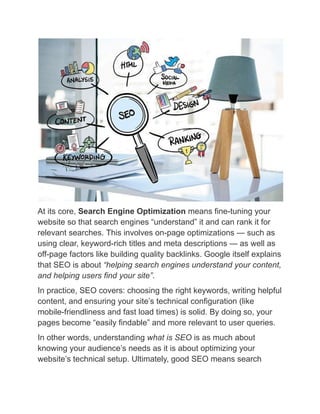
At its core,Search Engine Optimization means fine-tuning your
website so that search engines “understand” it and can rank it for
relevant searches. This involves on-page optimizations — such as
using clear, keyword-rich titles and meta descriptions — as well as
off-page factors like building quality backlinks. Google itself explains
that SEO is about “helping search engines understand your content,
and helping users find your site”.
In practice, SEO covers: choosing the right keywords, writing helpful
content, and ensuring your site’s technical configuration (like
mobile-friendliness and fast load times) is solid. By doing so, your
pages become “easily findable” and more relevant to user queries.
In other words, understanding what is SEO is as much about
knowing your audience’s needs as it is about optimizing your
website’s technical setup. Ultimately, good SEO means search
3.
engines can indexand rank your content, making it visible to
customers searching for products or services you offer.
Why SEO Matters
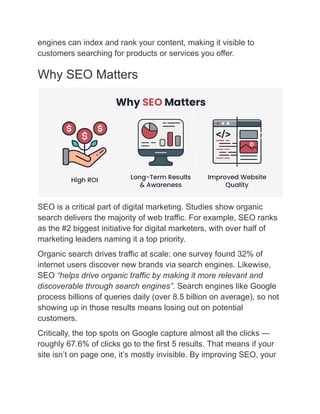
SEO is a critical part of digital marketing. Studies show organic
search delivers the majority of web traffic. For example, SEO ranks
as the #2 biggest initiative for digital marketers, with over half of
marketing leaders naming it a top priority.
Organic search drives traffic at scale: one survey found 32% of
internet users discover new brands via search engines. Likewise,
SEO “helps drive organic traffic by making it more relevant and
discoverable through search engines”. Search engines like Google
process billions of queries daily (over 8.5 billion on average), so not
showing up in those results means losing out on potential
customers.
Critically, the top spots on Google capture almost all the clicks —
roughly 67.6% of clicks go to the first 5 results. That means if your
site isn’t on page one, it’s mostly invisible. By improving SEO, your
4.
small business canclimb the rankings, stand out in search, and tap
into that traffic.
Benefits of SEO for Small Businesses
SEO offers many advantages for a small business looking to grow
online:
● Increased Website Traffic: A higher ranking means more
clicks. SEO can significantly boost the number of visitors to
your site without paying for ads. (In one case study, focused
SEO work led to 100% growth in organic traffic within two
months.)
5.
● Better Visibility:As noted, only a tiny fraction (0.63%) of
users click past the first page. SEO helps your business
appear on that coveted first page, improving brand exposure.
● Qualified Leads & Sales: Higher visibility means more
qualified leads. Visitors from search often have high purchase
intent. Proper SEO attracts people who are actively searching
for solutions you offer, leading to better conversion rates.
● Trust and Credibility: Users tend to trust organic search
results more than ads. Ranking well signals authority.
Consistent SEO (quality content and a healthy backlink profile)
builds credibility in your industry.
● Cost-Effective Marketing: Compared to paid ads, SEO is
relatively low-cost. Once you rank, you can maintain visibility
without ongoing ad spend. For small budgets, organic search
can deliver a strong ROI.
● Local Customers: SEO isn’t just global — local SEO helps
nearby customers find you. Optimizing for local search (like
“plumber near me” or including city names) can increase foot
traffic. For instance, focusing on local optimization and
citations can dramatically grow leads — one campaign
targeting specific towns saw organic keywords in top positions
rise by 326%.
● Improved User Experience: Many SEO best practices
(mobile-friendly design, fast pages, clear navigation) also
make your site better for visitors. A better user experience not
only boosts rankings but keeps people on your site longer.
SEO in Digital Marketing
SEO in digital marketing means integrating search optimization with
your broader marketing plan. It is not a standalone tactic but part of
a cohesive strategy. For example, content you create for SEO can
6.
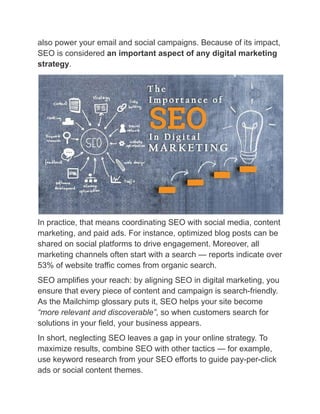
also power youremail and social campaigns. Because of its impact,
SEO is considered an important aspect of any digital marketing
strategy.
In practice, that means coordinating SEO with social media, content
marketing, and paid ads. For instance, optimized blog posts can be
shared on social platforms to drive engagement. Moreover, all
marketing channels often start with a search — reports indicate over
53% of website traffic comes from organic search.
SEO amplifies your reach: by aligning SEO in digital marketing, you
ensure that every piece of content and campaign is search-friendly.
As the Mailchimp glossary puts it, SEO helps your site become
“more relevant and discoverable”, so when customers search for
solutions in your field, your business appears.
In short, neglecting SEO leaves a gap in your online strategy. To
maximize results, combine SEO with other tactics — for example,
use keyword research from your SEO efforts to guide pay-per-click
ads or social content themes.
7.
Local SEO andFinding an SEO Company
Local SEO focuses on targeting customers in your geographic area.
If you run a brick-and-mortar shop or serve a specific region, local
SEO is a must. This includes optimizing your Google Business
Profile, getting reviews, and using location keywords in your
content.
Google notes that optimizing for local SEO can be “a powerful way
to ensure a business reaches customers in the area,”. For example,
people near Lucknow might search for phrases like “seo company
in Lucknow” or “best seo services in Lucknow” when looking for
local help. If you appear in those searches, Lucknow customers are
more likely to find and contact you.
Hiring a reputable SEO company in Lucknow can help small
businesses compete locally: these agencies understand the local
market and can tailor your strategy. To choose wisely, look for
providers with proven results and positive reviews. Whether you go
DIY or hire out, make sure to claim your local listings and use
region-specific keywords. Read more about local SEO techniques
and see how optimizing for nearby searches can put your business
on the map.
SEO Strategies and Best Practices
Implementing SEO effectively involves several key steps:
8.
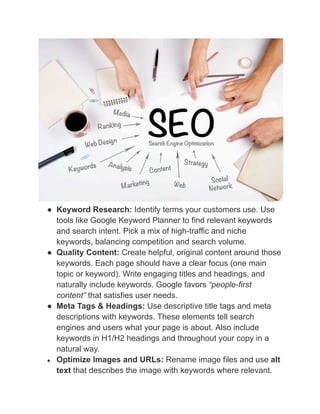
● Keyword Research:Identify terms your customers use. Use
tools like Google Keyword Planner to find relevant keywords
and search intent. Pick a mix of high-traffic and niche
keywords, balancing competition and search volume.
● Quality Content: Create helpful, original content around those
keywords. Each page should have a clear focus (one main
topic or keyword). Write engaging titles and headings, and
naturally include keywords. Google favors “people-first
content” that satisfies user needs.
● Meta Tags & Headings: Use descriptive title tags and meta
descriptions with keywords. These elements tell search
engines and users what your page is about. Also include
keywords in H1/H2 headings and throughout your copy in a
natural way.
● Optimize Images and URLs: Rename image files and use alt
text that describes the image with keywords where relevant.
9.
This helps withimage search and accessibility. URLs should
be short, readable, and keyword-rich (e.g.
/seo-services-lucknow instead of /?id=123).
● Technical SEO: Improve site speed (fast loading pages),
ensure mobile responsiveness, and use HTTPS (secure site).
A clean site structure (using sitemaps, proper linking, and no
broken links) makes it easy for search engines to crawl and
index your pages.
● Google Tools: Set up Google Analytics and Google Search
Console to monitor traffic and performance. For example,
creating a Search Console account can show which keywords
you rank for and alert you to any errors. These free tools are
recommended first steps for any small business SEO.
● Backlinks: Build quality backlinks by partnering with reputable
sites, getting listed in directories, or creating shareable content
(like infographics). Links from relevant, authoritative sites
signal trust to search engines.
● User Experience: Finally, make your site user-friendly. Easy
navigation, clear information, and a good layout keep visitors
engaged. Search engines track user behavior, so a positive
user experience can boost rankings. Google’s guide reminds
us there are no shortcuts: “following best practices will make it
easier for search engines to crawl, index, and understand your
content.”.
By following these SEO best practices, you align your site with
search engine expectations and user needs. It’s a long-term effort
but essential for sustainable online growth.
SEO Case Study
10.
To see SEOin action, consider this real-world example. A small
digital marketing agency optimized a client’s website by refreshing
old content and targeting medium-difficulty keywords. The result?
Organic traffic doubled in just two months. The agency’s owner
reports, “Using these strategies, I was able to achieve 100% growth
in organic traffic… in just 2 months.”. This shows how focused SEO
work — even without a huge budget — can quickly pay off.
Another case involves a local wealth-management firm called
Moneta Group. By creating geo-targeted content for each of their
key market areas and improving on-page SEO elements, they
dramatically boosted local visibility. Within months, their targeted
keyword portfolio grew by 326%, and keywords ranking in positions
1–3 on Google jumped by 164%.
In other words, they greatly increased their chances of being found.
These case studies highlight that with the right strategy (keyword
focus, quality content, and local optimization), small businesses can
achieve impressive SEO gains.
How to Get Started with SEO
If you’re ready to start, here are practical steps for small
businesses:
1.Audit Your Website: Ensure you have a clear, functioning site
with fast load times and a mobile-friendly design.
2.Set Up Google Tools: Create accounts on Google Analytics
and Search Console. These free tools help you track visitors
and fix issues. Verify your site in Search Console to see what
keywords bring traffic and receive alerts about site errors.
11.
3.Perform Keyword Research:Make a list of keywords
relevant to your offerings and location. Use tools (Google
Keyword Planner, etc.) to see search volumes and difficulty.
4.Optimize On-Page Elements: For each page, update title
tags, headings, and meta descriptions to include your target
keywords naturally. Write clear, helpful content that answers
users’ questions. Don’t forget to add descriptive alt text to
images.
5.Publish Quality Content: Start a blog or resource section and
regularly post useful articles or guides. Fresh, authoritative
content can attract links and shares.
6.Build Backlinks: Encourage customers or partners to link to
your site. Submit your business to reputable directories and
engage with local community sites.
7.Local Listings: Create or update your Google Business
Profile and ensure your NAP (Name/Address/Phone) is
consistent across the web. This boosts local SEO.
8.Monitor & Adjust: SEO takes time. Check your progress
monthly in Analytics and Search Console. If certain keywords
aren’t working, adjust your content strategy. Remember,
Google advises that changes can take weeks or months to
fully impact rankings.
For more detailed tactics, Google’s SEO Starter Guide is an
authoritative resource on best practices. By systematically applying
these steps, a small business can steadily improve its search
rankings and online presence over time.
FAQs
What is SEO?
12.
SEO (Search EngineOptimization) is the practice of improving a
website so that search engines like Google can find it and show it to
users searching for related terms. In simpler terms, SEO makes
your website easier to discover online by relevant customers. It
involves optimizing content, keywords, and technical aspects of
your site to rank higher in organic (non-paid) search results.
Why is SEO important for digital growth?
SEO is important because the majority of online experiences begin
with a search engine. By ranking well, you can capture a large
share of organic traffic without constantly paying for ads. For
businesses, this means more visibility, credibility, and qualified leads
over time. Studies show that organic search drives about 50% or
more of website traffic. Good SEO also aligns your site with user
needs, helping you reach people actively looking for your products
or services.
How can small businesses benefit from SEO?
Small businesses benefit greatly because SEO is cost-effective. It
levels the playing field: even a local shop can compete online by
optimizing its site. SEO brings more website traffic and foot traffic
(via local SEO), enhances brand awareness, and often has a better
return on investment than traditional advertising. It’s especially
helpful for niche or location-based businesses — for example, a
cafe in Lucknow can rank for “coffee shop near me” searches,
bringing in nearby customers who are ready to buy.
How long does it take to see SEO results?
SEO is a long-term strategy. Simple on-page changes can yield
improvements in a few weeks, but big ranking gains often take a
few months. Google usually needs time to crawl and index your
updates. Industry sources suggest waiting a few months (often 3–6
13.
months) to evaluateprogress. If you’re not seeing improvement, you
may need to refine your keywords or create more content.
Remember, ongoing effort (publishing new content, building links)
will continue to pay off over time.
How do I find the best SEO services in Lucknow?
To find an SEO company in Lucknow, start by searching for reviews
and case studies. Look for agencies that understand the local
market. Good clues are clear examples of past successes and
transparent processes. Phrases like “best seo services in Lucknow”
can turn up agency websites and listings — compare their
testimonials and ask about the strategies they use. Ultimately, the
best SEO services in Lucknow will tailor their approach to your
industry and show measurable results (like traffic or lead increases)
from their work.
What does an SEO consultant or company do?
An SEO expert analyzes your website and industry to develop a
strategy. They research keywords, recommend content
improvements, fix technical issues (like site speed or mobile
usability), and help attract quality backlinks. They monitor your
rankings and analytics to adjust the plan. Essentially, an SEO
provider acts as a coach and doer: guiding you on best practices
and executing optimizations that improve your site’s visibility. For
busy business owners, an SEO company handles the work behind
the scenes so you can focus on your core business.
Conclusion
SEO is a powerful tool for growing a small business online. By
optimizing your site for search, you increase visibility to customers
actively looking for your products or services. Start by ensuring your
14.
website is user-friendlyand optimized for keywords, then publish
helpful content and build your local presence. If needed, consider
partnering with a reputable SEO company in Lucknow or another
expert agency. The best seo services in Lucknow can craft a
strategy specifically for your market, helping you climb the ranks
faster.