SEO Audit
What is an audit?
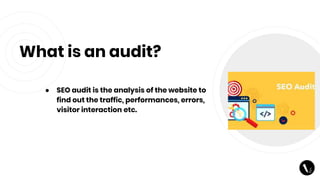
● SEO audit is the analysis of the website to
find out the traffic, performances, errors,
visitor interaction etc.
Audit process
● Objective.
● Domain authority.
● Keyword analysis.
● Competitor analysis.
● Technical analysis.
● Page level analysis.
● Content analysis.
● User experience analysis.
● Link analysis.
● Social media analysis.
● The objective of an audit differs for
different businesses.
● An audit should majorly
concentrate in gaining valuable
insights about the website
performance.
● The insights could then be used to
increase the performance.
Objective
Domain
authority
● Domain authority can be
determined by the score given
by moz.
● The score ranges between 0-100.
● The age, number of links and
history of the domain are the
factors considered to calculate
the DA.
● Higher the DA score, there is a
good chance of your site ranking
on top.
● Page-level authority (PA) can
also be found for every page in
the site.
Keyword
analysis
● Finding the right keywords to
target is the most important step
for SEO success.
● Find out the terms used by the
customers while searching, &
make sure to include them in the
website.
● Likewise find few more keywords
that perform well in the search.
● Tools like Semrush, Google
keyword planner, Ahrefs etc are
widely used for Keyword
research.
Competitor
analysis
● Keeping a tab on your competitors is
extremely important.
● Knowing competitor backlinks,
keyword density, paid campaigns
etc would help you in doing better
than them.
● Several tools like Spyfu, Similarweb,
SEOProfiler etc can help you with
competitor analysis.
Technical
analysis
● The technical aspects of the
website must be analysed
regularly.
● There are few technical aspects
which should be optimized.
Technical
analysis
● Speed
● Redirect issues
● Canonical
● Robots.txt
● Sitemap
● Duplicate metadata
● Page level duplicate content
● 404 errors?
● URLs
● Broken links
Speed
● The most important technical
aspect.
● Slow speed leads to poor user
experience.
● Speed can be improved by
reducing image sizes, using cdn,
external hosting platforms etc.
Redirect issues
● The redirect code should be given
to pages which are taken down.
● 301 code is given for permanent
redirect
● 302 code is given for temporary
redirect.
● Ensure the visitors are redirected
to a relevant page
Canonical
● Canonical tag is given to pages
with duplicate content.
● This is essential for easier
crawling for the webmaster.
● It is given as “rel= canonical”.
Robots.txt
● Robots exclusion protocol is given
to communicate with the
webcrawler.
● This tag mentions the pages that
you don’t want to be crawled or
indexed.
Sitemap
● It is the list of webpages in a site.
● Optimization of sitemap is done
for better indexing of the site.
● There are two types of
sitemaps- HTML and XML.
Duplicate
metadata
● As the name suggests, using the
same description for all the other
sites.
● It is an error that can be easily
avoided.
Page level
duplicate
content
● Using the same content for
different pages of the site.
● Makes it difficult for Google to find
the unique content of the site.
404 error
● This code is given to indicate the
absence of the page in the site.
● This happens when the wrong URL
is given by the customer.
URL
● It stands for uniform resource
locator.
● It is the name of our resource
online.
● It is used as a text to link your
webpage.
● These links lead to pages which
are not there anymore in the site.
● Broken links must be found & 404
error code must be given on those
pages.
Broken links
Page level analysis
● Duplicate content.
● Keywords in relevant
places.
● Internal links
● External links
● Images
Duplicate
content
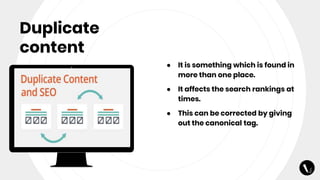
● It is something which is found in
more than one place.
● It affects the search rankings at
times.
● This can be corrected by giving
out the canonical tag.
Keywords in
relevant places
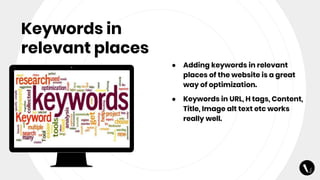
● Adding keywords in relevant
places of the website is a great
way of optimization.
● Keywords in URL, H tags, Content,
Title, Image alt text etc works
really well.
Internal links
● Hyperlinks which lead to pages
of the website.
● Gives the user easy access
● Increases user experience.
External links
● The hyperlink which takes the
visitor from your website to
another one.
● A small ranking factor, as Google
understands your site’s
authenticity based on your
external links too.
Images
● Images must be used smartly to
catch or hold the visitor’s
attention.
● Infographics, GIF animations are
used over normal images these
days.
● Image size should be reduced for
better user experience.
Content analysis
● Interactive, innovative and unique
content a very important role in
search rankings.
● Grammatical and plagiarism errors
should be corrected.
● Every word of the content is very
important and should be thoroughly
checked before posting.
Content analysis
● Original content.
● Useful and informative.
● Better content than competitor.
Original
content
● The content you write should be
unique and different than others.
● References can be taken but
should not be completely copied.
● Copyrights should be given when
a statement or an image is
copied.
● Copied content leads to poor
results.
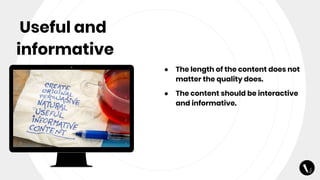
Useful and
informative
● The length of the content does not
matter the quality does.
● The content should be interactive
and informative.
Better content
than competitor
● Lot of research should be done
to write better content than our
competitors.
● You can also use professional
content writers for this.
User experience
analysis
● Using these analysis you can find
out how the user feels while using
your site.
● Some of the factors to
understand UX are
● Bounce rate
● Average time spent on site
● Goal completions
● Exit pages
● Return visitors
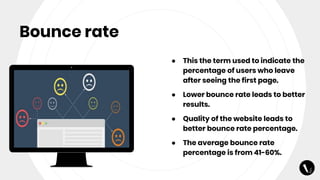
Bounce rate
● This the term used to indicate the
percentage of users who leave
after seeing the first page.
● Lower bounce rate leads to better
results.
● Quality of the website leads to
better bounce rate percentage.
● The average bounce rate
percentage is from 41-60%.
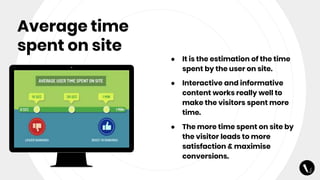
Average time
spent on site
● It is the estimation of the time
spent by the user on site.
● Interactive and informative
content works really well to
make the visitors spent more
time.
● The more time spent on site by
the visitor leads to more
satisfaction & maximise
conversions.
Goal
completions ● Goals may include sign up forms,
buying products etc.
● It is necessary to compile your
tasks as goals.
● By understanding what makes the
visitors perform these tasks, you
can optimise your page for better
results.
Exit pages
● This is the last page which the user
viewed before exiting.
● You must determine if most
visitors are exiting your site from
the same few pages & take action
to prevent it.
● Generic and uninteresting content
are some of the major reasons for
this.
Returning
visitors
● Users who come regularly or
within a span of two years are
called returning visitors.
● This data can be collected using
Google analytics.
● Regulating good content can
make the visitor a follower.
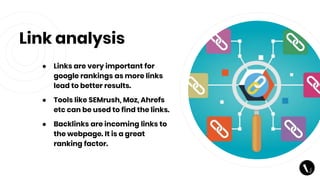
Link analysis
● Links are very important for
google rankings as more links
lead to better results.
● Tools like SEMrush, Moz, Ahrefs
etc can be used to find the links.
● Backlinks are incoming links to
the webpage. It is a great
ranking factor.
Link analysis
● Link relevancy
● Link authority
● Branded searches
● Anchor text
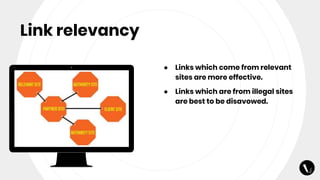
Link relevancy
● Links which come from relevant
sites are more effective.
● Links which are from illegal sites
are best to be disavowed.
● High quality links have higher
authority.
● A website with 50 quality links has
a higher link authority than a
website with 1000 low authority
links.
Link authority
Branded
searches
● The search where the company
name is used.
● Right optimization and regular
updates should be done to
reach the top place.
● Carrying out the right digital
marketing activities to
enhance brand awareness is
important.
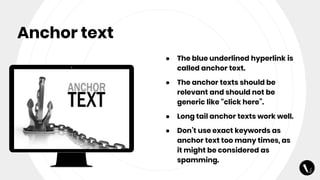
Anchor text
● The blue underlined hyperlink is
called anchor text.
● The anchor texts should be
relevant and should not be
generic like “click here”.
● Long tail anchor texts work well.
● Don’t use exact keywords as
anchor text too many times, as
it might be considered as
spamming.
Social media
analysis
● Using the Social media to enhance
your brand awareness is extremely
important.
● Analysing helps in improving the
visibility in social media.
Social media
analysis
● Social signals
● Social media presence
Social signals
● These are the human
interactions in social media.
● They are the likes, retweets,
pins etc our posts get in social
media.
● By making people engage with
your posts more, you can
increase your brand value.
Social media
presence
● Presence in all social media
platforms is very important for
any brand
● Posting regular updates
increases the following and
popularity
These are the steps that needs to
be followed for an audit.
○ Thank you for
watching.

Seo audit slides

  • 1.
  • 2.
    What is anaudit? ● SEO audit is the analysis of the website to find out the traffic, performances, errors, visitor interaction etc.
  • 3.
    Audit process ● Objective. ●Domain authority. ● Keyword analysis. ● Competitor analysis. ● Technical analysis. ● Page level analysis. ● Content analysis. ● User experience analysis. ● Link analysis. ● Social media analysis.
  • 4.
    ● The objectiveof an audit differs for different businesses. ● An audit should majorly concentrate in gaining valuable insights about the website performance. ● The insights could then be used to increase the performance. Objective
  • 5.
    Domain authority ● Domain authoritycan be determined by the score given by moz. ● The score ranges between 0-100. ● The age, number of links and history of the domain are the factors considered to calculate the DA. ● Higher the DA score, there is a good chance of your site ranking on top. ● Page-level authority (PA) can also be found for every page in the site.
  • 6.
    Keyword analysis ● Finding theright keywords to target is the most important step for SEO success. ● Find out the terms used by the customers while searching, & make sure to include them in the website. ● Likewise find few more keywords that perform well in the search. ● Tools like Semrush, Google keyword planner, Ahrefs etc are widely used for Keyword research.
  • 7.
    Competitor analysis ● Keeping atab on your competitors is extremely important. ● Knowing competitor backlinks, keyword density, paid campaigns etc would help you in doing better than them. ● Several tools like Spyfu, Similarweb, SEOProfiler etc can help you with competitor analysis.
  • 8.
    Technical analysis ● The technicalaspects of the website must be analysed regularly. ● There are few technical aspects which should be optimized.
  • 9.
    Technical analysis ● Speed ● Redirectissues ● Canonical ● Robots.txt ● Sitemap ● Duplicate metadata ● Page level duplicate content ● 404 errors? ● URLs ● Broken links
  • 10.
    Speed ● The mostimportant technical aspect. ● Slow speed leads to poor user experience. ● Speed can be improved by reducing image sizes, using cdn, external hosting platforms etc.
  • 11.
    Redirect issues ● Theredirect code should be given to pages which are taken down. ● 301 code is given for permanent redirect ● 302 code is given for temporary redirect. ● Ensure the visitors are redirected to a relevant page
  • 12.
    Canonical ● Canonical tagis given to pages with duplicate content. ● This is essential for easier crawling for the webmaster. ● It is given as “rel= canonical”.
  • 13.
    Robots.txt ● Robots exclusionprotocol is given to communicate with the webcrawler. ● This tag mentions the pages that you don’t want to be crawled or indexed.
  • 14.
    Sitemap ● It isthe list of webpages in a site. ● Optimization of sitemap is done for better indexing of the site. ● There are two types of sitemaps- HTML and XML.
  • 15.
    Duplicate metadata ● As thename suggests, using the same description for all the other sites. ● It is an error that can be easily avoided.
  • 16.
    Page level duplicate content ● Usingthe same content for different pages of the site. ● Makes it difficult for Google to find the unique content of the site.
  • 17.
    404 error ● Thiscode is given to indicate the absence of the page in the site. ● This happens when the wrong URL is given by the customer.
  • 18.
    URL ● It standsfor uniform resource locator. ● It is the name of our resource online. ● It is used as a text to link your webpage.
  • 19.
    ● These linkslead to pages which are not there anymore in the site. ● Broken links must be found & 404 error code must be given on those pages. Broken links
  • 20.
    Page level analysis ●Duplicate content. ● Keywords in relevant places. ● Internal links ● External links ● Images
  • 21.
    Duplicate content ● It issomething which is found in more than one place. ● It affects the search rankings at times. ● This can be corrected by giving out the canonical tag.
  • 22.
    Keywords in relevant places ●Adding keywords in relevant places of the website is a great way of optimization. ● Keywords in URL, H tags, Content, Title, Image alt text etc works really well.
  • 23.
    Internal links ● Hyperlinkswhich lead to pages of the website. ● Gives the user easy access ● Increases user experience.
  • 24.
    External links ● Thehyperlink which takes the visitor from your website to another one. ● A small ranking factor, as Google understands your site’s authenticity based on your external links too.
  • 25.
    Images ● Images mustbe used smartly to catch or hold the visitor’s attention. ● Infographics, GIF animations are used over normal images these days. ● Image size should be reduced for better user experience.
  • 26.
    Content analysis ● Interactive,innovative and unique content a very important role in search rankings. ● Grammatical and plagiarism errors should be corrected. ● Every word of the content is very important and should be thoroughly checked before posting.
  • 27.
    Content analysis ● Originalcontent. ● Useful and informative. ● Better content than competitor.
  • 28.
    Original content ● The contentyou write should be unique and different than others. ● References can be taken but should not be completely copied. ● Copyrights should be given when a statement or an image is copied. ● Copied content leads to poor results.
  • 29.
    Useful and informative ● Thelength of the content does not matter the quality does. ● The content should be interactive and informative.
  • 30.
    Better content than competitor ●Lot of research should be done to write better content than our competitors. ● You can also use professional content writers for this.
  • 31.
    User experience analysis ● Usingthese analysis you can find out how the user feels while using your site. ● Some of the factors to understand UX are ● Bounce rate ● Average time spent on site ● Goal completions ● Exit pages ● Return visitors
  • 32.
    Bounce rate ● Thisthe term used to indicate the percentage of users who leave after seeing the first page. ● Lower bounce rate leads to better results. ● Quality of the website leads to better bounce rate percentage. ● The average bounce rate percentage is from 41-60%.
  • 33.
    Average time spent onsite ● It is the estimation of the time spent by the user on site. ● Interactive and informative content works really well to make the visitors spent more time. ● The more time spent on site by the visitor leads to more satisfaction & maximise conversions.
  • 34.
    Goal completions ● Goalsmay include sign up forms, buying products etc. ● It is necessary to compile your tasks as goals. ● By understanding what makes the visitors perform these tasks, you can optimise your page for better results.
  • 35.
    Exit pages ● Thisis the last page which the user viewed before exiting. ● You must determine if most visitors are exiting your site from the same few pages & take action to prevent it. ● Generic and uninteresting content are some of the major reasons for this.
  • 36.
    Returning visitors ● Users whocome regularly or within a span of two years are called returning visitors. ● This data can be collected using Google analytics. ● Regulating good content can make the visitor a follower.
  • 37.
    Link analysis ● Linksare very important for google rankings as more links lead to better results. ● Tools like SEMrush, Moz, Ahrefs etc can be used to find the links. ● Backlinks are incoming links to the webpage. It is a great ranking factor.
  • 38.
    Link analysis ● Linkrelevancy ● Link authority ● Branded searches ● Anchor text
  • 39.
    Link relevancy ● Linkswhich come from relevant sites are more effective. ● Links which are from illegal sites are best to be disavowed.
  • 40.
    ● High qualitylinks have higher authority. ● A website with 50 quality links has a higher link authority than a website with 1000 low authority links. Link authority
  • 41.
    Branded searches ● The searchwhere the company name is used. ● Right optimization and regular updates should be done to reach the top place. ● Carrying out the right digital marketing activities to enhance brand awareness is important.
  • 42.
    Anchor text ● Theblue underlined hyperlink is called anchor text. ● The anchor texts should be relevant and should not be generic like “click here”. ● Long tail anchor texts work well. ● Don’t use exact keywords as anchor text too many times, as it might be considered as spamming.
  • 43.
    Social media analysis ● Usingthe Social media to enhance your brand awareness is extremely important. ● Analysing helps in improving the visibility in social media.
  • 44.
    Social media analysis ● Socialsignals ● Social media presence
  • 45.
    Social signals ● Theseare the human interactions in social media. ● They are the likes, retweets, pins etc our posts get in social media. ● By making people engage with your posts more, you can increase your brand value.
  • 46.
    Social media presence ● Presencein all social media platforms is very important for any brand ● Posting regular updates increases the following and popularity
  • 47.
    These are thesteps that needs to be followed for an audit. ○ Thank you for watching.