Finding Websites
• Google finds websites through links or submissions
• Google finds pagesby following links on asite or
external links to pageson asite
I
RankingWeb Pages-What’s on your site and who
links toit
1. Google ranks websites based on content and
inbound links
2..SiteNavigation, GlobalArchitectureand
Internal Linking
• Well-structured and consistent navigation
• Internal linking structure that asearch enginerobot
canfollow (spiderablity)
• No cannibals or orphans
3.OnsiteFactors– SitePage Structure
• Standard and valid code
• Content defined in semantically meaningfulblocks
• Keyword used in titles, images and other on-page
elements
• Deepcontent written in sentences using
relevant keywords
• Unique content (rather than content
that’s replicated elsewhere on the web)
• Content that’s updated frequently
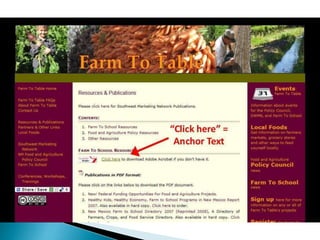
Offsite Factors– Links
• Quality, authority (PageRank/inbound links/domain
extension) and topicality of the linking site, and of
the linking target
• Geographical location/domain extension of the
linking site
• Words used in the anchor text oflinks
Atthe endof the day,Googlelikessitesthat are:
• Well-organized and easyto navigate
• Loadquickly with fewerrors
• Contain well-structured, relevant information
• Are updated frequently
• Are linked to (recommended) by otherwebsites
Atthe endof the day,Googlelikessitesthat are:
• Well-organized and easyto navigate
• Loadquickly with fewerrors
• Contain well-structured, relevant information
• Are updated frequently
• Are linked to (recommended) by otherwebsites
…andsodoyourusers
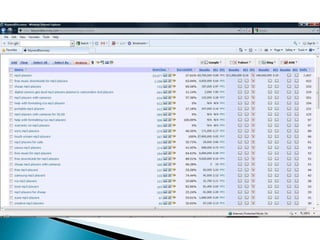
KeywordResearch– Organic Search
• Usekeyword research tools to determine
optimization targets based on potential
traffic, competitiveness, trends andgeography
• Useinternal metrics to determine real keyword
traffic (correlated with rankings), conversionand
profitability of keywords
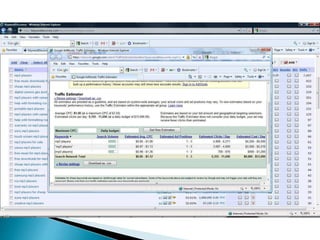
KeywordResearch– Paid Search
• Usekeyword research tools to determine
optimization targets based on potential traffic,ad
competitiveness and cost
• Useinternal and ad metrics to determine
effectiveness and ROIof keyword campaigns
On-SiteSEO– Technicaland Structural
• EnsureURLsare canonical (singular) and
semantically meaningful
• Work towards asite and link architecture that’s
consistent, spiderable and semantically meaningful
• Submit XMLsitemaps and useother search-engine
supplied tools
On-SiteSEO– PageLevelOptimization
• “Tag” each page(HTMLelements and select page
elements) to maximize keywordfocus
• Ensurekeyword content is spiderable, either by
using text or textreplacement
• Control number of outbound links andwhere
they’re going
On-SiteSEO– Content
• Update content frequently, asapplicable
• Ensurecontent is original (unique) and useful
(linkable)
• Usekeyword research to frame contentkeyword
universe
On-SiteSEO– Optimization for Paid Search
• Usethe sametechniques for organic search
optimization to ensure that PPCad targetpages
provide agood match for bid keywords
• Testand refine PPC-specific landing-pages for
maximum ROI
• Watch paid search metrics like ahawk
LinkDevelopment
• Create content that’s actually good/useful enough
that people will link toit
• Utilize social media and other engagementstrategies
to generatelinks
• Get listed in directories, buy links and otherwisebe
creative in acquiringlinks
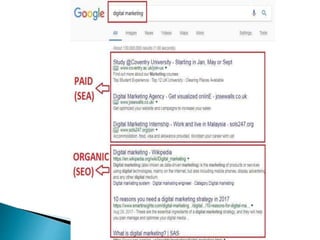
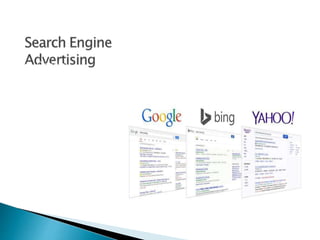
• SEM is part of online marketing and covers
both paid and organic search queries.
• “Search EngineOptimization” (SEO)refers to
techniques that helpyou achieve better rankings
for your website in organic search results.
• “Search EngineAdvertising” (SEA)measures
involve you paying for your website to be listed
in the display area of a search engine when
particular search queries or phrases are
entered.
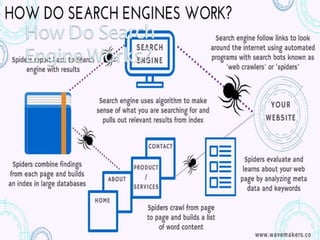
• Imagine the World Wide Web as a
network of stops in a big city subway
system.
• Each stop is a unique document (usually a web
page, but sometimes a PDF
,JPG,or other file).
Thesearch engines need away to “crawl” the
entire city and find all the stops along the way,
so they use the best path available—links.
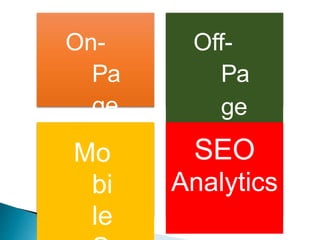
On-
Pa
ge
SE
O
Off-
Pa
ge
S
E
O
Mo
bi
le
SEO
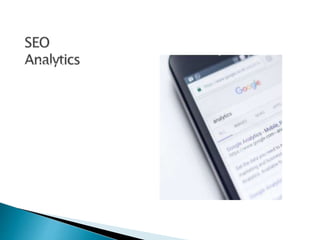
Analytics
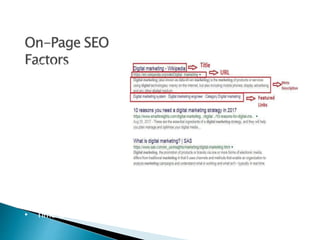
• Content
• Title Tag
• Meta Description
• URL Structure
• Heading Tags
• Image
Optimization
• Internal Links
• Sitemap and
Robots.txt Files
• Bounce Rate
• Time On Site
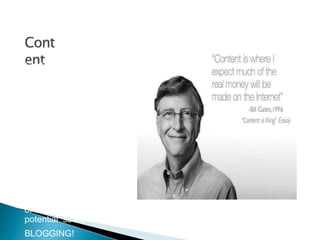
Content is KING!
Without rich content,
you will find it difficult to
achieve good rankings
with specific keywords
and to direct traffic to
your website.
Avoid duplicate content!
Create content that can
fully satisfy the users’
needs. It is notjust about
the quantity (huge
amounts of text); it’s
more about the relevance
of the content to
potential searches.
BLOGGING!
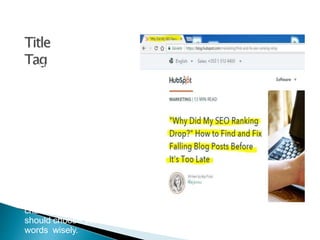
In addition to the actual
title bar of your site,
every web page that
you create has a so
called “title tag.”
This is the snippet of
text that appears in the
top left-hand corner or
in your web browser
tab.
Title tags have up to 70
characters, so you
should choose your
words wisely.
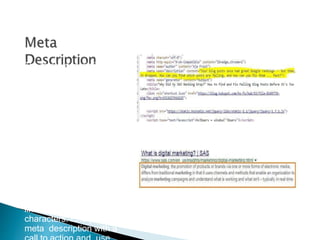
The“meta description,” in
contrast, is a piece of
text that describes what
a specific page is about.
Meta descriptions
are typically
displayed as text
below the blue links
in search engine
results
The meta description is
limited to 175
characters. End your
meta description with a
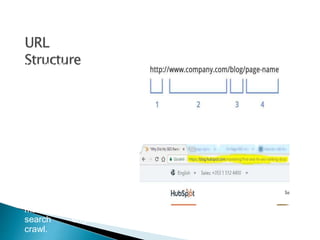
The structure of your
URLs can also help
search engines to better
understand your
website content.
You should use your
keyword(s) in URL
and keep short and
simple.
Avoid special characters
in the URL: They can
make it difficult for
search engines to
crawl.
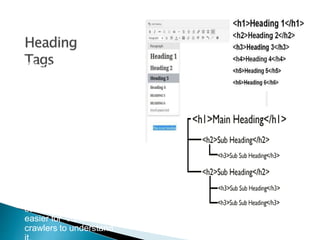
When search engine
crawlers scan your
website, they look for
clues about the
content on your pages.
There are basically six
heading tags in HTML.
H1-H2-H3-H4-H5-H6
If you use different
headline tags, you
structure your website’s
content and make it
easier for visitors and
crawlers to understand
Images are a great way
to break up pieces of
text, and also to
communicate with
search engines.
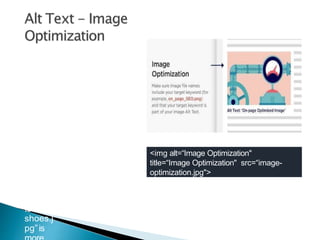
Every image that you
upload to your site will
have a file name. If you
insert the image into
your website, your
image’s file name will also
appear in your site’s
sourcetext.
<img alt=“Image Optimization"
title=“Image Optimization" src=“image-
optimization.jpg">
The
name
“red
tennis
shoes.j
pg”is
If you create content
on your blog or
specific web pages,
you should also
nonetheless refer to
other pages within
your website.
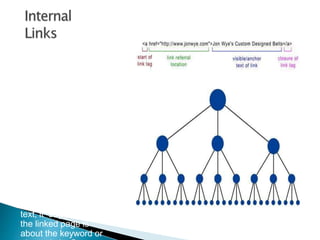
You can do this by
adding a link between
the pages. I
recommend that you
use anchor text to do
this.
When you use anchor
text, it suggests that
the linked page is
about the keyword or
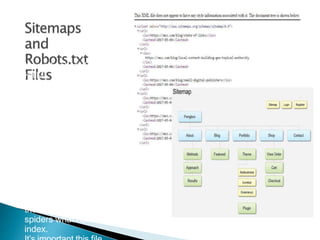
Your site should have an
HTML sitemap, and
every page should link
to that sitemap, probably
in the footer.
You should also
have an XML
sitemap you
submit to search
engines.
The Robots.txt file tells
the search engine
spiders what not to
index.
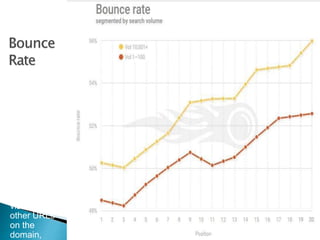
The
Bounce
Rate
measures
the
percentage
of users
who only
click on the
URL from
Google’s
search
results,
without
visiting any
other URLs
on the
domain,
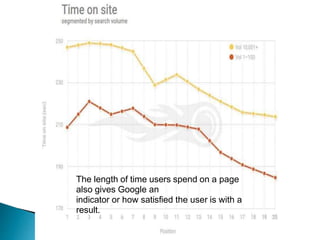
The length of time users spend on a page
also gives Google an
indicator or how satisfied the user is with a
result.
• Link
Building
• Social
Media
• Guest
Articles
• Blogging
• E-Mail
Marketing
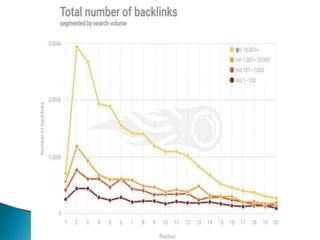
This is the process by
which inbound links
are generated from
other websites.
Search engines
evaluate the quality of
backlinks. This involves
a number of issues
which you also need to
keep in mind when
creating links.
Relevancy, anchor text,
link location, and follow
or nofollow are
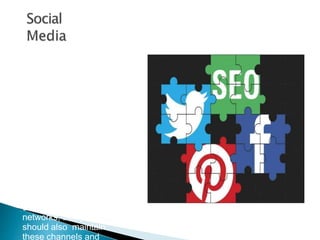
Search engines also
take into account the
traffic generated by
links from social
networks.
It is assumed that
these so-called “social
signals” caninfluence a
website’s ranking at
leastwhen
search queries relate to
something current.
Keep in mind, when
using social
networks, that you
should also maintain
these channels and
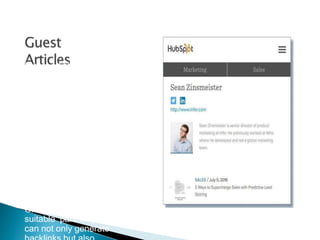
Guest articles are a
good way of
improving your
branding and getting
high-quality
backlinks.
So you should look for
publication channels
that would be a good fit
for you to write guest
posts.
Once you have found a
suitable partner, you
can not only generate
Many companies
already run their own
blogs and use them to
publish articles about
their own subject areas
and company news.
This creates high-
quality, relevant
content that offers a lot
of added value to
users, customers, and
potential customers.
It enables you to
increase traffic to your
website while also
enabling other users to
Use E-Mail to distribute
content.
Your emails should
include a clear call-to-
action, you should
maintain your lists,
generate leads, and
convert them to
customers.
You should also make it
easy for your email
readers to share their
content with their
friends and post it on
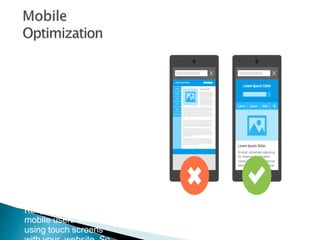
• Mobile First
Index
• Mobile
Optimization
• Page Speed
The importance of
mobile SEO is made
even clearer by
Google’s
recent announcement.
Sometime in 2018,
Google will switch to a
mobile-first index.
What does this mean?
For the first time,
Google will determine
rankings based on the
quality of the mobile
version of the site
instead of the desktop
version.
Deploy “responsive web
design” if possible.
This ensures that your
website adjusts to any
display size.
Make sure that image
files and other graphics
are not too big. This
prevents loading times
from being
unnecessarily
increased for mobile
users.
Keep in mind that
mobile users will be
using touch screens
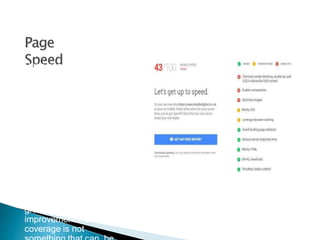
Page speed is
important on all
devices, but it can be
critically important on
mobile when users are
out and about looking
for quick answers.
A page that may load
relatively quickly on a
WiFi network may not
be quite so snappy on a
mobile data network.
4G has delivered some
great speed
improvements, but
coverage is not
• Google
Analytics
• Google Search
Console
• SEO Tools
Google
Analytics
Analy
tics
Google Search
Console
Search
Console
Sem
rush
Ahre
fs
MO
Z
Searchm
etrics
Alexa
• Blog.hubspot.
com
• MOZ.com
• Semrush.com
• Searchmetrics
.com
• Searchenginel
and.com
• Google
AdWords
• Bing Ads
• Yahoo Ads
• Yandex
Ads
Google AdWords is a
product that you can
use to promote your
business, help sell
products or services,
raise awareness, and
increase traffic to your
website.
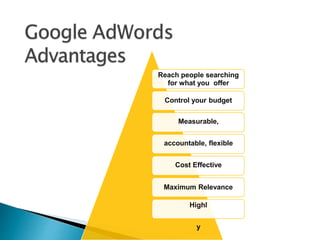
Reach people searching
for what you offer
Control your budget
Measurable,
accountable, flexible
Cost Effective
Maximum Relevance
Highl
y
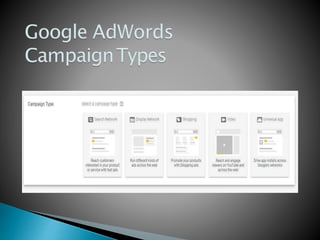
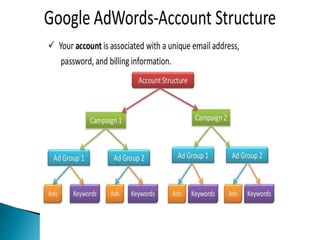
AdWords is organized into three layers:
• Account
• Campaigns
• ad groups.
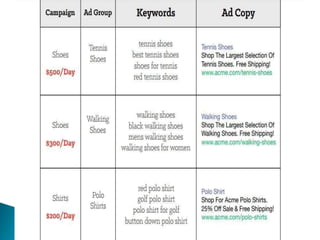
Account structure is critical. Organize your
campaigns, ad groups, keywords, and ad
copy appropriately.
Your ad campaign has its own budget and
settings that determine where your ads
appear.
Your ad campaign has its own budget and
settings that determine where your ads
appear.
• Location
• Budget
• Bidding
• Language
• Date
• Extensions
Your ad group contains a set of similar ads and
the words and phrases, known as keywords
An AdGroup contains one or more ads which
target a shared set of keywords.
Each of your campaigns is made up of
one or more ad groups. Use ad groups
Mainly Three kinds of bidding
types. Namely
CPM (Cost-per-thousand
impressions)
CPC (Cost-per-click )
CPA (Cost-per-acquisition)
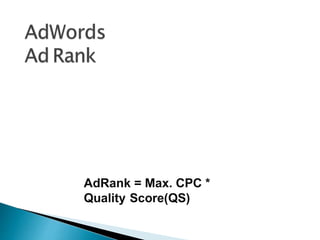
Ad Rank determines your ad Position where
your ad shows on the page in relation to
other ads and whether your ads are eligible
to show at all.
The main components of your Ad Rank are
your bids and the quality of your ads and
website.
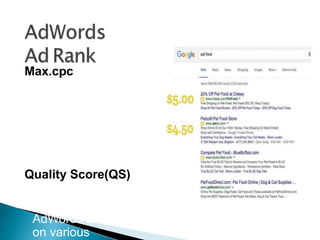
AdRank = Max. CPC *
Quality Score(QS)
Max.cpc
 A bid that you set to
determine the
highest amount
that you were
willing to pay for a
click on your ad
Quality Score(QS)
 QS is a metric
calculated
AdWords based
on various
Google uses an auction-style bid
to set their prices
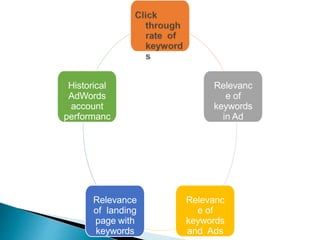
Relevanc
e of
keywords
in Ad
Group
Relevanc
e of
keywords
and Ads
Relevance
of landing
page with
keywords
Historical
AdWords
account
performanc
e
Quali
ty
Scor
e
Facto
rs
SEM.pptx
SEM.pptx

SEM.pptx

  • 3.
    Finding Websites • Googlefinds websites through links or submissions • Google finds pagesby following links on asite or external links to pageson asite I
  • 4.
    RankingWeb Pages-What’s onyour site and who links toit 1. Google ranks websites based on content and inbound links 2..SiteNavigation, GlobalArchitectureand Internal Linking • Well-structured and consistent navigation • Internal linking structure that asearch enginerobot canfollow (spiderablity) • No cannibals or orphans
  • 5.
    3.OnsiteFactors– SitePage Structure •Standard and valid code • Content defined in semantically meaningfulblocks • Keyword used in titles, images and other on-page elements • Deepcontent written in sentences using relevant keywords • Unique content (rather than content that’s replicated elsewhere on the web) • Content that’s updated frequently
  • 6.
    Offsite Factors– Links •Quality, authority (PageRank/inbound links/domain extension) and topicality of the linking site, and of the linking target • Geographical location/domain extension of the linking site • Words used in the anchor text oflinks
  • 9.
    Atthe endof theday,Googlelikessitesthat are: • Well-organized and easyto navigate • Loadquickly with fewerrors • Contain well-structured, relevant information • Are updated frequently • Are linked to (recommended) by otherwebsites
  • 10.
    Atthe endof theday,Googlelikessitesthat are: • Well-organized and easyto navigate • Loadquickly with fewerrors • Contain well-structured, relevant information • Are updated frequently • Are linked to (recommended) by otherwebsites …andsodoyourusers
  • 11.
    KeywordResearch– Organic Search •Usekeyword research tools to determine optimization targets based on potential traffic, competitiveness, trends andgeography • Useinternal metrics to determine real keyword traffic (correlated with rankings), conversionand profitability of keywords
  • 12.
    KeywordResearch– Paid Search •Usekeyword research tools to determine optimization targets based on potential traffic,ad competitiveness and cost • Useinternal and ad metrics to determine effectiveness and ROIof keyword campaigns
  • 16.
    On-SiteSEO– Technicaland Structural •EnsureURLsare canonical (singular) and semantically meaningful • Work towards asite and link architecture that’s consistent, spiderable and semantically meaningful • Submit XMLsitemaps and useother search-engine supplied tools
  • 17.
    On-SiteSEO– PageLevelOptimization • “Tag”each page(HTMLelements and select page elements) to maximize keywordfocus • Ensurekeyword content is spiderable, either by using text or textreplacement • Control number of outbound links andwhere they’re going
  • 18.
    On-SiteSEO– Content • Updatecontent frequently, asapplicable • Ensurecontent is original (unique) and useful (linkable) • Usekeyword research to frame contentkeyword universe
  • 19.
    On-SiteSEO– Optimization forPaid Search • Usethe sametechniques for organic search optimization to ensure that PPCad targetpages provide agood match for bid keywords • Testand refine PPC-specific landing-pages for maximum ROI • Watch paid search metrics like ahawk
  • 20.
    LinkDevelopment • Create contentthat’s actually good/useful enough that people will link toit • Utilize social media and other engagementstrategies to generatelinks • Get listed in directories, buy links and otherwisebe creative in acquiringlinks
  • 21.
    • SEM ispart of online marketing and covers both paid and organic search queries. • “Search EngineOptimization” (SEO)refers to techniques that helpyou achieve better rankings for your website in organic search results. • “Search EngineAdvertising” (SEA)measures involve you paying for your website to be listed in the display area of a search engine when particular search queries or phrases are entered.
  • 23.
    • Imagine theWorld Wide Web as a network of stops in a big city subway system. • Each stop is a unique document (usually a web page, but sometimes a PDF ,JPG,or other file). Thesearch engines need away to “crawl” the entire city and find all the stops along the way, so they use the best path available—links.
  • 27.
  • 28.
    • Content • TitleTag • Meta Description • URL Structure • Heading Tags • Image Optimization • Internal Links • Sitemap and Robots.txt Files • Bounce Rate • Time On Site
  • 29.
    Content is KING! Withoutrich content, you will find it difficult to achieve good rankings with specific keywords and to direct traffic to your website. Avoid duplicate content! Create content that can fully satisfy the users’ needs. It is notjust about the quantity (huge amounts of text); it’s more about the relevance of the content to potential searches. BLOGGING!
  • 30.
    In addition tothe actual title bar of your site, every web page that you create has a so called “title tag.” This is the snippet of text that appears in the top left-hand corner or in your web browser tab. Title tags have up to 70 characters, so you should choose your words wisely.
  • 31.
    The“meta description,” in contrast,is a piece of text that describes what a specific page is about. Meta descriptions are typically displayed as text below the blue links in search engine results The meta description is limited to 175 characters. End your meta description with a
  • 32.
    The structure ofyour URLs can also help search engines to better understand your website content. You should use your keyword(s) in URL and keep short and simple. Avoid special characters in the URL: They can make it difficult for search engines to crawl.
  • 33.
    When search engine crawlersscan your website, they look for clues about the content on your pages. There are basically six heading tags in HTML. H1-H2-H3-H4-H5-H6 If you use different headline tags, you structure your website’s content and make it easier for visitors and crawlers to understand
  • 34.
    Images are agreat way to break up pieces of text, and also to communicate with search engines. Every image that you upload to your site will have a file name. If you insert the image into your website, your image’s file name will also appear in your site’s sourcetext. <img alt=“Image Optimization" title=“Image Optimization" src=“image- optimization.jpg"> The name “red tennis shoes.j pg”is
  • 35.
    If you createcontent on your blog or specific web pages, you should also nonetheless refer to other pages within your website. You can do this by adding a link between the pages. I recommend that you use anchor text to do this. When you use anchor text, it suggests that the linked page is about the keyword or
  • 36.
    Your site shouldhave an HTML sitemap, and every page should link to that sitemap, probably in the footer. You should also have an XML sitemap you submit to search engines. The Robots.txt file tells the search engine spiders what not to index.
  • 37.
    The Bounce Rate measures the percentage of users who only clickon the URL from Google’s search results, without visiting any other URLs on the domain,
  • 38.
    The length oftime users spend on a page also gives Google an indicator or how satisfied the user is with a result.
  • 39.
    • Link Building • Social Media •Guest Articles • Blogging • E-Mail Marketing
  • 40.
    This is theprocess by which inbound links are generated from other websites. Search engines evaluate the quality of backlinks. This involves a number of issues which you also need to keep in mind when creating links. Relevancy, anchor text, link location, and follow or nofollow are
  • 42.
    Search engines also takeinto account the traffic generated by links from social networks. It is assumed that these so-called “social signals” caninfluence a website’s ranking at leastwhen search queries relate to something current. Keep in mind, when using social networks, that you should also maintain these channels and
  • 43.
    Guest articles area good way of improving your branding and getting high-quality backlinks. So you should look for publication channels that would be a good fit for you to write guest posts. Once you have found a suitable partner, you can not only generate
  • 44.
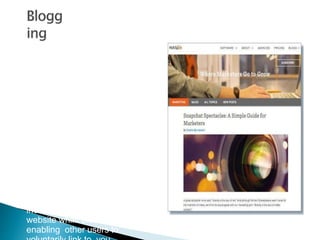
    Many companies already runtheir own blogs and use them to publish articles about their own subject areas and company news. This creates high- quality, relevant content that offers a lot of added value to users, customers, and potential customers. It enables you to increase traffic to your website while also enabling other users to
  • 45.
    Use E-Mail todistribute content. Your emails should include a clear call-to- action, you should maintain your lists, generate leads, and convert them to customers. You should also make it easy for your email readers to share their content with their friends and post it on
  • 46.
    • Mobile First Index •Mobile Optimization • Page Speed
  • 47.
    The importance of mobileSEO is made even clearer by Google’s recent announcement. Sometime in 2018, Google will switch to a mobile-first index. What does this mean? For the first time, Google will determine rankings based on the quality of the mobile version of the site instead of the desktop version.
  • 48.
    Deploy “responsive web design”if possible. This ensures that your website adjusts to any display size. Make sure that image files and other graphics are not too big. This prevents loading times from being unnecessarily increased for mobile users. Keep in mind that mobile users will be using touch screens
  • 49.
    Page speed is importanton all devices, but it can be critically important on mobile when users are out and about looking for quick answers. A page that may load relatively quickly on a WiFi network may not be quite so snappy on a mobile data network. 4G has delivered some great speed improvements, but coverage is not
  • 50.
    • Google Analytics • GoogleSearch Console • SEO Tools
  • 51.
  • 52.
  • 53.
  • 54.
    • Blog.hubspot. com • MOZ.com •Semrush.com • Searchmetrics .com • Searchenginel and.com
  • 56.
    • Google AdWords • BingAds • Yahoo Ads • Yandex Ads
  • 58.
    Google AdWords isa product that you can use to promote your business, help sell products or services, raise awareness, and increase traffic to your website.
  • 61.
    Reach people searching forwhat you offer Control your budget Measurable, accountable, flexible Cost Effective Maximum Relevance Highl y
  • 62.
    AdWords is organizedinto three layers: • Account • Campaigns • ad groups. Account structure is critical. Organize your campaigns, ad groups, keywords, and ad copy appropriately. Your ad campaign has its own budget and settings that determine where your ads appear.
  • 63.
    Your ad campaignhas its own budget and settings that determine where your ads appear. • Location • Budget • Bidding • Language • Date • Extensions
  • 64.
    Your ad groupcontains a set of similar ads and the words and phrases, known as keywords An AdGroup contains one or more ads which target a shared set of keywords. Each of your campaigns is made up of one or more ad groups. Use ad groups
  • 68.
    Mainly Three kindsof bidding types. Namely CPM (Cost-per-thousand impressions) CPC (Cost-per-click ) CPA (Cost-per-acquisition)
  • 69.
    Ad Rank determinesyour ad Position where your ad shows on the page in relation to other ads and whether your ads are eligible to show at all. The main components of your Ad Rank are your bids and the quality of your ads and website. AdRank = Max. CPC * Quality Score(QS)
  • 70.
    Max.cpc  A bidthat you set to determine the highest amount that you were willing to pay for a click on your ad Quality Score(QS)  QS is a metric calculated AdWords based on various Google uses an auction-style bid to set their prices
  • 71.
    Relevanc e of keywords in Ad Group Relevanc eof keywords and Ads Relevance of landing page with keywords Historical AdWords account performanc e Quali ty Scor e Facto rs