Max Thomas  max@thunderseo.com  @ThunderMax  (800) 819-6894SEO Sunday, January 24, 2010
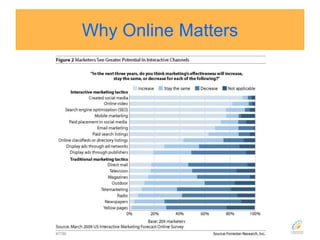
Why Online Matters
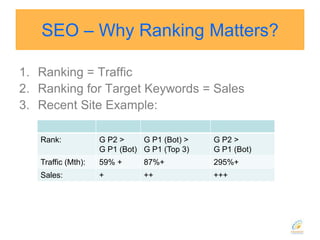
SEO – Why Ranking Matters?Ranking = TrafficRanking for Target Keywords = SalesRecent Site Example:
SOM – Strategic Online MarketingThink strategically.Search and Social Media are separate channels, but they do overlap.SEO is not Online Marketing – that’s short sighted.Look at your market – sometimes Search is better than social, sometimes email, etc.Be on lookout for new media, like Mobile.SEO = turtle (steady, slow, wins in the end)Social = hare (fast, fun, unpredictable)
SEO & GoogleWhite vs Black Hat SEO“A lot of people think Google hates SEO and nothing could be further from the truth. SEO when done well and done in a white hat way, can make your site more crawlable, more accessible and help users find useful content on your site.”Matt CuttsSee State of the Index 2009 on GoogleWebmasterHelpYoutube.com
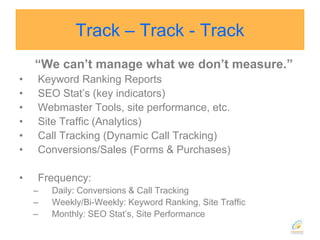
Track – Track - Track“We can’t manage what we don’t measure.”Keyword Ranking ReportsSEO Stat’s (key indicators)Webmaster Tools, site performance, etc.Site Traffic (Analytics)Call Tracking (Dynamic Call Tracking)Conversions/Sales (Forms & Purchases)Frequency:Daily: Conversions & Call TrackingWeekly/Bi-Weekly: Keyword Ranking, Site TrafficMonthly: SEO Stat’s, Site Performance
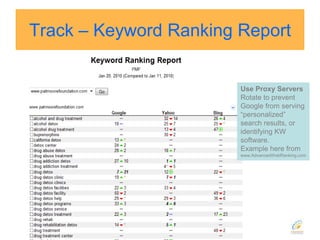
Max Thomas | max@thunderinternetmarketing.com | (800) 819-6894Track – Keyword Ranking ReportUse Proxy Servers Rotate to prevent Google from serving “personalized” search results, or identifying KW software.Example here fromwww.AdvancedWebRanking.com
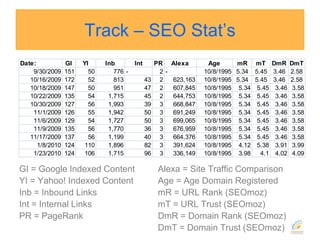
Track – SEO Stat’sGI = Google Indexed ContentYI = Yahoo! Indexed ContentInb = Inbound LinksInt = Internal LinksPR = PageRankAlexa = Site Traffic ComparisonAge = Age Domain RegisteredmR = URL Rank (SEOmoz)mT = URL Trust (SEOmoz)DmR = Domain Rank (SEOmoz)DmT = Domain Trust (SEOmoz)
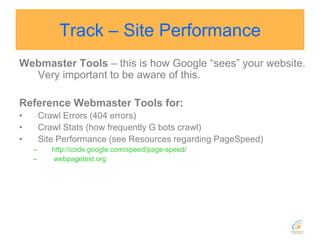
Track – Site PerformanceWebmaster Tools – this is how Google “sees” your website. Very important to be aware of this.Reference Webmaster Tools for:Crawl Errors (404 errors)Crawl Stats (how frequently G bots crawl)Site Performance (see Resources regarding PageSpeed)http://code.google.com/speed/page-speed/ webpagetest.org
Track – Site TrafficUsing Analytics, consider (at minimum):Change in Visitors (month to month)Traffic SourcesOrganic Keywords
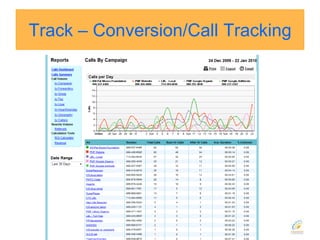
Track – Conversion/Call TrackingConversions:Use Analytics for sales & “form submits”Call Tracking/Leads:Dynamic call tracking enables tracking by sourceSee VoiceStar example
Track – Conversion/Call Tracking
What Impacts RankingsSEO’s Three-Legged Stool:
1. Content – Site StructureKeyword RelevancyOnpage Keyword Optimization (SEO Elements)PageRank and Navigation
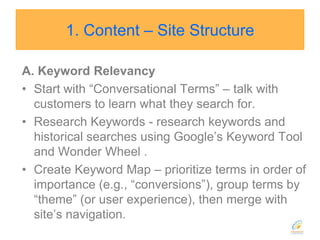
1. Content – Site StructureA. Keyword RelevancyStart with “Conversational Terms” – talk with customers to learn what they search for.
Research Keywords - research keywords and historical searches using Google’s Keyword Tool and Wonder Wheel .
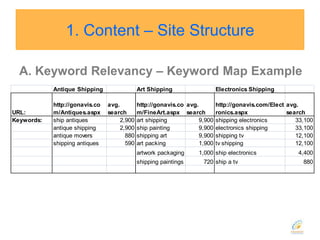
Create Keyword Map – prioritize terms in order of importance (e.g., “conversions”), group terms by “theme” (or user experience), then merge with site’s navigation.1. Content – Site StructureA. Keyword Relevancy – Keyword Map Example
1. Content – Site StructureB. Onpage SEO/Keyword OptimizationOrganize/Optimize page for target keyword(s)
Don’t try to rank homepage for multiple terms; target keyword-specific pages (the sub-pages)
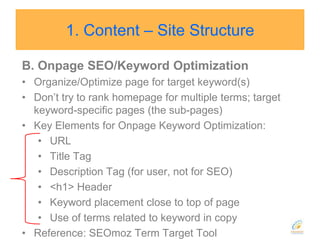
Key Elements for Onpage Keyword Optimization:
URL
Title Tag
Description Tag (for user, not for SEO)
<h1> Header
Keyword placement close to top of page
Use of terms related to keyword in copy
Reference: SEOmoz Term Target Tool1. Content – Site StructureC. PageRank and Navigation (Internal Linking)PageRank Primer
Google’s quantitative measure of a site’s “Authority”
PR’s influence has wavered over time; Cutts now “says” it’s important
Highly relevant and quality inbound links are primary determinant of PR; links help determine a site’s Authority.
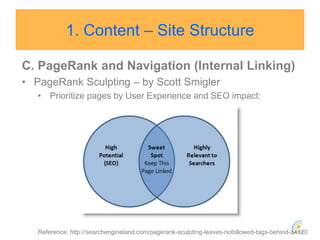
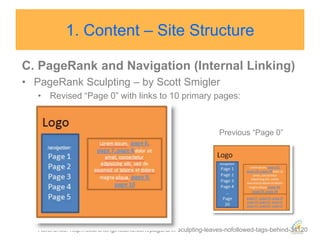
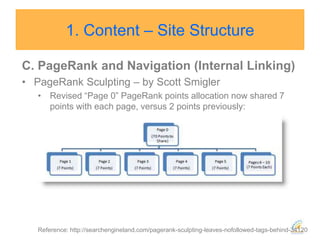
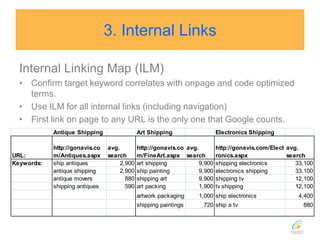
Site Goal: Maximize the flow of PR throughout site to important pages.1. Content – Site StructureC. PageRank and Navigation (Internal Linking)PageRank Sculpting – by Scott SmiglerPageRank sculpting is the application of rules regarding the quantity, prioritization and relevance of links on pages throughout a site to efficiently distribute PageRank. For example, suppose a page on my site has 100 PageRank “points” to pass on to the pages that it links to. I will want to be strategic about how those points are distributed rather than squander them indiscriminately.Reference: http://searchengineland.com/pagerank-sculpting-leaves-nofollowed-tags-behind-34120
1. Content – Site StructureC. PageRank and Navigation (Internal Linking)PageRank Sculpting – by Scott Smigler
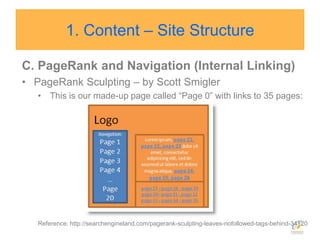
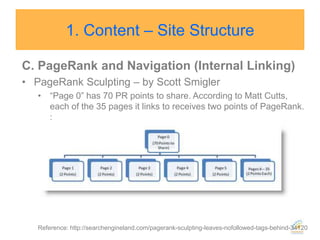
This is our made-up page called “Page 0” with links to 35 pages: Reference: http://searchengineland.com/pagerank-sculpting-leaves-nofollowed-tags-behind-34120
1. Content – Site StructureC. PageRank and Navigation (Internal Linking)PageRank Sculpting – by Scott Smigler
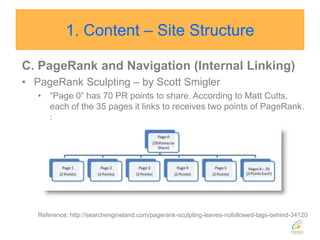
“Page 0” has 70 PR points to share. According to Matt Cutts, each of the 35 pages it links to receives two points of PageRank. : Reference: http://searchengineland.com/pagerank-sculpting-leaves-nofollowed-tags-behind-34120
1. Content – Site StructureC. PageRank and Navigation (Internal Linking)PageRank Sculpting – by Scott Smigler
“Page 0” has 70 PR points to share. According to Matt Cutts, each of the 35 pages it links to receives two points of PageRank. : Reference: http://searchengineland.com/pagerank-sculpting-leaves-nofollowed-tags-behind-34120
1. Content – Site StructureC. PageRank and Navigation (Internal Linking)Rel=nofollow
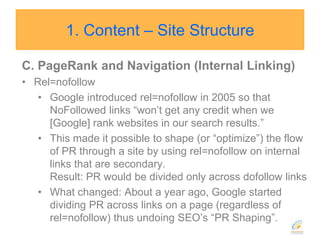
Google introduced rel=nofollow in 2005 so that NoFollowed links “won’t get any credit when we [Google] rank websites in our search results.”
This made it possible to shape (or “optimize”) the flow of PR through a site by using rel=nofollow on internal links that are secondary. Result: PR would be divided only across dofollow links
What changed: About a year ago, Google started dividing PR across links on a page (regardless of rel=nofollow) thus undoing SEO’s “PR Shaping”.1. Content – Site StructureC. PageRank and Navigation (Internal Linking)PageRank Sculpting – by Scott Smigler

Seo 2010

  • 1.
    Max Thomas max@thunderseo.com @ThunderMax (800) 819-6894SEO Sunday, January 24, 2010
  • 2.
  • 3.
    SEO – WhyRanking Matters?Ranking = TrafficRanking for Target Keywords = SalesRecent Site Example:
  • 4.
    SOM – StrategicOnline MarketingThink strategically.Search and Social Media are separate channels, but they do overlap.SEO is not Online Marketing – that’s short sighted.Look at your market – sometimes Search is better than social, sometimes email, etc.Be on lookout for new media, like Mobile.SEO = turtle (steady, slow, wins in the end)Social = hare (fast, fun, unpredictable)
  • 5.
    SEO & GoogleWhitevs Black Hat SEO“A lot of people think Google hates SEO and nothing could be further from the truth. SEO when done well and done in a white hat way, can make your site more crawlable, more accessible and help users find useful content on your site.”Matt CuttsSee State of the Index 2009 on GoogleWebmasterHelpYoutube.com
  • 6.
    Track – Track- Track“We can’t manage what we don’t measure.”Keyword Ranking ReportsSEO Stat’s (key indicators)Webmaster Tools, site performance, etc.Site Traffic (Analytics)Call Tracking (Dynamic Call Tracking)Conversions/Sales (Forms & Purchases)Frequency:Daily: Conversions & Call TrackingWeekly/Bi-Weekly: Keyword Ranking, Site TrafficMonthly: SEO Stat’s, Site Performance
  • 7.
    Max Thomas |max@thunderinternetmarketing.com | (800) 819-6894Track – Keyword Ranking ReportUse Proxy Servers Rotate to prevent Google from serving “personalized” search results, or identifying KW software.Example here fromwww.AdvancedWebRanking.com
  • 8.
    Track – SEOStat’sGI = Google Indexed ContentYI = Yahoo! Indexed ContentInb = Inbound LinksInt = Internal LinksPR = PageRankAlexa = Site Traffic ComparisonAge = Age Domain RegisteredmR = URL Rank (SEOmoz)mT = URL Trust (SEOmoz)DmR = Domain Rank (SEOmoz)DmT = Domain Trust (SEOmoz)
  • 9.
    Track – SitePerformanceWebmaster Tools – this is how Google “sees” your website. Very important to be aware of this.Reference Webmaster Tools for:Crawl Errors (404 errors)Crawl Stats (how frequently G bots crawl)Site Performance (see Resources regarding PageSpeed)http://code.google.com/speed/page-speed/ webpagetest.org
  • 10.
    Track – SiteTrafficUsing Analytics, consider (at minimum):Change in Visitors (month to month)Traffic SourcesOrganic Keywords
  • 11.
    Track – Conversion/CallTrackingConversions:Use Analytics for sales & “form submits”Call Tracking/Leads:Dynamic call tracking enables tracking by sourceSee VoiceStar example
  • 12.
  • 13.
    What Impacts RankingsSEO’sThree-Legged Stool:
  • 14.
    1. Content –Site StructureKeyword RelevancyOnpage Keyword Optimization (SEO Elements)PageRank and Navigation
  • 15.
    1. Content –Site StructureA. Keyword RelevancyStart with “Conversational Terms” – talk with customers to learn what they search for.
  • 16.
    Research Keywords -research keywords and historical searches using Google’s Keyword Tool and Wonder Wheel .
  • 17.
    Create Keyword Map– prioritize terms in order of importance (e.g., “conversions”), group terms by “theme” (or user experience), then merge with site’s navigation.1. Content – Site StructureA. Keyword Relevancy – Keyword Map Example
  • 18.
    1. Content –Site StructureB. Onpage SEO/Keyword OptimizationOrganize/Optimize page for target keyword(s)
  • 19.
    Don’t try torank homepage for multiple terms; target keyword-specific pages (the sub-pages)
  • 20.
    Key Elements forOnpage Keyword Optimization:
  • 21.
  • 22.
  • 23.
    Description Tag (foruser, not for SEO)
  • 24.
  • 25.
  • 26.
    Use of termsrelated to keyword in copy
  • 27.
    Reference: SEOmoz TermTarget Tool1. Content – Site StructureC. PageRank and Navigation (Internal Linking)PageRank Primer
  • 28.
    Google’s quantitative measureof a site’s “Authority”
  • 29.
    PR’s influence haswavered over time; Cutts now “says” it’s important
  • 30.
    Highly relevant andquality inbound links are primary determinant of PR; links help determine a site’s Authority.
  • 31.
    Site Goal: Maximizethe flow of PR throughout site to important pages.1. Content – Site StructureC. PageRank and Navigation (Internal Linking)PageRank Sculpting – by Scott SmiglerPageRank sculpting is the application of rules regarding the quantity, prioritization and relevance of links on pages throughout a site to efficiently distribute PageRank. For example, suppose a page on my site has 100 PageRank “points” to pass on to the pages that it links to. I will want to be strategic about how those points are distributed rather than squander them indiscriminately.Reference: http://searchengineland.com/pagerank-sculpting-leaves-nofollowed-tags-behind-34120
  • 32.
    1. Content –Site StructureC. PageRank and Navigation (Internal Linking)PageRank Sculpting – by Scott Smigler
  • 33.
    This is ourmade-up page called “Page 0” with links to 35 pages: Reference: http://searchengineland.com/pagerank-sculpting-leaves-nofollowed-tags-behind-34120
  • 34.
    1. Content –Site StructureC. PageRank and Navigation (Internal Linking)PageRank Sculpting – by Scott Smigler
  • 35.
    “Page 0” has70 PR points to share. According to Matt Cutts, each of the 35 pages it links to receives two points of PageRank. : Reference: http://searchengineland.com/pagerank-sculpting-leaves-nofollowed-tags-behind-34120
  • 36.
    1. Content –Site StructureC. PageRank and Navigation (Internal Linking)PageRank Sculpting – by Scott Smigler
  • 37.
    “Page 0” has70 PR points to share. According to Matt Cutts, each of the 35 pages it links to receives two points of PageRank. : Reference: http://searchengineland.com/pagerank-sculpting-leaves-nofollowed-tags-behind-34120
  • 38.
    1. Content –Site StructureC. PageRank and Navigation (Internal Linking)Rel=nofollow
  • 39.
    Google introduced rel=nofollowin 2005 so that NoFollowed links “won’t get any credit when we [Google] rank websites in our search results.”
  • 40.
    This made itpossible to shape (or “optimize”) the flow of PR through a site by using rel=nofollow on internal links that are secondary. Result: PR would be divided only across dofollow links
  • 41.
    What changed: Abouta year ago, Google started dividing PR across links on a page (regardless of rel=nofollow) thus undoing SEO’s “PR Shaping”.1. Content – Site StructureC. PageRank and Navigation (Internal Linking)PageRank Sculpting – by Scott Smigler