Search Engine Optimization
(SEO)
 Mark Branom
Continuing Studies CS 22
Agenda
 What is SEO?
 The Seven Steps to SEO
 GetYour Site Fully Indexed
 GetYour PagesVisible
 Build Links & PageRank
 LeverageYour PageRank
 Encourage Clickthrough
 Track the Right Metrics
 AvoidWorst Practices
Part 1: What Is SEO?
Search Engine Optimization
 6 times more effective than a banner ad
 Delivers qualified leads
 Most user sessions begin at the search
engines
 Most online purchases are made on sites
found through search engine listings
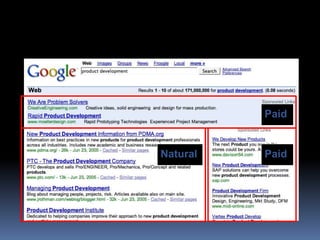
SEO is NOT Paid Advertising
 SEO – influence rankings in the “natural”
(a.k.a. “organic”, a.k.a. “algorithmic”) search
results
 PPC – paid search advertising on a pay-per-
click basis.The more you pay, the higher your
placement. Stop paying = stop receiving
traffic.
 SEM – encompasses both SEO and PPC
Natural
Paid
Paid
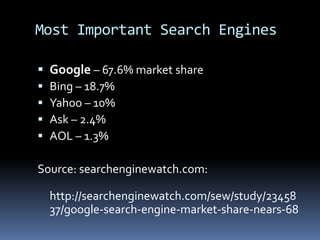
Most Important Search Engines
 Google – 67.6% market share
 Bing – 18.7%
 Yahoo – 10%
 Ask – 2.4%
 AOL – 1.3%
Source: searchenginewatch.com:
http://searchenginewatch.com/sew/study/23458
37/google-search-engine-market-share-nears-68
What Are Searchers Looking
For?
 Keyword Research
 “Target the wrong keywords and all your efforts
will be in vain.”
 The “right” keywords are…
 relevant to your business
 popular with searchers
Keyword Research
 Tools to check popularity of keyword
searches
 http://WordTracker.com
 http://KeywordDiscovery.com
 http://adwords.google.com/KeywordPlanner
 http://www.google.com/trends/
 http://ubersuggest.org/
SEO. A Moving Target.
 Lots is changing…
 Personalization & customization
 Vertical search services (Images,Video, News, Maps, etc.)
 “Universal Search”
 Fortunately, the tried-and-true tactics still work…
 Topically relevant links from important sites
 Anchor text
 Keyword-rich title tags
 Keyword-rich content
 Internal hierarchical linking structure
 The whole is greater than the sum of the parts
The Search Engines Are Your
Friend
 Sitemaps.org
 Webmaster tools (e.g. GoogleWebmaster, Bing
Webmaster)
 Rel=“nofollow” tag
Part 2: Seven Steps to SEO
Begin The 7 Steps
1) GetYour Site Fully Indexed
2) GetYour PagesVisible
3) Build Links & PageRank
4) LeverageYour PageRank
4) Encourage Clickthrough
6)Track the Right Metrics
7) Avoid Worst Practices
1) Get Your Site Fully
Indexed
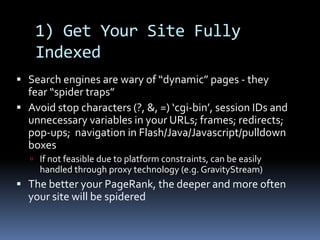
 Search engines are wary of “dynamic” pages - they
fear “spider traps”
 Avoid stop characters (?, &, =) ‘cgi-bin’, session IDs and
unnecessary variables in your URLs; frames; redirects;
pop-ups; navigation in Flash/Java/Javascript/pulldown
boxes
 If not feasible due to platform constraints, can be easily
handled through proxy technology (e.g. GravityStream)
 The better your PageRank, the deeper and more often
your site will be spidered
1) Get Your Site Fully Indexed
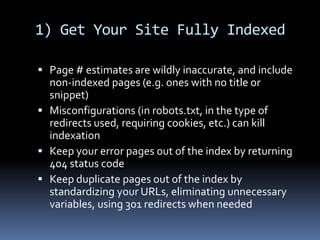
 Page # estimates are wildly inaccurate, and include
non-indexed pages (e.g. ones with no title or
snippet)
 Misconfigurations (in robots.txt, in the type of
redirects used, requiring cookies, etc.) can kill
indexation
 Keep your error pages out of the index by returning
404 status code
 Keep duplicate pages out of the index by
standardizing your URLs, eliminating unnecessary
variables, using 301 redirects when needed
Not Spider-Friendly
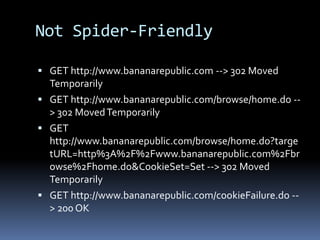
 GET http://www.bananarepublic.com --> 302 Moved
Temporarily
 GET http://www.bananarepublic.com/browse/home.do --
> 302 MovedTemporarily
 GET
http://www.bananarepublic.com/browse/home.do?targe
tURL=http%3A%2F%2Fwww.bananarepublic.com%2Fbr
owse%2Fhome.do&CookieSet=Set --> 302 Moved
Temporarily
 GET http://www.bananarepublic.com/cookieFailure.do --
> 200 OK
2) Get Your Pages Visible
 100+ “signals” that influence ranking
 “Title tag” is the most important copy on the page
 Home page is the most important page of a site
 Every page of your site has a “song” (keyword theme)
 Incorporate keywords into title tags, hyperlink text,
headings (H1 & H2 tags), alt tags, and high up in the page
(where they’re given more “weight”)
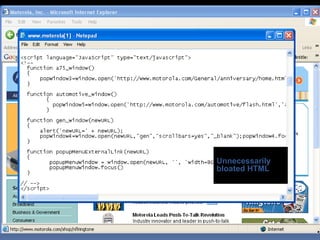
 Eliminate extraneous HTML code
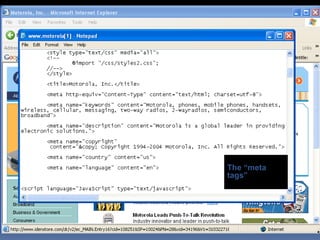
 “Meta tags” are not a magic bullet
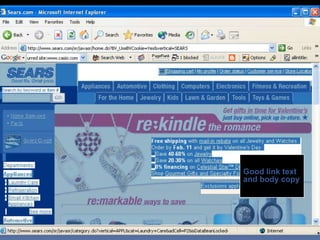
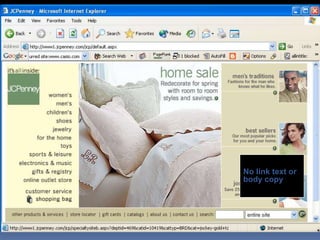
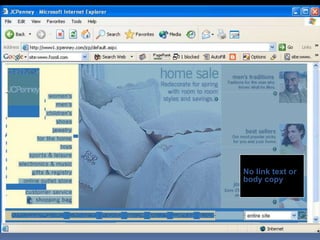
 Have text for navigation, not graphics
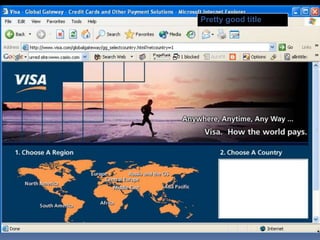
Pretty good title
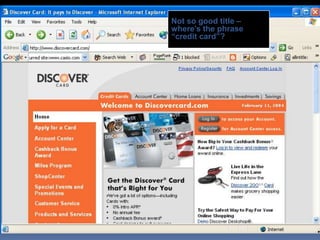
Not so good title –
where’s the phrase
“credit card”?
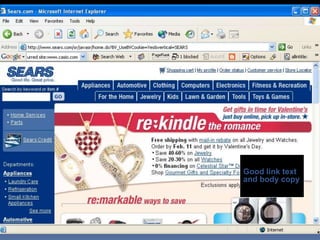
Good link text
and body copy
Good link text
and body copy
No link text or
body copy
No link text or
body copy
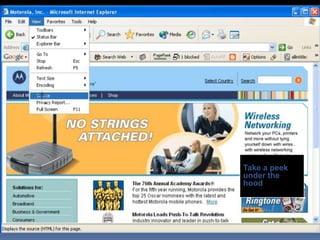
Take a peek
under the
hood
The “meta
tags”
Unnecessarily
bloated HTML
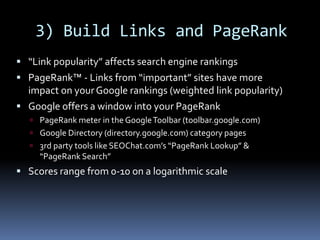
3) Build Links and PageRank
 “Link popularity” affects search engine rankings
 PageRank™ - Links from “important” sites have more
impact on yourGoogle rankings (weighted link popularity)
 Google offers a window into your PageRank
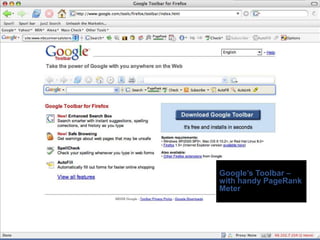
 PageRank meter in the GoogleToolbar (toolbar.google.com)
 Google Directory (directory.google.com) category pages
 3rd party tools like SEOChat.com’s “PageRank Lookup” &
“PageRank Search”
 Scores range from 0-10 on a logarithmic scale
Google’s Toolbar –
with handy PageRank
Meter
4) Leverage Your PageRank
 Your home page’s PageRank gets distributed
to your deep pages by virtue of your
hierarchical internal linking structure (e.g.
breadcrumb nav)
 Pay attention to the text used within the
hyperlink (“Google bombing”)
 Don’t hoard your PageRank
 Don’t link to “bad neighborhoods”
4) Leverage Your PageRank
 Avoid PageRank dilution
 Canonicalization (www.domain.com vs. domain.com)
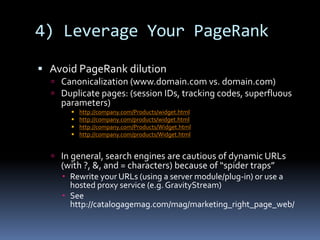
 Duplicate pages: (session IDs, tracking codes, superfluous
parameters)
 http://company.com/Products/widget.html
 http://company.com/products/widget.html
 http://company.com/Products/Widget.html
 http://company.com/products/Widget.html
 In general, search engines are cautious of dynamic URLs
(with ?, &, and = characters) because of “spider traps”
 Rewrite your URLs (using a server module/plug-in) or use a
hosted proxy service (e.g. GravityStream)
 See
http://catalogagemag.com/mag/marketing_right_page_web/
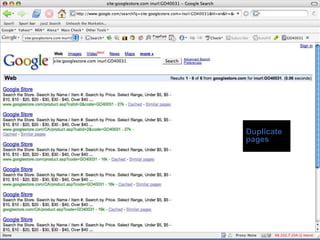
Duplicate
pages
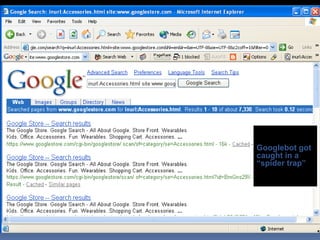
Googlebot got
caught in a
“spider trap”
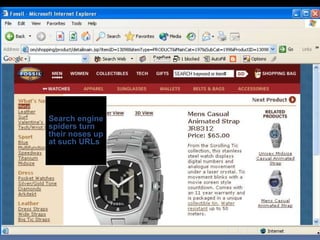
Search engine
spiders turn
their noses up
at such URLs
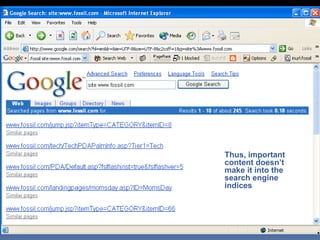
Thus, important
content doesn’t
make it into the
search engine
indices
5) Encourage Clickthrough
 Zipf’s Law applies - you need to be at the top of page 1 of
the search results. It’s an implied endorsement.
 Synergistic effect of being at the top of the natural
results & paid results
 Entice the user with a compelling call-to-action and value
proposition in your descriptions
 Your title tag is critical
 Snippet gets built automatically, but you CAN influence
what’s displayed here
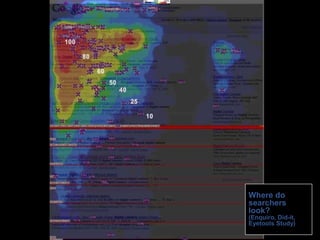
Where do
searchers
look?
(Enquiro, Did-it,
Eyetools Study)
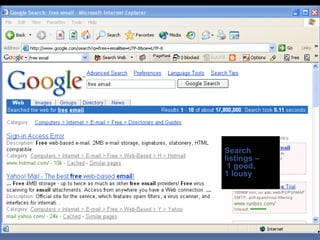
Search
listings –
1 good,
1 lousy
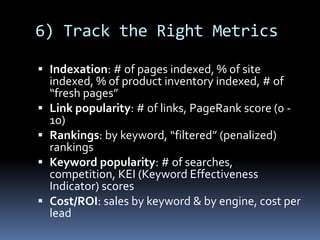
6) Track the Right Metrics
 Indexation: # of pages indexed, % of site
indexed, % of product inventory indexed, # of
“fresh pages”
 Link popularity: # of links, PageRank score (0 -
10)
 Rankings: by keyword, “filtered” (penalized)
rankings
 Keyword popularity: # of searches,
competition, KEI (Keyword Effectiveness
Indicator) scores
 Cost/ROI: sales by keyword & by engine, cost per
lead
Avoid Worst Practices
 Target relevant keywords
 Don’t stuff keywords or replicate pages
 Create deep, useful content
 Don't conceal, manipulate, or over-optimize
content
 Links should be relevant (no scheming!)
 Observe copyright/trademark law & Google’s
guidelines
Spamming in Its Many Forms…
 Hidden or small text
 Keyword stuffing
 Targeted to obviously irrelevant keywords
 Automated submitting, resubmitting, deep
submitting
 Competitor names in meta tags
 Duplicate pages with minimal or no changes
 Spamglish
 Machine generated content
Spamming in Its Many Forms…
 Pagejacking
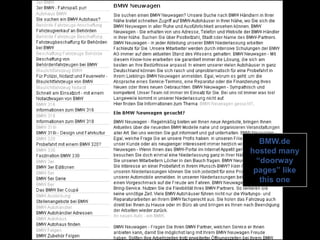
 Doorway pages
 Cloaking
 Submitting to FFA (“Free For All”) sites & link
farms
 Buying up expired domains with high
PageRanks
 Scraping
 Splogging (spam blogging)
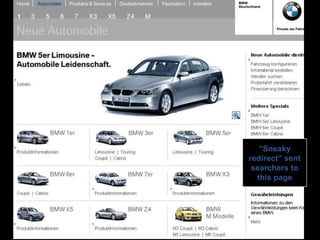
BMW.de
hosted many
“doorway
pages” like
this one
“Sneaky
redirect” sent
searchers to
this page
Not Spam, But Bad for
Rankings
 Splash pages, content-less home page, Flash
intros
 Title tags the same across the site
 Error pages in the search results (eg “Session
expired”)
 "Click here" links
 Superfluous text like “Welcome to” at beginning
of titles
 Spreading site across multiple domains (usually
for load balancing)
 Content too many levels deep
What Next? Conduct an SEO
Audit!
 Is your site fully indexed?
 Are your pages fully optimized?
 Could you be acquiring more PageRank?
 Are you spending your PageRank wisely?
 Are you maximizing your clickthrough rates?
 Are you measuring the right things?
 Are you applying “best practices” in SEO and
avoiding all the “worst practices”?
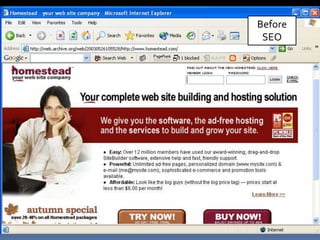
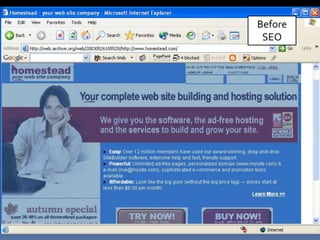
Before
SEO
Before
SEO
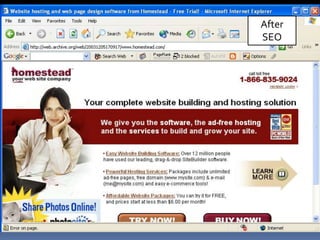
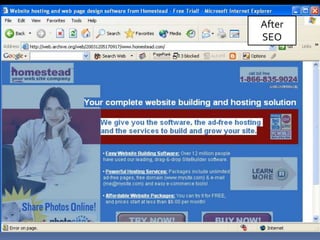
After
SEO
After
SEO
In Summary
 Focus on the right keywords
 Have great keyword-rich content
 Build links, and thus your PageRank™
 Spend that PageRank™ wisely within your
site
 Measure the right things
 Continually monitor and benchmark

seo (1).ppt

  • 1.
    Search Engine Optimization (SEO) Mark Branom Continuing Studies CS 22
  • 2.
    Agenda  What isSEO?  The Seven Steps to SEO  GetYour Site Fully Indexed  GetYour PagesVisible  Build Links & PageRank  LeverageYour PageRank  Encourage Clickthrough  Track the Right Metrics  AvoidWorst Practices
  • 3.
    Part 1: WhatIs SEO?
  • 4.
    Search Engine Optimization 6 times more effective than a banner ad  Delivers qualified leads  Most user sessions begin at the search engines  Most online purchases are made on sites found through search engine listings
  • 5.
    SEO is NOTPaid Advertising  SEO – influence rankings in the “natural” (a.k.a. “organic”, a.k.a. “algorithmic”) search results  PPC – paid search advertising on a pay-per- click basis.The more you pay, the higher your placement. Stop paying = stop receiving traffic.  SEM – encompasses both SEO and PPC
  • 6.
  • 7.
    Most Important SearchEngines  Google – 67.6% market share  Bing – 18.7%  Yahoo – 10%  Ask – 2.4%  AOL – 1.3% Source: searchenginewatch.com: http://searchenginewatch.com/sew/study/23458 37/google-search-engine-market-share-nears-68
  • 8.
    What Are SearchersLooking For?  Keyword Research  “Target the wrong keywords and all your efforts will be in vain.”  The “right” keywords are…  relevant to your business  popular with searchers
  • 9.
    Keyword Research  Toolsto check popularity of keyword searches  http://WordTracker.com  http://KeywordDiscovery.com  http://adwords.google.com/KeywordPlanner  http://www.google.com/trends/  http://ubersuggest.org/
  • 10.
    SEO. A MovingTarget.  Lots is changing…  Personalization & customization  Vertical search services (Images,Video, News, Maps, etc.)  “Universal Search”  Fortunately, the tried-and-true tactics still work…  Topically relevant links from important sites  Anchor text  Keyword-rich title tags  Keyword-rich content  Internal hierarchical linking structure  The whole is greater than the sum of the parts
  • 11.
    The Search EnginesAre Your Friend  Sitemaps.org  Webmaster tools (e.g. GoogleWebmaster, Bing Webmaster)  Rel=“nofollow” tag
  • 12.
    Part 2: SevenSteps to SEO
  • 13.
    Begin The 7Steps 1) GetYour Site Fully Indexed 2) GetYour PagesVisible 3) Build Links & PageRank 4) LeverageYour PageRank 4) Encourage Clickthrough 6)Track the Right Metrics 7) Avoid Worst Practices
  • 14.
    1) Get YourSite Fully Indexed  Search engines are wary of “dynamic” pages - they fear “spider traps”  Avoid stop characters (?, &, =) ‘cgi-bin’, session IDs and unnecessary variables in your URLs; frames; redirects; pop-ups; navigation in Flash/Java/Javascript/pulldown boxes  If not feasible due to platform constraints, can be easily handled through proxy technology (e.g. GravityStream)  The better your PageRank, the deeper and more often your site will be spidered
  • 15.
    1) Get YourSite Fully Indexed  Page # estimates are wildly inaccurate, and include non-indexed pages (e.g. ones with no title or snippet)  Misconfigurations (in robots.txt, in the type of redirects used, requiring cookies, etc.) can kill indexation  Keep your error pages out of the index by returning 404 status code  Keep duplicate pages out of the index by standardizing your URLs, eliminating unnecessary variables, using 301 redirects when needed
  • 16.
    Not Spider-Friendly  GEThttp://www.bananarepublic.com --> 302 Moved Temporarily  GET http://www.bananarepublic.com/browse/home.do -- > 302 MovedTemporarily  GET http://www.bananarepublic.com/browse/home.do?targe tURL=http%3A%2F%2Fwww.bananarepublic.com%2Fbr owse%2Fhome.do&CookieSet=Set --> 302 Moved Temporarily  GET http://www.bananarepublic.com/cookieFailure.do -- > 200 OK
  • 17.
    2) Get YourPages Visible  100+ “signals” that influence ranking  “Title tag” is the most important copy on the page  Home page is the most important page of a site  Every page of your site has a “song” (keyword theme)  Incorporate keywords into title tags, hyperlink text, headings (H1 & H2 tags), alt tags, and high up in the page (where they’re given more “weight”)  Eliminate extraneous HTML code  “Meta tags” are not a magic bullet  Have text for navigation, not graphics
  • 18.
  • 19.
    Not so goodtitle – where’s the phrase “credit card”?
  • 20.
  • 21.
  • 22.
    No link textor body copy
  • 23.
    No link textor body copy
  • 24.
  • 25.
  • 26.
  • 27.
    3) Build Linksand PageRank  “Link popularity” affects search engine rankings  PageRank™ - Links from “important” sites have more impact on yourGoogle rankings (weighted link popularity)  Google offers a window into your PageRank  PageRank meter in the GoogleToolbar (toolbar.google.com)  Google Directory (directory.google.com) category pages  3rd party tools like SEOChat.com’s “PageRank Lookup” & “PageRank Search”  Scores range from 0-10 on a logarithmic scale
  • 28.
    Google’s Toolbar – withhandy PageRank Meter
  • 29.
    4) Leverage YourPageRank  Your home page’s PageRank gets distributed to your deep pages by virtue of your hierarchical internal linking structure (e.g. breadcrumb nav)  Pay attention to the text used within the hyperlink (“Google bombing”)  Don’t hoard your PageRank  Don’t link to “bad neighborhoods”
  • 30.
    4) Leverage YourPageRank  Avoid PageRank dilution  Canonicalization (www.domain.com vs. domain.com)  Duplicate pages: (session IDs, tracking codes, superfluous parameters)  http://company.com/Products/widget.html  http://company.com/products/widget.html  http://company.com/Products/Widget.html  http://company.com/products/Widget.html  In general, search engines are cautious of dynamic URLs (with ?, &, and = characters) because of “spider traps”  Rewrite your URLs (using a server module/plug-in) or use a hosted proxy service (e.g. GravityStream)  See http://catalogagemag.com/mag/marketing_right_page_web/
  • 31.
  • 32.
    Googlebot got caught ina “spider trap”
  • 33.
    Search engine spiders turn theirnoses up at such URLs
  • 34.
    Thus, important content doesn’t makeit into the search engine indices
  • 35.
    5) Encourage Clickthrough Zipf’s Law applies - you need to be at the top of page 1 of the search results. It’s an implied endorsement.  Synergistic effect of being at the top of the natural results & paid results  Entice the user with a compelling call-to-action and value proposition in your descriptions  Your title tag is critical  Snippet gets built automatically, but you CAN influence what’s displayed here
  • 36.
  • 37.
  • 38.
    6) Track theRight Metrics  Indexation: # of pages indexed, % of site indexed, % of product inventory indexed, # of “fresh pages”  Link popularity: # of links, PageRank score (0 - 10)  Rankings: by keyword, “filtered” (penalized) rankings  Keyword popularity: # of searches, competition, KEI (Keyword Effectiveness Indicator) scores  Cost/ROI: sales by keyword & by engine, cost per lead
  • 39.
    Avoid Worst Practices Target relevant keywords  Don’t stuff keywords or replicate pages  Create deep, useful content  Don't conceal, manipulate, or over-optimize content  Links should be relevant (no scheming!)  Observe copyright/trademark law & Google’s guidelines
  • 40.
    Spamming in ItsMany Forms…  Hidden or small text  Keyword stuffing  Targeted to obviously irrelevant keywords  Automated submitting, resubmitting, deep submitting  Competitor names in meta tags  Duplicate pages with minimal or no changes  Spamglish  Machine generated content
  • 41.
    Spamming in ItsMany Forms…  Pagejacking  Doorway pages  Cloaking  Submitting to FFA (“Free For All”) sites & link farms  Buying up expired domains with high PageRanks  Scraping  Splogging (spam blogging)
  • 42.
  • 43.
  • 44.
    Not Spam, ButBad for Rankings  Splash pages, content-less home page, Flash intros  Title tags the same across the site  Error pages in the search results (eg “Session expired”)  "Click here" links  Superfluous text like “Welcome to” at beginning of titles  Spreading site across multiple domains (usually for load balancing)  Content too many levels deep
  • 45.
    What Next? Conductan SEO Audit!  Is your site fully indexed?  Are your pages fully optimized?  Could you be acquiring more PageRank?  Are you spending your PageRank wisely?  Are you maximizing your clickthrough rates?  Are you measuring the right things?  Are you applying “best practices” in SEO and avoiding all the “worst practices”?
  • 46.
  • 47.
  • 48.
  • 49.
  • 50.
    In Summary  Focuson the right keywords  Have great keyword-rich content  Build links, and thus your PageRank™  Spend that PageRank™ wisely within your site  Measure the right things  Continually monitor and benchmark