Search Engine Optimization 101
BrightEdge Marketing
What is SEO?
How does SEO work?
How to succeed in SEO
Takeaways
01
02
03
04
AGENDA
WHAT IS SEO
WHAT IS SEO?
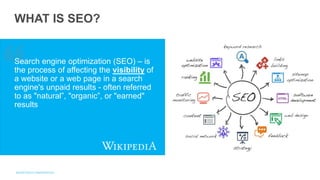
Search engine optimization (SEO) – is
the process of affecting the visibility of
a website or a web page in a search
engine's unpaid results - often referred
to as "natural”, "organic”, or "earned"
results
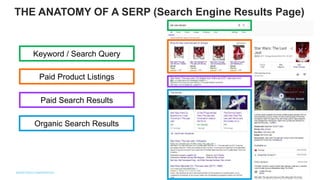
THE ANATOMY OF A SERP (Search Engine Results Page)
Keyword / Search Query
Paid Product Listings
Paid Search Results
Organic Search Results
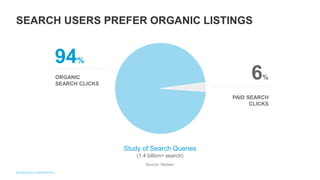
SEARCH USERS PREFER ORGANIC LISTINGS
Study of Search Queries
(1.4 billion+ search)
Source: Nielsen
PAID SEARCH
CLICKS
6%ORGANIC
SEARCH CLICKS
94%
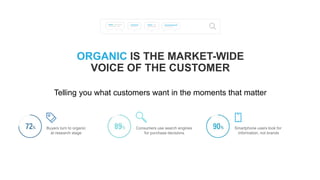
ORGANIC IS THE MARKET-WIDE
VOICE OF THE CUSTOMER
Buyers turn to organic
at research stage
Consumers use search engines
for purchase decisions
Smartphone users look for
information, not brands
Telling you what customers want in the moments that matter
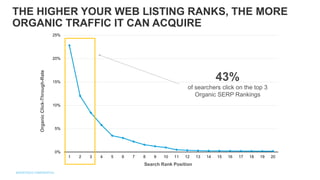
THE HIGHER YOUR WEB LISTING RANKS, THE MORE
ORGANIC TRAFFIC IT CAN ACQUIRE
0%
5%
10%
15%
20%
25%
1 2 3 4 5 6 7 8 9 10 11 12 13 14 15 16 17 18 19 20
43%
of searchers click on the top 3
Organic SERP Rankings
Search Rank Position
OrganicClick-Through-Rate
HOW DOES SEO WORK?
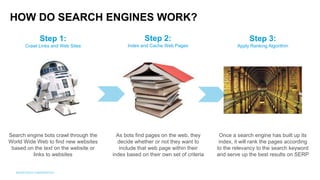
HOW DO SEARCH ENGINES WORK?
Step 1:
Crawl Links and Web Sites
Step 2:
Index and Cache Web Pages
Step 3:
Apply Ranking Algorithm
Search engine bots crawl through the
World Wide Web to find new websites
based on the text on the website or
links to websites
As bots find pages on the web, they
decide whether or not they want to
include that web page within their
index based on their own set of criteria
Once a search engine has built up its
index, it will rank the pages according
to the relevancy to the search keyword
and serve up the best results on SERP
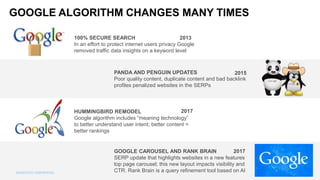
GOOGLE ALGORITHM CHANGES MANY TIMES
PANDA AND PENGUIN UPDATES
Poor quality content, duplicate content and bad backlink
profiles penalized websites in the SERPs
HUMMINGBIRD REMODEL
Google algorithm includes “meaning technology”
to better understand user intent; better content =
better rankings
GOOGLE CAROUSEL AND RANK BRAIN
SERP update that highlights websites in a new features
top page carousel; this new layout impacts visibility and
CTR. Rank Brain is a query refinement tool based on AI
100% SECURE SEARCH
In an effort to protect internet users privacy Google
removed traffic data insights on a keyword level
2013
2015
2017
2017
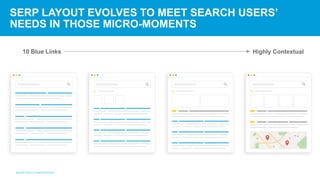
10 Blue Links Highly Contextual
SERP LAYOUT EVOLVES TO MEET SEARCH USERS’
NEEDS IN THOSE MICRO-MOMENTS
HOW TO SUCCEED IN SEO
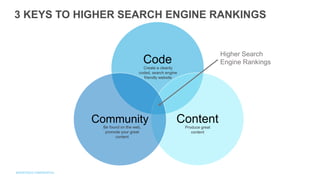
3 KEYS TO HIGHER SEARCH ENGINE RANKINGS
Code
ContentCommunity
Higher Search
Engine Rankings
Be found on the web,
promote your great
content
Produce great
content
Create a cleanly
coded, search engine
friendly website
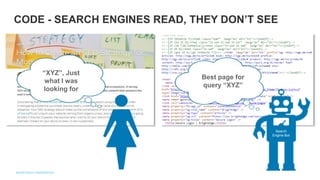
CODE - SEARCH ENGINES READ, THEY DON’T SEE
Best page for
query “XYZ”
“XYZ”, Just
what I was
looking for
Search
Engine Bot
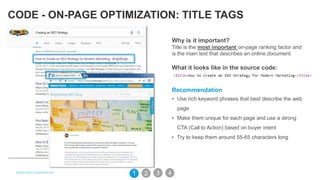
CODE - ON-PAGE OPTIMIZATION: TITLE TAGS
Why is it important?
Title is the most important on-page ranking factor and
is the main text that describes an online document.
What it looks like in the source code:
Recommendation
• Use rich keyword phrases that best describe the web
page
• Make them unique for each page and use a strong
CTA (Call to Action) based on buyer intent
• Try to keep them around 55-65 characters long
31 2 4
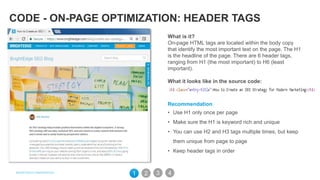
CODE - ON-PAGE OPTIMIZATION: HEADER TAGS
What is it?
On-page HTML tags are located within the body copy
that identify the most important text on the page. The H1
is the headline of the page. There are 6 header tags,
ranging from H1 (the most important) to H6 (least
important).
What it looks like in the source code:
Recommendation
• Use H1 only once per page
• Make sure the H1 is keyword rich and unique
• You can use H2 and H3 tags multiple times, but keep
them unique from page to page
• Keep header tags in order
31 2 4
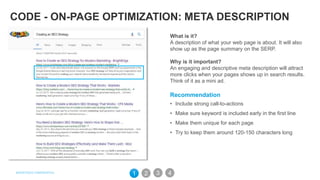
CODE - ON-PAGE OPTIMIZATION: META DESCRIPTION
What is it?
A description of what your web page is about. It will also
show up as the page summary on the SERP.
Why is it important?
An engaging and descriptive meta description will attract
more clicks when your pages shows up in search results.
Think of it as a mini ad.
Recommendation
• Include strong call-to-actions
• Make sure keyword is included early in the first line
• Make them unique for each page
• Try to keep them around 120-150 characters long
31 2 4
CONTENT - CREATING ENGAGING CONTENT
1. Prioritize profitable topics – Identify the 1-3
keywords or keyword phrases that relate to your
topic
2. Tune content to your audience – Balance
informative content for the human reader with
keyword placement
3. Keep readers clicking – Ensure you have
interlinking from your content to other related topics
within your site
4. Keep published content optimized – Track content
performance and optimize accordingly
32 41
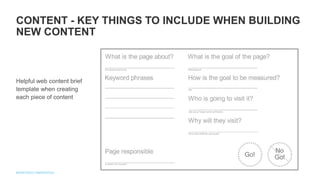
Helpful web content brief
template when creating
each piece of content
CONTENT - KEY THINGS TO INCLUDE WHEN BUILDING
NEW CONTENT
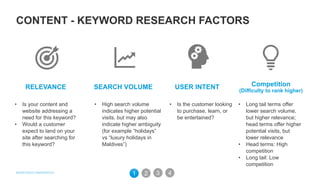
SEARCH VOLUME USER INTENTRELEVANCE
• Is your content and
website addressing a
need for this keyword?
• Would a customer
expect to land on your
site after searching for
this keyword?
• High search volume
indicates higher potential
visits, but may also
indicate higher ambiguity
(for example “holidays”
vs “luxury holidays in
Maldives”)
• Is the customer looking
to purchase, learn, or
be entertained?
Competition
(Difficulty to rank higher)
• Long tail terms offer
lower search volume,
but higher relevance;
head terms offer higher
potential visits, but
lower relevance
• Head terms: High
competition
• Long tail: Low
competition
31 2 4
CONTENT - KEYWORD RESEARCH FACTORS
CONTENT - INTERNAL LINKS
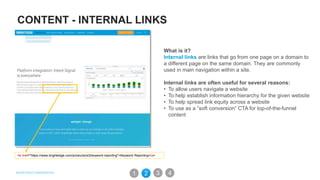
What is it?
Internal links are links that go from one page on a domain to
a different page on the same domain. They are commonly
used in main navigation within a site.
Internal links are often useful for several reasons:
• To allow users navigate a website
• To help establish information hierarchy for the given website
• To help spread link equity across a website
• To use as a ”soft conversion” CTA for top-of-the-funnel
content
<a href="https://www.brightedge.com/products/s3/keyword-reporting">Keyword Reporting</a>
31 2 4
CONTENT - ANCHOR TEXT
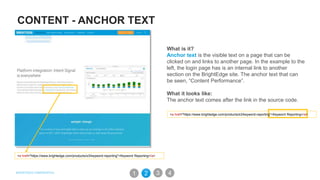
What is it?
Anchor text is the visible text on a page that can be
clicked on and links to another page. In the example to the
left, the login page has is an internal link to another
section on the BrightEdge site. The anchor text that can
be seen, “Content Performance”.
What it looks like:
The anchor text comes after the link in the source code.
<a href="https://www.brightedge.com/products/s3/keyword-reporting">Keyword Reporting</a>
31 2 4
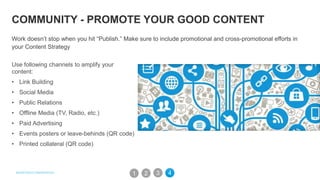
Use following channels to amplify your
content:
• Link Building
• Social Media
• Public Relations
• Offline Media (TV, Radio, etc.)
• Paid Advertising
• Events posters or leave-behinds (QR code)
• Printed collateral (QR code)
Work doesn’t stop when you hit “Publish.” Make sure to include promotional and cross-promotional efforts in
your Content Strategy
COMMUNITY - PROMOTE YOUR GOOD CONTENT
31 2 4
COMMUNITY - WHAT IS LINK BUILDING?
Why is this important?
Link building is an important area of SEO, as it influences a site’s
domain authority. Higher domain authority correlates to higher ranking.
Higher volumes of high quality backlinks leads to higher domain
authority.
Recommendation
Focus on a natural, well-diversified, relevancy-based link building
strategy to strengthen your profile.
Tactics should primarily be focused around acquiring links from high-
quality domains - for example, a domain with a homepage that has a
PageRank of 3+, or a domain with a Majestic Trust Flow of 20+.
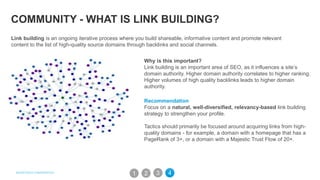
Link building is an ongoing iterative process where you build shareable, informative content and promote relevant
content to the list of high-quality source domains through backlinks and social channels.
31 2 4
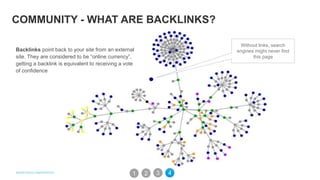
Backlinks point back to your site from an external
site. They are considered to be “online currency”,
getting a backlink is equivalent to receiving a vote
of confidence
COMMUNITY - WHAT ARE BACKLINKS?
Without links, search
engines might never find
this page
31 2 4
COMMUNITY - GOOD BACKLINKS VS. BAD BACKLINKS
Your link is good if it is:
1. EDITORIALLY PLACED: It is earned or
volunteered freely from the linking source’s
author/editor
2. CONTEXTUAL: It is contextually relevant to
the page in which it is found, and naturally
included therein
3. NATURAL: It uses relevant, descriptive, and
(where appropriate) branded anchor text to
describe the content of the link’s target
Your link may be bad if the source:
1. IS A LOW-QUALITY DOMAIN: TrustFlow < 20,
PageRank < 3
2. HOSTS LOW-QUALITY CONTENT: Page or
domain with frequent misspellings and bad
grammar, duplicate, thin or machine-generated
content
3. IS PART OF A LOW-QUALITY NETWORK:
Low-quality (content or equity) IP or subdomain
group
31 2 4
1. Focus on a manageable number of pages
2. Ensure you’re building the right type of content for the SERP
3. Link your content to relevant pages with keyword rich anchor text
4. Promote pages on social media and with other teams
TAKEAWAYS

Seo basics

  • 1.
    Search Engine Optimization101 BrightEdge Marketing
  • 2.
    What is SEO? Howdoes SEO work? How to succeed in SEO Takeaways 01 02 03 04 AGENDA
  • 3.
  • 4.
    WHAT IS SEO? Searchengine optimization (SEO) – is the process of affecting the visibility of a website or a web page in a search engine's unpaid results - often referred to as "natural”, "organic”, or "earned" results
  • 5.
    THE ANATOMY OFA SERP (Search Engine Results Page) Keyword / Search Query Paid Product Listings Paid Search Results Organic Search Results
  • 6.
    SEARCH USERS PREFERORGANIC LISTINGS Study of Search Queries (1.4 billion+ search) Source: Nielsen PAID SEARCH CLICKS 6%ORGANIC SEARCH CLICKS 94%
  • 7.
    ORGANIC IS THEMARKET-WIDE VOICE OF THE CUSTOMER Buyers turn to organic at research stage Consumers use search engines for purchase decisions Smartphone users look for information, not brands Telling you what customers want in the moments that matter
  • 8.
    THE HIGHER YOURWEB LISTING RANKS, THE MORE ORGANIC TRAFFIC IT CAN ACQUIRE 0% 5% 10% 15% 20% 25% 1 2 3 4 5 6 7 8 9 10 11 12 13 14 15 16 17 18 19 20 43% of searchers click on the top 3 Organic SERP Rankings Search Rank Position OrganicClick-Through-Rate
  • 9.
  • 10.
    HOW DO SEARCHENGINES WORK? Step 1: Crawl Links and Web Sites Step 2: Index and Cache Web Pages Step 3: Apply Ranking Algorithm Search engine bots crawl through the World Wide Web to find new websites based on the text on the website or links to websites As bots find pages on the web, they decide whether or not they want to include that web page within their index based on their own set of criteria Once a search engine has built up its index, it will rank the pages according to the relevancy to the search keyword and serve up the best results on SERP
  • 11.
    GOOGLE ALGORITHM CHANGESMANY TIMES PANDA AND PENGUIN UPDATES Poor quality content, duplicate content and bad backlink profiles penalized websites in the SERPs HUMMINGBIRD REMODEL Google algorithm includes “meaning technology” to better understand user intent; better content = better rankings GOOGLE CAROUSEL AND RANK BRAIN SERP update that highlights websites in a new features top page carousel; this new layout impacts visibility and CTR. Rank Brain is a query refinement tool based on AI 100% SECURE SEARCH In an effort to protect internet users privacy Google removed traffic data insights on a keyword level 2013 2015 2017 2017
  • 12.
    10 Blue LinksHighly Contextual SERP LAYOUT EVOLVES TO MEET SEARCH USERS’ NEEDS IN THOSE MICRO-MOMENTS
  • 13.
  • 14.
    3 KEYS TOHIGHER SEARCH ENGINE RANKINGS Code ContentCommunity Higher Search Engine Rankings Be found on the web, promote your great content Produce great content Create a cleanly coded, search engine friendly website
  • 15.
    CODE - SEARCHENGINES READ, THEY DON’T SEE Best page for query “XYZ” “XYZ”, Just what I was looking for Search Engine Bot
  • 16.
    CODE - ON-PAGEOPTIMIZATION: TITLE TAGS Why is it important? Title is the most important on-page ranking factor and is the main text that describes an online document. What it looks like in the source code: Recommendation • Use rich keyword phrases that best describe the web page • Make them unique for each page and use a strong CTA (Call to Action) based on buyer intent • Try to keep them around 55-65 characters long 31 2 4
  • 17.
    CODE - ON-PAGEOPTIMIZATION: HEADER TAGS What is it? On-page HTML tags are located within the body copy that identify the most important text on the page. The H1 is the headline of the page. There are 6 header tags, ranging from H1 (the most important) to H6 (least important). What it looks like in the source code: Recommendation • Use H1 only once per page • Make sure the H1 is keyword rich and unique • You can use H2 and H3 tags multiple times, but keep them unique from page to page • Keep header tags in order 31 2 4
  • 18.
    CODE - ON-PAGEOPTIMIZATION: META DESCRIPTION What is it? A description of what your web page is about. It will also show up as the page summary on the SERP. Why is it important? An engaging and descriptive meta description will attract more clicks when your pages shows up in search results. Think of it as a mini ad. Recommendation • Include strong call-to-actions • Make sure keyword is included early in the first line • Make them unique for each page • Try to keep them around 120-150 characters long 31 2 4
  • 19.
    CONTENT - CREATINGENGAGING CONTENT 1. Prioritize profitable topics – Identify the 1-3 keywords or keyword phrases that relate to your topic 2. Tune content to your audience – Balance informative content for the human reader with keyword placement 3. Keep readers clicking – Ensure you have interlinking from your content to other related topics within your site 4. Keep published content optimized – Track content performance and optimize accordingly 32 41
  • 20.
    Helpful web contentbrief template when creating each piece of content CONTENT - KEY THINGS TO INCLUDE WHEN BUILDING NEW CONTENT
  • 21.
    SEARCH VOLUME USERINTENTRELEVANCE • Is your content and website addressing a need for this keyword? • Would a customer expect to land on your site after searching for this keyword? • High search volume indicates higher potential visits, but may also indicate higher ambiguity (for example “holidays” vs “luxury holidays in Maldives”) • Is the customer looking to purchase, learn, or be entertained? Competition (Difficulty to rank higher) • Long tail terms offer lower search volume, but higher relevance; head terms offer higher potential visits, but lower relevance • Head terms: High competition • Long tail: Low competition 31 2 4 CONTENT - KEYWORD RESEARCH FACTORS
  • 22.
    CONTENT - INTERNALLINKS What is it? Internal links are links that go from one page on a domain to a different page on the same domain. They are commonly used in main navigation within a site. Internal links are often useful for several reasons: • To allow users navigate a website • To help establish information hierarchy for the given website • To help spread link equity across a website • To use as a ”soft conversion” CTA for top-of-the-funnel content <a href="https://www.brightedge.com/products/s3/keyword-reporting">Keyword Reporting</a> 31 2 4
  • 23.
    CONTENT - ANCHORTEXT What is it? Anchor text is the visible text on a page that can be clicked on and links to another page. In the example to the left, the login page has is an internal link to another section on the BrightEdge site. The anchor text that can be seen, “Content Performance”. What it looks like: The anchor text comes after the link in the source code. <a href="https://www.brightedge.com/products/s3/keyword-reporting">Keyword Reporting</a> <a href="https://www.brightedge.com/products/s3/keyword-reporting">Keyword Reporting</a> 31 2 4
  • 24.
    Use following channelsto amplify your content: • Link Building • Social Media • Public Relations • Offline Media (TV, Radio, etc.) • Paid Advertising • Events posters or leave-behinds (QR code) • Printed collateral (QR code) Work doesn’t stop when you hit “Publish.” Make sure to include promotional and cross-promotional efforts in your Content Strategy COMMUNITY - PROMOTE YOUR GOOD CONTENT 31 2 4
  • 25.
    COMMUNITY - WHATIS LINK BUILDING? Why is this important? Link building is an important area of SEO, as it influences a site’s domain authority. Higher domain authority correlates to higher ranking. Higher volumes of high quality backlinks leads to higher domain authority. Recommendation Focus on a natural, well-diversified, relevancy-based link building strategy to strengthen your profile. Tactics should primarily be focused around acquiring links from high- quality domains - for example, a domain with a homepage that has a PageRank of 3+, or a domain with a Majestic Trust Flow of 20+. Link building is an ongoing iterative process where you build shareable, informative content and promote relevant content to the list of high-quality source domains through backlinks and social channels. 31 2 4
  • 26.
    Backlinks point backto your site from an external site. They are considered to be “online currency”, getting a backlink is equivalent to receiving a vote of confidence COMMUNITY - WHAT ARE BACKLINKS? Without links, search engines might never find this page 31 2 4
  • 27.
    COMMUNITY - GOODBACKLINKS VS. BAD BACKLINKS Your link is good if it is: 1. EDITORIALLY PLACED: It is earned or volunteered freely from the linking source’s author/editor 2. CONTEXTUAL: It is contextually relevant to the page in which it is found, and naturally included therein 3. NATURAL: It uses relevant, descriptive, and (where appropriate) branded anchor text to describe the content of the link’s target Your link may be bad if the source: 1. IS A LOW-QUALITY DOMAIN: TrustFlow < 20, PageRank < 3 2. HOSTS LOW-QUALITY CONTENT: Page or domain with frequent misspellings and bad grammar, duplicate, thin or machine-generated content 3. IS PART OF A LOW-QUALITY NETWORK: Low-quality (content or equity) IP or subdomain group 31 2 4
  • 28.
    1. Focus ona manageable number of pages 2. Ensure you’re building the right type of content for the SERP 3. Link your content to relevant pages with keyword rich anchor text 4. Promote pages on social media and with other teams TAKEAWAYS

Editor's Notes

  • #2 Add company logo who you are presenting to
  • #7 *Organic search as a marketing channel. (compared to all online channels – social, ppc, email, display, etc) *3 Billion searches p/day on Google. *Over 90% click on organic vs paid. SUMMARY: if you want your website to show up in the largest online channel where 90% of your target audience is starting their search, you have to show up on Google.
  • #9 If you aren’t in the first 3 you are last. Rank well for smaller group than rank ok for a lot. Organic Search Click-Through Rate is the percent of clicks your page receives based on how many times any URL from your site appears in the search results.
  • #13 Google changes its search algorithm approximately 500–600 times per year, most are minor Google occasionally rolls out a "major" algorithmic update that affects search results in significant ways [Google announced earlier this year that will no longer publicly announce any of its algorithm changes as it did with Hummingbird, Penguin, etc. – MA] Universal search results regularly appear in the SERP including Images, Quick Answers and News Competitors in search are often different than brick and mortar
  • #15 The SEO Venn diagram is the trifecta that encapsulates success in SEO terms. The more a website is able to excel in all 3, the more successful it will be in SEO and make it to the top of the search engines’ rankings: Clean Structure – having clean, search-engine friendly code is the basic foundation of helping bots crawl, index and rank your site. Producing Great Content – SEO is constantly changing and in order to remain at the top of the SERP, a website should not only produce great content, but always have a content strategy in the pipeline and new articles published on a regular cadence. Alongside having great content is the fact that on the web, authority is king and unless searchers see your content, like your content, and ultimately link to your content, then you will not win in the SEO game. Once you have great content, it’s important to build up that authority on your site and promote your content to make sure that the web knows about it and the search engine recognizes it as an authoritative site. Without all 3, you cannot be successful in SEO. Throughout our training, we’ll continue to refer back to this slide as every aspect of SEO is related to building and improving one of these 3 areas.
  • #25 Create unique URL of your good content with unique UTM source code to track each source of traffic, and create unique QR code for each offline medium: TV ads, Outdoor poster, printed leave-behinds, etc.
  • #27 Called the web for a reason